University of South Florida
Scholar Commons
Graduate Theses and Dissertations Graduate School
November 2017
Learning to Predict Clinical Outcomes from Soft
Tissue Sarcoma MRI
Hamidreza Farhidzadeh
University of South Florida, [email protected]
Follow this and additional works at:https://scholarcommons.usf.edu/etd Part of theComputer Engineering Commons
This Dissertation is brought to you for free and open access by the Graduate School at Scholar Commons. It has been accepted for inclusion in Graduate Theses and Dissertations by an authorized administrator of Scholar Commons. For more information, please contact
Scholar Commons Citation
Farhidzadeh, Hamidreza, "Learning to Predict Clinical Outcomes from Soft Tissue Sarcoma MRI" (2017).Graduate Theses and Dissertations.
Learning to Predict Clinical Outcomes from Soft Tissue Sarcoma MRI
by
Hamidreza Farhidzadeh
A dissertation submitted in partial fulfillment of the requirements for the degree of
Doctor of Philosophy
Department of Computer Science and Engineering College of Engineering
University of South Florida
Co-Major Professor: Dmitry Goldgof, Ph.D. Co-Major Professor: Lawrence Hall, Ph.D.
Rangachar Kasturi, Ph.D. Richard Gitlin, Sc.D.
Jacob Scott, M.D.
Date of Approval: November 6, 2017
Keywords: Image Processing, Tumor Heterogeneity, Radiomics, Deep Learning, Ensemble Bag of Visual Words
DEDICATION
I would like to dedicate this study and dissertation to my lovely family. My father and my
mother who support me in all aspects, continuously and steadily. Also, I want to dedicate
my dissertation to my lifelong friend, my brother, who without him, I couldn’t stand in this
ACKNOWLEDGMENTS
I would like to appreciate Dr. Dmirty Goldgof and Dr. Lawrance Hall because of their
constant support over last five years. I am thrilled to be guided by knowledgeable and
exceptional supervisors. With fruitful and insightful discussions, they directed me to boost
my study during my PhD. program.
I would like to address my sincere to our supporting group in Moffitt Cancer Center,
Dr. Meera Raghavan, Dr. Robert Gatenby and Dr. Robert Gillies. The foundation of
this research is established on the Soft Tissue Sarcomas data which are collected with this
team. Special thanks to Meera who devoted a lot of time to explain and clarify the basics of
biological background of this project while I was pretty new in this field. Likewise, I would
like to thanks Dr. Gateby and Dr. Gillies for suggestions and directions every time needed.
Furthermore, I want to express my appreciation to Dr. Scott and Dr. Joo Kim for their
support in sarcoma project as well as study on nasopharyngeal carcinoma tumors.
Finally, I want to thank my committee members for their valuable suggestions when
TABLE OF CONTENTS
LIST OF TABLES iii
LIST OF FIGURES v
ABSTRACT vii
CHAPTER 1 INTRODUCTION 1
1.1 Motivation and Challenges 2
1.2 Contributions 4
1.2.1 Intra-tumor Heterogeneity Quantification with Imaging Features 5 1.2.2 Ensemble Bags of Visual Words Framework 5
1.2.3 Model Applications 6
1.3 Dissertation Overview 7
CHAPTER 2 BACKGROUND 8
2.1 What are Soft Tissue Sarcomas 8
2.2 Soft Tissue Sarcomas in MRI Sequences 9 2.3 Feature Extraction and Representation 10
2.3.1 Radiomics Features 10
2.3.2 Deep Features 12
2.3.3 Transfer Learning from Deep Learning Models 13
2.4 Bag of Visual Words 14
2.5 Feature Selection 17
2.6 Learning Strategies 21
2.7 Evaluation Metrics 22
2.8 Summary 23
CHAPTER 3 METHODOLOGY 25
3.1 Proposed Methods Overview 25
3.2 Radiomics Framework 25
3.2.1 Region of Interest Delineation 26
3.2.1.1 Habitat Identification 27
3.2.2 Feature Extraction 28
3.2.2.1 Intensity Histogram Analysis 30 3.2.2.2 Quantitative Feature Analysis 32
3.2.4 Classification 40 3.3 An Ensemble of Bags of Visual Words 41
3.4 Summary 45
CHAPTER 4 RESULTS AND DISCUSSION 47
4.1 Summary of Datasets 47
4.2 Radiomics Analysis Results 49
4.2.1 Histogram Analysis 49
4.2.2 Summary of Histogram Analysis 55 4.2.3 Quantitative Feature Analysis Results 60 4.3 Ensemble of Bags of Visual Words Analysis Results 64
4.4 Methods Comparisons 66 CHAPTER 5 CONCLUSIONS 69 5.1 Summary 70 5.2 Future Work 71 REFERENCES 72 APPENDICES 85
Appendix A Reuse Permission 86
LIST OF TABLES
Table 2.1 Occurrence percentage of STS in different parts of the body 8
Table 3.1 Numbering the region of interest (ROI) 32
Table 3.2 GLRL and GLSZM features 38
Table 3.3 VGG-F deep architecture 44
Table 3.4 VGG-M deep architecture 44
Table 3.5 VGG-S deep architecture 44
Table 4.1 Summary of MCC and TCIA dataset 48
Table 4.2 Meta-classifiers description 50
Table 4.3 Best average result on 1D intensity histogram for metastasis development classification on MRI sequences in MCC dataset 50
Table 4.4 Best average result on 1D intensity histogram for necrosis rate classifica-tion on MRI sequences in MCC dataset 51
Table 4.5 Best average result on 1D intensity histogram for metastasis development classification on MRI sequences in TCIA dataset 52
Table 4.6 Numbering the region of interest (ROI) in MCC dataset 53
Table 4.7 Numbering the region of interest (ROI) in TCIA dataset 53
Table 4.8 The classification performance for prediction of metastasis for different spatial mapping habitats in pairs of sequences, TCIA dataset,
pretreat-ment images 55
Table 4.9 Evaluation of quantitative features for metastasis prediction on the MCC
data set 60
Table 4.10 Evaluation of quantitative features for necrosis prediction on the MCC
Table 4.11 Quantitative features evaluation for metastasis prediction on the TCIA
data set 62
Table 4.12 Evaluation of quantitative features from T1 pre-contrast within habi-tats for metastasis prediction for different spatial mapping habihabi-tats using pairs of sequences, TCIA dataset, pre-treatment images 62
Table 4.13 Evaluation of quantitative features from T2 for metastasis prediction for different spatial mapping habitats using pairs of sequences, TCIA
dataset, pre-treatment images 63
Table 4.14 BoVW evaluation on T1 pre-contrast for the metastasis development
task 65
Table 4.15 BoVW evaluation on T2 non-contrast for the metastasis development
task 65
Table 4.16 Evaluation of ensemble model on metastasis prediction on the MCC data
set 66
Table 4.17 Evaluation of ensemble model on metastasis prediction on the TCIA data
set 66
Table 4.18 BoVW evaluation on T1 pre-contrast for the metastasis development task, trained on MCC and tested on TCIA 67
Table 4.19 BoVW evaluation on T2 non-contrast for the metastasis development task, trained on MCC and tested on TCIA 67
Table 4.20 BoVW evaluation on T1 non-contrast for the metastasis development task, cross-validation on combined MCC and TCIA dataset 67
Table 4.21 BoVW evaluation on T2 non-contrast for the metastasis development task, cross-validation on combined MCC and TCIA dataset 67
LIST OF FIGURES
Figure 1.1 The dissertation scheme 4
Figure 2.1 Three MRI sequences 9
Figure 2.2 Transfer learning vs. traditional machine learning 14
Figure 2.3 Feature vector from bag of visual words model 17
Figure 2.4 BoVW framework in CBIR systems 18
Figure 3.1 Radiomics workflow on STS 26
Figure 3.2 ROI delineation and mask 27
Figure 3.3 Habitat on single MRI sequence 29
Figure 3.4 Overlapped habitats on multi-sequences MRI 30
Figure 3.5 Intensity histograms for ROIs 31
Figure 3.6 Difference intensity histograms 33
Figure 3.7 Corresponding original image (a), GLCM (b), GLRL (c) and GLSZM
(d) 36
Figure 3.8 Local binary patterns 37
Figure 3.9 Ensemble of bag of visual words 45
Figure 4.1 The classification performance for prediction of metastasis for different spatial mapping habitats sequence pairs for the MCC dataset,
pretreat-ment images 56
Figure 4.2 The classification performance for prediction of necrosis rate for different spatial mapping habitats sequence pairs for the MCC dataset,
pretreat-ment images 57
Figure 4.3 The classification performance for prediction of metastasis for difference of signal intensity with habitats, for pre-treatment and post-treatment images using sequence pairs for the MCC dataset 58
Figure 4.4 The classification performance for prediction of necrosis rate for dif-ference of signal intensity with habitats, for pre-treatment and post-treatment images using sequence pairs for the MCC dataset 59
ABSTRACT
Soft Tissue Sarcomas (STS) are among the most dangerous diseases, with a 50%
mor-tality rate in the USA in 2016. Heterogeneous responses to the treatments of the same
sub-type of STS as well as intra-tumor heterogeneity make the study of biopsies imprecise.
Radiologists make efforts to find non-invasive approaches to gather useful and important
information regarding characteristics and behaviors of STS tumors, such as aggressiveness
and recurrence. Quantitative image analysis is an approach to integrate information
ex-tracted using data science, such as data mining and machine learning with biological and
clinical data to assist radiologists in making the best recommendation on clinical trials and
the course of treatment.
The new methods in “Radiomics” extract meaningful features from medical imaging
data for diagnostic and prognostic goals. Furthermore, features extracted from
Convolu-tional Neural Networks (CNNs) are demonstrating very powerful and robust performance
in computer aided decision systems (CADs). Also, a well-known computer vision approach,
Bag of Visual Words, has recently been applied on imaging data for machine learning
pur-poses such as classification of different types of tumors based on their specific behavior and
phenotype. These approaches are not fully and widely investigated in STS.
This dissertation provides novel versions of image analysis based on Radiomics and Bag
of Visual Words integrated with deep features to quantify the heterogeneity of entire STS
as well as sub-regions, which have predictive and prognostic imaging features, from single
and multi-sequence Magnetic Resonance Imaging (MRI). STS are types of cancer which are
lung, brain and breast cancers. This dissertation does a comprehensive analysis on available
data in 2D and multi-slice to predict the behavior of the STS with regard to clinical outcomes
such as recurrence or metastasis and amount of tumor necrosis.
The experimental results using Radiomics as well as a new ensemble of Bags of
Vi-sual Words framework are promising with 91.66% classification accuracy and 0.91 AUC for
metastasis, using ensemble of Bags of Visual Words framework integrated with deep features,
and 82.44% classification accuracy with 0.63 AUC for necrosis progression, using Radiomics
CHAPTER 1 INTRODUCTION
1In the health care field, diagnostic and prognostic medical imaging plays a pivotal role
in planning and deciding on care or therapy regimes. Traditionally, expert radiologists,
pathologists, and clinicians intensively carry out qualitative and quantitative assessments.
They aim to assess the right therapy along with the right dosages, at the right time to get
the best results from clinical trials, in a process known as “precision medicine” [1]. However,
this procedure is time consuming and costly because it relies on the experts’ knowledge.
“Big data analysis” [2] aims to discover unseen correlations and useful information in
large databases. Dealing with a large amount of data in different categories (e.g clinical data,
Magnetic Resonance Imaging (MRI) or Computed Tomography (CT)) is demanding new and
novel data mining approaches to do underlying analysis for prediction (e.g classification or
clustering). Computational and mathematical based methods in computer science, which
include data mining and machine learning, are indispensable tools to use for quantitative
analyses and evaluations. Integration of machine learning and data mining with clinical
knowledge is the basis of the Computer Aided-Diagnostic (CAD) systems. CAD systems
can assist clinicians to optimize a therapy plan to get the best outcome and yield less risk
in earlier stages of treatment.
Additionally, it would be desirable to consider a non-destructive approach when doing
tumor diagnosis. Instead of resection for biopsies, which is invasive and potentially causes
1Part of this chapter is partially from recently published paper: ”Hamidreza Farhidzadeh, Dmitry B
Goldgof, Lawrence O Hall, Jacob G Scott, Robert A Gatenby, Robert J Gillies, and Meera Raghavan. A quantitative histogram-based approach to predict treatment outcome for soft tissue sarcomas using pre-and posttreatment mris. In 2016 IEEE International Conference on Systems, Man, and Cybernetics. IEEE, 2016”. The reuse permission is in Appendix A.
bleeding, infection and other side effects, MRI sequences offer a non-invasive option for tumor
diagnosis. MRIs, in different sequences, can be used to extract many mineable imaging
features and characteristics, which are associated with cellularity and blood flow in-vivo [3].
As a result, intra-tumoral functional features related to tumor can be assessed. Intra-tumor
diversity and variability contain information which should be explored. Thus, MRIs play
the key role in the initial step of data acquisition.
After data acquisition, we will have obtained data sets of medical images for quantitative
analysis. To perform quantitative analysis, learned models are capable of providing valuable
information to enhance the diagnosis. The learned models extract mineable information
from MRI scans, generate the predictive framework, and given a test image, prognosticate
the clinical outcome, particularly tumor recurrence or metastasis and necrosis. However, the
primary challenges raised include the way in which information such as imaging bio-markers
can be captured in a meaningful way. Further, it must be decided how machine learning
methods could be helpful with MR images and relevant clinical information as an input
towards an image-guided therapy assistant.
1.1 Motivation and Challenges
Tumors that occur in soft tissues such as muscles, fat and nerves are called Soft Tissue
Tumors (STT). Generally speaking, there are two categorizations for these tumors:
malig-nant and benign. In maligmalig-nant tumors, cancerous cells spread out through other sections
of the body via blood flow. The term “Sarcoma” identifies a malignant tumor. Soft Tissue
Sarcomas (STS) are an aggressive group of lesions within soft tissue such as fat, muscle,
and nerves structure. According to the American Cancer Society2, there are 50 subtypes
of sarcomas. They also reported that 12,310 patients suffered from STS in 2016 and about
50% of them die because of STS. It is desirable for radiologists to optimize (personalize) the
2
treatment regimen at the initial stage of treatment. Ideally, quantification of tumor
charac-teristics would be helpful to select the most effective therapy approach such as radiation or
chemotherapy for each patient. However, the main problem in this step is the heterogeneity
of STS.
Genetic and phenotypic variability exist between tumors and within the same tumor,
which are known as inter-tumor and intra-tumor heterogeneity, respectively [4]. Generally,
tumor cancers exhibit intra-tumor heterogeneity in various phenotypic features, such as in
gene expression, metabolism and metastatic cancer cells [5, 6, 7, 8]. The present view on
tumor heterogeneity is rooted in Darwinian evolution and ecology [9]. Intra-tumoral diversity
can emerge at the epigenetic level [10] and at multiple genetic levels [11, 12]. Ultimately,
tumor heterogeneity causes substantial negative effects on tumor prognosis, weakens the
understanding of intra-tumor interactions and confounds future drug-development methods
[4].
STSs are heterogeneous groups of tumors. Due to intra-tumoral heterogeneity; for
pa-tients with the same tumor stages, different responses to the treatment are observed.
Tempo-ral and spatial heterogeneity of STS make its quantification challenging. As previously
men-tioned, with a 50% mortality rate, it is essential to look for the right and precise treatments
to address aggressiveness of a tumor at an earlier stage of its development. Identifying the
right treatment can reduce the morbidity caused by chemotherapy and radiation [13, 14, 15].
To boost the optimal (personalized) treatment, it is important to distinguish the type
of tumor based on imaging bio-markers. This work looks deeply into these challenges and
presents methodologies with regard to quantitative image analysis and learning models. The
1.2 Contributions
The main target of this study is to integrate the STS tumor radiology using medical
oncology with learned models associated generated by data science which make use of image
processing and machine learning. Generally speaking, the outline of the study is summarized
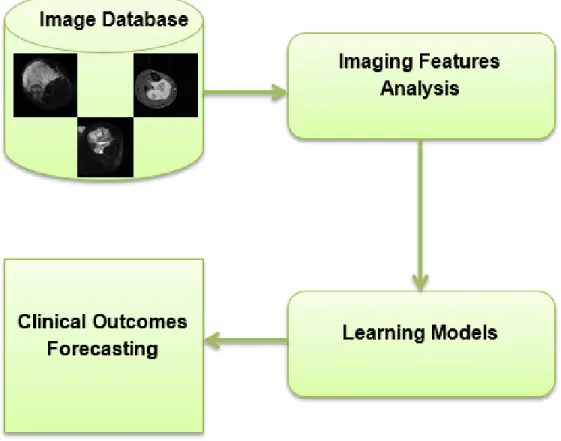
and illustrated in Figure 1.1.
Figure 1.1. The dissertation scheme
The general scheme of this work is to quantify the intra-tumor heterogeneity in a
non-invasive fashion. This work considers imaging biomarkers for the entire tumor as a Region of
Interest (ROI), as well as the tumor’s “habitats” [16]. In [16], authors proposed that regional
variations in imaging variables, such as contrast intensity which is controlled by blood flow,
tumor as a union of tumor habitats. The imaging parameters associated with each habitat
are captured and quantified to examine it’s contribution in clinical outcome forecasting.
1.2.1 Intra-tumor Heterogeneity Quantification with Imaging Features
We investigated the entire tumor as well as tumor habitats to extract and represent
imaging features to quantify STS heterogeneity. This is the first study in quantitative image
analysis on STS to explore the presence of tumor habitats defined by contrast intensities
variation in a single sequence and spatial mapping analysis on multiple MRI sequences.
After habitat identification, we analyzed different types of Radiomics features [17] such as
contrast enhancement intensity, texture and morphological features as well as deep features
[18], which are extracted from pre-trained deep neural network architectures [19, 20]. To
extract the deep features, we follow the transfer learning [21, 22] idea. The novelty of this
work, in addition to the habitat identification of STS tumors, is to capture local binary
patterns as a texture feature and make use of deep features.
1.2.2 Ensemble Bags of Visual Words Framework
Bag of words (BoW) [23] is a well-known approach to classify documents based on
fre-quency of words which is employed to train classifiers. Bags of Visual Words (BoVW) is a
derived version of BoW which is designed for computer vision [24]. In this study, for the
first time we are using the novel BoVW model for STS classification.
The integration of different feature extractors, here pre-trained CNNs, and different
clas-sifiers is a key part of developing a BoVW model which is called Bags of Visual Words. This
framework uses deep features, derived from same-sized patches extracted from the whole
tu-mor, to explore the intra-tumor variations. Histograms of visual words are treated as input
for training the classifiers and ultimately the aggregation of predicted outputs classifies the
To summarize, the first contribution is based on the idea that imaging bio-markers derived
from each tumor habitat [16] will have different capabilities for identifying clinical outcomes.
For the first time, we examined the STS as a coalition of distinctive habitats and compared
the prediction ability of derived imaging features from different parts of the tumor regarding
metastasis development and necrosis rate. This contribution is central for image processing
and machine learning techniques.
The second contribution is based on computer vision technique, Bag of Visual Words.
Here, for the first time, we used a transfer learning approach to capture deep features out
of the entire tumor to create a feature vector. Also, we built a new ensemble framework to
classify the STS regarding prediction for metastasis development.
1.2.3 Model Applications
Surgical resection can cure primary tumors; however metastatic tumors are widely
in-curable due to the diffusion throughout the body of tumor cells. According to [25, 26] more
than 90% of patients who suffer from cancer die due to metastasis, not the primary tumor.
As a result, effective and efficient cancer medication and treatment is highly correlated with
the ability to prevent the metastasis process. By using quantitative image analysis, we assay
the regional and micro-environmental variations to characterize the likelihood of metastatic
tumor for further consideration.
Another factor used to assay the STS is the necrosis rate of tumor cells in biopsies which
is the gold-standard evaluation method [27]. Based on the tumor necrosis percentage in
re-sected specimens, there are histological classifications that separate good and bad treatment
responders [27]. The discriminator threshold to separate good and bad treatment responders
is set as 90% of tumor exhibiting necrosis. Good treatment responders show more than a
tumor necrosis rate. This rate is computed as the fraction of necrotic tumor size over total
tumor size [27].
The proposed frameworks are applied on described data sets to evaluate the performance
in classifying metastatic and non-metastatic STS, as well as necrosis.
1.3 Dissertation Overview
The dissertation contains five chapters. The second chapter mainly discusses data science
(e.g. image processing and computer vision as well as data mining and machine learning)
for bio-medical applications in oncology. Chapter 3 presents a detailed explanation of the
proposed methodologies associated with Radiomics and BoVW analysis on identified
habi-tats. Chapter 4 shows the comprehensive and complete experimental results of the proposed
CHAPTER 2 BACKGROUND
This chapter discusses the general concepts regarding Soft Tissue Sarcomas and its
tax-onomy, the common MRI sequences used on STS, data science in biomedical engineering,
feature reduction and selection, machine learning strategies, and machine learning classifier
evaluation metrics.
2.1 What are Soft Tissue Sarcomas
The out of control growth of cells in the body results in cancers. Generally, a sarcoma
tumor is a type of tumor which arises from a certain part of the body, either bone or soft
tissues. Soft Tissue Sarcomas occur from soft tissue such as nerves, fibrous structures and
muscles. They can reside in the body’s structures for a long time before being discovered1.
Table 2.1. Occurrence percentage of STS in different parts of the body Body Part Occurrence Percentage
Head & Neck 6%
Thoracic 9% Visceral 13% Upper Exremity 13% Retroperitoneal Intra-abdominal 27% Lower Exremity 32%
These are rare tumors that arise in different parts of the body. Table 2.1 is from the
Chicago Cancer Surgery Center2 which illustrates the percentage of STS occurrence in
dif-1
http://www.cancer.org/cancer/sarcoma-adultsofttissuecancer/detailedguide/sarcoma-adult-soft-tissue-cancer-soft-tissue-sarcoma
(a) (b) (c)
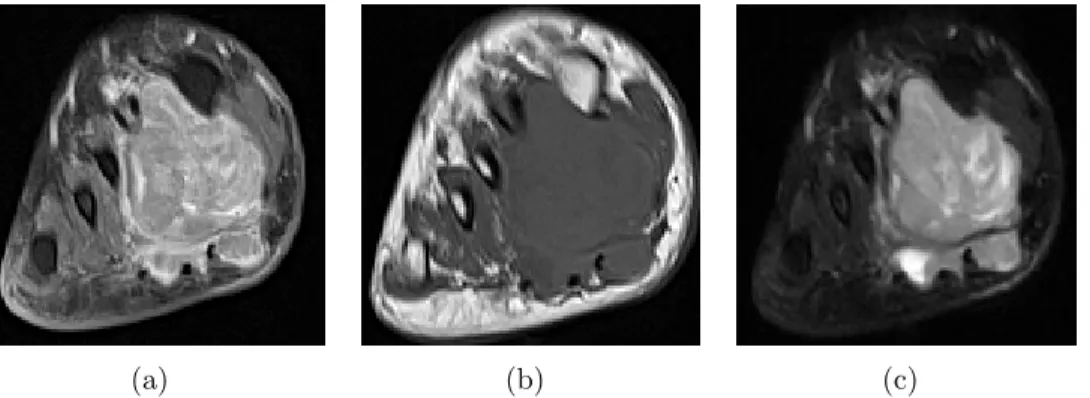
Figure 2.1. Three MRI sequences. (a) T1 post-contrast (b) T1 pre-contrast (c) T2 non-contrast of Soft tissue Sarcomas from private dataset
ferent regions of the human body. According to the Table 2.1, it is understood that the
majority of STS (almost 1/3) develop from lower extremities and only 6% of them are in the
head and neck.
2.2 Soft Tissue Sarcomas in MRI Sequences
MRI can detect blood flow and malformations in vessels as well as demyelinating disease
and simplify visualization of the posterior fossa [28, 29, 30, 31]. Radiographic parameters
can also be revealed in cross-sectional MRI radiology images. It also enables visualization of
the tumor environment from different angles which are the axial, coronal and sagittal planes.
Thus, it is worthwhile to utilize these imaging data to assess the tumor heterogeneity.
There are multiple MRI protocols that provide detail of tumor vascular anatomy: T1
pre/post-contrast and T2 non-contrast. The contrast enhancement is predominately
ob-served in T1 sequences after contrast agent (gadolinium chelates) injection. Enhancement
discriminates between the colony of the cancerous cell, which are ceaselessly absorbing blood
and non-active regions. The active region, due to high blood flow, has high (enhanced) signal
intensity. As a complementary sequence, T2 identifies the watery cells within the tumor and
demonstrates cellularity. The bright spots contain water, while fat and air appear dark [32].
2.3 Feature Extraction and Representation
A key initial step in building learning models from imaging data is feature extraction. The
feature extraction objective is to quantitatively obtain useful information from the biology
and environment of the tumor as represented in MRIs that could result in case-specific
patterns for making medical decisions. Mathematically, in this stage of imaging analysis,
features, which are correlated to tumor biology and discriminative enough, are desirable.
This section reviews popular image features for biomedical applications such as Radiomics
features. Also, it covers the state-of-art feature representation [33], Bag of Visual Words as
well as a new feature learning approach, Deep Learning [34].
2.3.1 Radiomics Features
As previously mentioned, Radiomics analyses [35] include a group of methods to
ex-tract features from radiographic images, mine them, and ultimately utilize them for clinical
decision making purposes. Radiomics features are associated with contrast enhancement
voxel/pixel intensity, texture and morphological (e.g shape and color) features.
• Signal Intensity Features: These features are from first-order statistics [36] and are derived from a histogram of intensities. The first order is related to the distribution of
gray-level frequency within the ROI. The statistics of this level are based on a histogram
of intensity, consisting of mean, maximum, minimum intensity and standard deviation
of the gray-level histogram, irregularity of gray level distribution (entropy), uniformity
of distribution (uniformity), flatness of the histogram (kurtosis) and asymmetry of the
histogram (skewness).
• Texture Features: Texture features [37] are second-order statistics. The second level features are related to co-occurrence measurements by using a gray-level dependence
intensities. Well-known second order features include the Gray-level Co-occurrence
Matrix (GLCM) [37], Gray-level Run-Length Matrix (GLRLM) [38, 39, 40, 41] and
Gray-level Size Zone Matrix (GLSZM) [38, 41, 39, 40].
Local Binary Patterns (LBP) [42], Scale Invariant Feature Transform (SIFT) [43] and
Histogram of Oriented Gradients (HOG) [44] also are popular robust descriptors which
are abstracted from the computer vision domain.
The third order of features is hierarchically built on the first and second level of feature
layers. They depend on gray-tone-difference matrices to test the spatial interaction of a
pixel value and its neighborhoods (e.g. NGTDM: Neighborhood Gray-Tone Difference
Matrix [45]).
• Morphological Features: These features are obtained from geometric attributes of the tumor. Generally, they include: size, diameter, color, solidity and eccentricity.
Recently, radiomics analyses have been used for different biomedical applications,
es-pecially in tumor cancer classification. Chicklore et al. [46] reviewed radiomics features
analysis in 18FDG PET/CT to measure the spatial variation within the tumor and its
prog-nostic information in determining response to the treatment in an early stage rather than
using standardized uptake value (SUV), because the prognosis ability of SUVs from a
base-line scan is limited. In [47, 48, 49, 50], Aerts group from Harvard Medical School worked on
Lung and Head and Neck cancer, using clustering to deal with high dimensional radiomics
feature space (440 radiomics features) and discovered common radiomics patterns. They
have used radiomics features for classification of head and neck and lung cancers based on
survival time (they dichotomized the survival data using a cutoff time of 2 years for lung
and 3 years for head and neck cancer.). In [51] a novel quantitative radiomics feature
analy-sis from multiparametric MRI (mpMRI) was proposed to perform prostate cancer detection.
tumor candidate regions. On breast cancer, [52, 53, 54, 55, 56, 57] presented studies
regard-ing radiomics feature analyses on identified radiological habitats to predict Axillary lymph
node (ALN) metastases and Estrogen receptor (ER) status. Likewise, [58, 59, 60, 61, 62, 63]
conducted radiomics analysis to classify the Glioblastoma (GBM) brain tumor regarding
survival time based on identified radiological habitats. In [64], Vallieres et al. quantified
the tumor heterogeneity to stratify the metastatic STS using radiomics features. In [65],
we used Radiomics to predict progression free survival in Head and Neck (Nasopharyngeal
Carcinoma) cancer. Also, in line with the dissertation, multiple contributions were published
[3, 66, 67, 68, 69] which will be explained in the next chapter.
2.3.2 Deep Features
The primary idea of deep learning algorithms is to stack up the non-linear
transforma-tion layers. These consist of convolutransforma-tion, pooling (i.e max or average) and rectifying [70]
layers. The main goal is to obtain complex representations of input data from a hierarchical
structure, where layers at the lower levels (closer to the input layer) capture more generic
complex representations of data, while higher level layers create case-specific representations
[71]. By adding more layers to the architecture of the deep learning model, more complex
non-linear transformations are built to extract important attributes of input data [72, 73].
The resultant attributes can be extracted and utilized as input features to train machine
learning classifiers.
Two main applications of deep learning algorithms are segmentation [74] and classification
[75] tasks. To perform the segmentation task, auto-encoders are widely used, especially in
brain segmentation [76, 77, 78, 79]. U-net [80] is a new model which won the ISBI cell tracking
challenge 2015 for microscopy images. The auto-encoders or auto-associators [81] manipulate
target is to visualize the reconstructed input. To obtain this goal, in their architecture, the
deconvolution layers [82] are succeeded by convolutional layers.
To do classification tasks on images, Convolutional Neural Networks (CNNs) are very
popular. The pioneering CNN, called LeNet, was proposed by LeCun [83] to classify
hand-written digits. In biomedical applications, recently, researchers are making efforts to design
a deep learning model for their classification purposes. For lung nodules [84, 85, 86, 87], for
breast cancer [88, 89, 90] and for brain tumor classification [91, 92] deep learning algorithms
have been applied.
2.3.3 Transfer Learning from Deep Learning Models
Generally speaking, transfer learning (also known as inductive transfer) [21, 93] means
using the obtained knowledge from a particular problem in a specific domain, and applying
it to another problem from a different domain. To be specific, in the machine learning area,
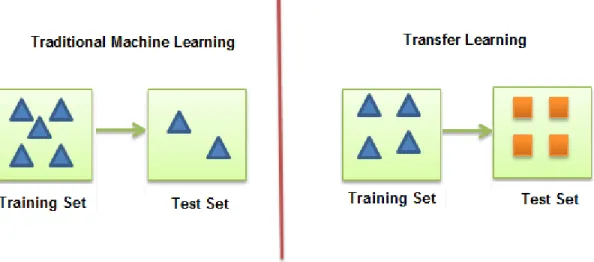
in contrast to traditional machine leaning approaches in which training and testing data
are from same domain (e.g brain images), in transfer learning training and testing data can
be from different domains (e.g training data contains natural images while testing data has
biomedical images). Figure 2.2 illustrates this comparison.
Using CNN as a feature extractor or fine-tuning the CNN are two approaches to transfer
learning using deep learning algorithms [94, 95]. The CNN pre-trained on ImageNet3 [96]
without the last classifier layer (fully-connected layer) can be treated as a feature extractor
for input images from any category.
The second approach is to fine-tune the CNN weights of a pre-trained network by
con-tinuing the backpropagation training process, instead of training the network from scratch.
Recently, Tajbakhsh [97] showed that in some medical imaging applications fine-tuning
Figure 2.2. Transfer learning vs. traditional machine learning
performed the full-training of the CNNs and the fine-tuned CNNs are more robust when the
size of the training set is small.
2.4 Bag of Visual Words
Bag of Words templates were invented for use in information retrieval to simplify
docu-ment representation. In a BoW model, docudocu-ments are transformed into histograms of words.
From a machine learning point of view, these histograms are feature sets to train the
classi-fier to do the document classification task. Each element of the feature vector is the count
of the number of times a word occurs.
The derived version of the BoW model for the computer vision field is the Bag of Visual
Words (BoVW) model in which the features are “visual words” instead of actual words
in a language. The visual words are the feature representations of image attributes from
primitive (low) level features to abstract (high) level features. Primitive features are image
attributes such as color, shape and texture (e.g. features obtained from flowers) while high
level features are semantic attributes require some reasoning to deduce meaning (e.g features
The BoVW models are the basis of the content-based image retrieval (CBIR) systems [99]
which match the extracted primitive image features, such as texture, from training images
with the query (test) image. The highest matching score between training images and query
image results in the assignment of the class of the query image.
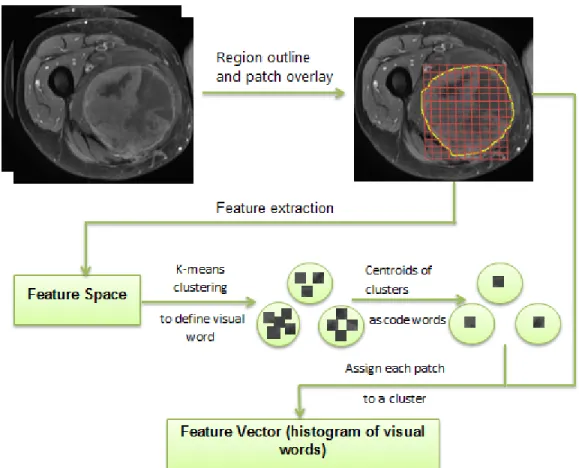
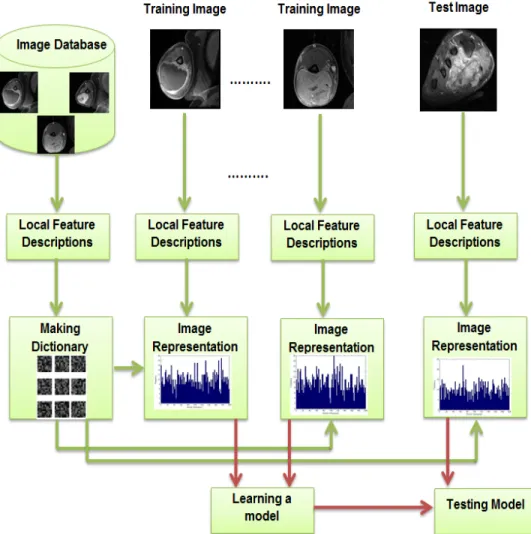
CBIR in medical imaging applications [100, 101] contains the following steps (Figures 2.3
and 2.4):
1. Local Feature Description: First, from training set images, some underlying
compo-nents associated with the whole image should be identified. For example, using SIFT,
there are some keypoints within the image used to describe the image. However, in
medical images, as all points (pixels) within the ROI are interest points, it would be
computationally intensive to explore all the points. Instead, same size patches,
con-sisting of multiple pixels (e.g. 16×16 pixels), are extracted from the ROI for local attribute description.
To explain this step, let’s follow an example. Suppose we haveN images in the training
set and extract a different number of patches out of the images (obviously, as the size
of the ROIs are different across images, the number of extracted patches are different,
as well. Any patch, which has more than half of its area covered by tumor tissue, is of
interest and will be processed). Suppose in total, there are M patches from whole the
training set (For image i, mi patches are extracted, s.t.
P
Nmi = M). Next, a fixed
number of features F are captured from each patch (the feature space is of dimension
F).
2. Visual Dictionary Generation: K-means clustering [102] on the feature space
deter-mines the size of the dictionary, or simply the number of words in the dictionary which
are centroids of the clusters. The size of the dictionary (K) is a gray area as some
while others [101] indicate the dictionary size matters in medical image classification
tasks.
3. Image Representation: In this step, the images in the training set are transformed into
a histogram of visual words.
Based on our example, the algorithms starts to analyze each image in the training set.
It uses a simple nearest neighbor algorithm (with Euclidean distance) between each
patch of the image and K centroids of clusters to see which of centroids (visual words
here) is closest to the patch (using features extracted from step 1) as shown in Figure
2.3. The word histogram of each image is generated when all the patches are each
assigned to one of the words in the dictionary. The histogram consists of a vector of
size K where each entry is the number of patches assigned to the ith (1 ≤ i ≤ K) word (a number between 0 and number of patches).
4. Training a Classifier: The word histograms captured from the previous step are the
input feature vectors for learning a model such as an SVM or K-nearest Neighbor [102].
5. Test: After generating the image representation (visual bag of words representation)
of the incoming image, we can use our trained model to classify the test image.
In [101], authors employed abag of feature framework to classify histopathological images
from 18 categories. In [104] authors proposed a mutual information based word selection
method to improve the classification rate of three separate datasets of chest x-rays, liver
lesion CT images and mammography micro-calcifications images. In [105], the authors used
a patch-based visual words framework on the ImageCLEF4 dataset as well as a chest x-ray
with 98 frontal chest images (separate dataset). By proposing the bag of semantic words
model, [106] fills the gap between the primitive image features and medical concepts. It
concluded that the extracted semantic information from the ADNI dataset [107] can enhance
Figure 2.3. Feature vector from bag of visual words model
the classification rate. For lung nodule classification [108] proposed a novel adaptive
multi-level framework in which instead of same size patches, clustered regions using superpixel
formation on signal intensities are used as the image components.
2.5 Feature Selection
In the feature extraction step, the main goal is to get a concise and unique representation
of the object. The feature selection process obtains a subset of features which one hopes does
not have irrelevant and redundant information and also preserves the original discriminative
information [109]. Feature selection methods try to reduce model computation time (with
fewer features) and boost prognostication. To select the subset, which reduces dimensionality,
Figure 2.4. BoVW framework in CBIR systems
The feature selection methods belong to two main categories: filter and wrapper
meth-ods [110]. In the filter method, the features are ordered independent of the classifier, and
only high ranked features are utilized as the pattern from which to do classification. In the
wrapper method, the learning algorithm ranks the feature subset with regard to the highest
classification accuracy for a specific classifier.
• Filter Method: Filter methods use feature ranking approaches to select features. Us-ing orderUs-ing methods provides simplicity and has had reasonable success for different
data before classification to remove the less relevant features. A feature which can
provide discriminant information about different classes is favorable. This is so-called
relevancy which quantifies the feature discrimination ability for different classes. To
measure the relevancy of the feature, there are multiple efforts [111, 112]. One
crite-rion for irrelevancy is that a feature is weakly dependent on the target class [113]. The
feature is ignored when there is no correlation with or predictive ability for the class
label. The best feature subset is not unique because of the unknown underlying
distri-bution and a classifier may obtain the same accuracy by using different sets of features.
Some methods in this category are mutual information [114], Fisher score [115], and
RELIEF-F [116].
• Wrapper Method: In wrapper methods, the predictor performance using the selected feature subset is the objective function for evaluation. To find the optimal subset, at
each step (iteration) a feature set of size x(1, n) (n is the total number of features)
is tested to maximize prediction performance. As an example, branch and bound
methods [117] employ a tree structure to weight different feature subsets. However,
the drawback of this approach is exponential growth in the search space for the large
feature set.
Wrapper methods use sequential search and heuristic search algorithms. The sequential
search algorithms are iterative. The Sequential Feature Selection (SFS) algorithm [118]
initializes an empty feature set and adds one feature in each step to obtain maximum
classification performance. The feature which enables maximum classification accuracy
will remain in the feature subset. No more features are added to the subset when
accuracy does not improve. The Sequential Backward Selection (SBS) algorithm is like
SFS but in reverse, which means it starts with a full subset of features and removes a
feature at each iteration such that losing that feature yields minimum or no reduction
The heuristic search algorithms optimize the prediction performance by evaluating
different subsets. The Genetic Algorithm and Particle Swarm Optimization are in this
category [119].
The main drawback of wrapper methods is the high computational complexity to find
the best feature subset. For each subset, the classifier makes a new model in which the
classifier is trained on a feature subset and tested for performance. For large datasets,
most of the time is spent on training. Over fitting is also a weakness of these methods.
It occurs when the classifier is trained to tightly fit the training data and loses it’s
generalization ability for unseen data. Over fitting leads to a higher classification error
rate because it makes the classifier biased towards the training data. To ease this
problem a holdout validation set could be applied to enhance prediction accuracy.
Dimensionality reduction tries to project high dimensional data into a meaningful
repre-sentation in a lower dimension. As dimension reduction relieves the curse of dimensionality
and potentially some unfavorable properties of data, it is widely applicable. In medical
imag-ing data, dimensionality reduction has been applied for different applications [120, 121, 122].
There are two main classes of dimension reduction methods: linear and nonlinear methods.
The linear methods are simpler, but they cannot handle the complex nonlinear data.
Two well-known linear dimension reduction methods are Principal Component Analysis
(PCA) and Linear Discriminant Analysis (LDA) [123]. PCA [124] is an unsupervised linear
technique which performs dimension reduction by creating orthogonal vectors which explain
the data variance [125]. It computes the mean vector and co-variance matrix of variables as
well as eigenvalues and eigenvectors. It sorts eigenvectors according to decreasing eigenvalues
and uses theK largest eigenvectors. PCA has been used in various types of studies on several
cancers [126, 127]. PCA does not consider the difference between classes of data, but LDA
construct a low dimension subspace by minimizing intra-class and maximizing inter-class
variances.
2.6 Learning Strategies
Machine learning techniques have been broadly used for medical image analysis in
differ-ent applications such as tumor segmdiffer-entation [128] and cancer type prediction [66]. Based on
available data and the target task, a proper model can be designed. In regard to utilization
of the labels of training data, machine learning algorithms are supervised, unsupervised and
semi-supervised.
In supervised learning, the target is to learn the model from training data with known
class labels to forecast the label of the unknown input patterns from unseen data.
Unsuper-vised learning is used to find structure in data without having any labels. Semi-superUnsuper-vised
learning is a hybrid approach which takes a small portion of labeled training data. The
un-labeled data are used in the learning process as well, instead of being untouched [129, 130].
In case of STS, supervised learning has been used in some efforts [131, 132, 133, 134].
Supervised learning contains two steps: the training and testing step. The classifier will
use the training data with class labels in the training step. The classifier performance is
evaluated by a predicted label compared with ground truth in the testing step. To sum
up, the goal of supervised learning is to build a predictive model from training samples and
generalize to testing samples. For example, in [132], authors used gene expression profiling
to classify different subtypes of STS and in [134], authors used texture features to classify
benign and malignant STTs.
The unsupervised learning methods have also been used for medical imaging data
analy-sis [132, 135, 136]. In unsupervised learning, there exists a set of unlabeled observations with
no information about the class of each sample. It groups the unlabeled data based on mutual
target of study in [137] was to classify clear cell sarcoma (CCS) as either soft tissue sarcoma
or typical melanoma. CCS has common features with both soft tissue sarcoma and typical
melanoma. Authors used gene expression profiles as features and an unsupervised learning
technique and finally concluded that CCS is a distinct genomic subtype of typical melanoma.
In [6], authors clustered subtypes of STS by using gene profile expressions.
Semi-supervised learning is well-suited in tasks for which it is difficult to find the class
labels for certain samples. In other words, this hybrid approach is designed to overcome
the limitation of supervised learning which is incapable of training with data with missing
labels. In [138] semi-supervised methods on gene expression profiling have been used to
predict cancer recurrence. The authors integrated gene expression with Protein-Protein
Interaction (PPI) and recognized the informative gene pairs with the labeled instances, and
then built an instance based graph model using selected genes to make a semi-supervised
learning classifier.
2.7 Evaluation Metrics
The performance of the two-class classifier is usually represented in a confusion matrix.
The entries of a confusion matrix show whether the samples are correctly or incorrectly
classified. One of the methods to evaluate the learning algorithms performance is
cross-validation [139].
The cross-validation method divides samples into two partitions: one is used to learn or
train a model, and the other unseen part is used to validate the model. K-fold cross validation
and the special case of it, leave-one-out cross-validation, is used to evaluate classification
algorithms. For K-fold cross validation, the process iteratively proceeds K times. At each
round, the data is divided into K approximately equal sized subsets, K-1 of the subsets are
In the leave-one-out method, only one instance from the dataset is chosen as the testing
set; all remaining samples are considered as training samples. The performance of the
learning algorithms for a two class problem is determined by the True Positives (TP), True
Negatives (TN), False Positives (FP), and False Negatives (FN) that indicate samples which
are correctly classified, correctly rejected, incorrectly classified, and incorrectly rejected,
respectively. The accuracy of the learning algorithm is defined by:
Accuracy = T P+T NT P++T NF P+F N
There are other metrics to evaluate learning algorithm performance. Sensitivity or recall,
measures the rate of correctly classified instances (true positive rate). Specificity measures
the rate of correctly rejected instances (true negative rate). Precision measures positive
predictive value.
Sensitivity = T PT P+F N, Specif icity= F PT N+T N,P recision= F PT P+T P
The F-measure and G-measure also combine the precision and recall in terms of a compatible
mean:
F −measure= 2×P recision×Recall P recision+Recall, G=
√
P recision×Recall
Receiver Operating Characteristic (ROC) analysis and Area Under Curve (AUC) are also
popular to evaluate the performance of the algorithm [134].
2.8 Summary
To conduct quantitative medical image analysis, it is imperative to utilize data science
knowledge i.e image processing, computer vision, and data mining. After delineation of the
ROI within the medical image, the ROI attributes should be translated into mathematical
Radiomics features as well as deep features have gained popularity recently to describe
image characteristics. Not all extracted features have underlying discriminative capability,
and some good features can be correlated with others, which is not helpful. Thus, removing
these variables can be helpful in improving accuracy and training time when learning a
model. By training the supervised classifier with a predictive subset of features, the trained
CHAPTER 3 METHODOLOGY
3.1 Proposed Methods Overview
1This work presents novel and new quantitative images analysis frameworks to quantify
the heterogeneity of Soft Tissue Sarcomas from the whole tumor as well as tumor habitats.
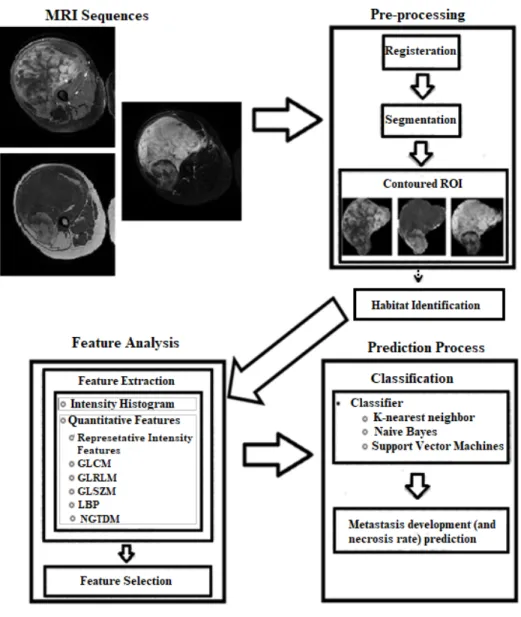
The frameworks begin with pre-processing and ROI detection and continue with feature
extraction and finally classification.
3.2 Radiomics Framework
This section proposes a Radiomics framework for quantitative image analysis on STS
MRI. Figure 3.1 shows the Radiomics workflow.
As pixel level values or gray-level signal intensity values are the most easily observable
image attributes, first we analyze the intensity histogram of ROIs as imaging features and
weigh its ability in outcome prediction.
Besides that, the framework captures representative first order statistics of the intensity
histogram as well as second and third order statistics, which are associated with the texture
parameters within the ROI. The captured features should be purified by removing redundant
and irrelevant features using feature selection techniques and finally, the best subset of
features are input variables into a machine learned classifier.
1Parts of this chapter were published in the SPIE Medical Imaging Proceedings and IEEE Systems, Man
and Cybernetics (SMC) Proceedings [3, 66, 67, 68, 69]. The copyright permissions to reuse the contents are in Appendix A.
Figure 3.1. Radiomics workflow on STS
The ROIs are either the entire tumor or the tumor habitats. The next part explains a
method to identify the habitats.
3.2.1 Region of Interest Delineation
The input data for our framework are either 2D or multi-slice MRIs of STS tumor
im-ages. The images are in T1 pre/post contrast (which measures the vascular blood flow) and
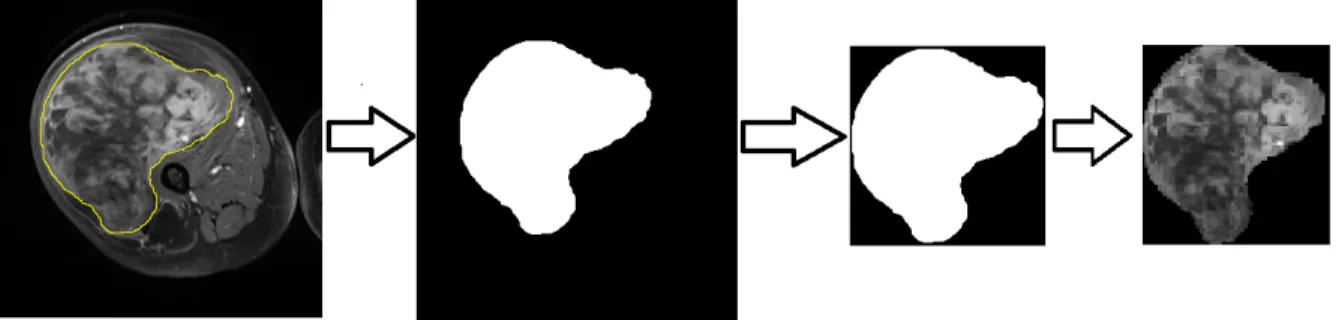
techniques such as in [140] and particularly for STS [141], an expert radiologist manually
contoured (yellow line in Figure 3.2) the ROI to have reliable ground truth. After manual
delineation, a binary mask is created where the tumor areas are represented in white and
healthy tissue and background is shown in black. The tightest box which includes the ROI
is the final mask. By mapping the mask to the MRI image the final outcome is obtained
(the final square with ROI in it). This process is shown in Figure 3.2. The captured mask
is applied to all modalities which are registered. In the framework which extracts attributes
from the entire tumor, the masked images are used as input for the system. To quantify the
intra-tumor regional based spatial variations, we followed by idea of “habitats” [16]. This is
the first work that measures the tumor variation in underlying sub-regions on STS tumors.
Figure 3.2. ROI delineation and mask
3.2.1.1 Habitat Identification
The concept of habitats considers the entire tumor as an integration of different
sub-regions which have various imaging attributes and functionalities. To define specific habitats,
we applied the Otsu segmentation method [142] to divide the tumor into two sets of signal
intensity groups. It iteratively looks for the grey level threshold in grey levels which is the
optimal cut-off point to separate the image into two classes by maximizing the between class
variance as well as minimizing within class variance.
σ
b2=
β
1(
µ
1−
µ
2)
2+
β
2(
µ
1−
µ
2)
2where σ2
w,σb2, β1,β2, µ1 and µ2 are, inter-class and intra-class variances, class probabilities
for divided pixels and average pixel value for different classes, respectively.
• Single Sequence Habitats: Simply, by applying the Otsu segmentation on different imaging sequences individually, different sub-regions are obtained as shown in Figure
3.3 as an example.
• Multi-Sequences Habitats: As mentioned before, different MRI sequences identify unique tumor attributes. Combined habitats already show promising results on brain
[61] to predict the survival time of Giloblastoma Multiforme (GBM) and breast
tu-mors [57] to predict Axillary lymph node (ALN) metastases and Estrogen receptor
(ER) status. Following the idea proposed in [61], we extracted combined habitats by
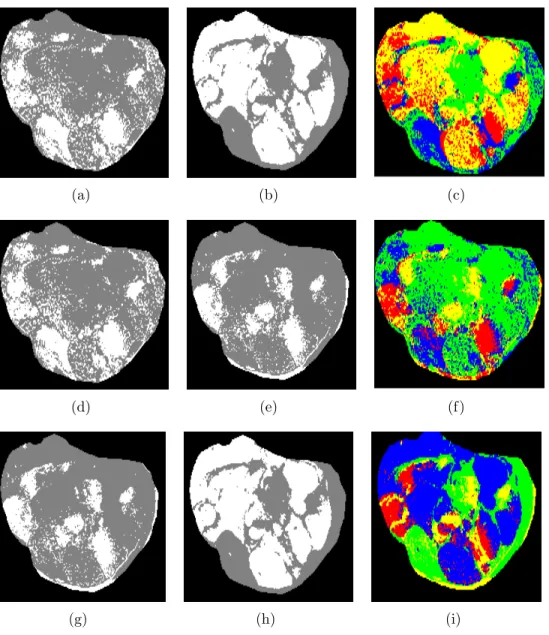
intersecting signal intensity classes of individual sequences. Figure 3.4 shows Otsu
segmentation on T1 post-contrast presented in (a and d), Otsu segmentation on T2
non-contrast presented in (b and h), Otsu segmentation on T1 pre-contrast presented
in (e and g), and (c, f and i) are the intersection results.
After defining the ROI, i.e. entire tumor, habitats within a single sequence or a combined
habitat using multi-sequence MRIs, the next phase is to obtain features.
3.2.2 Feature Extraction
This section describes the feature extraction in pixel gray level values, as well as higher
order of statistics. For intensity histogram analysis, we used the method proposed in GBM
prognostication [61] as it showed promising results. Then, instead of working on pixel level
features, first order statistics as well as second and third order statistics were evaluated in
Figure 3.3. Habitat on single MRI sequence. T1 post/pre contrast and T2 from up to down (while region is high signal group and gray region is low signal group)
(a) (b) (c)
(d) (e) (f)
(g) (h) (i)
Figure 3.4. Overlapped habitats on multi-sequences MRI
3.2.2.1 Intensity Histogram Analysis
As previously mentioned, different MRI protocols capture underlying imaging biomarkers
and identify diverse characteristics of the ROI. The T1 sequence mainly measures the vascular
blood flow, the active part of the tumor (where blood flow is high) is bright while the
non-active part is dark. The intermediate sections also appear in gray. T2 is used to identify the
necrosis within the tumor by which the dead cells turn to watery cells, and can be observed
Figure 3.5. Intensity histograms for ROIs. Intensity histograms from (a) entire tumor, (b) low and (c) high signal group
To take these variabilities into account in Radiomics analysis, the pixel signal intensity of
the ROI is transformed to the quantized histogram of intensities in 1D (for single sequence
MRI) and 2D (multi-sequences MRI). Figure 3.5 illustrates the 1D histogram (in 100 bins)
of the entire tumor as well as binary classes of high and low signal intensity groups from one
patient in a T1 post-contrast sequence.
Notably, a 1D histogram is from one input channel input which measures the frequency
of the single sequence MRI and ignores the undiscovered and unseen correlation between
multiple scans. In this work, for the first time on STS tumor, 2D pair-wise sequence
his-tograms are used as they showed good results on GBM brain tumors [60] already. Thus ifIi
and Ij are images in different sequences Hi,jk = f(Ii, Ij) is the joint histogram for a patient
with index k.
All of these experiments are on pre-treatment images as both datasets contain them
Center, the post-treatment images are also included. Thus, we could expand our analysis by
considering post treatment images for quantification. For histogram analysis, one interesting
set of features is the difference between post and pre-treatment signal intensity distributions
[59]. As a result, besides previous analysis, we tested the absolute difference of histograms
in 1D and 2D for this special dataset. Figure 3.6 shows these feature sets, for a randomly
selected patient, in a 10×10 histogram for twelve ROIs (the blue to red color spectrum illustrates the difference between post-treatment histogram and pre-treatment histogram
from most negative to most positive value) which are labeled in Table 3.1.
Table 3.1. Numbering the region of interest (ROI)
Habitat ID
T1 post-contrast (low) & T2 non-contrast (low) (a) T1 post-contrast (low) & T2 non-contrast (high) (d) T1 post-contrast (high) & T2 non-contrast (low) (g) T1 post-contrast (high) & T2 non-contrast (high) (j)
T1 pre-contrast (low) & T2 non-contrast (low) (b) T1 pre-contrast (low) & T2 non-contrast (high) (e) T1 pre-contrast (high) & T2 non-contrast (low) (h) T1 pre-contrast (high) & T2 non-contrast (high) (k)
T1 post-contrast (low) & T1 pre-contrast (low) (c) T1 post-contrast (low) & T1 pre-contrast (high) (f) T1 post-contrast (high) & T1 pre-contrast (low) (i) T1 post-contrast (high) & T1 pre-contrast (high) (l)
3.2.2.2 Quantitative Feature Analysis
In this section we explain quantitative feature analysis using different orders of statistics
in detail such as feature of intensity histograms and textural features that have been used
(a) (b) (c)
(d) (e) (f)
(g) (h) (i)
(j) (k) (l)
Figure 3.6. Difference intensity histograms. The dark red color is 1 and the dark blue color is 0 as normalized histograms are shown. (a-c) difference intensity histogram of low/low habitat, (d-i) difference intensity histogram of low/high and high/low habitat, (j-l) difference intensity histogram of high/high habitat.
Textural features are sets of numeric values that describe the surface of the image,
math-ematically. These descriptions provide valuable information about image attributes such as
smoothness, coarseness, regularity, and directionality.
Statistical texture analysis is an acceptable approach to extract quantitative features to
describe a medical image. Texture analysis deals with pixel level relationships using their
gray level values.
Signal intensity ranges differ between sequences. This may affect the capture of
mean-ingful imaging biomarkers from the data in the feature analysis step. To standardize the
signal intensity range, we used following equation:
S(m) = ∀i ∈ROIm(Ng×(i−mini∈ROIm)/(maxi∈ROIm−mini∈ROIm))
wherei is a pixel value in the ROI (delineated tumor), theNg is the number of quantification
bins which can be 8, 16, 32, 64 and 128 values. Them indicates the corresponding sequence.
This normalization standardizes the signal intensity variations across all sequences for all
patients. This step is done for all data at once.
The representative features derived from an intensity histogram are mean, variance,
stan-dard deviation, skewness which measures the asymmetry of the intensity histogram and
kur-tosis which measures the flatness (heavy- or light-tailed) of the normal distribution. These
are the five representative first order statistics used for further processing.
The GLCM (gray-level co-occurrence matrix(ces)) features [37] are those which are
de-fined based on pair-wise gray-level histograms of a pixel i and its neighbor at some offset j.
The value in the histogram is the probability of occurrence of a pixel with a gray level of
P and Q based on specific Euclidean distance d and specific angle θ. Four values for θ are
0◦,45◦,90◦,135◦. IfI represents the image with a normalized number of gray levelsNg, then
C∆(d,θ)(P, Q) = Pn i=1 Pm j=1 1,ifI(i, j) = P and I(i+ ∆(d, θ), j+ ∆(d, θ) =Q) 0,otherwise
where,n andm are image dimensions and ∆(d, θ) is the function to define the spatial relation
of the matrix. The rows and columns in GLCM are the gray level values.
The GLCM features that have been used in this study are eight variables: energy,
homo-geneity, contrast, variance, correlation, sum average, dissimilarity and entropy.
The Gray level run length matrix (GLRLM) [38] measures the imaging attributes based
on a consecutive set of pixels which have same gray level value, called a run. Basically, it
measures the coarseness and fineness of the surface of the image. In GLRLM, the rows are
gray levels, but columns represent the lengths of the runs. Hence, the GLRLM entries are
the number of runs of a specific length.
Other second order statistics are derived from gray level size zone matrix (GLSZM) [41].
The rows in GLSZM are also gray levels, but the columns represent the number of zones
of size s that have gray level g. In addition to the GLCM and GLRLM which quantify the
pair of gray levels in a specific direction and for a specific angle, GLSZM deals with zones
which have no specific shape or direction. To clarify how to extract the GLCM, GLRLM and
GLSZM from an image, Figure 3.7 demonstrates an example (for GLCM and GLRL degree
is zero and distance is one pixel). Also Table 3.2 shows the GLRLM and GLSZM features
that have been used in this study.
To compute local binary patterns [42], we used a 3×3 sliding window for neighborhoods of center pixels for an entire ROI. We tested different sizes, and determined that the 3×3 window best captured information for our prediction task based on classification results.
The neighborhood intensity values were thresholded by the center pixel intensity value, and
a binary map was made wherein the center pixel was assigned a value of 1 if the neighborhood
intensity was greater than that of the center pixel intensity value and, if less, the center pixel
Finally, after computing the decimal values for center pixels across the ROI, the frequency
of these values will be captured by a histogram of 256 bins. The counts in the bins give us
256 LBP values from a ROI.
(a) Image (b) GLCM (Gray-Level vs. Gray-level)
(c) GLRL (Gray-Level vs. Run Length)
(d) GLSZM (Gray-Level vs. Zone Size)
Figure 3.7. Corresponding original image (a), GLCM (b), GLRL (c) and GLSZM (d)
The Neighborhood gray-tone difference matrix (NGTDM) features captures the third
order of statistics which are busyness, complexity, contrast, coarseness and strength. In
total, 300 quantitative features have been used as an input for learning model. To compute
the GLCM. GLRLM, GLSZM and NGTDM, the code provided from2 [17] was used.
Figure 3.8. Local binary patterns
3.2.3 Feature Selection
The size of feature set used in medical imaging analysis affects the predictive models.
High data dimensionality negatively affects the prognostication capability of a learning model
due to over-fitting.
It is often not obvious which features out of many might be best regarding predictive
ability. Intuitively, it is imperative to use methods to effectively and efficiently decrease
dimensionality by reducing the number of features using established feature selection
ap-proaches. The aim is to get a subset of features that will maximize the prediction accuracy
Table 3.2. GLRL and GLSZM features
GLRL GLSZM
Short Run Emphasis Small Zone Emphasis Long Run Emphasis Large Zone Emphasis Gray-Level Non-uniformity Gray-Level Non-uniformity Gray-Level Non-uniformity Zone-Size Non-uniformity
Run Percentage Zone Percentage
Low Gray-Level Run Emphasis Low Gray-Level Zone Emphasis High Gray-Level Run Emphasis High Gray-Level Zone Emphasis Short Run Low Gray-Level Emphasis Small Zone Low Gray-Level Emphasis Short Run High Gray-Level Emphasis Small Zone High Gray-Level Emphasis Long Run Low Gray-Level Emphasis Large Zone Low Gray-Level Emphasis Long Run High Gray-Level Emphasis Large Zone High Gray-Level Emphasis
Gray-Level Variance Gray-Level Variance Run-Length Variance Zone-Size Variance
In this work, we used several feature selectors: Support Vector Machine Recursive Feature
Elimination (SVM-RFE) [143, 111], ReliefF [144] and Minimum Redundancy and Maximum
Relevance [145].
• Support Vector Machine Recursive Feature Elimination was proposed by Guyon et. al. [111] as a method for gene selection for cancer (leukemia) classification. It uses
a backward selection strategy, which starts with all features as the initial set, and
iteratively removes feature which is least important for classification. Using linear
SVM with training set instance of xi, ci, where xi ∈ IR and ci ∈ {0,1} the decision
function is:
f(x) =w·x+b
where w and b are weight and bias vectors and it has been shown that the margin is
2
kwk and by minimizing thekwk
2
, the maximized margin is obtained. The problem can
be written in the dual form of Lagrangian formulation [146]:
L=Pn i=1αi− 1 2 Pn i,j=1αiαjcicjxi·xj
where α is the Lagrange multiplier. The α can be found by maximizing L under
constraintsα ≥0,Pn
i=1αici = 0. Then w is:
w=Pn
i=1αicixi
and the ranking criterion for feature l is:
R(l) =w2l
Iteratively, the feature which has the minimum R(l) is removed due to it having the
least effect on classification performance.
• The ReliefF [147] algorithm also ranks the features by their computed weights. ReliefF iteratively and randomly picks a sample and finds the k nearest samples from same
class, which are called “hits”. It also looks for k nearest samples from other class(es),
which are called “misses”. It ranks features based on well they correlate with the true
class and how poorly with the other classes.
• Minimum Redundancy and Maximum Relevance or mRMR [145] is a forward selection filter method that selects features based on mutual information values between features
and class labels as well as between features themselves. It tries to choose features which
have not only the most mutual information with the target class, but also the least
mutual information with other attributes. To formalize the Max-Relevance :
M =max(Mi), Mi = |F1|
P
xiF I(xi, y)
and for minimum redundancy :
m=min(mi), mi = |F1|2
P
where F is the feature set and y is the set of class labels. To combine these two
constraints, we have:
maxΘ(M, m) = M −m
Finally, the incremental search is used to find best features determined by Θ.
3.2.4 Classification
To do supervised learning and create a predictive model, selected features were used as
input to machine learning classifiers. The classifiers were K-Nearest Neighbors (KNN) [102],
Naive Bayes (NB) [102] and Support Vector Machines (SVM) [102].
To do parameter setting for K in KNN, we used a 10-fold cross-validation strategy to
approximate the true performance and maximize accuracy. We tested K= 3, 5, 7 and 9
fold-wise in a cross validation on the training data and ultimately used the value which had
the highest model internal validation (minimum error) on the training dataset. The distance
is measured using the Euclidean distance.
The Radial Basis Function (RBF) has been used as a kernel function for SVM. To set
the values for C and γ, grid search in a 10-fold cross-validation, on the training data, was
used to select pairwise values which make a model which has minimum error on training
data for every fold of cross-validation. The tested range for C was 2−5,2−3, ...,215 and for γ
was 2−15,2−13, ...,23.
To evaluate the performance of the classification task, we used multiple metrics based
on a confusion matrix. The performance of the learning algorithms for a two class
prob-lem is determined by the True Positives (TP), True Negatives (TN), False Positives (FP)
and False Negatives (FN) which indicate samples which are correctly classified, correctly
rejected, incorrectly classified and incorrectly rejected, respectively. There are other metrics
to evaluate learning algorithm performance. Sensitivity, Specificity, Precision and F1-score
value as a supporting metric besides the classification accuracy, which is the factor to justify
the generalization capability of the algorithm.
Accuracy = T P+T NT P++T NF P+F N, Sensitivi