Thesis for The Degree of Licentiate of Engineering
Enhancing Trust in Devices and Transactions of
the Internet of Things
Christos Profentzas
Department of Computer Science and Engineering Chalmers University of Technology
Christos Profentzas
Copyright©Christos Profentzas, 2020.
Technical Report No 210L ISSN 1652-876X
Department of Computer Science and Engineering Chalmers University of Technology
SE-412 96 Gothenburg Sweden
This thesis has been prepared using LATEX.
Printed by Chalmers Reproservice, Gothenburg, Sweden 2020.
Enhancing Trust in Devices and Transactions of the Internet of Things
Christos Profentzas
Department of Computer Science and Engineering Chalmers University of Technology
Abstract
With the rise of the Internet of Things (IoT), billions of smart embedded devices will interact frequently. These interactions will produce billions of transactions. With IoT, users can utilize their phones, home appliances, wearables, or any other wireless embedded device to conduct transactions. For example, a smart car and a parking lot can utilize their sensors to negotiate the fees of a parking spot. The success of IoT applications highly depends on the ability of wireless embedded devices to cope with a large number of transactions. However, these devices face significant constraints in terms of memory, computation, and energy capacity.
With our work, we target the challenges of accurately recording IoT trans-actions from resource-constrained devices. We identify three domain-problems: a) malicious software modification, b) non-repudiation of IoT transactions, and c) inability of IoT transactions to include sensors readings and actuators. The motivation comes from two key factors. First, with Internet connectivity, IoT devices are exposed to cyber-attacks. Internet connectivity makes it possible for malicious users to find ways to connect and modify the software of a device. Second, we need to store transactions from IoT devices that are owned or operated by different stakeholders.
The thesis includes three papers. In the first paper, we perform an empirical evaluation of Secure Booton embedded devices. In the second paper, we proposeIoTLogBlock, an architecture to record off-line transactions of IoT devices. In the third paper, we proposeTinyEVM, an architecture to execute off-chain smart contracts on IoT devices with an ability to include sensor readings and actuators as part of IoT transactions.
Keywords: Internet of Things, Distributed Systems, Blockchain, Smart Con-tracts, Embedded Systems, Secure Boot
Acknowledgment
First, I would like to thank Lovisa for her love and her support. I would like to thank my family and especially my mother for her support to carry on my studies.
I would like to thank my supervisors Olaf and Magnus for their support and effort to this thesis. I would like to thank the administrators Monica, Rebecca, Marianne and Eva for their help. Finally, I would like to thank my colleagues and especially Georgia, Hannah, Dimitris, Babis, Bastian, Thomas, Karl, Carlo and Beshar that make Chalmers workplace a fun and interesting environment.
Funding sources. This work is supported by the Swedish Research Coun-cil (VR) through the project “AgreeOnIT”, the Swedish Civil Contingencies Agency (MSB) through the project “RIOT”, and the Vinnova-funded project “KIDSAM”.
Christos Profentzas, Gothenburg, May 2020
List of Publications
Appended publications
This thesis is based on the following publications:
[A] Christos Profentzas, Mirac G¨unes, Yiannis Nikolakopoulos, Olaf Land-siedel, Magnus Almgren, “Performance of Secure Boot in Embedded Systems”, Proceedings of the 1st International Workshop on Security and Reliability of IoT Systems (SecRIoT), part of: IEEE International Conference on Distributed Computing in Sensor Systems (DCOSS) 2019. [B] Christos Profentzas, Magnus Almgren, Olaf Landsiedel, “IoTLog-Block: Recording Off-line Transactions of Low-Power IoT Devices Using a Blockchain”, Proceedings of the 44th IEEE Conference on Local Com-puter Networks (LCN) 2019.
[C] Christos Profentzas, Magnus Almgren, Olaf Landsiedel, “TinyEVM: Off-Chain Smart Contracts on Low-Power IoT Devices”, Accepted for publication by the 40th IEEE International Conference on Distributed Computing Systems (ICDCS) 2020.
Contents
Abstract v
Acknowledgement vii
List of Publications ix
List of Figures xiii
List of Tables xv
1 Introduction 1
1.1 Motivation and Challenges . . . 2
1.2 Background . . . 3
1.2.1 Blockchain . . . 3
1.2.2 Smart Contract . . . 4
1.2.3 Security Properties . . . 5
1.3 Domain Problems . . . 5
1.3.1 Malicious Software Modification . . . 5
1.3.2 Non-Repudiation of IoT Transactions . . . 6
1.3.3 Sensor Readings and Actuators as part of IoT Transactions 8 1.4 Research Questions . . . 9
1.5 Scope and Delimitation . . . 10
1.6 Thesis Contributions . . . 10
1.6.1 Device Firmware Verification (Paper A) . . . 10
1.6.2 Recording IoT Transactions (Paper B) . . . 11
1.6.3 Smart Contracts on Low-Power Devices (Paper C) . . . 12
1.7 Conclusions and Future Work . . . 12
2 Performance of Secure Boot in Embedded Systems 15 2.1 Introduction . . . 16
2.2 Background and Definitions . . . 17
2.3 Adversary Model . . . 19
2.4 Systems Overview . . . 20
2.4.1 Software-based Secure Boot with U-Boot . . . 20
2.4.2 Hardware Security for Secure Boot . . . 22
2.5 Evaluation . . . 23
2.5.1 Experimental Setup . . . 23
2.5.2 Evaluation Results . . . 23 xi
2.5.2.1 Software Mechanism of U-Boot . . . 24
2.5.2.2 TPM Hardware on BeagleBone . . . 25
2.5.3 Discussion . . . 26
2.6 Limitations and Discussion . . . 26
2.7 Conclusion . . . 27
2.8 Acknowledgments . . . 27
3 IoTLogBlock 29 3.1 Introduction . . . 30
3.2 Overview and Background . . . 32
3.2.1 Contract Signing Protocols . . . 32
3.2.2 Smart Contracts . . . 33
3.2.3 Blockchains and Hyperledger . . . 33
3.3 Application Scenario and Adversary Model . . . 34
3.3.1 Application Scenario . . . 34
3.3.2 Adversary Model . . . 34
3.4 System Design . . . 35
3.4.1 Design Overview . . . 35
3.4.1.1 Node discovery and node interaction (1*) . . . 35
3.4.1.2 Interaction between nodes and the cloud . . . 35
3.4.1.3 Verification and storage in the cloud (2*, 3*) . 35 3.4.2 Setup: Deploying new Devices . . . 36
3.4.3 Creating and Signing Transactions . . . 36
3.4.4 Validation with the Smart Contract . . . 36
3.4.5 Register Transactions in the Blockchain . . . 37
3.4.6 Security Analysis . . . 37
3.5 Experimental Evaluation . . . 38
3.5.1 Implementation and Experimental Setup . . . 38
3.5.2 Evaluation of IoTLogBlock on the IoT Node . . . 39
3.5.3 System Performance of IoTLogBlock. . . 42
3.6 Discussion and Limitations . . . 42
3.7 Related Work . . . 44 3.8 Conclusion . . . 44 3.9 Acknowledgments . . . 45 4 TinyEVM 47 4.1 Introduction . . . 48 4.2 Background . . . 49 4.2.1 Overview of Blockchains . . . 49
4.2.2 Smart Contracts and the Ethereum Virtual Machine . . 50
4.2.3 Payment Channels . . . 50
4.2.4 Side-Chains . . . 51
4.3 TinyEVM Overview . . . 51
4.3.1 Application Scenario: Smart Parking . . . 51
4.3.2 System Requirements . . . 52
4.3.3 System Challenges . . . 52
4.3.4 Threat Model . . . 53
4.4 TinyEVM System Design . . . 53
CONTENTS xiii
4.4.2 Customized Ethereum Virtual Machine . . . 55
4.4.3 On-Chain Smart Contract . . . 56
4.4.4 Off-Chain Smart Contract . . . 56
4.4.5 On-Chain Commit & Challenge Period . . . 58
4.5 Security Analysis . . . 59
4.6 Performance Evaluation . . . 59
4.6.1 Experimental Setup . . . 60
4.6.2 Ethereum Virtual Machine on IoT Devices . . . 60
4.6.2.1 Memory Requirements . . . 60
4.6.2.2 Deployment Execution Time . . . 62
4.6.3 Off-chain Payment Channels . . . 63
4.6.3.1 Memory Requirements. . . 63 4.6.3.2 Cryptographic modules . . . 63 4.6.3.3 Energy consumption . . . 63 4.7 Related Work . . . 66 4.8 Conclusion . . . 68 4.9 Acknowledgments . . . 68 Bibliography 69
List of Figures
1.1 Parking Application Example . . . 2
1.2 Blockchain Structure . . . 3
2.1 Boot Process of Embedded Systems . . . 17
2.2 U-Boot Configuration . . . 20
2.3 Boot Sequence with U-Boot . . . 21
2.4 Secure Boot with a TPM . . . 22
2.5 The Evaluation of U-Boot . . . 24
2.6 Evaluation of Entire Boot Process . . . 25
3.1 Car Rental Motivating Scenario . . . 30
3.2 Signature Exchange Protocol . . . 32
3.3 Hyperledger Fabric Architecture . . . 34
3.4 Electric Current Drawn from Contract Signing Protocol . . . . 40
3.5 Off-line Transction Evaluation . . . 43
4.1 TinyEVM - Application Scenario . . . 52
4.2 TinyEVM - System Design . . . 54
4.3 Memory Usage of Smart Contracts . . . 61
4.4 Deploying Time of Smart Contracts . . . 62
4.5 Electric Current Drawn from Off-chain payments . . . 66
List of Tables
2.1 Secure Boot Terminology . . . 19
2.2 Secure Boot Hardware Specifications . . . 23
2.3 Verification Overhead of TPM . . . 26
3.1 Memory Footprint of IoTLogBlock . . . 40
3.2 IoTLogBlock - Cryptographic Functions . . . 41
3.3 IoTLogBlock Energy Consumption . . . 41
4.1 TinyEVM Specifications . . . 55
4.2 Overview of Deployed Smart Contracts . . . 64
4.3 Memory Footprint of TinyEVM . . . 65
4.4 Energy Consumption of TinyEVM . . . 65
4.5 Performance of Cryptographic Operations - TinyEVM . . . 66
Part A
Chapter 1
Introduction
In recent years, we have experienced the rapid development of major disruptive technologies that have increased information processing and automation. One of the most prominent technologies is the Internet of Things (IoT). With the proliferation of IoT, billions of smart devices get connected and frequently interact with each other and the cloud.
This connectivity will transform major parts of our society, driven by the vast amount of data generated by connected devices. For example, a smart city may provide smart parking applications by utilizing wireless sensors on parking lots. In this example, a parking lot can interact with a vehicle to negotiate the terms of parking fees. This scenario is part of a broad spectrum of applications where smart sensors and actuators participate in billions of interactions.
In order to make these application scenarios successful, we need to investigate two key factors. First, it is inevitable for IoT devices to be exposed to security threats through Internet connections. For example, a malicious user can find ways to connect to a device and modify its software. Software modifications are especially critical in the context of IoT, as devices often control physical objects such as the cooling system of a refrigerator, or the engine of a car. Ensuring the integrity of the software is an essential property to enhance trust in IoT devices. Second, we need to store billions of interactions produced by devices that are owned or operated by different stakeholders. These interactions may be part of several agreements and transactions. With different stakeholders in action, each device needs to ensure a non-repudiation property of their transactions. It is essential for the success of IoT applications that none of the stakeholders can deny any transaction.
The remaining parts of the introduction are structured as follows. In Section 1.1, we present the challenges related to IoT architecture. In Section 1.2, we provide the necessary background on blockchains, smart contracts, and security properties in the context of IoT. In Section 1.3, we provide the domain-problems that motivated our work. In Section 1.4, we formulate the research questions that we investigate in this thesis. In Section 1.5, we present the scope of the thesis, and we formulate the research boundaries. In Section 1.6, we present the contributions of the appended papers. Finally, in Section 1.7, we conclude the introduction and present our future work.
Icons by flaticon (CC 3.0 BY)
IoT to IoT IoT to Backend
Cloud-Storage
1
2
3
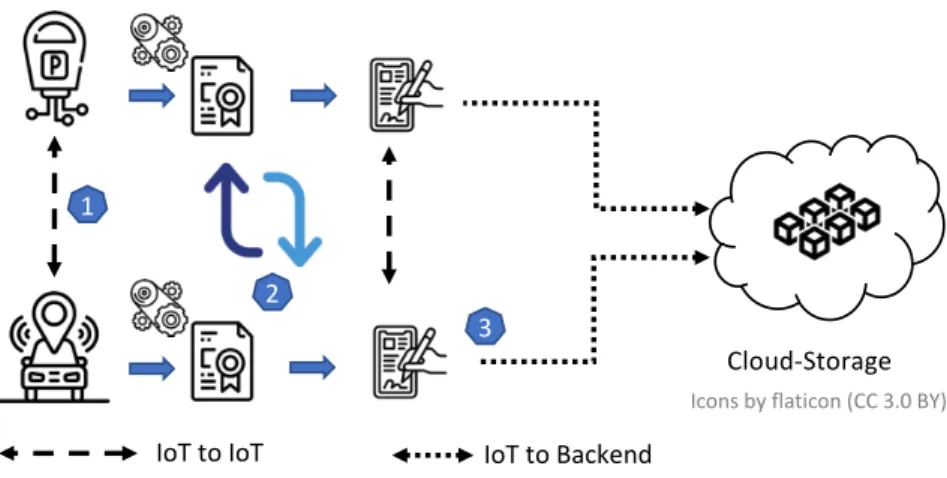
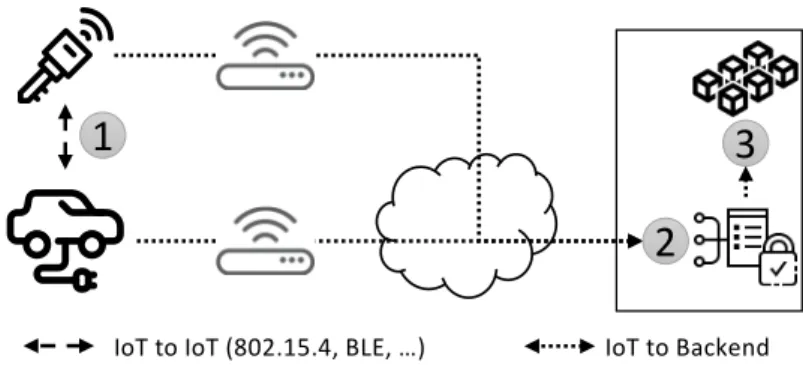
Figure 1.1: The parking application scenario. 1) The car and the parking-lot communicate via a short-range IoT protocol. 2) They reach an agreement for the parking fee. 3) Later, at any time, they can submit the final state to the cloud.
1.1
Motivation and Challenges
One useful feature of IoT systems is that cloud services may use Internet connections to have access to sensor readings and actuators in remote locations. Processing of sensor data can reveal valuable information, and often initiate control signals to actuators. In IoT systems, it is typical to use low-cost embedded devices with low-power consumption, able to operate autonomously for years. These devices experience significant constraints in terms of memory, energy, and computation capabilities. Moreover, embedded devices often have tight latency requirements with real-time properties.
As motivation, we present an example in Figure 1.1. In this example, two IoT devices interact with each other to negotiate parking fees. It is vital for IoT devices to interact with a local context (e.g., sensor data) and, at a later time, forward their interactions to the cloud where storage resources are abundant. In this scenario, IoT devices are making their interactions into two phases. In the first phase, IoT devices need to agree on the local conditions gathered from sensor data to evaluate the value of an agreement. In the second phase, IoT devices forward their interactions to the cloud, where the IoT application ensures the agreement conditions have been fulfilled. However, IoT devices do not trust each other, as they are commonly owned or operated by different stakeholders. The different interests of the stakeholders increase the risk of an inaccurate recording of IoT interactions. As these interactions may be part of several IoT agreements and transactions, it is essential to record them accurately.
The above scenario reveals a limitation of IoT devices to cope with a large number of IoT transactions. There are three key proposals to address device constraints. First, starting with the memory limitation, a way to address this challenge is to allow IoT devices to forward their transactions to the cloud, where
1.2. BACKGROUND 3 Previous Block Transactions Hash Transactions Hash Previous Block
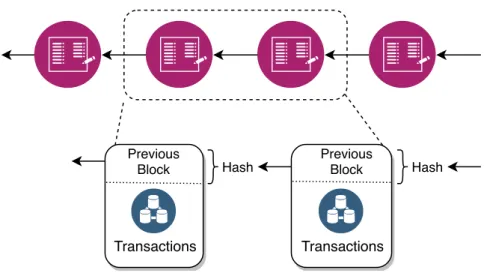
Figure 1.2: The structure of a blockchain: each block is linked with the previous block using its cryptographic hash value. Each block consists of several transactions.
hardware resources are abundant. However, cloud models face a scalability issue and fail to handle a large number of transactions. It is infeasible to send billions of transactions from IoT devices to the cloud, without exhausting the available bandwidth. Second, a way to overcome the bandwidth limitation is the proposal of edge computing. With this model, we place edge devices with enough computational resources closer to IoT devices. However, by using multiple edge devices, we create a distributed network, which requires active synchronization. It is infeasible to continuously communicate and synchronize IoT devices to edge computing without depleting the energy resources of IoT devices. Third, a way to overcome energy limitation is to allow IoT devices to perform duty cycling. However, duty cycling leads to intermittent network connections.
1.2
Background
This section provides an overview of the topics relevant to the thesis. First, we discuss the properties of distributed ledger technology (the so-called blockchain) relevant to the IoT applications and inherent challenges. Second, we intro-duce the concept of smart contracts and how they enforce various financial agreements. Finally, we review two major security properties in the context of resource-constrained devices.
1.2.1
Blockchain
A blockchain is essentially a type of distributed ledger [1], where multiple nodes keep replicated blocks of transactions as an append-only data structure. The data structure is a linked list that chains together the next block by using the cryptographic hash value of the previous block. The structure of a
blockchain is visualized in Figure 1.2. With this structure, it is trivial for each node in the network to verify the validity of every new appended block. Any change to an older block inherently invalidates all chained blocks. As blocks are replicated over multiple nodes in the network, the nodes need to reach a consensus regarding the order of the blocks. Several algorithms have been proposed to reach a consensus in a blockchain, such as Proof of Work (PoW) [2], Proof of Stake (PoS) [3], and Practical Byzantine Fault Tolerance (PBFT) [4]. For example, Bitcoin [2] uses a PoW algorithm. In this algorithm, every node can participate in the consensus algorithm. A node in the network may propose the next block by solving a probabilistic mathematical problem. When a node solves the mathematical problem, it creates and broadcasts a new block to the network for validation.
The increasing deployment of large-scale blockchains reveals several scalabil-ity issues, for example, low transaction throughput [5–7]. The append-only data structure creates an ever-growing blockchain which reaches large sizes in a short period of time [8]. The number of transactions that the network can handle is relatively small compared to traditional transaction systems. Currently, the throughput is an order of tenth per second [5], compared to an order of thousands when using traditional financial systems, such as credit cards. The research community has proposed several ways to scale the blockchains, such as sharding [9, 10], consensus algorithm variations [1], trusted execution [11], side-chains [12], payment channels [13, 14], and payment networks [15, 16].
In the context of IoT, we can identify three resource-intensive requirements that make blockchains challenging to adopt in resource-constrained devices. First, the consensus algorithms require extensive processing power from partici-pating nodes. Second, participartici-pating nodes require sufficient network bandwidth to broadcast each block. Third, the ever-growing blockchain requires sufficient memory to store the complete data structure.
1.2.2
Smart Contract
A smart contract is an executable program replicated in a blockchain. The primary use for a smart contract is the digital representation of financial agreements between untrusted parties. The parties assign a public key to a smart contract that anyone can use and send transactions to it through a blockchain network. Smart contracts have variables to store their states in a blockchain, and the execution of it may update the state of a blockchain. Each node participating in the consensus process of a blockchain executes and validates every smart contract. It is typical to use a Virtual Machine (VM) and write a smart contract in a high-level programming language [17].
The current design of VMs for smart contracts assumes a sequential exe-cution with no support for parallel or concurrent exeexe-cution. Moreover, smart contracts do not have access to data outside of a blockchain network, limiting their ability to handle events of the real world. With the current design, in order to include sensor data inside a smart contract, we need to use a third party, the so-called Oracles [18]. We argue that Oracles, acting as third parties, oppose the fundamental principle of blockchain to replace central authorities. In the context of IoT, we can identify two main obstacles to adopt smart contracts on IoT devices. First, smart contracts are written in high-level
1.3. DOMAIN PROBLEMS 5
languages which are commonly too memory-intensive for resource-constrained devices. Second, the virtual machines of current blockchains do not provide any opcode to handle sensor data or send signal to actuators.
1.2.3
Security Properties
The security of payment protocols is crucial for the success of many applications, especially in IoT. In this thesis, we focus on two security properties of IoT devices. First, we focus on theintegrity [19] of the software running on the embedded device. Second, we focus on thenon-repudiation[19] property of transactions between two or multiple untrusted parties, commonly found in our application scenarios.
It is common for manufacturers of embedded devices to divide the boot process into several steps due to memory constraints. Commonly, they divide the boot process of embedded devices into three steps. First, the boot-ROM is the initial software running when a device starts. Second, the boot-loader is the software responsible for transferring control to the operating system. Third, the operating system is the final software that starts the application(s) of the device. We investigateSecure Boot[20], as a way to ensure the integrity of software of all the above steps.
One way to achievenon-repudiationis to exchange cryptographic signa-tures of a pre-agreed message such that either both parties or none obtain a signed message. We use the term fair exchangeto refer to the property of signature exchange protocols where either both or none of the participants obtain the cryptographic signature. Acontract signing protocolallows two or multiple parties to exchange signatures in a fair-way. We group the contract signing protocols in three categories: protocols with an online Trusted Third Party (TTP) [21], protocols without TTP (e.g., time commitments [22]), and protocols with an off-line TTP (e.g., optimistic [23]).
1.3
Domain Problems
In this section, we introduce three domain-problems that motivate our work: a) malicious software modification, b) non-repudiation of IoT transactions, and c) inability of IoT transactions to include sensors readings and actuators.
1.3.1
Malicious Software Modification
In the first problem-domain, we encounter malicious modifications of the software running on IoT devices. The possibility of these modifications decrease the trust in the data produced by the sensors and actuators commonly found in an IoT application.
Motivation. As the Internet of Things (IoT) brings connectivity to ev-eryday objects, embedded devices get exposed to numerous cyber-attacks [24]. Device manufacturers commonly design their systems to work in isolation with little exposure to Internet connections. With Internet connectivity, internal structures, such as the firmware of the device, are now exposed to cyber-attacks such as malicious software modifications. These modifications can remain
unnoticed for an extended period of time, which raises questions regarding the trust in the data originating from the device.
For example, a possible malicious user can find ways to remotely connect into an IoT device and replace the existing firmware with one containing malicious code. The malicious code will be the first function to be executed every time the device boots-up, prior to any security protection mechanism. Therefore, any malicious activity of the device can remain hidden.
A common approach to detect software modifications is to ensure the integrity of the software during the boot process, the so-called Secure Boot. It is common to findSecure Boot inside a desktop computer [25]. However, in the domain of embedded systems, it is quite rare.
Challenges. The process of Secure Boot in any device requires the ex-tension of the system with additional software or hardware. The resource-constrained devices need to overcome two significant overheads to adopt these additional components. First, it requires an extension of the boot-up software or hardware. This additional software or hardware increases the complexity of the boot-up process, and it depletes the limited resources of the embedded de-vice. Second, it introduces extra sequential steps in the boot-up process, which delays the start-up time and may affect the usefulness of the user-application.
When it comes to embedded devices, we can find a broad range of devices. This variety makes it hard to adopt anySecure Boot process uniformly. More-over, IoT applications have different delay and response requirements. One main challenge is to recognize and adopt the overheads introduced bySecure Boot.
Related work. There is a large body of research in the field of Secure Boot. Khalid et al. [26] discuss the difference between Secure and Trusted Boot, and they further evaluate the performance overhead on FPGA boards. Lebedev et al. [27] give examples of a remotely attested system using FPGA boards.
From the practitioner’s side, Google’s Chromium OS uses Verified Boot to build a chain of trust [28]. Asokan et al. [29] focus on solutions regarding firmware updates on large-scale IoT deployments. For resource-constrained devices, Boot-IoT [30] proposes an authentication scheme for secure bootstrap-ping. We can see the need for Secure Boot on different device sizes ranging from consumer-level printers to industrial robots [31, 32].
Open problems Even though researchers propose several methods to ensure the integrity of device firmware, most of them have not been evaluated on resource-constrained devices. Moreover, there are millions of connected devices without any measure to verify the software they run. In most cases, there is no way to update or change the software after the deployment of IoT devices.
1.3.2
Non-Repudiation of IoT Transactions
In the second domain-problem, we focus on the challenges involved in ensuring non-repudiation of IoT transactions. In our case, the non-repudiation property would be violated if a completed IoT transaction is wrongly recorded or not stored at all, or if a misbehaving node is not immediately reported.
Motivation. In a typical IoT application, small devices need to interact frequently, producing billions of transactions that their stakeholders want to
1.3. DOMAIN PROBLEMS 7
store. In this case, the interacting IoT devices commonly do not trust each other, as they are, for example, owned or operated by different stakeholders. Moreover, the distributed nature of IoT applications makes it challenging to record such interactions coming from distrusting nodes.
Blockchain technology, as described in Section 1.2, stores blocks of transac-tions in the form of an immutable linked list. Moreover, blockchain promotes a verifiable property of transactions in a network of untrusted parties. This property makes the blockchain an ideal candidate for storing the billions of transactions produced by IoT devices.
As motivation, we present an application in Figure 1.1, where one device provides a service to another for an exchange of money. The small embedded devices are limited in terms of the connectivity that they can establish. Thus, it becomes infeasible to verify each transaction by contacting an online verification service every time. It is more reasonable for the devices to interact off-line using the online services only in case of a dispute. The devices can ensure a non-repudiation property of their transactions by applying a contract signing protocol to sign their transaction in a fair-way [33]. In this thesis, we are motivated by the advances in the cryptographic capabilities of embedded systems [34], and we identify new opportunities for applying cryptographic protocols to sign IoT transactions.
Challenges. In order to operate a blockchain network with IoT nodes, we face three key challenges. First, blockchain nodes require sufficient network bandwidth to broadcast a large number of messages. Blockchains require network bandwidths that is beyond the capacity of resource-constrained devices. Even in the case of a broadband connection (e.g., 5G), its energy requirements will deplete the battery of the device too quickly. Second, it is inevitable for devices to off-load their transactions to the cloud as their storage capacity is insufficient to store the complete blockchain. Third, nodes participating in a blockchain network need to use heavy-cryptographic operations to verify each block.
The resource limitations of IoT devices lead to three relaxations. First, nodes need to operate, assuming intermittent network access. They need to utilize edge connections to reach cloud-based blockchains. Second, nodes need to act optimistically and create off-line transactions. In case of a conflict, they should contact cloud services to resolve it. Third, nodes need to use lightweight protocols to address device limitations in terms of memory, computation, and energy consumption.
Related work. Recent studies on the affordability of cryptographic oper-ations on embedded devices [35] [36] inspire the idea of utilizing a blockchain in the context of IoT. However, current architectures focus on power-full de-vices, and they overlook the limitations of the resource-constrained devices [37]. Several architectures [38] [39] identify the ability of blockchains to provide data provenance. While other studies, such as AGasP [40] and Edgechain [41], identify different applications of blockchains within IoT.
Open problems. Even though state-of-the-art has increased the adoption of IoT devices within blockchains, there are still significant limitations. We identify three key limitations of the existing approaches. First, they are not able to ensure non-repudiation of IoT transactions. Non-repudiation is essential, as stakeholders often have a conflict of interest, and we need to ensure they
cannot deny any transaction. Second, current architectures require significant communication and fixed connection points, which overlooks the limitation of resource-constrained devices. For example, in prominent designs [41] [42], nodes participating in the networks need to actively communicate and broadcast their transaction, demanding considerable energy capacity. Third, data tampering and device impersonation attacks [43] raise concerns about the secure collection of sensor data.
1.3.3
Sensor Readings and Actuators as part of IoT
Trans-actions
In the third domain-problem, we encounter the inability of IoT transactions to include sensors readings and actuators.
Motivation. We can imagine a smart car and a parking lot negotiating hourly parking fees by utilizing sensor data (see Figure 1.1). After the smart car and parking lot reach an agreement, they can publish it on the blockchain. The involved parties can utilize payment channels (see Section 1.2) to perform off-line transactions, and at a later time, enforce the payments by publishing a final state in the blockchain.
The parking application reveals two main challenges. First, the current technology of blockchains and smart contracts assumes powerful nodes. For example, Ethereum [17] uses a virtual machine to execute smart contracts, and nodes need to connect to the blockchain both to upload their frequent transactions and to query updates. Second, smart contracts do not have access to sensor readings and actuators. Thus, an application using a smart contract is unable to utilize the local context (sensor data) of the environment (e.g., parking slot).
We recognize the following two properties for the above application. First, the application needs to utilize sensor readings and actuators inside a smart contract. This ability will allow the application to make decisions based on local conditions. Second, the application expects the exchange of transactions to happen quickly. In our application, we expect a car and a parking lot to finish a transaction in the order of seconds.
Related work. The increasingly large-scale deployments of blockchains reveal the limited scalability of its payment system [6, 7]. The scalability of blockchains is an active field with several proposals, such as sharding [9, 10], consensus algorithm variations [1], and trusted execution [11]. In this thesis, we look into three prominent proposals for scaling the payment system of blockchains. First, research studies propose the extension of the blockchain system with payment channels [13, 14]. With a payment channel, two or more parties can swiftly exchange off-line payments, and at a later time, update the blockchain with the final state. Second, other research studies extend the idea of payment channels with payment networks [15, 44, 45]. With a payment network, nodes can reuse existing payment channels to route payments without the need to reopen and close new channels. Third, the proposal of side-chains [12, 46] attempts to solve the scalability issues in a different way. The idea of side-chains is to create and maintain one or multiple separate off-line chains connected to the main blockchain. A published smart contract on the main blockchain acts as a root of a side-chain. Finally, an exit function allows off-chain nodes to
1.4. RESEARCH QUESTIONS 9
claim tokens from the main blockchain.
Another research area focuses on the inability to include data from the physical world in blockchains. Several proposals focus on third parties that act as an Oracle [18] inside the blockchain. For example, TownCrier [11] provides HTTPS-enabled data from websites. Moudoud et al. [18] propose an Oracle for industrial supply chains.
Open problems. Even though payment channels offer a solution to scalability issues of blockchains, there are two main challenges to make payment channels applicable in the context of IoT. First, a payment channel requires the exchange of several messages. These requirements are questionable on resource-constrained devices. Second, the off-line exchange of payments uses heavy-cryptographic computations to sign each state. There is a lack of empirical analysis of the feasibility of IoT devices to execute such off-line payments.
Another issue with existing proposals is that they do not integrate any local context (e.g., sensor data) in IoT applications. Smart contracts are not well designed to handle input from the outside world. The current data providers (e.g., Oracles) do not give a direct way for a smart contract to include sensor readings and actuators as part of a transaction. Overall, we recognize a gap between high-level blockchain architectures and the need to integrate sensor data and actuators of IoT devices.
1.4
Research Questions
Based on our discussion and the challenges presented in Section 1.3, we introduce three main research questions that motivate this thesis:
• RQ1: How can we ensure the software integrity of IoT devices?
• RQ2: How can we provide non-repudiation for IoT transactions?
• RQ3: How can sensor readings and actuators become part of IoT trans-actions?
RQ1 becomes particularly important when considering the untrusted nature of the IoT environment. Any malicious user can try to modify the device software through Internet connections. There are several approaches to ensure the integrity of the software when it comes to desktop computers. However, resource-constrained devices face different performance and run-time overheads compared to desktop computers.
RQ2 and RQ3 become important when considering billions of IoT trans-actions coming from small embedded devices. The ability to store billions of transactions is quite challenging when applied to resource-constrained devices. We need to ensure that none of the stakeholders can deny any transaction between IoT devices. On the other hand, IoT applications need to include sensor readings and actuators as part of IoT transactions.
1.5
Scope and Delimitation
This thesis is a systems research study that covers aspects of data verification, recording, and processing in the context of the Internet of Things (IoT). The thesis uses empirical experimentation on a system level to investigate properties relevant to the deployment of IoT devices. Our motivation stems from recent advances in cryptographic operations on IoT devices and the potential use of distributed ledgers to store IoT transactions. This thesis addresses challenges related to the integration of resource-intensive technologies on resource-constrained devices.
The integrity of the software running on the devices is an important security property when it comes to the massive adoption of IoT devices. These connected devices are vulnerable to cyber-attacks and penetration from malicious users. Any intruder can modify the executable files of the device through Internet connections and compromise essential functions of the system. The prevention of malicious software modification is critically important in the context of the IoT, as it is common for these devices to include sensors and actuators in safety-critical environments, e.g., the fire-alarm of a building.
Recording of interactions between IoT devices, as in any other distributed system, is an essential property of the system. Multiple parties are involved in the process, and they do not trust each other as they may face a conflict of interest. However, maintaining a distributed ledger of interactions is challenging for resource-constrained devices. Distributed ledgers are resource-intensive technologies, and small embedded devices face constraints in terms of memory, computation, and communication capacity.
Finally, we limit our study within two boundaries. First, our study inves-tigates techniques to ensure the integrity of device software limited to detect malicious firmware modifications. Our thesis does not introduce a general protection mechanism against cyber-attacks. Second, the privacy of IoT trans-actions is limited to existing techniques suitable for blockchains. Our study does not propose any design alteration on the existing blockchains.
1.6
Thesis Contributions
In this section, we outline the contributions of the appended papers in relation to our research questions. The papers address the domain-problems mentioned in Section 1.3.
1.6.1
Device Firmware Verification (Paper A)
In Paper A, we identify the performance trade-offs of performingSecure Boot
on medium-scale embedded systems. This work builds on the observation that modern embedded devices have increased capabilities of performing crypto-graphic operations. As a result, conventional techniques designed initially for desktop computers are becoming applicable to resource-constrained devices. With that in mind, we target medium-scale embedded devices, and we show how different cryptographic algorithms affect the boot-up time. In this way, we contribute towardsRQ 1and identify trade-offs when it comes toSecure Bootwith relation to time performance.
1.6. THESIS CONTRIBUTIONS 11
We follow a two-step approach. First, we identify two secure boot techniques that are applicable on medium-scale embedded devices: i) a software-based technique where the verification is part of the boot-loader, and ii) a hardware-based technique where we extend the device with additional hardware to store the verification software in a trusted way. Second, we analyze the trade-off of secure boot techniques concerning time performance. We emphasize time performance as we identify it as a crucial element for several applications. For example, safety-critical embedded devices usually have strict boot-up times as any delay can lead to life-risks. Another example is a home appliance, where users frequently restart their devices, and they expect devices to become quickly available. In that case, the boot-time can determine the usability of a device. For our experiments, we use wide-spread platforms such as Beaglebone and Raspberry Pi. We implement and evaluate two secure boot techniques on these platforms. We investigate the trade-offs of a software-based and a hardware-based technique. In the case of the software-based technique, we show a time overhead of 4% relative to the original boot process. In the case of the hardware-based technique, the additional overhead is 36%. This relatively high overhead of the hardware-based technique is reasonable as the extra hardware is used for additional security purposes rather than increasing performance.
1.6.2
Recording IoT Transactions (Paper B)
In Paper B, we introduce IoTLogBlock, a novel architecture for recording IoT transactions using a blockchain. With this architecture, we address the challenges of storing records of interactions coming from IoT devices that do not necessarily trust each other. The devices are owned and operated by different entities with a conflict of interest. We investigate the challenges of managing and registering untrusted IoT devices using a blockchain network. Through this work, we contribute towards RQ 2by designing and implementing an architecture to record IoT transactions. We show the trade-offs of using a blockchain to record transactions coming from resource-constrained devices.
We motivate our work using a car rental service application. In this application, a company provides rental cars distributed throughout a city. A customer willing to rent a car needs to reach an agreement with the rental company. In this case, the stakeholders are known in advance, but they are facing a conflict of interest, and they do not necessarily trust each other.
IoTLogBlockfocuses on resource-constrained devices, and it consists of three building blocks: a) a lightweight contract signing protocol, b) a smart contract, and c) a blockchain. The contract signing protocol achieves non-repudiation of off-line transactions by utilizing an on-line entity to report any misbehavior. We design a smart contract to act as the on-line entity to report complete transactions or misbehaving nodes. The blockchain network is used to store the transactions permanently.
We took into consideration three potential threats when designing our architecture. First, an adversary may try to skip reporting transactions. Second, we consider an adversary that may try to remove stored transactions. Third, an adversary can try to include unverified transactions. In our design, we took care of the above threats and motivate our prevention measures.
and quantify the performance of IoTLogBlock in terms of memory, com-putation, and energy consumption. TI CC2538 has a 32-bit ARM Cortex M3 CPU at 32 MHz, 32 KB of RAM, 512 KB of ROM, and 802.15 radio transceiver. Our results show that a recourse-constrained device can create and sign a transaction within three seconds on average. Finally, we evaluate the devices using different network scenarios with edge connections ranging from ten seconds to over two hours.
1.6.3
Smart Contracts on Low-Power Devices (Paper C)
In Paper C, we introduce TinyEVM, a novel system to generate and execute off-chain smart contracts. With TinyEVM, smart contracts have access to sensor readings and actuators of IoT devices. TinyEVM allows IoT devices to create and perform off-chain payment channels considering the resource-constraints of IoT devices. Through this work, we contribute towardsRQ 2
by showing the trade-offs of executing off-chain payment channels on resource-constrained devices. We are considering a broad spectrum of applications where the myriads of IoT devices are frequently exchanging payments in two steps. First, they use their sensor data and actuators upon their environment to agree on payment conditions. Second, they enforce these payments by publishing a final state.
We motivate this work using a parking service scenario. Through this scenario, we show the challenges of negotiating a parking place between two parties using a smart contract. In order to make this scenario feasible, we need to ensure two properties. First, we need the utilization of the sensor data to determine the value of the parking place. Second, we need to enable the parties to finish their interactions and complete a transaction in a matter of seconds.
TinyEVM focuses on resource-constrained devices like TI CC2538 [47], and it consists of three components: a) publishing the on-chain smart contract, b) creating off-chain channels, and c) committing on the on-chain. We achieve these steps by separating the logic of on- and off-chain transactions by designing two smart contracts. Moreover, we design, implement, and extend with IoT opcodes an Ethereum Virtual Machine to execute smart contracts on resource-constrained devices.
We investigate the trade-offs to execute smart contracts on recourse-constrained IoT devices. We test our system with 7,000 publicly verified smart contracts, whereTinyEVM manages to deploy 93% of them. Finally, we evaluate the execution of off-chain smart contracts in terms of run-time performance, energy, and memory requirements. Notably, we find that recourse-constrained devices can deploy a smart contract in 215 ms on average, and they can complete an off-chain payment in 584 ms on average.
1.7
Conclusions and Future Work
This thesis is motivated by the emergence of IoT technologies and their impact on our society. With IoT, billions of devices get connected to the Internet and interact with each other. IoT devices can potentially create billions of transactions and enable new application scenarios. With this work, we target
1.7. CONCLUSIONS AND FUTURE WORK 13
challenges related to accurately recording IoT transactions from resource-constrained devices. We identify three domain-problems: a) malicious software modification, b) non-repudiation of IoT transactions, and c) inability of IoT transactions to include sensors readings and actuators.
For the first domain-problem, we raise the question: How can we ensure the software integrity of IoT devices? We investigate this question in Paper A. In this paper, we perform an empirical evaluation of Secure Booton embedded devices. For the second domain-problem, we raise the question: How can we provide non-repudiation for IoT transactions? We investigate this question in Paper B. In this paper, we proposeIoTLogBlock, an architecture to recording off-line transactions of IoT devices. For the third domain-problem, we raise the question: How can sensor readings and actuators become part of IoT trans-actions? We investigate this question with Paper C. In this paper, we propose
TinyEVM, an architecture that includes sensor readings and actuators by executing off-chain smart contracts on recourse-constrained devices.
Based on insights from our work in the integration of IoT devices with blockchains, we identify two interesting topics for future work. First, there is the open topic of the privacy of stored transactions in a cloud-based blockchain. Second, the off-chain payment channel can be extended into payment networks and improve the scalability of IoT transactions.
Part B
Paper A
Chistos Profentzas, Mirac G¨unes, Yiannis Nikolakopoulos, Olaf Landsiedel, Magnus Almgren,
Performance of Secure Boot in Embedded Systems
Proceedings of the 1st International Workshop on Security and Reliability of IoT Systems (SecRIoT), part of: IEEE International Conference on
Chapter 2
Performance of Secure
Boot in Embedded Systems
With the proliferation of the Internet of Things (IoT), the need to prioritize the overall system security is more imperative than ever. The IoT will profoundly change the established usage patterns of embedded systems, where devices traditionally operate in relative isolation. Internet connectivity brought by the IoT exposes such previously isolated internal device structures to cyber-attacks through the Internet, which opens new attack vectors and vulnerabilities. For example, a malicious user can modify the firmware or operating system by using a remote connection, aiming to deactivate standard defenses against malware. The criticality of applications, for example, in the Industrial IoT (IIoT) further underlines the need to ensure the integrity of the embedded software.
One common approach to ensure system integrity is to verify the operating system and application software during the boot process. However, safety-critical IoT devices have constrained boot-up times, and home IoT devices should become available quickly after being turned on. Therefore, the boot-time can affect the usability of a device. This paper analyses performance trade-offs of secure boot for medium-scale embedded systems, such as Beaglebone and Raspberry Pi. We evaluate two secure boot techniques, one is only software-based, and the second is supported by a hardware-based cryptographic storage unit. For the software-based method, we show that secure boot merely increases the overall boot time by 4%. Moreover, the additional cryptographic hardware storage increases the boot-up time by 36%.
2.1
Introduction
The Internet of Things (IoT) will bring connectivity to everyday objects and devices, including vehicles [48], autonomous robots [49], and smart home appliances [50] (e.g., smart vacuum cleaners, smart cookers, smart heaters). While Internet connectivity allows numerous new applications and use-cases, it exposes devices to the security threats of the Internet: if we connect a device to the Internet, it will certainly be attacked and potentially penetrated, i.e., intruders can read data or even modify executable system files. Such modifications are especially critical in the context of the IoT, as the devices often control physical objects such as the cooling system of a refrigerator or the engine of a car.
Today, we commonly find a secure boot process in regular computer systems, including personal computers [25], data centers [51] and also portable devices such as smartphones or tablets [52]. Those computers usually include extra hardware (e.g., a Trusted Platform Module) to ensure the integrity of the firmware and the operating system during the boot process. However, in the domain of embedded systems, secure boot is often overlooked. Therefore, common IoT devices rarely secure the boot process and fail to assure software free from manipulation [53]. The absence of secure boot opens the door to attacks on mission-critical IoT systems. For instance, recent work demonstrates attacks that alter the firmware of interconnected industrial robots [32]. A secure boot mechanism would have detected such modifications during the boot-up process.
Securing the boot process in embedded devices leads to two significant overheads. Firstly, a secure boot process adds additional hardware and com-plexity. Embedded devices need efficient and simple designs since they face several constraints when it comes to energy consumption and memory capacity. Secondly, verifying the integrity of the operating systems or firmware adds a further delay to the boot process. In some applications, longer boot time may not be affordable. For example, micro-controllers used in the automotive indus-try should be able to boot almost immediately, preferably in the sub-second domain, so that the vehicle can be used directly after ignition [54]. Other examples are smart home devices where users frequently turn them on and off, like vacuum cleaners and electric kettles. For those devices, longer boot-up times lead to less usability for their users.
Embedded devices include a range of different microcontrollers, which we can classify into three groups: small scale (8–16 bit), medium scale (16–32 bit), and sophisticated micro-controllers. This paper focuses on securing the boot process of medium-scale microcontrollers (e.g., Raspberry Pi, Beaglebone) equipped with an embedded operating system.
The paper makes two contributions: (1) We examine two different ap-proaches to secure the boot process of an embedded device. (2) We show the performance and runtime overhead of the secure boot for those two approaches. Our results underline the trade-offs between security and performance: we present the tradeoffs ranging from 58ms to 245ms for a software-based secure boot, which is 5.6–16% of the boot-loader execution time, and 1.4–4% of the entire boot time (4065ms) of an off-the-shelf Linux distribution. For the hardware-based secure boot technique, we observe an overhead of 1900ms,
2.2. BACKGROUND AND DEFINITIONS 17 Boot ROM Primary stage Secondary stage Execute Kernel Valid kernel & configuration?
Yes Abort
No
E.g. X-Loader on BeagleBone & First stage bootloader on RPi3 E.g U-boot on Beaglebone & Second stage bootloader + U-boot on RPi3
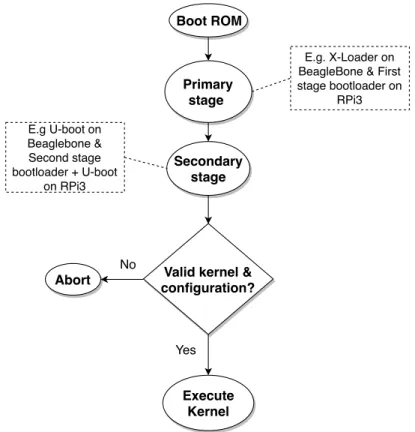
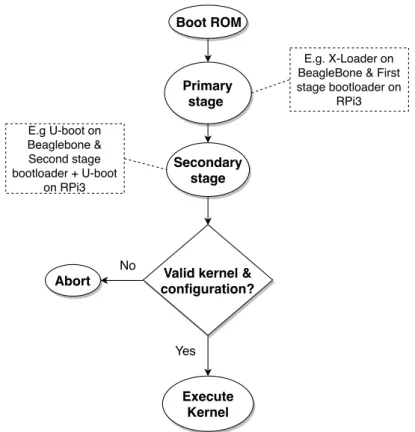
Figure 2.1: The boot process of the medium-scale embedded systems consists of multiple stages. The Boot ROM and first stage boot-loader are hard-coded by the manufacturer and are hard to modify. The second stage and the kernel code are modifiable and usually stored in flash memory.
which is 72% of the boot-loader execution time, and 36% of the entire boot time (5352ms) of an off-the-shelf Linux distribution.
The remainder of the paper is structured as follows. First, Section 2.2 introduces basic concepts and definitions of secure boot. Next, Section 2.3 presents our threat model. We present secure boot on off-the-shelf embedded hardware in Section 2.4 and evaluate its performance in Section 2.5. In Section 2.6 we discuss the limitation of secure boot in IoT devices. Section 2.2 presents related work and Section 2.7 concludes the paper.
2.2
Background and Definitions
In this section, we introduce the required background for both the boot process of a medium-scale embedded device and secure boot in particular.
Boot Process. Commonly, manufacturers of embedded devices divide the boot-up process [55] into several stages (see Fig. 2.1). The purpose of each stage is to prepare the CPU and transfer code fragments from external to internal memory. Eventually, the boot-loader loads the operating system and starts the execution of the kernel. The boot process begins with the Boot
ROM, provided by the manufacturer, which sets and initializes the peripherals. The Boot ROM prepares the system to execute the primary boot stage. The primary stage configures the system and prepares the memory for loading the secondary stage boot-loader. The secondary stage is the actual bootloader of the operating system.
Commonly, both the Boot ROM and the primary stage are tamper-proof, as both are hard-coded in the device firmware. However, manufacturers allow the modification of the second stage to provide flexibility and support for different bootloaders and operating systems. As a result, a secure boot process has to ensure the integrity of the kernel and application code before executing the secondary stage.
Security Challenge. The code in each stage can change the overall status of the system and often the next-stage software. As a result, we cannot trust a self-verified software, as it can be modified to provide a false verification status. Therefore, we need to verify in advance, and before we run each piece of software that we give control over the system.
Secure Boot. In a secure boot process, an inherently trusted component triggers the boot process, which is a tamper-proof component referred to as the
Roots of Trust (RoT) [56]. The Trusted Computing Group (TCG) [56] defines RoT as a set of functions designed to be trusted by the operating system. In embedded systems, RoT can be the Boot ROM (see Fig. 2.1), which verifies the next-stage software and executes only authentic software. Each stage verifies the integrity of the next one leading to aChain of Trust. For the verification, we can use a dedicated monitoring hardware co-processor. TCG has defined an international standard called the Trusted Platform Module (TPM), which defines the properties that those modules need to fulfill.
We note that different standards and vendors use various terminology to describe a secured boot process: Common terms include, for example, Secure boot, Trusted Boot and Verified boot. Different solutions have been defined and implemented in specific environments including personal computers, data centers, routers, and mobile phones [28, 51, 57]. Especially,Secure Boot has been among the standard techniques to define a secured process to assure the integrity of each booting steps [20]. In table 2.1 we compare the terminology for the existing techniques.
Related Work. Recent works demonstrate the need for securing the boot process of connected devices from consumer level printers to industrial robots [31, 32]. There is a large body of research in the field of securing and ver-ifying the boot process. Khalid et al. [26] discuss the difference between secure and trusted boot and further evaluate the performance overhead using FPGA boards. Liu et al. give a slightly different approach for system verification. [58] and Lebedev et al. [27], where they are giving examples of a remotely attested system using FPGA embedded systems. In contrast to our work, they focus on FPGA embedded systems while this paper focus on embedded IoT systems. From the practitioner’s side, Google’s Chromium OS uses verified boot, which builds a chain of trust [28]. For recent work regarding IoT devices, Asokan et al. [29] focus on solutions regarding the firmware update on large-scale IoT deployments. For constraint devices, Boot-IoT [30] propose an authentication scheme towards secure bootstrapping.
2.3. ADVERSARY MODEL 19
Table 2.1: Terminology comparison
Term Halt RoT Verification Added HW
Secure boot [26]
Auto-termination
Boot ROM By certificate authorities (Remote attestation) Not specified Trusted boot [51] Letting users decide
Boot ROM Compare hash values HSM Verified boot [28] Letting users decide
Boot ROM Stored cryp-tographic hash compar-ison Not specified Measured boot [59] No termina-tion BIOS Measures hash of ob-jects and logs them Not specified
2.3
Adversary Model
In this section, we discuss attack vectors on the boot process of IoT systems and introduce our adversary model. A medium-scale embedded device commonly consists of the application itself, an embedded operating system, and the boot firmware. The boot firmware is similar to a BIOS in commodity computers and manages the initial boot process, as discussed in Section 2.2. From a security perspective, a secure boot process has to ensure the integrity of each of these components, i.e., that none of them has been modified maliciously [60]. In the context of connected embedded devices, i.e., IoT devices with Internet connectivity, for example, via 5G/LTE, Bluetooth or WiFi, this leads to two main directions of attack: (1) the traditional attack vector of gaining physical access to the device and (2) adversaries can manipulate the firmware via their Internet connection. Thus, connectivity opens new attack vectors, when compared to traditional embedded devices without connectivity.
To compromise a connected IoT device, an adversary may use security holes in both operating systems and its applications to trigger execution of remote, malicious code. Via this code, an adversary can potentially modify data [61], the OS [62] and also the boot process [31]. The adversary’s goal is to make a permanent malicious modification, which is unobservable to security analysis. Moreover, we argue that for most IoT devices connectivity is essential for their operation, i.e., they cannot provide their services to the users without connectivity. Thus, just disabling Internet connectivity to close this attack vector is not an option for the vast majority of applications. Via physical access, the adversary can directly manipulate and modify the application, OS, and the boot process. The TPM is also exposed by an adversary with physical access, ongoing research by using Physical Unclonable Functions (PUF) [63] is a promising solution. In our threat model and further system design, we focus on the new attack vector that Internet connectivity brings.
Boot loader Enable verified boot
& configure U-Boot
Crypto-algorithms & specifications Kernel Signature Board specifications Link Configure Compile U-Boot kernel verification Run-Time
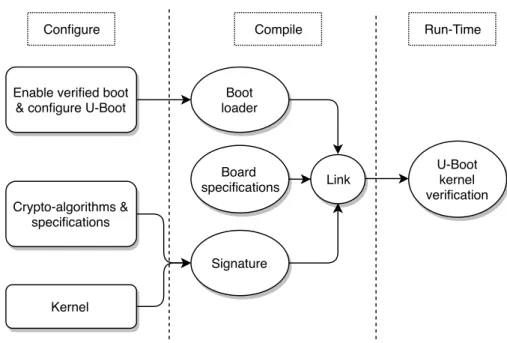
Figure 2.2: From U-Boot configuration to deployment: First, we configure the U-Boot to include the verification module. Next, we link the object files to produce the secure version of U-Boot. Finally, we deploy the executable file on the platform.
2.4
Systems Overview
In this section, we present and discuss two system designs to secure the boot process of an IoT device equipped with an operating system such as embedded Linux: one design is based solely on software mechanisms, and one additionally utilizes hardware primitives. Both designs have specific trade-offs regarding complexity, overhead, and system cost. Both approaches are established [26, 28, 51] in the field, and we do not claim their novelty. Instead, the contribution of this paper lies (1) in comparatively evaluating the overhead that both add to the boot process and (2) in contrasting this overhead to the security each design provides.
2.4.1
Software-based Secure Boot with U-Boot
For the software-based method, we rely on the U-Boot [64] bootloader to verify the integrity of the operating system. In our system design, we make the following assumptions. Firstly, the pre-boot environment of U-Boot has to be trusted, meaning that the security of the boot stages before U-Boot cannot be modified. Typically, the manufacturer embeds the first stage in the Boot ROM. Secondly, U-Boot has to be placed in read-only memory since there is no prior verification of the booting process. Lastly, this design requires read-only storage of the cryptographic hashes used to verify the integrity of the operating system.
2.4. SYSTEMS OVERVIEW 21 Boot ROM Primary stage Secondary stage Execute Kernel Valid kernel & configuration?
Yes Abort
No
E.g. X-Loader on BeagleBone & First stage bootloader on RPi3 E.g U-boot on Beaglebone & Second stage bootloader + U-boot on RPi3
Figure 2.3: Secure boot sequence with U-Boot: U-Boot runs as the second stage, which verifies the kernel and the chosen configuration. U-Boot passes the control of the system to the operating system only after successful verification.
andRun-Time, see Figure 2.2. The software-based secure boot process extends the boot process with an additional verification step, see Figure 2.3. As a result, the bootloader only boots the operating system once it has successfully verified the integrity of the operating system. In practice, U-Boot binds the kernel with the hardware information of the board. Thus, U-Boot verifies that the kernel is correct and it will run on the specific hardware configuration.
To verify the integrity of the kernel efficiently, we need to resolve the digital block data of each image to a single value; a conventional method is to use cryptographic hash functions [19]. Cryptographic hash functions map an arbitrarily long data to a small and fixed output, but they need to fulfill specific properties to be considered cryptographically secure [19]. U-Boot supports three cryptographic hash functions, namely MD5, SHA-1 & SHA-256 [19]. The hash functions have the following digest sizes: (1) MD5: 128-bit (2) SHA-1: 160-bit (3) SHA-256: 256-bit. Finally, the hash digest is being signed by the private key, and the bootloader (U-Boot) can verify the authenticity of the hash value by applying its public key. Various public key algorithms could verify the hash digest of the image. Popular public key cryptographic algorithms are RSA [19] and Elliptic Curve Cryptography (ECC) [19]. U-Boot currently supports only RSA, and the two supported key sizes are 2048-bit and 4096-bit. The key size is the critical factor of public key algorithms; bigger key sizes are
Boot-ROM 1st Stage Boot Loader Fetch U-Boot Pre-Boot Enveroment Measurements Valid Pre-boot Env Yes Measurements Start U-Boot & Fetch Kernel TPM TPM Initialization Valid Kernel Yes Execute Kernel Abort No No TPM
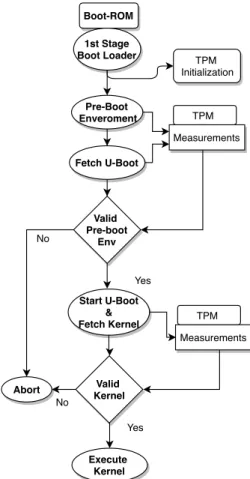
Figure 2.4: Secure boot with a TPM co-processor: The manufacturer provides the boot-ROM and first stage bootloader. We split the second stage into two phases: 1) The pre-boot environment, where we check the integrity of U-Boot. 2) U-Boot execution, where we check the integrity of the operating system.
more difficult to break. On the other hand, the larger the key size, the longer the verification takes [19].
2.4.2
Hardware Security for Secure Boot
After introducing the software-only secure boot process, we next introduce secure boot with a hardware security module. This design further increases the security of the boot process at the cost of adding additional hardware and boot latency.
This design is based on the TPM module as proposed by Khalid et al. [26]. The method always starts with the initialization of the TPM, which ensures that the TPM is activated. The TPM provides the following functions defined by the standard [65]: (1) Measurement, TPM calculates the hash of the input data using SHA-1. (2)Extend, TPM takes the current hash-value inside the register, appends the Measurement and produces a new hash value (3)
2.5. EVALUATION 23
Table 2.2: Hardware specifications
Model Hardware
Raspberry Pi 3 Model B ARM®Cortex A53 - 1.2GHz(quad-core) 1 GB LPDDR2 RAM
Beglebone Black C ARM®Cortex A8 - 1GHz 512MB DDR3 RAM
Cryptocape (by Cryptotronix) TPM-Module:AT97SC3204T
verified entity. The process continues by calculating the cryptographic hash value of the boot environment, which includes the system configuration before loading the secondary stage boot loader (see Section 2.2). The process consists of a repetitive Measure–Extend–Executeprocedure [26]. This method is a common way to ensure aChain of Trust[66], which verifies the integrity of the different stages step by step. The TPM transfers the control of the system to each measured image only if it has successfully verified the extended hash-value. In the case of failure, the boot process will halt as shown in Figure 2.4.
For this technique, we make the following assumption: The first entity of the Chain of Trust needs to be trusted, which in this case is the boot ROM and first stage boot-loader. The manufacturer should embed this code in a way so that nobody can modify it, for example, by placing it in read-only memory.
2.5
Evaluation
This section evaluates both system designs in detail and focuses on the overhead of the secure boot process in each system. Practical application scenarios motivate this evaluation, for example, vehicles are expected to be immediately usable after ignition, imposing a low-latency requirement between turning on the ignition and the full boot up of all the micro-controllers of a vehicle. Also, home appliances like smart vacuum cleaners and smart heaters experience frequent turn off and on by their users, where the boot time can affect the usability of the device.
2.5.1
Experimental Setup
We implement our system design on two generic embedded platforms for IoT applications [67] that are readily available, namely a Raspberry Pi and a BeagleBone (see Table 2.2). Finally, we extend the capabilities of the BeagleBone to support hardware cryptographic primitives.
2.5.2
Evaluation Results
Next, we present the results of our evaluation of the overhead of the secure boot process. We begin with the software-based method and continue with the hardware-based technique. The results summarize the performance of our system design.
0.90 0.95 1.00 1.05 1.10 1.15 Time (s) Md5 Sha-1 Sha-256 Hash Algorithm 0.00 0.05 0.10 0.15 0.20 U-Boot Hash RSA
(a) RSA 2048-bits key-size on BeagleBone
0.90 0.95 1.00 1.05 1.10 1.15 Time (s) Md5 Sha-1 Sha-256 Hash Algorithm 0.00 0.05 0.10 0.15 0.20 U-Boot Hash RSA
(b) RSA 4096-bits key-size on BeagleBone
0.90 0.95 1.00 1.05 1.10 1.15 Time (s) Md5 Sha-1 Sha-256 Hash Algorithm 0.00 0.05 0.10 0.15 0.20 U-Boot Hash RSA
(c) RSA 2048-bits key-size on RaspberryPi
0.90 0.95 1.00 1.05 1.10 1.15 Time (s) Md5 Sha-1 Sha-256 Hash Algorithm 0.00 0.05 0.10 0.15 0.20 U-Boot Hash RSA
(d) RSA 4096-bits key-size on RaspberryPi
Figure 2.5: For the evaluation of U-Boot using the BeagleBone & Raspberry Pi, we apply RSA with a key size of 2048 and 4096 bits. The U-Boot time refers to the performance without the verification module. All figures compare the three available hash functions: MD5, SHA-1, SHA-256. Note the graphs have discontinuing scale numbers
2.5.2.1 Software Mechanism of U-Boot
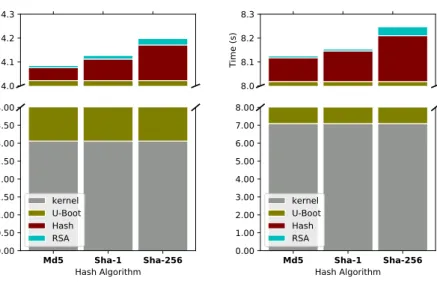
Figures 2.5a, 2.5b, 2.5c & 2.5d present the overhead of verification using different key sizes and three different hash functions (MD5, SHA-1, SHA-256). The average execution time for U-Boot without any security mechanism is 976ms for the BeagleBone and 903ms for Raspberry-Pi. These numbers form the baseline to compare the overhead of secure boot. The entire boot time of the off-the-shelf Linux-kernel (Debian GNU 7) on BeagleBone is 4s, and for Raspberry Pi (Debian Jessie 4.4) is 7s (see Figure 2.6).
2.5. EVALUATION 25 4.0 4.1 4.2 4.3 Time (s) Md5 Sha-1 Sha-256 Hash Algorithm 0.00 0.50 1.00 1.50 2.00 2.50 3.00 3.50 4.00 kernel U-Boot Hash RSA
(a) Entire Boot Time: BeagleBone
8.0 8.1 8.2 8.3 Time (s) Md5 Sha-1 Sha-256 Hash Algorithm 0.00 1.00 2.00 3.00 4.00 5.00 6.00 7.00 8.00 kernel U-Boot Hash RSA
(b) Entire Boot Time: RaspberryPi
Figure 2.6: Evaluation of entire boot time using the BeagleBone & Raspberry Pi. The RSA key-size is 2048-bits, and we compare with the three available hash functions: MD5, SHA-1, SHA-256. The RSA overhead is very small and barely visible. Note: the graphs have discontinuing scale numbers
We begin evaluating the overhead that different hash functions in U-Boot bring. In this evaluation, we set the key-size of RSA to 2048-bit and use BeagleBone. With the MD5 hash function, the average overhead is 58ms, representing 5.7% of the U-Boot execution time (see Figure 2.5a), and 1.4% of the entire boot time of the Linux kernel (see Figure 2.6a). With the SHA-1 hash function, the average overhead increases to 117ms, which is 11% and 2.8% of the U-Boot execution (see Figure 2.5a) and the entire boot time of the Linux kernel (see Figure 2.6a), respectively. For SHA-256 hash function, the overhead increases to 164 ms, 15% and 4%, respectively (see Figure 2.5a & 2.6a).
Next, we increase the key-size of RSA to 4096-bits, using the same hash functions and BeagleBone. This key-size increases the overhead by 24ms to 35ms depending on the hash function (see Figure 2.5b). For the same experiment using Raspberry Pi, we observe similar results (see Figures 2.5c & 2.5d).
2.5.2.2 TPM Hardware on BeagleBone
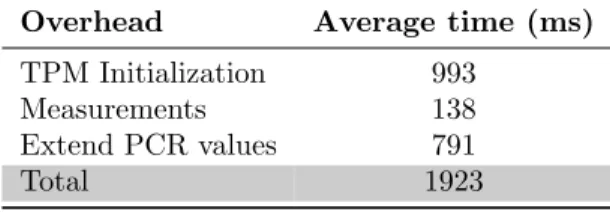
Table 2.3 presents the overhead after introducing the hardware primitive (TPM). The initialization of the TPM takes 993ms. TPM uses SHA-1 as the hash function and the overhead of calculating the measurements (see Section 2.2) is 138ms. For extending the Registers (PCR) TPM takes 791ms. Overall, the whole method takes 1923ms, which adds an overhead of 36%.
Table 2.3: Verification overhead of TPM
Overhead Average time (ms)
TPM Initialization 993
Measurements 138
Extend PCR values 791
Total 1923
2.5.3
Discussion
Configuration choices, like the hash function, have different performance impact and trade-offs. For example, MD5 provides better performance, but it is no longer recommended [68]. FIPS 180-4 Secure Hash Standard (SHS) recommends SHA-1 and SHA-256, but Stevens et al. [69] have found the first collisions on SHA-1.
Regarding the performance of Secure boot with TPM, we have noticed a higher verification overhead (approximately eight times more) compared to the software-based technique (Verified U-Boot). The main reason for this is that there are more measurement requirements in this method: we verify the kernel, U-Boot and boot states which include the complete system configurations. Another source of overhead is the initialization time of the TPM. It is worth to notice that the extra hardware does not intend to accelerate the cryptographic functions, but rather to provide stronger security properties as we