A G E N E R A L F R A M E W O R K
F O R C O S T - S E N S I T I V E
B O O S T I N G
au t o r
:
i a g o l a n d e s a vá z q u e z
d i r e c t o r
:
j o s é l u i s a l b a c a s t r o
F O R C O S T - S E N S I T I V E
B O O S T I N G
m e m o r i a q u e p r e s e n ta
i a g o l a n d e s a vá z q u e z
pa r a o p ta r a l g r a d o d e d o c t o r p o r l a u n i v e r s i d a d e
d e v i g o
,
c o n m e n c i ó n d e d o c t o r a d o i n t e r na c i o na l
d i r e c t o r
j o s é l u i s a l b a c a s t r o
Departamento de Teoría do Sinal e Comunicacións Escola de Enxeñaría de Telecomunicación
Universidade de Vigo
Por
la
presente,
y
como
Director
de
la
misma, autorizo
la
presentación
ydefensa de la
tesis
doctoral titulada
"A
general framework for
cost-sensitive boosting", por parte de suautor, lago
Landesa Vázquez.lgualmente
autorizo
la solicitudde
la Menciónlnternacional para
la misma.Atentamente,
José
LuisAlba
CastroVigo,
30de
mayode
2014 'I-clcrr>rnunicacicil r Carnpus Iinivcniuuro 36ill0 \''isoLlv¡na
fosó l,uis Alba Castrrr
Don’t want to see another generation drop I’d rather be a comma than a full stop Maybe I’m in the black, maybe I’m on my knees Maybe I’m in the gap between the two trapezes But my heart is beating and my pulses start Cathedrals in my heart
— Coldplay - Every Teardrop Is A Waterfall
Subo la música, pongo mis discos Desde debajo de los escombros canto una canción rebelde No quiero ver a otra generación caer Prefiero ser una coma, no un punto final Quizás lo vea todo negro, quizás esté de rodillas Quizás esté en el hueco entre los dos trapecios Pero mi corazón está latiendo, y mis latidos construyen Catedrales en mi corazón
— Coldplay - Every Teardrop Is A Waterfall (Interpretación en Español)
Boosting algorithms have been widely used to tackle a plethora of problems. Among them, cost-sensitive classification stands out as one of the scenarios in which Boosting is most frequently applied in practice. In the last few years, a lot of approaches have been proposed in the literature to provide standard AdaBoost with asymmetric ca-pabilities, each with a different focus. However, for the researcher, these algorithms shape a confusing heap with diffuse differences and properties, lacking a unified framework to jointly compare, classify, analyze and discuss the approaches on a com-mon basis.
Motivated by the preeminent role of AdaBoost in the Viola-Jones framework for object detection in images, a markedly asymmetric learning problem, in this thesis we try to untangle the different Cost-Sensitive AdaBoost alternatives presented in the literature, demystifying some preconceptions and making novel proposals (
Cost-Generalized AdaBoost and AdaBoostDB) with a full theoretical derivation. We try to
classify, analyze, compare and discuss this family of algorithms in order to build a general framework unifying them. Our final goal is, thus, being able to find a definitive scheme to translate any cost-sensitive learning problem to the AdaBoost framework while shedding light on which algorithm ensures the best performance and formal guarantees.
k e y w o r d s: AdaBoost, Classification, Cost, Asymmetry, Boosting, Object Detection
Tradicionalmente, el esquema clásico para resolver un problema de clasificación se ha basado en la búsqueda de un único experto con la complejidad suficiente para construir, por sí mismo, una solución al problema planteado. Sin embargo, durante las últimas décadas, el desarrollo de un nuevo paradigma de clasificación, basado en la combinación de varios expertos (generalmente más simples) en un esquema de de-cisión distribuido, ha irrumpido con gran fuerza en el ámbito de Machine Learning. El éxito de este paradigma, sustentado en sus múltiples ventajas teóricas, prácticas e incluso biológicas (propiedades de generalización, complejidad, manejo de datos, fusión de diferentes fuentes de datos, etc.), ha llegado a hacer de estosConjuntos de
Clasificadores [49] una solución preferible al esquema clásico en multitud de
escena-rios.
Uno de los hitos fundamentales en el desarrollo de este tipo de estrategias lo mar-có el trabajo publicado por Robert E. Schapire en1990[53], en el que se demostraba
que los algoritmos de aprendizaje débil (aquellos capaces de generar clasificadores con una tasa de acierto ligeramente superior a una decisión aleatoria) podían llegar a conformar clasificadores fuertes (aquellos que sólo fallan en una fracción arbitra-riamente pequeña de las instancias), si eran combinados de manera apropiada. Este esquema de “incremento” de las prestaciones de los esquemas de clasificación fue bautizado comoBoosting, y significó el primer paso de una prolífica familia de algo-ritmos, dentro de la que, AdaBoost [17] es el algoritmo por excelencia.
Gracias a sus garantías teóricas, a sus ventajas prácticas y a la extraordinaria resis-tencia que presenta en la práctica al fenómeno del overfitting (sobrejuste), AdaBoost ha recibido desde su publicación inicial en1997 [17], una atención “en raras
ocasio-nes igualada en el ámbito de la inteligencia computacional” [49], siendo un tema de
investigación activo en los ámbitos de machine learning, reconocimiento de patrones y visión por computador [55,26,54,45,19,41,64,20,40] hasta la actualidad.
Entre los diferentes problemas de clasificación, un subconjunto muy relevante es el de los escenarios en los que están definidos diferentes costes en función de cada posible decisión del sistema, así como aquellos en los que una de las clases es mucho más frecuente o fácil de muestrear que la otra. En estas situacionesasimétricas o
sen-sibles al coste(piénsese en predicción de desastres, detección de fraudes, diagnósticos
médicos, detección de objetos, etc.), los clasificadores, en lugar de buscar hipótesis que se ajusten lo mejor posible al global de los datos, deben centrar su atención en las clases que se consideran más valiosas o que son menos frecuentes.
La relación entre AdaBoost y los problemas asimétricos tiene además una relevan-cia práctica esperelevan-cial, dado que AdaBoost es el algoritmo de aprendizaje que utiliza el sistema propuesto por Paul Viola y Michael J. Jones [64] para detección de objetos *This is an extended abstract to summarize, in Spanish, the main contents and contributions presented throughout this thesis.
objetos que se utilizan hoy en día, y lleva implícito un problema de marcado carácter asimétrico.
Teniendo en cuenta que AdaBoost es un algoritmo planteado para escenarios simé-tricos, se hacía necesario dotar al algoritmo de propiedades asimétricas, de forma que a lo largo del tiempo se han ido proponiendo en la literatura multitud de variantes para tal fin (por ejemplo, [26, 10, 60,64, 63, 57, 39, 40]). Sin embargo, las diferentes
propuestas hacia un AdaBoost asimétrico que han ido apareciendo en la literatura son muy heterogéneas, presentan propiedades y diferencias muy difusas, y en mu-chos casos están basadas en modificaciones heurísticas del algoritmo inicial. Como consecuencia, para el investigador, se presentan como un conjunto enmarañado de algoritmos carente de un marco general capaz de clasificar, analizar y discutir sus propiedades sobre una base común y objetiva.
En esta tesis, motivados por el papel esencial de AdaBoost en el esquema de Viola-Jones [64] para detección de objetos en imágenes, tratamos de desenmarañar las
di-ferentes aproximaciones asimétricas de AdaBoost que se han ido presentado en la literatura a lo largo del tiempo, derribando algunas ideas preconcebidas, y haciendo nuestros propios desarrollos teóricos que desembocan en nuevas propuestas algorít-micas (Cost-Generalized AdaBoost y AdaBoostDB). Con el objetivo final de encontrar un esquema definitivo capaz de trasladar cualquier problema de aprendizaje asimé-trico al marco de AdaBoost, intentamos clasificar, analizar, comparar y discutir los diferentes algoritmos en un un marco general que los unifique y nos muestre cuál de ellos ofrece las mejores prestaciones y garantías formales.
e s t r u c t u r a
La tesis está estructurada en los siguientes capítulos:
En elCapítulo2introducimos los conceptos básicos de AdaBoost y la aplicación
práctica que motivó que centráramos nuestra investigación en los algoritmos de boosting asimétrico: la detección de objetos en imágenes.
En elCapítulo3hacemos una revisión de las principales variantes de AdaBoost
asimétrico propuestas en la literatura previamente a nuestra investigación, pro-poniendo asimismo un esquema de clasificación de las mismas basado en el tipo de estrategia de asimetría seguida en cada caso.
En elCapítulo4presentamos una nueva perspectiva para analizar AdaBoost de
forma condicional a cada clase. Este análisis “Generalizado con Costes” (
Cost-Generalized) nos muestra que, más allá de algunas ideas preconcebidas, la
inicia-lización desbalanceada de la distribución de pesos del algoritmo, puede hacer de AdaBoost un algoritmo de clasificación asimétrico con plena fundamenta-ción teórica.
En elCapítulo5, proponemos un marco analítico de desarrollo a partir del que
derivamos una nueva variante de AdaBoost aasimétrico que hemos
se, y durante el entrenamiento utiliza dossubdistribuciones paralelas de pesos, una para positivos y otra para negativos.
En elCapítulo 6realizamos un análisis exhaustivo para comparar todos los
al-goritmos tratados durante la tesis (tanto los nuestros como los de otros autores en la literatura). Con el objetivo final de clarificar las propiedades específicas y el comportamiento de cada uno de ellos, nuestro análisis finaliza apuntando hacia el algoritmo que es capaz de asegurar las mejores prestaciones y garantías formales.
Finalmente, en elCapítulo7, recapitulamos las ideas principales, contribuciones
y conclusiones extraídas de esta tesis, y esbozamos algunas líneas de investiga-ción futura basadas en nuestro trabajo.
A continuación, haremos un breve recorrido por las ideas fundamentales que se exponen en cada uno de estos capítulos.
a d a b o o s t e n u n e s c e na r i o a s i m é t r i c o: d e t e c c i ó n d e o b j e t o s e n i m á -g e n e s
Nuestro trabajo en detección de objetos en imágenes, empezó [25] con el desarrollo,
desde cero, de nuestra propia implementación de una plataforma de entrenamiento basada en el sistema propuesto por Viola y Jones [64] y en el detector de caras que
incluía OpenCV por aquel entonces [35,36]. Centrados inicialmente en aplicaciones
faciales, el primer detector de caras [25] fue posteriormente expandido con la
loca-lización concurrente de características faciales [29], mientras también estudiamos el
uso de etapas de preprocesado basadas en la detección del color de la piel [21].
Dentro del ámbito de esta tesis, y aunque no se trate de propuestas puramente relacionadas con AdaBoost, hacemos referencia a dos contribuciones del ámbito de la detección de objetos que están intrínsecamente relacionadas con el algoritmo: las
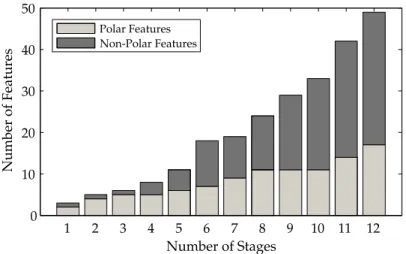
Características Haar Invariantes a la Polaridad [30] y las Características Quantum [32].
Estos dos nuevos tipos de características persiguen modelar de forma más eficiente la información débil que sirve de entrada a AdaBoost para para la construcción de clasificadores fuertes.
Basadas en estudios fisiológicos [28] y psicofísicos [61], las características Haar
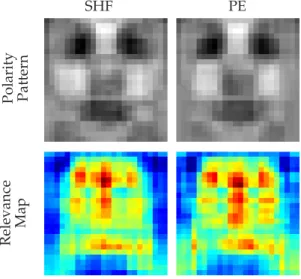
in-variantes a la polaridad permiten enriquecer la capacidad descriptiva de las caracte-rísticas Haar convencionales permitiendo modelar la comparación del contraste entre las dos áreas de interés en términos de similitud-disimiliud, independentiemente de cuál de las áreas es más clara u oscura que la otra. Los resultados experimentales para detección de caras nos muestran que, mientras la precisión y capacidad de generaliza-ción de los clasificadores no se ve afectada, la utilizageneraliza-ción del conjunto enriquecido de características nos permite obtener clasificadores más compactos y eficientes en los
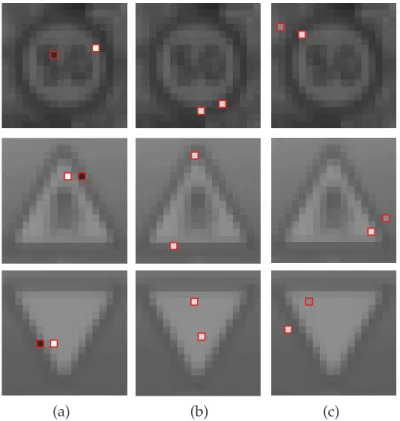
Las características Quantum, por su parte, se basan en simples comparaciones del nivel de intensidad entre dos píxeles de la imagen a clasificar en resolución nativa (la mínima que se considera detectable). Son una simplificación del concepto de las características Haar, pero con una diferencia fundamental: las áreas a comparar no tienen por qué estar adyacentes. Así, una característica Haar puede modelarse como una combinación de características Quantum. Nuestros experimentos con este nuevo conjunto de características (a las que también se les puede aplicar el concepto de inva-rianza a la polaridad) en una aplicación real de detección de señales de tráfico (para las que las características Quantum presentan, además, ciertas ventajas descriptivas) nos ha permitido obtener resultados muy satisfactorios.
Ambos ejemplos, uno (las características Haar invariantes a la polaridad) por plan-tear un conjunto complementario de descriptores, y el otro (las características Quan-tum) por presentar un conjunto enteramente nuevo de características que portan in-formación mucho más débil, sirven para poner de relieve la importancia de AdaBoost en este tipo de sistemas de detección de objetos basados en la arquitectura de Viola-Jones. AdaBoost consigue adaptarse satisfactoriamente a las nuevas definiciones y logra, en un caso, sacar provecho de la nueva situación para codificar la solución de forma más compacta; mientras en el otro se enfatiza su capacidad de combinar uni-dades de información extremadamente simples para construir clasificadores fuertes con una gran capacidad de generalización y elevadas tasas de acierto.
va r i a n t e s a s i m é t r i c a s d e a d a b o o s t
El esquema que proponemos para la clasificación analítica de las diferentes varian-tes de AdaBoost asimétrico en la literatura divide las diferenvarian-tes alternativas en tres grupos, dependiendo del tipo de mecanismo utilizado para alcanzar la asimetría:
A posteriori: Modificando un clasificador simétrico una vez ha sido entrenado.
Heurístico: Mediante manipulaciones directas de la regla de actualización de
pesos de AdaBoost (que, en realidad, es una consecuencia del proceso de mini-mización inherente a AdaBoost y no un punto de partida).
Teórico:Siguiendo una derivación teórica completa.
Así, el esquema queda como sigue: A posteriori:
• AdaBoost con Modificación del Umbral [64]
Heurísticos:
• AsymBoost [63]
• AdaCost [10]
• CSB0, CSB1y CSB2[59,60]
Teóricos:
• Cost-Sensitive AdaBoost [39,40]
a d a b o o s t g e n e r a l i z a d o c o n c o s t e s
Nuestro análisis de AdaBoost Generalizado con Costes (Cost-Generalized Ada-Boost) [33] nos permite arrojar algo de luz sobre las capacidades reales que AdaBoost
tiene, en sí mismo, de comportarse como un algoritmo de aprendizaje asimétrico, sim-plemente con una inicialización adecuada de su distribución de pesos.
Históricamente, y a pesar de que algunos trabajos iniciales sobre AdaBoost dejaban libre la definición de la distribución de pesos inicial [17,67], los sucesivas
aportacio-nes que se han ido publicando insisten en dos ideas:
Por un lado, AdaBoost se define “de facto” con una distribución inicial de pesos fija y uniforme (por ejemplo, [55,54,10,18,60,19,49,57,50,40]).
Por otro la inicialización asimétrica de pesos ha sido sistemáticamente recha-zada como un método válido para conseguir asimetría en AdaBoost. En unos casos por ser considerada insuficiente (varios métodos lo utilizan como una técnica secundaria [10,60]) y en otros por considerarla inefectiva [63,39,40].
Sin embargo, hasta donde nosotros pudimos llegar, no existía ninguna explicación formal y clara sobre las consecuencias, en un sentido (es un método válido) o en el otro (no es un método válido), de la utilización de un esquema de inicialización de pesos desbalanceado en AdaBoost.
A partir de una descomposición por clases del error del clasificador, el análisis que proponemos, presenta un nuevo modelo para entender e interpretar el compor-tamiento de AdaBoost, que pone de manifiesto que el algoritmo maneja la asimetría de forma aditiva ronda tras ronda. Así, la inicialización de pesos no es más que una forma de modificar la distribución de los datos de entrenamiento que ve el algoritmo de aprendizaje y, con ello, lo que hace es establecer la cota de error que marca el obje-tivo de minimización global de AdaBoost. En otras palabras, nuestro análisis muestra de forma totalmente teórica (y que se corrobora en la práctica) que AdaBoost, al ser inicializado con una distribución de pesos asimétrica, es por sí mismo un algoritmo de aprendizaje asimétrico. Las consecuencias fundamentales de nuestro análisis son: La distribución inicial de pesos es algo más que la distribución vista por el primer clasificador débil, es la distribución que pondera el error global que va a ser minimizado por AdaBoost, de forma que cualquier asimetría que aquí se incorpore es arrastrada al clasificador final que se entrene.
Este tipo de asimetría es asintótica y permite que el número de rondas de en-trenamiento sea tan flexible como en el caso original.
pesos de AdaBoost.
Las garantías formales de la versión standard de AdaBoost se mantienen intac-tas.
En realidad, más que un nuevo algoritmo, Cost-Generalized AdaBoost. . . ¡es Ada-Boost!
a d a b o o s t c o n b a s e d o b l e
Como complemento a la línea de investigación anterior, hemos seguido otra ruta diferente para intentar encontrar nuevas variantes asimétricas de AdaBoost, también sustentadas por una derivación íntegramente teórica y que requiriesen una menor car-ga computacional que la única alternativa totalmente teórica previamente propuesta en la literatura , Cost-Sensitive AdaBoost [39, 40], cuya complejidad es
extraordina-riamente superior a la de AdaBoost.
Nuestro análisis está basado en cinco rasgos distintivos:
Su derivación se basa en el análisis generalizado de Schapire y Singer (Cost-Sensitive AdaBoost se basa en la Statistical View of Boosting);
La cota de error a minimizar se modela en base a funciones exponenciales con bases diferentes para cada clase (bases dobles);
Se utilizan dos subdistribuciones de pesos de forma paralela (una para positivos y otra para negativos) a lo largo de todo el proceso de entrenamiento;
Se utiliza un modelo polinómico para la minimización (en lugar del hiperbólico utilizado por Cost-Sensitive AdaBoost).
nuestra derivación permiten definir una estrategia de búsqueda condicional que incrementa la compacidad y eficiencia del algortimo de aprendizaje final. Como consecuencia de todo lo anterior, conseguimos un nuevo algoritmo, al que denominamos AdaBoostDB (de AdaBoost con base doble) [34], que consume sólo
el 0,49 % del tiempo que necesita Cost-Sensitive AdaBoost y alcanza una solución equivalente. Esta superioridad computacional (del orden de 200 veces más rápido) supone una gran ventaja en la utilización de AdaBoostDB respecto a Cost-Sensitive AdaBoost, especialmente en aplicaciones con procesos de entrenamiento que requie-ren el manejo de una cantidad enorme de características y ejemplos (como es el caso de la detección de objetos en imágenes).
u n a ná l i s i s u n i f i c a d o r
Tras analizar el escenario y exponer nuestras propuestas (Cost-Generalized Ada-Boost y AdaAda-BoostDB) el paso final de nuestro trabajo es realizar una comparativa
clasificación, comparación y evaluación, en términos teóricos y prácticos.
Desde un punto de vista netamente teórico Cost-Generalized AdaBoost [33],
pre-senta la definición de cotas de error más consistente de todas las alternativas. Es capaz de preservar la proporción entre las cotas asociadas a cada clase, independien-temente de la ronda de entrenamiento en la que se encuentre, mientras Cost-Sensitive AdaBoost [39,40] y AdaBoostDB [34], las otras dos alternativas íntegramente teóricas,
acaban dando énfasis a la clase de menor coste cuando el entrenamiento está muy avanzado. . . que es justo lo contrario a lo que se pretendía. A este efecto lo hemos denominado “intercambio de asimetría”.
A nivel práctico, nuestra serie final de experimentos realiza un análisis detallado y exhaustivo del comportamiento de las diferentes variantes a lo largo de un conjunto muy denso y amplio de problemas de clasificación asimétrica. Los resultados nos muestran que la mayor parte de los algoritmos heurísticos presentan unas prestacio-nes muy bajas y tienen cierta propensión a obtener clasificadores saturados (esto es, que consideran, en función de las condiciones, que todo son positivos o todo son ne-gativos). Por otro lado, Cost-Sensitive AdaBoost y AdaBoostDB acaban presentando en la práctica el fenómeno del intercambio de asimetría, que habíamos adelantado en la teoría.
Dos algoritmos destacan claramente sobre el resto en cuanto a prestaciones obteni-das en la práctica: AdaC1[58,57], que es de naturaleza heurística, y Cost-Generalized
AdaBoost, que es íntegramente teórico. Sin embargo, y aunque las prestaciones glo-bales de AdaC1 son ligeramente superiores a las de Cost-Generalized AdaBoost, el primero parece presentar potenciales casos de intercambio de asimetría en algunas situaciones, lo que puede deberse a la naturaleza heirística (y por tanto, menos con-trolada) del algoritmo.
De este modo, como conclusión final, tanto desde un punto de vista teórico, co-mo práctico, coco-mo algorítmico, nuestro análisis final sostiene que Cost-Generalized AdaBoost es la opción mejor y más simple opción para dotar a AdaBoost de pro-piedades asimétricas, con solidez teórica, preservando todas las garantías formales y con, exactamente, la misma carga computacional que la versión simétrica.
c o n t r i b u c i o n e s
Las contribuciones más importantes presentadas a lo largo de esta tesis son: La definición de dos nuevos descriptores de imágenes, con ventajas perceptua-les y prácticas, que han sido utilizados con éxito para entrenar sistemas de de-tección de objetos en imágenes: LasCaracterísticas Haar Invariantes a la Polaridad
[30] y lasCaracterísticas Quantum[32].
Una nueva perspectiva sobre las capacidades de aprendizaje asimétrico de Ada-Boost, basada en una nueva interpretación (condicionada a las clases) de la cota del error del algoritmo. Este análisis nos lleva a una definición de AdaBoost
el único cambio que necesita AdaBoost para ser asimétrico reside en la forma en que la distribución de pesos es inicializada, manteniendo todas las garantías formales del algoritmo original.
Un nuevo algorimo asimétrico dentro del marco de AdaBoost, que hemos de-nominado AdaBoostDB(de AdaBoost con Base Doble) [34]. Basado en una
deri-vación completamente teórica, y en un modelo matemático muy eficiente, este algoritmo es 200 veces más rápido que la única variante totalmente teórica de AdaBoost publicada en la literatura previamente a nuestra investigación, consi-guiendo, además, clasificadores equivalente.
Un marco para clasificar las múltiples y heterogéneas variantes asimétricas de AdaBoost que se han ido proponiendo en la literatura [31].
Un análisis unificador [31], tanto en términos teóricos como prácticos, para
evaluar exhaustivamente y sobre una base común, las prestaciones de todas las variantes de AdaBoost asimétrico.
Como culminación de todo lo anterior, nuestra tesis sostiene queCost-Generalized
AdaBoostes la opción mejor y más simple para dotar a AdaBoost de
propieda-des asimétricas, preservando todas las garantías formales de la versión clásica (simétrica) y con exactamente la misma carga computacional [31].
p u b l i c a c i o n e s
Los principales contenidos de esta tesis están respaldados por las siguientes publi-caciones:
I. Landesa-Vázquez and J.L. Alba-Castro. Shedding Light on the Asymmetric Learning Capability of AdaBoost.Pattern Recognition Letters,33:247-255,2012. I. Landesa-Vázquez and J.L. Alba-Castro. Double-Base Asymmetric AdaBoost.
Neurocomputing,118:101-114,2013.
I. Landesa-Vázquez and J.L. Alba-Castro. AdaBoost for Cost-Sensitive Classifi-cation: A Unified Analysis. Submitted to Journal of Machine Learning Research, 2014.
I. Landesa-Vázquez and J.L. Alba-Castro. The Role of Polarity in Haar-like Fea-tures for Face Detection. In Proc. of the 20th International Conference on Pattern
Recognition,412-415,2010.
I. Landesa-Vázquez, J.L. Alba-Castro and F. Parada-Loira. Fast Real-Time Mul-ticlass Traffic Sign Detection Based on Novel Shape Texture Descriptors. InProc.
of the13th International IEEE Conference on Intelligent Transportation Systems,1388
-1395,2010.
Hace ya mucho tiempo, una persona cerró una etapa de su vida y decidió con-tinuar sus pasos avanzando por el mismo camino que había conocido y recorrido hasta entonces. Lo que esa persona no sabía es que, en ese momento, lo que en reali-dad emprendía era una aventura que acabaría siendo, probablemente, la etapa más enriquecedora de toda su vida.
Esa persona es la misma que ahora escribe estas líneas, y la etapa que yo en aquel momento empezaba es la que ahora concluyo con la presentación de esta tesis. Pero lo verdaderamente importante de todo este período no tiene que ver con los pocos o muchos conocimientos técnicos adquiridos, ni con el contenido en sí de la tesis. Lo verdaderamente importante es todo lo que está detrás, el proceso de crecimiento y superación personal que han hecho posible que la travesía, aunque larga y dura, acabase llegando a buen puerto.
Más allá del boosting o de la detección de objetos, esta tesis, en realidad, va de la capacidad de ver las cosas con otros ojos, de replantearse las ideas, de sobreponerse a los golpes, de aguantar, de no rendirse, de reinventarse, de perseverar, de seguir siempre adelante y de intentar exponer tu trabajo con honestidad. Esa es la auténtica tesis que está detrás de esta tesis, y eso sólo se puede conseguir si tienes a tu gente detrás, apoyándote y confiando en ti, día tras día, a lo largo de tanto tiempo.
Por ello, este trabajo va dedicado: e n g e n e r a l
A todas las personas que a lo largo mi vida me han ayudado a confiar en mí y a intentar ser una versión mejor de mí mismo cada día.
e n pa r t i c u l a r
A todos los compañeros que han pasado por los diferentes laboratorios (sobre todo por el de Visión) a lo largo de estos años y con los que he compartido infinidad de buenos momentos, dentro y fuera del CUVI. Todos tenéis un huequecito aquí (no pongo la lista, que sería muy larga, no vaya a ser que se me despiste alguien). Aunque, eso sí, tengo que hacer dos menciones especiales: Por un lado, a Javi, Roi, Nacho y Ricardo, que durante todos estos años han demostrado ser amigos con mayúsculas. Y por otro, como no podía ser menos, a nuestro capitán, el alma máter del Laboratorio de Visión, Paco. ¡Qué diferentes hubiesen sido estos años sin ti en el laboratorio! ¡Muchas gracias por todo, Paquito!
A “La Logia”, mis amigos de toda la vida: Marcelo, Pedro, Rober y Natalia. Sabed que sois una parte esencial de mi vida. Mi tiempo libre (por poco que sea) no sería el mismo sin vosotros, y sin ese tiempo libre, sin esas risas, sin esas conversaciones, sin esos partidos, sin esas pelis, sin esos viajes, sin esos churrascos. . . ¿Quién se iba a poner a investigar al día siguiente?
principio del fin de esta tesis.
A Avelina porque, con su infinita sabiduría, nos impulsa a conseguir lo que parecía imposible.
A KITT, mi socio, por todo lo que significa para mí haber conseguido ponerme al volante de mi propio coche (fantástico) y la revolución que ha significado en mi vida.
Al Celtiña, por los duros años que hemos pasado juntos en la sombra, pero que sabemos que con “afouteza e corazón” se puede salir adelante.
A mi Yeya, que me acompaña a todas partes. A Abú y a Madrina porque, cada uno en su estilo, son un modelo a seguir. A Lau, porque el tiempo no te cambie.
A Bubi, por confiar tanto en mí. Gracias por darme la oportunidad de poder llevar a cabo toda esta aventura. Por largo y duro que haya sido el camino (tú mejor que nadie sabes lo que hemos pasado para que nos reconociesen cada paso) es todo un privilegio llegar a tener en la vida la oportunidad de encontrarse a uno mismo y crecer, como la que me has brindado siendo mi director de tesis, mi jefe y mi amigo. Sin tu fe tranquila y ciega en mis posibilidades, mucho mayor de la que yo podía tener en mí mismo, esto jamás hubiese sido posible.
e n e s p e c i a l
A las tres personas más importantes de mi vida:
A Iris, mi hermana y mi peque, por los buenos momentos que pasamos juntos, lo mucho que nos divertimos, el inmenso cariño que siempre me demuestra, su capa-cidad de superación y lo “curra” que es. Nunca me cansaré de repetirlo: el día que naciste no hiciste otra cosa que mejorar mi vida para siempre. La cita al final de esta página va en tu honor.
A mi padre, Javier, porque siempre está ahí, por lo mucho que me ayuda, por lo mucho que se preocupa por nosotros, por su inmenso cariño, por sus desvelos y porque siempre ha sido y es un gran padre.
Pero por encima de todas las cosas, si a alguien le dedico y le debo haber llegado hasta aquí es a mi madre, Auri. Por su apoyo incondicional, por su cariño infinito, por su paciencia, por su preocupación, por todos sus desvelos y por sus sabios consejos que valen más que el oro. Porque nadie mejor que ella sabe por lo que he llegado a pasar, porque sin ella jamás hubiese sido capaz de levantarme, enfrentarme a mí mismo y superarme. En definitiva, porque sin ella nada hubiese sido posible. Porque, parafraseando una preciosa canción (“Fix You” de Coldplay), cuando todo parece perdido, ella es la luz que te guía, que ilumina tus huesos y que siempre está ahí para intentar repararte. Con tu dedicación a Iris y a mí, nos has hecho el mayor regalo que unos hijos puedan recibir jamás. ¡¡¡¡Gracias Mami, todo esto es tuyo!!!!
Recuerda quién eres. Recuérdalo.
— Mufasa
1 i n t r o d u c t i o n 1
1.1 The Title, Inside Out . . . 1
1.2 Thesis Outline . . . 3 1.3 Contributions . . . 3 1.4 Publications . . . 4 2 a d a b o o s t i n a c o s t-s e n s i t i v e s c e na r i o: o b j e c t d e t e c t i o n i n i m a g e s 5 2.1 AdaBoost, in short . . . 5
2.1.1 The AdaBoost Algorithm . . . 5
2.1.2 AdaBoost Interpretations . . . 6
2.2 AdaBoost and Object Detection: The Viola-Jones Framework . . . 8
2.3 Our Work in Object Detection . . . 10
2.3.1 Haar-Like Polarity Invariant Features . . . 11
2.3.2 Quantum Features . . . 17
3 c o s t-s e n s i t i v e a d a b o o s t va r i a n t s 23 3.1 Characterization of Cost-Sensitive Classification Problems . . . 23
3.1.1 Experimental evaluation . . . 24
3.2 Cost-Sensitive AdaBoost Variants Review . . . 25
3.2.1 A Posteriori . . . 25
3.2.2 Heuristic . . . 27
3.2.3 Theoretical . . . 31
4 c o s t-g e n e r a l i z e d a d a b o o s t 37 4.1 AdaBoost and Asymmetry . . . 38
4.2 Revisiting AdaBoost . . . 39
4.2.1 Asymmetric Interpretation . . . 39
4.2.2 Asymmetric Error Analysis . . . 43
4.3 Cost-Generalized AdaBoost Algorithm . . . 44
4.4 Experiments . . . 44 4.5 Discussion . . . 48 4.6 Conclusions . . . 50 5 a d a b o o s t w i t h d o u b l e-b a s e 51 5.1 Cost-Sensitive AdaBoost . . . 51 5.2 AdaBoostDB . . . 52
5.2.1 Double-Base Error Bound . . . 52
5.2.2 Algorithm Derivation . . . 54
5.2.3 Conditional Search . . . 56
5.3 Experiments . . . 58
5.3.1 Bayes Error Rates . . . 58 5.3.2 Asymmetric Behavior . . . 60 5.3.3 AdaBoostDB vs. Cost-Sensitive AdaBoost . . . 65 5.3.4 Real-world dataset . . . 69 5.4 Conclusions . . . 70
6 a n u n i f y i n g a na ly s i s 73
6.1 Classification of Cost-Sensitive AdaBoost Variants . . . 73 6.2 Theoretical Analysis and Discussion . . . 74 6.2.1 The Question of Weight Initialization . . . 74 6.2.2 Weight Initialization inside the Cost-Sensitive Boosting
Frame-work . . . 76 6.2.3 Algorithms Comparison . . . 78 6.3 Experiments . . . 88 6.3.1 Experimental framework . . . 89 6.3.2 Results . . . 92 6.3.3 Discussion . . . 98 6.4 Conclusions . . . 104 7 s u m m a r y 105 a a p p e n d i x. a d d i t i o na l c o m m e n t s 109
a.1 Global Asymmetry Adjustment Rounds and Flat Sections . . . 109 a.2 Cost-Sensitive Boosting Extensions and Weight Initialization . . . 110
b a p p e n d i x. d e ta i l e d e x p e r i m e n ta l r e s u lt s 113
Figure1 Example of a simple Haar-like feature and Haar-like feature definitions used in the Viola-Jones Framework. . . 9
Figure2 Cascade of classifiers. . . 10
Figure3 Center/surround nature of receptive fields in the retina . . . 11
Figure4 Contrast polarity and context information in face detection. . . 12
Figure5 Haar-like polarity enhanced features. . . 13
Figure6 Feature distribution evolution in the polarity enhanced face detector. . . 15
Figure7 Polarity patterns and relevance maps of the standard Haar-like features and polarity enhanced features detectors. . . 16
Figure8 Polar and non-polar relevance maps of the polarity enhanced detector. . . 17
Figure9 Example of quantum features for a 8x8 patch at native (train-ing) resolution. . . 18
Figure10 Quantum features with polarity enhancement for traffic signs . 19
Figure11 Examples of some of the quantum features selected by Ad-aBoost in our training experiments. . . 22
Figure12 AdaBoost exponential training error bound . . . 38
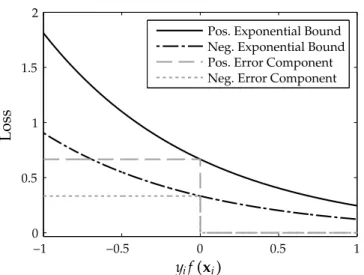
Figure13 AdaBoost training error and its exponential bound split into two class-conditional components. . . 41
Figure14 Training set and example weak classifiers used to illustrate our Cost-Generalized analysis of AdaBoost. . . 45
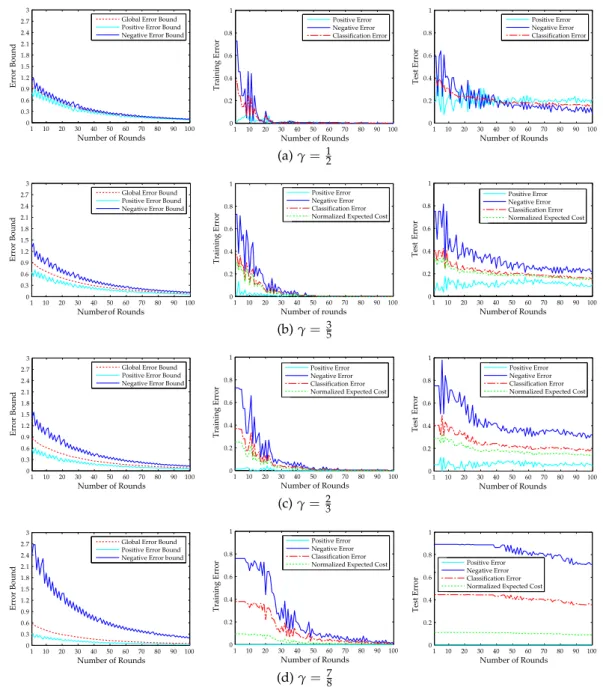
Figure15 Evolution of training error bound, training error and test er-ror obtained by Cost-Generalized AdaBoost on the set without overlapping. . . 46
Figure16 Training set with overlapping and example weak classifiers over the test set. . . 47
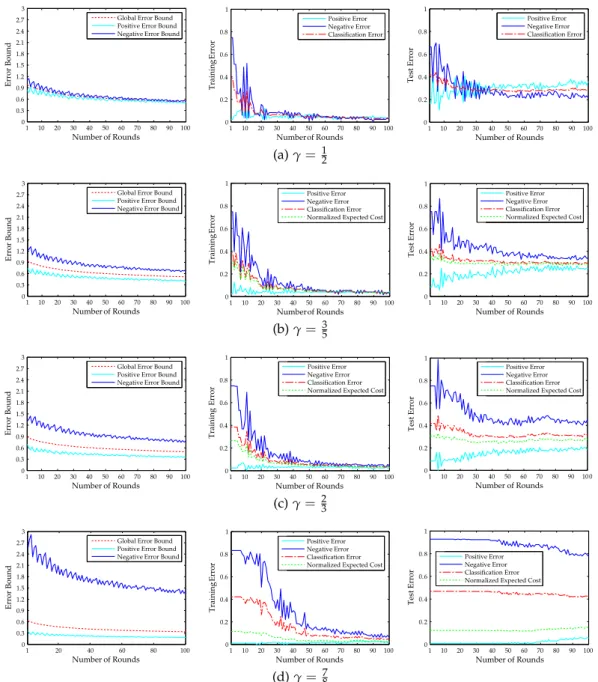
Figure17 Evolution of training error bound, training error and test error obtained by Cost-Generalized AdaBoost on the set with over-lapping. . . 48
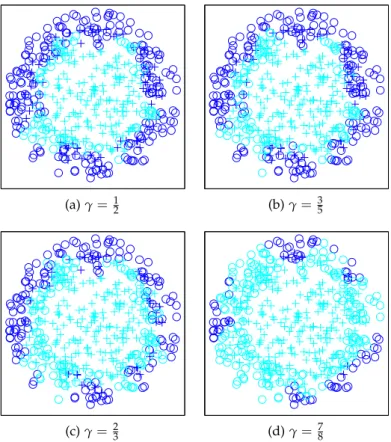
Figure18 Classification results over the test set with overlapping for dif-ferent asymmetries. . . 49
Figure19 Misclassification and AdaBoost exponential training error bounds with different bases. . . 53
Figure20 Conditional search graphic scenarios. . . 57
Figure21 Bayes Risk datasets used in our experiments . . . 60
Figure22 Lower envelope graphic comparative representations among Bayes, AdaBoostDB and Cost-Sensitive AdaBoost . . . 61
Figure23 Performance comparison of classifiers obtained by AdaBoostDB, Bayes and Cost-Sensitive AdaBoost over the Bayes synthetic test set. . . 62
Figure24 Two Clouds dataset used in our experiments. . . 63
Figure25 Mean error and standard deviation of the normalized expected cost difference between AdaBoostDB and Cost-Sensitive Boost-ing. . . 68
Figure26 Synthetic counterexample to the example by Viola and Jones when deriving AsymBoost, with the same polarity as the orig-inal. . . 75
Figure27 Synthetic counterexample to the example by Viola and Jones when deriving AsymBoost, with opposite polarity to the original. 77
Figure28 Training error bound of AdaBoost. . . 79
Figure29 Training error bound of Cost-Sensitive AdaBoost and AdaBoostDB forCP =2 andCN =1. . . 80
Figure30 Training error bound of Cost-Generalized AdaBoost forCP =2 andCN =1 . . . 81
Figure31 Class prevalence of error bounds for Cost-Generalized Ad-aBoostand Cost-Sensitive AdaBoost. . . 82
Figure32 Different kinds of cost scenarios with their corresponding cost matrices. . . 84
Figure33 Boosting models applied to the cost scenarios in Figure32. . . . 86
Figure34 Variable cost coefficients mapped to different initial weights on Cost-Generalized AdaBoost, and to different exponential bases in Cost-Sensitive AdaBoost. . . 87
Figure35 Synthetic datasets used in our final empirical analysis. . . 90
Figure36 Global Conditional Expectations and Variances of ∆NEC for each tested algorithm. . . 93
Figure37 Global Conditional Expectations and Variances of∆CEfor each tested algorithm. . . 94
Figure38 Cost-Dependent Conditional Expectations and Variances of∆NEC for each tested algorithm. . . 96
Figure39 Cost-Dependent Conditional Expectations and Variances of∆CE for each tested algorithm. . . 96
Figure40 Classification asymmetry comparative between Cost-Generalized AdaBoost and Cost-Sensitive AdaBoost, across training rounds and costs, for Bayes, UCI Ionosphere and CBCL datasets. . . 102
Figure41 Classification asymmetry comparative between Cost-Generalized AdaBoost and AdaC1, across training rounds and costs, for the CBCL dataset. . . 103
Figure42 Results obtained for the Bayes Dataset. . . 116
Figure43 Results obtained for the Two Clouds Dataset. . . 119
Figure44 Results obtained for the UCI Breast Cancer Dataset. . . 122
Figure45 Results obtained for the UCI Credit Dataset. . . 125
Figure49 Results obtained for the CBCL Dataset. . . 137
L I S T O F TA B L E S
Table1 Performance of the standard Haar-like features and polarity enhanced features detectors. . . 14
Table2 Comparison of True Positive Rate and Positive Predictive Value obtained by the Local Contour Patterns with Quantum fea-tures traffic sign detection scheme and the standard Viola-Jones. 20
Table3 Average Processing Time per Frame consumed by the Local Contour Patterns with Quantum features traffic sign detection scheme and the standard Viola-Jones. . . 21
Table4 Classifier behavior for different asymmetric requirements over the synthetic cloud dataset with overlapping. . . 47
Table5 Cost-Generalized AdaBoost behavior for different asymmetric requirements over real UCI datasets. . . 49
Table6 AdaBoostDB asymmetric behavior over the synthetic and UCI datasets. . . 64
Table7 Mean error between AdaBoostDB and Cost-Sensitive Boosting classification performance parameters. . . 67
Table8 Training computational burden of Cost-Sensitive AdaBoost, Ad-aBoostDB without conditional search, and AdAd-aBoostDB with conditional search, over the synthetic and UCI sets. . . 69
Table9 Comparative computational burden of Cost-Sensitive AdaBoost, AdaBoostDB without conditional search, and AdaBoostDB with conditional search over the synthetic and UCI sets. . . 70
Table10 AdaBoostDB asymmetric behavior for each cost combination over the CBCL example dataset. . . 70
Table11 Summary of the proposed mapping between AdaBoost algo-rithms and the different asymmetric scenarios. . . 88
Table12 Global Conditional Expectation and Variance values of∆NEC for each tested algorithm. . . 93
Table13 Global Conditional Expectation and Variance values of ∆CE for each tested algorithm. . . 95
Table14 Average training time elapsed by each algorithm. . . 97
Table15 Average training time ratio needed by the tested algorithms compared to that consumed by Cost-Generalized AdaBoost. . . 98
Table16 Results obtained for the Bayes Dataset. . . 115
Table17 Results obtained for the Two Clouds Dataset. . . 118
Table20 Results obtained for the UCI Diabetes Dataset. . . 127
Table21 Results obtained for the UCI Ionosphere Dataset. . . 130
Table22 Results obtained for the UCI Spam Dataset. . . 133
Table23 Results obtained for the CBCL Dataset. . . 136
L I S T O F A L G O R I T H M S Figure1 AdaBoost . . . 6 Figure2 AsymBoost . . . 29 Figure3 AdaCost . . . 30 Figure4 CSB0 . . . 31 Figure5 CSB1 . . . 32 Figure6 CSB2 . . . 33 Figure7 AdaC1 . . . 34 Figure8 AdaC2 . . . 34 Figure9 AdaC3 . . . 35
Figure10 Cost-Sensitive AdaBoost . . . 36
Figure11 Cost-Generalized AdaBoost . . . 45
Figure12 AdaBoostDB . . . 59
A C R O N Y M S
SHF Standard Haar-like Features
PE Polarity Enhanced Haar-like features
LCP Local Contour Patterns
LCQ Local Contour Patterns with Quantum features scheme
VJ Viola-Jones Scheme
FP False Positives
TP True Positives
FNR False Negative Rate
FPR False Positive Rate
TNR True Negative Rate
TPR True Positive Rate
PPV Positive Predictive Value
PCF Probability Cost Function NEC Normalized Expected Cost
CE Classification Error
ABT AdaBoost with Threshold Modification
ASB AsymBoost ADC AdaCost CB0 CSB0 CB1 CSB1 CB2 CSB2 AC1 AdaC1 AC2 AdaC2 AC3 AdaC3
CSA Cost-Sensitive AdaBoost
CGA Cost-Generalized AdaBoost
ADB AdaBoostDB
DBN AdaBoostDB (without Conditional Search)
BAY Optimal Bayes classifier
CA Classification Asymmetry
1
I N T R O D U C T I O N
1.1 t h e t i t l e, i n s i d e o u t
Boosting
The classical approach to solve a classification problem is based on the use of a single expert that must be able to build a solution classifier. However, in the last few decades, a new classification paradigm, based on the combination of several experts in a distributed decision process, has arisen and attracted the attention of the Machine Learning community. The success of this paradigm relies on several theoretical, practical and even biological reasons (such as generalization properties, complexity, data handling, data source fusion, etc.) making theseEnsemble Classifiers
[49] preferable to classical ones in many scenarios.
One of the milestones on the history of ensemble methods was the work published by Robert E. Schapire in 1990 [53], in which the author proves the equivalence
be-tween weaklearners, algorithms able to generate classifiers performing only slightly better than random guessing, andstrong learners, those generating classifiers which are correct in all but an arbitrarily small fraction of the instances. This new model of learnability, in which weak learners can beboosted to achieve strong performance when they are properly combined, paved the way to one of the most prominent fam-ilies of algorithms within the ensemble classifiers paradigm:boosting.
In1997, Yoav Freund and Robert E. Schapire proposed [17] a more general boosting
algorithm called AdaBoost (from Adaptive Boosting). Unlike previous approaches, AdaBoost does not require any prior knowledge on weak hypothesis space, and it iter-atively adjusts to weak hypothesis that become part of the ensemble. Apart from the-oretical guarantees and practical advantages over its predecessors, early experiments on AdaBoost also showed a surprising resistance to overfitting. As a consequence of all these qualities, AdaBoost has received an attention “rarely matched in com-putational intelligence” [49] being an active research topic in the fields of machine
learning, pattern recognition and computer vision [55,26,54,45,19,41,64,20,40] till
present.
Throughout this time, several studies have been conducted to analyze AdaBoost from different points of view, relating the algorithm with different theories: margin theory [55], entropy [27], game theory [16], statistics [19], etc. In the same way,
numer-ous variations of the algorithm have been proposed for the two-class and multiclass problems: Real AdaBoost [54,19], LogitBoost [19], Gentle AdaBoost [19], AsymBoost
[63], AdaCost [10], AdaBoost.M1 [15], AdaBoost.M2 [15], AdaBoost.MH [54],
Ad-aBoost.MO [54], AdaBoost.MR [54], JointBoosting [62], AdaBoost.ECC [22], etc.
Cost-Sensitive
Among the different kinds of classification problems, one remarkable subset is that of tasks with clearly different costs depending on each possible decision, or scenarios with very unbalanced class priors in which one class is extremely more frequent or easier to sample than the other one. In suchcost-sensitive or asymmetric
conditions (disaster prediction, fraud detection, medical diagnosis, object detection, etc.) classifiers, instead of searching hypothesis trying to fit well to global data, must be able to focus their attention in the rare/most valuable class. In the literature, many works have been devoted to cost-sensitive learning [9,51,66], including a significant
set of proposals on how to provide AdaBoost with asymmetric properties (e.g. [26, 10,60,64,63,57,39,40]). The link between AdaBoost and Cost-Sensitive learning has
special interest since AdaBoost is the learning algorithm inside the widespread Viola-Jones object detector framework [64], a seminal work in computer vision dealing with
a markedly asymmetric problem and a huge number of weak classifiers (the order of hundred of thousands).
In the Viola and Jones face detector framework, a validation set is used to modify the AdaBoost strong classifier thresholda posteriori, in order to adjust false positive and detection rates balance. Nevertheless, as the authors stated, it is not clear if the selected weak classifiers are optimal for the asymmetric goal [63] nor if these
mod-ifications preserve AdaBoost training and generalization errors original guarantees [64]. The vast majority of other proposed methods [26, 10, 60, 63, 57] try to cope
with asymmetry through direct manipulations of the AdaBoost weight update rule. These proposals, not being a full reformulation of the algorithm for asymmetric sce-narios, have been analyzed [39, 40] to be heuristic modifications of AdaBoost. On
the other hand, the more recent Cost-Sensitive AdaBoost algorithm [39,40], based on
the Statistical View of Boosting [19], proposes a solution that, despite having a full
theoretical basis, is uncommonly more complex and computing demanding than the original AdaBoost.
Hence, the different AdaBoost asymmetric variants proposed in the literature are very heterogeneous, while their related works are focused on emphasizing the pos-sible advantages of each respective method, rather than building a framework to jointly classify, analyze and discuss the different approaches. The consequence, for the researcher is that this heap of algorithms shapes a confusing set with no clear theoretical properties to rule their application in practical problems.
A General Framework
In this thesis, motivated by their use in computer vision applications (and, par-ticularly, in object detection), we try to untangle the different approaches on Cost-Sensitive AdaBoost algorithms presented in the literature, deconstructing some myths and making our own proposals [33,34]. We try to classify, analyze, compare and
dis-cuss all of these alternatives in order to build a general framework unifying them [31]. Our final goal is, thus, being able to find a definitive scheme to translate any
cost-sensitive learning problem to the AdaBoost framework while shedding light on which algorithm ensures the best performance.
1.2 t h e s i s o u t l i n e
This thesis is structured in the following chapters:
InChapter 2we introduce the basics of the AdaBoost algorithm and the
prac-tical application that lead our research towards cost-sensitive boosting: object detection in images.
InChapter3we review, with a homogenized formulation, the main cost-sensitive
AdaBoost variants proposed in the literature before our research, also suggest-ing a clustersuggest-ing scheme for them based on the kind of asymmetrizsuggest-ing strategy followed in each case.
In Chapter 4 we present a novel perspective to analyze AdaBoost in a
class-conditional way. This Cost-Generalized analysis shows that, beyond some pre-conceptions, an unbalanced class-conditional initialization of the weight distri-bution, can make AdaBoost a theoretically sound cost-sensitive classification algorithm.
In Chapter 5 we propose a self-contained analytical framework leading to an
asymmetric boosting algorithm coined as AdaBoostDB (from AdaBoost with Double-Base). This novel approach is based on an error bound with class-condi-tional (double) exponential bases and uses two parallel class-condiclass-condi-tional weight
subdistributionsduring training.
InChapter6 we perform a thorough unifying analysis to compare all the
alter-natives discussed along the thesis (our proposals and those by other authors in the literature). Aimed to shed light on the specific properties and behavior of each alternative, our analysis ends spotting which algorithm is able to ensure the best performance and formal guarantees.
Finally, inChapter7, we recapitulate the main ideas, contributions and
conclu-sions drawn from this thesis, while pointing out some future lines of research based on our work.
1.3 c o n t r i b u t i o n s
The most important contributions of the work presented in this thesis are:
The definition of two novel image descriptors, with perceptual and practical advantages, that can be successfully used to feed boosted classifiers for object detection: Haar-like Polarity Invariant Features[30] andQuantum Features[32].
A new insight on the asymmetric learning capabilities of AdaBoost, based on a novel class-conditional interpretation of the error bound, that leads to a
Cost-Generalizeddefinition of the algorithm [33]. Demystifying some assertions in the
literature, our formulation shows that the only change needed in AdaBoost to be cost-sensitive resides in the way the weight distribution is initialized, main-taining all the formal guarantees of the original (cost-insensitive) algorithm. A novel cost-sensitive algorithm within the AdaBoost framework, AdaBoostDB
(AdaBoost with Double-Base)AdaBoostDB. Supported by a full theoretical deriva-tion, and a highly efficient mathematical model, this algorithm is 200 times faster than the only fully theoretical AdaBoost variant in the literature prior to our research, and reaches an equivalent solution.
A classification framework to cluster the multiple and heterogeneous cost-sen-sitive AdaBoost variants proposed in the literature [31].
A thorough unifying analysis, both in theoretical and practical terms, able to asses and rank all the cost-sensitive AdaBoost proposals in a common basis. As a culmination of the above, our thesis holds thatCost-Generalized AdaBoostis the best and simplest option to provide AdaBoost with cost-sensitive sound ca-pabilities, preserving all the formal guarantees from the classical (cost-insensitive) version and exactly its same computational burden [31].
1.4 p u b l i c at i o n s
The main contents of this thesis are supported by the following publications: I. Landesa-Vázquez and J.L. Alba-Castro. Shedding Light on the Asymmetric Learning Capability of AdaBoost. Pattern Recognition Letters,33:247-255,2012. I. Landesa-Vázquez and J.L. Alba-Castro. Double-Base Asymmetric AdaBoost.
Neurocomputing,118:101-114,2013.
I. Landesa-Vázquez and J.L. Alba-Castro. AdaBoost for Cost-Sensitive Classifi-cation: A Unified Analysis. Submitted to Journal of Machine Learning Research, 2014.
I. Landesa-Vázquez and J.L. Alba-Castro. The Role of Polarity in Haar-like Features for Face Detection. InProc. of the20th International Conference on Pattern
Recognition,412-415,2010.
I. Landesa-Vázquez, J.L. Alba-Castro and F. Parada-Loira. Fast Real-Time Mul-ticlass Traffic Sign Detection Based on Novel Shape Texture Descriptors. In
Proc. of the13th International IEEE Conference on Intelligent Transportation Systems,
2
A D A B O O S T I N A C O S T - S E N S I T I V E S C E N A R I O : O B J E C T D E T E C T I O N I N I M A G E S
In this chapter we will introduce the basics of the AdaBoost algorithm and the practical application that lead our research towards cost-sensitive boosting: object de-tection in images. We will also review the contributions related to object dede-tection we made within the framework of this PhD thesis and their connection with AdaBoost. 2.1 a d a b o o s t, i n s h o r t
As a brief introduction to AdaBoost, we will revise the definition and some essen-tial concepts of the algorithm.
2.1.1 The AdaBoost Algorithm
Let us defineXas the random process from which our observationsx= (x1, . . . ,xN)T are sampled, andY the random variable governing the related labelsy∈ {−1, 1}. In this scenario, a detector H(x) (we will also refer to it as classifier or hypothesis) is a function able to guess the labelyof a given samplex, and it can be defined in terms of a more generic function f(x)∈Rwhich we will callpredictor.
H(x) =sign[f(x)]
Suppose we have a training set ofn examples xi with its respective labelsyi from which themfirst are positives{yi =1}mi=1 and the rest are negatives{yi =−1}in=m+1, a weight distribution D(i)over these examples and a weak learnerable to select, ac-cording to labels and weights, the best detectorh(x)from a predefined collection of weak classifiers. In this scenario, the role of AdaBoost is to compute a goodness mea-sureαdepending on the performance obtained by the selected weak classifier, and to update, accordingly, the weight distribution to emphasize misclassified training ex-amples. Then, with a different weight distribution, the weak learner can make a new hypothesis selection and the process restarts. By iteratively repeating this scheme (1, 2,3,4) withtindexing the number of learning rounds, AdaBoost obtains an ensemble
of weak classifiers with respective goodness parametersαt.
αt = 1 2ln 1+rt 1−rt (1) rt = n
∑
i=1 Dt(i)yiht(xi) (2) 5Dt+1(i) = Dt(i)exp(−αtyiht(xi)) Zt (3) Zt= n
∑
i=1 Dt(i)exp(−αtyiht(xi)) (4)Weak hypothesis search in AdaBoost is guided to maximize goodness αt of each selected classifier, which is equivalent to maximize, at each iteration, weighted cor-relationrt (2) between labels yi and predictions ht. This iterative searching process
can continue until a predefined number T of training rounds have been completed or some performance goal is reached. The final AdaBooststrong detector H(x)is de-fined (5) in terms of a boostedpredictor f(x)built as an ensemble of the selected weak
classifiers weighted by their respective goodness parametersαt.
H(x) =sign(f(x)) =sign T
∑
t=1 αtht(x) ! (5) AdaBoost is summarized onAlgorithm1.Algorithm1AdaBoost
Input:
Training set ofnexamples:(xi,yi), whereyi= (
1 if 1≤i≤m(Positives), −1 ifm<i≤n(Negatives). Pool ofFweak classifiers:hf(x)
Number of rounds:T
Initial (uniform) weight distribution:D(i)
Iterate:
fort=1toTdo forf=1toFdo
Compute the weighted error of thefthweak classifier,e
t,f =∑ni=1D(i)Jhf(xi)6=yiK
end for
Select the weak learnerht(x)of smallest error,et=argmin f
et,f
Compute the goodness parameter of the selected classifier,αt=12log
1−et
et
Update weights:D(i)← D(i)exp(−αtyiht(xi)) ∑n i=1D(i)exp(−αtyiht(xi)) end for Final Classifier: H(x) =sign∑T t=1αtht(x) 2.1.2 AdaBoost Interpretations
In the literature, AdaBoost have been studied and analyzed from different points of view, linking the algorithm with different theories (margin theory [55], entropy
probably the main ones: the Generalized Analysis [54] and the Statistical View of
Boosting [19]. This will serve as a basis for the different analysis, derivations and
discussions we will delve into in the forthcoming chapters.
2.1.2.1 Generalized Analysis
Robert E. Schapire and Yoram Singer proposed [54], from the original derivation
of AdaBoost [17], a generalized and simplified analysis that models the algorithm
as an additive (round-by-round) minimization process of an exponential bound on the strong classifier training error (ET). This bounding process is explained in Equa-tion (6)1 from which all AdaBoost equations we have presented, weight update rule
included, can be derived [33].
H(xi)6=yi ⇒ yif(xi)≤0 ⇒ exp(−yif(xi))≥1 | {z } ⇓ ET =∑ni=1D1(i)JH(xi)6=yiK≤∑ n i=1D1(i)exp(−yif(xi)) (6)
After (6), the final bound of the training error obtained by AdaBoost can be
ex-pressed as (7), and the additive minimization of the exponential bound ˜ETcan be seen
as finding, in each round, the weak hypothesisht that maximizesr(t), the weighted correlation between labels(yi)and predictions(ht).
ET ≤ T
∏
t=1 Zt ≤ T∏
t=1 p 1−rt2= E˜T (7)When weak hypothesis are binary, hi ∈ {−1,+1}, last inequality on (7) becomes
an equality, and parameterαt can be directly rewritten2 (9) in terms of the weighted
erroret of the current weak classifier. As can be seen, the minimization process turns out to be equivalent to simply selecting the weak classifier with less weighted error.
et= n
∑
i=1 Dt(i)Jh(xi)6= yiK=∑
nok Dt(i) (8) αt = 1 2ln 1−et et (9) In line with other works, for the sake of simplicity and clarity, we will be focused on this Discreteversion of AdaBoost using binary weak classifiers, which does not prevent our conclusions from being extended to other variations of the algorithm.1 Notation: Following [54],
JaKis 1 whenais true and 0 otherwise.
2 Notation: For the sake of simplicity, we will use the term ‘ok’ to refer to those training examples in which the result of the weak classifier is right{i:h(xi) =yi}and ‘nok’ when it is wrong{i:h(xi)6=yi}.
2.1.2.2 Statistical View of Boosting
One of the milestones in boosting research, and the foundation of many variations of AdaBoost, is the highly-cited contribution by Jerome H. Friedman et al. [19] in
which a statistical reinterpretation of boosting is given. Following the exponential criterion seen in the previous subsection, Friedman et al. showed that AdaBoost can be motivated as an iterative algorithm building an additive logistic regression model
f(x)that minimizes the expectation of the exponential loss, J(f(x)):
J(f(x)) =E[exp(−y f(x)] (10)
This loss is effectively minimized at
f(x) =0.5 log
P(y=1|x) P(y= −1|x)
so a direct connection between boosting and additive logistic regression models is drawn. According to this statistical perspective, AdaBoost predictions can be seen as estimations of the posterior class probabilities, which has served as basis to de-velop many extensions and variants of the algorithm (among them, the Cost-Sensitive Boosting scheme [39,40]).
It is important to mention that, despite the huge and unquestionable value of the statistical view, some enriching controversy, revealed by empirical evidences [41, 4, 42], has arisen about inconsistencies of this interpretation.
2.2 a d a b o o s t a n d o b j e c t d e t e c t i o n: t h e v i o l a-j o n e s f r a m e w o r k In2001, Paul Viola and Michael J. Jones [65,64] presented a system that succeeded,
for the first time, to detect faces in images in real-time. Their framework, aimed to be a general scheme for real-time object detection, was a revolution in the world of Computer Vision, becoming one of its milestones in the last decade (and, probably throughout Computer Vision history).
The Viola-Jones framework for object detection in grayscale images is based on three key ideas:
The use of Haar-like features, efficiently computable using Integral Images, as descriptors.
The use of AdaBoost as learning Algorithm.
A cascaded classifier architecture to improve efficiency.
Haar-like Features
Images in the Viola-Jones framework are processed following asliding-window tech-nique across the entire image, and at several scales. From each of these subwindows
the algorithm must extract a set of descriptors, and depending on them the classifier must decide if the subwindow contains the target object or not.
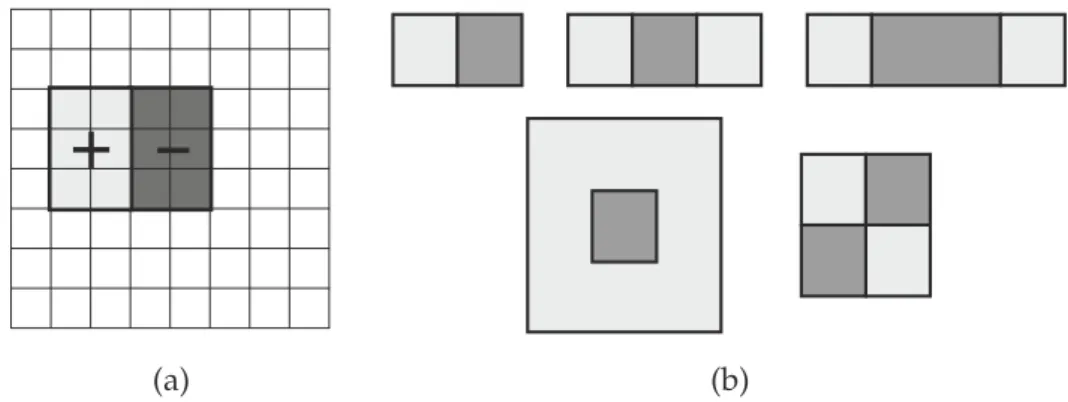
The descriptors used inside the Viola-Jones framework, known as Haar-like fea-tures, compare the average intensity of two adjacent zones of the subwindow, with a predefined geometry and proportionality (seeFigure1). The key advantage of this
kind of features is that they carry localized contrast information and require very low computational cost, since they can be very efficiently computed using integral images.
+
-(a) (b)
Figure1: Example of a simple Haar-like feature (a) and Haar-like feature definitions used in
the Viola-Jones Framework (b). Average intensity of the pixels inside the darker areas is substracted from the average intensity of the pixels inside clearer areas.
However, a single Haar-like feature does not carry enough information to address the detection task (they are too weak), while the total cardinality of the set of Haar-like features extractable from each subwindow is extremely high (they are toomany)3
. Thus, in order to make the problem tractable, a subset of meaningful features must be
selected and accordinglycombined to build a classifier. . . and here is where Adaboost
appears.
AdaBoost
As we have seen in Section 2.1, AdaBoost is a learning algorithm that, using a
training dataset (with positive and negative examples of the desired object), is able to select a set of weak classifiers from a predefined pool, and combine them into a final strong classifier. Thus, AdaBoost fits perfectly to the scenario we have just described: we have a huge pool of very weak features, from which we need to select a small sub-set (dimensionality reduction) and then combine them to build a stronger classifier able to tackle the detection problem. In other words, in the Viola-Jones framework, AdaBoost is responsible for selecting the most discriminant Haar-like features accord-ing to the trainaccord-ing dataset, and combine them to build the final classifier (detector).
3 As originally defined by Viola and Jones, in a 24x24 image window (the resolution of their original detector) there are 268364 different features.
Cascaded Architecture
In real conditions, the number of positives of a given object (think of a face) is negligible with regard to the total number of subwindows in an entire image, and most of those windows will be “easy-to-reject” negatives. In such conditions, a
sim-ple monolithic detector devoting the same time and computational burden to all the
windows, regardless they are easy or difficult ones, will be extremely inefficient and ruin the real-time capabilities of such a system.
Because of that, Viola and Jones proposed an architecture in which detection is per-formed in a distributed way by a cascade of simpler classifiers (seeFigure2). The key
of their proposal is that any negative decision, at any point of the cascade, will lead to a direct rejection of the candidate subwindow, avoiding the following classifiers to be evaluated. In order to optimize efficiency, each classifier of the cascade must be trained to reject as many negatives as possible with a controlled computational load, while preserving all (or almost all) the positives. The authors refer to this architecture as anattentional cascade, since classifiers are intended to progressively focus (as the cascade advances) their attention in the most difficult examples.
Classifier 1 No
Input Yes Classifier 2
No
Yes Yes Classifier T
No
Yes
...
Negative
Positive
Figure2: Cascade of classifiers. A negative result, at any point of the cascade, leads to a final
rejection of the candidate input.
The huge unbalance in cardinality and structural variability of positives and neg-atives leads to a distributed detection scheme made of several classifiers holding compromise between rejection of negatives and preservation of positives. . . and that is cost-sensitiveness.
2.3 o u r w o r k i n o b j e c t d e t e c t i o n
Our work in Object Detection started [25] by developing, from scratch, our own
implementation of a object detection training platform based on both the original Viola-Jones proposal [64] as well as the variations included in the OpenCV version
of the detector by that time [35, 36]. Our aim was initially geared towards facial
applications, and the first face detector [25] was later expanded to be concurrently
used for facial features localization [29], while we also studied the use of skin color
detection preprocessing stages [21].
Within the scope of this thesis, in this chapter we will focus our attention on the contributions we have made in the field of object detection that, though not pure boosting research, are most closely related to AdaBoost: Haar-like Polarity Invariant
Features [30] and Quantum Features [32]. In both cases they are novel descriptors
that are used in different object detection scenarios (faces and traffic signs, respec-tively), and that are aimed to reach a better or more efficient modeling of the weak
information to feed (cost-sensitive) AdaBoost learning stages.
2.3.1 Haar-Like Polarity Invariant Features
The Human Visual System is the main reference for the development and evalua-tion of many computer vision applicaevalua-tions, especially those based on human skills, as is the case with face (and object) detection. Thus, we can draw a parallel between human perception, based on local contrast and polarity, and Haar-like features that basically encode local contrast and polarity information. Nevertheless, while contrast polarity invariance has been shown to be perceptually relevant for the human capa-bility of detecting faces [61], contrast polarity in original Haar-like features is always fixed.
Physiological and Psychopysical Evidences
Human vision [12] is based on the interpretation of patterns of light projected onto
the photoreceptor cells (cones and rods) of our retina. These cells transduce light to electric impulses, and synapse on a neural network which connects them to ganglion cells. Inputs of ganglion cells come from spatially localized groups of photoreceptors in the retina called receptive fields, which have different sizes and can overlap one another.
Physiological studies [28] have shown that receptive fields are organized in an
antagonistic center/surround nature: stimulation in the center of the field tends to be suppressed by stimulation in the surrounding area. The result of such antagonistic organization is that ganglion cells behavior, which is the basic unit for higher-level visual processing, depends on contrast of local regions.
+
+
-(a) (b)
Figure3: Center/surround nature of receptive fields in the retina: On-Center (a) and
Off-Center (b).
From a functional point of view, two classes of receptive fields have been identified: those which increase the ganglion cell firing rate with increments of light in the center of the field, and those which increase the firing rate with center light decrements. This on-center off-center discrimination shows that contrast polarity is already present in the early stages of the visual pathway.
More recently, Antonio Torralba and Pawan Sinha conducted a series of psychophys-ical experiments [61] to study the influence of several image attributes in the
perfor-mance of human observers detecting faces at different resolutions. They found that, when using images of the internal part of the face, contrast negation caused a clear detrimental effect on face detection performance. However, when those images were expanded to include local context (bounding contours), the human capability of de-tecting faces not only improved in the general case, but also contrast reversal had a smaller detrimental impact.
These results reveal that local context information makes detection easier and sug-gest that, while contrast polarity must be encoded in our brain representation of faces specially for internal features, some information, as bounding contours, might be encoded in a polarity invariant way (seeFigure4).
Normal
Inverted
Expanded
Internal
Polarity invariant Fixed polarity (a) (b)Figure4: Contrast polarity and context information in face detection: Contrast reversal of
face images has a smaller influence on the human capability of detecting faces when bounding contours (local context) are included (a), suggesting that our brain representations of faces must encode both fixed polarity and polarity invariant in-formation (b).
Haar-like features and polarity
Following physiological evidences as those sketched in Section2.3.1, David Marr
[37] theorized that a visual system must have a hierarchical processing architecture
and should be based in scalable and differential (contrast based) features, properties which are satisfied by wavelets. Constantine Papageorgiou et al. [47] used Haar
wavelets as features in SVM classifiers for object detection, suggesting that an over-complete set of such basis functions will increase the descriptive power and the spa-tial resolution needed for the detection task. Following this line, Paul Viola and Michael J. Jones [64] take one step further defining what today are called Haar-like
features: an overcomplete set of functions, efficiently computed via the integral im-age, which compare the average intensity difference between adjacent rectangular regions of the image.