(will be inserted by the editor)
The dark side of Interval Temporal Logic:
marking the undecidability border
Davide Bresolin · Dario Della Monica · Valentin Goranko · Angelo Montanari · Guido Sciavicco
Received: date / Accepted: date
Abstract Unlike the Moon, the dark side of interval temporal logics is the one we usually see: their ubiquitous undecidability. Identifyingminimalundecidable interval logics is thus a natural and important issue in that research area. In this paper, we identify several new minimal undecidable logics amongst the fragments of Halpern and Shoham’s logic HS, including the logic of theoverlapsrelation, over the classes of all and finite linear orders, as well as the logic of themeetsandsubintervalrelations, over the classes of all and dense linear orders. Together with previous undecidability results, this work contributes to bringing the identification of the dark side of interval temporal logics very close to the definitive picture.
Keywords Interval temporal logic·Undecidability·Tiling problems
1 Introduction
Temporal reasoning plays a major role in computer science. In the most standard approach, the basic temporal entities are time points and temporal domains are represented as ordered A short preliminary version of this paper appeared in [6].
D. Bresolin
Dept. of Computer Science, University of Verona, Italy E-mail: [email protected]
D. Della Monica
ICE-TCS, School of Computer Science, Reykjavik University, Iceland E-mail: [email protected]
V. Goranko
Department of Informatics and Mathematical Modelling, Technical University of Denmark and Department of Mathematics, University of Johannesburg (visiting professor) E-mail: [email protected]
A. Montanari
Dept. of Mathematics and Computer Science, University of Udine, Italy E-mail: [email protected]
G. Sciavicco
Dept. of Information and Communication Engineering, University of Murcia, Spain E-mail: [email protected]
structures of time points. The interval reasoning approach adopts another perspective on time, sometimes more natural, according to which the primitive ontological entities are time intervals instead of time points.
The tasks of representing and reasoning about time intervals arise naturally in various fields of computer science, artificial intelligence, and temporal databases, such as theories of action and change, natural language processing, and constraint satisfaction problems. Tem-poral logics with interval-based semantics have also been proposed as a useful formalism for the specification and verification of hardware [21] and of real-time systems [23].
Despite the relevance of interval-based temporal reasoning, however, interval temporal logics are far less studied and popular than point-based ones because of their higher con-ceptual and computational complexity (relations between intervals are more complex than those between points). Interval temporal logics typically feature modal operators that corre-spond to (binary) relations between intervals usually known as Allen’s relations [1]. In [13], Halpern and Shoham introduce a modal logic for reasoning about interval structures (HS), with a modal operator for each Allen’s relation.HSis undecidable under very weak assump-tions on the class of interval structures [13]. In particular, undecidability holds for any class of interval structures over linear orders that contains at least one linear order with an infinite ascending (or descending) sequence of points, thus including the natural time flowsN,Z,Q, andR. For a long time, such sweeping undecidability results have discouraged attempts for
practical applications and further research on interval logics. A renewed interest in the area has recently been stimulated by the discovery of some interesting decidable fragments of HS[7–10]. Gradually, the quest for more expressive yet still decidable fragments ofHShas become one of the main focuses of the current research agenda for interval temporal logic.
In this paper, we contribute to delineate the border between decidable and undecidable fragments ofHSby establishing new undecidability results. The initial undecidability results mentioned above have been strengthened further in a number of more recent publications, including [3–5, 18], where many fragments ofHShave been shown to be undecidable. The present paper extends and partly subsumes some of these results. In particular, we exhibit the first known case of a single-modalityHSfragment which is undecidable in the class of alllinear orders, as well as in the class of allfinitelinear orders, strengthening previous re-sults [4, 5]. Moreover, most undecidability proofs for interval logics hinge on the existence of a linear ordering with an infinite sequence of points; here we show how to relax such an assumption. Although this paper is about undecidability, we believe that the presented results also give a better insight in the expressive power of interval-based temporal log-ics. While these results exclude the possibility of having correct and complete algorithmic decision procedures for some very natural fragments ofHS, they may stimulate further re-search in this area and contribute to a deeper understanding of interval reasoning in artificial intelligence and the mathematics around it.
A complete picture of the state-of-the-art on the classification of HSfragments with respect to the decidability of satisfiability can be found in [11]. The web pagehttp:// itl.dimi.uniud.it/content/logic-hsalso provides a collection of online tools that enable one to check the status (decidable/undecidable/unknown) of any fragment ofHS with respect to the satisfiability problem, over various classes of linear orders (all, dense, discrete, and finite). As a surprising outcome of the study of the family of fragments ofHS with respect to the satisfiability problem, the borderline between decidable and undecidable such fragments turned out to be quite complicated, and they show an unexpected variety of behavior over different kinds of linear orders.
The rest of the paper is organized as follows. In Section 2, we introduce syntax and se-mantics of interval temporal logics. In Section 3, we give a short summary of undecidability
Relation Operator Formal definition Pictorial example a b meets hAi [a,b]RA[c,d]⇔b=c c d before hLi [a,b]RL[c,d]⇔b<c c d started-by hBi [a,b]RB[c,d]⇔a=c,d<b c d finished-by hEi [a,b]RE[c,d]⇔b=d,a<c c d contains hDi [a,b]RD[c,d]⇔a<c,d<b c d overlaps hOi [a,b]RO[c,d]⇔a<c<b<d c d
Table 1 Allen’s interval relations and the correspondingHSmodalities.
results and proof techniques. The following two sections are devoted to the study of specific relevant fragments ofHS: the logicsOandOof Allen’s relationoverlapsand its inverse (Section 4) and the logicsAD,AD,AD, andADof Allen’s relationsmeetsandduringand their inverses (Section 5). Section 6 provides an assessment of the work done and outlines future research directions.
2 Interval temporal logics: syntax and semantics
LetD=hD, <ibe a linearly ordered set. AnintervaloverDis an ordered pair[a,b], where
a,b∈Danda≤b. Intervals of the form[a,a]are calledpoint intervals, while those where
a<barestrict intervals. There are 12 different non-trivial relations (excluding the equality)
between two intervals in a linear order, often calledAllen’s relations[1]: the six relations de-picted in Table 1 and their inverses, which are defined as follows: for each relationRX, with X∈ {A,L,B,E,D,O}, its inverse is the relationRX= (RX)−1. One can naturally associate a modal operatorhXiwith each Allen’s relationRX. For each operatorhXi, we denote byhXi
itstranspose, corresponding to the inverse relation. The notion of sub-interval (contains) can
be defined into two variants, namely,strictsub-interval ([a,b]is a proper sub-interval of[c,d]
if bothc<aandb<d) andpropersub-interval (whenc≤a,b≤d, and[a,b]6= [c,d]). Both variants will be considered in this paper. Except when stated otherwise, we refer to proper ones.
Halpern and Shoham’s logicHSis a multi-modal logic with formulae built over a set
APof proposition letters, the propositional connectives∨and¬, and all (unary) modalities for Allen’s relations. For each subset{RX1, . . . ,RXk}of these relations, we define theHS fragmentX1X2. . .Xk, whose formulae are defined by the grammar:
ϕ::=p|π| ¬ϕ|ϕ∨ϕ| hX1iϕ|. . .| hXkiϕ,
whereπis a modal constant, true precisely at point intervals. We omitπwhen it is definable in the language or when point intervals are not allowed. The other propositional connectives, like∧and→, and universal modalities[X]are defined as usual, e.g.,[X]ϕ≡ ¬hXi¬ϕ.
LetI(D)be the set of all intervals overD. Thenon-strict semanticsof an interval
tem-poral logic is given in terms ofinterval models M=hI(D),Vi, whereV:I(D)→2APis the
valuation functionthat assigns to every interval[a,b]∈I(D)the set of proposition letters
V([a,b])that are true on it. The truth of a formula over an interval[a,b]in a modelMis defined by structural induction on formulae:
– M,[a,b]πiffa=b;
– M,[a,b]piffp∈V([a,b]), for allp∈AP; – M,[a,b]¬ψiff it is not the case thatM,[a,b]ψ; – M,[a,b]ϕ∨ψiffM,[a,b]ϕorM,[a,b]ψ;
– M,[a,b]hXiiψiff there is an interval[c,d]such that[a,b]RXi[c,d], andM,[c,d]ψ.
Satisfiabilityis defined as usual: given a formulaϕ ofHS, we say thatϕissatisfiableif
there exist a modelMand an interval[a,b]such thatM,[a,b]ϕ. Throughout the paper, for every proposition letterpand interval[a,b], we say that[a,b]is ap-intervalifpholds over it (in the considered model).
Interval temporal logics can be given astrict semanticsby excluding point intervals from the set of intervals over which formulae are interpreted (and by correspondingly excluding π from the language). In the following, we will restrict our attention to strict semantics. However, all undecidability results hold also for the non-strict semantics.
3 A short summary of undecidability results and proof techniques
In this section, we first summarize the main undecidability results forHSfragments, and then we state the main results of the present paper (Theorem 1), which extend existing ones by providing new undecidability proofs for proper sub-fragments of logics that were already known to be undecidable.
3.1 Undecidability results
Undecidability of fullHSwas proved by Halpern and Shoham in [13]. Since then, several other undecidability results have been obtained. In [16], Lodaya proved undecidability of BEover dense linear orders, or, alternatively, overhω, <i, provided that infinite intervals are allowed. In [3], Bresolin at al. showed undecidability of a number ofHSfragments, namely, ADE,ADE,ADE,ADE,ADO,ADO,ADO,ADO,ADB,ADB,ADB,ADB,BE,BE, and BE. Undecidability of all (HS-)extensions ofO(resp.,O), except for those with modalities hLiandhLi, interpreted over any class of linear orders with at least one infinite ascending or descending (it depends on the modalities of the fragment) sequence of points, has been shown in [4]. In [5], the one-modality fragmentOhas been proved to be undecidable over the class of discrete linear orders. Finally, Marcinkowski et al. have shown the undecidability ofBD,BD,BD, andBDon finite and discrete linear orders in [19], and, then, strengthened that result to the one-modality fragmentsDandDin [18].
The present paper aims at contributing as much as possible to the completion of the undecidability picture. Its results can be summarized as follows.
Theorem 1 The satisfiability problem forHSfragmentsO,O,AD,AD,AD, andAD, over
any class of linear orders that contains, for each n>0, at least one linear order with
cardi-nality greater than n, is undecidable.
Theorem 1 states the undecidability of variousHSfragments over (ii) classes of linear or-ders that contain at least one linear order with an infinite ascending (fragmentsO,AD,AD) or descending (fragmentsO,AD,AD) sequence of points, and (ii) those classes that contain arbitrarily large finite linear orders. The next sections are devoted to the proof of Theorem 1. The proof makes use of reductions from two different problems, depending on the con-sidered class of linear orders: a reduction from the Octant Tiling Problem is used to deal
with classes of linear orders containing an infinite sequence of points (we will call it “the infinite case”), while a reduction from the Finite Tiling Problem is used to deal with classes of unbounded finite linear orders (“the finite case”). It is important to point out that all mean-ingful classes of linear orders fit in one of these two cases, including the classes of all linear orders, dense linear orders, discrete linear orders, finite linear orders, as well as the linear orders ofN,Z,Q, andR(singletons). The proof of Theorem 1 follows from Corollary 2
(infinite case forOandO), Corollary 3 (finite case forOandO), Corollary 5 (infinite case forAD), Corollary 9 (infinite case forAD), Corollary 10 (infinite case forADandAD), and the undecidability results given in [18] (finite case forAD,AD,AD, andAD).
Pairing known results with those given in this paper, we make a significant step toward the complete classification ofHSfragments with respect to their decidable/undecidable sta-tus, as we can conclude thatO,O,AD,AD,AD,AD,BE,BE,BE, andBEare undecidable over all meaningful classes of linear orders, that is, over the classes of all, dense, discrete, and finite linear orders. The undecidability proof forOandOover all relevant classes of linear orders generalizes those given in [4, 5] as it neither assumes discreteness (as [5] does) nor the existence of an infinite sequence (as [4] does). The undecidability proof forADand AD(resp.,ADandAD), over any class of linear orders that contains at least a linear order with an infinite ascending (resp., descending) sequence of points, strengthens the undecid-ability results given in [3]. Since undecidundecid-ability of these fragments over the class of finite linear orders immediately follows from that ofDandD, undecidability spans all meaningful classes of linear orders. As a matter of fact, undecidability of finite satisfiability forDand Dcan also be exploited to prove undecidability ofADandAD(resp., ADandAD) over infinite, discrete, and right-bounded (resp., left-bounded) interval structures. Undecidability ofBE,BE,BE, andBEover all meaningful classes of linear orders follows from a col-lection of results. First, sincehDi(resp., hDi) is definable inBE(resp.,BE) by equation hDiϕ=hBihEiϕ(resp.,hDiϕ=hBihEiϕ), undecidability ofBE(resp.,BE) over finite and discrete linear orders immediately follows from that ofD(resp., D) [18]. Undecidability ofBEover the class of all dense linear orders has been proved in [16] (since density is expressible inBEby a constant formula, undecidability over the class of all linear orders immediately follows [12]), while undecidability ofBEover the classes of dense and all lin-ear orders has been shown in [3]. Finally, sinceO(resp.,hOi) is definable inBE(resp.,BE) by equationhOiϕ=hEihBiϕ (resp.,hOiϕ=hBihEiϕ), undecidability ofBE(resp.,BE) over all meaningful classes of linear orders immediately follows from that ofO(resp.,O).
3.2 Proof techniques
The undecidability results given in this paper are proved by reduction of suitable instances of the Tiling Problem to the satisfiability problem for the consideredHSfragments. Generally speaking, the Tiling (or Domino) Problem is the problem of deciding whether a set of tiles of a particular kind can tile a given portion of the plane. Starting from the seminal work by Wang [22], the Tiling Problem has been extensively used to prove undecidability and to give complexity bounds to the satisfiability problem for many different logical formalisms [2, 14]. As a matter of fact, a number of variants of the problem have been proposed in the literature, which differ from each other in the constraints they impose on the placement of the tiles and on the shape of the considered portion of the plane. In this paper, we will we make use of the Octant Tiling Problem (OTP) and of the Finite Tiling Problem (FTP).
OTP is the problem of establishing whether a given finite set of tile typesT ={t1, . . . ,tk}
For every tile typeti∈T, letright(ti),le f t(ti),up(ti), anddown(ti)be the colors of the corresponding sides ofti. To obtain acorrect tilingof the octantO, one must find a function f:O→T such thatright(f(n,m)) =le f t(f(n+1,m)), whenevern<m, andup(f(n,m)) =
down(f(n,m+1)). Undecidability of OTP can be shown by means of an argument similar to the one used in [2] to prove undecidability of the Quadrant Tiling Problem.
FTP is a well-known undecidable problem, that has been studied in the literature in different, yet closely related, variants. Here, we refer to the one introduced and shown to be undecidable in [17]. Formally, we define FTP as the problem of establishing whether there exist two natural numberskandlsuch that a finite set of tile typesT, containing two distinguished tile typest0andtf, can correctly tile the{0, . . . ,k} × {0, . . . ,l}finite portion of the plane, under the additional restriction thatf(0,0) =t0andf(k,l) =tf.
Given anHSfragmentFand an instance OTP(T)of OTP, whereT is a finite set of tile types, to reduce OTP to the satisfiability problem forF, we build anF-formulaΦT which
is satisfiable if and only ifT can correctly tileO. The construction is similar to those used to prove undecidability of otherHSfragments, but it is not readily derivable from them.
First, given an interval[a,b], sometimes referred to as thestarting interval, we identify a subsetG[a,b]of relevant intervals. Such a set contains all and only the intervals we need. Typically,G[a,b] is the set of all intervals reachable from the starting interval[a,b]using modalities ofF. However, this is not alway the case. For instance, in the proof forADand AD(Section 5),G[a,b]is a subset of the set of intervals reachable from[a,b]. A
characteriza-tion of the setG[a,b]is given by means of aglobal operator[G](definable inF) such that, for
each proposition letterp,[G]pis true if and only ifpis true over all intervals inG[a,b]. Since all relevant formulae exclusively refer to intervals belonging toG[a,b], hereafter, even if not explicitly said, we will only refer to intervals inG[a,b], all other intervals being irrelevant.
Second, we set the tiling framework by forcing the existence of a unique infinite chain of u-intervals (ustands forunit), calledu-chain, on the underlying linear order. The elements of theu-chain are used as cells to arrange the tiling. Moreover, a new modality (definable in
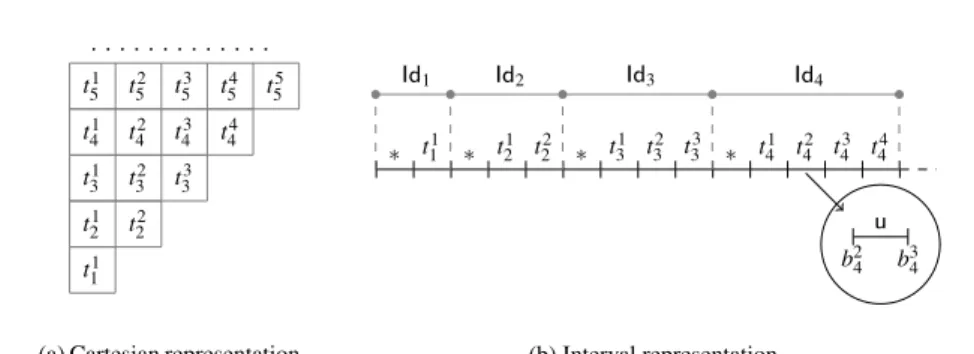
F) is introduced to move from the currentu-interval to the next one in theu-chain. Third, we encode the octant by means of a unique infinite sequence ofId-intervals (Id stands foridentifier), calledId-chain. EachId-interval represents a row of the octant, and it consists of a sequence ofu-intervals. Eachu-interval is used either to represent a labeled position of the plane or to separate two consecutive rows. In the former case, it is labeled withtile; in the latter case, it is labeled with∗.
Finally, by using suitable proposition letters, we encode theabove-andright-neighbor relations, which connect each tile of the octant with, respectively, the one immediately above it and the one immediately at the right of it. Throughout the paper, if two tilest1andt2are connected by the above-neighbor (resp., right-neighbor) relation, we say thatt1 is
above-connected(resp.,right-connected) tot2, and similarly fortile-intervals (when they encode
tiles of the octant that are above- or right-connected, respectively). The two neighbor rela-tions must satisfy the followingcommutativity property.
Definition 1 An interval model has the commutativity property if for any pair of tile-intervals[c,d]and[e,f], if there is atile-interval[d1,e1], such that[c,d]is right-connected to[d1,e1]and[d1,e1]is above-connected to[e,f], then there is atile-interval[d2,e2]such that[c,d]is above-connected to[d2,e2]and[d2,e2]is right-connected to[e,f].
The rest of the paper is devoted to the proof of Theorem 1. As we already mentioned in Section 2, strict semantics is assumed. However, the proof can be easily adapted to non-strict semantics, because only proper intervals are used in the construction of models representing correct tilings.
b0 u c0 k b1 u c1 k b2 u c2 k b3 u c3 k b4 u c4 k b5 u c5 k b6 u c6 k b7 c7 Fig. 1 Encoding of theu-chain inO.
4 The fragmentsOandO
The section is structured as follows. First, we prove undecidability ofO over any class of linear orders containing at least one linear order with an infinite ascending sequence of points (infinite case) by building step-by step anO-formula that encodes OTP; then, to prove undecidability ofOover any class of linear orders containing finite linear orders of unbounded cardinality (finite case), we show that an encoding of FTP can be obtained by a suitable adaptation of the construction for the infinite case. Since, by symmetry, analogous results hold forO, this suffices to prove Theorem 1 as far asOandOare concerned. The proof for the infinite case is based on that given in [5] for the class of discrete linear orders, but dropping the discreteness assumption turned out to be far from being simple. The final achievement is a very general (and elegant) undecidability proof forO(andO).
4.1 Undecidability in the infinite case
Let[a,b]be any interval of length at least 2, that is, such that there is at least one pointc in betweenaandb. Moreover, letG[a,b]be the set containing[a,b]and all and only those intervals[c,d]of length at least 2 such thatc>aandd>b. Finally, let modality[G]be defined as follows:[G]p≡p∧[O]p∧[O][O]pforp∈AP. It can be easily checked that[G]p holds over[a,b]if and only ifpholds over all intervals inG[a,b].
Definition of the u-chain. The definition of theu-chain is the most difficult step in the construction, due to the weakness of the language. It represents the most significant de-parture from the solution given in [5], where the definition of theu-chain hinges on the discreteness assumption. Here, a completely new approach is needed. It rests on three main ingredients:(a)existence of an infinite sequence ofu-intervals[b0,b00],[b1,b01], . . . ,[bi,b0i],
. . ., withb≤b0andb0i=bi+1for eachi∈N;(b)existence of an interleaved auxiliary chain
[c0,c00],[c1,c10], . . . ,[ci,c0i], . . ., withbi<ci<b0i=bi+1<c0i<b0i+1 andc0i=ci+1 for each i∈N;(c)uniqueness of chains. We callk-intervals the intervals of the auxiliary chain. Each k-interval overlaps exactly oneu-interval, and it will be exploited to move from the current u-interval to next one in theu-chain. A graphical account of the relationships between the two chains is given in Fig. 1.
The third ingredient is definitely the most difficult one to deal with. To guarantee unique-ness, we will show that, under certain conditions, Ocan impose suitable conditions on proper sub-intervals of a given interval (which is quite surprising for a very weakHS frag-ment likeO). In particular, we will show that, under appropriate constraints on the valuation ofp∈AP(see Definition 2 below), it is possible to express properties like: “for each interval
[c,d], if[c,d]satisfiesp, then no proper sub-interval of[c,d]satisfiesp”.
Definition 2 LetMbe a model,[a,b]be an interval overM, andp,q∈AP. We say that pandqaredisjoint inhM,[a,b]iif, for every pair of intervals[c,d],[e,f]∈G[a,b]such that
consequent of p inhM,[a,b]iif pandq are disjoint in hM,[a,b]iand any p-interval is followed by aq-interval, that is, for eachp-interval[c,d]∈G[a,b], there is aq-interval[e,f]∈ G[a,b], withe≥d. Finally, we say that p isdisjointly-bounded inhM,[a,b]iwith disjoint
consequent qif(i)[a,b]neither is ap-interval nor overlaps ap-interval, that is, if[c,d]is a p-interval, thenc≥b;(ii)there are not twop-intervals[c,d]and[e,f]withc<e<d<f, that is,p-intervals do not overlap;(iii) qis a disjoint consequent ofpinhM,[a,b]i. The definition ofu-chain makes use of the auxiliary proposition lettersu1,u2,k1, andk2.
The following formulae constrainu1,u2,k1, andk2to be disjointly-bounded inhM,[a,b]i
with disjoint consequentu2,u1,k2,k1, respectively.
hOi> ∧ ¬u∧ ¬k∧[O](¬u∧ ¬k) (1)
[G]((u↔u1∨u2)∧(k↔k1∨k2)∧(u1→ ¬u2)∧(k1→ ¬k2)) (2)
[G]((u1→[O](¬u∧ ¬k2))∧(u2→[O](¬u∧ ¬k1))) (3)
[G]((k1→[O](¬k∧ ¬u1))∧(k2→[O](¬k∧ ¬u2))) (4)
[G]((hOiu1→ ¬hOiu2)∧(hOik1→ ¬hOik2)) (5)
[G]((u1→ hOik1)∧(k1→ hOiu2)∧(u2→ hOik2)∧(k2→ hOiu1)) (6)
(1)∧. . .∧(6) (disj-bndk
u)
Lemma 1 Let M be a model and[a,b]be interval over M such that M,[a,b](disj-bndk u).
Thenu1,u2,k1, andk2are disjointly-bounded inhM,[a,b]iwith disjoint consequentsu2,
u1,k2,k1, respectively.
Proof We prove the statement foru1. The proof foru2,k1, andk2is analogous. We show
thatu1satisfies the three conditions for disjointly-bounded proposition letters of Definition
2. By (1) and (2),[a,b]neither satisfiesu1nor overlaps anu1-interval (condition (i)). By
(2) and (3),u1-intervals do not overlap each other (condition (ii)). We show now thatu2is
a disjoint consequent ofu1(condition (iii)). First, we prove thatu1andu2are disjoint. To
this end, suppose, for the sake of contradiction, that there are anu1-interval[c,d]and an
u2-interval[e,f]such thatd>eandf>c. We distinguish three cases:
1. e<c. If f<d, (3) is violated, while if f≥d, (5) is violated. The former case is straight-forward; as for the latter case, consider an interval starting strictly inside[a,b]and end-ing strictly inside[c,d]. Such an interval overlaps both theu1-interval[c,d]and the
u2-interval[e,f](by the first conjunct of (1), the length of[a,b]is greater than or equal
to 2, and, by definition of[G], the same holds for each interval reachable from[a,b]);
2. e=c. (5) is violated (same argument of point 1);
3. e>c. Iff≤d, (5) is violated (same argument of point 1), while iff>d, (3) is violated.
To complete the proof, we need to show that, for eachu1-interval[c,d], there is anu2
-interval[e,f], withe≥d. This follows from (6) and disjointedness ofu1andu2. ut
We now show that whenever a proposition letterpis disjointly-bounded inhM,[a,b]iwith disjoint consequentq, we can introduce an auxiliary proposition letterinsidepand force it to be true over all proper sub-intervals (inG[a,b]) ofp-intervals. Then, by simply stating that
insidep-intervals andp-intervals cannot overlap, we prove that nop-interval can be a proper sub-interval of another one. To properly constrain the behavior ofinsidep, we introduce an auxiliary proposition letter−→p and we force it to be true over intervals that start inside a
following three formulae express the above conditions for a generic proposition letter p disjointly-bounded inhM,[a,b]iwith disjoint consequentq.
[G](p→[O](hOiq→ −→p)) (7)
[G](¬p∧[O](hOiq→ −→p)→insidep) (8)
[G]((insidep→ ¬hOip)∧(p→ ¬hOiinsidep)) (9) Lemma 2 Let M be a model,[a,b]be an interval over M, and p,q∈APbe two proposition letters such that p is disjointly-bounded inhM,[a,b]iwith disjoint consequent q. If M,[a,b]
(7)∧(8)∧(9), then no p-interval can be a proper sub-interval of another one inG[a,b].
Proof Suppose, for the sake of contradiction, that there exist twop-intervals[c,d]and[e,f]
inG[a,b]such that[e,f]is a proper sub-interval of[c,d]. By definition of proper sub-interval,
we have that c<e or f <d. Without loss of generality, let us suppose that c<e(the other case is analogous). Since[e,f]∈G[a,b], then there exists a point in betweeneand f,
call it e0. The interval[c,e0]cannot satisfy p, since it overlaps the p-interval[e,f]andp is disjointly-bounded inhM,[a,b]i. Moreover,[c,e0]is a sub-interval of[c,d], and, by (7), each interval starting at a point betweencandd and ending inside aq-interval (qbeing a disjoint consequent ofp) satisfies−→p. Hence,[c,e0]satisfies¬pand[O](hOiq→ −→p). By (8), it immediately follows that[c,e0]satisfiesinsidepas well, and then, by (9), that[c,e0]does
not overlap anyp-interval (contradiction). ut
Hereafter, we will denote bynon-sub(x,y), withx,yproposition letters inAP, the formula obtained from (7)∧(8)∧(9) by replacingpbyx,−→p by−→x,insidepbyinsidex, andqbyy, stating that nox-interval is a sub-interval of another one.
To complete the construction of theu-chain, the following formulae are needed, where firstis used to identify the first interval of theu-chain.
hOihOi(u1∧first) (10)
[G](u∨k→[O]¬first∧[O][O]¬first) (11)
[G]((first→u1)∧(first→[O][O]¬first)) (12)
non-sub(u1,u2)∧non-sub(u2,u1)∧non-sub(k1,k2)∧non-sub(k2,k1) (13)
[G](u∨k→[O]hOi(u∨k)) (14)
(10)∧. . .∧(14) (u-chain)
Lemma 3 Let M be a model and[a,b]be an interval such that M,[a,b](disj-bndk u)∧
(u-chain). Then,
(a) there exists an infinite sequence ofu-intervals[b0,b00],[b1,b01], . . . ,[bi,b0i], . . ., with b≤b0 and b0i=bi+1for every i∈N, such that M,[b0,b00]first,
(b) there exists an infinite sequence ofk-intervals [c0,c00],[c1,c01], . . . ,[ci,c0i], . . . such that bi<ci<bi0, bi+1<c0i<b0i+1, and c0i=ci+1for every i∈N, and
(c) any other interval[c,d]∈G[a,b]satisfies no one amongu,k, andfirst, unless c>bifor
every i∈N.
Proof For the sake of simplicity, we first prove a weaker version of (a) and (b), namely,
(a’) there exists an infinite sequence ofu-intervals[b0,b00],[b1,b01], . . . ,[bi,b0i], . . ., withb≤ b0andb0i≤bi+1(instead ofb0i=bi+1) for everyi∈N, such thatM,[b0,b00]first, and (b’) there exists an infinite sequence ofk-intervals[c0,c00],[c1,c01], . . . ,[ci,c0i], . . .such that
Then, we will prove (c), and, finally, we will forceb0i=bi+1andc0i=ci+1for everyi∈N.
As a matter of fact, the existence of anu-chain and ak-chain that respectively satisfy (a)’ and (b)’ easily follows from formulae (1), (2), (3), (4), (6), and (10).
To prove (c) , we show that any other interval (inG[a,b]) satisfies neitherunork, unless its starting point is greater than all points belonging to the intervals of theu-chain and the k-chain. As a preliminary step, we show that nou-interval (resp.,k-interval) belonging toG[a,b]
can be a proper sub-interval of anu-interval or ak-interval. Formula (5) guarantees that no u1-interval (resp.,k1-interval) can be a sub-interval of anu2-interval (resp.,k2-interval) and
vice versa, that is, nou2-interval (resp.,k2-interval) can be a sub-interval of anu1-interval
(resp.,k1-interval). Moreover, by Lemma 1,u1,u2,k1, andk2are disjointly-bounded, and
thus from (13) it follows that nou1-interval (resp.,u2-interval,k1-interval,k2-interval) can
be a sub-interval of anotheru1-interval (resp.,u2-interval, k1-interval,k2-interval). It
re-mains to show that nou-interval can be a sub-interval of anyk-interval, and vice versa. Suppose, for the sake of contradiction, that there exist anu-interval[c0,d0]which is a sub-interval of ak-interval[c00,d00]. By (6), it follows that there is ak-interval, say it[c000,d000], which starts in betweenc0andd0. Then, eitherd000≤d00and thek-interval[c000,d000]is a sub-interval of thek-interval[c00,d00](contradiction, as we just proved that this cannot be the case) ord000>d00and thek-interval[c00,d00]overlaps thek-interval[c000,d000] (contradiction, as (4) constrainsk-intervals to not overlap). With a similar argument, one can show that no k-interval can be a sub-interval of anu-interval.
To conclude the proof of (c), suppose, for the sake of contradiction, that there exists anu-interval[c,d]inG[a,b]such that[c,d]6= [bj,b0j], for every j∈N, andc≤bk, for some k∈N. By (1),c≥b. We show that all possible choices forclead to a contradiction.
– If b≤c<b0, then one of the following two cases applies: (i) ifd<b00, then (11) is
violated; (ii) ifd≥b00, then theu-interval[b0,b00]is a sub-interval of theu-interval[c,d]
(contradiction).
– Ifc=bifor somei≤k, then one of the following cases applies: (i) ifd<b0i, then the u-interval[c,d]is a sub-interval of theu-interval[bi,b0i](contradiction); (ii) ifd=b0i, then
[c,d] = [bi,b0i], against the assumption that[c,d]= [6 bi,b0i]for anyi∈N; (iii) ifd>b0i, then theu-interval[bi,b0i]is a sub-interval of theu-interval[c,d](contradiction). – Ifbi<c<b0ifor somei≤k, then one of the following two cases applies: (i) ifd≤b0i,
then theu-interval[c,d]is a sub-interval of theu-interval[bi,b0i](contradiction); (ii) if d>b0i, then theu-interval[bi,b0i]overlaps theu-interval[c,d], thus violating (3). – Ifb0i≤c<bi+1for somei<k, then one of the following cases applies: (i) ifd≤bi+1,
then the u-interval[c,d] is a sub-interval of thek-interval[ci,c0i](contradiction); (ii) if bi+1<d<b0i+1, then the u-interval[c,d]overlaps theu-interval[bi+1,b0i+1], thus violating (3); (iii) if d≥b0i+1, then theu-interval[bi+1,b0i+1]is a sub-interval of the u-interval[c,d](contradiction).
A similar argument can be used to prove that there exists nok-interval[c,d]∈G[a,b]with [c,d]6= [ci,c0i]for everyi∈N, unlessc>bifor everyi∈N. Finally, assume, for the sake of
contradiction, that there exists an interval[c,d]inG[a,b], with[c,d]6= [b0,b00]andc≤bkfor somek∈N, that satisfiesfirst. By the first conjunct of (12),[c,d] = [bi,b0i]for somei∈N, withi6=0 (we just proved that there are no otheru-intervals), but this immediately leads to a violation of the second conjunct of (12).
We conclude the proof by showing thatb0i=bi+1andc0i=ci+1for everyi∈N. Suppose,
for the sake of contradiction, thatb0i<bi+1 for somei∈N. By (a’) and (b’), there exist
bi,ci,c0i,bi0+1such thatbi<ci<b0i,bi+1<c0i<b0i+1, and[ci,c0i]satisfiesk. Moreover, by (c), there exists nou- ork-interval starting in betweenciandbi+1. It can be easily checked that
theu-interval[bi,b0i]overlaps the interval[ci,bi+1]that, in turn, does not overlap anyu- or k-interval, thus violating (14). A similar argument can be used to prove thatc0i=ci+1 for
everyi∈N. ut
In the following, we will make use of a derived modalityhXuito access the firstu-interval
of theu-chain and to step from any givenu-interval to the next one in theu-chain.hXuiis
defined as follows:
hXuiϕ≡ hOihOi(first∧ϕ))∨(u∧ hOi(k∧ hOi(u∧ϕ)))
Definition of theId-chain.TheId-chain is defined by the following set of formulae:
¬Id∧ ¬hOiId∧[G](Id→ ¬hOiId) (15)
hXui(∗ ∧ hXui(tile∧Id∧ hXui ∗ ∧[G](∗ → hXui(tile∧ hXuitile)))) (16)
[G]((u↔ ∗ ∨tile)∧(∗ → ¬tile)) (17) [G](∗ → hOi(k∧ hOiId)) (18) [G](Id→ hOi(k∧ hOi∗)) (19) [G]((u→ ¬hOiId)∧(Id→ ¬hOiu)) (20) [G](hOi∗ → ¬hOiId) (21) non-sub(Id,∗) (22) (15)∧. . .∧(22) (Id-chain)
Lemma 4 Let M be a model and[a,b]be an interval such that M,[a,b](disj-bndk u)∧
(u-chain)∧(Id-chain). Moreover, let b≤b01<c01<b11< . . . <bk1−1
1 <c k1−1 1 <b k1 1 =b02<c k1 1 = c02<b12< . . . <bk2
2 =b03< . . .be a sequence of points such that[bij,b i+1
j ]is anu-interval
and[ci j,c
i+1
j ]is ak-interval, for every j≥1,0≤i<kj, whose existence is guaranteed by
Lemma 3. Then, for every j≥1, it holds that:
(a) M,[b0j,b1j]∗;
(b) M,[bij,bij+1]tilefor each0<i<kj; (c) M,[b1j,b0j+1]Id;
(d) k1=2, and k`>2for` >1.
Moreover, any other interval[c,d]∈G[a,b] satisfies no one among∗,tile, and Id, unless
c>bi
jfor every i,j>0.
Proof As a first step, we show thatIdis a disjointly-bounded proposition inhM,[a,b]iwith
disjoint consequent∗. By (15), it can be easily checked thatIdmeets the first two conditions of Definition 2. By (17), (20) and (21),∗andIdare disjoint, and, by (19),∗is a disjoint consequent ofId. Now, we prove the statements of the lemma one by one.
(a) From (16), (18), and (19), it immediately follows that there exists an infinite sequence of∗-intervals. Without loss of generality, we can assume it to be[b01,b11],[b02,b12], . . . , [b0j,b1j], . . . . Moreover, by the first conjunct of (17), we can assume that, for every j>0, there is no a∗-interval between[b0j,b1j]and[b0j+1,b1j+1].
(b) By (17), every interval satisfying∗ortileis anu-interval and everyu-interval satisfies either∗ortile. Then,u-intervals between two consecutive∗-intervals (if any) must be tile-intervals.
(c) By (18), for everyk-interval[c0j,c1j]overlapped by a∗-interval, there exists anId-interval
[c,d], withc0j<c<c1j<d. We show thatc=b1jandd=b0j+1. For the sake of contradic-tion, suppose thatc6=b1j. Ifc<b1j, then theu-interval[b0j,b1j]overlaps theId-interval
[c,d], thus violating (20). If c>b1j, two cases must be considered, both leading to a contradiction.
(i) j=1. By (16),[b11,b21]is theId-interval corresponding to the first row of the octant. Now, ifd>b2
1, then theu-interval[b11,b12]overlaps theId-interval[c,d], violating (20); otherwise, ifd≤b2
1, then theId-interval[c,d]is a sub-interval of theId-interval
[b11,b21], violating (22).
(ii) j>1. By (16),[b1j,b2j]is not the last tile-interval of the jth row, and thus the k-interval[c1j,c2j]does not overlap a∗-interval ([b2j,b3j]is atile-interval). By (19), it must bed≥c2j, from which it follows that theu-interval[b1j,b2j]overlaps the Id-interval[c,d], thus violating (20).
We show now thatd=b0j+1, that is, theId-interval starting at the right endpoint of the ∗-interval[b0j,b1j]ends at the left endpoint of the next∗-interval[b0j+1,b1j+1]. Suppose, for the sake of contradiction, thatd6=b0
j+1. Two cases must be considered: j=1 and j>1. If j=1, then fromd<b02 (resp.,d>b02), it follows that theId-interval[c,d]
(resp.,[b11,b21]) is a sub-interval of theId-interval[b11,b21](resp.,[c,d]), violating (22). If j>1, various alternatives must be considered, all leading to a contradiction:
(i) ifd≤ckjj−1, then (19) is violated, since either[c,d]does not overlap anyk-interval or it overlaps ak-interval that does not overlap any∗-interval;
(ii) ifckjj−1<d<b0j+1, then theId-interval[c,d]overlaps theu-interval[bkjj−1,bkjj], thus violating (20);
(iii) ifb0j+1<d<b1j+1, then theId-interval[c,d]overlaps theu-interval[b0j+1,b1j+1], again violating (20);
(iv) ifd≥b1j+1, then (21) is violated, since any interval[a0,c0j+1], witha<a0<b(by (1), there exists at least one such interval), overlaps both the∗-interval[b0j+1,b1j+1]
and theId-interval[c,d]. (d) It immediately follows from (16).
Finally, for the sake of contradiction, suppose that there exists anId-interval[c,d]∈G[a,b]
such that[c,d]6= [b1j,b0j+1], for every j>0, andc≤bij, for somei,j>0. By (15),[a,b]is not anId-interval and it does not overlap anId-interval. Hence,c≥b. We show now that all possible choices forc(≥b)lead to a contradiction:
(i) ifb≤c<b01, then, by (19), it must bed>c01, which causes a violation of (21); (ii) ifb0
j≤c<c0jfor some j>0, then (21) is violated; (iii) ifc0
j≤c<b1jfor some j>0, then, by (19), it must bed>c1jand thus theu-interval
[b0
j,b1j]overlaps theId-interval[c,d], violating (20); (iv) ifc=b1
jfor somej>0, then it must bed=b0j+1(see proof of statement(c)); (v) ifb1
j<c<b0j+1 for some j>0, then (i) ifd≤b0j+1, then theId-interval[c,d]is a sub-interval of theId-interval[b1j,b0j+1], violating (22), and (ii) if d>b0j+1, then the Id-interval[b1j,b0j+1]overlaps theId-interval[c,d], violating (15).
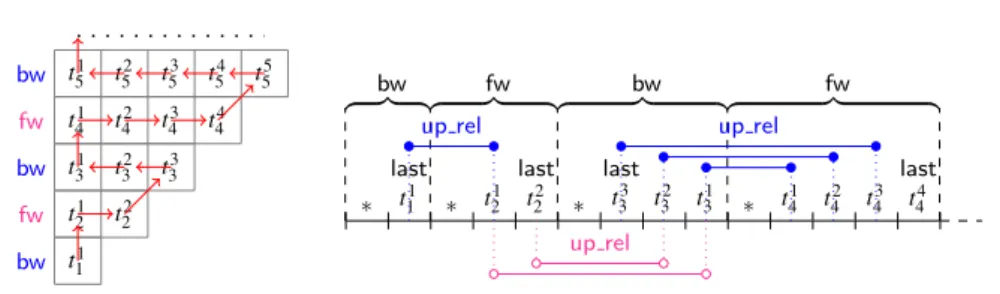
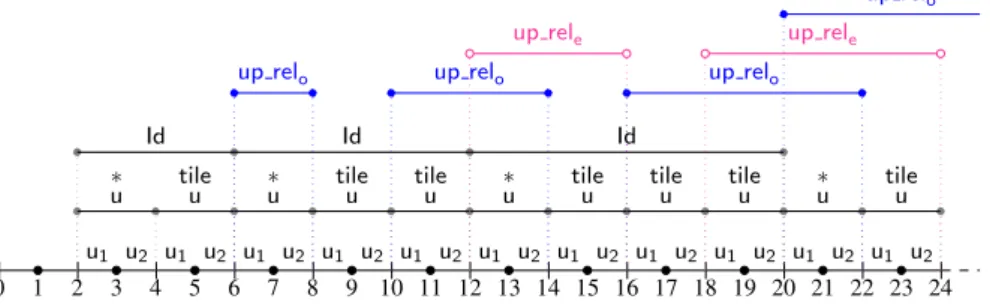
A similar argument can be used to prove that no other interval[c,d]∈G[a,b] satisfies∗or tile, unlessc>bijfor everyi,j>0 ut Above-neighbor relation.The next (difficult) step is the encoding of the above-neighbor relation (the idea is depicted in Fig. 2). The main role here is played by proposition letter
t1 1 t1 2 t22 t13 t32 t33 t1 4 t42 t43 t44 t15 t52 t53 t54 t55 bw fw bw fw bw
(a) Cartesian representation.
last last last last
∗ t11 ∗ t21 t22 ∗ t33 t32 t31 ∗ t41 t42 t43 t44 z }| {z }| {z }| {z }| { bw fw bw fw up rel up rel up rel (b) Interval representation.
Fig. 2 Encoding of the above-neighbor relation inO.
up rel, used to connect eachtile-interval with its vertical neighbor in the octant, e.g.,t22 witht32 in Fig. 2). For technical reasons, we need to partition rows ofOintobackward
andforwardrows making use of proposition lettersbwandfw. Intuitively, tiles belonging
to forward rows ofOare encoded in ascending order, while those belonging to backward rows are encoded in descending order (the tiling is encoded in a zig-zag manner by suitably connecting forward and backward rows). In particular, this means that the left-most tile-interval of a backward row encodes the last tile of that row ofO(not the first one). Letα,β vary into the set{bw,fw}, with α6=β. We label eachu-interval withbw(resp.,fw) if it belongs to a backward (resp., forward) row:
hXuibw∧[G]((u↔bw∨fw)∧(bw→ ¬fw)) (23)
[G]((α∧¬hXui∗ → hXuiα)∧(α∧hXui∗ → hXuiβ)) (24)
(23)∧(24) (bw/fw)
Lemma 5 Let M be a model,[a,b]be an interval over M, and b≤b01<c01<b11< . . . <
bk1−1 1 <c k1−1 1 <b k1 1 =b 0 2<c k1 1 =c 0 2<b 1 2< . . . <b k2 2 =b 0
3< . . .be the sequence of points de-fined by Lemma 4. If M,[a,b](disj-bndk
u)∧(u-chain)∧(Id-chain)∧(bw/fw), then M,[bij,bi
+1 j ] bw(resp., M,[bij,bij+1]fw) if and only if j is an odd (resp., even) number, for every j≥1. Moreover, no other interval[c,d]∈G[a,b]satisfiesbworfw, unless c>bi
jfor every i,j>0. The alternation between backward and forward rows makes it possible to correctly encode the above-neighbor relation by constraining everyup rel-interval starting from a backward (resp., forward) row not to overlap any otherup rel-interval starting from a backward (resp., forward) row. The structure of the encoding is shown in Fig. 4.1, whereup rel-intervals starting from a given forward (resp., backward) row are placed one inside the other. Con-sider, for instance, how the 3rd and 4th rows of the octant are represented in Fig. 4.1. The 1sttile-interval of the 3rd row (t33) is connected to the second from lasttile-interval of the 4th row (t43), the 2ndtile-interval of the 3rd row (t32) is connected to the third from last tile-interval of the 4th row (t2
4), and so on. Notice that, in forward (resp., backward) rows, the last (resp., first)tile-interval has notile-intervals above-connected to it, in order to constrain each row to have exactly onetile-interval more than the previous one (thesetile-intervals are labeled withlast).
Formally, the above-neighbor relation is defined as follows. We constrain every tile-interval[bij,bij+1]belonging to a forward (resp., backward) row to be above-connected to the
tile-interval[bjj++2−i1 ,bjj++2−i1 +1](resp.,[bjj++2−i−11 ,bjj++2−i1 ]) by labeling the interval[cij,cjj++2−i1 ]
(resp.,[cij,cjj++2−i−11 ]) withup rel. Moreover, we distinguish betweenup rel-intervals start-ing from forward and backward rows and, within each case, between those startstart-ing from odd and eventile-intervals. To this end, we use of a new proposition letterup relbwo (resp.,
up relbwe ,up relfwo ,up relfwe ) to labelup rel-intervals starting from an oddtile-interval of
a backward row (resp., even tile-interval/backward row, odd/forward, even/forward). To ease the reading of formulae, we group up relbwo andup relbwe in up relbw (up relbw↔
up relbwo ⊕up rel bw
e , where⊕denotes “exclusive or”), and similarly forup rel fw
. Finally, up relis exactly one amongup relbwandup relfw(up rel↔up relbw⊕up relfw). Letα,β vary into the set{bw,fw}and letγ,δ vary into{o,e}, withα6=βandγ6=δ. We encode the correspondence between tiles of consecutive rows of the plane induced by the above-neighbor relation as follows:
¬up rel∧ ¬hOiup rel (25)
[G]((up rel↔up relbw∨up relfw)∧(up relα↔up relα
o∨up relαe)) (26)
[G]((k∨ ∗ → ¬hOiup rel)∧(up rel→ ¬hOik)) (27)
[G](u∧ hOiup relα
γ → ¬hOiup rel α
δ∧ ¬hOiup rel
β) (28)
[G](up relα→ ¬hOiup relα) (29)
[G](up rel→ hOiId) (30)
[G](hOiup rel→ ¬hOifirst) (31)
[G](up relα
γ → hOi(tile∧ hOiup rel β
γ)) (32)
(25)∧. . .∧(32) (up rel-def1)
Lemma 6 Let M be a model,[a,b]be an interval over M, and b≤b01<c01<b11< . . . <
bk1−1 1 <c k1−1 1 <b k1 1 =b 0 2<c k1 1 =c 0 2<b 1 2< . . . <b k2 2 =b 0
3< . . .be the sequence of points
defined by Lemma 4. If M,[a,b](disj-bndk
u)∧(u-chain)∧(Id-chain)∧(bw/fw)∧(up rel-def1),
then, it holds that:
(a) if[c,d]is anup rel-interval, then c=cijand d=cij00for some i,i0,j,j0>0;
(b) for all i,i0,j,j0>0,[cij,cij00]is anup rel-interval iff it is either anup relbw-interval or
anup relfw-interval, and[cij,cij00]is anup relbw-interval (resp.,up relfw-interval) iff it is
either anup relbwo -interval or anup rel
bw
e -interval (resp.,up rel
fw
o -interval orup rel
fw e
-interval);
(c) for all i,i0,j,j0>0,α,β∈ {bw,fw}, andγ,δ∈ {o,e}, if[cij,ci
0
j0]is anup rel
α
γ-interval,
then there is no anup relβδ-interval starting at cijwithup relα
γ 6=up rel β δ;
(d) no up relbw-interval (resp., up relfw-interval) overlaps any other up relbw-interval
(resp.,up relfw-interval);
(e) for all i,i0,j,j0>0, if[cij,cij00]is anup relbwo -interval (resp.,up relbwe -interval,up relfwo
-interval,up relfwe -interval), then there is anup rel
fw
o -interval (resp.,up rel
fw
e -interval,
up relbwo -interval,up rel bw
e -interval) starting at ci
0
j0.
Proof We only prove (a), which can be rephrased as follows: eachup rel-interval starts
(resp., ends) at the same point in which ak-interval starts (resp., ends). The other statements of the lemma are rather straightforward. Let[c,d]be anup rel-interval. As a preliminary step, we observe that it cannot be the case thatc=c0j(resp.,d=c0j0) for some j≥1 (resp.,
j0≥1), since this would imply the existence of an up rel-interval overlapped by (resp., overlapping) a∗-interval, thus violating (27).
We first show thatc=cij, for somei,j>0. By (25),c≥b. Since, by (1), the length of
[a,b]is greater than or equal to 2, it immediately follows that there exists at least one point
e, witha<e<b, such that noup rel-interval starts ate. Together with (31) and (32), this
allows us to conclude thatc≥c01. Moreover, by (27) and (32), it cannot be the case that bi
j≤c<cij for anyi≥0,j>0. It only remains to exclude thatcij<c<b i+1
j for some i≥0,j>0. For the sake of contradiction, suppose thatcij<c<bij+1for somei≥0,j>0. Ifd>cij+1, then (27) is violated. Thus, let us assumed≤cij+1. By (30),[c,d]overlaps an Id-interval, which necessarily starts atbij+1, and thus[bi
j,b i+1
j ]is a∗-interval. Since[bij,b i+1 j ] overlaps theup rel-interval[c,d], (27) is violated.
We now show thatd=cij00 for somei0,j0>0. For the sake of contradiction, we assume
thatd6=ci0
j0for everyi
0,j0>0. Two cases are possible, both leading to a contradiction. (i)c=ci
jandd<c i+1
j . By (30),d>b i+1
j and anId-interval starts atb i+1
j .[bij,b i+1
j ]is thus a∗-interval. Since[bij,bij+1]overlaps theup rel-interval[c,d], (27) is violated.
(ii)c=cijandd>cij+1. Hence, theup rel-interval[c,d]overlaps thek-interval starting at
cij+1, thus violating (27). ut
To complete the encoding of the above-neighbor relation, we constrain eachtile-interval, apart from those encoding the last tile of a row, to have atile-interval above-connected to it. To this end, we first label anytileinterval representing the last tile of a row with the new proposition letterlast(formulae (38)-(40)). Then, we force alltile-intervals which are not labeled withlastto have atile-interval above-connected to them (formulae (41)-(44)):
[G](tile→ hOiup rel) (33)
[G](α→[O](up rel→up relα)) (34)
[G](up relα→ hOiβ) (35)
[G](hOi∗ → ¬(hOiup relbw∧ hOiup relfw)) (36)
[G](tile∧ hOiup relα
γ ∧ hXuitile→ hXui(tile∧ hOiup rel α
δ)) (37)
[G](last→tile) (38)
[G]((∗ ∧bw→ hXuilast)∧(fw∧ hXui∗ →last)) (39)
[G]((last∧fw→ hXui∗)∧(bw∧ hXuilast→ ∗)) (40)
[G](∗ ∧fw→ hXui(tile∧ hOi(up rel∧ hOi(tile∧ hXui∗)))) (41)
[G](last∧bw→ hOi(up rel∧ hOi(tile∧ hXui(tile∧ hXui∗)))) (42)
[G](k∧ hOi(tile∧ hOiup relα
γ)→[O](hOiup rel α γ∧
hOi(k∧ hOi(tile∧ hOiup relβ
δ∧ ¬last))→ hOiup rel α δ))
(43)
[G](up rel→ ¬hOilast) (44)
(33)∧. . .∧(44) (up rel-def2)
Lemma 7 Let M be a model,[a,b]be an interval over M, and b≤b01<c01<b11< . . . <
bk1−1 1 <c k1−1 1 <b k1 1 =b 0 2<c k1 1 =c 0 2<b 1 2< . . . <b k2 2 =b 0
3< . . .be the sequence of points
defined by Lemma 4. If M,[a,b](disj-bndk
u)∧(u-chain)∧(Id-chain)∧(bw/fw)∧(up rel-def1)∧
(a) for everyup rel-interval[cij,cij00]connecting thetile-interval[bij,b i+1 j ]to thetile-interval [bi0 j0,b i0+1 j0 ], if[cij,ci 0 j0]is anup rel
bw-interval (resp.,up relfw-interval), then[bi j,b
i+1 j ]is abw-interval (resp.,fw-interval) and[bi0
j0,b i0+1
j0 ]is afw-interval (resp.,bw-interval);
(b) for every tile-interval [bi
j,b i+1
j ], with i<kj−1, such that there exists an up relbwo
-interval (resp., up relbwe -interval, up relfwo -interval, up relfwe -interval) starting at cij, there exists anup relbwe -interval (resp.,up relbwo -interval,up relfwe -interval, up relfwo
-interval) starting at cij+1(strict alternation property);
(c) for everytile-interval[bij,bij+1]satisfyinglast, there is noup rel-interval ending at cij; (d) for eachup rel-interval[cij,cij00], with0<i<kj, j0=j+1.
Proof (a) Let[ci
j,ci
0
j0]be anup rel-interval connecting thetile-interval[b i j,b i+1 j ]to the tile-interval[bi0 j0,b i0+1
j0 ]. Suppose, for the sake of contradiction, that[c i j,ci
0
j0]is anup rel
bw
-interval (the other case is symmetric) and[bij,bij+1]is anfw-interval. Then, (34) is vio-lated. Similarly, if[bij00,bi
0+1
j0 ]is abw-interval, then (35) is violated.
(b) Straightforward (by (37)). (c) Straightforward (by (44)). (d) Let[ci
j,ci
0
j0]be anup rel-interval, with 0<i<kj. We assume[c i
j,ci
0
j0]to be anup rel
bw
-interval (the other case is symmetric). For the sake of contradiction, suppose that j06=
j+1. We just proved (item (a)) that[bij,bij+1]is abw-interval and[bij00,bi 0+1
j0 ]is a
fw-interval. Two cases must be considered. (i) Letj0=j. Then[bij,bij+1]and[bij00,bi
0+1
j0 ]belong to the sameId-interval. By Lemma 5, both of them must be labeled either bybwor byfw(contradiction).
(ii) Letj0>j+1. Consider atile-interval[bh j+1,b
h+1
j+1]belonging to the(j+1)-th row. Since[bij,bij+1]is abw-interval, by Lemma 5,[bhj+1,bhj++11]is afw-interval. By (33) and (34), there is anup relfw-interval starting atch
j+1 and ending at somech
0
j00, with j00> j+1 (by (i), j00cannot be equal to j+1). Consider now the∗-interval
[b0j+2,b1j+2]. Since, by (1), the length of[a,b]is greater than or equal to 2, there existse, witha<e<b, such that[e,c0j+2]overlaps the∗-interval[b0j+2,b1j+2], the up relbw-interval[cij,cij00], and theup relfw-interval[chj+1,ch
0
j00], thus violating (36). Lemma 8 Let M be a model,[a,b]be an interval over M, and b≤b01<c01<b11< . . . <
bk1−1 1 <c k1−1 1 <b k1 1 =b 0 2<c k1 1 =c 0 2<b 1 2< . . . <b k2 2 =b 0
3< . . .be the sequence of points
defined by Lemma 4. Then, eachtile-interval is above-connected to exactly onetile-interval
and, if it does not satisfylast, then there exists exactly one tile-interval which is
above-connected to it.
Proof Step 1. From (33) and item (a) of Lemma 6, it immediately follows that each
tile-interval is above-connected with at least onetile-interval.
Step 2. We prove now that if atile-interval is not alast-interval, then there is a
tile-interval which is above-connected to it. For the sake of contradiction, suppose that there is a tile-interval[bi
j,b i+1
j ], which is not alast-interval, such that there is notile-interval above-connected to it. The proof is by induction on the position of thetile-interval within theId-interval it belongs to.
Base case.Let [bij,bij+1] be the rightmost tile-interval, belonging to the j-th Id-interval,
(resp.,i=kj−1). Formula (42) (resp., (41)) guarantees the existence of anup rel-interval ending atcij(contradiction).
Inductive step.Let[bi j,b
i+1
j ]betile-interval, belonging to thej-thId-interval, which is not a last-interval, but not the rightmost one. By inductive hypothesis, there is anup rel-interval ending atcij+1and starting at some pointcij−10 . We prove that there is also anup rel-interval ending at ci
j. Without loss of generality, suppose that [ci
0
j−1,cij+1] satisfies up rel
fw o . By
item (e) of Lemma 6, anup relbwo -interval starts atcij+1, and then, by item (b) of Lemma 7 (strict alternation property), anup relbwe -interval starts atcij.
We now focus our attention on thek-interval[cij−10−1,ci0
j−1], showing that we get a con-tradiction with the condition expressed by formula (43). First, we observe that[cij−10−1,cij−10 ]
satisfies the formulak∧ hOi(tile∧ hOiup relfw
o )and it overlaps the u-interval[bi
0
j−1,bij], which satisfies the formulahOiup relfwo , as[cij−10 ,cij+1]is aup relfwo -interval, and the
for-mulahOi(k∧ hOi(tile∧ hOiup relbwe ∧ ¬last)), as[ci−1j ,cij]is ak-interval that overlaps the tile-interval[bij,bij+1], which is not alast-interval (by hypothesis) and overlaps anup relbwe
-interval (the one starting atcij).
To violate (43), it suffices to show that[bi0
j−1,bij]does not satisfyhOiup rel
fw e . For the
sake of contradiction, suppose that there is anup relfwe -interval[e,f], withbij−10 <e<bij<f. We show that all possible choices foreandf lead to a contradiction.
– If f >cij+1ande>ci0
j−1, then theup relfwo -interval[ci
0
j−1,cij+1]overlaps theup rel
fw e
-interval[e,f](contradiction with item (d) of Lemma 6). – If f >cij+1 ande=cij−10 , then both theup relfwo -interval[ci
0
j−1,ci
+1
j ]and theup rel
fw e
-interval[e,f]start atci0
j−1(contradiction with item (c) of Lemma 6). – If f =cij+1, then both theup relfwo -interval[ci
0
j−1,ci
+1
j ]and theup rel
fw
e -interval[e,f]
end at cij+1 and thus, by item (e) of Lemma 6, there are anup relbwo -interval and an
up relbwe -interval that both start atci
+1
j (contradiction with item (c) of Lemma 6). – If f=cij, then there is atile-interval above-connected to[bij,bij+1]via[e,f]against the
initial hypothesis.
Step 3. To complete the proof, we need to guarantee uniqueness. For the sake of con-tradiction, suppose that for someci
j,ci 0 j+1, andci 00 j+1, withci 0 j+1<ci 00 j+1(the caseci 0 j+1>ci 00 j+1 is symmetric), both[cij,cij0+1]and[cij,cij00+1]areup rel-intervals. By item (c) of Lemma 6, they both satisfy one among proposition lettersup relfwo ,up rel
fw e ,up rel bw o , andup rel bw e ,
say up relfwo (the other cases are analogous). Then, by item (e) of Lemma 6, bothci
0
j+1 andcij00+1 start anup relbwo -interval. By item (b) of Lemma 7 (strict alternation property), anup relbwe -interval starts atci
0+1
j+1. Since[b i0+1
j+1,b i0+2
j+1]is not alast-interval (it is neither the rightmost nor the leftmosttile-interval of the(j+1)-thId-interval), then there existscsuch that[c,cij0++11]is anup rel-interval (step 2 above). By items (e) and (c) of Lemma 6,[c,cij0++11]is anup relfwe -interval. We show now that all possible choices forcleads to a contradiction: (i)
ifc<ci
j, then[c,c i0+1
j+1]overlaps theup rel
fw
o -interval[cij,ci
00
j+1](contradiction with item (d) of Lemma 6); (ii) ifc=cij, thencijstarts both anup relfwo -interval and anup relfwe -interval
(contradiction with item (c) of Lemma 6); and (iii) if c>ci
j, then the up rel
fw o -interval [ci j,ci 0 j+1]overlaps[c,c i0+1
j+1](contradiction with item (d) of Lemma 6). In a similar way, one can prove that two distinctup rel-intervals cannot end at the same point. ut
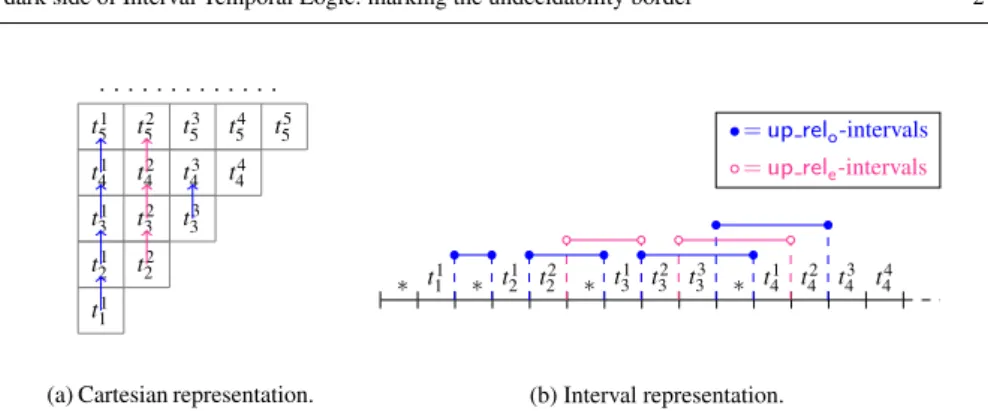
Right-neighbor relation.The right-neighbor relation connects each tile with its horizontal (right) neighbor in the octant, if any (e.g.,t32witht33in Fig. 2). Again, in order to encode the right-neighbor relation, we must distinguish between forward and backward rows: a tile-interval belonging to a forward row is right-connected to thetile-interval immediately to the right, if any, while atile-interval belonging to a backward row is right-connected to the tile-interval immediately to the left, if any. As example, in Fig. 4.1, the 2ndtile-interval of the 4th row (t42) is right-connected to thetile-interval immediately to the right (t43), since the 4th row is a forward one, while the 2ndtile-interval of the 3rd row (t32) is right-connected to thetile-interval immediately to the left (t33), since the 3rd row is a backward one.
We define the right-neighbor relation as follows: if[bij,bij+1]is atile-interval belonging to a forward (resp., backward)Id-interval, withi6=kj−1 (resp.,i6=1), then we say that it is right-connected to thetile-interval[bij+1,bij+2](resp.,[bi−1j ,bi
j]). As a matter of fact, no additional proposition letter is needed to encode it.
The following lemma proves that the commutativity property holds.
Lemma 9 Let M be a model,[a,b]be an interval over M, and b≤b01<c01<b11< . . . <
bk1−1 1 <c k1−1 1 <b k1 1 =b 0 2<c k1 1 =c 0 2<b 1 2< . . . <b k2 2 =b 0
3< . . .be the sequence of points
defined by Lemma 4. If M,[a,b](disj-bndk
u)∧(u-chain)∧(Id-chain)∧(bw/fw)∧(up rel-def1)∧
(up rel-def2), then M satisfies the commutativity property.
Proof Given twotile-intervals[bi
j,b i+1 j ]and[bi 0 j0,b i0+1
j0 ], let[c,d]be atile-interval such that
[bi j,b
i+1
j ]is right-connected to[c,d]and[c,d]is above-connected to[bi
0
j0,b i0+1
j0 ]. We assume
[bij,bij+1] to be afw-interval, that is, it belongs to a forwardId-interval. The case when
[bi j,b
i+1
j ]is abw-interval can be dealt with in a similar way, and thus it is omitted.
By definition of right-neighbor relation,[c,d] = [bij+1,bij+2]and, by definition of above-neighbor relation,[cij+1,cij00]is anup rel-interval. It follows thatj0=j+1. Since[bij+1,b
i+2 j ] is a fw-interval, by item (a) of Lemma 7 , [cij+1,cij0+1] is either an up relfwo -interval or
anup relfwe -interval. Without loss of generality, we assume[cij+1,ci
0
j+1]to be anup rel
fw o
-interval (the case when[cij+1,cij0+1]is anup relfwe -interval is similar and thus omitted).
Since [bij,bij+1] is atile-interval, by Lemma 8, it is above-connected to exactly one tile-interval, say[bij00+1,bij00++11]. Thus,[cij,cij00+1]is anup rel-interval. Since[cij+1,cij0+1]is an up relfwo -interval, by item (b) of Lemma 7, it is anup relfwe -interval.
To complete the proof, we must show that[bij00+1,bij00++11]is right-connected to[bij0+1,bij0++11]. Since[bij,bij+1]is afw-interval, by Lemma 5, it follows that[bij0+1,bij0++11]is abw-interval. Hence, the only interval that is right-connected to[bi0
j+1,b i0+1
j+1], if any, is the interval[b i0+1
j+1, bij0++12]. Then, it suffices to show that[bij00+1,bij00++11] = [bij0++11,bij0++12], which amounts to prove thatcij00+1=cij0++11. For the sake of contradiction, suppose that this is not the case. Two cases must be considered, both leading to a contradiction.
(i)cij00+1<cij0++11. Ifcij00+1=cij0+1, then theup rel-intervals[cij,cij0+1]and[cij+1,cij0+1]end at the same point (contradiction with Lemma 8); otherwise, ifcij00+1<cij0+1, then theup relfw -interval[ci
j,ci
00
j+1]overlaps theup rel
fw-interval[ci+1 j ,ci
0
j+1](contradiction with item (d) of Lemma 6).
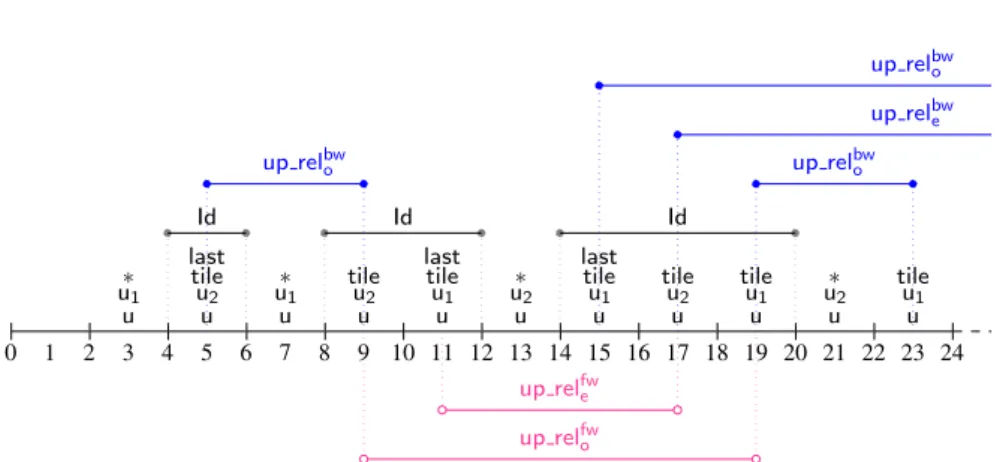
0 1 2 3 4 5 6 7 8 9 10 11 12 13 14 15 16 17 18 19 20 21 22 23 24
u1 u2 u1 u2 u1 u2 u1 u2 u1 u2 u1
u u u u u u u u u u u
∗ lasttile ∗ tile lasttile ∗ lasttile tile tile ∗ tile
Id Id Id up relbw o up relfwo up relfw e up relbw o up relbwe up relbw o
Fig. 3 A model satisfying the formulaΦT (for the sake of readability, we writeiforbi,i=0, . . . ,24).
(ii)cij00+1>cij0++11. By Lemma 8, there is a pointcij000such that[cij000,cij0++11]is anup rel-interval. By item (e) of Lemma 6 and item (b) of Lemma 7,[cij000,cij0++11]is anup relfwe -interval. We
show now that all possible choices forcij000leads to a contradiction: – ifci000
j >c i+1
j , then the up rel
fw-interval[ci+1 j ,ci
0
j+1]overlaps the up rel
fw-interval
[ci000 j ,c
i0+1
j+1](contradiction with item (d) of Lemma 6);
– ifcij000=cij+1, then theup rel-intervals[cij+1,cij0+1]and[cij+1,cij0++11]begin at the same point (contradiction with Lemma 8);
– ifcij000=cij, then theup rel-intervals[cij,cij00+1]and[cij,cij0++11]begin at the same point (contradiction with Lemma 8);
– if cij000 < cij, then the up relfw-interval [cij000,cij0++11] overlaps the up relfw-interval
[cij,cij00+1](contradiction with item (d) of Lemma 6)
Hence,cij00+1=cij0++11, and thus[bij00+1,bij00++11] = [bij0++11,bij0++12]. This allows us to conclude that
[bi j,b i+1 j ]is above-connected to[b i0+1 j+1,b i0+2 j+1], which is right-connected to[bi 0 j+1,b i0+1 j+1], thus
proving the thesis. ut
Corollary 1 The i-thtile-interval of the j-th row (Id-interval) is above-connected to the i-th tile-interval of the(j+1)-th row.
Tiling the plane.The following formulae constrain eachtile-interval (and no other one) to be tiled by exactly one tile (formula (45)) and tiles that are right- or above-connected to respect color constraints (formulae (46) – (48)):
[G]((Wk
i=1ti↔tile)∧(Vki,j=1,i6=j¬(ti∧tj))) (45)
[G](tile→W
up(ti)=down(tj)(ti∧ hOi(up rel∧ hOitj))) (46)
[G](tile∧fw∧ hXuitile→Wright(ti)=le f t(tj)(ti∧ hXuitj)) (47)
[G](tile∧bw∧ hXuitile→Wle f t(ti)=right(tj)(ti∧ hXuitj)) (48)
(45)∧. . .∧(48) (tiles)
LetT be the set of tile types{t1,t2, . . . ,tk}andΦT be the formula (disj-bndku)∧(u-chain)∧
Lemma 10 For any linear orderDwith an infinite ascending sequence of points, the
for-mulaΦT is satisfiable inDif and only ifT can tile the second octantO.
Proof (“only if” direction) LetDbe a linear order with an infinite ascending sequence of
points such thatM,[a,b]ΦT for some model M=hI(D),Viand interval[a,b]∈I(D).
Letb≤b01<b11<b21=b02< . . . <bk2 2 =b 0 3< . . . <b 0 j<b 1 j < . . . <b kj j =b 0 j+1< . . .be the sequence of points defined by Lemma 4. For each j>0 and 0<i<kj,[bij,bij+1]is a tile-interval, and thusM,[bij,bij+1]tvfor a uniquev. Then, for eachi,j, with 0≤i≤ j,
we put f(i,j) =tv, wheretvis the unique proposition letter in the setT={t1,t2, . . . ,tk}
such thatM,[bij++11,bij++21]tv. By Lemma 8, Lemma 9, Corollary 1, and formula (tiles), the
function f:O7→T defines a correct tiling ofO.
(“if” direction) LetDbe a linear order with an infinite ascending sequence of points, and
let f :O7→T be a correct tiling ofO. We provide a modelM=hI(D),Viand an interval [a,b]∈Msuch thatM,[a,b]ΦT (see Fig. 3). Letσ=b0,b1, . . .be the infinite ascending sequence of points inDwhose existence is guaranteed by hypothesis. The valuation function
V is defined as follows, whereg:N7→Nis an auxiliary function such thatg(n) = (n+1)· (n+2):
– u∈V([c,d])iff[c,d] = [bi,bj],i=2·n, andj=i+2 for somen(>0)∈N;
– k∈V([c,d])iff[c,d] = [bi,bj]andu∈V([bi−1,bj−1])for somei,j∈N;
– u1∈V([c,d])iff[c,d] = [bi,bj],u∈V([bi,bj]), andi=2·nfor some oddn∈N;
– u2∈V([c,d])iff[c,d] = [bi,bj],u∈V([bi,bj]), andu16∈V([bi,bj])for somei,j∈N;
– k1∈V([c,d])iff[c,d] = [bi,bj],u1∈V(bi−1,bj−1])for somei,j∈N;
– k2∈V([c,d])iff[c,d] = [bi,bj],u2∈V([bi−1,bj−1])for somei,j∈N;
– insideu1∈V([c,d])iffu1∈V([bi,bj])for somei,j∈N, withbi≤c,d≤bj, and[c,d]6=
[bi,bj];
– −→u1∈V([c,d])iffu1∈V([bi,bj])andu2∈V([bk,bl])for somei,j,k,l∈N, withbi< c<bj<d,c<bk<d<bl;
– insideu2∈V([c,d])iffu2∈V([bi,bj])for somei,j∈N, withbi≤c,d≤bj, and[c,d]6= [bi,bj];
– −→u2∈V([c,d])iffu2∈V([bi,bj])andu1∈V([bk,bl])for somei,j,k,l∈N, withbi< c<bj<d,c<bk<d<bl;
– insidek1∈V([c,d])iffk1∈V([bi,bj])for somei,j∈N, withbi≤c,d≤bj, and[c,d]6= [bi,bj];
– −→k1∈V([c,d])iffk1∈V([bi,bj])andk2∈V([bk,bl])for somei,j,k,l∈N, withbi<
c<bj<d,c<bk<d<bl;
– insidek2∈V([c,d])iffk2∈V([bi,bj])for somei,j∈N, withbi≤c,d≤bj, and[c,d]6= [bi,bj];
– −→k2∈V([c,d])iffk2∈V([bi,bj])andk1∈V([bk,bl])for somei,j,k,l∈N, withbi< c<bj<d,c<bk<d<bl;
– first∈V([c,d])iff[c,d] = [b2,b4];
– ∗ ∈V([c,d])iff[c,d] = [bi,bj],u∈V([bi,bj]), andi=g(n)for somen≥0;
– Id∈V([c,d])iff[c,d] = [bi,bj],∗ ∈V([bi−2,bi]),∗ ∈V([bj,bj+2]),i=g(n) +2, and j=g(n+1)for somen≥0;
– insideId∈V([c,d])iffId∈V([bi,bj])for somei,j∈N, withbi≤c,d≤bj, and[c,d]6=
[bi,bj];
– −→Id∈V([c,d])iffId∈V([bi,bj])and∗ ∈V([bk,bl])for somei,j,k,l∈N, withbi<c< bj<d,c<bk<d<bl;