R
URAL
E
CONOMY
Traceability – a literature review
Dawn Trautman, Ellen Goddard and Tomas Nilsson
Project Report # 08-02
Project Report
Department of Rural Economy
Faculty of Agricultural, Life and
Environmental Sciences
University of Alberta
Edmonton, Canada
Traceability – a literature review
Dawn Trautman, Ellen Goddard and Tomas Nilsson
Project Report #08-02
June 2008
The authors are, respectively, student, Professor and Assistant Professor, Department of Rural
Economy, the University of Alberta, Edmonton.
Acknowledgements
Acknowledgements for funding are to Alberta Agriculture and Rural Development and the
University of Alberta. Acknowledgements for constructive inputs and ideas to Bruce Viney and
Don Milligan.
TABLE OF CONTENTS
TABLE OF CONTENTS... 3
LIST OF TABLES... 4
LIST OF FIGURES ... 4
ABSTRACT... 5
1. INTRODUCTION ... 7
2. OUTLINE ... 8
3. DEFINITIONS OF TRACEABILITY ... 8
4. OVERVIEW OF SELECTED LITERATURE ... 13
4.1 STUDY AUTHOR, GEOGRAPHIC FOCUS AND YEAR ... 15
4.2 DEFINITION OF TRACEABILITY... 15
4.3 CONTEXT AND SCOPE... 16
4.4 STUDY OBJECTIVES... 17
4.5 METHODS ... 18
4.6 AGGREGATE SUMMARY ... 19
5. EXISTING TRACEABILITY SYSTEMS: CASE STUDIES ... 21
6. BENEFITS AND COSTS OF A BEEF TRACEABILITY SYSTEM ... 24
6.1 BENEFITS... 24
6.2 COSTS ... 26
6.3 QUALITATIVE COST-BENEFIT ANALYSIS... 27
7. EMPIRICAL DATA COLLECTED... 28
8. CANADIAN BEEF SUPPLY STRUCTURE ... 30
9. CONCLUSION... 31
10. BIBLIOGRAPHY... 35
APPENDIX 1. DEFINITION OF TRACEABILITY... 53
APPENDIX 2. LITERATURE SUMMARY ... 56
APPENDIX 3. OVERVIEW OF SELECTED EXISTING TRACEABILITY SYSTEMS... 126
APPENDIX 4. COSTS AND BENEFITS OF TRACEABILITY... 131
APPENDIX 5.SURVEY INSTRUMENTS... 137
APPENDIX 6. CANADA CATTLE/BEEF STATISTICS ... 142
LIST OF TABLES
Table 1 Definitions of Traceability... 53
Table 2 Literature Summary. ... 56
Table 3 Existing Traceability Systems. ... 126
Table 4 Qualitative Benefits and Costs of a Traceability System. ... 131
Table 5. Selected Studies that Provide Quantitative Direct Cost Estimates of Traceability. ... 136
Table 6 Survey Instruments Summary... 137
Table 7 Cattle Inventory by Province (thousand of head). ... 142
Table 8 Interprovincial Cattle Trade (thousand of head)... 142
Table 9 International Cattle Trade (thousand of head). ... 143
Table 10 Beef Cattle Ranches and Farms, Including Feedlots. ... 143
Table 11 Cattle Inventory by Sector. ... 144
Table 12 Federally Inspected Cattle Slaughter Plants. ... 144
Table 13 Cattle Slaughtered in Federally Inspected Establishments ... 145
Table 14 Cattle Slaughtered in Provincially Inspected Establishments... 145
Table 15 Distribution of Cattle Slaughter Activity in Federal Establishments. ... 146
Table 16 Cattle Slaughter by Province. ... 147
LIST OF FIGURES
Figure 1 Canadian beef supply structure………144
Traceability – a literature review
ABSTRACT
In light of recent food safety crises and international trade concerns associated with food or
animal associated diseases, traceability has once again become important in the minds of public
policymakers, business decision makers, consumers and special interest groups. This study
reviews studies on traceability, government regulation and consumer behaviour, provide case
studies of current traceability systems and a rough breakdown of various costs and benefits of
traceability. This report aims to identify gaps that may currently exist in the literature on
traceability in the domestic beef supply chain, as well as provide possible directions for future
research into said issue. Three main conclusions can be drawn from this study. First, there is a
lack of a common definition of traceability. Hence identifying similarities and differences across
studies becomes difficult if not impossible. To this end, this study adopts CFIA’s definition of
traceability. This definition has been adopted by numerous other agencies including the EU’s
official definition of traceability however it may or may not be acceptable from the perspective
of major Canadian beef and cattle trade partners. Second, the studies reviewed in this report
address one or more of five key objectives; the impact of changing consumer behaviour on
market participants, suppliers incentive to adopt or participate in traceability, impact of
regulatory changes, supplier response to crisis and technical description of traceability systems.
Drawing from the insights from the consumer studies, it seems as if consumers do not value
traceability per se, traceability is a means for consumers to receive validation of another
production or process attribute that they are interested in. Moreover, supply chain improvement,
food safety control and accessing foreign market segments are strong incentives for primary
producers and processors to participate in programs with traceability features. However the
objectives addressed by the studies reviewed in this paper are not necessarily the objectives that
are of most immediate relevance to decision makers about appropriate traceability standards to
recommend, require, subsidize etc. In many cases the research objectives of previous work have
been extremely narrow creating a body of literature that is incomplete in certain key areas. Third,
case studies of existing traceability systems in Australia, the UK, Scotland, Brazil and Uruguay
indicate that the pattern of development varies widely across sectors and regions.
In summary, a traceability system by itself cannot provide value-added for all participants in the
industry; it is merely a protocol for documenting and sharing information. Value is added to
participants in the marketing chain through traceability in the form of reduced transactions costs
in the case of a food safety incident and through the ability to shift liability. To ensure consumer
benefit and have premiums returned to primary producers the type of information that consumers
value is an important issue for future research. A successful program that peaks consumer
interest and can enhance their eating experience can generate economic benefits to all sectors in
the beef industry. International market access will increasingly require traceability in the
marketing system in order to satisfy trade restrictions in the case of animal diseases and country
of origin labelling, to name only a few examples. Designing appropriate traceability protocols
industry wide is therefore becoming very important.
JEL Codes: D020, D100, D200, Q100
Keywords: traceability, institutions, Canada, consumer behaviour, producer behaviour, supply
chain
1. INTRODUCTION
For many years, farmers, processors and retailers have maintained different types of traceability
programs with varying degree of precision, accuracy and speed. Several EU countries, the U.S.
and Canada have developed traceability programs in the livestock sector. However, more than
often these programs do not provide information to the consumer about live animal management,
processing, storage and distribution practices. Rather, traceability is viewed as a mechanism for
improving food safety control by ensuring rapid product recall ability, should a food safety
incident occur.
In the wake of several food safety related occurrences such as BSE, Salmonella and E. Coli, and
concerns about production and process attributes such as genetic modification, antibiotics and
animal welfare, the interest in tracing individual food items back to its original source of
conception in Canada extends past the walls of academia, e.g. see Cooper (2008). According to
Golan et al, traceability systems are “recordkeeping systems designed to track the flow of
product or product attributes through the production process or supply chain” (2004: 1). Industry
studies show that the benefits of traceability go beyond food safety management: traceability can
be used as a tool to monitor and manage information and product flow, which may lead to
improved efficiency and ultimately enhanced profitability. In addition to food safety control and
supply chain management, traceability can also be used in new product development and is
increasingly required in securing foreign market access.
The objective of this report is to present a literature review on the current state of knowledge
about food traceability systems, in particular traceability systems in beef supply chains. The
report aims to identify information gaps that may currently exist in the literature on traceability
in the domestic beef supply chain. Traceability has existed in different forms in the livestock
sector such as individual animal identification for at least 3,800 years Blancou (2001).
Moreover, considerable research has been devoted to the pros and cons of traceability. This study
provides a literature review on studies of traceability; literature which is available through public
sources e.g. government websites, university library databases and search engines on the Internet
(e.g. Google Scholar, YAHOO). Examples of existing systems, elsewhere in the world are also
provided.
2. OUTLINE
The project report consists of 7 sections. Section 3 in this report discusses the different
definitions of traceability that exist in the literature and among industry stakeholders. Section 4
presents the study methodology, criteria used in retrieving studies deemed relevant for this
project, in particular categorizing the study objectives and motivation. Five case studies on
countries that have implemented various voluntary and mandatory traceability programs are
discussed in Section 5. Section 6 summarizes the costs and benefits of traceability on individual
stakeholders in the food supply chain. Section 7 summarizes quantitative estimates of costs and
benefits based on studies that did provide empirical estimates of the cost impact of traceability or
food safety protocol. Section 8 provides a brief overview of the Canadian cattle industry and
highlight current patterns such as international and interprovincial trade, primary producer
structure, and current slaughter and processor distribution and capacity. Conclusions and study
limitations are discussed in Section 9 of this report.
3. DEFINITIONS OF TRACEABILITY
In documenting the benefits and costs of food traceability systems on stakeholders in the
Canadian agri-food systems it is important adopt a structured yet inclusive definition of the term
traceability. However, although there is an extensive literature on traceability, each study uses its
own definition of the term, which makes it difficult to quantify what the costs and benefits of
traceability on primary producers, processors, retailers and food service might be. Table 3.1
presents a summary of 30 commonly found definitions of traceability.
In particular definitions of traceability varies widely because of differences in geographic
coverage, time period, business activities, industry structure, consumer perceptions and the legal
framework regulating consumer and producer rights. Even within Canada, the definition of
traceability varies slightly, e.g. see Agri-Traçabilité Québec, Alberta Agriculture and Food and
CFIA in Table 1. The Canadian Food Inspection Agency (CFIA) has adopted the European
Commission’s (EC) definition for traceability as established by the European General Food Law:
“Traceability is the ability to trace and follow food, feed, food-producing animals or
substances intended to be, or expected to be incorporated into a food or feed, through all
stages of production, processing and distribution.”
This definition is broad as it can be applied to both companies involved in the food supply chain
and may also have relevance for non-food producers (ECR Europe 2004). This definition makes
it clear that traceability is an issue involving all steps in a complete supply chain. According to
ECR Europe (2004) companies in the supply chain collaborate to optimize the interfaces
determined by its different directions, areas and sub-processes and thus consider traceability a
method to meet consumers’ expectations of product safety and quality.
Arisland and Kjærnsrød (2005) use the ISO definition of traceability for the TraceTracker
Traceability Glossary:
“The ability to trace the history, application or location of an item or activity by means
of recorded identification. When considering product (3.4.2), traceability can relate to
the origin of materials and part, the processing history, and the distribution and location
of the product after delivery.”
This definition is rather generic and does not specify characteristics such as precision i.e. tracing
individual product packages back to individual animals vs. batches of animals, accuracy i.e. 100
per cent accuracy vs. 10 per cent, and speed i.e. time it takes to recall a product; hours vs. days.
Hence comparing the costs and benefits of traceability in supply chains that have adopted the
ISO protocol for feed and food traceability, ISO 22005:2007, becomes challenging. Moreover,
the literature indicated that some studies refer to traceability as the ability to identify individual
animals and their product flow whereas others refer to traceability more broadly as a system to
Dessureault (2006) considers the ISO definition the most commonly used, as it is also very broad
and does not specify a standard measurement, a standard location size, a list of processes that
must be identified, where the information is recorded, or the bookkeeping technology (Golan et
al. 2004). The Codex Alimentarius Commission (2006) uses a similar definition to ISO, where
“traceability or product tracing is the ability to follow the movement of food through specified
stage(s) of production, processing and distribution.”
Another fairly broad definition is developed by Golan et al. (2004) where traceability is defined
as “a record keeping system designed to track the flow of product or product attributes through
all stages of production, processing and distribution.” This definition only describes one
direction of traceability from the channel of distribution to the consumer. Golan et al. (2004)
specify that a traceability system is designed to track the flow of a product, but the need of a
broad definition is due to the fact that traceability is a tool for achieving different objectives.
When the Codex Alimentarius Commission together with the Food and Agriculture Organization
(FAO) and the World Health Organization (WHO) presented a definition in 2004 it was
increasingly specific to food:
“A tool that may be applied within a broader food inspection and certification system as
part of a risk management option for meeting specific food safety or fair trading practice
objectives.”
Specific to agriculture and agri-food is the OnTrace (2007) definition of traceability:
“The ability to locate an animal, commodity, food product or ingredient and follow its
history in the supply chain forward (from source to consumer) or backward (from
consumer to source.”
General definitions of traceability such as those presented above have made some stakeholders
concerned. There are concerns that the lack of detailed definitions prevents the possibility to
achieve necessary food safety or assurance goals (Farm Foundation 2004). Farm Foundation
defines traceability as
“The efficient and rapid tracking of physical product and traits from and to critical
points of origin or destination in the food chain necessary to achieve specific food safety
Moreover, specific definitions such as this lead to new objectives of traceability, such as
consumer assurance (Dessureault 2006). In this vein, Agri-Traçabilité Québec’s (2007) definition
also entails other uses of traceability as “a tool that will allow for the rapid identification of sites
affected, preventing the spread to other sites and narrow as soon as possible disease or health
problems.” The definition given by Smith et al. (2000) even suggests the use of traceability to
ascertain ownership, identify parentage, improve palatability, and assure safety.
The concept of traceability may also be referred to by other terms. Traceback, traceability and
source verification are referred to with the same definition in Smith et al. (2000) as
“the ability to identify origin of animals or meat as far back in the production sequence
as necessary to ascertain ownership, identify parentage, improve palatability, assure
safety and determine compliance in ‘branded beef’ programs.”
Dickinson, Hobbs, and Bailey (2003) use both traceability and identity preservation in their
definition of traceability: “the ability to track the inputs used to make food products backward
and forward to/from their source at different levels of the marketing chain.” Becker (2007)
defines animal identification as “the marking of individual farm animals, or a group or lot of
animals, so that they can be tracked from birth to slaughter.” Hobbs (2004) distinguishes
between ex post traceability as the process of tracing something to the source of origin, and ex
ante traceability as the provision of information on process attributes that verifies product
quality.
There are also several terms used within or implied by the definitions of traceability. While the
CFIA and EU definition of traceability imply the areas of traceability, the idea of tracking and
tracing are stated by OnTrace (2007). Meuwissen et al. (2003) describe tracking as the ability to
track food and food ingredients forward along the supply chain which can be used to find and
recall products which may pose risk to consumers’ health. This is contrasted to tracing which is
described as the ability to trace food and food ingredients back along the supply chain from end
user to producer or supplier to producer (Meuwissen et al. 2003). ECR Europe (2004) further
explain tracking and tracing in legal terms with tracking being the one-step forward legal
principle and tracing being the one-step back legal principle.
ECR Europe (2004) also defines the areas of traceability where upstream covers the first part of
the supply chain including producers of raw materials, ingredients, packaging and all
intermediate suppliers, while downstream covers the final part of the supply chain starting at the
final product manufacturer, logistic service providers, distribution centers and ending at the retail
point of sale. The forward-backward or one-up, one-down traceability can also be defined
through internal traceability where
“Traceability within one single company, including complete records of the origin of all
incoming materials received from external sources (suppliers) and of the destination of
all outgoing products delivered to external destinations (customers)” (Arisland and
Kjærnsrød 2005).
Global traceability or chain traceability is then defined as “traceability across companies having
internal traceability and/or conglomerate enterprises having enterprise traceability” (Arisland
and Kjærnsrød 2005).
This study adopts CFIA’s definition of traceability, “The ability to trace and follow food, feed,
food-producing animals or substances intended to be, or expected to be incorporated into a food
or feed, through all stages of production, processing and distribution. There are three recognized
pillars to traceability: Animal or product identification; Animal or product movement; Premises
identification.” Furthermore, this definition appears conformable to the European Union
definition of traceability, “traceability means the ability to track any food, feed, food-producing
animal or substance that will be used for consumption, through all stages of production,
processing and distribution” (EU Food Law 2008). There are at least three limitations that apply
to this definition however. First, CFIA’s definition of traceability may not imply automatically
that individual animal information (e.g. precision), live animal management practices, slaughter
and processing practices are recorded or verified. Second, this definition may or may not be
considered acceptable from the perspective of importers of Canadian cattle and beef. Third,
issues surrounding cost impact and liability are largely unresolved.
In particular, the definition does not provide information or guidelines to determine how the
costs associated with traceability might be distributed across the market participants within the
supply chain. For example, with regards to liability, according to Golan et al., “Many in the
livestock sector worry that traceability systems linking meat to animals will break this tradition
and shift at least some of the liability for food borne illness back to cow-calf operators and
feedlots. Some livestock organizations have even publicly called for limits on liability that may
arise from animal identification” (page no.; 2004).
4. OVERVIEW OF SELECTED LITERATURE
The objective of this overview of selected literature is to categorize selected literature on
traceability, summarize studies of changes in the marketplace and its impact on suppliers, and
review studies that show why traceability might provide opportunities for firms in the beef
supply chain. The literature will be assessed for consistency in their definition of traceability,
how the definition varies across markets, impact on stakeholders and opportunities for
traceability in the food system. The literature presented in this section is a summary of published
articles in scholarly journals and the grey literature. Grey literature refers to publications by
government, academia and industry that are not necessarily peer-reviewed. Selected literature
will be retrieved in a three step process further described below.
The first stage of this overview is to identify appropriate databases to search. Utilizing the
information from University of Alberta libraries, 13 databases were identified. These databases
are (descriptor of each database as given by the provider in parenthesis): ABI Inform Global
(business and management, engineering, health, and education), Academic Search Complete
(interdisciplinary), AgEcon Search (agricultural and applied economics), Blackwell Journals
(interdisciplinary), Business and Industry Database (business and trade articles on companies,
industries and markets), Business Source Complete (business journal and magazine articles),
EconLit (Economics journal articles), Emerald Insight (interdisciplinary) Google Scholar
(interdisciplinary), Proquest (Dissertations and theses in Canada, the U.S. and the EU),
ScienceDirect (s
cientific, technical, medical, business and economics literature),
Scopus
(science, technology, medicine, social sciences), Web of Science (natural and social sciences)
and Statistics Canada (government publication).
The databases provide a comprehensive coverage of journals and grey literature in agricultural
economics, applied economics, consumer behaviour, supply chain management, marketing and
business. The period of the literature review extends from January 1991 to March 2008.
The second stage includes listing appropriate keywords for the literature search. The keywords
used for this review include: animal identification, country of origin labelling, identity
preservation, meat supply chain, quality assurance, quality control, traceability, trace back,
tracing, and tracking. In total 320 articles were retrieved from the databases using the
aforementioned keywords and search delimiters. The complete list of references is available in
Section 10 of this report.
In the final and third stage, articles were selected based the study’s perceived relevance to the
research topic. This selection process resulted in published Master Theses or Dissertations and
working papers in departments of agricultural economics across North America, articles
published in journals with focus on agriculture, agribusiness or food economics, papers presented
at agricultural economics conferences, industry white papers or government publications. Of the
total 320 articles, 135 articles were ultimately selected. Three databases provided a fairly large
proportion of articles that were reviewed: 12 articles were published by the OIE, 17 by Emerald
insight and 15 by ScienceDirect. Each study is categorized according to six criterion: (1) study
author, geographic focus and year; (2) definition of traceability; (3) context and scope; (4)
objective; (5) methods; and (6) aggregate summary. On basis of these criterions it is feasible to
identify commonalities and differences across papers.
4.1 STUDY AUTHOR, GEOGRAPHIC FOCUS AND YEAR
Of the 135 articles, 30 were published during the period 1995 to 2002, 16 in 2003, 19 in 2004, 13
in 2005, 22 in 2006 and 22 between 2007 and 2008. Moreover, 57 studies focused on EU
markets (e.g. 2, 3, 5, 8, 13, 19, 22, 28, 29, 30, 33, 34, 37, 38, 40, 41, 42, 43, 44, 45, 46, 47, 48,
55, 56, 57, 60, 64, 66, 71, 74, 75, 77, 79, 80, 81, 88, 89, 93, 98, 99, 102, 104, 108, 109, 110, 111,
113, 115, 116, 118, 121, 126, 127, 129, 130 and 134), whereas 59 focused on the North
American market (e.g. 1, 6, 7, 9, 11, 12, 17, 18, 20, 21, 23, 24, 25, 27, 31, 32, 33, 34, 35, 36, 37,
39, 45, 49, 50, 51, 52, 53, 54, 58, 59, 61, 62, 63, 64, 66, 67, 68, 69, 79, 82, 83, 86, 87, 90, 93, 98,
103, 106, 107, 112, 113, 114, 120, 121, 122, 125, 132 and 133), and 12 on the Asian or Oceania
markets (e.g. 4, 26, 33, 34, 45, 66, 70, 76, 79, 93, 113 and 118). Several studies focused on
several markets. For example at least 12 studies focused on both North America and the EU (e.g.
33, 34, 37, 45, 64, 66, 79, 93, 98, 113 and 121).
4.2 DEFINITION OF TRACEABILITY
As indicated in Section 3, the definition of traceability varies across markets and time. Hence,
comparing two studies that documents the costs and benefits of traceability that use different
definitions of the term becomes a difficult task, if not impossible. Of the 135 articles, there are a
total of 83 different definitions of traceability (e.g. the second column of Table 4.1). Of the total
33 articles apply one of the definitions of traceability by the EU, ISO or Codex Alimentarius
Commission, or choose a definition that is similar (7, 10, 13, 16, 21, 23, 24, 26, 29, 30, 32, 35,
42, 43, 44, 52, 56, 65, 68, 69, 70, 72, 74, 75, 82, 93, 98, 99, 107, 109, 114, 118, 128). There are
37 studies which do not use one of the EU, ISO or Codex Alimentarius Commission definitions
but apply their own definition of traceability, which may include all stages/participants in the
food chain (8, 9, 11, 19, 22, 34, 36, 39, 45, 46, 48, 57, 61, 63, 64, 67, 76, 77, 79, 84, 89, 90, 91,
94, 100, 101, 102, 103, 104, 112, 113, 115, 120, 125, 130, 132, 134).
Example of such definitions of traceability are “[Traceability] can be used to establish or affirm
the reputations of producers and suppliers by communicating either positive or negative
information to consumers” (7), “The ability to trace the history of a product’s origin including
the identity of the farms and the marketing firms along a supply chain” (102), and “Traceability
systems are record-keeping systems designed to track the flow of product or product attributes
through the production process or supply chain” (120). Approximately ten studies apply a less
precise definition of farm-to-fork traceability e.g. “To be able to follow the animal back to the
farm of origin” (60), “Tracing a product or animal forward or tracking a product or animal back”
(88). That is, it is not clear to discern from the definition how or if information is transmitted
between the stakeholders in the food supply chain.
4.3 CONTEXT AND SCOPE
The reviewed studies focused on traceability, or opportunities for traceability in the food/meat
sector in general (11, 13, 17, 18, 19, 20, 21, 23, 26, 30, 31, 33, 34, 35, 36, 39, 42, 43, 44, 46, 47,
49, 50, 51, 52, 53, 54, 57, 58, 61, 62, 63, 64, 65, 66, 68, 72, 73, 74, 74, 75, 77, 78, 80, 85, 89, 91,
92, 93, 95, 96, 98, 100, 101, 102, 104, 108, 109, 112, 114, 116, 117, 119, 123, 124, 129, 130, 134
and 135) or the cattle/beef/livestock sector (1, 2, 3, 4, 5, 7, 8, 8, 9, 12, 16, 17, 18, 18, 21, 22, 23,
25, 27, 28, 29, 37, 40, 45, 48, 48, 55, 56, 57, 59, 60, 61, 62, 64, 67, 68, 69, 69, 70, 71, 71, 76, 81,
82, 83, 86, 87, 90, 94, 97, 97, 99, 103, 103, 104, 106, 107, 111, 112, 113, 114, 118, 121, 122, 127
and 132). In particular, 44 of the reviewed studies focused on the cattle/beef sector (2, 5, 8, 9, 12,
16, 17, 18, 21, 22, 23, 25, 27, 28, 37, 40, 48, 55, 56, 57, 59, 60, 64, 67, 70, 71, 76, 81, 82, 83, 86,
87, 90, 94, 97, 103, 106, 107, 111, 113, 118, 121, 127 and 132).
Moreover, the traceability studies can be classified into four different categories of scope. The
categories are farm-to-fork, farmer to processor stage, retail and consumer. In particular, 56
studies focus on traceability with a farm-to-fork perspective (1, 3, 7, 10, 11, 13, 19, 23, 24, 26,
28, 29, 30, 33, 37, 38, 39, 40, 43, 48, 56, 57, 58, 59, 60, 70, 75, 76, 77, 78, 80, 81, 83, 84, 85, 86,
87, 88, 89, 91, 94, 95, 97, 98, 100, 101, 104, 107, 109, 111, 112, 115, 118, 119, 124, 126, 130,
132, 134, 135, 2, 4, 5, 6, 8, 9, 12, 14, 15, 18, 20, 21, 22, 25, 27, 31, 32, 34, 35, 36, 41, 42, 44, 45,
46, 47, 49, 50, 51, 52, 53, 54, 55, 61, 62, 63, 64, 65, 66, 67, 68, 69, 71, 72, 73, 74, 79, 82, 90, 92,
93, 96, 99, 102, 103, 105, 106, 108, 110, 113, 114, 116, 117, 120, 121, 122, 123, 125, 127, 128,
105, 106, 110, 120, 122, 125, 127 and 133) and 11 studies (2, 5, 42, 47, 55, 74, 82, 90, 108, 123
and 129) with a focus primarily on consumer reaction to traceability.
4.4 STUDY OBJECTIVES
The objective gives the main thrust of a paper as it motivates the importance of the study and the
type of information sought. The objective also provides information on relevant theoretical
approach, appropriate research methodology used and the type of empirical data that is collected,
if any. In this vein, although two authors may study the same economic phenomena, the results
and recommendations may differ because their objectives differ.
Five main study objectives can be discerned from the reviewed literature. The objectives range
from analyzing the impact of changing consumer behaviour on market participants (2, 9, 25, 26,
31, 33, 34, 35, 36, 46, 47, 54, 55, 61, 62, 66, 74, 80, 82, 86, 89, 90, 94, 130 and 132), how
incentives might impact supplier participation in traceability (4, 11, 19, 20, 21, 24, 27, 28, 32, 37,
40, 41, 44, 45, 46, 48, 49, 50, 51, 52, 53, 55, 58, 59, 60, 61, 62, 63, 64, 65, 66, 67, 68, 69, 70, 73,
77, 78, 79, 86, 91, 97, 101, 103, 104, 111, 112, 113, 115, 116, 118, 119, 120, 121, 122, 123, 126,
127 and 135), impact of regulatory changes on suppliers (11, 17, 18, 19, 23, 30, 32, 39, 40, 43,
44, 48, 49, 51, 53, 59, 67, 78, 80, 83, 88, 98, 100, 102, 103, 114, 115, 118, 122 and 135),
response to crises such as BSE in the UK or Canada (7, 8, 30, 32, 37, 39, 40, 43, 46, 60, 78, 80,
81, 99, 104, 106, 117, 125, 129, 132 and133), technical description of a traceability system such
as DNA markers or comparisons of traceability systems (1, 3, 4, 5, 6, 7, 8, 10, 12, 13, 14, 15, 16,
19, 20, 22, 23, 24, 29, 38, 41, 42, 43, 45, 46, 52, 54, 56, 57, 65, 69, 71, 72, 73, 75, 76, 77, 79, 84,
85, 87, 88, 92, 93, 95, 96, 98, 102, 105, 107, 108, 109, 110, 111, 112, 114, 120, 124, 128, 131,
134 and135). One study may address more than one objective. Studies that used one of EU, ISO
or farm-to-fork definition of traceability and who’s study objective concerned consumer
behaviour include (9, 34, 35, 36, 46, 61, 74, 82, 89, 90, 94, 130, and 132). For example, study (9)
uses the term traceability as “tracking methods for animals and meat” and seeks “to discuss the
difficulties associated with a farm-to-fork beef traceability system in the U.S. and to determine if
consumers are WTP for BSE testing and traceability”. Studies (34) and (35) defined traceability
as “the ability to track the inputs used to make food products backward to their source at
4.5 METHODS
The study methods in the reviewed literature range from qualitative methods such as literature
reviews (3, 4, 7, 8, 9, 14, 19, 20, 21, 24, 25, 26, 27, 29, 37, 38, 39, 42, 43, 44, 45, 46, 48, 49, 50,
52, 53, 56, 57, 65, 68, 72, 74, 76, 77, 78, 79, 80, 81, 82, 83, 84, 85, 86, 87, 88, 89, 91, 92, 93, 96,
97, 98, 99, 100, 102, 107, 108, 109, 111, 112, 113, 114, 115, 116, 117, 118, 119, 121, 122, 123,
124, 127, 128, 134 and 135), surveys of primary producer, processor and/or retailers (15, 16, 19,
20, 21, 22, 27, 28, 30, 32, 40, 41, 48, 54, 59, 60, 67, 69, 70, 104, 105, 110 and 120), to consumer
segmentation analysis and/or estimation of consumer willingness to pay (2, 9, 31, 33, 34, 35, 47,
55, 61, 62, 63, 90, 94, 126 and 130), or fitting a statistical or economic model to model firm
behaviour in response to crises or food outbreaks, new regulations, and/or consumer behaviour
(17, 18, 32, 51, 58, 64, 66, 75, 95, 101, 103 and 106). Nine consumer studies applied ISO, EU’s,
Codex Alimenaritus or a similar definition of traceability (9, 34, 35, 36, 61, 63, 90, 94 and130).
For example study (9) sought to “determine if consumers are WTP for BSE testing and
traceability”. About half of the producer studies and review studies applied similar definitions of
traceability as described above (16, 21, 30, 32, 69, 70, 19, 22, 48, 67, 104 and 120) and (7, 21,
24, 26, 29, 42, 43, 44, 52, 56, 65, 68, 72, 74, 82, 93, 98, 99, 107, 109, 114, 118, 128, 8, 19, 39,
45, 46, 48, 57, 76, 77, 79, 84, 89, 91, 100, 102, 112, 113, 115 and 134). Several studies that focus
on the impact of traceability and changing behaviour on firms tend to take a farm-to-fork
perspective on traceability (9, 25, 26, 33, 34, 36, 46, 47, 55, 61, 62, 74, 82 ad 132). Eight studies
that adopt the farm to processor scope are qualitative in nature i.e. involve minimal or no
statistical analysis (4, 14, 22, 71, 105, 110, 125 and 127). Moreover, 37 of the 56 articles that
takes a farm-to-fork perspective on traceability are descriptive or conceptual i.e. qualitative in
nature (1, 3, 10, 13, 16, 23, 24, 28, 29, 30, 38, 40, 43, 56, 57, 75, 77, 78, 80, 81, 84, 85, 88, 89,
91, 94, 95, 98, 100, 107, 109, 111, 118, 124, 130, 134 and 135). Twelve studies are written with
a focus on North American markets, use a farm-to-fork perspective on traceability and apply a
quantitative method in studying the impact of traceability (7, 11, 17, 33, 37, 39, 59, 83, 86, 87,
112 and 132). However, the challenge is that these studies provide only a partial estimate of the
costs and benefits associated with traceability such as willingness to pay for traceability (33 and
132), the direct costs associated with implementing traceability (37 and 39, 86), or costs of a
specific piece of legislation, country of origin labelling (59 and 83).
4.6 AGGREGATE SUMMARY
The aggregate summary provides a quick overview of the issues covered, study results and
implications for policy formation, where appropriate. It is challenging to reach any general
conclusions from the literature review. Grouping authors or studies that draw similar conclusions
and identifying areas in which authors are in disagreement becomes a difficult task, because of
differences in the definitions of traceability and study methods. In particular, comparing studies
that estimate or present direct/indirect cost impact of traceability across market participants (e.g.
7, 12 and 45) become problematic as some consider traceability up until the point of processing
and not necessarily retail. Six key findings can be drawn from the literature however. First, the
results of the studies that looked at consumer perception of food safety and process attributes
suggest that consumers do not value traceability per se but rather see traceability as a means to
deliver desired product or process attributes (2, 9, 17, 18, 20, 21, 25, 26, 31, 32, 33, 34, 35, 36,
43, 46, 47, 49, 50, 55, 61, 62, 63, 66, 68, 69, 70, 74, 75, 79, 80, 81, 82, 87, 89, 90, 94, 97, 101,
107, 108, 113, 114, 121, 129, 130 and 132). However, it is worth noting that previous estimates
of willingness to pay for traceability attributes (e.g. 25, 33, 34, 63 and 82) may or may not be
relevant in a current and future Canadian context. In particular, there is still an open question as
to what type of attributes that Canadian consumers value that can be provided a farm to fork
traceability system (e.g. hormone free, natural, omega-3). Second, retailers may regard
traceability programs as an opportunity to intensify the level of product differentiation and brand
competition in the meat shelves (16, 17, 18, 19, 20, 21, 26, 40, 41, 46, 48, 49, 50, 52, 53, 54, 55,
58, 59, 60, 65, 67, 72, 75, 77, 80, 81, 83, 89, 97, 98, 99, 101, 102, 103, 107, 111, 114, 115, 116
and 121). In this vein traceability can be seen as a tool to make information on product attributes
and process history credible. Third, primary producers’ incentives to adopt in traceability
systems are driven by factors such as efficiencies through improved supply chain management,
food safety/quality control, meeting requirements for accessing foreign markets and creating new
niche markets (3, 10, 12, 17, 18, 19, 22, 23, 24, 27, 28, 29, 30, 32, 34, 38, 40, 45, 48, 49, 50, 52,
53, 54, 59, 65, 67, 71, 73, 76, 77, 81, 83, 84, 91, 97, 104, 115 and 116). One key finding that tend
to stick out from these studies is that since the cost of adoption of a new regulation entails fixed
investments in labour (e.g. hiring qualified staff, education) and capital (renovation of facilities,
upgrading equipment to comply with new standards etc), smaller firms with smaller throughput
Hence, government may have a role to play in providing financial incentives to smaller farm and
food firm operators. Fourth, regulatory changes may drive adoption of traceability among
retailers and suppliers (3, 4, 5, 6, 7, 9, 17, 18, 23, 26, 30, 39, 43, 44, 48, 60, 61, 64, 69, 70, 98,
99, 100, 103, 107, 113, 118, 122, 125, 133). For example, if there are no private benefits of
traceability but there is a net social benefit (i.e. suppliers are not able to realize the social gains),
the government may have a role in developing traceability programs and ensuring compliance.
Fifth, food safety outbreaks and crises such as BSE, Salmonella and E. coli may stimulate
improved coordination among industry stakeholders (8, 10, 11, 14, 26, 31, 37, 50, 51, 52, 56, 62,
64, 81, 88, 100, 101, 112, 123, 127, 128 and 133). This may in turn lead to development of new
programs such as traceability. Lastly, numerous studies have identified opportunities and
challenges associated with traceability, such as costs of maintaining animal identification
systems, cost of segregating products as it goes through the supply channel and market
opportunities associated with new niche markets and improved supply chain control (4, 5, 6, 7, 8,
9, 10, 12, 13, 14, 15, 17, 18, 19, 20, 21, 22, 24, 27, 28, 29, 32, 33, 35, 36, 39, 40, 41, 42, 43, 45,
46, 48, 49, 54, 57, 59, 60, 61, 62, 65, 66, 67, 68, 73, 77, 79, 87, 88, 89, 90, 91, 101, 104, 112,
114, 115, 116, 119, 128, 133, 134 and 135). However, it is difficult to come up with economic
estimates of the cost of adoption and maintaining a viable traceability system at the farm,
processor and retail stages, respectively. To the knowledge of the authors, no North American
study has to date provided a comprehensive quantitative assessment of the costs associated with
developing, implementing and maintaining a program at the farm, feedlot, processing and retail
stages, with a definition of traceability akin to the one used in the present study. Hence, even
establishing cost ranges becomes difficult as the notion of traceability is not used, or applied, in a
consistent and precise manner. While as individual studies do provide estimates of consumer
willingness to pay and impact assessments on individual stakeholders, this information provide
only partial guidance to actors on how the program may impact market participants in terms of
cost sharing and government involvement. Indeed, a key limitation that arises from the reviewed
literature is that there is very little data collected in quantifying the economic impact on
stakeholders of traceability, at the farm to processor stages as well as processor to retail stages of
traceability.
5. EXISTING TRACEABILITY SYSTEMS: CASE STUDIES
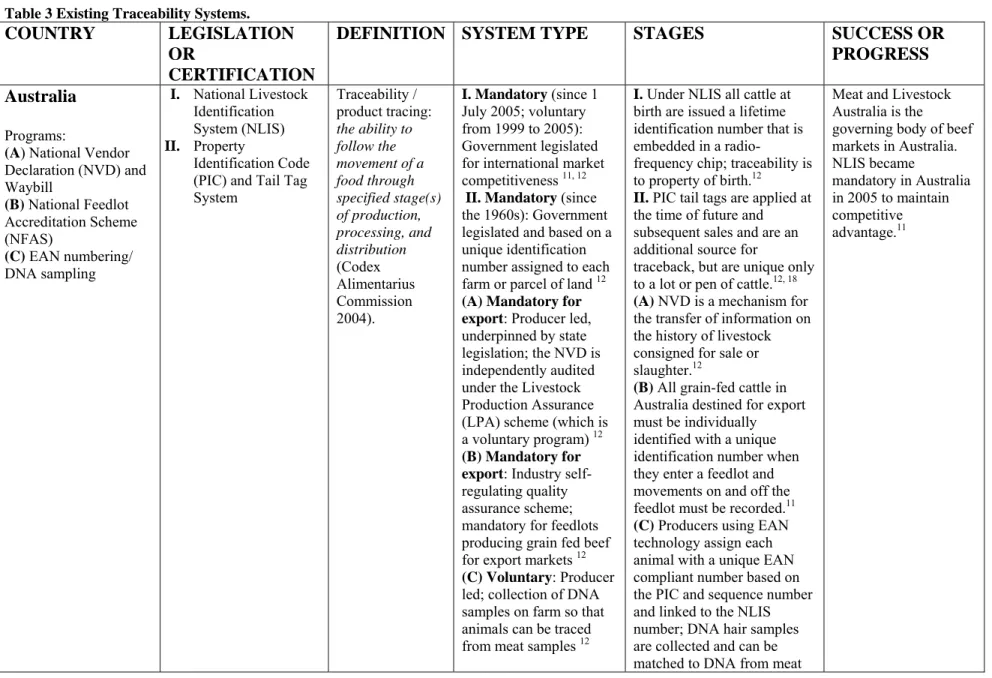
A number of specific traceability systems, applied to cattle/livestock industries world wide are
described in Appendix 3, Table 3. The point of providing brief descriptions of these other
traceable systems is to provide context to the discussion of the benefits and costs of traceable
systems. Clearly benefits and costs will relate to the coverage in the system, whether the system
is mandatory or voluntary, whether developed by specific agents (e.g. grocery store chains) or by
all agents within a supply chain (all processors or all retailers, for example).
Traceability systems have evolved differently across sectors and countries depending upon direct
market pressures. For example, within Australia a previously voluntary system for national
livestock identification became mandatory in 2005 in an attempt ‘to maintain competitive
advantage’ in export markets. Australia has both a livestock identification system and a property
identification system, ensuring that since 2005, the animal (through radio-frequency chip) and
property of birth are traceable. For export, tracing the history of animals through saleyards and
slaughter facilities is mandatory, movements on and off feedlots are also tracked if applicable.
Further traceable standards such as DNA samples (through an EAN numbering system) are
voluntary and can allow tracing animals back from meat samples. It is also worth noting that
these traceable standards are included in a much larger system of quality assurance (Gong et. al,
2007) within the Australian livestock industry. Within Australia there are government
administered quality assurance schemes relating to such things as chemical residue status, and
hormones as well as traceability and industry administered ‘consumer quality standards’ such as
Cattlecare, administered by third party independent audit of company specific requirements,
relating to consistency, environmental management and animal welfare.
In the U.K. post BSE and foot and mouth national quality assurance schemes became more
prevalent. Grocery stores such as TESCO have established company Codes of Practice for
livestock as “all Tesco fresh meat, farmed fish and animal products have the highest standards of
food safety. They also address animal health and welfare, animal feed, animal medicine usage
and environmental management and biodiversity. The Codes of Practice cover all aspects of an
animal’s life from birth, through their life on the farm, transportation and eventually slaughter.
(http://www.tescofarming.com/livestock.asp). The TESCO system builds on and where
necessary is more rigorous than the government mandated independently set up national
assurance schemes. Grocery store chains have the option to develop additional standards and
contributed to the base line national assurance schemes. TESCO prides itself on delivering,
where possible, whole life traceability including the husbandry of animals that not be used to
supply the stores, such as breeding stock.
Within Japan the system is much more proscribed, government regulations introduced in 2002
and 2003 require the traceback ability of cattle from packing plant to feedlot and from
consumption through distribution to production, using an internet based system. In addition retail
chains have adopted voluntary systems to provide consumers with certification of assurances
from export organizations such as the Australian Feedlot Association, BSE testing certificates
and in some cases photographs of producers and information on animal type.
In Scotland, again a combination of government driven mandatory assurance schemes and
industry driven voluntary assurance schemes are operating. Mandatory schemes such as the
British Cattle Movement Service – provide traceability from birth to death. However producers
and industry have collaborated to provide assurances of production methods, producers, animal
welfare, animal health management and feed management (since 1992) and to allow full
traceability from live animal to batches of meat (1995). In certain cases restaurants are able to
trace Scotch lamb and beef to their suppliers.
A major exporting country, Uruguay, has implemented government managed mandatory
traceback of animals from slaughter to farm of origin, through region codes, movement records
and police authentication. The Uruguayan system also allows for traceability of meat cuts from
carcass disassembly to animal lot numbers. In addition the Certified Natural Meat Program of
Uruguay, established in 2001, provides assurances of source, of no hormone use, of no antibiotic
use, of grass feeding on open ranges. This voluntary system is accredited through independent
certification bodies.
In Brazil, a traceable system was imposed by government in 2002. At that time the “Ministry of
Agriculture, Husbandry and Supply (MAPA) published Normative Instruction 1, instituting the
Brazilian Bovine and Bubaline Identification and Certification System, the Sisbov, to identify
register and individually monitor all of the cattle and buffalo born in Brazil or imported since
that date. Sisbov is a set of actions, measures and procedures adopted to characterize the origin,
sanitary state, production and productivity of Brazilian cattle and buffalo raising, and the safety
of foods from this economic activity” (Lima et. al. 2006). However it is worth noting that the
existence of the system does not in itself necessarily provide access to export markets. In
December of 2007, after inspection by the EU, trade in beef products from Brazil to the EU was
severely restricted, due to “deficiencies in Brazil’s animal health and traceability systems”
(Reuters, December 19, 2007, EU tightens requirements for Brazilian beef,
(http://www.alertnet.org/thenews/newsdesk/L19461466.htm). As of February 27, 2008, the EU
significantly loosened its restrictions on Brazilian beef allowing for meat from bovine animals
from 106 rural establishments to be exported to the EU. These establishments were found to be
in compliance with traceability standards. As other establishments become compliant it is
expected that they too will become able to export beef to the EU (press release, Embassy of
Brazil in London, February 27, 2008
(http://www.brazil.org.uk/newsandmedia/pressreleases_files/20080227.html).
In the cases reviewed there is a blend of mandatory and voluntary standards or quality assurances
operating in most schemes. In most cases the mandatory government driven program involves
the traceability of animals from origin to slaughter in a packing plant. Further tracing from
processor to consumer, while described as consumer driven, is usually established by industry
groups, and is usually independently audited and associated with production standards of interest
to consumers – animal welfare, animal feed, and environmental management. Countries that
establish standards for their own production expect to be able to have similar standards adopted
in exporting countries, are willing to suspend trade if such standards are not available and in
some cases will pay premiums for detailed traceable standards.
6. BENEFITS AND COSTS OF A BEEF TRACEABILITY
SYSTEM
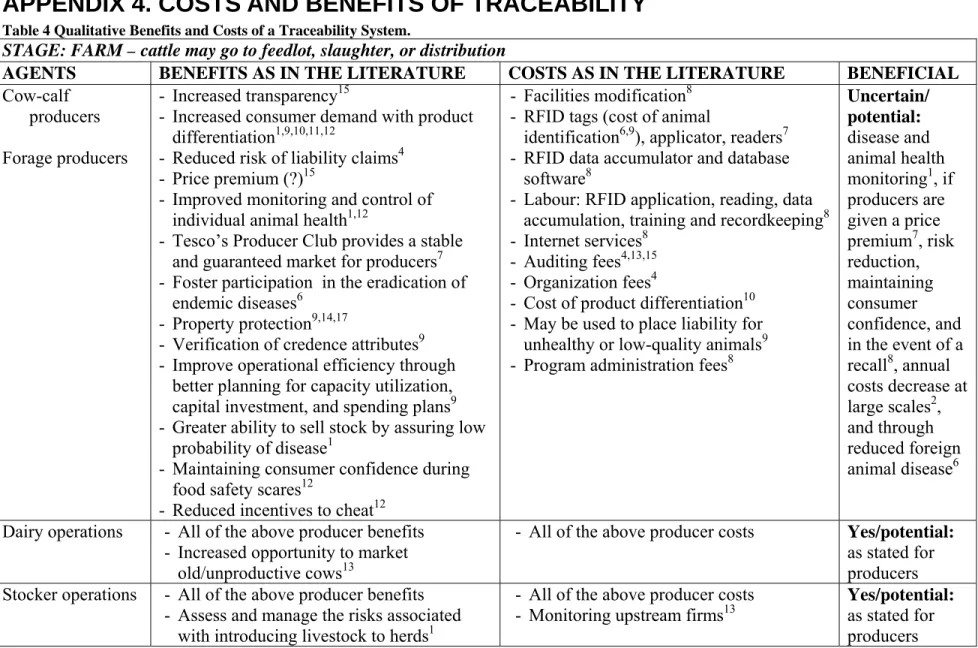
The qualitative costs and benefits of a beef traceability system are described in Appendix 4,
Table 4, which relate to the supply chain relationships shown in Appendix 8, Figure 1. The
purpose of determining the qualitative costs and benefits of the beef supply chain is in part to
identify all potential agents involved in the supply chain and to determine the impact of
implementing traceability on individual stakeholders. Seventeen studies were used to analyze the
qualitative benefits and costs which documented how costs and benefits were disaggregated
between various stages and/or agents.
6.1 BENEFITS
There are six stages identified in the beef supply chain: farm, feedlot, slaughter, processing,
distribution, and consumption. Agents at the farm stage include cow-calf producers, forage
producers, dairy operations, and stocker operations; in this stage cattle may move to feedlots,
slaughter, or distribution. At the feedlot stage agents consist of commercial feedlot or farmer
feedlot. From the feedlot stage cattle may be moved to slaughter or distribution; it is also
recognized that cattle may come from auction markets, interprovincial import, or cattle for
export and be moved for slaughter. Agents at the slaughter stage may move beef towards
processing or distribution and include abattoirs and cutting plants. In the processing stage beef
goes to distribution via the processing and packing plants. Agents in the distribution stage
include exporters, meat wholesalers, traditional butchers, restaurants, supermarkets, independent
grocers, direct sale outlets, foodservice companies, farmer’s markets, and imported meat. From
the distribution stage beef flows along the supply chain toward the consumption; agents affected
at this stage include the individual consumer and the government in the concern of public health
and policy decisions.
The benefits of a beef traceability system can be summarized according to the three main
objectives of firms as described by Golan et al. (2004): supply management, food safety and
quality control, and product differentiation. Supply management is improved through efficiency
gains from the farm to the retailer. At the farm stage traceability supplies producers with
Along with property protection agents at the farm and the feedlot stage are prone to less risk
when traceability systems are in place when introducing new livestock to existing herds.
Producers have a reduced incentive to cheat, on age verification and vaccination records for
example, because with traceability subsequent agents can verify information and trace problems
back to the source. There are also efficiency gains in cost reduction as traceability reduces
information costs between agents and reduces transaction costs spent monitoring upstream
suppliers, which may lower price. Overall, the benefits of efficiency gains in supply management
are due to increased transparency at all stages.
The benefits of traceability for food safety and quality control are also present in all stages of the
supply chain. For the farm, processor, slaughter, and distribution stages food safety and quality
control minimizes liability of each individual agent and may reduce the incidence of recalls. In
addition, by ensuring food safety and quality control producers and retailers can maintain
consumer confidence in the case of a food safety violation. At the farm stage, agents have an
added benefit of individual animal health monitoring through traceability systems; this may
increase the productivity of these agents as traceability systems allow verifiable and complete
records of vaccinations and production. With traceability there is reduced risk of allowing older
or at risk cattle into the beef supply chain since records are verifiable; this is a benefit for both
beef cattle producers and dairy producers to safely and honestly sell cull animals. Agents at the
processing stage may benefit from reduced insurance premiums by the reduced risk associated
with implementing traceability. Largely, traceability for food safety and quality control is a
consumer benefit because they are assured safe food. This is also a government and public
benefit of traceability as there may be reduced food borne illnesses which reduce societal and
health costs. There are again some commonalities in the benefits of traceability for food safety
and quality control in that there is increased transparency among supply chain agents.
Increased consumer demand due to product differentiation is a potential benefit for all agents up
to the distribution stage. This increased ability to market beef with credence attributes, such as
traceability, can only be done through record-keeping by agents as the product moves through
the supply chain.
A potential but controversial benefit to producing agents in the supply chain is a price premium
for producers and processors for products that are labelled as containing certain credence
attributes (Meuwissen et al. 2003). Evidence supporting a price premium and benefit of
traceability is uncertain for consumers because while consumers often state they would be
willing to pay more for safer food, actual buying decisions show it is economic convenience that
most affects purchasing decisions, not statement of safety or traceability on the label of a product
(Meuwissen et al. 2003, Loureiro and Umberger 2007).
A common benefit of traceability appears to be increased transparency for all members of the
beef supply chain. Transparency improves the efficiency of the movement of cattle and beef as
well as ensuring verification and assurance to consumers regarding credence attributes. Improved
efficiency of information relay improves the supply management ability of the agents and greater
efficiency and lower costs may potentially be realized from farm to retail.
6.2 COSTS
The costs of a beef traceability system can also be divided according to Golan et al. (2004) into
supply management, quality and safety control, and product differentiation categories. Costs of
supply management include costs that reduce the efficiency of the movement of cattle or beef
through the supply chain. Monitoring of upstream firms to ensure credible traceability methods
may be a cost of supply management at all stages of the supply chain. Additional monitoring and
enforcement costs would likely be incurred by the government. Food quality and safety control
costs would include items such as equipment costs and facilities modifications, increased hours
of labour due to increased time to ensure quality and safety, and audits, inspection fees,
certification fees and administration costs of a quality and safety assurance program. Increased
labour may be a cost at the farm, feedlot, slaughter and processing stages as more time would be
needed for tagging, reading, and testing cattle or beef. However, some studies suggest
traceability systems may actually reduce labour time in the distribution stage (Bracken and
Matthews 2005). Consumers may face a cost of traceability in the form of a price premium
(Meuwissen et al. 2003) or perhaps the loss of consumer privacy (Popper 2007). Costs of product
differentiation are from additional advertising and promotion by firms to reassure consumers of
the quality and safety of their product.
According to Loader and Hobbs (1996) a potential cost to auction markets would be the direct
purchase of cattle from the farm to the slaughter stage, without passing through an auction,
causing the auction market to lose commission money. Major costs of traceability systems vary
according to the depth of modification and monitoring needed for particular agents and thus are
difficult to establish.
6.3 QUALITATIVE COST-BENEFIT ANALYSIS
Determining whether benefits outweigh costs for a beef traceability program requires some
guesswork, further research, and at this point a definite outcome is uncertain. However, based on
the benefits and costs as described in the literature we can establish likely outcomes. There is
some potential for benefits to outweigh costs in the farm stage, for the cow-calf producers,
forage producers, dairy operations, and stocker operations, at larger scales (Bailey 2004) and if
these producers are given a price premium (Fearne 1998). The ratio of benefits to costs is
uncertain for commercial feedlots and farmer feedlots as there is contradictory evidence in the
literature; Buhr (2003) states there is more efficiency gains at small scales, while Bailey (2004)
and Golan et al. (2004) state annual costs decrease at large scales. There is also uncertainty for
interprovincial import and for the auction markets, as costs may vary from no additional cost to
thousands of dollars. At the feedlot stage there does appear to be greater benefits than costs for
exporting agents as feedlot benefits are greater when exporting (Hobbs, Yeung and Kerr 2007).
At the slaughter stage there is also uncertainty regarding efficient size of operation, but there
appears to be greater benefit than cost in the minimization of safety or quality failures. During
the processing stage there is greater benefit in improved ability to export products and increased
credibility (Hobbs, Yeung and Kerr 2007), but still some uncertainty as costs vary. Benefits may
be greater than cost in the distribution stage if there is export potential or a food recall.
Consumers may view a beef traceability system as beneficial as it provides safety and quality
reassurance and product differentiation; however, according to Hobbs (2003) traceability alone is
not valuable to most consumers and must be bundled with other attributes to be of value. The
government or public sector may view a traceability system as beneficial as one national portal
provides economies of scale to the industry and there is potential for a traceability program to act
as an active surveillance for the beef industry for introduction of new diseases or other changes
Implementing one national traceability system is efficient and facilitates interprovincial trade
(Hobbs, Yeung and Kerr 2007). The national standardization of traceability could also
potentially open international markets as a national program may be perceived as more credible
than provincial or private standards.
A traceability system within the beef supply chain has many benefits and costs. In general,
benefits of traceability are increased transparency in all stages of the supply chain, from the farm
to retail. Costs of traceability take the form of monitoring and administration costs with
monetary outlays in the form of required equipment and technology for traceability. These could
be taken as costs necessary to reduce information asymmetry and increase transparency. Benefits
and costs of implementing traceability can be divided into three categories provided by Golan et
al. 2004, improvement of supply management, traceback to ensure food safety and quality
control, and product differentiation for credence attributes.
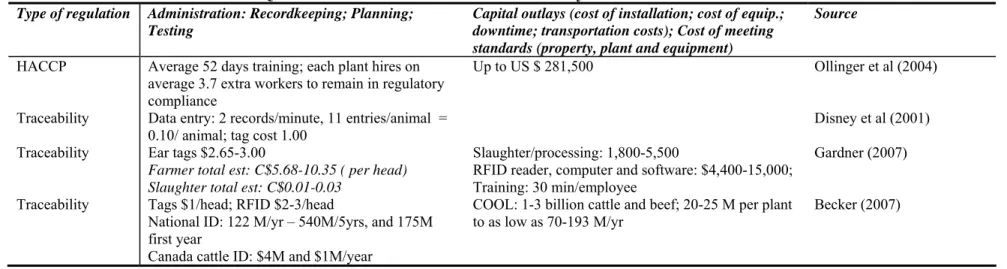
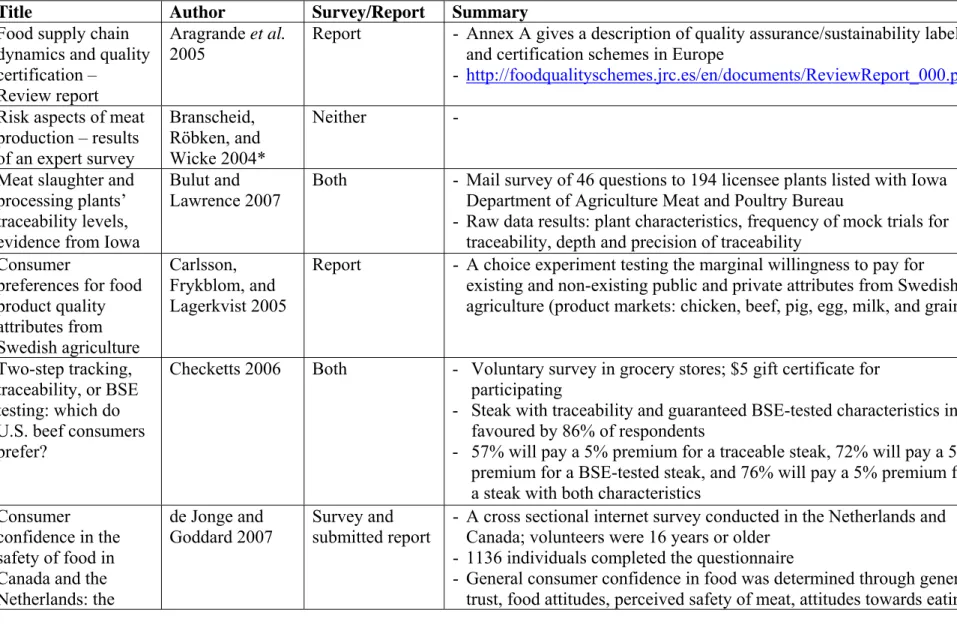
7. EMPIRICAL DATA COLLECTED
This section of the report refers explicitly to the kinds of empirical data researchers have
collected in previous attempts to understand, in most cases a priori, what the economic impact of
introducing a traceability system might be. Although we have examined more studies a number
of the studies that collected primary data are included in Appendix 5 Table 6. It is clear from the
information provided in Table 6 that a number of studies have attempted to collect data on what
consumers are interested in. A major function of traceable systems is to provide consumers with
additional information at point of purchase, allowing them to maximize their utility. It is
important that any marketer understand exactly what consumers want and, at least
hypothetically, what they might be willing to pay for, prior to establishing a complex record
keeping and verifiable system. The approach to establishing consumer willingness to pay for a
traceable system is well understood and has been applied in a number of different jurisdictions
(Sweden, Carlsson et al, 2005; U.S., Checketts, 2006 and Loureiro and Umberger, 2007 are two
examples). Some studies mentioned in Table 6 refer explicitly to the proposed imposition of
COOL legislation in the U.S., a closely related market requirement using similar tools to the
studies identified above.
It is worth noting that no studies have looked explicitly at what consumers are willing to pay for
traceability (verified) in food away from home purchases, although these continue to grow as a
percentage of total food expenditures and in North America represent between 40 and 50% of
total food expenditure by individuals.
The second major focus of the empirical studies have been to look at the supply chain issues
associated with traceability programs on two grounds – either to assess in general terms how
industry assesses existing systems and sees the benefits and costs of adopting such a system
(GS1, Hobbs et al, 2007; Jones et al, 2004; various government reports) and/or to interview
specific industry segments about actual costs associated with implementation of a traceable
system (Bulut and Lawrence, 2007; Hanselka, 2004). This last area of research is one in which
there does not appear to be a wealth of data either globally or nationally. An interesting study by
Williamson et al (1996) has assessed the attitudes and methods used by quality auditors and it
contains a useful instrument that could be of relevance in the Canadian context, since
practitioners are key to the success of any system. A certain amount of information has been
collected throughout Canada on the industry stakeholder interest in traceable systems but no data
has been published on how industry stakeholders perceive their own abilities and constraints in
adopting such a system or their perceptions of or actual costs associated with implementation.
This particular item is of critical importance in designing the appropriate role of public
organizations in supporting the development of traceable systems and/or regulating the existence
of these programs. It is worth noting that Dessureault (2006) collected data on perceptions and
costs of implementing traceability in the Canadian dairy processing industry – results suggest
that there is enormous variability in perceptions of costs and benefits across the various firms
responding to his survey. Clearly empirical analysis of these issues across other sectors would
provide critical input to policy makers within Canada.
8. CANADIAN BEEF SUPPLY STRUCTURE
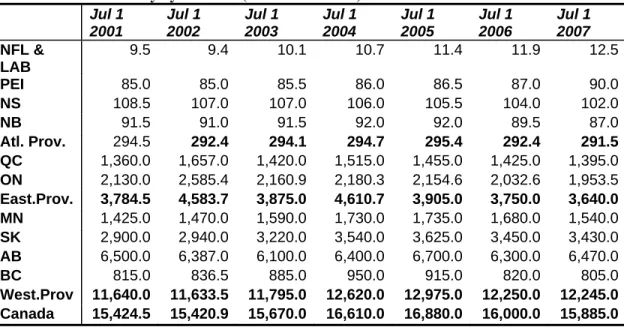
According to statistics from the Agriculture Division at Statistics Canada the number of cattle
averaged 15.9 million between 2001 and 2007. The statistics show that the topology of firms
providing breeding animals, raising feeders and slaughter cattle are not one homogeneous group.
Firm size, measured as the number of animals per farm, and total production vary widely across
provinces and stage of production. For example, about three-quarter of the cattle population are
located in the Western Provinces (Manitoba, Saskatchewan, Alberta and British Columbia),
one-quarter in Quebec and Ontario and the remainder in the Atlantic Provinces, see table 7.
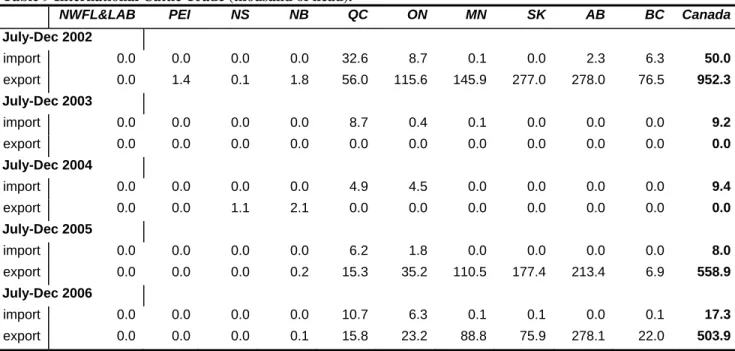
Moreover, cattle are traded across provinces and countries. For example, Alberta is a net
importer of cattle from the other provinces: about two-thirds of all cattle traded across provinces
are imported to Alberta, and about 7 per cent of total interprovincial export originates from said
province. The second largest trader is Ontario; importing on average 16 per cent of total
interprovincial trade volume. Tables 8 and 9 show interprovincial and international cattle trade
figures for five-six month periods, July through December for 2002 to 2006. It is possible that
the cattle imported to Alberta represent mostly slaughter cattle, whereas other provinces import a
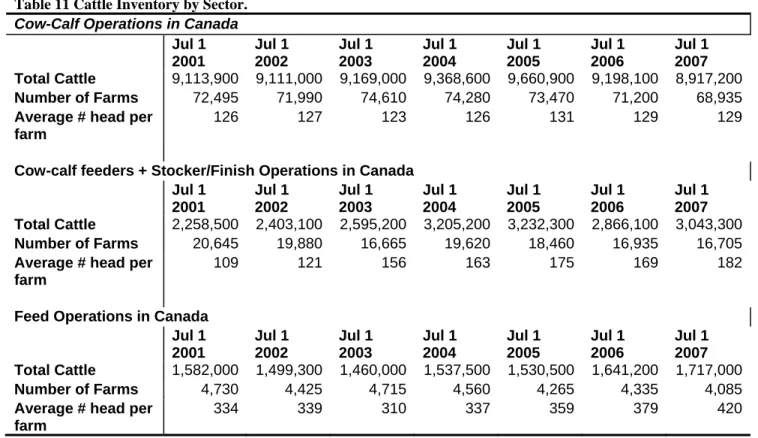
relatively larger share of feeder cattle. Furthermore, nearly 60 per cent of all ranches, farms and
feedlots are located in the Western Provinces, whereas 18 and 8 per cent of all firms are located
in Ontario and Quebec respectively in 2001 and 2006. Additionally, the size distribution of firms
is relatively skewed: on average, feeder operations are about twice the size of calf and
cow-calf feeder and stocker/finisher operations for the period 2001 to 2007; see Table 11.
With regards to cattle slaughter and processing, there were 30 federally inspected cattle slaughter
plants, according to AAFC (2007); see Table 12. Nearly 43 per cent of all plants were located in
Western Canada of which 20 per cent in Alberta, and 27 per cent in Ontario and 27 per cent in
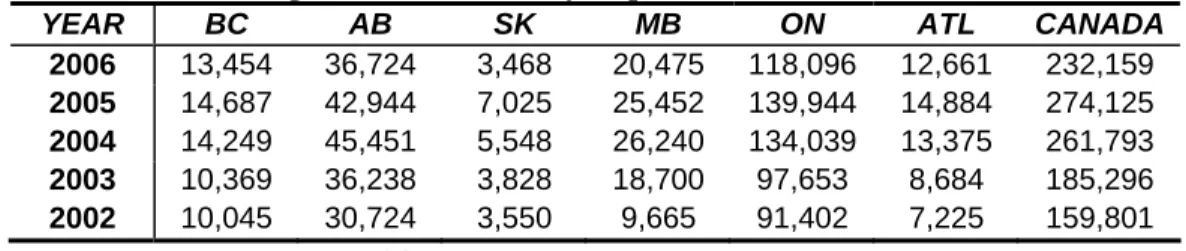
Quebec. Total cattle slaughter averaged 3.6 million heads for the period 2002 to 2006, of which
6 and 94 per cent were slaughtered in provincially and federally inspected plants, respectively;
see Tables 13 and 14. Hence, the vast majority of all cattle are slaughtered in federally inspected
plants. Moreover, the capacity of the largest four plants averaged 178 thousand heads, with a
combined market share average 86 per cent for the period 1998 to 2006.
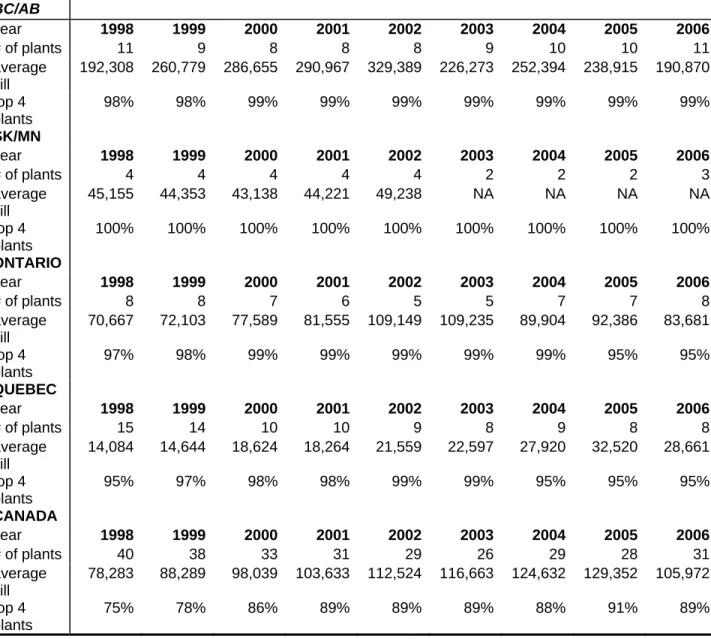
In the Western Provinces, the combined market share of the four largest plants average 99 per
cent; see Table 15. In Alberta alone, capacity of the federally inspected plants in 2006 was 63 per
cent of national capacity, or 3.1 million head per year; see Table 16.
In summary, by the sheer nature and structure of the Canadian beef and cattle industry, it is
likely that adoption of traceability might impact market participants very differently. Previous
studies suggest that the cost impact of new regulations and voluntary quality controls are
characterized by some degrees of economies of scale or scope, e.g. Hooker et al (2002), Ollinger
et al (2004) and Jayasinghe-Mudalige and Henson (2007). For example, fixed costs associated
with adoption of new technologies are less of a threat for larger volume firms, whereas they can
stimulate exit pattern among smaller firms that are not able to access markets associated with
price premium.
9. CONCLUSION
The objective of this report is to provide a literature review and case studies of existing
traceability systems on the costs and benefits of food traceability systems, in particular
traceability systems in the beef supply chain. The aim of the report is to identify gaps that may
currently exist in the literature on traceability in the domestic beef supply chain, as well as
provide possible directions for future research on traceability. Three main conclusions can be
drawn from this study.
First, there is a lack of a common definition of traceability, as seen in Table 1. This lead to
difficulties in interpreting and drawing conclusions from traceability studies in terms of finding
similarities and differences and identifying quantifiable costs and benefits to potential
stakeholders. This study adopts the CFIA’s definition of traceability “The ability to trace and
follow food, feed, food-producing animals or substances intended to be, or expected to be
incorporated into a food or feed, through all stages of production, processing and distribution.
There are three recognized pillars to traceability: Animal or product identification; Animal or
product movement; Premises identification.”
The strengths and weaknesses of this definition has already been highlighted, however it is
important to reiterate that while as this definition appears conformable to the EU’s official
definition of traceability, it may or may not be acceptable from the perspective of major
Canadian beef and cattle trade partners such as the U.S., Japan, Korea and Taiwan.
Second, the literature reviewed in this report in general seems to address one or more of five key
objectives; the impact of changing consumer behaviour on market participants, suppliers
incentive to adopt or participate in traceability, impact of regulatory changes, supplier response
to crisis and technical description of traceability systems. Several studies that address the first
objective have also adopted one of EU’s or a similar farm-to-fork definition of traceability. In
particular, these studies tend to find that consumers to not value traceability per se but ascribe an
economic value to product or process traits. Moreover, the review indicates that retailers may
regard traceability as a means to increase product differentiation and enhance brand competition
within stores. In a similar vein, studies indicate that supply chain improvement, food safety
control and accessing foreign market segments are strong incentives for primary producers to
participate in programs with traceability features. However there are very few studies that
examine traceability, using the CFIA definition, empirically, before or after implementation.
This likely reflects the fact that there are not very many systems established world wide –
particularly from an industry wide perspective that do this. Individual retailers have established
their own systems, traceable back to farm, for their own branding purposes. Governments have
mandated, or assisted in the implementation of systems that go from farm to processors or
packer, in the livestock case, or in a few cases to international buyers. A comprehensive analysis
from farm to consumer, that quantifies true costs and benefits is lacking.
Third, case studies of existing traceability systems in Australia, the UK, Scotland, Brazil and
Uruguay indicate that the pattern of development varies widely across sectors and regions. For