Features
• Easy to use• Interfaces directly with microprocessors
• 0.15” character height in 4, 8, and 16 (2×8) character packages
• 0.20” character height in 4 and 8 character packages
• Rugged X- and Y-stackable package
• Serial input
• Convenient brightness controls
• Wave solderable
• Offered in five colors
• Low power CMOS technology
• TTL compatible
Applications
• Telecommunications equipment
• Portable data entry devices
• Computer peripherals • Medical equipment • Test equipment • Business machines • Avionics • Industrial controls
Device Selection Guide
Description Deep Red HER Orange Yellow Green DrawingPackage
1 × 4 0.15” Character HCMS-2905 HCMS-2902 HCMS-2904 HCMS-2901 HCMS-2903 A
1 × 8 0.15” Character HCMS-2915 HCMS-2912 HCMS-2914 HCMS-2911 HCMS-2913 B
2 × 8 0.15” Character HCMS-2925 HCMS-2922 HCMS-2924 HCMS-2921 HCMS-2923 C
HCMS-29xx Series
High Performance CMOS 5
×
7 Alphanumeric Displays
Data Sheet
Description
The HCMS-29xx series are high performance, easy to use dot matrix displays driven by on-board CMOS ICs. Each display can be directly inter faced with a microproces sor, thus eliminat ing the need for cum ber-some interface compo nents. The serial IC interface al-lows higher char ac ter count information displays with a minimum of data lines. A variety of colors, font heights, and character counts gives designers a wide range of prod uct choices for their specific appli cations and the easy to read 5×7 pixel format allows the display of up-percase, lower case, Kata kana, and custom user-defined characters. These dis plays are stackable in the x- and y- directions, making them ideal for high character count displays.
HCMS-291x
HCMS-290x
NOTES:
1. DIMENSIONS ARE IN mm (INCHES).
2. UNLESS OTHERWISE SPECIFIED, TOLERANCE ON DIMENSIONS IS ± 0.38 mm (0.015 INCH). 3. LEAD MATERIAL: SOLDER PLATED COPPER ALLOY.
X Z COO 2.11 (0.083) TYP. 0.25 (0.010) 7.62 (0.300) PIN # 1 IDENTIFIER 4 3 2 1 17.78 (0.700) MAX. 3.71 (0.146) TYP. 4.45 (0.175) TYP. 2.22 (0.087) SYM. 10.16 (0.400) MAX. PIN # 1
LIGHT INTENSITY CATEGORY DATE CODE COLOR BIN COUNTRY OF ORIGIN PART NUMBER 5.08 (0.200) 2.54 (0.100) SYM. TYP. 0.51 ± 0.13 (0.020 ± 0.005) 2.54 ± 0.13 (0.100 ± 0.005) (NON ACCUM.) TYP. 4.32 (0.170) TYP. 1.27 (0.050) SYM. 1 12 0.51 (0.020) DATA OUT OSC V LED DATA IN RS CLK CE BLANK GND SEL V LOGIC RESET PIN FUNCTION ASSIGNMENT TABLE 1 2 3 4 5 6 7 8 9 10 11 12 PIN # FUNCTION HCMS-290X YYWW NOTES:
1. DIMENSIONS ARE IN mm (INCHES).
2.54 ± 0.13 (0.100 ± 0.005) (NON ACCUM.) TYP. 35.56 (1.400) MAX. 7 6 5 4 3 2 1 0 0.25 (0.010) 7.62 (0.300) PIN # 1 IDENTIFIER X Z COO INTENSITY CATEGORY DATE CODE (YEAR, WEEK) COLOR BIN COUNTRY OF ORIGIN PART NUMBER 5.08 (0.200) 2.54 (0.100) SYM. 0.51 (0.020) TYP. 0.51 ± 0.13 (0.020 ± 0.005) 2.22 (0.087) SYM. 10.16 (0.400) MAX. 2.11 (0.083) TYP. 4.32 (0.170) TYP. 1.27 (0.050) SYM. 4.45 (0.175) TYP. 3.71 (0.146) TYP. NO PIN NO PIN V LED NO PIN NO PIN NO PIN GND LED NO PIN NO PIN V LED NO PIN NO PIN NO PIN DATA IN RS NO PIN CLOCK CE BLANK GND LOGIC SEL V LOGIC NO PIN RESET OSC DATA OUT PIN FUNCTION ASSIGNMENT TABLE 1 2 3 4 5 6 7 8 9 10 11 12 13 14 15 16 17 18 19 20 21 22 23 24 25 26 PIN # FUNCTION 3 26 HCMS-291X YYWW
HCMS-292x
HCMS-296x
NO PIN NO PIN V LED NO PIN NO PIN NO PIN GND LED NO PIN NO PIN V LED NO PIN NO PIN NO PIN DATA IN RS NO PIN CLOCK CE BLANK GND LOGIC SEL V LOGIC NO PIN RESET OSC DATA OUT PIN FUNCTION ASSIGNMENT TABLENO PIN NO PIN V LED NO PIN NO PIN NO PIN GND LED NO PIN NO PIN V LED NO PIN NO PIN NO PIN DATA IN RS NO PIN CLOCK CE BLANK GND LOGIC SEL V LOGIC NO PIN RESET OSC DATA OUT 1A 2A 3A 4A 5A 6A 7A 8A 9A 10A 11A 12A 13A 14A 15A 16A 17A 18A 19A 20A 21A 22A 23A 24A 25A 26A PIN # FUNCTION NOTES:
1. DIMENSIONS ARE IN mm (INCHES).
2. UNLESS OTHERWISE SPECIFIED, TOLERANCE ON DIMENSIONS IS ± 0.38 mm (0.015 INCH). 3. LEAD MATERIAL: SOLDER PLATED COPPER ALLOY.
15 14 13 12 11 10 9 8 7 6 5 4 3 2 1 0 1.27 (0.050) 0.25 (0.010) 7.62 (0.300) 2.03 (0.080) 4.83 (0.190) PIN # 1 IDENTIFIER ROW A ROW B 35.56 (1.400) MAX. 3.71 (0.146) TYP. 2.22 (0.088) SYM. 4.45 (0.175) MAX. 19.81 (0.780) MAX. 9.65 (0.380) X Z COO INTENSITY CATEGORY DATE CODE (YEAR, WEEK) COLOR BIN COUNTRY OF ORIGIN PART NUMBER 5.08 (0.200) 2.54 (0.100) SYM. 0.51 (0.020) 0.51 ± 0.13 (0.020 ± 0.005) TYP. 2.54 ± 0.13 (0.100 ± 0.005) (NON ACCUM.) TYP. 3A 26A 3B 26B 2.11 (0.083) TYP. 1B 2B 3B 4B 5B 6B 7B 8B 9B 10B 11B 12B 13B 14B 15B 16B 17B 18B 19B 20B 21B 22B 23B 24B 25B 26B PIN # FUNCTION HCMS-292X YYWW 3 2 1 0 PIN # 1 IDENTIFIER PART NUMBER 2.67 (0.105) SYM. 2.54 (0.100) TYP. 11.43 (0.450) MAX. 5.36 (0.211) TYP. 0.25 (0.010) 4.57 (0.180) TYP. INTENSITY CATEGORY DATE CODE (YEAR, WEEK) COLOR BIN COUNTRY OF ORIGIN 21.46 (0.845) MAX. DATA OUT OSC V LED DATA IN RS CLK CE BLANK GND SEL V LOGIC RESET 1 2 3 4 5 6 7 8 9 10 11 12 PIN FUNCTION ASSIGNMENT TABLE PIN # FUNCTION
Absolute Maximum Ratings
Logic Supply Voltage, VLOGIC to GNDLOGIC -0.3 V to 7.0 V
LED Supply Voltage, VLED to GNDLED -0.3 V to 5.5 V
Input Voltage, Any Pin to GND -0.3 V to VLOGIC +0.3 V
Free Air Operating Temperature Range TA [1] -40 °C to +85 °C
Relative Humidity (noncondensing) 85%
Storage Temperature, TS -55 °C to 100 °C
Soldering Temperature [1.59 mm (0.063 in.) Below Body]
Solder Dipping 260 °C for 5 secs
Wave Soldering 250 °C for 3 secs
ESD Protection @ 1.5 kΩ, 100 pF (each pin) Class 1, 0-1999 V TOTAL Package Power Dissipation at TA = 25 °C [2]
4 Character 1.2 W
8 Character 2.4 W
16 Character 4.8 W
Note:
1. For operation in high ambient temperatures, see Appendix A, Thermal Considerations.
HCMS-297x
Recommended Operating Conditions Over Temperature Range (-40 °C to +85 °C)
Parameter Symbol Min. Typ. Max. Units
Logic Supply Voltage VLOGIC 3.0 5.0 5.5 V
LED Supply Voltage VLED 4.0 5.0 5.5 V
GNDLED to GNDLOGIC -0.3 0 +0.3 V
PIN FUNCTION ASSIGNMENT TABLE
NOTES:
1. DIMENSIONS ARE IN mm (INCHES).
2. UNLESS OTHERWISE SPECIFIED, TOLERANCE ON DIMENSIONS IS ± 0.38 mm (0.015 INCH). 3. LEAD MATERIAL: SOLDER PLATED COPPER ALLOY.
8 7 6 5 4 3 2 1 X ZCOO PIN # 1 IDENTIFIER INTENSITY CATEGORY DATE CODE (YEAR, WEEK) COLOR BIN COUNTRY OF ORIGIN PART NUMBER 5.31 (0.209) 6.22 (0.245) SYM. 0.51 (0.020) TYP. 0.51 ± 0.13 (0.020 ± 0.005) 2.54 ± 0.13 (0.100 ± 0.005) (NON ACCUM.) TYP. 2.67 (0.105) SYM. 5.36 (0.211) TYP. 11.43 (0.450) MAX. 2.54 (0.100) TYP. 0.25 (0.010) 7.62 (0.300) 3.71 (0.146) TYP. 1.90 (0.075) SYM. NO PIN NO PIN V LED NO PIN NO PIN NO PIN GND LED NO PIN NO PIN V LED NO PIN NO PIN NO PIN DATA IN RS NO PIN CLOCK CE BLANK GND LOGIC SEL V LOGIC NO PIN RESET OSC DATA OUT 1 2 3 4 5 6 7 8 9 10 11 12 13 14 15 16 17 18 19 20 21 22 23 24 25 26 PIN # FUNCTION 4.57 (0.180) TYP. 3 26 HCMS-297X YYWW 42.93 (1.690) MAX.
Electrical Characteristics Over Operating Temperature Range (-40 °C to +85 °C) TA = 25 °C -40 °C < TA < 85 °C
VLOGIC = 5.0 V 3.0 V < VLOGIC < 5.5 V
Parameter Symbol Typ. Max. Min. Max. Units Test Conditions
Input Leakage Current II µA VIN = 0 V to VLOGIC
HCMS-290x/296x (4 char) +7.5 -2.5 +50
HCMS-291x/297x (8 char) +15 -5.0 +100
HCMS-292x (16 char) +15 -5.0 +100
ILOGIC OPERATING ILOGIC(OPT) mA VIN = VLOGIC
HCMS-290x/296x (4 char) 0.4 2.5 5
HCMS-291x/297x (8 char) 0.8 5 10
HCMS-292x (16 char) 0.8 5 10
ILOGIC SLEEP [1] ILOGIC(SLP) µA VIN = VLOGIC
HCMS-290x/296x (4 char) 5 15 25
HCMS-291x/297x (8 char) 10 30 50
HCMS-292x (16 char) 10 30 50
ILED BLANK ILED(BL) mA BL = 0 V
HMCS-290x/296x (4 char) 2.0 4 4.0
HCMS-291x/297x (8 char) 4.0 8 8
HCMS-292x (16 char) 4.0 8 8
ILED SLEEP [1] ILED(SLP) µA
HCMS-290x/296x (4 char) 1 3 50
HCMS 291x/297x (8 char) 2 6 100
HCMS-292x (16 char) 2 6 100
Peak Pixel Current [2] IPIXEL VLED = 5.5 V
HCMS-29x5 (Deep Red) 15.4 17.1 18.7 mA All pixels ON,
HCMS-29xx (Other Colors) 14.0 15.9 17.1 mA Average value per pixel
HIGH Level Input Voltage Vih 2.0 V 4.5 V < VLOGIC < 5.5 V
0.8 VLOGIC V 3.0 V < VLOGIC < 4.5 V
LOW Level Input Voltage Vil 0.8 V 4.5 V < VLOGIC < 5.5 V
0.2 VLOGIC V 3.0 V < VLOGIC < 4.5 V
HIGH Level Output Voltage Voh 2.0 V VLOGIC = 4.5 V,
Ioh = -40 µA
0.8 VLOGIC V 3.0 V < VLOGIC < 4.5 V
LOW Level Output Voltage Vol 0.4 V VLOGIC = 5.5 V,
Iol = 1.6 mA [3]
0.2 VLOGIC V 3.0 V < VLOGIC < 4.5 V
Thermal Resistance RqJ-P 70 °C/W IC junction to pin
Notes:
1. In SLEEP mode, the internal oscillator and reference current for LED drivers are off.
2. Average peak pixel current is measured at the maximum drive current set by Control Register 0. Individual pixels may exceed this value.
Electrical Description
Pin Function Description
RESET (RST) Sets Control Register bits to logic low. The Dot Register contents are unaffected by the Reset pin. (logic low = reset; logic high = normal operation).
DATA IN (DIN) Serial Data input for Dot or Control Register data. Data is entered on the rising edge of the Clock input.
DATA OUT (DOUT) Serial Data output for Dot or Control Register data. This pin is used for cascading multiple dis-plays.
CLOCK (CLK) Clock input for writing Dot or Control Register data. When Chip Enable is logic low, data is en-tered on the rising Clock edge.
REGISTER SELECT (RS) Selects Dot Register (RS = logic low) or Control Register (RS = logic high) as the destination for serial data entry. The logic level of RS is latched on the falling edge of the Chip Enable input. CHIP ENABLE (CE) This input must be a logic low to write data to the display. When CE returns to logic high and CLK
is logic low, data is latched to either the LED output drivers or a Control Register.
OSCILLATOR SELECT (SEL) Selects either an internal or external display oscillator source. (logic low = External Display Oscil-lator; logic high = Internal Display Oscillator).
OSCILLATOR (OSC) Output for the Internal Display Oscillator (SEL = logic high) or input for an External Display Oscil-lator (SEL = logic low).
BLANK (BL) Blanks the display when logic high. May be modulated for brightness control.
GNDLED Ground for LED drivers.
GNDLOGIC Ground for logic.
VLED Positive supply for LED drivers.
VLOGIC Positive supply for logic.
Optical Characteristics at 25 °C[1]
VLED = 5.0 V, 50% Peak Current, 100% Pulse Width
Peak Dominant
Luminous Intensity per LED [2] Wavelength Wavelength
Character Average (µcd) lPeak (nm) ld [3] (nm)
Display Color Part Number Min. Typ. Typ. Typ.
Deep Red HCMS-29x5 95 770 645 637
High Efficiency Red HCMS-29x2 64 270 635 626
Orange HCMS-29x4 64 180 600 602
Yellow HCMS-29x1 64 180 583 585
Green HCMS-29x3 64 270 568 574
Notes:
1. Refers to the initial case temperature of the device immediately before measurement. 2. Measured with all LEDs illuminated.
3. Dominant wavelength, ld, is derived from the CIE chromaticity diagram and represents the single wavelength, which defines the perceived
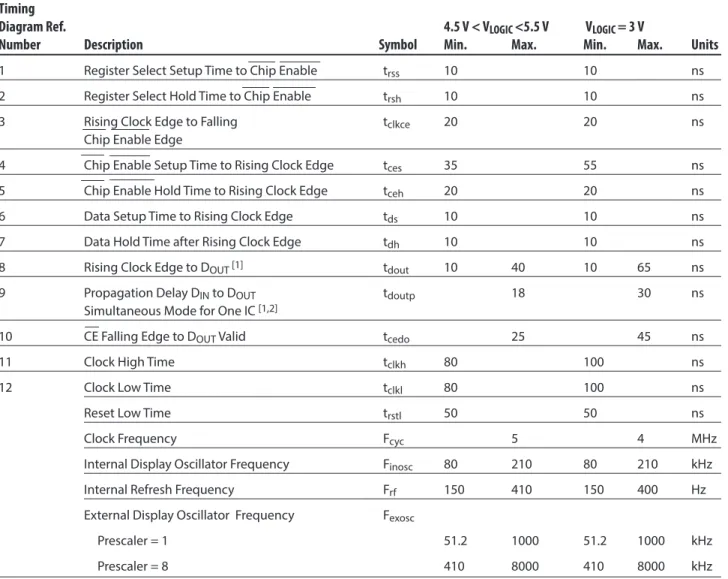
AC Timing Characteristics Over Temperature Range (-40 °C to +85 °C) Timing
Diagram Ref. 4.5 V < VLOGIC <5.5 V VLOGIC = 3 V
Number Description Symbol Min. Max. Min. Max. Units
1 Register Select Setup Time to Chip Enable trss 10 10 ns
2 Register Select Hold Time to Chip Enable trsh 10 10 ns
3 Rising Clock Edge to Falling tclkce 20 20 ns
Chip Enable Edge
4 Chip Enable Setup Time to Rising Clock Edge tces 35 55 ns
5 Chip Enable Hold Time to Rising Clock Edge tceh 20 20 ns
6 Data Setup Time to Rising Clock Edge tds 10 10 ns
7 Data Hold Time after Rising Clock Edge tdh 10 10 ns
8 Rising Clock Edge to DOUT [1] tdout 10 40 10 65 ns
9 Propagation Delay DIN to DOUT tdoutp 18 30 ns
Simultaneous Mode for One IC [1,2]
10 CE Falling Edge to DOUT Valid tcedo 25 45 ns
11 Clock High Time tclkh 80 100 ns
12 Clock Low Time tclkl 80 100 ns
Reset Low Time trstl 50 50 ns
Clock Frequency Fcyc 5 4 MHz
Internal Display Oscillator Frequency Finosc 80 210 80 210 kHz
Internal Refresh Frequency Frf 150 410 150 400 Hz
External Display Oscillator Frequency Fexosc
Prescaler = 1 51.2 1000 51.2 1000 kHz
Prescaler = 8 410 8000 410 8000 kHz
Notes:
1. Timing specifications increase 0.3 ns per pF of capacitive loading above 15 pF. 2. This parameter is valid for Simultaneous Mode data entry of the Control Register.
Display Overview
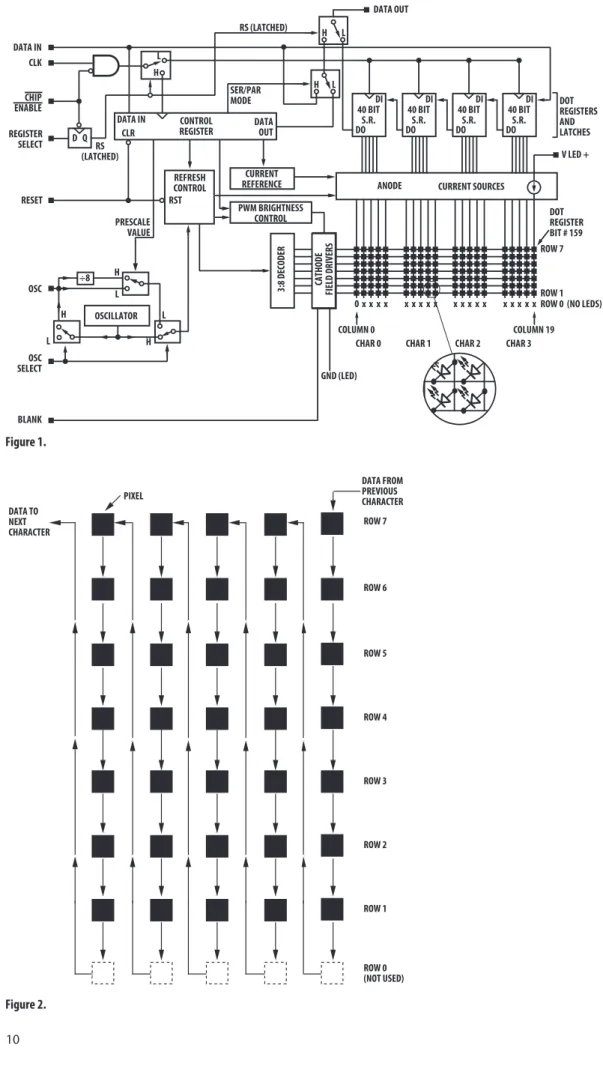
The HCMS-29xx series is a family of LED displays driven by on-board CMOS ICs. The LEDs are configured as 5 x 7 font characters and are driven in groups of 4 characters per IC. Each IC consists of a 160-bit shift register (the Dot Register), two 7-bit Control Words, and refresh circuitry. The Dot Regis ter contents are mapped on a one-to-one basis to the display. Thus, an individual Dot Register bit uniquely controls a single LED.
8-character displays have two ICs that are cascaded. The Data Out line of the first IC is internally connected to the Data In line of the second IC forming a 320-bit Dot Register. The dis play’s other control and power lines are connected directly to both ICs. In 16-character displays, each row functions as an independent 8-character dis-play with its own 320-bit Dot Register.
Reset
Reset initializes the Control Registers (sets all Control Register bits to logic low) and places the display in the sleep mode. The Reset pin should be con nected to the system power-on reset circuit. The Dot Registers are not cleared upon power-on or by Reset. After power-on, the Dot Register contents are random; however, Reset will put the display in sleep mode, there by blanking the LEDs. The Control Register and the Control Words are cleared to all zeros by Reset.
To operate the display after being Reset, load the Dot Register with logic lows. Then load Control Word 0 with the desired bright ness level and set the sleep mode bit to logic high.
Dot Register
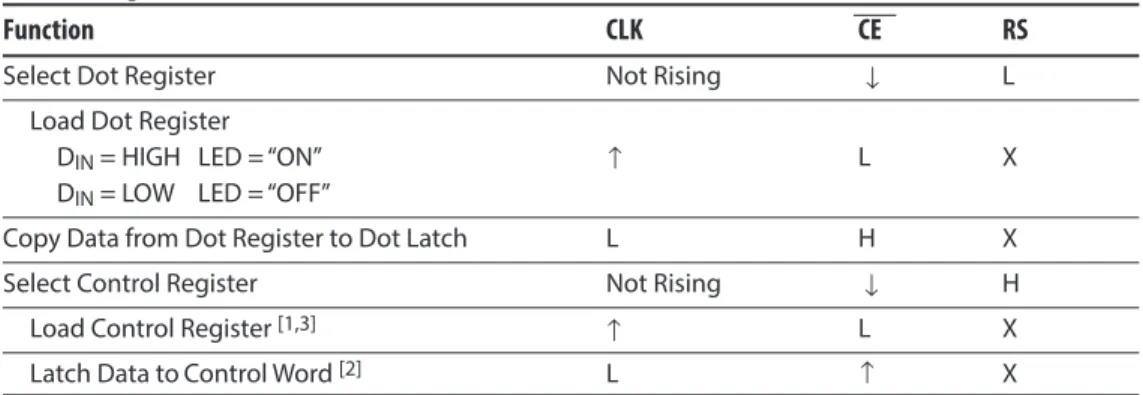
The Dot Register holds the pattern to be displayed by the LEDs. Data is loaded into the Dot Register according to the procedure shown in Table 1 and the Write Cycle Timing Diagram.
First RS is brought low, then CE is brought low. Next, each successive rising CLK edge will shift in the data at the DIN pin. Loading a logic high will turn the cor-responding LED on; a logic low turns the LED off. When all 160 bits have been loaded (or 320 bits in an 8-digit display), CE is brought to logic high.
When CLK is next brought to logic low, new data is latched into the display dot drivers. Loading data into the Dot Register takes place while the previous data is displayed and eliminates the need to blank the display while loading data.
Pixel Map
In a 4-character display, the 160-bits are arranged as 20 columns by 8 rows. This array can be conceptualized as four 5 x 8 dot matrix character loca tions, but only 7 of the 8 rows have LEDs (see Figures 1 & 2). The bottom row (row 0) is not used. Thus, latch location 0 is never displayed. Column 0 controls the left-most column. Data from Dot Latch locations 0-7 determine whether or not pixels in Column 0 are turned-on or turned-off. Therefore, the lower left pixel is turned-on when a logic high is stored in Dot Latch location 1. Characters are loaded in serially, with the left-most character being loaded first and the right-most character being loaded last. By loading one character at a time and latching the data before loading the next character, the figures will appear to scroll from right to left.
Table 1. Register Truth Table
Function CLK CE RS
Select Dot Register Not Rising L
Load Dot Register
DIN = HIGH LED = “ON” L X
DIN = LOW LED = “OFF”
Copy Data from Dot Register to Dot Latch L H X
Select Control Register Not Rising H
Load Control Register [1,3] L X
Latch Data toControl Word [2] L X
Notes:
1. BIT D0 of Control Word 1 must have been previously set to Low for serial mode or High for simultaneous mode.
2. Selection of Control Word 1 or Control Word 0 is set by D7 of the Control Shift Register. The unselected control
word retains its previous value.
3. Control Word data is loaded Most Significant Bit (D7) first.
↑ ↓
↑ ↓ ↑ ↓ ↑ ↓
HCMS-29xx Write Cycle Diagram
Control Word 0
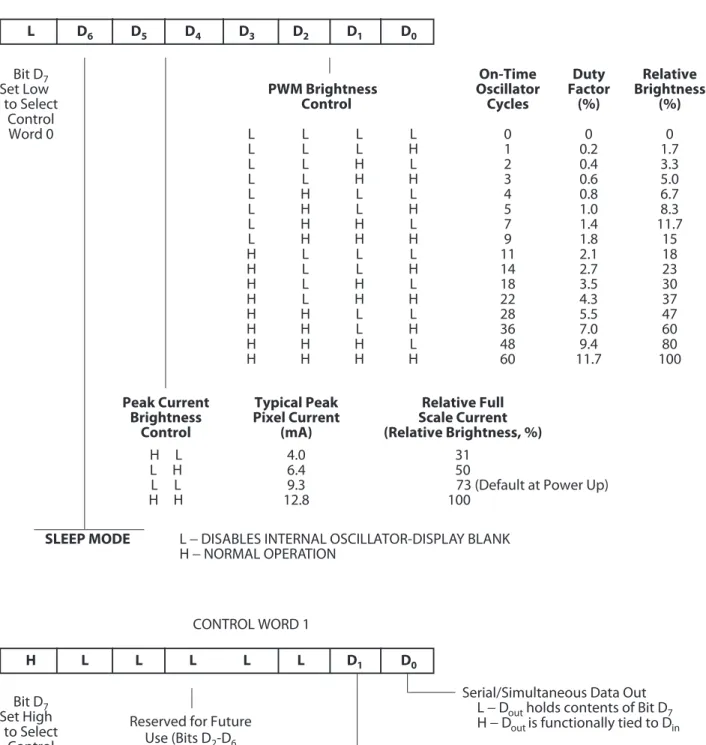
Loading the Control Register with D7 = Logic low
se-lects Control Word 0 (see Table 2). Bits D0-D3 adjust the display brightness by pulse width modulating the LED on-time, while Bits D4-D5 adjust the display brightness by changing the peak pixel current. Bit D6 selects normal operation or sleep mode.
Sleep mode (Control Word 0, bit D6 = Low) turns off the Internal Display Oscillator and the LED pixel drivers. This mode is used when the IC needs to be powered up, but does not need to be active. Current draw in sleep mode is nearly zero. Data in the Dot Register and Control Words are retained during sleep mode.
Control Register
The Control Register allows software modification of the IC’s opera tion and consists of two independent 7-bit control words. Bit D7 in the shift register selects one of the two 7-bit control words. Control Word 0 performs pulse width modula tion brightness control, peak pixel current brightness control, and sleep mode. Control Word 1 sets serial/simultaneous data out mode, and external oscilla tor prescaler. Each function is indepen-dent of the others.
Control Register Data Loading
Data is loaded into the Control Register, MSB first, ac-cording to the proce dure shown in Table 1 and the Write Cycle Timing Diagram. First, RS is brought to logic high and then CE is brought to logic low. Next, each successive rising CLK edge will shift in the data on the DIN pin. Finally, when 8 bits have been loaded, the CE
NOTE:
1. DATA IS COPIED TO THE CONTROL REGISTER OR THE DOT LATCH AND LED OUTPUTS WHEN CE IS HIGH AND CLK IS LOW. TRSS TRSH
TCLKCE TCES TCLKH TCLKL TCEH
DS T TDH CEDO T TDOUT DOUTP T
PREVIOUS DATA NEW DATA
NEW DATA LATCHED HERE[1] CE RS CLK DIN LED OUTPUTS, CONTROL REGISTERS (SIMULTANEOUS)DOUT D (SERIAL)OUT 2 1 3 4 11 12 6 7 8 10 9 5
Figure 1. 40 BIT S.R. DO DI DATA IN OSCILLATOR ÷8 CLK CHIP ENABLE REGISTER SELECT RESET OSC OSC SELECT BLANK DATA IN
CLR REGISTERCONTROL DATAOUT
REFRESH CONTROL RST PRESCALE VALUE H L H L L H D Q RS (LATCHED) L H CURRENT REFERENCE PWM BRIGHTNESS CONTROL L H L H RS (LATCHED) SER/PAR MODE 3:8 DECODER 40 BIT S.R. DO DI 40 BIT S.R. DO DI 40 BIT S.R. DO DI
ANODE CURRENT SOURCES
V LED +
GND (LED) 0
CHAR 0
COLUMN 0 COLUMN 19
CHAR 1 CHAR 2 CHAR 3 ROW 7
DOT REGISTER BIT # 159
ROW 1 ROW 0 (NO LEDS)
DOT REGISTERS AND LATCHES DATA OUT CATHODE FIELD DRIVERS x x x x x x x x x x x x x x x x x x x ROW 0 (NOT USED) DATA TO NEXT CHARACTER PIXEL DATA FROM PREVIOUS CHARACTER ROW 7 ROW 6 ROW 5 ROW 4 ROW 3 ROW 2 ROW 1
Control Word 1
Loading the Control Register with D7 = logic high selects Control Word 1. This Control Word performs two func-tions: serial/simultaneous data out mode and external oscillator prescale select (see Table 2).
Serial/Simultaneous Data Output D
0Bit D0 of control word 1 is used to switch the mode of DOUT between serial and simul ta neous data entry during Control Register writes. The default mode (logic low) is the serial DOUT mode. In serial mode, DOUT is connected to the last bit (D7) of the Control Shift Register.
Storing a logic high to bit D0 changes DOUT to simul-taneous mode which affects the Control Register only. In simul taneous mode, DOUT is logically con nected to DIN. This arrange ment allows multiple ICs to have their Control Registers written to simul taneously. For example, for N ICs in the serial mode, N*8 clock pulses are needed to load the same data in all Control Registers. In the si-multaneous mode, N ICs only need 8 clock pulses to load the same data in all Control Registers. The propaga tion delay from the first IC to the last is N * tDOUTP.
External Oscillator Prescaler Bit D
1Bit D1 of Control Word 1 is used to scale the frequency of an external Display Oscillator. When this bit is logic low, the external Display Oscil la tor directly sets the inter-nal display clock rate. When this bit is a logic high, the external oscilla tor is divided by 8. This scaled frequency then sets the internal display clock rate. It takes 512 cycles of the display clock (or 8 x 512 = 4096 cycles of an external clock with the divide by 8 pre scaler) to com-pletely refresh the display once. Using the pre scaler bit allows the designer to use a higher external oscillator fre quency without extra circuitry.
This bit has no affect on the internal Display Oscillator Frequency.
Bits D
2-D
6These bits must always be pro grammed to logic low.
Cascaded ICs
Figure 3 shows how two ICs are connected within an HCMS-29xx display. The first IC controls the four left-most characters and the second IC controls the four right-most characters. The Dot Registers are connected in series to form a 320-bit dot shift register. The location of pixel 0 has not changed. However, Dot Shift Register bit 0 of IC2 becomes bit 160 of the 320-bit dot shift register. The Control Registers of the two ICs are independent of each other. This means that to adjust the display brightness the same control word must be entered into both ICs, unless the Control Registers are set to simultaneous mode.
Longer character string systems can be built by cascad-ing multi ple displays together. This is accomplished by creating a five line bus. This bus consists of CE, RS, BL, Reset, and CLK. The display pins are connected to the corresponding bus line. Thus, all CE pins are connected to the CE bus line. Similarly, bus lines for RS, BL, Reset,
and CLK are created. Then DIN is connected to the
right-most display. DOUT from this display is connected to the next display. The left-most display receives its DIN from the DOUT of the display to its right. DOUT from the left-most display is not used.
Each display may be set to use its internal oscillator, or the displays may be synchronized by setting up one display as the master and the others as slaves. The slaves are set to receive their oscillator input from the master’s oscillator output.
Table 2. Control Shift Register
Bit D7 On-Time Duty Relative
Set Low PWM Brightness Oscillator Factor Brightness
to Select Control Cycles (%) (%)
Control Word 0 L L L L 0 0 0 L L L H 1 0.2 1.7 L L H L 2 0.4 3.3 L L H H 3 0.6 5.0 L H L L 4 0.8 6.7 L H L H 5 1.0 8.3 L H H L 7 1.4 11.7 L H H H 9 1.8 15 H L L L 11 2.1 18 H L L H 14 2.7 23 H L H L 18 3.5 30 H L H H 22 4.3 37 H H L L 28 5.5 47 H H L H 36 7.0 60 H H H L 48 9.4 80 H H H H 60 11.7 100 CONTROL WORD 0 L D6 D5 D4 D3 D2 D1 D0
Peak Current Typical Peak Relative Full Brightness Pixel Current Scale Current
Control (mA) (Relative Brightness, %)
H L 4.0 31
L H 6.4 50
L L 9.3 73 (Default at Power Up)
H H 12.8 100
SLEEP MODE L − DISABLES INTERNAL OSCILLATOR-DISPLAY BLANK H − NORMAL OPERATION
Serial/Simultaneous Data Out L − Dout holds contents of Bit D7 H − Dout is functionally tied to Din External Display Oscillator Prescaler
L − Oscillator Freq 1 H − Oscillator Freq 8 Bit D7 Set High to Select Control Word 1
Reserved for Future Use (Bits D2-D6 must be set Low)
CONTROL WORD 1
Figure 3. Cascaded ICs CE IC2 BITS 160 – 319 CHARACTERS 4 – 7 RS BL SEL OSC CLK DOUT D IC1 BITS 0 – 159 CHARACTERS 0 – 3 DIN RS BL SEL OSC CLK DOUT CE RESET RESET RS BL SEL OSC CLK D CE RESET DIN OUT IN
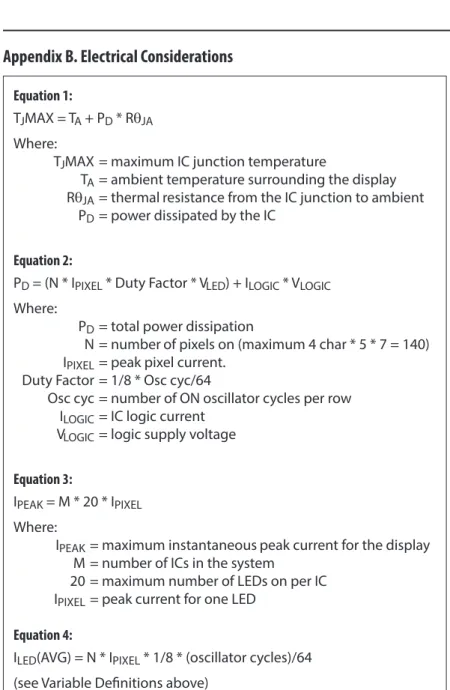
Equation 1:
TJMAX = TA + PD * RqJA Where:
TJMAX = maximum IC junction temperature
TA = ambient temperature surrounding the display
RqJA = thermal resistance from the IC junction to ambient
PD = power dissipated by the IC
Equation 2:
PD = (N * IPIXEL * Duty Factor * VLED) + ILOGIC * VLOGIC Where:
PD = total power dissipation
N = number of pixels on (maximum 4 char * 5 * 7 = 140)
IPIXEL = peak pixel current.
Duty Factor = 1/8 * Osc cyc/64
Osc cyc = number of ON oscillator cycles per row
ILOGIC = IC logic current
VLOGIC = logic supply voltage
Equation 3:
IPEAK = M * 20 * IPIXEL Where:
IPEAK = maximum instantaneous peak current for the display
M = number of ICs in the system
20 = maximum number of LEDs on per IC
IPIXEL = peak current for one LED
Equation 4:
ILED(AVG) = N * IPIXEL * 1/8 * (oscillator cycles)/64 (see Variable Definitions above)
Figure 4.
PD MAX – MAXIMUM POWER DISSIPATION PER IC – W
0 25 TA – AMBIENT TEMPERATURE – °C 0.7 0.6 0.5 0.4 0.3 0.2 0.1 60 55 50 45 40 35 30 0.8 0.9 1.0 1.1 1.2 85 80 75 70 65 90 1.3 R = 100 θJ-A °C/W
Appendix B. Electrical Considerations
Appendix A. Thermal Considerations
The display IC has a maximum junction temperature of 150°C. The IC junction temperature can be calculated with Equation 1.
A typical value for RqJ-A is 100 °C/W. This value is typical for a display mounted in a socket and covered with a plastic filter. The socket is soldered to a .062 in. thick PCB with .020 inch wide, one ounce copper traces.
PD can be calculated as in Equa tion 2.
Figure 4 shows how to derate the power of one IC versus ambient temperature. Opera tion at high ambient tem-peratures may require the power per IC to be reduced. The power con sump tion can be reduced by changing either the N, IPIXEL, Osc cyc or VLED. Changing VLOGIC has very little impact on the power consumption.
Appendix B. Electrical Considerations (Continued...)
Current Calculations
The peak and average display current requirements have a significant impact on power supply selection. The maximum peak current is calculated with Equation 3.
The average current required by the display can be calculated with Equation 4.
The power supply has to be able to supply IPEAK transients and supply ILED(AVG) continuously. The range on VLED allows noise on this supply without sig nifi cantly changing the display brightness.
V
LOGICand V
LEDConsiderations
The display uses two indepen dent electrical systems. One system is used to power the display’s logic and the other to power the display’s LEDs. These two systems keep the logic supply clean.
Separate electrical systems allow the voltage applied to VLED and VLOGIC to be varied independently. Thus, VLED can vary from 0 to 5.5 V without affecting either the Dot or the Control Registers. VLED can be varied between 4.0 to 5.5 V with out any noticeable variation in light output. However, oper at ing VLED below 4.0 V may cause objection-able mismatch between the pixels and is not recommended. Dimming the display by pulse width modulat ing
VLED is also not recommended.
VLOGIC can vary from 3.0 V to 5.5 V without affecting either the displayed message or the display intensity.
How-ever, operation below 4.5 V will change the timing and logic levels and operation below 3 V may cause the Dot and Control Registers to be altered.
The logic ground is internally connected to the LED ground by a substrate diode. This diode becomes forward biased and conducts when the logic ground is 0.4 V greater than the LED ground. The LED ground and the logic ground should be connected to a common ground which can withstand the current introduced by the switching LED drivers. When separate ground connections are used, the LED ground can vary from -0.3 V to +0.3 V with respect to the logic ground. Voltages below -0.3 V can cause all the dots to be ON. Voltage above +0.3 V can cause dimming and dot mismatch. The LED ground for the LED drivers can be routed separately from the logic ground until an appropri ate ground plane is available. On long interconnections between the display and the host system, voltage drops on the analog ground can be kept from affecting the display logic levels by isolating the two grounds.
Electrostatic Discharge
The inputs to the ICs are pro tected against static discharge and input current latchup. How ever, for best results, standard CMOS handling precautions should be used. Before use, the HCMS-29xx should be stored in antistatic tubes or in conductive material. During assembly, a grounded conductive work area should be used and assem-bly personnel should wear conduc tive wrist straps. Lab coats made of synthetic material should be avoided since they are prone to static buildup. Input current latchup is caused when the CMOS inputs are subjected to either a voltage below ground (VIN < ground) or to a voltage higher than VLOGIC (VIN > VLOGIC) and when a high current is forced into the input. To prevent input current latchup and ESD damage, unused inputs should be con nected to either ground or VLOGIC. Voltages should not be applied to the inputs until VLOGIC has been applied to the display.
Appendix C. Oscillator
The oscillator provides the internal refresh circuitry with a signal that is used to synchron ize the columns and rows. This ensures that the right data is in the dot drivers for that row. This signal can be supplied from either an external source or the internal source.
Figure 5.
Appendix E. Display Brightness
Two ways have been shown to control the brightness of this LED display: setting the peak current and setting the duty factor. Both values are set in Control Word 0. To compute the resulting display brightness when both PWM and peak current control are used, simply multiply the two relative bright ness factors. For example, if Control Register 0 holds the word 1001101, the peak current is 73% of full scale (BIT D5 = L, BIT D4 = L) and the PWM is set to 60% duty factor (BIT D3 = H, BIT D2 = H, BIT D1 = L, BIT D0 = H). The resulting brightness is 44% (.73 x .60 = .44) of full scale.
The temperature of the display will also affect the LED bright ness as shown in Figure 5.
Intensity Bin Limits for HCMS-29xx (except for HCMS-29x5)
BIN Intensity Range (mcd) Min. Max. D 1.18 2.07 E 1.78 3.13 F 2.70 4.64 G 4.00 7.00 H 6.00 10.50 I 9.00 15.75 J 13.58 23.88 K 20.59 36.03 L 31.06 54.35 Note:
Test conditions as specified in Optical Characteristic table. Intensity Bin Limits for HCMS-29x5
BIN Intensity Range (mcd) Min. Max. H 6.00 10.50 I 9.00 15.75 J 13.58 23.88 K 20.59 36.03 L 31.06 54.35 M 46.45 80.41 Note:
Test conditions as specified in Optical Characteristic table.
Appendix D. Refresh Circuitry
This display driver consists of 20 one-of-eight column decoders and 20 constant current sources, 1 one-of-eight row decoder and eight row sinks, a pulse width modulation control block, a peak current control block, and the circuit to refresh the LEDs. The refresh counters and oscillator are used to synchronize the columns and rows. The 160 bits are organized as 20 columns by 8 rows. The IC illuminates the display by sequentially turning ON each of the 8 row-drivers. To refresh the display once takes 512 oscillator cycles. Because there are eight row driv-ers, each row driver is selected for 64 (512/8) oscillator cycles. Four cycles are used to briefly blank the display before the following row is switched on. Thus, each row is ON for 60 oscillator cycles out of a possible 64. This corresponds to the maximum LED on time.
RELATIVE LUMINOUS INTENSITY (NORMALIZED TO 1 AT 25
° C) YELLOW HER/ORANGE 0.2 -55 TA – AMBIENT TEMPERATURE – °C 3.0 2.6 2.2 1.8 1.4 1.0 0.6 85 65 45 25 5 -15 -35 GREEN DEEP RED
Appendix F. Reference Material
Application Note 1027: Soldering LED Components