
ADV7842
FEATURES
Dual HDMI® 1.4a fast switching receiver HDMI support
3D TV support Content type bits CEC 1.4-compatible Extended colorimetry
256-ball, 17 mm × 17 mm BGA package HDMI 225 MHz receiver
Xpressview fast switchingof HDMI ports
3D video format support including frame packing 1080p 24 Hz, 720p 50 Hz, 720p 60 Hz
Full colorimetry support including sYCC601, Adobe RGB, Adobe YCC 601
36-/30-bit Deep Color and 24-bit color support HDCP 1.4 support with internal HDCP keys Adaptive HDMI equalizer
Integrated CEC controller HDMI repeater support
5 V detect and hot plug assert for each HDMI port HDMI audio support including HBR and DSD Advanced audio mute feature
Flexible digital audio output interfaces Supports up to 5 S/PDIF outputs Supports up to 4 I2S outputs Video and graphics digitizer
Four 170 MHz, 12-bit ADCs 12-channel analog input mux 525i-/625i-component analog input
525p-/625p-component progressive scan support 720p-/1080i-/1080p-component HDTV support Low refresh rates (24 Hz/25 Hz/30 Hz) support for
720p/1080p
Digitizes RGB graphics up to 1600 × 1200 at 60 Hz (UXGA) SCART fast blank support
3D video decoder
NTSC/PAL/SECAM color standards support NTSC/PAL 2D/3D motion detecting comb filter Advanced time-base correction (TBC) with frame
synchronization
Interlaced-to-progressive conversion for 525i and 625i IF compensation filters
Vertical peaking and horizontal peaking filters
Robust synchronization extraction for poor video source Advanced VBI data slicer
General
Highly flexible 36-bit pixel output interface Internal EDID RAM for HDMI and graphics
Dual STDI (standard identification) function support Any-to-any, 3 × 3 color space conversion (CSC) matrix 2 programmable interrupt request output pins Simultaneous analog processing and HDMI monitoring
APPLICATIONS
Advanced TVs
PDP HDTVs, LCD TVs (HDTV ready) LCD/DLP® rear projection HDTVs CRT HDTVs, LCoS™ HDTVs AVR video receivers LCD/DLP front projectors HDTV STBs with PVR Projectors
FUNCTIONAL BLOCK DIAGRAM
ADC ADC ADC ADC IN PU T M U X OU TP U T M U X OU TP U T M U X CVBS SCART G SCART CVBS SCART RGB + CVBS GRAPHICS RGB CVBS YC HDMI 1 HDMI 2 HD YPbPr SD/PS YPbPr SCART B SCART R Y/G Pb/B Pr/R I2S S/PDIF DSD HBR MCLK SCLK CVBS HS/VS FIELD/DE CLK HS/VS FIELD/DE CLK 36-BIT YCbCr/RGB AUDIO OUTPUT MCLK SCLK TO AUDIO PROCESSOR DATA HS/VS FIELD/DE CLK DATA 48 36 4 5 SDRAM TMDS DDC TMDS DDC DEEP COLOR HDMI Rx FAST SWITCH HDCP KEYS ADV7842 08849-001 SDP CVBS 3D YC S-VIDEO SCART CP YPbPr 525p/625p 720p/1080i 1080p/ UXGA RGB Figure 1.
TABLE OF CONTENTS
Features ... 1
Applications ... 1
Functional Block Diagram ... 1
Revision History ... 2
General Description ... 3
Detailed Functional Block Diagram ... 4
Specifications ... 5
Electrical Characteristics ... 5
Power Specifications ... 6
Analog Specifications ... 8
Video Specifications ... 8
Timing Characteristics ... 9
Timing Diagrams ... 10
Absolute Maximum Ratings ... 11
Package Thermal Performance ... 11
ESD Caution ... 11
Power Supply Sequencing ... 12
Power-Up Sequence ... 12
Power-Down Sequence ... 12
Pin Configuration and Function Descriptions ... 13
Functional Overview ... 20
HDMI Receiver ... 20
Analog Front End ... 20
Standard Definition Processor ... 21
Component Processor ... 21
Other Features ... 22
External Memory Requirements ... 23
Single Data Rate (SDR) ... 23
Double Data Rate (DDR) ... 23
Pixel Input/Output Formatting ... 24
Pixel Data Output Modes Features ... 24
Register Map Architecture ... 25
Outline Dimensions ... 26
Ordering Guide ... 26
REVISION HISTORY
1/11—Rev. SpA to Rev. B Updated Revision Number ... Universal Updated Publication Code ... 2810/10—Rev. Sp0 to Rev. SpA Changes to Product Title and Features Section ... 1
Changes to Note 1, Table 1 ... 5
Added Note 1, Table 5 ... 9
Changes to Pin No. C11 Description, Table 7 ... 14
Changes to Pin No. N11 Description, Table 7 and Pin No. P11 Description, Table 7 ... 18
GENERAL DESCRIPTION
The ADV7842 is a high quality, single-chip, 2:1 multiplexed HDMI™ receiver and graphics digitizer with an integrated multiformat video decoder.
The ADV7842 incorporates a dual input HDMI 1.4-compatible receiver that supports all HDTV formats up to 1080p and display resolutions up to UXGA (1600 × 1200 at 60 Hz). The ADV7842 incorporates Xpressview™ fast switching on both input HDMI ports. Using the Analog Devices, Inc., hardware-based HDCP engine that minimizes software overhead, Xpressview technology allows fast switching between any HDMI input ports in less than 1 second.
The ADV7842 supports all mandatory HDMI 1.4 3D TV formats in addition to all HDTV formats up to 1080p, 36-bit Deep Color. The ADV7842 also integrates an HDMI v1.4 CEC controller that supports the capability discovery and control (CDC) feature.
The ADV7842 offers a flexible audio output port for the audio data decoded from the HDMI stream. HDMI audio formats, including super audio CD (SACD) via DSD and HBR are supported.
Each HDMI port has dedicated 5 V detect and hot plug assert pins. The HDMI receiver also includes an integrated equalizer that ensures robust operation of the interface with cable lengths up to 30 meters. The HDMI receiver has advanced audio functionality, such as a mute controller, that prevents audible extraneous noise in the audio output.
The multiformat 3D comb filter decoder supports the conversion of PAL, NTSC, and SECAM standards in the form of a composite or an S-Video input signal into a digital ITU-R BT.656 format. SCART and overlay functionality are enabled by the ability of the ADV7842 to process CVBS and standard definition RGB signals simultaneously.
The ADV7842 contains one main component processor (CP) that processes YPbPr and RGB component formats, including RGB graphics. The CP also processes the video signals from the HDMI receiver. The ADV7842 can operate in dual HDMI and analog input mode, thus allowing for fast switching between the ADCs and HDMI.
The ADV7842 supports the decoding of a component RGB/ YPbPr video signal into a digital YCbCr or RGB pixel output stream. The support for component video includes 525i, 625i, 525p, 625p, 720p, 1080i, 1080p, and 1250i standards, as well as many other SMPTE and HD standards.
The ADV7842 supports graphics digitization. The ADV7842 is capable of digitizing RGB graphics signals from VGA to UXGA rates and converting them into a digital RGB or YCbCr pixel output stream. Internal EDID is available for one graphic port. Fabricated in an advanced CMOS process, the ADV7842 is provided in a 17 mm × 17 mm, 256-ball, BGA, surface-mount, RoHS-compliant package and is specified over the −10°C to +70°C temperature range.
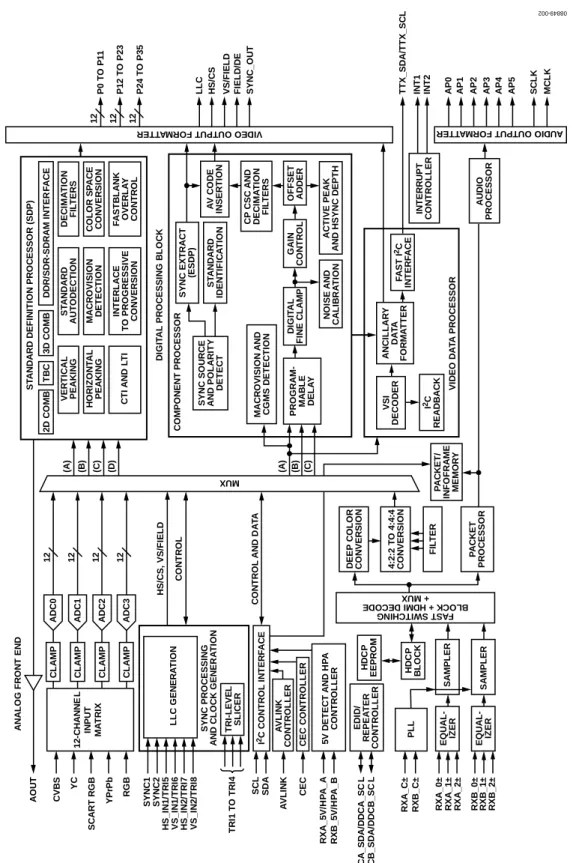
DETAILED FUNCTIONAL BLOCK DIAGRAM
ADC0 CL AM P 12 ADC1 CL AM P 12 ADC2 CL AM P 12 ADC3 CL AM P 12 (A) (B) (C) (D) (A) (B) (C) 12 12 12 CE C CO NT RO L L E R 5V DE T E CT AND H P A C ON TR OLLE R E DI D/ R EPE A T ER C ON TR OLLE R HDC P EEPR O M PLL E Q UAL -IZE R E Q UAL -IZE R HDC P BL O CK SA MPL ER SA MPL ER FAS T S WIT CHING BLO CK + HDM I DE CODE + M UX DE E P C OLOR CO NV E RS IO N H S /C S , V S /FIE LD CO NT RO L CO NT RO L AND D AT A FI L T ER P ACKE T PR O C ESSO R 4: 2: 2 T O 4: 4: 4 CO NV E RS IO N P ACKE T / IN FOFR A M E MEMOR Y VSI DE CO DE R I 2C RE ADBACK ANCI L L A R Y D AT A FOR M A TTE R F AS T I 2C IN TE R F ACE VI D EO D AT A PR O C ESSO R INT E RRUP T C ON TR OLLE R AUDI O PR O C ESSO R AU DIO OU TPU T FORM ATTE R VID EO OU TPU T FORM ATTE R TTX _ S D A /TTX _ S C L S Y NC_O UT FIE LD /D E V S /FIE LD HS /CS LLC P0 T O P 1 1 P 12 T O P 23 P 24 T O P 35 IN T1 IN T2 AP 0 AP 1 AP 2 AP 3 AP 4 AP 5 S CL K M CL K A C T IVE PEA K AND HS Y NC DE P T H N OIS E AND CAL IBR A TION OFFS E T ADDE R GA IN CO NT RO L D IGI T AL F INE CL AM P P RO G RAM -M ABL E DE L A Y M A C R OV IS ION AND C GM S D E TE C TION CP CS C AND DE CI M A TION FI L T E RS A V CO DE IN S E R TION ST ANDARD ID E N TIFIC A TION S Y NC E X T RACT (ESD P) S Y NC S O URCE AND P O L ARI T Y DE T E CT C O MPO N EN T PR O C ESSO R D IGI T AL P RO CE S S ING BL O CK ST ANDARD DE F INI T IO N P RO CE S S O R ( S DP ) 2D CO M B 3D CO M B DDR/ S DR-S DRAM I NT E R F ACE T BC V E RT ICA L P E AKI NG H OR IZON T AL P E AKI NG CT I AND L TI ST ANDARD AU T OD E C TION M A C R OV IS ION D E TE C TION INT E RL ACE T O PR O G R ESSI VE CO NV E RS IO N DE CI M A TION FI L T E RS C OLOR S P ACE CO NV E RS IO N F AS T BL ANK O VER LA Y CO NT RO L AO UT CV BS YC S CART RG B YPr Pb RG B S Y NC1 S Y NC2 HS _I N1/ T RI 5 V S _I N1/ T RI 6 HS _I N2/ T RI 7 V S _I N2/ T RI 8 TR I1 T O TR I4 SCL SDA A V LIN K CE C RX A_5V /H P A_ A RX B_5V /H P A_B DDCA_S DA/ DDCA_S C L DDCB_S DA/ DDCB_S C L RX A_C± RX B_C± RX A_0± RX A_1± RX A_2± RX B_0± RX B_1± RX B_2± 12-CHANNE L INP UT MA TR IX ANAL O G F RO NT E ND LLC GE N E R A TION SYN C PR O C ESSI N G AND CL O CK G E NE R A TION T R I-L EVE L SL IC ER I 2C CO NT RO L IN TE R F ACE A V LIN K C ON TR OLLE R 08849-002 MUXSPECIFICATIONS
AVDD = 1.8 V ± 5%, CVDD = 1.8 V ± 5%, DVDD = 1.8 V ± 5%, PVDD = 1.8 V ± 5%, DVDDIO = 3.3 V ± 5%, TVDD = 3.3 V ± 5%, VDD_SDRAM = 3.2 V to 3.4 V (SDR), VDD_SDRAM = 2.35 V to 2.65 V (DDR). TMIN to TMAX = −10°C to +70°C, unless otherwise noted.
ELECTRICAL CHARACTERISTICS
Table 1.
Parameter Symbol Test Conditions/Comments Min Typ Max Unit
STATIC PERFORMANCE
Resolution (Each ADC) N 12 Bits
Integral Nonlinearity INL 27 MHz (at a 12-bit level) −3.0 to +8.0 LSB 54 MHz (at a 12-bit level) −3.0 to +8.0 LSB 74.25 MHz (at a 12-bit level) −4.0 to +7.0 LSB 108 MHz (at a 11-bit level) −3.5 to +8.0 LSB 170 MHz (at a 9-bit level) −0.7 to +1.5 LSB Differential Nonlinearity DNL 27 MHz (at a 12-bit level) −0.7 to +0.8 LSB 54 MHz (at a 12-bit level) −0.7 to +0.8 LSB 75 MHz (at a 12-bit level) −0.7 to +0.8 LSB 108 MHz (at a 11-bit level) −0.7 to +0.8 LSB 170 MHz (at a 9-bit level) −0.6 to +0.5 LSB DIGITAL INPUTS
Input High Voltage VIH XTALN and XTALP pins 1.2 V
Input Low Voltage VIL XTALN and XTALP pins 0.4 V
VIH Other digital inputs 2 V
VIL Other digital inputs 0.8 V
Input Current IIN RESET pin ±60 µA
EP_MISO pin ±60 µA
SPDIF_IN pin ±60 µA
TEST4 pin ±60 µA
TEST6 pin ±60 µA
Other digital inputs ±10 µA
Input Capacitance CIN 10 pF
DIGITAL INPUTS (5 V TOLERANT)1
Input High Voltage VIH 2.6 V
Input Low Voltage VIL 0.8 V
Input Current IIN −82 +82 µA
DIGITAL OUTPUTS
Output High Voltage VOH 2.4 V
Output Low Voltage VOL 0.4 V
High Impedance Leakage Current ILEAK 10 µA
Output Capacitance COUT 20 pF
POWER SPECIFICATIONS
Table 2.
Parameter Symbol Min Typ Max Unit Test Conditions/Comments
POWER REQUIREMENTS
Digital Core Power Supply VDD 1.75 1.8 1.85 V Digital I/O Power Supply DVDDIO 3.14 3.3 3.46 V
SDRAM Power Supply VDD_SDRAM 3.2 3.3 3.4 V SDR memory VDD_SDRAM 2.35 2.5 2.65 V DDR memory
PLL Power Supply PVDD 1.71 1.8 1.89 V
Analog Power Supply AVDD 1.71 1.8 1.89 V Terminator Power Supply TVDD 3.14 3.3 3.46 V Comparator Power Supply CVDD 1.71 1.8 1.89 V CURRENT CONSUMPTION1, 2, 3
Digital Core Supply Current IVDD 155 220 mA Analog 1080p sampling at 148 MHz
148 196 mA RGB graphics sampling at 162 MHz
285 343 mA RGB graphics sampling at 162 MHz in simultaneous mode with both background ports enabled
163 176 mA HDMI 1080p: 12-bit Deep Color
216 273 mA HDMI 1080p: 12-bit Deep Color in simultaneous mode with both background ports enabled
194 230 mA CVBS processing
332 378 mA CVBS processing in simultaneous mode with both background ports enabled
57 72 mA SD 576i component processing
197 224 mA SD 576i component processing in simultaneous mode with both background ports enabled
270 289 mA SCART processing
404 435 mA SCART processing in simultaneous mode with both background ports enabled
Digital I/O Supply Current IDVDDIO 51 109 mA Analog 1080p sampling at 148 MHz
41 129 mA RGB graphics sampling at 162 MHz
45 117 mA RGB graphics sampling at 162 MHz in simultaneous mode with both background ports enabled
27 32 mA HDMI 1080p: 12-bit Deep Color
22 150 mA HDMI 1080p: 12-bit Deep Color in simultaneous mode with both background ports enabled
9 11 mA CVBS processing
10 11 mA CVBS processing in simultaneous mode with both background ports enabled
8 11 mA SD 576i component processing
8 11 mA SD 576i component processing in simultaneous mode with both background ports enabled
10 11 mA SCART processing
10 12 mA SCART processing in simultaneous mode with both background ports enabled
Parameter Symbol Min Typ Max Unit Test Conditions/Comments
PLL Supply Current IPVDD 28 30 mA Analog 1080p sampling at 148 MHz
25 27 mA RGB graphics sampling at 162 MHz
25 28 mA RGB graphics sampling at 162 MHz in simultaneous mode with both background ports enabled
35 36 mA HDMI 1080p: 12-bit Deep Color
35 38 mA HDMI 1080p: 12-bit Deep Color in simultaneous mode with both background ports enabled
34 37 mA CVBS processing
35 37 mA CVBS processing in simultaneous mode with both background ports enabled
22 24 mA SD 576i component processing
22 24 mA SD 576i component processing in simultaneous mode with both background ports enabled
34 37 mA SCART processing
35 37 mA SCART processing in simultaneous mode with both background ports enabled
Analog Supply Current IAVDD 279 295 mA Analog 1080p sampling at 148 MHz
281 297 mA RGB graphics sampling at 162 MHz
285 301 mA RGB graphics sampling at 162 MHz in simultaneous mode with both background ports enabled
0.1 0.3 mA HDMI 1080p: 12-bit Deep Color
0.1 0.3 mA HDMI 1080p: 12-bit Deep Color in simultaneous mode with both background ports enabled
85 89 mA CVBS processing
86 91 mA CVBS processing in simultaneous mode with both background ports enabled
267 281 mA SD 576i component processing
270 285 mA SD 576i component processing in simultaneous mode with both background ports enabled
283 294 mA SCART processing
286 301 SCART processing in simultaneous mode with both background ports enabled
Terminator Supply Current4 I
TVDD 85 95 mA One port connected
120 135 mA Two ports connected Comparator Supply Current ICVDD 120 130 mA HDMI 1080p: 12-bit Deep Color
220 250 mA HDMI 1080p: 12-bit Deep Color in simultaneous mode with both background ports enabled
Memory Interface Supply Current
IVDD_SDRAM 28 35 mA CVBS input sampling at 54 MHz
Power-Down Currents5 I DVDDIO 0.1 mA IVDD_SDRAM 2.6 mA IVDD 10 mA IAVDD 0.1 mA ICVDD 0.5 mA ITVDD 1.1 mA IPVDD 1.7 mA
Power-Up Time tPWRUP 25 ms
1 All maximum current values are guaranteed by characterization to assist in power supply design.
2 Typical current consumption values are recorded with nominal voltage supply levels, SMPTE bar video pattern, and at room temperature.
3 Maximum current consumption values are recorded with maximum rated voltage supply levels, MoireX video pattern, and at maximum rated temperature. 4 Termination power supply includes TVDD current consumed off chip.
ANALOG SPECIFICATIONS
Table 3.
Parameter Test Conditions/Comments Min Typ Max Unit
CLAMP CIRCUITRY1
Input Impedance Clamps switched off 10 MΩ
Analog (AIN1 − AIN12)
ADC Midscale (CML) 0.91 V
ADC Full-Scale Level CML + 0.55 V
ADC Zero-Scale Level CML − 0.55 V
ADC Dynamic Range 1.1 V
Clamp Level (When Locked) Component input, Y signal CML − 0.12 V
Component input, Pr signal CML V
Component input, Pb signal CML V
PC RGB input (R, G, B signals) CML − 0.12 V
CVBS input CML − 0.205 V
SCART RGB input (R, G, B signals) CML − 0.205 V
S-Video input (Y Signal) CML − 0.205 V
S-Video input (C Signal) CML V
Large Clamp Source Current SDP only 0.3 mA
Large Clamp Sink Current SDP only 0.4 mA
Fine Clamp Source Current SDP only 9 μA
Fine Clamp Sink Current SDP only 8 μA
1 Specified for external clamp capacitor of 100 nF.
VIDEO SPECIFICATIONS
Table 4.
Parameter Symbol Test Conditions/Comments Min Typ Max Unit
NONLINEAR SPECIFICATIONS
Differential Phase DP CVBS input (modulated five-step) 0.6 Degrees
Differential Gain DG CVBS input (modulated five-step) 0.8 %
Luma Nonlinearity LNL CVBS input (modulated five-step) 0.9 % NOISE SPECIFICATIONS Measured at 27 MHz LLC
SNR Unweighted Luma ramp 63 dB
SNR Unweighted Luma flat field 64 dB
Analog Front-End Crosstalk 60 dB
LOCK TIME SPECIFICATIONS (SDP)
Horizontal Lock Range ±5 %
Vertical Lock Range 40 70 Hz
Subcarrier Lock Range fSC ±0.8 kHz
Color Lock-In Time 60 Lines
Sync Depth Range1 20 200 %
Color Burst Range 1 200 %
Vertical Lock Time 300 ms
Horizontal Lock Time 100 Lines
CHROMA SPECIFICATIONS (SDP)
Chroma Amplitude Error 0.9 %
Chroma Phase Error 0.3 Degrees
Chroma Luma Intermodulation 0.3 %
TIMING CHARACTERISTICS
Data and I
2C Timing Characteristic
Table 5.
Parameter1 Symbol Test Conditions/Comments Min Typ Max Unit
CLOCK AND CRYSTAL
Crystal Frequency, XTAL 28.63636 MHz
Crystal Frequency Stability ±50 ppm
Horizontal Sync Input Frequency 10 110 kHz
LLC Frequency Range 12.825 170 MHz
I2C PORTS
SCL Frequency 400 kHz
SCL Minimum Pulse Width High t1 600 ns
SCL Minimum Pulse Width Low t2 1.3 µs
Start Condition Hold Time t3 600 ns
Start Condition Setup Time t4 600 ns
SDA Setup Time t5 100 ns
SCL and SDA Rise Time t6 1000 ns
SCL and SDA Fall Time t7 300 ns
Stop Condition Setup Time t8 0.6 µs
TTX I2C PORTS
SCL Frequency 3.4 MHz
SCL Minimum Pulse Width High t1 60 ns
SCL Minimum Pulse Width Low t2 160 ns
Start Condition Hold Time t3 160 ns
Start Condition Setup Time t4 160 ns
SDA Setup Time t5 10 ns
SCL and SDA Rise Time t6 10 80 ns
SCL and SDA Fall Time t7 10 80 ns
Stop Condition Setup Time t8 160 ns
RESET FEATURE
Reset Pulse Width 5 ms
CLOCK OUTPUTS
LLC Mark-Space Ratio t9:t10 45:55 55:45 % duty cycle
DATA AND CONTROL OUTPUTS2
Data Output Transition Time SDR (SDP) t11 End of valid data to negative clock edge 2.9 4.6 ns
Data Output Transition Time SDR (SDP) t12 Negative clock edge to start of valid data 0.2 0.6 ns
Data Output Transition Time SDR (CP) t13 End of valid data to negative clock edge 1.5 2.2 ns
Data Output Transition Time SDR (CP) t14 Negative clock edge to start of valid data 0.1 0.3 ns
I2S PORT, MASTER MODE
SCLK Mark-Space Ratio t15:t16 45:55 55:45 % duty cycle
LRCLK Data Transition Time t17 End of valid data to negative SCLK edge 10 ns
LRCLK Data Transition Time t18 Negative SCLK edge to start of valid data 10 ns
I2Sx Data Transition Time t19 End of valid data to negative SCLK edge 5 ns
I2Sx Data Transition Time t20 Negative SCLK edge to start of valid data 5 ns 1 Guaranteed by characterization.
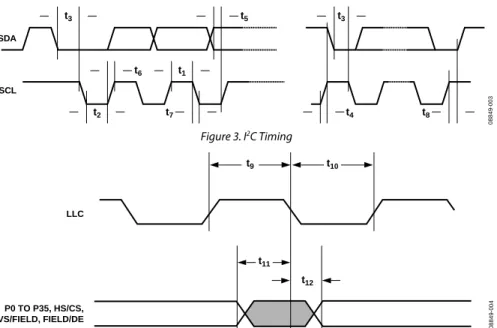
TIMING DIAGRAMS
08849-003 SDA SCL t5 t3 t4 t8 t6 t7 t2 t1 t3 Figure 3. I2C Timing 08849-004 t9 LLC P0 TO P35, HS/CS, VS/FIELD, FIELD/DE t11 t12 t10Figure 4. Pixel Port and Control SDR Output Timing (SDP)
08849-005 t9 LLC P0 TO P35, VS/FIELD, HS/CS, FIELD/DE t13 t14 t10
Figure 5. Pixel Port and Control SDR Output Timing (CP)
SCLK LRCLK I2Sx LEFT-JUSTIFIED MODE I2Sx RIGHT-JUSTIFIED MODE I2Sx I2S MODE MSB MSB – 1 t15 t16 t17 t19 t20 t18 MSB MSB – 1 LSB MSB t19 t20 t 19 t20 NOTES
1. THE SUFFIX x REFERS TO 0, 1, 2, AND 3 ENDING PIN NAMES. 2. LRCLK IS A SIGNAL ACCESSIBLE VIA AP5 PIN.
3. I2Sx ARE SIGNALS ACCESSIBLE VIA AP1 TO AP4 PINS.
08849-006
ABSOLUTE MAXIMUM RATINGS
Table 6. Parameter Rating AVDD to GND 2.2 V VDD to GND 2.2 V PVDD to GND 2.2 V DVDDIO to GND 4.0 V VDD_SDRAM to GND 4.0 V CVDD to GND 2.2 V TVDD to GND 4.0 V AVDD to PVDD −0.3 V to +0.3 V AVDD to VDD −0.3 V to +0.3 V TVDD to CVDD −0.3 V to +2.2 V DVDDIO to VDD_SDRAM −0.3 V to +3.3 V VDD_SDRAM to AVDD −0.3 V to +2 V VDD_SDRAM to VDD −0.3 V to +2 VDigital Inputs Voltage to GND −0.3 V to DVDDIO + 0.3 V Digital Outputs Voltage to GND −0.3 V to DVDDIO + 0.3 V 5 V Tolerant Digital Inputs to GND1 5.5 V
Analog Inputs to GND −0.3 V to AVDD + 0.3 V XTALN and XTALP to GND −0.3 V to PVDD + 0.3 V Maximum Junction Temperature
(TJ MAX)
125°C
Storage Temperature Range −65°C to +150°C Infrared Reflow Soldering (20 sec) 260°C
1 The following inputs are 3.3 V inputs but are 5 V tolerant: HS_IN1/TRI5,
HS_IN2/TRI7, VS_IN1/TRI6, VS_IN2/TRI8, DDCA_SCL, DDCA_SDA, DDCB_SCL and DDCB_SDA.
Stresses above those listed under Absolute Maximum Ratings may cause permanent damage to the device. This is a stress rating only; functional operation of the device at these or any other conditions above those indicated in the operational section of this specification is not implied. Exposure to absolute maximum rating conditions for extended periods may affect device reliability.
PACKAGE THERMAL PERFORMANCE
To reduce power consumption when using the ADV7842, the user is advised to turn off unused sections of the part. Due to PCB metal variation, and therefore variation in PCB heat conductivity, the value of θJA may differ for various PCBs.
The most efficient measurement solution is obtained using the package surface temperature to estimate the die temperature because this eliminates the variance associated with the θJA value.
The maximum junction temperature (TJMAX) of 125°C must not be
exceeded. The following equation calculates the junction tempera-ture using the measured package surface temperatempera-ture and applies only when no heat sink is used on the device under test (DUT):
(
JT TOTAL)
S
J T Ψ W
T = + ×
where:
TS is the package surface temperature (°C).
ΨJT = 0.5°C/W for the 256-ball BGA.
WTOTAL = (PVDD × IPVDD) + (0.4 × TVDD × ITVDD) +
(CVDD × ICVDD) + (AVDD × IAVDD) + (VDD × IVDD) +
(A × DVDDIO × IDVDDIO) + (VDD_SDRAM × IVDD_SDRAM)
where:
0.4 reflects the 40% of TVDD power that is dissipated on the part itself.
A = 0.5 when the output pixel clock is >74 MHz.
A = 0.75 when the output pixel clock is ≤74 MHz.
POWER SUPPLY SEQUENCING
POWER-UP SEQUENCE
The recommended power-up sequence of the ADV7842 is as follows:
1. 3.3 V supplies
2. 2.5 V supply (applies only if using DDR memory) 3. 1.8 V supplies 08849-009 3.3V SUPPLIES POWER-UP PO W ER SU PPL Y (V) 3.3V SUPPLIES 1.8V SUPPLIES 2.5V SUPPLIES (IF ANY)
2.5V SUPPLIES POWER-UP 1.8V SUPPLIES POWER-UP 3.3V 2.5V 1.8V
Figure 7. Recommended Power-Up Sequence
Notes
Reset should be held low while the supplies are being powered up.
• 3.3 V supplies should be powered up first.
• 2.5 V supply should be powered after the 3.3 V supplies are established but before the 1.8 V supplies.
• 1.8 V supplies should be powered up last.
The ADV7842 can alternatively be powered up by simulta-neously asserting all supplies.
Inthis case, care must be taken to ensure that a lower rated supply does not go above a higher rated supply level, because the supplies are being established.
POWER-DOWN SEQUENCE
The ADV7842 supplies can be deasserted simultaneously as long as a higher rated supply does not go below a lower rated supply.
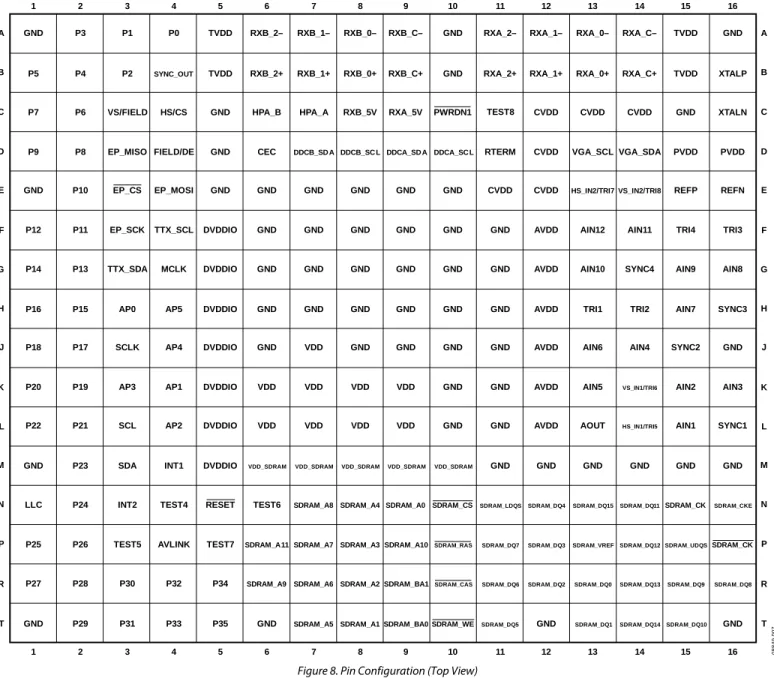
PIN CONFIGURATION AND FUNCTION DESCRIPTIONS
A B C D E F G H J K L M N P R T A B C D E F G H J K L M N P R T 16 15 14 13 12 11 10 9 8 7 6 5 4 3 2 1 GND TVDD RXA_C– RXA_0– RXA_1– RXA_2– GND RXB_C– RXB_0– RXB_1– RXB_2– TVDD P0 P1 P3 GND XTALP TVDD RXA_C+ RXA_0+ RXA_1+ RXA_2+ GND RXB_C+ RXB_0+ RXB_1+ RXB_2+ TVDD SYNC_OUT P2 P4 P5 XTALN GND CVDD CVDD CVDD PWRDN1 RXA_5V RXB_5V HPA_A HPA_B GND HS/CS VS/FIELD P6 P7 PVDD PVDD VGA_SDA VGA_SCL CVDD RTERM DDCA_SC L DDCA_SD A DDCB_SC L DDCB_SD A CEC GND FIELD/DE EP_MISO P8 P9 REFN REFP VS_IN2/TRI8 HS_IN2/TRI7 CVDD CVDD GND GND GND GND GND GND EP_MOSI EP_CS P10 GND TRI3 TRI4 AIN11 AIN12 AVDD GND GND GND GND GND GND DVDDIO TTX_SCL EP_SCK P11 P12 AIN8 AIN9 SYNC4 AIN10 AVDD GND GND GND GND GND GND DVDDIO MCLK TTX_SDA P13 P14 SYNC3 AIN7 TRI2 TRI1 AVDD GND GND GND GND GND GND DVDDIO AP5 AP0 P15 P16 GND SYNC2 AIN4 AIN6 AVDD GND GND GND GND VDD GND DVDDIO AP4 SCLK P17 P18 AIN3 AIN2 VS_IN1/TRI6 AIN5 AVDD GND GND VDD VDD VDD VDD DVDDIO AP1 AP3 P19 P20 SYNC1 AIN1 HS_IN1/TRI5 AOUT AVDD GND GND VDD VDD VDD VDD DVDDIO AP2 SCL P21 P22 GND GND GND GND GND GND VDD_SDRAM VDD_SDRAM VDD_SDRAM VDD_SDRAM VDD_SDRAM DVDDIO INT1 SDA P23 GND SDRAM_CKE SDRAM_CK SDRAM_DQ11 SDRAM_DQ15 SDRAM_DQ4 SDRAM_LDQS SDRAM_CS SDRAM_A0 SDRAM_A4 SDRAM_A8 TEST6 RESET TEST4 INT2 P24 LLC SDRAM_CK SDRAM_UDQS SDRAM_DQ12 SDRAM_VREF SDRAM_DQ3 SDRAM_DQ7 SDRAM_RAS SDRAM_A10 SDRAM_A3 SDRAM_A7 SDRAM_A11 TEST7 AVLINK TEST5 P26 P25 SDRAM_DQ8 SDRAM_DQ9 SDRAM_DQ13 SDRAM_DQ0 SDRAM_DQ2 SDRAM_DQ6 SDRAM_CAS SDRAM_BA1 SDRAM_A2 SDRAM_A6 SDRAM_A9 P34 P32 P30 P28 P27 GND SDRAM_DQ10 SDRAM_DQ14 SDRAM_DQ1 GND SDRAM_DQ5 SDRAM_WE SDRAM_BA0 SDRAM_A1 SDRAM_A5 GND P35 P33 P31 P29 GND 16 15 14 13 12 11 10 9 8 7 6 5 4 3 2 1 08849-007 TEST8Table 7. Pin Function Descriptions
Pin No. Mnemonic Type Description
A1 GND Ground Ground.
A2 P3 Digital video output Video Pixel Output Port. A3 P1 Digital video output Video Pixel Output Port. A4 P0 Digital video output Video Pixel Output Port.
A5 TVDD Power Terminator Supply Voltage (3.3 V).
A6 RXB_2− HDMI input Digital Input Channel 2 Complement of Port B in the HDMI Interface. A7 RXB_1− HDMI input Digital Input Channel 1 Complement of Port B in the HDMI Interface. A8 RXB_0− HDMI input Digital Input Channel 0 Complement of Port B in the HDMI Interface. A9 RXB_C− HDMI input Digital Input Clock Complement of Port B in the HDMI Interface.
A10 GND Ground Ground.
A11 RXA_2− HDMI input Digital Input Channel 2 Complement of Port A in the HDMI Interface. A12 RXA_1− HDMI input Digital Input Channel 1 Complement of Port A in the HDMI Interface. A13 RXA_0− HDMI input Digital Input Channel 0 Complement of Port A in the HDMI Interface. A14 RXA_C− HDMI input Digital Input Clock Complement of Port A in the HDMI Interface. A15 TVDD Power Terminator Supply Voltage (3.3 V).
A16 GND Ground Ground.
B1 P5 Digital video output Video Pixel Output Port. B2 P4 Digital video output Video Pixel Output Port. B3 P2 Digital video output Video Pixel Output Port. B4 SYNC_OUT Miscellaneous digital Sliced Synchronization Output B5 TVDD Power Terminator Supply Voltage (3.3 V).
B6 RXB_2+ HDMI input Digital Input Channel 2 True of Port B in the HDMI Interface. B7 RXB_1+ HDMI input Digital Input Channel 1 True of Port B in the HDMI Interface. B8 RXB_0+ HDMI input Digital Input Channel 0 True of Port B in the HDMI Interface. B9 RXB_C+ HDMI input Digital Input Clock True of Port B in the HDMI Interface.
B10 GND Ground Ground.
B11 RXA_2+ HDMI input Digital Input Channel 2 True of Port A in the HDMI Interface. B12 RXA_1+ HDMI input Digital Input Channel 1 True of Port A in the HDMI Interface. B13 RXA_0+ HDMI input Digital Input Channel 0 True of Port A in the HDMI Interface. B14 RXA_C+ HDMI input Digital Input Clock True of Port A in the HDMI Interface. B15 TVDD Power Terminator Supply Voltage (3.3 V).
B16 XTALP Miscellaneous analog Input pin for 28.63636 MHz crystal or external 1.8V, 28.63636 MHz Clock Oscillator Source to Clock the ADV7842.
C1 P7 Digital video output Video Pixel Output Port. C2 P6 Digital video output Video Pixel Output Port.
C3 VS/FIELD Digital video output Vertical Synchronization/Field Synchronization. VS is a vertical synchronization output signal in the CP and HDMI processor. FIELD is a field synchronization output signal in all interlaced video modes. VS or FIELD can be configured for this pin.
C4 HS/CS Digital video output Horizontal Synchronization/Composite Synchronization. HS is a horizontal synchronization output signal in the CP and HDMI processor. CS (composite synchronization) signal is a single signal containing both horizontal and vertical synchronization pulses. HS or CS can be configured for this pin.
C5 GND Ground Ground.
C6 HPA_B Miscellaneous digital Hot Plug Assert Signal Output for HDMI Port B. C7 HPA_A Miscellaneous digital Hot Plug Assert Signal Output for HDMI Port A. C8 RXB_5V HDMI input 5 V Detect Pin for Port B in the HDMI Interface. C9 RXA_5V HDMI input 5 V Detect Pin for Port A in the HDMI Interface.
C10 PWRDN1 Miscellaneous digital Controls the Power-Up of the ADV7842. Should be connected to a digital 3.3 V I/O supply to power up the ADV7842.
C11 TEST8 Test pin Tie this pin to ground via 4.7 kΩ resistor. C12 CVDD Power Comparator Supply Voltage (1.8 V). C13 CVDD Power Comparator Supply Voltage (1.8 V).
Pin No. Mnemonic Type Description
C15 GND Ground Ground.
C16 XTALN Miscellaneous analog Input Pin for 28.63636 MHz Crystal. D1 P9 Digital video output Video Pixel Output Port.
D2 P8 Digital video output Video Pixel Output Port.
D3 EP_MISO Digital input SPI Master In/Slave Out for External EDID Interface.
D4 FIELD/DE Miscellaneous digital Data Enable (DE). DE is a signal that indicates active pixel data.
Field Synchronization Output Signal in All Interlaced Video Modes (FIELD). DE or FIELD can be configured for this pin.
D5 GND Ground Ground.
D6 CEC Digital input/output Consumer Electronic Control Channel.
D7 DDCB_SDA Digital input/output HDCP Slave Serial Data Port B. DDCB_SDA is a 3.3 V input/output that is 5 V tolerant. D8 DDCB_SCL Digital input HDCP Slave Serial Clock Port B. DDCB_SCL is a 3.3 V input that is 5 V tolerant. D9 DDCA_SDA Digital input/output HDCP Slave Serial Data Port A. DDCA_SDA is a 3.3 V input/output that is 5 V tolerant. D10 DDCA_SCL Digital input HDCP Slave Serial Clock Port A. DDCA_SCL is a 3.3 V input that is 5 V tolerant. D11 RTERM Miscellaneous analog Sets Internal Termination Resistance. A 500 Ω resistor between this pin and GND
should be used.
D12 CVDD Power Comparator Supply Voltage (1.8 V). D13 VGA_SCL Miscellaneous digital DDC Port Serial Clock Input for VGA D14 VGA_SDA Miscellaneous digital DDC Port Serial Data Input/Output for VGA D15 PVDD Power PLL Supply Voltage (1.8 V).
D16 PVDD Power PLL Supply Voltage (1.8 V).
E1 GND Ground Ground.
E2 P10 Digital video output Video Pixel Output Port.
E3 EP_CS Digital output SPI Chip Select for External EDID Interface. E4 EP_MOSI Digital output SPI Master Out/Slave In for External EDID Interface.
E5 GND Ground Ground.
E6 GND Ground Ground.
E7 GND Ground Ground.
E8 GND Ground Ground.
E9 GND Ground Ground.
E10 GND Ground Ground.
E11 CVDD Power Comparator Supply Voltage (1.8 V). E12 CVDD Power Comparator Supply Voltage (1.8 V).
E13 HS_IN2/TRI7 Miscellaneous analog HS on Graphics Port 2 (HS_IN2). The HS input signal is used for 5-wire timing mode. Trilevel/Bilevel Input on the SCART or D-terminal Connector (TRI7). (Selection available via the I2C.)
E14 VS_IN2/TRI8 Miscellaneous analog VS on Graphics Port 2 (VS_IN2). The VS input signal is used for 5-wire timing mode. Trilevel/Bilevel Input on the SCART or D-Terminal Connector (TRI8). (Selection available via the I2C.)
E15 REFP Miscellaneous analog Internal Voltage Reference Output. E16 REFN Miscellaneous analog Internal Voltage Reference Output. F1 P12 Digital video output Video Pixel Output Port.
F2 P11 Digital video output Video Pixel Output Port.
F3 EP_SCK Digital output SPI Clock for External EDID Interface.
F4 TTX_SCL Miscellaneous digital Fast I2C Interface for Teletext Data Extraction. TTX_SCL is used as the I2C port serial clock input.
F5 DVDDIO Power Digital I/O Supply Voltage (3.3 V).
F6 GND Ground Ground.
Pin No. Mnemonic Type Description
F13 AIN12 Analog video input Analog Video Input Channel. F14 AIN11 Analog video input Analog Video Input Channel.
F15 TRI4 Miscellaneous analog Trilevel or Bilevel Input on the SCART or D-Type Connector. (Selection available via the I2C.)
F16 TRI3 Miscellaneous analog Trilevel or Bilevel Input on the SCART or D-Type Connector. (Selection available via the I2C.)
G1 P14 Digital video output Video Pixel Output Port. G2 P13 Digital video output Video Pixel Output Port.
G3 TTX_SDA Miscellaneous digital Fast I2C Interface for Teletext Data Extraction. TTX_SDA is used as the I2C port serial data input/output pins.
G4 MCLK Miscellaneous Audio Master Clock Output. G5 DVDDIO Power Digital I/O Supply Voltage (3.3 V).
G6 GND Ground Ground. G7 GND Ground Ground. G8 GND Ground Ground. G9 GND Ground Ground. G10 GND Ground Ground. G11 GND Ground Ground.
G12 AVDD Power Analog Supply Voltage (1.8 V). G13 AIN10 Analog video input Analog Video Input Channel.
G14 SYNC4 Miscellaneous analog This is a synchronization on green or luma input (SOG/SOY) used in embedded synchronization mode. User configurable.
G15 AIN9 Analog video input Analog Video Input Channel. G16 AIN8 Analog video input Analog Video Input Channel. H1 P16 Digital video output Video Pixel Output Port. H2 P15 Digital video output Video Pixel Output Port. H3 AP0 Miscellaneous Audio Output Pin. H4 AP5 Miscellaneous Audio Output Pin.
H5 DVDDIO Power Digital I/O Supply Voltage (3.3 V).
H6 GND Ground Ground. H7 GND Ground Ground. H8 GND Ground Ground. H9 GND Ground Ground. H10 GND Ground Ground. H11 GND Ground Ground.
H12 AVDD Power Analog Supply Voltage (1.8 V).
H13 TRI1 Miscellaneous analog Trilevel or Bilevel Input on the SCART or D-Type Connector. (Selection available via I2C.) H14 TRI2 Miscellaneous analog Trilevel or Bilevel Input on the SCART or D-Type Connector. (Selection available via I2C.) H15 AIN7 Analog video input Analog Video Input Channel.
H16 SYNC3 Miscellaneous analog This is a synchronization on green or luma input (SOG/SOY) used in embedded synchronization mode. User configurable.
J1 P18 Digital video output Video Pixel Output Port. J2 P17 Digital video output Video Pixel Output Port. J3 SCLK Miscellaneous digital Audio Serial Clock Output. J4 AP4 Miscellaneous Audio Output Pin.
J5 DVDDIO Power Digital I/O Supply Voltage (3.3 V).
J6 GND Ground Ground.
J7 VDD Power Digital Core Supply Voltage (1.8 V).
J8 GND Ground Ground.
J9 GND Ground Ground.
J10 GND Ground Ground.
J11 GND Ground Ground.
Pin No. Mnemonic Type Description
J14 AIN4 Analog video input Analog Video Input Channel.
J15 SYNC2 Miscellaneous analog This is a synchronization on green or luma input (SOG/SOY) used in embedded synchronization mode. User configurable.
J16 GND Ground Ground.
K1 P20 Digital video output Video Pixel Output Port. K2 P19 Digital video output Video Pixel Output Port. K3 AP3 Miscellaneous Audio Output Pin. K4 AP1 Miscellaneous Audio Output Pin.
K5 DVDDIO Power Digital I/O Supply Voltage (3.3 V). K6 VDD Power Digital Core Supply Voltage (1.8 V). K7 VDD Power Digital Core Supply Voltage (1.8 V). K8 VDD Power Digital Core Supply Voltage (1.8 V). K9 VDD Power Digital Core Supply Voltage (1.8 V).
K10 GND Ground Ground.
K11 GND Ground Ground.
K12 AVDD Power Analog Supply Voltage (1.8 V). K13 AIN5 Analog video input Analog Video Input Channel.
K14 VS_IN1/TRI6 Miscellaneous analog VS on Graphics Port 1 (VS_IN1). The VS input signal is used for 5-wire timing mode. Trilevel/Bilevel Input on the SCART or D-Terminal Connector (TRI6). (Selection available via the I2C.)
K15 AIN2 Analog video input Analog Video Input Channel. K16 AIN3 Analog video input Analog Video Input Channel. L1 P22 Digital video output Video Pixel Output Port. L2 P21 Digital video output Video Pixel Output Port.
L3 SCL Miscellaneous digital I2C Port Serial Clock Input. SCL is the clock line for the control port. L4 AP2 Miscellaneous Audio Output Pin.
L5 DVDDIO Power Digital I/O Supply Voltage (3.3 V). L6 VDD Power Digital Core Supply Voltage (1.8 V). L7 VDD Power Digital Core Supply Voltage (1.8 V). L8 VDD Power Digital Core Supply Voltage (1.8 V). L9 VDD Power Digital Core Supply Voltage (1.8 V).
L10 GND Ground Ground.
L11 GND Ground Ground.
L12 AVDD Power Analog Supply Voltage (1.8 V). L13 AOUT Analog monitor
output Analog Monitor Output.
L14 HS_IN1/TRI5 Miscellaneous analog HS on Graphics Port 1 (HS_IN1). The HS input signal is used for 5-wire timing mode. Trilevel/Bilevel Input on the SCART or D-Terminal Connector (TRI5). (Selection available via the I2C.)
L15 AIN1 Analog video input Analog Video Input Channel.
L16 SYNC1 Miscellaneous analog This is a synchronization on green or luma input (SOG/SOY) used in embedded synchronization mode. User configurable.
M1 GND Ground Ground.
M2 P23 Digital video output Video Pixel Output Port.
M3 SDA Miscellaneous digital I2C Port Serial Data Input/Output Pin. SDA is the data line for the control port. M4 INT1 Miscellaneous digital Interrupt. This pin can be active low or active high. When status bits change, this pin is
triggered. The events that trigger an interrupt are under user control. M5 DVDDIO Power Digital I/O Supply Voltage (3.3 V).
Pin No. Mnemonic Type Description M12 GND Ground Ground. M13 GND Ground Ground. M14 GND Ground Ground. M15 GND Ground Ground. M16 GND Ground Ground.
N1 LLC Digital video output Line-Locked Output Clock for the Pixel Data. N2 P24 Digital video output Video Pixel Output Port.
N3 INT2 Miscellaneous digital Interrupt. This pin can be active low or active high. When status bits change, this pin is triggered. The events that trigger an interrupt are under user control.
N4 TEST4 Test Connect this pin to ground.
N5 RESET Miscellaneous digital System Reset Input. Active low. A minimum low reset pulse width of 5 ms is required to reset the ADV7842 circuitry.
N6 TEST6 Test Float this pin.
N7 SDRAM_A8 SDRAM interface Address Output. Interface to external RAM address lines. N8 SDRAM_A4 SDRAM interface Address Output. Interface to external RAM address lines. N9 SDRAM_A0 SDRAM interface Address Output. Interface to external RAM address lines.
N10 SDRAM_CS SDRAM interface Chip Select. SDRAM_CS enables and disables the command decoder on the RAM. One of four command signals to the external SDRAM.
N11 SDRAM_LDQS SDRAM interface Lower Data Strobe Pin. Data strobe pins are used for the RAM interface. This is an input when reading data from external memory and an output when writing data to external memory. It is edge aligned with data when reading from external memory and centered with data when writing to external memory. SDRAM_LDQS corresponds to the data on SDRAM_DQ7 to SDRAM_DQ0.
N12 SDRAM_DQ4 SDRAM interface Data Bus. Interface to external RAM 16-bit data bus. N13 SDRAM_DQ15 SDRAM interface Data Bus. Interface to external RAM 16-bit data bus. N14 SDRAM_DQ11 SDRAM interface Data Bus. Interface to external RAM 16-bit data bus.
N15 SDRAM_CK SDRAM interface Differential Clock Output. All address and control output signals to the RAM should be sampled on the positive edge of SDRAM_CK and on the negative edge of SDRAM_CK. N16 SDRAM_CKE SDRAM interface Clock Enable. This pin acts as an enable to the clock signals of the external RAM. P1 P25 Digital video output Video Pixel Output Port.
P2 P26 Digital video output Video Pixel Output Port. P3 TEST5 Test Connect this pin to ground. P4 AVLINK Digital input/output Digital SCART Control Channel.
P5 TEST7 Test Float this pin.
P6 SDRAM_A11 SDRAM interface Address Output. Interface to external RAM address lines. P7 SDRAM_A7 SDRAM interface Address Output. Interface to external RAM address lines. P8 SDRAM_A3 SDRAM interface Address Output. Interface to external RAM address lines. P9 SDRAM_A10 SDRAM interface Address Output. Interface to external RAM address lines.
P10 SDRAM_RAS SDRAM interface Row Address Select Command Signal. One of four command signals to the external SDRAM.
P11 SDRAM_DQ7 SDRAM interface Data Bus. Interface to external RAM 16-bit data bus. P12 SDRAM_DQ3 SDRAM interface Data Bus. Interface to external RAM 16-bit data bus.
P13 SDRAM_VREF SDRAM interface 1.25 V Reference for DDR SDRAM Interface or 1.65 V for SDR SDRAM Interface. P14 SDRAM_DQ12 SDRAM interface Data Bus. Interface to external RAM 16-bit data bus.
P15 SDRAM_UDQS SDRAM interface Upper Data Strobe Pin. Data strobe pins are used for the RAM interface. This is an input when reading data from external memory and an output when writing data to external memory. It is edge aligned with data when reading from external memory and centered with data when writing to external memory. SDRAM_UDQS corresponds to the data on SDRAM_DQ15 to SDRAM_DQ8.
P16 SDRAM_CK SDRAM interface Differential Clock Output. All address and control output signals to the RAM should be sampled on the positive edge of SDRAM_CK and on the negative edge of SDRAM_CK. R1 P27 Digital video output Video Pixel Output Port.
R2 P28 Digital video output Video Pixel Output Port. R3 P30 Digital video output Video Pixel Output Port.
Pin No. Mnemonic Type Description
R5 P34 Digital video output Video Pixel Output Port.
R6 SDRAM_A9 SDRAM interface Address Output. Interface to external RAM address lines. R7 SDRAM_A6 SDRAM interface Address Output. Interface to external RAM address lines. R8 SDRAM_A2 SDRAM interface Address Output. Interface to external RAM address lines.
R9 SDRAM_BA1 SDRAM interface Bank Address Output. Interface to external RAM bank address lines.
R10 SDRAM_CAS SDRAM interface Column Address Select Command Signal. One of four command signals to the external SDRAM.
R11 SDRAM_DQ6 SDRAM interface Data Bus. Interface to external RAM 16-bit data bus. R12 SDRAM_DQ2 SDRAM interface Data Bus. Interface to external RAM 16-bit data bus. R13 SDRAM_DQ0 SDRAM interface Data Bus. Interface to external RAM 16-bit data bus. R14 SDRAM_DQ13 SDRAM interface Data Bus. Interface to external RAM 16-bit data bus. R15 SDRAM_DQ9 SDRAM interface Data Bus. Interface to external RAM 16-bit data bus. R16 SDRAM_DQ8 SDRAM interface Data Bus. Interface to external RAM 16-bit data bus.
T1 GND Ground Ground.
T2 P29 Digital video output Video Pixel Output Port. T3 P31 Digital video output Video Pixel Output Port. T4 P33 Digital video output Video Pixel Output Port. T5 P35 Digital video output Video Pixel Output Port.
T6 GND Ground Ground.
T7 SDRAM_A5 SDRAM interface Address Output. Interface to external RAM address lines. T8 SDRAM_A1 SDRAM interface Address Output. Interface to external RAM address lines.
T9 SDRAM_BA0 SDRAM interface Bank Address Output. Interface to external RAM bank address lines.
T10 SDRAM_WE SDRAM interface Write Enable Output Command Signal. One of four command signals to the external SDRAM.
T11 SDRAM_DQ5 SDRAM interface Data Bus. Interface to external RAM 16-bit data bus.
T12 GND Ground Ground.
T13 SDRAM_DQ1 SDRAM interface Data Bus. Interface to external RAM 16-bit data bus. T14 SDRAM_DQ14 SDRAM interface Data Bus. Interface to external RAM 16-bit data bus. T15 SDRAM_DQ10 SDRAM interface Data Bus. Interface to external RAM 16-bit data bus.
FUNCTIONAL OVERVIEW
HDMI RECEIVER
The ADV7842 front end incorporates a 2:1 multiplexed HDMI 1.4 receiver with Xpressview fast switching technology and support for HDMI 1.4 features such as 3D TV. Building on the feature set of Analog Device existing HDMI devices, the ADV7842 also offers support for all HD TV formats up to 12-bit, 1080p Deep Color and all display resolutions up to UXGA (1600 × 1200 at 60 Hz). Xpressview fast switching technology, using Analog Devices hardware-based HDCP engine that minimizes software overhead, allows switching between the two input ports in less than 1 second.
With the inclusion of HDCP 1.4, the ADV7842 can receive encrypted video content. The HDMI interface of the ADV7842 allows for authentication of a video receiver, decryption of encoded data at the receiver, and renewal of that authentication during transmission, as specified by the HDCP 1.4 protocol. Repeater support is also offered by the ADV7842.
The HDMI receiver incorporates active equalization of the HDMI data signals. This equalization compensates for the high frequency losses inherent in HDMI and DVI cabling, especially at longer lengths and higher frequencies. It is capable of equalizing for cable lengths up to 30 meters to achieve robust receiver performance at even the highest HDMI data rates. The HDMI receiver offers advanced audio functionality. It supports multichannel I2S audio for up to eight channels. It also
supports a 6-DSD channel interface with each channel carrying an over-sampled 1-bit representation of the audio signal as delivered on SACD. The ADV7842 can also receive HBR audio packet streams and outputs them through the HBR interface in an SPDIF format conforming to the IEC60958 standard. The receiver contains an audio mute controller that can detect a variety of conditions that may result in audible extraneous noise in the audio output. On detection of these conditions, the audio signal can be ramped to mute to prevent audio clicks or pops. HDMI receiver features include:
• 2:1 multiplexed HDMI receiver
• HDMI 1.4, 3D format support, DVI 1.0
• 225 MHz HDMI receiver
• Integrated equalizer
• High-bandwidth Digital Content Protection (HDCP 1.4) also on background ports
• Internal HDCP keys
• 36-/30-bit Deep Color support
• PCM, HBR, DSD audio packet support
• Repeater support
• Internal E-EDID RAM
• Hot plug assert output pin for each HDMI port
• CEC controller
ANALOG FRONT END
The ADV7842 analog front end comprises four 170 MHz, 12-bit ADCs that digitize the analog video signal before applying it to the standard definition processor (SDP) or component processor (CP). The analog front end uses differential channels to each ADC to ensure high performance in a mixed-signal application. The front end also includes a 12-channel input mux that enables multiple video signals to be applied to the
ADV7842 without the requirement of an external mux. Current and voltage clamp control loops ensure that any DC offsets are removed from the video signal. The clamps are positioned in front of each ADC to ensure that the video signal remains within the range of the converter.
The ADCs are configured to run up to 8× oversampling mode when decoding composite or S-Video inputs. For component 525i, 625i, 525p, and 625p sources, 4× oversampling is performed. All other video standards are 1× oversampled. Oversampling the video signals reduces the cost and complexity of external antialiasing filters with the benefit of an increased signal-to-noise ratio (SNR).
Optional internal antialiasing filters with programmable bandwidth are positioned in front of each ADC. These filters can be used to band limit video signals, removing spurious, out-of-band noise.
The ADV7842 can support the simultaneous processing of CVBS and RGB standard definition signals to enable SCART compatibility and overlay functionality. A combination of CVBS and RGB inputs can be mixed with the output under the control of I2C registers.
Analog front-end features include:
• Four 170 MHz, NSV, 12-bit ADCs that enable true 12-bit video decoding
• 12-channel analog input mux that enables multiple source
connections without the requirement of an external mux
• Four current and voltage clamp control loops that ensure any dc offsets are removed from the video signal
• SCART functionality and SD RGB overlay on CVBS controlled by fast blank input
• SCART source switching detection through TRI1-TRI8 input • Four programmable antialiasing filters
STANDARD DEFINITION PROCESSOR
The SDP is capable of decoding a large selection of baseband video signals in composite and S-Video formats. The video standards supported by the SDP include PAL, PAL 60, PAL M, PAL N, PAL NC, NTSC M/J, NTSC 4.43, and SECAM. The ADV7842 can automatically detect the video standard and process it accordingly.
The SDP has a 3D temporal comb filter and a five-line adaptive 2D comb filter that gives superior chrominance and luminance separation when decoding a composite video signal. This highly adaptive filter automatically adjusts its processing mode according to the video standard and signal quality with no user intervention required. The SDP has an IF filter block that compensates for attenuation in the high frequency chroma spectrum due to a tuner SAW filter. The SDP has specific luminance and chrominance parameter controls for brightness, contrast, saturation, and hue. The ADV7842 implements a patented Adaptive Digital Line Length Tracking (ADLLT™) algorithm to track varying video line lengths from sources such as a VCR. ADLLT enables the ADV7842 to track and decode poor quality video sources (such as VCRs) and noisy sources (such as tuner outputs, VCR players, and camcorders). Frame TBC ensures stable clock synchronization between the decoder and the downstream devices.
The SDP also contains both a luma transient improvement (LTI) block and a chroma transient improvement (CTI) block. These increase the edge rate on the luma and chroma transitions, resulting in a sharper video image. The SDP has a Macrovision® detection circuit that allows Type I, Type II, and Type III Macrovision protection levels. The decoder is also fully robust to all Macrovision signal inputs.
SDP features include:
Advanced adaptive 3D comb (using either external DDR or SDR SDRAM memory)
Adaptive 2D five-line comb filters for NTSC and PAL that give superior chrominance and luminance separation for composite video
Full automatic detection and autoswitching of all worldwide standards (PAL, NTSC, and SECAM)
Automatic gain control with white peak mode that ensures the video is always processed without loss of the video processing range
Proprietary architecture for locking to weak, noisy, and unstable sources from VCRs and tuners
IF filter block that compensates for high frequency luma attenuation due to tuner SAW filter
Internal color bar test pattern
Advanced TBC with frame synchronization, which ensures nominal clock and data for nonstandard input
Interlace-to-progressive conversion for 525i and 625i formats, enabling direct drive of HDMI Tx devices
Color controls that include hue, brightness, saturation, and contrast
COMPONENT PROCESSOR
The CP section of the ADV7842 is capable of decoding and digitizing a wide range of component video formats in any color space. Component video standards supported by the CP are 525i, 625i, 525p, 625p, 720p, 1080i, 1080p, 1250i, VGA up to UXGA at 60 Hz, and other standards.
The any-to-any, 3 × 3 CSC matrix is placed between the analog front end and the CP section. This enables YPbPr to RGB and RGB to YCbCr conversions. Many other standards of color space can be implemented using the color space converter. The CP section contains circuitry to enable the detection of Macrovision encoded YPbPr signals for 525i, 625i, 525p, and 625p. It is designed to be fully robust when decoding these types of signals. VBI extraction of CGMS data is performed by the CP section of the ADV7842 for interlaced, progressive, and high definition scanning rates. The data extracted can be read back over the I2C interface.
CP features include:
525i, 625i, 525p, 625p, 720p, 1080i, 1080p, and many other HDTV formats are supported
Supports 720p 24 Hz/25 Hz formats
Manual adjustments, including gain (contrast), offset (brightness), hue, and saturation
Support for analog component YPbPr and RGB video formats with embedded synchronization, composite synchronization or separate HS and VS
Any-to-any, 3 × 3 CSC matrix that supports YCbCr-to-RGB and YCbCr-to-RGB-to-YCbCr, fully programmable or preprogrammable configurations
Synchronization source polarity detector (SSPD) that determines the source and polarity of the synchronization signals that accompany the input video
Macrovision copy protection detection on component formats (525i, 625i, 525p, and 625p)
Free-run output mode that provides stable timing when no video input is present or video lock is lost
Arbitrary pixel sampling support for nonstandard video sources
Data enable (DE) output signal supplied for direct connection to HDMI/DVI Tx IC
32-phase DLL that allows optimum pixel clock sampling Automatic detection of synchronization source and
polarity by SSPD block
Contrast, brightness, hue, and saturation controls
Automatic or manual clamp-and-gain controls for graphics modes
OTHER FEATURES
The ADV7842 has HS, VS, FIELD, and DE output signals with programmable position, polarity, and width, and two I2C host
port interfaces (control and VBI). The ADV7842 has two programmable interrupt request output pins, INT1 and INT2. It also features a number of low power modes and a full power-down mode. The ADV7842 is provided in a 17 mm × 17 mm, RoHS-compliant BGA package, and is specified over the −10°C to +70°C temperature range.
For more detailed product information about the ADV7842, contact your local Analog Devices sales office.
EXTERNAL MEMORY REQUIREMENTS
The ADV7842 uses external SDRAM for 3D comb and frame synchronizer. The ADV7842 supports either SDR or DDR SD RAM.
SINGLE DATA RATE (SDR)
The ADV7842 can use SDR external memory to provide 3D comb or frame synchronizer operation nonconcurrently.
There is a 64 Mb SDR SDRAM minimum memory require-ment. The required memory architecture is four banks of 1 Mb × 16 (4M16) with a speed grade of 133 MHz at CAS latency (CL) 3. Using 22 Ω series termination resistors is recom-mended for this configuration.
Recommended SDR memory that is compatible with the ADV7842 includes Winbond W9864G6PH-7.
DOUBLE DATA RATE (DDR)
The ADV7842 can use DDR external memory to simultaneously provide 3D comb and frame synchronizer operation.
There is a 128 Mb DDR SDRAM minimum memory requirement. The required memory architecture is four banks of 2 Mb × 16 (8M16) with a speed grade of 133 MHz at CL 2.5. Using 22 Ω series termination resistors is recommended for this configuration Recommended DDR memory that is compatible with the ADV7842 includes the K4H561638J-LCB3 from Samsung, the MT46V16M16P-6T from Micron Technology, Inc. and the H5DU1262GTR-E3C from Hynix Inc.
PIXEL INPUT/OUTPUT FORMATTING
The output section of the ADV7842 is highly flexible. The pixel output bus can support up to 36-bit 4:4:4. The pixel data supports both single and double data rates modes. In SDR mode, a 16-/20-/24-bit 4:2:2 or 24-/30-/36-bit 4:4:4 output is possible. In DDR mode, the pixel output port can be configured in 8-/10-/12-bit 4:2:2 modes or 24-/30-/36-bit 4:4:4 modes. Bus rotation and bus inversion are also supported. All output modes are controlled via I2C controls.
PIXEL DATA OUTPUT MODES FEATURES
The output pixel port features include the following:
• 8-/10-/12-bit ITU-R BT.656 4:2:2 with embedded time codes and/or HS, VS, and FIELD output signals
• SDR 16-/20-/24-/30-/36 bit with embedded time codes and/or HS/CS and VS/FIELD pin timing
• DDR 8-/10-/12-bit 4:2:2 with embedded time codes and/or
HS, VS, and FIELD output signals
• DDR 24-/30-/36 bit 4:4:4 with embedded time codes and/or HS, VS, and FIELD output signals
Note that DDR modes are supported up to 54 MHz by characterization.
REGISTER MAP ARCHITECTURE
The registers of the ADV7842 are controlled via a 2-wire serial (I2C-compatible) interface. The ADV7842 has
12 maps. The IO map has a static I2C address. All other
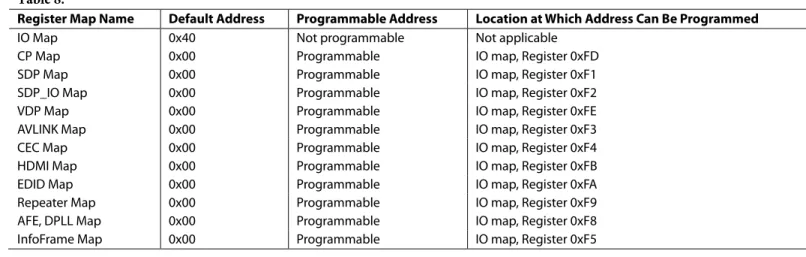
map addresses must be programmed; this ensures no addressing clashes on the system. Figure 9 shows the register map architecture.
Table 8.
Register Map Name Default Address Programmable Address Location at Which Address Can Be Programmed
IO Map 0x40 Not programmable Not applicable
CP Map 0x00 Programmable IO map, Register 0xFD
SDP Map 0x00 Programmable IO map, Register 0xF1
SDP_IO Map 0x00 Programmable IO map, Register 0xF2
VDP Map 0x00 Programmable IO map, Register 0xFE
AVLINK Map 0x00 Programmable IO map, Register 0xF3
CEC Map 0x00 Programmable IO map, Register 0xF4
HDMI Map 0x00 Programmable IO map, Register 0xFB
EDID Map 0x00 Programmable IO map, Register 0xFA
Repeater Map 0x00 Programmable IO map, Register 0xF9 AFE, DPLL Map 0x00 Programmable IO map, Register 0xF8 InfoFrame Map 0x00 Programmable IO map, Register 0xF5
CEC MAP SLAVE ADDRESS: PROGRAMMABLE AVLINK MAP SLAVE ADDRESS: PROGRAMMABLE VDP MAP SLAVE ADDRESS: PROGRAMMABLE SDP_IO MAP SLAVE ADDRESS: PROGRAMMABLE SDP MAP SLAVE ADDRESS: PROGRAMMABLE CP MAP SLAVE ADDRESS: PROGRAMMABLE IO MAP SLAVE ADDRESS: 0x40 INFOFRAME MAP SLAVE ADDRESS: PROGRAMMABLE AFE, DPLL MAP SLAVE ADDRESS: PROGRAMMABLE REPEATER MAP SLAVE ADDRESS: PROGRAMMABLE EDID MAP SLAVE ADDRESS: PROGRAMMABLE HDMI MAP SLAVE ADDRESS: PROGRAMMABLE SCL SDA 08849-008
OUTLINE DIMENSIONS
COMPLIANT TO JEDEC STANDARDS MO-192-AAF-1 02
20 07 -A 1.00 BSC A B C D E F G H J K L M N P R 15 14 13 12 11 10 9 8 7 6 5 4 3 2 1 BOTTOM VIEW 15.00 BSC SQ A1 BALL CORNER 16 T 1.10 MAX 0.25 MIN COPLANARITY 0.20 0.70 0.60 0.50 BALL DIAMETER 0.30 MIN DETAIL A TOP VIEW DETAIL A 1.70 MAX 17.20 17.00 SQ 16.80 BALL A1 CORNER SEATING PLANE
Figure 10. 256-Ball Chip Scale Package Ball Grid Array [CSP_BGA] (BC-256-3)
Dimensions shown in millimeters
ORDERING GUIDE
Model1 Notes Temperature Range Package Description Package Option
ADV7842KBCZ-5 2, 3 −10°C to +70°C 256-Ball Chip Scale Package Ball Grid Array [CSP_BGA] BC-256-3
ADV7842KBCZ-5P 2, 4, 5 −10°C to +70°C 256-Ball Chip Scale Package Ball Grid Array [CSP_BGA] BC-256-3
EVAL-ADV7842EB1Z 3, 6, 7 Front-End Evaluation Board
EVAL-ADV7842EB2Z 5, 6, 8 Front-End Evaluation Board
1 Z = RoHS Compliant Part. 2 Speed grade: 5 = 170 MHz.
3 This part is programmed with internal HDCP keys. Customers must have HDCP adopter status (consult Digital Content Protection, LLC, for licensing requirements) to purchase any components with internal HDCP keys.
4 HDCP functionality: P = no HDCP functionality (professional version).
5 Professional version for non-HDCP encrypted applications. Purchaser is not required to be an HDCP adopter.
6 An ATV motherboard is also required to process the ADV7842 digital outputs and achieve video output. An ATV video output board is optional to evaluate performance through an HDMI transmitter and video encoder.
7 Front-end board for the ATV video evaluation platform, fitted with ADV7842KBCZ-5 decoder. 8 Front-end board for the ATV video evaluation platform, fitted with ADV7842KBCZ-5P decoder.
NOTES
I2C refers to a communications protocol originally developed by Phillips Semiconductors (now NXP Semiconductors).
HDMI, the HDMI Logo, and High-Definition Multimedia Interface are trademarks or registered trademarks of HDMI Licensing LLC in the United States and other countries.


![Figure 10. 256-Ball Chip Scale Package Ball Grid Array [CSP_BGA]](https://thumb-us.123doks.com/thumbv2/123dok_us/48187.2506032/26.918.187.672.181.527/figure-ball-chip-scale-package-ball-grid-array.webp)
