Strategic Interactions between Tax and Statutory
Auditors and Different Information Regimes:
Implications for Tax Audit Efficiency
∗
April 2, 2020
Kay Blaufus, Jens Robert Schöndube and Stefan Wielenberg
†Abstract
We examine whether tax audits become more efficient if tax auditors have access to audited financial statements and information about statutory audit adjustments. We extend the standard tax compliance game by a statutory auditor to analyze the strategic interactions among a firm issuing financial and tax reports, a statutory auditor, and a tax auditor. For medium-powered tax auditor incentives and firms that place a high weight on book income, we show that granting the tax auditor access to information on statutory audit adjustments increases firms’ tax compliance, raises tax revenues, and decreases tax audit frequency. Thus more information sharing between statutory and tax auditors could be an important but so far overlooked policy instrument to combat tax evasion and increase tax audit efficiency. However, we also highlight the limitations of this approach. The efficiency effect of information sharing turns out to be ambiguous in many constellations and depends on the strength of tax auditor incentives and the weight that firms place on book income.
Keywords: Tax compliance game; Tax audit; Statutory audit; Tax audit efficiency; Strategic auditing.
JEL Classifications: H26, M41, M42.
∗We thank Joachim Gassen, Laszlo Goerke, Kyungha Lee, Ulf Schiller, Alfred Wagenhofer, partici-pants of the ARFA - Workshop 2015, the GEABA - Symposium 2015, the EAA - Conference 2016, the VHB - Conference 2016, and the EISAM Workshop on Accounting and Economics 2016 for helpful comments on an earlier version of this paper.
†Faculty of Economics and Management, Leibniz Universität Hannover. Address: Königsworther Platz 1, 30167 Hannover, Germany.
1
Introduction
In many countries, tax administration budgets have declined significantly in recent years, and tax administrations, therefore, reduced their workforce. For example, the United States Internal Revenue Service reduced the number of its employees from 94,711 in 2010 to 73,518 in 2018 (IRS, 2019). Similarly, the number of employees at the U.K. tax authority, the HMRC, fell from 91,167 in 2005 to 61,370 in 2014 (Slem-rod, 2016). This raises the importance of improving the tax audit selection process to increase tax revenues per tax audit costs, i.e., tax audit efficiency. Using a game-theoretical model, this paper investigates whether giving tax auditors access to audited financial statements and information about statutory audit adjustments increase the ef-ficiency of the tax audit regime.
The idea of this paper is based on the observation that financial statements are often subject to two kinds of audit: a statutory audit that is conducted by an independent pri-vate auditor and, usually with a time lag, a tax audit that is conducted by the country’s tax administration. This observation raises the question of whether information shar-ing between statutory and tax auditors could be used to increase tax audit efficiency, i.e., to simultaneously increase tax revenues and reduce tax audit frequency.
In general, values from financial accounting are positively correlated with values in tax accounting, meaning that financial accounting information could provide an in-formative signal for tax auditors (Mills and Sansing, 2000). However, at first sight, it might be surprising why providing access to statutory audit adjustments could pro-vide an additional informative signal for tax auditors because these adjustments do not contain any direct information regarding tax values. The statutory audits of financial accounting statements are conducted by independent private auditors, certified pub-lic accountants. Moreover, statutory auditors are typically perceived as conservative, i.e., they are primarily interested in preventing upward earnings management but not in preventing downward earnings management, which is what firms might do to save
taxes. The statutory audit adjustments, however, reveal information on whether a firm has engaged in upward earnings management of book income. As we will show in this paper, the strategic incentives to conduct upward earnings management of book income depend to some extent on a firm’s taxable income. Thus the information about statutory audit adjustments provides an additional informative signal to the tax auditor with respect to the correct tax treatment.
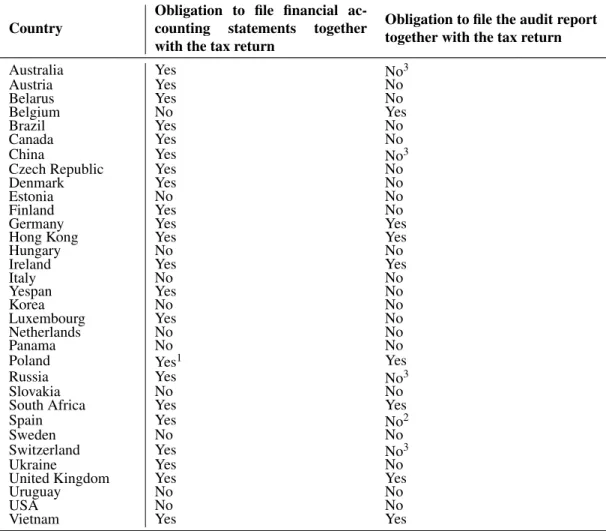
Tax administrations seem to have recognized the potential benefits of financial state-ments and statutory audit information for tax audits. Firms in many countries are obliged to file their financial accounting statements together with their tax returns, e.g., in Australia, Canada, and the United Kingdom, and in some countries, firms must also file their statutory audit report with the tax administration, e.g., in Belgium, Germany, and the United Kingdom (see Table 5, appendix B). To the best of our knowledge, however, the filed statutory audit reports do not currently contain any detailed infor-mation on the audit adjustments made by the statutory auditor. Therefore, our analysis goes one step further: We inform legislators as to whether it would be efficient to also provide the tax auditors with information on documented adjustments made by the statutory auditor. Thus we contribute to the ongoing discussion of how to improve the effectiveness and efficiency of tax administrations (OECD, 2017).
Despite its potential to increase tax compliance, the usage of information from finan-cial accounting statements and statutory audit adjustments might also trigger opposing effects. Some firms may attempt to decrease detection risk and manipulate or avoid the signal, for example, by understating not only taxable income but also financial ac-counting income such that no book-tax-difference arises (conforming tax avoidance). Other firms may have a further increased incentive to misreport only taxable income (non-conforming tax avoidance) to align book and tax income. The overall effect of using financial accounting information and statutory audit adjustments in the tax audit selection process is therefore unclear. The aim of our study is to show under which circumstances information about the statutory audit and financial statements increases
tax audit efficiency.
Our analysis proceeds in three steps. In a first step, we assume that no information beyond the reported tax return is available. This is the standard inspection game be-tween taxpayers and tax auditors (Graetz et al., 1986), which we label the reduced-information regime. Firms (the taxpayers) face an asset valuation issue1 and decide whether to report the correct tax value or evade taxes. Tax auditors decide, based on the reported tax returns, whether to conduct a tax audit.
In a second step, we add observable financial accounting statements. In this intermediate-information regime, firms need to prepare a report not only for tax but also for financial accounting purposes. For the sake of simplicity, the asset’s tax value can be either low or high; similarly, the asset’s book value can be either low or high. To reflect existing similarities between financial accounting principles and tax law, we assume a positive correlation between book and tax values (Mills and Sansing, 2000). Thus, book values provide a (noisy) signal regarding a firm’s correct tax value. We assume that firms have a preference for high book income and low tax income. Accordingly, firms will have an incentive to engage in upward (downward) management of book (tax) income. As with tax returns, financial statements are usually subject to an audit. Thus statutory auditors determine, based on the reported book value, their effort in the statutory audit of the firm’s asset valuation. In line with prior research, we assume a conservative statutory auditor who prefers conservative (income-decreasing) accounting choices to reduce his or her litigation and reputation risk (e.g., Francis and Krishnan, 1999; Kim et al., 2003; Cahan and Zhang, 2006). Thus the statutory auditor challenges firms’ up-ward, but not downup-ward, book income management. In the subsequent tax audit, the tax auditor observes the financial statements in the form in which they were prepared after the statutory audit. Therefore, the tax auditor has access to financial statement information but no information about statutory audit adjustments.
1Alternatively, we could assume that the taxpayer makes an expenditure and must decide whether
this expenditure may be expensed or must be capitalized for book and tax income purposes. See Mills and Sansing (2000).
In a third step, we model ahigh-information regime by assuming that the tax auditor has access to audited financial statements and, in addition, information on required statutory audit adjustments.
Firms and both auditors alter their reporting and audit decisions with variations in the information regime. In each information regime, we determine the mixed-strategy equilibria, where the two auditors employ a probabilistic audit strategy and certain taxpayers randomize their reporting behavior.2 In these equilibria, we compare the effects of the different information regimes on our measures of tax audit efficiency: firms’ tax evasion, tax revenues and tax audit frequency. Our findings reveal that the effect of information on tax audit efficiency depends on the tax auditors’ incentives and the importance that firms ascribe to book income.
For countries where tax auditors have medium-powered incentives and firms place a relatively high weight on book income, our analysis shows an unambiguously positive effect of information sharing between statutory and tax auditors on tax audit efficiency. In this case, the additional information can induce higher tax revenues and a lower tax audit frequency. Information about statutory audit adjustments is particularly useful under these circumstances, as it allows the tax auditor to decrease the audit probability to zero for specific reports without any negative effect on tax compliance. Thus shar-ing information between statutory and tax auditors has the potential to significantly increase tax audit efficiency.
However, in line with prior research (Sansing, 1993) our results also demonstrate that giving more information to tax auditors is not always helpful to enhance tax com-pliance. In particular, we show that information sharing between the auditors is not effective for all firms. If tax auditors have medium-powered incentives, but firms place a much higher weight on tax than on book income, tax revenues decrease with in-formation sharing. Because the tax audit frequency also decreases with inin-formation
2We do not examine pure-strategy equilibria in which the tax auditor never or always audits and the
taxpayer always or never evades taxes because these equilibria are rarely observed in real-world audit and reporting behavior.
sharing, the overall efficiency effect is ambiguous in this case.
The reason for the different effects of information about statutory audit adjustments is as follows: In case of a relatively high weight on book income, taxpayers who con-duct upward earnings management of book income report their tax income truthfully because this reduces the risk that the statutory auditor corrects earnings management. Thus, information on detected earnings management signals tax honesty and the tax auditor can reduce the audit probability for these reports without losing tax revenues. By contrast, in case of a relatively low weight on book income, the reduced tax audit probability for reports with detected earnings management comes at the cost of lost tax revenues. In this case, taxpayers combine upward earnings management with tax evasion because the benefit of the lower tax audit probability for reports with detected upward earnings management outweighs the disadvantage that the statutory auditor potentially corrects earnings management.
In countries where tax auditors have high-powered incentives, our model predicts that tax auditors do not decrease their audit frequency due to the additional information. Increasing the information level of the tax auditors induces some firms to engage in more tax evasion, while other firms reduce their evasion. However, in equilibrium, average tax evasion remains at the same level. Thus the provision of the additional information does not affect tax audit efficiency. In countries with low-powered tax auditor incentives, we find that tax revenues increase if tax auditors have access to financial statements and statutory auditor reports. However, this comes at the cost of increased tax audit frequency. Thus the overall efficiency effect is ambiguous in this case.
Most previous tax compliance research explains tax evasion as taxpayers maximizing their expected utility given the detection probability and the size of the penalty (Alling-ham and Sandmo, 1972). However, this fails to recognize that the detection probability is the result of a game between taxpayers and the government and thus endogenous. Graetz et al. (1986) and Reinganum and Wilde (1986) were the first to study tax
com-pliance as a game in which the revenue agency could not credibly commit to an audit strategy. Reinganum and Wilde (1988) introduce taxpayer uncertainty regarding the government’s audit costs, and Beck and Jung (1989) consider tax liability uncertainty. In Beck et al. (1996), taxpayers are allowed to purchase tax advice to resolve all un-certainty. Erard and Feinstein (1994) modify the approach of Reinganum and Wilde (1986) to consider nonstrategic taxpayers. Rhoades (1999) analyzes the impact of component reporting on the tax compliance game. Bayer (2006) considers taxpayers’ concealment costs and demonstrates that higher tax rates lead to higher tax evasion and higher concealment and audit costs. Other studies analyze the effect of a signal re-garding the taxpayer’s income on the audit process. Sansing (1993) examines a signal regarding the correct tax treatment of a loss. He demonstrates that this signal can result in an increased amount of tax evasion while tax revenues (before audit costs) remain unaffected. Beck et al. (2000) study the effect of voluntary disclosures regarding an uncertain tax benefit to avoid a substantial underpayment penalty if the tax return is au-dited. Related to the study of Beck et al. (2000), De Simone et al. (2013) investigate the benefits of “Enhanced Relationship Tax Compliance Programs”. Niggemann (2018) finds that book-tax conformity restricts misreporting positive book-tax differences but may impair the accuracy of financial statements.
The two studies most related to our paper are Mills and Sansing (2000) and Mills et al. (2010). In Mills and Sansing (2000), the tax auditor observes the (correct) financial statement valuation, which results in a higher audit probability for positive book-tax differences. Mills et al. (2010) investigate the effects of disclosed uncertain tax posi-tions according to FIN 48. Contradicting public opinion, they demonstrate that some taxpayers will actually benefit from mandatory disclosure requirements. Empirical re-search has confirmed that public financial accounting information can be useful for tax auditors to infer the tax aggressiveness of companies (e.g. Lisowsky et al. (2013), Bozanic et al. (2017)).
auditors and tax auditors while allowing taxpayers to misreport both financial and tax reporting positions. The strategic interaction between statutory auditors, tax auditors, and taxpayers reveals that information sharing between statutory and tax auditors has the potential to increase tax audit efficiency. In times of decreasing resources for many tax administrations (Nessa et al., 2019), this is an important policy result. However, our model also shows that firms and auditors respond to the changing information en-vironments and that the desired positive effects may depend on the specific countries’ institutional environments that determine, for example, the incentives of statutory and tax auditors. Thus the optimal tax policy will vary across countries, which might ex-plain the large empirical variation that we observe in the obligations to file financial statements and statutory audit reports with the tax administration (Table 5, appendix B).
The remainder of this paper is organized as follows: In the second section, we present the model. In the third section, we discuss some important aspects of the equilibrium analysis of the game and introduce our efficiency measures. Sections 4, 5 and 6 in-vestigate how the three different information environments affect the efficiency of the tax audit regime. The last section discusses the results and implications for future research.
2
The model
We consider a multi-stage game involving three players: the manager of a firm, a statutory auditor, and a tax auditor. The manager has to release a report about both the tax and the financial statement valuation of an issue.3 Subsequently, the statutory auditor determines her audit effort and the tax auditor has to decide whether to audit
3To avoid having an excessively complex model, we exclude agency conflicts from the analysis. The
effect of agency problems (among shareholders or between shareholders and managers) on corporate tax avoidance is analyzed, for example, in Chen and Chu (2005), Crocker and Slemrod (2005), and Jacob et al. (2019).
the tax report. All players are assumed to be risk neutral. A definition of all variables is presented in appendix A.
In the first stage of the game, the firm’s manager (in the following denoted as the “tax-payer”) faces an asset valuation issue. The asset’s correct book value in the financial statements isb∈ {b,b}. A similar valuation issue – with a potentially different out-come – arises for tax purposes, where the proper valuation is t ∈ {t,t}. We define ∆b=b−band ∆t =t−t and assume b=t and b=t. Thus, ∆b=∆t =∆. Without loss of generality, we normalize∆=1. Think of different depreciation, amortization or impairment rules, different rules concerning the capitalization of assets or fair value vs. historical costs valuation as examples for possibly different book and tax valua-tions. For both financial statement and tax issues, a low (high) valuation also implies a low (high) income. Therefore, we use the terms book (tax) valuation and book (tax) income interchangeably.
We refer to the true valuations(b,t)as the taxpayer’s type. Accordingly, in the game, the taxpayer can be any of the following four types: (b,t), b,t,(b,t), b,t . At the beginning of the game, nature chooses a type for the taxpayer. Nature’s move is observed only by the taxpayer such that the correct valuations(b,t)are the taxpayer’s private information.4 We assume the following common prior probability distribution over the taxpayer’s type:
1. The ex ante probabilities Prob{t}and Prob{t}are 0.5.
2. The conditional probabilities Prob{b|t}are given by Prob{b|t}=Prob{b|t}=p
and Prob{b|t}=Prob{b|t}=1−p. We assume that 0.5< p<1.
The joint probabilities are Prob{b,t}=0.5(1−p), Prob{b,t}=0.5p, Prob{b,t}= 0.5pand Prob{b,t}=0.5(1−p). Furthermore, Prob{b}=Prob{b}=0.5.
4We do not address taxpayer’s uncertainty about the correct valuations in this paper. An analysis of
tax uncertainty can be found, for example, in Graetz et al. (1986), Beck and Jung (1989), Beck et al. (1996), Mills et al. (2010), or De Simone et al. (2013).
The parameter pis a measure of the conformity between tax and financial statement valuation. A strong conformity means p→1, and a low conformity implies p→0.5. In this sense, the assumption thatp>0.5 ensures that the correlation between tax and financial statement valuation is positive.
At the beginning of the game, after observing the true values b and t, the taxpayer decides the valuations ˆb and ˆt to be reported. We assume that the taxpayer makes simultaneous reports of book and tax income whereas in practice there is usually a time gap between the filing of annual statements and tax returns. Our simplifying assumption of simultaneous reports is based on the fact that taxpayers have to calculate the tax liability when preparing the annual accounts because otherwise they wouldn’t be able to report the correct amount of deferred taxes. The taxpayer may bias the reported valuation for example because she is interested in a low asset value for tax assessment; we specify the taxpayer’s objective function after we have introduced the other players of the game.
In the second stage of the game the statutory auditor conducts the annual financial statement audit after having observed the taxpayer’s reported valuations ˆb,tˆ. The statutory auditor determines the audit effort that can be either high (aS=1) or low (aS=0). The costs of the statutory audit are given by CS(aS=1) =CS> 0 and
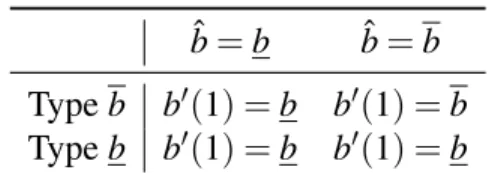
CS(aS=0) = 0. For the sake of simplicity, we assume a perfect audit technology for the statutory auditor with regard to the financial statement valuation. That means that for aS =1, the statutory auditor with certainty detects an inaccurate financial statement valuation by the taxpayer. For aS = 0 the statutory auditor will not de-tect any misreporting. The statutory auditor’s benefits come from reducing litiga-tion and reputalitiga-tion risk. She benefits from detecting an overstatement of the asset value ˆb=balthoughb=b but accepts conservative (income-decreasing) account-ing choices because they have no impact on litigation and reputation risk. We assume that the benefit is proportional to the overstatement,λ b−b. Thus, the preferences
ˆ
b=b bˆ =b
Typeb b0(1) =b b0(1) =b
Typeb b0(1) =b b0(1) =b
Table 1:Financial statement valuationb0(aS=1) after financial statement audit
of the statutory auditor can be characterized by
max aS∈{0,1}
E λmaxbˆ−b0(aS),0 −CS(aS)
whereb0(aS)is the final financial statement valuation after the statutory auditor’s de-cisionaS, withb0(0) =bˆ andb0(1)as in table 1.
We need to assume thatλ−CS>0 to ensure that high effort can be induced as equi-librium behavior. The statutory auditor’s audit effort decisionaS is not observable to the tax auditor who enters the game at its final stage.
The tax auditor is modeled in a very similar fashion to the statutory auditor. She also possesses a perfect audit technology with regard to ˆtand has to decide whether to audit (aT =1) the tax valuation ˆt or not (aT =0). The tax auditor benefits from detecting an understated tax valuation (ˆt =t althought =t) but earns no benefit from detecting an overstatement.5 Denoting the tax auditor’s preference parameter for detecting an understatement byδ and the personal cost of auditing actionsaT byCT(aT), the tax auditor’s objective function can be written as
max
aT∈{0,1}E(δmax{t 0(a
T)−tˆ,0} −CT(aT)). (1)
Heret0(aT) denotes the final tax valuation after the tax auditor’s decision aT, with
t0(0) =tˆ,t0(1) =t. We further assumeCT(0) =0 andCT(1) =CT >0.
Similar to the statutory auditor we impose the regularity conditionδ−CT >0. Figure
5There are typically implicit incentives for assessing additional taxes during tax audits because the
effectiveness of the tax audit staff is evaluated with respect to additional taxes ‘earned’ from tax audits (Alissa et al., 2014). In some countries, explicit incentives also exist (Kahn et al., 2001).
1 summarizes the timing of events in our model.
taxpayer privately observes her type
(b,t) taxpayer releases reports (bb,bt) audit effort decision by statutory auditor audit decision by tax auditor
Figure 1:Timeline of events
We are now able to specify the taxpayer’s objective function. Assuming that the tax-payer is interested in a low asset value for tax assessment and in a high asset value in the financial statements, a taxpayer of type(b,t)maximizes the following function
max
ˆ
b,tˆ E
(ω·b0(aS)−γ·t0(aT)−FT(t0(aT))−FB(b0(aS))), (2)
FT andFBdenote disutility from penalties due when an incorrect valuation is detected either in the tax (FT) or in the financial statements (FB), respectively. They are defined by FT(t0) = FT, ift06=tˆ 0, else andFB(b0) = FB, ifb06=bˆ 0, else. (3)
The parameters ω and γ are positive weights indicating the taxpayer’s preferences
for financial statement and tax valuation. In the following, we consider the case of
γ >ω, implying that the taxpayer’s preferences are more sensitive to the tax than
to the financial statement valuation. This is typical for firms characterized by low capital market exposure, by managers not predominantly driven by financial reporting measures and by less important outside debt financing. Thus, taxpayers withγ>ωcan
be regarded as managers of mainly private firms. Our focus on firms that give at least a small prioritization of tax outcomes over book outcomes is based on the fact that only these firms have an incentive to conduct conforming tax avoidance. However, we will discuss the implications for firms that prioritize book over tax outcomes in section 7. Analyzing the effect of different information environments on tax compliance, we
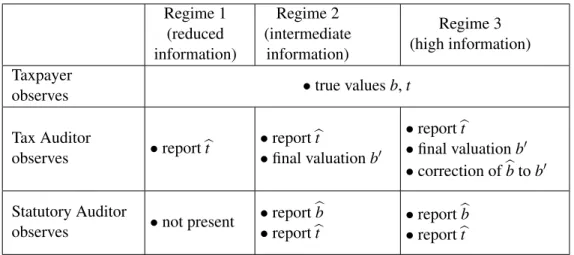
con-Regime 1 (reduced information) Regime 2 (intermediate information) Regime 3 (high information) Taxpayer
observes •true valuesb,t
Tax Auditor observes •reportbt •reportbt •final valuationb0 •reportbt •final valuationb0 •correction ofbbtob0 Statutory Auditor
observes •not present
•reportbb •reportbt
•reportbb •reportbt Table 2:Different informational structures considered in the game.
sider three different regimes. Across the regimes, we vary the information available to the tax auditor when he or she has to select an audit strategy, see table 2.
We begin with a benchmark setting (reduced-information regime) in which neither financial statements nor statutory auditor are present. The game is only between the taxpayer and the tax auditor, who observes the tax report. Thus our benchmark is a standard tax compliance inspection game (Graetz et al., 1986). The second regime (the intermediate-information regime) simultaneously introduces the need for financial statement valuation and the statutory auditor. We assume that the statutory auditor observes both the report on financial statements ˆb and that on tax valuation ˆt. The tax auditor, in contrast, observes the report on tax valuation ˆt and the final financial statement valuationb0after the statutory auditor’s effort choice. In regime 3 (the high-information regime), both auditors observe the same high-information as in regime 2, but the tax auditor can also observe whether the statutory auditor has corrected the taxpayer’s financial statement valuation. Formally, this is equivalent to a setting where the tax auditor observes the tax report ˆt, the final valuation b0 and the financial statement report ˆb.
3
Preliminary analysis
The game described in the previous section is an inspection game with two auditors. Inspection games only have pure-strategy equilibria for extremely low or high inspec-tion costs. Thus the inspectors never or always audit, and the inspectee always or never reports falsely. We do not consider these equilibria because they are rarely de-scriptive of real-world audit and reporting behavior. Therefore, we concentrate on mixed-strategy equilibria, in which the two auditors employ a probabilistic audit strat-egy and some taxpayer types randomize their reporting behavior. In these equilibria, we compare the effects of the different information regimes on the efficiency measures of tax evasion, tax revenue and tax audit frequency. This section (1) describes the equi-librium in the reduced information setting, (2) eliminates dominated strategies in the intermediate- and high-information regimes, and (3) defines the efficiency measures tax evasion, lost tax revenue and tax audit frequency.
3.1
Equilibrium in the reduced-information regime
As a first step, we compute the equilibrium in the reduced information setting. In this case, the game reduces to a simple variant of the inspection game. Thus proposition 1 replicates equilibrium strategies well known in the literature.
Proposition 1 (Reduced information regime) If there is no financial statement val-uation, the equilibrium strategies of the taxpayer and tax auditor are as follows:
• Taxpayer: Type t reports truthfully. Type t reports t with probabilityθT := δ−CTCT
as long asθT ≤1. Type t always reports t forθT >1.
• Tax auditor: Report t is never verified. Report t is verified with probability
α = γ
Proof: See appendix D.1 The term θT = δ−CTCT can be interpreted as a reverse measure of the tax auditor’s in-centives. Low values ofθT represent low audit costs and high rewards for detecting underreporting, implying high-powered incentives. A combination of high audit costs and low rewards yields low-powered incentives for the tax auditor and a largeθT. Proposition 1 states that the taxpayer’s misreporting probability decreases with the tax auditor’s incentives. By choosing a misreporting probability amounting toθT, the taxpayers ensure that the tax auditor is indifferent between auditing and not auditing a report ˆt =t, and by choosing the tax audit probabilityα, the tax auditor makes the
taxpayers indifferent between tax evasion and honest tax reporting. The unique mixed-strategy equilibrium vanishes if incentives become very low. In this case, the taxpayer always misreports, and the tax auditor never challenges the reported tax valuation.
3.2
Dominated strategies in regimes 2 and 3 and notation
We proceed with the intermediate- and the high-information regime. In these cases, financial statements and the statutory auditor enter the scene and things become more complicated. To simplify the following analysis, it is useful to rule out actions that will never be part of any equilibrium because they are dominated by other actions.
Lemma 1 In regimes 2 and 3, the following actions will never be played in equilib-rium:
• The tax auditor will never audit a tax report t.
• The statutory auditor will never audit a financial statement report b with high effort.
• A taxpayer of type b,t will always report truthfully.
• A taxpayer of type b,t will never report b,t and b,t.
Proof: See appendix D.2.
Intuitively, the tax and statutory auditors will never audit reports that do not offer them any potential benefits. The taxpayer will never issue reports that imply a lower payoff, even absent any detection risk, than the payoff under truthful reporting. Table 3 displays the reporting strategies for the taxpayer reports that are not dominated (see lemma 1 above).
Type b,t b,t b,t b,t
Report b,t b,t b,t b,t b,t b,t b,t b,t b,t b,t
Table 3:The taxpayer’s non dominated reporting strategies
Table 4 contains the definitions of the tax and statutory auditor’s audit probabilities. The tax auditor’s audit probabilities depend on whether we consider regime 2 or regime 3. While in regime 2 the tax auditor can only observe the final financial statement valuation in addition to the tax report, in regime 3 the tax auditor can make the audit probabilities also conditional on the (possible) correction by the statutory auditor.
x1 Statutory auditor audits reportbwith high effort given tax reportt x2 Statutory auditor audits reportbwith high effort given tax reportt
α Tax auditor auditst given reportb,t (regimes 2 and 3) β Tax auditor auditst given reportb,t (regime 2)
β1 Tax auditor auditst given uncorrected reportb,t(regime 3)
β2 Tax auditor auditst given corrected reportb,t(regime 3)
Table 4:Audit probabilities for the tax and statutory auditors in regimes 2 and 3
In the following, we use superscripts "R1", "R2" and "R3" to identify the three different regimes. For example,αR2denotes the tax audit probability for reportb,t in regime 2.
3.3
Efficiency measures
The tax evasion probability (TE) is generally defined as the unconditional probability of a low tax valuation report by the high-tax-valuation types, i.e.,
TE=prob{ˆt=t,t}=1
2(p·prob{ˆt=t|b,t}+ (1−p)·prob{ˆt=t|b,t}). (4)
The following lemma shows that different information regimes do not necessarily im-ply a different tax evasion probability.
Lemma 2 (Constant tax evasion property) 1. Suppose that an equilibrium is char-acterized by αR1>0in the reduced-information regime 1, αR2,βR2>0in the
intermediate-information regime 2 andαR3,β1R3,β2R3>0in the high-information
regime 3. This implies that TE= 12θT independent of the information regime.
2. Suppose that one of the audit probabilities in regime 1, 2 or 3 is equal to zero. Then, TE< 12θT.
Proof: See appendix D.3.
Lemma 2 states that additional information does not affect tax evasion if all reports are subject to a positive tax audit probability. The reason for this result is that in equilibrium the tax auditor is indifferent between auditing and not auditing the report. Indifference on the part of the tax auditor, however, requires that the ratio of false to correct reports is identical for each type of report and set such that the tax auditor expects on average “no profit”. Therefore, as long as each report with low tax values is audited by the tax auditor with a positive probability, firms’ average tax evasion must remain the same in all information regimes.
In addition to tax evasion, we analyze two other measures that characterize the tax audit efficiency. These measures are defined as follows:
1. Frequency of tax audits: The audit frequency can be measured by the ex ante probability of a tax audit. In the reduced-information regime, the tax audit fre-quency can simply be written as
TAR1= αR1·prob{ˆt=t} ifθT ≤1 0 ifθT >1. (5)
In the intermediate- and the high-information regime we define
TAR2:=αR2·prob{ˆt=t|bˆ =b}+βR2·prob{ˆt=t|bˆ=b} (6)
in regime 2 and
TAR3=αR3·prob{ˆt=t|bˆ =b}+β1R3·prob{ˆt=t|bˆ=b,no correction}
+β2R3·prob{ˆt=t|bˆ=b,correction}
(7)
in regime 3.
2. Lost tax revenue (LTR): The probability of taxing a type-ttaxpayer who reportst
based on a reported tax valuationtcan be interpreted as “lost tax revenue”. LTR measures the fraction of tax evasion that is not detected by the tax auditor and can be seen as an inverse measure of tax revenue. A low value of LTR implies a high tax revenue, and vice versa. In the reduced-information regime we obtain
LTRR1= (1−αR1)prob{t|tˆ=t} ifθT ≤1 1 2 ifθT >1. (8)
In the intermediate- and the high-information regimes, we define the measure as
LTRR2:=(1−αR2)·prob{t|bˆ=b,tˆ=t}
+ (1−βR2)·prob{t|bˆ =b,tˆ=t}
and LTRR3= (1−αR3)·prob{t|bˆ =b,tˆ=t} + (1−β1R3)·prob{t|bˆ=b,tˆ=t,no correction} + (1−β2R3)·prob{t|bˆ=b,tˆ=t,correction}. (10) in regime 3.
4
Tax auditors with high-powered incentives: no
infor-mation effect
In the following three sections, we will show how the changes in the measures of the tax audit efficiency implied by variations in the information regimes critically depend on the tax and statutory auditors’ incentives to provide an audit. We differentiate be-tween high-powered incentives, medium incentives and low incentives. In our model, the incentives for both auditors are represented (1) by the rewards for a successful au-dit (represented byλ for the statutory auditor andδ for the tax auditor) and (2) by the
audit costs (CSandCT). In addition toθT = δ−CTCT, it is useful to define
θS:=
CS
λ−CS
(11)
as a measure of the statutory auditor’s incentives. Values of θS,T close to zero are equivalent to high-powered incentives, increasing values imply medium and even lower incentives. The following analysis reveals that θT andθS determine the equilibrium audit and reporting decisions. As a consequence, the impact of different informa-tion regimes on the efficiency measures also depends on these variables. Our analy-sis concentrates on the tax auditor and, therefore, we focus on variations inθT. We obtain different results for (1) high-powered incentives (0<θT ≤θT(θS), this
sec-tion), (2) medium incentives (θT(θS)<θT ≤1, section 5) and (3) lower incentives (1<θT ≤θT(θS), section 6), where the upper and lower bounds onθT depend onθS. We restrictθS such that the statutory auditor exerts high effort (aS=1) with positive probability for at least reportb,torb,t.
Our discussion starts with a setting in which both auditors have high-powered incen-tives. Appendices C.1.1 and C.2.1 show that for high-powered incentives the tax au-ditor uses the same audit probability for all reports in all information regimes - that meansαR1=αR2=βR2=αR3=β1R3=β2R3. With positive tax audit probabilities the
tax evasion probability is the same in all three information regimes by lemma 2. Also the statutory auditor exerts high effort with equal probabilitiesxR12=xR22=xR13=xR23. Thus changes in the information regime have no effect on tax revenue and audit prob-ability if tax and statutory auditors have strong incentives. The following proposition 2 states the result.
Proposition 2 (No information effect) There exist critical valuesθT,θS(θT)such that
for0<θS<θSand0<θT <θT(θS), the following relations hold:
1. LTRR1=LTRR2=LTRR3 2. TAR1=TAR2=TAR3.
Proof: See appendix D.4
Note that the change from information regime 2 to regime 3 has no consequences for the composition of the taxpayer’s equilibrium reporting. For example, taxpayer type
b,twill reportb,tandb,t with positive probability in both regimes. However, the con-crete reporting probabilities will not necessarily be the same in the two regimes. Firms with b and t increase their tax compliance but firms with b and t will reduce com-pliant reporting - see appendix C.1.1 and C.2.1 for the details. The differences stem from the enriched tax auditor strategy: In the intermediate-information regime, the tax auditor can condition his audit on low and high financial statement valuations. The
high-information regime additionally allows for a distinction between a low financial statement valuation that is corrected or uncorrected by the statutory auditor.
5
Tax auditors with medium incentives: mixed
infor-mation effects
What happens if the tax auditor’s incentives become weaker? First, the tax auditor uses different audit strategies for different reports. Second, the taxpayer adjusts her equi-librium reporting with respect to both financial statements and tax valuation. Finally, these adjustments also affect the statutory auditor’s audit effort choice.
Tax auditors have intermediate incentives if the preference parameterδ together with
the personal audit costCT result in θT such that θT ≤θT <1. Due to the existence of different equilibria, we consider important financial statement valuation (γ <ω+
FB, regime 3a) and less important financial statement valuation (γ >ω+FB, regime 3b). The reduced incentives for the tax auditor have the following effects in the two regimes:6
(1) Compared to a situation with high-powered incentives, the probability of false reporting increases for all types exceptb,t. (2) Typeb,tstops reporting truthfully and typeb,tstarts to understate both valuations by reportingb,twith a positive probability. Both types reduce the probability of reportingb,t. (3) The change in the reporting profiles also induces changes in the audit probabilities. In both information regimes the statutory auditor audits reportsb,t with high effort (xR12=xR13) but stops auditing reportsb,twith high effort (xR22=xR23=0) because typeb,treduces the probability for reportb,t more than typeb,t. The tax auditor decreases the audit probability of report
b,t in both information regimes (βR2=β1R3) while the audit probability for reports
6See appendix C.1.2 for the intermediate-information regime, appendix C.2.2 for the
b,t remains the same as in the case with high auditor incentives (αR1=αR2=αR3).
Moreover, if information on statutory audit adjustments is available (regime 3) and upward earnings management is detected the tax auditor further decreases the audit probability for these reports (β2R3<β1R3).
The effect of lower tax auditor incentives on the efficiency measures in the two infor-mation regimes depends on the relative importance of the financial statement valuation for the taxpayer:
(1) Important financial statement valuation (γ <ω+FB, regime 3a): In regimes 2 and 3a, typeb,tfinds the reportb,tmore attractive than reportb,tbecause the statutory auditor may downgradeb,ttob,t. Thus she sacrifices the chance of a low tax valuation to obtain a high financial statement valuation with certainty. As a consequence, the probabilities for a reportb,t sent by types b,t andb,t do not change from regime 2 to regime 3a because the potential senders of reportb,t do not change. However, the probability of an uncorrected reportb,twith false tax values has to decrease in regime 3a. This is due to the observable correction activity of the statutory auditor: The tax auditor can better conclude on types b,t and b,t. Therefore, both type t - taxpayers decrease the probability of reportb,t in regime 3a. Taken together, more information induces lower tax evasion. Moreover, a reportb,tcorrected by the statutory auditor can only stem from typeb,t. Thus, the tax auditor can reduce the probability of auditing a corrected reportb,t to zero without any negative consequences regarding tax revenues. Alltogether, lower tax evasion and lower audit acitivity in regime 3 explain the result in Proposition 3:
Proposition 3 (Efficient information effect) Suppose γ <ω+FB. Then there exist
θT,θT,θS(θT), θS(θT)such that forθT <θT <θT ≤1andθS(θT)<θS<θS(θT)
the following relations hold:
1. LTRR1<LTRR3a<LTRR2or LTRR3a<LTRR1<LTRR2
Proof: See appendix D.5. Intuitively, the high information content of the statutory auditor’s observable correc-tions drives the result. In case of important financial statement valuation, corrected financial statements together with a reported low tax valuation are a perfect indicator for a truthful tax report. Therefore, the tax auditor will not audit these reports. How-ever, uncorrected financial statements together with a reported low tax valuation also become a much better indicator for misreporting. The tax auditor audits these reports, and taxpayers with a high tax valuation reduce their probability of misreporting in equilibrium. In sum, providing information about the statutory auditors corrections to the tax auditor is efficient (compared to regime 2). The additional information will induce both higher tax revenue and lower audit frequency.
In the reduced-information regime 1, both tax evasion and tax audit frequency are higher than in regime 3a. However, tax audit frequency may dominate and induce lower lost tax revenue compared to regime 3a. This explains why regime 3a is not necessarily efficient with respect to the no information regime 1.
(2) Less important financial statement valuation (γ >ω+FB, regime 3b): In this case the taxpayer has relatively strong preferences for a low tax valuation. Therefore typeb,t reportsb,t and takes the risk of being corrected to b,t. This is the key dif-ference from regimes 2 and 3a. The possibility of type b,t as a sender of report b,t
dampens the reporting probabilities for a reportb,t sent by types b,t andb,t. More-over, in contrast to regime 3a, the tax auditor will also audit the corrected report b,t
because a high tax valuation type may be the sender. Because all tax audit probabilities for reportst are positive, lemma 2 applies. Thus in contrast to regime 3a, tax evasion is not affected by providing access to the statutory audit report. However, tax revenues decrease because the report b,t of type b,t is corrected tob,t by the statutory audi-tor with positive probability and the taxpayer then benefits from the lower tax audit probability (compared to reportb,t).
statement valuation is relatively unimportant to the taxpayer.
Proposition 4 (Negative tax revenue effect) Suppose that γ >ω+FB. Then, there
existθT, θT, θS(θT), θS(θT) such that for θT <θT <θT ≤1 and θS(θT)<θS<
θS(θT), the following relations hold:
1. LTRR1<LTRR2<LTRR3b
2. TAR3b<TAR2<TAR1.
Proof: See appendix D.6
The lower information content of the statutory auditor’s observable corrections is re-sponsible for the difference between the efficiency result in proposition 3 and the neg-ative tax revenue effect in proposition 4. Because of the less important financial state-ment valuation, the taxpayer does not report a truthful high tax valuation to ensure a favorable financial statement valuation. Therefore, a reported low tax valuation to-gether with a corrected financial statement valuation will not perfectly indicate a truth-ful tax report. As a consequence, the tax auditor audits with a lower, but positive audit probability. Moreover, also a report with uncorrected low financial statement and low tax valuation is less informative. As a consequence, tax evasion is higher in equilib-rium compared to regime 3a. Thus more information decreases tax revenue and audit frequency.
6
Low powered tax auditor incentives: positive tax
rev-enue effect
We now consider lower incentives for the tax auditor that are characterized by 1<θT <
θT. Compared to medium incentives, lower incentives have the following effects:7 (1)
7See appendix C.1.3 for the intermediate-information regime, appendix C.2.3 for the
They increase the probability of false reporting with respect to tax and financial state-ment valuation. (2) We observe changes in the reporting profiles: Taxpayer type b,t
stops truthful reporting in regimes 2 and 3b. In regime 3a truthful reporting is main-tained due to the relative importance of financial statement valuation. Taxpayer type
b,t will no longer issue the reportb,t in regime 2 and 3b. Again, the profile in regime 3a does not change due to the important financial statement valuation. (3) Changes in the reporting profiles entail changes in the equilibrium tax audit probabilities, while the statutory auditor’s behavior remains the same as in the case with medium incen-tives for tax auditors. In regime 2, the tax auditor never audits any reportb,t. Although this report can be filed by two types with high tax valuation, the possibility of a true or corrected report originated by typeb,t is sufficient to justify the no audit decision. This changes in both regimes 3a and 3b. In those cases, the tax auditor can observe the statutory auditor’s correction of an overstated financial statement valuation. In the event of a correction, the reporting probabilities forb,tand the statutory auditor’s cor-rection probabilityx1are determined such that the tax auditor has no incentive to audit a corrected report. However, the tax auditor still prefers to audit an uncorrected report
b,t.
Proposition 5 demonstrates how the tax system’s efficiency measures vary with the changes in the information environment.
Proposition 5 (Positive tax revenue effect) There exist 1<θT <θ¯T and θS(θT)<
θS<θS(θT)such that
1. LTRR1>LTRR2>LTRR3a,R3b
2. TAR1<TAR2<TAR3a,R3b.
Proof: See appendix D.7.
The reduced-information scenario (regime 1) induces the highest lost tax revenue and the lowest audit frequency because the tax auditor terminates his audit activities and
the taxpayer always understates his tax valuation. Providing more information to the tax auditor, as in regimes 2 and 3, allows for more elaborated audit strategies. More information has two effects on tax revenues and audit frequency that work in the same directions: (1) The tax audit probabilities increase with more information and, thus, in-crease audit frequency and inin-crease tax revenue. (2) Taxpayers with high tax valuation may deviate to reporting strategies with low tax valuation but lower audit risk. Then, tax revenue and audit frequency decrease. With respect to tax revenues the first effect dominates the second. Tax revenue increases with better information independent of the relative importance of financial statement valuation. The same argument holds for the tax audit frequency in the case of important financial statement valuation. Because taxpayer typesb,tandb,t reportb,twith the same probability in regimes 2 and 3a, the second effect is not strong enough to outweigh increased audit probability and thus au-dit frequency increases. In regime 3b, taxpayer typesb,t andb,tlower the probability of reportb,t compared to regime 2. However, audit frequency still increases because of the higher audit probability for an uncorrected reportb,t in regime 3b .
7
Conclusion
Is it possible to simultaneously increase tax revenues and reduce tax audit frequency simply by providing the tax auditor with access to statutory audit adjustments? To ex-amine this question, we integrate two novel features in a tax compliance game: In the first modification of the standard inspection game, the tax auditor can observe the fi-nancial statements that are already audited by a statutory auditor. The statutory auditor is a strategic player who acts conservatively, i.e., he or she only corrects overstate-ments. Thus firms can misreport both their book and their tax income. In the sec-ond modification, we extend this model by assuming that the tax auditor additionally receives a report from the statutory auditor that contains information on audit adjust-ments regarding the firms’ book values. The report is an informative signal about the
true tax values of a firm because a firm’s incentive to conduct upward management of book values depends on the respective tax value.
If tax auditors have medium-powered incentives and firms place high weight on book income, we indeed find that providing the tax auditor with access to statutory audit adjustments reduces tax evasion and tax audit frequency and increases tax revenues. In this case, granting access to statutory audit adjustments clearly improves the effi-ciency of the tax audit regime. Information sharing between statutory and tax auditors could therefore be an important but so far overlooked policy instrument to combat tax evasion and increase the efficiency of tax audits. In particular, in countries such as Canada or the United States, where private firms signal that they place high weight on book income by voluntarily opting for an audit of their financial statements, the obligation for auditors to share their information with tax auditors could improve tax audit efficiency.
However, our model also highlights the limitations of this approach. We find that the effect on tax audit efficiency strongly depends on the tax auditors’ incentives and the importance that firms place on book income.
If tax auditors have medium-powered incentives but firms’ place a low weight on book income, then tax revenues may even decrease because tax audit frequency de-creases while average tax evasion is not affected by the additional information pro-vision. Moreover, we obtain no effect on efficiency for high-powered tax auditor in-centives. Highly motivated tax auditors do not decrease their audit frequency due to the additional information, whereas firms’ change their evasion behavior. Increasing the information level of the tax auditors induces some firms to engage in more tax evasion, while other firms reduce their evasion. However, in equilibrium, average tax evasion remains at the same level. Moreover, because highly motivated tax auditors do not differentiate their audit probability with respect to book-tax differences, we do not observe that firms conduct downward management of book income. Finally, for low-powered tax auditor incentives, the audit frequency increases with increasing
ad-ditional information. This also raises tax revenues but the overall efficiency effect is ambiguous.
Before giving tax auditors extended access to statutory audit information, the incen-tives of tax auditors in the respective country should therefore be taken into account. Moreover, countries should differentiate with respect to the type of firm, as the efficiency-increasing effect requires firms to place high weight on book income.
The focus of this study is to examine the implications of additional information on tax compliance and tax audit effectiveness. However, as we have seen, the strategic inter-action between statutory auditors and tax auditors also affects firms’ financial report-ing. Interestingly, the observability of the statutory audit report affects both downward and upward earnings management of book income. Future research could investigate these implications in greater detail and might also consider different incentives of the statutory auditor, as we limit our analysis to conservative statutory auditors.
Moreover, our analysis concerns firms in which managers place greater weight on tax savings than on the disclosure of high book income. Although we also study varia-tions in the importance of book income, we explicitly exclude from our analysis those firms that prioritize financial reporting over tax outcomes. Thus our analysis does not fully cover public firms, which prior research finds place greater emphasis on finan-cial reporting outcomes than private firms (Mills, 1998; Mills and Newberry, 2001; Beuselinck et al., 2015; Lynch et al., 2018). Nevertheless, we can still transfer some of our considerations to those firms that prioritize financial reporting over tax outcomes. First, for tax auditors with high-powered incentives, the result that the additional in-formation does not affect tax audit efficiency holds independent of the prioritization of book and tax outcome. Second, firms that prioritize book over tax income will not engage in downward book income management. Instead, we expect that some firms would overstate tax income to conceal upward book income management (as reported in Erickson et al. (2004) and modeled in Niggemann (2018)). This should expand the settings in which additional information increases tax audit efficiency. Third, similar to
our above analysis, we expect that additional information should, in general, increase tax audit frequency and tax revenues if tax auditors have low-powered incentives. In sum, when applied under the right conditions, information sharing between statutory and tax auditor has the potential to significantly improve tax audit efficiency.
References
Alissa, W., Capkun, V., Jeanjean, T., Suca, N., 2014. An empirical investigation of the impact of audit and auditor characteristics on auditor performance. Accounting, Organizations and Society 39, 495–510.
Allingham, M.G., Sandmo, A., 1972. Income tax evasion: A theoretical analysis. Journal of Public Economics 1, 323–338.
Bayer, R.C., 2006. A contest with the taxman–the impact of tax rates on tax evasion and wastefully invested resources. European Economic Review 50, 1071–1104. Beck, P.J., Davis, J.S., Jung, W.O., 1996. Tax advice and reporting under uncertainty:
Theory and experimental evidence. Contemporary Accounting Research 13, 49–80. Beck, P.J., Davis, J.S., Jung, W.O., 2000. Taxpayer disclosure and penalty laws.
Jour-nal of Public Economic Theory 2, 243–272.
Beck, P.J., Jung, W.O., 1989. Taxpayers’ reporting decisions and auditing under infor-mation asymmetry. The Accounting Review 64, 468–487.
Beuselinck, C., Deloof, M., Vanstraelen, A., 2015. Cross-jurisdictional income shift-ing and tax enforcement: evidence from public versus private multinationals. Re-view of Accounting Studies 20, 710–746.
Bozanic, Z., Hoopes, J.L., Thornock, J.R., Williams, B.M., 2017. IRS attention. Jour-nal of Accounting Research 55, 79–114.
Cahan, S.F., Zhang, W., 2006. After Enron: Auditor conservatism and ex-Andersen clients. The Accounting Review 81, 49–82.
Chen, K.P., Chu, C.C., 2005. Internal control versus external manipulation: a model of corporate income tax evasion. The RAND Journal of Economics 36, 151–164.
Crocker, K.J., Slemrod, J., 2005. Corporate tax evasion with agency costs. Journal of Public Economics 89, 1593–1610.
De Simone, L., Sansing, R.C., Seidman, J.K., 2013. When are enhanced relationship tax compliance programs mutually beneficial? The Accounting Review 88, 1971– 1991.
Erard, B., Feinstein, J.S., 1994. Honesty and evasion in the tax compliance game. The RAND Journal of Economics 25, 1–19.
Erickson, M., Hanlon, M., Maydew, E.L., 2004. How much will firms pay for earnings that do not exist? Evidence of taxes paid on allegedly fraudulent earnings. The Accounting Review 79, 387–408.
Francis, J.R., Krishnan, J., 1999. Accounting accruals and auditor reporting conser-vatism. Contemporary Accounting Research 16, 135–165.
Graetz, M.J., Reinganum, J.F., Wilde, L.L., 1986. The tax compliance game: Toward an interactive theory of law enforcement. Journal of Law, Economics, & Organiza-tion 2, 1–32.
IRS, 2019. IRS funding cuts compromise taxpayer service and weaken enforcement. https://www.irs.gov/statistics/soi-tax-stats-personnel-summary-by-employment-status-budget-activity-and-selected-type-of-personnel-databook-table-30 .
Jacob, M., Rohlfing-Bastian, A., Sandner, K., 2019. Why do not all firms engage in tax avoidance? Review of Managerial Science, forthcoming .
Kahn, C.M., Silva, E.C., Ziliak, J.P., 2001. Performance-based wages in tax collection: The Brazilian tax collection reform and its effects. The Economic Journal 111, 188– 205.
Kim, J.B., Chung, R., Firth, M., 2003. Auditor conservatism, asymmetric monitoring, and earnings management. Contemporary Accounting Research 20, 323–359.
Lisowsky, P., Robinson, L., Schmidt, A., 2013. Do publicly disclosed tax reserves tell us about privately disclosed tax shelter activity? Journal of Accounting Research 51, 583–629.
Lynch, D., Romney, M., Stomberg, B., Wangerin, D., 2018. Trade-Offs between tax and financial reporting benefits: Evidence from purchase price allocations in taxable acquisitions. Contemporary Accounting Research, forthcoming .
Mills, L.F., 1998. Book-tax differences and Internal Revenue Service adjustments. Journal of Accounting Research 36, 343–356.
Mills, L.F., Newberry, K.J., 2001. The influence of tax and nontax costs on book-tax reporting differences: Public and private firms. Journal of the American Taxation Association 23, 1–19.
Mills, L.F., Robinson, L.A., Sansing, R.C., 2010. Fin 48 and tax compliance. The Accounting Review 85, 1721–1742.
Mills, L.F., Sansing, R.C., 2000. Strategic tax and financial reporting decisions: The-ory and evidence. Contemporary Accounting Research 17, 85–106.
Nessa, M., Schwab, C., Stomberg, B., Towery, E., 2019. How do irs resources affect the corporate audit process? The Accounting Review .
Niggemann, F., 2018. Mandatory book tax conformity and its effects on strategic reporting and auditing. Available at SSRN .
OECD, 2017. The Changing Tax Compliance
En-vironment and the Role of Audit. URL:
https://www.oecd-ilibrary.org/content/publication/9789264282186-en, doi:https://doi.org/10.1787/9789264282186-en.
Reinganum, J.F., Wilde, L.L., 1986. Equilibrium verification and reporting policies in a model of tax compliance. International Economic Review 27, 739–760.
Reinganum, J.F., Wilde, L.L., 1988. A note on enforcement uncertainty and taxpayer compliance. The Quarterly Journal of Economics 103, 793–798.
Rhoades, S.C., 1999. The impact of multiple component reporting on tax compliance and audit strategies. The Accounting Review 74, 63–85.
Sansing, R.C., 1993. Information acquisition in a tax compliance game. The Account-ing Review 68, 874–884.
Slemrod, J., 2016. Tax compliance and enforcement: New research and its policy implications. Ross School of Business Paper .
Appendix
A
List of variables
A.1
Taxpayer types and prior probabilities
Type Prior Probability
b,t 0.5p b,t 0.5p b,t 0.5(1−p)
b,t 0.5(1−p)
A.2
Objective function parameters
Taxpayer
ω financial statement valuation γ tax valuation
FB penalty for incorrect financial stat. valuation
FT penalty for incorrect tax valuation
Statutory auditor
λ return from detecting overstatement
CS auditing cost
}θS=λC−SCS
Tax auditor δ return from detecting understatement
CT auditing cost
}θT=δCT−CT
A.3
Probabilities in mixed-strategy equilibria
Taxpayer
Type Report Report Probability
b,t b,t 1 b,t b,t 1−φ1−φ2 b,t φ1 b,t φ2 b,t b,t 1−η b,t η b,t b,t 1−ν1−ν2−ν3 b,t ν1 b,t ν2 b,t ν3 Statutory auditor
x1 Statutory auditor audits reportbwith high effort given tax reportt
x2 Statutory auditor audits reportbwith high effort given tax reportt
Tax auditor
α Tax auditor auditstgiven reportb,t(reg. 2 and 3) β Tax auditor auditstgiven reportb,t(reg. 2)
β1 Tax auditor auditstgiven uncorrected reportb,t(reg. 3)
B
Legal obligations: Overview
Country
Obligation to file financial ac-counting statements together with the tax return
Obligation to file the audit report together with the tax return
Australia Yes No3 Austria Yes No Belarus Yes No Belgium No Yes Brazil Yes No Canada Yes No China Yes No3
Czech Republic Yes No
Denmark Yes No
Estonia No No
Finland Yes No
Germany Yes Yes
Hong Kong Yes Yes
Hungary No No
Ireland Yes Yes
Italy No No Yespan Yes No Korea No No Luxembourg Yes No Netherlands No No Panama No No
Poland Yes1 Yes
Russia Yes No3
Slovakia No No
South Africa Yes Yes
Spain Yes No2
Sweden No No
Switzerland Yes No3
Ukraine Yes No
United Kingdom Yes Yes
Uruguay No No
USA No No
Vietnam Yes Yes
1Non-audited financial statements do not need to be filed. 2The audit report is a publicly available information.
3Survey respondents state that in practice the audit report is often enclosed along with the financial
statements or that the revenue agency may request it as part of a tax audit.
Table 5:Legal obligations to file financial accounting statements and statutory auditor reports to the tax administration. Data source: Own survey conducted between March and June 2016 among tax managers, directors, and partners of PricewaterhouseCoopers.
C
Equilibrium analysis in regimes 2 and 3: the details
This appendix contains the detailed equilibrium analysis for both information regimes.
C.1
Equilibrium analysis in regime 2
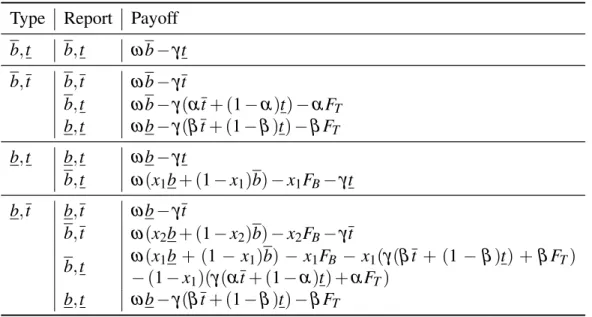
We begin the analysis with the derivation of the taxpayer’s payoffs for those strategies that are not dominated. These are given in Table 6.
Type Report Payoff
b,t b,t ωb−γt b,t b,t ωb−γt b,t ωb−γ(αt+ (1−α)t)−αFT b,t ωb−γ(βt+ (1−β)t)−βFT b,t b,t ωb−γt b,t ω(x1b+ (1−x1)b)−x1FB−γt b,t b,t ωb−γt b,t ω(x2b+ (1−x2)b)−x2FB−γt b,t ω(x1b + (1−x1)b)−x1FB −x1(γ(βt + (1− β)t) + βFT) −(1−x1)(γ(αt+ (1−α)t) +αFT) b,t ωb−γ(βt+ (1−β)t)−βFT
Table 6:The taxpayer’s payoffs in the intermediate information regime (regime 2) depending on type and report.
C.1.1 Equilibrium for high-powered tax auditor incentives
We first derive the equilibrium for lowθT and lowθS and present the restrictions for
θT andθSunder which this equilibrium will be valid.
First, high powered-incentives imply positive audit probabilities for all conditions un-der which an audit can take place. Therefore we conjecturex1∈(0,1),x2∈(0,1)as well asα∈(0,1)andβ∈(0,1). Under this conjecture reporting the truthful valuations
will be part of the equilibrium for the taxpayer. Then, the concrete audit probabilities for both auditors can be derived from the following equilibrium conditions:
(1) The statutory auditor will setx1andx2such that
... Type b,t taxpayers are indifferent between reports b,t and b,t. Equating the payoffs and rearranging yieldsx1= ω
... Typeb,t taxpayers are indifferent between reportsb,t andb,t. This yieldsx2=
x1.
(2) The tax auditor will setα andβ such that
... Type b,t is indifferent between reportingb,t and b,t. Equating the respective payoffs yieldsα= γ+γFT.
... Typeb,tis indifferent betweenb,t andb,tyieldingβ =α. Moreover,α=β =
γ
γ+FT also make typeb,tindifferent between reportingb,t andb,t.
(3) The conjectures and considerations above have shown that the taxpayer will use an equilibrium strategy profile consisting ofφ1>0,η >0,ν1>0,ν2>0 andν3>0.
These probabilities will be set such that the statutory and the tax auditor are indifferent between their pure strategies. The auditors use Bayes’ rule when updating their beliefs after observing a certain report. We obtain the following four equations to determine five probabilities:
• The statutory auditor is indifferent between high and low effort after observing reportb,t. Updating leads to prob{b|bˆ=b,tˆ=t}= p pη+(1−p)ν2
η+(1−p)ν2+1−p+pφ1 and pη+ (1−p)ν2=θS(1−p+pφ1). (12)
• The statutory auditor’s indifference given report b,t and updating beliefs to prob{b|bˆ=b,tˆ=t}= ν1(1−p)
ν1(1−p)+p(1−φ1) yields
ν1(1−p) =θSp(1−φ1). (13)
• The tax auditor being indifferent given report b,t and updating to prob{t|bˆ =
b,tˆ=t}= pφ1+(1−p)ν2(1−x1)
pφ1+(1−p)ν2(1−x1)+1−p+pη(1−x1) yields
pφ1+ (1−p)ν2(1−x1) =θT(1−p+pη(1−x1)). (14)
• The tax auditor being indifferent given report b,t and updating to prob{t|bˆ =
b,tˆ=t}= (1−p)(ν3+ν2x1)
(1−p)(ν3+ν2x1)+p(1−η+ηx1) implies
Solving these equations forφ1,η,ν1,ν2andν3yields φ1= (1−p)(θT(1+θS(1−x1))−ν2(1−x1)(1+θT)) p(1−θSθT(1−x1)) η =(1−p)(θS(1+θT)−ν2(1+θS(1−x1)) p(1−θSθT(1−x1)) ν1= θS((1−x1)(1+θT)(1−p)ν2−θTθS(1−x1) + (1+θT)p−θT) (1−p)(1−θSθT(1−x1)) ν2∈(ν2,ν2) ν3= (1−p)((1−x1)θT(1+θS)−x1)ν2−θT((1−x1)θS(1+θT −p)−p) (1−p)(1−θSθT(1−x1)) . (16)
The probabilityν2has to be set such that all other reporting probabilities are between
zero and one. Note that for sufficiently small θT,θS all reporting probabilities are between zero and one forν2=0. Therefore, the lower bound ν2 will be zero. The
upper bound has to be determined fromφ1(ν2)≥0,η(ν2)≥0,ν3(ν2)≥0 orν1(ν2) +
ν2+ν3(ν2)≤1.
Similar considerations yield restrictions onθT and θS defining the valid range of the equilibrium:
1. The first boundary condition ensures positive probabilities: 1−θSθT(1−x1)>
0 ⇔ θT <θS(11−x1).
2. A taxpayer of typeb,t has the strongest incentives to deviate from truthful re-porting. The reportb,twill be part of the equilibrium as long asν1+ν2+ν3<1.
Inserting and reformulating yields the implicit condition
(1−x1)(θT2θS+θTθS2) + (1−p)θTθS−p(1+θT+θS) +1 −(1−x1)(1+θT)(1+θS)(1−p)ν2>0.
(17)
Note that both conditions provide a valid space for θS and θT for all x1,p∈(0,1).
Condition 17 can be rearranged to
p< 1+θTθS+ (1−x1)(θ
2
TθS+θTθS2)−(1−x1)(1+θT)(1+θS)ν2 1+θTθS+θT+θS−(1−x1)(1+θT)(1+θS)ν2
<1 (18)
C.1.2 Equilibrium under medium tax auditor incentives
We conjecturex1∈(0,1), x2=0,α ∈(0,1)andβ ∈(0,1)as the equilibrium
strate-gies for the statutory and tax auditors. The probabilities can be determined from the following:
(1) The statutory auditor will setx1such that typeb,t is indifferent between reporting
b,t andb,t. This yieldsx1= ω+ωFB.
(2) The tax auditor will setα andβ such that
... Typeb,t being indifferent betweenb,t andb,t yieldsα = γ
γ+FT.
• Typeb,t is indifferent betweenb,t andb,t. This yieldsβ = (γ−ω)
γ+FT . These prob-abilities imply that typeb,t is also indifferent between reportingb,tandb,t.
Given the conjectures above, the taxpayer will use an equilibrium reporting profile with
φ1,φ2,η,ν3∈(0,1) and ν1=1−ν3∈(0,1). Equating the payoffs for the statutory
and tax auditors foraS=1,0 andaT =1,0 and using Bayes’ rule gives three equations that can be used to determine the four equilibrium reporting probabilities.
• The statutory auditor being indifferent given b,t and prob{b|bˆ =b,tˆ=t}= pη
pη+1−p+pφ1 yields
pη =θS(1−p+pφ1). (19)
• The tax auditor being indifferent givenb,tand prob{t|bˆ=b,tˆ=t}= φ1p
φ1p+pη(1−x1)+1−p
implies
φ1p=θT(pη(1−x1) +1−p). (20)
• The tax auditor being indifferent givenb,tand prob{t|bˆ=b,tˆ=t}= pφ2+(1−p)ν3
pφ2+(1−p)ν3+p(1−η+ηx1)
implies
pφ2+ (1−p)ν3=θTp(1−η+ηx1). (21)
The solution to this system of three equations is
φ1= (1−p)θT(1+θS(1−x1)) p(1−θSθT(1−x1)) φ2∈(φ2,φ2) η= (1−p)θS(1+θT) p(1−θSθT(1−x1)) ν3= θT(p−(1−x1)θS((1+θT)−p)) (1−p)(1−θSθT(1−x1)) −φ2 p 1−p (22)
The equilibrium derived above will be valid if the following conditions are fulfilled: 1. Our conjecturex2=0 must be fulfilled. Using prob{b|bˆ=b,tˆ=t}=(1− (1−p)(1−ν3)
ν3)(1−p)+p(1−φ1−φ2)
yields(1−ν3)(1−p)<θS(1−φ1−φ2). Insertingν3,φ1andφ2=0 yields
(1−x1)(θT2θS+θTθS2) + (1−p)θTθS−p(1+θT+θS) +1<0, (23)
which replicates the LHS of condition (17) atν2=0.
2. Reformulatingν3≤1 usingφ2=1−φ1yields the conditionθT ≤1. 3. Reformulating η ≤1 yields θS≤ 1+θT−pp(1+θTx
1). Tedious algebra shows that
this condition impliesφ1≤1 providedθT ∈(0,1).
The lower and upper bounds for φ2 will be determined as follows: (1)ν3≤1 yields
φ2≥ (1+θT)p−(1+θ
2
TθS(1−x1))
p(1−θTθS(1−x1)) . Combining this with conditionφ2≥0 we obtain:
φ 2(·) =max 0,(1+θT)p−(1+θ 2 TθS(1−x1)) p(1−θTθS(1−x1)) . (24)
(2)φ2 has to be determined such that (23) holds. Inserting and rearranging leads to
φ2≤
p(θT+θS)−(1−x1)(θT2θS+θTθS2)−(1−p)(1+θTθS)
p(1+θS)(1−θSθT(1−x1)) . (3) Reformulating ν3≥0 yieldsφ2≤ θT(p−(1−x1)θS((1+θT)−p))
p(1−θTθS(1−x1)) . The minimum of the two expressions above determines the
upper boundφ2.
C.1.3 Equilibrium under low tax auditor incentives
Under weaker incentives, the tax auditor will not audit reportb,t orb,t. We conjecture thatα>0 andβ=0 because the taxpayer has stronger incentives for the former report.
We also guessx1>0 andx2=0. The probabilities can be determined as follows: (1) The audit probabilityx1will make typeb,t indifferent between reportsb,t andb,t. Therefore,x1=ω+ωFB.
(2) The tax audit probabilityα is set such that b,t is indifferent between b,t andb,t.
We obtainα =γ+ωFT.
(3) G