TE
E
THER
: Gnawing at Ethereum to Automatically Exploit Smart Contracts
Johannes Krupp
CISPA, Saarland University,
Saarland Informatics Campus
Christian Rossow
CISPA, Saarland University,
Saarland Informatics Campus
Abstract
Cryptocurrencies like Bitcoin not only provide a decen-tralized currency, but also provide a programmatic way to process transactions. Ethereum, the second largest cryptocurrency next to Bitcoin, is the first to provide a Turing-complete language to specify transaction pro-cessing, thereby enabling so-calledsmart contracts. This provides an opportune setting for attackers, as security vulnerabilities are tightly intertwined with financial gain. In this paper, we consider the problem of automatic vul-nerability identification and exploit generation for smart contracts. We develop a generic definition of vulnera-ble contracts and use this to buildTEETHER, a tool that allows creating an exploit for a contract given only its bi-nary bytecode. We perform a large-scale analysis of all 38,757 unique Ethereum contracts, 815 out of which our tool finds working exploits for—completely automated.
1
Introduction
Cryptocurrencies are widely regarded as one of the most disruptive technologies of the last years. Their central value proposition is providing a decentralized currency—not backed by banks, but built on concepts of cryptography and distributed computing. This is achieved by using a blockchain, a publicly verifiable append-only data structure in which all transactions are recorded. This data structure is maintained by a peer-to-peer network. All nodes of this network follow a consensus protocol that governs the processing of trans-actions and keeps the blockchain in a consistent state. Furthermore, the consensus protocol guarantees that the blockchain cannot be modified by an attacker, unless they control a significant fraction of computation power in the entire network.
In 2009, the first cryptocurrency, Bitcoin [22], was launched. Since then, it has seen an unprecedented hype and has grown to a market capitalization of over 150
bil-lion USD [1]. Although Bitcoin remains the predominant cryptocurrency, it also inspired many derivative systems. One of the most popular of these is Ethereum, the second largest cryptocurrency by overall market value as of mid 2018 [1].
Ethereum heavily extends the way consensus proto-cols handle transactions: While Bitcoin allows to specify simple checks that are to be performed when processing a transaction, Ethereum allows these rules to be specified in a Turing-complete language. This makes Ethereum the number one platform for so-calledsmart contracts.
A smart contract can be seen quite literally as a con-tract that has been formalized in code. As such, smart contracts can for example be used to implement fundrais-ing schemes that automatically refund contributions un-less a certain amount is raised in a given time, or shared wallets that require transactions to be approved of by multiple owners before execution. In Ethereum, smart contracts are defined in a high-level, JavaScript-like lan-guage called Solidity [2] and is then compiled into a bytecode representation suitable for consumption by the Ethereum Virtual Machine (EVM). Parties can interact with this contract through transactions in Ethereum. The consensus protocol guarantees correct contract execution in the EVM.
Of course, increased complexity comes at the cost of increased risk—Ethereum’s Turing-complete Solidity is more error-prone than the simple checks that can be spec-ified in Bitcoin. To make matters worse, once deployed, smart contracts are immutable and cannot be patched or updated. This causes an unparalleled coupling of soft-ware vulnerabilities and financial loss. In fact, since the inception of Ethereum in 2015, several cases of smart contract vulnerabilities have been observed [3, 4], caus-ing a loss of tens of millions USD. As Ethereum is be-coming more and more popular and valuable, the impact of smart contract vulnerabilities will only increase.
In this work, we tackle the problem of automatic vul-nerability discovery and, more precisely, automatic
ex-ploit generation. Our attacker model assumes a regular Ethereum user without special capabilities whose goal it is to steal Ether from a given contract. Towards this, we first give a generic definition of contract vulnerabili-ties. Our definition is based on the observation that value transfer from one account (a contract) to another can only occur under few and well-defined conditions. In particu-lar, we identify four critical, low-level EVM instructions that are necessarily involved in a value transfer: One used to create regular transactions (CALL), one for contract ter-mination (SELFDESTRUCT), and two that can allow for code injection (CALLCODE,DELEGATECALL).
We propose a methodology to find vulnerable execu-tion traces in a contract and employ symbolic execuexecu-tion to automatically create an exploit. Our approach is as fol-lows: We search for certain critical paths in a contract’s control flow graph. Specifically, we identify paths that lead to a critical instruction, where the instruction’s ar-guments can be controlled by an attacker. Once a path is found, we leverage symbolic execution to turn this path into a set of constraints. Using constraint solving we can then infer the transactions an attacker has to perform to trigger the vulnerability. The special execution envi-ronment of smart contracts make this a non-trivial task. Most notably we show how to handle hash values sym-bolically, which are used extensively in smart contracts.
To demonstrate the utility of our methodology, we fi-nally perform a large-scale analysis of 38,757 unique contracts extracted from the blockchain.TEETHERfinds exploits for 815 (2.10%) of those—completely auto-mated, without the need for human intervention or man-ual validation, and not requiring source code of contracts. Due to code sharing this puts the funds of at least 1,731 accounts at risk. Furthermore, a case-study indicates, that many of the underlying vulnerabilities are caused by the design choices of Solidity and misunderstandings about the EVM’s execution model.
We summarize our core contributions as follows: 1. We provide a generic definition of vulnerable
con-tracts, based on low-level EVM instructions (Sec-tion 3).
2. We develop a toolTEETHER that provides end-to-end exploit generation from a contract’s bytecode only. To this end, we tackle several EVM-specific challenges, such as novel methodologies to handle hash values symbolically (Section 4).
3. We provide a large-scale vulnerability analysis of 38,757 unique contracts extracted from the Ethereum blockchain (Section 5).
2
Background
Ethereum is the second largest consensus-based transac-tion system next to Bitcoin, with a current market capi-talization of over 110 billion USD [1]. Ethereum is of-ten described as a second-generation blockchain, due to its support of so-calledsmart contracts—accounts con-trolled only by code which can handle transactions fully autonomously. In this section, we give a description of smart contracts, the Ethereum virtual machine, as well as the Ethereum execution model.
2.1
Transaction System
At the very core, Ethereum provides a public ledger for a new cryptocurrency calledEther. It provides a mapping between accounts—identified by a 160-bit address—and their balance. This ledger is backed by a network of mu-tually distrusting nodes, so-called miners. Users can sub-mit transactions to the network in order to transfer Ether to other users or to invoke smart contracts. Miners will then process these transactions and, using a consensus protocol, agree on the outcome thereof. A processing fee is paid to the miner for each transaction to prevent re-source exhaustion attacks on the network as well as to in-centivize miners to process as many transactions as pos-sible. All processed transactions are kept in a blockchain, a public hash-based append-only log, which allows any-one to verify the current state of the system.
2.2
Smart Contracts
Asmart contractis a special type of Ethereum account that is associated with a piece of code. Like regular ac-counts, smart contracts can hold a balance of Ether. Ad-ditionally, smart contracts also have a (private) storage— a key-value store with 256-bit keys and 256-bit values. This storage is only “private” in the sense that it cannot be read or modified by other contracts, only by the con-tract itself. Furthermore, the storage is notsecret. In fact is only cryptographically secured against external mod-ifications. As all transactions are recorded in the public blockchain, the contents of a contract’s private storage can be easily reconstructed by analyzing all transactions.
2.2.1 The Ethereum Virtual Machine (EVM)
The code of a smart contract is executed in a spe-cial purpose virtual machine, the Ethereum Virtual Ma-chine (EVM). The EVM is a stack-based virtual ma-chine with a wordsize of 256 bit. Besides arithmetic and control-flow instructions, the EVM also offers special instructions to access fields of the current transaction,
modify the contract’s private storage, query the current blockchain state, and even create further transactions1.
The EVM only provides integer arithmetic and cannot handle floating point values. To be able to denote val-ues smaller than 1 Ether, balance is expressed inWei, the smallest subdenomination of Ether. 1 Ether=1018Wei.
In addition to the 256 bit word stack and the persistent storage the EVM also provides a byte-addressable mem-ory, which serves as an input and output buffer to various instructions. For example, theSHA3 instruction, which computes a Keccak-256 hash over a variable length data, reads its input from memory, where both the memory lo-cation and length of the input are provided via two stack arguments. Content of this memory is not persisted be-tween contract executions, and the memory will always be set to all zero at the beginning of contract execution.
2.2.2 Solidity
Smart contracts are usually written in Solidity [2], a high-level language similar to JavaScript, and then compiled to EVM bytecode. For ease of readability, we will use Solidity in examples, however, our analysis is based on EVM bytecode only and completely Solidity-agnostic.
Smart contracts can be created by anyone by sending a special transaction to the zero address. After creation, the code of a contract is immutable, which means that smart contracts cannot be updated or patched. While some at-tempts have been made to create “updatable” contracts that only act as a front-end and delegate actual execution to another, updatable contract address, in most cases cre-ating a new contract with updated code and transferring funds is the only option—given that funds can still be reclaimed from the old contract2.
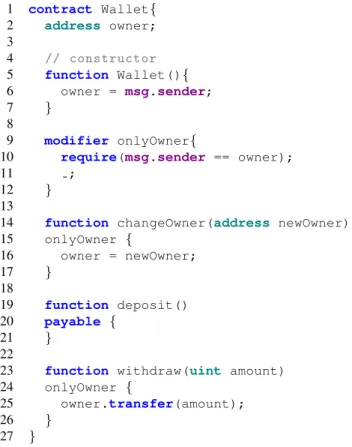
An example smart contract is given in Figure 1. This smart contract models a wallet, which allows to deposit and withdraw money (deposit,withdraw) as well as to transfer ownership of the wallet (changeOwner). In Solidity, a function with the same name as the contract is considered a constructor (Wallet). The constructor code is only executed once during contract creation and is not part of the contract code afterwards.
Furthermore, Solidity has the concept of modifiers. Modifiers are special functions with a placeholder ( ) that allow to “wrap” other functions. Modifiers are often used to implement sanity or security checks. For instance, the example contract defines a modifieronlyOwner, which checks if the sender of the current transaction is equal to the stored owner of the wallet. Only if the check suc-1The original Ethereum paper [25] distinguishes between
transac-tions, which are signed by regular accounts, andmessages, which are not. For simplicity we will refer to both as transactions in this paper.
2https://np.reddit.com/r/ethereum/comments/3l6b6b/ fuck i just send all my ether to a new contract/
1 contract Wallet{ 2 address owner; 3 4 // constructor 5 function Wallet(){ 6 owner = msg.sender; 7 } 8 9 modifier onlyOwner{
10 require(msg.sender == owner);
11 ;
12 }
13
14 function changeOwner(address newOwner)
15 onlyOwner { 16 owner = newOwner; 17 } 18 19 function deposit() 20 payable { 21 } 22
23 function withdraw(uint amount)
24 onlyOwner {
25 owner.transfer(amount);
26 }
27 }
Figure 1: A contract that models a wallet.
ceeds the actual function is executed. This is used to en-sure that only the owner of the wallet can perform with-draw money or transfer ownership.
2.2.3 Transactions
In Ethereum, all interactions between accounts happens through transactions. The most important fields of a transaction are to, sender, value, data, and gas.
sender andtoare the sender and receiver of a trans-action respectively. In a normal transtrans-action between two regular accounts,valuedenotes the amount to be trans-ferred whiledatacan be used as a payment reference. A simple function call on a smart contract on the other hand is a transaction with a valueof 0 and datathe input data to the contract. By convention, Solidity uses the first four bytes ofdataas a function identifier, followed by the function arguments. The function identifier is com-puted as the first four bytes of the Keccak-256 hash of the function’s signature. E.g., to call thewithdrawfunction,
datawould consist of the bytes2e1a7d4d, followed by the amount to be withdrawn in Wei as a 256-bit word. Functions marked aspayable, as for exampledeposit
in Figure 1 can also be invoked through transactions with a non-zerovalue. In this case, the transferred value is
added to the contract’s balance.
The concept of “functions” and “modifiers” only ex-ists at the level of Solidity, not at the bytecode-level of the EVM. At EVM level, a smart contract is just a single string of bytecode, and execution always starts at the first instruction. This is why compiled contracts usually start with a sequence of branches, each comparing the first four bytes ofdatato the contract’s function signatures.
A transaction also specifies the transaction fee a miner gets for processing the transaction. To this end, Ethereum uses the concept of “gas”: Every instruction that is executed by a miner in order to process the trans-action consumes a certain amount of gas. Gas consump-tion depends on the instrucconsump-tion type to model the actual work performed by the miner. For example, a simple addition consumes 3 units of gas, whereas access to the contract’s storage consumes 20000. The transaction field
gastherefore specifies the maximum amount of gas that may be consumed in processing the transaction. When this limit is exceeded, processing of the transaction is aborted. However, the processing fee is still deducted.
2.3
Notation
Keeping our terminology close to the formal specifica-tion of Ethereum [25], we use the following notaspecifica-tion: We useµto denote an EVM machine state with memoryµm and stackµs. Furthermore, we useIto refer to a trans-action’s execution environment, in particular, we useId as thedatafield of the transaction andIv as itsvalue. Finally,Srefers to a contract’s storage.
2.4
Attacker Model
For the attacks considered in this paper we do not require special capabilities from the attacker. An attacker needs only be able to (i) obtain a contract’s bytecode (in order to generate an exploit) and (ii) to submit transactions to the Ethereum network (to execute the exploit). The fact that both of these are trivial to accomplish serves to stress the severity of the attacks found by our toolTEETHER.
2.5
Ethical Considerations
On the one hand, we believe that raising awareness of critical vulnerabilities in smart contracts is fundamen-tally important to maintain the trust of their manifold users. Our methodology thus represents a step forward and allows users to check their contracts for critical flaws that may lead to financial loss. On the other hand, de-scribing a detailed methodology, and in particular, re-leasing a tool to automatically findand exploitflaws in contracts may ask for abuse. Yet we argue this is the right way of going forward, as “security by obscurity”
has proven ineffective since long. Furthermore, espe-cially the fully automated creation of exploits allows to easily validate whether the found vulnerabilities are ac-tually real—an important step to show the effectiveness and accuracy of any bug finding mechanism.
A fundamental downside of largely anonymous blockchain networks like Ethereum, however, is that we cannot reach out to owners of vulnerable contracts. This is in stark contrast to responsible disclosure processes in open-source software projects that have dedicated points of contact. For Ethereum accounts and contracts, such contacts do not exist. We discussed several approaches to tackle this problem, including but not limited to (i) public disclosure of all vulnerable accounts such that they can remedy the problem (yet revealing exactly to the public which contracts are vulnerable); (ii) temporarily trans-fer (“steal”) money from vulnerable contracts into secure contracts until the owner has fixed the problem (yet ren-dering the old contract unavailable, causing money loss due to transaction fees, and being illegal). In the end, we deemed none of these options optimal, and decided to refrain from mentioning particular vulnerable contracts in public. If contract owners are in doubt and can prove their ownership to us, we will responsibly disclose the generated exploit to them. We aim to releaseTEETHER
180 days after publication of this paper, to give contract owners sufficient time fixing their contracts until others can easily reproduce our work by re-executing our tool.
3
Smart Contract Vulnerabilities
Smart contracts usually enforce certain control over who is allowed to interact with them. A particularly impor-tant guarantee is that contracts only allow “authorized” Ethereum accounts to receive coins that are stored in the contract. In this context, a contract isvulnerable, if it al-lows an attacker to transfer Ether from the contract to an attacker-controlled address. From such vulnerable con-tracts, an attacker can steal all (or at least parts of) the Ether stored in them, which can result in a total loss of value for the contract owner.
We now describe how one can identify such vulnera-bilities in Ethereum contracts. Our idea is to statically analyze a contract’s code to reveal critical code parts that might be abused to steal Ether stored in a contract. To this end, we describe how the aforementioned vulnera-bilities map to EVM instructions.
3.1
Critical Instructions
We identify four critical EVM instructions, one of which must necessarily be executed in order to extract Ether from a contract. These four instructions fall into two cat-egories: Two instructions cause a direct transfer, and two
instructions allow arbitrary Ethereum bytecode to be ex-ecuted within a contract’s context.
3.1.1 Direct value transfer
Two of the EVM instructions described in Ethereum’s formal specification [25] allow the transfer of value to a given address: CALLandSELFDESTRUCT.3TheCALL
instruction performs a regular transaction, with the fol-lowing stack arguments:
1. gas– the amount of gas this transaction may con-sume
2. to– the beneficiary of the transaction
3. value– the number of Wei (i.e., 10−18Ether) that will be transferred by this call
4.-7. in offset,in size,out offset,out size– memory location and length of call data respectively returned data.
Thus, if an attacker can control the second stack argu-ment (to) when a CALL instruction is executed with a non-zero third stack argument, they can cause the con-tract to transfer value to an address under their control.
TheSELFDESTRUCTinstruction is used to terminate a contract. This will cause the contract to be deleted, al-lowing no further calls to this contract. SELFDESTRUCT
takes a single argument – an address where all remaining funds of this contract will be transferred to. If an at-tacker can cause execution of aSELFDESTRUCT instruc-tion while controlling the topmost stack element, he can obtain all the contract’s funds as well as cause a perma-nent Denial-of-Service of this contract.
3.1.2 Code injection
While CALL and SELFDESTRUCT are the only two in-structions that allow an attacker to directly transfer funds from a contract to a given address, this does not imply that contracts lacking these two instructions are not vul-nerable. In order to facilitate libraries and code-reuse, the EVM provides theCALLCODEandDELEGATECALL in-structions, which allow the execution of third party code in the context of the current contract.CALLCODEclosely resemblesCALL, with the only exception that it does not perform a transaction toto, but rather to the current con-tract itself as if it had the code of to. I.e. the bene-ficiary of the new transaction remains the same, but it will be processed usingto’s code. DELEGATECALLdoes 3Additionally, theCREATEinstruction allows to create a new con-tract and transfer value to it. However, this would require an attacker to have control over the resulting contract to receive the coins. Therefore, we will not considerCREATEfor the remainder of this work.
1 PUSH20 <attacker−controlled address> 2 SELFDESTRUCT
Figure 2: EVM “shellcode”
the same, but persists the original values ofsenderand
value, i.e., instead of creating a new internal transaction, it modifies the current transaction and “delegates” han-dling to another contract’s code. Consequently,valueis omitted from the arguments ofDELEGATECALL.
If an attacker controls the second stack element (to) of eitherCALLCODEorDELEGATECALL, they can “inject” arbitrary code into a contract. By deploying the snippet from Figure 2 to a new contract, and subsequently is-suing aCALLCODEorDELEGATECALL in the vulnerable contract to this new contract, the original contract can be destructed and all funds transferred to the attacker.
3.1.3 Vulnerable State
Summarizing, this systematic analysis of the Ethereum instructions allows us to precisely define when a contract is in a vulnerable state:
Definition 1(Critical Path). A critical path is a potential execution trace that either
1. leads to the execution of aCALLinstruction with a non-zero third stack element where the second stack argument can be externally controlled,
2. leads to the execution of aSELFDESTRUCT instruc-tion where the first stack argument can be externally controlled, or
3. leads to the execution of either a CALLCODE or
DELEGATECALLinstruction where the second stack
argument can be externally controlled.
Definition 2(Vulnerable State). A contract is in a vul-nerable state, if a transaction can lead to the execution of a critical path.
We will call a transaction that exploits a contract in vulnerable state by one of the critical instructions as a
critical transaction.
3.2
Storage
While it is obvious that a contract in vulnerable state is vulnerable according to our intuition that attackers can steal Ether, the converse it not necessarily true. Con-sider, for example, the contract given in Figure 3. As long asvulnerableis set to false, this contract is not in a vulnerable state, as thetransfer-statement—and
1 contract Stateful{
2 bool vulnerable = false;
3 function makeVulnerable(){ 4 vulnerable = true;
5 }
6 function exploit(address attacker){ 7 require(vulnerable);
8 attacker.transfer(this.balance);
9 }
10 }
Figure 3: Stateful contract
its corresponding CALLinstruction—cannot be reached due to the preceding require. Only after a call to
makeVulnerablethevulnerablevariable is set and a vulnerable state is reached. Yet, intuitively, this contract is vulnerable. We thus have to extend our definition to also include a notion of state that captures modifications made to a contract’s storage.
The only instruction that allows to modify storage is
SSTORE. A transaction that performs a storage modifica-tion therefore always executes aSSTOREinstruction. We can therefore define state-changing transactions.
Definition 3 (State Changing Path). A state changing pathis a potential execution trace that contains at least
oneSSTOREinstruction.
Definition 4 (State Changing Transaction). A transac-tion is state changing if its execution trace is a state changing path.
Combining this with Definition 2 allows us to give the following definition
Definition 5 (Vulnerable). A contract is vulnerable if there exists a (possibly empty) sequence of state chang-ingtransactions that lead to avulnerable state.
From this it immediately follows that a successful ex-ploit always consists of a sequence of state changing transactions followed by a critical transaction.
4
Automatic Exploitation
In this section we presentTEETHER, our tool for auto-matic exploit generation for smart contracts.
4.1
Overview
Figure 4 shows the overall architecture ofTEETHER. In a first step, the CFG-recovery module disassembles the EVM bytecode and reconstructs a control flow graph (CFG). Next, this CFG is scanned for critical instructions
CFG recovery EVM bytecode critical instructions path generation constraint generation exploit generation exploit
Figure 4: Architecture ofTEETHER 0: 0: 34 CALLVALUE 1: 60 PUSH1 0d 3: 57 JUMPI 4: 4: 60 PUSH1 0b 6: 60 PUSH1 00 8: 60 PUSH1 17 a: 56 JUMP 0 d: d: 5b JUMPDEST e: 60 PUSH1 15 10: 60 PUSH1 ff 12: 60 PUSH1 17 14: 56 JUMP 0 17: 17: 5b JUMPDEST 18: 50 POP 19: 56 JUMP 4 b: b: 5b JUMPDEST c: 00 STOP d 15: 15: 5b JUMPDEST 16: 00 STOP 4 d
Figure 5: An example CFG with dependent edges
and for state changing instructions. The path generation module explores paths from the root of the CFG lead-ing to these instructions, from which the constraint gen-eration module creates a set of path constraints through symbolic execution. Finally, the exploit generation mod-ule solves the combined constraints of critical paths and state changing paths to produce an exploit.
4.2
CFG Recovery
Reconstructing a control flow graph from EVM byte-code is a non-trivial task. This is due to the fact that the EVM only provides control flow instructions with indi-rect jumps. Both the conditionalJUMPIand the uncondi-tionalJUMPread the jump target from the top-most stack element. While the jump target can be trivially inferred
in some cases, such as PUSH2 <addr>; JUMP, it be-comes less obvious in other cases. For example, consider theJUMPinstruction at address 19 in Figure 5. Here, the
JUMPinstruction is used similar to x86’sretinstruction, to resume execution at a “return address” that the caller pushed on the stack before the function call.
To address this, TEETHER uses backward slicing to iteratively reconstruct the CFG. Initially, the CFG con-tains only trivial edges, i.e., those matching the above pattern as well as fall-through cases forJUMPI. All other
JUMPandJUMPIinstructions are marked asunresolved. Next, an unresolvedJUMPor JUMPIis selected and the set of (path-sensitive) backward slices of its jump target is computed. If a full backward slice can be found, it is executed to compute the jump target, the newly found edge is added to the CFG, and the corresponding jump instruction marked asresolved. Since introduction of a new edge can lead to possibly new backward slices of jumps within the newly connected subtree, allJUMPand
JUMPI instructions in this subtree are again marked as
unresolved. This process is repeated until no new edges are found and all jump instructions marked asresolved.
In the example in Figure 5, two backward slices can be found for the JUMP instruction at address 19, (PUSH1 0b) and (PUSH1 15), which allows to introduce two out-edges for basic block 17, 17→b and 17→15.
4.2.1 Dependent edges
Another problem that arises from indirect jumps is the problem that a path in the CFG does not necessarily cor-respond to a valid execution trace. E.g. the path 0→4
→17→15, while seemingly plausible from the CFG, can never occur in an actual execution, as the edge 17→
15 can only be taken if 17 was entered from d.
To reduce the number of invalid paths considered in further analyses,TEETHERuses an approach we call de-pendent edges. For this, edges are annotated with a basic block-level summary of their backward slices. In a for-wards exploration, a path may be extended by an edge iff one of its annotations is fully contained in the path. Referring to Figure 5, the path 0→4 →17 may only be extended via 17→b. Likewise, in a backwards ex-ploration these annotations form a set of path require-ments, restricting the exploration to subpaths that can still reach all required basic blocks. For example, a back-wards analysis starting from 15→17 has collected the requirement set{b}and may not take the back-edge 17
→4 as b is not an ancestor of 4.
4.3
Path Generation
The resulting CFG is then scanned forCALL,CALLCODE,
DELEGATECALL, and SELFDESTRUCT instructions. For
each found instruction, the set of backward slices of its critical argument is computed. As we require that this argument is potentially attacker controlled, slices are then filtered for those containing instructions whose results can be directly (ORIGIN, CALLER, CALLVALUE,
CALLDATALOAD,CALLDATASIZE,CALLDATACOPY) or in-directly (SLOAD,MLOAD) controlled by an attacker.
Each of the remaining slices defines an instruction subsequence of a critical path. To find critical paths,
TEETHERexplores paths using A* [15], where the cost of a path is defined as the number of branches this path traverses in the CFG. As every branch in the CFG cor-responds to an additional path constraint, this allows
TEETHER to explore less-constrained paths first. This captures the intuition that a path with fewer constraints is easier to satisfy. To focus on critical paths only, after every step we check whether all remaining instructions of at least one critical slice can still be reached from the current path. If no critical slice can be reached in full, further exploration of the path is discarded.
State changing paths are found in a similar fashion by searching forSSTOREinstructions. As a state change can be useful for an attacker even without controlling the ad-dress or value written (e.g., Figure 3), no backward slices need to be computed in this case. Thus, the A* search only has to check whether aSSTOREinstruction can be reached on the current path.
4.4
Constraint Generation
The constraint generation module runs in lockstep with the path generation. Once a path is found, the path con-straint generation module tries to execute the path sym-bolically in order to collect a set of path constraints. To this end, TEETHER uses a symbolic execution en-gine based on Z3 [13]. Fixed-size elements, such as the call value or the caller’s address are modelled us-ing fixed-size bitvector expressions, variable-length ele-ments, such as the call data, the memory, and the storage are modeled using Z3’s array expressions.
Whenever a conditional branch (JUMPI) is encoun-tered whose condition µs[1] is a symbolic expression, both the jump target and the fall through target are com-pared to the next address defined by the given path, and a new constraint of the formµs[1]6=0 respectively
µs[1] =0 is added accordingly.
4.4.1 Infeasible Paths
Not all paths generated by the path generation module necessarily correspond to feasible execution traces. Con-sider for example the code given in Figure 6. Here the path generation module will eventually output the path 1 → 2→ 4→ 5→ 6. However, when executing this
1 int x = 0;
2 if(msg.value > 0){ 3 x = 1;
4 }
5 if(x!=0){
6 msg.sender.transfer(this.balance);
7 }
Figure 6: Infeasible Paths Example
path, the value ofxat line 5 will always be a concrete value and, since the path skipped the assignment in line 3, will have value 0. Thus the branch to line 6 will not be taken going directly to line 7 instead, leading to a mis-match between the program counter (7) and the next step of the intended path (6). Therefore, we consider a path
infeasible, as soon as the program counter deviates from the desired path. To prevent expensive symbolic execu-tion of further paths that would also be infeasible due to the same conditions, we extract a minimal infeasible subpath. As such deviations can only occur following aJUMPorJUMPIinstruction, we consider the backward slices of the last executed instruction. These slices con-tain all instructions contributing to the jump target and in case ofJUMPIalso to the branch condition. The minimal infeasible subpath is then the subpath of the execution trace starting from the first instruction that is contained in any of the slices. In case a value loaded from memory or storage is contained in the path, the entire execution trace is taken as the minimal infeasible subpath, to keep the analysis sound. This minimal infeasible subpath is then passed back to the path generation module, which will stop exploring paths containing this subpath.
4.4.2 Hash Computation
While symbolic translation of most EVM instructions is relatively straight-forward, special care has to be taken to symbolically model the EVM’sSHA3instruction. The
SHA3instruction takes a memory region as input (speci-fied through two arguments, address and size) and com-putes the Keccak-256 hash over the memory contents stored therein. This instruction is, for example, used by the Solidity compiler for themappingdata structure, which provides a key-value store. Accessing a value stored in amappingis commonly implemented by com-puting the Keccak-256 hash of the key and using the resulting value as an index into the contract’s storage. Since such mappings are a common data structure in Ethereum contracts,TEETHERneeds to be able to reason about such storage accesses, which requires a symbolic modeling of theSHA3instruction.
To this end, whenever we want to symbolically
exe-cute a SHA3 instruction, we introduce a new symbolic 256-bit variable to model the result of the Keccak-256 computation. At the same time we record the relation between this new variables and the input data given to theSHA3instruction. We will later show in Section 4.5.1 how this mapping can be used to solve path constraints which include hash-dependent constraints.
4.4.3 Symbolic-Length Memory Access
Another issue of symbolic execution is that some EVM instructions can copy to/from variable-length elements. For example, theSHA3instruction can compute hashes over variable length data. Similarly, theCALLDATACOPY
instruction, which copies bytes from the given call data into memory, operates on variable-length data. This makes symbolic execution non-trivial, as the length is not a concrete value but a symbolic expression instead.
TEETHERuses two approaches to address these issues. First, whenever data of symbolic length is copied to memory, e.g., when usingCALLDATACOPY, we use Z3’s
Ifexpression to model conditional assignments. For ex-ample, a common pattern seen in smart contracts is copy-ing the entire input data into memory. TEETHER will execute this using assignments of the form
µm0[a+i]←If(i<l,Id[b+i],µm[a+i])
wherea=µs[0],b=µs[1], andl=µs[2]. To keep the number of generated expressions reasonable, we perform assignments only up to a pre-configured upper limit fori
(256 in our experiments).
Second, if data of symbolic length is read from mem-ory, we will return a new symbolic read object. Similarly to mapping of Keccak-256 results to their respective in-put data, we also keep a mapping from symbolic read ob-jects to their address, their length, and the memory-state when the read occurs. This allows us to later resolve the value of a symbolic read object.
4.4.4 Constraint Results
The final output of the constraint generation module for a given pathpis a tupleRp= (µ,S,I,C,H,M), where
µ is the symbolic machine state after execution
S is the symbolic storage of the contract after execu-tion
I is the symbolic environment in which pathpis exe-cuted
C is a set of constraints that must be fulfilled to exe-cute path p
H is a mapping of Keccak-256 result variables to their respective input data
M is a mapping of symbolic read objects to their ad-dress, length, and memory state
We assume that bothµandSalso capture the entire his-tory of the respective states after every instruction.
As discussed, sometimes it will be necessary to per-form a sequence of multiple state changing transactions followed by an exploiting transaction. For this we define the combined constraint result given by a path sequence
~v = p0, . . . , pnasR~v. Letµ0andS0denote the initial
state of a path, thenR~v = (~µ,~S,~I,C,H,M), where
~µ=µp0, . . . ,µpn ~S=Sp0, . . . ,Spn ~I=Ip0, . . . ,Ipn C= n [ i=0 Cpi∪ n−1 [ i=0 {Spi+1 0 =Spi} ∪ {S p0 0 =S}ˆ H= n [ i=0 Hpi M= n [ i=0 Mpi
Note the introduction of additional constraints
Spi+1
0 = Spi and S
p0
0 = Sˆ, which encode that the
state changes performed by path pi, are still present at the beginning of path pi+1. Storage at the beginning of
the first pathp0is equal to the last state ˆS stored in the
blockchain. We will use the notationµ∗andS∗to refer
to the symbolic machine state and storage just before execution of the critical instruction in the final path.
In order to only create meaningful path combinations, we only prepend a state changing path p to a path se-quence~v, if any of the paths in~vmay read from stor-age entries modified by p. To this end, TEETHERalso records every storage accesses that is performed during symbolic execution of a path. A path sequence~vmay read from the storage modifications made by a path p
iff there exists a write to addresseinpand a read from address f in~vsuch that either
1. Botheand f are concrete values ande=f
2. At least one ofeandf is a symbolic expression, and neither depend on a Keccak-256 result
3. Botheandf are symbolic expression dependent on Keccak-256 resultsheandhf respectively, both are structurally identical, i.e., have an identical AST, and the hash results could potentially be equal, i.e., their input data has at least the same length,
kHp[h e]k = H~v[hf] .
TEETHERtries to create an exploit based on a single path first, before trying larger path sequences. For our experiments, we explored path sequences up to length three, consisting of at most two state-changing paths and one final critical path.
4.5
Exploit Generation
The final stage of TEETHER is the exploit generation module, which checks the combined path constraints generated in the previous step for satisfiability with re-spect to Keccak-256 results and symbolic read objects. If a path sequence with satisfiable combined path con-straints is found, this module will output a list of transac-tions that lead to exploitation of the smart contract. Oth-erwise, the next path sequence is requested and tested.
Before checking satisfiability of a combined result, we first encode the attacker’s goals using additional con-straints. The first goal is to transfer funds or code exe-cution to an attacker-controlled addressa. We achieve this by adding a constraintµs∗[1] =a(CALL,CALLCODE,
DELEGATECALL) orµs∗[0] =a(SELFDESTRUCT). The sec-ond goal of the attacker is to make profit. While this is not an issue in the cases ofCALLCODE,DELEGATECALL, andSELFDESTRUCT, as here all funds of the smart con-tract can be transferred to the attacker, additional checks are needed in case of aCALL-based exploit. This is espe-cially true since some of the necessary transactions might require transferring Ethertothe contract first. We thus require that the value transmitted in the finalCALL in-struction is greater than the sum of all values sent to the contract. As value is specified by the third stack argu-ment toCALL, formally this gives
µs∗[2]> n
∑
i=0 Ipi v 4.5.1 Satisfying AssignmentHaving assembled the combined path constraints of a path sequence, including their state inter-dependencies and the attacker’s goals, the next step is to find a sat-isfying assignment, which will give us concrete values to build the transactions required for successful exploita-tion. We leverage the constraint solver Z3. Yet we cannot simply pass our set of collected constraintsas is, as the constraint solver is unaware of the special semantics of Keccak-256 results and symbolic-read objects.
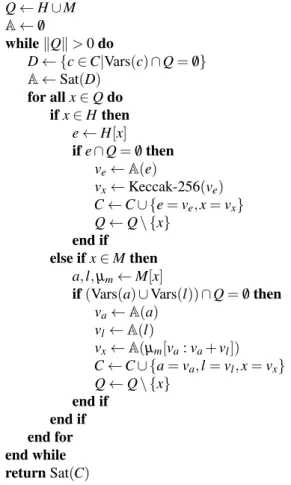
To overcome this problem we apply the iterative ap-proach shown in Figure 7. The algorithm keeps a setQof
unresolvedvariables, which is initially set to all elements ofHandM. As long as this queue is non-empty, we com-pute the subsetDof constraints that is not dependent on any of the variables inQand use a constraint solver to
Q←H∪M A←/0 whilekQk>0do D← {c∈C|Vars(c)∩Q=/0} A←Sat(D) for allx∈Qdo ifx∈Hthen e←H[x] ife∩Q=/0then ve←A(e) vx←Keccak-256(ve) C←C∪ {e=ve,x=vx} Q←Q\ {x} end if else ifx∈Mthen a,l,µm←M[x]
if(Vars(a)∪Vars(l))∩Q=/0then va←A(a) vl←A(l) vx←A(µm[va:va+vl]) C←C∪ {a=va,l=vl,x=vx} Q←Q\ {x} end if end if end for end while returnSat(C)
Figure 7: Iterative Constraint Solving Algorithm
find a satisfying variable assignmentAforD. Next, the
algorithm attempts to resolve unresolved variables from
Q. A variable can be resolved, if it does not depend on other unresolved variables. To resolve a Keccak-256 re-sult, we first evaluate the hash’s input data expression (according toH) in the assignmentA. This gives us a concrete value for the input data, over which we can then compute a Keccak-256 hash. To “fix” this relation be-tween Keccak-256 result variable and input data, we add two new constraints that bind the input-data to its cur-rent valuation and the Keccak-256 result variable to the computed hash value. A symbolic-memory read object is resolved similarly by computing concrete value for the start address and length. Once a variable has been re-solved, it is removed fromQ. This process is repeated until all variables are resolved.
The key insight here is that, since the mappingsHand
Mdefine dependencies between the elements ofHandM
and the variables involved in their corresponding expres-sions, they also implicitly define a topological ordering onHandM. Furthermore, as these mappings can never define a cycle, this ordering is well-defined.
Consider, for example, the Solidity statement
sha3(sha3(msg.sender))which takes the address of the message sender and hashes it twice. This will lead to two entries in H, h0 and h1 with H[h0] =Is and
H[h1] =h0, which gives the dependency chainh1→h0 →Is. This means we first have to fix the value ofIsto computeh0, which will then allow us to computeh1.
4.5.2 Exploiting Transactions
If a satisfying assignment A can be found, TEETHER
will then output a list of transactionst0, . . . ,tnan attacker would have to perform in order to exploit the contract. Transaction value and data content for each transactionti are given by
valuei=A(Iv)
datai=A(Id)
4.6
Implementation
TEETHERis implemented in 4,300 lines of Python, using Z3 [13] as constraint solver. We will releaseTEETHER
as open source 180 days after paper publication.
5
Evaluation
To demonstrate the utility ofTEETHER, we downloaded
a snapshot of the Ethereum blockchain and scanned it for contracts. Using a snapshot from Nov 30 2017, we found a total of 784,344 contracts. Interestingly, many contracts share the same bytecode, with the most popu-lar code being shared by 247,654 contracts. On the other hand, 32,401 contracts were only deployed on a single address. Removing duplicates left us with a total num-ber of 38,757 unique contracts. We executedTEETHER
on all these 38,757 contracts. To avoid the situation that our code analysis gets stuck too long in a single con-tract, we allowed up to 30 minutes for CFG reconstruc-tion plus 30 minutes for finding each aCALL,CALLCODE,
DELEGATECALL, andSELFDESTRUCT-based exploit. We furthermore assumed a contract’s storage was empty at the beginning, such that we can treat duplicate contracts the same. All experiments were performed on a virtu-alized Intel Xeon E5-2660 system with 16 threads and 192 GB of memory, however, we never observed a mem-ory usage of more than 32 GB.
5.1
Results
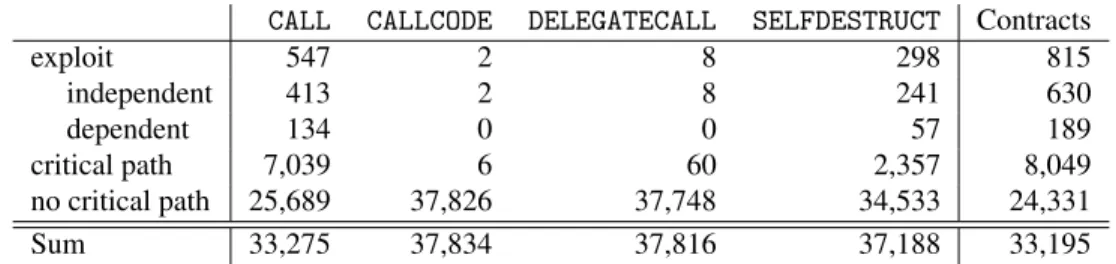
For 33,195 (85.65%) contracts, the analysis finished within the given time limit. Out of these, TEETHER
was able to generate an exploit for 815 (2.10%), which we will analyze in detail below. To put this into per-spective, about two thirds of all contracts, 24,331 or
CALL CALLCODE DELEGATECALL SELFDESTRUCT Contracts exploit 547 2 8 298 815 independent 413 2 8 241 630 dependent 134 0 0 57 189 critical path 7,039 6 60 2,357 8,049 no critical path 25,689 37,826 37,748 34,533 24,331 Sum 33,275 37,834 37,816 37,188 33,195
Table 1: Detailed exploit generation results
62.78%, do not even expose a single critical path. In other words, these contracts either do not contain any
CALL,CALLCODE,DELEGATECALL, orSELFDESTRUCT in-structions, or do so only with non-attacker controllable arguments. Further 8,049 (20.77%) contracts did have a critical path, but we were not able to exploit it. While some of these can be false negatives due toTEETHER’s limitations, like the restricting the transaction sequences to maximum three, or limitations of the underlying con-straint solver, we believe the majority of these cases are actually true negatives, as our definition of critical paths is broad. We will discuss this issue in detail in Section 6. Table 1 shows a breakdown of analysis results per vulnerability type. While many contracts were found vulnerable to CALL- or SELFDESTRUCT-based exploits, only a small number ofCALLCODE- andDELEGATECALL -based exploits were found. However, also the number of contracts having a criticalCALLCODEorDELEGATECALL
path is significantly lower compared with CALL or
SELFDESTRUCT. Interestingly, some contracts exposed multiple vulnerabilities so thatTEETHERgenerated a to-tal of 855 exploits targeting 815 different contracts.
The 855 exploits can be grouped into two classes: As the target contract can send further transactions to other, third-party contracts during execution, the out-come of an exploit might be dependent upon the results returned by these transactions. We will call such ex-ploitsdependent. In contrast, in anindependentexploit, the execution of the target contract does not depend on further transactions to non-attacker-controlled addresses. 134 (24.50%) of the 547 CALL-based exploits and 57 (19.13%) of the 298SELFDESTRUCT-based exploits are dependent, leaving 413 respectively 241 independent ex-ploits. AsTEETHERcan only create path constraints for a single contract, we will only consider independent ex-ploits in the following.
As said before, many contract addresses share the same contract code. Therefore, while the 664 indepen-dent exploits only target 630differentcontracts, in total, 1,731 contract accounts are affected.
5.2
Validation
To verify that the exploits generated by TEETHER do in fact work as intended, for ethical and jurisdictional reasons we refrain from testing them on the actual blockchain. While there are no technical limitations to buying Ether and performing the attacks on the main net-work of Ethereum, we chose to evaluate the generated exploits on private test networks only. We thus modeled an attack on the actual blockchain as close as possible.
Since every contract account has its own storage that can influence the execution, we validate every exploit against every affected account individually, leading to a total of 1,769 (exploit,account)combinations. To this end, we create a fresh test Ethereum network (i.e., a sepa-rate blockchain) containing three accounts: The contract under test, a regular account to model the attacker, and a third contract whose code will be used inCALLCODEand
DELEGATECALLexploits. The attacker’s account and the contract account are given an initial balance of 100 and 10 Ether, respectively. Additionally, we also ensure that the contract’s storage content in our test network agrees with the one from our snapshot of the actual Ethereum blockchain. The network is then run using the unmodi-fied official Ethereum Go client [5], whose scripting in-terface will also be used to submit the exploit transac-tions.
To reduce computation time by allowing tests on sev-eral non-unique contracts at once, we computed the ex-ploit assuming that the contract’s storage was set to zero. The first step in evaluation is thus to repeatTEETHER’s constraint and exploit generation stages by supplying the contract’s actual storage content. Unfortunately, creat-ing an updated exploit fails for 84 (5.71%) of theCALL -based and 28 (9.69%) of the SELFDESTRUCT-based ex-ploits, which means that the generated exploit was a false positive. Note that while the analysis performed by
TEETHERis sound in general, this assumption is the only thing breaking soundness in our evaluation. We further discuss this issue in Section 6
If generation of the updated exploit succeeded, we submit its transaction to our test network. To prevent transaction reordering, we wait until the miner processed each transaction before submitting the next. After the
CALL CALLCODE DELEGATECALL SELFDESTRUCT Total
successful exploit 1,301 1 7 255 1,564 (88.41%)
failed exploit 85 1 1 6 93 (5.26%)
failed update 84 0 0 28 112 (6.33%)
Sum 1,470 2 8 289 1,769 (100.00%)
Table 2: Validation results
last transaction has been processed, we check the final balance of the attacker’s account. As the attacker’s goal is to extract Ether from the target account we call the ex-ploit successful if the final balance is greater than the 100 Ether that we preallocated to it. In order to minimize in-terference due to processing fees we set the gas price in our test network to 0, i.e., no processing fee is deducted. The results for all tested 1,769 exploits are given in Ta-ble 2. Overall, a large fraction (88.41%) of the generated exploits works as expected: Once all exploit transactions have been processed, the attacker has successfully stolen Ether and increased their own balance.
Overall, 205 exploits (11.59%) failed for mainly two reasons. As mentioned earlier, 112 (6.33%) of all ex-ploits failed in the update stage due to the mismatch in storage between the initial exploit generation and the ex-ploit re-computation on the actual storage contents. To better understand why the exploit did not succeed in the remaining 93 cases, we further analyzed the con-straints they induce. About half of these can be attributed to differences between our test network and the actual blockchain. For example, some of these exploits result in constraints based on the current block number or the balance of another account. As we base our test network on a custom genesis block, the current block number will be low when executing the contract, whereas the actual Ethereum blockchain has been constantly growing since 2015 and currently contains over 5,000,000 blocks. Sim-ilarly, as our test network only contains three accounts, retrieving another account’s balance will always return 0, as these accounts do not exist in our network.
5.3
Case Studies
In an effort to shed some light onto the cause of these vul-nerabilities, we manually reviewed all vulnerable con-tracts for which users had uploaded Solidity source code toetherscan.io. However, as this was the case for only 44 (3%) contracts, these findings do not provide a com-prehensive list of contract vulnerabilities, but rather serve as a case-study. Finally, to protect contracts that are still “live”, we only provide a description of the vulnerabili-ties we found, but do not publish addresses of vulnerable contracts.
Vulnerabilities we found in these contracts can be clas-sified into four categories:
1. Erroneous visibility: Per default, Solidity functions are publicly accessible, unless marked with the key-wordinternal. This can lead to unintended expo-sure of contract functionalities. For example, one of the 44 contracts implements a betting functionality with a dedicated function to handle a draw. How-ever, this function is not marked asinternaland can be called directly to transfer funds to arbitrary addresses.
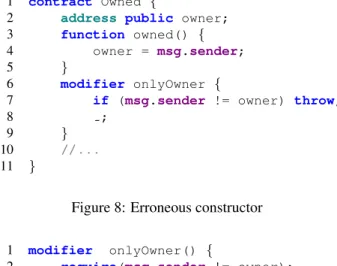
2. Erroneous constructor: In Solidity, a function with the same name as the contract itself serves as the contract’s constructor. In contrast to regular func-tions, the constructor does not become part of the contract’s compiled code and is only executed once during contract creation. However, as Solidity does not provide a special keyword to mark the con-structor, functions that were meant to be construc-tors can become regular functions due to ignoring case-sensitivity, spelling mistakes, or oversight dur-ing refactordur-ing operations such as renamdur-ing. The analyzed contracts contain examples of both, sim-ple mistakes (e.g. Figure 8) and cases where the contract was presumably renamed without renam-ing the constructor (e.g. contractMyContract v1
with constructorMyContract).
3. Semantic confusion: Another class of vulnerable contracts stem from different misunderstandings of Ethereum’s execution model. For example, these contracts seemingly confuse the contract’s total bal-ance (this.balance) with the value held by the current transaction (msg.value). Other cases ne-glect the fact that a contract’s storage is publicly readable and thus should not be used to store se-crets.
4. Logic flaws: The final class of vulnerabilities we observed is caused by logic flaws. For example, the excerpt given in Figure 9 is a flawed imple-mentation of the classicalonlyOwnermodifier, but has an inverted condition. Contrary to the intended behaviour, this allows all marked functions to be called by anyonebutthe owner.
Interestingly, the first three of these categories can be almost exclusively attributed to Solidity. While
vulnera-1 contract Owned {
2 address public owner;
3 function owned() { 4 owner = msg.sender;
5 }
6 modifier onlyOwner {
7 if (msg.sender != owner) throw;
8 ;
9 }
10 // ...
11 }
Figure 8: Erroneous constructor
1 modifier onlyOwner() {
2 require(msg.sender != owner);
3 ;
4 }
Figure 9: FlawedonlyOwnermodifier
bilities due to logic flaws are also common in other do-mains, others could be prevented through modifications of Solidity. For example, making functionsinternal by defaultwould eliminate the first category. Likewise, the second category could be eliminated by introducing a dedicated keyword for constructors.
6
Discussion
While the evaluation results are promising and our tool has identified several hundreds of vulnerable contracts, there are cases in which our current implementation fails to create working exploits. In this section we discuss some of the underlying assumptions and limitations, both ofTEETHERand of the evaluation we performed.
6.1
Critical Path Definition
One potential limitation ofTEETHERis the broad defini-tion of a critical path, specifically of potentially attacker-controlled instructions. Our definition states that a crit-ical path is a path that contains a slice of a critcrit-ical in-struction which contains at least one potentially attacker-controlled instruction (cf. Definition 1). The inclusion of
SLOADandMLOADinto the potentially attacker-controlled instructions makes this criterion apply to many paths, even though the corresponding storage or memory lo-cations may never be writable by an attacker. This, in turn, may cause irrelevant paths to be considered in the path generation. While this does not pose a conceptual problem, it can cause a significant increase in compu-tation time and thus lead to a larger number of
time-outs. This problem could be alleviated by performing additional checks to matchSLOAD andMLOAD to previ-ous writes to create a more precise definition of critical paths, thereby limiting the number of paths considered.
6.2
Inter-Contract Exploits
Furthermore, our current implementation of TEETHER
focuses on intra-contract exploits. In fact, however, a contract may call other contracts, and by supporting this inter-contract communication one could find additional exploits. For example, the bug in Parity’s multi-signature wallet [6] that allowed an attacker to take over multiple wallets, splits core functionality between two contracts. Whereas one contract acts as the actual Wallet, the other is the support library. Only by combining these two con-tractsTEETHERcould find an exploit of this documented vulnerability. In fact, with all relevant code in a single contract, our tool can indeed find the vulnerability and create a working exploit (see Appendix A).
6.3
Evaluation
As described in Section 5, our evaluation initializes the contract’s storage to an empty state when we start search-ing for exploits. This allows us to combine the analysis of contracts that share the same code, reducing the num-ber of tool runs from 784,344 to only 38,757 and has re-duced the overall runtime by roughly factor 20. However, this comes at the cost of imprecise results. As we already have observed in 112 cases, an exploit that would work against a contract with empty storage might not work against the same contract with filled storage. Conversely, our current evaluation might alsomissexploits that only work if the storage contains certain entries. However, this is not a fundamental limitation ofTEETHERand can be solved by retrieving the actual storage state from the real Ethereum blockchain, and reapplying it to our local testbed. While it would require to treat all collapsed non-unique contracts separately, as each address has its own storage state, the results obtained would be sound.
7
Related Work
In this section we discuss related work in the areas of smart contract analysis and automatic exploitation, and how they relate to the work presented here.
7.1
Smart Contract Analysis
Analysis of smart contracts has been an area of active research for the past few years. In a similar vein to the work present herein, Luu et al. [20] presented OYENTE,
a tool to detect certain vulnerabilities like transaction-ordering dependence or reentrancy. However, their work is substantially different from ours in two ways: Firstly, OYENTE only considers a very specific set of vulnera-bilities, many of which can also only be exploited by a malicious miner or a by colluding with a miner collud-ing. In contrast, we give a general vulnerability defini-tion that can be exploited by a much weaker attacker—in fact, anyone with an Ethereum account. Secondly, the goal of OYENTEis only todetecta vulnerability. This means that the report generated by OYENTE have to be painstakingly verified on a case-by-case basis. Our tool, on the other hand, is designed to automatically provide an exploit once a vulnerability is found. Validation is then often as easy as executing the exploit transactions and checking the final balance.
Atzei et al. [7] provide a survey on attacks against Ethereum smart contracts, giving a taxonomy and dis-cussing attacks and flaws that have been observed in the wild. While not all attacks they consider provide a mone-tary benefit to the attacker, some of the attacks presented therein are a special case of the vulnerabilities consid-ered byTEETHER. For example, the multiplayer games attack described in their paper can also be identified and be exploited by our tool—fully automated.
In an effort to support further vulnerability analyses, Matt Suiche has proposed a decompiler [24]. Also, Zhou et al. [26] developed Erays, a tool for reverse engineering smart contracts able to produce high-level pseudocode from compiled EVM code. Yet in contrast to our work, both of these rely on manual contract inspection (al-though at a higher code abstraction).
Aside from security vulnerabilities, Delmolino et al. [19] describe several pitfalls that can lead to logic flaws in smart contracts. In a similar vein, several works consider the problem of designing good contracts, e.g. Mavridou et al. [21] or Chen et al. [12].
Fr¨owis and B¨ohme [14] performed an analysis on trust-dependencies between contracts, revealing that contracts oftentimes rely on further external contracts. This also implies that a vulnerable contract may put other, dependent contracts at risk.
Complementary to vulnerability detection there have also been advances towards verification of smart con-tracts. The work by Bhargavan et al. [9] presentsEVM*
andSolidity*that provide a direct translation of a sub-set of EVM bytecode and Solidity into F* respectively, which can then be used for further verification.
ZEUS, recently presented by Kalra et al. [18], provides a framework to check smart contracts written in Solid-ity against a user-defined policy. Both contract source code and policy are compiled together into an LLVM-based intermediate representation, which is then further analysed statically, leveraging existing LLVM-IR-based
verification tools. Based on this, they analyze 1,524 Ethereum contracts for policy violations against a list of known bugs (including the ones considered by OYENTE). Additionally, they also use ZEUS to check a subset of contracts against contract-specific fairness properties.
Like OYENTE, ZEUS also requires access to a con-tract’s source code, whereas our tool works given only compiled EVM bytecode. Furthermore, in contrast to our tool, ZEUS requires user-interaction to define a policy, which is often contract specific. Finally, a policy viola-tion found by ZEUSdoes not imply practical exploitabil-ity of the contract in question, whereas our tool outputs exploits that can be easily validated.
Finally, Breidenbach et al. [10] proposed using bug bounties to incentivize security analyses of smart con-tracts. Specifically, they designed a framework that en-codes the process of identifying exploits and paying re-wards into a smart contract itself, thereby guaranteeing fairness between the bounty payer and the bug finder.
7.2
Automatic Exploitation
Another area that is related to our work is the research field of automatic exploitation. Many tools have been proposed that can create specific classes of exploits under certain conditions. Notable examples are: Q, presented by Schwartz et al. [23], can transform a x86 software exploit into another exploit that still works under harder constraints (e.g., Address Space Layout Randomization and WˆX).AEGby Avgerinos et al. [8] andMAYHEM
by Cha et al. [11] both provide means to create a control flow hijacking exploit using buffer overflows or format string attacks from source code and compiled binaries, respectively. Huang et al. [17] extends the considered attack surface by including the operating system and li-braries a compiled binary uses at runtime, and work by Hu et al. [16] considers non-control-flow hijacking ex-ploits by modelling data-oriented exex-ploits.
While all of these share the general idea of symbolic execution, constraint generation, and resolution to gen-erate an exploit—as does the work presented herein— there are major differences. The most obvious difference is that the execution environment of the EVM does not provide an equivalent to buffer overflows or format string exploits. As such, the considered exploits are substan-tially different. Furthermore, all works mentioned rely on preconditioning, i.e., providing a starting point to the path exploration, most often in the form of a crashing in-put. In contrast to this, our work can create an exploit only based in the compiled contract’s code without fur-ther input. Finally, fur-there are also challenges specific to the EVM that do not apply to previous work, primarily handling and resolution of hash-values, which are an in-tegral part of many smart contracts.
8
Conclusion
We have presented a generic definition of vulnerable con-tracts and a methodology for automatic exploit gener-ation based on this definition. In a large-scale analy-sis encompassing 38,757 contracts from the Ethereum blockchain,TEETHERidentified 815 as vulnerable. Fur-thermore,TEETHERsuccessfully generated 1,564 work-ing exploits against Ethereum accounts that use these contracts. This illustrates that smart contract security should be taken seriously, especially as these exploits are fully anonymous and trivial to conduct—they only require an Ethereum account. Exploit generation, as we have shown, can be fully automated.
Over the last years, Ethereum has seen a rapid and steady increase in value. Should this trend continue into the future, smart contract exploitation will only become more lucrative, and in turn, seeking protection will be-come even more important. Our methodology and espe-cially concrete tools such asTEETHERcan help in find-ing, understandfind-ing, and preventing exploitsbeforethey cause losses. Finally, our systematic analysis of the real Ethereum blockchain has revealed that the problem of highly-critical vulnerabilities in smart contracts is way larger than anecdotal evidence might suggest.
Acknowledgements
We would like to thank the anonymous reviewers for their comments. Furthermore, this project has received funding from the European Union’s Horizon 2020 re-search and innovation programme under grant agreement No 700176 (“SISSDEN”).
References
[1] https://coinmarketcap.com. Accessed Feb 1st, 2018. [2]
https://soliditylang.com/documentation/language-specifications.html. Accessed Feb 1st, 2018.
[3] https://blog.consensusx.com/dissecting-the-two- malicious-ethereum-messages-that-cost-30m-but-couldve-cost-100m-155e023a9500. Accessed Feb 1st, 2018.
[4] https://www.nytimes.com/2016/06/18/business/ dealbook/hacker-may-have-removed-more-than- 50-million-from-experimental-cybercurrency-project.html. Accessed Feb 1st, 2018.
[5] https://github.com/ethereum/go-ethereum. Accessed Feb 1st, 2018.
[6] https://paritytech.io/the-multi-sig-hack-a-postmortem/. Accessed Feb 1st, 2018.
[7] ATZEI, N., BARTOLETTI, M.,ANDCIMOLI, T. A Survey of Attacks on Ethereum Smart Contracts (SoK). InProceedings of the 6th International Conference on Principles of Security and Trust (POST’17)(2017).
[8] AVGERINOS, T., CHA, S. K., HAO, B. L. T.,ANDBRUMLEY, D. Automatic exploit generation. InProceedings of the 18th Network and Distributed System Security Symposium (NDSS’11).
[9] BHARGAVAN, K., DELIGNAT-LAVAUD, A., FOURNET, C., GOLLAMUDI, A., GONTHIER, G., KOBEISSI, N., KULATOVA, N., RASTOGI, A., SIBUT-PINOTE, T., SWAMY, N.,ET AL. For-mal verification of smart contracts: Short paper. InProceedings of the 11th ACM SIGSAC Workshop on Programming Languages and Analysis for Security (PLAS’16)(2016).
[10] BREINDENBACH, L., DAIAN, P., TRAM`ER, F.,ANDJUELS, A. Enter the hydra: Towards principled bug bounties and exploit-resistant smart contracts. InProceedings of the 27th USENIX Security Symposium (USENIX Security’18)(2018).
[11] CHA, S. K., AVGERINOS, T., REBERT, A.,ANDBRUMLEY, D. Unleashing mayhem on binary code. InProceedings of the 33rd IEEE Symposium on Security and Privacy (S&P’12)(2012). [12] CHEN, T., LI, X., LUO, X.,ANDZHANG, X. Under-optimized
smart contracts devour your money. InProceedings of the 24th IEEE International Conference on Software Analysis, Evolution and Reengineering (SANER’17)(2017).
[13] DE MOURA, L., AND BJØRNER, N. Z3: An efficient smt solver. InProceedings of the 14th International Conference on Tools and Algorithms for the Construction and Analysis of Sys-tems (TACAS’08)(2008).
[14] FROWIS, M.,¨ ANDB ¨OHME, R. In code we trust? In Proceed-ings of the First International Workshop on Cryptocurrencies and Blockchain Technology (CBT’17)(2017).
[15] HART, P. E., NILSSON, N. J.,ANDRAPHAEL, B. A formal ba-sis for the heuristic determination of minimum cost paths.IEEE Transactions on Systems Science and Cybernetics 4, 2 (1968). [16] HU, H., CHUA, Z. L., ADRIAN, S., SAXENA, P.,ANDLIANG,
Z. Automatic generation of data-oriented exploits. In Proceed-ings of the 24th USENIX Security Symposium (USENIX Secu-rity’15)(2015).
[17] HUANG, S.-K., HUANG, M.-H., HUANG, P.-Y., LU, H.-L., ANDLAI, C.-W. Software crash analysis for automatic exploit generation on binary programs.IEEE Transactions on Reliability 63, 1 (2014).
[18] KALRA, S., GOEL, S., DHAWAN, M.,ANDSHARMA, S. Zeus: Analyzing safety of smart contracts. InProceedings of the 25th Network and Distributed System Security Symposium (NDSS’18)
(2018).
[19] KEVINDELMOLINO, MITCHELLARNETT, A. K. A. M.,AND SHI, E. Step by step towards creating a safe smart con-tract: Lessons and insights from a cryptocurrency lab. Cryp-tology ePrint Archive, Report 2015/460, 2015. https:// eprint.iacr.org/2015/460.
[20] LUU, L., CHU, D.-H., OLICKEL, H., SAXENA, P.,AND HO-BOR, A. Making Smart Contracts Smarter. InProceedings of the 23rd ACM SIGSAC Conference on Computer and Communi-cations Security (CCS’16)(2016).
[21] MAVRIDOU, A.,ANDLASZKA, A. Designing secure ethereum smart contracts: A finite state machine based approach. arXiv preprint arXiv:1711.09327(2017).
[22] NAKAMOTO, S. Bitcoin: A peer-to-peer electronic cash system. http://www.bitcoin.org/bitcoin.pdf, 2009.
[23] SCHWARTZ, E. J., AVGERINOS, T., ANDBRUMLEY, D. Q: Exploit hardening made easy. InProceedings of the 20th USENIX Security Symposium (USENIX Security’11)(2011).
[24] SUICHE, M. Porosity: A decompiler for blockchain-based smart contracts bytecode.DEF CON 25(2017).
[25] WOOD, G. Ethereum: A Secure Decentralised Generalised Transaction Ledger.http://gavwood.com/Paper.pdf, 2014. [26] ZHOU, Y., KUMAR, D., BAKSHI, S., MASON, J., MILLER, A.,
ANDBAILEY, M. Erays: Reverse engineering ethereum’s opaque smart contracts. InProceedings of the 27th USENIX Security Symposium (USENIX Security’18)(2018).
1 contract MultiOwned{ 2 uint public m numOwners;
3 uint public m required;
4 uint[256] m owners;
5 mapping(uint => uint) m ownerIndex;
6 mapping(bytes32 => PendingState) m pending;
7 bytes32[] m pendingIndex;
8 struct PendingState { uint yetNeeded; uint ownersDone; uint index; } 9 modifier onlymanyowners(bytes32 operation) {
10 if (confirmAndCheck( operation)) ;
11 }
12 function confirmAndCheck(bytes32 operation) internal returns (bool) { 13 uint ownerIndex = m ownerIndex[uint(msg.sender)];
14 if (ownerIndex == 0) return;
15 var pending = m pending[ operation];
16 if (pending.yetNeeded == 0) { 17 pending.yetNeeded = m required;
18 pending.ownersDone = 0;
19 pending.index = m pendingIndex.length++;
20 m pendingIndex[pending.index] = operation;
21 }
22 uint ownerIndexBit = 2∗∗ownerIndex;
23 if (pending.ownersDone & ownerIndexBit == 0) { 24 if (pending.yetNeeded <= 1) {
25 delete m pendingIndex[m pending[ operation].index];
26 delete m pending[ operation];
27 return true; 28 }else{ 29 pending.yetNeeded−−; 30 pending.ownersDone |= ownerIndexBit; 31 } 32 } 33 }
34 function initMultiowned(address[] owners, uint required) { 35 m numOwners = owners.length + 1;
36 m owners[1] = uint(msg.sender);
37 m ownerIndex[uint(msg.sender)] = 1;
38 for (uint i = 0; i < owners.length; ++i)
39 {
40 m owners[2 + i] = uint( owners[i]);
41 m ownerIndex[uint( owners[i])] = 2 + i;
42 }
43 m required = required;
44 }
45 function pay(address to, uint amount) onlymanyowners(sha3(msg.data)){ 46 to.transfer(amount);
47 }
48 }
A
Parity-Wallet Bug
Figure 10 shows a minimal working example of the Parity-Wallet Bug in a single contract. Lines 1-44 are taken verbatim from the original Parity wallet4.
We ran TEETHER on this contract with the goal to produce an exploit transferring 1 Ether from the con-tract (address 0x400...000) to the attacker (address
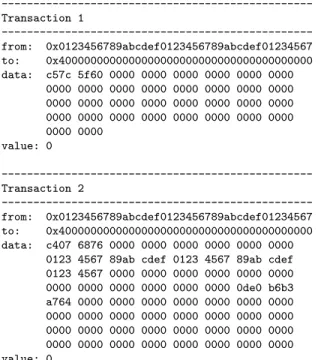
0x012...567). TEETHER produces the following ex-ploit in 26.74 seconds: ---Transaction 1 ---from: 0x0123456789abcdef0123456789abcdef01234567 to: 0x4000000000000000000000000000000000000000 data: c57c 5f60 0000 0000 0000 0000 0000 0000 0000 0000 0000 0000 0000 0000 0000 0000 0000 0000 0000 0000 0000 0000 0000 0000 0000 0000 0000 0000 0000 0000 0000 0000 0000 0000 value: 0 ---Transaction 2 ---from: 0x0123456789abcdef0123456789abcdef01234567 to: 0x4000000000000000000000000000000000000000 data: c407 6876 0000 0000 0000 0000 0000 0000
0123 4567 89ab cdef 0123 4567 89ab cdef 0123 4567 0000 0000 0000 0000 0000 0000 0000 0000 0000 0000 0000 0000 0de0 b6b3 a764 0000 0000 0000 0000 0000 0000 0000 0000 0000 0000 0000 0000 0000 0000 0000 0000 0000 0000 0000 0000 0000 0000 0000 0000 0000 0000 0000 0000 0000 0000 0000 value: 0
The first transaction of this exploit calls function
initMultiowned (c57c5f60) with all-zeros as ar-guments, i.e., an empty owners-array and 0 as
required. This function will re-initialize the con-tract’s owner information, settingm numOwnersto 1 and addingmsg.sender, the attacker, tom owners[]as the sole owner.
The second transaction then calls pay (c4076876), with the attacker’s address (0x012...567) as to and 1018=0xde0b6b3a7640000 (1 Ether in Wei) asamount. As the attacker has been set as the sole owner by th