25
Journal of Advanced Research in
Materials Science
Journal homepage: www.akademiabaru.com/arms.html ISSN: 2289-7992
Effects of Welding on the Microstructural Properties of AISI
430 Ferritic Stainless Steel
Shahid Zaman1, Muhammad Adil Khattak1,∗, Mohd Nasir Tamin1
1 Faculty of Mechanical Engineering, Universiti Teknologi Malaysia, 81310, Skudai, Johor, Malaysia
ARTICLE INFO ABSTRACT
Article history: Received 18 January 2018
Received in revised form 6 February 2018 Accepted 28 March 2018
Available online 20 May 2018
Ferritic stainless steel (FSS) are engineering alloys with high strength, improved ductility and better corrosion resistance in environments containing various compounds of chloride, normally experienced in petrochemical and nuclear power industries. However ferritic stainless steel suffer some weldability issues like grain growth at heat effected zone (HAZ), martensite and carbide formation at grain boundaries, sensitization and intergranular stress corrosion cracking. In this study AISI 430 butt TIG welding is investigated for these issues. The investigations reveal the presence of martensites and carbides in the grain boundaries along with coarse grain structure in HAZ and FZ. The increased hardness and strength at weld zone causes FSS to have low ductility and prone to cracking in stress environment.
Keywords:
Welding, ferritic stainless steels, sensitization, welding conditions,
mechanical properties Copyright © 2018 PENERBIT AKADEMIA BARU - All rights reserved
1. Introduction
Ferritic stainless steel (FSS) is most important type in the family of stainless steel due to better ductility, good strength and corrosion resistance in chloride, acidic and petrochemical industries [1, 2]. These alloys offer good resistance to corrosion and stress corrosion cracking in aggressive environments. They are used in various applications where corrosion resistance rather than mechanical properties is the primary operation requirement [3]. It is an inexpensive alloy as compared to austenitic stainless steel due to the absence of nickel and considered best alternative in high temperature environment due to the low thermal expansion [4, 5]. Ferritic stainless steel is considered to be the good substitute for austenitic stainless steel in various applications especially that require nickel free stainless steel.
Although this alloy possess good ductility and formability in wrought form however it is less used in engineering applications. This is because the fusion welding of ferritic stainless steel particularly the first generation group (AISI 430) suffered many welding problems. One such problem is the excessive grain growth in the fusion zone (FZ) and heat affected zone (HAZ) during welding of FSS.
∗Corresponding author.
E-mail address: Muhammad Adil Khattak ([email protected]) Penerbit
Akademia Baru
Open Access
26
The coarse grain structure in FZ and HAZ can cause the material to have low toughness and ductility [6, 7]. Along with the grain growth there is also formation of martensites in the grain boundaries in FZ and HAZ which increase strength but at the cost of toughness and ductility [8, 9]. These authors also recommended low heat input during welding to reduce the grain growth. Other investigated the effect of grain refinement element such as Ti on the mechanical properties of AISI 430 [10]. They observed the incremental strength and ductility upto the addition of 2 g Ti.
Another problem associated with the welding is the intergranular corrosion (IGC) caused by depletion of chromium content in the vicinity of HAZ. This susceptibility to IGC is called sensitization [11]. Sensitization in the presence of stress and corroded environment promote stress corrosion cracking [12, 13].
Various researchers investigated to reduce sensitization, including controlling the interstitial constituents (C+N), ferritic factor, addition of stabilization elements (Ti,Nb) and heat input and cooling rate [12, 14]. For welding, addition of stabilizing elements and heat input is the good options for sensitization control, provided that other factors of welding are optimized.
High temperature Embrittlement (HTE) is another problem associated with welding of FSS. In welding when this alloy is heated to solid solution, upon cooling the chromium carbides and nitrides distributed inter and intragranularly. The combined effect of coarse grain and carbides make the HAZ brittle [15]. All of the above problems and their remedies are reviewed by [16].
In the past various attempts has been made to overcome various problems associated with FSS welding separately. In this study a characterization technique is used to investigate various issues related to the welding of FSS (AISI 430). The same material is welded using tungsten inert gas welding (TIG). Metallurgical and mechanical properties of TIG welded FSS has been tested to arrive at the weldability issues. The outcome of this study will be beneficial to the welding of AISI 430 in various structures.
2. Materials and Methods
The welding process, Tungsten inert gas welding (TIG) was used to join AISI 430 plate of thickness 2 mm by single pass using 309 austenitic stainless steel electrode. The process parameters are presented at Table 1. While a summary of the characterization presented at Table 2. The two plates were welded using butt welding.
3. Results and Discussion
3.1 Microstructure
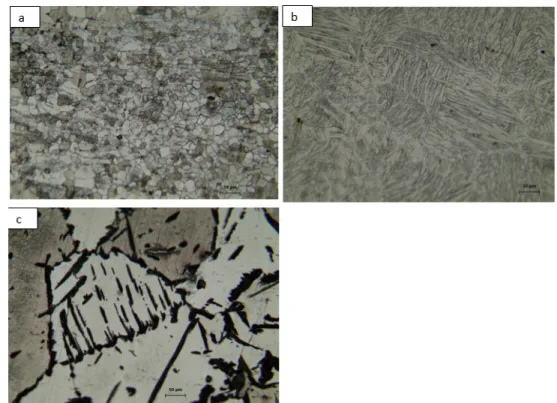
The microstructure of base metal, fusion zone and heat affected zone is shown in figure 1. The microstructure of base material consists of fine equiaxed ferrite grain structure with some martensites and carbides figure 1 (a).
The optical micrographs after etching in ferric Chloride 5g + HCL 50ml in 100 ml water solution of the HAZ, BM and FZ shows the grain growth at the HAZ. When the wrought structure of ferritic stainless steel is heated above 1100 °C the carbides and martensites dissolves as austenite and carbides. As the material cool down the ferrite grain growth occur. If austenite is stable at high temperature it will stop the grain growth by pinning. The grain growth have very deleterious effect on the toughness. From the Figure 1 (c) the tremendous grain growth occur due to welding heating cycle at the HAZ. Due to grain growth the ductility is decrease dramatically and limits its applications in some cases.
27
The optical micrograph also shows the grain boundary martensites and carbides distributed inter and intragranularly. The austenite that may have formed during the heating cycle convert to martensite during rapid cooling and deposited intergranularly. The intergranular martenstes formed during heating cycle increase the hardness at the heat effected zone and decrease the toughness.
Optical microscopic examination of the weld zone after etching revealed typical microstructure of weld zone, namely dendritic and columnar grain structure Figure 1 (b). The micrograph reveal the elongated grains of ferrite matrix with probably martensitic grain boundaries. The elongated grains have lower toughness and prone to cracking in cyclic loading conditions. Also the martensites at the grain boundaries increase the hardness which also contribute to the low ductility and reduced toughness. The martensite formation during weld thermal cycle can be determine by Kaltenhauser Ferrite Factor (KFF). The KFF value of greater than 9.5 indicate higher ferrite and less than 9.5 give substantial martensite formation [17].
Figure 2 shows the comparison of various zones during welding. The HAZ zone have immense grain growth during welding. The base metal consist of fine grain structure with fine precipitates along the grain boundaries. The precipitation behaviour at HAZ and FZ is the Chromium carbides and nitrides dring TIG welding as pointed out by [18].
Table 2
Characterization techniques
Characterization Description Chemical
Composition
In order to determine the chemical composition of the base metal and the welds, GDX was performed table 3.
Microstructure To reveal the constituent and structure, specimens were prepared according to the ASTM E3 standard for optical microscopy and scanning electron microscopy (SEM). The specimens were then etched with ferric Chloride 5g + HCL 50ml in 100 ml water.
Optical Microscopy The fusion zone, heat effected zone and base metal was analyzed using optical microscope to see the grain size and grain boundary morphology.
SEM/EDS The above three areas were further examined for deep incite using SEM attached
with electron dispersive spectroscopy (EDS) to see the precipitates.
Mechanical The study of the hardness on the base metal and the welds was performed to examine the hardness profile across the weld. Tensile testing was performed according to ASTM E-08 to see the effect of welding on mechanical properties.
Table 3
Chemical composition of base material
Chemical composition Wt. %
Material C Mn Cr P S Si N Fe
AISI 430 0.06 0.5 17 0.02 0.001 0.2 0.1 Balance
Table1
Parameters of TIG welding process
Weld current Start current Frequency Voltage Passes Filler
28
Fig. 1. Optical micrograph showing microstructure of (a) base material (b) fusion zone dendritic structure (c) heat affected zone grain growth.
Fig. 2. Substantial grain growth at HAZ as compared to BM
29
Fig. 4. SEM/EDS line scan in HAZ along the grain boundaries showing precipitation behaviour
Scanning electron microscope (SEM) was used to analyse the microstructure with more detail. Energy-dispersive spectrometry (EDS) spectra including line scan was taken as part of the analysis. The micrograph in Figure 3 reveal the grain boundaries martensites and carbides at HAZ and FZ. These precipitates which is most likely chromium carbides deplete the chromium content near the grain boundaries and becomes sensitized [3, 14]. The line scan using SEM attached with EDS was taken along the grain boundaries to reveal the contents of different elements as shown in Figure 4. The result shows that iron content is lower along the grain boundaries while Cr and C content is higher which shows the Cr-C precipitates.
The precipitation and martensite behaviour along the grain boundaries at HAZ make the FSS sensitized, which is also called weld decay. When this sensitized material is put in operation in humid or chloride environment cracks are initiated along the sensitized area. This process is further termed as intergranular cracking (IGC) [19, 20].
3.2 Hardness Variations
Hardness measurement was taken across the welded zone as shown in figure 5, where different areas at weld zone are identified such as FZ, HAZ and BM. Figure shows the trend of the hardness at various locations. The increased hardness of HAZ was due to the martensite and carbide formation inter and intra granularly as evident from microstructural studies. Lippoldand Kotecki [21] reported that the martensites formed in ferritic stainless steel is of low carbon with reduced hardness value. The increased hardness in welding cause the material strengthen but at the cost of reduce toughness. The hardness distribution in the welding zone can be controlled by various techniques as applied by [18].
3.3Tensile Results
To study the tensile properties, tensile tests of base and welded material were carried out. Engineering stress strain curve were plotted. Yield strength, tensile strength and percent elongation were determined. The stress strain diagram of ferritic stainless is shown in Figure 6. Tensile studies clearly showed that base metal showed improved ductility as compared to welding. The increased strength is achieved at the cost of low ductility. The reduction in ductility is about 52 % to that of the
30
base metal. The controlling factors behind the strength and ductility are investigated by many researchers. As pointed out by [18] the grain refinement give improved ductility when the welding is done in cryogenic cooling and 80 % of the base metal ductility can be achieved. The improved ductility and strength can be achieved by using the friction stir welding (FSW) process [22]. The coarse grains structure of base metal can be converted into fine grain structure of ferrite and martensite due to rapid cooling rate and plastic deformation in FSW.
Fig. 5. Rockwell hardness on B-scale (a) profile scheme of hardness implemented (b) Graphic of the hardness measured
Fig.6. Tensile properties of base material and weld metal
As pointed out by [18] the grain refinement give improved ductility when the welding is done in cryogenic cooling and 80 % of the base metal ductility can be achieved. The improved ductility and strength can be achieved by using the friction stir welding (FSW) process [22]. The coarse grains structure of base metal can be converted into fine grain structure of ferrite and martensite due to rapid cooling rate and plastic deformation in FSW.
31
3. Conclusion
The microstructure and mechanical properties of tungsten inert gas (TIG) welding of AISI 430 ferritic stainless steel joint were investigated. From this study the following conclusions are derived.
• The equi-axed fine grain structure of base metal is changed to needle like duplex martensitic
and ferritic structure in weld zone due to high cooling rate from austenitic formation temperature.
• The fine grains of base metal is converted into large grain size with martensite and chromium
carbides precipitates inter and intragranularly distributed in heat affected zone. This behaviour causes sensitization and intergranular corrosion in severe environments.
• The tensile specimen of welded and base metal was compared and it was found that there is little increase in the strength (16 %) but the ductility is dropped by 52 %. This is due to the martensitic, precipitates and coarse grain structure in HAZ and FZ.
• The hardness of the FZ and HAZ is varying from 53 to 59 HRB as compared to base metal having hardness 30 to 34 HRB. This is due to the martensitic and chromium carbides precipitation in HAZ and FZ.
References
[1] Amuda, Moh, and S. Mridha. "MICROSTRUCTURAL FEATURES OF AISI 430 FERRITIC STAINLESS STEEL (FSS) WELD
PRODUCED UNDER VARYING PROC." International Journal of Mechanical and Materials Engineering4, no. 2 (1970). [2] Amuda, M. O. H., and Shahjahan Mridha. "Grain refinement in ferritic stainless steel welds: the journey so far."
In Advanced Materials Research, vol. 83, pp. 1165-1172. Trans Tech Publications, 2010.
[3] Kotecki, D. J., and J. C. Lippold. "Welding metallurgy and weldability of stainless steels." Wiley, Hoboken, NJ Barbero B, Ureta E (2011) Comparative study of different digitization techniques and their accuracy. Comput Aided Des 43 (2005): 188-206.
[4] Sedriks, A., Corrosion of stainless steels, 1996. Sponsored by The Electrochemical Society, Princeton, NJ, and John Wiley & Sons, New York, 2nd ed,. p. 111.
[5] Sabioni, Antônio Claret Soares, Anne-Marie Huntz, Elizete Conceição da Luz, Marc Mantel, and Christian Haut. "Comparative study of high temperature oxidation behaviour in AISI 304 and AISI 439 stainless steels." Materials Research 6, no. 2 (2003): 179-185.
[6] Kou, Sindo. "Welding Metallurgy, Hoboken, New Jersey: A John Wiley and Sons." Inc. Publishing (2003).
[7] Pickering, F. B. "Physical metallurgy of stainless steel developments." Int. Met. Rev., Dec. 1976, 21, 227-268 (1976). [8] Reddy, G. M. "Grain refinement in ferritic stainless steel welds through magnetic arc oscillation and its effect on
tensile property." Indian Welding Journal 39, no. 3 (2006): 35.
[9] Reddy, G. Madhusudhan, and T. Mohandas. "Explorative studies on grain refinement of ferritic stainless steel welds." Journal of Materials Science Letters 20, no. 8 (2001): 721-723.
[10] Mallaiah, G., P. Ravinder Reddy, and A. Kumar. "Influence of titanium addition on mechanical properties, residual stresses and corrosion behaviour of AISI 430 grade ferritic stainless steel GTA welds." Procedia Materials Science 6 (2014): 1740-1751.
[11] Amuda, Muhammed Olawale Hakeem, and Shahjahan Mridha. "An overview of sensitization dynamics in ferritic stainless steel welds." International Journal of Corrosion 2011 (2011).
[12] Matthews, L. M., B. Griesel, P. T. Longman, G. T. Van Rooyen, and J. M. Prozzi. "Sensitisation in low-carbon 12% chromium containing stainless steels." In Proceedings of the 14th International Corrosion Congress, p. 332. 1999. [13] Nishimura, R. "Stress corrosion cracking of type 430 ferritic stainless steel in chloride and sulfate
solutions." Corrosion 48, no. 11 (1992): 882-890.
[14] Du Toit, M., G. T. Van Rooyen, and D. Smith. "An overview of the heat-affected zone sensitization and stress corrosion cracking behaviour of 12% chromium type 1.4003 ferritic stainless steel." Welding in the World 51, no. 9-10 (2007): 41-50.
[15] Amuda, M. O. H., and S. Mridha. "Grain refinement and hardness distribution in cryogenically cooled ferritic stainless steel welds." Materials & Design 47 (2013): 365-371.
[16] Khattak, M.A., et al., Effect of Welding Phenomenon on the Microstructure and Mechanical Properties of Ferritic Stainless Steel – A Review. Journal of Advanced Research in Materials Science 32 (2017): 13-31.
32 [17] Demo, J., D. Peckner, and I. Benstein, Structure and Constitution of Wrought Ferritic Stainless Steels in Handbook
of Stainless Steels. 1977, McGraw-Hill Book Company, New York.
[18] Amuda, Muhammed Olawale Hakeem, and Shahjahan Mridha. "Comparative evaluation of grain refinement in AISI 430 FSS welds by elemental metal powder addition and cryogenic cooling." Materials & Design 35 (2012): 609-618.
[19] Kim, JongMin, and HaeWoo Lee. "Study for corrosion characteristics of ferritic stainless steel weld metal with respect to added contents of Ti and Nb." Metals and Materials International 20, no. 2 (2014): 329-335.
[20] Swaminathan, J., Raghuvir Singh, Manoj Kumar Gunjan, and Bhupeshwar Mahato. "Sensitization induced stress corrosion failure of AISI 347 stainless steel fractionator furnace tubes." Engineering Failure Analysis 18, no. 8 (2011): 2211-2221.
[21] John, Lippol, and J. Kotecki Damian. "Welding metallurgy and weldability of stainless steels." (2005).
[22] Lakshminarayanan, A. K., and V. Balasubramanian. "An assessment of microstructure, hardness, tensile and impact strength of friction stir welded ferritic stainless steel joints." Materials & Design 31, no. 10 (2010): 4592-4600.