1
CONTENTS
1. Introduction 2
2. Degree Requirements for Computer Engineering Major 4 2.1 A.B.E.T. Requirements for the Major 4
2.2 Diversified Education Curriculum 5
2.3 Recommended Course Sequence 6
2.4 Checklist for Computer Engineering Major 7
2.5 Academic Advising 8
2.6 Communication skills 8
2.7 Transfer Credit Equivalency 8
3. Academic Guidelines 8
4. Appendices
A ESE Course Descriptions 10
B CSE Course Descriptions 18
C List of Faculty 20
D Teaching Laboratories 22
E Research Laboratories 26
THE INFORMATION CONTAINED IN THIS DOCUMENT IS SUBJECT TO CHANGE WITHOUT NOTICE
September 2013
This guide is to be used as an aid for students planning course sequences within the Computer Engineering Major. All students should consult the University Undergraduate Bulletin and Bulletin Supplements for official academic information and regulations.
2
1. INTRODUCTION
Computer Engineering is one of the CEAS programs leading to the Bachelor of Engineering degree. As technology continually advances, the solutions to design problems in computer and data processing equipment more frequently encompass both hardware and software solutions. It is important for students who wish to specialize in computer engineering to be fluent in both the newest software techniques as well as digital electronics and the application of large-scale integrated devices. The curriculum of the Computer Engineering program prepares students to meet these objectives.
Students gain a solid foundation to enable them to adapt successfully through out their professional careers. The firs two years of study provide a strong foundation in fundamental courses in mathematics, sciences, writing, and core electrical engineering. In the junior and senior years. Students take computer engineering courses as well as other upper-level computer science courses and technical electives such as computer communications, digital signal processing, digital image processing, computer vision, and embedded microprocessor system design. In the meantime, they also carry out hands-on laboratories and internships to apply the theoretical training. They meet with faculty advisors to consult on course selection, academic progress, and career preparation. In the final year of study, students work in teams and complete an original design project under the supervision of a faculty member.
Career Opportunities in Computer Engineering
Computer engineers design digital systems, a majority of which are microprocessor-based systems. The Systems include a wide variety of consumer products, industrial machinery, and specialized systems such as those used in flight control or automotive anti-loc brakes.
The students may work as interns in engineering and high-technology industries in Long Island corporate offices such as BAE Systems, Omnicon Group, Motorola and Data Device and as graduates they are employed in these corporations and in New York City and across the country. These include Ford Motor, Boeing, GE Energy, and Texas Instruments. A large number of major and international financial institutions including Citigroup, Goldman Sachs and J P Morgan Chase also employ Stony Brook computer engineering graduates. Many baccalaureate graduates choose to go on to graduate school in engineering, business, law, and medicine.
ECE Mission and Needs of Constituencies:
The ECE Department seeks to educate engineers who will possess the basic concepts, tools, skills, and vision necessary to maintain the technological and economic competitiveness of United States.
The department achieves this through a balance of required courses and judicious choices of technical electives in three stages of undergraduate studies in electrical and computer engineering. The first teaches students basic mathematics and science; the second teaches the fundamental techniques of analysis and design of systems; and the third teaches in depth some specialized areas of electrical and computer engineering through choices of technical electives taken during the junior and senior years.
The mission of the ECE Department continues a tradition of excellence by honoring our commitments to students, faculty, alumni, and the University. More specifically,
for our students, we strive:
To provide undergraduates with the broad education necessary for careers in the public/private sector, or to pursue advanced professional degrees;
To provide undergraduates with a deep understanding of both fundamentals and contemporary issues in electrical and computer engineering; and
To engage graduate students with focused instruction and research opportunities for careers in the public/private sector.
3 For our faculty, we strive to
provide support and resources for them to develop as dedicated scholars, devoted educators, and innovative researchers so that they may enjoy long fulfilling, and challenging careers; and
support a collegial environment rich with autonomy, teamwork, discourse, and inquiry. For our alumni, we strive to:
maintain productive ties to enhance their opportunities for lifelong learning and leadership, as well as to benefit from their skills, knowledge, and experience.
For the University, we strive to:
work towards our goals of supporting a challenging and engaging community and to enhance the quality of life for all.
Our mission statement has a preamble followed by declarations of four interconnected commitments to the students, faculty, alumni and the University. Furthermore, the needs of industry are implied from the statements of commitments. Therefore, the major constituencies of our program are students, faculty, alumni, and industry.
Program Educational Objectives (PEO):
The Computer Engineering program has five educational objectives (PEOs):
PEO1: Our graduates should excel in engineering positions in industry and other organizations that emphasize design and implementation of engineering systems and devices.
PEO2: Our graduates should excel in the best graduate schools, reaching advanced degrees in engineering and related discipline.
PEO3: Within several years from graduation our alumni should have established a successful career in an engineering-related multidisciplinary field, leading or participating effectively in interdisciplinary engineering projects, as well as continuously adapting to changing
technologies.
PEO4: Our graduates are expected to continue personal development through professional study and self-learning.
PEO5: Our graduates are expected to be good citizens and cultured human beings, with full appreciation of the importance of professional, ethical and societal responsibilities.
Student Outcomes (SO) To prepare students to meet the above program educational objectives (PEOs), a set of student outcomes that describes what students should know and be able to do when they graduate, have been adopted. We expect our graduates to attain:
a) an ability to apply knowledge of mathematics, science, and engineering;
b) an ability to design and conduct experiments, as well as to analyze and interpret data;
c) an ability to design a system, component, or process to meet desired needs within realistic constraints such as economic, environmental, social, political, ethical, health and safety, manufacturability, and sustainability;
4 d) an ability to function on multi-disciplinary teams;
e) an ability to identify, formulate, and solve engineering problems; f) an understanding of professional and ethical responsibility;
g) an ability to communicate effectively;
h) the broad education necessary to understand the impact of engineering solutions in a global, economic, environmental, and societal context;
i) a recognition of the need for ability to engage in life-long learning; j) a knowledge of contemporary issues, and
k) an ability to use the techniques, skills, and modern engineering tools necessary for engineering practice.
2. DEGREE REQUIREMENTS FOR COMPUTER ENGINEERING MAJOR
Students following a program of study leading to a Bachelor of Engineering must satisfy the general education requirements of the university, as well as, the requirements of the major, which consist of a core of mandatory courses and a set of electives. The Computer Engineering Major of the B.E. degree program is periodically evaluated by the national Accreditation Board for Engineering and Technology (A.B.E.T.). This board, comprising various professional engineering organizations, ensures a consistent engineering curriculum throughout the United States. The B.E. program in computer engineering is accredited by the Engineering Accreditation Commission of ABET, http://www.abet.org.
2.1 A.B.E.T. Requirements for Computer Engineering
A.B.E.T. requires that students have a sound training in mathematics (including probability and statistics), natural sciences, computer sciences, humanities, social sciences, communication skills, and engineering topics. Engineering topics include engineering science and engineering design. Content of the former category is determined by the creative application of basic science skills, while the content in the latter category focuses on the process of devising a system, or component, or process. Design has been integrated into the four year program, beginning with a freshman course ESE 123 Introduction to Electrical and Computer Engineering.. This course concentrates on the design issues of real systems through the fabrication of a working prototype. This course also serves as a vehicle for informing the students of the needs for understanding the fundamentals of basic mathematics and sciences. Sophistication in the use of design tools and analytical skills are continuously developed through a series of required courses taken during the sophomore and junior years, culminating in a capstone senior design project.
5
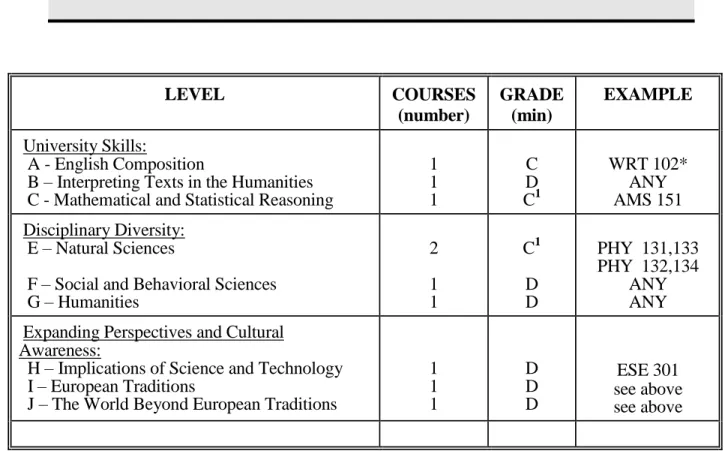
2.2 Diversified Education Curriculum (D.E.C.)
The general education requirements of the university, described in the Diversified Education Bulletin, summarized in Table 1, must be satisfied by all students. D.E.C. requirements are divided into three categories of University Skills, Disciplinary Diversity, and Expanding Perspectives and Cultural Awareness. Additionally, each category is subdivided and assigned a letter from A through J. Courses satisfying each letter category may be taken at any time, except for D.E.C. A, which must be taken in the Freshman year. No D.E.C. course may be used to satisfy two categories simultaneously, however, it may also be used to satisfy the major requirements. For example, PHY 131 satisfies D.E.C. category E as well as the major requirement. In selecting courses for the I and J categories, students must select one with a humanities designator and the other with a social sciences designator (this ensures necessary depth). Students should use Table 1 in planning their D.E.C. course assignments. LEVEL COURSES (number) GRADE (min) EXAMPLE University Skills: A - English Composition
B – Interpreting Texts in the Humanities C - Mathematical and Statistical Reasoning
1 1 1 C D C1 WRT 102* ANY AMS 151 Disciplinary Diversity: E – Natural Sciences
F – Social and Behavioral Sciences G – Humanities 2 1 1 C1 D D PHY 131,133 PHY 132,134 ANY ANY Expanding Perspectives and Cultural
Awareness:
H – Implications of Science and Technology I – European Traditions
J – The World Beyond European Traditions
1 1 1 D D D ESE 301 see above see above
* Students are required to complete WRT 101, Introductory Writing Workshop, and WRT 102, Intermediate Workshop A, with a grade of C or higher, or completion of WRT 103, Intermediate Writing Workshop B, with a grade of C or higher.
1
A grade of "C" is a major requirement
Table 1: Diversified Education Curriculum (D.E.C.) Requirements for Computer Engineering Majors
6
2.3 Recommended Course Sequence For Computer Engineering Major
FALL Credits SPRING Credits AMS 1511 Calculus I(or MAT 131) 3-4 AMS 1611 Calculus II (or MAT 132) 3-4 PHY 1312 Classical Physics I2 3 PHY 1322Classical Physics II 3 PHY 1332 Classical Physics Lab. I2 1 PHY 1342 Classical Physics Lab. II 1
Freshman D.E.C. A English Comp 3 ESE 218 Digital Sys Design 4
ESE 123 Introduction to ECE 4 First Year Seminar 102 1 First Year Seminar 101 1 ESE 124 Com. Tech. for Elect. Design 3 15-16 15-16
D.E.C Course 3 AMS 210 Applied Lin Algebra (or MAT 211) 3
AMS 361 Appl Cal IV (or MAT 303) 4 ESE 382 Digital Design using VHDL 4 ESE 380 Embedded Sys.Dsgn.I 4 ESE 211 Electronics Lab. A 2
Sophomore ESE 271 Circuit Analysis 4 ESE 372 Electronics 4
CSE 230 Int. Prog.in C and C++ 3 CSE 114 Computer Science I 4 or ESE 224 18 17
CSE 214 Computer Science II 3 ESE Elective4 3
AMS 301 Finite Math. Struc. I 3 ESE 300 Writing in Elect. Eng. 3 Junior ESE 305 Deterministic Signals & Sys. 3 D.E.C. H: ESE 301 Eng. Ethics & Soc. Imp. 3 ESE 345 Computer Architecture 3 ESE 306 Random Signals & Systems 4
D.E.C. Course 3 ESE 333 Real-time OS/ or CSE 306 3
ESE Elective3 3
18 16 ESE 440 Elec Engineering Dsgn.I 3 ESE 441 Electrical Eng. Design II 3
ESE Elective5 3 ESE Elective5 3
Senior Math or Science Elective7 4 ESE Elective6 3
D.E.C. Course 3 D.E.C. Course 3
ESE Elective6 3 D.E.C. Course 3
16 15 Total credits = 130 - 132
All courses in boldface must be passed with a minimum grade of C. A course may not satisfy more than one elective category.
1- AMS 151 and AMS 161 can be replaced by (MAT 131 and MAT 132) or (MAT 131 and 171), or (MAT 125, MAT 126 and MAT 127) or (MAT 141 and 142), or (MAT 141 & 171)
2 - PHY 131/133 and PHY 132/134 can be replaced by (PHY 125, PHY 126 and PHY 127,133,134), or
(PHY 141 and PHY 142.). Students taking the three semester sequence should take PHY 125, PHY 127 and PHY 126, in that order.
3
One course selected from: ESE330 or ESE 356 or ESE 366,355,381 4
One course from ESE 304 or ESE 347 or CSE 219 5
Two courses from, ESE 330, ESE 344, ESE 346, ESE 347, ESE 355, ESE356, ESE 357, ESE 358, ESE 360, ESE 366, ESE 381, CSE 376
6
Two courses from ESE 304, ESE 307, ESE 311, ESE 314, ESE 315, ESE 319, ESE 322, ESE 323, ESE 324, ESE 330, ESE 337, ESE 340, ESE 342, ESE 344, ESE 346, ESE 347, ESE 355, ESE 356, ESE 357, ESE 358, ESE 360, ESE 366, ESE 373, ESE 381, ESE 476, CSE219, CSE 376
7
Math or Science elective: one 4-credit course or two three credit courses from CHE 131,(4)
CHE141(4), ESG 198(4), BIO 202&204, BIO 203&205, PHY 251&252(modern Physics), AMS261 (Calculus III) (4)
STUDENTS IN THE MAJOR
MAY NOT
G/PNC MAJOR REQUIRED COURSES
7
2.4. Checklist for Requirements in Computer Engineering
AMS 1511 _________________ PHY 1312 ________________ (PHY 125 _____& 133_____) (or MAT 131) PHY 133 ________________ Or (PHY 127_____& 134_____) AMS 1611 __________________ PHY 1322 ________________ (PHY 126 ________)
(or MAT 132) PHY 134 ________________
AMS 210 (or MAT 211) _____________ AMS 301 ___________AMS 361 (or MAT 303)_________ CSE 114 ___________________CSE 214 ______________CSE 230 (or ESE 224)______________
ESE 301 ___________________(D.E.C. H)
ESE 123 ___________________ ESE 124 _______________ ESE 211 _______________ ESE 218 ___________________ ESE 271 _______________ ESE 300 _______________ ESE 305 ___________________ ESE 306 _______________ ESE 333 _______________
(or CSE 306)
ESE 345 ___________________ ESE 372 _______________ ESE 380 _______________ ESE 382 ___________________ ESE 440 _______________ ESE 441 _______________ ESE Elective 1 ____________________
ESE Elective 2 ____________________
ESE Elective 3 ____________________ _____________________ ESE Elective 4 ____________________ _____________________ Math or Science Elective 5 ____________________ or ___________________ Total credits = 130 - 132
All courses in boldface must be passed with a minimum grade of C A course may not satisfy more than one elective category.
1- AMS 151 and AMS 161 can be replaced by (MAT 131 and MAT 132) or (MAT 131 and 171), or (MAT 125, MAT 126 and MAT 127) or (MAT 141 and 142), or (MAT 141 & 171)
2 - PHY 131/133 and PHY 132/134 can be replaced by (PHY 125, PHY 126 and PHY 127,133,134), or
(PHY 141 and PHY 142.). Students taking the three semester sequence should take PHY 125, PHY 127 and PHY 126, in that order.
3
One course selected from: ESE330 or ESE 356 or ESE 366,355,381 4
One course from ESE 304 or ESE 347 or CSE 219 5
Two courses from, ESE 330, ESE 344, ESE 346, ESE 347, ESE 355, ESE356, ESE 357, ESE 358, ESE 360, ESE 366, ESE 381, CSE 376
6
Two courses from ESE 304, ESE 307, ESE 311, ESE 314, ESE 315, ESE 319, ESE 322, ESE 323, ESE 324, ESE 330, ESE 337, ESE 340, ESE 342, ESE 344, ESE 346, ESE 347, ESE 355, ESE 356, ESE 357, ESE 358, ESE 360, ESE 366, ESE 373, ESE 381, ESE 476, CSE219, CSE 376
7
Math or Science elective: one 4-credit course or two three credit courses from CHE 131,(4)
CHE141(4), ESG 198(4), BIO 202&204, BIO 203&205, PHY 251&252(modern Physics), AMS261 (Calculus III) (4)
STUDENTS IN THE MAJOR
MAY NOT
G/PNC MAJOR REQUIRED COURSES
Fall 2013
8
2.5 Academic Advising
The Department has an undergraduate committee that consists of the Undergraduate Program Director and six faculty members. In addition to curriculum issues, the members of the undergraduate committee also serve as advisors. Each advisor is required to have at least four hours each week for walk-in advising. During these office hours students need not make an appointment to see an advisor. Additionally, the department mandates that all freshmen students in their second semester and transfer students in their first semester see an academic advisor during the pre-registration period. All the other students are divided into two groups. One group is required to see an advisor in the fall semester whereas the other group in the spring semester. This compulsory advising is enforced through a registration block, which is removed only after the student’s course plan is approved by an advisor.
2.6 Communication Skills
The importance of reporting results through written and oral communication is stressed throughout the four years. Technical report writing is an essential component of all laboratory courses. The skills are honed and fine tuned in a required junior level technical communication course. Students must register for the technical communication course ESE 300 concurrently with or after completion of ESE 314, 324, 380, or 382. The senior design project is a final platform for students with an opportunity to present their results in two written reports and an oral presentation.
2.7 Transfer Credit Equivalency
The Department of Electrical & Computer Engineering considers transfer credits for equivalency to ESE courses at any time. The student must provide a detailed course outline, textbook used, and any other pertinent course material for proper evaluation. The process is initiated by the student submitting a completed transfer credit equivalency form, together with additional attachments, to the College of Engineering and Applied Sciences undergraduate office. A record of previous transfer equivalency is available for reference.
3. ACADEMIC GUIDELINES
a) Grading RequirementsAll courses required for the major must be taken for a letter grade (A through D). A grade of "C" or higher is required in each of the following courses:
ESE 211, ESE 271, ESE 218, ESE 300, ESE 345, ESE 372, ESE 380, ESE 382, AMS 151 or MAT 131 , AMS 161 or MAT 132, PHY 131/133, PHY 132/134, CSE 114, CSE 214,
CSE 230 or ESE 224
One course selected from: ESE330, ESE 355, ESE356, ESE 366 or ESE 381 One course from ESE 304 or ESE 347 or CSE 219
Two courses from ESE 330, ESE 344, ESE 346, ESE 347, ESE 355, ESE356, ESE 357, ESE 358, ESE 360, ESE 366, ESE 381, CSE 376
Two courses from ESE 304, ESE 307, ESE 311, ESE 314, ESE 315, ESE 319, ESE 322, ESE 323, ESE 324, ESE 330, ESE 337, ESE 340, ESE 342, ESE 344, ESE 346, ESE 347, ESE 355, ESE 356, ESE 357, ESE 358, ESE 360, ESE 366, ESE 373, ESE 381, ESE 476, CSE 219, CSE 376
b) Pass/No Credit Option
9 c) Residency Requirements
In addition to the University requirements, the following courses must be completed at Stony Brook:
1. Four ESE technical electives and ESE 345, ESE 380, and ESE 382, all with a grade of "C" or higher 2. ESE 440 and ESE 441 with a faculty advisor from the Electrical & Computer Engineering Department. The senior design project must be one that has been pre-approved as appropriate for the Computer Engineering Major.
3. ESE 300
d) College Time Limits for the Bachelor of Engineering Degree
All requirements for the Bachelor of Engineering degree must be met in eleven semesters by those students with full-time status. Full-time transfer students must meet all degree requirements in the number of semesters remaining after the number of transferred degree related credits are divided by 12 (the semester equivalency) and the result is subtracted from 11 (semesters).
e) Graduate Courses
Graduate level courses may be taken by undergraduates with a superior academic record (technical G.P.A. of 3.3 or greater) to satisfy elective requirements with approval. Approval must be obtained from the Department of Electrical & Computer Engineering, the course instructor, and the College of Engineering and Applied Science.
f) Undergraduate Research
Students with a superior academic record may use ESE 499 (0-3 credits) to do an independent research study under the guidance of an Electrical & Computer Engineering faculty. Additional details may be found in the course description. The department has several research laboratories; Appendix F gives a brief description of each laboratory. This course must be taken at Stony Brook.
g) Undergraduate Teaching
Students with a superior academic record may use ESE 475 (3 credits of open elective) or ESE 476 to assist faculty in teaching by conducting recitation, laboratory sections and developing new laboratory experiments. These courses must be taken at Stony Brook, with permission of the Electrical & Computer Engineering Department. ESE 476 may be used as an ESE Elective.
h) University Graduation Requirements
In addition to the above requirements a student should check that he or she has met all additional requirements set forth by the University, and The College of Engineering and Applied Sciences.
STUDENTS SHOULD CONSULT THE UNDERGRADUATE BULLETIN FOR ADDITIONAL INFORMATION ON ACADEMIC GUIDELINES.
10
APPENDIX A
DESCRIPTION OF ESE COURSES
ESE 120 Projects in Electrical Engineering (3)This course allows students to work with faculty and graduate students on an independent project in electrical engineering. This course is intended for high school students who are taking the Principles of Engineering course. Spring.
Prerequisite: Permission of Department.
ESE 123 Introduction to Electrical and Computer Engineering (4)
This course introduces basic electrical and computer engineering concepts through a two-pronged approach; hands-on wired and computer simulation experiments in analog and logic circuits; and supporting lectures providing concepts and theory relevant to the labs, with each experiment discussed one week earlier in lectures. The primary emphasis is on physical insight and applications rather than on mathematical rigor, and the intention is to stimulate the interest of students rather than overwhelm them with theory. PNC grading allowed for non majors. Fall and Spring.
Prerequisites or Corequisites: MAT 125 or 131 or 141 or AMS 151; PHY 125 with Lab 133 or PHY 131 with Lab 133 or PHY141
ESE 124 Computer Techniques For Electronic Design I (3)
An extensive introduction to problem solving in electrical engineering using the ANSI C language. Topics covered include data types, operations, control flow, functions, data files, numerical techniques, pointers, structures, and bit operations. Students gain experience in applying the C language to the solution of a variety of electrical engineering problems, based on concepts developed in ESE 123. Knowledge of C at the level presented in this course is expected of all electrical engineering students in subsequent courses in the major. Spring and Fall.
Prerequisite or Corequisite: MAT 125 or 131 or 141 or AMS 151; ESE 123 or equivalent ESE 201 Engineering and Technology Entrepreneurship (3)
The purpose of this course is to bridge the gap between technical competence and entrepreneurial proficiency. Students are not expected to have any formal business background, but have some background in a technical field. These fields can range from the engineering disciplines to computer science, and from biology and chemistry to medicine. Accordingly, the course will provide the necessary exposure to the fundamentals of business, while minimizing the use of business school jargon. Entrepreneurship is considered as a manageable process built around innovativeness, risk-taking and proactiveness. The course focuses on ventures where the business concept is built around either a significant technical advance in an operational process, or in the application of technology to create a new product or service.
Prerequisites for engineering majors: any core engineering course from one of the engineering majors. Prerequisites for non-engineering majors: any two combinations of the following: EST 192, EST 194, EST 202, LSE 320.
ESE 211 Electronics Laboratory A (2)
Introduction to the measurement of electrical quantities; instrumentation; basic circuits, their operation and applications; electronic devices; amplifiers, oscillators, power supplies, wave-shaping circuits, and basic switching circuits. Fall and Spring.
Prerequisite: ESE 271 Corequisite: ESE 372
11 ESE 218 Digital Systems Design (4)
Develops methods of analysis and design of both combinational and sequential systems regarding digital circuits as functional blocks. Utilizes demonstrations and laboratory projects consisting of building hardware on breadboards and simulation of design using CAD tools. Topics include: number systems and codes; switching algebra and switching functions; standard combinational modules and arithmetic circuits; realization of switching functions; latches and flip-flops; standard sequential modules; memory, combinational, and sequential PLDs and their applications; design of system controllers. Fall and Spring.
Prerequisite or Coreq: PHY 127 with Lab 134 or PHY 132 with Lab 134 or PHY 142 or ESE 124 Prerequisite for CSE majors: CSE 220
ESE 224 Computer Techniques for Electronic Design II (3)
This course is an introduction of C++ programming language for problem solving in electrical and computer engineering. Topics covered include: C++ structures, classes, abstract data types and code reuse. Basic Object-oriented programming concepts as well as fundamental topics of discrete mathematics and algorithms are introduced to solve problems in many areas in electrical and computer engineering.
Fall.
Prerequisite: ESE 124
ESE 231 Introduction To Semiconductor Devices (3)
This course covers the principles of semiconductor devices. Energy bands, transport properties and generation recombination phenomena in bulk semiconductors are covered first. Junctions between semiconductors and metal-semiconductor will then be studied. Equipped with an understanding of the character of physical phenomena in semiconductors, students learn the principles of operation of diodes, transistors, light detectors and light emitting devices. This course will provide general background for subsequent courses in electronics. Spring
Prerequisites: AMS 361 or MAT 303 and PHY 127 with Lab 134 or 132 with Lab134 or PHY 142 ESE 271 Electrical Circuit Analysis I (4)
Electrical circuit analysis. Kirchoff’s Laws, Ohm’s Law, nodal and mesh analysis for electric circuits, capacitors, inductors, and steady-state AC; transient analysis using Laplace Transform. Fundamentals of AC power, coupled inductors, and two-ports. Fall and Spring.
Prerequisites: MAT 127 or 132 or 142 or 171 or AMS 161; PHY 127 with Lab 134 or 132 with Lab 134 or PHY 142
ESE 290 Transitional Study (1-3)
A vehicle used to transfer students to remedy discrepancies between a Stony Brook course and a course taken at another institution. For example, it allows the student to take the laboratory portion of a course for which he or she has had the theoretical portion elsewhere. Open elective credit only. Fall and Spring.
Prerequisite: Permission of department
ESE 300 Technical Communications for Electrical/Computer Engineering (3)
Topics include how technical writing differs from other forms of writing, the components of technical writing, technical style, report writing, technical definitions, proposal writing, writing by group or team, instructions and manuals, transmittal letters, memoranda, abstracts and summaries, proper methods of documentation, presentations and briefings, and analysis of published engineering writing. Also covered is the writing of resumes and cover letters. Spring.
Prerequisite: ESE, ECE majors, junior standing; WRT 102; Prerequisite/ Corequisite: ESE 314 or 324 or 380 or 382
12
ESE 301 (D.E.C. H)Engineering Ethics and Societal Impact (3)
The study of ethical issues facing engineers and engineering related organizations, and the societal impact of technology. Decisions involving moral conduct, character, ideals and relationships of people and organizations involved in technology. The interaction of engineers, their technology, the society and the environment is examined using case studies.
Prerequisites: U3 or U4 standing, one D.E.C. category E course. ESE 304 Applications of Operational Amplifiers (3)
Design of electronic instrumentation: structure of basic measurement systems, transducers, analysis and characteristics of operational amplifiers, analog signal conditioning with operational amplifiers, sampling, multiplexing, A/D and D/A conversion; digital signal conditioning, data input and display, and automated measurement systems. Application of measurement systems to pollution and to biomedical and industrial monitoring is considered. Spring.
Prerequisite: ESE 372
ESE 305 Deterministic Signals and Systems (3)
Introduction to signals and systems. Manipulation of simple analog and digital signals. Relationship between frequencies of analog signals and their sampled sequences. Sampling theorem. Concepts of linearity, time-invariance, causality in systems. Convolution integral and summation; FIR and IIR digital filters. Differential and difference equations. Laplace transform, z-transform, Fourier series and Fourier transform. Stability, frequency response and filtering. Provides general background for subsequent courses in control, communication, electronics and digital signal processing. Fall and Spring
Pre- or corequisite: ESE 271
ESE 306 Random Signals and Systems (4)
Random experiments and events; random variables, probability distribution and density functions, continuous and discrete random processes; Binomial, Bernoulli, Poisson, and Gaussian processes; system reliability; Markov chains; elements of queuing theory; detection of signals in noise; estimation of signal parameters; properties and application of auto-correlation and cross-correlation functions; power spectral density; response of linear systems to random inputs. Spring.
Prerequisite or Corequisite: ESE 305 ESE 311 Analog Integrated Circuits (3)
Engineering design concepts applied to electronic circuits. Basic network concepts, computational analysis and design techniques: models of electronic devices; biasing and compensation methods; amplifiers and filters designed by conventional and computer-aided techniques. Spring.
Prerequisite: ESE 372
ESE 314 Electronics Laboratory B (3)
Laboratory course on design and operation of basic building blocks of electronics. The course is coordinated with, and illustrates and expands upon, concepts presented in ESE 372. Emphasis is given to design solutions more relevant to integrated rather than to discrete element electronics. Field effect transistors are given special attention due to their importance in contemporary analog and digital IC. Frequency responses of the basic amplifiers and active filters are analyzed. Internal structure and fundamental performance limitations of digital inverter and other gates are studied.
13
ESE 319 Electromagnetics and Transmission Line Theory (3)
Fundamental aspects of electromagnetic wave propagation and radiation, with application to the design of high speed digital circuits and communication systems. Topics include: solutions of Maxwell’s equations for characterization of EM wave propagation in unbounded and lossy media; radiation of EM energy; guided wave propagation with emphasis on transmission lines theory.
Prerequisite: ESE 271
ESE 324 Electronics Laboratory C (2)
Illustrates and expands upon advanced concepts presented in ESE 372. Experiments include analog circuits such as oscillators, voltage regulators; mixed-signal circuits such as data converters, phase-locked loops, and several experiments emphasizing the analog design issues in digital circuits. Laboratory fee required. Spring.
Prerequisites: ESE 211, 372; ESE, ECE majors; junior standing ESE 325 Modern Sensors (3)
The course focuses on the underlying physics principles, design, and practical implementations of senors and transducers including piezoelectric, acoustic, inertial, pressure, position, flow, capacitive, magnetic, optical and bioelectric sensors. Established as well as novel sensor technologies as well as problems of interfacing various sensors with electronics are discussed. Spring
Prerequisites: ESE 372 Co/Scheduled: ESE 525
ESE 330 Integrated Electronics (3)
An overview of the design and fabrication of integrated circuits. Topics include gate-level and transistor-level design; fabrication material and processes; layout of circuits; automated design tools. This material is directly applicable to industrial IC design and provides a strong background for more advanced courses. Fall.
Prerequisite: ESE 372
ESE 333 Real-Time Operating Systems (3)
Intro to basic concepts and principles of real-time operating systems. The topics to be covered include operating system concepts and structure, multiple processes, interprocess communication, real-time process scheduling, memory management, virtual memory, file system design, security, protection, and programming environments for real-time systems. Fall
Prerequisite: ESE 124, CSE 214 and ESE 380 or CSE 220 ESE 337 Digital Signal Processing Theory (3)
An introduction to Digital Signal Processing Theory, Sequences, Discrete-Time Convolution, and Difference Equations, Sampling and Reconstruction of Signals, One- and Two-Sided Z-Transforms, Transfer Functions and Frequency Response. Design of FIR and IIR Filters. Discrete and Fast Fourier Transforms and Applications. Fall
Prerequisite: ESE 305
ESE 340 Basic Communication Theory (3)
Basic concepts in both analog and digital data communications; signals, spectra, and linear networks; Fourier transforms, energy and power spectra, and filtering; AM, FM, and PM; time and frequency multiplexing; discussion of problems encountered in practice; noise and bandwidth considerations; pulse modulation schemes. Fall.
14 ESE 342 Digital Communications Systems (3)
Pulse modulation and sampling. All-digital networks. Pulse code modulation. Digital modulation techniques. Time-division multiplexing. Baseband signaling. Intersymbol interference. Equalization. Basic error control coding. Exchange of reliability for rate.ARQ schemes. Message and circuit switching. Spring
Prerequisite : ESE 340
ESE 344 Software Techniques for Engineers (3)
Trains students to use computer systems to solve engineering problems. It covers C/C++ programming language, UNIX programming environment, basic data structures and algorithms, and object oriented programming. Spring.
Prerequisites: ESE 218 or (discontinued ESE 318) and ESE 224 or CSE 230 ESE 345 Computer Architecture (3)
Starts with funcitonal components at the level of registers, buses, arithmetic, and memory chips, and then uses a register transfer language to manipulate these in the design of hardware systems up to the level of complete computers. Specific topics also included are microprogrammed control, user-level instruction sets, I/O systems and device interfaces, control of memory hierarchies, and parallel processing organizations. Fall.
Prerequisites for ESE, ECE majors: ESE 380
Prerequisites for CSE majors: CSE 220 and ESE 218 ESE 346 Computer Communications (3)
Basic principles of computer communications. Introduction to performance evaluation of protocols. Protocols covered include those for local, metropolitan and wide area networks. Introduction to routing, high speed packet switching, circuit switching and optical data transport. Other topics include TCP/IP, Internet, web server design, network security and grid computing. Crosslisted with CSE 346. Spring.
Prerequisite or corequisite for ESE, ECE majors: ESE 306
Prerequisite for CSE majors: CSE 220; Prerequisite or corequisite: AMS 310 or 311 ESE 347 Digital Signal Processing: Implementation (4)
Fundamental techniques for implementing standard signal processing algorithms on dedicated digital signal processing chips. Topics include a review of discrete-time systems, sampling and reconstruction, FIR and IIR filter design, FFT, architecture and assembly language of a basic signal processing chip, and an introduction to adaptive filtering. Spring.
Prerequisite: ESE 337 or ESE 305 and ESE 380 ESE 350 Electrical Power Systems (3)
Fundamental engineering theory for the design and operation of a modern electric power system. Modern aspects of generation, transmission, and distribution are considered with appropriate inspection trips to examine examples of these facilities. The relationship between the facilities and their influence on our environment are reviewed. Topics included are power system fundamentals, characteristics of transmission lines, generalized circuit constants, transformers, control of power flow and of voltage, per unit system of computation, system stability, and extra-high voltage AC and DC transmission. Spring.
Prerequisite: ESE 271
ESE 352 Electromechanical Energy Converters (3)
Basic principles of energy conversion; DC, induction, and synchronous rotary converters; the three-phase system and symmetrical components; the relationships between voltage, current, flux, and m.m.f.; equivalent circuits and operating characteristics of rotary converters; and analysis of saturation effects. Fall.
15 ESE 355 VLSI System Design (4)
Introduces techniques and tools for scalable VLSI design and analysis. Emphasis is on physical design and on performance analysis. Includes extensive lab experiments and hands-on usage of CAD tools.
Spring Prerequisite: ESE 218
ESE 356 Digital System Specification and Modeling(3)
Introduces concepts of specification and modeling for design at various level of abstraction. High Level specification language is used for executable models creation, representing possible
architecture implementations. Topics include design space exploration through fast simulation and reuse of models and implementation. Spring
Prerequsiites: ESE 380 and ESE 124 Co/Scheduled: ESE 501
ESE 358 Computer Vision (3)
Introduces fundamental concepts, algorithms, and computational techniques in visual information processing. Covers image formation, image sensing, binary image analysis, image segmentation, Fourier image analysis, edge detection, reflectance map, photometric stereo, basic photogrammetry, stereo, pattern classification, extended Gaussian images, and the study of the human visual system from an information processing point of view. Fall.
Prerequisites for ESE, ECE majors: ESE 305; ESE 224 or CSE 230 Prerequisites for CSE majors: CSE 214 and CSE 220
ESE 360 Network Security (3)
An introduction to computer network and telecommunication network security engineering. Special emphasis on building security into hardware and hardware working with software. Topics include encryption, public key cryptography, authentication, intrusion detection, digital rights management, firewalls, trusted computing, encrypted computing, intruders and viruses. Fall
Prerequisite: ESE/CSE 346
ESE 363 Fiber Optic Communications (4)
Design of single and multi-wavelength fiber optic communication systems. Topics include: analysis of optical fibers; optical transmitter and receiver design; optical link design, single-wavelength fiber optic networks with analysis of FDDI and SONET/SDH; wavelength division multiplexing. Spring.
Prerequisites: ESE 372
ESE 366 Design using Programmable Mixed-Signal Systems-on-Chip (4)
This course focuses on development of mixed-signal embedded applications that utilize systems on chip (SoC) technology. The course discusses design issues, such as (i) implementing functionality, (ii) realizing new interfacing capabilities, and (iii) improving performance through programming the embedded microcontroller and customizing the reconfigurable analog and digital hardware of SoC.
Prerequisite: ESE 372, ESE 380 and ESE 224 or CSE230 Spring. ESE 372 Electronics (4)
The pertinent elements of solid-state physics and circuit theory are reviewed and applied to the study of electronic devices and circuits, including junction diodes, transistors, and gate and electronic switches; large- and small-signal analysis of amplifiers; amplifier frequency response; and rectifiers and wave-shaping circuits. Fall and Spring.
Prerequisite: ESE 271
16 ESE 380 Embedded Microprocessor Systems Design I (4)
Fundamental concepts and techniques for designing electronic systems that contain a microprocessor or microcontroller as a key component. Topics include system level architecture, microprocessors, ROM, RAM, I/O subsystems, address decoding, PLDs and programmable peripheral ICs, assembly language programming and debugging. Hardware-software trade-offs in implementation of functions are considered. Hardware and software design are emphasized equally. Laboratory work involves design, implementation, and testing of microprocessor controlled circuits. Fall.
Prerequisite: ESE, ECE majors, ESE 218, or Permission of Instructor ESE 381 Embedded Microprocessor Systems Design II (4)
A continuation of ESE 380. The entire system design cycle, including requirements definition and system specifications, is covered. Topics include real-time requirements, timing, interrupt driven systems, analog data conversion, multi-module and multi-language systems. The interface between high-level language and assembly language is covered. A complete system is designed and prototyped in the laboratory. Spring.
Prerequisite:ESE 271 and 380
ESE 382 Digital Design Using VHDL and PLDs (4)
Digital system design using the hardware description language VHDL and system implementation using complex programmable logic devices (CPLDs) and field programmable gate arrays (FPGAs). Topics include design methodology, VHDL syntax, entities, architectures, test benches, subprograms, packages, and libraries. Behavioral and structural coding styles for the synthesis of combinational and sequential circuits are covered. Architectures and characteristics of PLDs and FPGAs are studied. Laboratory work involves writing the VHDL descriptions and test benches for designs, compiling and functionally simulating the designs, fitting and timing simulation of the fitted designs, and programming the designs into a CPLD or FPGA and bench testing. Spring. Prerequisite: ESE, ECE majors, ESE 218, or Permission of Instructor
ESE 440 Engineering Design I (3)
Lectures by faculty and visitors on typical design problems encountered in engineering practice. During this semester each student will choose a senior design project for Engineering Design II. The project incorporates appropriate engineering standards and multiple realistic constraints. A preliminary design report is required. Not counted as a technical elective. Laboratory fee required. Fall.
Prerequisites: ESE or ECE major, senior standing; Two ESE technical electives (excluding ESE 390 and ESE 499); project dependent ; ESE 300
ESE 441 Engineering Design II (3)
Student groups carry out the detailed design of the senior projects chosen during the first semester. The project incorporates appropriate engineering standards and multiple realistic constraints. A comprehensive technical report of the project and an oral presentation are required. Not counted as a technical elective. Laboratory fee required. Spring and Fall.
Prerequisite: ESE 440
ESE 475 Undergraduate Teaching Practicum (3)
Students assist the faculty in teaching by conducting recitation or laboratory sections that supplement a lecture course. The student receives regularly scheduled supervision from the faculty instructor. May be used as a non-ESE technical elective only and repeated once. All semesters.
Prerequisites: Senior standing, a minimum grade point average of 3.0 in all Stony Brook courses, and a grade of B in the course in which the student is to assist; permission of dept.
17
ESE 476 Instructional Laboratory Development Practicum (3)
Students work closely with faculty advisor and staff in developing new laboratory experiments for scheduled laboratory courses in electrical and computer engineering. A comprehensive technical report and the instructional materials developed must be submitted at the end of the course. May be used once as a technical elective for electrical or computer engineering major. May be repeated once but only 3 credits may be used as technical elective for either Electrical or Computer Engineering. Fall and Spring
Prerequisite(s): U4 standing, a minimum grade point average of 3.0 in all Stony Brook courses, and a minimum grade of A- in the course for which the student will develop instruction material; permission of the department and the instructor.
ESE 488 Internship in Electrical/Computer Engineering (3)
An independent off-campus engineering project with faculty supervision. May be repeated but only three credits of internship electives may be counted toward the non-ESE technical elective requirement. All semesters.
Prerequisites: ESE, ECE major; junior standing; 3.0 grade point average in all engineering courses; permission of department
ESE 494 Honors Seminar On Research (1)
An introduction to the world wide research enterprise with special emphasis on research in the United States. Topics include research funding, publications, patents, career options, theory versus experiment,
entrepreneurship and presentation skills. Spring
Prerequisite(s): Acceptance into ECE Honors program or permission of instructor. ESE 495 Honors Research Project (3)
A research project, for students in the honors program, conducted under the supervision of an electrical and computer engineering faculty member.
Prerequisite(s): ECE Honors program, Permission of Department ESE 499 Research in Electrical Sciences (0-3)
An independent research project with faculty supervision. Permission to register requires a 3.0 average in all engineering courses and the agreement of a faculty member to supervise the research. May be repeated but only three credits of research electives (AMS 487, CSE 487, MEC 499, ESM 499, EST 499, ISE 487) may be counted toward non-ESE technical elective requirements. All semesters.
18
APPENDIX B
CSE COURSE DESCRIPTION
CSE 114 Computer Science I (4)
An introduction to procedural and object-oriented programming methodology. Topics include program structure, conditional and iterative programming, procedures, arrays and records, object classes, encapsulation, information hiding, inheritance, polymorphism, file I/O, and exceptions. Software debugging and testing techniques are emphasized including an introduction to formal verification methods. Includes required laboratory.
Prerequisites: C or higher in CSE 113
CSE 214 Computer Science II (3)
An extension of programming methodology to data storage and manipulation on complex data sets. Topics include: programming and applications of major data structures; stacks, queues, lists, binary trees, heaps, priority queues, balanced trees and graphs. Recursive programming is heavily utilized. Fundamental sorting and searching algorithms are examined along with informal efficiency comparisons.
Prerequisite: Grade of C or higher in CSE 114 or passing the proficiency examination for CSE 114.
CSE 219 Computer Science III (3)
Development of the basic concepts and techniques learned in CSE 114 Computer Science I and CSE 214
Computer Science II into practical programming skills that include a systematic approach to program design, coding, testing an debugging. Application of these skills to the construction of robust programs of 1,000 to 2,000 lines of source code. Use of programming environments and tools to aid in the software development process.
Prerequisite: CSE 214
CSE 230 Intermediate Programming in C and C++ (3)
An intermediate introduction to the C and C++ programming languages. Topics include basic control structures and data types, functions and program structures, pointers and arrays, input and output system calls, classes and types, inheritance and object-oriented programming, exceptions and templates.
Prerequsities: CSE 130 or ESE 124 or MEC 112 or ESG 111
CSE 376 Advanced Systems Programming in UNIX/C (3)
Focuses on several aspects of producing commercial-grade system software; reliability, portability, security, and survivability. Uses Unix and C, heavily used in industry when developing systems and embedded systems code. Emphasizes techniques and tools to produce reliable, secure, and highly portable code. Requires substantial programming as well as a course project.
Prerequisite: CSE 214 or 230
19
APPENDIX C:
DEPARTMENT OF ELECTRICAL & COMPUTER ENGINEERING FACULTY
FACULTY RESEARCH INTERESTS
Belenky, Gregory L. Optoelectronic device and systems. Semiconductor devices, physics and technology.
Dhadwal, Harbans S. Integrated fiber optics, Fiber optic biosensors; optical signal processing; photon correlation spectroscopy
Djuric, Petar M. Signal analysis, modeling, and processing; Monte Carlo methods; wireless communications and sensor networks
Doboli, Alexa VLSI CAD with emphasis on hardware/software co-design and mixed-signal synthesis
Donetski, Dmitri Design of long-wavelength detectors, photovoltaic cells and high power laser diode arrays
Dorojevets, Mikhail N. Parallel computer architecture; high-performance systems design; superconductor processors.
Fernandez-Bugallo,Monica Statistical signal processing, with emphasis in the topics of Bayesian analysis, sequential Monte Carlo methods, adaptive filtering, stochastic optimization and their applications to multiuser communications, smart antenna systems, target tracking and vehicle positioning and navigation.
Gindi, Gene Medical Image Processing and Analysis with an emphasis on statistical methods Gorfinkel, Vera Semiconductor devices, including microwave and optoelectronics.
Hong, Sangjin Low-power VLSI design of multimedia wireless communications and digital signal processing systems, including SOC design methodology and optimization Kamoua, Ridha Solid-state devices and circuits; microwave devices; integrated circuits.
Luryi, Serge Sensor systems, semiconductor devices and technologies,
Optoelectronics
Milder, Peter Domain-specific hardware generation tools for FPGA and ASIC Murray, John Signal processing; power switching electronics; systems theory. Parekh, Jayant P. Microwave acoustics; microwave magnetics; microwave electronics;
microcomputer applications.
Robertazzi, Thomas G. Computer networks; parallel processing, performance evaluation and e-commerce technology.
Salman, Emre Nanoscale integrated circuit design; digital and mixed signal circuits Shamash, Yacov Control systems and robotics.
Shterengas, Leon High power and high speed light emitters, carrier dynamics in nanostructures, molecular beam epitaxy
Short, Kenneth L. Digital system design; embedded microprocessor systems; instrumentation. Stanacevic, Milutin Analog and Digital VLSI Circuits
Subbarao, Murali Computer vision; image processing.
Tang, K. Wendy, Parallel and distributed processing; massively parallel systems; computer architecture; neural networks.
Wang, Xin Mobile Computing and Wireless Networking
Westerfeld, David Design and characterization of high-performance mid-infrared semiconductor light sources (LEDs and lasers).
Yang, Yuanyuan Parallel and distributed computing and systems, high speed networks, optical networks, high performance computer architecture, and fault-tolerant computing
20
APPENDIX D
TEACHING LABORATORIES
Analog Laboratory
Contact Person: Anthony Olivo
Location: Room 283, Light Engineering
Usage: ESE 123, ESE 211, ESE 314, and ESE 324
This laboratory contains eighteen work stations consisting of equipment for testing simple to complex analog circuits, from DC to 20 MHz. Each work station consists of the following test equipment:
1) Dell Optiplex Personal Computer with ATE connectivity and Engineering software. 2) Agilent Model 54621A 60 MHz Two Channel Digital Storage Oscilloscope.
3) Agilent Model E3631A Triple Output Power Supply with a variable +6 VDC and +/- 25 VDC outputs. 4) Agilent Model 34401A 6½ Digit Digital Multimeter
5) Fluke Model 8845 High Resolution Digital Multimeter
6) Agilent Model 33120A Arbitrary Waveform Generator that produces various signals from 0.1 Hz to 15 MHz.
7) Agilent Model 33220A Arbitrary Waveform Generator that produces various signals from 0.1 Hz to 20 MHz.
8) E&L Cadet Digital Designer for digital designs.
9) Three section Solderless Breadboard for the construction and testing of circuits designed in the laboratory. A Philips Model 6303A Automatic RLC meter is available for general use. The workstations are networked through a HP Procurve 1800 24 port Gigabit switch to a HP 4200TN LaserJet Network Printer.
The CAD laboratory is used in conjunction with this laboratory for the design, modeling, and simulation of all Analog and Digital circuits built and tested for laboratory experiments
Digital Systems Design Laboratory
Contact Person: Anthony Olivo
Location: Room 283A, Light Engineering Usage: ESE 218
This laboratory contains fourteen workstations, each consisting of an Agilent Model MSO3012B 100 MHz Mixed Signal Oscilloscope, with Two Analog Channels and 16 Digital Logic Signal inputs, and an E&L Ruggedized CADET II Digital Designer.
The Agilent Mixed Signal Oscilloscope can capture and display up to 16 channels of digital data via a flexible dual 8-channel cable and two channels of analog data. Data acquisition is accomplished by normal, time base, channel activity, or glitch triggering. The E&L Instruments Ruggedized CADET II is a multi-function breadboard system,
which consists of the following:
1) A three section Solderless Breadboard for the construction and testing of circuits, 2) A function generator, which outputs sine waves, triangle waves, square waves, and TTL square waves from 0.1 Hz to 100 kHz.
3) Three internal power supplies with a fixed +5VDC, a +1.3 to +15 VDC variable output, and a -1.3 to -15 VDC variable output
21
5) 8 Logic switches, two debounced switches, and a 8 ohm speaker
The CAD laboratory is used in conjunction with this laboratory for the design, modeling, and simulation of all Digital circuits built and tested for laboratory experiments.
Digital Systems Rapid Prototyping Laboratory
Contact Individuals: Scott Tierno, Prof. Ken Short Location: Room: Room 230, Light EngineeringUsage: ESE 382, ESE 440, ESE 441, ESE 475, ESE 476, ESE 499
The Digital Systems Rapid Prototyping Laboratory is devoted to teaching, research, and system design projects involving advanced digital systems employing embedded microprocessor based systems and VHDL based digital systems. The laboratory is located adjacent to the Embedded Systems Design Laboratory (ESDL), in room 228 on the second floor of the Light Engineering building.
The DSRPL facility is structured to support advanced digital design projects, as well as the laboratory portion of an upper division undergraduate VHDL digital design course, ESE-382. The lab room is configured with design stations equipped with computer workstations that are networked to the laboratory's RAID 1 compliant Windows 2003 server. Each workstation includes a dual-display design interface, and provides access to a number of sophisticated software design packages, including ActiveHDL by Aldec, Synplify Pro by Synopsys, ispLEVER by Lattice Semiconductor, and other related software packages. All software packages utilize floating licensing, and are available on virtually all computers in the DSRPL, as well as the ESDL (see above).
The project design verification stations may also be configured with a variety of test and debugging equipment, as needed for a respective design project. Available are JTAG based (on-chip) in-circuit emulators, logic analyzers, spectrum analyzers, digital storage oscilloscopes, arbitrary function/waveform generators, frequency counters, and a variety of other standard and custom lab test equipment. Further available in this room is a device programming station that supports a large number of programmable logic devices including EPROMs, microcontrollers, standard and complex PLDs, and FPGAs. Currently this lab supports digital system design projects utilizing a large varienty of configurable devices such as CPLDs, Cross-over PLDs, and FPGAs from Lattice, Xilinx, and Altera.
The DSRPL meets all requirements of the Americans with Disabilities Act
(ADA), and other mandated safety requirements of the Federal and New York State governments. There are several wheel-chair accessible student workstations available in the DSRPL.
22
Electrical & Computer Engineering Computer Aided Design Laboratory
Contact Person: Scott Campbell, Prof. John Murray-Director
Location: Room 281, Light Engineering
Usage: ESE 123, ESE 124, ESE 211, ESE 218, ESE 271, ESE 300, ESE 305, ESE 306, ESE 314, ESE 315, ESE 316, ESE 324, ESE 337, ESE 345, ESE 346, ESE 347,ESE 349, ESE 357, ESE 358, ESE 372, ESE 380, ESE 381,ESE 382, ESE 440, ESE 441, ESE 475, ESE 476, ESE 499
The Electrical & Computer Engineering Computer Aided Design Laboratory is the primary computing resource for all undergraduate courses taught in the department. The ECE CAD Lab offers undergraduate students access to CAD software tools used to analyze, model, simulate, and better understand engineering concepts. The lab supports every undergraduate course in the department.
The lab has a total of 40 Dell PC's, that are networked via switched ethernet to a Dell file server. There are two network laser printers available for students to print their results.
The following software packages are available to the users on the network: Cadence LDV (VHDL and Verilog)
Matlab with three toolboxes - The Mathworks Inc. Aldec Active HDL – Aldec
Synplicity Pro – Synopsis
Embedded Workbench for Atmel AVR - IAR ISP Lever - Lattice
Microsoft Visual Studio C, C++ - Microsoft Microsoft Office - Microsoft
Pspice Capture, Pspice A/D – Cadence
Image Tool – University of Texas Health Science Center SynaptiCAD – SynaptiCAD
Texas Instruments TMS329 family development tools
Embedded Systems Design Laboratory
Contact Individuals: Scott Tierno, Prof. Ken Short Location: Room: Room 230, Light EngineeringUsage: ESE 380, ESE 381, ESE 440, ESE 441, ESE 475, ESE 499
The Embedded Systems Design Laboratory (ESDL) is devoted to teaching and system design projects involving embedded microprocessor and microcomputer based systems. The primary portion of the laboratory is located in the Light Engineering building, on the second floor, in room 230. A project related area is located in a portion of an adjacent room, room 228.
The ESDL facility is used primarily to support the laboratory portions of two undergraduate courses: ESE-380 and ESE-381, Embedded Microprocessor Systems Design I and II. The main portion of the lab contains 13 student stations, each of which supports a group of 2 students. Each student station is equipped with a networked personal computer (PC), a full function state-of-the-art solderless breadboarding system, a Fluke model 45 dual display digital multimeter, an HP 54603B Digital Storage Oscilloscope, and a variety of other test equipment. Each station also has available a number of specialized microcomputer daughter boards and accessories, along with several industry standard JTAG-ICE debugging units, which collectively provide support for a large number of microcomputer devices and system design projects. Finally, a variety of specialty
23
and custom designed items are available at each of the student stations, based on that semester’s student design project.
The ESDL facility also has available a device programming station that is used in by students enrolled in ESE380, ESE381, ESE475, ESE476, ESE499, and ESE440/441. The programming station enables the programming of SPLDs, CPLDs, EPROMS, microcontrollers, and a large number of other classic and state-of-the-art programmable devices.
Each personal computer of each lab station is networked via a gigabit Ethernet local area network (LAN), providing connectivity to the lab’s Xeon-based Dell PowerEdge server. This server is RAID 1 compliant and has eight high capacity high speed SCSI hard drives. At the present time the server is running the Windows Server 2003 network operating system. The laboratory LAN is connected by a dedicated firewall to the campus switched Ethernet network and the Internet. This provides high speed access to a variety of on and off campus computer systems and Websites. This server also supports the DSRPL facility (see below).
The ESDL meets all requirements of the Americans with Disabilities Act (ADA), and other mandated safety requirements of the Federal and New York State governments. There is also one wheel-chair accessible student station in the ESDL.
IEEE Student Laboratory
Contact Person: President, IEEE Student Branch Location: Room 175, Light Engineering
This laboratory is run, independently, by the student chapter of the Institute of Electrical and Electronic Engineers. This lab contains 16 networked computers and various test equipment. It also has 4 dedicated computers with access to Engineering CAD programs utilized in the curriculum. Seniors find the laboratory particularly useful in testing their senior design projects.
Microelectronics and Photonics Prototyping Laboratory
Contact Person: Prof. Ridha. Kamoua and Prof. Dmitri Donetski
Location: Room 235, Heavy Engineering
Usage: ESE 366, ESE 440, ESE 441, ESE 476, ESE 499
This lab is used to support undergraduate students, not restricted to seniors, in carrying out projects in microelectronics and optoelectronics. This facility supports senior design projects (ESE440/ESE441), independent projects, Laboratory development projects (ESE476), undergraduate research projects (ESE499), as well as ESE 366 (Design using Programmable Mixed-Signal Systems-on-Chip). The laboratory is equipped with: ten workstations: OptiPlex Pentium 4 Personal Computers with National Instruments data acquisition cards and interfaces operating under Labview, five ELVIS stations, five PXI-based measurement and automation systems each consisting of a high-precision DAQ, a 2 channel 100 MHz digitizer, a 100 MHz Frequency/clock generator, a 1M gate FPGA-based I/O device, a 6 ½ digit DMM and LCR meter, a camera with video acquisition card, a programmable power supply. general purpose testing equipment: 500-MHz Network/Spectrum/Impedance analyzer 4395A from Agilent, 1-GHz scope TDS5104B from Tektronics, digital delay/pulse generator DG535 and lock-in-amp SR810 form Stanford Research, a variety of precision voltage and current sources/meters from Keithley including semiconductor parameter analyzer 4200 and CV meter 590. euipment for optical measurements including high-resolution spectrometers OceanOptics HR4000 and Thermonicolet Nexus 670 covering the wavelength range from 200 nm to 10 um, microscope Ziess Stemi-2000 with a color camera, a precision motorized stage, accessories for laser diode pumping, optical beam collimation and fiber optics.
24
Digital Signal Processing Laboratory (DSP)
Contact Person: John MurrayLocation: Room 179, Light Engineering
Usage: ESE 347, 440, 441
The Digital Signal Processing Laboratory has a HP Spectrum Analyzer, FlexDSP in-circuit emulator and the capability for Real-time DSP implementation. The laboratory has ten workstations, each of which contains a Dell personal computer, a 60 MHz 2-channel digital oscilloscope, function generator, Texas Instruments TMS320C6713 DSP Starter Kit, and Texas Instruments TMS320C6701 Evaluation Module. All of the stations have a full set of development tools (Texas Instruments Code Composer Studio, C compiler, assembler, linker, and simulator) for the TMS320C67xx family; this software, with the simulator target, is also available in the CAD lab, providing students with access outside laboratory hours.
This facility supports ESE 347 (Digital Signal Processing: Implementation), ESE 440 (Engineering Design I), and ESE441 (Engineering Design II). ESE347 has a regularly scheduled laboratory (3 hours/week). The experiments performed include:
design and implementation of simple FIR filters;
design and implementation of high-order FIR filters, including low-pass, broadband differentiators, and Hilbert transformers;
design and implementation of simple IIR filters, with effects of overflow and saturation;
design and implementation of higher-order IIR filters, with special emphasis on bilinear transform designs;
design of digital oscillators.
AM and SSB modulation/demodulation
Senior Design Laboratory
Contact Person: Anthony Olivo, Instructional Support Associate Location: Room 283B, Light Engineering
This laboratory is used for the design, construction, and testing of the Senior Design Projects. It contains ten general work stations consisting primarily of:
1) Dell Dimension Personal Computer
2) Agilent Model 54621A, 54622D, DSO7012B, or MSO7012A Digital Storage Oscilloscope. 3) Agilent Model E3631A Triple Output Power Supply with a variable +6 VDC and
+/- 25 VDC outputs.
4) Agilent Model 34410A Precision Digital Multimeter
5) Agilent Model 33120A Arbitrary Waveform Generator that produces various signals from 0.1 Hz to 15 MHz.
6) Agilent Model 33220A Arbitrary Waveform Generator that produces various signals from 0.1 Hz to 20 MHz.
Two RF work stations consisting of:
1) Agilent Model E4401B Spectrum Analyzer with tracking generator, 9 kHz to 1.5 GHz 2) Agilent Model 8648A Synthesized Signal Generator, 0.01 to 1000 MHz
3) Agilent Model 4285A Precision LCR Meter, 75 kHz to 30 MHz 4) Agilent Model E5100A Network Analyzer, 10 kHz to 180 MHz 5) Agilent Model 54642A 500 MHz Digital Storage Oscilloscope.
6) Agilent Model 4395A Network/Spectrum/Impedance Analyzer, 10 Hz to 500 MHz
7) BWD-45 Shortwave Dipole and RF Systems Wideband DX500 Active antennae for reception of radio signals
25
The remaining six work stations consist of six Dell Optiplex Personal Computers that contain several engineering software packages. All PC’s are connected to a HP 4100TN LaserJet Network Printer through a HP Procurve 1800 24 port Gigabit switch and to the internet through a Smoothwall 3.0 Firewall.
Wireless and Intelligent Systems (WIS) Laboratory
Contact Person: Wendy Tang, Ridha Kamoua, DirectorsLocation: Room 150, Light Engineering
The WIS laboratory, directed by Dr. Wendy Tang and Ridha Kamoua, focuses on various sensors with i