FIU Digital Commons
FIU Digital Commons
Electrical and Computer Engineering Faculty
Publications
College of Engineering and Computing
12-31-2018
Survey on synchrophasor data quality and cybersecurity
Survey on synchrophasor data quality and cybersecurity
challenges, and evaluation of their interdependencies
challenges, and evaluation of their interdependencies
Aditya Sundararajan
Tanwir Khan
Amir Moghadasi
Arif I. Sarwat
Follow this and additional works at:
https://digitalcommons.fiu.edu/ece_fac
Part of the
Engineering Commons
This work is brought to you for free and open access by the College of Engineering and Computing at FIU Digital Commons. It has been accepted for inclusion in Electrical and Computer Engineering Faculty Publications by an authorized administrator of FIU Digital Commons. For more information, please contact [email protected].
Survey on synchrophasor data quality and cybersecurity
challenges, and evaluation of their interdependencies
Aditya SUNDARARAJAN
1, Tanwir KHAN
1, Amir MOGHADASI
1,
Arif I. SARWAT
1Abstract
Synchrophasor
devices
guarantee
situation
awareness for real-time monitoring and operational
visi-bility of smart grid. With their widespread implementation,
significant challenges have emerged, especially in
com-munication, data quality and cybersecurity. The existing
literature treats these challenges as separate problems,
when in reality, they have a complex interplay. This paper
conducts a comprehensive review of quality and
cyberse-curity challenges for synchrophasors, and identifies the
interdependencies between them. It also summarizes
dif-ferent methods used to evaluate the dependency and
sur-veys how quality checking methods can be used to detect
potential cyberattacks. This paper serves as a starting point
for researchers entering the fields of synchrophasor data
analytics and security.
Keywords
Synchrophasors, Data quality, Cybersecurity,
Methodologies
1 Introduction
Smart grid has complex dependencies between physical
and cyber realms [
1
–
4
]. This has been demonstrated by
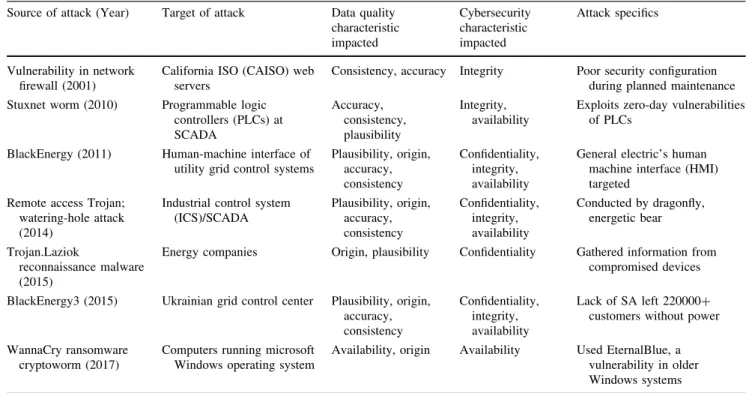
recent attacks on smart grid which is summarized in
Table
1
[
5
–
10
]. These attacks exploited a limited visibility
of the system and inadequate support from reliability
coordinators [
11
–
22
]. Wide-area measurement systems
(WAMS) increase the situation awareness (SA) for
oper-ators [
23
–
25
]. WAMS devices that are part of the wide area
monitoring, protection, automation and control include
phasor measurement units (PMUs) at transmission,
fre-quency disturbance recorders (FDRs) at low-voltage
dis-tribution and micro-PMUs (
l
-
PMUs) for distributed
renewables, called synchrophasors [
26
–
35
].
Significant challenges to the implementation of
syn-chrophasors have emerged in communication, data quality
and cybersecurity. The existing communication
infras-tructure is slow, expensive and inflexible. To leverage SA
and support timeliness, adequate quality checking methods
must be in-place at the phasor data concentrators (PDCs)
which aggregate and process raw data and flag corrupt data.
Due to their ubiquity, synchrophasors have an increased
attack surface. The applications and challenges of
syn-chrophasors are wellresearched [
36
–
41
]. However, the
challenges of data quality and cybersecurity are considered
one independent of the other, when in reality, they are
interdependent [
42
–
69
]. Further, the literature does not
leverage the knowledge of one challenge to address the
other. For example, studying the changes to data quality
can be key to potentially identify an underlying attack
vector or an unexploited vulnerability.
The main contributions of this paper are:
maps the
dependencies between data quality and cybersecurity
chal-lenges of synchrophasors;
`
reviews the methods to evaluate
CrossCheck date: 24 August 2018
Received: 11 November 2017 / Accepted: 24 August 2018 / Published online: 31 December 2018
The Author(s) 2018
& Arif I. SARWAT
[email protected] Aditya SUNDARARAJAN [email protected] Tanwir KHAN [email protected] Amir MOGHADASI [email protected]
1 Florida International University, 10555 W Flagler St., Miami,
FL 33174, USA
the challenges; and
´
surveys how data quality checking
methods can leverage their observations to detect issues
related to security. The paper also provides a high-level
overview of synchrophasors, their standards, key applications,
and challenges [
70
–
73
]. It is key to know that poor quality can
be due to device errors or communication challenges like
congestion and packet collision. Similarly, all cyber-attacks
do not impact the data, although reduction in quality is one of
the biggest observable consequences of a successful attack. A
layout of WAMS comprising synchrophasors is shown in
Fig.
1
. This paper explores the challenges for PMUs at
transmission and FDRs at distribution level.
This survey paper considers data quality and
cyberse-curity as
challenges
, where each has different
issues
. Issues
are the ways in which the particular challenge manifests
when observed. Figure
2
maps the challenges to their
corresponding issues. The challenge of quality manifests in
three ways: noise, outliers and missingness. Noise can be
due to logical inconsistencies in data values or attributes
while outliers result from poor integrity and origination.
Missing data is a direct consequence of poor completeness
and availability. Accuracy is impacted by noise, outliers as
well as missingness while plausibility is a characteristic
impacted by noise and outliers. These characteristics are
discussed in Section
3.1
. Cybersecurity manifests as delay/
Table 1 Summary of the recent cyberattacks on smart grid impacting data quality
Source of attack (Year) Target of attack Data quality characteristic impacted Cybersecurity characteristic impacted Attack specifics Vulnerability in network firewall (2001)
California ISO (CAISO) web servers
Consistency, accuracy Integrity Poor security configuration during planned maintenance Stuxnet worm (2010) Programmable logic
controllers (PLCs) at SCADA Accuracy, consistency, plausibility Integrity, availability
Exploits zero-day vulnerabilities of PLCs
BlackEnergy (2011) Human-machine interface of utility grid control systems
Plausibility, origin, accuracy, consistency Confidentiality, integrity, availability
General electric’s human machine interface (HMI) targeted
Remote access Trojan; watering-hole attack (2014)
Industrial control system (ICS)/SCADA Plausibility, origin, accuracy, consistency Confidentiality, integrity, availability Conducted by dragonfly, energetic bear Trojan.Laziok reconnaissance malware (2015)
Energy companies Origin, plausibility Confidentiality Gathered information from compromised devices BlackEnergy3 (2015) Ukrainian grid control center Plausibility, origin,
accuracy, consistency Confidentiality, integrity, availability Lack of SA left 220000? customers without power WannaCry ransomware
cryptoworm (2017)
Computers running microsoft Windows operating system
Availability, origin Availability Used EternalBlue, a vulnerability in older Windows systems
SCADA, Control center
Super PDC Transformer
PMU PMU PMU PMU
PMU Local PDC μ-PMU Distribution substation Transmission substation Smart loads PV Residential loads Spot loads FDR Ethernet WAN μ-PMU FI R E W A L L , V P N , R OUT E R S Communication link Com muni
cation link Local PDC
PMU
Fig. 1 Layout of smart grid WAMS comprising PMUs, l-PMUs,
FDRs and PDCs
Synchrophasors (PMUs, PDCs, FDRs,μ -PMUs)
Data quality Cybersecurity
Completeness Measurement and attribute accuracy
Plausbility Availability Origin Consistency Device, Aggregator, Communication, Application
Methods that leverage the interdependency Noise Outliers Missingness Delay/loss Manipulation Theft
Device, Aggregator, Communication Device, Aggregator, Communication Evaluation methodologies Inter-dependency
loss, manipulation or theft. While a delay/loss corresponds
to a packet delay or drop due to congestion, timeout, buffer
fullness or an intentional attack that affects availability,
manipulation deals with attacks that alter the information,
thereby impacting integrity. Theft captures attacks which
compromise the confidentiality of data such as snooping,
spoofing or espionage. These attacks occur at different
levels of the synchrophasor hierarchy:
Device
corresponds
to the edge devices like PMUs, FDRs, or
l
-
PMUs, while
Aggregator
implies Local PDCs or SuperPDCs.
Commu-nication
refers to the synchrophasor network while
Appli-cation
contains the different power system applications that
use synchrophasor data.
The rest of the paper is organized as follows. Section
2
summarizes the architecture, major applications and key
challenges of synchrophasors. The characteristics are
descri-bed in Section
3
, and their interdependencies mapped in
Section
4
. While evaluation methods for data quality and
cybersecurity are discussed in Section
4.1
, Section
4.2
sur-veys methods which use data quality characteristics to detect
potential cyber-attacks. Section
5
highlights future directions
of research in synchrophasor data analytics and cybersecurity.
2 Architecture, applications, challenges
Synchrophasors can be standalone devices with
dedi-cated purposes, or be a part of a larger system like the
substations, depending on various functional and
opera-tional requirements. With increased penetration of
renew-ables and smart loads, synchrophasors are used at
distribution transformers and points of common coupling to
study frequency disturbances and harmonics. The
archi-tecture of synchrophasor devices are summarized at the
device and network levels below.
1)
PMU device: It comprises current transformers (CTs)
and potential transformers (PTs) that measure current
and voltage magnitudes which are then converted to
digital data, a microprocessor module that compiles
these values, computes phasors, and synchronizes them
with the coordinated universal time (UTC) standard
reference used by global positioning system (GPS)
receivers that acquire a time-lag based on the atomic
clock of GPS satellites [
23
,
74
–
77
]. They measure local
frequency and its rate of change, and can record
individual phase voltage and current along with
har-monics, negative and zero sequence values [
78
]. The
information paints a dynamic picture of the grid at a
given time. PMUs and PDCs transmit measured data as
frames [
79
]. A 16-bit cyclic redundancy check ensures
data integrity. PDCs equipped with logging
functional-ity use comma separated values or transient data
exchange for data logs, and common format for event
data exchange for event logs [
80
,
81
]. The data transfer
rate of PMUs, which determine the message processing
delays and network latencies, depend greatly on the
timing requirements of applications.
2)
PMU network: If there are multiple PMUs in a
substation, Local PDCs aggregate site-level data and
then transmit to a SuperPDC. PDCs conduct various
data quality checks and set flags according to the issues
encountered, log performance, validate, transform,
scale and normalize data, and convert between protocols
[
82
]. There is typically a direct interface between PDC
and the utility’s SCADA or energy management system.
PDCs can be deployed as standalone devices or
integrated with other systems in the grid.
3)
FDR device: The Oak Ridge National Laboratory and
the University of Tennessee Knoxville have been
leading the FNET/GridEye project since 2004. FDRs
have been installed and managed to capture dynamic
behaviors of the grid. Although FDRs are essentially
PMUs, they are connected at 120 V, and hence incur
lower installation costs than traditional PMUs do [
83
].
FDRs are largely deployed at renewable integration
zones of the grid, and measure nearly 1440 samples
per second with a hardware accuracy of
±
0.5 mHz
while PMUs measure between 10 and 240 samples per
second and use GPS receivers that have 1
l
s accuracy
for synchronization [
84
–
87
]. Given the availability of
an extensive discussion of the architecture by the
author of [
88
,
89
], it is beyond the scope of this paper.
4)
FDR network: FDRs use the internet to send data
directly to the central servers for analytics and can
provide information on transients, load shedding,
breaker reclosing and the switching operations of
capacitor banks and load tap changers [
87
]. Unlike
PMUs, FDRs can be installed at buildings and offices.
5)
Synchrophasor standards: Multiple standards exist for
PMU data measurement, transfer and communication,
proposed by IEEE, the National Institute of Standards
& Technology (NIST), the North American Electric
Reliability Commission (NERC) and the International
Electrotechnical Commission (IEC) [
90
–
97
]. Due to
multiple specifications and guidelines, there are
pos-sible contradictions in recommendations [
70
–
73
,
98
].
A North American SynchroPhasor Initiative (NASPI)
report in early 2016 identified the need for
standard-izing definitions related to synchrophasor data quality
and availability by establishing the PMU applications
requirements task force (PARTF) [
99
]. IEEE standard
C37.X
deals
with
WAMS,
specifically
PMUs
[
82
,
100
,
101
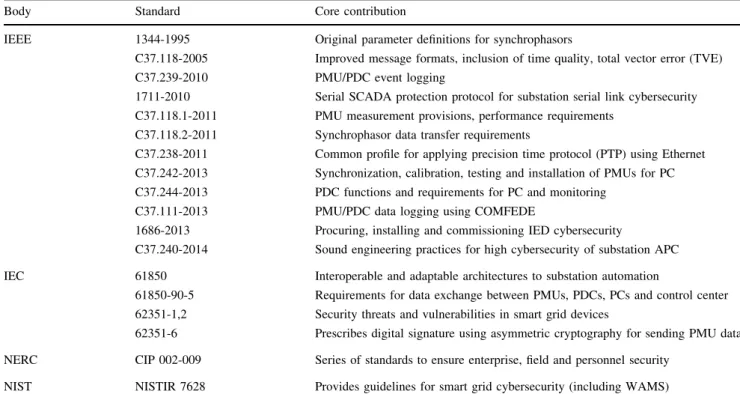
]. These standards are summarized in
Table
2
with their core contributions highlighted. A
more comprehensive review of the synchrophasor
standards is documented in [
102
].
6)
Applications: Synchrophasors streamline security,
reli-ability and streli-ability of power systems. They have online
and offline applications [
103
]. Online applications of
PMUs include enhancing real-time SA, analyzing faults
and disturbances, detecting and appraising oscillations
and harmonics that impact power quality, and
improv-ing accuracy and reducimprov-ing computational time of state
estimation. Offline applications include congestion
management, providing effective protection schemes,
benchmarking, system restoration, overload monitoring
and dynamic rating, validating the network model of
SCADA,
and
improving
overall
power
quality
[
25
,
104
,
105
]. Real-time (online) applications of FDRs
include frequency monitoring interface integrated with
command and control centers in the future for power
system health diagnosis to prevent cascading failures,
and event trigger module that detects and notifies the
mismatch between generation and load caused by
frequency variations. Offline applications include event
visualization that renders the data read from the even
data files [
106
].
7)
Challenges: One of the major drawbacks of
synchropha-sors is the lack of transmission protocol, which makes
them vulnerable to spoofing attacks [
26
]. The existing
architecture is not scalable since it entails an initially high
investment. NASPI’s research initiative task force
(RITT) emphasizes optimal placement as a significant
challenge but also one dependent on the nature of
applications the utility intends to use them for [
18
]. The
literature has multiple models including but not limited to
genetic algorithm, simulated annealing, Tabu search,
Madtharads method, particle swarm optimization,
artifi-cial neural networks, binary search and binary integer
programming
to
address
this
challenge
[
27
,
28
,
31
–
34
,
107
,
108
]. More recently, managing
and analyzing large volumes of synchrophasor data has
become increasingly challenging. Lack of standardized
data management solutions for smart grid has only made
this problem more challenging. The ubiquitous presence
of these devices has expanded their attack surface,
making them vulnerable to different types of attacks.
These two challenges are elaborated in the following
section since they percolate to applications that directly
operate upon the streaming data subject to minimal
processing owing to timeliness requirements.
3 Data quality and cybersecurity challenges
in synchrophasors
Due to their wide-ranging communication and
automa-tion capabilities, the challenges of synchrophasor data
quality and cybersecurity have gained prominence.
Table 2 Various standards and guidelines for synchrophasors
Body Standard Core contribution
IEEE 1344-1995 Original parameter definitions for synchrophasors
C37.118-2005 Improved message formats, inclusion of time quality, total vector error (TVE) C37.239-2010 PMU/PDC event logging
1711-2010 Serial SCADA protection protocol for substation serial link cybersecurity C37.118.1-2011 PMU measurement provisions, performance requirements
C37.118.2-2011 Synchrophasor data transfer requirements
C37.238-2011 Common profile for applying precision time protocol (PTP) using Ethernet C37.242-2013 Synchronization, calibration, testing and installation of PMUs for PC C37.244-2013 PDC functions and requirements for PC and monitoring
C37.111-2013 PMU/PDC data logging using COMFEDE
1686-2013 Procuring, installing and commissioning IED cybersecurity
C37.240-2014 Sound engineering practices for high cybersecurity of substation APC IEC 61850 Interoperable and adaptable architectures to substation automation
61850-90-5 Requirements for data exchange between PMUs, PDCs, PCs and control center 62351-1,2 Security threats and vulnerabilities in smart grid devices
62351-6 Prescribes digital signature using asymmetric cryptography for sending PMU data NERC CIP 002-009 Series of standards to ensure enterprise, field and personnel security
3.1 Data quality challenges
NERC’s real-time tools best practices task force
(RTBPTF) and NASPI’s PARTF impose requirements to
ensure synchrophasor data quality [
42
,
109
]. Data quality
can be contextualized in different ways, depending on the
needs of the concerned domain. For instance, data quality
requirements of a smart meter recording energy
con-sumption might differ from those of a net meter at a solar
photovoltaic (PV) power plant. NASPI contextualizes
synchrophasor data quality to determine ‘‘fitness of use’’ in
terms of accuracy and lineage for static data points;
lin-eage, completeness and logical consistency for static
datasets; and availability, timeliness and origination for
streams of data points [
42
].
There could be different causes for poor data quality as
follow.
1)
Device: poor calibration of device, biases due to CT,
PT; erroneous filter design, poor synchronization of
timing measurements, and issues due to measurement
channel;
2)
Communication: latency exceeding stipulated limits,
network congestion, signal interferences and failure of
communication nodes;
3)
Aggregator: data transformation resulting in errors,
delayed arrival of packets dropped due to time-limit
exceeding, and unwanted duplication or corruption of
data during computations;
4)
Application: storage and maintenance issues,
insuffi-cient training size, erroneous manipulations to the data
and poor association of context.
Although data quality requirements vary with
applica-tions,
they
have
been
extensively
documented
[
42
,
52
,
102
,
109
]. The existing literature on synchrophasor
data quality is summarized in Table
3
.
1)
Completeness: focuses on the gaps between different
values, accounts for missing values [
42
]. The attributes
of completeness defined at device and aggregator-levels
are:
gap rate
—number of gaps in data per unit time;
mean gap size
—mean of the length of known gaps; and
largest known gap
—length of the largest known gap
among the different gaps. While completeness is
impacted by device malfunction, packet drops and
communication link failure, the literature does not
rec-ognize the possibility of an attack behind such causes.
2)
Accuracy: can be of the value or attribute, primarily
measured in total vector error (TVE), which according
to IEEE standard C37.118, is the vector difference
between the measured and expected phasor value
(magnitude, angle and frequency). Accuracy is
cate-gorized into that of:
data values
—impacted by factors
like the difference between expected and observed
signals or the introduction of noise to the data within
the synchrophasor; and
data attributes
—affected by
factors like accuracy of the measured timestamp,
agreement between encoded and actual location
coor-dinates of the device, and alignment of the location
recorded in the power system topology with its actual
location [
46
].
3)
Plausibility and Availability: Measurement specifiers
are the attributes of data which describe whether the
process of measuring some phenomenon of the power
system (observed value) and calculating its value
(expected value) are documented effectively in terms
of standard units to a given precision and are within a
stated confidence interval [
46
,
48
]. These specifiers
have decisive sub-attributes influencing the qualitative
value of data: data representing the measurement of
quality or condition of the grid, and data represented in
the form of SI units up to 3 decimal places with a
confidence interval included.
Network availability plays an important role in
streaming data [
49
], and in-turn affects data
availabil-ity. In case of high network latency, the incoming data
streams from different synchrophasors get delayed or
lost, causing applications to perceive them as missing
or incomplete. Hence, network availability can be
considered an indirect attribute affecting quality. This
can be mitigated if the overlying applications are
programmed to account for the delays, or if a more
lenient waiting time limit is set. However, the second
solution is dependent on the kind of applications the
synchrophasors cater to. The latency requirements for
synchrophasors recommended by the standards are
very stringent.
4)
Origination: is the source from which the data is
measured. Its trustworthiness is associated with the
background and source. Its attributes are as follow.
Point of origin
: the class of device from where the data
originated (measurement (M) or performance (P) for
PMUs), the standard followed by the device, and any
data
manipulation
or
standardization
techniques
through which the data passes [
42
,
118
];
`
Coverage
:
physical location of the device based on its geospatial
or electrical topology location [
44
,
45
];
´
Transfor-mation
applied to the data at the device, aggregator or
application level.
5)
Consistency: determines how agreeable the data is
with the overall structure of its type. Incompatibility of
attributes in terms of measurement rates or header
labeling between datasets results in outliers, leading to
an inconsistent result from an application. The
attributes of consistency are as follow.
Header
frame consistency
: consistency of the header frame of
the device. This could be categorized into: persistence
of PMU header that states whether the PMU header
structure is consistent over time, and persistence of
PDC header that states whether the PDC header
structure is consistent over time.
`
Data frame
consistency
: consistency of data frames of the device.
This could be categorized into: persistence of PMU
data frame that states whether the PMU data frame
structure is consistent over time, and persistence of the
PDC data frame that states whether the PDC data
frame structure is consistent over time.
´
Order
consistency of data frames
: whether the order in which
the data frames are recorded is consistent in the
device.
ˆ
Consistency in compliance to standards
recommended for PMU and all the devices associated
with it.
˜
Consistency of reporting rate
: whether data
reporting rate is consistent across all devices.
Emerging research in this area has lately focused on
determining solutions for ensuring data quality. These
solutions include using omnidirectional antennas to
Table 3 Summary of existing research in synchrophasor data quality challenges and solutions
Attribute Challenges Solutions
Completeness (Device, Aggregator) [42,50,110]
PMU/PDC device damage Faulty PMU-PDC communication Network error
Database storage error
Data missing for failing to comply with latency and QoS requirements
Acquiring better management techniques Use of TCP protocol to re-transmit the lost data
packets at the cost of timeliness Adjusting the synchrophasor frame rate by
increasing the wait time at PDC
Measurement accuracy (Device) [42,43,110–113]
Expected signal differs from measured signal due to harmonic interference
Introduction of noise to data
Improving phase error using filtering techniques
NIST calibration per Standard C37.118-2005 Omnidirectional antennas
Context-based reconstruction of missing data Network time protocol (NTP), e-Loran and chip scale atomic clock (CSAC)
Attribute accuracy (Device, Aggregator, Communication) [42,44]
Measured vs actual timestamp discrepancy due to satellite timing error; disagreement between encoded and actual location of PMU
Development of linear state estimation tools Avoiding timestamp discrepancy by modifying
real-time clock element
Using OMP-based identification, BB algorithm to solve PMU location discrepancies Plausibility and availability
(Communication, Application) [47–49,51,114,115]
Impact of measurement system on individual data points Data inaccessibility due to high network
latency or device failure
Delayed data arrival due to increased routing traffic
Use of electrical data recorder (EDR) tools for capturing high-rate time series data, data storage and analysis
A more lenient time limit could be set for noncritical application usage
Latency-aware application design Origination (Device, Aggregator,
Communication, Application) [42,53,116,117]
Poor standard interpretation, implementation Misalignment, erroneous compression Latency, loss of communication nodes Data corruption due to delivery time of PDC exceeding permissible slot
Network unavailability to process incoming data streams
Redundancy in communication by using wireless and wired connections Lagrange interpolating polynomial method Data substitution, imputation, interpolation and
extrapolation
Stochastic forecasting with prediction error minimization (PEM)
Logical consistency (Aggregator, Communication) [42]
Data transmitted contains no headers
Sampling rate of data changed at PMU without being adjusted at PDC
Data duplication while processing
Data from different PMUs with incorrect timestamps
Logical consistency can be ensured by maintaining the PMU registries and data protocols
improve GPS availability, context-aware
determina-tion of missing data streams using accurate timing
information, network time protocol (NTP) and
asso-ciated chip scale atomic clocks (CSACs) as backups
for synchronization when GPS fails, imputation,
interpolation and extrapolation, stochastic forecasting
with prediction error minimization (PEM) and data
substitution [
52
].
6)
Evaluation of quality: Methods to evaluate quality is
discussed in Section
4.1
. The approach for
perfor-mance evaluation is to first study the impacts of device
calibration and network conditions on quality, then
examine how poor quality reduces the application
performance [
42
]. Two effective methods are
pro-posed to evaluate the impact of quality on
perfor-mance:
Benchmarking
that tests an application
multiple times with numerous erroneous datasets in
contrast to those with no known errors, and
`
Standardization
that documents, for each application,
the level of tolerable errors.
3.2 Cybersecurity challenges
Synchrophasors cater to applications like state
estima-tion, contingency analysis and optimal power flow that
need real-time high-resolution data measurement,
com-munication and analytics [
119
]. Therefore, a successful
attack on these devices might cause erroneous SA or
cas-cading failures [
56
,
120
]. Yet, many industrial
organiza-tions do not consider synchrophasors as critical cyber
assets. Recent cyberattacks on the smart grid in Table
1
mostly used powerful malware like worms, viruses or
Trojan horse, but a few attacks like the one on the Pacific
Gas & Electric transmission substation relied on physical
means. These attacks jeopardized not just the availability
of power but also that of control data (information). In
Table
4
, cybersecurity of synchrophasors are categorized
into:
Device, Aggregator;
`
Communication; and
´
Control center application.
1)
Device, Aggregator: NASPI network (NASPInet) is
logically capable of integrating WAMS across
multi-ple geographically distant organizations using phasor
gateways (PGWs). The attacks at this level
compro-mise data integrity, targeting devices from individual
PMUs to PDCs, SuperPDCs or even PGWs. Some
attacks include:
tampering the signal measurement
units of devices through interference;
`
illicitly
changing the calibration of devices to report erroneous
readings;
´
forging data to reflect wrong
measure-ments; and
ˆ
GPS spoofing by broadcasting fabricated
Table 4 Summary of existing research in synchrophasor cybersecurity challenges and solutions
Level Challenges Solutions
Device, Aggregator
[54,55,97,102,110,121]
Device damage Device calibration
tampering Forging PMU data GPS spoofing
Multi-alteration technique to trace adversary in event of GPS spoofing Visible GPS satellite prediction
Anomaly between expected and measured GPS signals Using SSL/TLS or IPSec to encrypt data before transmission Using state estimation technique to mitigate device calibration and
tampering
Rigorous penetration testing prior to installation Communication
[57,61,62,66,112–115,122]
Denial of service Man-in-the-middle False data injection Snooping attack Delay attack
Airgapping PMU network
Filtering routers, disabling IP broadcasts, applying security patches, disabling unused ports
Server authentication by clients before establishing connection Use of time-series state estimation
Cryptographic methods like AES, DES Mutual authentication
Cyber trust model with blockchains NASPInet hub-spoke model
Optimal key generation and distribution Application [63–65,116,117] Phishing and social
engineering
APT and insider threats Replay attacks
Authentication, authorization and accounting (AAA) Use of secure data transfer protocol to prevent replay attack
signals to the receiver to yield erroneous
synchro-nization of phasors computed, modifying satellite
position, or replaying legitimate GPS signals at later
timestamps [
54
].
GPS spoofing can be mitigated by enabling the
receiver to predict visible GPS satellites at a given
position and time instant and use the
coarse/acquisi-tion (C/A) code from those satellites. Another strategy
compares the measured GPS signal to the estimated
signal and computes the anomaly error which must
have an accuracy of
B
40 ns for nearly 95% of the
values according to IEEE C37.118 [
44
].
Synchropha-sors must be subject to rigorous testing before
instal-lation. Some methods include port scans, device
security feature robustness, network congestion
test-ing, denial of service testtest-ing, network traffic sniffing
and disclosure testing [
55
]. These tests should be
periodically conducted by certified white hat
penetra-tion testers after installapenetra-tion. Regular patches and
configuration updates must be made down to the
end-device level.
2)
Communication: Synchrophasors support bidirectional
communication channels, where data measurements
flow from devices to the control center while control
signals flow the other way. The vulnerabilities of the
protocols used by the devices also contribute to the
overall security. Attacks on communication channels
compromise integrity, availability and confidentiality.
Some attacks include:
Denial of service
(
DoS
) by
overwhelming PMUs, PDCs or other aggregation
devices higher in the hierarchy with bogus frames so
that legitimate frames are lost, delayed, denied or
dropped;
`
Man-in-the-middle (MITM)
attacks by a
malicious entity posing itself as PDC (to PMU) or
PGW (to PDC) and sending malicious commands that
causes PMUs/PDCs to behave in an abnormal manner
that triggers failures;
´
False data injection (FDI)
by
intercepting frames over the channel, altering or
replacing them with malicious information that then
gets propagated to higher levels of the WAMS;
ˆ
Snooping
by the attacker eavesdropping on the
chan-nel for incoming or outgoing frames, typically not
modifying or stealing but just capturing a copy of that
information for packet replay or espionage; and
˜
Delay
caused by compromising communication
rou-ters that deliberately induce latencies in propagation to
critically affect the grid’s SA.
Many authentication and authorization algorithms
are proposed to secure synchrophasor data over
communication channels [
57
]. These methods range
from conventional encryption methods to cyber trust.
Due to the ubiquity and widespread range of these
devices, key distribution and management becomes a
problem. Mutual authentication is also proposed to
account for trust [
61
]. Decentralized, blockchain-based
trust acquisition is being considered too. The
publish-subscribe hub-spoke architecture proposed by
NAS-PInet supports dynamic sharing of device data to
alleviate shortcomings of the communication medium
like
delays
and
latencies.
Standards
like
IEC
61850-90-5 recommend trusted key distribution center
to generate and distribute keys that meet system
requirements [
63
–
66
].
3)
Application: Despite being protected by enterprise
security tools for intrusion detection and prevention,
virtualization, segmentation, authentication,
authoriza-tion and access control, cyberattacks still proliferate
[
67
,
68
]. It is understood that any successful attack at
the other two levels perpetrated in a manner
unde-tectable by the enterprise security systems can pose a
significant threat. The attacks at this level are the most
dangerous, since crucial power system applications
use data from WAMS to conduct analysis to address
reliability, power quality, network topology, and
faults. An adverse impact on these calculations could
compromise the ‘‘self-healing’’ nature of the grid.
More recent solutions include game theory, machine
learning, proactive data visualization, and
defense-in-depth [
12
,
123
].
3.2.1 Evaluation of security
Works have tested the resilience of PMUs and PDCs
against different attacks. The authors in [
124
] conducted
penetration testing of a synchrophasor network in IEEE
68-bus system to map vulnerabilities against the common
vulnerabilities exposure (CVE) database. Potential
correc-tive measures to ensure the security of PMUs and PDCs is
proposed [
125
]. Considering the security at substation and
information levels, the authors provide a wide range of
tools to mitigate breaches at both fronts. A multilayered
architecture at the substation is proposed where different
levels of data abstraction is provided between PMUs and
external environment, supplemented by firewalls, user
datagram protocol (UDP) secure for communication over
untrusted networks, and remote access using secure shell
(SSH).
4 Data quality-cybersecurity dependency
The severity of an attack can be understood from the
extent of its impacts on the targeted system. With the smart
grid encouraging interoperability between devices,
infor-mation, applications, and protocols, a transparent and direct
information exchange is now feasible. This also means that
if information in one of the interconnected systems is
infected, it is bound to propagate to other systems upon
exchange, affecting the whole network. Synchrophasor
devices harbor such vulnerabilities, as summarized in
Section
3.2
. However, to mitigate cyberattacks on
inter-connected systems, the relationship between devices and
data must be known.
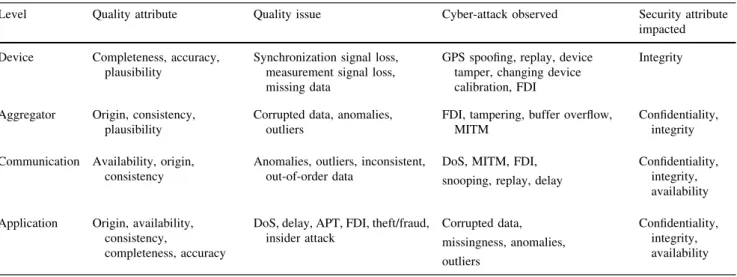
Table
5
summarizes key interdependencies between the
two challenges. There is a tight coupling between data
quality and cyber-attacks, implying it is wise to study
synchrophasor cybersecurity by accounting for the impacts
on quality. In most attacks, plausibility, completeness,
accuracy
and
consistency
are
primarily
impacted
[
126
,
127
]. In Section
4.1
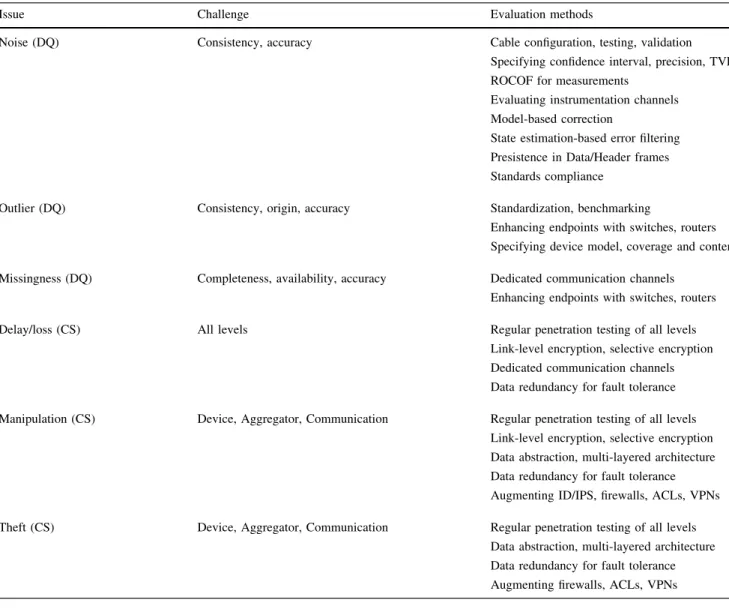
, specific evaluation methods for
quantifying this relationship are reviewed. Section
4.2
looks at how data quality characteristics can be used as
markers to detect potential cyber-attacks within the context
of synchrophasors. Results from these subsections are
summarized in Tables
6
and
7
, respectively.
4.1 Interdependency evaluation methods
Next to communications, cybersecurity was found to
impact the design and installation costs for synchrophasors
[
141
]. This is because they are critical to the
missionsup-port systems of the grid. Different practical ways for
util-ities to mitigate quality issues like accuracy, timeliness and
consistency are also identified. Some methods include
employing dedicated communication channels between
PMUs and PDCs, encrypting PMU data before
communi-cation, and enhancing communication endpoints using
firewalls and routers. The report, however, does not delve
into the details of how such methods could impact latency
(and hence, timeliness) and availability of the data.
Given different manufacturers of devices, there will be
differences in measurement and calibration quality despite
adhering to the standards. The varying application
requirements cause differences in application-level PMU
performance, of which data quality is a major one. The
static and dynamic PMU testing efforts of the Performance
and Standards Task Team (PSTT) of NASPI and the PMU
performance characterization are briefly summarized in
[
142
]. In it, the different steady-state tests performed on
magnitude, phase and frequency evaluate their
confor-mance to accuracy requirements, which is an important
attribute of data quality and is a direct target of many
cyberattacks. Given the impact of instrumentation channels
on the quality, they have been well-characterized and
evaluated for impacts on accuracy in the literature. The
errors induced by them could be rectified through
model-based correction algorithms and state estimation model-based
error filtering. Some other avenues where data quality
could be evaluated include the cable configurations, testing
and validating the devices to ensure accurate, consistent
performance and interoperability at all levels [
143
,
144
].
Although not explicit, these works hint at the improvement
in the resilience of synchrophasor devices against
poten-tially malicious activities by accounting for proper testing
methods to characterize and evaluate the different sources
of errors prior to deployment that might contribute to poor
quality.
Final conclusions can be gathered from [
145
]. The
report by the Pacific Northwest National Laboratory
(PNNL) analyzes existing synchrophasor networks in terms
of their communication and information-level
interoper-ability, security and performance. It concluded that latency
is a key issue for the future synchrophasor designs which is
expected to compound latency due to PDC functionality. It
also emphasized that substations generally did not employ
Table 5 Summary of the interdependency between quality and cybersecurity challenges
Level Quality attribute Quality issue Cyber-attack observed Security attribute impacted Device Completeness, accuracy,
plausibility
Synchronization signal loss, measurement signal loss, missing data
GPS spoofing, replay, device tamper, changing device calibration, FDI
Integrity
Aggregator Origin, consistency, plausibility
Corrupted data, anomalies, outliers
FDI, tampering, buffer overflow, MITM
Confidentiality, integrity Communication Availability, origin,
consistency
Anomalies, outliers, inconsistent, out-of-order data
DoS, MITM, FDI, snooping, replay, delay
Confidentiality, integrity, availability Application Origin, availability,
consistency,
completeness, accuracy
DoS, delay, APT, FDI, theft/fraud, insider attack Corrupted data, missingness, anomalies, outliers Confidentiality, integrity, availability
redundancy; there is little consistency in adoption of
security methods for synchrophasor networks. Some tools
include link-level encryption, virtual private networks
(VPNs), ID/IPS, firewalls and access control lists (ACLs).
Further, existing data quality checking methods locate a
compromise in integrity by identifying faulted data values
(due to measurement errors, communication delays or
external events) but not due to result of device tampering,
MITM, spoofing or FDI. Since both faults and attacks have
the same impact on quality, it is important to differentiate
the two causes while checking for the attributes such as
accuracy, consistency and timeliness.
To summarize, the following measures can be used as
metrics to quantify data quality: TVE, errors in magnitude,
phase, frequency and ROCOF, harmonics and noise for
measurement accuracy; comparison between measured and
expected results, confidence interval and precision for
measurement
specifiers;
temporal,
geospatial
and
topological accuracy for attribute accuracy; device model
specifications, geospatial and topological coordinates,
coverage and content for origination; persistence in Header
and Data frames, standards compliance, reporting rate and
order for logical consistency; and gap rate, gap size and
largest known gap for completeness. Benchmarking and
standardization are two methods that can be used to
eval-uate data quality. Similarly, cybersecurity can be quantified
by conducting extensive penetration testing of the
syn-chrophasor networks integrated into benchmarked IEEE
bus systems for different types of attacks (DoS, MITM,
FDI, spoofing, probing, cache poisoning) and discovering
potential vulnerabilities that could be exploited. While
doing so, it would be important to also repeat the
evalua-tion of the quality attributes using the above metrics and
explore how they are impacted due to the specific attacks,
and whether they violate the industry standards
require-ments specified for different applications.
Table 6 Summary of evaluation methods for quality (DQ) and cybersecurity (CS) issues
Issue Challenge Evaluation methods
Noise (DQ) Consistency, accuracy Cable configuration, testing, validation Specifying confidence interval, precision, TVE, ROCOF for measurements
Evaluating instrumentation channels Model-based correction
State estimation-based error filtering Presistence in Data/Header frames Standards compliance
Outlier (DQ) Consistency, origin, accuracy Standardization, benchmarking
Enhancing endpoints with switches, routers Specifying device model, coverage and content Missingness (DQ) Completeness, availability, accuracy Dedicated communication channels
Enhancing endpoints with switches, routers
Delay/loss (CS) All levels Regular penetration testing of all levels
Link-level encryption, selective encryption Dedicated communication channels Data redundancy for fault tolerance Manipulation (CS) Device, Aggregator, Communication Regular penetration testing of all levels
Link-level encryption, selective encryption Data abstraction, multi-layered architecture Data redundancy for fault tolerance Augmenting ID/IPS, firewalls, ACLs, VPNs Theft (CS) Device, Aggregator, Communication Regular penetration testing of all levels
Data abstraction, multi-layered architecture Data redundancy for fault tolerance Augmenting firewalls, ACLs, VPNs
Table 7 Summary showing how quality can help identify cybersecurity issues
Cyber-attack Quality affected Quality check looks for Mitigation methods using quality Device tampering (delay/
loss, theft) [128,129]
Completeness, plausibility, accuracy, consistency, origination
Large gap sizes, inaccurate readings, ping fail Statistical substitution: regression, imputation, interpolation Intelligent substitution: neural
networks, logistic regression, optimization
Securing the physical devices Spoofing PMU data
(manipulation) [130–132]
Consistency, accuracy, plausibility
Unexpected values, errors, mismatch with SCADA values, redundant timestamp, out-of-order packet arrival
Monitoring line impedances for anomalies
Divergence and miscorrelation between SCADA and PMU data GPS spoofing
(manipulation, delay/ loss) [54,133–135]
Consistency, origination, plausibility
Inaccurate timing value, TVE[1%, packets arrive out-of-order
Using multiple synchronization sources or telecommunications Anti-spoofing checking methods
at receivers
Internal holdover oscillators as backups for providing accurate timing signals
Spoofing match algorithm with Golden Search for lighter computation
Denial of service (delay/ loss) [129]
Completeness, accuracy, consistency
Congestion at PDCs/network, delayed arrival of packets, dropped packets, inability to reach suspected device
Augmenting PDCs with inline blocking tools
Employ port hardening and disable IP broadcasts Use high bandwidth
communications (expensive) Man-in-the-middle (delay/loss, manipulation, theft) [129] Origination, accuracy, availability, consistency
Mismatch between obtained and expected value, abnormal delay in packet arrival
Mutual authentication, message authentication codes Digital certificates with active
management of CRLs False data injection
(manipulation, theft) [136–140]
Plausibility, consistency, accuracy, origination
Mismatch with SCADA values, unexpected values, spatio-temporal outliers
Spatio-temporal correlations, density based local outlier factoring
Monitor line impedance for anomalies
Random time-hopping of packets Divergence and miscorrelation
between SCADA and PMU data Snooping, sniffing (theft)
[59,129]
Plausibility, origin No observable changesadditional analysis needed
Using secure gateway/VPN communication
Employing TLS/SSL, SSH, lightweight selective encryption Delay (delay/loss)
[59,129]
Completeness, consistency, availability, accuracy
Observable patterns in gaps, slow arrival of packets
Statistical and intelligent substitutions
Redundant measurement devices on the same line
APT, insider threat (delay/loss, theft, manipulation) [123]
Accuracy, consistency, origin, plausibility
No observable changesadditional analysis needed
Defense-in-depth
Machine learning, advanced data analytics
4.2 Addressing cyber-attacks using quality issues
It can be seen from Table
7
that successful cyberattacks
compromise synchrophasor data quality since the security
requirements are violated [
146
]. Given synchrophasors use
TCP/UDP on the transport layer for their communications,
attacks typically possible on TCP/IP stack like DoS,
MITM, packet replay or spoofing are possible in
syn-chrophasor domains as well.
Physical attacks like device tampering causes loss or
incurs theft of critical information, easily observed through
large gaps sizes, poor accuracy in obtained values and
unreliable origin. The lost data is typically handled through
substitution, either statistical or intelligent [
128
,
129
]. The
best way to prevent physical attacks like cable disconnects,
direct damage to device, etc. is by ensuring the devices are
isolated from external weather and human elements.
Spoofing synchrophasor data is achievable through
polynomial fitting or data mirroring techniques. Such
attacks impact quality that manifests as outliers or noise.
Several methods have been proposed to counter these
attacks: intra-PMU and inter-PMU correlations to
deter-mine the relationship between PMU parameters and across
PMUs in a locality, respectively; machine learning
tech-niques like support vector machines (SVMs) and more
[
130
–
132
].
GPS spoofing exploits publicly available civilian GPS
signals using air or cable to produce signals that initially
align with the original, but slowly start increasing the
power to drown the authentic signal and thereby
compro-mising the receiver [
54
,
133
]. By introducing measurement
errors in the time synchronization, the attacks induce
changes in data consistency and plausibility which can be
used as markers to identify the likelihood of the attack
[
134
,
135
,
147
].
In a successful DoS where multiple synchrophasor
devices get compromised, packet delay or loss is observed.
This impact in quality can serve a clue to the onset of
DoS-style attacks. Typical solutions involve augmenting inline
blocking tools, high bandwidth connections, disabling IP
broadcasts and port hardening.
MITM is possible in synchrophasors where the attacker
acts as a legitimate PDC to the PMUs and viceversa,
thereby
intercepting
and/or
modifying
all
messages
exchanged. This is noticed by quality checking methods in
the form of poor accuracy and consistency in values
between what was sent by PMU and what was received by
PDC. It can be avoided by having the devices employ
mutual authentication and a digital certificate mechanism
with an actively managed certificate evocation lists (CRLs)
and certificate authorities [
59
,
129
].
FDI impacts the consistency, accuracy and plausibility
of the data. The effects are typically observed as
spatio-temporal outliers in the data. Quality checking methods
check for this anomaly and may employ correlation across
different timestamps to identify the corruption of data. FDI
is one of the widely explored attacks on synchrophasor
domain, with solutions like determining the mismatch
between the values obtained from PMUs and that observed
in SCADA, monitoring the line impedances which get
affected when data is manipulated, and using density-based
local outlier filter (LOF) analysis [
136
–
140
].
Sometimes, attackers simply capture the packets flowing
in a channel with an intent to listen. Such sniffing/snooping
attacks have been conducted using WireShark to realize
messages are exchanged in plaintext. This attack is difficult
to detect using data quality checking methods since most
often, no quality characteristic is impacted as the attackers
do not affect the data actively. However, technologies like
VPN, encryption of selective messages (to reduce the
overall process overhead), or transport layer security
(TLS)/secure ocket layer (SSL), secure shell (SSH) can be
used to mitigate them. While TLS has been shown to be
susceptible to poisoning attacks and VPN to side channel
attacks, careful network design can account for them
[
129
,
148
].
With the increased frequency of campaign efforts and
nation-sponsored attacks against the grid, synchrophasors
could be lucrative targets for sophisticated attacks like
advanced persistent threats (APTs), social engineering,
watering-hole
attacks
and
malware-based
intrusions
[
149
–
153
]. While these attacks scale beyond specific
devices in the synchrophasor hierarchy, the quality
checking methods alone would not be sufficient [
123
]. The
use of defense-in-depth model augmented with stakeholder
interactions, awareness and training, and intelligent
solu-tions like machine learning for attack data classification
and/or event prediction, root-cause analysis of observed
events, developing evolving defense topographies using
moving target defense, and advanced visualization
tech-niques for efficient cognition of events would play a critical
role.
The key takeaway from this section is that impacts on
data quality can provide strong markers for an underlying
cyber-attack. Noise, outliers and missing values are all
commonly observed issues which quality checking
meth-ods may be programmed to detect, analyze and base
decisions on. Certain sophisticated attacks like APTs,
insider threats, sniffing, and social engineering have
indi-rect impacts on quality which a checking method may not
be able to detect with enough confidence or precision.
Additional solutions are required to mitigate such attacks in
the synchrophasor domain. These solutions include
statis-tical methods like divergence, correlation, regression and
substitution; intelligent methods like neural networks and
evolutionary algorithms for event
classification and
prediction, logistic regression for substitution; technologies
like VPNs, firewalls, ID/IPS, anomaly detectors, selective
encryption, port hardening, network isolation and use of
TLS/SSL, SSH; and human-in-the-loop solutions like
advanced visualization techniques, awareness and training,
and stakeholder engagements. While the impacts on quality
can also be due to underlying device or measurement
errors, most of the works in the literature assume the data
has been subject to delay/loss, manipulation or theft
intentionally. This paves way for the recommendation that
the upcoming research in this area must look at ways to
differentiate the impacts on data quality due to attacks from
errors.
5 Future directions of research and conclusion
The future directions of research in the areas of
syn-chrophasor data quality, cybersecurity and communications
are multi-faceted. Addressing data quality challenges must
begin with a strong push to the adoption of industry-wide,
vendor-agnostic data management, processing and storage
standards for smart grid. Most recent cyber-attacks were
successful due to the difference in speed of cognition of the
information generated by automated vulnerability detection
tools and the speed with which the machine data is created
(called cognitive gap) [
123
]. The design of synchrophasor
devices are also expected to improve in the future [
103
].
Keeping in mind the quality challenges, an improvement to
PDC design called flexible integrated synchrophasor
sys-tem (FIPS) was proposed to minimize issues in quality and
communication, and tackles specific tasks of PDC such as
data alignment, employs cryptographic methods to ensure
confidential exchange of data without jeopardizing
integ-rity, and establishes relevance to the NASPInet [
121
]. To
ensure device and applicationlevel interoperability,
devel-opment of technical standards and conformance testing
rules is expected. Further, the emergence of
distribution-level
l
-
PMUs will evoke the need for developing
mea-surement, communication, quality and security standards.
Further, with the deployment of distributed renewable
sources, electric and autonomous vehicles, energy storage
and transactive energy, there is a strong impetus for
enhancing technologies behind monitoring and control, of
which synchrophasors will play a major role [
141
].
To conclude, while existing research has focused on the
synchrophasor challenges of quality and cybersecurity
individually, their interdependency has largely been
ignored. This paper makes one of the first attempts at
highlighting the impacts of cyber-attacks on various quality
attributes, thereby recommending that the future research
on the design and development of security solutions should
account for their impacts on quality as well, and that
different quality characteristics can be used by quality
checking methods to flag for potential cyber-attacks.
Plausibility, completeness, accuracy and consistency are
some of the attributes that are most adversely impacted by
a majority of the attacks on synchrophasors. At the same
time, not all cases of poor data quality imply a successful
cyber-attack as the reason. Different metrics that could be
used to quantify quality attributes were summarized, and
the methods that help evaluate the impacts of quality and
security on performance were also briefly highlighted. This
paper serves as a starting point for researchers entering
these areas as it summarizes and determines their
interde-pendency and relevance to smart grid security.
Acknowledgements This work was supported by the National
Sci-ence Foundation Grant (No. CNS-1553494) and the Department of Energy Grant (No. 800006104). Any opinions, findings, and conclu-sions or recommendations expressed in this material are those of the authors and do not necessarily reflect the views of the NSF and DOE.
Open Access This article is distributed under the terms of the
Creative Commons Attribution 4.0 International License (http:// creativecommons.org/licenses/by/4.0/), which permits unrestricted use, distribution, and reproduction in any medium, provided you give appropriate credit to the original author(s) and the source, provide a link to the Creative Commons license, and indicate if changes were made.
References
[1] Ozgur U, Nair HT, Sundararajan A et al (2017) An efficient MQTT framework for control and protection of networked cyber-physical systems. In: Proceedings of IEEE conference on communications and network security, Las Vegas, USA, 9–11 October 2017, pp 421–426
[2] Sanjab A, Saad W, Guvenc I et al (2016) Smart grid security: threats, challenges, and solutions.arXiv:1606.06992[cs.IT] [3] Sundararajan A, Pons A, Sarwat AI (2015) A generic
frame-work for EEG-based biometric authentication. In: Proceedings of the 12th international conference on information technology new generations, Las Vegas, USA, 13–15 April 2015, pp 139–144
[4] Anzalchi A, Sarwat A (2015) A survey on security assessment of metering infrastructure in smart grid systems. In: Proceed-ings of IEEE SoutheastCon, Fort Lauderdale, USA, 9–12 April 2015, pp 1–4
[5] Dagle JE (2004) Data management issues associated with the August 14th, 2003 blackout investigation. In: Proceedings of IEEE power engineering society general meeting, Denver, USA, 6–10 June 2004, pp 1680–1684
[6] Larsson S, Ek E (2004) The blackout in southern Sweden and eastern Denmark, September 23, 2003. In: Proceedings of IEEE power engineering society general meeting, Denver, USA, 6–10 June 2004, pp 1668–1672
[7] Corsi S, Sabelli C (2004) General blackout in Italy Sunday September 28th, 2003, h 03:28:00. In: Proceedings of IEEE power engineering society general meeting, Denver, USA, 6–10 June 2004, pp 1691–1702
[8] Berizzi A (2004) The Italian 2003 blackout. In: Proceedings of IEEE power engineering society general meeting, Denver, USA, 6-10 June 2004, pp 1673–1679
[9] Gomes P (2004) New strategies to improve bulk power systems security: lessons learned from large blackouts. In: Proceedings of IEEE power engineering society general meeting, Denver, USA, 6–10 June 2004, pp 1703–1708
[10] Imai S (2004) TEPCO observations on August 14 blackout and recommendations to prevent future blackouts based on TEP-COs experience. In: Proceedings of IEEE power engineering society general meeting, Denver, USA, 6–10 June 2004, pp 1–27
[11] Jamei M, Sarwat AI, Iyengar SS et al (2015) Security breach possibility with RSS-based localization of smart meters incor-porating maximum likelihood estimator. In: Selvaraj H, Zydek D, Chmaj G (eds) Progress in systems engineering. Advances in intelligent systems and computing, vol 366. Springer, Cham. https://doi.org/10.1007/978-3-31908422-0-20
[12] Wei L, Sarwat AI, Saad W (2016) Risk assessment of coordi-nated cyber-physical attacks against power grids: a stochastic game approach. In: Proceedings of IEEE industry applications society annual meeting, Portland, USA, 2–6 October 2016, pp 1–7
[13] Hauer JF, Bhatt NB, Shah K et al (2004) Performance of ‘‘WAMS East’’ in providing dynamic information for the North East blackout of August 14, 2003. In: Proceedings of IEEE power and energy society general meeting, Denver, USA, 6–10 June 2004, pp 1685–1690
[14] U.S.-Canada Power System Outage Task Force (2004) Final report on the August 14, 2003 blackout in the United States and Canada: causes and recommendations. North American Electric Reliability Commission (NERC) Report. https://www.energy. gov/sites/prod/files/oeprod/DocumentsandMedia/Outage_Task_ Force_DRAFT_Report_on_Implementation.pdf. Accessed Octo-ber 2017
[15] Zima M, Larsson M, Korba P et al (2005) Design aspects for wide-area monitoring and control system. Proceedings of the IEEE 93(5):980–996
[16] Wei L, Sarwat A, Saad W et al (2018) Stochastic games for power grid protection against coordinated cyber-physical attacks. IEEE Trans Smart Grid 9(2):684–694
[17] Ashton PM, Taylor GA, Irving MR et al (2012) Prospective wide area monitoring of the Great Britain transmission system using phasor measurement units. In: Proceedings of IEEE power engineering society general meeting, San Diego, USA, 22–16 July 2012, pp 1–8
[18] Chow JH, Beard L, Patel M et al (2015) Guidelines for siting phasor measurement units. North American SynchroPhasor Initiative Research Initiative Task team (NASPI-RITT) Report. https://www.researchgate.net/publication/279658581_ Guidelines_for_Siting_Phasor_Measurement_Units__Version_ 8_June_15_2011_North_American_SynchroPhasor_Initiative_ (NASPI)_Research_Initiative_Task_Team_(RITT)_Report. Acces-sed 15 June 2011
[19] Gomes P, Martins N, de Mello P et al (1998) Assuring system reliability in a competitive environment. In: Proceedings of CIGRE meeting, Paris, France, 30 August–5 September 1998, pp 38–104
[20] de Azevedo R, Allen D, Perpuly Y et al (2015) PMU placement considering data uncertainty and redundancy. In: Proceedings of IEEE SoutheastCon, Fort Lauderdale, USA, 9–12 April 2015, pp 1–6
[21] Parvez I, Islam A, Kaleem F (2014) A key management-based two-level encryption method for AMI. In: Proceedings of IEEE power engineering society general meeting-conference & exposition, National Harbor, USA, 27–31 July 2014, pp 1–5
[22] Wang Y, Saad W, Sarwat AI et al (2018) Reactive power compensation game under prospect-theoretic framing effects. IEEE Trans Smart Grid 9(5):4181–4193
[23] Ma J, Zhang P, Fu HJ et al (2010) Application of phasor measurement unit on locating disturbance source for low-fre-quency oscillation. IEEE Trans Smart Grid 1(3):340–346 [24] Narendra K (2007) Role of phasor measurement unit (PMU) in
wide area monitoring and control. ERL phase power tech-nologies report, pp 1–45.http://www.erlphase.com/downloads/ application_notes/Roles_of_PMUs_in_Wide_Area_Monitoring_ and_Control.pdf. Accessed 17 July 2017
[25] Novosel D, Vu K (2006) Benefits of PMU technology for various applications. In: Proceedings of international council on large electric systems- CIGRE croatian national committee, 7th symposium on power system management, Paris, France, 5–8 November 2006, pp 1–13
[26] Ferrari L, Gentz R, Scaglione A et al (2014) The pulse coupled phasor measurement units. In: Proceedings of IEEE interna-tional conference on smart grid communications (Smart-GridComm), Venice, Italy, 3–6 November 2014, pp 320–325 [27] Sreenivasareddy PS, Chowdhury SP, Chowdhury S (2010)
PMU placement-a comparative survey and review. In: Pro-ceedings of IET international conference on developments in power system protection, Manchester, UK, 29 March–1 April 2010, pp 1–4
[28] Aamre K, Centeno VA, Pal A (2015) Unified PMU placement algorithm for power systems. In: Proceedings of North Amer-ican power symposium (NAPS), Charlotte, USA, 4–6 October 2015, pp 1–6
[29] Parvez I, Sarwat AI, Wei L et al (2016) Securing metering infrastructure of smart grid: a machine learning and localization based key management approach. MDPI J Energies 9(9):691–708
[30] Parvez I, Jamei M, Sundararajan A et al (2014) RSS based loop-free compass routing protocol for data communication in advanced metering infrastructure (AMI) of smart grid. In: Proceedings of 2014 IEEE symposium on computational intelligence applications in smart grid (CIASG), Orlando, USA, 9–12 December 2014, pp 1–6
[31] Negash K, Khan B, Yohannes E (2016) Artificial intelligence versus conventional mathematical techniques: a review for optimal placement for phasor measurement units. Technol Econ Smart Grids Sustain Energy. https://doi.org/10.1007/ s40866-016-0009-y
[32] Rahman NHA, Zobaa AF (2016) Optimal PMU placement using topology transformation method in power systems. J Adv Res 7(5):625–634
[33] Nazari-Heris M, Mohammed-Ivatloo B (2015) Application of heuristic algorithms to optimal PMU placement in electric power systems: an updated review. Renew Sustain Energy Rev 50:214–228
[34] Chouhan D, Jaiswal V (2016) A literature review on optimal placement of PMU and voltage stability. Indian J Sci Technol 9(47):1–7
[35] Meier A, Stewart E, McEachern A et al (2017) Precision micro-synchrophasors for distribution systems: a summary of appli-cations. IEEE Trans Smart Grid 8(6):2926–2936
[36] Sexauer J, Javanbakht P, Mohaghehi S (2013) Phasor mea-surement units for the distribution grid: necessity and benefits. In: Proceedings of IEEE PES innovative smart grid technolo-gies, Washington DC, USA, 24–27 February 2013, pp 1–7 [37] Singh B, Sharma NK, Tiwari AN et al (2011) Applications of
phasor measurement units (PMUs) in electric power system networks incorporated with FACTS controllers. Int J Eng Sci Technol 3(3):64–82
[38] Sanchez-Ayala G, Aguerc JR, Elizondo D et al (2013) Current trends on applications of PMUs in distribution systems. In: Proceedings of IEEE PES innovative smart grid technologies conference (ISGT), Washington DC, USA, 24–27 February 2013, pp 1–6
[39] Lee H, Tushar Cui B et al (2017) A review of synchrophasor applications in smart grid. WIREs Energy Environ 6(3):1–31 [40] Lauby M (2010) Real-time application of PMUs to improve
reliability task force (RAPIR TF). NERC technical presenta-tion. https://www.nerc.com/comm/oc/related%20files%20dl/ rapir_oc_slides.pdf. Accessed 1 August 2017
[41] Mohanta DK, Murthy C, Roy DS (2016) A brief review of phasor measurement units as sensors for smart grid. Electric Power Compon Syst 44(4):411–425
[42] NASPI PMU Applications Requirements Task Force White Paper (2017) PMU data quality: a framework for the attributes of PMU data quality and a methodology for examining data quality impacts to synchrophasor applications. NASPI technical report. https://www.naspi.org/sites/default/files/reference_ documents/PARTF_WhitePaper_20170314_Final_PNNL.pdf. Accessed 1 August 2017
[43] Christoforidis GP, Meliopoulos APS (1990) Effects of model-ing on the accuracy of harmonic analysis. IEEE Trans Power Deliv 5(3):1598–1607
[44] Zhu F, Youssef A, Hamouda W (2016) Detection techniques for data-level spoofing in GPS-based phasor measurement units. In: Proceedings of international conference on selected topics in mobile & wireless networking (MoWNeT), Cairo, Egypt, 11–13 April 2016, pp 1–8
[45] Yang B, Yamazaki J, Saito N, et al (2015) Big data analytic empowered grid applications—is PMU a big data issue? In: Proceedings of 12th international conference on the European energy market (EEM), Lisbon, Portugal, 19–22 May 2015, pp 1–4
[46] Rahman NHA, Zobaa AF (2016) Optimal PMU placement using topology transformation method in power systems. J Adv Res 7(5):625–634
[47] Veda S, Chaudhuri NR, Baone CA, et al (2014) Assessment of impact of data quality on PMU-based applications. In: Pro-ceedings of CIGRE US national committee grid of the future symposium, http://cigre-usnc.tamu.edu/wpcontent/uploads/ 2015/06/Assessment-of-Impact-of-DataQuality-on-PMU-Based-Applications.pdf. Accessed 1 August 2017
[48] Zhu K (1988) A method for plausibility checks and data vali-dation in power systems. IEEE Trans Power Syst 3(1):267–271 [49] Danielson CFM, Vanfretti L, Almas MS et al (2013) Analysis of communication network challenges for synchrophasor-based widearea applications. In: Proceedings of IREP symposium on bulk power system dynamics and control - IX optimization, security and control of the emerging power grid (IREP), Rethymno, Greece, 25–30 August 2013, pp 1–13
[50] H