A Practical Approach to the Operation of
Telecommunication Services driven by
the TMF eTOM Framework
Hou Jiejin
Thesis Director – Dr.Prof. Joan Serrat Fernández
Departament de Teoria del Senyal i Communicacions
Universitat Poliècnica de Catalunya
A thesis submitted for the degree of
Master of Universitat Poliècnica de Catalunya
Abstract
Nowadays, the gap between data communications and telecommunications disappears rapidly, which leads to augment of the complexity and size of supporting networks. This calls for the software developers to embrace a new way of developing management software. This is the impetus for the TM Forum’s New Generation Operations Systems and Software (NGOSS) initiative. It aims to deliver a framework for rapid and flexible integration of Operation and Business Support Systems in telecommunications and throughout the wider communications industry.
The enhanced Telecom Operations Map (eTOM) is a key part of NGOSS. It plays an important role as a guidebook built on TM Forum Telecom Operations Map (TOM). The eTOM model describes the full scope of business processes required by a service provider and defines key elements and how they interact.
This thesis is aimed to the following objectives:
z Know the challenges a service provider or network operator have to face in order to provide services to their customers.
z Understand the role of eTOM in the context of the NGOSS framework and the benefits brought by its potential use by service providers.
z Know how to express the needs of service providers and network operators in terms of eTOM artefacts.
For this reason we undertook a set of activities that are reported in the memory as follows:
First of all it was necessary to understand eTOM in the context of NGOSS through the study of selected TMF documents. A summary of this learning phase is reported in Chapter 2.
In addition to the concept of eTOM we also wished to know up to which extend the work based on eTOM background was supported by design tools. Therefore we undertook a search activity in related business processes supporting tools that has been summarized in Chapter 3. Also part of this activity was the selection of the most appropriate ones in our current context.
In the remaining we focus into the design of a scenario representing the goals of a service provider and its solution in terms of business processes to be implemented according to the eTOM framework. Hence, in Chapter 4 we illustrate the important role of eTOM based on the business process supporting tools of Chapter 3. According to the scenario design, we are able to implement a solution that is presented in Chapter 4 as well.
Keywords:
NGOSS eTOM Business Processes Service Management Operation Support Systems
Acknowledgement
First of all, in particular, I appreciate so much of the enlightening instruction, constructive suggestion and patient help from my director, Dr.Prof. Joan Serrat Fernández. He provides guidance from the very beginning until the end of my thesis for all the phases, from the board view to tiny details. I am so honored and delighted to accomplish my master thesis with the support from him.
Moreover, in a very board sense, this thesis is based on eTOM Framework developed by TM Forum which embraces the work and efforts of a huge number of individuals and companies who have participated over the years. Thanks are due to all those who have worked in, and the officers in TM Framework who offer generous help and provide abundant relevant materials. Beside, I want to thank the staffs in Casewise and Enterprise Architect who supply information of the tools and prices issue, etc. I would also like to acknowledge Alfred Anaya-Dubernard for his inestimable help to facilitate us the usage of ArcheTOM, the tool thanks to which this thesis has been possible.
There are also a number of persons, who may not have been directly involved in this project. But without them, things would have been much harder. I want to express my thanks too. Finally, give thanks to my family, who has provided me with continual support and care.
Content
1 General introduction ...1
1.1 Thesis objectives and expected contribution...1
1.2 Thesis structure ...2
2 Background ...4
2.1 NGOSS background...4
2.2 eTOM background ...6
2.2.1 eTOM introduction...8
2.2.2 Benefits of using the eTOM framework...10
2.2.3 Purpose of the eTOM Business Process Framework ...10
2.3 eTOM architecture ...12
3 Supporting tools for business processes specification ...17
3.1 Casewise ...17 3.2 ARIS ...19 3.3 Enterprise Architect...21 3.4 MG-SOFT ...24 3.5 ArcheTOM ...27 3.6 Visio ...34
4 Business processes deployment in a practical scenario...35
4.1 Scenario and use cases ...35
4.1.1 Actors identification...36
4.1.2 Use case 1-Service subscription...38
4.1.3 Use case 2-Problem complain ...39
4.2 Solution design approach ...39
4.3 Detailed design...40
4.3.1 Process instantiation...41
4.3.2 Process priority classification...42
4.3.3 Process decomposition ...47
4.3.4 Process flow diagram ...52
5 Conclusion ...57
5.1 Thesis achievement ...58
5.2 Future work ...60
References...62
Appendix A ...64
A.1 Business Processes ...64
A.2 Decomposition diagram ...74
List of Figure
Figure 2.1: TM Forum NGOSS Framework ...6
Figure 2.3: Conceptual overview of eTOM framework...9
Figure 2.4: eTOM Business Process Framework - Level 1 processes ...13
Figure 2.5: Process hierarchy...15
Figure 3.1: Corporate Modeler, repository-based business process modeling...18
Figure 3.2: BPMN Model in ARIS business architect ...21
Figure 3.3: Business Process Modeling ...22
Figure 3.4: RTF template editor ...23
Figure 3.5: MG-SOFT visual MIB builder (Main window) ...25
Figure 3.6: Hierarchy diagram by MG-SOFT...26
Figure 3.7: Overview diagram of ArcheTOM...28
Figure 3.8: eTOM Level 1 view of ArcheTOM ...29
Figure 3.9: eTOM Level 2 view of ArcheTOM ...30
Figure 3.10: eTOM navigation view of ArcheTOM ...31
Figure 3.11: eTOM process detail of ArcheTOM ...33
Figure 4.1: Hardware deployments in use cases ...36
Figure 4.2: Roles of entities in value network ...37
Figure 4.3: Partial decomposition from Level 0 to Level 4 ...48
Figure 4.4: Relevant Level 2 processes of use case 1 ...53
List of Table
Table 3.1: Price scheme for academic license...24 Table 4.1: First priority processes of two use cases ...52
List of Diagram
Diagram 4.1: Process flow diagram of use case 1...54 Diagram 4.2: Process flow diagram of use case 2...56
1 General introduction
Nowadays, a plethora of service providers - communications, entertainment, applications, Internet service providers, etc - emerge with everyday newer products with the trend of combining data services and communication services. In order to have quick response and to be competitive in the current market, these companies have to base their organization and operations on a set of well defined and efficient business processes which is a collection of related, structured activities or tasks that produce a specific service or product for a particular customer Moreover, in the current business scenarios there is an increasing need to make business establishing coalitions among different enterprises. This makes necessary a common view and understanding of business processes to allow for an efficient business to business cooperation.
Being aware of that needs, the Telemanagement Forum (TMF), an organization, promotes the Next Generation Operation Systems and Software (NGOSS). In short, NGOSS is a view of how the key actors of telecommunications have to manage their services. Constituted by four building blocs, namely the extended Telecommunications Operation Map (eTOM), the Shared Information and Data model (SID), the Telecommunication Neutral Architecture (TNA) and the Telecommunications Application Map (TAM), we will concentrate in the former because it provides a framework for business processes design and deployment. In fact, TMF aims that service providers utilize the Business Process Framework (eTOM) to analyze their existing business processes, identify redundancy or gaps in their current strategies, and re-engineer processes to correct deficiencies and add automation. Currently, eTOM is a well accepted and used standard in the industry which provides a map and common language of business process with different hierarchy. Based on the current hierarchy of the framework, it also enables to be used to invent processes at a service provider.
eTOM is a well documented de facto standard. More than ten documents describe it along with other white papers and guidelines. With the spirit to be generic enough to be applicable to any context, eTOM has then to be somehow interpreted to each real scenario. And this is not really straightforward. In fact, to use eTOM to describe the business processes of a company, it is necessary to gather a good understanding of the enterprise needs as well as a good understanding of the concepts laid down in the norm.
1.1
Thesis objectives and expected contribution
In line with the above paragraphs, this thesis is aimed to the following objectives:General introduction
z Know the challenges a given service provider has to face in order to provide services to their customers.
z Know how to express the needs of the service provider in terms of eTOM artefacts.
z Understand, in summary, the role of eTOM in the context of the NGOSS framework and the benefits brought by its potential use by service providers. In this thesis, we will address the introducing background of NGOSS and eTOM Business Process Framework to provide an overview of the knowledge based on the research in TMF documents. The use of eTOM entails the manipulation of a lot of nested concepts. The eTOM processes are articulated in a tree-like structure through which is taught to move around unless a navigation tool is provided. The main aim of this browsing tool is similar to the Explorer in Windows. A search activity in related business processes supporting tools is carried out and introduced.
By utilizing the most appropriate ones in our current context, we will define a scenario to serve as the driving element of design and implementation based on eTOM Business Process Framework concepts. As one of the important sections in the thesis, we will present several supporting tools for business processes specification and assistant tools to implement the scenario.
The scenario will represent the needs of a specific service provider to offer their services. It will be identified according to a common current situation in the nowadays telecommunication market. The needs of this service & network provider are figured out, understanding the business processes defined in eTOM.
Last but not least, we pretend that the report coming out from that thesis project constitutes a complement to the official eTOM documents existing today for practitioners and students wishing to get closer to the eTOM concepts especially under the point of view of one of its potential applications.
1.2
Thesis structure
Due to the objective of this project, we undertook a set of activities that are reported in the memory as follows:
At the beginning, Chapter 1 General introduction is aimed to introduce the objective, contribution and the structure of this thesis, in order to provide an overall idea of this thesis.
Following with the main content, first of all, it was necessary to understand eTOM in the context of NGOSS through the study of selected TMF documents. A summary of this learning phase is reported in Chapter 2. It describes the background of NGOSS
In addition to the concept of eTOM we also wished to know up to which extend the work based on eTOM background was supported by design tools. Therefore we undertook a search activity in related business processes supporting tools that has been summarized in Chapter 3. In order to accomplish the project and reach a clear presentation of the scenario implementation, the supporting tools play an important role in the whole thesis. At the same time of doing research on the Architecture of eTOM, before the scenario design, we made a search in the tool area which includes diverse tools. The selection of the most appropriate tools in our current context is one of the issues discussed in Chapter 3. It also describes the contribution of each tool in different areas and the comparison as well.
In the remaining, we focus into the design of a scenario representing the goals of a service provider and its solution in terms of business processes to be implemented according to the eTOM framework. According to the scenario design, we are able to implement a solution that is presented in Chapter 4. As for the scenarios, we focus on a case with a starting company called Media to implement on eTOM. This chapter is related not only to the design and filtering of all the existing processes from level 1 to level 3 according to different priorities, but also to creating and adjusting the processes in level 4 to move deeper in the eTOM Architecture.
Finally, Chapter 5 summarizes all the efforts made and the achievement of this project. At the end, we also point out the development and future work in this area. Inside the Appendix A, there are two mail parts. First part is the table listed all the eTOM processes from Level 1 to Level 3, and the second part relates to the process decomposition implemented in Chapter 4. It illustrates the eTOM navigation in the context of the supporting tool.
Background
2 Background
2.1
NGOSS background
Nowadays the gap between data communications and telecommunications becomes blurred. There is a boom in the number of users along with the increasing diversity of services provided. This calls for the service provider to think over the way to manage their business. Evidently, the ability of current Operation Support Systems (OSS) to manage the information and communication networks is not able to meet the challenges of the above depicted scenario. Therefore, a new generation of OSS is a necessity to adapt the situation characterized by an increasing complexity and sophistication of services.
The TM Forum frameworks known as New Generation Operation Systems & Software (NGOSS) enable users to analyze their business operations against industry processes, applications and information standards. They also provide a framework to support the procurement, development and implementation of a comprehensive operations environment. NGOSS is a set of guidelines and specifications for industry to build software in a more structured and complementary way based on industry experience and previous and ongoing TM Forum activities [1]. In this way, the problem is solved with the new generation OSS which enables to adopt the rapid emerging of new technology, the boom of users, and the increasing complexity of the networks.
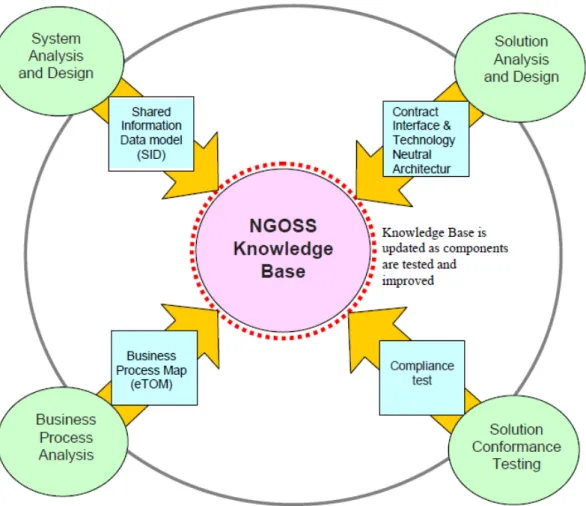
The TM Forum’s four foundational NGOSS frameworks include Business Process Framework (eTOM), Information Framework (SID), Integration Framework (TNA), and Application Framework (TAM). In the following paragraphs we present each of these key components [2].
The enhanced Telecom Operations Map (eTOM) is a guidebook built on TM Forum Telecom Operations Map (TOM). Currently, eTOM is the most widely used and accepted standard for business processes in the telecommunications industry. The eTOM model describes the full scope of business processes required by a service provider and defines key elements and how they interact. Among its advantages we can mention that it establishes a common vocabulary for both business and functional processes. The Framework enables to map the business processes into a language that all parts of an organization can understand, thus supporting a business-driven approach to manage enterprise processes. It also helps to identify and prioritize which operational areas are most critical to given business objectives.
vocabulary defining more than 1,000 industry standard business entities. The benefit of using the NGOSS SID and its common information language is that it enables business benefits relating to cost, quality, timeliness, and adaptability of enterprise operations, letting the enterprise (i.e. the service provider enterprise) to focus on creating value for its customers. SID and eTOM collaborate to illustrate how the business process works to contribute to the enterprises as a commonly accepted standard. In this procedure, SID plays a role to provide the definition which is to be affected by the business processes defined in the eTOM.
The Telecom Application Map (TAM) effectively provides a bridge between the NGOSS framework building blocks (eTOM and SID) and real, deployable, potentially procurable operational systems by grouping process functions and information into recognized Operation Support Systems (OSS) and Business Support Systems (BSS) applications or services. There can be no categorical solution in this area; the TAM provides a common frame of reference that allows suppliers, customers, and their partners who operate in this area to understand one another's viewpoints. From an integration perspective, TAM provides a canonical model of the underlying operational systems and provides generic endpoints for the business functions and processes defined within the eTOM. It builds on the success of the eTOM and SID which together with the TAM make up the heart of NGOSS [3].
The whole NGOSS picture is completed by the Technology Neutral Architecture (TNA) which leads to the physical implementation of Telecom Technology Solutions. Technology Neutral Architecture (TNA) is an architecture that is sustainable through the technology changes. The NGOSS TNA defines component-based, distributed system architecture and an associated critical set of system services [4].
Figure 2.1 illustrates the overview of the Tele Management Forum’s NGOSS Framework. In our project, we focus only in the eTOM Business Process Framework.
Background
Figure 2.1: TM Forum NGOSS Framework
2.2
eTOM background
eTOM brings the industry with a common structure to define and share business processes, the Business Process Framework enables service providers and their suppliers to work together to understand the current state of business activities, identifying improvement, and define new processes to streamline their business. As it is the convergence of networks and services, there are enough challenges.
Service providers in many sectors simultaneously feel great competition growing customer expectations, fully market share, and increasing price pressures. As a result, they feel pressure to clearly define and understand the business processes they use to deliver convergent services in the competitive environment. All the members in the value chain need a business driven approach to managing their enterprises, if they are to develop the complete understanding of their customer ,that understanding depends on the OSS, vital to support their customers. Only by gaining this kind of understanding, can service provider integrate the OSS, and improve the enterprise
framework for categorizing all business activities at all levels of enterprises. The focus of the Business Process Framework are the business process the linkage among processes, the identification of interfaces and the use of customer, service, resource, supplier partner and other information by multiple processes.
The analysis of all phases of business processes makes the Business Process Framework a critical tool for improving ongoing development. In review where different processes deliver the same business functionality while the service providers can eliminate duplication, review gaps to improve process design. For suppliers and partners trying to identify category process used in business to business attraction, the Business Process Framework serves to assist relationship by identifying where the interdependence exists; the most efficiently deliver services to customers. For planer, manager and strategists, the Business Process Framework helps in the assessment of process structure, process component, process interactivity and the business roles in responsibility to which they rely. This assessment ability gives them advises for setting accurate requirement for solutions, technical architectures, technology choices and implementation tasks.
The Business Process Framework has been widely adopted in the current industry. According to the statement of one member, they reach the 50% faster time to market through using the process framework as the guarding principle for billing systems and product management. Another report indicates that a company has an amount of saving of 400,000 dollars per month by using the process framework. All of this is spotting the success of eTOM [5].
The eTOM Business Process Framework can serve as the blueprint of standardized business activities which helps the enterprise to set a starting point and future develop directions.
eTOM framework develops a scope addressing all enterprise processes.
z It distinctly identifies marketing processes to reflect their heightened importance in an e-business world.
z It distinctly identifies Enterprise Management processes, so that everyone in the enterprise is able to identify their critical processes, thereby enabling process framework acceptance across the enterprise.
z It brings Fulfillment, Assurance and Billing & Revenue Management (FAB) onto the high-level framework view to emphasize the customer priority processes as the focus of the enterprise.
z It defines an Operations Support & Readiness vertical process grouping that relates to all the Operations functional layers. In integrating e-business and making customer self-management a reality, the enterprise has to understand the processes it needs to enable for direct and (more and more) online customer operations support and customer self-management.
z It recognizes three process groupings within the enterprise that are distinctly different from operations processes by identifying the SIP processes, i.e., Strategy
Background & Commit, Infrastructure Lifecycle Management and Product Lifecycle Management.
z It recognizes the different cycle times of the strategy and lifecycle management processes and the need to separate these processes from the customer priority operations processes where automation is most critical. This is done by decoupling the Strategy & Commit and the two Lifecycle Management processes from the day-to-day, minute-to-minute cycle times of the customer operations processes.
z It moves from the older customer care or service orientation to a customer relationship management orientation that emphasizes customer self-management and control, increasing the value customers contribute to the enterprise and the use of information to customize and personalize to the individual customer. It adds more elements to this customer operations functional layer to represent better the selling processes and to integrate marketing fulfillment within Customer Relationship Management. Note that Customer Relationship Management within the eTOM framework is very broadly defined and larger in scope than some definitions of CRM.
z It acknowledges the need to manage resources across technologies, (i.e., application, computing and network), by integrating the Network and Systems Management functional process into Resource Management & Operations. It also moves the management of IT into this functional layer as opposed to having a separate process grouping.
z It recognizes that the enterprise interacts with external parties, and that the enterprise may need to interact with process flows defined by external parties, as in e-business interactions [6]
2.2.1 eTOM introduction
The eTOM is a Business Process Framework, but not a service provider business model. Since it doesn’t focus on the strategic issues to give a marketing point of view for the enterprise, it can not be a so called business model. However, it can be treated as an essential part in the strategic business model which provides the detailed processes that the enterprise needs to follow.
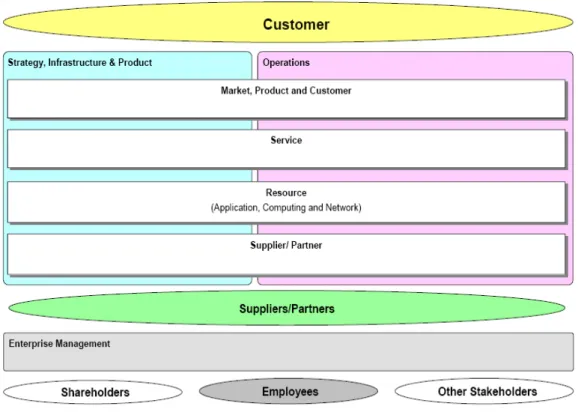
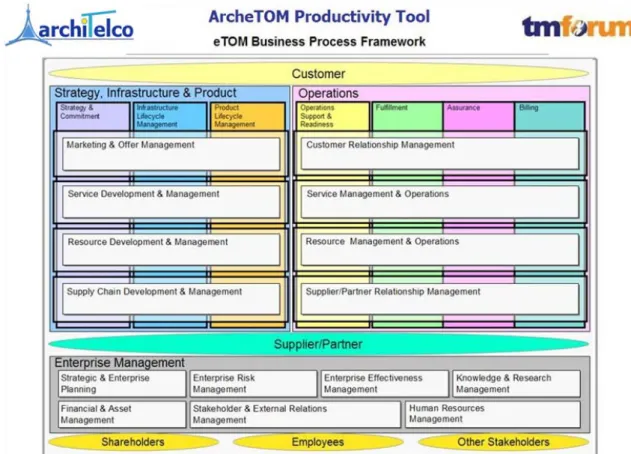
The eTOM framework is consisted of different horizontal and vertical process areas. Figure 2.2 shows the highest conceptual view of eTOM framework. As it can be appreciated, there are two main vertical slices, namely Strategy, Infrastructure & Product in one hand and Operations in the other, with four functional horizontal layers across. In addition, there is another main area called Enterprise Management in the bottom of the diagram. Customer, Suppliers/Partners and other relevant external actors are shown in that picture. eTOM is better regarded as a Business Process
Assurance, Billing & Revenue Management) which deliver value for the customer and the service provider.
Figure 2.2: Conceptual overview of eTOM framework
The eTOM work undertaken by the TMF has potential to develop further, in areas such as lower-level process decompositions and flows, applications in specific areas of business, guidelines and assistance in using the eTOM framework, cost and performance issues associated with the processes, etc. In addition, ongoing feedback from the industry, together with its linkage with the wider NGOSS program, can be used to guide future priorities for continuing work. It should be noted that the development of a full process framework is a significant undertaking, and the work must be phased over time based on member process priorities and member resource availability. This effect is visible in eTOM’s history, from the early work on a business process map that carried through to the eTOM framework itself, broadening along the way to a total enterprise framework and the current Release.
The TM Forum initially identified business processes as a consensus tool for discussion and agreement among service providers and network operators. This encouraged convergence and general support for a broad common base in this area, which has been built on and extended with the eTOM framework, to enable:
z Focused work to be carried out in TM Forum teams to define detailed business requirements, information agreements, business application contracts and shared data model specifications (exchanges between applications or systems) and to review these outputs for consistency
Background
z A common process view for equipment suppliers, applications builders and integrators to build management systems by combining third party and in-house developments
The anticipated result is that the products purchased by service providers and network operators for business and operational management of their networks, information technologies and services will integrate better into their environment, enabling the cost benefits of end-to-end automation. Furthermore, a common industry view on processes and information facilitates operator-to-operator operator-to-customer and operator-to-supplier/partner process interconnection, which is essential for rapid service provisioning and problem handling in a competitive global environment. This process interconnection is the key to e-business supply chain management in particular.
The eTOM work also provides the definition of common terms concerning enterprise processes, sub-processes and the activities performed within each. Common terminology makes it easier for service providers to negotiate with customers, third party suppliers, and other service providers.
2.2.2 Benefits of using the eTOM framework
The ability to utilize a standard set of telecommunication industry processes covering all operational areas is an increasing requirement from Telecommunication customers. The eTOM framework fills this need by providing a real solution for cycle time reduction, improved customer satisfaction and overall operational efficiency resulting in long-term revenue growth. There are several main benefits of using the eTOM framework:
z It makes available a standard structure, terminology and classification scheme for describing business processes and their constituent building blocks
z It supplies a foundation for applying enterprise-wide discipline to the development of business processes
z It provides a basis for understanding and managing portfolios of IT applications in terms of business process requirements
z Its use enables consistent and high-quality end-to-end process flows to be created, with opportunities for cost and performance improvement, and for re-use of existing processes and systems
z Its use across the industry will increase the likelihood that off-the-shelf applications will be readily integrated into the enterprise, at a lower cost than custom-built applications [6]
service providers, for example the internet service providers need to cope with the situation of an increasing numbers of customers, and at the same time, provide superior and competitive services to the customer. Thus, they keep expanding their markets and business relationship.
Service Providers face very different environments and their business strategies and approaches to competition are quite distinct, nevertheless they share several common characteristics:
z Heavily dependent upon effective management of information and
communications networks to stay competitive
z Adopting a service management approach to the way they run their business and their networks
z Moving to more of an end-to-end Process Management approach developed from the customer’s point of view
z Automating their Customer Care, Service and Network Management Processes
z Need to integrate new BSSs/OSSs with legacy systems
z Focusing on data services offerings
z Focusing on total service performance, including customer satisfaction
z Integrating with current technology and new technologies
z Emphasizing more of a “buy” rather than “build” approach that integrates systems from multiple suppliers [6]
There are two ways for the service providers to run their business, one is to operate their own network or information technology infrastructure; the other is to outsource some part of their business. All of these ways cast influence on the service quality and cost issues which have a direct relationship with the customers. Therefore, no matter they are communication service providers, application providers or internet provider in any phases of their business, from the very beginning to the growth of the enterprise, there is an intensive drive to enable end-to-end process automation of the business and operations processes in the information and telecommunication areas. In this case, we are able to move from a manual-intensive, inconsistent, inflexible environment to one that provides significant improvement in customer focus, service quality, unit cost, and time to market. eTOM is a well integrated standardized framework which also allows specific case to be applied. Based on the specification, the framework enables to be customized to meet the diverse needs of the service provider during implementation in specific cases.
There are some major goals of applying eTOM. First of all, it captures consensus industry agreements on reference business process structure and decompositions (i.e. the “static” process view) down to an appropriate level. Secondly, it applies these in typical business scenarios to show process flows in which these process elements are used (i.e. the “dynamic” process view). Moreover, it recommends methodologies that
Background assist users to extend eTOM in their own applications to include local process details. Finally, it also gathers results from all this to validate the core eTOM model and approach.
eTOM is an ‘industry standard’ Business Process Framework which provide a common definition to describe process elements of a service provider. The framework depends closely on the information and telecommunication industry agreement to identify the priority of the processes and interfaces in integration and automation. Service providers are in need of this standardized framework to run their business effectively and efficiently. In an e-business environment, it is essential to have a common understanding and using of process, especially in the current market with the boom of the number of customers and the increasing complexity of the services and network.
2.3
eTOM architecture
eTOM is the most widely used and accepted standard for business processes in the communications industry. It delivers a business process model/framework for use by service providers and others organizations within the communications and related sectors industry. It describes the full scope of business processes and provides a commonly used business language for the whole industry to enable compatibility. The Business Process Framework can serve as a tool to analyze the existing process, by assessing the value, cost and performance of these processes. With the review the existing processes, it enables the service providers to eliminate duplication where different processes deliver the same business functionality, thus leading to cost saving. The Business Process Framework can find missing steps in process and simplify procurement, serving as a common language between service providers and suppliers. The highest conceptual view of the eTOM framework was showed in Figure 2.2. In the upper two major boxes in the diagram, it provides an overall context that differentiates strategy and lifecycle processes from the operations processes in two large process areas. The key functional areas horizontally lay across these process areas. Moreover, the third major process area, concerned with management of the enterprise itself, is shown as a separate box in the lower part of the diagram with different interfaces. In addition, Figure 2.2 also shows the internal and external entities that interact with the enterprise such as customer, suppliers/partners, shareholders, employees and other stakeholders.
After the conceptual overview of the eTOM architecture, there is a need to dedicate into deeper levels of eTOM framework to master the mechanism of utilizing eTOM to solve problems.
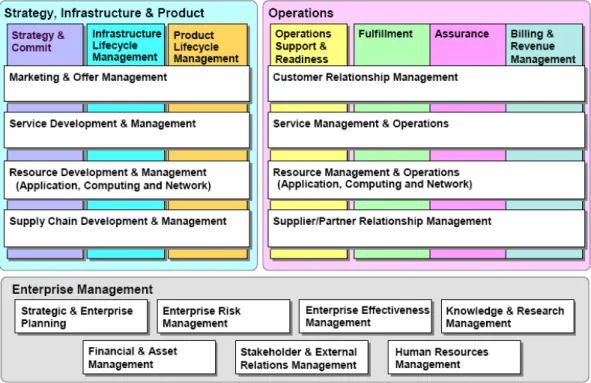
Figure 2.3: eTOM Business Process Framework - Level 1 processes
Thus, Figure 2..3 illustrates how the three major process areas – designated as Level 0 processes of the eTOM Business Process Framework - are decomposed into their constituent Level 1 process groupings. This view thus provides the Level 1 decomposition of the Level 0 processes and gives a more detailed overall view of the eTOM framework. However, in practice it is the next level – the Level 2 decomposition of the Level 1 processes - at which we tend to work, as this degree of detail is needed in analyzing the specific businesses. Later in the thesis, there will be in a series of diagrams examining one of the main parts of the framework according to our scenarios.
Figure 2.3 also shows seven vertical process groupings. They are the end-to-end processes which play a role as a support for customers to manage the business. Among these vertical process groupings, operations processes of Fulfillment, Assurance and Billing & Revenue Management (FAB) are the most crucial part in the eTOM framework.
z Fulfillment
This vertical end-end process grouping is responsible for providing customers with their requested products in a timely and correct manner. It translates the customer's business or personal need into a solution, which can be delivered using the specific products in the enterprise’s portfolio. This process informs the customers of the status of their purchase order, ensures completion on time, as well as ensuring a delighted customer [6].
Background This vertical end-end process grouping is responsible for the execution of proactive and reactive maintenance activities to ensure that services provided to customers are continuously available and performing to SLA or QoS performance levels. It performs continuous resource status and performance monitoring to proactively detect possible failures. It collects performance data and analyzes them to identify potential problems and resolve them without impact to the customer. This process manages the SLAs and reports service performance to the customer. It receives trouble reports from the customer, informs the customer of the trouble status, and ensures restoration and repair, as well as ensuring a delighted customer [6].
z Billing & Revenue Management.
This vertical end-end process grouping is responsible for the collection of appropriate usage records, determining charging and billing information, production of timely and accurate bills, for providing pre-bill use information and billing to customers, for processing their payments, and performing payment collections. In addition, it handles customer inquiries about bills, provides billing inquiry status and is responsible for resolving billing problems to the customer's satisfaction in a timely manner. This process grouping also supports prepayment for services [6].
Operations Support & Readiness (OSR) is differentiated from FAB real-time processes. It highlights the focus on enabling support and automation in FAB, i.e. on-line and immediate support of customers, with OSR ensuring that the operational environment is in place to let the FAB processes do their job. Outside of the Operations process area - in the Strategy, Infrastructure & Product (SIP) process area - the Strategy & Commit vertical, as well as the two Lifecycle Management verticals, are differentiated. These are distinct because, unlike Operations, they do not directly support the customer, are intrinsically different from the Operations processes and work on different business time cycles.
The horizontal functional process groupings in Figure 2.3 distinguish functional operations processes and other types of business functional processes, e.g., Marketing versus Selling, Service Development versus Service Configuration, etc. Among these Horizontal Functional Process Groupings, those on the left enable, support and direct the work in the Operations process area.
Many process groupings within Enterprise Management (see Figure 2.3) will contain elements that relate to both policy setting and support of the enterprise. For example, Human Resources Management is concerned with both strategy and direction as well as supporting the management of Human Resources throughout the enterprise. These processes are sometimes collectively considered as the “corporate” functions and/or processes.
deeper levels, we will make a process selection based on the need of the processes and carry out analysis.
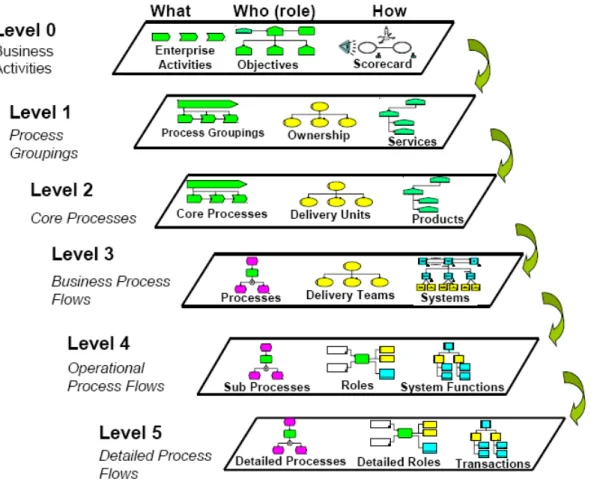
From the Level 0 to Level 5 of eTOM framework, there are different manifestations and functionality for each level. There is a brief introduction to the different levels of the framework (shows as Figure 2.4).
Figure 2.4: Process hierarchy
z Level 0 Business Activities
Identify and model: business objectives, value streams, environmental and fiscal constraints; develop balanced scorecard and product lines. These are the business goals that process and systems solutions must deliver [7].
z Level 1 Process Groupings
Design: product structure, product delivery and support process chains, enterprise-level data model, organizational structure. Identify business knowledge. This is the functional structure that delivers your business [7].
It refines the Level 0 entities, such as operations, into more specific functional areas, such as Customer Relationship Management (CRM), service management, and resource management.
Background Identify industry standard reference models; develop: generic processes, process hierarchy; identify and model business data definitions, system structure; define business roles. Processes are the key to delivering business objectives [7].
It provides a further level of decomposition into specific processing areas, such as order handling or loyalty retention.
z Level 3 Business Process Flow
Design detailed processes; assign business roles; identify supporting systems, data flows. Map business data models to systems data models. Consider failure paths; queues and bottlenecks. The detail is essential to ensure every action adds value to the business (which means to the customer) or is an essential requirement [7].
It defines the process flows of the Core Processes defined at Level 2, such as issuing customer orders, authorizing credit, and tracking order handling. As the thesis introduced in Chapter 3, the supporting tool we select to use provides the processes only until Level 3.
z Level 4 Operational Process Flow
Develop detailed sub-process design; define operational roles; link processes to written procedures; identify detailed systems, equipment and resource usage [7]. It defines in more detail the business process flows which should base on the specific case of the enterprises. Normally there is no more standardized process in the eTOM framework; the main task is to create the processes in Level 4 according to the scenarios and problems emerged in the enterprises.
z Level 5 Detailed Process Flow
Deliver the process flow automatically through workflow systems, e-business solutions and systems development. Link process and data models to systems and software development environments [7].
It defines in more detail the operational process flows defined at Level 4.
From the perspective of process hierarchy, the Level 0 and Level 1 can be integrated as business level whereas Level 2 and Level 3 are process level and Level 4 and Level 5 are operations level. In our project, Level 5 was not taken into account by the implementation of the scenarios. We will work on the framework until Level 4. It already enables us to go through all the business, process and operations levels to develop our scenarios.
3
Supporting tools for business
processes specification
In order to carry out the design of the business processes and flows that a service provider has to instrument, there is a need of supporting tools with the functionality to demonstrate the entire framework and assist to implement the project. At the beginning phase of this project, we devoted effort looking at supporting tools to lead a bright way to the ultimate objectives. This chapter summarizes the search we did on tools that could be useful for the above purpose
The supporting tools for business processes specification are in need to implement the scenario design. According to different functionality of these tools we will introduce later, we divide them into three groups:
z Ad hoc business process design tools (Casewise, ARIS, Enterprise Architect)
z Data structuring tools (MG-SOFT, ArcheTOM)
z Assisted drawing tools (Visio)
3.1
Casewise
The core of the eTOM work is the eTOM Framework, and associated artifacts such as process flows, all of which need to be captured and managed in a process analysis and design tool environment.
Casewise [8] is able to support eTOM from the point where a process analysis tool was needed to handle the expanding scope and detail of the eTOM Framework Model. Corporate Modeler [9] is used for the development of the eTOM Framework, and the resulting Model is made available for use within a wide variety of other tools and environments.
The eTOM work has benefited from the consistency and control that tool-based modeling provides. It has also been possible to evolve to use the variety of publishing options in Corporate Modeler to deliver a document output that follows past practice when the core eTOM development was document-based. This has allowed continuity for the huge variety of users for the TM Forum output, as well as allowing easy options for delivery of other types of artifact, such as browser-based web information. Corporate Modeler is the easy-to-use visual modeling tool at the heart of the Corporate Modeler Suite. By linking together organizational, process, IT architecture and data technology modeling though dynamic object linking, the tool enables teams to capture and understand the relationships between people, processes and technology. Through this multi-dimensional view, users can highlight the impact of change, find
Supporting tools for business processes specification and eliminate inefficiencies, identify and rollout best practices and implement IT solutions that truly support an enterprise.
Figure 3.1: Corporate Modeler, repository-based business process modeling Repository-based business process modeling and analysis tool in the Casewise Corporate Modeler Suite, as the Figure 3.1 shows, supports various business process modeling notations, approaches, and methodologies as eTOM, to allow users to define and map visual representation of an organization’s strategy, plans, and goals, and the business processes required to support these goals.
This tool is extensible to support a wide-range of methodologies and frameworks. It provides a very capable repository that supports team development and interaction, and Web publishing of models. It also has a very intuitive and rich visual modeling environment.
Casewise offers different frameworks, templates, models, and guidance that organization can use to jump start a range of enterprise architecture projects using Corporate Modeler. These visualized frameworks provide a “holistic” project management vision that can be modified to meet the user’s requirements. In addition, templates can be integrated and used in other models providing standardized objects types and artifacts, bringing consistency throughout modeling and documentation projects. Moreover, Corporate Modeler is highly extensible, allowing organizations to modify existing frameworks, or create new ones, to suit their specific needs. Accordingly, the toolset ships with the Casewise Framework – a step-by-step guide to creating enterprise architecture models based on the Zachman Framework, ITIL Best Practice Framework, ArchiMate Framework, eTOM, etc.
A full featured license for one user costs about 11000 Euros whereas for universities they offer 20 licenses for 1500 Euros.
3.2
ARIS
The software and consulting company IDS Scheer [reference the web site] is a provider of business process management related products and consulting services. IDS Scheer develops Business Process Management solutions for corporations and public authorities.
With its ARIS Platform [10] provided by IDS Scheer for Process Excellence, the company offers integrated and complete software tool portfolio for strategy, design, implementation and controlling of business processes and enterprise architecture management approaches.
ARIS Platform supplies integrated software products which help enterprises to continuously improve their business processes. These products cover every phase of a BPM (Business Process Management) project—from strategy definition and process design to transferring the models into IT systems and monitoring process execution. However, tapping into improvement potential as part of a BPM project should not be a one-time activity. Over the mid-term, only continuous BPM can yield sustained competitive advantages, which is why ARIS also supports the process of Business Process Management itself.
Based on IDS Scheer’s approach to BPM projects, the ARIS Platform products are assigned to four specialized modules:
z ARIS Strategy Platform: For defining business strategies, implementing them in operational processes, and performing continuous monitoring of target systems which includes ARIS Business Optimizer, ARIS Balanced Scorecard, etc.
z ARIS Design Platform: For distributed modeling, simulation, optimization, and publishing of business processes and managing IT architectures which includes ARIS Business Architect, ARIS Business Designer, ARIS Business Simulator, etc.
z ARIS Implementation Platform: For executing process models in IT systems, configuring SAP systems, managing business rules, and creating service-oriented architectures which include ARIS UML Designer, ARIS Business Rules Designer, etc.
z ARIS Controlling Platform: For dynamic monitoring of current business processes and establishing an enterprise-wide compliance management system which includes ARIS Process Performance Manager, ARIS Process Event Monitor, etc.
IDS Scheer has developed an ARIS reference model based on Information Technology Infrastructure Library (ITIL) to document, analyze, and implement IT processes. For companies wanting to align their IT processes with ITIL, ARIS ITIL offers a customizable graphical reference model and user-friendly modeling and analysis environment. After carefully research, there is no existing special eTOM
Supporting tools for business processes specification method or method content in ARIS. However it is possible to use the standard ARIS Model types to describe eTOM content, the ITIL content is compatible with eTOM to some extent.
In addition, ARIS offers several ways to model processes, with each method applying semantics that enforce process integrity. We can model the process flow, process rules, actor, systems, inputs and outputs, and other resources needed in the process.
Processes are defined using ARIS Business Architect or ARIS Business Designer – graphical design tools for modeling and documenting business processes, organizational views, and data. Users can also describe process models in text format. Only if models meet certain requirements are they processed further by other ARIS components, such as ARIS Business Simulator or ARIS Business Optimizer.
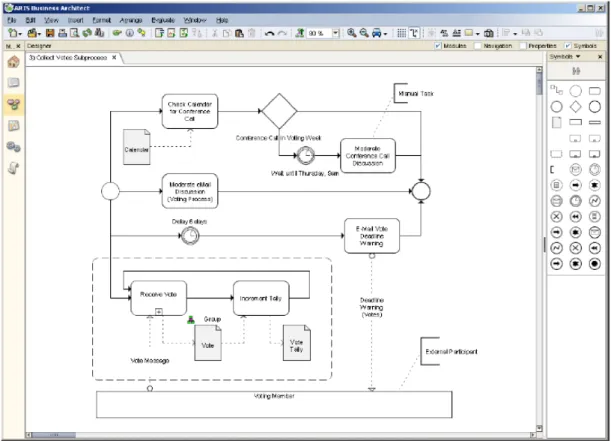
ARIS supports over 150 notations for modeling processes, data, systems, organizations, products, and services. Users can also create own-defined, tailored notations and frameworks, such as eTOM framework needed in our project. This is accomplished using the ARIS Configuration component, which provides facilities for configuring ARIS Business Architect and ARIS Business Designer to meet organizational and end-user needs. For example, by using special configuration functionality and by creating the appropriate filters, end-user organizations can adapt the ARIS Methodology to special requirements (for example, to rename model types, object types, symbols, attribute type groups, etc.). Figure 3.2 shows a Business Process Modeling Notation (BPMN)-Model, which is available in ARIS as an additional modeling notation.
Figure 3.2: BPMN Model in ARIS business architect
Besides, ARIS provides a drill-down capability for representing and managing sub processes. Through this, we are able to undertake eTOM framework and deal with the decomposition into deeper levels.
As for the price of license scheme, ARIS Business Architect costs 650 Euros, whereas ARIS Business Designer costs 260 Euros, and ARIS Business Server with an amount smaller than 235 users cost 790 Euros.
Since we are not able to implement the eTOM infrastructure directly with this tool, even though there are diverse advantages, we still prefer to carry out our scenario on other tools which is mentioned in rest of the thesis.
3.3
Enterprise Architect
Enterprise Architect [11] is a Computer Aided Software Engineering (CASE) tool for designing and constructing software systems, for business process modeling, and for more generalized modeling purposes.
This Unified Modeling Language (UML) tool is based on the latest UML 2.1 specification. UML defines a visual language that is used to model a particular domain or system.
Supporting tools for business processes specification Enterprise Architect is a progressive tool that covers all aspects of the development cycle, providing full traceability from the initial design phase through to deployment and maintenance. It also provides support for testing and change control.
With EA we can:
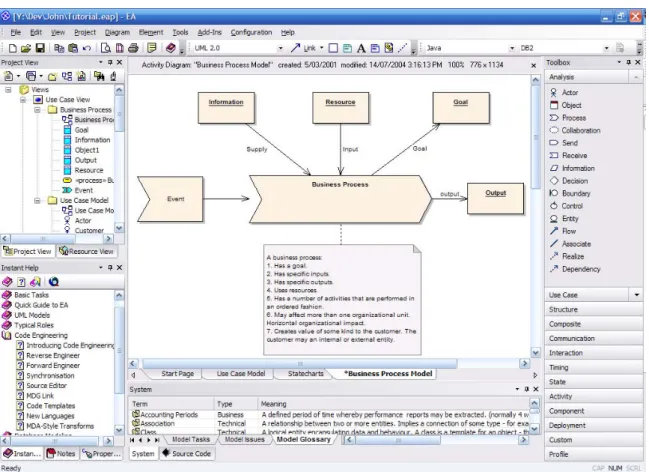
z Model business processes with industry standard UML (shows as following Figure 3.3)
z Easily take advantage of the Business Process Modeling Notation (BPMN)
z Model processes, information flows and data stores
z Manage requirements at a very detailed level
z Take advantage of UML Profiles for business process modeling
z Reverse engineer legacy code and database models
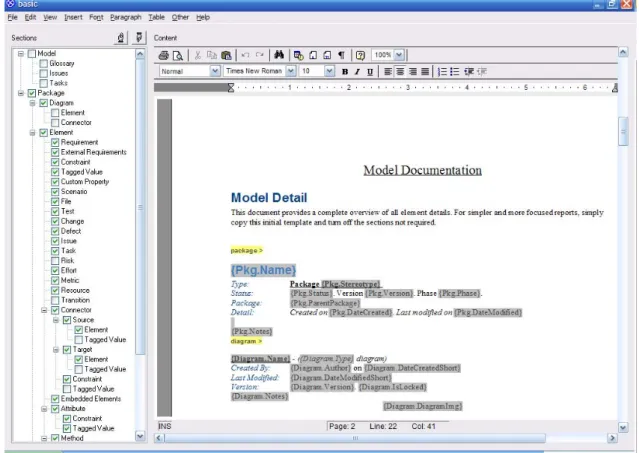
z Produce great looking reports in standard RTF and HTML format (shows as following Figure 3.4)
z Connect business process model to use case and software design models for end to end traceability. Hierarchy window is a most useful and versatile traceability tool which can present a model to enable traceability.
processes, flows and stores. Utilizing this function of Enterprise Architect, we are able to build our eTOM Business Process Framework and personalize the processes according to different scenarios.
The Business Process Modeling Notation (BPMN) is a standard for business process modeling, and provides a graphical notation for specifying business processes in a Business Process Diagram (BPD), based on a flowcharting technique very similar to activity diagrams from Unified Modeling Language (UML). The objective of BPMN is to support business process management for both technical users and business users by providing a notation that is intuitive to business users yet able to represent complex process semantics. The BPMN notation is specifically targeted at the business modeling community and has a relatively direct mapping to UML through BPMN Profiles integrated with the Enterprise Architect installer. Through use of these profiles, Enterprise Architect enables you to develop BPMN diagrams quickly and simply. The BPMN facilities are provided in the form of:
z A BPMN diagram type, accessed through the New Diagram dialog
z BPMN pages in the Enterprise Architect UML Toolbox
z BPMN element and relationship entries in the UML Toolbox Shortcut Menu and Quick Linker
Figure 3.4: RTF template editor
After the investigation on Enterprise Architect license scheme, we achieve the Table 3.1 as below to show the price especially for Academic License:
Supporting tools for business processes specification
Academic License Price: Standard / Floating Enterprise Architect Ultimate Edition US $349 / US $424 Enterprise Architect Systems Engineering Edition US $299 / US $399
Enterprise Architect Business & Software Engineering
Edition US $299 / US $399
Enterprise Architect Corporate Edition US $119 / US $168 Enterprise Architect Professional Edition US $105
Enterprise Architect Desktop Edition US $65 Table 3.1: Price scheme for academic license
According to the above functionality, we can conclude that EA is an appropriate tool supporting modeling and design based on the eTOM framework. Nevertheless, it’s more sophisticated and superfluous according to the objective of our project.
3.4
MG-SOFT
MG-SOFT MIB Browser with MIB Compiler is a toolkit intended to design and test SNMP-based management tools. Particularly, it allows building management information bases (MIB) compliant with the different SNMP standards and to browse through their respective implementations.
Although the use of a tool intended for low level network management may appear inappropriate to describe high level business processes, it is not less true that a SNMP MIB is a hierarchical data structure as the eTOM framework is also a hierarchical processes structure. In that sense, we understood that tools to build MIBs and browse MIBs could also be used to represent processes.
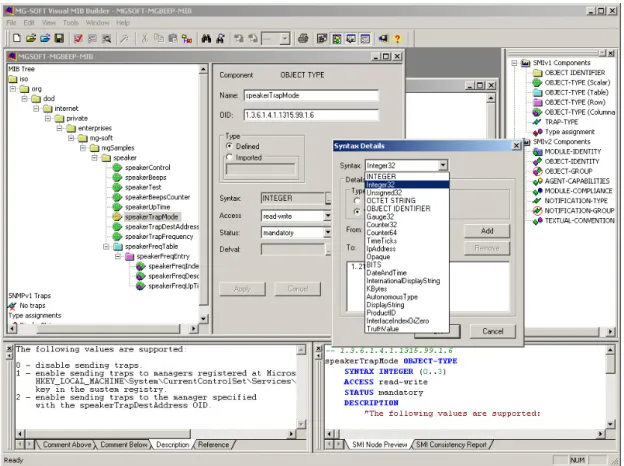
As the Figure 3.5 shows, MG-SOFT [12] has a user-friendly interface, through which, we are able to instantiate the eTOM framework.
Figure 3.5: MG-SOFT visual MIB builder (Main window)
Making full use of this point mentioned above, we are able to build a roadmap with different hierarchy and objects based on eTOM framework. In order to have a clear view of the entire eTOM framework, as for the supporting research phase of the project, we decided to build part of the eTOM framework by means of the MG-Soft MIB Builder. Through this, we would be able to move around with navigation like the MG-Soft MIB Browser.
First of all, the MIB Tree is built according to the eTOM framework which includes the three parts as Operations (OPS), Strategy, Infrastructure & Product (SIP) and Enterprise Management (EM). Then, both the OPS and SIP parts have vertical and horizontal sections which are cross laid in the eTOM framework Level 1. Finally, the objects represented with the icon of a leave play an important role in the business process detail description. Figure 3.6 shows how the tree-like structure built with MG-SOFT tools is able to provide the functionality of browsing and navigation. It enables us to deal with the eTOM framework at different levels to cover the appropriate business process. In this figure, we will instantiate the whole eTOM framework in Level 1.
MG-SOFT Visual MIB Builder for Windows, Standard Edition for single user license costs about 1500 US dollars. In this project, we make full use of the existing supporting tools to assist to understand and navigate the framework.
3.5
ArcheTOM
ArcheTOM productivity software is a tool specialized in eTOM Business Process Framework issued by ArchiTelco and TM Forum. ArchiTelco stands for “Telco Architecture”. It was created in January 2003 as an open association of Telecoms industry experts. ArchiTelco [13] is constantly involved in activities carried out by various industry and participates in numerous ongoing projects related to the definition of ICT standards, methodologies and architecture models, such as those published by the TM Forum, the Open Group, the IT Service Management Forum (ITSMF), European Telecommunications Standards Institute (ETSI), the Software Engineering Institute (SEI), the IT Governance Institute (ITGI) and so on.
As for the tool, ArcheTOM provides an information repository that follows the structure of the eTOM Business Process Framework. It provides a user-friendly, ergonomic and simple graphical user interface (GUI) which allows designing and developing business process architecture across 8 different process decomposition levels. ArcheTOM provides a facility to integrate heterogeneous data formats into each and all of its defined process elements.
ArcheTOM is a productivity tool which contributes to the interpretation and implementation of different scenarios based on eTOM framework. As the Figure 3.7 shows as following, ArcheTOM provides the overall view of the Framework with the main parts in eTOM framework: SIP, OPS and EM. In addition, it also illustrates actors as Customer, Supplier/Partner, Shareholders, Employees and other Stakeholders.
Supporting tools for business processes specification
Figure 3.7: Overview diagram of ArcheTOM
In the form of an overview diagram, in Figure 3.7, it indicates that ArcheTOM supports the eTOM Business Process Framework.
Inside ArcheTOM, there are mainly 4 labels in the toolbar which enables different functionalities showing over the framework of following figures. Thus, in order to discover more significance of this tool, we devote into the details as following.
Figure 3.8: eTOM Level 1 view of ArcheTOM
As for the first label, eTOM Level 1 view provides a diagram of eTOM framework in Level 1 which includes all the three areas: Strategy Infrastructure & Product (SIP), Operations (OPS) and Enterprise Management (EM). Inside each area, we have a clear view of different sections, both horizontal and vertical process groupings. Besides there is an extra function below this label, to zoom into one process groupings to have a detail look at the specific horizontal or vertical grouping into Level 2, as the Figure 3.8 shows. With this, we are able to have a general notion about the whole framework and main processes. It provides a clear architecture which facilitates the ongoing of our project.
To penetrate into the framework, Figure 3.9 illustrates the eTOM framework in Level 2 with all processes contained. With the second label, eTOM Level 2 view, we have an easier approach to have an overview with the detail of all the process groupings. It enables us to clarify the relationship and its adscription. This is in need, during the design and implementation of specific scenarios, to assist.
Supporting tools for business processes specification As the Figure 3.10 shows, the third label, eTOM navigation, provides a tree-like diagram enables us to modify and delete existing processes, and add a new sub process. Through this, we can simplify the framework and decompose the essential processes into deeper level in the context of the scenarios with the necessary processes and sub processes. In this way, the supporting tool can contribute in both the scenario design and implement.
By choosing one specific process in the hierarchical diagram, to click the fourth label, we can get the definition and detailed description on the other page. In addition, there are much more information that is not defined yet on the left scalable list showing in the Figure 3.11. Using this, we can instantiate the description and define other parameters due to the specific situation of our scenarios.
Supporting tools for business processes specification Moreover, with the report option, it is able to generate an excel document to describe all the processes existed in the framework with descriptions and hierarchy. Especially after the selection and decomposition of processes, we are able to report a document with a list of the result. It will be taken into practice in the chapter 4 for our scenarios and the detail navigation diagram will be shown in the Appendix.
Due to the clear advantages exhibited by ArcheTOM in front of the MG-SOFT tools we decided to adopt it for further development of this project.
3.6
Visio
Visio is a user friendly tool to create diagrams; hence it can be used by everyone. We do not need to know software programming in order to use Visio. Using Visio, an electrician can create Electrical Diagrams; a student can create a flowchart to understand the process flow; sales persons can create charts and graphs; engineers can create Mechanical Engineering diagrams, managers can create organizational charts and software programmers can create UML diagrams and user interface prototypes. Some of the different kinds of diagrams that you can create using Visio are:
• Flowcharts
• Block Diagrams
• Business Process Diagrams
• Charts and Graphs
• Database Models
• Data Flow Diagrams
• Electrical Diagrams
• Mechanical Engineering Diagrams
• Systems and Network Architecture Diagrams
• Organizational Charts
• Gantt Charts
• User Interface Prototypes
• Sitemaps for Websites
• UML Diagrams, etc.
In our case, we need to illustrate the scenario implementation as a part of the project with flowcharts. Since the ArcheTOM doesn’t provide this functionality and Visio is a user-friendly tool, we adopt this one as a complement of ArcheTOM for designing
4 Business processes deployment in a
practical scenario
4.1
Scenario and use cases
This project is devoting in creating a new content provider company with business processes aligned with eTOM. The content provider company was named as MEDIA, an SME (Short-Medium Enterprise) that owns different types of multimedia content. This content includes video and audio which is enabled to offer to its customers. The services are orientated to people living in a given geographical area which are interested in the content. As for the network, they are also equipped with the appropriate access device of their own.
The offer of MEDIA is available through a catalog visible as an Internet portal. Furthermore, the content is stored in different types of media. Selective subscription has the access to different types of content as well as different types of QoS. The QoS standard was divided into gold, silver and bronze. It is selected by the customer at subscription time. As for the billing scheme, it charges not only the fixed rate for service subscription type, but also pays per view.
Instead of buying their own servers and carrying out the corresponding operation, MEDIA has signed an agreement with CLOUD, another company that materializes the concept of “cloud computing”. In this particular case, CLOUD is offering to host the content of MEDIA in appropriate servers, making them accessible through the Internet with a given end-to-end latency.
Acting as a provider, CLOUD is supporting an overlay network. When a request is received, it is redirected to the most appropriate server which stores the content ordered by the subscriber. In the mean time, CLOUD has access to the Internet through an Internet service provider, shown as the Figure 4.1 below.
Moreover, in order to make an easy access to its potential customers, MEDIA has decided to deploy its own access network to the Internet. This network will consist of a mix of WiMAX and WiFi technology conveniently deployed in the area of coverage. Interconnection of the wireless network and the fixed network is through an Internet service provider mentioned above.
MEDIA will install the OSS in a central location which supports the business process of the company. This OSS includes the business processes that are the subject of this thesis.
Business processes deployment in a practical scenario
Figure 4.1: Hardware deployments in use cases
4.1.1 Actors identification
Figure 4.2 depicts the sets of relationship groupings involved in a value network in the ICT industry. The value network must operate with the efficiency of a self-contained enterprise, which requires managing the network on a process rather than an organizational basis. The model explicitly shows the use of the eTOM Business Process Framework by the service provider at its core. It is only shown here to simplify the figure and its presence is not intended to imply that its use by the Service Provider is prescribed, just that the service provider would probably benefit from its use. Likewise, it is not intended to preclude the use of eTOM by the other entities shown within the value network. These entities may or may not make use of the eTOM business process.
Figure 4.2: Roles of entities in value network
The roles of the entities in the value network shown in Figure 4.2 are described below:
z Customer
The customer may represent an end customer who is responsible for ordering, using and paying for service products where the product provided by the value network is consumed, or a wholesale customer. In our scenario, the customer of MEDIA is the end customer, the subscribers who make use of the content service and subscribe to pay for the content service.
z Service Provider
The service provider supplies the customers with services and support who is responsible for the contract and billing as well. It acts on behalf of the value network it represents in relationships with Intermediaries as well as with the customer. In our scenario, the service provider is the enterprise MEDIA who provide the content service to the subscribers. It plays a role to interact with customers including subscribing, problem solving, billing and so on.
z Complementary Provider
The complementary provider is in a partnership with the service provider to extend the product provided by the service provider and offers additional capability, making interactions with the service provider more attractive and convenient for the customer.
Business processes deployment in a practical scenario In our scenarios, there is no complementary provider who adds more services provided to customers, only MEDIA works as a service provider itself.
z Intermediary
The Intermediary supplies a service for a fee. At a time of Internet globalization an Intermediary can play an important role as it can promote market transparency by overcoming the geographic constraints that used to limit knowledge about the products available [6]. Functional intermediaries provide a specific function, such as selling, electronic payment or authentication. In our scenarios, to simplify, there is no intermediary.
z Supplier
The supplier interacts with the service provider in providing hardware, software, solution and services which are assembled by the service provider in order to deliver its solutions or services to the customer [6]. In our scenarios the supplier is CLOUD, the overly network owner who supports the network for the service provider MEDIA to run its business. In addition, the Internet access provider adopts the role to provide Internet connectivity to MEDIA. Therefore, it is a supplier as well.
Generally, an enterprise can play different parts in different value networks. A service provider serves its customer whereas it can also be a customer of the other service provider or complementary provider at the same time. In current telecommunication market, the roles keep changing and updating. There are no fixed rules to follow but all depends on the situation and specific scenarios. According to the role analysis based on the scenarios, we conclude that:
Service Provider: MEDIA (the Enterprise)
Customer: Subscriber (Subscribe services)
Supplier: CLOUD (overlay network) and Internet Provider (Internet access)
4.1.2 Use case 1-Service subscription
One of the most basic end-to-end processes a service provider must support is to ensure the appropriate response to a potential customer service request. A subscription process defines who has access to selected information. Whether we are developing a newsletter, deliver regular e-mail-based or telephone communications, to internal or external subscribers, we will need a process to ensure that the right people are accessing only the information intended for them. Let’s imagine an individual who never had any relationship with MEDIA. This means that the company has no records about the identity or the profile of that person. Our user is roughly aware of the MEDIA services through advertisements he got through his mail. He knows the URL and contact of the company and he expects that through a relatively simple interaction
Summarizing, the use case is triggered by an unknown user and ends with a formal subscription to one particular service of the MEDIA portfolio.
4.1.3 Use case 2-Problem complain
Going back to the user mentioned in Use Case 1, now already a customer of MEDIA, assume that he has been enjoying satisfactorily of different content programs when suddenly, viewing the retransmission of a match of his football team he observes an abnormal deterioration of the quality of the image. He start