Construction Management in practice
- Perspectives of CM utilisation in Sweden
Master of Science Thesis in the Master’s Programme Design and Construction Project Management
SANDRA BERG & SANDRA PERSSON
Department of Civil and Environmental EngineeringDivision of Construction Management
CHALMERS UNIVERSITY OF TECHNOLOGY Göteborg, Sweden 2013
MASTER’S THESIS 2013:21
Construction Management in practice
- Perspectives of CM utilisation in SwedenMasterof Science Thesis in the Master’s Programme
SANDRA BERG & SANDRA PERSSON
Department of Civil and Environmental Engineering
Division ofConstruction Management
CHALMERS UNIVERSITY OF TECHNOLOGY Göteborg, Sweden 2013
Construction Management in practice - Perspectives of CM utilisation in Sweden
Master of Science Thesis in the Master’s Programme
SANDRA BERG & SANDRA PERSSON
© SANDRA BERG and SANDRA PERSSON, 2013
Examensarbete/Institutionen för bygg- och miljöteknik, Chalmers tekniska högskola2013:21
Department of Civil and Environmental Engineering Chalmers University of Technology
SE-412 96 Göteborg Sweden
Telephone: + 46 (0)31-772 1000
Chalmers reproservice / Department of Civil and Environmental Engineering Göteborg, Sweden 2013
Construction Management in practice -Perspectives of CM utilisation in Sweden
Master of Science Thesis in the Master’s Programme
SANDRA BERG & SANDRA PERSSON
Department of Civil and Environmental Engineering Chalmers University of Technology
ABSTRACT
One key factor for any successful project is to choose the right project delivery method. In the construction industry there are several ways to implement a project and a client have several aspects to consider before choosing the most appropriate method. Construction Management (CM) is one way to execute a project where the client and a CM-organisation work together to implement the clients project objective. CM can basically be described as the project delivery approach where the client employs a CM-organisation in order to assist the client and to coordinate all activities in the pro-ject. The design-build contractor or general contractor is replaced with the CM-organisation that always should have the best interest for the client in mind and exe-cutes the client role and responsibilities. A fundamental idea with CM is that the client has the ultimate responsibility and takes the risks in the project, often resulting in lower costs.
This master thesis has the purpose to describe a general understanding of CM and to study CM practises. During the thesis nineteen interviews have been done with project managers representing CM-organisations, clients of the studied company and prime contractors in an on-going project. Further, the thesis is primarily focusing on one company working with CM in the western part of Sweden and how to facilitate this company’s continuing work with CM. The view of CM differs geographically in Sweden, in Stockholm the concept of CM is more widespread and used more fre-quently. Therefore companies operating in Stockholm are also included and their practises are compared to the studied company’s.
The findings from the interviews indicated that the practises of CM in Sweden con-form. Issues that was highlighted by the interviewees was the importance of early involvement of the CM-organisation, having the appropriate organisation and be lo-cated on the construction site. The view of the remuneration to the CM-organisation and the use of incentives slightly diverged among the interviewees. Further, the find-ings emphasise the way that the companies handle risks and responsibilities in their projects, along with characteristics of the more suitable projects and clients. Finally, the findings from the interviews and the literature study are compared, discussed and some recommendations to the company are given.
Key words: Construction Management (CM), project delivery methods, construction industry
Construction Management i praktiken – Perspektiv på användning av CM i Sverige
Examensarbete inom Design and Construction Project Management
SANDRA BERG & SANDRA PERSSON Instutitionen för bygg- och miljöteknik Avdelningen för Construction Management Chalmers tekniska högskola
SAMMANFATTNING
En viktig faktor för ett lyckat projekt är att välja rätt genomförandemetod. I byggbran-schen finns det flera olika metoder att välja på och en beställare ha flera aspekter i åtanke innan valet görs. Construction Management (CM) är ett sätt att genomföra ett projekt där beställaren och CM-organisationen arbetar tillsammans. CM kan i princip beskrivas som en genomförandeform där beställaren använder en CM-organisation för att få hjälp i alla beslut och för att samordna alla delar i projektet. Total- eller general-entreprenören ersätts av en CM-organisation som alltid agerar utifrån beställarens bästa och med andra ord agerar som om de vore beställaren. En grundtanke med CM är att beställaren har det övergripande ansvaret och tar alla risker i projektet vilket kan resultera i lägre kostnader.
Detta examensarbete har som syfte att ge en generell förståelse av CM och studera hur CM används i praktiken. Nitton intervjuer har genomförts med projektledare i CM-organisationer, beställare till det studerade företaget och entreprenörer i ett pågående projekt. Vidare, fokuserar examensarbetet främst på ett företag som arbetar med CM i Västsverige och hur detta företag kan fortsatta arbeta med CM. Synen på CM har geografiska skillnader i Sverige, i Stockholm är begreppet CM mer utbrett och an-vänds oftare. Därför har även företag verksamma i Stockholm också intervjuats och deras sätt att arbeta med CM jämförs med det studerade företagets.
Resultatet från intervjuerna visar att CM används på liknande sätt i Sverige. Frågor som betonades av de intervjuade var vikten av tidig involvering i projektet av CM-organisationen, att ha en tillräckligt stor organisation och att vara placerad och till-gänglig på byggarbetsplatsen. Synen på ersättningen till CM-organisationen och an-vändningen av incitament var något som skilde de intervjuade åt. Vidare betonar re-sultaten hur företagen hanterar risker och ansvar i sina projekt samt vilken typ av pro-jekt och beställare som är mer lämpliga för CM. Slutligen är resultaten från intervju-erna och litteraturstudien jämförda, diskuterade och några rekommendationer till före-taget ges.
Contents
ABSTRACT I SAMMANFATTNING II CONTENTS III PREFACE V 1 INTRODUCTION 1 1.1 Purpose 2 1.2 Limitations 21.3 The studied company, Bygg-Fast 2
1.4 Disposition of the thesis 3
2 FRAME OF REFERENCE 4
2.1 Defining project delivery methods 4
2.1.1 Design-build 5 2.1.2 Design-bid-build 5 2.1.3 Partnering 6 2.2 Construction Management 8 2.2.1 The emergence of CM 8 2.2.2 Variants of CM 9 2.2.3 CM application 10
2.2.4 The use of CM in practice 11
2.2.5 The client view of CM 13
2.2.6 Contracts, responsibilities and risks involved in CM-projects 14
2.2.7 Summary of CM 15
2.3 Comparison of CM and other project delivery methods 16
2.4 CM in this study 17
3 METHOD 18
3.1 Literature study 18
3.2 Interviews 18
3.3 Analysis of interview data 19
4 FINDINGS 20
4.1 Defining CM 20
4.2 Practical use of CM 21
4.3 Contracts, responsibilities and risks in a CM-project 25
4.4 Application of CM 27
4.6 The future of CM 30
5 DISCUSSION 31
5.1 How to define CM? 31
5.2 How to use CM in practice? 32
5.3 How to handle contracts, risks and responsibilities in CM-projects? 33
5.4 What projects and clients can CM be applied on? 34
5.5 How does clients view CM? 35
5.6 What is the future for CM? 36
6 CONCLUSION AND FINAL RECOMMENDATIONS 37
7 REFERENCES 39
8 APPENDIX 41
8.1 List of included companies 42
8.2 Interview Guide 43
Preface
This master thesis is the final part of the authors’ education at Chalmers University of Technology in Göteborg. It is also our master thesis for a degree from the master pro-gram Design and Construction Project Management. The thesis presented is based on a literature study concerning Construction Management (CM) as a project delivery approach and interviews with a total of six companies working with CM. In the proc-ess three clients and four prime contractors have also been engaged. The study had been carried out from January 2013 until May 2013 at the company Bygg-Fast. This thesis is related to their work to develop and market CM.
A first and big thank you goes to the employees at Bygg-Fast’s division in Göteborg for welcoming us at their office, where most of the work has been carried out. Espe-cially thanks to our supervisor Oskar Lindström, the business unit director Sten Mo-berg and other employees at Bygg-Fast that have supported us during the thesis. We also greatly appreciate the assistance and comments from our supervisor and examiner at Chalmers, Göran Lindahl.
Last but not least, we wish to thank all those who we interviewed during the thesis process and specially the other five CM-organisations that shared their experiences. Without the help and information from all interviewees this master thesis would not have been possible.
Göteborg May 2013
1
Introduction
A necessity when a client intends to implement a construction project is to choose the most suitable project delivery method and contracting form for the project. A contract is an arrangement between the involved actors in a project and can be seen as a tool in how to handle project risk. A project delivery method is on the other hand describing how to achieve project completion from initiation to finished building. The choosing of the right project delivery method might be difficult and therefore the client needs to consider several aspects in the project before a decision can be made. Which method the client chooses should be based on project priorities, responsibility allocation, fi-nancial possibilities and how the risk should be shared among the involved actors. When the client have chosen the method and implementing company e.g. a main con-tractor, this company has a commitment to deliver the project within the specifications set in documents and contracts. The commitment entails certain obligations for the chosen company that sometimes may be hard to pursue due to difficulties to strive against the client’s project objectives. A challenge in all projects is the financial as-pect e.g. to meet the client’s needs in building cost effectiveness rather than with low-est price. Construction Management (CM) is one way of implementing a project where the client and company are working together in consensus to fulfil project ob-jectives.
In literature concerning CM or in different encyclopaedias on the Internet there is no unique definition that once and for all states what CM is. Often the term construction management is used broadly in the construction industry to describe a variety of pro-fessional management services, which is not describing CM as a project delivery method. However, due to many involved in the process, several interpretations of CM have developed around the world and resulted in different variants of CM with both similarities and differences. Common for most of the variants is that CM is a project delivery method where the client contracts a construction manager in order to coordi-nate all activities from planning and design, to construction and completion of the project (Oyegoke, 2001). The fundamental idea with CM is that the construction man-agers always should act and work in the best interest of the client which sets CM apart from other delivery methods.
CM began to develop in the middle of the 20th century when the construction industry went through large changes (Kluenker, 2001). Projects become more complex, the profit margins for the contractors narrowed and the roles in the construction industry were changed. There was a need for a new project delivery approach and in the same time CM was developed simultaneously around the world. In Sweden, Åke Larson Byggare AB is often credited as the first company in Sweden using CM (Linder, 1980). Today, several companies are working with CM in Sweden and they are often considering Åke Larson as a role model and forerunner. However there are geo-graphically differences, in Stockholm the CM-approach is a more prevalent concept than in the rest of Sweden. Therefore some companies in Stockholm have specialised themselves in delivering projects using mainly CM. In this master thesis the focus is to compile and develop a company’s way of working with CM in the western part of Sweden, especially in the Göteborg region.
1.1
Purpose
This master thesis has the purpose to explore the project delivery approach Construc-tion Management and to compare and analyse approaches to try and define the con-cept of CM. Further, it aims to study how companies in Sweden are approaching and work with CM. The literature in the field of Construction Management will be re-viewed and compared to the actual practise from the interviews in order to improve Bygg-Fast’s way of working with CM. To facilitate their development, other compa-nies using CM as a project delivery approach in Sweden will also be included in the study. In other words, the main idea is to evaluate Bygg-Fast’s approach to CM and give recommendations on how to further develop their CM practices.
In order to achieve the purpose, the objective with this master thesis is to:
Study CM, both theoretical and practical, in different companies to find differ-ent approaches of working with CM.
Describe how companies in Sweden work with CM and how the companies view the Swedish market.
Contribute with an input regarding CM to companies in Sweden concerning how they can spread and increase CM in the construction market.
1.2
Limitations
This master thesis takes its starting point in the Swedish construction industry. The focus is on housing and construction works rather than infrastructure project delivery methods. The study will include one company, operating in the western part of Swe-den, where project managers and their clients are being interviewed. As a comple-ment, other companies working with CM are questioned and they are limited to those in CM-bolagen, an industry association for companies active within the field of CM.
1.3
The studied company, Bygg-Fast
In this master thesis the company Bygg-Fast AB operating in the western part of Sweden is studied. Bygg-Fast is a consultancy organisation specialised in project management and property development. The company is divided into two subsidiar-ies, one working with project management in various forms and the other is develop-ing properties. Bygg-Fast was founded 1979 in Borås and is today actdevelop-ing substantially in the western part of Sweden with offices in Malmö, Helsingborg, Halmstad and Göteborg. Recently in spring 2012 two new offices was opened, one in Stockholm and one in Linköping. Today Bygg-Fast has approximately 60 employees working at the offices around Sweden. There are currently two shareholders holding 75 % of Bygg-Fast while the rest is owned by the employees.
Already from the beginning, there has been a fundamental idea at Bygg-Fast that they should both build and manage their properties. Early in the development the founders decided that they should not do the construction by themselves and this was the start-ing point for their workstart-ing method, the CM-approach. Bygg-Fast wanted to offer its clients a complete business model instead of competing for the best price and always be on the client’s side in the project. Today, all projects that Bygg-Fast implements in their property development use CM. They have also implemented several CM-projects in collaboration with their clients.
Bygg-Fast provides their clients with a professional knowledge and helps them with both commercial and technical advises in the development of the clients’ property portfolio. Furthermore, Bygg-Fast distinguishes from other consultancy organisations because they implement their own projects. Therefore, Bygg-Fast offers the client an overall approach and has the experience of being on the client side. In this master the-sis three reference projects, with Bygg-Fast as the CM-organisation, was studied. The CM-projects differ from each other in size, complexity and level of experienced cli-ent. Among the projects there is one currently on-going and there are both new con-struction and refurbishment projects.
1.4
Disposition of the thesis
This master thesis consists of six chapters which together constitute our knowledge-base on Construction Management. Below the chapters are briefly described to ex-plain the main content of each chapter. The structure and working process of the mas-ter thesis is further illustrated in, Figure 1.
Chapter 2 – Frame of reference,provides a theoretical frame for the master thesis
based on a literature study. In this part different project delivery methods are de-scribed followed by a deeper compilation of Construction Management.
Chapter 3 – Method,defines the method that has been selected and utilized during
the process of the master thesis. Further, the chapter describes of how the data was collected and analysed.
Chapter 4 – Findings,presents the results deriving from the conducted interviews.
The chapter is divided into six parts based on the literature study and the answers from the interviewees.
Chapter 5 – Discussion,is the chapterwhere the findings from the interviews are
discussed and analysed with support from the theories in the Frame of references.
Chapter 6 – Conclusion and recommendations,has the purpose to conclude the
master thesis and make recommendations to the company.
2
Frame of Reference
In order to view CM in the relevant context, this chapter starts with presenting the two traditional project delivery methods, design-build and design-bid-build. Further, the approach of partnering, where the aim of better relations between the actors is similar to the ideas within CM, is described. The major part of the chapter aims to give a thorough view of CM. In the end CM is summarised and compared with the other delivery methods. During the whole chapter there is an assumption that the readers are familiar with the basics of the construction industry.
2.1
Defining project delivery methods
When a construction project is executed there should be an emphasis on selecting the project delivery method that is most suitable for the project. A project delivery method describes how the client, designers and contractors are organised during the project in order to complete the project (Jackson, 2010). The method need to be de-sign in order to meet the client’s objectives in the best way and deliver a satisfying project (CMAA, 2007). What method the client selects should be based on their pro-ject priorities and how the responsibilities and risks are allocated among the involved actors (Höök, 2005). The relationships, roles and responsibilities between the actors can vary significantly depending on the used project delivery method (Alberta Infrastructure, 2001). It is further essential to consider the client’s management capa-bility, time of project delivery and financial aspects.
In the publication An owner’s guide to Construction Management edited by Construc-tion Management AssociaConstruc-tion of America (CMAA, 2007) several issues of what a client should consider when choosing a project delivery method are presented:
The project time, whether the project needs to be completed quickly or if outside conditions is claiming short delivery time.
Flexibility in the project, considering possible changes and the extent the client wants to be able to influence the different project phases.
Preconstruction service, if the client needs assistance in the defining and planning of the project regarding cost, time, quality and safety.
Interaction in the design phase, reflecting the understanding that the client has concerning the design phase including project complexity and cost im-pacts.
Financial aspects, how the project will be financed and the effects the fi-nancing will have on e.g. schedule, type of contract, and risk.
After consideration of these aspects the client should choose the project delivery method that is most suitable for the project and meet the client’s requirements in the best possible way.
2.1.1
Design-build
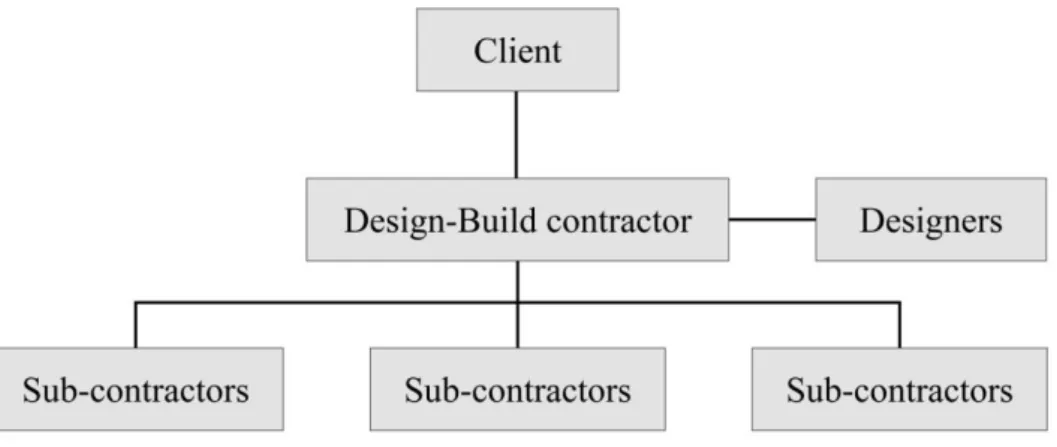
Over the last ten years the design-build delivery method has faced a major growth in popularity both in Europe and the United States (Jackson, 2010). The method is asso-ciated with a single-contract project where the client only contracts with one contrac-tor. This contractor, the design-build-contractor is responsible for both the design and the construction of the project (see Figure 2). However, the contractor is able to use in-house resources or sub-contract both the design and the construction (Oyegoke, 2001).
Figure 2, Organisational structure and actors involved in a design-build contract - The contract and communication relationships in a design-build agreement.
In a design-build project the client transfer the control and responsibility to the de-sign-build-contractor in accordance to the client’s requirements (Kenig, 2004). The selection process of a contractor can either be negotiated or competitive based on price, time and qualification (Hardin, 2009). The tendering requirements consist of outline design and specifications which will be the basis for the project design pro-vided by the contractor (Potts, 2008). To be able to start the construction the client has to approve the design. Further, the design-build-contractor is responsible for all documentation including design errors and is also the one taking the risk for the con-struction (Hardin, 2009).
One of the advantages with the design-build method is the early involvement of the design-build-contractor in the project (Jackson, 2010). This enables communication and integration between the designers, engineers and sub-contractors that works to-gether as a team (Hardin, 2009). As a result this facilitates integration and overlapping of the design and construction phases and the project might be completed earlier to a reduced cost (Jackson, 2010). A drawback with design-build as a project delivery method is that the client may lose control over the design of the project (Potts, 2008). The client needs to define the project scope early in the process and if any changes are made during the construction it might be expensive for the client.
2.1.2
Design-bid-build
Design-bid-build is the project delivery method that by many authors e.g. Hardin (2009), Jackson (2010), and Oyegoke (2001), are seen as the traditional way of deliv-ering projects. This method has a linear process starting with the client hiring a design team of architects and engineers (Hardin, 2009; Jackson, 2010). The team develops the design and prepares complete construction documentation for the project. Further, a selection of contractors is handed the documents in order to provide the best price.
Based on the documentation the contractors prepare and deliver a tender for the pro-ject. The client considers the tenders evaluating the qualifications and price and there-after contracts the most suitable contractor. This contractor, the general contractor, is then responsible for the construction of the project according to the documentation (Oyegoke, 2001). The construction is often made by the general contractor and its sub-contractors.
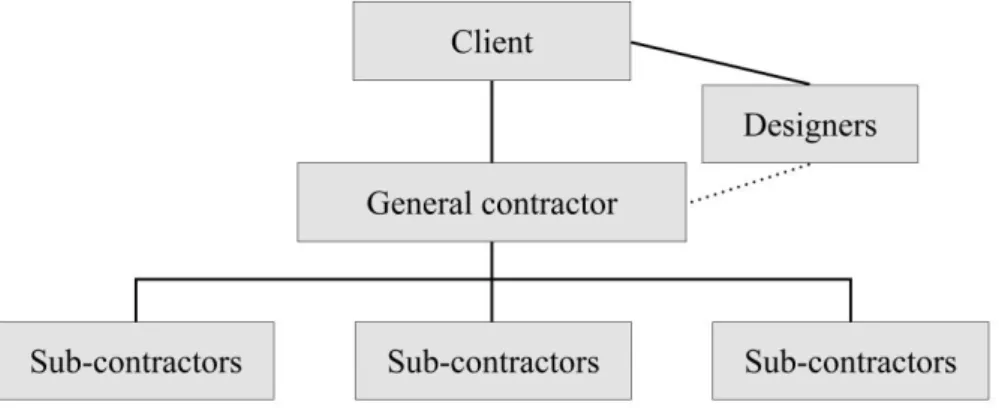
In design-bid-build projects the client holds two separate contracts; one with the de-sign team and one with the general contractor (see Figure 3). In this arrangement the control of the project is retained by the client who in turn needs the knowledge and resources required to manage the project in their organisation (Hardin, 2009). All in-teractions between the design team and the contractor must be managed and led by the client (Jackson, 2010) and in some cases it may position the contractor as an adver-sary to the client and the design team (Haltenhoff, 1986).
Figure 3, Organisational structure and involved actors in a design-bid-build con-tracts - The contract and communication relationship in a design-bid-build agree-ment. The dotted line indicates a communication path with no contractual relation-ship.
In a design-bid-build project the client have a high degree of certainty of the total cost of the project (Potts, 2008). However, the design-bid-build method has its drawbacks, mostly originating in the linearity of the process. When the general contractor is not involved in the planning or designs of the project they have no possibility to provide management and constructability input early in the project (Walker & Hampson, 2003). Clients applying this method also assume that cheaper is better and that the competition in the tendering process will provide the best prices (Hardin, 2009). In the focus on price; project quality, ability to perform, and collaboration skills are often forgotten. Furthermore, the general contractor is only contracted to perform in accor-dance to the tendering documentation. Any change during the construction phase or error in the documentation is the client’s responsibility and may cause additional ex-penses for the client (Hardin, 2009).
2.1.3
Partnering
As a project delivery approach, partnering has its origin in the traditional industry and was introduced to construction about fifteen years ago (Hindersson, 2012). The reason for bringing this approach up here is that the partnering philosophy is closely related to the one of CM. The literature often refers to the definition of partnering set by the US Construction Industry Institute (CII), however, it is generally agreed among the authors in the field that there is no common use of this definition (Bygballe, et al.,
2010). Partnering is divided into two parts; strategic and project partnership. Strategic partnership refers to a long term relationship that spans more than one project while project partnership is a short term commitment during one project (Bygballe, et al., 2010; Hindersson, 2012).
Partnering is basically described as a long-term commitment between two or more organisations where a common objective is set to be achieved (Bygballe, et al., 2010; Eriksson, 2010; Gadde & Dubois, 2010). In a partnering project each participant is able to contribute with its expertise and resources to the project (Potts, 2008). In order to achieve the goals, a change in the traditional relationships and boundaries between organisations is required. The partnering organisations need to have a shared culture, the same values and expectations, and the relationship have to be based upon trust (Bygballe, et al., 2010; Gadde & Dubois, 2012) Regardless which organisation the actors work for, everyone should work with the best interest of the project in mind (NCC, 2013). There should be a situation in which all actors can benefit and where open books is a key element. Further, an example of an organisational structure and the involved actors in a partnering project is shown in Figure 4.
Figure 4, Organisational structure and involved actors in partnering - One possible arrangement between the involved actors in a partnering project.
By using partnering in construction projects the time for the project might be reduced due to early involvement and integration of contractors and suppliers (Bygballe, et al., 2010). Partnering promotes a collaborative business relationship with improved per-formance that is based on best value rather than lowest price (Potts, 2008). All pro-jects are not suitable for partnering, however, complex propro-jects with high uncertainty; long project time and high time pressure are most suitable (Eriksson, 2010).
2.2
Construction Management
In this part of the thesis, CM as a project delivery approach is described. The back-ground of CM, the key elements and other basic aspects are handled. The different variants of CM is included, however, the focus will not be on the variants. Instead the aim is to provide a general understanding of CM and the practical use of the approach.
2.2.1
The emergence of CM
In the middle of the 20th century the construction industry went through large changes (Kluenker, 2001). Projects became more complex in several aspects such as technical, size and logistics, and the contractors were forced to specialise in different structures or systems. The main contractor went from performing most of the construction work themselves to sub-contracting more and more of the work to the specialised contrac-tors.
Around the same time, in the 1960’s and 1970’s, US clients were facing chronic prob-lems with their projects (Kluenker, 2001). Projects over budget and behind schedule became more common than uncommon in a time of high inflation. For the contractors the tendering process became tougher and the profit margins were narrowed. In order to submit a low tender the contractors had to take advantage of design errors and missing parts in the documentations. When obtaining the contract, the contractors were able to make claims for all work absent in the documentation but required to complete the project. Otherwise the contractor would not make any profit on the pro-ject.
At this time, the design professional’s roles were changing due to new financial struc-tures and changes in the market that made them diminish their roles during the struction phase. The architect that used to be the US client’s agent left and the con-tractor ended up in a business relationship holding a higher risk (Kluenker, 2001). This, in combination with the issues in the tendering process, resulted in an adversar-ial relationship between the contractor and the client.
To overcome all the problems there was a need for a new contracting system and the Construction Management profession emerged in different parts of United States si-multaneously (Kluenker, 2001). The prime driver behind CM was the clients who wanted knowledge in construction on their side. The construction manager became the client’s agent responsible for managing the client’s best interest during the project. The CM approach was based on the belief that teamwork might reduce the adversarial conflicts existing in the construction industry (Oyegoke, 2001). Furthermore, the CM-organisation replaced the main contractor in packaging and tendering the work at spe-cialised contractor level (Kluenker, 2001). The contractual relations were changed when former sub-contractors became prime contractors to the client, all coordinated by the CM-organisation.
The following years the Construction Management approach evolved resulting in dif-ferent variants of CM. The above described variant is often referred to as Agency Construction Management (Kluenker, 2001). In order to receive the best value US clients begun to contract both an agency construction manager and a main contractor (Kenig, 2004). This resulted in a new variant, Construction Management at-risk, that combines the positive qualities of the two organisational types. The construction in-dustry in United Kingdom observed that the inin-dustry in the US performed better and their management techniques were studied (Murdoch & Hughes, 2001). The differ-ences between the countries made it impossible to fully adopt the approach and
there-fore Management Contracting, where the management contractors hold very little risk, was developed. The UK construction industry had difficulties in embracing this variant which led to a purer variant of CM, just called Construction Management in UK.
In Sweden, CM is often referred to as ‘mycket delad entreprenad’ (much divided con-tracts) (SABO, 2013). The first Swedish company using CM was Åke Larson Byggare AB founded in 1963. The originator Åke Larson’s business concept was that the client and the contractor should be collaborators instead of counterparts (Linder, 1980). Among their project repertoire where CM has been used there are the SAS headquarter in Stockholm, Aker Brygge in Oslo, the Ark in London and Astra’s American headquarter in Boston. In 1986 Åke Larson Byggare was awarded ‘the Swedish service company of the year’ by Dagens Industri for ‘their way of success-fully separating the technically and managerial expertise in the construction process’.
2.2.2
Variants of CM
Although there is no agreed definition of CM in the world of construction four distin-guishing variants have been developed. Two of the variants, Agency Construction Management and Construction Management at-risk, are used in the United Stated and the other two, Management Contracting and Construction Management, have been developed in United Kingdom. Below there is a short compilation of each of the four variants. Finally, to summarise some of the differences between the CM variants the client risk and involvement in contracts are compared in Figure 5.
Agency Construction Management (Agency CM) is a construction management
variant where a construction manager is hired to assist the client in all decision-making processes during the project (Jackson, 2010). It is a fee-based agreement be-tween the client and the Agency CM organisation where the construction manager should not have any conflicts of interests with the client (Oyegoke, 2001). Thereby the Agency CM-organisation is seen as an extension of the client’s own organisation (Kubba, 2010). Further, all contracts in Agency CM with the involved actors are held directly with the client (Jackson, 2010).
Construction Management at-risk (CM at-risk) is an agreement between the client
and the CM at-risk organisation, which entails a commitment for the construction manager at-risk to deliver the project within a guaranteed maximum price (GMP) (Hardin, 2009). This is the price negotiated between the CM at-risk-organisation and the client where the client agrees to reimburse the costs for the work up to a ceiling amount (Kenig, 2004). The CM at-risk-organisation has dual roles in each project. First in the planning and design phase the CM-organisation works as a consultant in the development of the project and thereafter during the construction as a general con-tractor, in order to deliver the project within the GMP.
Management Contracting (MC) is where a main contractor is contracted for its
management expertise to manage a project (Oyegoke, 2001). The manager gives the client advises in the design phase concerning issues of constructability, planning and cost (Anon, 1984; Murdoch & Hughes, 2001). The MC-organisation does not perform or are responsible for any work during the construction, but the manager is coordinat-ing all the work (Murdoch & Hughes, 2001). In MC the client contracts with design-ers and the MC-organisation. Further it is the MC-organisation that, after approval from the client, contracts with the prime contractors.
Construction Management (CM in UK)is the variant where a construction manager is hired in a project, as a consultant in the role as the client’s representative or agent, in order to manage the process (Murdoch & Hughes, 2001). During the planning and design phase the CM in UK-organisation assists the client in developing the project. In CM in UK the construction manager are responsible for managing and coordinating all work on-site but does not take any risk. All contracts are held between the client and each of the prime contractors performing the construction work (Murdoch & Hughes, 2001; Oyegoke, 2001).
Figure 5, Client risk in different CM variants - The graph indicates the client risk in a project compared with how much the client is involved in the contracts.
2.2.3
CM application
The use of CM is most suitable in large and complex projects that need an overview and coordination (Kubba, 2010). However, the use of a construction manager it is not limited to a certain size of projects (Kenig, 2004). A construction manager is preferred if the client does not have in-house expertise in design and construction. The con-struction manager will then help the client in controlling costs and avoid delays in the project (Kenig, 2004). Furthermore, CM is beneficial on projects where the client wishes the design to be carried out by an independent architect or design team (Murdoch & Hughes, 2001).
Alberta Infrastructure, a governmental organisation in Canada, specified in the publi-cation An Owner’s Guide to Using the ‘Construction Management’ (2001) when it is advantageous to use CM:
Complexity, when the project is complex or a refurbishment project where the users may occupy the building during the project.
Time, when the project time is critical or it is essential to have a specific com-pletion time resulting in significant operational savings.
Special design, when the design is extraordinary or innovative and an early in-volvement in the project is required.
Flexibility, when the client has difficulties in deciding all requirements early in the project.
Market conditions, when the market in the location of the project is rapidly changing.
2.2.4
The use of CM in practice
All clients may not have the knowledge required about how to accomplish a construc-tion project. When clients like this still want to keep the entire responsibility by them-selves, they can hire a construction manager. The use of CM is not, by itself, a sepa-rate construction project delivery method (Kubba, 2010). It may be seen as a resource the client might use in order to provide knowledge in a construction project and repre-sent the client during the project (Potts, 2008).
A construction manager is contracted to control and coordinate all activities in a pro-ject, from planning and design to the construction completion (Oyegoke, 2001). The manager assists the client in contacts regarding involved actors and will be involved in the administration of the work. (Linder, 1980; Oyegoke, 2001). Throughout the project a team approach is applied, where the construction manager is leading the team of designers, prime contractors and the client (Potts, 2008). This allows the cli-ent to be increasingly involved while maintaining a higher degree of control. A neces-sity is that the client’s objective is shared and pursued by the construction manager (Potts, 2008).
What role the construction manager undertakes depends on the applied variant of CM. In Agency CM and CM in UK the manger acts as a consultant in the best interest of the client, and thereby has no conflicts of interest with the client. The manager is in the variants able to offer advices that are unbiased and may be seen as an extension of the client’s organisation (Kubba, 2010). In Management Contracting the client is hir-ing a main contractor in order to manage the project (Murdoch & Hughes, 2001). The three variants; Agency CM, Management Contracting and CM in UK, have distinct similarities while the construction manager in CM at-risk-project distinguishes in the role the manager has in the project. In this variant the CM at-risk-manager is working as a consultant to the client during the design and planning phase and when the con-struction phase starts the manager’s role in the project changes (Jackson, 2010). The CM at-risk manager then becomes the general contractor similar to the role of a con-tractor in a design-bid-build contract. Thereby the relationship between the client and CM at-risk manager change leading to a contradiction between the manager acting in the client’s best interest and the need to deliver within the guaranteed maximum price for getting any profit (Oyegoke, 2001).
Depending on the client’s in-house expertise and the objectives of the project a con-struction manager may provide vital elements to the project (Kubba, 2010). It is im-portant to have clear communication regarding responsibility areas and boundaries throughout the whole project (Rawlinsson, 2006). The roles need to be clear, in order to provide a base for construction manager to perform according to their commitment and for the client to transfer the responsibilities to the construction manager. Before the collaboration between the client and the construction manager starts both actors need to take time to understand and determine the planned project process (Haltenhoff, 1987). Furthermore, the additional cost with a construction manager needs to be weighed against the potential benefits the manager brings to the project (Kubba, 2010). When using CM ‘value for money’ is more important for a successful project than simply securing the least possible final cost (Murdoch & Hughes, 2001). One key element to the success of a CM-project is early involvement of the construc-tion manager (Haltenhoff, 1987). If the client brings in a construcconstruc-tion manager early in the process it enables a deeper understanding for the manager and a possibility to have a direct dialogue with the design team. To integrate the prime contractors early
in the project process also adds value and facilitates the work during the project (Hardin, 2009). Problems that may occur early in the project can be identified and corrected before the problem causes any damages to the project, such as delays, cost overruns and quality issues (Kubba, 2010).
In a CM-project there are other considerations to take into account as opposed to tra-ditional projects. The client needs to be sufficiently informed and involved in all pro-ject phases in order to achieve the propro-ject obpro-jectives (Haltenhoff, 1987). In the design phase, the construction manager provides the client with advice concerning issues of constructability, planning and cost (Anon, 1984). It is essential to identify difficulties in the design phase to minimise problems later in the project (Rawlinsson, 2006). Having a construction manager already from the beginning of a project provides con-tinuity throughout the project and allows overlapping of design and construction (Anon, 1984; Potts, 2008).
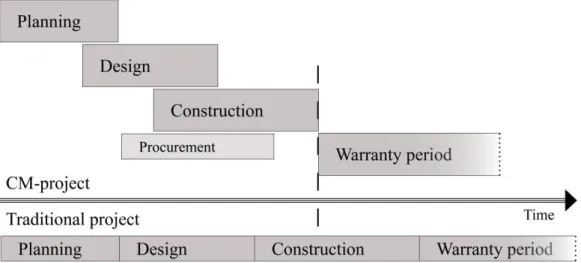
Fast-tracking is a concept used to accelerate the work by overlapping the design and construction phase (Jackson, 2010). The concept aims to progressive design of the project with the effect that the construction is possible to start as soon as the essential design is finished (see Figure 6) (Rounds & Segner, 2011). An advantage by using fast-tracking is that the overall time required for design and construction can be sig-nificantly reduced. The continuous design also facilitates a larger flexibility by allow-ing late changes in client requirements and design (Murdoch & Hughes, 2001). On the backsides of fast-tracking there are difficulties when changes need to be made be-cause not all the documentation was finished when the construction started (Rounds & Segner, 2011).
Figure 6, Project phases in a CM-project compared with a traditional construction project - In a typical CM-project the planning, design and construction phases are overlapping.
In the design phase the managers in the different variants of CM have the same com-mitment to the client. When the project turns into the construction phase the construc-tion manger’s role varies. However, in all variants it is important to provide sufficient on-site management throughout the whole construction (Rawlinsson, 2006). In CM at-risk the manager has the role of a general contractor and thereby performs all
con-struction work (Jackson, 2010). In Agency CM, Management Contracting and CM in UK the manager does not undertake any work, instead it is prime contractors that are responsible for the construction (Kubba, 2010). The work is packaged in smaller parts and each package is purchased separately from different prime contractors (Potts, 2008). This is called multiple prime where each prime contractor is responsible for the performance of a part of the work that is defined in their contract (Rounds & Segner, 2011). The construction manager is responsible for coordination, management and monitoring of the progress of the different prime contractors. The packaging of the work can be done either by the client, the construction manager or by the two in col-laboration.
The completion and warranty period is not straightforward in CM (Murdoch & Hughes, 2001). When there is no main contractor the client needs to take the overall responsibility even though it is the construction manager that hand over the completed project. The construction manager assists the client with final inspections and collects the required documents from the prime contractors (Kenig, 2004). In a CM-project where the work is packaged and some work packages are finished before the project is complete, the period of liability need to be clearly defined (Murdoch & Hughes, 2001). It can either be when the single packages, made by one prime contractor, is finished or when the whole project is completed.
2.2.5
The client view of CM
It is always the client who decides which project delivery method or approach to use (Jackson, 2010). However, many clients are not adequately familiar with all factors that might have an impact on project success. Rather, they often prefer the traditional methods that they are more accustomed to (Jackson, 2010). The most widely em-ployed project objective in the construction industry is that the clients want to maxi-mize the value for their money (Anon, 1984). On the basis of project priorities, the client’s management capability, and potential risk the client will select the project delivery method or approach that is most suitable for their project (Rawlinsson, 2006). CM is a client-oriented project delivery approach throughout the project (Haltenhoff, 1986). The effort and actions taken by construction managers need to be in the best interest of the client which means that the manager need to see the client’s needs in favour of their own. Additionally, the client can be confident that the construction manager will focus on the project objectives rather than managing its own risk in the project (Rawlinsson, 2006). However, the client needs to be careful in selecting the CM-organisation since a CM-project requires a high level of experience and skills of the CM-organisation (Kluenker, 2001).
In a CM-project the client is allowed to have a complete and constant involvement throughout the entire project, resulting in a higher degree of control (Potts, 2008). This indeed, requires the client to offer more time and resources on the project and act as a decision maker between the design team and the construction manager (Rawlinsson, 2006). Furthermore, when the client selects the prime contractors there are a higher flexibility towards using a main contractor (Potts, 2008). Consequently, by contracting directly with the prime contractors the client will save money by lower tenders and no supplementary contractor fee (Kluenker, 2001; Potts, 2008).
In CM, clients often find themselves in a situation where they do not know the overall cost of the project (Potts, 2008). In the beginning of a project the client has to rely on cost estimates made by the construction manager that are often based on incomplete
documents. Along with the work packages becomes contracted the certainty of the cost will rise (Rawlinsson, 2006). However, every change in the client requirements needs new forecasts to be established in order to estimate the effect that the change will have on the cost. All errors in the documents that will increase the costs for the prime contractors will also affect the overall cost, as these are paid for by the client (Söderberg, 2011).
2.2.6
Contracts, responsibilities and risks involved in CM-projects
A central feature of CM is controlling risks in projects. Potts (2008) is arguing that CM is an ideal process for managing risks, as risks can be identified early and be pro-actively managed during the project. The distribution of risk varies between the dif-ferent variants of CM depending on who is holding the contracts and what role the construction manager has in the construction phase (Oyegoke, 2001). In CM at-risk and Management Contracting the client holds two types of contracts, one with the organisation and another with the designers. In these projects the CM-organisation either performs the work as a general contractor, as in CM at-risk, or contracts sub-contractors as in Management Contracting. In Agency CM and CM in UK the client also holds the contracts with the prime contractors. As the contractual relations change towards Agency CM and CM in UK one contracting tier is removed when the sub-contractors becomes prime contractors (Oyegoke, 2001). Thereby, the client receives a higher contractual complexity in the one to one contractual relation-ship with all actors in a project (Rawlinsson, 2006).
Table 1, Risk Table - Risk allocation in the different variants of CM.
When managing risks it is essential to identify and acknowledge all possible risks as early as possible (Oyegoke, 2001). The risks must be clearly allocated between the actors, to the one that is most appropriate to control them. The overall risk in CM is the risk of negligence that the construction manager is failing in performing their commitment. This risk is a risk that all variants of CM have to consider. The general risks in a construction project, handled in this thesis, are cost, time, quality, and per-formance, shown in Table 1. The risk of time, cost and quality are easy to understand, however, the performance risk implies the workmanship and defaults of prime con-tractors.
As a result of the client holding all contracts in Agency CM and CM in UK the client takes all risk (Kenig, 2004). The CM-organisation in Agency CM and CM in UK are responsible for monitoring the risks but bear none of them by their own (Oyegoke, 2001). In MC the management contractor is taking the risk on time and cost (Murdoch & Hughes, 2001). The performance risk is distributed between the client and the prime contractors, which leaves the management contractor with barely any contrac-tual risk. In CM at-risk the construction manager submits a guaranteed maximum
price and therefore acts as a general contractor in the construction phase (Kenig, 2004). This implies that all the risks are allocated to the construction manager at-risk. The services provided by construction managers vary between and in the different variants of CM. These should be fully defined in the contract between the client and the construction manager (Rounds & Segner, 2011). Furthermore, in the contracts the remuneration for the CM services needs to be stated. There may be a fee as in Agency CM and in CM in UK, included in the guaranteed maximum price as in CM at-risk or as cost reimbursement plus fee as in Management Contracting (Kenig, 2004; Murdoch & Hughes, 2001). The construction manager has the responsibility for managing and coordinating the different work packages on behalf of the client. Therefore it is essen-tial that there is a part in the contracts between the client and the prime contractors mentioning that the construction manager is the coordinator on-site (Murdoch & Hughes, 2001). Further in the contracts there must be stated that all instructions will come from, and that all communication must go through, the construction manager.
2.2.7
Summary of CM
To summarise CM as a project delivery approach the largest advantages and disad-vantages will be discussed:
Early involvement of the construction managers means that the managers
have the possibility to provide their knowledge already in the planning and de-sign phase. The client can use the construction managers’ knowledge both for coordinating and managing the process, and for advice in issues as construc-tability, planning and in choice of prime contractors.
Contracting directly with the prime contractors reduces one contracting
tier. This might lead to cost savings due to removed supplementary contractor fee and increased competition in the tendering phase. In this way the client will be in a different position towards the prime contractors and has more con-trol over the costs in the project.
The overlapping of the design and construction phases will shorten the
overall project time. The saved time is a result from a planning and design phase that early covers the fundamental design. This means that the construc-tion phase can start as soon as the foundaconstruc-tion and frameworks are set and pro-cured.
Possibility for changing the project requirements far into the process. As there is no main contractor the client can change before the prime contractors for detailed design are procured. If it turns out that a change in already built-in is required the client only has to pay what it actually cost.
- The extended risks that the clients need to handle by themselves might be seen as a disadvantage. In another delivery method the client pays a main con-tractor to take the most of the risks. However, when taking the risk by them-selves clients only pays when the risk happens.
2.3
Comparison of CM and other project delivery
methods
Project delivery methods have four significant differences concerning; the number of contracts the client sign in a project; the relationship and role of each party involved in the contracts; the point the main contractor gets involved in the project and finally the ability for the design and construction to overlap (Haltenhoff, 1986).
Comparing CM with other project delivery methods, both build and design-bid-build uses one independent contractor while in CM prime contractors can be used (Oyegoke, 2001). Partnering can be formed in different arrangements; the structure might be similar to design-build or design-bid-build. However, it is most probable that the main contractor and the client will form an entity together. Further, the financial stake for a design-bid-build contract is in the construction phase while in design-build, CM and partnering stake is in both the design and the construction phase (Oyegoke, 2001). Three of the CM variants (Agency CM, MC and CM in UK) are similar in sev-eral ways while CM at-risk differs from the others. CM at-risk is more similar to a design-bid-build contract, with the exception that the construction manager offers preconstruction services to the client during the planning and design phase while in design-bid-build the general contractor enters after the design is settled (CMAA, 2007).
The CM-approach is seen by many as a client-oriented approach, where the client controls its own risk (Haltenhoff, 1986). Compared with independent contractors where the client transfers the risk to a main contractor, a contractor-oriented approach. In partnering, where organisations work together towards a common goal, the risk is divided and shared among the actors (Bygballe, et al., 2010). Some design-build con-tracts are similar to design-bid-build regarding timeline and schedule, however, de-sign-bid-build have a linear sequence of work while design-build allows overlapping in the design and the construction phase (Hardin, 2009; Jackson, 2010). The fast-tracking system used in CM and partnering has developed the overlapping even fur-ther. A study in US, comparing CM with other major project delivery methods, showed that the most significant advantages of reduced project time (13.3 % faster delivery speed) were between CM and design-bid-build projects (Alberta Infrastructure, 2001). Cost and quality where shown to be almost the same or slightly better in a CM-project compared with the other methods.
The basic idea with CM was to develop a project delivery approach where the client and the prime contractors where working together in order to implement a construc-tion project. In the other methods there will always be a contract between the client and the main contractor to use if conflicts will arise between the actors. With CM, where the client is holding all contacts, this is diminished. The client is in CM taking more risks and has more responsibilities in the project. However, the client has the possibility to be more involved in the project compared with other delivery methods. In the end, this will most probably result more work for the client but also enhance the client’s total control over its own project.
2.4
CM in this study
Bygg-Fast, that further will be referred to as BF, and the other studied actors in this thesis are using a variant of CM that mostly resemble Agency CM or CM in UK. The CM-organisation does not have any vested interest in the project. They are hired to manage and coordinate the project with the best interest for the client in mind. In most of the projects fast-tracking and varying extent of multiple prime is used. All actors, designers, prime contractors and the CM-organisation, in a CM-project are contracted directly to the client. This implies that the prime contractors are working side by side in the construction phase. In this way the communication paths and the contractual relations differ, see the project structure in Figure 7.
Figure 7, Organisational structure and involved actors in a CM-project in Sweden – The contract and communication relationship in a typical Construction Management approach. The dotted line indicates a communication path with no contractual rela-tionship between the actors.
In Sweden there are several standard contracts used to procure construction projects. These general conditions have been developed jointly by clients and contractors in Byggandets Kontraktskommitté (BKK) in order to allocate risks and minimise con-flicts. There are the AB04, General Conditions of Contract for Building, Civil Engi-neering and Installation Work that is used in traditional design-bid-build projects and ABT06, General Conditions of Contract for Building, Civil Engineering and Installa-tion Work performed on a package deal basis Design-Build for design-build projects. The difference between the two is that in ABT06 the responsibility for planning and design are included. There is no standard contract for CM; instead these two are used depending on whether there is a functional responsibility (ABT06) or not (AB04). Some adjustments for CM are made to the standard contracts and are settled in the general regulations (AF07).
For consultancy services there is the standard contract ABK09, General Rules for Consulting Works in Architectural and Engineering Activities. In Sweden this is the foundation for the contract between the client and the CM-organisation.
3
Method
This master thesis has been performed using a qualitative research method approach aiming to compile and develop BF’s way of working with CM. Literature concerning research methods distinguishes between quantitative and qualitative methods. In stud-ies performed with quantitative methods there are large sample sizes in order to quan-tify the data and statistically find relations or measurable results (Holme & Solvang, 1997). The qualitative method is used to achieve a deeper understanding and a large amount of information is gathered from a small sample size. This method was applied in this master thesis, since qualitative data makes it possible to study information that is not available elsewhere (Silverman, 2006). One of the strengths with the qualitative method is that qualitative studies are flexible and new insights might be gained from the participants that may change the structure of the thesis during the study (Adams, 2010). In qualitative methods there are three main phases: planning, gathering and analysing (Holme & Solvang, 1997). The gathering phase in this thesis project has been collecting primary data from interviews and secondary data from literature.
3.1
Literature study
It is important to be familiar with the area of research in order to ask relevant ques-tions (Kvale & Brinkmann, 2009). To attain a thorough understanding of CM a litera-ture study was conducted in the beginning of the thesis project. In the search for lit-erature in the studied field, both scientific articles written by professionals in the field and books in the area of project delivery methods have been reviewed. The search resulted in a large amount of literature originating from United Kingdom and United States where CM is more frequently used than in Sweden. The frame of reference is based on articles and books found in the review process and will, in addition to pro-viding a general understanding, clarify the different project delivery methods that are most widely used. The Swedish perspective is covered whenever possible, particularly in the part about delivery methods and contracts. The literature study has also been performed in order to get knowledge of interviewing and different research methods.
3.2
Interviews
One of the main ways to collect qualitative data is by interviewing. The purpose of interviewing is to integrate different people’s experiences and interpretations of the same thing (Thomsson, 2010). To determine BF’s way of working with CM and to be able to develop their practices, 15 interviews were conducted. Based on the purpose and objectives of the thesis an interview guide was prepared. The questions focus on CM in general and also how the interviewees perceive some key elements of CM. In order to try the questions and improve the quality of the guide two exploratory inter-views were conducted. Further, between the interinter-views, the interview guide was evaluated and small changes were made in order to adjust the focus in the questions. The selection of interviewees is a complex issue. According to Kvale and Brinkman (2009) the number of interviewees will be as many that are required to get the ‘right’ answer. If the number is too small it is hard to generalise and if the number is too large it is hard to make deeper interpretations. In this study the interviewees had to cover all key positions in a CM-project from the client to the project organisation. It is essential to capture different perspectives in order to obtain a comprehensive view of CM. For this reason the interviewee list (see Table 2) also include some other compa-nies working with CM and prime contractors in an on-going project. The interview
guide has been adjusted to suit the different perspectives of CM: personnel at BF, their clients and other companies in the CM industry.
Table 2, Interview Table – The table indicates the number of interviewees from differ-ent perspectives of CM.
The interviews were semi-structured to enable an open discussion around the ques-tions. This allows flexibility, and the progress in the interview was directed from the interviewees answer and inputs rather than from the interview guide. After questions of basic information about the interviewee, the interview started with a general ques-tion about CM. depending on the extent of the answer the rest of the interview was adjusted. The interviews lasted approximately 45 minutes and were all held in Swed-ish in order to get more information and to avoid misinterpretations since everyone’s mother tongue was Swedish. All interviews were conducted by two persons, one re-sponsible for questioning and one for observation and ask supplementary questions. To give the interviewers’ time to focus on given answers and to ask additional ques-tion, the interviews were recorded. Notes were only made to add thoughts and to sup-port the analysis of the answers.
3.3
Analysis of interview data
After the interviews the result was transcribed, although not verbatim. Only relevant answers for the purpose of this master thesis were summarised and analysed to pro-vide a base for the findings. The recording ensures that correct interpretations of the information in each interview were available for analysis. It also makes it possible to go back to the recorded interview, listen again and to include quotations in the find-ings. In analysing the data from the interviews the data was coded into different themes or elements of CM that made it possible to compare the different thoughts. In order to differentiate between the interviewees from different companies, the compa-nies have been labelled, Company A-E. This was done with no specific order and will not be marked in the thesis.
4
Findings
This chapter present the outcome from the fifteen interviews that were conducted. It is a compilation of the issues brought up in the interviews and the focus is on the content that is linked to the purpose of this master thesis. All interviewees, both the ones working at CM-companies and the clients, have their backgrounds in construction contractor organisations. Among them the age varied between 35 and 55 years and there were two women. Furthermore, their common opinions as well as those only mentioned once, are presented in order to visualise both the wide, and the narrow, span of thoughts.
4.1
Defining CM
During the interviews it became clear that defining CM is not an easy task. All inter-viewees had to take some time to reflect and think before they could shortly describe CM. The overall view is coinciding; the interviewees are mentioning the relationship between the actors in a CM-project, the division of contracts and the involvement of the client etc. Both the interviewees from BF and the ones from other companies agree that CM is not a contractual form like design-build or design-bid-build. It is more seen as a form of project execution or an agreement between the client and the CM-organisation built upon a relation. Åke Larson as an initiator of CM was men-tioned by the majority of the interviewees. Some of them have been working at Åke Larson Byggare while others perceived him as a role model.
The words collaboration and trust is mentioned by several of the interviewees about the relationships in a CM-project. If there is no trust, the project will be in trouble and as a client pointed out it is important that “the thinking has to be us, not us and them”. An interviewed project manager explained it as the CM-organisation and the client have to make an effort in building the relationship to be able to work together solving all problems. It is important that all actors in a project have the same objectives and vision of the project.
In CM-projects the clients run their projects with the aid of a consulting company that manage all parts of the project. The connection between the CM-organisation and the client are described by the interviewees in different ways. One interviewee said that the CM-organisation is working as the client’s extended arm. Another explained that the CM-organisation is the main contractor in the eyes of the client. A third inter-viewee related CM to in-house construction where the CM-organisation “acts as the
client’s own construction company”. In other words the CM-organisation is the cli-ent’s part towards the other actors in the CM-project and is carrying out the project as an integrated part of the client’s organisation viewing the project as their own.
A client stated that “CM is an overall commitment” from the CM-organisation in the
project. A general opinion among the interviewees is that the CM-organisation has no vested interest in the project; they are always working towards the client’s best. One interviewee described the CM-organisation as the umbrella of the project and another that they have to think as the owner. The CM-organisation is hired in order to manage a project according to the client’s wishes and requirements. They bring their knowl-edge and expertise through individuals into the project in several ways as the client’s advisor. If the client wants, the CM-organisation can take part during the entire pro-ject, from the initial idea, over the construction phase as on-site coordinators to the end of the warranty period.