- Earthquakes
- Tsunamis
- Water-related Disasters
National Graduate Institute for Policy Studies (GRIPS)
Building Research Institute (BRI)
DISASTER MANAGEMENT POLICY PROGRAM
in collaboration with BRI, ICHARM/PWRI, and JICA
Public Works Research Institute (PWRI) Japan International Cooperation Agency (JICA)
Program Director: Senior Professor Shigeru Morichi
Deputy Director: Professor Kenji Okazaki
Target Groups: Technical officials, engineers, and researchers in the fields of ear thquakes, tsunamis, water-related disasters, and disaster risk management policy in developing countries
Career Paths: Professional positions in disaster risk management focusing on earthquakes, tsunamis, or water-related disasters
Degree conferred: Master of Disaster Management
Course Duration: One year (October-September)
Language of Instruction: English
Natural disasters result in crippling economic losses and human tragedy, hampering development wherever and whenever they occur. Due to recent rapid urbanization in developing countries, many people reside in buildings and areas that are vulnerable to natural disasters. Disasters that strike in developing countries can severely impair efforts to alleviate poverty. In order to reduce the effects of natural disasters, and human losses in particular, proactive disaster risk management should be promoted in multi-disciplinary ways. To meet this need, disaster management experts must be cultivated through professional education and training, so that they may develop, then apply suitable disaster management policies and techniques in line with local conditions.
In order to enhance the capacity of professionals in developing countries to cope with natural disasters, the National Graduate Institute for Policy Studies (GRIPS) offers a master’s degree program in Disaster Management Policy. This Program is offered jointly with the International Institute of Seismology and Earthquake Engineering (IISEE) of the Building Research Institute (BRI); the International Centre for Water Hazard and Risk Management (ICHARM)1 of the
Public Works Research Institute (PWRI); and the Japan International Cooperation Agency (JICA). This program is administered as a JICA training program under Official Development Assistance from the Government of Japan. Through the program, students will:
●acquire knowledge in seismology, earthquake engineering, tsunami disaster mitigation, and water-related disasters, as well as basic knowledge necessary for disaster risk management;
●learn theories on which disaster management policies are based, while studying Japanese policies and systems; and ●cultivate the capability to develop concrete technologies and policies in line with local conditions, by utilizing a
problem-solving approach.
1 ICHARM, which was established in March of 2006 under the auspices of UNESCO, functions as one of twelve UNESCO International Hydrology Program Centers worldwide for providing and assisting the implementation of the most practicable strategies to mitigate water-related disasters.
Introduction
Earthquake Disaster Mitigation / Tsunami Disaster Mitigation
GRIPS-BRI-JICA Joint Program
Earthquakes are one of the most deadly natural disasters, and since they can occur without warning, precise prediction remains impossible even with the most advanced technology. A strong earthquake can devastate homes and civic infrastructure, causing enormous losses in both human and economic terms. Developments in seismology and earthquake engineering technology have made developed countries more resilient in dealing with earthquakes, but developing countries in earthquake-prone areas remain vulnerable.
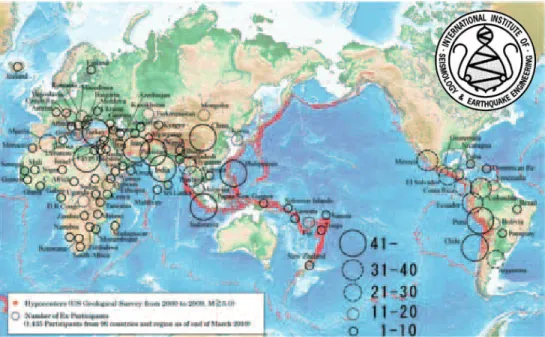
In 1961, the Building Research Institute (BRI; at the time, part of Japan’s Ministry of Construction), in cooperation with the Overseas Technical Cooperation Agency (OTCA; which later became Japan International Cooperation Agency or “JICA”), launched a one-year training program in seismology and earthquake engineering for researchers and engineers from developing countries considered earthquake-prone. BRI created the International Institute of Seismology and Earthquake Engineering (IISEE) to administer the program. In 2005, that program was upgraded to a master’s program in Earthquake Disaster Mitigation, now administered jointly by the National Graduate Institute for Policy Studies (GRIPS), BRI, and JICA. The Program was expanded in 2006 to incorporate a new specialization in tsunami mitigation, including the sub-programs of Earthquake Disaster Mitigation and Tsunami Disaster Mitigation. Since 1961, more than 1,400 students from approximately 100 countries have graduated from these programs (Figure 1).
Improving seismic safety in developing countries demands the development of suitable technologies and policies that take into consideration the specific conditions and social systems of each country. Responsible experts must enhance their capabilities for formulating and implementing suitable policies, utilizing advanced knowledge in seismology, earthquake engineering, and tsunami disaster mitigation. Through the program, students will:
1. acquire knowledge and techniques in seismology, earthquake engineering, and tsunami disaster mitigation that are necessary for earthquake disaster mitigation;
2. learn theories on which disaster mitigation policies are based, while studying Japanese policies and systems; and 3. cultivate the capability to develop concrete technologies and policies in line with local conditions, by utilizing a problem-solving approach
Admission
Category
Qualifications for admission
Age: Applicants must be at least 22 and under 40 years of age at the time of application.
Academic qualifications: Applicants must hold a Bachelor’s degree or equivalent in seismology, earthquake engineering, seismic disaster mitigation, or science and technology from a regionally accredited college or university and have an excellent academic record. Applicants are expected to have a strong background in mathematics and be familiar with differentiation and integration, partial derivatives, differential equations, matrices, vector algebra, and Fourier analysis.
Work experience: Applicants are expected to have three or more years of experience in seismology, earthquake engineering, or seismic disaster mitigation. English proficiency: A TOEFL score of at least 550 on the paper-based test, 79 on the Internet-based test, or equivalent degree of proficiency is required for admission.
Application and selection
A completed application and all supporting documents should be submitted to the JICA Overseas Office or Embassy of Japan by the beginning of June. A final selection of candidates will be made by the GRIPS/BRI/JICA admission committee in July.
Scholarship
Successful applicants will receive scholarships from BRI, which will cover the application fee, the admission fee and tuition fee for the Master’s Degree Program. Necessary allowance (airplane ticket, travel insurance, accommodation, living expenses and medical insurance, etc) will be provided by JICA.
Number of students
Approximately 25 students (ten specializing in seismology, ten specializing in earthquake engineering, and five specializing in tsunami disaster mitigation) will be selected.
*More detailed information about this Program can be found in the General Information (GI) brochure available at JICA Overseas Offices and at the Embassy of Japan in eligible developing countries
Required Courses Recommended Courses Elective Courses Individual Study
Disaster Mitigation Policy
Disaster Risk Management
Earthquake Hazard Assessment
Earthquake Risk Assessment
Disaster Mitigation and Development Assistance
Tsunami Hazard Assessment Tsunami Countermeasures
Earthquake Phenomenology
Characteristics of Earthquake Disasters
Earthquake Circumstance
Information Technology Related with Earthquake and Disasters
Structural Analysis
Structural Dynamics
Seismic Design
Seismic Evaluation and Retrofitting
Theory of Tsunami Case Study
(Practice for Earthquake Disaster Mitigation Policy I)
Case Study
(Practice for Earthquake Disaster Mitigation Policy II) Case Study
(Practice for Earthquake Disaster Mitigation Policy III) Case Study
(Practice for Tsunami Disaster Mitigation Policy) Selected Topics in Policy Studies
Course Name Focus Credit
Guidance and advice for thesis
Policies and legislation, risk management systems, education Safer building, community-based activities, practical risk assessment Soil dynamics, probabilistic assessment, scenario earthquakes
Micro-tremor measurement, strong motion observation, risk assessment Development assistance, disaster mitigation dissemination
Tsunami hazard map, tsunami disaster mitigation dissemination Tsunami protection facility, tsunami observation, early warning system Hypocenter location, focal mechanism, seismicity
Site characteristics, wave propagation, amplification
Plate tectonics, earthquake source process, earthquake prediction Fortran programming, GMT (generic mapping tools), Unix/Linux Structural mechanics, finite element analysis, frame analysis Dynamic magnification, modal analysis, forced vibration Steel structure, RC structure, masonry structure
Seismic performance evaluation, seismic retrofit, damage evaluation Basic theories for tsunami, tsunami simulation, computer practices Observation visits to Kansai region and Kobe City
Colloquium, presentations, observation visits Observation visits to Hokkaido and Tohoku regions
Tsunami trace, real time determination of earthquake parameters
10 2 2 2 2 2 2 2 3 3 3 3 3 3 3 3 3 1 1 1 1
GRIPS-PWRI-JICA Joint Program
A natural hazard becomes a disaster when the affected country or region lacks the capacity to cope. In recent years, water-related disasters such as floods and tsunamis have been increasing in number as well as in scale (Figure 2). This is particularly true in developing countries, due to the lack of leadership with vision, political will, coping capacity, and resources. The resulting social and economic damages in such cases are likely to worsen with climate change. In order to address this problem, and to plan sustainable development in developing countries, there is an urgent need to nurture leaders and experts on water-related disaster mitigation, who can plan and implement management measures such as preparedness, responsiveness, recovery, and rehabilitation. Japan has a wealth of experience in coping with and managing many kinds of natural disasters including water-related catastrophes and, therefore, is in a position to assist by transferring knowledge and expertise that can contribute to the development process of needy countries.
This Program aims to cultivate experts with the hope that they in turn will transfer the knowledge attained to the next level of professionals, thereby upgrading the human resource capacities of developing countries. Through this program, students will:
1. Be able to explain basic concepts and theories on the Generation Process of Water-related Disasters, Control Measures for Landslide, and Debris Flow.
2. Be able to explain basic concepts and theories on Water-related Hazard Risk Evaluation, as well as Disaster Risk Management Policy and Technologies. 3. Formulate countermeasures to solve problems and issues concerning water-related disasters for applying techniques and knowledge acquired through the program to their home countries. (Ph.D. Program in Disaster Management)
GRIPS and PWRI launches a “Ph.D. Program in Disaster Management” jointly in October of 2010, in order to cultivate professionals with the ability to train researchers and take leadership in planning and implementation of national and international strategies, as well as policies in the field of water-related risk management. This program accepts one to three students per year. Applicants must have a master’s degree or equivalent professional knowledge/skills/experience in research and/or practice in water-related risk management at universities, research institutes, or governmental organizations. After completing the program, they will be expected to return to their home organizations and take the lead in implementing what they learned at ICHARM.
PWRI is seeking candidates for ICHARM Research Assistantship positions. If hired, students will work at ICHARM as ICHARM Research Assistants. This provides an excellent opportunity to learn and experience the practical work of ICHARM while they carry out their own research.
Figure2. Number of Water-related Disasters
Admission
Qualifications for admission
Academic qualifications:
Applicants must hold a Bachelor’s degree or equivalent from a recognized/accredited university of the highest standard in civil engineering, water resource management, or disaster mitigation. Applicants must have a working knowledge of civil engineering, especially of hydraulics and hydrology. Applicants must be familiar with mathematical principles such as differentiation and integration. English proficiency: A TOEFL score of at least 550 on the paper-based test, 79 on the Internet-based test, or equivalent proficiency is required for admission.
Application and selection
A completed application and all supporting documents must be submitted to the JICA Overseas Office or local Japanese Embassy, by the beginning of June. These must arrive at the GRIPS Admissions Office by the end of June. A final selection of candidates will be made by the GRIPS/ICHARM /JICA admission committee in July.
Scholarship
Successful applicants will receive scholarships from the PWRI, which will cover the application, admission, and tuition fees for the master’s degree program. JICA will provide necessary allowances (airplane ticket, travel insurance, accommodation, living expenses, and medical insurance, etc).
Number of students
Approximately 20 students will be selected.
*More detailed information about this program can be found in the General Information (GI) brochure available at JICA Overseas Offices, and at the local Japanese Embassy in developing countries that are eligible
*More detailed information about this program is also available from ICHARM.
*This Program is open to students who do not receive the PWRI scholarship. Detailed information is available at the GRIPS website.
Category Required Courses Recommended Courses Elective Courses Individual Study
Disaster Mitigation Policy Disaster Risk Management
Basic Hydrology
Hydraulics
Basic Concepts of Integrated Flood Risk Management(IFRM) Local Disaster Management and Hazard Mapping
Urban Flood Management
Advanced Hydrology
Flood Hydraulics and Sediment Transpor t
Mechanics of Sediment Transpor tation and Channel Changes
Sustainable Reservoir Development & Management
Control Measures for Landslide & Debris Flow
Computer Programming Practice on Hydraulics
Practice on Local Disaster Management Plan Practice on Advanced Hydrology
Practice on Flood Hazard Modeling & Flood Forecasting
Practice on Sustainable Reservoir
Development & Management
Practice on Control Measures for
Landslide & Debris Flow
Selected Topics in Policy Studies I -IV*
Course Name Focus Credit
Policies and legislation, risk management systems, education
Safer building, community-based activities, practical risk assessment Hydrological cycle, Precipitation, Extreme weather, Run-off
Hydrological cycle, Precipitation, Extreme weather, Run-off
Advection and diffusion, General transpor t equations, Open channel flow
Outline of IFRM, Disaster management cycle, Global warming, Basic concepts of IFRM
River information and early warning system in Japan, Related laws, Evacuation criteria
Urban flood risk management, Comprehensive flood control measures, People’s reactions and responses to disasters
Hydrological modeling, Systems theor y approach, Instantaneous Unit Hydrograph (IUH)
Outline of rivers in Japan, Fundamental mechanics of flood flows, Steady quasi-two dimensional analysis of flood flow
Mechanics of sediment transpor tation, River morphology
Planning and design of reser voirs, Environmental impact assessment, Reservoir operation, Dam construction, Reservoir management
Hydraulics of debris flow, Dynamics of landslide, Landslide control
Programming language, Numerical computation Practice on general transpor t equation, open channel flow
Disaster imagination game (DIG), Town watching, Project cycle management Exercise on system function estimation, typical rainfall runoff model
Countermeasures against urban flood, Inundation analysis, On-sight survey
Practice on water resource management, On-sight survey
Practice on procedures for sediment disaster warning and evacuation, On-sight survey 10 2 2 2 2 2 2 2 2 2 2 2 2 1 1 1 1 1 1 1
Curriculum (Water-related Risk Management)
Testimonials from Disaster Management Policy Program Students
Ms. Titi Handayani (Graduated in 2009)Seismic Analyst, Meteorological, Climatological and Geophysical Agency (BMKG), Indonesia
I am very glad that I completed in Tsunami Disaster Mitigation Program. I am graduating with a feeling of profound satisfaction. I would like to give special thanks to my learning team members (professors, lecturers, and other staff members) in GRIPS and the IISEE/BRI who helped, guided, and supported me. The academic staff and environment are wonderful at GRIPS, the BRI and JICA.
Japan is rich in culture, but also has many natural disasters. I have enjoyed studying natural
disasters, especially Japanese tsunamis, through lectures, practices, and study trips. The curriculum was very well organized and easy to understand. As this program provides an in-depth understanding of Disaster Mitigation, it has helped me to understand disaster impact management. These skills are presently very useful to me, and will definitely continue to be. I would also like to share my knowledge and experiences with my compatriots. We learned lessons from the past, along with new information and policies to help resolve current problems. I will remember my student days at GRIPS as the most valuable year in my life.
Ms. Monica Patricia Gutierrez Martinez (Graduated in 2009)
Lecturer, Civil Engineering Faculty, Jose Simeon Cañas University, El Salvador
El Salvador is a country highly prone to earthquakes. Therefore, learning how to act, handle, and manage ourselves in times of disaster is a highly important endeavor. I received the great opportunity to join the Disaster Management Policy Program over the one-year course. Each of us in the program understands the importance of disaster risk management studies for sustainable national development.
At IISEE and GRIPS, we learned methodologies and theories for making safer structures. We
also learned how advanced Japanese technology is improving disaster risk management around the world. All the knowledge that GRIPS and IISEE have imparted in lectures contribute to the understanding we need to improve in our country before, during, and after disasters. I know that we all had an amazing year living in Japan, during which we visited many wonderful places and learned about Japanese culture and lifestyles. Some say that learning from the experience of others’ is difficult because we must experience it ourselves to really learn. However, in the case of coping with disasters, we must try to break this mind-set.
Mr. Xiao Fei (Graduated in 2009)
Songliao Water Resources Commission, Ministry of Water Resources, People’s Republic of China
I had a wonderful time in Japan, and was exposed to much advanced knowledge. I was also able to develop a better understanding of Japanese people, culture, and society. One year is short, making it tough for me to learn so much from advanced courses since I had to complete the master’s thesis in less than six months. However, during this year, I was able to concentrate on my studies wholehear tedly, giving me valuable experiences and unforgettable memories. I am so grateful to GRIPS, ICHARM and JICA, and really appreciate the comfortable learning and living environment that they provided. Last but not least, I
extend my thanks to my professors at GRIPS and ICHARM. With the knowledge that I acquired from them, I can do a better job in the future.
Number of Students
Address and Location
National Graduate Institute for Policy Studies (GRIPS) Admissions Office 7-22-1 Roppongi, Minato-ku Tokyo 106-8677 Japan Tel: +81-(0)3-6439-6046 Fax: +81-(0)3-6439-6050 E-mail: [email protected] URL: http://www.grips.ac.jp/index.html
International Institute of Seismology and Earthquake Engineering (IISEE)
Building Research Institute (BRI)
1 Tachihara, Tsukuba-shi Ibaraki-ken 305-0802 Japan Tel: +81-29-879-0678 Fax: +81-29-864-6777 E-mail: [email protected] URL: http://iisee.kenken.go.jp/ http://www.kenken.go.jp
International Centre for Water Hazard and Risk Management (ICHARM)
Public Works Research Institute (PWRI)
1-6 Minamihara, Tsukuba-shi Ibaraki-ken 305-8516 Japan Tel: +81-29-879-6809 Fax: +81-29-879-6709 E-mail: [email protected] URL: http://www.icharm.pwri.go.jp/ http://www.pwri.go.jp/eindex.html 2005-06 19 -19 2006-07 20 5 -25 2007-08 20 5 9 34 2008-09 18 4 7 29 2009-10 17 5 12 34 total 94 19 28 141 Earthquake Tsunami Water-related Total