Review on Swarm Intelligence Optimization Techniques for
Obstacle-Avoidance Localization in Wireless Sensor Networks
Saravanan Palani*, Harriet Puvitha
School of Computing, SASTRA Deemed University, India *Corresponding Author
Abstract
Wireless sensor network (WSN) is an evolving research topic with potential applications. In WSN, the nodes are spatially distributed and determining the path of transmission high challenging. Localization eases the path determining process between source and destination. The article, describes the localization techniques based on wireless sensor networks. Sensor network has been made viable by the convergence of Micro Electro- Mechanical Systems technology. The mobile anchor is used for optimizing the path planning location-aware mobile node. Two optimization algorithms have been used for reviewing the performacne. They are Grey Wolf Optimizer(GWO) and Whale Optimization Algorithm(WOA). The results show that WOA outperforms in maximizing the localization accuracy.
Keywords: Wireless Sensor Network, Localization, Mobile Node, 3D path planning
1. Introduction
Micro-Electro-Mechanical
Systems(MEMS) is identified as most promising technology in wireless communications and digital electronics which enabled the development of low-cost, low-power, multifunctional sensor nodes that are small in size and communicate in
short distances [1]. Large sensors use some complex techniques to distinguish the targets from environmental noise are required. Mobility-assisted localization technique is used for path planning in three dimensions [16-27]. The mobile anchor is used to optimize the path planning location and also avoid the obstacles. Two algorithms, Grey Wolf Optimization(GWO) and Whale Optimization Algorithm(WOA) which is used in optimization wherein minimizes the localization error and maximizes the localization rate [28-39].
2. Localization:
Localization is one of the key technologies in Wireless Sensor Networks. We discuss sensor node localization schemes are having different features used for different applications. Different algorithms of localization are used for static sensor nodes and mobile sensor nodes. Localization is estimated through communication between the localized node and un-localized node for determining their geometrical placement or position.
Lateration: It occurs when the distance between nodes is measured to estimate location [2].
Angulation: It occurs when the angle between nodes is measured to estimate location.
Trilateration: Location of the nodeis estimated through distance measurement from three nodes. Here intersection of three circles is calculated, which gives a single point which is a position of the unlocalized node.
Multilateration: It is the concept where more than three nodes are used in location estimation.
Triangulation: It is the mechanism to measure two localized in which has two angles of an un-localized node. Trigonometric laws, rule of sines and cosines are used to estimate node position.
3. Mobile anchor:
Mobile Anchor Nodes (MANs) is an encouraging method to localize the unknown nodes, which are equipped with GPS units moving among unknown nodes and occasionally broadcasting their current locations to help nearby mysterious nodes with localization [3] [4].
There are two issues in MANNAL algorithms, to design movement trajectories that mobile anchor nodes should move along in a given monitoring area to improve the localization performance of WSNs.
Another research issue of MANNAL algorithms is the localization methods by which unknown nodes calculate their position based on the beacon packets received from location-aware mobile anchors nodes as they move through the monitoring area. These algorithms work on mobile anchor nodes together with reference nodes to help unknown nodes with localization.
3.1 Basic terminologies
Anchor (Beacon) Node: To localize a WSN in the global coordinate system, some special sensor nodes should be aware of their positions in advance either from GPS or by manually placed.
Mobile anchor (Beacon) Node: As soon as the initial deployment is done, automatically the anchor node will move.
Anchor (Beacon) Packet: The data packet broadcasted by Mobile Anchor nodes periodically.
Anchor (Beacon) Point: Virtual coordinates broadcasted by Mobile Anchor nodes periodically, which is part of the anchor.
In three –dimensional environment mobile node localization algorithm cannot meet the actual application. Least Square Support Vector Regression (LSSVR) and Kalman Filter (KF) is based on Hybrid mobile node localization [5]. The KF model is used to iterate and correct the measured distance to obtain the distance between the unknown node and each anchor node and the LSSVR localization model is employed to obtain the estimated location of the unknown nodes. KF-LSSVR reduces the localization error and localization accuracy. Since it has a range error, RSSI ranging method is used.
Movement of MA and localization is performed in two aspects are a procedure on unknown node side and procedure in Mobile anchor side.
3.2 Procedure in unknown node side:
All UNs are distributed randomly
Each node initiates a neighbor table, which includes all
neighbor node located within the communication range.
Each UN will wait for MA arrival.
Once three varied points are received, the UN estimates its location.
When UN gets its location estimation, it turns to RN, and update in the table.
Each RN will share updates with the neighboring node shown in Figure 1 [6].
4. Mobility-Assisted localization:
Mobile-assisted localization method which employs a mobile user to assist in measuring distances between node pairs until these distance constraints form a “globally rigid” structure that guarantees a unique localization [7]. A roving human or robot wanders through an area, collecting distance information between the nodes and itself.
4.1 Anchor Free Localization:
Once we get enough inter-node distance to build a rigid graph of the nodes, we can run away several localization schemes to compute node coordinates. Some of these localization schemes assume the availability of a fraction of an anchor node with already known position information for computing node coordinates [8]. It does not need any distance information.
Figure1: The node localization process in the UN
MANAL has some path planning schemes, but most scenarios assume the absence of
obstacles in the environment. However, in a realistic environment, sensor
nodes cannot be located because the obstacles block the path traversed by the MAN, thereby rendering the sensor incapable of receiving sufficient three location information from the MAN. The sensor location problem owing to obstacle blockage is solved by Obstacle-Tolerant Path Planning (OTPP) approach [9]. OTPP can be solved by approximation the optimum beaconPoint number and path planning, thereby ensuring that all the unknown nodes can receive the three location information from the MAN and reduce the number of MAN broadcast packet times. OTPP reduces the total number of beacon points utilized than Curves. OTPP performs better than the Z-curve as the total number of beacon points is reduced, localization errors lowered and coverage increased. This implies that OTPP is more adaptive to obstacle-present environments. An obstacle with mobility or 3D spaces in path planning is proposed in future.
5. Grey Wolf Optimizer(GWO)
Grey Wolf Optimizer (GWO) is a new metaheuristic algorithm that mimics the natural leadership hierarchy system of grey wolves. Four types of grey wolves such as alpha, beta, delta, and omega are employed for simulating the leadership hierarchy. There are 29 famoustest functions, and the solutions are verified by a comparative study with Particle Swarm Optimization (PSO), Gravitational Search Algorithm (GSA), Differential Evolution (DE), Evolutionary Programming (EP), and Evolution Strategy (ES). The results show that the GWO algorithm can provide very competitive
results compared to these well-known meta-heuristics [10].
6. Whale Optimization Algorithm (WOA)
It is a Meta-heuristic optimization algorithm becoming more and more popular in engineering applications. They rely rather on simple concepts and are easy to implement, they do not require gradient information, and they can bypass local optima and can be utilized in a wide range of problems covering different disciplines. The search for prey, encircling prey, and bubble-net foraging behavior of humpback whales are the three operators used in the proposed model.
7. Optimization techniques:
Maximal energy efficiency, the shortest delay, the longest network lifetime, the highest reliability, and the most balanced distribution of the nodes’ residual energy, or the trade-offs among the above objectives [11]. Multi-Objective Optimization is adopted to solve many problems, since it may be more consistent.
Existing single- and multi-objective optimization techniquesare described. Thereafter, a newly developed simulated Annealing-based multi-objective optimization technique named the archived multi-objective simulated annealing-based optimization technique (AMOSA). The different search optimization techniques are single objective optimization technique and multi-objective optimization technique.
7.1 Single objective optimization technique:
Different optimization techniques that are classified into three types,
Calculus-based techniques.
Enumerative techniques.
Random techniques.
Numerical methods are also called a calculus-based method which uses a set of necessary and sufficient conditions that must be satisfied by the solution of the optimization problem. They are further subdivided into direct and indirect search models. Direct search methods perform hill climbing in the function space by moving in a direction related to the local gradient. In the indirect method, the solution is solved using a set of equations resulting from setting the gradient of the objective function to zero.
7.2 Genetic algorithm:
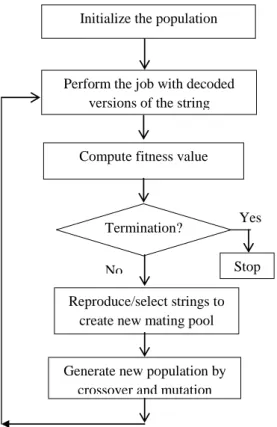
Genetic algorithms (GAs), which are efficient, adaptive, and robust search and optimization processes, use guided random choice as a tool for guiding the search in very large, complex, and multimodal search spaces. The basic principles and features of genetic algorithms shown in Figure 2.
The normal optimization and search procedures are different in GA in four ways,
GAs work with a coding of the parameter set, not with the parameters themselves.
GAs work simultaneously with multiple points, and not with a single point.
GAs search via sampling (blind search) using only the payoff information.
GAs search using stochastic operators, not deterministic rules, to generate new solutions [12].
Figure: 2 explain the basic steps of the genetic algorithm. For example, a population is initialized first then it performs the job with decoded version then the fitness value is computed. It checks for the fitness value then it terminates the process. If it doesn’t get the fitness value, then it again reproducesand the process continues until it gets the fitness value.
Figure 2: Basic steps of genetic algorithm 8. Multi-objective optimization:
Multi-objective optimization is an integral part of optimization activities and has
Compute fitness value
Termination?
Reproduce/select strings to create new mating pool
Generate new population by crossover and mutation
Stop Perform the job with decoded
versions of the string Initialize the population
Yes
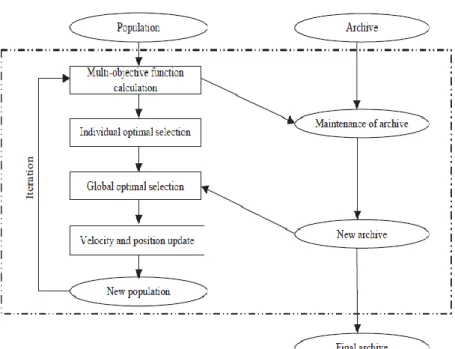
tremendous practical importance since almost all real-world optimization problems are ideally suited to be modeled using multiple conflicting objectives. Figure 3 shows the framework of multi-objective PSO.
8.1Evolutionary multi-objective optimization:
The popular and useful field of research and application is Evolutionary Multi-Objective optimization (EMO).
Evolutionary optimization (EO) algorithms use a population based approach in which more than one solution participates in iteration and evolves a new population of solutions in the each iteration [13].
A multi-objective optimization problem includes a number of objective functions which are to be either minimized or maximized.
Figure 3: Framework for multi-objective PSO
The application outside the realm of solving multi-objective optimization problems per second is the act of finding multiple trade-off solutions using an EMO procedure. The concept of finding multiple trade-off solutions using an EMO procedure is applied to solve other kinds of optimization problems that are otherwise not multi-objective. For example, to solve constrained
single-objective optimization problems by converting the task into a two-objective optimization task of additionally minimizing an aggregate constraint violation using EMO concept.
9. Three-dimensional path planning
Two-dimensional (2D) path planning models have been proposed in recent years, many WSNs’ realistic applications are
applied in three-dimensional (3D) regions. A three-dimensional path planning model for mobile anchor-assisted localization is introduced in WSN [14]. Proposed model offers higher performance regarding localization accuracy with a lower error rate in comparison to other proposed models.
In 2D scenarios, when three different points are known, the unknown node can
estimate its location. However, in 3D environments, the unknown node can estimate its location when four different points are reached [15].
Figure 4 depicts a set of points and the nearest non-domination front.
Figure 4: A set of points and the nearest non-domination front 9.1Fuzzy–logic based path planning:
Dynamic Fuzzy-Logic Based Path Planning for Mobility-Assisted Localization in Wireless Sensor Networks uses the Fuzzy-Logic based Path Planning for Mobile Anchor-Assisted Localization in WSNs (FLPPL) technique and implementing RSSI (Received Signal Strength Indicator) [4]. RSSI improves the accuracy of localization. To analyze the effectiveness of the mobility models Weighted Centroid Localization (WCL) and Weight- Compensated Weighted Centroid Localization (WCWCL) were implemented. It produces localization accuracy and localization ratio. It is not obstacle-free, an insignificant number of sensor nodes and the inputs of the fuzzy system might be affected.
10. Conclusion:
In this paper, we discuss the various localization techniques used in Wireless Sensor Networks and Mobile–Assisted localization node for path planning using GWO and WOA algorithms. The future work is to implement Three Dimensional optimization technique and also use Mobile Anchor for irregular obstacle avoidance which results in localization accuracy and localization rate.
References:
[1]. Akyildiz, I.F., Su, W.,
Sankarasubramaniam, Y. and Cayirci, E., 2002. Wireless sensor networks: a
survey. Computer networks, 38(4), pp.393-422.
[2]. Han, G., Jiang, J., Zhang, C., Duong, T.Q., Guizani, M. and Karagiannidis, G.K., 2016. A survey on mobile anchor node assisted localization in wireless sensor networks. IEEE Communications Surveys & Tutorials, 18(3), pp.2220-2243.
[3]. Alomari, A., Phillips, W., Aslam, N. andComeau, F., 2017. Dynamic fuzzy-logic based path planning for mobility-assisted localization in wireless sensor networks. Sensors, 17(8), p.1904. [4]. Sivasakthiselvan, S. and Nagarajan,
V., 2018. A new localization technique for node positioning in wireless sensor networks. Cluster Computing, pp.1-8. [5]. Zhang, L., Wang, R., He, J. and Wang,
P., 2018. Mobile node localization method based on a KF-LSSVR algorithm. EURASIP Journal on
Wireless Communications and
Networking, 2018(1), p.64.Tsai, R.G. and Tsai, P.H., 2018. An Obstacle-Tolerant Path Planning Algorithm for Mobile-Anchor-Node-Assisted
Localization. Sensors, 18(3), p.889. [6]. Han, G., Jiang, J., Zhang, C., Duong,
T.Q., Guizani, M. and Karagiannidis, G.K., 2016. A survey on mobile anchor node assisted localization in wireless sensor networks. IEEE communications surveys& Tutorials, 18(3), pp.2220-2243.
[7]. Priyantha, N.B., Balakrishnan, H., Demaine, E.D. and Teller, S., 2005, March. Mobile-assisted localization in
wireless sensor networks. In
INFOCOM 2005. 24th Annual Joint
Conference of the IEEE Computer and
Communications Societies.
Proceedings IEEE (Vol. 1, pp. 172-183). IEEE.
[8]. Saleem, M., Di Caro, G.A. and Farooq, M., 2011. Swarm intelligence based routing protocol for wireless sensor networks: Survey and future directions. Information Sciences, 181(20), pp.4597-4624.
[9]. Shu, M., Cui, H., Wang, Y. and Wang, C.X., 2015. Planning the obstacle-avoidance trajectory of mobile anchor in 3D sensor networks. Science China Information Sciences, 58(10), pp.1-10. [10]. Mirjalili, S., Mirjalili, S.M. and Lewis,
A., 2014. Grey wolf optimizer. Advances in engineering software, 69, pp.46-61.
[11]. Logesh, R., Subramaniyaswamy, V., Malathi, D., Senthilselvan, N., Sasikumar, A., & Saravanan, P. (2017). Dynamic particle swarm
optimization for personalized
recommender system based on
electroencephalography feedback. Biomedical Research, 28(13).
[12]. Deb, K., 2011. Multi-objective optimization using evolutionary algorithms: an introduction. Multi-objective evolutionary optimization for product design and manufacturing, pp.1-24.
[13]. Fei, Z., Li, B., Yang, S., Xing, C., Chen, H. and Hanzo, L., 2017. A survey of multi-objective optimization in wireless sensor networks: Metrics, algorithms, and open problems. IEEE Communications Surveys & Tutorials, 19(1), pp.550-586.
[14]. Alomari, A., Aslam, N., Phillips, W. and Comeau, F., 2017, April. Three-dimensional path planning model for mobile anchor-assisted localization in
Wireless Sensor Networks. In
Electrical and Computer Engineering (CCECE), 2017 IEEE 30th Canadian Conference on (pp. 1-5). IEEE. [15]. Shu, M., Cui, H., Wang, Y. and Wang,
C.X., 2015. Planning the obstacle-avoidance trajectory of mobile anchor in 3D sensor networks. Science China Information Sciences, 58(10), pp.1-10. [16]. Logesh, R., Subramaniyaswamy, V.,
Vijayakumar, V., Gao, X. Z., & Indragandhi, V. (2017). A hybrid quantum-induced swarm intelligence clustering for the urban trip recommendation in smart city. Future Generation Computer Systems, 83, 653-673.
[17]. Subramaniyaswamy, V., & Logesh, R.
(2017). Adaptive KNN based
Recommender System through Mining of User Preferences. Wireless Personal Communications, 97(2), 2229-2247. [18]. Logesh, R., & Subramaniyaswamy, V.
(2017). A Reliable Point of Interest Recommendation based on Trust Relevancy between Users. Wireless Personal Communications, 97(2), 2751-2780.
[19]. Logesh, R., & Subramaniyaswamy, V.
(2017). Learning Recency and
Inferring Associations in Location Based Social Network for Emotion
Induced Point-of-Interest
Recommendation. Journal of
Information Science & Engineering, 33(6), 1629–1647.
[20]. Subramaniyaswamy, V., Logesh, R., Abejith, M., Umasankar, S., & Umamakeswari, A. (2017). Sentiment Analysis of Tweets for Estimating Criticality and Security of Events. Journal of Organizational and End User Computing (JOEUC), 29(4), 51-71.
[21]. Indragandhi, V., Logesh, R., Subramaniyaswamy, V., Vijayakumar, V., Siarry, P., & Uden, L. (2018). Multi-objective optimization and energy management in renewable based AC/DC microgrid. Computers & Electrical Engineering.
[22]. Subramaniyaswamy, V., Manogaran, G., Logesh, R., Vijayakumar, V., Chilamkurti, N., Malathi, D., & Senthilselvan, N. (2018). An
ontology-driven personalized food
recommendation in IoT-based
healthcare system. The Journal of Supercomputing, 1-33.
[23]. Arunkumar, S., Subramaniyaswamy, V., & Logesh, R. (2018). Hybrid
Transform based Adaptive
Steganography Scheme using Support Vector Machine for Cloud Storage. Cluster Computing.
[24]. Indragandhi, V., Subramaniyaswamy, V., & Logesh, R. (2017). Resources, configurations, and soft computing techniques for power management and control of PV/wind hybrid system. Renewable and Sustainable Energy Reviews, 69, 129-143.
[25]. Ravi, L., & Vairavasundaram, S. (2016). A collaborative location based travel recommendation system through enhanced rating prediction for the
group of users. Computational intelligence and neuroscience, 2016, Article ID: 1291358.
[26]. Arunkumar, S., Subramaniyaswamy, V., Karthikeyan, B., Saravanan, P., & Logesh, R. (2018). Meta-data based secret image sharing application for different sized biomedical images. Biomedical Research,29.
[27]. Vairavasundaram, S., Varadharajan, V., Vairavasundaram, I., & Ravi, L. (2015). Data mining‐based tag recommendation system: an overview. Wiley Interdisciplinary Reviews: Data Mining and Knowledge Discovery, 5(3), 87-112.
[28]. Logesh, R., Subramaniyaswamy, V., &
Vijayakumar, V. (2018). A
personalised travel recommender system utilising social network profile and accurate GPS data. Electronic Government, an International Journal, 14(1), 90-113.
[29]. Vijayakumar, V., Subramaniyaswamy, V., Logesh, R., & Sivapathi, A. (2018). Effective Knowledge Based Recommeder System for Tailored
Multiple Point of Interest
Recommendation. International
Journal of Web Portals.
[30]. Subramaniyaswamy, V., Logesh, R., & Indragandhi, V. (2018). Intelligent sports commentary recommendation system for individual cricket players. International Journal of Advanced Intelligence Paradigms, 10(1-2), 103-117.
[31]. Indragandhi, V., Subramaniyaswamy, V., & Logesh, R. (2017). Topological review and analysis of DC-DC boost
converters. Journal of Engineering Science and Technology, 12 (6), 1541–1567.
[32]. Saravanan, P., Arunkumar, S., Subramaniyaswamy, V., & Logesh, R. (2017). Enhanced web caching using bloom filter for local area networks. International Journal of Mechanical Engineering and Technology, 8(8), 211-217.
[33]. Arunkumar, S., Subramaniyaswamy, V., Devika, R., & Logesh, R. (2017). Generating visually meaningful encrypted image using image splitting technique. International Journal of
Mechanical Engineering and
Technology, 8(8), 361–368.
[34]. Subramaniyaswamy, V., Logesh, R., Chandrashekhar, M., Challa, A., &
Vijayakumar, V. (2017). A
personalised movie recommendation system based on collaborative filtering. International Journal of High
Performance Computing and
Networking, 10(1-2), 54-63.
[35]. Senthilselvan, N., Udaya Sree, N., Medini, T., Subhakari Mounika, G.,
Subramaniyaswamy, V.,
Sivaramakrishnan, N., & Logesh, R. (2017). Keyword-aware recommender system based on user demographic attributes. International Journal of
Mechanical Engineering and
Technology, 8(8), 1466-1476.
[36]. Subramaniyaswamy, V., Logesh, R., Vijayakumar, V., & Indragandhi, V. (2015). Automated Message Filtering System in Online Social Network. Procedia Computer Science, 50, 466-475.
[37]. Subramaniyaswamy, V., Vijayakumar, V., Logesh, R., & Indragandhi, V. (2015). Unstructured data analysis on big data using map reduce. Procedia Computer Science, 50, 456-465. [38]. Subramaniyaswamy, V., Vijayakumar,
V., Logesh, R., & Indragandhi, V.
(2015). Intelligent travel
recommendation system by mining attributes from community contributed photos. Procedia Computer Science, 50, 447-455.
[39]. Vairavasundaram, S., & Logesh, R. (2017). Applying Semantic Relations
for Automatic Topic Ontology
Construction. Developments and Trends in Intelligent Technologies and Smart Systems, 48.