Energy-Aware Scheduling of Conditional Task
Graphs on NoC-Based MPSoCs
Umair Ullah Tariq
∗, Hui Wu
∗and Suhaimi Abd Ishak
∗† ∗The University of New South Wales, Australia
†
Universiti Tun Hussein Onn, Malaysia
{
tariqu, huiw, sishak
}
@cse.unsw.edu.au
Abstract
We investigate the problem of scheduling a set of tasks with individual deadlines and conditional precedence con-straints on a heterogeneous Network on Chip (NoC)-based Multi-Processor System-on-Chip (MPSoC) such that the total expected energy consumption of all the tasks is minimized, and propose a novel approach. Our approach consists of a scheduling heuristic for constructing a single unified schedule for all the tasks and assigning a frequency to each task and each communication assuming continuous frequencies, an Integer Linear Programming (ILP)-based algorithm and a polynomial time heuristic for assigning discrete frequencies and voltages to tasks and communications. We have performed experiments on 16 synthetic and 4 real-world benchmarks. The experimental results show that compared to the state-of-the-art approach, our approach using the ILP-based algorithm and our approach using the polynomial-time heuristic achieve average improvements of 31% and 20%, respectively, in terms of energy reduction.
1 Introduction
Modern mobile systems such as robots and driverless cars require computationally powerful and energy-efficient hardware due to their complex functions and battery power constraint. MPSoC is an ideal architecture for those mobile systems due to its high performance and low power dissi-pation. Examples of commercial MPSoCs include Samsung Exynos 5422 SoC [1] and Zynq UltraScale+ MPSoC devices [3]. Samsung Exynos 5422 SoC powers the famous Samsung Galaxy smartphone series. Zynq UltraScale+ MPSoC devices have been used in robots. Typically an MPSoC consists of processors with different power and performance profiles. For example, Samsung Exynos 5422 SoC consists of 4 high-performance ARM Cortex-A15 CPU, 4 low-power ARM Cortex-A7 CPU. Modern MPSoCs have a large number of processors and the number of processors on MPSoCs are expected to grow [10]. According to International Technology Roadmap for Semiconductors (ITRS), MPSoCs will integrate thousands of processors [15] by 2025. Therefore, the tradi-tional bus-based on-chip communication is no longer feasible due to its poor scalability. NoC-based communication provides a significant improvement in terms of flexibility, scalability and performance over hierarchical (e.g., Advanced
Micro-controller Bus Architecture and STBus) and traditional bus structures [23].
Mobile systems are battery powered. Although battery life-times have increased over the years, modern batteries are still far from meeting the needs of power-hungry mobile devices. Therefore, energy efficiency is a critical issue in mobile systems. One way to improve energy efficiency is to apply Dynamic Voltage and Frequency Scaling (DVFS). DVFS saves energy consumption by lowering the voltage/frequency of a processor/communication link when it is underutilized. For example, in order to reduce the energy consumption of a Nexus 4 Android smartphone on-demand governor scales the CPU frequency and voltage level based on CPU utilization every 50 millisecond [17]. In addition to processors, NoC communication links and routers also consume a large amount of on-chip energy. For Alpha 21364 processor [32], out of 125W total on-chip power consumption, 23W (20%) is consumed by NoC routers and links, and out of 23W, the NoC links consume 58% of the power. Therefore, it is important to take communication energy into account when mapping applications onto NoC-based MPSoCs.
In this paper, we target energy-efficient mobile embedded systems such as driver-less cars, robots and advanced combat helmets using a NoC-based MPSoC as the hardware platform. For those mobile systems, their complex functions such as object recognition and communication, are known at the design stage, and the embedded software is typically modelled as a set of tasks with conditional precedence constraints and individual deadlines. We investigate the problem of scheduling a set of tasks with conditional precedence constraints and individual deadlines on a heterogeneous NoC-based MPSoC such that the total expected processor and communication energy is minimized. The processors and NoC links are voltage scalable and can operate at a set of discrete voltage/frequency levels. We make the following major contributions:
1) We propose a novel offline task scheduling approach. Our approach consists of a task scheduling heuristic that constructs a single unified schedule for all the tasks and collectively assigns a frequency to each task and each communication assuming continuous frequencies, and an ILP-based algorithm and a polynomial-time heuristic for assigning a discrete frequency to each task and each communication. To the best of our knowledge, our approach is the first one that investigates the problem of scheduling a set of tasks and communications with
Proceedings of the 51st Hawaii International Conference on System Sciences|2018
URI: http://hdl.handle.net/10125/50604 ISBN: 978-0-9981331-1-9
(CC BY-NC-ND 4.0)
conditional precedence constraints on NoC-based MP-SoCs such that the total expected energy consumption is minimized.
2) We have performed experiments on 20 benchmarks. Compared to the state-of-the-art approach proposed by Li and Wu [24] that does not consider conditional prece-dence constraints, our approach using the ILP-based algorithm achieves an average improvement of 31% and a maximum improvement of 61%, and our approach using the polynomial-time heuristic achieves an average improvement of 20% and a maximum improvement of 46%. Furthermore, both our approach using the ILP-based algorithm and our approach using the polynomial-time heuristic run approximately three polynomial-times faster than the state-of-the-art approach.
The rest of this paper is organized as follows. Section 2 gives an overview of the related work. Section 3 describes all the models, including the task model, the power models, and the MPSoC model. Section 4 presents our heuristic for task scheduling and frequency assignment assuming contin-uous frequencies for both processors and communications. Section 5 proposes an ILP-based algorithm and a polynomial-time heuristic for assigning discrete frequencies to tasks and communications. Section 6 presents our experimental results and analysis. Lastly, Section 7 concludes this paper.
2 Related Work
Several approaches have been proposed to minimize en-ergy consumption for heterogeneous multi-processors systems. Gebotys et al. [12] investigate the problem of scheduling tasks onto heterogeneous processors such that total energy consumption is minimized. In their approach task mapping and scheduling are integrated with dynamic voltage scaling to maximize energy efficiency. Singh et al. [38] propose a contention-aware, energy efficient, duplication-based mixed integer programming (CEEDMIP) formulation for scheduling task graphs on NoC-based heterogeneous multiprocessors. The key idea of their approach is to duplicate some tasks to reduce the communication energy as well as traffic congestion. Zhang et al. [45] propose an ILP-based, energy-aware task mapping algorithm on heterogeneous multi-processors, and an evolutionary algorithm-based, energy-efficient task mapping heuristic. Cai et al. [6] propose an energy efficient approach for heterogeneous multi-processor mobile embedded systems. Their approach assigns discrete frequencies to tasks based on the critical path lengths of tasks. Lin et al. [25] propose an energy-efficient algorithm for heterogeneous MPSoC-based mobile devices. They integrate task mapping and scheduling with dynamic voltage scaling to reduce the energy consump-tion of mobile devices.
Huang et al. [21] propose a simulated annealing-based energy-aware task mapping algorithm on heterogeneous NoC-based MPSoCs. In their model, processors are assumed to be voltage scalable and NoC links operate at a fixed frequency. Mixed Integer Linear Programming (MILP) is used to assign voltages/frequencies to tasks. Shin et al. [37] consider a NoC model with voltage scalable links and propose a genetic algorithm for minimizing the communication energy of the
NoC by scaling the link voltages. Ghosh et al. [13] consider a model similar to that of Huang et al. [21] and propose an energy-aware task scheduling heuristic based on MILP relaxation and randomized rounding. Li et al. [24] assume a NoC model with voltage scalable links. They propose a task mapping algorithm and a genetic algorithm-based task voltage/frequency assignment algorithm. A detailed survey on approaches for multi-processor energy-efficient embedded computing is given in [31].
Only a few approaches have been proposed aiming at minimizing the energy consumption of tasks with conditional precedence constraints. Shin et al. [36] propose a scenario-based offline Non-Linear Programming (NLP) algorithm that assigns each task a speed for each scenario. The approach has an exponential time complexity as it constructs a separate schedule for each scenario. Wu et al. [41] propose an approach that employs the schedule table generated by [9] to identify the available slack time in the worst-case and propose a heuristic that assigns a frequency to each task. In [28] a heuristic is proposed to assign each task a speed based on the critical path length. The heuristic has an exponential time complexity in the worst case since it enumerates all the possible scenarios when computing the critical path lengths. Umair et al. [40] propose a task mapping algorithm for periodic CTGs, and propose an NLP-based algorithm and a heuristic to assign voltages/frequencies to tasks.
Energy efficiency is not only critical in mobile embedded systems but also important in cloud computing. In cloud data centers, efficient power management may reduce operation costs, increase system reliability and reduce adverse effects of large power consumption on environments. Many approaches have been proposed to minimize energy consumption in the data center. Hasan et al [19] formulate the problem of offline scheduling of jobs on the servers of a data center such that the total energy consumption is minimized, as a binary integer program. They also propose an online heuristic for the same problem. Sarood et al. [35] propose an Integer Linear Programming (ILP)-based scheduler to reduce energy consumption in data centers. Huai et al. [20] propose a load balancing algorithm combined with DVFS to significantly reduce the energy consumption of data center servers. Roukh et al. [34] argue that database management systems (DBMSs) are one of the major energy consumers in data centers, and propose a machine learning-based approach to reduce the energy consumption of nodes of database clusters when optimizing queries. Xu et al. [42] propose an energy-aware query optimization platform called PET for DBMSs. PET estimates the energy costs of queries offline and the evaluation engine of the DBMS configures PET parameters towards a desired energy/performance trade-off. Guo et al. [16] propose an energy efficient query processing framework in DBMSs. Their approach works out energy cost query plans and makes a trade-off between the performance and the energy plans. Authors in [18] and [14] discuss practices in detail to reduce the energy footprint of data centers. Mittal et al. [30] give a survey of power management techniques for data centers.
Our approach differs from all the previous approaches in three major aspects. First, our approach considers conditional
v1 v2 v3 v4 v5 v6 v7 10 15 8 1 1 a a’ 10 15 3 (a) v1 v2 v3 v5 v6 v7 v 9 v 10 v 8 v 11 v 13 v 12 v 15 v 14 a a ’ Task Node Communication Node v4 (b)
Fig. 1. (a) A CTGG(b) An extended CTGGe
precedence constraints. Second, our approach handles NoC and takes link contentions into account. Third, our approach collectively optimizes the frequencies of processors and NoC links aiming at minimizing the total expected energy consump-tion of the MPSoC.
3 Models
The target application is modelled by a conditional task graph (CTG) [39]. A CTG is a weighted directed acyclic graph
G(V, E, A, X) defined as follows.V ={v1, v2, . . . , vn} is a set of tasks. Each task has an execution time represented by the number of clock cycles on each processor and a deadline
di. All the tasks are non-preemptible. E ⊆ V ×V is a set of directed edges each denoting the dependency between the two tasks. Ais a set of triplets (ei, ci, p(ci)), where ei ∈E, andciandp(ci)represent the condition associated witheiand its probability [26], respectively. X is a set of edge weights. An edge weight χs ∈X of an edge es= (vi, vj)represents the communication volume in bits from task vi to task vj. Our task model is described in detail in [39]. The execution probability of each node vi ∈V is represented by p(vi). We use algorithm presented in [26] to compute the probabilities.
The MPSoC has a set P = {pe1, pe2, . . . , pem} of m processors. We assume heterogeneous processors, where each processor pek ∈ P is DVFS-enabled and can operate on a set {(Vdd1, f1), . . . , (Vddnk, fnk)} of nk discrete
voltage-frequency pairs. A matrix N C represents the execution times in clock cycles of all the tasks in G on different processors, where N C(j, i) is the number of clock cycles of task vi on
pej.
The dynamic power Pdk,i of a task vi on processor pek,
dominated by discharging and charging of load capacitance due to gate switching, is given as Pdk,i = Cef fk,iV
2
ddk,ifk,i
[5], [4], where Cef fk,i,Vddk,i andfk,i are the effective load
switching capacitance, the supply voltage and the operating frequency, respectively. The execution time of a task vi on processor pek operating at frequency fk,i is given as tk,i =
N C(k, i)/fk,i. The operating frequencyf is approximated by
f = ((1 +K1)Vdd+K2Vbs−Vth1)
α/K
6LdVdd [4], where
K1, K2, K6 and Vth1 are circuit dependent constants, Ld is
the logic depth, and α is velocity saturation imposed by the used technology(1.4≤α≤2). The total energy consumption
Ek,i of a taskvi onpek is computed as follows [4]:
Ek,i =N C(k, i)Cef fk,iVdd2k,i+Lg(Vddk,iK3e
K4Vddk,i eK5Vbs+|V
bs|Ij)tk,i (1)
We consider the 2D mesh NoC architecture, where each pro-cessor is associated with a router, and there areNRrows and
NCcolumns. Every router has five ports with one port used to communicate with the associated processor, and the remaining four ports used to communicate with the neighboring routers. A link connecting two routers is called global link and a link connecting a router with its associated processor is referred to as a local link. All the links are full duplex. All the global links are identical and have same link width (also called bus width or the number of wires) bw.
We only take into account the energy consumption of global links and neglect the energy consumption of the local links. In the rest of this paper, links refer to global links unless they are explicitly specified.
The NoC links can operate at a set {(Vdd1, f1), . . . ,
(VddF, fF)}, of voltage-frequency pairs. In a 2D mesh, the
Manhattan distanceηi,j between two processors pei andpej is defined as follows:ηi,j =|xi−xj|+|yi−yj|, where(xi, yi) and(xj, yj)are the coordinates ofpei andpej, respectively.
The wormhole switching [27], [24] and deterministic XY
routing are used. We do not scale router frequencies as adjusting router frequencies makes the problem too complex. We assume that router frequencies are fixed and commensurate with link frequencies as in [24].
Consider the message ei for a communication node. The time taken by ei on the links operating at frequency fi such that ei traverses the network without contention is calculated as follows [24]:
ti=
χi
bwfi
(2) We use the bit energy model given in [43], [29] for communi-cation. Assume that the source node and the destination node of ei are mapped on processors pes and ped, respectively. The energy of transmitting one bit of the message ei is
Ebit= (ηs,d+ 1)ERbit+ηs,dElbiti, whereERbitis the energy
consumption of one bit on one router, andElbiti is the energy
consumption of transmitting one bit on one link when all the links of ei operate at fi. Thus, the energy consumption of transmitting ei on the links operating at frequency fi is calculated as follows:
Ecommi =χi((ηs,d+ 1)ERbit+ηs,dPi/(fibw)) (3)
wherePi is the total power consumed in transmitting one bit when the links thatei traverses operate at frequencyfi.Pi is the sum of the dynamic powerPdyni and static powerPstati, Pi=Pdyni+Pstati[4]. The static and dynamic powers depend
on how links are implemented. The frequency fi is approx-imated by fi = ((1 +K1)Vdd+K2Vbs−Vth1)
α/K
6LdVdd [4].
4 Task Mapping, Scheduling and Frequency
As-signment
In order to schedule tasks and communications in a unified way, we first transform a CTG G into an extended CTG by adding an additional node for every edge in the original CTG. We refer to these additional nodes as communication nodes. The original nodes inGare kept unchanged and are referred to as task nodes. Specifically, for each edge(vi, vj)∈G, we add
a communication nodevs, and replace(vi, vj)by two directed edges (vi, vs) and (vs, vj). If (vi, vj) ∈ G has a condition,
(vi, vs)has the same condition and probability. The extended graph is represented byGe(V+V∗, E0, A0), whereV is a set of task nodes, V∗ is a set of communication nodes, E0 is a set of edges, and A0 is a set of 3-tuples where each 3-tuple consists of an edge, the condition associated with the edge and probability of the condition. Figure 1(b) shows the extended graph Ge of the CTG in Figure 1(a).
4.1 Successor-Tree-Consistent Deadline
Our offline scheduling algorithm schedules nodes using the priorities of task nodes and communication nodes. We extend the notion of successor-tree-consistent deadline [39] to NoC-based MPSoCs, and propose a priority scheme for nodes, where the priority of each node vi is its successor-tree-consistent deadline denoted by d0i. When computing the successor-tree-consistent deadline of each node, we assume that all the processors and NoC-links operate at the maximum frequencies. Furthermore, the original CTG is used rather than the extended graph Ge. Before defining the successor-tree-consistent deadline, we introduce the worst case set of a task. LetIP red(vi)andISucc(vi)be the sets of all the immediate predecessors and all the immediate successors of a task vi, respectively.
Definition 1: The worst-case set of a task vi, denoted by
W CS(vi), is a set of tasks defined as follows: 1) If vi is a sink node, W CS(vi) =∅.
2) If vi is an OR-FORK node, W CS(vi) = {vj} ∪
W CS(vj), where vj is in ISucc(vi) satisfying
d0j − min∀pek∈P {tk,j} = min∀vs∈ISucc(vi){d
0 s − min∀pek∈P{tk,s}}. 3) If vi is an AND-FORK node, W CS(vi) = S vs∈ISucc(vi) (W CS(vs)∪ {vs}).
Definition 2: Given a CTG G and a taskvi, the successor tree of a task vi is a weighted directed tree ST(G,vi)= (V0,
E0, X0) where v0 = {v
i} ∪W CS(vi), E0 = {(vi, vj) :
vj ∈ W CS(vi)}, and X0 = {w0i,j: if vj is an immediate successor of vi,w0i,j is equal to the edge weight of(vi, vj)in
G; otherwise, wi,j0 = 0}.
Definition 3: Given a task vi, if vi is a sink task, its successor-tree-consistent deadlined0iis equal to its preassigned deadline di. Otherwise, d0i is the upper bound on the latest completion time ofvi in any feasible schedule of the relaxed problem instance: a set V0={vi} ∪W CS(vi)of tasks with the precedence constraints in the form of the successor tree
ST(G, vi), where the deadline of each taskvj ∈W CS(vi)is its successor-tree-consistent deadline, and the deadline of vi is its preassigned deadline, and the same MPSoC.
The successor-tree-consistent deadlines of all the tasks in
G are computed as follows. For each task vi in reverse topological order of G, ifviis a sink node, its successor-tree-consistent deadline d0i is equal to its preassigned deadlinedi andW CS(vi)is an empty set. Otherwise, computeW CS(vi), construct the successor tree of vi, and do the following:
1) Partition the tasks inW CS(vi)into two disjoint sets U and J. The set U consists of all the tasks inW CS(vi)
each of which does not receive any data from vi, and the set J contains all the tasks inW CS(vi)that are not in U.
2) Sort all the tasks in U in non-increasing order of their successor-tree-consistent deadlines.
3) Schedule each task vj in U on a processor that maxi-mizes its start time.
4) Sort all the tasks in J in non-increasing order of their successor-tree-consistent deadlines. For the tasks with the same successor-tree-consistent deadlines, sort them in non-increasing order of their edge weights.
5) Schedule each taskvjin J on a processor that maximizes its start time.
6) Schedule vi on a processor that maximizes its com-pletion time respecting the constraints specified by the successor tree ofvi.
7) Setd0i to the completion time ofvi.
A communication node vsin the extended graph Ge has a single child node vj. Therefore, the successor-tree-consistent deadline of vs is d0s = d0j −min∀pek∈P{tk,j}, where the
execution time tk,j of a task node vj is computed assuming the maximum processor frequency.
4.2 Earliest Successor-Tree-Consistent Deadline First
Algorithm
In a CTG, the number of scenarios grows exponentially as the number of conditions increases. Therefore, it is not feasible to construct a separate schedule for each scenario. Our offline scheduling approach constructs a single unified schedule for all the scenarios by exploiting the mutual exclusion relations between communication and task nodes. Two nodes are said to be mutually exclusive in the graph Ge if they cannot co-exist in any scenario. For example, in Figure 1(a) v5 and v6
are mutually exclusive. Two mutually exclusive nodes can be allocated the same resource at the same time. In a CTG, two nodes are said to be concurrent if they are not reachable from each other in graph Ge and are not mutually exclusive.
We propose an Earliest-Successor-Tree-consistent Deadline First (ESTDF) list scheduling algorithm assuming that all processors and links operate at the maximum frequencies. ESTDF is called by our main algorithm IOETCS described in the next subsection. It determines the order in which task nodes and communication nodes execute and captures this order by adding additional precedence constraints in the input graphG. The output of ESTDF is the input graphGwith the additional precedence constraints. Given a CTG G, a matrix N C of worst-case clock cycles of tasks, a vectorXof communication volumes and a task-to-processor mappingM ap, ESTDF works by constructing a setReadySetcontaining the source nodes of
Gand repeating the following steps untilReadySetis empty. 1) Select a node vj with the minimum
successor-tree-consistent deadline fromReadySet.
2) Compute its ready time rj = max{ζl : vl ∈
IP red(vj)}, where ζl is the finish time of the nodevl. 3) If vj is a communication node, compute its finish time
ζj = rj +tj, where tj is given in Equation (2), and insert unconditional directed edges in Gfrom vj to the communication nodes that are concurrent to vj, have
larger or equal successor tree consistent deadlines as compared to vj and traverse the same links that vj traverses.
4) If vj is a task node, compute its finish time ζj =rj+
tk,j, and insert unconditional directed edges fromvj to unscheduled nodes concurrent tovj and mapped on the same processor wherevj is mapped.
5) Delete vj fromReadySet and insert all ready nodes in
GtoReadySet.
Consider the CTG in Figure 1(b) and the MPSoC in Figure 2(a) where all the processors are identical. The execution times of tasks at the maximum processor frequency aret1,1= 7, t1,2 = 2, t1,3= 5, t1,4= 3, t1,5= 3, t1,6= 2, t1,7 = 4time
units. The communication times are t8 = 7, t9 = 8, t10 = 6, t11 = 5, t12 = 4, t13 = 5, t14 = 7, t15 = 9 time units.
All the tasks have a common deadline of 40 time units. Consider the task mapping in Figure 2(a). Based on this task mapping the input CTG Ge shown in Figure 1(b) to ESTDF does not contain communication nodes v11, v14 and v15. Furthermore edges(v4, v11),(v11, v3),(v6, v14),(v14, v7), (v5, v15), (v15, v7) in Ge are replaced by (v4, v3), (v6, v7)
and (v5, v7). Figure 2(b) gives an illustration of ESTDF
scheduling algorithm for task mapping in Figure 2(a). Three communication nodesv8,v10andv9become ready afterv1is
scheduled. Communication nodesv8andv10traverse the same
linkl1. Since they are concurrent, they contend forl1. ESTDF
resolves this conflict by schedulingv8 before v10 asv8 has a
smaller successor-tree-consistent deadline than v10. Since v8
andv10 are concurrent nodes, an edge is inserted fromv8 to v10to capture this order as shown in Figure 2(c). Notice that
communication nodesv12andv13are allocated the same time
slot even though both use the same link l3. This is because
both are mutually exclusive. No additional edges are inserted betweenv12 andv13 as they are not concurrent nodes.
4.3 Iterative Offline Energy-Aware Task and
Com-munication Scheduling Algorithm (IOETCS)
We propose an iterative offline energy-aware task and communication scheduling algorithm (IOETCS), Algorithm 1, for a NoC-based MPSoC. IOETCS constructs a single unified schedule iteratively assuming continuous frequencies for both processors and links.
IOETCS repeats three major steps until all the nodes inGe are mapped and scheduled. First, it selects an unscheduled task node vi ∈V with the smallest successor-tree-consistent deadline among all the unscheduled task nodes. Second, it initializes the initial energy consumption Einiof the schedule to infinity and repeats the following steps for everypek∈P: 1) Tentatively assignvito the processorpekbyM ap[i]←
k and construct a sub-graph Gs(Vs+Vs∗, Es) where
Vs is the set of all the mapped task nodes, Vs∗ is a set of communication nodes with both child and parent nodes mapped on different processors and Es is a set of all the edges where every edge inEs belongs toE0 and both its head and tail nodes are in Vs+Vs∗. For each communication nodevswhose parent nodevpand child nodevc are mapped on the same processor, insert a directed edge(vp, vc)toEs.
ALGORITHM 1: IOETCS
input : CTGGe(V +V∗, E0, A0)with a matrixN C and a setX, node deadlines, and a NoC-based MPSoC
output: Schedule graph G∗(Vs+Vs∗, Es), a vector M ap for task mapping, and a communication and task voltage assignment.
Construct a listLof nodes inV sorted in non-descending order of successor-tree-consistent deadlines;
∀vi ∈V M ap[i]←0;
for eachvi∈Lin orderdo
Eini← ∞;p←0;
foreachpek ∈P do
M ap[i]←k; Construct graph Gs;
Gs←EST DF(Gs, N C, X, M ap);
Compute voltage assignment of nodes inGsand total expected energyEexpof Gsby solving NLP;
ifEexp< Einithen
G∗←Gs;Eini←Eexp;p←k;
M ap[i]←p;
2) Call Gs ← EST DF(Gs, N C, X, M ap) to construct a local schedule and capture the resource constraints introduced by the local schedule.
3) Given a task-to-processor mapping and a graph Gs, assign voltages/frequencies to task and communication nodes by solving a non-linear programming (NLP) problem. The objective of the NLP is to minimize the total expected energy consumption of graph Gs. The expected energy consumption is given as Eexp =
P
vi∈Vsp(vi)Ek,i + P
vi∈Vs∗p(vi)Ecommi. The NLP
problem is formulated as follows:
min{Eexp} Subject To ∀vi∈Vs tk,i= N C(k, i)K6LdVddk,i ((1 +K1)Vddk,i+K2Vbs−Vth1) α (4) ∀vi∈Vs∗ ti= χiK6LdVddi bw((KVddi+K2Vbs−Vth1) α) (5) ∀vi∈Vs ρi+tk,i≤d0i (6) ∀(vi, vj)∈Es∧vi∈Vs ρi+tk,i≤ρj (7) ∀(vi, vj)∈Es∧vi∈Vs∗ ρi+ti≤ρj (8) ρi≥0 (9)
Vddk,min ≤Vddk,i ≤Vddk,max (10) Vddmin ≤Vddi≤Vddmax (11)
In Equation (5),K=K1+1. The decision variables are, the start timeρi, the task node execution time tk,i, the communication time ti, the task voltage Vddk,i and the
communication voltageVddi.Vddk,max andVddk,min are
R R R R R R R R R l2 l3 v5 v6 v7 v3 v4 l1 v1 v2
Pro ces s or Ro u ter
(a) Mapping 40 v1 v8 v10 v4 v3 v12 v13 v6 v5 v7 v9 v2 5 10 15 20 25 30 35 0 (b) Local Schedules v1 v2 v3 v5 v6 v7 v9 v10 v8 v13 v12 a a’ v4 (c) Schedule Graph
Fig. 2. An illustrative example (a) Task-to-processor mapping (b) Local schedules constructed by ESTDF (b) Graph capturing the precedence and resource constraints
the minimum and the maximum supply voltages of the processorpek, respectively. Equations (4) and (5) are the task execution time and communication time constraints, respectively. Equation (6) is the deadline constraint, and the Equations (7), (8) are precedence constraints. Since the constraints and the objective function are convex, this NLP problem can be solved in polynomial time [44]. 4) If the initial energyEiniis greater thanEexp, setp←k,
G∗←Gs, andE
exp←Eini.
In the final step, IOETCS maps vi to processor p, and set
M ap[i]←p.
5 Discrete Frequency Assignment
Algorithm 1 constructs a graph G∗(Vs + Vs∗, Es) that captures the original precedence constraints and constraints introduced by the schedule, and assigns an optimal fre-quency/voltage to each node in G∗. However, the fre-quency/voltage level assigned to a node may not be a valid dis-crete frequency/voltage of the processor/link where the node is mapped. Therefore, we propose an ILP-based algorithm and a polynomial time heuristic for assigning a discrete frequency to each node.
5.1 ILP-Based Algorithm
The optimal frequencyfiopt of a communication node and the optimal frequency fk,iopt of a task node are computed as described in Section 4. We differentiate between the following two cases for each task or communication nodevi:
1) If vi is a task node and its frequencyf opt
k,i is a discrete frequency of the processor pek where vi is assigned, assign fk,iopt to vi. If vi is a communication node and its frequencyfiopt is equal to a discrete link frequency, assignfiopt tovi.
2) If vi is a task node and its frequency f opt
k,i is not a discrete frequency of the processor pek where vi is assigned, find two frequenciesfk,iopt,u and fk,iopt,l of the
pek wherevi is assigned such thatf opt,u
k,i is the smallest discrete frequency of pek larger than f
opt k,i and f
opt,l k,i is the largest discrete frequency of pek smaller than
fk,iopt. Similarly, if vi is a communication node and its frequency fiopt is not a discrete link frequency, find two discrete frequencies fiopt,l and fiopt,u of commu-nication links such that fiopt,u is the smallest discrete frequency of communication links larger thanfioptand
fiopt,lis the largest discrete frequency of communication
links smaller than fiopt. Clearly, the optimal discrete frequency of vi must be either fiopt,u or f
opt,l i for a communication node and either fk,iopt,u or fk,iopt,l for a task node.
We introduce a binary decision variable to select between
fiopt,u and fiopt,l if vi is a communication node or between
fk,iopt,u andfk,iopt,l ifvi is a task node.
xi=
(
0 if vi usesfiopt,lorf opt,l k,i 1 if vi usesf opt,u i orf opt,u k,i
LetVoptbe a set of nodes that lie in Case 1.VR=Vs\Vopt is a set of task nodes andVR∗=Vs∗\Voptis a set of commu-nication nodes for which Case 2 holds. The expected energy consumption is now given asEexp=Pvi∈VR((1−xi)E
opt,l k,i + xiEopt,uk,i )p(vi)+Pvi∈VR∗((1−xi)E opt,l commi+xiE opt,u commi)p(vi)+ C, where Ek,iopt,l and Ek,iopt,u (given in Equation (1)) are the energy consumptions of a task node vi on a processor pek at the frequenciesfk,iopt,landfk,iopt,u, respectively,Eopt,l
commi and Eopt,u
commi (given in Equation (3)) are the energy consumptions
of a communication node vi when all the links on its routing path operate at the frequencies fiopt,l andfiopt,u, respectively and C is the sum of energy consumption of nodes inVopt. The ILP problem is formulated as follows:
min{Eexp} Subject To
∀vi∈VR tk,i =tk,iopt,l(1−xi) +topt,uk,i xi (12)
∀vi∈VR∗ ti=t opt,l i (1−xi) +t opt,u i xi (13) ∀vi∈VR ρi+tk,i ≤d0i (14)
∀vi ∈Vopt, Vs ρi+toptk,i ≤d0i (15)
∀(vi, vj)∈Es∧vi∈Vopt, Vs ρ(vi) +toptk,i ≤ρj (16)
∀(vi, vj)∈Es∧vi∈Vopt, Vs∗ ρ(vi) +t opt i ≤ρj (17) ∀(vi, vj)∈Es∧vi∈VR ρ(vi) +tk,i≤ρj (18) ∀(vi, vj)∈Es∧vi∈VR∗ ρ(vi) +ti≤ρj (19) ρi≥0 (20)
The decision variables are task execution time tk,i, commu-nication time ti, binary variable xi and start time ρi. t
opt,l k,i and topt,uk,i are the execution times of the task node vi on the processorpek wherevi is mapped at the frequenciesf
opt k,l andfk,uopt, respectively.topt,li andtopt,ui are the communication times (given in Equation (2)) of the communication node
vi when all the links of the communication path operate at the frequencies fiopt,l and fiopt,u, respectively. toptk,i is the execution time of the task nodeviat frequency levelf
opt k,i and
topti is the communication time of the communication node
vi when all the links of the communication operate at the frequencyfiopt. Equation (12) defines the execution time of a task node. Equation (13) defines the communication time of a communication node. Equations (14) and (15) collectively define the deadline constraints, Equations (16), (17), (18) and (19) collectively define the precedence constraints.
5.2 Heuristic Algorithm
The ILP problem is a well-known NP-Complete problem. Therefore, the previous ILP-based algorithm is not scalable. Next, we propose a polynomial time heuristic to assign discrete frequencies to task and communication nodes. The heuristic uses the schedule constructed by IOETCS algorithm (Algo-rithm 1) and works as follows:
1) Compute the cuts of graph G∗ as follows:
• Create a copy G0 of G∗ and repeat the following steps untilG0 is empty:
a) Create a cut containing all the source nodes with zero in-degree inG0.
b) Remove all the source nodes and their incident edges fromG0.
2) For every node vi ∈Vs+Vs∗, if its optimal frequency computed by NLP is a discrete frequency, assign the optimal frequency tovi. Otherwise, assignfk,iopt,ltoviif
viis a task node orfiopt,ltoviifvi is a communication node.
3) Construct a new local schedule using the new frequency such that the order between nodes remain the same as in the schedule used by the NLP-based algorithm. 4) If there is no late task node, the algorithm terminates.
Otherwise, repeat the following steps until there is no late task node.
• Find the first late task node vj and repeat the following steps until vj is not late.
a) Find a set B of nodes where every node vz ∈
B satisfies the following two conditions. First,
vz belongs to the set {vj} ∪P red(vj), where
P red(vj)is a set of predecessors ofvj. Second, the frequency ofvzhas not been adjusted before andvzhas not been assigned an optimal discrete frequency by NLP.
b) For every node vi ∈B, compute its rank. The rank of vi is a 2-tuple (gi, κi) which reflects the impact of vi on shifting the late node vj to an earlier time. Let Cp be a set of nodes of a cut containing vi, Cp0 be Cp∩B, F Tjold the finish time of vj in the current schedule,
F Tnew
j the finish time ofvjafter the frequencies of all the nodes in the setCp0 are increased by one level, and F Tjnew,i the finish time of vj when the frequency of vi is increased by one level. The normalized time gain gi of the cut
TABLE I
CHARACTERISTICS OFBENCHMARKS WITHOUT CONDITIONAL PRECEDENCE CONSTRAINTS.
BM a/b/D Dim BM a/b/D Dim TG 1 17/19/1.4 4x5 TG 2 20/24/0.77 5x4 TG 2 15/11/0.98 4x5 TG 4 16/12/0.89 5x4 TG 5 27/28/2.4 6x5 TG 6 27/35/2.7 6x5 TG 7 27/39/2.9 6x5 TG 8 30/40/3.45 6x6
TABLE II
CHARACTERISTICS OFBENCHMARKS WITHCONDITIONALPRECEDENCE
CONSTRAINTS.
BM x/y/z/D Dim BM x/y/z/D Dim CTG1 17/2/6/0.74 3x3 CTG2 20/1/2/1.06 3x3 CTG3 15/2/4/0.723 3x3 CTG4 17/2/6/0.93 3x3 CTG5 30/4/11/1.73 3x3 CTG6 35/3/8/3.101 3x2 CTG7 33/5/15/3.7128 3x2 CTG8 31/3/9/3.69 3x2 containing vi, is given as gi = F Told j −F Tjnew ET+EC , where ET = Pvi∈Cp0,Vs(E opt,u k,i −E opt,l k,i )p(vi) and EC = Pvi∈Cp0,Vs∗(E opt,u i −E opt,l i )p(vi). The normalized time gainκi of vi is computed as: κi = F Told j −F T new,i j (Eopt,ui −Eiopt,l)p(vi) vi is commun− ication node F Told j −F T new,i j (Eopt,uk,i −Ek,iopt,l)p(vi)
vi is task node
c) Select a node with the highest rank by compar-ing ranks lexicographically. Adjust its frequency tofiopt,uifviis a communication node orf
opt,u k,i ifvi is a task node. Update the schedule.
6 PERFORMANCE EVALUATION
In this section, we use IOETCS-ILP and IOETCS-Heuristic to denote our approach using the ILP-based algorithm and the heuristic, respectively, for assigning a discrete frequency to each task and each communication. To demonstrate the effectiveness of IOETCS-ILP and IOETCS-Heuristic, we com-pare them with three approaches. The first approach is Li-Wu approach, a state-of-art approach for unconditional task graph model proposed in [24]. The second approach ILP-vpv-flv that is the same as IOETCS-ILP except that the NLP and ILP algorithms are modified such that they only scale processors frequencies/voltages and assign the maximum link frequency to all communication nodes. The third approach is ILP-fpv-vlv that is the same as IOETCS-ILP except the NLP and ILP algorithms are modified such that they only scale the voltages of links and assign the maximum processor frequencies to task nodes.
6.1 Simulation Setup
We use the same experimental setup as in [11], [7], [4]. The technology parameters are taken from [7]. We use two types of processors in our experiments, Type 1 and Type 2, modelled after the processors in [7] and [8], respectively. The configuration for NoC links are adopted from [24]. The execution times in cycles of tasks are randomly gener-ated within [10,100]×106 and [5,10]×106, respectively.
0 2 4 6
ATR JPEG Encoder
Ener gy Consumption (Joules) Benchmarks IOETCS-ILP IOETCS-Heuristic Li-Wu Approach
(a) Energy Consumption
0 1 2 3 4
ATR JPEC Encoder
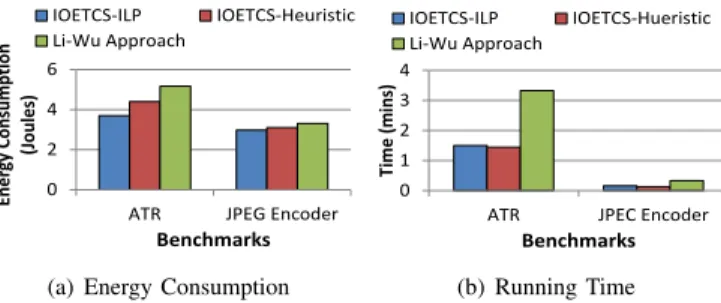
Time (mins) Benchmarks IOETCS-ILP IOETCS-Hueristic Li-Wu Approach (b) Running Time
Fig. 3. Comparison of real-world benchmarks without conditional precedence constraints 0 0.5 1 1.5 2 2.5 CTG 1 CTG 2 CTG 3 CTG 4 CTG 5 CTG 6 CTG 7 CTG 8 Ener gy Co nsu mp tion (Joules) Benchmarks IOETCS-ILP IOETCS-Hueristic ILP-vpv-flv ILP-fpv-vlv
(a) Energy consumption
0 1 2 3 4 5 6 CTG 1 CTG 2 CTG 3 CTG 4 CTG 5 CTG 6 CTG 7 CTG 8 Time (mins) Benchmarks IOETCS-ILP IOETCS-Hueristic ILP-vpv-flv ILP-fpv-vlv (b) Running time
Fig. 4. Comparison of eight benchmarks in Table II
The communication volumes are generated randomly within
[80,800]×106 in bits. The deadline for each application is
set to twice the makespan of the schedule of the application constructed by IOETCS algorithm assuming the maximum processors frequencies, the maximum links frequencies and a common deadline of 300 seconds for all the tasks so that there is reasonable slack for energy reduction. All the approaches are implemented in Matlab version R2015a. We use fmincon, quadprog and intlinprog solvers to solve the NLP, quadratic programming and ILP problems, respectively. The hardware platform consists of Intel(R) Core(TM) i5-4570 CPU with a clock frequency of 3.20 GHz, 8.00 GB memory, and 3 MB caches.
6.2 Results and Discussion
6.2.1 Experiments with conditional task graphs: In the first set of experiments we choose eight benchmarks and their details are given in Table II where x/y/z/D stands for the number of tasks, the number of OR-FORK tasks, the number of conditions and the deadline of the application in seconds, respectively. The column with heading Dim represents NoC dimensions. The benchmarks in Table II are the same bench-marks used in [26].
IOETCS-ILP achieves an average improvement of 31%, a maximum improvement of 62 % for CTG 7 and a minimum
0 5 10 15
Cruise Control Robot Control
Ener
gy Consumption (Joules)
Benchmarks IOETCS-ILP IOETCS-Hueristic ILP-vpv-flv ILP-fpv-vlv
(a) Energy consumption
0 20 40 60 80 100
Cruise Control Robot Control
Time (mins) Benchmarks IOETCS-ILP IOETCS-Hueristic ILP-vpv-flv ILP-fpv-vlv (b) Running time
Fig. 5. Comparison of real-world benchmarks with conditional precedence constraints 0 5 10 15 20 TG 1 TG 2 TG 3 TG 4 TG 5 TG 6 TG 7 TG 8 Ener gy Co nsu mp tion (Joules) Benchmarks
IOETCS-ILP IOETCS-Hueristic Li -Wu Approach
(a) Energy consumption
0 10 20 30 40 50 60 70 TG 1 TG 2 TG 3 TG 4 TG 5 TG 6 TG 7 TG 8 Time (mins) Benchmarks
IOETCS-ILP IOETCS-Hueristic Li -Wu Approach
(b) Running time
Fig. 6. Comparison of eight benchmarks in Table I
improvement of 1.03 % for CTG 1 over ILP-vpv-flv. It achieves an average improvement of 27%, a maximum im-provement of 61% for CTG 3 and a minimum imim-provement of 7.9% for CTG 6 over ILP-fpv-vlv. IOETCS-Heuristic achieves an average improvement of 23%, a maximum improvement of 40% for CTG 5 and a minimum improvement of 1.3% for CTG 1 in comparison to ILP-vpv-flv. It achieves an average im-provement of 18%, a maximum imim-provement of 61% for CTG 3 and a minimum improvement of 4% for CTG 6 over ILP-fpv-vlv. We observe that ILP-vpv-flv performs significantly better in terms of energy consumption if the computation energy dominates the total energy, and ILP-fpv-vlv performs better if communication energy dominates the total energy. CTG 5, 6 and 7 favour ILP-fpv-vlv as the communication volumes for these benchmarks are significantly larger than the execution times of task nodes. Both IOETCS-ILP and IOETCS-Heuristic distribute slacks efficiently between communication nodes and task nodes and thus perform significantly better than flv and ILP-fpv-vlv. In terms of running time both ILP-vpv-flv and ILP-fpv-vlv run slightly faster than IOETCS-ILP and IOETCS-Heuristic. This is because the search space of ILP-vpv-flv and ILP-fpv-vlv is smaller as compared to IOETCS-ILP and IOETCS-Heuristic. IOETCS-ILP-vpv-flv only scales processor voltages and ILP-fpv-vlv only scales link voltages. Whereas, IOETCS-ILP and IOETCS-Heuristic scale both the processor
voltages and the link voltages.
We choose two real-world benchmarks vehicle cruise con-troller [33] and Robot control [2] that are the task graphs of actual applications. These benchmarks are executed on 3x3 NoC where the processors are selected randomly as either Type 1 or Type 2. Both IOETCS-ILP and IOETCS-Heuristic perform significantly better than ILP-vpv-flv and ILP-fpv-vlv in terms of energy consumption. In terms of running time IOETCS-ILP and IOETCS-Heuristic take longer time compared to ILP-vpv-flv and ILP-fpv-vlv. The reason is that IOETCS algorithm cannot find a feasible solution for some sub-problems, and thus the solver takes a longer time to converge.
6.2.2 Experiments with non-conditional task graphs:
To demonstrate the effectiveness of our approach on task graphs without conditional precedence constraints, we have conducted a second set of experiments. We choose eight task graphs (TG) and their details are given in Table I where a/b/D stand for the number of tasks, the number of edges and the deadline of the application in seconds, respectively. The column with the heading Dim represents NoC dimensions. The benchmarks in Table II are the same benchmarks used in [26] except that all the edges are treated as unconditional edges. Figure 6(a) gives a comparison of 8 benchmarks in Table I in terms of energy consumption where all the processors are of Type 1. IOETCS-ILP achieves an average improvement of 31%, a maximum improvement of 61% for TG 6 and a minimum improvement of 9% for TG 1 over Li-Wu approach. IOETCS-Heuristic achieves an average improvement of 20%, a maximum improvement of 46% for TG 4 and a minimum im-provement of 2% for TG 1 over Li-Wu approach. We observe that Li-Wu approach makes very poor mapping decisions for heterogeneous processors. The benchmarks TG 3, TG 4, TG 6 and TG 8 are executed on MPSoCs where the processors are randomly selected as either Type 1 or Type 2. The reason for poor performance of Li-Wu approach is that it does not take into account the energy profiles of processors when making mapping decisions. The benchmarks TG 1, TG 2, TG 5 and TG 8 are executed on MPSoCs with homogeneous processors (Type 1). As a result, Li-Wu approach performs considerably better. In terms of running time, ILP and IOETCS-Heuristic run approximately three times faster than Li-Wu approach. The major reason is that the genetic algorithm takes significantly longer time as it constructs a new schedule for each candidate solution using ETFGBF.
We have chosen two real-world benchmarks JPEG encoder [22] and Automatic Target Recognition (ATR) [24]. JPEG encoder is executed on a 3x3 MPSoC and ATR is executed on a 4x5 MPSoC. The processors are randomly selected as either Type 1 or Type 2. For both benchmarks, IOETCS-ILP and IOETCS-Heuristic outperform Li-Wu approach in terms of both running time and energy consumption.
We observe that the energy consumption of the schedules produced by IOETCS-Heuristic are close to those of the schedules produced by IOETCS-ILP. IOETCS-ILP achieves the average improvement of 11% over IOETCS-Heuristic in terms of energy consumption for all the problem instances. In terms of running time, IOETCS-Heuristic runs slightly faster
than IOETCS-ILP.
7 Conclusion
We investigate the problem of energy-aware mapping and scheduling of tasks and communications with conditional precedence constraints and individual deadlines on a hetero-geneous NoC-based MPSoC and propose a novel approach. Our approach reduces the total expected energy consumption by collectively optimizing the voltages/frequencies of proces-sors and NoC links. The IOETCS algorithm maps tasks to processors and serializes communications that use same com-munication links. It constructs a unified schedule and assigns voltages/frequencies to tasks and communications collectively assuming continuous voltages/frequencies. The IOETCS al-gorithm significantly narrows down the search space for our ILP-based algorithm and our heuristic for assigning discrete frequencies/voltages to tasks and communications. The exper-imental results show that in terms of energy consumption, our approach using either ILP or heuristic outperforms the state-of-the-art approach proposed by Li and Wu [24] that considers only unconditional task graphs. Compared to the state-of-the-art approach, our ILP-based approach achieves an average improvement of 31%, a maximum improvement of 61% and a minimum improvement of 9%, and our heuristic-based approach achieves an average improvement of 20%, a maximum improvement of 46% and a minimum improvement of 2%. In terms of running time, our approach is approximately 3 times faster than the state-of-the-art approach.
8 References
[1] “Mobile processor exynos 5 octa (5422),” http://www.samsung.com/ semiconductor/minisite/Exynos/Solution/MobileProcessor/Exynos 5 Octa 5422.html, accessed: 2017-09-4.
[2] “Standard task graph,” URLhttp://www.kasahara.elec.waseda.ac.jp, ac-cessed: 2017-09-4.
[3] “Zynq ultrascale+ mpsocs,” https://www.xilinx.com/products/ silicon-devices/soc/zynq-ultrascale-mpsoc.html, accessed: 2017-09-4. [4] A. Andrei, P. Eles, Z. Peng, M. T. Schmitz, and B. M. Al Hashimi,
“Energy optimization of multiprocessor systems on chip by voltage selection,”IEEE Transactions on Very Large Scale Integration (VLSI)
Systems, vol. 15, no. 3, pp. 262–275, 2007.
[5] T. D. Burd and R. W. Brodersen, “Energy efficient cmos microprocessor design,” in Proceedings of the Twenty-Eighth Hawaii International
Conference on System Sciences, vol. 1. IEEE, 1995, pp. 288–297.
[6] Y. Cai, M. T. Schmitz, B. M. Al-Hashimi, and S. M. Reddy, “Workload-ahead-driven online energy minimization techniques for battery-powered embedded systems with time-constraints,”ACM Transactions on Design
Automation of Electronic Systems (TODAES), vol. 12, no. 1, p. 5, 2007.
[7] G. Chen, K. Huang, and A. Knoll, “Energy optimization for real-time multiprocessor system-on-chip with optimal dvfs and dpm combination,”
ACM Transactions on Embedded Computing Systems (TECS), vol. 13,
no. 3s, p. 111, 2014.
[8] K. Choi, R. Soma, and M. Pedram, “Fine-grained dynamic voltage and frequency scaling for precise energy and performance tradeoff based on the ratio of off-chip access to on-chip computation times,”
IEEE transactions on computer-aided design of integrated circuits and
systems, vol. 24, no. 1, pp. 18–28, 2005.
[9] P. Eles, K. Kuchcinski, Z. Peng, A. Doboli, and P. Pop, “Scheduling of conditional process graphs for the synthesis of embedded systems,” in
Proceedings of the conference on Design, automation and test in Europe.
IEEE Computer Society, 1998, pp. 132–139.
[10] M. Engel and O. Spinczyk, “A radical approach to network-on-chip operating systems,” inSystem Sciences, 2009. HICSS’09. 42nd Hawaii
International Conference on. IEEE, 2009, pp. 1–10.
[11] Y. Ge, Y. Zhang, P. Malani, Q. Wu, and Q. Qiu, “Low power task scheduling and mapping for applications with conditional branches on heterogeneous multi-processor system,”Journal of Low Power Electron-ics, vol. 8, no. 5, pp. 535–551, 2012.
[12] C. H. Gebotys and R. J. Gebotys, “Power minimization in heterogeneous processing,” inProceedings of the Twenty-Ninth Hawaii International
Conference on System Sciences, 1996., vol. 1. IEEE, 1996, pp. 330–
337.
[13] P. Ghosh, A. Sen, and A. Hall, “Energy efficient application mapping to noc processing elements operating at multiple voltage levels,” in
Proceedings of the 2009 3rd ACM/IEEE International Symposium on
Networks-on-Chip. IEEE Computer Society, 2009, pp. 80–85.
[14] Q. Gu, P. Lago, H. Muccini, and S. Potenza, “A categorization of green practices used by dutch data centers,”Procedia Computer Science, vol. 19, pp. 770–776, 2013.
[15] G. Guindani and F. G. Moraes, “Achieving qos in noc-based mpsocs through dynamic frequency scaling,” in2013 International Symposium
on System on Chip (SoC). IEEE, 2013, pp. 1–6.
[16] B. Guo, J. Yu, B. Liao, D. Yang, and L. Lu, “A green framework for dbms based on energy-aware query optimization and energy-efficient query processing,” Journal of Network and Computer Applications, vol. 84, pp. 118–130, 2017.
[17] J. Guo and M. Potkonjak, “Coarse-grained learning-based dynamic voltage frequency scaling for video decoding,” in 26th International Workshop on Power and Timing Modeling, Optimization and Simulation
(PATMOS), 2016. IEEE, 2016, pp. 84–91.
[18] R. Harmon, H. Demirkan, N. Auseklis, and M. Reinoso, “From green computing to sustainable it: Developing a sustainable service orien-tation,” in 43rd Hawaii International Conference on System Sciences
(HICSS), 2010. IEEE, 2010, pp. 1–10.
[19] C. Hasan and Z. J. Haas, “Deadline-aware energy management in data centers,” inIEEE International Conference on Cloud Computing
Technology and Science (CloudCom), 2016. IEEE, 2016, pp. 79–84.
[20] W. Huai, Z. Qian, X. Li, G. Luo, and S. Lu, “Energy aware task scheduling in data centers.”JoWUA, vol. 4, no. 2, pp. 18–38, 2013. [21] J. Huang, C. Buckl, A. Raabe, and A. Knoll, “Energy-aware task
alloca-tion for network-on-chip based heterogeneous multiprocessor systems,”
in19th Euromicro International Conference on Parallel, Distributed and
Network-Based Processing (PDP), 2011. IEEE, 2011, pp. 447–454.
[22] J. In, S. Shirani, and F. Kossentini, “Jpeg compliant efficient progressive image coding,” inProceedings of the IEEE International Conference on
Acoustics, Speech and Signal Processing, 1998., vol. 5. IEEE, 1998,
pp. 2633–2636.
[23] H. G. Lee, N. Chang, U. Y. Ogras, and R. Marculescu, “On-chip com-munication architecture exploration: A quantitative evaluation of point-to-point, bus, and network-on-chip approaches,”ACM Transactions on
Design Automation of Electronic Systems (TODAES), vol. 12, no. 3,
p. 23, 2007.
[24] D. Li and J. Wu, “Energy-efficient contention-aware application map-ping and scheduling on noc-based mpsocs,” Journal of Parallel and
Distributed Computing, vol. 96, pp. 1–11, 2016.
[25] X. Lin, Y. Wang, Q. Xie, and M. Pedram, “Task scheduling with dynamic voltage and frequency scaling for energy minimization in the mobile cloud computing environment,”IEEE Transactions on Services
Computing, vol. 8, no. 2, pp. 175–186, 2015.
[26] M. Lombardi, M. Milano, M. Ruggiero, and L. Benini, “Stochastic allocation and scheduling for conditional task graphs in multi-processor systems-on-chip,”Journal of scheduling, vol. 13, no. 4, pp. 315–345, 2010.
[27] Z. Lu, “Using wormhole switching for networks on chip: Feasibility
analysis and microarchitecture adaptation,” Ph.D. dissertation, KTH, 2005.
[28] P. Malani, P. Mukre, Q. Qiu, and Q. Wu, “Adaptive scheduling and voltage scaling for multiprocessor real-time applications with non-deterministic workload,” in Proceedings of the conference on Design,
automation and test in Europe. ACM, 2008, pp. 652–657.
[29] C. Marcon, N. Calazans, F. Moraes, A. Susin, I. Reis, and F. Hessel, “Exploring noc mapping strategies: an energy and timing aware tech-nique,” inProceedings of the conference on Design, Automation and
Test in Europe-Volume 1. IEEE Computer Society, 2005, pp. 502–507.
[30] S. Mittal, “Power management techniques for data centers: A survey,”
arXiv preprint arXiv:1404.6681, 2014.
[31] ——, “A survey of techniques for improving energy efficiency in em-bedded computing systems,” International Journal of Computer Aided
Engineering and Technology, vol. 6, no. 4, pp. 440–459, 2014.
[32] S. S. Mukherjee, P. Bannon, S. Lang, A. Spink, and D. Webb, “The alpha 21364 network architecture,” inHot Interconnects 9, 2001. IEEE, 2001, pp. 113–117.
[33] P. Pop,Scheduling and communication synthesis for distributed real-time
systems. Department of Computer and Information Science, Link¨opings
universitet, 2000.
[34] A. Roukh, L. Bellatreche, N. Tziritas, and C. Ordonez, “Energy-aware query processing on a parallel database cluster node,” inAlgorithms and
Architectures for Parallel Processing. Springer, 2016, pp. 260–269.
[35] O. Sarood, A. Langer, A. Gupta, and L. Kale, “Maximizing throughput of overprovisioned hpc data centers under a strict power budget,” in
Proceedings of the International Conference for High Performance
Computing, Networking, Storage and Analysis. IEEE Press, 2014, pp.
807–818.
[36] D. Shin and J. Kim, “Power-aware scheduling of conditional task graphs in real-time multiprocessor systems,” inProceedings of the 2003
international symposium on Low power electronics and design. ACM,
2003, pp. 408–413.
[37] ——, “Communication power optimization for network-on-chip archi-tectures,”Journal of Low Power Electronics, vol. 2, no. 2, pp. 165–176, 2006.
[38] J. Singh, S. Betha, B. Mangipudi, and N. Auluck, “Contention aware energy efficient scheduling on heterogeneous multiprocessors,” IEEE
Transactions on Parallel and Distributed Systems, vol. 26, no. 5, pp.
1251–1264, 2015.
[39] U. U. Tariq and H. Wu, “Energy-aware scheduling of conditional task graphs with deadlines on mpsocs,” in IEEE 34th International
Conference on Computer Design (ICCD), 2016. IEEE, 2016, pp. 265–
272.
[40] ——, “Energy-aware scheduling of periodic conditional task graphs on mpsocs,” in Proceedings of the 18th International Conference on
Distributed Computing and Networking. ACM, 2017, p. 13.
[41] D. Wu, B. M. Al-Hashimi, and P. Eles, “Scheduling and mapping of conditional task graph for the synthesis of low power embedded systems,”IEE Proceedings-Computers and Digital Techniques, vol. 150, no. 5, pp. 262–273, 2003.
[42] Z. Xu, Y.-C. Tu, and X. Wang, “Pet: reducing database energy cost via query optimization,”Proceedings of the VLDB Endowment, vol. 5, no. 12, pp. 1954–1957, 2012.
[43] T. T. Ye, G. D. Micheli, and L. Benini, “Analysis of power consumption on switch fabrics in network routers,” inProceedings of the 39th annual
Design Automation Conference. ACM, 2002, pp. 524–529.
[44] A. N. Yurii Nesterov,Interior Point Polynomial Algorithms in Convex
Programming. SIAM, 1987.
[45] W. Zhang, E. Bai, H. He, and A. M. Cheng, “Solving energy-aware real-time tasks scheduling problem with shuffled frog leaping algorithm on heterogeneous platforms,”Sensors, vol. 15, no. 6, pp. 13 778–13 804, 2015.