GROUP
11
FUNGICIDE
QUADRIS
®Flowable Fungicide
SUSPENSION
COMMERCIAL
For Use in Controlling Diseases in Labelled Crops.
GUARANTEE:
Azoxystrobin ... 250 g/L
Contains 1,benzisothiazolin-3-one at 0.031% or 1,benzisothiazolin-3-one at 0.039% plus
2-bromo-2-nitropropane-1,3-diol at 0.021% as preservatives as preservatives.
READ THE LABEL AND ATTACHED BOOKLET BEFORE USING
KEEP OUT OF REACH OF CHILDREN
REGISTRATION NO: 26153
PEST CONTROL PRODUCTS ACT
Syngenta Canada Inc.
140 Research Lane, Research Park
Guelph, Ontario
N1G 4Z3
Telephone: 1-877-964-3682
Pamphlet
NOTICE TO USER
This pest control product is to be used only in accordance with the directions on the label. It is an
offence under the
Pest Control Products Act
to use this product in a way that is inconsistent with the
directions on the label. The user assumes the risk to persons or property that arises from any such
use of this product.
FIRST AID
IN CASE OF POISONING, contact a physician or a poison control centre IMMEDIATELY. Take
container, label or product name and Pest Control Product Registration Number with you when
seeking medical attention.
If swallowed, call a poison control centre or doctor IMMEDIATELY for treatment advice. Have
person sip a glass of water if able to swallow. Do not induce vomiting unless told to do so by a
poison control centre or doctor. Do not give anything by mouth to an unconscious person.
If on skin or clothing, take off contaminated clothing. Rinse skin IMMEDIATELY with plenty of
water for 15–20 minutes. Call a poison control centre or doctor for treatment advice.
If in eyes, hold eye open and rinse slowly and gently with water for 15–20 minutes. Remove contact
lenses, if present, after the first 5 minutes, then continue rinsing eye. Call a poison control centre or
doctor for treatment advice.
If inhaled, move person to fresh air. If person is not breathing, call 911 or an ambulance, then give
artificial respiration, preferably by mouth-to-mouth, if possible. Call a poison control centre or doctor
for further treatment advice.
TOXICOLOGICAL INFORMATION
No specific symptoms of poisoning are known for this product. If ingested, nausea, vomiting,
diarrhea and abdominal pain may occur. Treat symptomatically.
PRECAUTIONS
KEEP OUT OF REACH OF CHILDREN.
May irritate eyes. Avoid contact with eyes, skin and clothing. Avoid breathing dust or spray mist.
Wash with soap and water after handling, and before eating, drinking or smoking. Wash
contaminated clothing, separately from household laundry, before re-use. Do not wear
contaminated shoes.
PERSONAL PROTECTIVE EQUIPMENT (PPE)
Wear long-sleeved shirt and long pants when mixing, loading and applying and during clean-up and
repair activities. Wear chemical resistant gloves during mixing and loading.
Remove clothing/PPE immediately if pesticide gets inside. Then wash thoroughly and put on clean
clothing. Remove PPE immediately after handling this product. Wash the outside of gloves before
removing. As soon as possible, wash thoroughly and change into clean clothing.
Follow manufacturer’s instructions for cleaning/maintaining PPE. If no such instructions for
washables exist, use detergent and hot water. Keep and wash PPE separately from other laundry.
All users should wash hands before eating, drinking, chewing gum, using tobacco, or using the
toilet.
Do not enter or allow worker entry into treated areas during the restricted-entry interval (REI) of 12
hours following application.
ENVIRONMENTAL HAZARDS
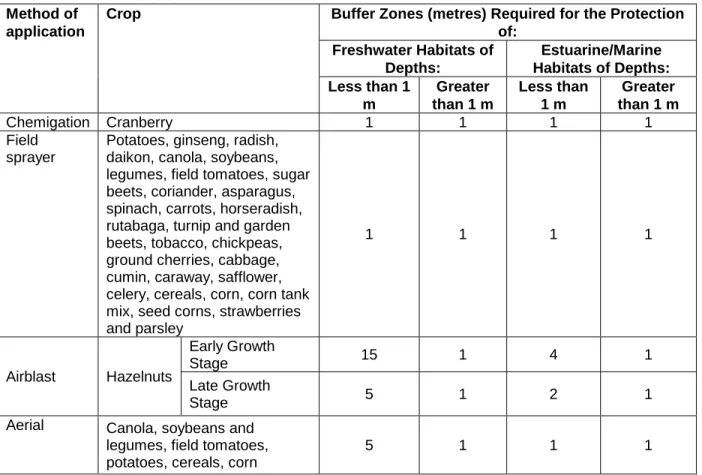
TOXIC to aquatic organisms. Observe buffer zones specified in Table 1 under DIRECTIONS FOR
USE.
Azoxystrobin is persistent and will carryover. It is recommended that this product not be used in
areas treated with Azoxystrobin during the previous season.
To reduce runoff from treated areas into aquatic habitats avoid application to areas with a moderate
to steep slope, compacted soil, or clay.
Avoid application when heavy rain is forecast.
Contamination of aquatic areas as a result of runoff may be reduced by including a vegetative strip
between the treated area and the edge of the water body.
The properties of this product indicate it may leach to ground water. The use of this product may
result in contamination of ground water, particularly in areas where soils are permeable (e.g. sandy
soil) and/or the depth to the water table is shallow.
If this pest control product is to be used on a commodity that may be exported to the U.S. and you
require information on acceptable residue levels in the U.S., contact Syngenta Canada Inc. at
1-87-SYNGENTA/1-877-964-3682.
STORAGE
Keep in original container, tightly closed, during storage. Store in a cool, dry, well ventilated area
away from feed and foodstuffs, and out of the reach of children and animals. Do not store below
0°C.
SPILL CLEANUP
Wear appropriate protective equipment (gloves, glasses, apron) when attempting to clean up the
spill. If the container is leaking, secure leak and place the container into a drum or heavy gauge
plastic bag. Contact Syngenta Canada Inc. (See EMERGENCY NUMBER) for further information.
For spills and leaks - contain the liquid with dikes of inert material (soil, clay, kitty litter, etc.). Absorb
the spill onto inert material and shovel into a sealable waste container.
On hard surfaces - sprinkle spill area with detergent and scrub in a small quantity of water with a
coarse broom. Let stand 10 minutes then absorb onto an inert material and shovel into the waste
container.
On soil - remove the top 15 cm of soil in the spill area and replace with fresh soil. Dispose of all
waste including scrub brush in accordance with provincial requirements.
DISPOSAL OF UNUSED, UNWANTED PRODUCT
For information on disposal of unused, unwanted product, contact the manufacturer or the provincial
regulatory agency. Contact the manufacturer and the provincial regulatory agency in case of a spill,
and for clean-up of spills.
CONTAINER DISPOSAL:
For returnable containers:
Do not reuse this container for any purpose. For disposal, this empty container may be returned to
the point of purchase (distributor/dealer).
For refillable containers:
For disposal, this container may be returned to the point of purchase (distributor/dealer). It must be
refilled by the distributor/dealer with the same product. Do not reuse this container for any other
purpose.
For recyclable containers:
Do not reuse this container for any purpose. This is a recyclable container, and is to be disposed of
at a container collection site. Contact your local distributor/dealer or municipality for the location of
the nearest collection site. Before taking the container to the collection site:
1. Triple- or pressure-rinse the empty container. Add the rinsings to the spray mixture in the
tank.
2. Make the empty, rinsed container unsuitable for further use.
If there is no container collection site in your area, dispose of the container in accordance with
provincial requirements.
IN CASE OF EMERGENCY INVOLVING A MAJOR SPILL, FIRE OR POISONING,
CALL 1-800-327-8633 (FASTMED)
PRODUCT INFORMATION
QUADRIS
®Flowable Fungicide is a broad spectrum, preventative fungicide with systemic properties
recommended for the control of plant diseases of canola, legume vegetables including soybeans,
seed corn, potatoes, tomatoes, ginseng, hazelnuts, filberts, sugarbeets, coriander, ferns of
asparagus, spinach, sweet and field corn, carrots, radish, daikon, horseradish, rutabaga, turnip,
garden beet, tobacco, cereals, celery and ground cherries and for the suppression of plant diseases
in cabbage, cumin, caraway, and strawberry varieties.
QUADRIS Flowable Fungicide is to be applied as a foliar spray. Optimum disease
control/suppression will be obtained by protective treatments prior to disease establishment. Refer
to the specific use directions for each crop for detailed instructions on rates, application timing and
technique.
Do not apply QUADRIS Flowable Fungicide through irrigation equipment unless specified.
ROTATIONAL CROP RESTRICTIONS
Please see the following table for the crop rotational restrictions:
Rotational Crops Planting Time From Last Application of
Azoxystrobin-containing Products
All crops with Azoxystrobin registered uses 0 days
All other crops Intended for Food and Feed 30 days
DIRECTIONS FOR USE
As this product is not registered for the control of pests in aquatic systems, DO NOT use to control
aquatic pests.
DO NOT contaminate irrigation or drinking water supplies or aquatic habitats by cleaning of
equipment or disposal of waste.
GROUND APPLICATION
MIXING INSTRUCTIONS:
1.
Ensure that the sprayer interior is clean, then fill the spray tank with ½ the required
amount of water and engage gentle agitation. Good agitation is indicated by a rippling or
rolling action on the surface of the water.
2.
Add any WG or DF formulation mix partners and agitate to ensure complete mixing.
3.
Add QUADRIS Flowable (SC) and agitate to ensure complete mixing.
4.
Add any additional SC formulation mix partners and agitate to ensure complete mixing.
5.
Add any EC formulation mix partners and agitate to ensure complete mixing.
6.
Fill the tank to ¾ the required amount of water.
7.
Add any solution (SN or SL) formulation mix partners and agitate to ensure complete
mixing.
8.
Finish filling the sprayer with water, maintaining good agitation.
9.
After any break in spraying operations, agitate thoroughly before spraying again.
10.
Spray the pesticide suspension the same day as mixing.
11.
Do not mix, load or clean spray equipment where there is a potential to contaminate wells or
aquatic systems.
When using chemical handling equipment to fill the sprayer, the following additional
recommendations apply:
• WG and DF formulations are preferentially batch mixed.
• SC, SN, and SL formulations may be inducted or batch mixed.
• EC formulations are preferentially batch mixed.
SPRAYER CLEAN-UP:
Before Spraying:
• Prior to using QUADRIS Flowable fungicide, ensure that the spray tank, lines and filter are
thoroughly clean.
After Spraying:
• Thoroughly clean application equipment immediately after spraying. Do not allow QUADRIS
Flowable residue to dry within the spray tank
• When using tank mixes, consult the tank-mix partner label for additional cleanup instructions.
• The following recommendations are provided:
1. Drain and flush tank walls, boom and all hoses for ten minutes with a clean water/detergent
mixture. Rinse with clean water. Do not clean the sprayer near desirable vegetation, wells
or other water sources.
2. Remove all nozzles and screens and wash separately.
3. Dispose of all rinsate in accordance with provincial regulations.
EQUIPMENT SPECIFIC INSTRUCTIONS
Field sprayer application: DO NOT apply during periods of dead calm. Avoid application of this
product when winds are gusty. DO NOT apply spray droplets which are smaller than the American
Society of Agricultural and Biological Engineers (ASABE) medium classification. Boom height must
be 60 cm or less above the crop or ground.
SPRAYING INSTRUCTIONS:
1.
Water Volume: Specific to crop and disease. Consult the following tabulated instructions for
use.
2.
Spray Nozzles: 80° or 110° drift reducing flat fan (e.g. those with a pre-orifice or turbulence
chamber) or air induction nozzles are recommended. Use 50 mesh nozzle screens. Do not
use flood type nozzles, controlled droplet application equipment, spray foils or hollow cone
nozzles.
3.
Pressure: As recommended by the nozzle manufacturer to achieve ASABE medium sized
droplets.
4.
Apply at uniform speed and avoid overlapping. Shut off spray boom while starting, turning,
slowing or stopping to avoid potential crop injury from over application.
Airblast application: DO NOT apply during periods of dead calm. Avoid application of this product
when winds are gusty. DO NOT direct spray above plants to be treated. Turn off outward pointing
nozzles at row ends and outer rows. DO NOT apply when wind speed is greater than 16 km/h at the
application site as measured outside of the treatment area on the upwind side.
AERIAL APPLICATION
Apply only by fixed-wing or rotary aircraft equipment which has been functionally and operationally
calibrated for the atmospheric conditions of the area and the application rates and conditions of this
label.
before opening this product. Apply only at the rate recommended for aerial application on this label.
When no rate for aerial application appears for the specific use, this product cannot be applied by
any type of aerial equipment.
Ensure uniform application. To avoid streaked, uneven or overlapped application, use appropriate
marking technology. GPS based marking is recommended.
DO NOT apply during periods of dead calm. Avoid application of this product when winds are gusty.
DO NOT apply when wind speed is greater than 16 km/h at flying height at the site of application.
DO NOT apply spray droplets which are smaller than the American Society of Agricultural and
Biological Engineers (ASABE) medium classification. The nozzle distribution along the spray boom
length MUST NOT exceed 65% of the wing or rotor span in order to reduce drift caused by turbulent
wingtip vortices.
MIXING INSTRUCTIONS:
Mixing this product directly in the aircraft hopper IS NOT recommended. The use of chemical
handling or managing equipment to load the hopper IS recommended. This product MAY BE
inducted into a hopper which is prefilled with water or when the product and water are mixed prior to
entering the hopper. This product MAY BE batch mixed and pumped into the hopper. In all cases
the chemical handling equipment and hopper interior must be clean prior to use.
NOTE: WG and DF formulations are preferentially batch mixed.
NOTE: SC, SN, and SL formulations may be inducted or batch mixed.
NOTE: EC formulations are preferentially batch mixed.
It is NOT recommended to combine solid (WG or DF) formulations with liquid tank mix partners
within a single batch. Batch mix WG or DF formulations first, pump into the hopper, and then add
liquid tank mix partners by induction or as an additional batch mix. When tank mixing multiple
products, follow the mixing order outlined below:
1.
Pump water into the hopper to at least ¼ to ½ of the desired spray volume. Engage hopper
circulation, if possible.
2.
Thoroughly batch mix any WG or DF formulation mix partners and agitate to ensure
complete mixing. Pump into the hopper
3.
Induct or thoroughly batch mix QUADRIS Flowable (SC) and any additional SC formulations.
4.
Thoroughly batch mix any EC formulation mix partners. EC formulations may be added to
the batch from Step 2, if desired.
5.
Induct or thoroughly batch mix any solution (SN or SL) formulation mix partners. SN/SL
formulations may be added to the batch from Step 2, if desired.
6.
Pump batch mixed SC, EC, and/or SN/SL products into the hopper.
7.
Finish filling the hopper with water.
8.
If it was not possible to engage hopper agitation in Step 1, do so as soon as possible once
airborne.
9.
Spray the pesticide suspension the same day as mixing.
10.
Do not mix, load or clean equipment where there is a potential to contaminate wells or
aquatic systems.
EQUIPMENT CLEAN-UP:
Before Spraying:
• Prior to using QUADRIS Flowable fungicide, ensure that the hopper, chemical handling
equipment, lines and filter are thoroughly cleaned.
After Spraying:
• Thoroughly clean application equipment immediately after spraying. Do not allow QUADRIS
Flowable residue to dry within application equipment.
• When using tank mixes, consult the tank-mix partner label for additional cleanup instructions.
• The following recommendations are provided:
1. Drain and flush tank walls, boom and all hoses for ten minutes with a clean water/detergent
mixture. Rinse with clean water. Do not clean application equipment near desirable
vegetation, wells or other water sources.
2. Remove all nozzles and screens and wash separately.
3. Dispose of all rinsate in accordance with provincial regulations.
Buffer zones:
Use of the following spray methods or equipment DO NOT require a buffer zone: hand-held or
backpack sprayer and spot treatment, inter-row hooded sprayer, soil drench and soil incorporation.
The buffer zones specified in the table below are required between the point of direct application
and the closest downwind edge of sensitive freshwater habitats (such as lakes, rivers, sloughs,
ponds, prairie potholes, creeks, marshes, streams, reservoirs and wetlands) and estuarine/marine
habitats.
Table 1. Buffer Zones
Method ofapplication
Crop Buffer Zones (metres) Required for the Protection of: Freshwater Habitats of Depths: Estuarine/Marine Habitats of Depths: Less than 1 m Greater than 1 m Less than 1 m Greater than 1 m Chemigation Cranberry 1 1 1 1 Field sprayer
Potatoes, ginseng, radish, daikon, canola, soybeans, legumes, field tomatoes, sugar beets, coriander, asparagus, spinach, carrots, horseradish, rutabaga, turnip and garden beets, tobacco, chickpeas, ground cherries, cabbage, cumin, caraway, safflower, celery, cereals, corn, corn tank mix, seed corns, strawberries and parsley 1 1 1 1 Airblast Hazelnuts Early Growth Stage 15 1 4 1 Late Growth Stage 5 1 2 1
Aerial Canola, soybeans and legumes, field tomatoes, potatoes, cereals, corn
5 1 1 1
*Field sprayer application, buffer zones can be reduced with the use of drift reducing spray shields.
When using a sprayboom fitted with a full shield (shroud, curtain) that extends to the crop canopy,
the labelled bugger zone can be reduced by 70%. When using a spray boom where individual
nozzles are fitted with cone-shaped shields that are no more than 30 cm above the crop canopy, the
labelled buffer zone can be reduced by 30%.
Use Precautions
Apply only when meteorological conditions at the treatment site allow for complete and even crop
coverage. Apply only under conditions of good practice specific to aerial application as outlined in
the
National Aerial Pesticide Application Manual,
developed by the Federal/Provincial/Territorial
Committee on Pest Management and Pesticides.
Do not apply to any body of water. Avoid drifting of spray onto any body of water or other non-target
areas. Specified buffer zones should be observed.
Coarse sprays are less likely to drift, therefore, avoid combinations of pressure and nozzle type that
will result in fine particles (mist). Do not apply during periods of dead calm or when wind velocity
and direction pose a risk of spray drift. Do not spray when the wind is blowing towards a nearby
sensitive crop, garden, terrestrial habitat (such as shelter-belt) or aquatic habitat.
Operator Precautions
Do not allow the pilot to mix chemicals to be loaded onto the aircraft. Loading of premixed
chemicals with a closed system is permitted.
It is desirable that the pilot have communication capabilities at each treatment site at the time of
application.
The field crew and the mixer/loaders must wear chemical resistant gloves, coveralls and goggles or
face shield during mixing/loading, cleanup and repair. Follow the more stringent label precautions in
cases where the operator precautions exceed the generic label recommendations on the existing
ground boom label.
All personnel on the job site must wash hands and face thoroughly before eating and drinking.
Protective clothing, aircraft cockpit and vehicle cabs must be decontaminated regularly.
Product Specific Precautions
Read and understand the entire label before opening this product. If you have questions, call the
manufacturer at 1-87-SYNGENTA (1-877-964-3682) or obtain technical advice from the distributor
or your provincial agricultural representative. Application of this specific product must meet and/or
conform to the following:
Volume: Apply the recommended rate in a minimum of 45 litres of water per hectare.
QUADRIS Flowable Fungicide is extremely phytotoxic to certain apple varieties. Avoid spray drift.
Extreme care must be taken to prevent injury to apple trees (and apple fruit). DO NOT spray
QUADRIS where spray drift may reach apple trees.
Do not spray when the wind is blowing towards a nearby sensitive crop, garden, terrestrial habitat
(such as shelter-belt) or aquatic habitat.
The buffer zones specified in Table 1 above are required between the point of direct application and
the closest downwind edge of sensitive terrestrial habitats (such as grasslands, forested areas,
shelter belts, woodlots, hedgerows, riparian areas and shrublands), sensitive freshwater habitats
(such as lakes, rivers, sloughs, ponds, prairie potholes, creeks, marshes, streams, reservoirs and
wetlands) and estuarine/marine habitats.
Follow recommendations provided by local disease monitoring services or provincial spray
calendars regarding the appropriate application timing for protectant fungicides in your area.
Cultural practices such as canopy management and removal of overwintered plant debris should be
integrated with the use of fungicides to reduce disease incidence. Use the higher rate, and the
shorter application interval under conditions of heavy infection pressure, on highly susceptible
varieties, or when environmental conditions are favourable for disease development.
QUADRIS Flowable Fungicide treatments should be integrated into an overall disease management
strategy that includes selection of varieties with disease tolerance, plant residue management, crop
rotation, and proper timing and placement of fertilizer and irrigation. Fungicide applications should
begin prior to disease infection and continue throughout the season following a resistance
management strategy (see Resistance-Management Recommendations).
CANOLA
DISEASE CONTROLLED Virulent Blackleg (Leptosphaeria maculans)
PRODUCT RATE (mL/ha) 500
APPLICATION TIMING 1 application as a broadcast foliar spray at the 2-6 leaf stage NOTES One (1) litre of QUADRIS Flowable Fungicide will treat 2 hectares. DISEASE CONTROLLED Sclerotinia Stem Rot (Sclerotinia sclerotiorum)
PRODUCT RATE (mL/ha) 700-1000
APPLICATION TIMING 1 application as a broadcast foliar spray at the early bloom stage (prior to 30% bloom)
NOTES Use the higher rate if there is a history of Sclerotinia infection in the area and when environmental conditions favour disease development.
DISEASE CONTROLLED Alternaria Black Spot (Alternaria brassicae, Alternaria raphani)
PRODUCT RATE (mL/ha) 500
APPLICATION TIMING 1 application as a broadcast foliar spray at the pod stage (90% petal fall) NOTES One (1) litre of QUADRIS Flowable Fungicide will treat 2 hectares.
CANOLA
DISEASE SUPPRESSED Alternaria Black Spot (Alternaria brassicae, Alternaria raphani)
PRODUCT RATE (mL/ha) 700-1000
APPLICATION TIMING Early bloom stage (prior to 30% bloom)
NOTES One (1) litre of QUADRIS Flowable Fungicide will treat 1 to 1.4 hectares. Restrictions:
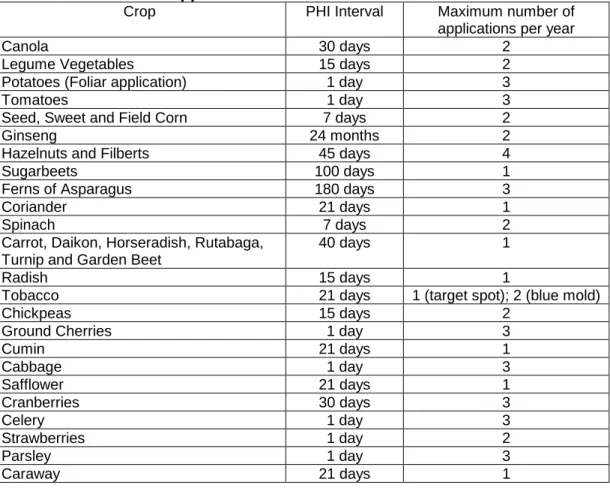
1. DO NOT apply 30 days before harvest (PHI 30 days).
2. QUADRIS Flowable Fungicide is not a substitute for good management practices. For optimum control of Blackleg, plant seed treated with a seed treatment recommended for the control of seed borne Blackleg, followed by a foliar application of QUADRIS Flowable Fungicide.
LEGUMES VEGETABLES (Crop Group 6) INCLUDING SOYBEANS
Soybeans
Crop Group 6A: Edible-podded legume vegetables - Any succulent cultivar of edible podded
bean (
Phaseolus
spp.) and any succulent cultivar of edible-podded pea (
Pisum
spp.). Bean
(
Phaseolus
spp.) (includes runner bean, snap bean, wax bean); bean (
Vigna
spp.) (includes
asparagus bean, Chinese longbean, moth bean, yardlong bean); jack bean; pea (
Pisum
spp.)
(includes dwarf pea, edible-podded pea, snow pea, sugar snap pea); pigeon pea; soybean
(immature seed); and sword bean.
Crop Group 6B: Succulent shelled pea and bean - Any succulent shelled cultivar of bean
(
Phaseolus
spp.) and garden pea (
Pisum
spp.); bean (
Phaseolus
spp.) (includes lima bean, green
bean); broad bean (succulent); bean (
Vigna
spp.) (includes black-eyed pea, cowpea, southern pea);
pea (
Pisum
spp.) (includes English pea, garden pea, green pea); and pigeon pea.
Crop Group 6C: Dried shelled pea and bean - Any dried cultivar of bean (
Phaseolus
spp.); and
dried cultivar of pea (
Pisum
spp.): dried cultivars of bean (
Lupinus
spp.) (includes grain lupin, sweet
lupin, white lupin, and sweet white lupin); (
Vigna
spp.) (includes adzuki beans); (
Phaseolus
spp.)
(includes field bean, kidney bean, lima bean (dry), navy bean, pinto bean, tepary bean, mung bean,
rice bean, southern bean, urd bean); broad bean (dry); chickpea; guar; lablab bean; lentil; pea
(
Pisum
spp.) (includes field pea); and pigeon pea.
DISEASE Asian (Soybean) Rust (Phakopsora pachyrhyizi)
CROPS All Crop Group 6A, B, C legumes vegetables listed above, and soybeans PRODUCT RATE (mL/ha) 500
APPLICATION TIMING Make first application at the R1 to R3 developmental stage, or when there is 5% disease level in the field, followed by a second application 14 days after the first, if environmental conditions are favourable for disease development.
DISEASE Powdery Mildew (Microsphaera diffusa, Erysiphe pisi, E. polygoni) CROPS Soybeans, and field peas (Pisum spp.)
PRODUCT RATE (mL/ha) 500
APPLICATION TIMING Make first application at the R1 to R3 developmental stage, or when there is 5% disease level in the field, followed by a second application 14 days after the first, if environmental conditions are favourable for disease development.
DISEASE Cercospora Leaf Spot (Cercospora kikuchii)
CROPS Soybeans only
PRODUCT RATE (mL/ha) 500
APPLICATION TIMING Make first application at the R1 to R3 developmental stage, or when there is 5% disease level in the field, followed by a second application 14 days after the first, if environmental conditions are favourable for disease development.
DISEASES Ascochyta blight (Ascochyta spp.)
Powdery Mildew (Microsphaera diffusa, Erysiphe pisi, E. polygoni) CROPS Succulent shelled peas varieties
PRODUCT RATE (mL/ha) 500
APPLICATION TIMING For Ascochyta blight the first application must be applied before disease is established and no later than the onset of flowering. A second
application can be made 10-14 days after the first application, when disease pressure is severe or when agronomic or weather conditions are conducive to disease development or movement.
For powdery mildew make first application at the R1 to R3 developmental stage, or when there is 5% disease level in the field, followed by a second application 14 days after the first, if environmental conditions are
favourable for disease development. DISEASES Ascochyta blight (Ascochyta spp.)
Mycosphaerella blight (Mycosphaerella pinodes) Anthracnose (Colletotrichum spp.)
Sclerotinia (Sclerotinia sclerotiorum) – suppression only
CROPS Any commodity listed under Crop Group 6C - the dried shelled pea and bean sub-group
PRODUCT RATE (mL/ha) 500
APPLICATION TIMING The first application must be applied before disease is established and no later than the onset of flowering. A second application can be made 10-14 days after the first application, when disease pressure is severe or when agronomic or weather conditions are conducive to disease development or movement.
Restrictions:
1. DO NOT apply within 15 days of harvest (PHI 15 days).
2. APPLY A MAXIMUM OF 2 APPLICATIONS OF QUADRIS FLOWABLE FUNGICIDE PER SEASON. Alternate with a fungicide with a different mode of action after each application.
3. Not all members of the legume vegetable group have been tested for efficacy and phytotoxicity at the recommended label rates, and should be used at the discretion of the user.
QUADRIS FLOWABLE FUNGICIDE TANK MIXED WITH TILT® 250E FUNGICIDE
LEGUME VEGETABLES (Crop Group 6) INCLUDING SOYBEANS
DISEASE Asian (Soybean) Rust (Phakopsora pachyrhyizi)
CROPS All Crop Group 6A, B, C legumes vegetables listed above, and soybeans PRODUCT RATE (L/ha) 0.3 - 0.45 L/ha of QUADRIS Flowable Fungicide with
0.5 - 0.75 L/ha of TILT 250E Fungicide
REMARKS Make the first application at the first sign of disease. Apply the high rate only under conditions of high disease pressures. A second application at 14 days interval may be needed if conditions persist. It is important to protect the developing pod of soybean and podded legume vegetables. Good spray coverage and canopy penetration are important for best results.
Apply in a minimum of 45 L of water per hectare. Restrictions:
1. DO NOT apply within 30 days of harvest for crop subgroup 6C (dry legume vegetables) and soybeans (30 day PHI).
2. DO NOT apply within 15 days of harvest for crop subgroup 6A (edible podded legume vegetables) and 6B (succulent shelled legume vegetables) (15 day PHI).
3. DO NOT APPLY MORE THAN 2 APPLICATIONS OF QUADRIS FLOWABLE FUNGICIDE PER SEASON. DO NOT APPLY MORE THAN 2 APPLICATIONS OF TILT 250E FUNGICIDE PER SEASON.
4. Do not make more than one application to soybean hay and dry pea hay. 5. Do not apply within 14 days of harvest of soybean hay and dry pea hay. 6. Do not feed dried pea vines to livestock.
7. Not all members of the legume vegetable group have been tested for efficacy and phytotoxicity at the recommended label rates and this tank mix should be used at the discretion of the user. The tank mix of QUADRIS Flowable Fungicide plus TILT 250E Fungicide may be applied by air or ground
application equipment.
QUADRIS FLOWABLE FUNGICIDE TANK MIX WITH MATADOR® 120EC INSECTICIDE OR WARRIOR®
INSECTICIDE
LEGUMES VEGETABLES (CROP GROUP 6) INCLUDING SOYBEANS
QUADRIS Flowable Fungicide can be tank mixed with MATADOR 120EC Insecticide or WARRIOR Insecticide for common leaf rust and insect control. Apply QUADRIS Flowable Fungicide at a rate of 500 mL/ha in a tank mix with MATADOR 120EC Insecticide or WARRIOR Insecticide at a rate of 83-233 mL/ha for control of soybean aphid on soybean and at a rate of 83mL/ha for the rest of the crops in Crop Group 6. Refer to the QUADRIS Flowable Fungicide, MATADOR 120EC Insecticide and WARRIOR Insecticide labels for diseases and insects controlled, specific application instructions and precautions. Pests and crops must be at the correct stage as specified on the QUADRIS Flowable Fungicide, MATADOR 120EC Insecticide as well as on WARRIOR Insecticide label. DO NOT apply more than 2 applications per season of this tank mix. DO NOT make more than one application to soybean hay and dry pea hay per season of this tank mix. PHI 30 days for crop subgroup 6C (dry legume vegetables) and soybeans. PHI 15 days for crop subgroup 6A (edible podded legume vegetables) and 6B (succulent shelled legume vegetables). DO NOT apply within 14 days of harvest of soybean hay and dry pea hay. DO NOT feed dried pea vines to livestock. Not all members of the legume vegetable group have been tested for efficacy and phytotoxicity at the recommended label rates, and should be used at the discretion of the user. This tank mix can be applied by ground application equipment only. DO NOT APPLY THE TANK MIX WITH MATADOR 120EC Insecticide OR WARRIOR Insecticide BY AIR.
POTATOES
DISEASE CONTROLLED Early Blight (Alternaria solani) PRODUCT RATE (mL/ha) 500 - 800
APPLICATION TIMING Apply on a 7 to 14 day interval, starting prior to disease establishment. NOTES Apply as a broadcast foliar spray in sufficient water for thorough coverage.
Use the higher rate if extending the treatment interval to 14 days. Apply in alternation with fungicides which have a different mode of action, and to which disease resistance has not developed.
For Early Blight, use the high rate and short application interval under high disease pressures.
DISEASE CONTROLLED Late Blight (Phytophthora infestans) PRODUCT RATE (mL/ha) 800
APPLICATION TIMING Apply on a 7 day interval, starting prior to disease establishment.
NOTES Apply as a broadcast foliar spray in sufficient water for thorough coverage. Use the higher rate if extending the treatment interval to 14 days.
Apply in alternation with fungicides which have a different mode of action, and to which disease resistance has not developed.
If Late Blight becomes established, discontinue use of QUADRIS Flowable Fungicide, and use alternative fungicides.
DISEASE CONTROLLED Black Dot (Colletotrichum coccodes)
PRODUCT RATE (mL/ha) 500 - 800
APPLICATION TIMING Apply on a 7 to 14 day interval, starting prior to disease establishment. NOTES Apply as a broadcast foliar spray in sufficient water for thorough coverage.
Use the higher rate if extending the treatment interval to 14 days. Apply in alternation with fungicides which have a different mode of action, and to which disease resistance has not developed.
For Black Dot, use the high rate and short application interval under high disease pressures.
Restrictions:
1. DO NOT apply within 1 day of harvest (1 day PHI).
2. Do not apply more than 2.4 L of QUADRIS Flowable Fungicide per hectare per crop per season. 3. Do not exceed more than 3 applications of QUADRIS Flowable Fungicide per hectare per season. 4. Do not apply sequential treatments of QUADRIS Flowable Fungicide.
5. Follow all precautions, restrictions and directions on the labels of fungicide products used in an alternation program. Follow all precautions, restrictions and directions on the labels of fungicide products used in an alternation program.
QUADRIS FLOWABLE FUNGICIDE TANK MIXED WITH BRAVO® 500FUNGICIDE
QUADRIS Flowable Fungicide can be tank mixed with BRAVO 500 Fungicide for Early Blight (Alternaria solani) control on potatoes. Apply QUADRIS Flowable Fungicide at a rate of 500 mL/ha in tank mix with BRAVO 500 Fungicide at a rate of 2 L/ha.
• Read all the labels and follow the precautionary statement, directions for use (rates, diseases controlled and application intervals) and other restrictions.
• Always check the compatibility of QUADRIS Flowable Fungicide tank mix using a jar test with proportionate amounts of BRAVO 500 Fungicide, and the water, before mixing in the spray tank. • Provide sufficient jet or mechanical agitation during filling and application to keep the tank mix
uniformly suspended.
• Fill tank at least 1/2 full of clean water.
• Add first BRAVO 500 Fungicide then QUADRIS Flowable Fungicide next.
• Do not leave tank mix combinations in the spray tank for prolonged periods without agitation. Mix and apply in the same day.
• This tank mix can be applied by ground only. Use minimum of 100 L of water per hectare when applying by ground.
Apply on a 7 to 14 day interval, starting prior to disease development. Use the short application interval under high disease pressures.
Apply as a broadcast foliar spray in sufficient water for thorough coverage. Restrictions:
1. DO NOT apply to potato plants later than 2 days before harvest (2 day PHI).
2. Do not apply sequential treatments of BRAVO 500 Fungicide tank mixed with QUADRIS Flowable Fungicide.
3. Do not exceed more than 3 applications per hectare per season. 4. DO NOT APPLY BY AIR.
5. Follow recommendations provided by local disease monitoring services or provincial spray calendars regarding the appropriate application timing for protectant fungicides in your area. Cultural practices such as canopy management and removal of overwintered plant debris should be integrated with the use of fungicides to reduce disease incidence. Use the higher rate, and the shorter application interval under conditions of heavy infection pressure, on highly susceptible varieties, or when environmental conditions are favourable for disease development.
POTATOES – IN-FURROW APPLICATION
DISEASE CONTROLLED Soilborne Diseases: Silver Scurf (Helminthosporium solani) PRODUCT RATE 4-6 mL product/100 m row
NOTES Apply once as an in furrow spray in 50 to 140 L per hectare of water at planting.
Mount the spray nozzle so the spray is directed into the furrow as a 15-20 cm band just before the seed is covered.
Restrictions:
QUADRIS FLOWABLE FUNGICIDE TANK MIXED WITH RIDOMIL GOLD® 480SL FUNGICIDE (OR
RIDOMIL GOLD 480EC FUNGICIDE)
QUADRIS Flowable Fungicide can be tank mixed with RIDOMIL GOLD 480SL Fungicide (or RIDOMIL GOLD 480EC Fungicide) for the control of Rhizoctonia stem and stolon canker (Rhizoctonia spp.) and black scurf (Rhizoctonia solani) and the suppression of pink rot (Phytophthora erythroseptica) when applied as an in-furrow application on potatoes.
Apply QUADRIS Flowable Fungicide at a rate of 4 mL/100 m row in tank mix with RIDOMIL GOLD 480SL Fungicide (or RIDOMIL GOLD 480EC Fungicide) at a rate of 4 mL/100 m row. Apply once as an in-furrow spray in 50 to 140 L per hectare of water at planting. Mount spray nozzle so the spray is directed into the furrow as a 15-20 cm band just before the seed is covered.
• Read all the labels and follow the precautionary statement, directions for use (rates, diseases controlled and application intervals) and other restrictions.
• Always check the compatibility of QUADRIS Flowable Fungicide tank mix using a jar test with proportionate amounts of RIDOMIL GOLD 480SL Fungicide (or RIDOMIL GOLD 480EC Fungicide), and the water, before mixing in the spray tank.
• Provide sufficient jet or mechanical agitation during filling and application to keep the tank mix uniformly suspended.
• Fill tank at least 1/2 full of clean water.
• Add first QUADRIS Flowable Fungicide then RIDOMIL GOLD 480SL Fungicide (or RIDOMIL GOLD 480EC Fungicide) next.
• Do not leave tank mix combinations in the spray tank for prolonged periods without agitation. Mix and apply in the same day.
Restrictions:
POTATOES
QUADRIS FLOWABLE FUNGICIDE TANK MIXED WITH RIDOMIL GOLD 480SL FUNGICIDE (OR RIDOMIL GOLD 480EC FUNGICIDE) AND ACTARA® 240SC INSECTICIDE
DISEASE/PEST Rhizoctonia stem and stolon canker Black scurf
Pink rot (suppression only) Colorado potato beetle Potato leafhopper
Aphids - including green peach, potato, buckthorn, and foxglove aphid PRODUCT RATE 4-6 mL/100 m row QUADRIS Flowable Fungicide +
4 mL/100 m row RIDOMIL GOLD 480SL Fungicide (or 4 mL/100 m row RIDOMIL GOLD 480EC Fungicide) +
3.4-4.4 mL/100 m row ACTARA 240SC Insecticide
NOTES Apply once as in-furrow spray in sufficient water to ensure good coverage. Use the higher rate of QUADRIS Flowable Fungicide when the risk of disease is high.
Use the higher rate of ACTARA 240SC Insecticide for extended residual control. Mount spray nozzle so the spray is directed into the furrow as a 15-20 cm band just before the seed is covered.
Mixing Instructions:
1. Fill tank at least 1/2 full of clean water.
2. With the agitator running, add QUADRIS Flowable Fungicide and ACTARA 240SC Insecticide, followed by RIDOMIL GOLD 480SL Fungicide (or RIDOMIL GOLD 480EC Fungicide).
3. Continue filling the spray tank with water until the desired volume is reached.
4. Begin application of the solution after the products have completely dispersed into the mix water. Maintain agitation until all of the mixture has been applied.
Precautions:
Read the labels for all products in the tank-mix and follow the precautionary statements, directions for use (rates, diseases controlled and application intervals) and other restrictions.
Always check the compatibility of the QUADRIS Flowable Fungicide tank-mix using a jar test with proportionate amounts of RIDOMIL GOLD 480SL Fungicide (or RIDOMIL GOLD 480EC Fungicide), ACTARA 240SC Insecticide and water before mixing in the spray tank.
Provide sufficient jet or mechanical agitation during filling and application to keep the tank mix uniformly suspended.
Do not leave tank mix combinations in the spray tank for prolonged periods without agitation. Mix and apply in the same day.
Restrictions:
1. Do not follow a soil application of ACTARA 240SC Insecticide with a foliar application of ACTARA 25WG Insecticide.
QUADRIS Flowable Fungicide Tank Mixed with TILT 250E FUNGICIDE CEREALS - CROP GROUP 15
CROPS Barley, oats
DISEASE Barley net blotch (Pyrenophora teres)
PRODUCT RATE (L/ha) 0.225 L/ha of QUADRIS Flowable Fungicide with 0.5 L/ha of TILT 250E Fungicide
APPLICATION TIMING Apply once between stem elongation and half-head emergence (BBCH Growth Stage 29-55).
Good spray coverage and canopy penetration are important for best results.
CROPS Barley, rye
DISEASE Barley scald (Rhynchosporium secalis)
PRODUCT RATE (L/ha) 0.225 L/ha of QUADRIS Flowable Fungicide with 0.5 L/ha of TILT 250E Fungicide
APPLICATION TIMING Apply once between stem elongation and half-head emergence (BBCH Growth Stage 29-55).
Good spray coverage and canopy penetration are important for best results.
CROPS Barley
DISEASE Barley leaf rust (Puccinia hordei)
PRODUCT RATE (L/ha) 0.225 L/ha of QUADRIS Flowable Fungicide with 0.5 L/ha of TILT 250E Fungicide
APPLICATION TIMING Apply once between stem elongation and half-head emergence (BBCH Growth Stage 29-55).
Good spray coverage and canopy penetration are important for best results. CROPS Wheat, barley, rye, oats, triticale
DISEASE Septoria leaf spot (Septoria sp.)
PRODUCT RATE (L/ha) 0.225 L/ha of QUADRIS Flowable Fungicide with 0.5 L/ha of TILT 250E Fungicide
APPLICATION TIMING Apply once between stem elongation and half-head emergence (BBCH Growth Stage 29-55).
Good spray coverage and canopy penetration are important for best results. CROPS Wheat, barley, rye, triticale
DISEASE Tan spot (Pyrenophora tritici-repentis)
PRODUCT RATE (L/ha) 0.225 L/ha of QUADRIS Flowable Fungicide with 0.5 L/ha of TILT 250E Fungicide
APPLICATION TIMING Apply once between stem elongation and half-head emergence (BBCH Growth Stage 29-55).
Good spray coverage and canopy penetration are important for best results. CROPS Winter wheat, spring wheat, and barley
DISEASE Stripe rust (Puccinia striiformis)
PRODUCT RATE (L/ha) 0.2-0.3 L/ha of QUADRIS Flowable Fungicide with 0.4-0.5 L/ha of TILT 250E Fungicide
APPLICATION TIMING Apply once between stem elongation and half-head emergence (BBCH Growth Stage 29-55).
CROPS Winter wheat and spring wheat DISEASE Wheat leaf rust (Puccinia triticina)
PRODUCT RATE (L/ha) 0.2-0.3 L/ha of QUADRIS Flowable Fungicide with 0.4-0.5 L/ha of TILT 250E Fungicide
APPLICATION TIMING Apply once between stem elongation and half-head emergence (BBCH Growth Stage 29-55).
Good spray coverage and canopy penetration are important for best results. Restrictions:
1. Do not make more than one application per season of this tank mixture. An additional application of TILT 250E Fungicide can be made, if required. Refer to the TILT 250E Fungicide label for details of the rate and timing. A total of two applications of TILT 250E Fungicide should be applied per season either in a tank mix with QUADRIS Flowable Fungicide or alone. Do not apply within 30 days of harvesting for forage and hay or 45 days for mature grain.
2. The tank mix of QUADRIS Flowable Fungicide and TILT 250E Fungicide may be applied with ground or air equipment. GROUND APPLICATION: Apply specified rates in a minimum of 100 L of water per hectare. AERIAL APPLICATION: Apply specified rates in a minimum of 45 L of water per hectare.
CROPS Field corn, Sweet Corn (including Seed Production), Popcorn (including Seed Production)
DISEASE Rust (Puccinia sorghi)
Northern Corn Leaf Blight (Setosphaeria turcicum) Southern Corn Leaf Blight (Cochliobolus heterostrophus)
Eye Spot (Aureobasidium zeae)
Grey Leafspot (Cercospora zeae-maydis)
PRODUCT RATE (L/ha) 0.225 - 0.3 L/ha of QUADRIS Flowable Fungicide with 0.5 L/ha of TILT 250E Fungicide
APPLICATION TIMING Make first application at the first sign of disease, followed by a second application 14 days after the first, if environmental conditions are favourable for disease development. Good spray coverage and canopy penetration are important for best results.
Use the low rate of QUADRIS under low to moderate disease pressure. Use the high rate of QUADRIS only under conditions of severe disease
pressure. Restrictions:
1. DO NOT apply to field corn and field corn grown for seed after brown silk. 2. DO NOT apply within 30 days of harvest for forage (30 day PHI).
3. DO NOT apply within 14 days for grain (14 day PHI).
4. DO NOT apply to sweet corn within 14 days of harvest (14 day PHI).
5. A maximum of two applications of QUADRIS Flowable Fungicide and a maximum of two applications of TILT 250E Fungicide should be applied per season either as a tank mix or as products applied alone. Not all of these cereal crops have been tested for efficacy and phytotoxicity at the
recommended label rates and the tank mix of QUADRIS Flowable Fungicide and TILT 250E Fungicide should be used at the discretion of the user.
6. The tank mix of QUADRIS Flowable Fungicide and TILT 250E Fungicide may be applied with ground or air equipment.
GROUND APPLICATION: Apply specified rates in a minimum of 100 L of water per hectare. AERIAL APPLICATION: Apply specified rates in a minimum of 45 L of water per hectare.
FIELD TOMATOES ONLY
DISEASE CONTROLLED Anthracnose (Colletotrichum coccodes) PRODUCT RATE (mL/ha) 300 - 500
APPLICATION TIMING Apply on a 7 to 10 day interval, starting at first fruit set.
NOTES Apply as a broadcast foliar spray in sufficient water for thorough coverage. Use the higher rate if extending the treatment interval to 14 days.
Apply in alternation with fungicides which have a different mode of action, and to which disease resistance has not developed.
DISEASE CONTROLLED Early Blight (Alternaria solani) PRODUCT RATE (mL/ha) 300 - 500
APPLICATION TIMING Apply on a 7 to 14 day interval, starting prior to disease establishment. NOTES Apply as a broadcast foliar spray in sufficient water for thorough coverage.
Use the higher rate if extending the treatment interval to 14 days. Apply in alternation with fungicides which have a different mode of action, and to which disease resistance has not developed.
Restrictions:
1. DO NOT apply within 1 day of harvest (1 day PHI).
2. Do not apply more than 1.5 L of QUADRIS Flowable Fungicide per hectare per crop per season. 3. Do not exceed more than 3 applications of QUADRIS Flowable Fungicide per season.
4. Do not apply sequential treatments of QUADRIS Flowable Fungicide.
5. To avoid damage to tomatoes, QUADRIS Flowable Fungicide should not be applied within 6 days, either before or after, a broadcast application of metribuzin. Follow all precautions, restrictions and directions on the labels of fungicide products used in an alternation program.
6.
QUADRIS Flowable Fungicide should not be applied until 21 days after transplanting or 35 days after seeding.QUADRIS FLOWABLE FUNGICIDE TANK MIXED WITH MATADOR 120EC INSECTICIDE OR WARRIOR INSECTICIDE:
SEED CORN, SWEET CORN AND FIELD CORN
QUADRIS Flowable Fungicide can be tank mixed with MATADOR 120EC Insecticide or WARRIOR Insecticide for common leaf rust (Puccinia sorghi) and insect control on seed, field and sweet corn. Apply QUADRIS Flowable Fungicide at a rate of 453 mL/ha in a tank mix with MATADOR 120EC Insecticide or WARRIOR Insecticide at a rate of 83mL/ha. Refer to QUADRIS Flowable Fungicide, MATADOR 120EC Insecticide and WARRIOR Insecticide labels for diseases and insects controlled, specific application instructions and precautions. Crops and insects must be at the correct stage as specified on the QUADRIS Flowable Fungicide label, MATADOR 120EC insecticide label and WARRIOR Insecticide label.
The tank mix of QUADRIS Flowable Fungicide with MATADOR 120EC Insecticide can be applied by ground or air. The tank mix of QUADRIS Flowable Fungicide with WARRIOR Insecticide may be applied by ground only. Use 200 L of water per hectare when applying by ground. Use 45 L of water per hectare when apply by air.
Compatibility should always be confirmed by premixing small proportional quantities of water, QUADRIS Flowable Fungicide and the tank-mix partners in advance.
Restrictions:
1. DO NOT harvest treated corn within 14 days of this tank-mix (14 day PHI). 2. This tank mix is not registered for use on popcorn.
READ THE FOLLOWING BEFORE USING THIS PRODUCT FOR THE INDICATED SPECIAL USE
APPLICATIONS
NOTE TO USER:
The DIRECTIONS FOR USE for this product for the uses described below were developed by
persons other than Syngenta Canada Inc. and accepted for registration by Health Canada under the
User Requested Minor Use Label Expansion program. Syngenta Canada Inc. itself makes no
representation or warranty with respect to performance (efficacy) and crop tolerance (phytotoxicity)
claims for this product when used on the crops listed below.
Accordingly, the User assumes all risks related to performance and crop tolerances arising, and
agrees to hold Syngenta Canada Inc. harmless from any claims based on efficacy or phytotoxicity in
connection with the uses described below.
POTATO - in furrow application
DISEASES CONTROLLED Soilborne Diseases:
Rhizoctonia Stem Canker(Rhizoctonia sp.)
Rhizoctonia Stolon Canker(Rhizoctonia sp.) Black Scurf(Rhizoctonia solani)
PRODUCT RATE 4-6 mL product /100 m row
NOTES Apply once as an in furrow spray in 50 to 140 L per hectare of water at planting.
Mount the spray nozzle so the spray is directed into the furrow as a 15-20 cm band just before the seed is covered
Restrictions:
1. DO NOT APPLY BY AIR. SEED CORN
DISEASE CONTROLLED Rust (Puccinia sorghi) PRODUCT RATE (mL/ha) 453
APPLICATION TIMING First application should begin prior to disease development and continue with the second application with 7-14 day interval.
Restrictions:
1. DO NOT apply within 7 days of harvest (7 day PHI).
2. Do not exceed more than 2 applications of QUADRIS Flowable Fungicide per season. 3. Ground application ONLY - Apply in 200 litres of water per hectare.
4. Do not apply QUADRIS Flowable Fungicide through irrigation equipment. 5. DO NOT APPLY BY AIR.
GINSENG
DISEASE CONTROLLED Rhizoctonia (Rhizoctonia solani)
PRODUCT RATE Newly seeded gardens: 1.12 L product/ha
NOTES For best control of Rhizoctonia (Rhizoctonia solani) on ginseng, apply QUADRIS Flowable Fungicide in 4000 L of water per hectare.
Newly seeded gardens: Maximum of two applications at the rate of 280 g a.i./ha in 4000 L water. One application in the fall (September/October) of the first growing year; apply after seedling prior to straw mulch application. Second application in the following spring; apply over straw mulch (pre-emergence).
An aquatic buffer zone is not required for the ginseng use (aquatic buffer zone 0 m).
Restrictions:
1. DO NOT apply within 24 months on harvest (24 months PHI). 2. Ground application only.
3. DO NOT apply QUADRIS Flowable Fungicide through irrigation equipment. 4. DO NOT apply QUADRIS Flowable Fungicide by air.
5. DO NOT use the leaves for feed. HAZELNUTS and FILBERTS
DISEASE CONTROLLED Eastern filbert blight (Anisogramma anomala) PRODUCT RATE 900 mL product/ha.
Apply in 1000 L of water per hectare.
NOTES Apply at a 7-10 day interval prior to the disease development; from bud swell to bud break (approximately mid March to mid May).
Do not apply more than four applications per season. Apply two sequential applications of QUADRIS Flowable Fungicide followed by two or more applications of fungicides with different modes of action registered for Eastern Filbert Blight.
Restrictions:
1. DO NOT apply within 45 days of harvest (45 day PHI). 2. DO NOT APPLY BY AIR.
SUGARBEETS
DISEASES CONTROLLED Rhizoctonia root and crown rot (Rhizoctonia solani) PRODUCT RATE 0.5 – 1.1 L product/ha (4-6 mL/100 m of row for in-furrow)
Apply in 50 - 100 L water/ha.
NOTES Apply once in-furrow at seeding or a banded application over the row soon after emergence but before the 6th leaf stage.
Restrictions:
1. The pre-harvest interval (PHI) is 100 days. 2. DO NOT APPLY BY AIR.
CORIANDER (Plants Grown for Seed Only)
DISEASE CONTROLLED Blossom blight (Aureobasidium spp.) PRODUCT RATE ML/HA 453-1125 mL product/ha
Apply in a minimum of 100 L of water per hectare with ground boom sprayer. NOTES Apply one application per season. Apply prior to disease establishment.
Use higher rate (1125 mL product/ha) at high disease pressure. Restrictions:
1. DO NOT apply within 21 days of harvest (21 day PHI). 2. DO NOT APPLY BY AIR.
3. Do not use treated leaves for food.
4. Do not apply QUADRIS Flowable Fungicide through irrigation equipment.
5. Apply using nozzle tips and in sufficient water volume for thorough coverage (i.e. at least 100 L/ha). FERNS OF ASPARAGUS
DISEASE CONTROLLED Purple Spot Disease (Stemphylium vesicarium) PRODUCT RATE 453-1124 mL/ha
Apply in a minimum of 100 L of water/ha APPLICATION INTERVAL 7-14 days
NOTES Use the lower rate (453 mL product/ha) and the longer application interval (14 days) under low disease pressure and the higher rate (1124 mL product/ha) and the shorter interval (7 days) under high disease pressure. Begin applications following the final harvest of asparagus spears, prior to disease development.
Maximum of 3 applications per crop season. Restrictions:
1. DO NOT apply within 180 days of harvest (180 day PHI). 2. DO NOT APPLY BY AIR.
3. Do not apply QUADRIS Flowable Fungicide through irrigation equipment.
4. Apply using nozzle tips and in sufficient water volume for thorough coverage (i.e. at least 100 L/ha). SPINACH
DISEASE CONTROLLED Downy Mildew (Peronospora farinosa f.sp. spinaciae)
PRODUCT RATE 1.125 L/ha (281 g ai/ha) mixed in sufficient water for thorough coverage APPLICATION INTERVAL 7 days
NOTES Begin applications prior to disease establishment and subsequently at a 7 day interval.
Apply a maximum of 2 applications per season. Restrictions:
1. DO NOT apply within 7 days of harvest (7 day PHI). 2. DO NOT APPLY BY AIR.
3. (1) Do not apply QUADRIS Flowable Fungicide through irrigation equipment. Apply using nozzle tips and in sufficient water volume for thorough coverage (i.e. at least 100 L/ha). Higher water volumes may be necessary to provide adequate coverage in thick crop canopies.
SWEET AND FIELD CORN
DISEASES CONTROLLED Rust (Puccinia sorghi)
PRODUCT RATE 453 mL product/ha in 200 L of water/ha. APPLICATION INTERVAL 7-14 days
NOTES Begin applications prior to disease establishment and subsequently at a 7 to 14 day interval.
Apply a maximum of 2 applications per season. Restrictions:
1. DO NOT apply within 7 days of harvest (7 day PHI). 2. DO NOT APPLY BY AIR.
CARROTS, DAIKON, HORSERADISH, RUTABAGA, TURNIP and GARDEN BEET
DISEASES CONTROLLED Rhizoctonia root rot, crown rot and stem canker (Rhizoctonia solani) PRODUCT RATE 4-6 mL of product/100 m row in 50-100 L water/ha
APPLICATION TIMING Apply either in-furrow at seeding or as a banded application over the row soon after emergence or within 30 days of emergence.
Use the higher rate when the weather conditions are expected to be
conducive for disease development or if minimum or low till programs are in place.
Restrictions:
1. DO NOT apply within 40 days of harvest (40 day PHI). 2. Do not apply more than one application per year.
3. Banded applications come in contact with foliage and are counted as foliar applications when considering resistance management.
RADISH
DISEASES CONTROLLED Rhizoctonia root rot, crown rot and stem canker (Rhizoctonia solani) PRODUCT RATE 4-6 mL of product/100 m row in 50-100 L water/ha
APPLICATION TIMING Apply either in-furrow at seeding or as a banded application over the row soon after emergence.
Use the higher rate when the weather conditions are expected to be
conducive for disease development or if minimum or low till programs are in place.
Restrictions:
1. DO NOT apply within 15 days of harvest (15 day PHI). 2. DO NOT apply more than one application per year.
3. Banded applications come in contact with foliage and are counted as foliar applications when considering resistance management.
4. DO NOT APPLY BY AIR.
5. Do not apply through irrigation equipment.
TOBACCO
DISEASE CONTROLLED Blue mold (Peronospora tabacina) PRODUCT RATE 870 mL product/ha
APPLICATION TIMING Begin applications prior to disease development or at the first indication that blue mold is in the area.
DO NOT apply QUADRIS Flowable Fungicide as a curative application. NOTES DO NOT apply more than 2 applications per year for blue mold.
Apply on a 7 to 14 day interval with shorter intervals under conditions conducive for disease development.
PHI 21 days.
DISEASE SUPPRESSED Target spot (Rhizoctonia solani) (suppression only) PRODUCT RATE 870 mL product/ha
APPLICATION TIMING Apply once in the spring or early summer
NOTES Apply on a 7 to 14 day interval with shorter intervals under conditions conducive for disease development.
Apply QUADRIS Flowable Fungicide in sufficient water volume for adequate coverage and canopy penetration.
Restrictions:
1. DO NOT apply within 21 day of harvest (PHI 21 days).
2. DO NOT apply more than 1 application per year for target spot. 3. Apply by ground application.
4. DO NOT apply more than one application of QUADRIS Flowable Fungicide or other Group 11 fungicides before alternation with a fungicide that is not from Group 11.
5. QUADRIS may enhance weather flecking on the leaves of certain tobacco types. This does not affect yield and quality.
6. DO NOT tank mix with THIODAN. Tank mixing with insecticides formulated as ECs or containing high amounts of solvents may cause some crop injury.
CHICKPEAS
DISEASES CONTROLLED Aschochyta blight (Ascochyta spp.)
PRODUCT RATES (L/HA) 0.5 L/ha QUADRIS Flowable Fungicide + 2 - 4* L/ha BRAVO 500 Agricultural Fungicide
APPLICATION TIMING The first application must be applied before disease is established and no later than the onset of flowering.
A second application can be made 10-14 days after the first application, when disease pressure is severe or when agronomic or weather conditions are conducive to disease development.
NOTES Apply in 220 L of water per hectare.
Do not apply sequential treatments of BRAVO 500 Agricultural Fungicide tank mixed with QUADRIS Flowable Fungicide.
Follow recommendations provided by local disease monitoring services or provincial spray calendars regarding the appropriate application timing for protectant fungicides in your area.
Cultural practices such as canopy management and removal of
overwintered plant debris should be integrated with the use of fungicides to reduce disease incidence.
Use the higher rate, and the shorter application interval under conditions of heavy infection pressure, on highly susceptible varieties, or when environmental conditions are favourable for disease development.
* For the first application use 3 - 4 L/ha BRAVO 500 tank mixed with 0.5 L/ha QUADRIS Flowable Fungicide and for the second application use 2 - 3 L/ha BRAVO 500 tank mixed with 0.5 L/ha QUADRIS Flowable Fungicide.
Restrictions:
1. Do not apply more than 2 applications of the tank mix per season. 2. DO NOT APPLY BY AIR.
3. Do not apply within 15 days of harvest (15 day PHI). GROUND CHERRIES
DISEASE CONTROLLED Early blight (Alternaria solani) PRODUCT RATE (ML/HA) 300 - 500
APPLICATION TIMING Begin applications prior to disease development.
NOTES Use sufficient water to provide thorough coverage as a ground application or a broadcast foliar spray.
Use the higher rate if extending the treatment interval to 14 days. Allow 7 to 14 days between applications.
Apply in alternation with fungicides which have a different mode of action, and to which disease resistance has not developed.
Restrictions:
1. Apply up to three (3) applications per season. 2. Do not apply within one (1) day of harvest (1 day PHI). 3. Do not apply more than 1.5 L/ha per crop per season.
4. Do not apply sequential treatments of QUADRIS Flowable Fungicide.
5. QUADRIS Flowable Fungicide should not be applied within 6 days, either before or after, of a broadcast application of metribuzin.
6. Follow all precautions, restrictions and directions on the labels of fungicide products used in an alternation program.
7. QUADRIS Flowable Fungicide should not be applied until 21 days after transplanting or 35 days after seeding.
CUMIN
DISEASE SUPRESSED Blossom blight (Ascochyta spp. and Alternaria spp.) PRODUCT RATE ML/HA
(GAI/HA)
1125 (281)
APPLICATION TIMING Begin foliar applications prior to disease establishment. NOTES Apply in a minimum of 100 L of water per hectare. Restrictions:
1. DO NOT apply within twenty one (21) days of harvest (21 day PHI). 2. DO NOT apply more than the 1 application per year.
3. DO NOT apply by air. CABBAGE
DISEASE SUPRESSED Alternaria leaf spot (Alternaria brassicae) PRODUCT RATE L/HA
(GAI/HA)
1.12 (280)
APPLICATION TIMING Begin applications prior to disease development and continue throughout the season.
NOTES For foliar ground application in a minimum spray volume of 95 L/ha. Apply at 7-14 day intervals.
Apply in alternation with fungicides which have a different mode of action, and to which disease resistance has not developed.
Restrictions:
1. Do not apply within one (1) day of harvest (1 day PHI).
2. Do not apply more than 3.36 L product/ha per season (840 g ai/ha). 3. Do not make more than 3 applications per season.
4. Do not apply by air. 5. Suppression only. SAFFLOWER
DISEASE CONTROLLED Alternaria leaf spot (Alternaria carthami) PRODUCT RATE (ML/HA) 1120
APPLICATION TIMING The application is to be made preventively at early bloom when the first flowers are seen in the field.
NOTES Use a minimum spray volume of 100 L/ha to provide thorough coverage. Restrictions:
1. Do not apply within 21 days of harvest (PHI 21 days).
2. Apply 1 application of QUADRIS Flowable Fungicide per crop season. 3. DO NOT APPLY BY AIR.