Exchange Rate Predictability in a Changing World
*Joseph P. Byrne
a, Dimitris Korobilis
b, and Pinho J. Ribeiro
cFebruary 14, 2014
Abstract
An expanding literature articulates the view that Taylor rules are helpful in predicting
exchange rates. In a changing world however, Taylor rule parameters may be subject to
structural instabilities, for example during the Global Financial Crisis. This paper
forecasts exchange rates using such Taylor rules with Time Varying Parameters (TVP)
estimated by Bayesian methods. In core out-of-sample results, we improve upon a
random walk benchmark for at least half, and for as many as eight out of ten, of the
currencies considered. This contrasts with a constant parameter Taylor rule model that
yields a more limited improvement upon the benchmark. In further results, Purchasing
Power Parity and Uncovered Interest Rate Parity TVP models beat a random walk
benchmark, implying our methods have some generality in exchange rate prediction.
Keywords
: Exchange Rate Forecasting; Taylor Rules; Time-Varying Parameters;
Bayesian Methods.
JEL Classification
: C53, E52, F31, F37, G17.
*Corresponding author at: Department of Economics, University of Glasgow, UK. Email address:
[email protected], Tel: +44 (0)141 330 2950. Fax.: +44 (0)141 330 4940.
a Department of Economics, Heriot-Watt University, Edinburgh, UK. b
Department of Economics, Adam Smith Business School, University of Glasgow, Glasgow, UK.
1
1.
Introduction
Academics and market practitioners have long sought to predict exchange rate
fluctuations. A long held view, initiated by Meese and Rogoff (1983), proposed that
forecasts based upon macroeconomic fundamentals could not improve upon a random walk
benchmark, especially at short horizons. Rossi (2013) provides a survey of a subsequent
literature that achieved successes in improving upon the benchmark, using theoretical and
empirical innovations. Theoretical improvements have included utilising asset pricing
models and Taylor rules and, separately, empirical advances have included nonlinear
methods.
1This paper seeks to combine these theoretical and empirical innovations in
predicting exchange rates, in a changing world.
Engel and West (2005) and Engel et al. (2008) illustrate that models that can be cast
in the standard present-value asset pricing framework imply that exchange rates are
approximately random walks. This holds under the assumptions of non-stationary
fundamentals and a near unity discount factor. However, Engel and West (2004) present
evidence that even when the discount factor is near one, a class of models based on
observable fundamentals can still account for a fairly large fraction of the variance in
exchange rates. An example in this class includes structural exchange rate models in which
monetary policy follows the Taylor (1993) rule. Indeed, Engel et al. (2008), Molodtsova
and Papell (2009) and Rossi (2013) find that empirical exchange rate models conditioned
on an information set from Taylor rules outperform the random walk benchmark in
out-of-sample forecasting, especially at short-horizons.
Despite the optimism instilled by this emerging research, one area remains
unresolved. This is the frequent regularity that exchange rate predictability is often
sample-dependent, and hence forecasting ability appears in some periods but not in others. Rogoff
and Stavrakeva (2008) and Rossi (2013) examine these issues thoroughly. Rogoff and
Stavrakeva (2008) show for instance that Molodtsova and Papell’s (2009) results may
change in a different forecast window. Rossi (2013) also finds that models’ predictive
power is specific to some currencies in some periods but not others. In fact, she concludes
by questioning whether instabilities can be explored to improve exchange rates forecasts.
1
For nonlinear models, see Wolff (1987), Sarno et al. (2004), Rossi (2006), Bacchetta et al. (2010), Balke et al. (2013) and Park and Park (2013). Other empirical approaches have included: long-horizon methods, see Mark (1995); panel models, see for example Papell (1997), Groen (2000), MacDonald and Nagayasu (2000), Mark and Sul (2001) and Engel et al. (2008); and factor exchange rate models, see Engel et al. (2012).
2
There are several reasons to examine the hypothesis that exchange rate
predictability is dependent on instabilities in regression and policy coefficients. Firstly,
research shows that macroeconomic conditions and policy actions evolve, often suddenly.
2Boivin (2006), Kim and Nelson (2006) and Cogley et al. (2010) present evidence that the
U.S. Federal Reserve's conduct of monetary policy is better characterized by a
changing-coefficients Taylor rule. Trecoci and Vassali (2010) present similar evidence for the U.S.,
U.K., Germany, France and Italy. Secondly, there is widespread evidence of a
time-evolving relationship between exchange rates and fundamentals. Bacchetta and van
Wincoop (2004), for example, explain this relationship on the basis of a scapegoat theory.
Foreign exchange traders often seek explanations for fluctuations in the exchange rate, such
that even when an unobservable is responsible for the actual change, it is common to
attribute it to an observable macro variable or the scapegoat. Subsequently, this scapegoat
variable influences trading behaviour and the exchange rate. Over time, fluctuations in
exchange rates are then explained by time-varying weights attributed to scapegoat
variables. In a recent application, Balke et al. (2013) and Park and Park (2013) show that
allowing for such type of coefficient adaptivity in an monetary model improves in-sample
fit and out-of sample predictive power for exchange rates.
It is timely and topical to exploit non-linear Taylor rules when predicting
exchange rates. While an extensive literature focuses on linear and non-linear models with
standard fundamentals based models, there is limited research focusing on the predictive
ability of non-linear Taylor rules.
3Non-linear methods are pertinent given the nature of the
world economy during the last decade. Taylor (2009) argues that before the Global
Financial Crisis the U.S. Fed’s conduct of monetary policy was characterized by deviations
from a linear Taylor rule. After the Crisis, Central Banks around the world have adopted
unconventional monetary policy, also inconsistent with linear Taylor rules. Hence we look
afresh at Taylor rules predictive content against a random walk.
2 See for example, Stock and Watson (1996) for evidence on structural instabilities in macroeconomic time
series in general.
3
Rossi (2013) provides an excellent survey of recent work using linear and non-linear Purchasing Power Parity, Monetary Model and Uncovered Interest Rate Parity. Papers that focus on Taylor rule predictive content in a linear modelling framework include, Engel and West (2004, 2005, 2006), Engel et al. (2008), Rogoff and Stavrakeva (2008) Molodtsova et al. (2008) and Molodtsova and Papell (2009, 2013). For non-linear modelling of Taylor rules, Mark (2009) is a notable contribution. He employs a Vector Autoregressive model and least-squares learning techniques to update Taylor rules estimates, inflation and output gap which are then then used to compute the exchange rate value. Using in-sample evidence, he finds that allowing for time-variation in parameters is relevant to account for the volatility of the Deutschemark and the Euro, relative to the U.S dollar. Our approach differs from Mark (2009) in that we focus upon out-of-sample predictability of non-linear Taylor rules.
3
This paper's main contribution is to predict exchange rates accounting for
parameter instabilities in Taylor rules by using Bayesian methods. Previous studies, such as
Molodtsova and Papell (2009), Engel et al. (2008), Rossi (2013), among others, assumed
constant coefficients in the Taylor rules, along with constant coefficients in the forecasting
regression. These restrictions about the degree of parameter adaptivity may rationalize the
difficulty in pining down model’s forecasting performance over-time. Our hypothesis is
that the predictive content might be time-varying because fundamentals themselves and
their interaction with exchange rates change over time. In light of this, we estimate
time-varying parameter Taylor rules and examine their predictive content in a framework that
also allows for the parameters of the forecasting regression to change over time.
4In a major
break with the earlier non-linear exchange rate literature, we estimate time varying
parameters using information in the likelihood based upon Bayesian methods. Therefore,
we do not rely on calibration (e.g. Wolff, 1987; Bacchetta et al., 2010), which can be
subjective and may give less accurate parameter estimates and inferior forecasting
performance.
5In particular, this paper's dataset consists of quarterly exchange rates from 1973Q1
to 2013Q1, on up to 17 OECD countries relative to the U.S. dollar. We calculate Theil’s U
statistic from Root Mean Squared Forecast Error (RMSFE) recursively out-of-sample,
whilst using three forecasting windows. To preview our results, allowing for time-varying
Taylor rules improves upon the driftless random walk at both short and long horizons. In
fact, in most forecast windows our approach yields a lower RMSFE than the benchmark for
at least half of the currencies in the sample. We improve upon the benchmark for as many
as 11 out of 17 currencies in our earlier forecast window, and eight out of 10 in our latest
forecast window. Hence, the predictive ability is particularly robust to the recent Financial
Crisis.
This paper also contributes to the literature by forecasting using panel methods
and Bayesian time-varying parameters regressions conditioned on the standard predictors
4 Although in principle forecasting using a rolling regression scheme as in Molodtsova and Papell (2009,
2013) allows for instability to be taken into account, a TVP model allows for instabilities to be updated systematically. We also note that while formal tests of parameter instabilities could be conducted in-sample, our approach relies on verifying the plausibility of time-variation in the relationships by means of out-of-sample forecast evaluation.
5 Giannone (2010) provides a helpful critique of the results based on Bacchetta’s et al.(2010) calibration, and
shows how using the full maximum likelihood setup in a Bayesian framework is important in accounting for instabilities. Balke et al. (2013) also use Bayesian methods and focus upon modelling exchange rates in-sample with monetary fundamentals.
4
from Purchasing Power Parity (PPP), a Monetary Model (MM), Uncovered Interest Rate
Parity (UIRP) and Engel et al. (2012) factor model. The TVP forecasting regression also
performs relatively well for over half of the currencies in most windows, when conditioned
on PPP at all horizons and UIRP at long-horizon. The panel model generates lower RMSFE
than the benchmark for half or more currencies across windows when based on PPP and
factors at all horizons, and Taylor rules and UIRP for long-horizon forecasts. However,
results for the panel regression are only robust for PPP at all horizons and factors at longer
horizons. The predictive content of the MM is less promising for our quarterly sample
period, regardless of the forecasting model.
The rest of the paper proceeds as follows. The next section sets out the
Time-Varying Parameter regression we consider. Section 3 discusses the choice of fundamentals,
and Section 4 covers data description and the mechanics of our forecasting exercise. The
main empirical results are reported in Section 5. Section 6 deals with robustness checks and
the final Section concludes.
2.
The Time-Varying Parameter Regression
A common practice in forecasting exchange rates is to model the change in the
exchange rate as a function of its deviations from its fundamental implied value. As put
forward by Mark (1995), this accords with the notion that exchange rates frequently deviate
from their fundamental implied value, particularly in the short-run. More precisely, define
as the h-step-ahead change in the log of exchange rate, and
a set of
exchange rate fundamentals. Then,
(1)
where,
(2)
As (1) suggests,
signals the exchange rate’s fundamental value and hence
, is the
deviation from the fundamental’s implied level. When the spot exchange rate is lower than
the level implied by the fundamentals, i.e.,
, then the spot rate is expected to
increase.
In equation (2), the time-subscripts
attached to the coefficients
[
]
,
make it evident that the regression allows the coefficients to change over time.
The exact
coefficient’s law of motion is inspired, among others, by Stock and Watson (1996), Rossi
5
(2006), Boivin (2006) and Mumtaz and Sunder-Plassmann (2012). We assume a Random
Walk Time-Varying Parameter (RW-TVP). Thus, for
[
]
, the process is:
(3)
where, the error term
is assumed homoscedastic, uncorrelated with
in equation (1)
and with a diagonal covariance matrix
Q
. Putting together equations (1) and (3) results in a
state-space model, where (1) is the measurement equation and (3) the transition equation.
We use Bayesian methods to estimate the parameters of the state-space model.
While the use of the Kalman filter with maximum likelihood is another potential method,
the evaluation of a large number of likelihood functions in this case might undermine the
estimates (Kim and Nelson, 1999). That is, with the method of maximum likelihood there
is potential for accumulation of errors, as estimation of the state variables is conditional on
maximum likelihood estimates of the other parameters of the system. In addition, there are
is also the issue of identifying objective priors to initialize the Kalman filter. Whilst to
address the latter the approach in the literature often involves setting diffuse priors or using
a training sample, solving the problem of obtaining efficient parameter estimates is a more
cumbersome task. By contrast, Bayesian methods treat all the unknown parameters in the
system as jointly distributed random variables, such that the estimate of each of them
reflects uncertainty about the others (Kim and Nelson, 1999).
In particular, we rely on the Carter and Kohn (1994) algorithm and the Gibbs
sampler to simulate draws from the parameters’ posterior distribution. The Gibbs sampler,
which falls within the category of Markov Chain Monte Carlo (MCMC) methods, is a
numerical method that uses draws from conditional distributions to approximate joint and
marginal distributions. More precisely, to fully implement the Bayesian method, we need to
(i) elicit priors for the unknown parameters, (ii) specify the form of their posterior
conditional distributions, and finally (iii) draw samples from the specified conditional
posterior distribution. To parameterize the prior distributions we use pre-sample
information. We do so largely because we are comparing the forecasting performance of
various models, at a number of forecast windows and horizons. By setting priors based on a
training sample we aim at ensuring that all the models are based on the same prior
elicitation setting, and hence their performance is not influenced by the model’s particular
prior parameterization choice. This approach also provides natural shrinkage based on
evidence in the likelihood, which in turn ensures that TVP estimates will be more accurate,
with smaller variance, resulting in a sharper inference and potentially more precise
6
forecasts.
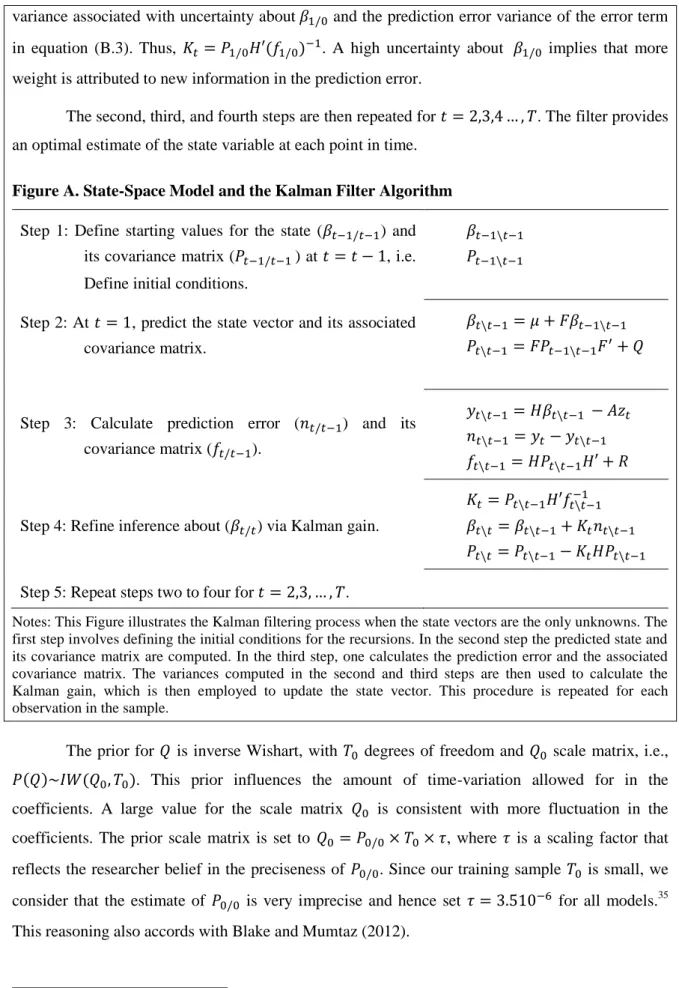
6The remainder of the details about priors’ elicitation and all the other steps are
provided in Appendix B.
3.
Choice of Fundamentals
Having defined the form and the method to estimate the parameters of our main
forecasting regression, an additional modelling issue relates to the exact specification of the
fundamental information contained in
. In this regard, our approach is broadly consistent
with models that relate the exchange rate to macroeconomic variables within the asset
pricing framework. In this framework, the exchange rate is expressed as the present-value
of a linear combination of economic fundamentals and unexpected shocks. Under the
assumptions of rational expectations and a random walk time series process for the
fundamentals, the framework implies that the spot exchange rate is determined by current
observable fundamentals and unobservable noise (Engel and West, 2005). We focus
primarily on observable fundamentals derived from the Taylor (1993) rule, MM, PPP,
UIRP, and the co-movement among exchange synthetized by factors from exchange rates.
3.1.1
Taylor Rule Fundamentals
The Taylor (1993) rule postulates that monetary authorities should set the target for
the policy interest rate considering the recent inflation path, inflation deviation from its
target, output deviation from its potential level, and the equilibrium real interest rate. Then,
it follows that they increase the short-term interest rate when inflation is above the target
and/or output is above its potential level. Note that the Taylor principle presupposes an
increase in the nominal policy rate more than the rise in inflation rate to stabilize the
economy.
An emerging research considers the implications of this policy setting for exchange
rates, including Engel and West (2005), Engel et al. (2008), Mark (2009), and Molodtsova
and Papell (2009, 2013). The premise is that the home and the foreign central banks
conduct monetary policy following the Taylor principle. In line with this principle, the
foreign monetary authority, taken as the U.S. in our empirical section, is concerned with
inflation and output deviations from their target values. In addition to these targets and
6 In our empirical exercise we also experimented using the Kalman filter with Maximum Likelihood (ML).
However unlike papers that employ diffuse priors, such as Rossi (2006), we also used data-based priors to initialize the Kalman filter recursions. Our rationale for employing these priors in this case is that while diffuse priors when using ML estimates are objective, they result in larger uncertainty about the TVP estimates, which may lead to loss of forecast power.
7
consistent with historical evidence, Engel and West (2005) assume that the home country
also targets the real exchange rate. It is also common, following Clarida et al. (1998), to
consider that central banks adjust the actual interest rate to eliminate a fraction of the gap
between the current interest rate target and its recent past level, known as interest rate
smoothing. By subtracting the foreign Taylor rule from the home, the following interest
rate differential equation is obtained:
̅
̅
(4)
where
, is the short-term nominal interest rate set by the central bank, asterisks denote
foreign (U.S.) variables;
, is inflation;
̅
, denotes output gap;
is the real exchange rate
defined as
;
, is the log nominal exchange rate, defined as the home
price of foreign currency;
, is the log of the price level;
for
, are
coefficients, and
is the unexpected disturbance term, which is assumed to be Gaussian.
A full derivation of equation (4) is provided in Appendix A.
The link from monetary policy actions to exchange rates occurs through UIRP and
the forward premium puzzle. Molodtsova and Papell (2009) discuss at length such
mechanisms. They note for example that under UIRP and rational expectations, any
circumstance that causes the home central bank to increase its policy rate relative to the
foreign, will lead to an expected depreciation of its currency relative to the foreign country.
Such circumstances include for example an increase in inflation above the target, a rise in
the output gap or a deviation of the real exchange from the target. Conversely, foreign
country’s policy actions characterized by an increase in the interest rate will be followed by
an expected depreciation of its currency. However, the empirical evidence frequently
rejects the UIRP condition and this is known as the forward premium puzzle (Engel, 1996).
In fact, the evidence is that high interest rate currencies tend to appreciate, rather than
depreciate as UIRP posits. This suggests that while we can substitute out the interest rate
differential by the expected change in exchange rate in equation (4) to obtain the exchange
rate forecasting regression, we impose no restrictions on the effect of monetary policy on
exchanges rates.
Using equation (4) to derive the forecasting regression or estimate Taylor rule
fundamentals is valid when parameters are constant over time. In a dynamic world
however, Taylor rule parameters may be subject to structural instabilities. Therefore, rather
than estimating or assuming Taylor rules fundamentals from models with constant or
8
calibrated parameters, we allow for the possibility of monetary policies that respond to
macroeconomic conditions in a time-varying fashion. Hence, we estimate fundamentals
from Taylor rules using a TVP regression of the following form:
̅
̅
(5)
from which we compute the fundamentals as:
7̂
̂
̂
̂
̅
̂
̅
̂
̂
̂
(6)
where the time-subscript,
, attached to the coefficients defines time-varying parameters
and the symbol “^” indicates parameter estimates. Note that this is identical to equation (4)
except for the time-varying coefficients. This suggests that both, the information set from
Taylor rules and the exchange rate forecasts, are generated from TVP regressions.
The exact form of the Taylor rule and hence of equation (5) varies depending on a
number of assumptions. We focus on three popular variants.
8In all variants the equilibrium
real interest rate and the inflation target of the home and foreign country are assumed to be
identical. Thus, in equation (5) the term
equals zero.
9In addition, all specifications are
asymmetric; that is, apart from the inflation and output gaps which both countries target,
the home country also targets the real exchange rate.
With the above assumptions maintained, the first Taylor rule specification further
assumes homogeneous coefficients and no interest rate smoothing – abbreviated as TR
on.
This signifies that it imposes equality in the coefficients on inflation (
) and the
output gap (
) of the home and foreign country Taylor rules. In addition, central
banks do not smooth interest rates (
). Engel and West (2006) find that it is
reasonable to assume parameter homogeneity across countries. The assumption of no
interest rate smoothing accords with Engel and West’s (2005) formulation. Molodtsova and
Papell (2009) use an identical Taylor rule.
7 We can equivalently express the predictor in terms of - see equation (2). In this case we would have:
̂ ̂ ̂ ̂ ̅ ̂ ̅ ̂ ̂ ̂ .
8 The three variants we consider constitute counterpart to the constant-parameter specifications denoted TR on
and TRos and TRen in Appendix A. 9
This is a typical assumption in this literature including in Engel and West (2005), Engel et.al (2008), Rogoff and Stavrakeva (2008), and Molodtsova and Papell (2013). As Molodtsova and Papell (2013) note, whether to include a constant that capture differences in the equilibrium real interest rate and inflation target is irrelevant, because the forecasting regression includes a constant. We also opted to drop the constant term following our empirical experiment with Taylor featuring this term. In all cases the coefficient was very small and not significantly different from zero.
9
A second specification is similar to the above, except that it includes lagged interest
rates. Therefore, it is an asymmetric rule, with homogeneous coefficients and interest rate
smoothing (TR
os).
Since the assumption of coefficients’ homogeneity between the home
and the foreign country is maintained, then we also have
in equation (5). The
inclusion of lagged interest rates implies that central banks limit volatility in the interest
rates and is in the spirit of Engel et al. (2008), Mark (2009) and Molodtsova and Papell
(2009).
The third variant relaxes the assumption of homogeneous coefficients across
countries made above and central banks do not smooth interest rates. Therefore, in equation
(5),
; and is an asymmetric rule, with heterogeneous coefficients and no
interest rate smoothing (TR
en). Molodtsova and Papell (2009) find that models of this type
exhibit a strong forecasting performance.
To estimate each of these variants we set up a state-space representation as in
Section 2, but here the measurement equation is defined by (5) and the transition process
also follows a random walk. That is, as in equation (3) but with
replaced by
. The
estimation procedure is also based on Bayesian methods and details about priors’
elicitation, posterior distributions, and sampling algorithm are provided in Appendix B.
However, we note here that like in the forecasting regression, our results rely on data-based
information to parameterize priors and the initial conditions.
3.1.2
Monetary, PPP, UIRP and Factor Fundamentals
The TVP forecasting regression also uses the content of four alternative sets of
information. These are from the monetary model (MM), PPP condition, UIRP hypothesis,
and factors from exchange rates. In notation:
(
) (
)
(7)
(8)
(
)
(9)
∑
(10)
where, in addition to the variables previously defined,
is the log of money supply;
denotes the log of income;
R
is the number of factors;
is the loading of factor
in the
currency
;
and
is the estimated
factor.
While fundamentals given by identities (7), (8), and (9) are standard in the
exchange rate literature, those represented by the co-movement among exchange rates as in
10
identity (10) have been recently propounded by Engel et al. (2012). Their basic
presumption is that the exchange rate of country
follows the process:
(11)
where,
is the effect of the factor in country’s
exchange rate;
is the respective factor
loading, and
is a country specific shock, which is uncorrelated with the factors. Engel et
al. (2012) show that under plausible assumptions, for example that the common factor
follows a random walk process, the RMSFE of the factor model is lower relative to the
RMSFE of the random walk. In our empirical procedure we follow Engel et al. (2012) and
allow for one, two or three factors, estimated via principal components.
10To obtain initial conditions for the forecasting regression, we simply compute for
the initial 20 data-points the series defined by the identity (7) for MM, (8) for PPP, (9) for
UIRP, and extract factors to obtain fundamentals given by (10).
We then use these
fundamentals to estimate a constant-parameter model akin to our forecasting regression,
from which we parameterize the priors, initial states, and the covariance matrices of the
TVP forecasting regression. The observations used to parameterize priors are discarded,
and we use the remaining sample period and the same identities above, (7)-(10), to
compute fundamentals that constitute our predictors in the TVP forecasting regression.
Apart from our main forecasting regression which allows the coefficients to vary
over time, we also forecast with a second regression which maintains them constant; i.e.,
, for
in equation (1).
11Engel et al. (2008) find that panel data methods
forecast better than single-equation methods. Accordingly, we also use a Fixed-effect (FE)
panel regression as in Engel et al. (2008, 2012). In this case, except for the Taylor rules, the
set of information from the MM, PPP, UIRP, and factors is computed exactly as in the TVP
forecasting approach, i.e., as in identities, (7)-(10). The information set from Taylor rules
specifications is obtained by estimating, via OLS, a single-equation fixed-parameter model
similar to equation (4). Table 1 summarises all these aspects.
10 Engel et al. (2012) estimate the factors using maximum likelihood or principal components, and report
evidence of fairly comparable results.
11 As should be clearer in the next Section, allowing for time-variation in the parameters in a recursive
forecasting approach implies that there are potentially two sources of variation that will ultimately impact upon the parameters. The first is due to the recursive algorithm when computing the optimal parameter at each time of the in-sample period. The second source arises from extending the sample as observations are added to end of the in-sample period (recursions). Therefore, a TVP model allows for more flexibility and presumably more consistent estimates as the sample is extended. We note as well that the second effect is also prevalent in the constant-parameter forecasting regression.
11
Table 1. Empirical Exchange Rate Models and Forecasting Approaches
Fundamentals-based
Exchange Rate Model
TVP Approach Constant Parameter Approach Forecast Windows and Number of Currencies Considered (N) Information set (Fundamental) Forecasting model Information set (Fundamental) Forecasting model
Taylor Rule (TR)
Estimated with a random walk Time-Varying Parameter model using Bayesian methods: TRon: ( ) ( ̅ ̅ ) TRos: ( ) ( ̅ ̅ ) ( ) TRen: ̅ ̅
Random walk Time-Varying Parameter (TVP) model, estimated using Bayesian methods:
Estimated with a single-equation fixed-parameter model, via Ordinary Least Square estimator: TRon: ( ) ( ̅ ̅ ) TRos: ( ) ( ̅ ̅ ) ( ) TRen: ̅ ̅ Fixed-effect Panel model, estimated via Least Square Dummy Variable estimator: A: 1995Q1-1998Q4; N=17 (all currencies in the sample); B: 1999Q1-2013Q1; N=10 (non-Euro area currencies and the Euro);
C: 2007Q1-2013Q1; N=10 (non-Euro area currencies and the Euro). Monetary Model Computed as : ( ) ( ) Computed as: ( ) ( ) PPP Computed as : Computed as : UIRP Computed as : ( ) Computed as : ( )
Factors Factors estimated through principal components analysis.
Factors estimated through principal components analysis.
Notes: This Table summarizes the models considered and the forecasting approaches. The definition of the variables is as follows: = interest rate; = inflation rate; = output; ̅= output gap; = real exchange rate; = money; = price level; = nominal exchange rate. The subscripts and denote country and time, respectively. Asterisk defines the foreign country. Three variants of Taylor rules (TR) are considered: (i) TRon: asymmetric rule with homogeneous coefficients and no interest rate
smoothing, (ii) TRos: asymmetric rule with homogeneous coefficients and interest rate smoothing) and (iii) TRen: asymmetric rule with heterogeneous coefficients and no
interest rate smoothing. See Appendix A for derivations. The factor model allows for one (F1), two (F2), or three (F3) factors. The forecasts are computed for one-, four-, eight-, and 12-quarters-ahead forecasts.
12
4.
Data and Forecast Mechanics
4.1
Data
The data comprises quarterly figures spanning 1973Q1:2013Q1 from 18 OECD
countries: United States, United Kingdom, Switzerland, Sweden, Spain, Norway,
Netherlands, Korea, Italy, Japan, Germany, France, Finland, Denmark, Canada, Belgium,
Austria and Australia. The main source is the IMF’s (2012)
International Financial
Statistics
(IFS). Some of the countries in our sample period moved from their national
currencies to the Euro. To generate the exchange rate series for these countries, the
irrevocable conversion factors adopted by each country on the 1
stof January 1999 were
employed, in the spirit of Engel et al. (2012). The money supply is measured by the
aggregate M1 or M2.
15To estimate Taylor rules we need the short-run nominal interest rates set by central
banks, inflation rates and the output gap or the unemployment gap.
16We use the central
bank’s policy rates when available for the entire sample period, or alternatively the
discount rate or the money market rate. The proxy for quarterly output is the industrial
production in the last month of the quarter. The output gap and unemployment gap are
obtained by applying the Hodrick and Prescott (1997) filter recursively, to the output and
unemployment series. The price level consists of the consumer price index (CPI) and the
inflation rate is defined as the (log) CPI quarterly change. The data on money supply,
industrial production, unemployment rate and CPI were seasonally adjusted by taking the
mean over four quarters following Engel et al. (2012).
4.2
Forecast Implementation and Evaluation
As noted in the previous Sub-section, the sample covers the period 1973Q1 to
2013Q1. We use the sample period from 1974Q1 to 1978Q4 to parameterize the priors and
initial conditions for the TVP regressions. The in-sample estimation period begins in
1979Q1 for all models, including the fixed-parameter ones.
15
Exceptions are for Sweden, where M3 is used; Australia -M3; and the UK -M4. See Appendix C for extra details.
16 In estimating Taylor rules and due to possible endogeneity issues, several authors emphasize the timing of
the data employed. The discussion centres on the idea that Taylor rules are forward-looking, and hence ex-post data might reflect policy actions taken in the past. Kim and Nelson (2006) note two approaches that can be employed to account for this. The first comprises using historical real-time forecasts that were available to policy-makers. The second consists in using ex-post data to directly model the policy-makers’ expectations. Since historical real-time forecasts are unavailable for our sample of countries, we follow Molodtsova and Papell’s (2009) approach, and use data that were observed (as opposed to the real-time forecasts) at time t, while forecasting t + h period.
13
Rogoff and Stavrakeva (2008) argue that the predictive ability of
fundamentals-based exchange rate models is often sample-dependent. To verify models’ forecasting
performance in alternative forecast windows we consider three sub-samples.
17The first
out-of-sample forecasts are for the period 1995Q1-1998Q4. This corresponds to the
pre-Euro period. Forecasts for all the 17 countries’ currencies are generated and models’
forecast accuracy evaluated. A second forecasting window covers the post-Euro period:
1999Q1-2013Q1. Since we have extended the exchange rates of the Euro-area countries
throughout, the forecast of the Euro currency is computed as an average of the forecasts of
the Euro-area countries in our sample. The forecast error is constructed as the difference
between each of the country’s realized value and the computed average. We therefore
generate forecasts for the nine non-Euro area countries plus the Euro. These procedures
draw from Engel et al. (2012). The last out-of-sample forecast window begins just before
the recent financial turmoil and extends to the end of the sample, i.e., 2007Q1-2013Q1.
Considering this window is particularly important, given the substantial instabilities that
characterized the period, with consequences for the monetary policy reaction functions and
the variance of the exchange rate. In this window, we also compute forecasts for 10
currencies, following the procedure just described above.
Our forecasting horizons cover the short and the long horizons. Specifically, we
use a direct rather than an iterative method to forecast the h-quarter-ahead change in the
exchange rates for h = 1, 4, 8, 12. The benchmark model is the driftless random walk.
Since the seminal contribution by Meese and Rogoff (1983) it has been found that it is
challenging to improve upon this benchmark.
The forecasting exercise is based on a recursive approach using lagged
fundamentals. For concreteness, let
be the sample size comprising a
proportion of R
observations for in-sample estimation, and P for prediction at h-forecast
horizon. Thus,
constitutes the total number of observations after discarding
data-points used to parameterize priors for the TVP models. We first use R observations to
estimate or compute the information set and to generate the parameters of the exchange
rate forecasting regression. With these parameters we generate the first
-step-ahead
forecast and compute the forecast error. We then add one observation at a time to the end
of the in-sample period and repeat the same procedure until all P observations are used.
14
To compare the out-of-sample forecasting performance of our models we employ
the sample RMSFE as our metric. We compute the ratio of the RMSFE of the
fundamentals-based exchange rate model (FEXM) relative to RMSFE of the driftless
random walk, known as the Theil’s-U statistic. Hence, models that perform better than the
benchmark have a Theil’s U less than one. To test the null hypothesis of no difference in
the accuracy of the forecasts of FEXM relative to the forecasts of the random walk we
compute one-sided
Diebold Mariano (1995) (DM) test-statistic.
18Diebold and Mariano
(1995) show that under the null, the test follows a standard normal distribution. We reject
the null hypothesis of equal forecast accuracy if the DM statistic is greater than 1.282 at
10% significance level and conclude that the forecast from the FEXM is better than that of
the random walk. The appealing feature of the DM test is that we need not make any
assumption about the model that generates the forecast. It can be used to evaluate forecasts
generated from linear or non-linear models, either nested or non-nested. This contrasts
with the typical Clark and West’s (2006, 2007) (CW) test-statistic, which is suitable for
comparison of (linear) nested models. Additionally, Rogoff and Stavrakeva (2008) make
the case for using the DM test, rather than the CW test, arguing that the latter does not
always test for minimum mean square forecast error.
5.
Empirical Results
We summarise the results for each forecast window and horizon by reporting the
number of U’s less than one (No. of U's < 1), the Median U, and the number of DM
test-statistics greater than 1.282 (No. of DM > 1.282). Recall that a value of U less than one
suggests that the RMSFE of the fundamentals-based exchange rate model (FEXM) is
lower than that of the RW; hence on average, the FEXM forecasts better than the
benchmark driftless random walk (RW). Thus, the No. of U's < 1, provides the number of
currencies for which the FEXM improves upon the RW. For instance, when the No. of U's
< 1 corresponds to half of the currencies in a particular window, then the FEXM improves
upon the RW for half of the currencies in that window. The Median U provides the value
of the middle U-statistic across the sample of
N
currencies. At this value, the U-statistic of
N/2 currencies is less than the
Median U
and the U-statistic of the other N/2 currencies is
18 The Diebold and Mariano (1995) test is computed as: ̅
( ̂̅ ) where, ̅ ∑ ; ̂ ̅ is the
estimated long-run variance of √ ̅; and is the difference between the RMSFE of the random walk and the RMSFE of the FEXM.
15
greater than the same M
edian U
. Therefore, a Median U less than or equal to one along
with a No. of U's < 1 for half or more currencies in the window, is also consistent with a
better average performance of the FEXM relative to the benchmark. The number of DM
statistics greater than 1.282 (No. of DM > 1.282), corresponds to cases in which the null
hypothesis under the Diebold and Mariano (1995) test of equal forecast accuracy is
rejected, at 10% significance level. The higher the number of rejections across the number
of currencies in the window, the better is the average accuracy of the forecasts of the
FEXM relative to the forecasts of the benchmark.
5.1
Taylor Rules Results
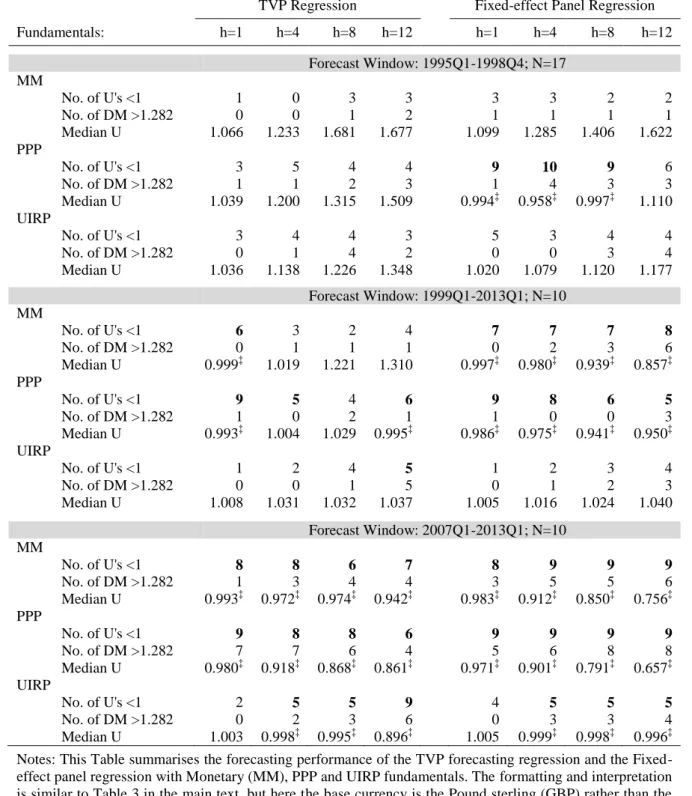
Table 2 presents the summary results from the TVP forecasting regression and the
Fixed-effect (FE) panel regression, both conditioned on Taylor rules.
19Focusing first on
the TVP regression, the results indicate improvements upon the benchmark for short (h=4)
and longer-horizon forecasts (h=8 and h=12) in most forecast windows. For instance, in
the first window and at four-quarter-ahead horizon, the TVP regression conditioned on
fundamentals from Taylor rules with homogenous coefficients and interest rate smoothing
(TR
os) outperform the RW for 11 out of 17 currencies. As the forecast horizon increases to
eight and 12-quarters ahead, it still outperforms the benchmark for nine currencies and 10
currencies, respectively. The regression conditioned on Taylor rules with homogenous
coefficients but no interest rate smoothing (TR
on) shows a similar performance as well. In
the last forecast window, the TVP predictive regression improves upon the benchmark for
over half of the currencies at four-, eight- or 12-quarter-ahead forecasts. In particular,
when conditioned on Taylor rules with heterogeneous coefficients and no interest rate
smoothing (TR
en), it shows the strongest performance. It outperforms the RW for at least
half of the currencies at all horizons, reaching as many as seven out of 10 at h=4, and eight
out of 10 at h=12. Our regressions performed unsatisfactorily in the forecast window
spanning 1999Q1-20013Q1.
20Table 2 also illustrates that the statistical significance of the forecasts accuracy of
the TVP regression based on Taylor rule’s information set stands out for long-horizon
forecasts. For example, consider the model conditioned on TR
onin the last forecast
window. Here we can reject the null of equally forecast accuracy for four out of five
19Detailed results by currency are provided in a results appendix. Also, recall that the information set for the
TVP Regression is estimated from a TVP Taylor rule, while for the fixed-effect panel regression is estimated from a single-equation constant-parameter model.
20
In this window, the median U’s are all above one, implying that for more than half of the currencies in the window the U’s are greater than one.
16
currencies that had U less than one at the 12-quarters-ahead forecasts. In contrast, for
four-quarter-ahead forecasts the null is rejected only once. A similar observation holds for other
Taylor rule specifications and forecast windows. This suggests that although the RMSFE
of the Taylor rule- based exchange rate models are smaller than that of the RW for
short-run forecasts, they become significantly lower for long-short-run forecasts. As we noted earlier,
this is unsurprising. Since exchange rates frequently deviate from their implied
fundamental level in the short-run but return to that level in the long-run, one should
expect the forecast accuracy to increase with the forecast horizon.
Shifting the focus to the FE panel regression, results in Table 2 show that in most
windows it outperforms the RW benchmark for over half of the currencies, only for
long-horizon forecasts, i.e., for h=8. This is the case in the window spanning from 1995Q1 to
1998Q4 where, for instance, the regression with TR
osperform well for 13 out of 17
exchange rates. In the last window, it still out-forecasts the RW for most currencies at h=8,
regardless of the Taylor rule specification. However, in this particular window most Taylor
rule specifications also do well at 12-quarter-ahead forecast. Note as well that like in the
TVP regression, the statistical significance of forecasts accuracy of the panel regression
stands out as the forecast horizon increases.
The performance of the FE panel regression in our sample is partially similar to the
results in Engel et al. (2008).
21Using a FE panel regression that includes a time effect and
a fixed effects, they find that the driftless RW outperforms the Taylor-rule based
regression at both, short (h=1quarter) and long (h=16 quarters) forecast horizons. Here,
while the findings for the short-run forecasts are similar, for long-run forecasts we find
improvement upon the RW benchmark. Of course there are a number of differences
between their analysis and ours. Probably the most significant are: (i) the differences in the
forecast windows considered and the sample span,
22and (ii) their use of a Taylor rule
specification (TR
on) with posited coefficients, whereas here we estimate the coefficients.
21 As we noted in the Introduction, there are other papers that condition on Taylor rules to forecast exchange
rates in a linear modelling setup. However, we leave the comparison of their results to our Robustness check section, as they employ a single-equation forecasting regression with monthly data, rather than a FE panel regression with quarterly data. Here we compare with Engel et al. (2008) as they also employ a FE panel regression and quarterly data.
22
Engel’s et al. (2008) sample covers the period 1973Q1-2005Q4, while our sample extends for an extra eight years from 2005Q4.
17
Table 2. Forecast Evaluation: Taylor Rules
TVP Regression Fixed-effect Panel Regression
Fundamentals: h=1 h=4 h=8 h=12 h=1 h=4 h=8 h=12 Forecast Window: 1995Q1-1998Q4; N=17 TRon No. of U's <1 5 9 11 10 4 5 4 7 No. of DM >1.282 1 4 9 8 1 1 3 3 Median U 1.023 0.989‡ 0.853‡ 0.939‡ 1.012 1.044 1.076 1.048 TRos No. of U's <1 5 11 9 10 5 7 13 8 No. of DM >1.282 1 4 6 10 0 1 6 7 Median U 1.031 0.980‡ 0.999‡ 0.965‡ 1.011 1.007 0.922‡ 1.099 TRen No. of U's <1 6 8 8 7 4 5 9 5 No. of DM >1.282 0 3 8 7 0 1 4 2 Median U 1.021 1.043 1.035 1.292 1.013 1.030 0.994‡ 1.142 Forecast Window: 1999Q1-2013Q1; N=10 TRon No. of U's <1 3 2 3 3 0 1 2 2 No. of DM >1.282 1 1 2 3 0 0 0 1 Median U 1.007 1.031 1.082 1.179 1.009 1.033 1.069 1.112 TRos No. of U's <1 1 2 3 3 2 2 2 2 No. of DM >1.282 0 0 2 2 0 1 1 1 Median U 1.010 1.043 1.099 1.219 1.007 1.033 1.065 1.156 TRen No. of U's <1 1 3 3 1 0 1 2 2 No. of DM >1.282 0 0 1 1 0 0 1 1 Median U 1.007 1.036 1.083 1.226 1.010 1.040 1.088 1.159 Forecast Window: 2007Q1-2013Q1; N=10 TRon No. of U's <1 4 5 7 5 4 4 8 6 No. of DM >1.282 0 1 4 4 0 1 2 3 Median U 1.004 1.003 0.973‡ 1.007 1.003 1.003 0.984‡ 0.992‡ TRos No. of U's <1 2 4 6 5 3 4 6 5 No. of DM >1.282 0 0 2 5 0 0 5 4 Median U 1.004 1.003 0.955‡ 0.930‡ 1.010 1.001 0.945‡ 0.942‡ TRen No. of U's <1 5 7 6 8 5 4 5 4 No. of DM >1.282 1 2 3 4 1 2 3 3 Median U 0.999‡ 0.991‡ 0.912‡ 0.828‡ 0.999‡ 1.004 0.972‡ 1.052 Notes: This Table summarises the forecasting performance of the TVP forecasting regression and the Fixed-effect panel regression with Taylor rule fundamentals specified as TRon, TRos and TRen. See Table 1 for details
about the form of the forecasting regressions and how fundamentals are computed or estimated. The benchmark model for both forecasting regressions is the driftless Random Walk (RW). For each regression, set of fundamentals, forecast window and quarterly horizon (h), the “No. of U's < 1” (number of U-statistics less than one), provides the number of currencies for which the model improves upon the RW, since it indicates cases where the RMSFE of the fundamental-based regression is lower than that of the RW. When the U’s are less than one for at least half of the currencies in the forecast window, marked in bold, then on average, the fundamental-based regression outperforms the benchmark in that window. The “No. of DM > 1.282” (number of DM statistics greater than 1.282) shows cases of rejections of the null hypothesis under the Diebold and Mariano (1995) test of equal forecast accuracy at 10% level of significance. The higher the No. of DM > 1.282, the better the average accuracy of the forecasts of the fundamental-based regression relative to the benchmark is. The “Median U” indicates the middle value of the U-statistic across the sample of N currencies for each forecast window and horizon. When “Median U” is less than or equal to one - marked with the symbol “‡”, and U’s are less than one for at least half of the currencies in the window, this is also consistent with a better average forecasting performance of the fundamental-based regression relative to the benchmark.
18
Figure 1. Recursive U-statistic for the TVP Regression with Taylor Rule Fundamentals
Notes: This Figure illustrates the recursive U-statistics of the TVP regression with Taylor rule-information set. The Taylor rule specification imposes homogenous coefficients between home and foreign country and no smoothing (TRon). The forecast window is 2007Q1-2013Q1, at four-quarter-ahead horizon. The recursive
U’s are computed as successive U’s at each point in the forecast window such that the last U includes all forecasts in the window. A recursive U less than one for the most or all part of the forecast window indicates that the corresponding RMSFE of the TVP regression conditioned on TRon is lower than the RMSFE of the
RW. Hence, the regression forecasts consistently better than the RW across the window.
On balance and across forecasting regressions, forecasting windows, and horizons,
the TVP regression had a better average performance. This is particularly notable at four,
eight and 12-quarters-ahead forecast horizons, and in the window that encompasses the
recent financial crisis, i.e., 2007Q1-2013Q1. To illustrate the variability of the RMSFE of
the TVP regression and check its sensitiveness across the forecast window, Figure 1 plots
the recursive U, for h=4, TR
enand six exchange rates.
23The recursive U’s are constructed
as successive U’s at each point in the forecast window, such that the final recursion
provides the U for the entire window.
At least two aspects can be observed in Figure 1. First and unsurprisingly, the U’s
vary considerable at the beginning of the forecast window (up to 2008Q1), since they are
computed from few forecasts. Second, as the number of forecasts increases, the pattern of
the U-statistics becomes much clear such that there is no obvious sensitivity to the sample:
23 We have selected only this windows and these currencies to make the graph readable, as the pattern of the
recursive U’s of the other exchange rates in this and other forecast windows and horizons is similar to that displayed in Figure 1. In fact, the same pattern is also observed when we define the GBP as the base currency (not reported), rather than the U.S. dollar in Figure 1.
19
in those cases where the TVP regression performs unsatisfactorily than the RW it does so
for the entire sample; whereas when it does better, it is also consistent. In the Figure, the
recursive U’s of the TVP regression are slightly above one for Canada for the most part of
the window. This indicates that at each additional point forecast, the recursive RMSFE of
the TVP regression is greater than the recursive RMSFE of the RW for the Canadian dollar
exchange rate, consistent with a poor forecasting performance of the TVP regression. By
contrast, the U’s are less than one for the UK, Japan, Norway, Sweden and Switzerland.
Therefore, the average good performance that we noted for 70% of the currencies in this
window and horizon holds across the entire sample period.
To illustrate what determines a U-statistic of certain magnitude for each forecasting
regression, Figure 2 depicts the predictive content of the TVP Taylor rule fundamentals,
vis-à-vis those resulting from a single-equation constant parameter regression, along with
the subsequent h-quarter change in the exchange rate. Recall that the former fundamentals
are employed in the TVP forecasting regression, while the latters in the FE panel
forecasting regression. The example is based on the UK, for the last forecast window, at
h=1 and h=12, and the Taylor rule specification with heterogeneous coefficients and no
smoothing (TR
en). The U-statistics are 1.004 (h=1) and 0.722 (h=12) for the TVP
regression, and 0.997 (h=1) and 1.091 (h=12) for the FE panel regression.
The top-left graph shows the case of the TVP Taylor rule fundamentals at
one-quarter forecast horizon. As depicted, at this horizon TVP Taylor rule fundamentals fail to
predict the direction of the subsequent one-quarter change in the Pound sterling/USD
exchange rate for the most part of forecast window, resulting in a U-statistic above one.
For instance, while the TVP regression predicts a fall in the Pound sterling from 2007Q2
up to 2008Q4, the data shows an opposite path. In the following periods the regression
predicts the correct movements until 2009Q4, failing subsequently until 2010Q3. In the
remaining periods it does reasonably well, except between 2011Q1 and 2011Q3. In
contrast, Taylor rule fundamentals from the constant parameter regression, depicted in the
graph at the bottom left, provide a relative better signal of the subsequent change in the
one-quarter Pound sterling exchange rate for the most part of the forecast window.
However, since there are also some periods were these fundamentals fail, for example
between 2009Q1- 2009Q3 and 2011Q3-2012Q2, the U-static is less one by a narrow
margin (U=0.997).
20
Figure 2. Predictive content of the TVP Taylor rules vs Constant-Parameter Taylor rules
Notes: This Figure depicts the predictive content of the TVP Taylor rule fundamentals, vis-à-vis those resulting from a constant parameter (CP) regression, along with the subsequent h-quarter change in the exchange rate. The Taylor rule specification assumes heterogeneous coefficients and no smoothing (TRen).
The fundamentals, or more precisely the interest rate differentials, are estimated recursively to nest the forecast method. The in-sample period spans 1979Q1-2006Q4 and the out-of-sample period comprise 2007Q1-2013Q1.
The graphs depicted at the right-hand side of Figure 2 illustrate a similar
comparison at the twelve-quarter-ahead forecast horizon. In the top-right graph, the TVP
Taylor rule fundamentals predicts almost all the subsequent movements in the exchange
rate, yielding a U-statistic significantly less than one (U=0.722). By contrast, fundamentals
from the constant-parameter Taylor rules, illustrated in the bottom-left side, are able to
correctly signal the changes in the Pound sterling exchange rate in a relatively few cases,
resulting in a U-statistic greater than one (1.091). To sum up, we can infer that the relative
good performance of the TVP regression across windows and horizons, is associated with
a relative better predictive content of the TVP Taylor rule fundamentals, employed in a
setting that also allows for the parameters of the forecasting regression to change over
time.
21
5.2
Monetary Model, PPP and UIRP Results
Table 3 illustrates the overall performance of the TVP and the FE panel forecasting
regressions with classic predictors: the MM, PPP and UIRP.
24At a glance, regressions
based on PPP perform better than the RW benchmark in all forecast windows and
horizons. That is, the U’s are less than one for over half of the currencies in all forecast
windows and nearly all horizons, regardless of the forecasting regression. Note though that
the FE panel regression yields an outstanding performance in the first forecast window. In
this window, the values of the Median U are substantially below one, and the regression
outperforms the RW for a minimum of 14 out of 17, and as many as 15 exchange rates. By
contrast and in the same window, the TVP forecasting regression does well for a minimum
of nine exchange rates, and a maximum of 11.
Regressions conditioned on fundamentals from the MM fail to improve upon the
benchmark for at least half of the currencies in most windows and horizons. For instance,
while the FE panel regression outperforms the RW for over 14 out of 17 exchanges rates in
the first forecast window and all horizons, in the remaining windows it fails completely.
Likewise, the TVP regression performs relatively well for over half of the currencies
across forecast horizons mainly in the first window. In the other forecast windows it barely
outperforms the RW for at least half of the currencies, except in the last window, at h=8.
Finally, regressions based on UIRP improve upon the RW only for long-horizon
forecasts and often with the TVP forecasting approach. In fact, at h=8 and h=12, the TVP
regression based on UIRP yields a median U below one in the first and last windows.
Consistent with this, the number of U’s less than one reach as many as 10 out of 17 in first
window and five out of 10 in the last window. By contrast, for the FE panel regression, the
Median U is below one in most forecast windows only at h=8. At this forecast horizon, it
out-forecasts the RW for 11 out of 17 exchanges in the first window and five out of 10 in
the last forecast window. We also note that in cases where the RMSFE of the TVP or FE
panel model is lower than that of the RW, the differences in the RMSFE are statistically
significant for long-horizon but not for short-horizon forecasts.
Our results are not unusual in the exchange rate literature. For instance, Rossi
(2013) also reports a poor performance of FE panel models based on the MM at any
horizon. Engel et al. (2008) find improvement over the RW with PPP implied
fundamentals at short and most significantly at long-horizon. Cheung et al. (2005) find
22
Table 3. Forecast Evaluation: Monetary Model, PPP and UIRP
TVP Regression Fixed-effect Panel Regression
Fundamentals: h=1 h=4 h=8 h=12 h=1 h=4 h=8 h=12 Forecast Window: 1995Q1-1998Q4; N=17 MM No. of U's <1 11 13 14 13 14 15 15 14 No. of DM >1.282 5 7 10 11 4 9 12 11 Median U 0.974‡ 0.923‡ 0.703‡ 0.646‡ 0.956‡ 0.785‡ 0.552‡ 0.623‡ PPP No. of U's <1 9 10 11 9 14 15 15 14 No. of DM >1.282 3 7 7 5 9 12 12 11 Median U 0.998‡ 0.935‡ 0.978‡ 0.977‡ 0.974‡ 0.866‡ 0.717‡ 0.759‡ UIRP No. of U's <1 5 10 9 10 10 11 11 11 No. of DM >1.282 1 2 5 8 1 5 10 11 Median U 1.007 0.981‡ 0.985‡ 0.986‡ 0.979‡ 0.969‡ 0.856‡ 0.888‡ Forecast Window: 1999Q1-2013Q1; N=10 MM No. of U's <1 1 1 1 1 1 1 1 1 No. of DM >1.282 0 0 0 0 0 0 1 1 Median U 1.019 1.087 1.216 1.359 1.021 1.100 1.303 1.633 PPP No. of U's <1 8 7 7 7 8 8 7 5 No. of DM >1.282 1 0 2 4 1 2 3 3 Median U 0.994‡ 0.971‡ 0.932‡ 0.857‡ 0.994‡ 0.985‡ 0.972‡ 0.955‡ UIRP No. of U's <1 1 1 3 3 2 2 2 2 No. of DM >1.282 0 0 1 2 0 1 1 1 Median U 1.008 1.030 1.096 1.204 1.009 1.037 1.070 1.137 Forecast Window: 2007Q1-2013Q1; N=10 MM No. of U's <1 2 2 6 4 2 3 4 3 No. of DM >1.282 0 1 2 1 0 0 0 0 Median U 1.012 1.045 0.972‡ 1.021 1.007 1.015 1.057 1.301 PPP No. of U's <1 8 8 7 3 7 8 6 4 No. of DM >1.282 2 4 5 3 3 4 4 4 Median U 0.989‡ 0.924‡ 0.845‡ 1.029 0.991‡ 0.931‡ 0.948‡ 1.260 UIRP No. of U's <1 2 4 5 5 3 4 5 4 No. of DM >1.282 0 0 2 4 0 0 3 2 Median U 1.007 1.009 0.991‡ 0.944‡ 1.012 1.016 0.990‡ 1.026 Notes: This Table summarises the forecasting performance of the TVP forecasting regression and the Fixed-effect panel regression with Monetary (MM), PPP and UIRP fundamentals. See Table 1 for details about the form of the forecasting regressions and how fundamentals are computed or estimated. The benchmark model for both forecasting regressions is the driftless Random Walk (RW). For each regression, set of fundamentals, forecast window and quarterly horizon (h), the “No. of U's < 1” (number of U-statistics less than one), provides the number of currencies for which the model improves upon the RW, since it indicates cases where the RMSFE of the fundamental-based regression is lower than that of the RW. When the U’s are less than one for at least half of the currencies in the forecast window, marked in bold, then on average, the fundamental-based regression outperforms the benchmark in that window. The “No. of DM > 1.282” (number of DM statistics greater than 1.282) shows cases of rejections of the null hypothesis under the Diebold and Mariano (1995) test of equal forecast accuracy at 10% level of significance. The higher the No. of DM > 1.282, the better the average accuracy of the forecasts of the fundamental-based regression relative to the benchmark is. The “Median U” indicates the middle value of the U-statistic across the sample of N currencies for each forecast window and horizon. When “Median U” is less than or equal to one - marked with the symbol “‡”, and U’s are less than one for at least half of the currencies in the window, this is also consistent with a better average forecasting performance of the fundamental-based regression relative to the benchmark.