UNIVERSITY OF THE WITWATERSRAND
SCHOOL OF ACCOUNTANCY
RESEARCH REPORT
An audit program planning methodology and
model specific to performance auditing
MJ van Vuuren
Student no. 0517 583T
Supervisor: N. Padia
Master of Commerce in Accountancy
(50% Coursework)
31 March 2011
A research report submitted to the Faculty of Commerce. Law and Management, University of the Witwatersrand, in partial fulfilment of the requirements for the degree of Master of Commerce in Accountancy.
DECLARATION
I, Mark van Vuuren, declare this research report is my own work except as indicated in the references and acknowledgements. It is submitted in partial fulfilment of the requirement of the degree of Master of Commerce in Accountancy at the University of the Witwatersrand, Johannesburg, South Africa. It has not been submitted before for any degree or examination at this or any other university.
___________________________ Mark J. van Vuuren
Signed at ……….
CONTENTS
DECLARATION... 2 List of Tables ... 5 ABSTRACT... 6 1 ORIENTATION... 7 1.1 Introduction ... 71.2 Rationale for the study... 7
1.3 Objective of the study... 8
1.4 Background to the research ... 8
1.5 Importance of the study ... 12
1.6 Statement of the research problem... 12
1.7 Delimitations and limitations ... 12
1.8 Assumptions ... 13
1.9 Significance of the study ... 14
1.10 Structure of the remainder of the research report ... 15
2 LITERATURE REVIEW... 17
2.1 Existing studies on performance auditing ... 17
2.2 Risk-based auditing... 25
2.3 The purpose of an audit program ... 27
2.4 Grounded theory... 28 2.5 Summary... 32 3. AUDIT MODELS... 34 4 RESEARCH METHODOLOGY... 43 4.1 Introduction ... 43 4.2 Research methodology... 43
4.3 Validity and reliability... 47
5 EVALUATION AND DISCUSSION OF RESULTS... 49
5.1 Research question 1 ... 49
5.1.1 Evaluation of the proposed methodology: Grounded theory ... 56
5.1.2 Evaluation of the proposed methodology: SAICA ... 65
5.1.3 Evaluation of the proposed methodology: INTOSAI... 69
5.1.3.1 Evaluation of the proposed methodology: ISSAI 3000... 71
5.1.3.2 Evaluation of the proposed methodology: ISSAI 3100... 80
5.2 Research question 2 ... 84
5.2.1 Field test 1 ... 84
5.2.1 Field-test 2 ... 97
5.3 Two examples of the proposed methodology and model... 115
5.4 Limitations within performance auditing ... 121
6 SUMMARY, CONCLUSION and RECOMMENDATIONS ... 127
6.1 Summary... 127
6.2 Conclusion... 128
6.3 Recommendations for further research... 129
7 REFERENCES... 132
8. APPENDICES... 141
Appendix 1: Definitions and terms... 141
Appendix 3: Examination of audit standards... 145 Appendix 4: List of abbreviations ... 147
List of Tables
Table Description Page
Table 1 Summary of private sector companies approached 13
Table 2 Positivist and interpretive theory 31
Table 3 Arens and Loebbecke (1994) audit table 35
Table 4 Cosserat (2000) audit table 35
Table 5 Sawyer, Dittenhofer and Scheiner (2005) audit table 36 Table 6 Process flowchart of the performance audit process 36
Table 7 ACT performance audit stages 39
Table 8 Performance auditing and regularity auditing 41
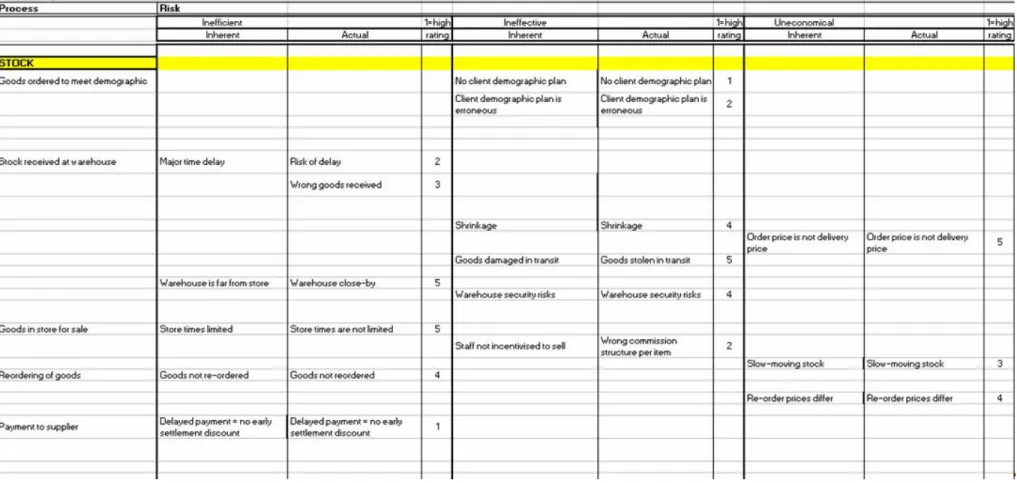
Table 9 Description of the proposed model 50
Table 10 The proposed performance audit model 54
Table 11 Objective and risk 58
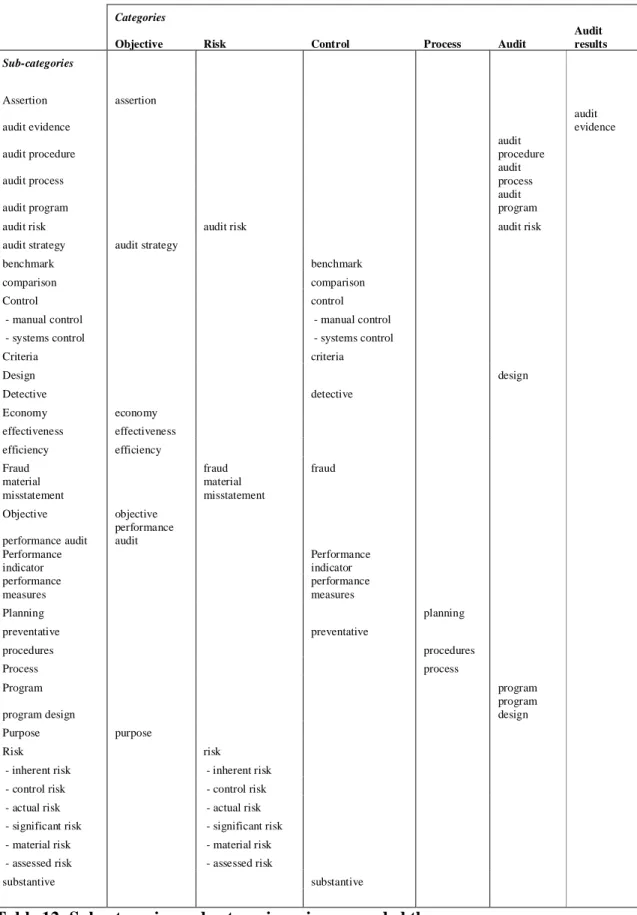
Table 12 Subcategories and categories using grounded theory 60 Table 13 SAICA process flow and the proposed methodology 65
Table 14 ISSAI Standards 69
Table 15 Research question 2, field-test 1 audit program 88 Table 16 Research question 2, field-test 1 audit program 89 Table 17 Research question 2, field-test 1 audit program 90 Table 18 Research question 2, field-test 1 audit program 91 Table 19 Research question 2, field-test 1 audit program 92 Table 20 Research question 2, field-test 1 audit program 93 Table 21 Research question 2, field-test 1 audit program 94 Table 22 Research question 2, field-test 1 audit program 95 Table 23 Research question 2, field-test 2 audit program 99 Table 24 Research question 2, field-test 2 audit program 100 Table 25 Research question 2, field-test 2 audit program 101 Table 26 Research question 2, field-test 2 audit program 102 Table 27 Research question 2, field-test 2 audit program 103 Table 28 Research question 2, field-test 2 audit program 104 Table 29 Research question 2, field-test 2 audit program 105 Table 30 Research question 2, field-test 2 audit program 106 Table 31 Research question 2, field-test 2 audit program 107 Table 32 Research question 2, field-test 2 audit program 108 Table 33 Research question 2, field-test 2 audit program 109 Table 34 Research question 2, field-test 2 audit program 110 Table 35 Research question 2, field-test 2 audit program 111 Table 36 Research question 2, field-test 2 audit program 112 Table 37 Example 1: audit concept and description 116
Table 38 Tabulation of hours 117
ABSTRACT
Performance audit as an audit discipline has developed seriously since the late 1970s. Due to its developing nature, it has been noted that it lacks formal methodologies. One such methodology is in the specific design of an audit program; this is important as the audit program is the basis of the audit. This study attempts to create a methodology of audit program design specifically for performance auditing and to present this in a model format. Grounded theory will be applied. The result indicates a methodology and model specific for performance audit can be compiled. The methodology and model were evaluated against SAICA and INTOSAI performance audit standards. In order to test the methodology and model in the external environment it was applied to an existing private sector business. No problems were identified.
The value of this research study contributes to the existing body of knowledge in that grounded theory was applied to develop a performance audit methodology specific to performance audit, the proposed methodology and model contributes to audit program design within performance audit, and in the evaluation of the methodology and model against SAICA and INTOSAI performance audit standards. Further research is required to confirm the applicability of the methodology and model in the private and public sectors.
Keywords
Performance audit; audit program; grounded theory; private sector; public sector; process; risk; control; risk-based auditing; efficiency; effectiveness; economy; inefficiency; ineffectiveness; uneconomical; INTOSAI
1 ORIENTATION
1.1 Introduction
Assessing risk is the core of the audit (Hayes, Dassen, Schilder and Wallage, 2005:23) and the audit program is the auditor’s plan of action (Dickinson, 1982:84). In a study by the US Securities and Exchange Commission (SEC) of audit engagements which received SEC enforcement actions from 1987 to 1997, 44% of cases reported deficiencies in audit planning (Beasely, Carcello and Hermanson, 2001:1).
Performance auditing within South Africa is applied within the public sector (Prinsloo and Roos, 2006:4) although attempts have been made to introduce it to the private sector (Loots, 1989:406). Performance audit is a nascent form of auditing that became distinctive in the later 1970s (Pollitt and Summa, 2002:1; Daujotaite and Macerinskiene, 2008:178) and is perceived to be without a prescribed list of performance audit methods (Lonsdale, 2002:146); an improvement in the methodology will contribute to the effective practice of performance auditing.
If one accepts that the development and use of the audit program forms an integral part of the audit but that a consistent, detailed methodology is lacking, then the implication is that the same audit, given various audit program methodologies, might not consistently and effectively address the audit mandate and the result may be a varied grouping of audit findings and possibly varied audit; this variability might not be to the benefit of the shareholder or decision-maker.
There is little guidance in the academic literature in terms of a detailed methodology for an audit program specific to performance auditing. Performance auditing is a recognised form of auditing and as such there is a need for research to contribute to the population of performance audit methodologies. An examination of various audit standards did not reveal a detailed performance audit audit methodology (refer Appendix 3).
1.3 Objective of the study
The objective of this study is to research a methodology and audit model that contributes to the effective design of an audit program applicable to performance auditing. The objectives are summarised as follows:
Objective 1
To compile a performance audit audit program methodology and model using grounded theory.
Objective 2
To determine whether the proposed methodology and model can be applied in practice.
1.4 Background to the research
Performance audit is a nascent audit discipline developed seriously since the late 1970s (Loots, 1989:1; Pollitt and Summa, 2002:1; Daujotaite and Macerinskiene, 2008:178). Largely due to its nascent nature it lacks formal methodologies (Lonsdale, 2002:146).
Performance audit is defined as the audit of economy, efficiency and effectiveness and embraces:
(b) audit of the efficiency of utilisation of human, financial and other resources, including examination of information systems, performance measures and monitoring arrangements, and procedures followed by audited entities for remedying identified deficiencies; and
(c) audit of the effectiveness of performance in relation to achievement of the objectiveness of the audited entity, and audit of the actual impact of activities compared with the intended impact.
(ISSAI 3000: Standards and guidelines for performance auditing)
Performance audit differs from financial auditing. Per the APA (Auditing Profession Act, Act 26, 2005: Ch1. s1) an audit is defined as the examination of, in accordance with prescribed or applicable auditing standards-
(a) financial statements with the objective of expressing an opinion as to their fairness or compliance with an identified financial reporting framework and any applicable statutory requirements; or
(b) financial and other information, prepared in accordance with suitable criteria, with the objective of expressing an opinion on the financial and other information.
Three notable differences between performance auditing and financial auditing (aka regularity auditing):
While financial auditing tends to apply relatively fixed standards, performance auditing is more flexible in its choice of subjects, audit objects, methods, and opinions.
Performance auditing is not a regular audit with formalised opinions, and it does not have its roots in private auditing.
the overall aim of performance auditing is to promote economy, efficiency and effectiveness.
(INTOSAI ISSAI 3000)
Performance audit is generally understood as to pertain to the public sector (Summa, 2002:18) but it is also practised in the private sector with descriptive titles such as operative audits, management audits, quality audits and
environmental audit (Summa 2002:19). Summa (2002:19) explains the primary difference as follows: performance audits are a part of the external control system operating on public organisations, and the private sector descriptions (as mentioned operative audits, management audits, quality audits and environmental audit) are internalised forms of corporate control.
Dittenhofer (2001:438) present the operation differences between the public and private sectors:
1. Performance criteria: The public sector uses performance measures such efficiency, effectiveness and economy but these are subjective criteria and are difficult to measure. The public sector uses customer satisfaction as a measure of performance, which is converted to profits.
2. Accessibility of government decision making to external influence: Government work is open to the public, to interest groups and to the media; it’s possible the public official may be responding to conflicting priorities and values. The private sector, except in director’s meetings, can operate in reasonable privacy.
3. Conflict between government policymakers and administration: Elected officials usually make the policy, which is carried out by the administration. These two groups have different goals and objectives, respond to different interests, and are rewarded for different functions.
4. The employment contract: Patronage and civil service systems in government reward employees for political activities or seniority rather than for efficiency and productivity.
5. Intense scrutiny by the media and public-interest groups: Since government resources come from the public’s taxes, the government is fair prey for the media and public-interest groups. Government officials therefore exert much time and effort in protecting themselves, which is counterproductive to innovation and risk taking.
6. Emphasis on stability and reliability: The emphasis in government is on reliability. Accountability, and legality rather than on maximum effectiveness and flexibility.
An audit program is important as it shows the auditor’s plan of action (Dickinson, 1982:84); meticulous preparation of the audit program is important in order to define the audit questions, the information needed, and the audit design (INTOSA ISSAI 3000:s.2.1). A search of the literature revealed no methodology to compile an audit program specific to performance auditing (refer Appendix 3).
This study attempts to compile a methodology and model for performance auditing. This will entail qualitative research using grounded theory.
Qualitative research is research that focuses on phenomena that occur in natural settings. Qualitative research is distinct from quantitative research, which is a method to answer questions among measured variables with the intent of explaining, predicting and controlling phenomena (Leedy & Ormrod 2005:133).
Within qualitative research, grounded theory will be applied. Grounded theory attempts to derive a methodology from data collected from a natural setting; this requires focusing on how elements act, interact and influence each other. The method entails three main steps:
1. A method of coding data into categories and identifying relationships 2. Continual reappraisal of data collection and data analysis
3. Construction of a methodology from the deduced categories and relationships
Grounded theory methodology and procedures are now among the most influential and widely used modes of carrying our qualitative research when generating theory is the researcher’s principal aim (Strauss & Corbin, 1997:vii).
Grounded theory will be applied since there does not appear to be an existing methodology for the compilation of a performance audit audit program.
The proposed methodology will be evaluated against the SAICA performance audit standards and INTOSAI’s performance audit standards.
Although Corbin & Strauss (2008:25) believe that qualitative studies are usually exploratory and more hypothesis generating than testing, the inclusion of field-tests in this research verifies the proposed methodology.
1.5 Importance of the study
The research problem arises from the following source:
Performance audit is a developing audit discipline and from the literature it is not evident a detailed audit program methodology and model for performance auditing exists.
1.6 Statement of the research problem
This study aims to create a methodology and model specific to performance auditing for the compilation of an audit program.
The research questions are presented as follows:
Research question 1
Can a performance audit audit program methodology and model be compiled using grounded theory?
Research question 2
Can the proposed methodology and model be applied in practice?
1.7 Delimitations and limitations
DelimitationsThe presented methodology is applicable specifically to performance auditing.
1. To accept the proposed solution implies the model is effective as an acceptable risk-identification and audit program methodology, but it has not been practically determined that this is applicable for all performance audits across all business sectors.
2. Appendix 2 shows a population of various audit assignments and where the proposed model can be applied.
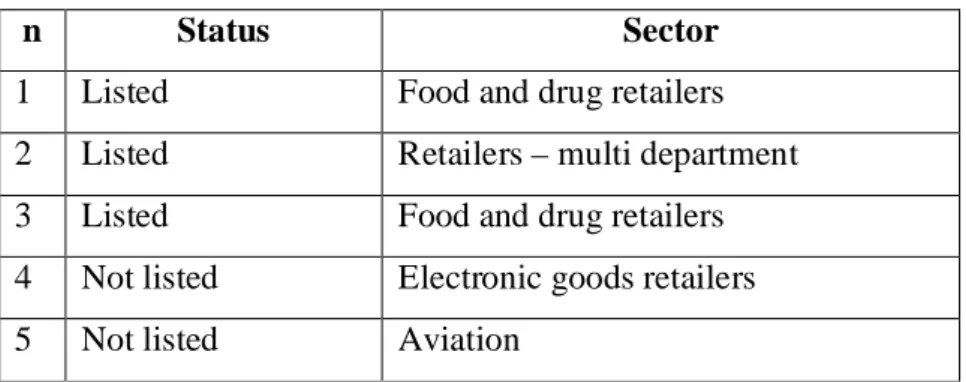
3. Five private sector firms were approached to participate in the second research question, i.e. to test the performance audit proposed methodology and model in a practical environment. Only two accepted. The reason the others declined to participate is due to confidentiality concerns, even though a confidentiality agreement was attached to the request. In addition, performance audit is not well-known in the private sector.
Of the five companies, three are listed. All have multi-million-rand annual turnovers. This is presented in the following table.
n Status Sector
1 Listed Food and drug retailers 2 Listed Retailers – multi department 3 Listed Food and drug retailers 4 Not listed Electronic goods retailers
5 Not listed Aviation
Table 1: Summary of private sectors companies approached
The presented methodology and model was also presented to the Auditor General (AGSA). AGSA has a policy that prevented it from presenting a statement agreeing with or endorsing the proposed methodology and model, and did not allow for testing of the proposed methodology and model against completed AGSA audits.
1. Performance audit is an established and recognised form of auditing. 2. Risk identification is a key step in the design of an audit program. 3. The audit program is the cornerstone of the audit.
4. At the point of putting data into the proposed model the auditor – 4.1 has received a mandate from the client to engage in a performance audit, 4.2 has familiarised himself with the goals and major projects of the
organisation,
4.3 has performed a risk analysis of the entity being audited, 4.4 has evaluated budget and actual outcomes,
4.5 has completed preliminary audit procedures, such as ratio analysis,
4.6 has obtained process flows, benchmark figures and key performance indicators,
4.7 has established audit materiality.
1.9 Significance of the study
If the results of this study show that there is a methodology contributing to an audit program specifically used for performance auditing that
1. does show a relationship between process, risk, control and audit program design,
2. does produce an effective audit program that can be applied to a performance audit
then the significance is as follows:
Internal and external to the corporation
1. The proposed model collates key planning information for the audit on a single page.
2. The proposed model can be applied by the internal audit function, both in the public and private sector, in the compilation of an effective audit program.
3. The proposed model can be applied by the external audit function to audits both in the public and private sector, in the compilation of an effective audit program.
4. An effective audit program methodology reduces the probability that an auditor will not be aware of key risks affecting the audit entity.
5. The proposed model facilitates an independent reviewer in determining how the audit program was designed, what the key risks were and how these were addressed; and can easily verify the integrity of the presented relationship between process, risk, control and the audit program.
6. The proposed model gives greater assurance to company management and to the shareholder that the auditor has addressed the key risks pertinent to the business process/ project/ strategy.
In the economic environment
1. In applying the proposed methodology the risk and cost of repeatedly changing risk-identification and audit program methodologies will be removed.
2. The same methodology applied to multiple audit teams reduces audit plan design time, supervisor review time and aligns risks shared between multiple audits.
3. With the pending exemption option of statutory audits for private companies within South Africa, performance audits will add value to private companies not receiving statutory audits.
1.10 Structure of the remainder of the research report
Literature review
The literature review has two main sections: performance auditing and grounded theory. The sections include: definition of performance auditing, development of performance auditing, the benefits of performance auditing, the challenges facing
performance auditing, expectation gap, risk-based auditing, the audit program, grounded theory.
The literature provides the rationale for this study.
Models
Various audit program models are presented.
Research methodology
The research methodology presents the methodology used. Issues relating to the validity and reliability of the research are discussed.
Presentation and discussion of results
The results of each research question are presented and discussed, as are shortcomings within the study
Summary, Conclusion and Recommendations
A summary of the study, research question and their results is presented. The conclusion of the study is presented.
2 LITERATURE REVIEW
The literature review is divided into the following sections: 2.1 Existing studies on performance auditing
2.2 Risk-based auditing 2.3 The audit program 2.4 Grounded theory
2.1 Existing studies on performance auditing
2.1.1 Definition of performance auditing
There are various synonyms for performance auditing, such as broad scope auditing, cost-effectiveness auditing, efficiency auditing, operational auditing, project auditing, and VFM (value for money) auditing (Funnell, 1998:446) as well as administration auditing, comprehensive auditing, efficiency and effectiveness auditing, integrated auditing and management auditing (Burrowes & Perrson, 2000:91). Prinsloo and Roos (2006:3) offer the synonyms value-for-money audit and operational audit.
Summa (2002:19) distinguishes audit variants as follows: Operative audits, management audits, quality audits and environmental audits are used mainly in the private sector, and these are internalised forms of corporate control. Conversely, performance audits and value-for-money audits form part of an external control system operating on public organisations.
Vinten (1996, recorded in Burrowes & Persson, 2000:92) does not see management audit as a synonym for operational auditing; management audit is an all-embracing term which contains both operational audit and financial audit as segments. Funnell (1998:448) describes an earlier term for an all-embracing audit
methodology that encompasses traditional regularity or financial audits with efficiency audits; that term is ‘comprehensive auditing’. Ironically, already in 1986 the International Congress of Supreme Audit Institutions selected the term ‘performance audit’ as the common future term to be applied to audits examining economy, efficiency and effectiveness of operations (Hatherly & Parker, 1988:21).
To Faucett and Kleiner (1994:66) there are two types of performance audit: economy and efficiency audits, and programme audits. The first type is more common, focusing on the acquisition and application of resources, determining the cause of inefficient or uneconomical practices, and testing for compliance with laws and regulations concerning economic and efficient operations. The second type focuses on actual outputs compared to intended outputs. Furthermore, both these audit types are public enterprise audits.
Barzelay (1996:22) lists five types of performance audits: efficiency audits, program effectiveness audits, performance management capacity audits, performance information audits, and best practice reviews.
Scott (1996:213) defines a performance audit in Australia as an independent, objective and systematic examination of the management and administration of an organization, programme or function for the purposes of:
- forming an opinion on
a) whether the organisation, programme or function is being managed in an economic, efficient and effective manner; and
b) the adequacy of internal procedures, for promoting and monitoring economy, efficiency and effectiveness; and
- suggesting ways by which management practices, including procedures for monitoring performances, might be improved.
Another approach presented by Hepworth (1996:261) is to define performance auditing by focussing on the output: Let performance auditing be the term that gives the public assurance that resources are properly used, on a properly
approved basis, and used in an appropriate way and in an efficient and effective manner.
Performance auditing may contain two main objectives: mentioned above, one of Faucett and Kleiner’s (1994:66) performance audit types is economy and efficiency audits. According the Netherlands Budget and Accounting Act, article 57 (BAA, 1991) performance auditing includes
Auditing the effectiveness and efficiency of management, which includes all possible aspects of the internal management,
Auditing the effectiveness and efficiency of the organisation’s departments, Auditing the effectiveness and efficiency of implemented policies.
Performance auditing may contain three main objectives, e.g. Prinsloo and Roos (2006:4) define public accountability to mean that those individuals responsible for government programs are held responsible for the economic, efficient and effective responsibilities of these programs.
From the above contributors it is apparent there are various synonyms for performance audit, and these synonyms have various placements, e.g. some in the private sector, some in the public sector. There are also different types of performance audit, and a difference in the number of main objectives. This observation is iterated by Shannd & Anand (1996:60) who warn that performance auditing itself covers a range of approaches in terms of scope, methodology and form of reporting, further supported by Sloan (1996:146) who warns that in practice many performance audits are less than clear on matters of methodology, evaluative criteria and development of recommendations.
For the purposes of this research paper the following definition of performance auditing will be used: The South African Institute of Chartered Accountants (SAICA) defines performance audit as ‘an independent auditing process aimed at evaluating the measures instituted by management, or the lack of these measures; ensuring that resources have been acquired economically and are utilised efficiently and effectively; and reporting on the acquisition and use of resources to
management or the relevant authority’ (SAICA Guide on performance audit in the public sector, 2006).
2.1.2 The development of performance auditing
In historical terms, performance auditing is a relatively new procedure (Pollitt & Summa, 2002:1; Loots 1989:1). This can also be deduced from the various terms given in the previous section to performance auditing by Funnell (1998) and Burrowes and Perrson (2000).
Although performance auditing is a relatively new procedure, Flesher, Samson and Previts (2003:375) present arguments that the concept of VFM (value for money) auditing has been used selectively in history, presenting examples of English governmental users as early as 1180 and 1662, and that even earlier use is reported by Roman authors such as Aristophanes, Caesar and Cicero. In more recent times the VFM auditing method was used in the management of the Baltimore and Ohio railroad in 1827, where the Baltimore and Ohio railroad audit committee served not only as a mechanism to safeguard assets but made operational and organizational recommendations to improve the management and financial performance of the railroad.
Zavelberg (1996:201) reports that as early as 1922 in Germany the Reich Budget Code imposed the obligation to audit the Reich revenue and manage the Reich expenditure in compliance with the demands of efficiency.
Although there is mention of performance audit in history, the main thrust of development started in the mid 1970s (Loots, 1989:1) and it is generally accepted that performance audit is still a developing field.
2.1.3 The benefits of performance auditing
Leeuw (1996:92) presents the argument that public sector auditing leads to improved efficient and effective performance of the public sector. According to
Leeuw (1996:93) performance auditing makes it possible to distinguish ambitions and intentions from realisations. Funnell (1998:440) holds that performance auditing can be more potent than regularity or financial auditing as it is a highly intrusive form of auditing. He also points out that performance audit also shifts the focus of specific accountability to higher management levels by questioning higher-level skills, not accounting prowess.
According to Trodden (1996:157) performance measurement determines whether goals are not being achieved, and performance auditing in turn offers a way of identifying and correcting the root cause for not achieving goals. Furthermore, performance auditing allows for identifying successful processes and adopting these in other areas of the organisation.
To Prinsloo and Roos (2006:4) one of the most important reasons for performance auditing is to enable the government to show that public accountability responsibilities have been fulfilled, which means that those who are in change of government responsibilities are held responsible for the economic, efficient and effective running of these programs.
Sloan (1996:141) identifies the beneficiaries of the performance audit: apart from the government institutions these are the media, academia and professional bodies. He additionally notes that the measurement of performance will have to reflect several different perspectives if it is to fulfil the expectations of multiple stakeholders.
2.1.4 The audit expectation gap and performance auditing
Fadzly and Ahmad (2004:897) explain the audit expectation gap as the difference between auditors’ and users’ expectation of the audit function. To Humphrey, Mozier and Turley (1993, recorded in Fadzly & Ahmad, 2004:900) the general understanding of the term ‘audit expectation gap’ is one of differing expectations of the functions of independent audit between the auditors and the public, namely, the users of the financial statements. Evans (2004:191) defines ‘performance gap’
as the difference between the business outcomes one expects and the hard reality of what one gets.
In a study conducted by Fadzly and Ahmad (2004:897), the users of financial statements were designated as brokers, bankers and investors. The criteria used to determine if there was an audit expectation gap in Malaysia comprised seventeen statements divided into two groups: responsibility statements (fifteen statements) and decision-usefulness statements (three statements). Within the decision-useful statements the focus was on the use of audited financial statements in decision making, performance monitoring and the assessment of how well the entity was managed. Statement 15 reads: ‘The audited financial statements are useful in monitoring the company’s performance.’ The survey result for this specific question identified that the perception between the auditor and the broker, banker and investor differed significantly, indicating an expectation gap.
The overall study identified substantial expectation gaps about audits in Malaysia (Fadzly & Ahmad 2004:911). Since a part of the study included a focus on performance monitoring and results showed this to be lacking , it follows that the audit of said performance is part of the expectation gap.
A similar study was performed by Best, Buckby & Tan (2001:134) researching the audit expectation gap in Singapore, claiming an audit expectation gaps exists (Best, Buckby & Tan (2001:138).
Within the South African context, Loots’ (1989) doctoral thesis ‘An evaluation of the applicability of comprehensive auditing in the South African context’ is generally accepted as the introduction of performance audit within South Africa. Loots is generally recognised as the father of performance audit within the South African context (Prinsloo and Roos, 2006:v). In his thesis, Loots’ formulation of the initial problem recognised a significant movement since the mid-1970s in various countries towards the comprehensive audit approach, and raised the question whether in the South African context the auditor’s traditional attest function could expand to the comprehensive audit approach, i.e. to also report on
the economic acquisition and the efficient and effective deployment of resources. His research concluded in the affirmative.
O’Leary (1996:16) considers performance auditing as one of the ways to close this expectation gap in that performance audits, whereby independent bodies review and comment on how efficiently, effectively and economically management have utilized an entity’s resources, and so would appear to be an ideal means for alleviating third parties’ fears of an entity collapsing.
To sum, an audit expectation gap is the difference between auditors’ and users’ expectation of the audit function. This is amplified and identified in Fadzly and Ahmad’s (2004) study. Loots (1989) and O’Leary (1996) have identified performance audit as a means of closing the audit expectation gap.
2.1.5 The challenges facing performance auditing
The following challenges face performance auditing:
Given an environment focussed on performance measures further subject to a performance audit, it’s possible that an excessively rigid system of measurement can lead to organisational paralysis, which Smith (1995, recorded in Leeuw 1996:95) refers to as ‘ossification’. He adds another risk: tunnel vision, which refers to an emphasis on phenomena that are quantified by performance measurements at the expense of unquantified aspects of performance.
Meyer and O’Shaughnessy (1993, recorded in Leeuw 1996:99) coined the concept ‘performance paradox’ based on their work in the private sector. Through the implementation of excessive performance measures the result is a simultaneous proliferation and non-correlation of the same performance measures; the resultant effect is not necessarily an effective organisation.
Funnell (1998:444) raises a demand and risk associated with performance auditing: the full potential of the audit depends entirely on the auditors receiving
full information. This means the audited department has to have the requisite information in order to present it for audit, and may also prevent key information from reaching the auditors. Mimba, van Helden and Tillema (2007:192) argue that public sector organisations in developing countries are likely to face an unbalanced position between the demand for and supply of performance information. To be specific, the public sector reforms, which in part are stimulated by an increasing involvement by stakeholders, leads to an increased demand for performance information but because of the low-institutional capacity and high level of corruption the supply of sufficient performance information is compromised.
Halachmi and Bouckaert (1994:19) present an argument to do with the complexity of the organization – it may become more difficult to define what the input and output are, as well as type of input, e.g. capital, labour, management, hardware, software.
Shand and Anand (1996:67) raise the risk that performance auditors may be too judgemental by judging performance against standards which are unrealistic or criteria that are not significant in terms of improving performance. They also raise the criticism that audit reporting tends to be on an exception basis, which does not give a balanced view of performance, implying that a fault-finding approach is contrary to constructive suggestions to improve performance.
Sloan (1996:144) raises the concern that there are no well-defined performance audit professional bodies empowered to monitor the conduct of performance audit professionals.
A serious challenge is to determine the extent of the audit focus. Barzelay (1996:30) raises the question whether the principal goal of performance audit is performance improvement or performance accountability. The decision will affect the methodology. A key issue to Shand & Anand (1996:71) is the reappraisal of the role of performance auditor – to what extent the auditor should be involved in
‘hands on’ assistance to improve performance rather than the more detached approach previously considered necessary to preserve audit independence.
Sandberg and Larsson (1996:197) argue that the auditor as an independent teller of truth presents an audit that has a ‘moral’ responsibility for ensuring that action is taken to solve problems. Highlighting shortcomings is not sufficient; problem solving makes the audit a constructive catalyst for change without risking its independence. This critique is echoed by PUMA (1995:12) who warns of the narrow-minded approach of auditors who follow a fault-finding approach implying that the focus by auditors on procedures may be too limited to allow for performance improvement.
In a similar argument, Trodden (1996:159) calls for a rethink of the methodology and purpose of performance auditing with the goal of producing reports that focus on proposing alternatives for improvement, as opposed to focusing on what is wrong with existing systems.
2.2 Risk-based auditing
Puttick and Van Esch (1992:59) present four audit approaches: The balance sheet approach
The systems based approach
The transaction flow or cycle approach The risk-based audit approach
The risk-based approach requires an understanding of risks within an organization/ audit that are in turn addressed by systems of internal control; the converse approach would be to identify a set of controls and then determine if these are applied throughout the organization (Spencer Picket 2003: 12).
Puttick and Van Esch (2007:194) present two models for risk identification, traditional, and the business risk analysis approach.
With the traditional approach the auditor would first identify both internal and external factors that could result in material errors occurring at an overall financial statement level; after this process these factors would be related to their potential impact, at an assertion level, in respect of balances or classes of transactions contained in the financial statements. Example of assertions are existence, valuation, completeness.
The business risk analysis approach requires obtaining the business processes, to consider the risks attached to these processes, and to determine how these risks are identified and managed by the directors and management of the entity.
Puttick and van Esch (2007:195) list the benefits of the business risk analysis approach:
1. There is a perception by the client that the recommendations obtained through this approach adds value.
2. An effective and efficient audit process with better risk management. 3. It improves the work-flow timing, resulting in few problems with meeting
audit report deadlines.
4. The auditor’s focus on business and control issues leads to greater staff satisfaction within the audit firm.
According to Hayes et al (2005:23) business risk results from significant conditions, events, circumstances, actions and inactions that may impede the company’s ability to execute its strategies; furthermore, auditors are required to include business risks in the planning process. They conclude that assessing risk is the core of the audit.
To sum, given multiple audit approaches, this study applies the risk-based approach to auditing. In paragraph 1.8 ‘Assumptions’ the following two assumptions are presented:
By identifying the term ‘audit program’ as a common denominator in the above two assumptions, and then removing the term, what remains is that risk-identification becomes the cornerstone of the audit, which correlates with Hayes et al (2005:23) who state that assessing risk is the core of the audit.
2.3 The purpose of an audit program
According to Mautz (1964:170) the audit program fulfils two purposes: it serves as a plan of attack on the verification problem at hand; it also serves as a record for the audit work performed.
To Cooper (1974:33) the benefits of an audit program are:
1. It’s a detailed plan of work to be done; once done it’s a permanent record of the tests carried out and by whom.
2. By cross-referencing the audit program to the internal control questionnaire, evidence is presented that the audit program addresses the company’s systems of accounting and internal control.
3. It enables work to be organized, delegated and controlled.
4. The current audit program can be used as a basis for drawing up future audit programs.
According to Dickinson (1982:84) the audit program is the auditor’s plan of action, further noting that each audit program should be designed to meet the specific needs of each particular audit.
Advantages of an audit program according to Dickinson (1982:85) include: 1. It facilitates the review by the audit manager and partner.
2. It emphasizes the essential and important procedures for each client.
Per ISA 300.12 the audior shall include in the audit documentation (a) the overall audit strategy,
http://web.ifac.org/download/a016-2010-iaasb-handbook-isa-300.pdf
To sum, the audit program serves many purposes and a reasonable deduction would be that an audit cannot proceed without an audit program. The audit program is a fundamental focus of this study and the objective of this study is to research a methodology and audit model that contributes to the effective design of an audit program applicable to performance auditing.
2.4 Grounded theory
Grounded theory is a systematic theory used in research in the social sciences
emphasising theory generation from data.
http://en.wikipedia.org/wiki/Grounded_theory . Put otherwise, the procedures of grounded theory intend to develop an integrated set of concepts that provide a thorough theoretical explanation of the social phenomenon under study (Corbin and Strauss, 1990:5). Grounded theory was developed by sociologists Barney Glaser and Anselm Strauss in 1967.
Grounded theory is mainly used in qualitative research, which is to say a focus on phenomena that occur in natural settings, and it involves studying said phenomena in all their complexity (Leedy and Ormrod, 2005:133).
Grounded theory differs from normal theory in that traditional research begins at researching and developing a hypothesis. With grounded theory the first step is data collection, then the key points are marked with a series of codes, which are extracted from the text, then the codes are grouped into similar concepts in order to make them more workable. From these concepts, categories are formed; these categories are the basis for the creation of a theory, or a reverse engineered hypothesis. http://en.wikipedia.org/wiki/Grounded_theory
The specific approach of data analysis to be undertaken is that proposed by Corbin and Strauss (1990:12) to analyze data, namely:
1. Open coding: to divide data into segments and then scrutinize for commonalities reflecting categories or themes. The purpose is to give the analyst new insights by breaking through standard ways of thinking about interpreting phenomena reflected in the data. The method includes asking of any data ‘What is this about? What is the being referenced here?’ in order to identify, name, categorize and describe the phenomenon within the text.
2. Axial coding: Interconnections are made among categories and subcategories via a process of inductive and deductive thinking.
3. Selective coding: The interrelationships of categories are combined to create a sense of order and meaning, usually around a core category. 4. Theory development.
The benefits of grounded theory as an approach is that the theory is grounded in the data (Corbin and Strauss, 2008:48); as a result a theory cannot be refuted by more data or replaced by another theory as it is too intimately associated with the data; however, it can happen the theory is modified or reformulated. Put otherwise, theory evolves from data, i.e. it is not developed a priori and then tested (Lye, Perera & Rahman, 2006:129).
Grounded theory is not restricted to the social sciences but has also been applied to in accounting and auditing: Gurd (2008:122) revisited the intellectual roots of grounded theory by analyzing the method used in grounded theory research in accounting. About 23 papers were identified and analysed. A finding was that some accounting researchers used the label ‘grounded theory’ but misunderstood or did not apply the core canons of grounded theory established by Glaser and Strauss. The benefit of Gurd’s paper is that it raises concerns about the lack of consistency of grounded theory research in accounting with the central canons of grounded theory. It also provides some directions for future grounded theory research by encouraging accounting researchers who wish to use grounded theory to engage more strongly in understanding the method and providing transparent explanations of their data collection and analysis methods.
Elharidy, Nicholson and Scapens (2008:139) assessed the role of grounded theory in interpretive management accounting research (IMAR) to establish whether interpretive researchers could use grounded theory in relation to their ontological stance, methodological position and research methods, and if so, how. Their paper suggests that grounded theory offers a balance between the expediency of the research findings (thus allowing researchers freedom to interpret management accounting practices), and the development of rigorous theory from IMAR. The benefit of this research shows grounded theory interpretive researchers a way of balancing the need to develop theory, which is grounded in everyday practices.
Parker and Roffey (1997:212) restated the case for accounting and management research from a grounded theory perspective, and advocated more frequent application of grounded theory. They examined the intellectual foundations and key tenets of grounded theory in the context of researchers’ theoretical assumptions and methodological characteristics. Particular attention was given to grounded theory assumptions and methods in relation to other interpretive paradigms such as symbolic interactionism, ethnomethodology and hermeneutics. Their research presented potential applications to the accounting and management research arenas, arguing that rigorous grounded theory research could offer the accounting and management literatures unique understandings that provide additional perspectives to those already being offered by major schools of thought.
Although grounded theory is a descriptive term, there is debate about what constitutes theory. Charmaz (2006:176) presents four general types of theory: Positivist definition of theory, interpretive definition of theory, constructivist grounded theory, and objectivist grounded theory.
Positivist definition of theory
A positivist theory is a statement of relationships between abstract concepts that cover a wide range of empirical observations. The objective of the positivist
theory is explanation and prediction. A critique against this type of theory is that it can result in redutionaist explanations with simplistic models of action.
Interpretive definition of theory
Distinctly different from the positivist idea of explanation and prediction, the interpretive definition of theory emphasises understanding. The main difference is that interpretive theories show priority to showing patterns and connections, rather than linear reasoning.
The following table contrasts positive theory with interpretive theory:
Positivist theory Interpretive theory
Treat concepts as variables
Specify relationships between variables
Explain and predict these variables Systematize knowledge
Verify theoretical relationships through hypothesis testing
Generate hypotheses for research
Conceptualize the studied phenomenon to understand it in abstract terms
Articulate theoretical claims pertaining to scope, depth, power, and relevance
Acknowledge subjectivity in theorizing and hence the role of negotiation, dialogue, and understanding
Offer an imaginative interpretation
Table 2 – Positivist and interpretive theory
(Source: Charmaz, 2006:181)
Constructivist grounded theory
Constructivist grounded theory is part of the interpretive tradition. It places priority on phenomena and sees both data and analysis as created from shared experiences. A constructivist approach is much more than examining how
individuals view their situations – constructivists study how and why participants construct meaning and actions in specific situations.
Objectivist grounded theory
Objectivist grounded theory is derived from the positivist tradition. This approach erases the social context from which data emerges, there is no indication how interviewers and their research participants produced data; objectivist grounded theorists remain distant from research participants and their realities. There is an assumption by these theorists that data represents objective facts about a knowable world, the data already exists in the world and the research finds the data and ‘discovers’ theory from them.
Charmaz (2006:191) makes the point that in judging whether a specific study is constructivist or objectivist, it depends on the extent to which the key characteristics conform to one tradition or the other.
2.5 Summary
The purpose of a literature review is to describe theoretical perspectives and previous research findings regarding the problem at hand (Leedy & Ormrod, 2005:64). The problem at hand with performance auditing (first and generally) lies in a few places: the consistency within the definition, as raised by, inter alia, Funnell (1998), Burrows and Persson (2000), Summa (2002), Vinten (1996); in terms of the types of performance audit Faucett and Kleiner (1994:66) present 2 types, Barzelay (1996:22) lists 5 types. Perhaps this can be expected from a nascent discipline. There are benefits to performance auditing, as presented by Leeuw (1996:92), Trodden (1996:157) and Sloan (1996:142) which indicate that performance audit is worth pursuing and refining. That performance audit might close the audit expectation gap is notable.
There are also challenges, such as ossification (Smith 1995), performance paradox (Meyer and O’Shaughnessy, 1993), transparency and sufficiency of information (Mimba, van Helden and Tillema (2007), and exception-based reporting that does not improve performance (Shand and Anand, 1996:67).
Another problem with performance audit (second and specifically) is the nature of performance audit which is seen as a nascent form of auditing that became distinctive in the later 1970s (Pollitt and Summa, 2002:1; Daujotaite and Macerinskiene, 2008:178) and is perceived to be without a prescribed list of performance audit methods (Lonsdale, 2002:146). As stated earlier, the objective of this paper is to research a methodology and audit model that contributes to the effective design of an audit program applicable to performance auditing. How? By applying grounded theory to find a solution, for the primary reason that through the open coding process new insights might be created by breaking through standard ways of thinking about interpreting phenomena reflected in the data (Corbin & Strauss, 1990:12).
Even if grounded theory was applied, there needs to be a starting point. Given the four types of audit as listed by Puttick and Van Esch (1992), risk-based auditing is chosen. The presentation of the section on the audit program showed many interpretations of its benefit and purpose (Mautz 1964; Skousen and Jenson, 2001; Cooper,1974; Dickinson, 1982). It is clear an audit cannot proceed without an audit program.
Charmaz (2006:176) expounded on the types of theory.
The literature review, as defined by Leedy & Ormrod (2005:64), describes theoretical perspectives of the problem at hand, what is presented here is the background to performance audit and the concepts that are important in attempting to address the objective of this study.
3. AUDIT MODELS
The purpose of this chapter is to present various financial audit approaches as well as performance audit processes in order to present various audit concepts (e.g. existing control, test of control, weakness) and their relation to each other. In the grounded theory evaluation of data these relationships will be considered.
Introduction
This chapter serves to present various financial audit approaches as well as performance audit processes in order to present various audit concepts (e.g. existing control, test of control, weakness) and their relation to each other. In the chapter evaluating the results of the research questions grounded theory evaluation of data and these relationships will be considered.
Three financial audit models are presented: Arens and Loebecke (1994), Cosserat (2000) and Sawyer, Dittenhofer and Scheiner (2005).
Arens and Loebbecke
Arens and Loebbecke (1994:368) present a methodology for audit program design in which the relationship between (A1) the transaction-related audit objective is linked with (A2) the key existing control. The next step, (A3) is the test of this key existing control; (A4) a weakness is presented and (A5) is the substantive test to address this weakness.
Audit objective (A1) Existing control (A2) Test of control (A3) Weakness (A4) Substantive test (A5) Existing sales transactions are recorded. (Completeness
Bills of lading are accounted for weekly by the accountant to Account for a sequence of shipping documents. Lack of internal verification that sales invoices are included in Trace selected shipping documents to the sales journal to be
Table 3: Arens & Loebbecke (1994) audit table
Source: Arens & Loebecke (1994:368)
Example,
(A1) Existing sales transactions are recorded. (Completeness objective)
(A2) Bills of lading are accounted for weekly by the accountant to make sure they are billed.
(A3) Account for a sequence of shipping documents.
(A4) Lack of internal verification that sales invoices are included in the sales journal.
(A5) Trace selected shipping documents to the sales journal to be sure that each one has been included.
Cosserat
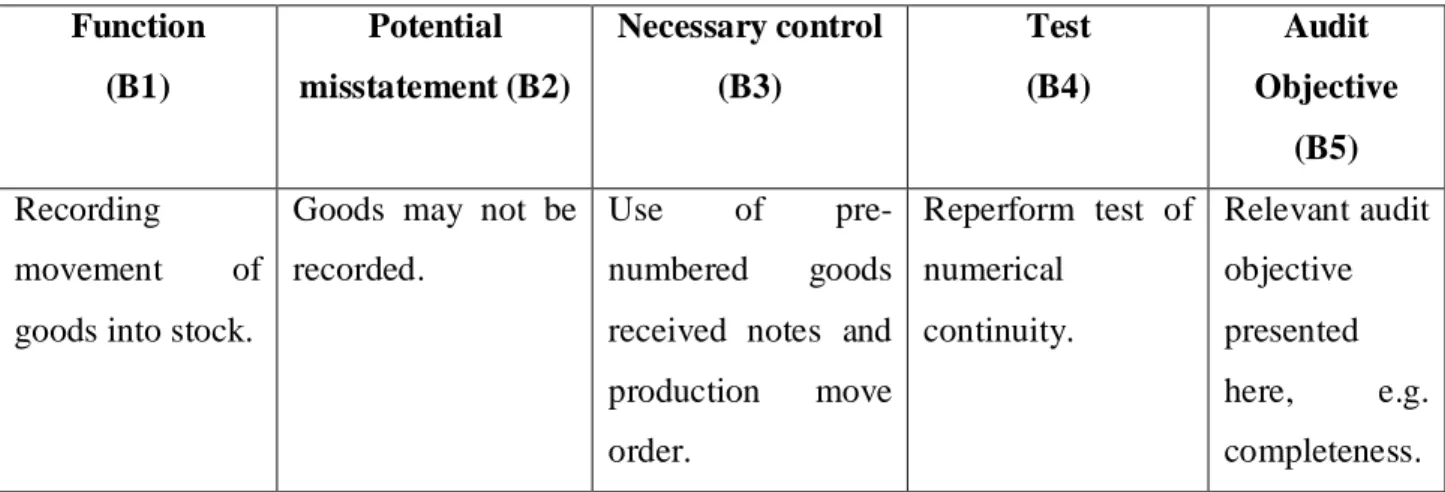
Cosserat (2000:489) presents a control risk assessment table in which the columns read (B1) function, (B2) potential misstatement, (B3) necessary control, (B4) possible test of operating effectiveness, (B5) relevant audit objective. This model is notable in that the function, risk and control are linked to the audit objective. In each of the models there is a columnar and developing relationship between the audit concepts. Function (B1) Potential misstatement (B2) Necessary control (B3) Test (B4) Audit Objective (B5) Recording movement of goods into stock.
Goods may not be recorded.
Use of pre-numbered goods received notes and production move order. Reperform test of numerical continuity. Relevant audit objective presented here, e.g. completeness.
Table 4: Cosserat (2000) audit table
objective) make sure they are billed.
the sales
journal.
sure that each one has been included.
Source: Cosserat (2000:489)
Example,
(B1) Recording movement of goods into stock. (B2) Goods may not be recorded.
(B3) Use of pre-numbered goods received notes and production move order. (B4) Reperform test of numerical continuity.
(B5) Relevant audit objective presented here, e.g. completeness.
Sawyer, Dittenhofer and Scheiner
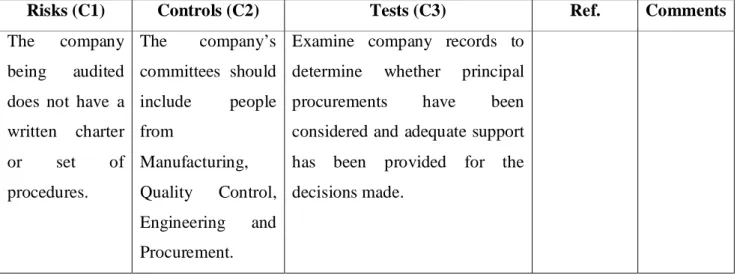
Sawyer, Dittenhofer and Scheiner (2005:233) presents an approach for audit program design in which (C1) risks pertaining to the business are presented, followed by (C2) controls that should be in place. The third column (C3) contains the audit tests. The logic is that the risk is followed by the control, and the audit tests the existence, effectiveness and sufficiency of the actual control.
Risks (C1) Controls (C2) Tests (C3) Ref. Comments
The company being audited does not have a written charter or set of procedures. The company’s committees should include people from Manufacturing, Quality Control, Engineering and Procurement.
Examine company records to determine whether principal procurements have been considered and adequate support has been provided for the decisions made.
Table 5: Sawyer, Dittenhofer and Scheiner (2005) audit table
Source: Sawyer, Dittenhofer and Scheiner (2005:233)
Example,
(C1) The company being audited does not have a written charter or set of procedures.
(C2) The company’s committees should include people from Manufacturing, Quality Control, Engineering and Procurement.
(C3) Examine company records to determine whether principal procurements have been considered and adequate support has been provided for the decisions made.
Discussion
On comparing the three models to create an audit program, some differences are noted, such as
Arens and Loebecke present the existing control, Cosserat presents the necessary control.
Arens and Loebecke present weakness, Cosserat presents the potential misstatement.
Arens and Loebecke present the objective first, Cosserat presents the objective last.
The ordering of the columns and the assumed relationships between them, e.g. Sawyer, Dittenhofer and Scheiner present the risk, the corresponding control and the consequent appropriate test. Arens and Loebecke present the existing control, the test of the control, then the weakness, then the substantive test.
These observations will have bearing in the design of the proposed methodology using grounded theory.
Performance auditing
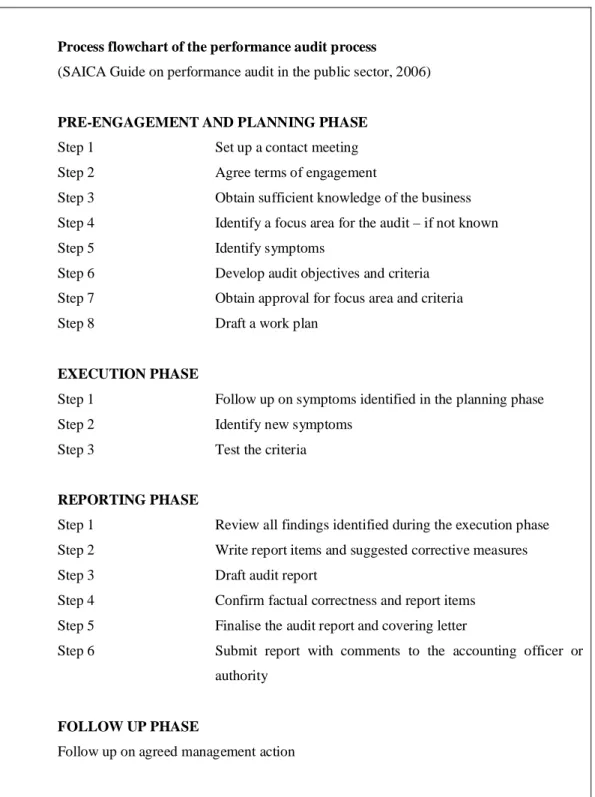
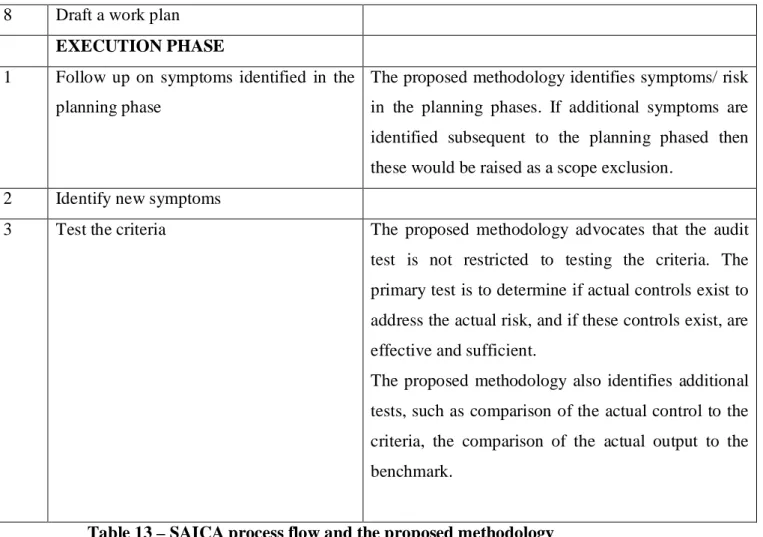
These above three models are applied to regularity or financial auditing. Within performance audit, the South African Institute of Chartered Accountants (SAICA) ‘Guide on performance audit in South Africa’ (2006) present a process flowchart of the performance audit process. The flowchart is presented below.
Process flowchart of the performance audit process
(SAICA Guide on performance audit in the public sector, 2006)
PRE-ENGAGEMENT AND PLANNING PHASE
Step 1 Set up a contact meeting Step 2 Agree terms of engagement
Step 3 Obtain sufficient knowledge of the business Step 4 Identify a focus area for the audit – if not known Step 5 Identify symptoms
Step 6 Develop audit objectives and criteria Step 7 Obtain approval for focus area and criteria Step 8 Draft a work plan
EXECUTION PHASE
Step 1 Follow up on symptoms identified in the planning phase Step 2 Identify new symptoms
Step 3 Test the criteria
REPORTING PHASE
Step 1 Review all findings identified during the execution phase Step 2 Write report items and suggested corrective measures Step 3 Draft audit report
Step 4 Confirm factual correctness and report items Step 5 Finalise the audit report and covering letter
Step 6 Submit report with comments to the accounting officer or authority
FOLLOW UP PHASE
Follow up on agreed management action
Table 6 Process flowchart of the performance audit process
(Source: SAICA Guide on performance audit in the public sector, 2006)
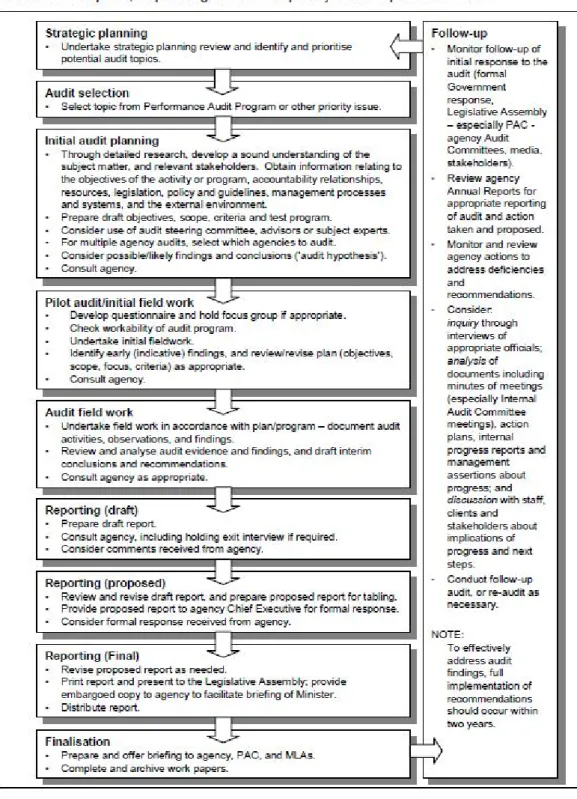
As a comparison to this flowchart, an Australian auditor general flowchart is presented:
ACT (Australian Capital territory) auditor general’s office: performance audit stages
Table 7: ACT performance audit stages
The main similarity between the performance audit process flows is the planning, fieldwork, reporting structure. This process is consistent with financial auditing.
The SAICA flowchart is divided into four main sections: pre-engagement and planning phase, execution phase, reporting phase, follow-up phase. The concepts presented in the pre-engagement and planning phase include:
a focus area, defined as a specific department, programme, activity, process, service rendered, management control system or organisational unit that has been identified for a performance audit (Prinsloo and Roos, 2006:28)
symptoms, defined as the uneconomical procurement of resources, and/or the inefficiency or ineffective utilisation of resources (Prinsloo and Roos 2006:29)
management measures (i.e. controls) cause of risk
effect, defined as a negative impact (Prinsloo and Roos, 2006:41) audit objectives
criteria, defined as sound management practices that should be in place if certain predetermined outputs and objectives/ outcomes are to be met economically, efficiently and effectively (Prinsloo and Roos, 2006:47) (Appendix 1 contains a glossary of terms)
The SAICA guidelines contain the following steps in compiling an audit program:
1. The auditor should obtain sufficient knowledge of the business (s.24.d). 2. The auditor identifies a focus area for the audit by evaluating programs
and sub-programs within the general process. Furthermore, symptoms for each sub/ program are identified (where a symptom is defined as a visible manifestation of something that is wrong); example an uneconomical procurement of resources; example, the inefficient or ineffective utilisation of resources (s.24.e). Inadequate management measures causing these symptoms should be identified.
3. The compilation of a ‘criteria matrix’ whereby all symptoms are presented and placed into specific focus areas (s.24.e).
4. Develop the audit objectives and criteria (s.24.g).
The performance audit terminology varies from standard auditing but the intent is the same: symptoms are actual risks, management measures are actual controls; criteria are the controls that should be in place. Table 8 shows the differences between performance auditing and regularity auditing (Prinsloo and Roos, 2006:13).
Auditing component
Performance auditing Regularity auditing
Objective To evaluate the management measures instituted to ensure economy, efficiency and effectiveness
To assess whether accounts or financial statements are a true and fair reflection of the financial position of the institution
Focus Mainly programmes, projects, systems or activities
Accounts and financial statements
Audit criteria Usually more subjective and compiled by the auditor and agreed upon with the auditee
Represent good
management practice
May vary from audit to audit
Relatively fixed and usually predefined, e.g. by legislation
Transactions are judged to be regular or irregular
Compliance with prescripts and all types of legislation is tested
Academic requirements
Economics, political science, sociology, management science, auditing Accounting, auditing Skills and abilities required Analytical, communication, problem-solving, reading, writing, computer literacy, innovation, endurance
Analytical, communication, computer literacy
Table 8: Performance auditing and regularity auditing
Source: Prinsloo & Roos (2006:13)
An additional difference between performance and regularity audit is raised within INTOSAI’s ISSAI 3100 (Performance audit guidelines – key principles) on the subject of an overall audit opinion. Within performance audit the auditor is not normally expected to provide an overall opinion on the achievement of economy, efficiency and effectiveness by an audited entity in the same way as the opinion on financial statements; however, where the nature of the audit allows this to be done in relation to specific areas of an entity’s activities, the auditor is expected to provide a report which describes the circumstances and context to arrive at a specific conclusion rather than a standardised statement (ISSAI 3100, s.2.4.2.29.)
Conclusion
The purpose of this chapter is to present various financial audit approaches as well as performance audit processes in order to present various audit concepts (e.g. existing control, test of control, weakness) and their relation to each other. In the grounded theory evaluation of data these relationships will be considered.
4 RESEARCH METHODOLOGY
4.1 Introduction
The objective of this study is to research a methodology and audit model that contributes to the effective design of an audit program applicable to performance auditing.
Two objectives are presented as follows:
Objective 1
To compile a performance audit audit program methodology and model using grounded theory.
Objective 2
To determine whether the proposed methodology and model can be applied in practice.
The research questions, based on the research objectives are as follows:
Research question 1
Can a performance audit audit program methodology and model be compiled using grounded theory?
Research question 2
Can the proposed methodology and model be applied in practice?