THE IMPLEMENTATION OF THINK-PAIR-SHARE (TPS) TECHNIQUE IN TEACHING READING COMPREHENSION
Fajar Kurniasih*, Ari Nurweni, Mahpul
FKIP Universitas Lampung, Jl. Prof. Dr. Soemantri Brojonegoro No. 1
*Corresponding author, tel/fax: 0852-68516761,email: [email protected]
Abstract: The Implementation of Think-Pair-Share Technique in Teaching Reading Comprehension. The objectives of this study were to investigate: i) the students’ improvement on reading comprehension achievement after they were taught through TPS technique and ii) the students’ constraints during the implementation of TPS technique. The data were obtained from the pre-test, the post-test, and the observation sheet. The result showed that there was a statistically significant improvement of students’ reading comprehension as the significant level (0.00<0.05). Furthermore, the results of the observation sheet showed that low vocabulary mastery and difficulty in interpreting the idea of the text became the major constraints encountered by the students during the implementation of TPS. However, this suggests that TPS technique can be applicable to improve students’ reading comprehension.
Key words: reading, reading comprehension, TPS technique
Abstrak: Penerapan Teknik Think-Pair-Share dalam Mengajar Pemahaman Membaca. Penelitian ini bertujuan untuk meneliti: i) peningkatan kemampuan pemahaman membaca siswa melalui penerapan teknik TPS dan ii) hambatan yang dihadapi siswa selama penerapan teknik TPS. Data diperoleh dari pre-test, post-test dan lembar pengamatan. Hasil menunjukkan bahwa terdapat peningkatan signifikan secara statistik pada pencapaian pemahaman membaca siswa dengan tingkat signifikan (0.00<0.05). Hasil dari lembar pengamatan menunjukkan bahwa rendahnya penguasaan kosakata dan kesulitan menginterpretasi ide dalam text adalah hambatan utama yang dihadapi siswa selama penerapan TPS. Bagaimanapun, penelitian ini menunjukkan bahwa teknik TPS dapat diterapkan untuk meningkatkan kemampuan membaca siswa.
INTRODUCTION
Reading is a skill which involves the students’ prior knowledge of the learned language and the students’ understanding on written forms. Anthony, Pearson, and Raphael in Farrel (2012:3) define reading as the process of constructing meaning through the dynamic interaction among the reader’s existing knowledge, the information suggested by the written language, and the context of the reading situation. It seems that the reader constructs the meaning of the text by trying to correlate the text and what he or she already knows about the words.
Reading that has an important part in teaching and learning process is a process of understanding the written text. The students do not only have to understand the written symbol but they also have to comprehend the content of the text. Based on Klingner in Smahillah (2011) reading comprehension is the process of constructing meaning by coordinating a number of complex processes that include word reading, word and word knowledge, and fluency. Moreover, in the learning process, students are expected to do extensive reading for their assignment or exam. However, there are many students who are not able to comprehend their lesson and improve their reading achievement. Thus, the difficulties in comprehending the text have been the main problem that has to be overcome.
Furthermore, reading is important in the curriculum of high school. According to School Based Curriculum (KTSP), the students are expected to achieve the basic competency of reading achievement
as follows: 1) The ability to obtain general and specific information in the written texts; 2) The ability to get the main ideas of the written texts; 3) The ability to guess the meaning of the words, phrases, or sentences, based on the context; and 4) The ability to guess the meaning of reference (Depdiknas, 2006).
However, there are a number of texts that should be comprehended by Senior High School students; one of them is narrative text. According to Anderson in Alberti (2014) narrative text is a text that has a purpose to entertain the reader or listener. In addition, narrative text can also be written to teach or inform, to change attitude or social opinions, and to show the moral of the story.
Concerning those statements above, teachers should find a way to succeed the teaching-learning process. A suitable technique is needed to keep the students’ motivation to read the whole part of the text and increase their reading comprehension. Therefore, Think-Pair-Share (TPS) is one of the techniques that is expected to be a good answer for the teacher to increase the students’ reading comprehension especially in narrative text. Simon in Sormin (2012) defines that most activities in Think-Pair-Share require the learners to solve some problems in cooperative way. This technique gives the opportunity for the students to work alone and also in a group by following the steps. According to Kagan in Sugiarto and Sumarsono (2014), there are five steps in TPS technique, those are: 1) organizing the students into pairs; 2) posing the topics / questions; 3) giving time for the students to think; 4) asking the
students to discuss with their pairs; and 5) calling on some pairs to share their ideas in front of the class. Thus, this technique is beneficial to improve students’ comprehension in reading. However, in order to find a new insight that might be taken as a guideline for the implementation of TPS technique, the researcher would find out the students’ constraints during the implementation of this technique.
Think Pair Share as an effective way to improve students’ reading comprehension has been previously studied by Palupi (2013). She conducted her research in SMPN 8 Bandarlampung. The result of her research proved that there is a significant difference of students’ achievement in reading comprehension before and after being taught through TPS technique. In addition, she also explained that there are three main problems that faced by the students during the implementation of this technique, those are: finding the meaning of difficult words that the students faced during the thinking process, getting the idea of the text in the pairing process, and focusing in the lesson by being cooperative in every steps of this technique. Thus, teachers can consider TPS technique to improve students’ reading comprehension achievement.
In addition, Goodman (2010) also proves that using TPS technique can improve students’ reading comprehension in the third graders of Osseo-Fairchild Elementary in United States. The population of the research was 20, consisted of 11 boys and 9 girls. Four similar styles Hougthon Mifflin generated comprehension test were used to gather data regarding the students
comprehension. However, she explains that Think Pair Share technique is beneficial to improve students’ reading comprehension.
According to the background above, those previous researches prove that Think Pair Share technique (TPS) can be implemented in teaching reading for junior high school and elementary school. Thus, the researcher will apply TPS technique in teaching reading for another level of education, which is senior high school. Therefore, this research was conducted at SMAN 14 Bandarlampung. The researcher tends to find out the significant improvement on students’ reading comprehension achievement after they are taught through TPS technique and students’ constraints during the implementation of the technique.
METHOD
This research was a combination of quantitative and qualitative study. This research was conducted at the second grade of SMAN 14 Bandarlampung academic year 2016/2017; also, the samples of this research were XI IPA 1 as the experimental class and XI IPA 2 as the try out class. For the data collection instruments, pretest and posttest of reading test were administered; in addition, to obtain the data of the second objective of this research, observation sheet was used.
This research used one group pretest posttest design. It means that the students were given pretest (T1) before the treatments and in the end, a posttest (T2) was conducted. This
research was conducted in five meetings: try out test, pretest, first treatment, second treatment, and posttest. During the treatments, observation sheet was used as a guide to find out students constraints during the implementation of the technique. First the researcher read and analyzed the observation sheet and then the researcher interpreted the data which focuses on the students’ constraints during the learning process.
In order to meet the content validity, the researcher used narrative text that is according to School Based Curriculum supposed to be comprehended by the second grade of senior high school students. In addition, to judge wether the construct validity was good or not, the researcher made a table of specification by modifying table of specification from Gassner, Mewald & Sigott (2007). Moreover, after the researcher analyzed the data, it was showed that the reliability of half test (rxy) was 0.747 and the reliability of the whole test (rk) was 0.855. It could be stated that the test had a very high reliability since the criteria range of the very high reliability was (0.80 – 1.000) (Arikunto, 2006).
On the other hand, in order to meet the validity of the observation sheet, the researcher arranged the observation items based on the procedure of TPS technique that was adapted from Kagan in Sugiarto and Sumarsono (2014). Furthermore, to obtain the reliabity of the observation sheet, the reseracher did participant observation which made the researcher involved in the process of observing while she was teaching. RESULT
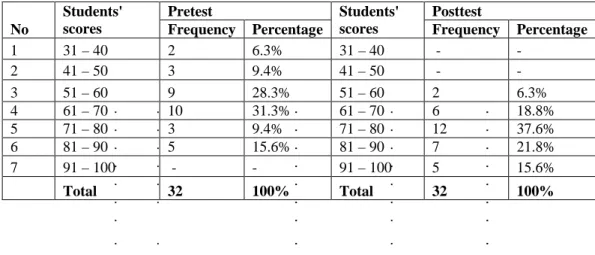
The results of the pretest and the posttest were showed in table 1 below. The table shows the improvement of students’ reading achievement after they are taught through Think Pair Share technique.
Table 1 shows that there was a significant improvement of the students’ comprehension achievement and there was an improvement pattern of the groups which improved almost twice of its previous score. This kind of improvement did not happen in all groups; thus, we also have to take a look at the table of students’ score in the pretest and posttest to get more detail.
Table 1. Students’ Reading Comprehension Achievement in the Pretest and the Posttest
No Students' scores Pretest Students' scores Posttest
Frequency Percentage Frequency Percentage
1 31 – 40 2 6.3% 31 – 40 - -2 41 – 50 3 9.4% 41 – 50 - -3 51 – 60 9 28.3% 51 – 60 2 6.3% 4 61 – 70 10 31.3% 61 – 70 6 18.8% 5 71 – 80 3 9.4% 71 – 80 12 37.6% 6 81 – 90 5 15.6% 81 – 90 7 21.8% 7 91 – 100 - - 91 – 100 5 15.6% Total 32 100% Total 32 100%
From table 1, it could be seen that in the pretest there were two students at the range of 31 - 40; both of them had improved into range 61 – 70 in the posttest. Two of the three students at the range 41 – 50 had improved into range 51 – 60; and one of them had improved into range 61 – 70. The third group which had nine students at the range 51 – 60 had improved into the range 61 – 70 (three students); 71 – 80 (five students); and 81 – 90 (one students). Then, the fourth group which had ten students at the range 61 – 70 during the pretest had improved into range 71 – 80 (six students) and 81 – 90 (four students). Two of the three students at the range 71 – 80 had improved into range 81 – 90; and one of them had improved into range 91 – 100. In addition, the last group which had five students in the range 81 – 90 had improved into range 81 – 90 (one student); and 91 – 100 (four
students). Therefore, there was a significant improvement of the students’ reading comprehension and the tendency that the low achieving students had better improvement than the high achieving students after the implementation of TPS technique.
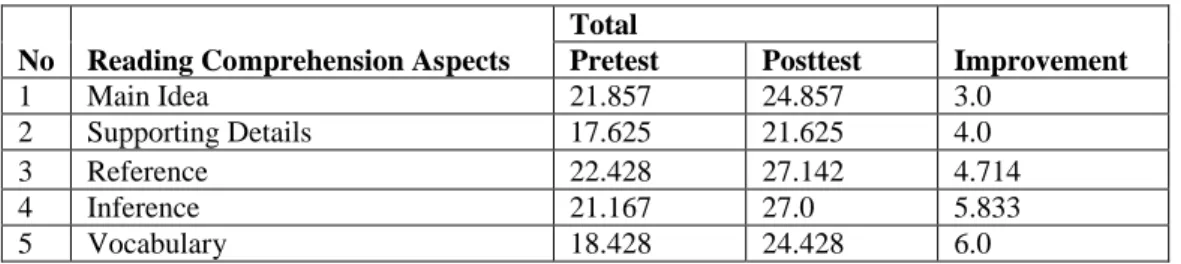
The mean score improved from 62.8 in the pretetst to 77.4 in the posttest. Moreover this technique improved the students’ reading comprehension achievement in all aspects of reading. It can be seen in the table 2 below.
Table 2 indicates that Think Pair Share technique improved the students’ reading comprehension achievement in all aspects of reading, such as main idea (3.0 improved), supporting details (4.0 improved), reference (4.714 improved), inference (5.833 improved), and vocabulary (6.0 improved).
Table 2. The Improvement of Reading Aspects
No Reading Comprehension Aspects
Total Improvement Pretest Posttest 1 Main Idea 21.857 24.857 3.0 2 Supporting Details 17.625 21.625 4.0 3 Reference 22.428 27.142 4.714 4 Inference 21.167 27.0 5.833 5 Vocabulary 18.428 24.428 6.0
Furthermore, it can be seen from table 2 that Think Pair Share technique improved the students’ reading comprehension achievement in vocabulary aspect the most, in which the students’ comprehension achievement in that aspect was 6.0. Since through the five-step of Think Pair Share technique the students would have opportunities to work alone and also in group. In the thinking process, when the students’ had to read the text individually, they could make use of their prior knowledge about the vocabularies in the text and consult the difficult words from their dictionary. In addition, in the pairing process, the students could improve their vocabulary by discussing it with their pairs.
Meanwhile, table 3 shows that the significant level was lower than 0.05 and it can be concluded that there was improvement of the students’ reading comprehension achievement.
During the treatment, the researcher used observation sheet to find out students’ constraints in the implementation of TPS technique. Nevertheless, the result of observation sheet showed that there were some constraints faced by the students in the implementation of TPS technique; however, the major constraints were low vocabulary mastery and difficulty in interpreting the idea of the text. These contraints affected the students when they had to share their opinion in the pairing and sharing processes. However, the constraints could be overcome and there was no big deal for teaching learning process.
DISCUSSION
The result of this research showed a statistically significant improvement of the students’ reading comprehension achievement in the pretest and the posttest. The improvement could be seen by comparing the mean score between the pretest (62.8) and the posttest (77.4). It means that the first hypothesis was accepted. It is also assumed that TPS technique contributed in improving students’ reading comprehension achievement.
This technique improved students’ reading comprehension through activating background knowledge related to the reading text in the pre teaching of this technique. It gave the students a chance to correlate their prior knowledge with the reading materials that they would learn. Furthermore, through the five steps of TPS technique students would have a chance to work alone and also in group. By implementing this technique students’ participation during the teaching and learning activities was increased.
Firstly the students thought about the problem given by the teacher individually. Next they would practice stating their thought to pair, in this step students’ comprehension in main idea, supporting details, reference, inference, and vocabulary would be increased because they discussed it with their pair and got new information from their pair. At last they would share the result of their discussion to the other students in front of the class.
That finding confirmed the result of the researches that were conducted by Palupi (2013), Goodman (2010),
Faradiaswita (2012), and Ofodu and Lawal (2011). All of them proved that TPS technique was effective to improve students’ reading comprehension. This technique could help the teacher to increase students’ comprehension of the text by focusing on the steps before, during, and after reading.
On the contrary, there were some different findings among those previous researches with this research. The previous researchers implemented the technique for elementary level and junior high school level; meanwhile this research implemented the technique for another level of education which was senior high school. In addition, the materials of the research were different and the mean scores of the improvement were also different. For example, Palupi (2013) implemented TPS technique for teaching recount text while this research implemented the technique for teaching narrative text. Moreover, the mean of this research was 14.5 and the mean of Palupi’s research was 12.45. This research also found that TPS technique would drastically improve reading comprehension achievement of students who were in the lower group (low achieving students). This finding was rightly observed by Johnson and Johnson in Ofodu and Lawal (2011), who stated that when learning task involves complex learning and problem solving skills, cooperation leads to higher achievement especially among students with low performance.
Therefore, through Think Pair Share technique students would have a chance to work with their pair and complete each other understanding. Moreover, by working in group,
students would be motivated to improve their reading comprehension achievement.
Thus, based on the explanation above, it could be concluded that the first research finding supported the previous researchers who stated there was a significant improvement in students’ reading comprehension achievement after they were taught through Think-Pair-Share technique.
The second finding of this research was the result of observation sheet which dealt with the students’ constraints in learning narrative text by using TPS technique. The students’ constraints were low of vocabulary mastery and difficulty in interpreting the idea of the text. Therefore, if the teacher could not overcome these constraints, it would affect the teaching learning process.
Considering the constraints or problems of the students, Palupi (2013) stated that there are three main problems that faced by the students during the implementation of Think-Pair-Share technique, those are: finding the meaning of difficult words that the students faced during the thinking process, getting the idea of the text in pairing process, and focusing in the lesson by being cooperative in every step of this technique. She obtained this result by conducting interview to eight representatives of the students. Meanwhile, the result of this research was obtained from the observation sheet. In this research the researcher found that low vocabulary mastery and difficulty in interpreting the main idea of the text were the major constraints in reading using TPS technique. It could be seen in the observation sheet that during the thinking process students complained
about some difficult words, for example: the words boasting, raged, furious, retaliated, and sprang from the first text and the words household chores, pumpkin, smashed, and
punished from the second text. This problem might influence the students in the next process because they had to understand the text first before discussing the text with their pairs. In order to overcome this problem the researcher asked the students to discuss their vocabulary problem with their pair, explained how to guess the meaning of the words from the context of the text, and taught students about word families in order to help them to use their knowledge about known words to decode unfamiliar words with the same letter pattern.
In addition, the finding of this research was also supported Carss (2007), who stated that one problem that interfered with comprehension and thinking on some occasions was incorrect interpretation of the question or requirement. Therefore, this problem would cause confusion when sharing in pairs. Meanwhile, in this research, the students had difficulty in interpreting the idea of the text which also cause confusion in the pairing and sharing process. To overcome this constraint, the researcher tried to guide the students understanding and previewed some selection before reading the text.
On the other hand, this research was in contrast with the first students’ constraints during the implementation of TPS technique proposed by Sugiarto and Sumarsono (2014). They stated that there are two main problems in the implementation of TPS technique, namely: (1) the students were not familiar with the model implemented by the
researcher, and it made them confused; (2) the students had difficulties in delivering their idea and opinion during the pairing and sharing steps. In this research, even though it was the first time the students were introduced with TPS technique, they were not confused and very cooperative. The researcher only had to explain about TPS specifically in the first treatment; thus, the students could understand well about the technique. Therefore the implementation of the technique could run well in the experimental class.
In brief, it can be concluded that TPS technique can be a good stimulus of teaching to increase students’ reading comprehension achievement. The result showed a positive impact on students’ reading achievement. The problems that occurred during the research could be solved and the students were able to comprehend the text well.
SUGGESTIONS
Referring to the discussion of the research findings, the implementation of Think Pair Share technique could improve students’ reading comprehension achievement especially in reading narrative text. It can be seen from the gain of the students’ mean score in the pretest and the posttest (62.8 to 77.4). Besides, after being taught by using Think Pair Share technique, the students’ score of vocabulary aspect increased the most. Moreover, TPS could work differently for different groups since this technique gave better effect for low achieving students compared to high achieving students. In addition, the students’ constraints during the
implementation of this technique could be their low vocabulary mastery and their problem in interpreting the idea of the text.
Referring to the conclusion above, the researcher would like to recommend some suggestions as follows:
Suggestions for English Teachers 1. English teachers are suggested to
implement Think Pair Share technique as an alternative technique in teaching narrative reading text since it can help the students in comprehending the text easier.
2. In order to improve main idea aspect, in the beginning of the class the teacher should clearly state the purpose of reading the text and decide the focus information in the text.
3. In teaching reading through TPS technique, the teachers should be able to fully monitor the class during the pairing and sharing session in order to make the group discussion in line with the material.
Suggestions for Further Researchers 1. Further research might implement
this technique in investigation of speaking ability, since Think-Pair-Share technique can provide a specific purpose about a topic and it seems practical in speaking field.
2. Further researchers can conduct this technique for different levels of students; i.e. for university level.
3. In this research, the researcher applied observation sheet in order to find out students’ constraints
during the implementation of TPS technique. Thus, for further research it is suggested to add another method in data collection, for example, by researcher triangulation. Through researcher triangulation, another observer will be added to observe the class and a better result will be investigated since it will not only measure from one perspective.
REFERENCES
Alberti,.Y.-2014.-Improving Students’.Reading Comprehension on Narrative Texts by Using-Story -Grammar Strategy at Grade VIIId of SMPN 1 Pondok-Kelapa-Bengkulu Tengah .-Retrieved_from:.http://repo- sitory.unib.ac.id/8290/2/I,II,III,II-14-yem.FK.pdf. Last retrieved: July 10th, 2016 at 20.00 pm.
Arikunto,.S..2005.Manajemen
Penelitian..Jakarta:.Rineka Cipta. Carss, W.-D. 2007. The Effect of.Using.Think.Pair.Share.Technique During- Guided- Reading Lessons. Retrieved.from:-http://waikato.re- searchgateaway.ac.nz/.-Last,retrie-ved: February 15th, 2017 at 15.00 pm.
Depdiknas.-2006.-KTSP: -Mata-Pelajaran-Bahasa-Inggris. Jakarta:.Departemen.Pendidikan Nasional.
Faradiaswita.-2012.-The Im-plementation-of-Think– Pair - Share Technique-in-Improving Students’ -Reading Comprehension-at-MTsN-1 -Tanjung-Karang- (unpublished-re-search report). Bandarlampung: Lampung University.
Farrel, T. S. C. 2012.
Reflecting on Teaching the Four Skills:-60-Strategies-for Professional Development..Retrieved.from:.https:/ /www.press.umich. edu/pdf/9780472 035052-ch1.pdf.-Last-retrieved:-Ja-nuary 2nd, 2015 at 16.00 pm.
Gassner, O. Mewald, C. Siggot, G. 2007.-Testing-Reading Specifications-for-the-E8-Standards -Reading-Tests ..Retrieved-from:-
http://www.uni-klu.ac.at/ltc/downloads/Reading_Spe cs.-Last-retrieved:-July 10th, 2016 at 10.00 am.
Goodman,-E.-J.-2010.-Active Research-on-Active-Learning Stra-tegies.-Retrieved-from: -http://www2.uwstout.edu/content/lib/ thesis/2010/2010goodmanj.pdf. Last Retrieved: January 10th, 2016 at 15.00 pm.
Ofodu, O. G & Lawal, A. R. 2011.-Cooperative-Instructional Stra-tegies and Performance Levels of Students in Reading Comprehension. Int-J-Edu-Sci,-3(2):103-107. Retrie-ved from:-http://www.krepublish-ers.com/02-Journals/IJES/IJ- ES-03-0-000-11-Web/IJES-0 3-2-000-11- ABST-PDF/IJES-03-2-103-11-124- Ofodu-G-O/IJES-03-2-103-11-124-Ofodu-G-O-Tt.pdf.-Last retrieved: February 15th, 2016 at 10.00 am. Palupi,-A.-A.-2013.-Teaching Reading -Comprehension through Think–Pair– Share (TPS) Technique -at-SMPN-8-Bandarlampung. Ban-darlampung: Lampung University.
Smahillah..2011..The Effecti-veness-of-Teaching-Reading Com-prehension-by-Using-Jigsaw Tech-nique.-Retrieved-from: http://hubpa
ges.com/education/mamaazaputri2.-Last retrieved: March 20th, 2016 at 09.00 am.
Sormin,-F.-F.-2012.-Impro-ving-Students’-Achievement-in Re-ading Comprehension through Think Pair Share Technique.-GENRE Journal of Applied Linguistics-of -FBS-Unimed, 1 (1):,1–16.-Retrieved-from: http://jurnal.unimed.ac.id/2012 /index.php/ellu/article/view/358/165. Last_retrieved: March 3rd, 2017 at 10.00 am.
Sugiarto, D & Sumarsono, P. 2014. TheImplementation.of Think -Pair.-.Share.Model.to-Improve Stu-dents’,Ability,in,Reading,Narrative, Texts.-International,Journal,of Eng-lish,and,Education,,3,(3):,206–215.
-Retrieved-from:-http://ijee.org/yahoo _site_admin/assets/docs/21.1841515 14.pdf.-Last retrieved: February 12th, 2017 at 09.00 am.