Using Gender Research in Development
by Agnes R. Quisumbing and Bonnie McClafferty
The International Food Policy Research Institute (IFPRI®) was established in 1975 to provide sustainable solutions for ending hunger and poverty. IFPRI is one of 15 agricultural research centers that receives its principal funding from governments, private foundations, and international and regional organizations, most of which are members of the Consultative Group on International Agricultural Research (www.cgiar.org).
Using Gender Research in Development
Agnes R. Quisumbing and Bonnie McClafferty
F o o D S e c U R i t y i n P R a c t i c e
International Food Policy Research Institute Washington, DC
ISBN 0–89629-755-1
Library of Congress Cataloging-in-Publication data available. Copyright © 2006 International Food Policy Research Institute. All rights reserved. Sections of this report may be reproduced without the express permission of, but with acknowledgment to, the International Food Policy Research Institute.
An earlier, expanded version of Appendix B, Section 1, “Intrahousehold allocation and gender relations: New empirical evidence from four developing countries” by A. R. Quisumbing and J. A. Maluccio, appeared in the Oxford Bulletin of Economics and Statistics 68 (3): 283–328 (2003). © 2003 by Blackwell Publishing. The current version appears with permission.
An earlier, expanded version of Appendix B, Section 3, “Gender differentials in farm productivity: Implications for household efficiency and agricultural policy by H. Alderman, J. Hoddinott, L. Haddad and C. Udry, appeared in Food Policy 20: 407–423 (1995). © 1995 by Elsevier. The current version appears with permission.
An earlier, expanded version of Appendix B, Section 9 “Gendered participation in water management: Issues and illustrations from water users’ associations in South Asia” by R. Meinzen-Dick and Margreet Zwarteveen, appeared in Agriculture and Human Values 15 (4): 337–345 (1998). © 1998 by Springer Netherlands. The current version appears with kind permission from Springer Science and Business Media.
An earlier, expanded version of Appendix B, Section 10, “Control and ownership of assets within rural Ethiopian households” by M. Fafchamps and A. R. Quisumbing, appeared in the Journal of Development Studies 38 (2): 47–82 (2002). © 2002 by Frank Cass Publishers. The current version appears with permission.
An earlier, expanded version of Appendix B, Section 11, “Women’s Land Rights in the Transition to Individualized Ownership: Implications for Tree-Resource Management in Western Ghana.” by A. R. Quisumbing, E. Payongayong, J. B. Aidoo, and K. Otsuka, appeared in Economic Development and Cultural Change 50 (1): 157–182 (2001). © 2001 by University of Chicago Press. The current version appears with permission.
Food Security in Practice iii
List of Tables, Figures, and Boxes . . . iv
Foreword. . . vi
Preface. . . .vii
1. The Importance of Using Gender and Intrahousehold Research to Inform Projects and Policies . . . .1
The Importance of Households in Influencing the Allocation of Resources and Development Interventions . . . .4
An Overview of IFPRI’s Gender and Intrahousehold Research Program . . . .8
Findings from IFPRI’s Research Program . . . 10
Using Project and Policy Cycles as Frameworks for Incorporating Gender Research . . . 14
Organization of the Guide. . . 22
2. Gender and Intrahousehold Aspects of Food Policy: Research Findings for Development Projects. . . 25
Addressing Gender in Needs Assessment and Problem Definition. . . 25
Addressing Gender in Project Design . . . .40
Addressing Gender in Project Implementation and Monitoring . . . 55
Addressing Gender Issues in Evaluation . . . .57
3. Weaving Gender Research into Project Design and Public Policy: Implications of the Research Results. . . 65
Implications of Gender Research for Project Managers . . . . 65
Implications of Gender Research for Policymakers . . . 74
Appendix A: Survey and Data Information . . . 78
Appendix B: Study Summaries. . . .80
References . . . 137
Contributors . . . 144
Tables
1. Information needs for integrating gender and
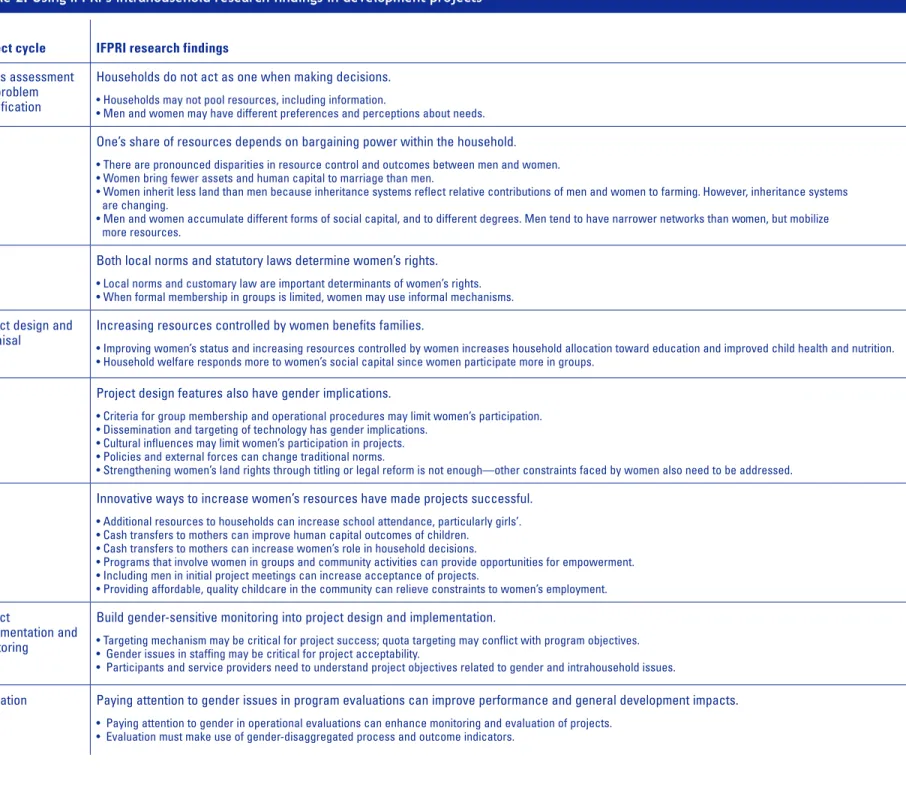
intrahousehold information into the project cycle . . . 15 2. Using IFPRI’s intrahousehold research findings in
development projects . . . 23 3. Poverty profiles for male- and female-headed households
and males and females, based on the 33rd percentile consumption per equivalent adult of the combined
distribution . . . .28 4. Status of women, by region and country . . . .30 5. Assets at marriage and human capital of husband
and wife . . . 33 6. Distribution of land inheritance between men and women,
parent and child generations . . . .34 7. The impact of participation in the Vegetable and Fruit Cash
Crop Program on the time allocation of head males and females in households, by the number of children aged 0 to 4.9 years . . . 45 8. Characteristics of families participating in the Hogares
Comunitarios Program compared with families from a random sample . . . .54 A.1. Sample size and survey data collected . . . 78 B1.1. Assets at marriage and human capital of husband
and wife . . . 81
B1.2. Signs of coefficients on male and female assets,
expenditure share regressions. . . 83 B2.1. Description of data sets employed and study sample sizes . . .86 B2.2. Dependent variables of the study. . . .87 B8.1. Determinants of individuals’ group membership, 1993
and 1998 . . . 106 B8.2. Determinants of per capita monthly expenditure, as a
function of social and human capital . . . 107 B10.1. Regression analysis of disposition of assets upon divorce
(currently married households only; estimator is ordered probit) . . . 113 B10.2. Regression analysis of disposition of assets upon death of
husband (currently married households only; estimator is logit; coefficients are reported as odds ratios) . . . 115 B11.1. Determinants of land acquisition at the household level:
Tobit regression with village fixed effects . . . 117 B11.2. Determinants of proportion planted to cocoa and cocoa
production per hectare at the parcel level, selected
coefficients. . . 118
Figures
1. Project life cycle. . . 17 2. Research and the policymaking process. . . .20 B2.1. Percentage of underweight, stunted, and wasted children,
by region . . . .88
Food Security in Practice v Food Security in Practice v
B2.2. Women’s status indexes, by region . . . .88
B2.3. Predicted child malnutrition (underweight), by indexes of women’s status. . . .89
B4.1. Relationship between woman’s time spent in male-controlled agricultural production and income transfers from man to woman under alternative scenarios . . . .94
B4.2. Simulated impact of price increases on cotton production over 1981–85 under alternative scenarios . . . 95
boxes 1. The Nature of Gender Differences. . . .1
2. The Costs of Doing Gender Research: Is It Worth It? . . . .3
3. Technology Adoption, by Male and Female Farmers . . . .6
4. Assets at Marriage in Different Cultures . . . 10
5. Farming Systems and Gender Roles . . . .26
6. IFPRI’s Evaluation of PROGRESA in Mexico . . . 59
7. Methodology for Operational Evaluation of the Hogares Comunitarios Program in Guatemala . . . .60
8. Methodology for the Impact Evaluation of the Hogares Comunitarios Program in Guatemala . . . 61
9. Using Quantitative and Qualitative Methods to Evaluate Agricultural Technologies in Bangladesh. . . 62
10. Essential Needs Assessment Questions for Project Managers . . . 67
11. Essential Project Design and Appraisal Questions for Project Managers. . . 69
12. Essential Implementation, Monitoring, and Evaluation Questions for Project Managers. . . 72
Foreword
W
hile gender equality is a basic human right, and closing the gender gap is key to achieving many development objectives, development practitioners and advocates concerned with achieving gender equality are often constrained by the lack of information to justify targeting limited resources toward closing the gender gap.In keeping with the purpose of IFPRI’s Food Security in Practice series, this practitioners’ guide bridges the gap between research and practice by providing up-to-date, relevant information on why and how gender issues, when taken into account, can improve the design, implementation, and effectiveness of development projects and policies. IFPRI’s work on gender and intrahousehold issues has already influenced programs, such as conditional cash transfers in Latin America, by contributing to the growing evidence that households do not make decisions as one, and that resources controlled by women lead to improved child outcomes. IFPRI’s gender research has also contributed to a wider acceptance by policymakers that paying attention to decisionmaking processes within the household is essential to the success of development interventions.
For IFPRI’s research to have continued impact on policies and programs, it needs to be communicated in accessible, understandable terms to its ultimate users—policymakers and technical personnel
in multilateral or bilateral aid agencies, nongovernmental organizations, and developing-country governments. This practitioners’ guide presents key research findings from IFPRI’s gender and intrahousehold program in the framework of project and policy cycles. The authors took the additional step of field-testing the guide among practitioners in Africa, Asia, and Latin America to see whether the findings were relevant outside the study countries. Finally, the authors conducted a workshop among Washington, D.C.– based practitioners and policymakers to see how the findings related to the policy cycle. Thus, the guide reflects the insights, comments, and suggestions of the ultimate users of this research.
I hope that this guide—by presenting rigorous technical evidence in support of gender-targeted programs and policies—will contribute to fairness in development and convince policymakers and practitioners that paying attention to gender issues will make their programs and policies more effective in reaching their ultimate development objectives.
Joachim von Braun Director General, IFPRI
Food Security in Practice vii Food Security in Practice vii
Preface
t
his guide offers a nontechnical presentation of research findings from IFPRI’s multicountry research program on gender and intrahousehold issues, along with implications and key questions for integrating gender research findings into project cycle and policy decisionmaking processes. The volume draws on work undertaken by IFPRI and its collaborators in developing and developed countries since the early 1990s. It presents empirical evidence—based on IFPRI’s field research using both quantitative and qualitative techniques—on the ways in which gender and intrahousehold issues affect the success of development interventions, and then shows readers how to incorporate the findings effectively into development programs. The guide—its findings, format, and presentation—has been field-tested in workshops with practitioners in Kathmandu, Nairobi, Guatemala City, and Washington, D.C.Most of the empirical research was funded by the U.S. Agency for International Development (USAID) Office of Women in Development under Grant No. FAO-0100-G-00-5020-00, “Strengthening Development Policy through Gender Analysis: An Integrated Multicountry Research Program.” This grant funded primary data collection in Bangladesh, Ethiopia, Guatemala, and South Africa, and supported the work of IFPRI collaborators in Ecuador, Ghana, Indonesia, Nepal, the Philippines, and Zimbabwe. The studies in Ghana and Indonesia (Sumatra) were funded under a grant from the U.K. Department for International Development (DFID). Other donors contributing to the program’s research were the Danish International Development Agency (Danida), the Government of Japan, the Government of Mexico, the Swedish
International Development Cooperation Agency (Sida), the World Health Organization, and the World Bank.
We thank the Government of Norway for providing the funding for this synthesis activity, especially Ruth Haug of the Agricultural University of Norway for her enthusiasm and support for gender research at IFPRI. We also thank Hari K. Upadhyay, Madan Prariyar, and the staff of the Center for Environmental and Agricultural Policy Research, Extension, and Development (CEAPRED) for organizing the Nepal workshop; Vicki Wilde, Pauline Bommett, the CGIAR Gender and Diversity Program, and the World Agroforestry Center for organizing the Kenya workshop; and Maggie Fischer and the Instituto de Nutrición de Centro America y Panamá (INCAP) for organizing the Guatemala workshop. Kathy Alison of Training Resources Group, Inc., facilitated the Washington, D.C., workshop. Manohar Sharma joined us in Nepal and John Maluccio in Guatemala to help us answer many difficult and challenging questions from the field. We are indebted to the workshop participants who spent many hours reading and annotating the documents and participating actively in discussions during the in-country workshops. We thank Ruth Meinzen-Dick and an anonymous referee for useful comments, Oscar Neidecker-Gonzales for his help in translating the presentation for Guatemala, Lourdes Hinayon and Jay Willis for producing the many iterations of this document, and Jay Willis for producing the final document. Last, we thank our husbands, Joel Villaseñor and Eric McClafferty, for minding hearth, home, and children when our travels took us to workshops all over the world.
Food Security in Practice Food Security in Practice
1. The Importance of Using Gender and Intrahousehold Research to
Inform Projects and Policies
t
his book is designed for technical personnel and policymakers in national government and international agencies, and nongovernmental organizations (NGOs), as well as other development practitioners who face the task of addressing gender issues in development projects and policy. Practitioners may ask why they should address gender issues in development. First and foremost, gender equality is a basic human right—with value in and of itself. Second, many disparities in development outcomes arise from gender differences (see Box 1). Third, the task of addressing gender inequality is made even more urgent by the reality of its significant effects on the efficiency and welfare outcomes of project or policy interventions.Gender issues are central to the attainment of development goals and poverty reduction. They play a prominent role in the United Nations Millennium Development Goals (MDGs), which have been commonly accepted as a framework for measuring development progress. Of the eight goals, four are directly related to gender: achieving universal primary education, promoting gender equality and the empowerment of women, reducing infant and child mortality, and improving maternal health. Gender also plays an important role in goals related to reducing poverty and eradicating hunger; combating HIV/AIDS, malaria, and other diseases; and ensuring environmental sustainability. Given these linkages, it is difficult to see how it would be possible to meet the MDGs without addressing gender.
The poverty reduction agenda, in particular, would benefit from paying attention to gender issues. One study (Klasen 1999, cited in
World Bank 2001) estimates that if the countries in South Asia, Sub-Saharan Africa, and the Middle East and North Africa had addressed their gender gap in schooling similarly to East Asia—which began tackling the issue in 1960 and closed the gap by 1992—their income per capita could have grown by 0.5–0.9 percentage points
Box . the nature of Gender Differences
G
ender differences arise from the socially constructed relationship between men and women (Oakley 1972). Sex differences, on the other hand, are biological and innate. The roles that men and women play in society show similarities and differences across classes and societies. Since the definition of men’s and women’s roles is specific to space and time, gender divisions cannot be checked off from lists (Moser 1989). Gender differences affect the distribution of resources between men and women and are shaped by ideological, religious, ethnic, economic, and social determinants (Moser 1989). Being socially rather than innately determined, this distribution can be changed through conscious social action, including public policy.IFPRI’s gender and intrahousehold research program treats gender as an important determinant of the distribution of rights, resources, and responsibilities within the household but recognizes that it is not the only factor. Age, birth order, rela-tionship to the household head, and position of the household in society (for example, whether low or high caste) are some of the factors that also influence the allocation of household resources.
higher per year, representing substantial increases over actual growth rates. Simulations from comparable studies using nationally representative samples from Egypt (1997) and Mozambique (1996) have shown that mothers’ education is crucial to poverty reduction (Datt and Jolliffe 1998; Datt, Simler, and Mukherjee 1999). In Egypt, increasing mothers’ schooling from “none” or “less than primary” to “completed primary schooling” reduces the proportion of the population below the poverty line by 33.7 percent. Similarly, increasing by one the number of adult females per household that have completed primary schooling in Mozambique leads to a 23.2 percent decrease in the proportion of the population living below the poverty line. In both of these country studies, female education had a much larger impact on poverty than other factors, including male education. Similar examples can be found for productive resources other than education (for example, land). The systematic inclusion of gender issues in poverty reduction strategy papers (PRSPs), prepared by developing countries through participatory processes involving domestic stakeholders and external development partners (such as the World Bank and International Monetary Fund), could enhance the effectiveness of poverty reduction strategies, particularly in countries where gender disparities among the poor are most pronounced.
How can research informed by a gender perspective—commonly called “gender research” for brevity—contribute to practitioners’ and policymakers’ efforts to reduce poverty and attain other development objectives? Practitioners are often knowledgeable about general development issues or about issues related to a specific technical field, but they lack understanding and resources on how to integrate
gender issues effectively into the development and design of specific projects and public policy. Many of these practitioners may not be convinced of the importance of gender issues to the success of an intervention, or they may be confused by changing approaches to addressing gender issues in the context of development.1 In some fields, such as education, health, village water supply, and rural development, the importance of gender is already fairly widely accepted, but in the so-called hard sectors such as transportation and infrastructure, which many planners consider to be gender-neutral, practitioners may need to be convinced of the importance of gender. They may view gender as an imposition from international donors or as an administrative requirement; hence, for these practitioners, “efficiency” arguments are paramount. Even where practitioners are interested in the equity aspects of gender or are trained in gender analysis, they can lack guidance on how to apply such analysis to their work. Thus, without technical knowledge in specific fields, the ability of practitioners to design and implement effective projects or policy may be limited. Cost factors may also influence project managers’ willingness to incorporate gender issues into their planning and implementation processes (see Box 2).
This guide aims to reach both types of practitioners. Grounded in field research undertaken by the International Food Policy Research Institute (IFPRI) as part of its multicountry program on gender and intrahousehold issues, the guide first provides empirical evidence on the effects of gender and intrahousehold issues on development intervention outcomes. It then guides the reader on how to effectively incorporate the findings into development projects. Because the
1 See Moser (1989) for a critical review of different policy approaches to “women in development” from a gender planning perspective. 2 For a more focused approach to methodologies for gender analysis in agriculture, see Feldstein and Jiggins, eds. (1994).
Food Security in Practice Food Security in Practice research examined the circumstances under which gender affected policy outcomes, the guide will also enable development practitioners to determine when gender issues are likely to be critical to a project’s success and when their importance may be secondary to other factors. For the specialist on gender issues, the guide provides new information on the relevance of gender analysis and research in a range of policy areas. While a wide range of topics are covered, this technical guide will be most useful to practitioners in agriculture, health, nutrition, education, and rural development.
The guide complements training manuals and toolkits on gender analysis and the project cycle, such as those published by Oxfam (Williams 1994), the Centre for Development and Population Activities (CEDPA 1994), the World Bank, and the International Fund for Agricultural Development.2 Like the other technical guides in IFPRI’s Food Security in Practice series, such as Methods for Rural Development Projects (Hoddinott 2001), what distinguishes this volume from others is its origins in field research using both quantitative and qualitative techniques and, in many cases, research-oriented project evaluation. A useful companion volume is the book, Household Decisions, Gender, and Development: A Synthesis of Recent Research (Quisumbing 2003), which contains more detail on the IFPRI studies. This volume should be viewed as a guide to gender research for practitioners, not a “how-to” or training manual for specific projects. Practitioners looking for “how-tos” and checklists are advised to consult the previously mentioned training manuals and toolkits.
It can be argued that conditions within countries may be so dif-ferent as to make it difficult to draw generalizations related to gender. This is true. Recognizing that gender issues are location-specific and culture-bound, different chapters were field tested in Asia, Africa,
Box . the costs of Doing Gender Research: is it Worth it?
P
ractitioners often balk at the perceived high costs of gender research. Yet a wide range of studies can be done, with a corresponding wide range of costs. In IFPRI’s experience, a number of modalities are compatible with gender research, with costs increasing depending on the level of detail, as the following examples show:• The Bangladesh household survey on the micronutrient impact of new agricultural technologies was fielded at a cost of approximately $50 per household per visit, for four visits. For close to 1,000 households, this amounted to $200,000 in 1996–97. This study was very detailed, however, and obtained information on production, incomes earned by individual household members, household and individual food consumption, total household expenditure, plus blood hemoglobin levels using finger prick techniques. Most studies do not require this level of detail. The modules for collecting information on assets at marriage and women’s empowerment were only a small part of one survey round.
• Part of the IFPRI research program consisted of a competitive small grants program, in which collaborators could add a series of questions on gender issues to ongoing studies. The maximum grant amount awarded was $20,000.
• Qualitative studies done as part of IFPRI’s gender and intra-household research program cost $10,000 to $50,000.
These were all systematic, research-focused studies, conducted from 1995 to 2000. Nevertheless, much can be learned from short field visits, particularly when accompanied by a local expert who is sensitive to gender issues. The bottom line is that some attention to gender issues—even very informally—is likely to pay off in terms of the relevance and usefulness of projects to beneficiaries.
and Latin America, and feedback was sought from development practitioners and policymakers as to its relevance and usefulness in their respective country settings. Workshops were also conducted in Washington, D.C., to elicit feedback from a group of policymak-ers and development practitionpolicymak-ers working on gender issues. These opportunities for feedback and review have added depth and ground-ed the research findings in the realities of development work.
T
he
I
mporTance
of
h
ouseholds
In
I
nfluencIng
The
a
llocaTIon
of
r
esources
and
d
evelopmenT
I
nTervenTIons
We begin with the assertion that gender considerations can affect the allocation, targeting, and control of resources and, thus, policy and project outcomes. An understanding of how resources are allocated within households can profoundly affect policies associated with the design and implementation of development projects. For projects, on the other hand, incorporating research findings into the design, implementation, monitoring, and evaluation of specific projects can increase their effectiveness.
In investigating intrahousehold resource allocation, IFPRI has developed a conceptual framework that takes account of interactions occurring between policy and program design and implementation; level, flow, use, and intrahousehold control of resources; and relevant policy outcomes, all of which exist within and are
conditioned by a given legal framework and set of social and cultural institutions. Hence, within IFPRI’s framework, policy and program instruments—such as agricultural development projects (irrigation management schemes, fragile lands management schemes),
employment programs (public works), credit programs, programs to decrease micronutrient malnutrition, and family planning programs—interact with a household’s level, flow, use, control, and allocation of resources—land, labor, capital, time—to affect the household’s consumption of various goods and services—such as food, education, health inputs, and family planning.
Control of resources within the household—particularly women’s control of resources—is determined not only by social and cultural institutions but also by factors such as women’s access to labor markets, paid employment, and other productive resources. The impact of policies and interventions, filtered through the often mysterious and opaque institution of the household, results in outcomes such as changes in the stock of natural resources; adoption of new technology; levels of food security, nutrition, health, and fertility; and ultimately the individual well-being of household members. The social, cultural, and legal environment is the umbrella under which these allocation decisions and policy and development project impacts are realized.
Household Decisionmaking and Policy
Why are intrahousehold resource allocation patterns and processes potentially important for policy and projects? Without taking intrahousehold allocation patterns into account, resources may be erroneously targeted to households based on the assumption that the worst-off individuals come from households with the lowest welfare. If households “protect” the consumption of adults relativeto preschoolers with the result that individual food adequacy (intake relative to requirements) is better for adults than for pre-schoolers, attempts to target undernourished preschoolers based on
Food Security in Practice Food Security in Practice household-level food consumption indicators may be highly inefficient
and wholly inaccurate. Further, resources can be poorly targeted across household types if intrahousehold inequalities across household types are not accounted for. There are many households where certain members, often women or children, do not receive sufficient food even though the average calorie intake for all household members would place the family well above the poverty line on a food poverty ranking scale. Haddad and Kanbur (1990) demonstrate that the calorie adequacy rankings of various socioeconomic and geographic household groups can change when individual- rather than household-level food consumption information is used. The extent to which individuals within households are “food insecure” would not be reflected in aggregated data on households or household groups. Such potential improvements in targeting need not be restricted to food consumption programs. Where food consumption data already exist, say from national surveys, similar household food poverty rankings could be conducted in prospective areas for targeted assistance.
The processes by which intrahousehold patterns are determined can affect policy and projects in several ways, predicated on the manner in which households behave. Consider the effect of public income transfers to households. The unitary household model, which assumes that the household has a single decisionmaker and pools its resources, predicts that the impact of household transfers will be unaffected by the identity of the recipient of the transfer. In contrast, the collective household model recognizes that individuals within households have different preferences and do not necessarily pool resources, so the welfare effects of a transfer may be quite different
depending on whether the recipient is male or female. In addition, the responses of nonrecipients of transfers must be considered. If households compensate for the transfer by reallocating resources away from the recipient, the intended effect of the transfer may not be realized. For example, the nutritional benefit of a feeding program may be weakened if parents reduce the amount of food given to the child at home or share supplements targeted to at-risk individuals with other household members. Only the collective model explicitly incorporates the effects of household behavioral processes on the success of projects or policies.
Adherence to the unitary model, which has led many
policymakers to believe that the identity of the recipient of the benefits of policy interventions does not matter, can give rise to the failure to adopt particular policies, and unintended costs arising from policies that are adopted. Dramatic examples of these failures are the nonadoption of new technologies or practices to retard environmental degradation (see Box 3), and the adoption of mandated new farming patterns that make the target group worse off. At worst, adherence to the unitary approach may allow the persistence of projects or programs that reinforce and perpetuate unequal power relationships within the household. Thus, challenging the assumption that the self-declared household head3 has detailed knowledge of the activities and preferences of other household members may lead to better policy.
Finally, using the unitary model for policy guidance disables pow-erful policy levers. This is perhaps the least understood drawback of the unitary approach. Under the unitary model, policymakers affect intrahousehold resource allocation through changes in prices. By
simply subsidizing the price of food, for example, food consumption by young children—often the most vulnerable household members in terms of undernutrition—can be increased. A collective view of the household suggests that additional policy levers are available to the policymaker, often with a very long reach. Examples include changes in access to common property resources and credit, eligibil-ity for public works schemes, cultural attitudes toward the consump-tion of certain types of food for certain individuals (such as dietary
restrictions for household members who are ill), and attitudes toward family planning. The collective model recognizes that providing credit directly to women rather than men may be more effective because women’s spending preferences differ. Similarly, using the collective view of household behavior, food subsidies would not be considered the only way to improve child nutrition because increasing the mother’s access to resources through a credit scheme or income transfer program may be more effective.
Box . technology adoption, by Male and Female Farmers
W
here new technologies are associated with “male” crops or activities, women may be less likely to adopt new crops or technologies unrelated to their specific activities. In some pastoral societies, women’s responsibilities are dairying and small stock, while crop cultivation is the domain of men. Indeed, female farm managers are less likely to rear livestock in Tanzania (Appleton et al. 1991). In agricultural areas of Zambia, female farmers are less likely to use oxen in cultivation (Jha, Hojjati, and Vosti 1991) because plowing is traditionally a male activity. However, women may more readily adopt technologies related to tasks they perform, especially if the extension agent is female. Evidence from Kenya suggests that female farmers are equally likely to apply technical advice from extension agents and even more likely to adopt relatively complex practices such as top dressing, chemical use, and stalk borer control (Bindlish and Evenson 1993).Most studies on technology adoption find that more educated farmers are more likely to adopt high-valued crops with longer maturation periods. A study cited in Appleton et al. (1991) on the adoption of coffee in Kenya is a case in point, whereby better-educated females are more likely to adopt coffee. Universal primary education for
female farmers has higher marginal effects on the probabilities of adopting coffee than increasing the educational level of all farmers because of the generally lower female education levels in Africa. Other simulations by Burger and Gunning suggest that female decisionmakers are unresponsive to increases in early adoption by male farmers. This is consistent with other findings that previous awareness and adoption of the technology—particularly by farmers of the same sex—also increased the probability of coffee adoption. The significance of gender-specific copying effects highlights the need not only for female extension agents to work with female farmers but also for female farmers to demonstrate the new technology to other farmers. The importance of cooperatives and extension in promoting technology adoption emphasizes the need for provision of support infrastructure to rural areas.
Most of the studies reviewed also suggest that farmers with larger areas cultivated and higher values of farm tools are more likely to adopt new technology. To the extent that female farmers may have less education, less access to land, and fewer tools, they may be less likely to adopt new technologies.
Food Security in Practice Food Security in Practice In recent years, policymakers have used the findings from
intra-household research to design programs that aim to change intra-household behavior by transferring income directly into the hands of women, as illustrated by Mexico’s PROGRESA (Programa de Educación, Salud y Alimentación [National Program for Education, Health, and Nutrition]).4 The receptiveness of policymakers both to designing and to implementing such programs, as well as to using experimental or quasi-experimental methods of evaluation, has increased our under-standing not only of how households make decisions but also of how policy can affect them. Moreover, the success of microcredit programs targeted to women, exemplified by the Grameen Bank in Bangladesh, has stimulated a new generation of projects that target technologies to women. Attention to gender issues also enables policymakers to anticipate the potential adverse outcomes of programs targeted to women—for example, leakages occurring when women obtain credit for their husbands or when husbands and other household members object to the time women spend attending program activities. It is
hoped that as more interventions are designed to address intrahouse-hold issues there will be greater interaction between projects, policy, and research.
Bargaining Power as an Alternative Paradigm
of Household Behavior
Although the internally differentiated household was described, analyzed, and widely accepted in mainstream anthropology from the mid-1970s, it took at least a decade for mainstream development economists to take notice (Jackson 2005). Challenges from economists to the traditional model of household behavior and proposals of alternative models that bear closer resemblance to reality came from studies in the 1980s that suggested that men and women systematically spend income under their control in different ways.5
These studies have added to the evidence rejecting the traditional paradigm of the unitary model of household behavior in favor of the
4 In 2002, PROGRESA was absorbed by a new public conditional cash transfer program called Oportunidades.
5 These studies included Guyer (1980), Tripp (1982), Pahl (1983), and studies from different countries (for example, Fapohunda 1988) in the volume edited by Dwyer and Bruce, eds.
(1988). A series of studies on agricultural commercialization and nutrition in developing countries also found that income controlled by women is more likely to be spent on food than is income controlled by men (Kennedy 1994). Evidence that men and women may have different production priorities can be found in the work of Dey (1985) and von Braun and Webb (1989) on irrigated rice in The Gambia, Jones’s (1983) formal model of intrahousehold conflict and husband’s and wife’s gains from cooperation based on work in the Cameroon, Mukhopadhyay’s (1984) decision model of the sexual division of labor for household tasks, Hill’s (1963, 1978) description of Fante women’s entrepreneurial behavior, and Gladwin’s (1975, 1982) models of women’s marketing and farming decisions. Implications of these differences for project design are discussed by Cloud (1983). These and other studies from Sub-Saharan Africa are reviewed in Gladwin and Macmillan (1989). By the mid-1990s, economists appeared to be developing a considerable level of interest in the issue of the unitary household, an issue that had preoccupied feminist anthropology for a decade at least and to which the research by Chris Udry and others in Burkina Faso (1996) was particularly important and continues to be heavily cited (Jackson 2005). IFPRI played an important role in bringing together current research on gender and intrahousehold issues—and in catalyzing future research—through a 1992 conference, the proceedings of which produced a publication comprising 30 policy briefs derived from the papers presented and, some time later, a book (Haddad, Hoddinott, and Alderman 1997).
6 See Strauss and Thomas (1995); Haddad, Hoddinott, and Alderman (1997); and Behrman (1997) for reviews.
7 We recognize that the “household,” defined as a group of individuals who co-reside, cook together, and share living expenses may not be the appropriate unit of analysis in all cases.
Bargaining models can be modified to take into account the important role of the extended family or lineage in many cultures, as in Foster and Rosenzweig (2002) on household partition in Bangladesh. Our studies in Ghana and Sumatra (Quisumbing, Estudillo, and Otsuka 2004) examine the role of the extended family in allocating lineage land between men and women, and across generations.
collective model, which allows for differences of opinion regarding economic decisions among household members.6,7 This raises the possibility that in the event of disagreement, resolution may depend on the relative bargaining power of individuals within the household (Manser and Brown 1980; McElroy and Horney 1981). However, the concept of bargaining power is elusive. Rather than making any claims to measure power itself, researchers have attempted to gain greater understanding of the determinants of bargaining power, including:
(1) control over resources such as assets, (2) factors that influence the bargaining process, (3) mobilization of interpersonal networks, and (4) basic attitudinal attributes.
Economic analysis of bargaining power has tended to focus on economic resources that do not depend on an individual’s labor supply decisions as a major determinant of bargaining power. These include assets (for example, Doss 1996; Thomas, Contreras, and Frankenberg 1997; Quisumbing 1994), unearned income (Schultz 1990; Thomas 1990), or transfer payments and welfare receipts (Lundberg, Pollak, and Wales 1997; Rubalcava and Thomas 1997). The threat of an individual withdrawing from the household and taking his or her assets grants the owner of those assets power over household resources. The implications of such threats are in part dependent on community norms and divorce laws. Indeed, Thomas, Contreras, and Frankenberg (1997) use assets at marriage as an indicator of bargaining power because in most of Indonesia, spouses can take what they brought into the marriage with them in the event that the marriage dissolves.
Factors that can influence the bargaining process include legal rights, skills and knowledge, access to labor markets, the capacity to acquire information, education, and bargaining skills. Some of these influences are external to the individual (for example, legal rights), but many of them are highly correlated with human capital or education. In some instances, domestic violence can be used to extract resources from spouses or their families, as in the case of dowry-related violence in India (Rao 1997; Bloch and Rao 2002). Individuals can also mobilize personal networks to improve their bargaining power. Membership in organizations, access to kin and other social networks, and “social capital” may positively influence a person’s power to affect household decisions. Last, basic qualities and attitudes that affect bargaining power include self-esteem, self-confidence, and emotional satisfaction. While the economic literature has not dealt extensively with this aspect, the success of group-based credit programs such as the Grameen Bank has been attributed in part to its group-based empowerment approach. Many NGOs have explicit empowerment objectives that go beyond economic means to include legal awareness, political participation, and use of contraception (Schuler, Hashemi, and Riley 1997).
a
n
o
vervIew
of
IfprI’
s
g
ender
and
I
nTrahousehold
r
esearch
p
rogram
The objective of research conducted under IFPRI’s Gender and Intrahousehold Research program and presented in this guide was to test whether or not intrahousehold allocation of resources affects the outcomes and consequences of policies, thereby generating information to assist in the development of effective policies,
Food Security in Practice Food Security in Practice understanding of how households actually behave—that is, whether
they adopt unified preferences and pool resources, per the unitary household model, or whether individuals within the household differ in their preferences, rights, resources, and responsibilities, per the collective household model. The five-year study, beginning in 1995, collected primary household data in Bangladesh, Ethiopia, Ghana, Guatemala, Indonesia, the Philippines, and South Africa. Additional work was undertaken in eight other countries. The last empirical study undertaken was also the program’s most comprehensive in terms of country coverage, incorporating Demographic and Health Survey data from 36 countries. All in all, 9 IFPRI researchers, 20 associated researchers, and over 30 collaborating institutions and individuals in the developed and developing world participated in the research program. In the IFPRI study countries alone, over 6,000 households in the developing world provided insight as to how poor households make decisions, divide resources, and cope to secure their livelihoods. The sample sizes and data collected are provided in Appendix A, while the key studies undertaken by the research program are summarized in Appendix B. As previously mentioned, the companion volume to this guide, Household Decisions, Gender, and Development: A Synthesis of Recent Research (Quisumbing 2003), contains more detail on the IFPRI studies.
Methods and Data
Recognizing the cultural specificity of intrahousehold allocation processes, the studies in Bangladesh, Ethiopia, Guatemala, Mexico, and South Africa involved both qualitative and quantitative components. The qualitative studies in Bangladesh, Guatemala, Mexico, and South Africa were designed collaboratively by in-country social scientists and IFPRI researchers. For Ethiopia, qualitative village studies had already been conducted by sociology and anthropology graduate students and were made available to IFPRI’s researchers.8 The surveys in Ghana and Indonesia followed a round of extensive community interviews, while the fieldwork in the Philippines was conducted with an in-country collaborator who had previous experience in the study villages. The qualitative studies were extremely valuable in informing the design of the quantitative survey modules, especially on assets at marriage (the indicator chosen to measure bargaining power in all the countries [see Box 4]), social capital, and measures of women’s empowerment. For example, IFPRI researchers used lists of assets at marriage suggested by the qualitative work to create a quantitative survey module to elicit information on the quantity and values of assets at marriage.9 A comparable methodological framework was then applied to the
8 Around the time the three-round panel survey was conducted in 1994/95, a set of 15 village studies using qualitative methods was undertaken by anthropology students from Addis
Ababa University in all Ethiopian sites (Bevan and Pankhurst 1996). The 1997 survey drew heavily from the qualitative studies. In Bangladesh, a qualitative study on the gender impact of new agricultural technology (Naved 2000) was conducted between the third and fourth survey rounds. In South Africa, a study of shocks and coping behavior was conducted by an anthropologist prior to the second round of the panel survey in KwaZulu-Natal (Cross, Mngadi, and Mbhele 1998). In Guatemala, a qualitative study and an operations research evaluation of the community day-care centers were conducted prior to the quantitative survey (Ruel, de la Brière, and Hallman 2000). Qualitative studies were also conducted in Indonesia (Frankenberg and Thomas 2001) and Mexico (Adato et al. 2000).
9 As much as possible, both husbands and wives were interviewed, and interviews were conducted separately where issues were potentially contentious. In Bangladesh, separate male and
female teams interviewed husbands and wives, respectively. In most countries, the person responsible for the relevant decision was interviewed (for example, the plot manager when the survey was about agricultural production or the wife when the survey module was about food preparation). Nevertheless, biases can result when one spouse answers for the other. Frankenberg and Thomas (2001) examine the validity of cross-reporting in their work on the Indonesian Family Life Survey.
countries to test whether men’s and women’s assets at marriage had different impacts on a variety of household-level and individual level outcomes in the context of very different social and economic conditions. Few previous studies have been systematically replicated over a range of conditions, making generalizations across societies difficult. Details of the sample design and variables collected are presented in Appendix Table A1.
f
IndIngs
from
IfprI’
s
r
esearch
p
rogram
The general findings of IFPRI’s Gender and Intrahousehold Research program (discussed in turn below) have been shown to hold beyond specific country settings. The more detailed research results (discussed in the next chapter) are more context-specific but serve to illustrate the general findings. Detailed discussions of the methodologies used are contained in the supporting documents listed in the references.
Households Do Not Act as One When
Making Decisions
In an overwhelming majority of cases from a wide range of develop-ing countries, the conventional wisdom that men’s and women’s resources have the same effects on household decisionmaking is rejected. Results indicate that household members have different preferences and do not pool their resources. Discounting the possibil-ity that development interventions can be targeted to more than one person within a household potentially decreases the effectiveness of interventions (Quisumbing and Maluccio 2000).
Application of a common methodological framework to a number of countries provides further evidence of the limitations of the unitary household model. This is true for outcomes at the household level (Quisumbing and Maluccio 2000, 2003a), the plot level (Alderman et al. 1996), and the individual level (Quisumbing and Maluccio 2003a; Hallman 2000; Smith et al. 2003a; Adato et al. 2000). Of course, in certain instances men’s and women’s decisions on resource
alloca-Box . assets at Marriage in Different cultures
A
lthough the IFPRI research program used a variety of measures of bargaining power—including indicators of women’s status (Smith et al. 2003a) and cash transfers targeted to women (Skoufias 2005)—most of the studies collected primary data on assets at marriage (or at the time of union formation) as an indicator of bargaining power within households. Human capital (education and experience) and assets at marriage are attractive indicators of bargaining power for several reasons. First, even though they may be a result of marriage market selection, they are clearly exogenous to decisions made within marriage. Second, in many cultures marriage is one of two key occasions during an individual’s lifetime when substantial assets are transferred across generations (the other is the death of the parent). Third, assets transferred at marriage may have a symbolic meaning over and above their economic value. Guyer (1997, 123) argues that such assets are imbued with value through cultural processes that are “much larger than the household or family, extending over much larger frames than the life cycle.” Last, assets transferred at marriage are an important determinant of the current stock of assets that men and women control.Food Security in Practice tion will have similar results. Individuals may also agree on many
household decisions. However, this doesn’t justify the assumption that decisions are always made based on consensus. The identity of the transfer recipient does affect the ultimate outcome of the interven-tion. Rejecting the unitary model has implications for the design of policies aiming to transfer resources—whether information (such as agricultural extension), education, food, or cash—to households. The most consistent effect across countries is that resources controlled by women tend to increase expenditure shares on education relative to resources controlled by men; however, the pathways through which men’s and women’s resources affect individual outcomes differ across the country case studies because of differences in social, cultural, and economic contexts. The differential effect of parental resources on children of different gender provides further evidence that households in developing countries do not act as one.
Share of Resources Depends on Bargaining
Power Within the Household
The inequality in resource distribution between men and women has both economic and social consequences, although the specific consequences differ across countries and cultures (Quisumbing 2003).
The collective model predicts that “bargaining power” determines the share of resources allocated to an individual within a household. While the concept of bargaining power is elusive, progress has been made in measuring some of the determinants of bargaining power. Regardless of the measure chosen, the distribution of power and resources within the household almost always favors men. In four countries—Bangladesh, Ethiopia, South Africa, and Indonesia—
Quisumbing and Maluccio (2003a) find that men bring more assets to marriage, both in terms of physical and human capital, than do women. Smith et al. (2003a) use data from 40 Demographic and Health Surveys in developing countries to construct an index of women’s relative decisionmaking power within the household and of societal gender inequality. They find that women tend to be less educated than their husbands, with the difference being greatest in South Asia, where women also marry younger, and the smallest in Latin America, where women marry older. Differences in the preferred numbers of girls and boys by region are similarly largest in South Asia and smallest in Latin America, and it is also in South Asia where boys are most preferentially treated with respect to preventive health care. Preference toward sons tends to be greater in countries where women have less decisionmaking power. Based on these measures, Smith et al. ranked countries in terms of women’s decisionmaking power and societal gender inequality. The results show that women have lowest status in South Asia, followed by Sub-Saharan Africa, and then Latin America and the Caribbean.
Increasing Resources Controlled by Women
has Beneficial Effects on Agriculture, Health,
and Nutrition
In agriculture, if resources are inefficiently allocated within the household, their redistribution, in favor of women, increases yields or leaves them unchanged, meaning that equity gains can be achieved without sacrificing efficiency (Quisumbing 2003). Improvements in women’s status and increases in the resources controlled by women are associated with increased allocations toward education and improving
child health and nutrition (Quisumbing and Maluccio 2000; Hallman 2000). Social networks may also be an important resource that women can use to help mitigate the impact of adverse shocks (Maluccio et al. 2002). Finally, investment in women—particularly in education—is key to poverty reduction and income improvement (Datt and Joliffe 1998; Datt, Simler, and Mukherjee 1999).
If the unitary model of the household with its assumption of pooled resources were to be believed, whether resources were controlled by the man or the woman would be irrelevant. IFPRI’s research, however, not only shows that the effects of men’s and women’s control over resources differ but also that increasing women’s control of resources or decisionmaking power has favorable effects on a number of important outcomes, such as education, child nutrition, and the well-being of women themselves. Research shows that reducing inequalities in human capital (that is, education), physical capital, and current inputs between male and women farmers in Sub-Saharan Africa has the potential to increase agricultural productivity by 10–20 percent (Alderman et al. 1996; Quisumbing 1996). The greater a woman’s asset holdings at marriage, the larger the share the household spends on children’s education (Quisumbing and Maluccio 2000). In Bangladesh, a higher share of women’s assets is associated with better health outcomes for girls (Hallman 2000). And improvements in women’s decisionmaking power within the family and society can significantly reduce child malnutrition rates (Smith et al. 2003a).
Women may invest in other forms of capital besides physical assets. Social capital—features of social organization such as networks, norms, and social trust that facilitate coordination and cooperation for mutual benefit—differs between men and women.
Evidence from South Africa suggests that while women’s social capital networks are wider than men’s, they mobilize fewer economic resources. Women’s contacts also tend to be among women, and men’s among men. While both men’s and women’s membership in groups is associated with increased household income, household welfare responds more strongly to women’s group membership (Maluccio et al. 2002; Maluccio, Haddad, and May 2003).
Finally, investment in women’s education has among the farthest-reaching effects. One of the biggest sources of agricultural productivity increases could lie in simply providing universal primary schooling to women in Sub-Saharan Africa. Simulations using data from women farmers in Kenya (Moock 1976) suggest that yields could be increased by 25 percent if all women attended primary school (Quisumbing 1996). A study by Smith and Haddad (2000) using cross-country data found that increases in women’s education have made the greatest contribution to reducing the rate of child malnutrition, being responsible for 43 percent of the total reduction. Improvements in women’s status, proxied by the ratio of female to male life expectancy, make up 12 percent. Improvements in food availability came in a distant second to women’s education, contributing 26 percent to the reduction rate. If women are able to work off the farm, investments in girls’ schooling result in higher probabilities of employment in the nonagricultural sector and higher lifetime incomes (Quisumbing et al. 2004). Otherwise, the returns to women’s education in rural areas will remain low, further dampening parental incentives to invest in girls’ education. Programs that reduce the price of schooling, especially for girls, reduce the opportunity costs of girls’ schooling for parents. Hence, providing conditional cash transfers to
Food Security in Practice Food Security in Practice increase girls’ school attendance may have far-reaching effects on
women’s status by equalizing women’s and men’s human capital. There may be added benefits as well: in Bangladesh, there is some evidence that the Food for Education Program led to delayed marriage, with important implications for women’s life opportunities (Arends-Kuenning and Amin 1998, cited in Smith et al. 2003a).
Local Norms and Statutory Laws
Both Determine Women’s Rights
Despite legal reform, what often determines women’s property rights in practice is how laws are interpreted and implemented at the local level (Fafchamps and Quisumbing 2002). Local custom, however, can evolve in response to changing economic incentives (Quisumbing et al. 2001b).In the past 20 years, the gender gap has been closing in many areas. The greatest improvements have been in increased opportunities for investing in and using human capital, while the smallest have been in securing women’s rights to property and other forms of natural and physical capital. Legal and institutional frameworks provide the basis for women to lay legitimate claim to these types of assets. Property rights are especially important in determining women’s fallback options should they be divorced or widowed and, indirectly, their bargaining power within marriage. The relative importance of norms and statutes varies across countries and is also influenced by women’s social class, education, and urban or rural location. In many cases, particularly in rural areas, customs may be more important than statutes.
In Ethiopia, for example, the share of household assets (land and livestock) brought to the marriage by a woman is a key determinant of her share in the event of divorce (Fafchamps and Quisumbing 2002). Moreover, while many countries have promulgated statutory laws to reform discriminatory customary practices, they have often had unintended side-effects or have never been implemented. If women are poor and uneducated, they may not be aware of the provisions of the law.
Technologies that increase the demand for women’s labor may improve their bargaining power and strengthen their claim over land (Quisumbing et al. 2001a). Such trends can be supported by legislation that strengthens women’s land rights. Men and women should be equally qualified to acquire land titles. Women also need to be made aware of their legal rights and empowered to claim them, for example, through legal literacy campaigns. However, attempts to increase women’s incomes or agricultural productivity by equalizing men’s and women’s land rights will only succeed if other constraints facing women are also addressed.
Increasing Women’s Resources Helps Achieve
Successful Development Outcomes
Innovative measures to increase women’s resources include credit programs targeted to women, programs designed to increase girls’ educational attainment, and community day-care programs and income transfers targeted to women. These programs have had positive effects on women’s earning and decisionmaking ability, as well as on child nutrition and educational outcomes (Sharma 2001; Ruel et al. 2002; Skoufias and McClafferty 2001).
Public policies to increase women’s resources and improve women’s status are of two types, those that aim to eradicate discrimination and those that explicitly target women to redress differences in terms of status (Smith et al. 2003a). The second type of program has been shown to be effective not only in improving outcomes related to women’s earnings (Ruel et al. 2002; Ruel et al. 2006), decisionmaking power, and status within the household (Adato et al. 2000) but also a range of outcomes related to children, including diet (Ruel et al. 2002; Ruel et al. 2006), nutrition, and others (Skoufias 2005; Maluccio and Flores 2005).
The effects of public policies to eliminate discrimination are more difficult to evaluate over the short term; a longer-term perspective is essential. The IFPRI study that tracked gender differences in land inheritance and education over three generations in the Philippines, Ghana, and Sumatra shows that policies to eradicate discrimination may increase lifetime incomes for women and provide benefits to their families over the long term (Quisumbing, Estudillo, and Otsuka 2004). As more data sets with repeated observations become available (that is, panel data sets), researchers and policymakers will be able to examine the extent to which reduced gender inequality has enabled individuals and households to improve their well-being over time.
Finally, unless evaluations are undertaken with a broad set of indicators and deliberately elicit participants’ views, success can easily be underestimated because the true impact of the intervention was on a process that evaluators did not measure. For example, evaluation of technology transfer programs in Bangladesh found only modest contributions to household income (Bouis et al. 1998). But it was not the vegetable technology package per se that increased women’s bargaining power within the household but
rather its being targeted to women and to credit provided by NGOs (also targeted to women). New opportunities for women to earn income outside the home strengthened their position in society and the community (Naved 2000; Hallman et al. 2002). In the evaluation of a large income-transfer program in Mexico (Adato et al. 2000), the findings from the qualitative study were essential to the accurate interpretation of results from the quantitative study. Changes resulting from the program were too subtle to be fully captured by the quantitative questionnaire, even when the quantitative analysis found that the program significantly affected couples’ decisionmaking in a few key areas. Policymakers need to be aware of the unintended consequences of interventions—such as the impact on use of time and childcare (Paolisso et al. 2001; Cooke 2000)—which become more apparent when intrahousehold allocation processes are considered.
u
sIng
p
rojecT
and
p
olIcy
c
ycles
as
f
rameworks
for
I
ncorporaTIng
g
ender
r
esearch
The main task of this guide is to show how the research findings summarized above can inform the design and implementation of development projects and policy. To this end, project and policy decisionmaking cycles are used as points of departure, illustrating the relevance of the findings at different stages of the processes. To begin, information required to address gender issues in local- or national-level project cycles must be identified (Table 1).
Food Security in Practice Food Security in Practice
table . information needs for integrating gender and intrahousehold information into the project cycle
Project
cycle stages Location Data needs Processes Analytical tools or implementation approaches Outcome indicators
Needs assessment and problem identification National • Gender-disaggregated indicators at national level • Ethnographic studies on gender differences
• Gender sensitive analysis of secondary data • Analysis of large
household surveys • Consideration of complex
structures of caste and class ethnicity
• Statistical and econometric techniques
• National consultations with key stakeholders
• Review of ethnographic studies
• Gender-disaggregated poverty profile (or similar outcome)
• Identification of national priorities
Local • Gender disaggregated
indicators at local level • Consideration of separate community consultations for men and women
• Participatory rural appraisal, rapid rural appraisal • Going beyond consultation • Problem causing and problem
solving (PCPS)
• Identification of community priorities, by gender
Project design
and appraisal National • Cost–benefit estimates under alternative scenarios (include effectiveness parameters) • Project appraisals • Feasibility studies • Assessments • Budget analysis
at national or regional level • Budget components can be
broken up by gender or gender impact
• Projections and simulations (can be gender-disaggregated)
• Project implementation plan (include objectives, proposed results, operating manuals, field instruments, calendar of operations, and so on)
Local • Cost–benefit estimates for various components (include effectiveness parameters) • Consultative project appraisals • Community assessments • Resources, constraints, personnel to be disaggregated by gender
• Men only and women only groups can be asked about possible interventions they would like to have
• Project implementation plan (include objectives, proposed results, operating manuals, field instruments, calendar of operations, and so on)
Project
cycle stages Location Data needs Processes Analytical tools or implementation approaches Outcome indicators
Implementation National • Baseline data disaggregated by gender
• Policy implementation by responsible government agencies, NGOs, and PVOs
• Degree of centralization/ decentralization will depend on type of project
• Targeting or phasing in of project as needed
• Process and outcome indicators (see monitoring and evaluation) and indicators to capture women’s empowerment
Local • Baseline data • Development and implementation of staffing and training plan
• Determination of operational budget • Start-up or pilot activities • Undertake activities
• Attention to gender balance of staff
• Attention to gender balance of clients
• Recording of gender balance depending on activity
• Process and outcome indicators (see monitoring and evaluation)
Monitoring and
evaluation National • Gender-disaggregated data on provision, use coverage, impact of new interventions • Baseline data • Design and implementation of evaluation (formats to include the ability to disaggregate by gender)
• Impact evaluations using nationally representative samples, household surveys, collecting gender-disaggregated data
• Mid-term and ex post evaluation should be considered
• Evaluation of impact of project, cost-effectiveness, equity, sustainability, and impact
Local • Gender-disaggregated data on provision, use, coverage, impact of new interventions • Baseline data • Design and implementation of evaluation • Operations research • Impact evaluations
• Participatory evaluations using focus groups (separately for men and women)
• Evaluation of impact of project, cost-effectiveness, equity, sustainability, and impact
table . information needs for integrating gender and intrahousehold information into the project cycle (ConTinued)
Source: Compiled by authors from various sources.
Food Security in Practice Food Security in Practice While the project cycle may differ across organizations, for
the purposes of exposition, in this guide a development project is determined to have four primary phases (Figure 1):
1. needs assessment and problem identification, 2. project design and appraisal,
3. project implementation and monitoring, and 4. evaluation.
Like the project cycle, the process of policymaking also has recognized phases: 1. agenda setting, 2. policy formulation, 3. adoption, 4. implementation, and 5. assessment.
“Unpacking” policymaking and project development into distinct stages allows gender research to be tackled within manageable analytical units that facilitate an understanding of information use within and across government and nongovernmental institutions. This approach is also useful in light of the growing tendency to outsource different aspects of the project cycle. Use of phases and cycles supports the decisionmaking process in terms of who gets what information, when, and in what form.
Assess needs and identify
problems
Project design and appraisal
• Determine goals, strategy, and objectives • Determine activities
and work plan
Monitor and evaluate
Implement project start-up and undertake activities
Source: adapted from CedPa (1994).
Gender Research Informing Projects
The level at which needs assessments are undertaken and monitoring and evaluation systems established depends on the nature of the project. A policy intervention that aims to improve the competitiveness of a country’s export products through price policy, for example, would have very different indicators compared with a community-based agricultural export program, even if the objectives were similar. According to the Centre for Population and Development Activities framework (CEDPA 1994), for community-based projects, the project cycle, first, must begin with needs assessment, second, is an ongoing process whereby the results of monitoring and evaluation must feed back into problem identification, and, third, is sequential; hence, certain activities (like the development of project objectives, indicators, and activities; undertaking financial planning; and establishing record keeping protocols) must be completed before the commencement of project activities.Table 1 shows how data, analyses, and methods pertaining to gender and intrahousehold issues can inform the project cycle. Each phase is defined at national and local levels, since the type of information required at each not only differs but also requires different information gathering techniques—greater use of national data, published statistics, or household surveys compared with direct consultation with local stakeholders.
Needs Assessment and Problem Identification
Needs assessments range from exercises involving community members who are asked about their problems and suggestedsolutions to them, possibly in a focus group discussion, to formal poverty assessments using nationally representative household data, such as those conducted by the World Bank. Because a number of development outcomes are expected to differ systematically by gender regardless of the scale of the exercise—or the resources required— it is important to include gender as one of the criteria for gathering and analyzing data. At the national level, important advances have been made through the compilation of