R E S E A R C H A R T I C L E
Biased interpretation of performance feedback:
The role of CEO overconfidence
Christian Schumacher
1|
Steffen Keck
2|
Wenjie Tang
31Department of Global Business and Trade, Vienna University of Economics and Business, Vienna, Austria 2Department of Business Administration, University of Vienna, Vienna, Austria
3Institute of Operations Research and Analytics, National University of Singapore, Singapore, Singapore
Correspondence
Christian Schumacher, Department of Global Business and Trade, Vienna University of Economics and Business, Welthandelsplatz 1, 1020 Vienna, Austria.
Email: [email protected]
Abstract
Research summary:This study examines how mana-gerial biases in the form of overconfidence change the interpretation of performance feedback and, conse-quently, shape a firm's risk taking in response to it. Our formal analysis suggests that CEO overconfidence is associated with a lower willingness to increase firm risk taking when facing negative performance feedback and a higher willingness to decrease risk when facing posi-tive feedback. An extension of our model also shows that, when firms are operating close to their survival level, the effects of CEO overconfidence will reverse. We test our predictions empirically with a sample of 847 American manufacturing firms in the years 1992 to 2014. Our results are consistent with our hypotheses and are robust to different empirical operationalizations of CEO overconfidence.
Managerial summary:Managers evaluate the success of their current business strategy through feedback in the form of their firm's current financial results relative to their own previous performance or that of their peers. Our results show that overconfident CEOs inter-pret information about the financial situation of their firms more optimistically than non-overconfident
DOI: 10.1002/smj.3138
This is an open access article under the terms of the Creative Commons Attribution License, which permits use, distribution and reproduction in any medium, provided the original work is properly cited.
© 2020 The Authors.Strategic Management Journalpublished by Wiley & Sons, Ltd. on behalf of Strategic Management Society.
CEOs, which in turn causes them to exhibit a less pro-nounced reaction to both positive or negative perfor-mance feedback. It is thus crucial that managers are clearly aware of how their interpretations and reactions to feedback are affected by their own deeply held per-sonal beliefs and dispositions.
K E Y W O R D S
behavioral theory of the firm, CEO overconfidence, formal model, performance feedback, risk taking
1
|
I N T R O D U C T I O N
Firms assess their financial performance by comparing it to specific aspiration levels, which then in turn strongly shapes their risk-taking preferences. In particular, prior research in the tradition of the behavioral theory of the firm posits that when organizations are performing “close to a target they appear to be risk-seeking below the target, and risk-averse above it” (Cyert & March, 1963, p. 228). Based on these predictions a large number of studies have explored the direct link between firms' financial performances relative to aspirations and firm risk taking (see, e.g., Gavetti, Greve, Levinthal, & Ocasio, 2012). However, a firm's response to performance feedback will fundamentally depend on how key decision makers such as the firm's CEO interpret this information rather than on an objective evaluation of firm perfor-mance (e.g., Gavetti et al., 2012; Greve & Gaba, 2017; Jordan & Audia, 2012; Levinthal & Rerup, 2006), thus suggesting that reactions to performance feedback will frequently be distorted by behavioral biases. At the same time, clearly showing the potential importance of such distor-tions, a large body of literature (see, e.g., Picone, Dagnino, & Minà, 2014 for an overview) has revealed that CEOs are frequently prone to exhibit excessively high levels of confidence in their own managerial abilities which strongly affects their strategic decision-making. Interestingly, in spite of this clear link, and the frequently noted importance of better understanding how execu-tives' behavioral dispositions and biases shape their interpretation of different levels of firm per-formance (Greve & Gaba, 2017; Jordan & Audia, 2012), the interplay between CEO overconfidence and reactions of performance feedback has remained unexplored. In this article, we address this gap by studying how CEOs' excessively high levels of confidence in their own managerial skills might distort their interpretation of performance feedback, thereby causing a clear difference between firms in their reactions to performance feedback depending on their CEO's idiosyncratic level of overconfidence.
Following previous work on bounded rationality (see, e.g., Puranam, Stieglitz, Osman, & Pillutla, 2015) and recent editorial calling for more rigorous analytical approaches to theory building (Ethiraj, Gambardella, & Helfat, 2018), we address our research questions by develop-ing a formal model which captures the different biasdevelop-ing effects of overconfidence on CEOs' reactions to high and low levels of performance feedback. Our analysis suggests that CEO over-confidence will be associated with a lower willingness to increase firm risk taking in the case of negative performance feedback, and a higher willingness to decrease risk when receiving posi-tive feedback. Moreover, consistent with recent work arguing that feedback interpretation can
lead to a switch of attention from meeting aspirations to ensuring survival (Greve & Gaba, 2017; Joseph, Klingebiel, & Wilson, 2016), our analysis points to firms' distance from bank-ruptcy as an important boundary condition of this effect. Specifically, when we allow for the possibility that CEOs might focus on survival rather than on aspiration levels, we find that the effects of CEO overconfidence will reverse—causing higher levels of firm risk taking in reaction to negative performance feedback compared to non-overconfident CEOs. In the second part of the paper, we then conduct an empirical test of these predictions in a sample of 847 American manufacturing firms in the years from 1992 to 2014 which provided supportive results.
Our study makes a number of novel contributions. As scholars have recently pointed out, in spite of the strong attention paid to research on performance feedback in the previous literature (see, e.g., Gavetti et al., 2012), there still exists a clear need for scholars to better understand how managers' subjective interpretation of performance feedback will affect the link between performance feedback and firm risk taking (Greve & Gaba, 2017; Jordan & Audia, 2012). This need arises because the interpretation of the received feedback serves as fundamental interme-diate step between the assessment of performance and subsequent decision-making. Building on this argument, the results of an emerging literature have revealed that decision makers' interpretation can strongly vary with the interpretative requirements of particular types of per-formance feedback (Greve & Gaba, 2017; Joseph & Gaba, 2015). For example, previous studies in this area showed that ambiguous feedback due to the presence of multiple aspiration levels or performance indicators is open to interpretation and thus affects a firm's problem-solving behavior (Joseph & Gaba, 2015; Kim, Finkelstein, & Haleblian, 2015). In addition, other research demonstrated the important effects arising from the structural location of decision makers, such as the centralization or structural embeddedness of the executives (Gaba & Joseph, 2013; Joseph et al., 2016; Vissa, Greve, & Chen, 2011) in this context. Finally, recent conceptual work (Jordan & Audia, 2012) has pointed out the potential importance of self-serving attributions for how managers interpret and learn from performance feedback.
Our findings contribute to this emerging literature by examining one of the most significant individual biases identified in the literature in the form of overconfidence and its potential to create distortions in the interpretation and thus reactions to performance feedback. Over-confidence is widely considered to be the most prevalent and impactful among the multiple managerial biases identified in the literature (e.g., Moore & Healy, 2008) and, importantly, has been shown to directly affect how individuals process and interpret information and conse-quently their subsequent decision-making (Åstebro, Jeffrey, & Adomdza, 2007; Chen, Cross-land, & Luo, 2015). Consistently, there is also strong empirical evidence in the strategic leadership literature demonstrating that as a consequence of their idiosyncratic cognitive pre-dispositions, key decision makers, such as the CEO, strongly differ from each other in their interpretation of firm specific information which has important implications for risk taking in organizations (Chatterjee & Hambrick, 2007, 2011; Hambrick, 2007; Hambrick & Mason, 1984). Thus, our results not only provide important novel insights into the process of performance feedback interpretation, but more generally also help to better understand when the traditional predictions of the behavioral theory of the firm for firm risk taking are likely to hold and when this might not be the case.
A second contribution to the behavioral theory of the firm arises from our focus on the joint implications of aspiration and survival levels for firm policies which previous research has increasingly shown interest in (e.g., Chen & Miller, 2007; Joseph et al., 2016; March & Shapira, 1992; Miller & Chen, 2004). In particular, our theoretical framework and its empirical test
enable us to add to this literature by introducing overconfidence as a novel factor that strongly determines when firms are more likely to focus on their aspirations or on survival.
Finally, our research should also be of value to researchers who are interested in the psycho-logical underpinnings of strategic decision-making in organizations (e.g., Levinthal, 2011; Pow-ell, Lovallo, & Fox, 2011). In particular, our results relate to previous findings on the effects of CEO overconfidence and the closely related construct of CEO hubris (for an overview, see Picone et al., 2014).1 Prior findings in this growing research area have connected over-confidence and hubris to various outcomes such as acquisition decisions (e.g., Hayward & Hambrick, 1997; Malmendier & Tate, 2005, 2008), innovation (Galasso & Simcoe, 2011; Hir-shleifer, Low, & Teoh, 2012), or corporate social responsibility (Tang, Mack, & Chen, 2018; Tang, Qian, Chen, & Shen, 2015). Moreover, most closely related to our findings, recent research by Chen et al. (2015) revealed that overconfident CEOs are less willing to learn from negative feedback about the quality of their financial forecasts compared to non-overconfident CEOs, and as a consequence fail to adjust their financial forecasts over time. Our results add to this active research area by demonstrating how overconfidence not only directly influences organizational outcomes, but that its effects also differ strongly depending on the type of perfor-mance feedback and the firm's overall distance from bankruptcy.
2
|
T H E O R E T I C A L F R A M E W O R K
2.1
|
CEO overconfidence
Reflecting its prominent role in the previous literature on judgmental biases, overconfidence has been described by prominent researchers in the field as“the most significant of the cogni-tive biases” (Kahneman, 2011), or even,“the mother of all decision-making biases”(Tenney, Haran, & Moore, 2015, p. 182). In general, individuals exhibit the most overconfidence about actions which they are highly committed to (Weinstein, 1980) and in situations where they believe outcomes to be at least partly under their control (Langer, 1975). Both of these condi-tions are likely to apply to CEOs who are strongly incentivized to achieve a positive outcome for their firms and have large discretion about their firms' financial strategy. Importantly, like other cognitive biases, the extent and nature of overconfidence can vary substantially from one individual to the other (Klayman, Soll, González-Vallejo, & Barlas, 1999), suggesting that differ-ences in CEO overconfidence might play an important role in explaining firm policies. Consis-tently, many prior empirical studies have already linked CEO overconfidence or the closely related construct of hubris to a variety of different firm outcomes such as acquisition results (e.g., Hayward & Hambrick, 1997; Malmendier & Tate, 2005, 2008), firm innovation (e.g., Galasso & Simcoe, 2011; Hirshleifer et al., 2012), and corporate social responsibility (Tang et al., 2015, 2018). In addition, prior theoretical and empirical work has also shown that over-confidence strongly affects how individuals process and interpret information concerning their own past performance and consequently their subsequent decision-making (Åstebro et al., 2007; Chen et al., 2015), indicating that it might be of particular importance for explaining CEOs' interpretation and reactions to performance feedback.
1While some research has treated these two related constructs as mostly synonymous, other work also suggests the
existence of possible subtle differences. We provide a more detailed discussion of similarities and differences between the two later in the paper.
Overconfidence manifests itself in a variety of different forms. In particular, previous work in social psychology has frequently distinguished between three different types of overconfidence (Moore & Healy, 2008): Miscalibration refers to an excessive certainty regarding the accuracy of one's beliefs, overplacement describes the tendency of individuals to believe themselves to be bet-ter than others, and overestimation is characbet-terized by an overly positive appraisal of one's abso-lute level of skills and abilities.2Reflecting the conceptual differences between these three types of overconfidence, they have typically been associated with different outcomes. In particular, whereas miscalibration has been mostly explored in the context of forecasting (e.g., Ben-David, Graham, & Harvey, 2013; Chen et al., 2015), overplacement has been frequently associated with excess market entry (e.g. Cain, Moore, & Haran, 2015; Camerer & Lovallo, 1999). In contrast, overestimation has been paid particular attention to with respect to its effect on acquisition deci-sions, which is based on the notion that“overconfident managers overestimate their ability to cre-ate value”(Malmendier & Tate, 2008, p. 22) or similarly as noted for the case of CEO hubris to overestimate“their ability to extract acquisition benefits”(Hayward & Hambrick, 1997, p. 106). In this article, we focus on this third manifestation of overconfidence in the form of CEOs' over-estimation of their own managerial skills, which we suggest will provide them with an exagger-ated confidence to achieve a particular level of firm performance and thus bias their reactions to performance feedback. Thus, for the purposes of our paper, we conceptualize overconfidence sim-ply as the“the overestimation of one's actual ability”(Moore & Healy, 2008, p. 502).
Moreover, in the present work, we focus specifically on exploring overconfidence by the most central decision maker within a firm—the CEO. Even though, decision-making in organi-zations is often shaped by a dominant coalition of multiple individual members with distinct goals and perspectives (Cyert & March, 1963; March, 1962), due to their prominent positions in the organizational hierarchy, CEOs have considerable power over firm decisions and strategies (Finkelstein, Hambrick, & Cannella, 2009). Therefore, it is highly likely that the CEO's specific reaction to performance feedback will have a major influence on determining risk taking deci-sions at the firm level.
Previous research generally suggests that overconfidence is a relatively stable cognitive dis-position which will only slowly change in response to external influences or disconfirming feed-back (see, e.g., Grossman & Owens, 2012). This is particularly likely to be true for CEOs who throughout their long, and highly successful professional careers have been provided with ample reasons to have strong confidence in their abilities, and thus this perception is unlikely to change easily in the short term. Consistent with this conceptualization of overconfidence as a relatively stable and only slowly changing disposition, Lee, Hwang, and Chen (2017) showed that the high levels of overconfidence typically exhibited by company founders persisted even long after their companies went public and they assumed the role of a more traditional CEO. Similarly, overconfident individuals have been shown to be more likely to not only become entrepreneurs, but also continue to found new businesses even in the face of repeated failure (e.g., Hayward, Forster, Sarasvathy, & Fredrickson, 2009), suggesting that their confidence in their own skills remains relatively unaffected by such experiences. Thus, whereas we do not suggest that overconfidence cannot at least to some extent be affected by shorter-term influ-ences if they are sufficiently salient (see, e.g., Chen et al., 2015 for a discussion of possible mal-leable aspects of overconfidence), the previously discussed evidence does suggest that such possible changes will be only quite small in the short term thereby causing overconfidence to be overall relatively stable over time.
2.2
|
Overconfidence and related constructs
Previous research has explored a number of CEO-specific factors which are related to over-confidence. The first of these related, but distinct concepts is CEO narcissism (see, e.g., Chatterjee & Hambrick, 2007). Even though narcissism is frequently accompanied by an overestimation of one's own ability, it is a much broader concept than overconfidence that also includes a strong need for continuous affirmation, applause, and adulation by others (Chatterjee & Hambrick, 2007) which overconfidence does not. A second related construct dis-cussed in the literature are hyper core self-evaluations (Hiller & Hambrick, 2005). Similar to nar-cissism, such high core self-evaluations are likely to include an overly high estimation of ability, but are also associated with other broader factors such as an internal locus of control, or high emotional stability. A third concept to be distinguished from overconfidence is dispositional opti-mism. In particular, the difference between the type of overconfidence we are interested in and optimism is that the former refers to an overestimation of personal ability, whereas optimism refers to the more general phenomenon of a generalized positive expectancy that one will experi-ence good outcomes in the future (e.g., Radcliffe & Klein, 2002). Thus, optimism in this general form could in some cases be partially driven by overconfidence in one's own ability to create posi-tive outcomes, but could also arise independently from it (see, e.g., Heger & Papageorge, 2018).
Finally, probably closest to overconfidence is the construct of hubris which entails“extreme confidence”as a fundamental element (Hayward & Hambrick, 1997). The conceptual closeness between hubris and overconfidence in the literature is also reflected by the fact that scholars in the strategy literature have used the same measure to assess both constructs at the CEO level. For example, in the same way as our paper, Chen et al. (2015) adapted the option- and media-based measures first developed by Malmendier and Tate (2005, 2008) to assess CEO over-confidence and Lee et al. (2017) used the option-based measure for the same purpose, whereas Tang et al. (2015, 2018) used the media-based measure to assess CEO hubris. However, some other previous conceptualizations of hubris also do suggest the existence of somewhat subtle differences between the two (see also Chen et al., 2015 for a related discussion of over-confidence and hubris). In particular, unlike overover-confidence hubris contains the idea of even-tual retribution (e.g., Hayward & Hambrick, 1997), implying that exhibiting hubris will inevitably be detrimental for an individual. By contrast, overconfidence does not imply such negative outcomes and prior work has even pointed out the potential benefits of overconfidence such as higher personal well-being or social success (see, e.g., Leary, 2007). Moreover, hubris is sometimes portrayed as mainly arising due to praise from external sources such as the media (Hayward, Shepherd, & Griffin, 2006), whereas overconfidence is not generally assumed to require reinforcement from outside sources to emerge. Thus overall, even though hubris is very closely related to our construct of overconfidence there are some differences with respect to the origins and consequences of hubris and the type of overconfidence which we consider in this article.
2.3
|
Model setup
Having introduced our core concept of CEO overconfidence, we now turn to describing our for-mal model and the development of our main hypotheses. To provide a concise display of the theoretical framework, after presenting the model setup, we only provide verbal and graphical description of our analytical results in the manuscript, and focus on the intuition behind our
predictions. The mathematical presentation of the results and corresponding proofs are pro-vided in the online Data S1.
Deviating from standard economic logic, we assume that the decision maker in our model will not attempt to maximize overall expected profits, but act in a boundedly rational manner, as first outlined by Simon (1955) and elaborated on by Cyert and March (1963). In particular, the decision maker engages in satisficing behavior and solely attempts to reach a specific aspira-tion level. Hence, in the following, we consider a CEO who chooses her risk-taking strategy so as to maximize the chances that the firm's financial performance exceeds a particular aspiration levelt.3
We assume a firm's financial performance, Y, to be the sum of a random variable X—
capturing the part of performance that is influenced by uncertain factors such as consumer preferences, the macro-economic environment, or the behavior of competitors, and a constant
α—representing the influence of the CEO's ability on performance.4
Y=X+α ð1Þ
In the absence of any performance feedback, while not knowing the actual mean ofX, the CEO believesXto follow a normal distribution with a cumulative distribution function (CDF)
G() with mean μ0, SD σ0, and precision τ0=1=σ20. Moreover, whereas the true ability of the
CEO isα, the CEO perceives her ability to beα^. As pointed out in our previous discussion we conceptualize overconfidence in very general terms as the CEO's tendency to overestimate her own managerial ability. Thus, whereas a non-overconfident CEO correctly judges her ability to beα^=α, an overconfident CEO overestimates her ability so thatα^>α.
Importantly, as a consequence of this overestimation, an overconfident CEO will have an inflated perception of the firm's future financial prospects Y. Thus, Equation (1) also suggests an alternative approach to modeling overconfidence which would be to assume that CEOs are optimistic aboutXfor reasons other than their own ability. For example, CEOs might have a stable and inflated perception of the value of their firms' resources and capabilities. Alterna-tively, rather than being overconfident about their own ability to create value, CEOs might dif-fer in their dispositional level of general optimism about future events (see, e.g., Heger & Papageorge, 2018) such as the nature of the macroeconomic climate. As all of these possibilities may ultimately lead to an overly positive perception of the firms' future prospects captured byY
our model will also provide the same general predictions under these alternatives. In this article we will not attempt to fully disentangle why CEOs might have a high estimate of Yand how much of it can be attributed to overconfidence in ability and how much to closely related biases such as a dispositional overoptimism about other factors. However, when we discuss our empir-ical findings, we will provide some additional results suggesting that consistent with our overall argument overconfidence about ability is indeed at least partially driving our results.
A second important issue highlighted by Equation (1) is the possibility that CEOs might dif-fer from each other in their managerial abilities and are able to accurately judge these difdif-ferent levels of ability. In this case, differences across CEOs in the assessment of their firms' future
3In the following, we will assume that the CEO in our model focuses her attention on one performance-based aspiration
level, without further assumptions on whether this aspiration level originates from historical performance, comparisons with competitors, or a combination of the two (see, e.g., Cyert & March, 1963).
4We use a capital letter to denote random variables and the corresponding noncapital letter for the realization of this
performance might at least partially be driven by differences in CEOs' true ability to create value rather than an inflated self-perception as we suggest in our model. We will address this issue directly in the empirical part of the paper where we control for true CEO ability and attempt to rule out accurate perceptions of differences in true ability as an alternative explana-tion for our findings.
2.4
|
Performance feedback
The CEO receives performance feedback in the form of the firm's realized financial perfor-mancey relative to aspiration levelt, and uses this piece of information to update her belief about X. Specifically, upon observing the firm's performance to be y, by the Bayes rule, the updated mean ofXbecomes
μα^=γμ0+ð1−γÞðy−α^Þ, whereγ=
τ0
τp+τ0
, ð2Þ
with precisionτp+τ0. Thus, the updated meanμα^is a linear combination of the prior meanμ0 and the observed signaly−α^, and the weight attached to each element depends on the precision of the prior belief,τ0, and that of the observed performance,τp.
Note that CEOs could generally also update their beliefs about their own ability in response to feedback. As we discussed previously, we conceptualize overconfidence as a relatively stable cognitive tendency developed over a long period of time that changes only slowly, if at all, as a consequence of short-term feedback. We thus assume that such updating would be very slow and would require persistent feedback of the same type (positive or negative) to significantly influence CEOs' beliefs about their ability. Consistent with this assumption, as we report in the empirical part of our paper, our results show that the direction of performance feedback in pre-vious years does not significantly affect CEOs' reactions to the current level of performance feedback.
After updating her belief aboutx, the CEO then chooses the optimal risk-taking strategy for the firm so as to maximize the probability of reaching the aspiration levelP Xð +α^>tÞ.5In partic-ular, the CEO has a choice between a riskystrategy and a conservative strategy which corre-spond to two possible CDFs of the random factorX,G−() andG+(), respectively. We assume thatG−() differs fromG+() by a mean preserving spread aboutμα^ (e.g., Rothschild & Stiglitz, 1970), that is, G−() and G+() have the same mean μα^ but the former has a higher SD
(or equivalently a lower precision) than the latter.6This setup can, for example, be interpreted as the choice between preserving the current status quo involving only a low level of risk, and making large investments in new product development, acquisitions, or other risky investment projects which could produce both a higher upside as well as a higher downside.
As described previously for any belief about the CEO's abilityα, a lower (resp., higher) per-formance feedback will cause CEOs to adjust their expectations for their firms' future
5Note that similar to other more formal frameworks of boundedly rational decision-making such as prospect theory
(Kahneman & Tversky, 1979), we do not assume that decision makers explicitly maximize the probability of reaching aspirations, only that their resulting decisions can be adequality captured by this assumption.
6As shown in Data S1, section 1.1, our predictions concerning the effect of observed performance, aspiration level, or
performance downward (resp., upward). This expectation about the future will then in turn have a direct effect on the relative desirability of a riskier or more conservative strategy. In par-ticular, as we derive and prove formally in the online Data S1, the probability of reaching the aspiration level with either the risky or the conservative strategy will depend on the observed performance feedback: Whereas negative feedback will make the risky strategy (relative to the conservative strategy) more attractive, positive feedback will increase the attractiveness of the conservative strategy (vis-à-vis the risky strategy). Taken together, these results are strongly consistent with the stylized facts in the literature suggesting more risk taking for performance below the aspiration level and less risk taking for performance above the aspiration level. (see, e.g. Gavetti et al., 2012) which provides some general confirmation for the validity of our model.
2.5
|
CEO overconfidence and the interpretation of performance
feedback
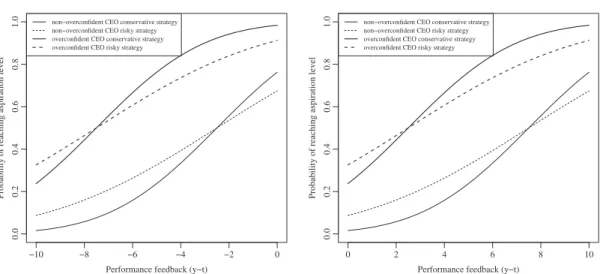
Now imagine an overconfident CEO who has the same aspiration level and receives the same performance feedback as a non-overconfident CEO. Due to the biased belief in her managerial ability, the probabilities of reaching the aspiration level under the two strategies differ from those for a non-overconfident CEO, which will eventually lead to a different choice of strategy. Figure 1 illustrates this point by showing the probabilities of reaching the aspiration level for a non-overconfident and an overconfident CEO, respectively, as a function of the received perfor-mance feedback.
As illustrated in Figure 1, because of her inflated perception of her own managerial ability, for any level of performance feedback an overconfident CEO will interpret the expected future performance of her firm to be more positive than it actually is. Therefore, whereas the
−10 −8 −6 −4 −2 0 0.0 0 .2 0.4 0.6 0.8 1.0
Negative Performance Feedback
Performance feedback (y−t)
Probability of reaching aspiration level
non−overconfident CEO conservative strategy non−overconfident CEO risky strategy overconfident CEO conservative strategy overconfident CEO risky strategy
0 2 4 6 8 10 0.0 0.2 0 .4 0.6 0.8 1.0
Positive Performance Feedback
Performance feedback (y−t)
Probability of reaching aspiration level
non−overconfident CEO conservative strategy non−overconfident CEO risky strategy overconfident CEO conservative strategy overconfident CEO risky strategy
F I G U R E 1 Probability of reaching aspiration level under risky and conservative strategy as a function of performance feedback (non-overconfident CEOs and overconfident CEOs).Note:Values are based on the following parameters:τ0=σ12
0=0:5,τ=
1
σ2=0:3,τp=1=σ2p=0:2,α=0, t=6; for the overconfident CEOα=^ 2;μ0=6 in the case of negative performance feedback, andμ0=2 in the case of positive performance feedback
behavioral theory of the firm suggests that when performance falls short of aspirations CEOs engage in problemistic search, explore alternative strategies, and tend to exhibit higher risk tak-ing in order to reach the aspiration level (e.g., March & Shapira, 1987; Wiseman & Bromiley, 1996), an overconfident CEO facing negative feedback might falsely believe that she is still in a situation where“locking in”the expected gains by choosing a low-risk strategy is the preferable and thereby perceives less need to increase risk. In other words, overconfident CEOs only prefer risky strategies when facing very strong negative performance feedback, and otherwise assume that they can still rely on past operating procedures in order to reach the aspiration level.7In summary, based on the previous argument we suggest that overconfident CEOs will interpret negative performance feedback as less severe as non-overconfident CEOs and will thus be less affected by negative performance feedback. This reasoning is stated more formally in the hypothesis below.
Hypothesis (H1) The relationship between firm risk taking and negative performance feedback will be moderated by CEO overconfidence such that the effect of negative feedback on risk taking will be less positive for overconfident CEOs.
We next turn our discussion to the case where financial performance exceeds aspirations. In general, as pointed out by prior work, managers of firms that are performing above their aspira-tions may be disinclined to engage in high levels of risk taking (Cyert & March, 1963; Gavetti et al., 2012). Specifically, Cyert and March (1963) argue that organizations generally rely on past operating procedures unless they fail to achieve aspirations. In particular, a positive outlook resulting from superior past performance creates an anticipation of likely future gains, which then leads to lower investments in risky projects as CEOs wish to avoid actions that might endanger these gains. We suggest that this prediction is even more likely to hold for over-confident CEOs. As can be seen in Figure 1, when facing positive feedback an overover-confident CEO will be more likely than a non-overconfident CEO to conclude that she has reached a situ-ation where high levels of risk taking are not necessary to reach the aspirsitu-ation level and instead a lower risk is desirable. On the other hand, it requires only relatively moderate positive feed-back to make a conservative strategy more appealing to the overconfident CEO. This argument is summarized in the hypothesis below:
Hypothesis (H2) The relationship between firm risk taking and positive performance feedback will be moderated by CEO overconfidence such that the effect of positive feedback on risk tak-ing will be more negative for overconfident CEOs.
2.6
|
Joint effects of survival level and CEO overconfidence
Firms do not always focus on reaching their social or historical aspiration (HA) levels. Instead, at times they try to ensure that the performance exceeds a minimal survival level—the
7This is also strongly in line with the suggestion made in the conceptual paper by Jordan and Audia (2012) on the effect
of self-enhancing attributions on the interpretation of feedback who suggest that“a decision maker may be performing poorly according to informed outside observers, but if she assesses her own performance as satisfactory, then
performance feedback theory's critical prediction that low performance induces the decision maker to intensify problem-solving responses is less likely to hold”(p. 212).
performance level at which the firm's existence is threatened (Audia & Greve, 2006; Chen & Miller, 2007; March & Shapira, 1992; Miller & Chen, 2004). In particular, when being in a situa-tion that threatens their firms' survival, CEOs shift their focus from reaching aspirasitua-tions toward ensuring survival (March & Shapira, 1987, 1992) and substantially decrease their risk taking. This might be because during a crisis CEOs have a clear obligation to avoid placing their firms in peril and to take actions that increase the probability of survival. Therefore, when CEOs focus their attention mainly on avoiding bankruptcy, they are likely to exhibit risk aversion. Consistent with these suggestions, prior empirical results indicate that organizations that are threatened by failure generally engage in less risk taking (Miller & Bromiley, 1990; Wiseman & Bromiley, 1996).
Guided by the above stream of literature, in the following, we refine our theoretical frame-work by incorporating the possibility that CEOs shift their focus from aspiration to survival levels, and derive additional predictions. Following March and Shapira's (1987, 1992) shifting-focus model which first drew attention to the important role of survival levels, we assume that once the expected performance falls below a certain threshold, CEOs will shift their attention from reaching the aspiration level to avoiding falling below the survival level. In this case, by the same intuition discussed previously, CEOs will try to“lock in”the current status quo and seek to minimize the variance in expected performance—leading to less risk taking. Thus, for firms operating near their survival level, upon receiving negative feedback, instead of increasing risk taking to reach their aspiration level, they will shift their focus toward avoiding bankruptcy and thus decrease the level of risk.
Importantly, just as overconfident CEOs are overly optimistic about reaching the aspiration level, they will also overestimate their distance from the survival level. Therefore, upon receiv-ing negative feedback, their focus will belesslikely to shift away from their aspiration level and toward the survival level, compared to non-overconfident CEOs. Figure 2 illustrates this intui-tion by showing the expected future performance of an overconfident and a non-overconfident CEO as a function of both the performance feedback they receive and the threshold at which attention shifts toward survival.
Since such a shift will be less likely to occur for overconfident CEOs than for non-overconfident CEOs, it is more likely that for firms operating relatively close to the survival level, upon receiving negative performance feedback, overconfident CEOs choose the risky strategy—designed to reach the aspiration level, whereas the non-overconfident CEOs are more likely to opt for the conservative strategy—thereby attempting not to fall below the survival level. This intuition is summarized in Hypothesis (H3).
Hypothesis (H3) When firms are operating close to their survival level, the relationship between firm risk taking and negative performance feedback will be moderated by CEO over-confidence such that the effect of negative feedback on risk taking will be less negative for overconfident CEOs than for non-overconfident CEOs.
3
|
M E T H O D S
3.1
|
Sample
Our sample consists of publicly listed American firms in the manufacturing industry (SIC codes 2000 to 3999). To construct our sample, we started with all manufacturing firms in the
Execucomp database consisting of roughly all companies in the S&P 1500 index. For these firms, we considered the period of 1992 to 2014 which constitutes all years for which all neces-sary data were available. We then added additional data from CRSP, Compustat, and Thomson One to compute our measures of performance feedback and firm-level controls. To avoid losing observations due to missing data, we also collected firm and CEO data from proxy statements when necessary. Importantly, following previous research on CEO overconfidence (e.g., Malmendier & Tate, 2005) and other CEO characteristics (e.g., Chatterjee & Hambrick, 2007), we use disjoint subsamples to establish our overconfidence measures and to determine its potential effects on firm outcomes. Specifically, we derived our measure of CEO over-confidence from the first 3 years of each CEO's tenure and then conducted our main analysis for the subsequent years. In total, our data collection generated a sample with complete data for 5,482 firm-year observations for 824 distinct firms.
3.2
|
Measures
3.2.1
|
Performance feedback
Following prior work (e.g., Bromiley, 1991; Chen & Miller, 2007; Miller & Chen, 2004), we employed return on assets (ROA) as our main measure of firm performance. Following Greve (2003) we calculated aspiration levels as a weighted average of historical and social aspirations (SA; see also Chen, 2008; Gaba & Joseph, 2013; Greve, 2003; Lim & McCann, 2014; Vissa et al., 2011). In particular, adapting the methodology by Greve (2003) we first modeled the HA level as an exponentially weighted moving average of performance in previous years: HAi,t−1=ð1−a1ÞPi,t−2+a1Pi,t−3: −10 −8 −6 −4 −2 0 2345678 PerformanceFeedback(y−t) Expected Future Performance ( μα +α )
shifting focus threshold non−overconfident CEO
overconfident CEO
F I G U R E 2 Shifting focus for overconfident and non-overconfident CEOs. Note. Values are based on the following parameters:τ0=σ12
0=
0:5,τ=1
σ2=0:3, τp=σ12
Thus, the HA level in t−1 is measured as the weighted average of the firm's own perfor-mance at timet−2 andt−3. To determine the weights, we varied the values ofa1from 0 to 1 with increments of 0.1 and found the best fit in terms of maximum log-likelihood at the value of 0.3. Next, we computed firms' SA levels as the median ROA of all other firms within the same industry group (defined at the four-digit SIC level). Finally, still following Greve (2003), we computed the combined aspiration level as a weighted average of historical and SAs:
Ai,t−1=a2HAi,t−1+ð1−a2ÞSAi,t−1
Like for HA levels, we again determined the weights by searching through different values from 0 to 1 with increments of 0.1 and found that a value fora2of 0.6 resulted in the highest log-likelihood of the model.
Based on our computation of aspiration levels, we then derived each firm's performance feedback as the difference between the firm's actual performance and its aspiration level. Thus, we generated two variables which capture positive and negative distance from aspiration levels: distance aspirations (negative) and distance aspirations (positive).8
3.2.2
|
CEO overconfidence
We employ two separate measures of overconfidence derived from the prior literature to test our hypotheses. This helps us to ensure that our findings are not driven by the idiosyncrasies of any specific measure of CEO overconfidence and to overcome some of the limitations that each individual measure might have. One of the most commonly employed approaches to assess CEO overconfidence in prior work relies on media portrayals that depict the CEO as over-confident (e.g., Chen et al., 2015; Hirshleifer et al., 2012; Malmendier & Tate, 2008). A second and often complimentary approach is based on CEOs' personal investment portfolios. In partic-ular, overconfidence of CEOs is deduced from their willingness to hold more company equity in the form of stock options than what would have been optimal, suggesting excessive confi-dence in their own managerial abilities to achieve a high financial outcome (e.g., Chen et al., 2015; Hirshleifer et al., 2012; Malmendier & Tate, 2005, 2008). In the following, we describe both measures in details.
Themedia-based overconfidencemeasure is based on the premise that media reports reflect
some of the underlying characteristics of a CEO. To compute this measure, we follow the proce-dure described in earlier work (see, e.g., Chen et al., 2015) and first searched for all news arti-cles about a particular CEO that appeared during the first 3 years of their tenure in major media outlet such as Business Week, Financial Times, New York Times, The Economist, and Wall Street Journal. For each CEO we then determined the number of articles that described the CEO as confident (e.g., “confident,” “confidence,” “optimism,” or “optimistic”) and the number of articles that described the CEO as not confident (e.g., “cautious,” “conservative,” “practical,” “frugal,” “steady,” “not confident,”or“not optimistic”). To increase the likelihood that the descriptions were indeed attributed to the CEO, we only counted confident or non-confident terms if they appeared within 10 words of the CEO's name. We then calculated the 8We also conducted our analysis with separate types of performance feedback based on only social or only historical
aspiration levels and found overall consistent results even though results were generally stronger for historical than for social aspiration levels.
difference between the number of articles that described the CEO as confident and those describing the CEO in non-confident terms. Finally, we divided this value by the total number of articles, resulting in a measure that could theoretically range from −1 to 1, where higher values indicate higher levels of overconfidence and vice versa.9
The option-based measurefirst established by Malmendier and Tate (2005) is based on the
premise that CEOs who persistently postpone exercising fully vested in-the-money stock options are overconfident about the future prospects of their firms, in comparison to the mar-ket's evaluation. In order to construct this measure, we analyzed the average“moneyness”of the CEO's options portfolio for the first 3 years in their tenure following the methodology out-lined in Hirshleifer et al. (2012). Based on this calculation we then coded a dummy variable capturing CEO overconfidence that takes a value of one if, at least once during the 3 years of their tenure, a CEO postponed the exercise of vested options that are at least 67% in the money, and zero otherwise.
3.2.3
|
Risk taking
We measure firm risk taking as a multidimensional construct (e.g., Chatterjee & Hambrick, 2011; Devers, McNamara, Wiseman, & Arrfelt, 2008; Miller & Bromiley, 1990). This approach addresses the issue that each spending category just provides a partial picture of a firm's overall risk taking, and thus by summing up measures of different categories we generate a more com-plete picture. Specifically, based on prior research (e.g., Devers et al., 2008) we measured the risk taking of a firm using two risk-taking dimensions: capital expenditure and the firm's long-term debt. All measures were scaled by dividing them with annual sales. In order to weight both variables, we extracted common components using principal component analysis. Recog-nizing that some studies also used R&D investment as a partial measure for risk taking (e.g., Chatterjee & Hambrick, 2011), we also employed an alternative operationalization of risk taking with R&D spending as a third category of our measure and found consistent results (reported in the online Data S2).
3.2.4
|
Threat of bankruptcy
We employed Altman's (1968) Z-score (Altman Z) as an indicator of how close a firm is operat-ing to its survival level (cf. Miller & Chen, 2004).
3.2.5
|
Control variables
We controlled forfirm size, measured as the logarithm of the total value of assets, which has been shown to be strongly associated with firm risk taking (e.g., Lim & McCann, 2014). Another important determinant of risk taking isfirm diversificationwhich we proxied for with Palepu's
9To confirm the reliability of our media-based measure, we asked two independent research assistants to read through
all media reports for a randomly selected subsample of 50 CEO and rate the perceived overconfidence of each CEO. We found a high level of interrater agreement (κ=0.259,p=.006) and the mean value given by the two raters
(1985) measure of relatedness among the various segments the firm operates in by computing a Herfindahl index across all two-digit SIC segments. Moreover, we controlled forfirm slack com-puted as the average of the SG&A (selling, general, and administrative expenses) to sales ratio and the current assets divided by current liabilities (Bromiley, 1991; Iyer & Miller, 2008). Fur-thermore, we controlled for firms' market-to-book ratio, which closely corresponds to a firm's growth opportunities and might thus affect risk taking (Baker & Wurgler, 2002), and forfree
cash flow. In addition to these firm-level controls, we also included several CEO specific
vari-ables. Specifically, we controlled for the value of CEO stock options granted in a particular fiscal year based on Black-Scholes valuation (CEO options), and for the value of CEO equity holdings
(CEO stocks) assessed as the number of shares a CEO owned in a fiscal year multiplied by the
closing stock price at the end of the year. In addition, we controlled forCEO age(in years) and
CEO tenure(in years).
Finally, since our overconfidence measures could reflect at least to some extent CEOs' accu-rate perception of their own high ability rather than biased self-perceptions we controlled in our analysis for CEO ability. Specifically, we use a measure developed and validated by Demerjian, Lev, Lewis, and McVay (2012) which is based on the premise that CEO ability is not directly observable and thus has to be inferred from observable resource allocation decisions of the CEO. The computation of this measure involves a two-stage procedure which is described in more detail in Demerjian et al. (2012). All ability scores are provided on their homepage from where we collected them. We find a positive, but relatively low and not significant correlation between the ability measure and our media-based overconfidence measure (r=.057,p=.126), and a positive and weakly significant correlation with our option-based overconfidence measure (r=.093,p=.082).10
To test our hypotheses, we employed OLS regression models11with firm fixed effects to con-trol for factors that are time invariant at the firm level. In addition, we also included year fixed effects. For all models, we report robust standard errors.
4
|
R E S U L T S
4.1
|
Main results
Table 1 presents means,SD, and correlations for all our variables.
We next present the results of several models that test our main hypotheses in Table 2. The dependent variable in all our regressions was firm risk taking in a given yeart. Model 1 shows the baseline results with all control variables. We then added variables that capture the positive and negative distance of firm performance to the aspiration level and CEO overconfidence (media-based) (Model 2) and CEO overconfidence (option-based) (Model 4). To test our main hypotheses, we next included interaction terms between our measures of CEO overconfidence and positive or negative distance from aspiration levels in Models 3 and 5.
10As an alternative measure for CEO ability, we also employed CEO cash compensation (e.g. Song & Wan, 2019)
measured as CEO salary and bonus in a specific year and found consistent results. For this measure, we find a negative correlation with our option-based overconfidence measure (r= −.005, p=.628) and a positive, but not significant, correlation with our media-based overconfidence measure (r=.001, p=.888).
11We also estimated a model using Arellano and Bond (1991) dynamic panel GMM estimator in which we included firm
TA BL E 1 Descriptive statistics Variable Mean SD 1234 567 891 0 1 1 1 2 1 3 1 4 1 5 1 6 1 Risk taking 0 1 1 2 Firm size 7.42 1.67 0.03 1 3 Altman Z 5.81 8.75 − 0.01 − 0.23 1 4 CEO options 0.14 0.87 0.00 0.10 0.12 1 5 CEO stock 1.56 4.36 − 0.03 − 0.21 0.08 − 0.01 1 6 Slack 0.01 0.93 0.01 − 0.40 0.59 0.02 0.09 1 7 Firm diversification 0.10 0.14 − 0.02 0.23 − 0.10 − 0.02 − 0.06 − 0.16 1 8 Market-to-book ratio 0.07 1.64 0.01 − 0.01 − 0.00 0.00 − 0.00 − 0.01 0.01 1 9 Free cash flow 0.00 0.08 − 0.01 0.00 0.00 − 0.00 − 0.00 − 0.00 − 0.02 − 0.04 1 10 CEO ability 0.02 0.12 − 0.00 0.15 0.07 0.11 − 0.00 0.07 − 0.00 − 0.00 − 0.00 1 11 CEO tenure (years) 7.99 6.95 − 0.01 − 0.15 0.09 − 0.02 0.38 0.13 − 0.03 0.01 − 0.02 0.01 1 12 CEO age (years) 56.13 7.07 − 0.00 0.08 − 0.07 − 0.05 0.14 − 0.08 0.07 − 0.01 − 0.01 − 0.00 0.41 1 13 Overconfidence CEO (options) 0.64 0.48 0.03 − 0.08 0.13 0.03 0.08 0.08 − 0.06 0.01 0.00 0.09 0.06 0.10 1 14 Overconfidence CEO (media) 0.03 0.06 0.03 0.00 0.00 − 0.00 − 0.00 − 0.00 0.02 0.00 0.00 0.06 0.01 0.02 0.11 1 15 Distance aspirations (negative) − 0.02 0.05 − 0.24 0.16 0.05 − 0.01 0.01 − 0.10 0.08 − 0.01 0.00 0.01 − 0.03 0.04 − 0.03 − 0.00 1 16 Distance aspirations (positive) 0.02 0.04 − 0.05 − 0.09 0.12 0.05 0.00 0.11 − 0.07 0.01 − 0.01 0.08 0.03 − 0.03 0.04 0.01 0.19 1 Note: N = 5,482.
TA BL E 2 Effects of performance feedback and CEO overconfidence on firm risk taking Variables CEO overconfidence (media-based) CEO overconfidence (option-based) Model 1 Model 2 Model 3 Model 4 Model 5 Coef. SE Coef. SE Coef. SE Coef. SE Coef. SE Firm size 0.047 0.023 0.070 0.024 0.064 0.024 0.070 0.024 0.076 0.022 Altman Z − 0.004 0.003 − 0.006 0.003 − 0.004 0.002 − 0.006 0.003 − 0.006 0.003 CEO options − 0.007 0.013 − 0.008 0.012 − 0.012 0.009 − 0.008 0.012 − 0.008 0.010 CEO stock − 0.001 0.002 − 0.002 0.002 − 0.002 0.002 − 0.002 0.002 − 0.002 0.002 Slack 0.008 0.035 0.032 0.035 − 0.003 0.022 0.032 0.035 0.027 0.032 Firm diversification − 0.111 0.224 − 0.089 0.264 − 0.100 0.260 − 0.087 0.264 − 0.182 0.255 Market-to-book ratio − 0.028 0.041 − 0.048 0.047 − 0.440 0.193 − 0.047 0.047 0.024 0.016 Free cash flow − 0.669 0.944 − 1.126 1.059 − 9.843 4.319 − 1.121 1.059 0.498 0.357 CEO ability − 0.904 0.532 − 0.502 0.298 − 0.356 0.190 − 0.501 0.300 − 0.377 0.227 CEO tenure − 0.005 0.003 − 0.002 0.002 − 0.002 0.002 − 0.002 0.002 − 0.002 0.002 CEO age 0.003 0.002 0.000 0.001 0.000 0.001 0.000 0.001 0.001 0.001 CEO overconfidence − 0.073 0.078 0.656 0.301 − 0.001 0.014 0.030 0.014 Distance aspirations (negative) − 1.353 0.872 − 0.408 0.223 − 1.352 0.872 − 1.177 0.433 Distance aspirations (positive) 0.142 0.145 0.094 0.125 0.142 0.145 1.015 0.394 Distance aspirations (negative) × CEO overconfidence 29.030 14.198 1.022 0.468 Distance aspirations (positive) × CEO overconfidence − 81.750 40.770 − 1.352 0.453 R 2 .039 .093 .131 .093 .109 Observations 5.482 4.532 4.532 4.532 4.532 Note: Robust standard errors. Firm and time fixed effectsare included. Exact p-values of the bold/italic values are described in the text.
In Hypothesis (H1), we predicted that the relationship between firm risk taking and nega-tive performance feedback will be moderated by CEO overconfidence such that the effect of negative feedback on risk taking will be less positive for overconfident CEOs. Strongly consis-tent with this prediction we find a significant positive interaction effect between negative dis-tance from aspirations and CEO overconfidence (media-based) (Model 3 in Table 2:β=29.029,
p= 0.041; CI95%[1.158, 56.901]) and CEO overconfidence (option-based) (Model 5 in Table 2:
β=1.021,p=0.029; CI95%[0.103, 1.941]). The effect is also of economic significance: a change in our interaction term by oneSDleads to a reduction of the firm risk taking by 0.046SDfor our option-based measure and 0.028 for our media-based measure.
Hypothesis (H2) postulates that the negative effect of positive performance feedback on risk taking will be moderated by CEO overconfidence such that it becomes even more negative for overconfident CEOs. Supporting this prediction, we find a significant negative interaction effect between positive distance from aspiration levels and the media-based overconfidence measure (Model 3 in Table 2:β = −81.749, p= .045; CI95%[−161.782,−1.718]) as well as the option-based measure (Model 5 in Table 2:β= −1.352,p=.003; CI95%[−2.241,−0.464]). The effect is again of economic significance: a change in the interaction term by oneSDleads to a change of the firm risk taking by 0.080 SD for our media-based measure and 0.051 SD for our option-based measure.
We next turn to our test of Hypothesis (H3) which predicts that when firms are operating close to their survival level (i.e., they are threatened by bankruptcy), the relationship between firm risk taking and negative performance feedback will be moderated by CEO overconfidence such that the effect of negative feedback on risk taking will be less negative for overconfident CEOs. To conduct our analysis, we first run our regressions on a split sample of (a) firms threatened by bankruptcy and (b) firms which are not. We used an Altman Z-score of 1.8 as the cutoff point: Firms above this score (n=4, 073) were considered distant from bankruptcy and firms below it (n=326) were con-sidered close to bankruptcy (e.g., Iyer & Miller, 2008).
We first note that in line with our prediction, firms threatened by bankruptcy significantly reduce their risk taking (β=2.571,p=.018; CI95%[0.466, 4.677]) when facing negative perfor-mance feedback. In order to test Hypothesis (H3), we first conduct our analysis on the same split sample as before, and then test for differences in the coefficients of the interaction terms between CEO overconfidence and distance from aspiration levels between firms threatened by bankruptcy and firms which are not. Consistent with Hypothesis (H3), we find that for firms close to bankruptcy our interaction term is insignificant for firms threatened by bankruptcy and consistent with our prediction switches signs. Specifically, for the interaction term between neg-ative distance from aspiration level and the media-based overconfidence measure we now have
β=34.71,p=.36, CI95%[−40.56, 110.01], and for the interaction with the option-based measure we now have β = 1.58, p = 0.67, CI95%[−5.81, 8.98]. Supporting Hypothesis (H3), we next employed a Chow test to analyze the difference in the interaction term coefficients between the two samples, and find significant differences for our media-based (χ2= 5.84, p = .014) and option-based (χ2=4.74,p=.018) overconfidence measures.
4.2
|
Additional analysis
In the following, we describe a number of additional results that provide insights into the underlying mechanisms behind our findings and help to distinguish between different possible interpretations.
4.2.1
|
The effects of CEO gender
One alternative interpretation of our results is that our overconfidence measures reflect at least to some extent CEOs' accurate perception of their own high ability rather than biased self-per-ceptions. We attempted to address this issue empirically by collecting data on proxies of actual CEO ability suggested in the literature and included this measures as controls in our main anal-ysis. To provide further supportive evidence for the role that overconfidence rather than ability is likely to play in our context, we build on the literature in psychology and behavioral econom-ics which repeatedly showed that women tend to be less confident about their abilities than men (e.g., Bengtsson, Persson, & Willenhag, 2005; Koellinger, Minniti, & Schade, 2013; Niederle & Vesterlund, 2007). Building on these findings, Huang and Kisgen (2013) have also already directly shown that female CEOs are less likely than male CEOs to engage in behavior that is typically associated with overconfidence, such as paying excessively high acquisition pre-miums. Moreover, Huang and Kisgen (2013) have linked this effect to overconfidence by show-ing that female CEOs score lower on typical measures of CEO overconfidence than male CEOs. Combined with our current findings this would suggest that female CEOs will react stronger to performance feedback than their male counterpart, that is, we would expect the interaction effect of ourfemale CEO dummyand the respective distance from aspiration levels to be statisti-cally significant and having the opposite sign as the coefficient ofCEO overconfidence. In partic-ular, the relationship between firm risk taking and negative performance feedback should be moderated by female CEOs such that the effect of negative feedback on risk taking will be stronger for female CEOs, whereas the negative effect of positive performance feedback on risk taking should be moderated by female CEOs such that it becomes less negative for female CEOs. Consistent with these predictions, we find a significant negative interaction between negative distance from aspirations and female CEOs (β = −1.153, p = .019; CI95%[−2.121,−0.187]) and a positive interaction effect between positive distance from aspira-tions and female CEOs (β=3.272,p=.000; CI95%[1.842, 4.702] when we replaced our measures of overconfidence with a gender dummy. Moreover, in line with these results and the prior find-ings by Huang and Kisgen (2013), a direct comparison revealed that female CEOs exhibited sig-nificantly less overconfidence than male CEOs (t=3.24,p=.001 for the option-based measure;
t=2.038, p=.042 for the media-based measure). Assuming that male and female CEOs do not differ in actual managerial skill, these results provide clear further evidence for our assertion that differences in our measures across CEOs are not driven by differences in actual ability.
These findings also help to provide insights into a second related question of interest. In par-ticular, one might wonder to what extent our findings reflect a more general overestimation by CEOs of their firms' future financial performance which could be due to reasons other than an overestimation of their own ability. CEOs might, for example, overestimate the overall value of their specific firms' capabilities and resource rather than their own personal ability, or have a general disposition to expect positive future outcomes. Even though, we cannot fully disentan-gle these effects the previously mentioned results do provide some evidence for the role of per-ceived ability in driving our observed effect. In particular, while consistent with this interpretation the literature has clearly shown differences between men and women with respect to their confidence in their own abilities (Bengtsson et al., 2005; Koellinger et al., 2013; Niederle & Vesterlund, 2007), there seems to be no other clear or more convincing reason why women should otherwise think more positively about the future performance of their firm than men.
4.2.2
|
CEO overconfidence across firms
In order to provide some additional insights into the role of perceived ability we also explored to what extent overconfidence remains constant when CEOs change firms. Thus, following Chatterjee and Hambrick (2007), we identified in our sample those CEOs who had already served as CEO in another public company included in our sample. This yielded 33 CEOs; we then computed the correlation between their overconfidence-media scores for their tenures in both companies. We find that the scores are highly and significantly correlated (r=.77, p=.000) showing a high degree of consistency for each CEO across successive CEO positions. While this result does not provide direct evidence for the role of overconfidence in their own ability, this pattern of within individual consistency across firms provides us with some confidence that our measures indeed reflect aspects of CEOs perceptions of themselves rather than a specific per-ception CEOs might have a particular firm.
4.2.3
|
Stability of CEO overconfidence over time
Finally, we directly tested for the possibility that the effects of initial CEO overconfidence might change over time if CEOs are exposed to highly positive or negative performance feedback. To do so, we generated a variable which captures if a CEO was exposed to persistent positive or negative performance feedback during her current tenure in the firm. Specifically, we measured the persistence of performance feedback with a rolling ratio variable computed as the periods of negative performance feedback over the periods of positive performance feedback for the spe-cific CEO in the current firm. We then included this measure as control in our regressions and found that all our main results remained significant at the 5% level. Additionally, we also con-ducted our original analyses on only the next 3 years after the initial assessment of CEO over-confidence during which CEOs could not yet have been exposed to persistent performance feedback in either direction and found results that are qualitatively similar to those reported previously using the whole sample.
4.3
|
Endogeneity concerns
One important remaining concern is that our estimates could be biased due to the omission of a confounding variable which affects both risk taking and CEO overconfidence. We have attempted to at least partially address this issue by including firm-fixed effects to account for any unobservable firm characteristic that are time-invariant. However, even though, given our relatively short sample period of 14 years, our fixed-effect estimator should be quite effective in controlling for unobservable variables on the firm level still does not fully rule out all possible concerns. In particular, prior research suggests that executives with certain attributes may be specifically attracted to and hired by firms where these characteristics are considered desirable due to the firm's specific circumstances (e.g., Schneider, 1987). While similarly as for findings about interaction effects more generally (see, e.g., Tang et al., 2018), this type of endogeneity does not provide a clear alternative explanation for our observed interaction effects of over-confidence and performance feedback on risk taking, it does suggest that our estimates could still be biased due to the sorting of more overconfident CEOs into companies with a certain preference for risk taking.
To address such concerns, we followed prior research (e.g., Chatterjee & Hambrick, 2007, 2011; Tang et al., 2018) and regressed our measure of CEO overconfidence against a set of vari-ables capturing the firm specific entry conditions of a particular CEO as well as other contem-poraneous variables. Specifically, these variables were comprised of firm performance, firm size, firm diversification, and change in performance, which were measured in the year prior to the year in which CEOs first took office, as well as year fixed effects. The other contemporane-ous variables were measured in the year after the CEOs started in their positions. In particular, we assessed if the CEO was also chairman of the board, CEO age, if the CEO was an insider, and the percentage of firm shares she owned. Among all these variables, none significantly predicted our media-based overconfidence measure and just firm performance and change in firm performance positively predicted our option-based overconfidence measure. When we included the predicted overconfidence score as controls in our regression all of our main results remained significant: β = 31.75, p = .028; CI95%[3.226, 60.07] and β = 1.011, p = .045; CI95%[0.03, 2.01] for the interaction between negative distance from aspiration levels and the option-based resp. media-based measure of CEO overconfidence; β = −85.76, p = .039; CI95%[−166.02,−3.89]) and β = −1.349, p = .003; CI95%[−2.33,−0.47]) for the interaction between positive distance from aspiration levels and the option resp. media-based over-confidence measure. In sum, our analysis suggests that endogeneity due to sorting was not a main driver of our results. Yet, we also note that other researcher designs might be even more effective in addressing such concerns. One such possibility would for example, be to explore sit-uations in which the specific characteristics of a CEO are mostly exogenous such as in the wake of the unexpected departure of the prior CEO due to death or illness (e.g., Fee, Hadlock, & Pierce, 2013).
5
|
D I S C U S S I O N A N D C O N C L U S I O N
The primary objective of this study was to examine how managerial biases in the form of over-confidence change the interpretation of performance feedback and thus firm risk taking in response to it. Our formal analysis suggests that overconfidence by CEOs will be associated with a lower willingness to increase firm risk taking in the case of negative performance feedback and a higher willingness to decrease risk when receiving positive feedback. However, when firms are threatened by the risk of bankruptcy, this relationship between firm risk taking and performance feedback should reverse. In this case, overconfidence might actually lead to more risk taking in reaction to negative feedback compared to reactions by non-overconfident CEOs. The results of our empirical analysis provided supportive evidence for all of these predictions.
These results make several important contributions. First, scholars have repeatedly called for a better understanding of how decision makers in organizations interpret performance feed-back (Greve & Gaba, 2017). In particular, because firms' response to performance feedfeed-back will be strongly affected by how their key decision makers, such as CEOs, interpret this information (e.g., Gavetti et al., 2012; Jordan & Audia, 2012; Levinthal & Rerup, 2006), there exists a clear need to better understand this process of interpreting performance feedback by executives in order to be able to assess its impact on organizational change (Greve & Gaba, 2017). Building on this line of reasoning, a number of recent papers have demonstrated that the interpretation of performance feedback can vary with the structural location of decision makers (Gaba & Joseph, 2013; Vissa et al., 2011), the interpretative requirements of the feedback received (Joseph & Gaba, 2015), and also the motives with which the decision maker approaches the
interpretation of feedback (Fang, Kim, & Milliken, 2014; Jordan & Audia, 2012). However, while these studies have begun to explore contextual factors under which the interpretation to performance feedback can vary (Greve & Gaba, 2017), the role of fundamental cognitive biases in this context has remained unexplored. Our research helps to close this gap and in doing so to map out more completely under what circumstances the traditional predictions in the performance feedback literature is likely to hold and when firm behavior will deviate. One particularly important implication that arises from our results in this context is that overconfident CEOs will generally be less affected by aspiration levels when they receive negative feedback that does not threaten the survival of their firm, and thus the specific pre-diction of increased risk taking which has been repeatedly empirically confirmed in the prior literature (see, e.g., Gavetti et al., 2012) will frequently not hold for them. In the same vein, our theoretical framework and its empirical test also enable us to identify more clearly than previous research when firms are likely to focus on their aspirations or on survival and how such a focus will affect risk taking (e.g., Chen & Miller, 2007; Joseph et al., 2016; March & Shapira, 1992; Miller & Chen, 2004). In particular, our results suggest that for firms that are close to their survival level, CEO overconfidence will generally shift attention away from firm survival and toward reaching aspiration levels, thereby reversing the previously described effect of CEO overconfidence which we found for firms not threatened in their survival.
Second, our findings also add to the growing research area of behavioral strategy (e.g., Levinthal, 2011; Powell et al., 2011) which has paid particular attention to the phenom-enon of overconfidence and connected it to a variety of different firm outcomes (see, e.g., Picone et al., 2014 for an overview). One particularly interesting implication of our results in this context is that overconfidence might frequently contribute to a resistance to change as overconfident CEOs are more likely to ignore negative performance feedback which would usually be a strong trigger of problemistic search (see, e.g., Gavetti et al., 2012). Thus, in stark contrast to previous work which has connected overconfidence to outcomes typically associated with organizational change such as increased innovation (Galasso & Simcoe, 2011) or mergers and acquisitions (Malmendier & Tate, 2008), our results show the potential other side of overconfidence as a possible inhibitor of risky change due to its effect of CEOs' interpretation of negative performance feedback. Related to this point, the present findings thus also suggest that rather than being triggered by an intent to justify past choices and sunk costs leading to an escalation of commitment (see, e.g., Sleesman, Conlon, McNa-mara, & Miles, 2012) as it has been suggested in the behavioral literature, insufficiently strong reactions to negative feedback might instead be caused by an CEO's overestimation of their own abilities to cope with a problematic situation without engaging risky change processes.
Finally, our results might also have managerial implications. Feedback in the form of their firms' financial results relative to the past or peers is one of the most important sources of infor-mation for executives when evaluating the success of their current strategy and the possible need for strategic change (see, e.g., Gavetti et al., 2012). It is thus crucial that executives are clearly aware of how their interpretations and reactions to both positive and negative financial results are affected by their own deeply held personal beliefs and dispositions. In addition, our findings suggest that boards as well as investors need to consider the possibility that when CEOs do not take action in the face of negative financial results this reaction might frequently be driven more by CEOs prior personal beliefs rather than an a purely objective interpretation of the firms' actual strategic situation.
6
|
L I M I T A T I O N S A N D F U T U R E R E S E A R C H
Clearly, our work is also subject to several limitations. First, it is important to acknowledge pos-sible alternative interpretations of our findings. Specifically, as discussed previously, one alter-native view on our results could be that highly confident CEOs in our study are not actually overconfident, but in fact simply highly skilled. We attempted to directly control for this possi-bility using proxies of true CEO apossi-bility in our analysis and still found supportive evidence for our hypotheses. Thus, even though we cannot fully rule out the potential role of true CEO abil-ity, this suggests that our results are indeed at least mostly driven by differences in CEOs idio-syncratic perception of their own ability rather than actual differences in managerial ability. Related to this issue, as discussed previously we cannot unambiguously link our measures to our suggestion that CEOs overestimate their own managerial abilities, rather than having a dis-position to overestimate the future value of their firm due to other related reasons. One possibil-ity would be that CEOs overestimate the value of their firms' capabilpossibil-ity and resources. Another closely related interpretation for our findings would be that rather than being overconfident about their own ability to create value, CEOs might differ in their dispositional level of opti-mism about future even