Use of OCL in a Model Assessment Framework:
An experience report
Joanna Chimiak–Opoka, Chris Lenz
Quality Engineering Research Group
Institute of Computer Science, University of Innsbruck Technikerstrasse 21a, A–6020 Innsbruck
Abstract. In a model assessment framework different quality aspects can be examined. In our approach we consider consistency and perceived semantic quality. The former can be supported by constraints and the later by queries. Consistency can be checked automatically, while for the semantic quality the human judgement is necessary. For constraint and query definitions the utilisation of a query language was necessary. We present a case study that evaluates the expressiveness of the Object Constraint Language (OCL) in the context of our approach. We focus on typical queries required by our methodology and we showed how they can be formulated in OCL. To take full advantage of the language’s expressiveness, we utilise new features of OCL 2.0. Based on our exam-ination we decided to use OCL in our analysis tool and we designed an architecture based on Eclipse Modeling Framework Technology.
1
Introduction
The necessity of model maintenance is growing together with the increasing size of models used in real applications. The importance ofintegrationgrows with the size and the number of designed models. The aspect of integration becomes crucial if the modelling environment is not homogeneous, i.e., it has to be dealt with diverse modelling tools and even with diverse notations. Such a situation is common if various aspects of the same system have to be described. For example in the domain of enterprise architecture modelling, for the description of business processes and technical infrastructure different tools and notations can be used. If additionally the models are large scale models with hundreds or thousands of elements they might very likely contain inconsistencies and gaps. Quality assurance of these models can not be done by pure manual inspection or review but requires tool assistance to supportmodel assessment.
We have developed a framework that is dedicated to both the integration and the assessment of models. To support the former we designed a modular archi-tecture with a generic repository as a central point, with a common meta model and consistency checks. For the latter we defined a mechanism for information retrieval, namely queries of different types. In our entire approach we focus on the static analysis of models.
The languages for expressing constraints and queries over models are an im-portant part of the model assessment process. Depending on their expressiveness it is possible to cover a wider or a narrower range of constraints and to retrieve more or less information from models.
One of the components of our heterogeneous tool environment for model assessment [1] is a generic analysis tool supporting queries over the model re-pository. Therefore, we started our case study on Object Constraint Language (OCL, [2,3]). In our study we want to examine all types of queries required by our methodology [4]. The OCL 2.0 provides a new definition and querying mechanisms which extend the expressiveness of this language. As described in [5,6], previous versions of OCL (1.x) were not expressive enough to define all of the operations required by relational algebra (RA) and were not adequate query languages (QLs). The main deficit of previous versions was the absence of the tuples concept. In the current version of OCL, tuples are already supported. Thus all primitive operators [7] needed to obtain full expressiveness of a QL, namely Union, Difference, Product, Selectand Project, can be expressed. This fact encouraged us to use OCL within our framework.
The remainder of the paper is structured as follows. In the next section we give a brief introduction to our methodology. Then, we present exemplary models (section 3.1) on which the case study from section 3.2 relies. In section 4 we present a design of our analysis module and finally, in the last section we draw a conclusion.
2
Model Assessment Framework
In this section, the methodology developed within the MedFlow project [4,1] is briefly described. A broader description of the methodology developed for systematic model assessment can be found in [4]. The architecture of our tool and the technologies and standards used for its implementation were described in [1]. The design based on the Eclipse Modeling Framework with a generic analysis tool is described in section 4.
As depicted in Fig. 1 at the topmost level of our architecture three compo-nents can be distinguished: a modelling environment, a model data repository, and an analysis tool. In this section, only the main ideas related to OCL appli-cation within our framework, which are necessary to understand the examples presented in section 3.2, are described.
Modelling Environment ←→ Model Data Repository ←→ Analysis Tool
The main assumption in our framework is that all designed models are based on a common meta model. Based on the meta model, the constraints for mo-delling tools are provided and the structure of the common central repository of model elements is generated. User modelscan be imported into the repo-sitory from modelling tools via adapters. The usage of a common meta model is crucial for model integration in a heterogeneous modelling environment with diverse notations and modelling tools.
Within our framework we consider two types of OCL expressions: constraints and queries, both defined at the meta model level and evaluated over user models. Constraints are related to modelling and extend the specification of models. The aim of using constraints is to support model consistency in an early mo-delling phase. They can be checked automatically each time model elements are saved to the repository or on demand. The expressions used for ensuring syn-tactical correctness are calledchecks(compare section 3.2).Queriesare related to the analysis phase and provide aggregated information on sets of model el-ements. The analysis by means of queries supportsemantic quality of models. As stated in [8], semantic quality belongs to the social layer and needs to be judged by humans. Our framework supports the user in the judgement process by providing mechanisms for information retrieval. Moreover, we can only eval-uate the perceived semantic quality comparing user knowledge of the considered domain with his interpretation of models [8] or in our case the results obtained by query evaluations. Both aspects of semantic quality examination — validity
and completeness— can be supported by queries. In the first case we check if all model elements are relevant to the domain. This can be achieved by listing all instances of a given meta model element and human inspection of their rel-evance. In the second case we look for elements from the domain in the model data repository.
We classify the constraints and queries in four categories (see examples in section 3.2):
Primitive query is the simplest query, which takes as arguments OCL Primi-tive Types or MOF Classes.
Check is a special kind of primitive query which returns a Boolean value. It is considered as a constraint for a model or, in particular case, as an invariant for a classifier.
Compound query is a query which aggregates results of primitive queries. The arguments of the query are collections. For a given collection the Carte-sian Product is built and for each of its element a given primitive query is evaluated. The result is ofSet(TupleType)type.
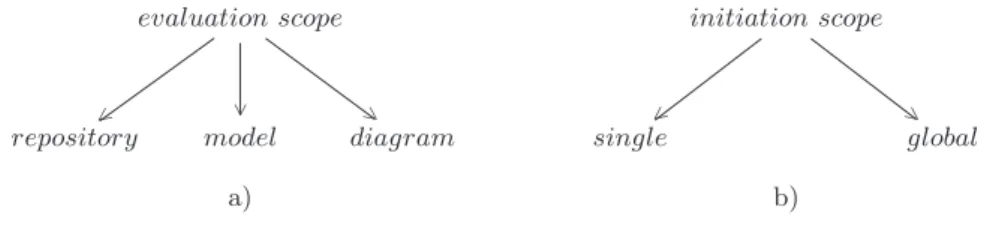
Complementary query is a query evaluated over the result of a given com-pound query. All other queries are evaluated over a set of model elements. The query can use checks and primitive queries for result calculation. All types of queries and checks can be evaluated on demand in different scopes selected by a user. We distinguish two types of scopes, namely an evaluation and an initiation scope. The evaluation scope (Fig. 2.a) determines, over what content
the query will be interpreted, and the initiation scope (Fig. 2.b), how the query is called.
evaluation scope initiation scope
repository< model ∨ diagram > single < global > a) b)
Fig. 2. The classification of scopes
Furthermore in both scopes we distinguish modes. In the evaluation scope we distinguish three modes:
Repository mode — the complete set of model elements is considered, i.e., a given expression is evaluated over the content of the repository.
Model mode — only a single user model is considered, e.g. in a running mo-delling tool on a local machine or model of a predefined type (filtered from the repository). This mode can be used if the queries do not need to be evaluated in the context of the complete set of elements (e.g. checks). Diagram mode — only one diagram is considered. The usage of this mode is
similar to the model mode.
The repository mode is typical for queries in the analysis phase. The ad-vantage of the model and the diagram mode is the possibility of making fast evaluation and ongoing corrections during the modelling phase.
In the initiation scope we consider two different modes, both can be evaluated in any evaluation scope.
Single (element) mode — only queries related to a given element can be activated. This mode enables fine granular analysis of models.
Global mode — all queries can be activated. This mode enables global analysis of models.
An analysis module for our methodology should be generic enough to enable both the definition and interpretation of arbitrary queries. In section 3.2, we examine the expressiveness of OCL and evaluate the possibility of its usage in the analysis module.
3
Case study
In this section the case study from the MedFlow project is presented. At first (section 3.1) the excerpt of the domain in question, in form of meta and user
models, is presented. Then examples of queries are presented (section 3.2) and their analysis within our framework is conducted (section 3.3).
3.1 Modelling of clinical processes
In the subsequent sections, parts of a meta model designed within theMedFlow
project and exemplary user models are presented. The meta model is used as a base for check and query definitions, the user models as a base for check and query evaluations (section 3.2). For our study we used a tool dedicated for OCL compilation, namely the OCL Environment (OCLE, [9]). In this tool, OCL expressions can be compiled and evaluated for single instances or for an entire project. The models and all queries were implemented in the OCLE version 2.0. We stress the fact that the used OCL syntax is the one implemented in the OCLE.
Meta model The aim of theMedFlowproject was the optimisation of clinical processes. Within the project, we developed a meta model of the clinical pro-cesses domain. Fig. 3 shows a fragment of the meta model (the complete meta model can be found in [4]).
Fig. 3.Part of theMedFlow’s meta model
In the meta model excerpt we can distinguish two main classes:Information andLogicalTool.LogicalToolis an abstract class with two subclasses:ITBasedSystem andPaperBasedSystem.Informationcan be saved inLogicalTool, expressed by an as-sociationprovidedByTool.LogicalToolcan use anotherLogicalTool, what is expressed by the associationuses. This simplified meta model is used as a base for the check and query definitions in section 3.2.
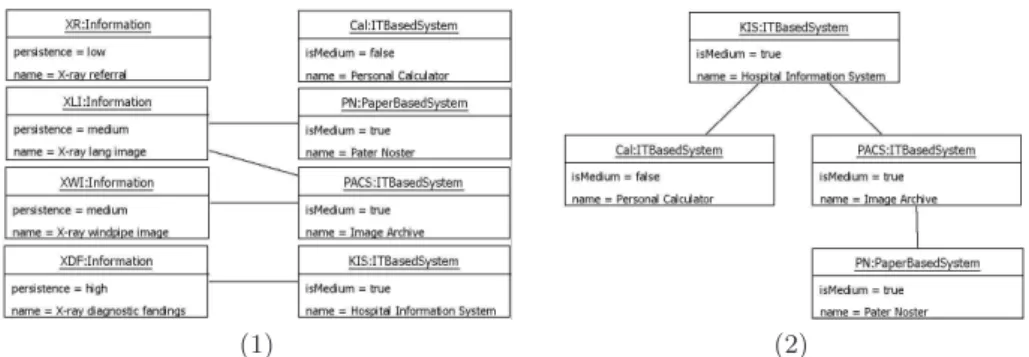
User models Based on an meta model (c.f. the previous section) user mo-dels are created. In our case study, we used the simplified meta model and two exemplary user models presented in Fig. 4.
In the first user model (Fig. 4.1) four instances of Information and four in-stances ofLogicalToolare defined. The instances ofInformationhave diverse persis-tence levels (low,medium,high) and instances ofLogicalToolare of diverse type (IT–
(1) (2)
Fig. 4.Exemplary user models: (1) instances of classesInformation,LogicalTool and associations between them, (2) hierarchy of instances ofLogicalTool
and paper–based). AnInformation can be saved in aLogicalTool if theLogicalTool is a medium (c.f. Example 2). There are four association links between instances ofInformationand instances ofLogicalTool. In the second user model (Fig. 4.2) the hierarchical dependencies between four instances ofLogicalToolare defined. These simplified user models are used as a base for the check and query evaluations in the next section.
3.2 Definition and evaluation of checks and queries
In this section, we present typical checks and queries. All definitions conform to the MedFlow meta model (Fig. 3) and their results are evaluated over the exemplary user models (Fig. 4). The examples are based on a representative selection of all types of checks and queries used within our framework for model assessment.
In the examples the checks and queries are defined in natural language and inspected manually. The corresponding listings are expressed in OCL 2.0 and automatically evaluated in OCLE version 2.0.
If not stated divers, definitions (def) and invariants (inv) are defined and evaluated in the context of Information (context Information) and based on the diagram depicted in Fig. 4.1. This context is added for technical reasons to enable easier compilation of OCL expressions. The definitions themselves are not context dependent (no reference ofselfis used within them).
Primitive query A primitive query can return a value of primitive type (except the Boolean type), class type or collection type. The construction of a primitive query is similar to the below defined examples for checks, thus we do not provide additional examples.
Check The simplest concept for information retrieval is a check. It is a function with a set of objects as a domain.
In Example 1 and Listing 1, the check is defined and evaluated. It checks if there exists an association between a givenInformationand a givenLogicalTool.
Example 1. (theCheck)
Definition:Is a given information saved in a given logical tool?
EvaluationforXLIandKIS: no.
Listing 1 (theCheck) Definition:
1 d ef: l e t
theCheck ( i :Information, l t : Lo g ica lTo o l)
3 = i . p r o v i d e d By To o l−>i n t e r s e c t i o n (Set{l t})−>notEmpty ( ) Evaluation: 1 d ef: l e t o b j I n f o = Information. a l l I n s t a n c e s 3 −>s e l e c t ( name=”X−r a y l u n g image ” ) −>any (t r u e) 5 l e t o b j L To o l = Lo g ica lTo o l. a l l I n s t a n c e s
−>s e l e c t ( name=” H o s p i t a l Information System ” )
7 −>any (t r u e)
l e t t h e C h e c k R e s u l t = theCheck ( o b j I n f o , o b j L To o l )
9 −− S e l e c t i o n : Boolean = f a l s e
Predefined check Checks can be used to express some well–formedness rules. Such checks should be defined during the meta modelling phase and are called predefined checks.
In Example 2 and Listing 2 a predefined check is defined and evaluated.
Example 2. (thePredefinedCheck)
Definition:An information can be saved only in logical tools which are mediums.
Evaluation: is fulfilled for all instances.
Predefined checks can be expressed in the form of invariants and checked for all instances of the context class by calling the function check UML models for errorsin the OCLE tool.
Listing 2 (thePredefinedCheck) Definition:
1 inv: s e l f . p r o v i d e d By To o l−>f o r A l l ( l t|l t . isMedium=t r u e) Evaluationcheck UML models for errors:
- Model appears to be correct according to the selected rules.
Compound query In order to aggregate information collected with single queries, we can build a compound query. The collections of elements, used as arguments, can be build in different manners, we can use all instances or a subset of them.
Example 3 and Listing 3 depict the results of the compound query with the check defined in Example 1 and Listing 1, applied for all instances ofInformation and LogicalTool. In Example 3, the result is presented in form of a table while in the Listing 3 it is presented as a set of tuples.
Example 3. (theCompoundQuery)
Definition:
EvaluatetheCheckfor all instances ofInformationandLogicalToolclasses. Evaluation:
Information\Logical Tool KIS PACS PN Cal
XR no no no no
XLI no yes yes no
XWI no yes no no
XDF yes no no no
Listing 3 (theCompoundQuery) Definition:
1 d ef: l e t
theCompoundQuery ( I n f C :Set(Information) , LToolC :Set(Lo g ica lTo o l) ) :
3 Set(TupleType( i : Information, 5 l t : LogicalTool, r : Boolean ) ) = 7 InfC−>c o l l e c t ( i n f o | LToolC−>c o l l e c t ( l t o o l | Tuple { 9 i : Information = i n f o , l t : Lo g ica lTo o l = l t o o l , 11 r : Boolean = theCheck ( i n f o , l t o o l ) }))−>a s S e t ( ) Evaluation: d ef: 2 l e t theCompoundQueryResult =
theCompoundQuery (Information. a l l I n s t a n c e s ,Lo g ica lTo o l. a l l I n s t a n c e s )
4 /∗
S e l e c t i o n : Se t ( Tuple ( i : Info r m a t io n , l t : L o g i c a l T o o l , r : Boolean ) ) = Se t{
6 Tuple{ XDF , PN , f a l s e } , Tuple{ XDF , PACS , f a l s e } ,
Tuple{ XDF , Cal , f a l s e } , Tuple{ XDF , KIS , t r u e } ,
8 Tuple{ XR , PN , f a l s e } , Tuple{ XR , PACS , f a l s e } ,
Tuple{ XR , Cal , f a l s e } , Tuple{ XR , KIS , f a l s e } ,
10 Tuple{ XWI , PN , f a l s e } , Tuple{ XWI , PACS , t r u e } ,
Tuple{ XWI , Cal , f a l s e } , Tuple{ XWI , KIS , f a l s e } ,
12 Tuple{ XLI , PN , t r u e } , Tuple{ XLI , PACS , t r u e } ,
Tuple{ XLI , Cal , f a l s e } , Tuple{ XLI , KIS , f a l s e }
14 } ∗/
Filtering We can additionally apply filters before or after evaluating the result of a given compound query.
The filtered compound query presented in Example 4 and Listing 4 is eva-luated only for instances ofInformationandLogicalToolclasses, which fulfil addi-tional constraints.
Example 4. (theFilteredCompoundQuery)
Evaluate theCheck for instances of Information, which have the persistence attribute set tomediumorhighand instances ofLogicalTool, which have the attributeisMedium equal to true.
Evaluation:
Information\Logical Tool KIS PACS PN
XLI no yes yes
XWI no yes no
XDF yes no no
The definition oftheFilteredCompoundQuerypresented in Listing 4 uses the resulttheCompoundQueryfrom Listing 3. Like in the previous section, the result
(theFilteredCompoundQueryResult) is presented as a set of tuples.
Listing 4 (theFilteredCompoundQuery) Definition:
d ef: l e t
2 t h e F i l t e r e dCo mpo und Que ry ( ) = theCompoundQueryResult−>s e l e c t ( t | ( t . i . p e r s i s t e n c e=#medium or t . i . p e r s i s t e n c e=#h i g h )
4 and t . l t . isMedium = t r u e ) Evaluation:
d ef:
2 l e t t h e F i l t e r e d Co m p o u n d Q u e r y Re su l t = t h e F i l t e r edCo mpo un dQu ery ( )
/∗
4 S e l e c t i o n : Se t ( Tuple ( i : Info r m a t io n , l t : L o g i c a l T o o l , r : Boolean))= Se t{
Tuple{ XDF , PN , f a l s e } , Tuple{ XDF , KIS , t r u e } ,
6 Tuple{ XDF , PACS , f a l s e } , Tuple{ XWI , PN , f a l s e } ,
Tuple{ XWI , KIS , f a l s e } , Tuple{ XWI , PACS , t r u e } ,
8 Tuple{ XLI , PN , t r u e } , Tuple{ XLI , KIS , f a l s e } ,
Tuple{ XLI , PACS , t r u e } } ∗/
Collecting Elements can be collected according to specific properties (e.g. values of slots, existing links). In the example below we collect elements according to the element hierarchy (c.f. Fig. 4.2). We do not construct a complete definition of a compound query, we only demonstrate how to create a collection using a recursive OCL function.
Example 5. (theCollection) Definition:
Collect all LogicalTools used by a given LogicalTool.
Listing 5 (theCollection) Definition:
1 context Lo g ica lTo o l d ef: l e t
3 g e t U s e d T o o l s ( t : Lo g ica lTo o l) : Set(Lo g ica lTo o l)
= t . u s e s−>c o l l e c t ( x|g e t U s e d T o o l s ( x))−>a s S e t ()−>u n i o n ( t . u s e s )
Evaluation:
d ef:
2 l e t o b j L To o l = Lo g ica lTo o l. a l l I n s t a n c e s
−>s e l e c t ( name=” H o s p i t a l Information System ” )
4 −>any (t r u e)
l e t LToolC = g e t U s e d T o o l s ( o b j L To o l )
6 −−− S e l e c t i o n : Se t ( L o g i c a l T o o l ) = Se t{ PN , Cal , PACS }
Complementary query After the evaluation of a compound query, comple-mentary queries can be evaluated over the obtained result.
In Example 6, a complementary query is defined and evaluated.
Example 6. (theComplementaryQuery)
Definition:
Which instances ofLogicalToolare use to saveInformationobjects with persistence level medium.
Evaluation:
{P ACS, P N}
The OCL expression presented below depicts one of the possible ways to express this complementary query. The condition in line 4 corresponds to the filtering condition and the remaining conditions correspond to the iteration over the result of the compound query.
Listing 6 (theComplementaryQuery) Definition:
d ef: l e t
2 theComplementaryQuery : C o l l e c t i o n( Lo g ica lTo o l ) =
Lo g ica lTo o l. a l l I n s t a n c e s ( ) 4 −>s e l e c t ( l t o o l | theCompoundQueryResult −>s e l e c t ( t | ( t . i . p e r s i s t e n c e = #medium ) and 6 ( t . l t = l t o o l and t . r = t r u e))−>notEmpty ( ) ) Evaluation: d ef:
2 l e t t h e Co m p l e men ta ry Qu ery Re su lt = theComplementaryQuery
−− S e l e c t i o n : C o l l e c t i o n ( L o g i c a l T o o l )= Se t{ PACS , PN }
One can notice that the usage of compound queries does not simplify OCL expressions for complementary queries. The complementary query defined in Example 6 can be expressed based on the result of the previously defined com-pound query (theCompoundQueryResult) as in Listing 6 or without any def-inition as in Listing 7. The results in both listings, 6 and 7, are equal. The
expression in Listing 7 seems to be easier and does not depend on any other definitions. Listing 7 (theComplementaryQueryBis) Definition: 1 Lo g ica lTo o l. a l l I n s t a n c e s −>c o l l e c t ( l t o o l | Information. a l l I n s t a n c e s 3 −>s e l e c t ( i | i . p e r s i s t e n c e=#medium ) . p r o v i d e d By To o l)−>a s S e t ( )
At this point, the question why compound queries are useful for complemen-tary queries may arise. Let us explain our motivation for the usage of the first variant. In our prototype for theMedFlowproject we have a common repository for all models. To evaluate a compound query we have to gather information from the repository, which can be located on a remote server. If we define a complementary query based on the result of the compound query, then the eval-uation is faster, otherwise for the evaleval-uation of a complementary query we again need to gather information from the repository. Moreover, we can evaluate more complementary queries over the same compound query without further connec-tion to the repository. The second reason for using the variant with compound queries is the modified presentation of the results of complementary queries. With some additional effort the result can be presented as a set of elements in form of highlighted elements in the result of compound query (c.f. Example 7).
Example 7. (theComplementaryQuery)
Evaluation:{P ACS, P N}
Persistence\Logical Tool KISPACS PNCal
low 0 0 0 0
medium 0 2 1 0
high 1 0 0 0
3.3 Summary
We showed how to construct all types of checks and queries used in our frame-work. The OCL 2.0 is expressive enough to be applied in our framework for model assessment.
The models created in our framework are MOF compliant and as the OCL supports the object oriented paradigm, it is easy to navigate through the ob-ject structures and create checks (compare Example 1) and queries. The in-variants can be used as consistency checks before saving models to the repo-sitory (Example 2). Tuples provide useful mechanisms for the aggregation of information of different types. Using tuples it is possible to evaluate the Carte-sian Product of given sets, what was used within our compound queries con-cept (Example 3). Using the select operation it is possible to filter collections. The select operation can be applied either to the result of a compound query (Example 4) or to a domain of it (for each argument separately). The first manner enables the expression of more complex conditions (e.g. in the form (e1.a1 = v11∧e2.a1 = v12)∨(e1.a1 = v12∧e2.a1 = v22), where ei denotes an
elementi,aj an attributej, andvji some value). OCL does not have a built–in operator for transitive closure, but it allows definitions of recursive functions. In Listing 5 used tools are recursively collected in order to represent the transitive closure of the relation defined byuses. Complementary queries can be expressed in OCL in two different manners. The first is based on a previously defined com-pound query and the second is a definition from scratch. The first one seems to be easier to automate regarding query definition and results presentation.
4
Technical aspects
In the SQUAM project we continue development of the system for quality as-sessment of models started in theMedFlowproject [1]. In this section we present redesigned architecture of our system which utilises the newest components de-veloped within the Eclipse Modeling Framework (EMF1). The architecture pre-sented below integrates three components of Eclipse Modeling Framework Tech-nology (EMFT2), namely Connected Data Objects (CDO3), Object Constraint Language (OCL4) and Query (QUERY5), to create a system with a central model repository and a generic analysis tool. The architecture of the repository and the management of checks and queries are described in subsequent sections. 4.1 Architecture
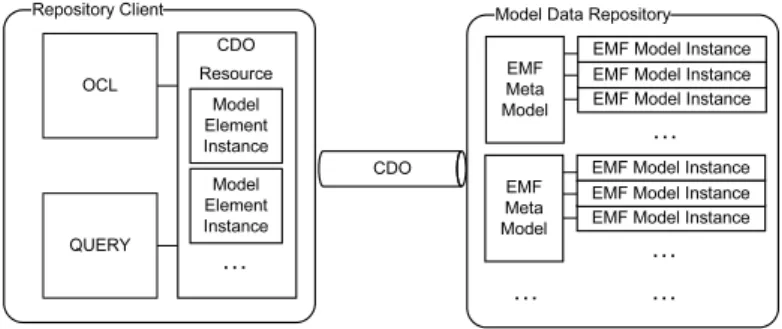
As mentioned above the design of the model data repository is based on the EMF and some of the EMFT projects.EMF is a modelling framework and code generation facility for building tools and other applications based on a structured data model[10]. The model data repository uses EMF as the meta model, it can save model instances of different EMF meta models (c.f. Fig. 5).
The architecture of the model data repository is based on the client–server paradigm. The repository clients can connect to a relational database manage-ment system via CDO, which provides multi user support. The connected clients can search, load, save or create new EMF model instances of an arbitrary EMF meta model. Moreover CDO provides a notification mechanism to keep connected clients up to date on model changes.
The repository client integrates the EMFT projects, OCL and QUERY, to specify and execute queries on EMF model elements. OCL component provides an Application Programming Interface (API) for OCL expression syntax which can be used to implement OCL queries and constraints. The QUERY compo-nent facilitates the process of search, retrieval and update of model elements; it provides an SQL like syntax.
1 http://www.eclipse.org/emf/ 2 http://www.eclipse.org/emft/ 3 http://www.eclipse.org/emft/projects/cdo/ 4 http://www.eclipse.org/emft/projects/ocl/ 5 http://www.eclipse.org/emft/projects/query/
TheSQUAMtool family is based on the above described core functionalities out of the EMF and EMFT projects. The repository client API (CDO, EMF, OCL and QUERY) provides an access mechanism for other tools, mostly mo-delling tools. The tree–based editors can be generated out of EMF meta model definitions. The native editors are especially useful for the prototyping phase, later on we plan to integrate some graphical editors to create model instances. In the MedFlow prototype we integrated the MS Visio6 and MagicDraw7 mo-delling tools. We plan to integrate these two momo-delling tools as well as editors developed within the Graphical Modeling Framework (GMF8) with theSQUAM tool family.
Fig. 5.The model data repository architecture design
For the analysis purposes we use the repository client which uses the OCL component to make queries on the model instances. The management of checks and queries is described in the subsequent section.
4.2 Checks and queries management
The OCL component provides mechanisms for check and query definitions and evaluations. In our framework it should be possible to evaluate checks and queries on demand, thus we need an OCL management system to store OCL expressions. For this purpose we implement a checks and queries catalogue. The catalogue enables users to evaluate OCL expressions in different modes (c.f. Fig. 2 in section 2).
The meta model of the OCL management system is also modelled in EMF, therefore the OCL expressions can also be saved in the model data repository in the same manner as other model instances.
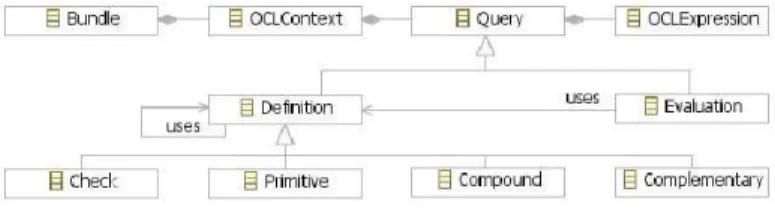
Fig. 6 illustrates the simplified meta model for the OCL management sys-tem. The model data repository supports the storage of several meta models. To
6
http://office.microsoft.com/visio/
7
http://www.magicdraw.com/
8
GMF is a combination of the EMF and GEF (Graphical Editing Framework) projects,http://www.eclipse.org/gmf/
Fig. 6. The meta model of the OCL management system
differentiate between queries specific to a given meta model we assign OCL ex-pressions to a specificBundle. TheBundledefines the type of the model instances by specifying the meta model they have to conform to.
Further we consider queries, where each Query is placed in a particular OCLContext. The context of the OCL expression enables the usage of the self
element. The context can also beNULL, it is useful for expressions without any particular contexts. In the example listings presented in section 3.2, for all list-ings except Listing 2 and Listing 5,NULLcontext can be used (these listings do not use theselfkeyword and the definitions are not related to the particular classifier). TheQueryelement contains oneOCLExpression.
We distinguish between a definition (Definition) and an evaluation (Evalu-ation) of queries. Within one Definition the prior definitions can be used, e.g. a compound query can use a primitive query (compare section 3.2). An OCL expression in theEvaluationalso uses definitions. TheDefinitionis split into the Check,Primitive, CompoundandComplementaryexpressions. TheDefinition ele-ments are eleele-ments which can be used as subroutines in other expressions and the Evaluation elements are evaluated over an explicit data model, where the OCLContexthas to be set to an explicit instance of a model element.
The presented design is a proof of concept for the model data repository. Used technologies and design allow easy extensions with additional features such as dynamic load of new meta models, or an extended editor for the OCL manage-ment system with OCL syntax check and compilation at design time.
5
Conclusion
Our examination shows that the OCL is expressive enough to be applied as a query language for model analysis. It is possible to define all types of checks and queries required by our model assessment framework (section 3.2). There are two other reasons for OCL usage within our framework. Firstly, there are more and more tools supporting the OCL notation, also non–commercial tools (e.g. OCL project within EMFT described in section 4 or tools presented in [11]). The second reason ensues from the first: the knowledge of the notation is getting broader among scientists and pragmatic modellers.
We presented a proof of concept for the model data repository created within EMF and EMFT technologies. In the pesented architecture OCL queries for as-sessment of models can be saved in the repository (section 4.2) and evaluated
on demand. Currently we are developing full support for the OCL management system (section 4.2). We plan to carry out more case studies to determine more requirements for model assessments queries and define patterns for query defi-nitions.
Acknowledgement
We would like thankDan Chioreanfor the presentation of the OCLE tool at our University and the later helpful tips for OCL expression implementation in the OCLE. We would like to thank all of the people who reviewed our paper and gave us constructive input, especially Frank Innerhofer–Oberperfler and both
reviewers. And at last but not leastRuth Breu, who supported us in our work.
References
1. Chimiak-Opoka, J., Giesinger, G., Innerhofer-Oberperfler, F., Tilg, B.: Tool– supported systematic model assessment. Volume P–82 of Lecture Notes in In-formatics (LNI)—Proceedings., Gesellschaft fuer Informatik (2006) 183–192 2. OMG: Object Constraint Language Specification, version 2.0 (2005)
3. Warmer, J., Kleppe, A.G.: The Object Constraint Language—Precise Modeling with UML. first edn. (1999)
4. Breu, R., Chimiak-Opoka, J.: Towards systematic model assessment. In Akoka, J., et al., eds.: Perspectives in Conceptual Modeling: ER 2005 Workshops CAOIS, BP-UML, CoMoGIS, eCOMO, and QoIS, Klagenfurt, Austria, October 24-28. Volume 3770 of Lecture Notes in Computer Science., Springer-Verlag (2005) 398–409 5. Akehurst, D.H., Bordbar, B.: On querying UML data models with OCL. In
Gogolla, M., Kobryn, C., eds.: UML. Volume 2185 of Lecture Notes in Computer Science., Springer (2001) 91–103
6. Mandel, L., Cengarle, M.V.: On the expressive power of OCL. In Wing, J.M., Woodcock, J., Davies, J., eds.: World Congress on Formal Methods. Volume 1708 of Lecture Notes in Computer Science., Springer (1999) 854–874
7. Codd, E.F.: Relational completeness of data base sub-languages. Data Base Sys-tems, Rustin(ed), Prentice-Hall publishers (1972)
8. Krogstie, J., Solvberg, A.: Quality of conceptual models. In:
In-formation systems engineering: Conceptual modeling in a quality
per-spective. Kompendiumforlaget, Trondheim, Norway (2000) 91–120
(avail-able at http://www.idi.ntnu.no/∼
krogstie/publications/2003/quality-book/b3-quality.pdf, last checked 2006–08–29).
9. LCI team: Object constraint language environment (2005) Computer Science Re-search Laboratory, ”BABES–BOLYAI” University, Romania.
10. Eclipse Foundation Inc.: Eclipse Modeling Framework homepage,
http://www.eclipse.org/emf(2006)
11. Baar, T., Chiorean, D., Correa, A.L., Gogolla, M., Hußmann, H., Patrascoiu, O., Schmitt, P.H., Warmer, J.: Tool support for OCL and related formalisms - needs and trends. In Bruel, J.M., ed.: MoDELS Satellite Events. Volume 3844 of Lecture Notes in Computer Science., Springer (2005) 1–9