Software as a Service: Implications for Investment in Software Development
Vidyanand Choudhary
The Paul Merage School of Business
University of California, Irvine
Irvine, CA 92697
[email protected]
Abstract
Software as a Service (SaaS) is a rapidly growing model of software licensing. In contrast to traditional software where users buy a perpetual-use license, SaaS users buy a subscription from the publisher. Whereas traditional software publishers typically release new product features as part of new versions of software once in a few years, publishers using SaaS have an incentive to release new features as soon as they are completed. We show that this property of the SaaS licensing model leads to greater investment in product development under most conditions. This increased investment leads to higher software quality in equilibrium under SaaS compared to perpetual licensing. The software publisher earns greater profits under SaaS while social welfare is also higher.
1. Introduction
“Something momentous is happening in the software business. Bill Gates of Microsoft calls it “the next sea change”. Analysts call it a “tectonic shift” in the industry. Trade publications hail it as “the next big thing””[20]. There is excitement in the software industry surrounding the rise of ‘Software as a Service’ (SaaS). SaaS is seen as a possible replacement to traditional software where the buyer obtains a perpetual license and installs and maintains all necessary hardware, software and other technical infrastructure. Under SaaS, the software publisher (seller) runs and maintains all necessary hardware and software and buyers obtain access using the Internet. For example Salesforce.com with annual revenues of over $300M, offers On-Demand Customer Relationship Management software solutions built on its own infrastructure and delivered directly to users over the Internet. Salesforce.com
does not sell perpetual licenses; instead it charges a monthly subscription fee starting at $65/user/month.
The Economist [20] estimates that the market for SaaS is growing at 50% each year. Other trade publications are equally enthusiastic about SaaS, for example the title of a recent International Data Corp. (IDC) white paper on SaaS [13] reads “The future of software licensing: Software Licensing under siege”. Credit Suisse First Boston has released an index to track this sector and their analyst John Maynard claims that “Traditional software is already dead” [20]. Although these articles in trade publications communicate the view that SaaS represents a dramatic change from traditional software, few substantive differences between SaaS and traditional software have been documented. Trade journals point out that SaaS does not require large upfront investments and thus there is an impact on cash flows of both buyer and seller with small, stable cash flows under SaaS rather than large periodic payments. Data security is another issue since users’ data is stored on the vendors’ hardware and systems. The University of Florida lists predictable costs, increased bargaining power, ability to switch across providers and up to date software as the key benefits based on a one year experiment with SaaS [8]. In this paper, we focus on the last of these reported benefits, i.e. users’ access to the latest and most current version of the software. SaaS and perpetual use licenses are different licensing schemes and thus typically considered to be marketing decisions that follow product development. In contrast we show that these licensing decisions influence the firm’s incentive to invest in product development. In particular, we focus on how software publishers’ incentive to invest in product development differs between traditional software development and SaaS. The difference in incentives arises due to SaaS vendor’s incentive to make available the most current features in their software solutions.
There is an extensive literature on pricing strategies for information goods. Bhargava and Choudhary [1] examine conditions for the optimality of versioning for information goods using a linear utility function. Clemons et al. [5] argue that firms can use information to develop more customized products and the increased ease of access to product information enhances the value of product differentiation. Dewan and Freimer [6] study software vendors’ strategy of bundling software add-ins together with the base product and find that such a strategy can increase profits and social welfare while reducing prices. Dewan, Jing and Seidmann [7] analyze online product customization and show that a monopolist seller may find it optimal to sell both standard and customized products. In a duopoly model, they find that simultaneous adoption of the technology reduces differentiation between their standard products but does not intensify price competition. Kauffman and Wang [12] study online dynamic pricing at a group buying website. They find three distinct effects – a positive participation externality effect, buyers’ expectation of a price drop (price drop effect) and an ending effect where a lot of orders were placed in the last 3 hours of the auction. Lang and Vragov [14] compare pricing policies and profits for content providers when they can choose either a client server model or a Peer-to-peer (P2P) model finding that content providers can achieve higher profits with the P2P model. Sankaranarayanan [17] analyzes pricing of software upgrades in the context of a monopoly. They find that the monopoly may suffer from a commitment problem leading to excessive upgrades. Sundararajan [19] analyzes fixed fee and usage based pricing of information goods and finds that the addition of fixed fee pricing is always profit maximizing in the presence of positive transactions costs.
Academic literature on SaaS is limited with most articles focused on optimal pricing strategies under a pay-per-use model of software. Motivated by the emergence of the On-Demand computing environment, Bhargava and Sundaresan [2] analyze contingent auctions showing how different levels of commitment can affect prices and revenues. Choudhary et al [4] analyzes software renting in the presence of delayed network externalities. Gurnani and Karpalem [9] examine a vendor’s strategy of supplementing perpetual use license with pay-per-use and report that this can be a profitable strategy for the vendor. Haruvy et al.[10] examine the role of piracy in affecting the adoption of subscription software products using an individual-level model in an adaptive population. Huang and Sundararajan [11] examine pricing strategies in a pay-per-use
on-demand computing environment. They analyze the effect of four different factors: cost of deploying IT in-house, the business value of IT, the scale of the provider’s infrastructure, and the variable costs of providing service. Ma and Seidmann [18] examine a firm’s choice between buying and maintaining a software application vs. buying services on a per-transaction basis from an Application Service Provider (ASP). They find that users with high demand will prefer to buy the application software whereas firms that expect light usage prefer to pay on a per-transaction basis through an ASP. Zhang and Seidmann [21] examine selling and renting of software and show that software vendors can segment the market and realize effective second-degree price discrimination by using subscription and licensing strategies together.
A key limitation of this literature is that it assumes that the software quality is exogenously determined. This assumption precludes an examination of the impact of various pricing schemes on optimal software quality. In contrast, we will focus on how the switch from perpetual software licensing to SaaS can impact software quality. To understand the key difference modeled in this paper, consider a software publisher that sells perpetual software licenses. Examples of this prevalent means of software licensing include Microsoft, Oracle, SAP and Adobe. In the Operating Systems (OS) market, Microsoft is a near monopoly and it releases OS software periodically. Some of their OS releases include Windows 95, Windows 98, Windows 2000, Windows XP and the upcoming Windows Vista scheduled for release in November 2006. From a user perspective, the purchase of a perpetual license represents substantial investment and becomes sunk cost once the purchase is completed. When a new version of the software becomes available, users who have previously purchased the software have a choice between continuing to use existing software (at no additional cost) or spending more money to purchase the upgrade. Hence users do not upgrade unless the new software provides substantial incremental benefits relative to the previous version. For instance, although Microsoft has released upgrades to Windows 98, a large number of users have not upgraded. Microsoft tried to end support for Windows 98 in January 2004 but the public outcry following that announcement forced Microsoft to reschedule the cutoff date to June 2006 [3]. As the new cutoff date approaches there are increasing calls in the global media for a further extension. Thus users upgrade to a newer version only if there is sufficient benefit to them that exceeds the cost of upgrading. Therefore Microsoft has spent more than
five years developing powerful new features in to Windows Vista. However since all these features are bundled together in Vista, users must wait for the release of the completed OS. Thus features that Microsoft developers may have finished in 2002 are unavailable for use until the complete OS has been released.
In contrast, the SaaS model does not rely on sales of perpetual licenses and instead uses the subscription model. This alleviates some of the problems with perpetual licensing described above. There is no competition between the present and future versions of software since the vendor does not sell a perpetual use license. Thus the publisher does not need to hold back new features for the next version and subscribers will have a higher willingness to pay if they expect to receive further enhancements1 to
software features. This alters a vendor’s incentive to invest in software development by allowing him to release new features as soon as they are finished2 and
make them available to all subscribers. Thus a key advantage offered by SaaS is that individual features can be released as soon as they are completed whereas the perpetual licensing model requires them to be withheld until a new version of the software is completed. In this paper we argue that this little noticed property of SaaS to deliver faster time to market for new features provides SaaS with a significant advantage over perpetual licensing. In particular we focus on how this impacts the vendor’s incentive to invest in software development. Given the convex cost of developing software quality, it is reasonable to expect that the vendor will reduce his software development budget and yet have higher “average” quality due to the faster time to market. This would lead to lower equilibrium (final) quality but higher profits for SaaS relative to perpetual licensing. However, counter to this expectation, our model shows that, in most cases, the publisher will invest more in software development under SaaS and thus have higher equilibrium quality. In §2, we develop our modeling approach, §3 analyzes the optimal prices, profits and quality in the case of perpetual licensing, §4 examines the case of SaaS licensing, §5 compares the solutions in §3 and §4 to determine the difference in profits, quality and social welfare between perpetual and SaaS licensing.
1 The dissemination of new product features under SaaS is distinct
from the ‘patches’ that are provided to fix bugs in existing products. Patches are intended to repair features that were promised in the existing software whereas SaaS disseminates completely new features.
2 Interdependencies between certain features may require that they
be released together thus potentially causing some delays.
2. Model
We wish to examine the optimal investment in product development for a software publisher under two different licensing schemes: the traditional way of licensing with perpetual licenses and the emerging paradigm of SaaS where software is provided using a subscription model. Differences in the optimal level of investment translate in to differences in resulting software quality which can affect optimal prices, market coverage, profitability and social welfare. We compare the software quality provided by the publisher when the firm offers a standard ‘perpetual use’ license as compared to the quality when the firm offers ‘software as a service’ (SaaS).
Following substantial literature on product quality (see e.g. [15]), we model quality as a vertical attribute where all users prefer higher quality to lower quality holding everything else constant (such as price).
We develop a 2 period model where the vendor invests in product development to improve product quality over time. For example software publishers such as Microsoft, Oracle and Salesforce.com are continually making improvements to their software. In our model, the trajectory of the firm’s quality is assumed to be linear:
q(t) = s·t
where s is the slope of the line and t the time period. At time t=0, the firm decides how much to invest in quality thus determining the trajectory (slope) of its software quality over the two periods. At time t=1, it releases the product to the market and continues software development. At t=2 the firm releases the upgraded version of the software product (in the case of perpetual licensing), achieving a final quality q(t=2) = q2. At t=2, the vendor ceases product
development.
The quality of the software product at t=1 is
q(t=1) = s·1 = q1. Hence s=q1. Further, the quality of
the product at t=2 is q(t=2) = s·2 = 2·q1:
q2 = 2(q1) (1)
The firm incurs fixed costs that are a convex function of the slope of the product improvement curve (q1):
Note that the cost function can also be equivalently expressed in terms final quality q2. Thus
we can use eq. 1, to write eq. 2 as:
c(q1) = c·q12 = c·(q2/2)2 = ĉ·q22 (3)
where ĉ = c/4. Thus the fixed costs are costs incurred for product development in the first two periods. 0.5 1 1.5 2 2.5 3 0.5 1 1.5 2 2.5 3
q(t)
t
t=1
t=2
q
1q
2period 1
period 2
Figure 1: Product quality over time. Under perpetual licensing users experience q1 and q2,whereas under SaaS, users experience q(t). It is important to understand differences in the way users experience quality under perpetual licensing and SaaS. Under perpetual licensing users in period 1 (1 ≤ t < 2) experience q1 and those who
buy/upgrade in period 2 (2 ≤ t < 3) experience q2.
Under SaaS, users experience q(t) which is linearly increasing till t=2 and flat thereafter (see fig. 1). This is consistent with anecdotal evidence and our previous description of Microsoft’s OS release schedule vs. the way Salesforce.com continually upgrades its product for subscribers. Product development ceases at t=2 (q(t) is flat for t>2) so that SaaS and perpetual licensing have the same time period for product development. When using perpetual licensing, the vendor has no incentive to continue product development beyond t=2 since this is the last period and he will have no opportunity to release the next version. In contrast the SaaS vendor can continue product development but this would make it hard to compare SaaS quality with perpetual licensing since they would have different time for development. In order to retain comparability we assume that the SaaS vendor stops product development at the same time as the vendor with perpetual licensing.
At the beginning of the first period, the firm reveals its product with quality q1. All consumers are
fully informed about the product’s quality trajectory.
The publisher also declares his prices for periods 1 and 2. We assume that the publisher can credibly commit to second period prices using one of many devices listed in prior literature such as a money back guarantee. Consumers then decide whether or not to purchase the software and at what time.
As stated previously, we use a vertical differentiation model of quality where buyers are heterogeneous in their ‘taste’ for quality with different buyers willing to pay different amounts for a unit improvement in software quality. Rearranging buyer types and indexing by θ, we can write the buyer’s willingness to pay as:
θ·q(t) + λ·q1 (2)
where q(t) is the quality experienced by the buyer in time period t, q1 is the quality at the beginning of
period 1, and λ is a scaling constant. This is a generalization of the standard utility function U = θ·q which can be obtained from this formulation by setting λ=0. Padmanabhan et al. [16] used a similar utility function that allows for buyers who obtain homogenous benefit (λ·q1) from some basic features
while retaining heterogeneity in benefits (θ·q) from other advanced features. We use this function to explore the robustness of our insight by establishes limiting cases for our results. θ is assumed to be uniformly distributed in [0, 1].
We use a multi-generational model that allows for entry of new buyers in period 2. A scaling parameter µ models the size of the market created by the second generation users relative to the first generation. By setting µ = 0, we can analyze the case where there is no entry of new buyers in period 2.
3. The Perpetual Licensing Scheme
We begin with the case where the software publisher offers perpetual use licenses. Buyers have several options; they can purchase the perpetual use license in the first period at a price of p1 and use the
product in both periods thus obtaining a surplus of: S1 = 2θ(q1) + 2λ(q1) – p1
She could decide to upgrade at the beginning of the second period at a price of pu thus obtaining a
total surplus over two periods of
Su = θ(q2+q1) + 2λ(q1) – p1 – pu
She could also decide to forego the software in the first period and purchase it in the second period (S2) at a price of p2. When a buyer does not buy in
period 1 but buys in period 2 (S2), she obtains the
same surplus as buyers who arrive in period two (Sn),
thus
S2 = Sn = θ(q2) + λ(q1) – p2
We now determine the consumer type that is indifferent between these options. Note that since q2
= 2(q1) (eq. 1), there is no single consumer type
indifferent between buying in period 1 only and buying in period 2 only. This can be understood by examining the relevant indifference equation: S1 = S2
where the θ terms cancel from each side. This implies that all buyers prefer one or the other of these strategies. Thus only one of these strategies will be pursued by buyers (either S1 > S2 or vice versa for
buyers of all types).
Let us first consider the case where the firm sets prices such that S2 > S1. In this case all consumers
who buy in period 1, upgrade in period 2. We find that none of the remaining consumers buy in period 2 (please see appendix for details). It is easy to see that from the publisher’s perspective such a strategy with sales only to consumers who buy and then upgrade is dominated by a strategy under which consumers can buy in period 1 without upgrading. The seller will always find it optimal to set prices such that S1 > S2.
We have verified this outcome but do not include the details here due to length limitations (see appendix for formulation).
Now we examine the dominant case where the publisher sets prices such that S1 > S2. In this case
some of the buyers who arrive in period 1 will buy in period 1 and some of those who buy in period 1 will upgrade in period 2. Some of the consumers who arrive in period 2 will buy in period 2.
Let θu be the buyer type who is indifferent
between the upgrade strategy (buying period 1 and upgrading in period 2) and purchasing in period 1 only. Therefore, we obtain the following indifference equation: Su = S1. Solving for the indifferent type (θ),
we obtain:
θu = pu/(q2-q1) …(3)
Let θ1 be the buyer type who is indifferent
between buying in period 1 only and not buying at all. The relevant indifference equation is S1 = 0.
Solving for the indifferent type (θ), we obtain: θ1 = (p1/(2q1)) – λ …(4)
Let θn be the buyer type who arrives in period 2
and is indifferent between buying in period 2 and not buying. The relevant indifference equation is Sn = 0.
Solving for the indifferent type (θ), we obtain:
θn = (p2 – λ·q1)/q2 …(5)
The profit function from perpetual licensing can be stated as:
pp = (1 - θu)(p1 + pu) + (θu – θ1)(p1)
+ µ(1 – θn)(p2) – c(q1)2
We replace θu, θ1, θn (eq. 3, 4 & 5) in to the profit
function above and compute the following first derivatives:
δpp/δpu = 1 + p1/(q2-q1) – pu/(q2-q1)
– (pu-p1)/(q2-q1)
δpp/δp1 = 1 + λ – (p1/q1)
δpp/δp2 = µ(1-((p2-λ·q1)/q2)) – µ·p2/q2
Using eq. 1, replacing q2 in pp and computing the
first derivative w.r.t q1, we get:
δpp/δq1 = ((p12+µp22+2pu2)/(2q12)) - 2c·q1
Setting these derivatives equal to zero, we solve the first order conditions to obtain optimal prices and quality:
p1* = (1+λ)(6+4λ(2+λ)+µ(2+λ)2)/16c
pu* = (6+4λ(2+λ)+k(2+λ)2)/32c
p2* = (2+λ)(6+4λ(2+λ)+µ(2+λ)2)/32c
q1* = (6+4λ(2+λ)+µ(2+λ)2)/(16c)
We calculate the optimal indifference points, and re-write the optimal prices and profits in terms of the optimal slope and first period quality q1*:
Proposition 1: A monopolist seller using perpetual licensing schemes, will find it optimal to set the following prices: pu* = q1*/2; p1* = (1+λ) q1*; p2* =
((2+λ) q1*)/2. The optimal quality q1* =
[6+4λ(2+λ)+µ(2+λ)2]/(16c). The resulting
indifference points are θu* = ½; θ1* = (1-λ)/2; θn* =
(2-λ)/4. The seller earns a profit pp* = q1*[6 + 4λ(2 +
λ) + µ(2 + λ)2 – 8c·q 1] /8. Proof: δpp*/δµ = [(2+λ)2(6+4λ(2+λ)+µ(2+λ)2] /(128c) > 0 δpp*/δλ = [4(1+λ)+µ(2+λ)(6+4λ(2+λ)+µ(2+λ)2] /(64c) > 0 δpp*/δc = -[(6+4λ(2+λ)+µ(2+λ)2]2 /(256c2) < 0 δ q1*/δµ = [(2+λ)2] /(16c) > 0 δ q1*/δλ = [4+2µ+4λ+µλ] /(8c) > 0 δ q1*/δc = -[(6+4λ(2+λ)+µ(2+λ)2] /(16c2) < 0 ■
Hence we find that more than half of the consumers, who arrive in period 1, buy in period 1. A majority of these consumers upgrade in period 2. A majority of consumers that arrive in the second period purchase the information good in the second period. 0.2 0.4 0.6 0.8 1 μ 0.3 0.4 0.5 0.6 0.7 0.8 0.9
p
p*q
p*p
1*p
2*p
u*Figure 2: Plot of pp, q1, p1, p2, pu with c=1, λ=0.2
0.2 0.4 0.6 0.8 1 λ 0.5 1 1.5 2 2.5
p
p*q
p*p
1*p
2*p
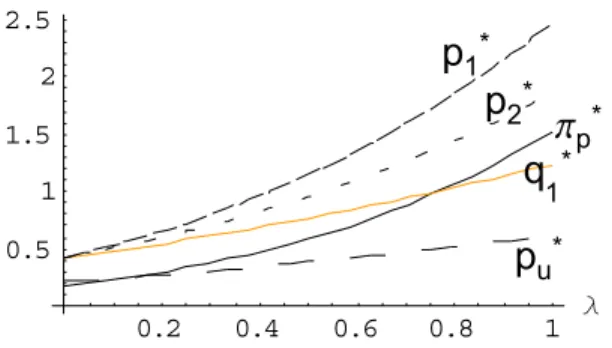
u*Figure 3: Plot of pp, q1 , p1, p2, pu with c=1, µ=0.2
Now we analyze the comparative statics for this solution.
Proposition 2: The optimal profit from perpetual licensing (pp*) and the optimal quality (q1*) and (q2*)
increase with increase in the proportion of new consumers arriving in period 2 (µ) and the utility from basic features (λ). The optimal profit and quality decrease with the cost of quality (c).
As the number of consumers entering in the second period increases, the software publisher’s
marginal revenue from quality improvement increases thus she finds it optimal to invest more in quality. Increase in utility from basic features (λ) has a similar effect.
4. Subscription Licensing (SaaS)
Now we analyze the case where the software publisher offers subscription licensing. In each of the two periods, consumers can either subscribe or not subscribe. If a consumer subscribes in period 1 at a price p1, she is able to use the software throughout
period 1. As described in §1, one of the key advantages of the subscription scheme is that consumers can obtain the benefits of software development faster such as the availability of new features. Thus subscribers experience regular software upgrades with quality tracking the product development process in period 1: q Є [q1, q2]. The
subscriber’s surplus can be computed by integrating the utility over the period:
1 1 2 1 1 1 2 1 [ ((q q)(t 1) q)dt] q p S =θ
∫
− − + +λ − Æ S1 = θ(q1 / 2 + q2 / 2) + λ(q1) – p1The seller could continue to invest in increasing the quality of the software in period 2, however, as explained previously, in order to maintain comparability in terms of the eventual quality produced under the two licensing schemes we assume that the seller of the subscription service also ceases quality improvement at the same time as in the case of perpetual licensing. Note that removing this restriction on the seller of the subscription software would result in an even higher quality from the subscription license.
A consumer who subscribes in period 2 at a price of p2 obtains a surplus of
S2 = θ(q2) + λ(q1) – p2
We now determine the consumer type that is indifferent between subscribing in period 1 and not subscribing. The relevant indifference equation is S1
= 0 solving for the indifferent θ, we obtain
θ1 = [2(p1 – λ·q1) / (q1 + q2)] …(6)
Let θ2 be the buyer type who is indifferent
between subscribing in period 2 and not subscribing. The relevant indifference equation is S2 = 0. Solving
for the indifferent type (θ), we obtain 1
θ2 = (p2 – λ·q1) / q2 …(7)
The profit function from perpetual licensing can be stated as:
ps = (1 – θ1)(p1) + (1 – θ2)(p2) (1+µ) – c(q1)2
We replace θ1, θ2, q2 (eq. 1, 6 &7) in to the profit
function above and compute the following first derivatives:
δps/δp1 = 1+(2λ/3) – (4 p1/3 q1)
δps/δp2 = (1+µ)(q1(2+λ)-2p2) / (2q1)
δps/δq1 =(4p12+3(1+µ)p22–12c·q13)/(6q12)
Setting these derivatives equal to zero, we solve the first order conditions to obtain optimal prices, quality, indifference points and profits. To make these terms more intuitive, we express them in terms of the optimal quality (q1*) or the optimal slope of the
trajectory for software development:
Proposition 3: A seller using SaaS will find it optimal to set the following prices:
p1* = (3+2λ)q1* / 4; p2* = ((2+λ)q1*)/2.
The optimal quality is:
q1* = [21+3µ(2+λ)2+λ(24+7λ)] / (48c).
The resulting indifference points are: θ1* = (3-2λ)/6; θ2* = (2-λ)/4.
The seller earns a profit of:
ps* = q1[21+3µ(2 + λ)2+λ(24 +7λ) – 24c·q1*]/24
Thus more than 50% of consumers subscribe in each period. Comparing θ1* with θ2*, we find that θ2*
- θ1* = λ/12. Hence a smaller fraction of consumers
subscribe in period 2 relative to period 1. The fraction of consumers arriving in period 2 who subscribe is same as the fraction of consumers who arrive in period 1 and subscribe in period 2.
It is interesting to compare the results of proposition 3 to those in proposition 1. Note that in the first period, the perpetual licensing scheme results in more users relative to SaaS. In the second period, the perpetual licensing scheme has greater total number of users but the subscription license has greater number of users working with the most current version of the product. This occurs because some of the users who buy a perpetual license in period 1 choose not to upgrade in period 2.
0.2 0.4 0.6 0.8 1 μ 0.3 0.4 0.5 0.6 0.7 0.8 0.9
p
s*q
s*p
1*p
2*Figure 4: Plot of ps, q1, p1, p2 with c=1, λ=0.2
0.2 0.4 0.6 0.8 1 λ 0.25 0.5 0.75 1 1.25 1.5 1.75
p
s*q
s*p
1*p
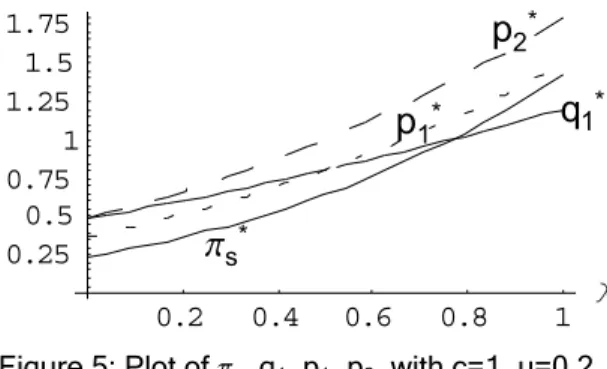
2*Figure 5: Plot of ps, q1, p1, p2, with c=1, µ=0.2
Now we analyze the comparative statics for this solution.
Proposition 4: The optimal profit from SaaS (ps*)
and the optimal quality (q1*) and (q2*) increase with
increase in the proportion of new consumers arriving in period 2 (µ) and the utility from basic features (λ). The optimal profit and quality decrease with the cost of quality (c). Proof: δpp*/δµ=[(2+λ)2(21+24λ+7λ2+3µ(2+λ)2]/(384c) Æδpp*/δµ > 0 δpp*/δλ=[12+7λ+3(2+λ)µ)(21+24λ+7λ2 +3µ(2+λ)2] /(576c) Æδpp*/δλ > 0 δpp*/δc = -[(21+24λ+7λ2+3µ(2+λ)2]2 /(2304c2) Æδpp*/δc < 0 δ q1*/δµ = [(2+λ)2] /(16c) > 0 δ q1*/δλ = [12+7λ+3µ(2+λ)] /(24c) > 0 δ q1*/δc = - [(21+λ(24+7λ)+3µ(2+λ)2] /(48c2) < 0 ■ 1 1
Increasing the number of consumers entering in the second period (µ), raises the software publisher’s marginal revenue from quality improvement thus she finds it optimal to invest more in quality. Increase in utility from basic features (λ) has a similar effect on the publisher’s incentive to invest in improving product quality.
5. Comparison of Perpetual and
Subscription Licensing
Now we compare the solutions of the perpetual and subscription licensing schemes. Let qΔ be the
difference between the final product quality under subscription (qs) and perpetual licensing (qp). Thus:
qΔ = qs – qp where qs and qp are the qualities at the
end of the second period. Substituting for qs and qp
from propositions 1 and 3, we obtain: qΔ = (3 – 5λ2) / (24c).
Proposition 5:When the utility from basic features λ <
5
3 ≈ 0.775, the seller invests greater effort in
product development resulting in higher quality under subscription licensing relative to perpetual licensing with the difference in product development costs being equal to (3 – 5λ2)2 / (576c).
Proposition 5 indicates that the faster revelation of new product features under subscription licensing provides incentives to the seller that result in greater investment in product development and hence a higher quality product relative to perpetual licensing. Most traditional models of consumer utility assume U = θ·q with λ=0, thus for such models subscription licensing would always yield higher quality. The difference in the number of users between perpetual and SaaS also affects the publisher’s incentive to invest in quality.
Now we compare the optimal profits under the two licensing schemes. Let pΔ be the difference between
profits from subscription and from perpetual licensing: pΔ = ps - pp.
Proposition 6:When the utility from basic features λ <
5
3 ≈ 0.775, the seller earns greater profits from
SaaS relative to perpetual licensing. The difference in profits is
pΔ=[(3-5λ2)(39+48λ+19λ2+6(2+λ)2µ)] / (2304c)
When λ <
5
3 , pΔ increases with µ and decreases
otherwise. When either (i) λ > 0.282503 or (ii) λ ≥ ( 55-5) / 10 and µ > 3)) -) (1 )(10 (3(2 )) 19 (36 5 (69 -(36 λ λ λ λ λ λ + + + + , pΔ
decreases with λ and increases otherwise.
Proof:
pΔ = [(3-5λ2)(39+48λ+19λ2+6(2+λ)2µ)] / (2304c).
Solving pΔ= 0 for λ, we get λ =
5
3 as the only feasible root. A quick inspection of pΔ shows that it is
positive when λ < 5 3 . δpΔ /δµ = (2+λ)2(3-5λ2) / 384,
which is clearly positive when λ < 5 3 . δpΔ/δλ=(18(2+µ)-λ(69+51µ+5λ(36+19λ
+6µ(3+λ))) / 576. Solving δpΔ /δλ =0 for µ, we get
µ = 3)) -) (1 )(10 (3(2 )) 19 (36 5 (69 -(36 λ λ λ λ λ λ + + + + . µ is positive only in the region ( 55-5) / 10 ≤ λ ≤ 0.282503.
It can be verified that δpΔ /δλ < 0 at any λ >
0.282503 and thus at all such λ. Further δ(δpΔ /δλ) /
δµ < 0 for λ > ( 55-5) / 10. ■ 0.2 0.4 0.6 0.8 1 μ 0.06 0.065 0.07 0.075 0.08 0.085 0.09
p
Δq
ΔFigure 6: Plot of pΔ , qΔ with c=1, λ=0.1
Proposition 7: Social welfare is higher under SaaS compared to social welfare under perpetual licensing. The difference between the social welfare with SaaS vs. perpetual licensing increases with µ and λ and decreases with c.
Proof:
Social welfare with perpetual licensing (SWp) =
(6+4λ(2+λ)+µ(2+λ)2)(18+20λ+6λ2+3µ(2+λ)2)/256c
Social welfare with SaaS licensing (SWs) =
(21+3µ(2+λ)2+λ(24+7λ)) * (63+9µ(2+λ)2+λ(84+29λ))/2304c SWs – SWp = SWΔ = (351+900λ+654λ2+132λ2 -13λ4-6(2+λ)2(2λ(λ-6)-9)µ)/2304c SWΔ evaluated at µ=λ=0 is equal to 0.15 δSWΔ /δµ=(2+λ)2(9+2λ(6-λ))/384c. It is easy to see
that this derivative as always positive for λє (0,1) δSWΔ /δλ=((9(25+14µ)+λ(327+147µ+λ
(99+18µ-λ(13+12µ)))/576
δSWΔ /δλ evaluated at µ=λ=0 is equal to 0.39
Solving δSWΔ /δλ=0 for µ, we find that the value µ
that solves this equation is always negative
µ= -(225+λ(327+(99-13λ)λ))/(3(2+λ)(21+2λ(7-2λ)))■ 0.2 0.4 0.6 0.8 1 λ -0.1 -0.075 -0.05 -0.025 0.025 0.05
p
Δq
ΔFigure 7: Plot of pΔ , qΔ with c=1, µ=0.2
Propositions 6 and 7 show that a monopoly software publisher generally earns greater profit under SaaS than under perpetual licensing and that social welfare is also higher under SaaS. While increases in the number of consumers arriving in the second period (µ) generally have a positive impact on profits, the impact of λ depends on certain conditions as stated in proposition 6.
6. Conclusion
The emergence and rapid growth of SaaS based licensing is attracting a lot of trade press. The trade press proclaims the rise of SaaS as a dramatic change but few substantive differences between SaaS and
perpetual licensing have been documented with the focus largely on the small continuous cash payments required under SaaS compared with large irregular payments under perpetual licensing. In addition, SaaS shifts the burden of running and maintaining hardware and software to the vendor.
Existing academic literature analyzing emerging licensing schemes implicitly assumes that software product quality is unaffected by the choice of licensing schemes. Thus software quality has been modeled as exogenously determined. In contrast, we develop a model in which the publishers’ choice of investment in software product development and the resulting quality is endogenous.
Our analysis of software quality under perpetual licensing and SaaS shows that there exists a robust and substantive difference in the publisher’s incentive to invest in software development under perpetual vs. SaaS licensing. We show that under commonly used buyer utility function (U=θ·q), the firm will always invest more in software development under the SaaS model relative to perpetual licensing model. This insight is robust and we examine its limits using a more general utility function. We show that under most conditions the firm will invest more under SaaS even under the general utility function. This increased investment leads to higher software quality, higher profits and higher social welfare under the SaaS licensing model. These results have implications for senior executives at many software firms and their users as they contemplate their response to the widely anticipated shift to SaaS.
Our results apply to software applications that can be continuously upgraded to obtain higher qualities. For some applications, it is necessary to discard previous software code and begin afresh. Our results do not apply for such discontinuous innovations. However SaaS licensing can still be used for such products provided there is scope for incremental quality improvement. In such cases the firm may find it optimal to make incremental improvements for some time and then make a large discontinuous improvement. Our work can be extended using empirical methods to compare the expenditure on software development between SaaS and perpetual licensing using data from industry. User surveys can also be used to assess differences in quality between SaaS and perpetual licensing.
References
[1] Bhargava, H.K. and V. Choudhary, “Information Goods and Vertical Differentiation,” Journal of Management Information Systems, Volume 18, Number 2 (Fall 2001), pp. 89-106.
[2] Bhargava, H.K. and S. Sundaresan, “Computing as Utility: Managing Availability, Commitment, and Pricing Through Contingent Bid Auctions,” Journal of
Management Information Systems, Volume 21, Number 2 (Fall 2004), pp. 201-227.
[3] Bowes, G., “End of Support for Windows 98,” Welland Tribune (Ontario), January 20, 2006, Pg. D5.
[4] Choudhary, V., K. Tomak, and A. Chaturvedi, “Economic Benefits of Software Renting”, Journal of Organizational Computing and Electronic Commerce, Vol. 8, No. 4, 1998, pp. 277-305.
[5] Clemons, E.K., B. Gu, R. Spitler, “Hyper-Differentiation Strategies: Delivering Value, Retaining Profits”, Proceedings, 35th Hawaii International Conference on System Sciences, January 2003.
[6] Dewan, R. M. and M. L. Freimer, “Consumers Prefer Bundled Add-Ins,” Journal of Management Information Systems, Vol. 20 No. 2, Fall 2003 , pp. 99 – 111.
[7] Dewan, R., B. Jing and A. Seidmann, “Product Customization and Price Competition on the Internet,”
Management Science, Vol. 49, No. 8, pp. 1055-1070, August 2003.
[8] Foley, J., “Power Shift,” InformationWeek, April 19, 2004.
[9] Gurnami H. and K. Karlapalem, “Optimal pricing strategies for Internet-based software dissemination,” pp.64-70, The Journal of the Operational Research Society, 52:1, 2001, Oxford.
[10] Haruvy, E., V. Mahajan, and A. Prasad, “The Effect of Piracy on the Market Penetration of Subscription
Software,” The Journal of Business, volume 77, 2004, pages S81–S107
[11] Huang K.W. and A. Sundararajan, “Pricing Models for On-Demand Computing,” Working Paper CeDER-05-26, Center for Digital Economy Research, Stern School of Business, New York University, November 2005. [12] Kauffman, R.J., B. Wang, “New Buyers' Arrival Under Dynamic Pricing Market Microstructure: The Case of Group-Buying Discounts on the Internet,” Journal of Management Information Systems, Volume 18, Number 2 (Fall 2001), pp. 157-188.
[13] Konary, A., S. Graham, and L. Seymour, “The future of software licensing: Software Licensing under Siege”,
IDC White Paper, March 2004.
[14] Lang, K. R. and, R. Vragov, “A Pricing Mechanism for Digital Content Distribution Over Computer
Networks,” Journal of Management Information Systems, Volume 22, Number 2 (November 2005), pp. 121-139. [15] Mussa, M., and S. Rosen, “Monopoly and Product Quality,” Journal of Economic Theory, 18(2), 1978, 301-317.
[16] Padmanabhan, V., S. Rajiv, and K. Srinivasan, “New Products, Upgrades, and New Releases: A Rationale for Sequential Product Introduction,” Journal of Marketing Research, 34(4), 1997, 456-472.
[17] Sankaranarayanan, R., “Excessive Software Upgrades: Reasons and Remedies,” Proceedings, 10th INFORMS
Conference on Information Systems and Technology, 2005. [18] Seidmann, A. and D. Ma, “ASPs versus Enterprise Software Solutions,” Workshop on Information Systems and Economics, 2004.
[19] Sundararajan, A. “Nonlinear Pricing of Information Goods,” Management Science, 50 (12), December 2004, pp. 1660-1673.
[20] The Economist, “Universal Service? Proponents of “software as a service” say it will wipe out traditional software,” April 20th, 2006.
[21] Zhang, J. and A. Seidmann, “The Optimal Software Licensing Policy under Quality Uncertainty,” Workshop on Information Systems and Economics, 2003.
Appendix
Perpetual licensing case with S2 > S1
This case is dominated by the case where S1 > S2. We briefly present the formulation along the lines of the case presented in the text. The profit function from perpetual licensing can be stated as:
pp = (1 - θu)(p1 + pu) + (θu – θ2)(p2)
+ µ(1 – θn)(p2) – c(q1)2
The indifference points are:
θu = (pu – p2 – λq1) /q1
θ2 =θn = (p2 – λq1/(2q1))
We set pb = p1 + pu and replace θu, θ2, θn in to the
profit function above and solve the first order conditions:
δpp/δpb = 0 ; δpp/δp2 = 0
Solving and computing optimal indifference points, we find that θu* – θ2* = – (m/4). Hence there are no
first generation users who buy only in the second period.