Theses & Dissertations
5-2017
A Basic Interpretative Study of Educators in the
Childcare Profession: Collegiality as a Base of Job
Satisfaction
Lynda Yvonne Cavazos
University of the Incarnate Word, [email protected]
Follow this and additional works at:http://athenaeum.uiw.edu/uiw_etds
Part of theEarly Childhood Education Commons, and theTeacher Education and Professional Development Commons
This Dissertation is brought to you for free and open access by The Athenaeum. It has been accepted for inclusion in Theses & Dissertations by an authorized administrator of The Athenaeum. For more information, please [email protected].
Recommended Citation
Cavazos, Lynda Yvonne, "A Basic Interpretative Study of Educators in the Childcare Profession: Collegiality as a Base of Job Satisfaction" (2017).Theses & Dissertations. 38.
by
LYNDA YVONNE CAVAZOS
A DISSERTATION
Presented to the Faculty of the University of the Incarnate Word in partial fulfillment of the requirements
for the degree of
DOCTOR OF PHILOSOPHY
UNIVERSITY OF THE INCARNATE WORD
Copyright by Lynda Cavazos
ACKNOWLEDGEMENTS
My journey to the completion of this dissertation was a laborious task that was spent with many long hours, however it could not have been accomplished without my professional colleagues and friends who helped guide the light to complete this journey. They provided me with guidance, spirituality, friendship, intellectual stimulation, and mentoring.
To my dissertation committee member, Dr. Dorothy Ettling, your beautiful spirit and leadership will always remain in my heart. Thank you for motivating me and always encouraging me to reach my highest potential. You are greatly missed.
To my first dissertation chair, Dr. Osman Ozturgut, thank you for your direct advice and expert consultation in completing this research. To my second dissertation chair, Dr. Mary Ruth Moore, whose great expertise in early childhood has provided me with a wealth of scholarship. I am so thankful for your kindness, generosity, and compassion in our discussions, and sharing of resources. I have enjoyed and appreciated your words of wisdom and encouragement in
cheering me on through the rigor and complexity of achieving this goal.
Also to my dissertation committee Dr. David Campos and Dr. Stephanie Grote-Garcia, who have given of their time in guiding and advising my learning along this journey. Your prompt suggestions and feedback were with kindness and inspiration to enable me to complete my dissertation. Your insights and attention to detail made me a better writer and a more thorough researcher. Many thanks to Dr. Jessica Kimmel for igniting the spark in this research topic, which began as a course assignment. A special thanks to Dr. Sharon Herbers for your consultation throughout my studies and special projects.
In addition, I especially want to thank the 12 childcare teachers, who took part in this study. I admire your passion and dedication to the early childhood profession. Your knowledge and experiences of your craft have inspired me to a better advocate for the early childhood profession. Thank you for sharing your incredible insights.
DEDICATION
I dedicate this dissertation to the Lord for providing me with strength and perseverance in completing my doctorate. To my parents, Emilio and Rosa, thank you for teaching me to be passionate and happy in what gives me purpose. My parents were my first teachers and taught me many life lessons. I was fortunate to grow up in an environment that encouraged play and the love of learning. Mom, you taught me to be creative in my thinking. Dad, you taught me to have a strong work ethic within my profession. I hope I have made you proud.
To my brother, Joel, thank you for your thoughtful cards that reminded me to stick with it and that I was near completion of this journey. To my son, Anthony, mom loves you with all of her heart. To my grandparents, thank you for wonderful memories that have helped me in establishing my cultural identity. I know that you were guiding me from Heaven throughout this journey. Since I was a young child, I was always inspired to be who I am and to pursue my education.
And to my good friend, Christie, I am grateful for all of your support through the doctoral program and dissertation.
A BASIC INTERPRETATIVE STUDY OF EDUCATORS IN THE CHILDCARE PROFESSION: COLLEGIALITY AS A BASE OF SATISFACTION
Lynda Cavazos, PhD
University of the Incarnate Word, 2016
This basic interpretative study explored 12 childcare teachers’ perceptions of job satisfaction and how their motivation has had an instrumental impact on their 10 years or more of job sustainability. In examining the childcare teachers’ perceptions of job satisfaction, the primary research question guiding this study was, “What are the motivational factors that childcare teachers perceive to have contributed to their job satisfaction and retention?” The theoretical framework underlying this study was the Self-Determination Theory, a theory that describes how interactions between early childhood teachers and the system within their work influences
motivation in their teaching and their authentic well-being as an educator (Deci & Ryan, 2010). The research participants were childcare teachers with a CDA and had 10 years or more of childcare teaching experience as a childcare teacher. Semi-structured interviews provided a rich, thick description of the experiences of the participants. The basic interpretative study took place in the natural world of the childcare profession with the focus on the context of job satisfaction (Rossman & Rallis, 2003).
The constant comparison analysis indicated four major themes: motivation of being a childcare teacher, a community of collegiality, a definition of job satisfaction, and inspiration of becoming a childcare teacher. Evidence also emerged that the participants would recommend the
early childhood profession to other potential childcare teachers because of their job satisfaction despite their low wages and lack of recognition for their work.
Based on the motivational factors of the childcare teachers’ perceptions of job satisfaction, a model was initiated with the purpose to improve recruitment and retention of childcare teachers. Collegiality is the basis and the foundation of the model, which is paramount for a functional and supportive community of collegiality (DuFour, DuFour, Eaker & Karhanek, 2004). The motivational factors of the model are: organizational climate, professional
development, intrinsic motivation, and credentials. In addition, the Model of Motivational Factors could increase student achievement with less childcare teacher turnover. Future research should focus on what the childcare teachers perceive as obstacles in the early childhood
profession and what they would recommend to recruit and retain childcare teachers. Their recommendations could merge and connect with this study’s motivational factors. Their recommendations for recruitment and retention of childcare teachers would be their voice on a personal level, which could be the basis for the study.
TABLE OF CONTENTS
CHAPTER 1: HIGH RATE OF CHILDCARE TEACHER TURNOVER ...1
Context of the Study ...8
Statement of the Problem ...8
Purpose of the Study ...9
Research Question ...9
Theoretical Framework ...9
Definition of Terms ...14
Overview of Research Design ...15
Background of Researcher ...16
Significance of the Study ...17
Limitations of the Study...18
Summary ... 18
CHAPTER 2: REVIEW OF THE LITERATURE ...20
Introduction ...20
Organizational Climate ...22
Qualities of Childcare Teachers ...25
Teacher Retention ...30
Gender ...33
Summary ...36
Table of Contents—Continued CHAPTER 3: METHODOLOGY
Research Design...37
Setting ...39
Participants ...40
Informed consent for participants ...41
Data Collection Procedures ...41
Demographic questionnaire ...41 Interviews ...42 Interview protocol ...43 Member checks ...44 Researcher’s journal ...44 Audit trail ...45
Protection of Human Subjects ...46
Data Analysis Procedures ...46
Trustworthiness and Credibility ...49
Triangulation ...50 Reflexivity ...50 Summary ...51 CHAPTER 4: FINDINGS ...52 Introduction ...52 Demographic Data ...54
Table of Contents-Continued CHAPTER 4: FINDINGS Participant Profiles ...56 Melina ...56 Helen ...56 Gabriela ...56 Stella ...57 Nancy ...57 Ida ...57 Ivy ...57 Renee ...57 Janet ...58 Regina ...58 Cathy ...58 Samantha ...58 Themes ...59
Motivation of Being a Childcare Teacher ...59
A Community of Collegiality ...66
The Definition of Job Satisfaction ...73
Table of Contents—Continued CHAPTER 4: FINDINGS
Summary ...87
CHAPTER 5: DISCUSSION AND FINDINGS ...89
Introduction ...89
Summary of Findings ...90
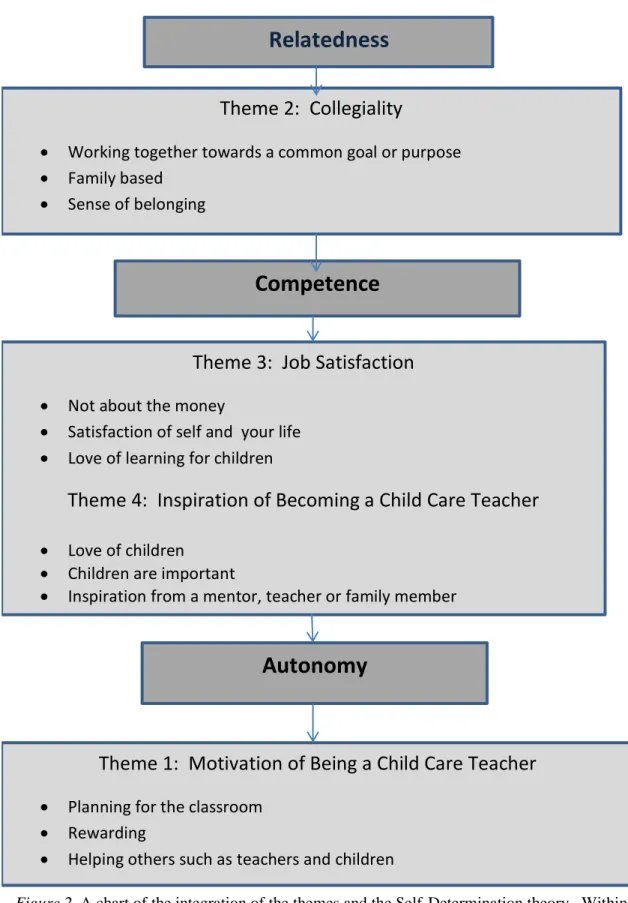
Relatedness ...91
Theme 2: Collegiality ...91
Competence ...94
Theme 3: Job Satisfaction ...95
Theme 4: Inspiration of Becoming a Childcare Teacher ...95
Autonomy ...96
Theme 1: Motivation of Becoming a Childcare Teacher ...97
Implications ...97
A Model of Motivational Factors ...97
Collegiality ...99
Organizational Climate ...101
Professional Development ...103
Intrinsic Motivation ...105
Credentials ...106
Table of Contents - Continued CHAPTER 5: DISCUSSION AND FINDINGS
Limitations of Research ...109
Recommendations for Future Research ...110
REFERENCES ...112
APPENDICES ...132
APPENDIX A Demographic Questionnaire ...133
APPENDIX B Invitation to Participate in Research ...134
LIST OF TABLES
1. Demographics of the Twelve Participants………..55 2. Childcare Teachers Having Only One Teaching Job………...93
LISTS OF FIGURES
1. Theoretical Framework: Self-Determination Theory………11 2. Themes Interwoven in the Self-Determination Theory……….92 3. Model of Motivational Factors………..98
Chapter One: High Rate of Childcare Teacher Turnover Context of the Study
The United States is often represented as providing inadequate quality childcare due to the high rate of teacher turnover (De Vita, Twombly & Montilla, 2002). According to the United States Bureau of Labor Statistics (2011), the yearly turnover rate for childcare teachers is 29%. The Occupational Employment Statistics (2001) have reported that childcare workers receive the typical wage of a hotel bellhop, not including tips, earning 10% less than other employees in personal service industries.
Low wages, long hours, and few benefits make childcare an unattractive occupation for many potential childcare workers. Very few childcare workers receive benefits and less than one third of childcare centers provide full paid health insurance (Whitebrook and Bellm, 1999). Whitebrook and Bellm (1999) concluded that the childcare teacher’s inadequate salary of $15,092 has been identified as the strongest predictor of teacher turnover. In the research of Morris (1999) and De Vita et al. (2002), it was established that to decrease the rate of childcare teacher turnover, the United States needed to improve their childcare teacher support system, teacher training and provide a decent compensation for qualified childcare teachers.
Consequently, there exists the challenge of maintaining childcare teacher sustainability due to the high demand for childcare teachers (Hale-Jinks, Knopf, & Kemple, 2006)
The early childhood profession is accountable for establishing and advocating standards of high quality and professional practice in early childhood programs from birth through the age of 8-years-old (Copple & Bredekamp, 2009). The purpose of high quality early childhood programs is to provide a supportive and developmentally appropriate learning environment for all children. Children learn and develop through developmentally appropriate practices (Copple
& Bredekamp, 2009). To follow this practice, early childhood teachers need to understand that a child from birth to the age of 8-years-old will experience developmental changes. Through their understanding, early childhood teachers are to teach how to best scaffold a child’s learning and development from birth to the age of 8-years-old. Copple and Bredekamp’s (2009) research have identified the following four domains: cognition, social, physical, and emotional. Each of these domains serves a functional purpose in the healthy developmental learning of a child.
The childcare teacher is to interweave the developmental domains through meaningful learning experiences to help the child have a healthy development. The meaningful learning experiences are to emerge in an environment that supports children, and to provide strong relationships among teachers and families alike. The childcare teacher is to provide meaningful experiences to enrich the development and learning of children. In the research of Copple and Bredekamp (2009), childcare teachers are provided with guidelines to support a high quality early childhood program. The National Association of Educators of Young Children guidelines state that “childcare teachers are to treat children with dignity, to establish positive relationships with the children and create a stimulating and developmentally appropriate environment” (Copple & Bredekamp, 2009, p.10). Early childhood experiences play a pivotal role in shaping subsequent developmental trajectories and the impact of these early experiences depends largely on the quality of caregivers and teachers (Fox, Levitt, & Nelson, 2010; Hamre & Pianta 2006; Knudsen, Heckman, Cameron, & Shonkoff, 2006; Peisner-Feinberg et al., 2001; Shonkoff & Phillips, 2000).
Most children who have had “success in schools and in life after graduating from high school were a result of attending a high quality early childhood program” (Copple & Bredekamp, 2009, p. 3). Lynch (2004) recognizes other positive results from “high quality programs such as
achieving high scores on math and reading, the language skills are at a higher level, and students are more likely to graduate from high school” (p. 3). Lynch (2004) further explains high quality early childhood programs are a long-term investment. In return, the large payoff is the reduction of the high school dropout rate. The investment in early childhood programs starts with the learning as an engaging process that begins at birth and involves all of the developmental domains (Copple & Bredekamp, 2009).
Research has shown that high quality early childhood programs can have healthy effects on children’s cognitive and social development (Barnett, 1995). In his extensive research on the long-term effects of quality early childhood programs, Barnett concluded that “high quality programs are a predictor of school readiness” (p. 27). Along with school readiness, other benefits that children will display are “more secure attachments to others, higher measures of critical thinking and improved language development” (Copple & Bredekamp, 2009, p. 5). Though the results are indicative that early childhood programs have positive effects, this will not be achieved unless the early childhood programs are of the highest quality standards to include well-prepared teachers and a stimulating learning environment.
With the emphasis on the role of the teacher in quality early childhood programs, retention of teachers could also be an issue. At a national level from 1999-2000, the childcare teacher “turnover rate was estimated at 30%” (Whitebrook, Sakai, Gerber, & Howes, 2001, p. 219). According to the Center for the Child Care Workforce (2004), the strongest predictor of teacher turnover or high attrition among childcare teachers was an “inadequate salary of $7.86 per hour or $15,092 per year” (p. 12). Six years later, the average annual income of paid early childcare education (ECCE) workers in 2009 was $18,000 (Government Accountability Office, 2012). In May 2010, the hourly wage of childcare workers was $9.28 (United States Bureau of
Labor Statistics, 2011). Childcare worker’s wages are lower than any other occupation requiring similar levels of education (Cleveland & Hyatt, 2002).
The low education, low compensation, and high turnover continues to be a valid
characterization of the 2.2 million ECCE workers. In 2010, nearly 40% of the ECCE workforce had a high school degree, and a third of the workforce had some college, but no bachelor’s degree and only 28% of ECCE workers received a pension and or health benefits from their employer (Committee on Early Childhood Care and Education Workforce, 2012). It was noted in the research of Lifton (2001) that childcare workers received low wages no health or retirement benefits and had to work in poor conditions. In the analysis of Bassok, Fitzpatrick, Loeb and Paglayan (2010), childcare teachers felt that ECCE was an unattractive industry to enter.
Whitebrook and Phillips (1991) have characterized childcare teachers as “the working poor” (p. 1), who reside in a new “low wage ghetto” (Burbank, 1994, p. 318). The childcare profession is described as having a “higher concentration of poverty level jobs than almost any other
occupation in the United S. (Laverty, Burton, Whitebrook, & Bellm, 2001, p. 3).
Cassidy, Lower, Kinder-Duff, Hedge, and Shim (2011) found that education and
experience are pivotal criteria in determining childcare teacher’s hourly wages. It was presented in the study of Machado (2008) that the main issues are “compensation pay and benefits” (p.3) because childcare teachers have a challenging time recruiting quality teachers. Kauffman (1994) emphasized that the labor markets provide, “low paid secondary dead end jobs and for childcare the labor market is secondary” (p. 576). Kauffman further emphasized that in a secondary labor market, turnover of workers is high while education and experience are not adequately rewarded. Therefore, opportunities for promotion and incentives are limited. Preston (1989) pointed out that high rates of job turnover do exist, however childcare workers in non-profit centers maybe
more altruistic and will work for lower wages. Low wages and the lack of opportunities for promotion and incentives can cause an increase in job turnover, resulting in possible negative implications in maintaining high quality early childhood developmental programs.
Kontos and File (1992) concluded that “55.7% of teachers ranked salary as a prime cause for leaving the childcare profession” (p. 17). Further findings in this study were 58.6 % of childcare teachers indicated that childcare was their chosen profession. While 17% revealed that childcare was a beginning entry job for another job in a similar profession, and 8.6% felt that childcare was an outstanding temporary job (p. 162). Though the study ranked salary as the main reason to leave their job, childcare teachers were highly satisfied and committed, regardless of less than perfect conditions of employment. This was also supported in Rose’s (1999) findings, which underscored that the childcare occupation has the most highly satisfied employees. Schyer (1994) further extended that when childcare teachers feel satisfied, they demonstrate a strong work ethic. They perceive work as a “central life interest” that relates to commitment
(Billingsley & Cross, 1992, p. 3). More effort to recruit and sustain childcare teachers should be complimented through efforts to prepare qualified childcare teachers.
This increased high teacher attrition of the childcare workforce has been identified as alarmingly unstable (Whitebrook, et al., 2001). If teacher turnover increases, the challenge becomes sustaining high quality early childhood programs with a decent salary and formal training. Modigliana (1986) conferred on the continuous struggle of the childcare profession and its lack of recognition and limited teaching resources and materials, and minimal daily breaks. Better childcare work environments are imperative in the recruitment and retention in
maintaining a stable workforce (Lower & Cassidy, 2007). The childcare profession can be described as a fragmented profession in sustaining qualified childcare teachers with reduced
working standards and working conditions. To date, wage enhancement needs to be substantial and match salaries of other similar qualified educators.
Hale-Jinks et al. (2006) explained that high rates of teacher turnover can be a consequence of low childcare program quality, which in turn causes unfavorable effects in children’s early childhood development. The research of Howes and Smith (1995) reviewed the importance of a child’s social and cognitive development through a secure attachment of the teacher and child. Pianta (1992) documented both how non-parental relationships can significantly influence the development of young children and how these relationships can support positive developmental outcomes. Feeney, Christiensen and Moravcik (1987) identified quality adult child relationships in early childhood settings to be essential to children’s security, self-confidence and learning. Other researchers found positive relationships with teachers and caregivers to be an important aspect of school adjustment (Pianta & Nimetz, 1991) and social competence with peers (Howes, Matheson, & Hamilton, 1994; Howes, Phillips & Whitebrook, 1992). When young children feel a sense of security and comfort from their teacher, they are given incentive to learn. Carter (2001) further highlighted how high teacher turnover can
segregate the security attachment between the child and the teacher causing emotional stress for the child’s developmental learning in an early childhood setting.
Begley (1997) expounded on the child’s emotional stress, the leading developmental risk factor for children, and its delay in developmental learning. Developmental learning should be consistent and enriched with positive learning experiences; otherwise the child’s development can be at risk (Carter, 2001). The risk factors are lower levels of language, cognitive, and social development (Howes & Hamilton, 1993; Howes, Hamilton & Philipsen, 1998; Howes et al. 1992; Howes & Smith, 1995). In the staffing and quality study of Whitebrook et al. (2001), low
teacher turnover was related to higher classroom quality. Furthermore, the research has
established that high teacher turnover can disparately impact a child’s learning which is essential for cognitive and social emotional development. Childcare teachers can be a positive influence in children’s lives and they work hard to ensure that children will receive all the nurturing and learning opportunities available.
Preparing young children for the success track of learning takes a “special calling or ministry” (Colker, 2008, p. 2), which can be correlated with intrinsic motivation. Sahlberg (2010) elaborated that “teaching is a profession which typically is driven by values, ethical motives or intrinsic motivations” (p. 1031). The idea of intrinsic motivation is further indicated in Argyris’ (2011) findings that employees who are intrinsically motivated are experiencing a humanistic merit of feeling good. The work of Super and Hall (1978) identified values that relate to job satisfaction. They point out that people who feel challenged by their work, who have autonomy in carrying out their tasks, and who feel adequately rewarded are more apt to be satisfied with their employment. Furthermore, additional identifying criteria of job satisfaction are personal characteristics, skills and abilities and the value assigned to selected criteria of success and the actual accomplishments in these areas as described by Chapman and Lowther (2001).
The National Center for Education Statistics (1997) identified job satisfaction as an “affective reaction to an individual’s work situation” (p. 2). Satisfaction for teachers can have strong implications for student learning and can be influential in the quality of instruction
provided to students. The researchers of Ostroff (1992) and Ashton and Webb (1986) argued that teachers, who do not feel supported in their work may feel less motivated to perform with high quality. However, when motivation exists, they are less likely to change schools or leave the
teaching profession (Choy, Bobbit, Henke, Medrich, Horn & Lieberman, 1993). Experiencing job satisfaction is an intrinsic merit in teaching young children and can be far greater than the inadequate salary, limited working conditions and lack of professional recognition. If more childcare teachers experience job satisfaction and remain in the profession, young children may have less developmental learning risk factors. (Copple & Bredekamp, 2009).
Statement of the Problem
There is extensive research supporting the challenge of the recruitment and retention of qualified childcare teachers (Saracho & Spodek, 2007; Torquati, Raikes, & Huddleston-Casas, 2007). Numerous studies have indicated that throughout the nation, high childcare teacher turnover rates have contributed to the childcare teacher shortage and the diminish of the quality of childcare programs which in turn effects young children’s learning development (Collins-Camargo, Ellett, Lester, 2012; Fenech & Sumsion, 2007; Helburn, 1996; Raver et al., 2008; Whitebrook & Bellm, 1988; Whitebrook et al. 2001).
Turnover in the child-care field has exceeded turnover rates in elementary school teaching positions (United States Department of Education, 2008). The average annual rate of turnover in child-care is approximately 18%, compared to the 8% turnover rate of elementary school teachers (Mau, Ellsworth, & Hawley, 2008; United States Department of Education, 2008). Research has confirmed the increase of teacher turnover and its effects in early childhood programs; however, there is limited research of the retention of childcare teachers and the motivational factors of their sustainability. Therefore, this study explored job satisfaction of 12 childcare teachers with 10 years or more of teaching experience.
Purpose of the Study
The purpose of this qualitative study was to explore 12 childcare teachers’ perceptions of job satisfaction at urban early childhood centers in a southwest city in the United States. This study explored their perceptions of job satisfaction and what has contributed to their retention.
Research Question
In examining the childcare teachers’ perceptions of job satisfaction, the primary question guiding this study was the following: What are the motivational factors thatchildcare teachers perceive to have contributed totheir job satisfaction and retention?
Theoretical Framework
The theoretical framework underlying this study was the self-determination theory, a theory that described how interactions between early childhood teachers and the system within their work influenced motivation in their teaching and their authentic well-being as an educator (Deci & Ryan, 1985). The self-determination theory was selected for this study to add to the knowledge and understanding of motivational processes within the work environment of
childcare teachers. In the self-determination theory, the “environment is autonomous, supportive, and controlling and will influence the degree of intrinsic motivation that an individual feels toward a given task” (Deci & Ryan, 2010, p. 154). Perceptions of the workplace, intrinsic motivation and a sense of community were key factors of the self-determination theory and will be explored within this study.
This self-determination theory provided a foundation of the interaction between childcare teachers and their motivation within their work environment. Intrinsic motivation is the
framework and it is a predictor of staying in the childcare profession. It also lends itself to understanding the participants’ factors of job satisfaction according to their experiences, artifacts
and stories that they use to discuss the performance of job satisfaction. This will allow a meaningful analysis from the participants when explaining their findings. Lastly, the
self-determination theory was postulated on motivation as intrinsic and instrumental in autonomy and manifesting greater job satisfaction. This learning process was an important consideration in this study since little has been documented in the literature about perceptions of job satisfaction among childcare teachers.
La Guardia’s (2009) evidence presented the self-determination theoretical framework as an understanding of motivational processes that influence identity concepts of exploration and commitment. The evidence of autonomy continues as a basic psychological need along with competence and relatedness, which are the essential factors for identity development and the sense of well-being. Autonomy is a “self-rule and is related to actions that are self-initiated and regulated” (La Guardia, 2009, p. 92). Competence is expressed as the “experiences that are challenging, curious and explorative” (La Guardia, 2009, p. 92). Relatedness is the “feeling of belonging and being of importance to others” (La Guardia, 2009, p. 92). Combined together, this triad had natural inclinations towards engaging in interesting and self-valued activities,
exercising capacities and skills, and its connectedness with others. In Figure 1, the
Self-Determination theory is exhibited with the three motivational factors of autonomy, competence, and relatedness.
Overall, autonomy environments were interpreted by La Guardia (2009) as encouraging the exploration and self-authorship to cultivate one’s potential. The environment is a key tenet in elevating unevolved complacency of one’s motivation. Laing (1969) discussed the social
environment as how it contributes to the “authenticity as the experience of being true to oneself,” (p. 127) and La Guardia (2009) connected the social environment with job satisfaction and the
structure of one’s identity. Kemis and Goldman (2006) and the results were being “cognizant of one’s motivation and creating connections with others to persevere the intrinsic motivation” (p. 97).
Figure 1. The motivational factors of the Self-Determination theory, which are influential in intrinsic motivation for job satisfaction.
Motivational
Factors
Relatedness
Competence Autonomy
The more autonomy support experienced by childcare teachers can manifest greater job satisfaction. Childcare teachers that are motivated in their organizational climate can continue to permeate motivation among each other and contribute in providing a high quality early
childhood program.
The framework of the self-determination theory consisted of the perceptions of the workplace and how they interacted with intrinsic motivation (Deci & Ryan, 1985, 2004, 2008). The theory indicated significant factors of: intrinsic interest, supervisor support, nature of the work and co-worker relations. When the environment is autonomous and supportive, it will influence the degree of intrinsic motivation that an individual feels. The influence of intrinsic motivation from teacher perceptions of the workplace was also indicative relation between
supervisor support and work satisfaction. Wagner and French (2010) highlighted the degree to which intrinsically motivated behavior is internalized and integrated into one’s sense of self.
Wagner and French (2010) summarized that teachers who “feel competent and connected have intrinsic motivation in their work” (p. 169) and those that were more satisfied with the degree of choice in their work environment also exhibited higher levels of intrinsic interest in their teaching. Bloom (2005) discussed the early childhood work environment as a system. In the system, a teacher’s work life is set in within the subsystems of people, structures, and processes that construct the work of an early childhood setting. The subsystems are planted within the overall work climate which is embedded in larger, political, social contexts that are influential in the early childhood setting. Furthermore, it added that organizational commitment is strongly correlated to motivations because childcare teachers who believe they are contributors to an important role in a worthwhile organization feel motivated to perform at higher levels.
Self-determination theory commended that people are naturally inclined to explore and dedicate much of their energies toward activities, roles and relationships that engage only with significant costs to their well-being (Deci & Ryan, 2000; Ryan & Deci, 2000). Research has shown that when teachers guided children by providing optimal challenges and provided
feedback that was clear and informational, children were able to navigate tasks more effectively instead of feeling that they were too difficult or overwhelming, therefore, greater intrinsic
motivation was witnessed (Danner & Lonky, 1981; Ryan, 1982; Ryan, Mims & Koestner, 1983). Autonomy supportive environments encourage exploration and self-authorship in cultivating one’s potential, and involvement that provides the support from which the child can challenge their own capacities.
The terms “true” or “authentic” self from the self-determination theory are descriptors of the person’s goals, values and behaviors that are integrated into a coherent and organized self-structure (La Guardia, 2009, p. 97). Sheldon and Elliot (1998) have examined the extent to which people’s goals are self-concordant or authentic and are correlated with basic psychological needs. Earlier work by Sheldon, Ryan, Rawthorne and Ilaridi (1997) further supported the point that roles in which people felt they could be more authentic are truly themselves, and they reported a more positive trait profile and a greater authenticity to their greater overall well- being. A healthy identity formation is an active exploration of one’s potentials and integration of experiences into a committed set of personally defining and meaningful values, goals, and roles.
The Torquati et al. (2007) study was supportive of the Deci and Ryan study (2010) because both emphasized motivation as intrinsic and as instrumental in the job tasks. Teacher motivation is a predictor of intention to stay in the childcare profession details Torquati and colleagues (2007). They identify motivation as a “personal calling” (p. 5) which paralleled with Coker’s (2008) identification of childcare teaching as a ministry. It was well documented among teachers that the degree to which the environmental contexts support teachers’ needs for
autonomy, competence and relatedness were influential in intrinsic motivation, work attitude and job performance ratings (Assor & Oplatka, 2003; Baard, Deci & Ryan, 2006; Reeve, 2002).
Previous research has shown that the individual’s level of pay was not a significant predictor of job satisfaction (Bloom, 1988 & 1996). Though pay was not a predictor of job satisfaction, it has been presented as a significant predictor of childcare teachers leaving the field (Kontos & Stremmel, 1988; Torquati, et al. 2007). Extrinsic rewards such as merit-based pay raises impaired intrinsic motivation by facilitating a locus of casualty and a reduced sense of autonomy (Deci & Ryan, 2008; Ryan & Deci, 2000). Since low pay is a serious source of
dissatisfaction for the early childhood workforce, the self-determination theory argued that it was not connected to one’s need for autonomy, competence or relatedness.
Definition of Terms
The following terms were provided to establish a universal understanding throughout this study.
Childcare center. Full day programs that serve children from infancy through preschool and may include before and after school care. (Nicholson, 2008).
Childcare teacher. Adults working with children in early childhood settings can have a variety of names (e.g. childcare workers, childcare teacher, childcare provider,
preschool teacher, early childhood teachers, early childhood educator, early
childhood professional, child development specialist, master teacher, assistant and a teacher aide), which are sometimes used interchangeably, but may also be used to designate variances in responsibility or educational level (Nicholson, 2008).
Developmentally appropriate practice. A curriculum design and decisions about what should be learned and how it would best be learned depends on what we know about the learner’s developmental status and our understanding of the relationships between early experience and subsequent development. Examples of how it would be best learned are individually appropriate, age appropriate and culturally appropriate (Katz, 1995).
Early childhood programs. Any group program in a center, school, or other facility that serves children from birth through the age of 8-years-old. Early childhood programs include childcare centers, family childcare homes, private and public preschools, kindergartens, and primary-grade schools (Copple & Bredekamp, 2009).
description of how organizational influences impact members of the organization. Organizational climate is defined by teachers’ perceptions of the school’s environment (Hoy, Tarter & Kottkamp, 1991).
Profit childcare center. Childcare centers that maybe independently owned and part of a small chain of a corporate or national chain (Nicholson, 2008).
Self-determination. The extent to which an environment is autonomy supportive,
controlling, and motivating will influence the degree of intrinsic motivation an individual feels toward a given activity. It also will affect the degree to which extrinsically
motivated behavior is internalized and integrated into one’s sense of self (Wagner & French, 2010).
Teacher attrition. Teacher attrition is “the departure of teachers from their teaching jobs” (Skaalvik & Skaalvik, 2011, p. 1029).
Overview of Research Design
To accomplish this study, a qualitative approach of the basic interpretative methodology was utilized. Merriam (2002) defined basic interpretative as “to seek to discover and understand a phenomenon, a process, the perspectives and worldviews of the people involved or a
combination of these” (p. 6). Qualitative research consists of interpretive, material practices that make the world visible (Denzin & Lincoln, 1998). The focus of this study was on the everyday experiences of motivation that have instilled the perceptions of job satisfaction among childcare teachers. Data collection assisted in identifying the participants’ understandings of their
perceptions of job satisfaction, their perceived experiences of what motivated their job
satisfaction and how their perceptions and experiences were described within the early childhood profession.
I used audio recorded in depth, face-to-face interviews and the collection of data through facilitation of a demographic questionnaire with 12 participants, who are childcare teachers in the Southwestern United States. The participants discussed and elaborated on their motivational perceptions of job satisfaction. Data from the interviews were transcribed verbatim and analyzed using the constant comparison analysis, which combined inductive and deductive methods (Payne & Payne, 2004). To describe the participants’ concepts, themes were generated from their experiences. Thick descriptions of each participant’s motivational factors, demographic
characteristics of educational background, credentials and other related characteristics that may be relevant in executing their motivational factors of job perceptions were chronicled.
Background of Researcher
Schweinle, Reisetter and Stokes (2009) discussed that qualitative researchers previous experiences and the meanings of the experiences were a significant element of the study. I have 20 years of experience and skills in early childhood as a consultant, a professional development trainer, an early childhood teacher, early childhood mentor and adjunct instructor in early childhood. Due to my experiences in the field of early childhood, I was careful to interpret the data in the most impartial manner and not to influence participants’ responses. Interviewers entered into a shared reality with their participants, therefore careful attention was given in preparation of the data analysis (Moustakas, 1994). In the transcription and data analysis, I was objective as possible. As an advocate of the field of early childhood education, I value the role of childcare teachers. Therefore, I listened to each childcare teacher’s perceptions and respected the validation of the rich meaningful descriptions. My reflections of experiences were recorded in a journal and used in reporting the findings of the study.
Significance of the Study
A better understanding of predictors of job satisfaction and job commitment can lead to improved recruitment and retention of childcare teachers. Kontos and File (1992) asserted that predictors of job satisfaction and job commitment can lead to successful recruitment and retention of childcare teachers. From this study, the data introduced a more complete picture of the organizational climate, the significance of the community, and the context of the childcare center, and its correlation to teacher retention. The significance of this study has greatest relevance to a number of educational stakeholders in the early childhood community such as community agencies, childcare directors, childcare teachers, families, and local policy makers. Directors of early childhood programs, providers of early childhood professional development and community agencies that oversee and support early childhood programs may find practical use of the motivational factors to improve job satisfaction for teacher retention.
Acknowledging and addressing teacher turnover is particularly important, given the costs associated with teacher turnover and the disproportionate impact teacher turnover has on the quality of early childhood programs. Lack of staff commitment and stability has been associated with lower quality programs and lower language skill levels in children (Adams, Tout & Laslow, 2007). Increasing childcare teachers' intent to remain in the teaching profession is vital to local, state, and national educational accountability. Successful recruitment strategies will potentially attract qualified individuals with the education and experience needed to provide quality care for children (Collins et al., 2012; Fenech, Robertson, Sumsion, & Goodfellow, 2007; Hopkins, Cohen-Callow, Kim & Hwang, 2010).
Limitations of the Study
In this study, a limitation was that I had a professional relationship with seven of the twelve participants, which was more than half of the participants. I was the teacher mentor and their instructor of early childhood studies for the seven participants. The teacher mentor
relationship was for two years and consisted of observing the seven participants in their teaching and providing support in best teaching practices and assisting with the classroom’s ecological design. Also for one year, I was their instructor in early childhood courses. I did not have any type of professional relationship with the five remaining participants.
I have a strong concern for early childhood education, specifically educators, who provide learning to the very young. Because of my personal and emotional attachment to the topic central to this research, I looked to Cole and Knowles (2001) description of the role of the researcher.
It is our position to understand and make explicit as best as we can the complex relationships between individuals and the contexts within which they live, work and develop we have a responsibility to provide a level of translation and theoretical and interpretation. (p. 115)
As an early childhood educator, I have worked closely with practitioners in child-care and have established many relationships with professionals in the childcare field. The insights from these inspiring individuals have led to an appreciation and admiration of the educators, who care for children in early childhood education. Therefore, I have ensured objectivity by
maintaining focus on the understanding of the perceptions of job satisfaction of the childcare teachers.
Summary
Inadequate quality childcare was the result of a high rate of teacher turnover (DeVita, et al. 2002). Scholars such as Whitebrook and Bellm (1998) and Whitebrook et al. have concluded
that increased childcare teacher turnover rates can undermine the quality of childcare for young children. Regardless of limited training standards and earning low salaries, childcare teachers demonstrated high levels of job satisfaction (Ackerman, 2004, 2006: Blau, 2002; Fenich & Sumsion, 2007; Whitebrook & Sakai, 2003). As advocates of early childhood, who are motivated and have remained in the childcare profession, they continue to strive in providing meaningful and developmental appropriate learning experiences to enrich the development of young children. Increasing job satisfaction would be one of the first steps to improving and leading to the recruitment and retention of quality childcare teachers (Latham, 1998). For this purpose, the current study was beneficial in childcare teacher’s job satisfaction sustainability by recruiting and retaining childcare teachers. Efforts to recruit and retain staff should be paralleled by efforts to prepare qualified early childhood teachers.
Chapter 2: Review of the Literature
Scholars have asserted that limited research has been explored regarding job characteristics of job satisfaction among childcare workers (Cassidy, Lower, Kintner &
Hestenes, 2009; Glisson & Durick, 1992; Kontos & File, 1992; Muller, Alliata & Benninghoff, 2009; & Rutman, 1996). Due to the lack of research literature focused on the retention of
childcare teachers, I have combined information from the fields of teacher education (Skaalvik & Skaalvik, 2011), childhood education (Copple & Bredenkamp, 2009), education administration (Assor & Oplatka, 2003), leadership (Bloom & Sheerer, 1992), and childcare studies (Center for Child Care Workforce, 2004). The shared information was from the United States and provided information to explain basic ideas related to the challenges in teacher retention. The following literature elaborated on the following: a) organizational climate of a childcare setting; b) the qualities of childcare teachers, c) the issue of gender of childcare teachers and the d) immediate need for teacher retention. Each of these sections provided information about important aspects of childcare teachers that will further guide to the motivational factors of job satisfaction.
Introduction
According to Beer (1940), before World War I, childcare centers did not fully exist. Once the men went to war, and the women headed for work, the children were left in the care of other women. Today, childcare centers are faced with a laborious task of finding quality childcare teachers, who are willing to stay in the profession (De Vita et al., 2002). Logically, it is during these formative years from infancy to 4-years-old that there is a need for quality childcare teachers, who are loving, caring, and nurturing. Historically, retention among childcare teachers has been an ongoing major crisis. During this major crisis, childcare centers for profit and nonprofit must function more like businesses and human service organizations (Kellogg, 1999).
Despite childcare teachers’ low wages and poor recognition for their work, they have reported job satisfaction and have stated they would recommend the career to other people (Whitebrook et al. 2001).
Locke (1976) contributed the idea of “job satisfaction as a positive emotional state resulting from one’s job experiences from a working environment that is supportive, safe, and autonomous” (p. 1). There was a general agreement that job satisfaction was a composite of the attitudes, evaluations, and emotional responses an individual has about the many facets of a particular job (Cameron, Mooney & Moss, 2002). Overall, the work of a childcare teacher was a paramount factor in job satisfaction and job commitment as suggested through research findings. The satisfaction was acquired from the intrinsic enjoyment of working with children, which outweighed the poor wages and low status recognition.
Skaalvik and Skaalvik (2011) stated “we conceptualize teacher job satisfaction as teachers’ affective reactions to their work to their teaching role” (p. 1030). Childcare teacher’s job satisfaction can predict teachers’ motivation of leaving the teaching profession. Scott, Stone and Dinham (2001) have identified three domains of job satisfaction: a) intrinsic rewards of teaching, b) factors extrinsic to the school, and c) administration factors.
The intrinsic rewards of teaching are the actual work of teaching, working with the children and seeing children learn and develop. All of these rewards were primary motives for becoming a teacher and a main source of satisfaction among teachers (Skaalvik and Skaalvik, 2011). Factors extrinsic to the school included imposed educational change, external evaluation of the schools, and a decrease in the status of teaching. School-based factors, or contextual variables at school, included relations with colleagues, parents and the school leadership, as well as the time pressure and the values emphasized at the school. Cameron et al. (2002) explained
that intrinsic value is a natural motivator of childcare teachers. They were acutely conscious that society does not acknowledge the same value to their work, but they continue to pursue their dedication for the love of children. Wagner and French (2009) confirmed that intrinsic motivation is influential of “teachers’ perceptions of the workplace” (p. 154). Intrinsic
motivation will continue to thrive when the work setting is supportive of their effectiveness as a teacher (Stremmell & Powell, 1990). The quality of interpersonal relationships between teachers and administrators, and the positive value and recognition that teachers receive from their co-teachers are important in their job satisfaction and its effectiveness in their teaching role
(Coughlan & Cooke, 1974; Little, 1982). Job satisfaction can occur when childcare teachers are active agents trying new early childhood research trends, practicing a voice of advocacy for their school community and are life-long learners in early childhood.
Researchers have acknowledged that childcare work is understood to be of high intrinsic value and satisfaction (Cameron et al. 2002; Rose, 1999; Skaalvik & Skaalvik, 2011; Wagner & French, 2009). Overall, the work itself is a fundamental factor in job commitment, satisfaction, working with children is both valued and enjoyed by childcare workers, and it appears that this factor overshadowed the negative aspects (Schryer, 1994).
Organizational Climate
Hoy et al. (1991) defined organizational climate as the “relatively enduring quality of the school environment that is experienced by participants, and how it affects their behavior and it’s based on their collective perception of behaviors in the school setting” (p. 10). A positive organizational climate can enhance staff performance, promote higher teacher morale, improve student achievement (Freiberg, 1998; Goddard, Heck, 2000; Hoy & Hoy, 2000; Hoy, Tarter & Hoy, 2006) and infuse teacher attitudes (Jorde-Bloom, 1986). It is also influential in attitudes,
practices and productivity within the childcare setting (Bloom, Sheerer & Britz, 1998). The organizational climate may be one of the most significant ingredients of a successful instructional program.
Childcare directors are the leaders of the organizational climate of their perspective programs as well as leaders of their community and the early childhood profession (Bloom, 1991). In further research of the organizational climate, Coughlan and Cooke (1974) and Silver (1984) found the following: a) leadership styles of the director, b) how directors relate to organizational structure, and c) the effects of organizational structure on teacher performance and work attitudes. The childcare directors are considered the “gatekeepers of quality,” who lead the teaching staff, and in turn, are the critical linkage for the education of young children (Bloom & Shearer, 1992, p. 580). For example, quality, supportive feedback, and positive reinforcement can increase the quality of teacher performance and boost teacher motivation (Pope & Stremmel, 1992). An organizational climate is inclusive of the childcare work environment and is closely related to program administration in that it describes how the teachers perceive the
administrative practices. In other words, childcare directors implement practices that create a framework and set a tone for developing the organizational climate by fostering and modeling relationships among the teaching staff, families and children.
Conceptually, the work environment is the aggregate of the program administration and organizational climate. A program administration is reflective of the leadership and management practices of an organization including program values, goals and vision as well as
implementation of tasks (Talan & Bloom, 2004). Director support has a genuine impact on both the teacher morale in the program and the effective quality of childcare classrooms (Mills & Romano-White, 1999). More specifically, they found that childcare teachers with grander levels
of direct support, leadership and staff morale were more likely to be more affectionate and responsive with children; than teachers with less supportive directors and lower morale. Such teachers were found to exhibit more anger and hostility to children. Organizational climate mirrored how the leadership and management practices of the work place were depicted by the staff and their collective experiences.
Forhand and Von Haller (1964) expounded on the organizational climate as being an influential factor in the members’ behaviors. They further illustrated how organizational climate was influential in the organizational climate. Lower and Cassidy (2007) discussed childcare work environments and how childcare teachers interpreted their work environment, which were correlated in building teacher sustainability in the childcare profession. In the childcare
environment, the teacher who identifies with the school, adopted the school goals as their own, and was willing to put forth extra effort in teaching duties was demonstrating commitment (Hoy, Bliss & Tarter, 1989). Steer and Porter (1979) claimed that a commitment by a childcare teacher happened over a substantial amount of time. During this time, childcare teachers identified themselves with the organization and its goals.
Eisenberger, Faolo and Davis-La Mastro (1990) explained organizational support as “the employee’s belief as the extent to which the organization values their contributions and cares about their well-being” (p. 51). Childcare teacher’s work as an early childhood professional is a “legitimate action” (Eisenberger et al. 1990, p. 210) of working in an organization that cares about their balance of work and family. “Legitimate organizations focus on developing and maintaining support and value among group members” states Tyler (as cited in Cook, 2009, p. 210). When this occurs, the employees feel that the organization is responding to their potential needs and recognizing they are valued members. Several researchers have suggested that internal
legitimacy supports value, caring, and understanding of the employees, the employees will then perceive the organizational climate as a family supportive environment (Elsbach, 1994; Major & Schmader, 2001; Tyler, 1997). An example of internal legitimacy was identified in Grover and Crooker’s (1995) research that a “work family policy is symbolic of organizational support and concern” (p. 207). The work family policy was indicative as positivity by the employees and confirmed that the organization was supportive of their employees and their families. Other researchers have substantiated the correlation between supportive work environments and positive employee outcomes such as greater job satisfaction, lower teacher turnover and
increased job performance (Kossek, Colquitt & Noe, 2001; Pare & Tremblay, 2007; Thompson, Beavais & Lyness, 1999; Thomas & Ganster, 1995).
Pope and Stremmel (1992) conducted a study of a childcare’s organizational climate and its relationship to job satisfaction. They concluded that a relationship between organizational climate and job satisfaction exists; however, a more individualized investigation job satisfaction in the organizational climate of childcare teachers is needed. Understanding the relationship between the work environment (program administration and organizational climate) and the global quality of childcare has important implications as it provides a foundation for improving global quality by focusing on the needs of teachers to support them in performing to the best of their ability. Their findings further provided evidence supporting the organizational climate and its effectiveness of the practices of the program administration and its impact on the learning environment.
Qualities of Childcare Teachers
Katz (1993) asked the question, “what does it take to be an effective childcare teacher?” (p. 1). In response to Katz’s (1993) question, Hsueh and Barton (2005) identified the most
important qualities of a childcare teacher as the following: a) understanding and enjoying children, b) affectionate and warm, and c) being devoted and conscientious (p. 181). Though knowledge, skills and characteristics are pivotal in effective teaching, Da Ros-Voseles and Fowler-Haughey (2007) addressed that personal characteristics were more imperative because childcare teachers should have personal interest in each of their students, show enthusiasm, be child-oriented, but most importantly they have a warm, caring, loving and nurturing heart to work with young children. King (1998) heightened the important qualities of warmth, caring, loving and nurturing and specifies them as “privileged attributes” (p. 6). Colker (2008) clarified that beyond the knowledge, skills and personal characteristics of childcare teachers it is a “ministry or a calling” (p. 2). The reference of ministry or calling was extended by Quaglia, Marion and McIntire (1991), whom reported that childcare teachers attached little importance to advancement or extrinsic rewards, their satisfaction was measured in special moments or
instances with the students.
In more specific research on the qualities of childcare teachers it was examined that the foundational quality was loving children. This precursor of childcare teachers was expounded by Page (2011), who also coined the term, “professional love,” which was defined as the teacher’s role as being “not to only educate, but care and love the children with the emphasis on love” (p. 313). The ethics of love, care and education were supported by Copple and Bredekamp (2009) whom further refined that most “childcare teachers understand and are secure in the reciprocal relationships with young children for whom they are responsible, and they are to do so with the rights of the children at the center of every aspect of their practice” (p. 5).
Charlesworth et al. (1993) referred to teacher qualities as attributes of professional standards (as cited in Hsueh and Barton, 2005, p. 184). Considered as professional standards,
cultural qualities of teachers can be interwoven (Hsueh & Barton, 2005). Cassidy and Lawrence (2000) agreed that childcare teachers tend to resort more to their cultural values and personal experiences during their teaching than from their professional training. Mothering of one’s own children can be reflective of personal experiences and cultural values in a childcare setting. Walkderdine (1986) explored the relationship of mothering and childcare teaching and found that moral values were naturally implemented in the teaching. Other seminal points of mothering and child care were Goldstein’s (1999) “ethic care,” teachers who experience a moral investment in the children (p. 233) and Singer’s (1993) “attachment pedagogy,” the idea that mother care is needed for secure development (p. 575). Childcare teachers do not consider themselves as just caregivers for the children, but identify themselves in a relationship where closeness involves exchanges of ethic care and attachment pedagogy in which they are both invested.
Childcare work has been inaugurated as a specialized nurturance because of the strong emotional relationship that is established and maintained between child and teacher (Lorber, 1994). In general, this emotional labor is neither recognized nor valued because it tends to be invisible (Hochschild, 1979). Interestingly, research suggested that it is the emotional
competence of a childcare teacher that was the most highly gendered component of childcare work. Rutman (1996) explained that women experienced a sense of obligation to always be “oncall” to attend to children’s emotional as well as physical needs; childcare work is continually thinking about and planning for children’s well-being (p. 630). Being “oncall” to the work
environment is congruent to the “goodness of fit” because the individual’s skills and abilities are to match the demands and requirements of the job (Jorde-Bloome, 1986, p. 180). The quality of children’s relationships in a childcare setting may have significance in terms of the various educational trajectories that children follow throughout their schooling experiences as well as
other learning benefits in enhancing the classroom as a place of learning (Johnson & Kossykh, 2008).
The childcare literature echoed the notion that childcare teachers found teaching children to be out of love and intrinsically rewarding. According to the researchers, teaching out of love and its intrinsic value were the primary reasons why childcare teachers enter and have
sustainability in the early childhood field (Canadian Child Care Federation / Canadian Day Care Advocacy Association, 1992; Ferguson, 1991; National Association for the Education of Young Children, 1984; Whitebrook, Howes, & Phillips, 1990). A national Canadian study on the wages and working conditions of center-based childcare providers found that the nature of the work and the opportunity to make a difference in children’s lives were the silver lining and the most
gratifying aspects of childcare work (Canadian Child Care Federation/Canadian Day Care Advocacy Association, 1992). Along with gratification and love of being a childcare teacher, they were also able to exercise some control of their work, and this greater autonomy may contribute to their levels of satisfaction (Cameron et al., 2002). The satisfaction to be gained from the intrinsic fruition of working with children seems to outweigh the loss associated with poor wages and working in a low status profession.
Experiencing meaningful teaching is demonstrated by childcare teachers sharing their knowledge and skills in helping to effect positive change in the lives of children and families (Quaglia et al., 1991). Childcare teachers that are motivated and demonstrate teaching that is meaningful and effective are empowered in their role as a teacher. Little (1988) believed empowered childcare teachers have the rights, responsibilities and resources to make sensible decisions and informed professional judgements. Childcare teachers become empowered and valued through garnering the respect and trust of the children in their care (Rutman, 1996).
Though childcare teachers felt a sense of respect and trust, caring for young children has often been considered “unskilled labor” which does not enable them to financially plan for their retirement (Thompson, 1988, p. 280). According to Cameron et al. (2002), few childcare
teachers were members of an occupational pension due to the below average level of salary. Childcare work is seen as mother care and yet, is devalued as a profession because of its low earnings. From Rutman’s (1996) findings, a childcare teacher shared a personal description of her childcare experience and its connections to mother care, “I suppose it is a career in a way. You don’t really look at it when you’re doing it. It’s like you know, a mother at home, bringing up their children, you just do it” (p. 647). Although the childcare industry has a history of functioning with low professional standards, Whitebrook et al. (2001) found over two-thirds of the childcare workforce to be satisfied with their work and would recommend it as a career to others. This phenomenon may exist because women are providing responses that are socially acceptable to internally justify their participation in the childcare industry and cater to their psychological well-being (Klein, 1983).
Childcare teaching is a profession in which teachers are working with “professionalism without professionalization” (Lindsay & Lindsay, 1987, p. 91). Thus far, it is intrinsically rewarding inside the profession and devalued outside the profession. With this division of professionalism and professionalization, pinpointing the qualities of an effective childcare teacher begins with teaching out of love. In addition, scholars conferred that in this love,
childcare teachers had a degree of energy and enthusiasm that motivated them to believe that all children can learn. The most effective childcare centers have teachers who believe all children can learn and while maintaining a degree of energy and enthusiasm in which they share with their students (Edmonds, 1979; Little, 1982). This learning builds emotional and cognitive
interactions that mediate the relationships between teacher and child and further develops children’s emotional and cognitive skills for positive and healthy outcomes (Downer, Sabol & Hamre, 2010). Empirically, highly effective childcare teachers deliver learning in a constructivist model that builds on children’s prior knowledge, real experiences and facilitates the provision of many opportunities to explore while learning (Copple & Bredekamp, 2009; Pianta et al., 2012; Mashburn et al, 2008).
Teacher Retention
Currently, childcare quality is a national problem as the workforce is plagued with barriers in retention and recruitment (Whitebrook et al. 2001), which have become a tremendous labor of searching and retraining staff. These barriers can prevent high quality care and education for all children. Efforts to recruit and retain childcare teachers should be paralleled by efforts to prepare qualified early childhood teachers. In several studies, scholars have concluded that childcare teachers are faced with low morale, stress, and job burnout (Hyson, 1982: Jorde, 1982; Maslach & Pine; 1997; Whitebrook, Howes, Friedman & Darrah, 1982).
This phenomenon called for further attention to the issue of retaining highly qualified teachers in the childcare field.The challenges of recruitment and retention were referred to as a “crisis of endemic proportions” (Cameron et al. 2002, p. 583). It was attributed to the rapid expansion of childcare, extreme pressure for the need of qualified teachers, and competition from childcare centers that provided higher salaries and more desirable work conditions (Thomson, 2011). The House of Commons (2000) has recognized strategies for teacher recruitment and retention. A policy has been developed and exhibits the following criteria:
Investing in the training and recruitment of the workforce is a major tool in enhancing the quality of services for young children. The aim is to bring people up to a national standard of qualification and training.
This investment involves a mixture of providing training, appropriate guidance and encouraging recruitment from a wide range of groups of people who may not have previously thought about working in childcare.
Raising the status of the workforce is essential in convincing the wider public that working in childcare is one of the most rewarding and important areas in which to invest your energy and best people.
Low pay in the childcare sector is to be addressed through the introduction of the National Minimum Wage (NMW) and through raising the qualification level, which is bound to have an impact on income levels for those working there.
Raising status and pay will encourage more men to work in early childhood services.
The recruitment campaign seeks to attract people who have a way with kids and then use professional development training to improve the quality of care offered.
The approach has the necessary criteria for teacher retention, but the challenge remains with childcare centers lacking the monies to increase teacher salaries.
Increasing status and wages are long overdue, but if implemented accordingly, could increase teacher retention. Although, compensation has emerged repeatedly as a source of dissatisfaction among childcare workers, it was not a significant predictor of job satisfaction (Jorde-Bloom, 1988; Kontos & Stremmel, 1988; Whitebrook et al., 1982; Whitebrook et al., 1990). Childcare teachers are intrinsically motivated through self-efficacy and strongly feel that they are intrinsically valued in the development of children’s lives (Pfieffer, 1981). Teachers
with a strong sense of efficacy in turn, created higher levels of satisfaction for other teachers, the administration and the childcare center (McLaughlin & Yee, 1988). Manlove and Guzell (1997) reinforced job satisfaction in its correlation to employee retention, but was not a reason for teacher turnover. Instead, the level of job satisfaction was higher for childcare teachers, who remained in their jobs, but was not a significant reason for leaving their job. Rather tenure and exhaustion were greater predictors of turnover than job satisfaction.
Based on high rates of turnover and poor quality childcare in the United States, the childcare industry is supporting a workforce that is functioning at the level of dysfunction rather than competence (Whitebrook, et al, 2001). When addressing recruitment and retention of qualified childcare teachers, the Center for the Childcare Workforce (2004) highlighted the need to focus on the work environment, in addition to wages and benefits. The childcare workforce is considered as a fragmented profession due to its poor professional standards and the working conditions.
Importantly, several provisions are needed in retaining highly educated and skilled teachers, and their work environments must also meet the needs of those entering the childcare field at the minimal educational levels. Howes, James, and Ritchie (2003) advised consistent childcare teacher mentoring with supportive feedback to aid in the retention of teachers. Aside from low wages as a challenging factor in teacher recruitment and retention, childcare work environments are vital in building a sustainable workforce and manifesting the quality of
childcare. When childcare teachers are fully committed to their jobs, they are less likely to leave the profession. Therefore, it is critical to create work environments that strengthen organizational commitment among childcare teachers (Stremmel, 1991).