Kent Academic Repository
Full text document (pdf)
Copyright & reuse
Content in the Kent Academic Repository is made available for research purposes. Unless otherwise stated all content is protected by copyright and in the absence of an open licence (eg Creative Commons), permissions for further reuse of content should be sought from the publisher, author or other copyright holder.
Versions of research
The version in the Kent Academic Repository may differ from the final published version.
Users are advised to check http://kar.kent.ac.uk for the status of the paper. Users should always cite the published version of record.
Enquiries
For any further enquiries regarding the licence status of this document, please contact: [email protected]
If you believe this document infringes copyright then please contact the KAR admin team with the take-down information provided at http://kar.kent.ac.uk/contact.html
Citation for published version
Vigneron, Sophie (2017) The return of illicitly exported cultural objects: the implementation of the 2014/60 Directive in France. Santander Art and culture law review, 3 (2). pp. 35-56.
DOI
https://doi.org/10.4467/2450050XSR.16.017.6125
Link to record in KAR
http://kar.kent.ac.uk/57015/
Document Version
1
The return of illicitly exported cultural
objects the implementation of the
Directive in France
Introduction
The free movement of goods is at the heart of the creation of the European Union (Articles 26, 28 and 30 of the Treaty on the Functioning of the European Union (TFEU)). Two consequences of this freedom of movement within the internal borders of the EU include the abolition of border controls and of tax duties on goods. Paintings, antiquities, works of art, furniture, musical instruments and other objects sold on the art market constitute goods that fall within the remit of Article 30 TFEU, which prohibits customs duties on imports and exports as well as charges having an equivalent effect, unless they belong to the category of national treasures (Article 36 TFEU). This means that any duties (such as export duties) that aim to restrict the flow of these objects are in violation of the principle of free movement, as confirmed by the Court of Justice of the European Union in the famous case Commission v Italy.1 Article 36 TFEU, however, excludes national treasures, possessing artistic, historic or archaeological value, from the remit of Article 30, and Member States can decide which antiquities, works of art and objects fall within this category. National treasures are identified by Member States as being amongst cultural objects that have a specific value for that Member State; this generic definition covers all categories of cultural objects, not only the exceptional Turner painting, but also a more modest piece of furniture which is of artistic, historic, or archaeological interest. One of the unfortunate consequences of the abolition of border controls is that trafficking in stolen and/or illicitly exported cultural objects has become easier. A recent case illustrates how easy it is to travel with a cultural object within the EU: on 26 February 2016, a representative of Puy du Fou Espérance bought a ring advertised as having belonged to Joan of Arc for £297,600 (including premium) at an auction in London. He then travelled back to the Puy du Fou historical theme Park in Western France without an export licence from the British Export Licencing Unit.2 The ring was later allegedly returned to London according to the Art
1 Case 7-68, Commission of the European Communities v Italian Republic [1968] ECR 423
2 M. Bailey. 'France and Britain prepare for battle over Joan of Arc’s ring; Jewel sold in UK for £300,000 last
2
Newspaper,3 but not according to French newspapers;4 although both reported that an export licence was retrospectively granted in May 20165 on the grounds that there ‘was insufficient
evidence that the ring had belonged to Joan of Arc.’6 Joan of Arc is celebrated for her role in
fighting the English invasion into France during the Hundred Years’ War (1337 to 1453) and is known as the ‘Maid of Orléans’ (la pucelle d’Orléans) after she liberated the town from the English in March 1429. She was born in a peasant family, and at the age of 13 heard voices from God asking her to fight the English and their French allies, the Burgundies, in support of Charles de Valois. She successfully led his armies to victory and he was crowned King Charles VII in July 1429. Two year later, at the age of 19, she was arrested, found guilty of heresy, and burnt at the stake in Rouen (a French city under English control), soon after which she became a symbol of French unity and was canonised in 1920.7 The ring, Lot 1220 in the auction catalogue, was described as a ‘Medieval Joan of Arc Devotional Ring with Casket and Documents’ with an estimate price of £10,000 - 14,000 and was given to Joan by her parents on the eve of her death. The auction house TimeLine also supplied a provenance dating back to 1431.8 After his successful bid, one can imagine that the representative of Puy du Fou Espérance stayed in London for the night to celebrate his purchase, got up, had a traditional English breakfast, and drove his car to Dover to cross the Channel so as to be back in France by midday; alternatively, he might have jumped on the Eurostar or flown back to Nantes on the same day. This is an illustration of how easy it is to hide an antique in one’s luggage and
<http://theartnewspaper.com/news/news/france-and-britain-prepare-for-battle-over-joan-of-arc-s-ring> accessed 16/06/2016
3 M. Bailey. 'British doubts over Joan of arc's ring' The Art Newspaper (June 2016) News 9
4 M.-A. Blin. 'Anneau de Jeanne d'Arc: comment va se défendre Nicolas de Villiers' Le Figaro (14/04/2016)
<http://www.lefigaro.fr/culture/2016/04/13/03004-20160413ARTFIG00089-anneau-de-jeanne-d-arc-comment-va-se-defendre-nicolas-de-villiers.php> accessed 07/06/2016
5 'L'anneau de Jeanne d'Arc restera en France' Le Figaro (05/05/2016)
<http://www.lefigaro.fr/culture/2016/05/05/03004-20160505ARTFIG00098-l-anneau-de-jeanne-d-arc-restera-en-france.php> accessed 07/06/2016; W. Blanc and C. Naudin. 'Comment Philippe de Villiers récupère le mythe
de Jeanne d’Arc' Le Monde (27/03/2016 2016) <http://www.lemonde.fr/idees/article/2016/03/27/comment-philippe-de-villiers-recupere-le-mythe-de-jeanne-d-arc_4890755_3232.html> accessed 07/06/2016
6 M. Bailey. 'British doubts over Joan of arc's ring' op. cit. 7 http://www.history.com/topics/saint-joan-of-arc.
Joan of Arc has become a symbol for nationalism and conservative right-wing politicians. For a recent article on this issue, see W. Blanc and C. Naudin. op. cit.
8‘Property of an Essex gentleman; inherited 1979 from Dr James Hasson of Harley Street, London; acquired
Sotheby's sale, 1 April 1947, lot 37; formerly in a private collection (1929-1947); previously with the F. A. Harman Oates collection (sold Sotheby's, 20 February 1929, lot 21); earlier with Augustus John before 1914, the gift to him of Lady Ottoline Morrell; by descent, through the Cavendish-Bentinck family (Duke of Portland) from cardinal Henry Beaufort (1375-1447), who was present at the trial and execution of Joan of Arc in 1431’.http://www.timelineauctions.com/lot/joan-of-arc-devotional-ring-with-casket-and-documents/62068/
3
how difficult it is to control the export of cultural objects that could qualify as national treasures because of their historic, artistic or archaeological interest.9
The 1993/7/EEC Directive of 15 March 1993 on the return of cultural objects unlawfully removed from the territory of a Member State aimed to address this issue by facilitating the return of national treasures that were illicitly exported after its entry into force on January 1st 1993 (this coincided with the time limit set in the Council Regulation (EEC) 3911/92 of 9 December 1992 on the export of cultural goods). Return is preferred to restitution, as the former defines the return of an illicitly exported cultural object, whereas the latter defines the restitution of a stolen cultural object.10 Since 1993, the Directive was amended several times,
but nevertheless failed to achieve its purpose.11 It had three major shortcomings: the complexity of the definition of a national treasure, the short time limitations, and the costs of compensation.12 Consequently, the 2014/60 Directive of the European Parliament and of the Council of 15 May 2014 on the return of cultural objects unlawfully removed from the territory of a Member State amended the 1993 Directive in four significant ways: Articles 1 and 2 (1) have widened the definition of a national treasure and abandoned the Annex; Article 5(3) has extended the time limitation for a Member State to check that the object in question is a cultural object from two to six months, from the time of notification to the relevant authorities; Article 8 (1) has extended the time for initiating return proceedings under this Directive from one year to three years after the competent central authority of the requesting Member State became aware of the location of the cultural object and of the identity of its possessor or holder; finally, Article 10 has transferred the due diligence duty or ‘due care and attention in acquiring the object’ to the purchaser rather than the seller, while at the same time adopting the definition of due diligence as set forth in the UNIDROIT Convention.13
9 S. Vigneron, 'Protecting Cultural Objects: Enforcing the Illicit Export of Foreign Cultural Objects' in V. Vadi
and H. Schneider (eds), Art, Cultural Heritage and the Market, Ethical and Legal Issues (Springer 2014) 117
10 M. Cornu and others, 'Synthèse comparative' in M. Cornu. and J. Fromageau (eds), Protection de la propriété
culturelle et circulation des biens culturels. Étude de droit comparé Europe / Asie (2008) <http://www.gip-recherche-justice.fr/wp-content/uploads/2014/07/05-23-RF.pdf; > accessed 10/06/2016, p 68
11 European Commission, Fourth report on the application of Council Directive 93/7/EEC on the return of
cultural objects unlawfully removed from the territory of a Member State (COM(2013) 310 final, 2013) <http://eur-lex.europbaileya.eu/LexUriServ/LexUriServ.do?uri=COM:2013:0310:FIN:EN:PDF> accessed 17/01/2014
12 Recitals 6, 8 and 9 of Directive 2014/60
13 C. Melot, Rapport fait au nom de la commission de la culture, de l'éducation et de la communication sur le
projet de loi adopte par l'assemblée nationale après engagement de la procédure accélérée portant diverses dispositions d'adaptation au droit de l'Union européenne dans les domaines de la propriété littéraire et artistique et du patrimoine culturel (172 Senat, 2014-2015) 52
4
The implementation of the Directive in France was surprisingly swift, taking place ten months before the deadline of December 2015, via the 2015-195 Act of 20 February 2015, which also implemented two Directives on artists’ rights (Directive 2011/77/EU on the term of protection of copyright and certain related rights and Directive 2012/28/EU on orphan works) for which deadlines for implementation had expired - respectively on 1st November 2013 and on 29th
October 2014. There was, thus, a sense of urgency because the European Commission had already sent a Letter of formal notice to France on the 10th of July 2014 regarding the delay in
implementing Directive 2011/77/EU, after which the Commission could have brought the matter before the Court of Justice of the EU, which in turn could have issued a fine of up to 10 million euro per year according to the then Minister of Culture, Mrs Pellerin (Articles 258 to 260 TFEU).14 The 2014/60 Directive was added to the package with relatively minor discussion compared with the implementation of the other two Directives on artists’ rights.
This paper will successively examine two questions with the aim of assessing the impact of the Directive on the protection of cultural objects in France. Firstly, it will take stock of the impact of the Directive by examining to what extent its implementation has improved the protection of French cultural objects (using as examples several successful return claims made by France since 1993, which, although not based on the Directive, were facilitated by it), and it will present cases of returns by France to other Member States as well as to States outside the European Union. Secondly, it will assess the wider impact of the Directive on French civil law and cultural heritage law, in particular the fundamental change in the requirement of due diligence (section L112-8 of the Cultural Heritage code) on the presumption of good faith in favour of a purchaser (section 2274 of the Civil code). It will also highlight the shortcomings of the French implementation of the Directive.
1 Taking stock of the situation
There are three institutions in France that play a major role in the fight against trafficking in cultural objects: the Ministry of culture, the Office central de lutte contre le trafic des biens culturels (hereafter OCBC) and the French Border control (Police des Douanes). The OCBC, which is a special branch of the national police, is the central authority which carries out the tasks provided for in the Directive (seeks a specified cultural object which has been unlawfully removed, identifies the possessor and/or holder, and notifies other Member States that a cultural
5
object was found in France if there are reasonable grounds for believing that it had been unlawfully removed from another state’s territory, and cooperates with Member States’ competent authorities). It also cooperates with French customs officials and foreign police units and customs to gather information and start legal proceedings when appropriate and necessary.15
This section will successively examine cases of cultural objects that were returned to France as well as cases where France returned cultural objects, with the involvement of either the OCBC or the French border control.
Cases of return to France
It is difficult to get an exact picture of how many objects have been illicitly exported from France, because by its very nature there is a lack of accurate information concerning illicit trafficking. It is however possible to infer that some national treasures have been returned either directly because of the Directive, or indirectly facilitated by it.16 As an example of the latter, even though the Directive did not apply to a claim that concerned eight statues stolen and illicitly exported before its entry into force,17 the possessor finally agreed to return them to France. He initially claimed that he was a good faith purchaser and argued that he had acquired the objects more than three years before they were found in his possession (which would have made the claim time barred), but was unwilling to name the sellers and did not have receipts. The notification and request for information procedures established by Article 4 of the Directive 93/7 (now Article 5 of the Directive 2014/60) have been used several times. For example, France introduced a request for 33,000 archives found in Belgium in 2003 and for two sculptures stolen from churches in Cantal that were found in Germany in 2011 (after notification from these Member States).18 However, in these two examples return took place
15 M. Cornu and others, 'France' in M. Cornu. and J. Fromageau (eds), Protection de la propriété culturelle et
circulation des biens culturels. Étude de droit comparé Europe / Asie (2008) <http://www.gip-recherche-justice.fr/wp-content/uploads/2014/07/05-23-RF.pdf> accessed 10/06/2016.
16 Direction générale des patrimoines, Vols, disparitions et restitutions d'objets mobiliers protégés au titre des
monuments historiques signales en 2014 (2015); Direction générale des patrimoines, Vols, disparitions et restitutions d'objets mobiliers protégés au titre des monuments historiques signales en 2013 (2014); Direction générale des patrimoines, Vols, disparitions et restitutions d'objets mobiliers proteges au titre des monuments historiques signales en 2012 ( 2013); Direction générale des patrimoines, Vols, disparitions et restitutions d'objets mobiliers protégés au titre des monuments historiques signales en 2011 ( 2012)
17--'Restitution d’oeuvres d’art volées' (14/03/2007)
<http://www.culture.gouv.fr/culture/actualites/conferen/donnedieu/dpoeuvres.pdf> accessed 11/03/2016
18 European Commission, op. cit. 11-13; Etude d'impact du Projet de loi portant diverses dispositions
d'adaptation au droit de l'Union européenne dans les domaines de la propriété littéraire et artistique et du patrimoine culturel (21/10, MCCB1421649L/Bleue1, 2014) 47
6
with no recourse to the Directive.19 The OCBC also requested searches from Italy in 2010 (that led to the return of one painting)20 and from Greece in 201021 (but the objects were not found). In other cases, the Netherlands notified France that it had identified a statue (the case is still ongoing) and archives (but no action was taken).22 Finland also notified France, but no action was taken.23
Several cases involved Belgium, Dutch and British dealers and/or possessors. In Belgium, a painting entitled ‘Baiser de Judas’ from a 16th century retable of the church of Vétheuil (France)
was found in 2007, but no compensation was paid to the dealer, whereas for another painting of the same retable called ‘Flagellation du Christ’ in 1999 compensation was paid to a different dealer in exchange for its return.24 An equestrian statue in stone found in 2009 (the year it was stolen) was returned in 2014, but no information on compensation was given.25 A statue entitled
‘La Vie de la Vierge’ was returned in December 2014, but also no information on compensation was given.26 Four national treasures were found in the Netherlands: two swords,27 a 14th century statue of the Virgin Mary in wood (the possessor was compensated) in 2006, 28 and a statue stolen in 1996 was found in 2010 and returned in 2014 (no information on compensation was given).29 Finally, stolen historical monuments have recently been identified in London. An 18th century tapestry, stolen in 1974, was found in London in February 2014, but no information on either return or compensation was given.30 In July 2014, a glass window stolen in Tours was withdrawn from a sale in London.31
19 ibid
20 European Commission, op. cit. 13 21 ibid 12
22 ibid 23 ibid
24 --'Retable de la passion' <http://www.culture.gouv.fr/culture/actualites/conferen/albanel/dpvetheuil.pdf>
accessed 11/03/2016
25 Direction générale des patrimoines, op. cit. (2015) 8 26 ibid 9
27 --'Restitution de deux glaives du roi Jérôme; Le 20 janvier, Frédéric Mitterrand a remis officiellement à Jean-François Hébert, président de l’établissement public du domaine et château de Fontainebleau, les deux glaives du
roi Jérôme de Westphalie qui avaient été volés dans la nuit du 15 au 16 novembre 1995.' (20/01/2010)
<http://www.culturecommunication.gouv.fr/Ministere/Histoire-du-ministere/Ressources- documentaires/Discours/Discours-de-ministres-depuis-1999/Frederic-Mitterrand-2009-2012/Articles-2009-2012/Restitution-de-deux-glaives-du-roi-Jerome> accessed 11/03/2016
28--'Restitution d’oeuvres d’art volées' (14/03/2007)
<http://www.culture.gouv.fr/culture/actualites/conferen/donnedieu/dpoeuvres.pdf> accessed 11/03/2016
29 Direction générale des patrimoines, op. cit. (2015) 8 30 ibid 10
7
In most cases, the national treasures (most of which were listed as historical monuments) had been stolen and illegally exported rather than illegally exported by their lawful owner. Furthermore, the search highlighted a lack of consistency regarding payment to the actual possessor/good faith purchaser of the object and no indication as to why such payment, if made, was considered justified.
Cases of return by France
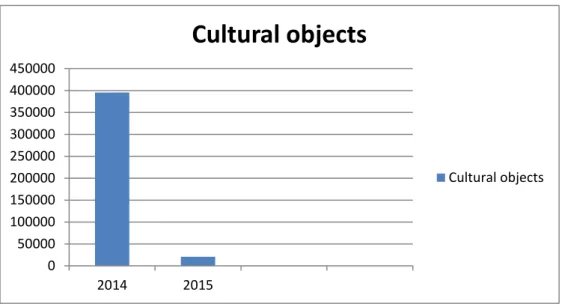
It is extremely difficult to get accurate information on this issue, but interesting cases are highlighted in French yearly customs reports. However, they should be read with care because the first set of reports gives numbers of seizure (Figure 1) and the second set of reports gives number of objects seized (Figure 2), and neither has information concerning where the objects originated from and to which country they were returned; although they are normally returned to their country of origin, whether they are EU Member States or not, in cooperation with the Minister for Culture.32 An unintended, and positive, consequence of the war on terror is that there are now more border controls which means that customs officials may seize and forfeit more trafficked cultural objects in cooperation with the OCBC.33
Figure 1 - Number of instances of seizures of cultural goods34
32 Direction générale des douanes et droits indirects, Résultat 2010, Bilan d'activité (2011) 10
33 Direction générale des douanes et droits indirects, Résultat 2015, Protéger les citoyens, soutenir les entreprises
(2016) 13; Dominique Perrin. 'How French Art Police Are Hunting ISIS Antiquities Racket' (07/03/2016)
<http://www.worldcrunch.com/culture-society/how-french-art-police-hunt-the-isis-antiquities-racket/c3s20733/>
34 Direction générale des douanes et droits indirects, Rapport annuel de performance, 2010 (2011) 105; Direction
générale des douanes et droits indirects, Rapport annuel de performance, 2012 (2013) 90; Direction générale des
0 10 20 30 40 50 60 70 80 90 100 Series1
8
Figure 2 - number of seized cultural objects35
Apart from the seizure of objects in transit, the OCBC has also identified other objects and informed respective Member States that it identified their national treasures. For example, it returned a painting to Italy, 36 a canvas to Spain after an out of court settlement in 2010, 37 and two sculptures to Germany, also after an out of court settlement in 2011.38
This snapshot of cases concerning the return of cultural objects to their countries of origin demonstrates that trafficking is an important issue in France and that international cooperation takes place between different police units as well as ministers for culture. Nevertheless more is needed, and the numbers given above only represent the tip of the iceberg.
2 - Impact of the Directive on French civil law and cultural heritage law
The 1993 Directive was implemented into French law by Statute 92-1477 of 31st January 1992, which was then codified in the Cultural Heritage Code in sections L. 112-1 to L.112-25 in 2004
douanes et droits indirects, Résultat 2014, Protéger les citoyens, soutenir les entreprises (2015) 18; Direction générale des douanes et droits indirects, Résultat 2015, Protéger les citoyens, soutenir les entreprises (2016) 13
35Direction générale des douanes et droits indirects, Rapport annuel de performance, 2010 (2011); Direction
générale des douanes et droits indirects, Rapport annuel de performance, 2012 (2013) 90; Direction générale des douanes et droits indirects, Résultat 2014, Protéger les citoyens, soutenir les entreprises (2015) 18; Direction générale des douanes et droits indirects, Résultat 2015, Protéger les citoyens, soutenir les entreprises (2016) 13
36 European Commission, op. cit. 13 37 ibid 10 38 ibid 11 0 50000 100000 150000 200000 250000 300000 350000 400000 450000 2014 2015
Cultural objects
Cultural objects9
(Chapter II – Return of Cultural Objects). This Directive created an exception to the doctrine of non-application of foreign public law in private international law, according to which French courts do not enforce foreign public laws that forbid the export of cultural objects. Accordingly, a state that is not a Member of the EU will not be able to start proceedings for return on the grounds that its export licence laws were not complied with.39 It is hoped that this position will
improve in the future as recent developments in international cultural heritage law suggest the recognition of a principle of cooperation to protect cultural heritage.40 This principle vests in
the state of origin a sufficient interest to commence proceedings for the return of an illicitly exported cultural object, and is found in the 1970 UNESCO Convention on the Means of Prohibiting and Preventing the Illicit Import, Export and Transfer of Ownership of Cultural Property, the 1995 UNIDROIT Convention on Stolen or Illegally Exported Cultural Objects, the above-mentioned 1993 and 2014 Directives, and the Model provision on State Ownership of Undiscovered Cultural Objects, as well as in some national laws, such as the English case of Iran v Barakat.41
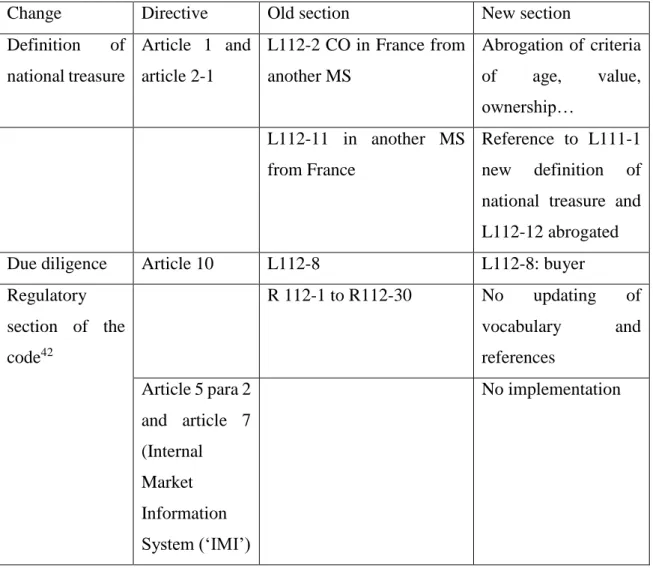
The implementation of the 2014 Directive by Act 2015-195 had a minimal impact on the existing structure of the Code: seven sections were amended and one section was abrogated for consistency purposes (Figure 3). The Act complies with the Directive by extending the time limitations to check that the object is a national treasure object and to make a claim for its return (respectively from two to six months and from one to three years) and updating the vocabulary, numberings and references to EU law (the European Economic Community became the European Union; Regulation 3911/92 of 9/12/1992 became Regulation 116/2009 of 18/12/2008; reference to Article 30 TEU became Article 36 TFEU; references to Member States were changed to the competent central authority of the requesting Member State). The competent central authority in France remains the Office central de lutte contre le trafic des biens culturels (OCBC).
Figure 3: Summary of changes made by Act 2015-195 of 20 February 2015
Nature of change
Directive Old section New section
39 M. Cornu and others, 'France' op. cit., p. 222. 40 S. Vigneron, op. cit. 117
41 Government of the Islamic Republic of Iran v The Barakat Galleries Ltd [2007] EWCA Civ 1374 (CA),
10 Updating vocabulary, numbering and references European Economic Community EEC (title of sections 1 and 2, L112-1, L112-2)
European Union (EEC to EU)
Regulation 3911/92 of 9/12/1992
Regulation 116/2009 of 18/12/2008
Art. 30 TEU Art. 36 TFEU
Member State Competent central authority of the requesting Member State Extension of time limitation to check provenance and for a court to order necessary measures for the physical
preservation of the object
Article 5 para 1 (3)
L112-5: two months and reference to Member State
L112-5: six months and reference to the relevant authority of the MS L112-5: necessary
measure (mesures conservatoires) can be ordered by a Judge to protect the object for up to one year (to coincide with the time limit to bring proceedings) L112-5: extension to three years Extension of time limitation to claim Article 8(1) L112-10: proceedings must be started within one year after the MS became aware of the location of the cultural object and of the identity of its possessor or holder. L112-10: extension to three years Competent central authority R112-3 : Office central de lutte contre le trafic des biens culturels
11
However, with respect to content fundamental changes were made, firstly to the definition of a national treasure in French law and secondly to the requirement of due diligence (section L112-8 of the Cultural Heritage code) or to the presumption of good faith in favour of a good faith purchaser (section 2274 of the Civil code) (Figure 4). Thirdly, the implementation of the Directive is incomplete as the regulatory section of the Code does not refer to the Internal Market Information Service, which is one of the main innovations of the Directive. Hence, this section will focus on these three issues: the definition of a national treasure in French law; the definition of due diligence; and the procedural implementation of the directive (or rather the lack thereof).
Figure 4: issues
Change Directive Old section New section Definition of national treasure Article 1 and article 2-1 L112-2 CO in France from another MS Abrogation of criteria of age, value, ownership… L112-11 in another MS from France Reference to L111-1 new definition of national treasure and L112-12 abrogated Due diligence Article 10 L112-8 L112-8: buyer Regulatory section of the code42 R 112-1 to R112-30 No updating of vocabulary and references Article 5 para 2 and article 7 (Internal Market Information System (‘IMI’) No implementation
12 Competent
central authority
R112-3 : Office central de lutte contre le trafic des biens culturels (OCBC)
OCBC and minister of culture?
Definition of a national treasure
One of the reasons of the lack of success of the previous Directive was that the definition of a national treasure was too narrow (Recital 8). It needed to be widened to give more flexibility to Member States to decide what is ‘a national treasure possessing artistic, historic or archaeological value within the meaning of Article 36 TFEU’ (Recital 9). The Directive abandoned the 14 categories listed in the Annex (archaeological objects; elements forming an integral part of artistic, historical or religious monuments which have been dismembered; pictures, paintings; mosaics; original engravings, prints, serigraphs and lithographs with their respective plates and original posters; original sculptures or statuary; photographs, films and negatives; incunabula and manuscripts, including maps and musical scores, singly or in collections; books more than 100 years old, singly or in collections; printed maps; archives; collections and specimens from zoological, botanical, mineralogical or anatomical collections, collections of historical, palaeontological, ethnographic or numismatic interest; means of transport more than 75 years old; any other antique item more than 50 years old). It also abandoned the age and financial value threshold. It still covers ‘objects of historical, paleontological, ethnographic, numismatic interest or scientific value, whether or not they form part of public or other collections or are single items, and whether they originate from regular
or clandestine excavations, provided that they are classified or defined as national treasures.’43
Hence, Article 2(1) of the 2014 Directive defines a cultural object as ‘an object which is classified or defined by a Member State, before or after its unlawful removal from the territory of that Member State, as being among the “national treasures possessing artistic, historic or archaeological value” under national legislation or administrative procedures’.
In French law, the category of National Treasures was defined by Parliament the day before the Common Market became a reality on the 1st of January 1993. Statute 92-1477, adopted on New Year’s Eve, defined national treasures as:
13
'Les biens appartenant aux collections publiques et aux collections des musées de France, les biens classés en application des dispositions relatives aux monuments historiques et aux archives, ainsi que les autres biens qui présentent un intérêt majeur pour le patrimoine national au point de vue de l'histoire, de l'art ou de l'archéologie sont considérés comme trésors nationaux’.
This section was later codified in section L.111-1 of the Cultural Heritage Code, and became its cornerstone. It defined three categories of national treasures, each of them including paintings, sculptures, silverware, tapestries, textiles, furniture, musical instruments, photography, and diverse heritage from railway, underwater or scientific heritage. The first category covered all objects belonging to national collections, museums or archives, as well as those belonging to accredited museums (musées de France), in total approximately 121 million artefacts.44 The second category covered all objects (approximately 260,000) and archives (approximately 50) listed as historic monuments.45 The last category included all objects belonging to private individuals that need an export certificate; i.e. cultural objects that have not yet been identified as national treasures. A refusal to grant an export certificate means that the object in issue must be purchased by an administrative body (usually a museum) within a period of 30 months. After this time, the object can be freely exported if it has not been bought. From 1993 to 2013, 204 objects became national treasures within the meaning of this section.46 The above definition was complex, it needed precision and simplification to avoid overlap.47 The aim was not to drastically change the definition but to simplify its style and fill in gaps. Now, the qualification of a national treasure comes first rather than last and the categories are numbered:
“Sont des trésors nationaux :
1° Les biens appartenant aux collections des musées de France ;
2° Les archives publiques, au sens de l'article L. 211-4, ainsi que les biens classés comme archives historiques en application du livre II ;
3° Les biens classés au titre des monuments historiques en application du livre VI ;
44 Etude d'impact, op. cit. 44
45 As of December 2013. Ministère de la Culture. 'Les objets mobiliers classes ou inscrits'
<http://www.culturecommunication.gouv.fr/Politiques-ministerielles/Monuments-historiques-Espaces- proteges/Intervenir-sur-un-monument-historique/Intervenir-sur-un-objet-mobilier/Les-objets-mobiliers-classes-ou-inscrits> accessed 11/01/2016
46 Etude d'impact, op. cit. 44
47 M. Cornu, 'France' in J. Nafziger and R. Paterson (eds), Handbook on the Law of Cultural Heritage and
14
4° Les autres biens faisant partie du domaine public mobilier, au sens de l'article L. 2112-1 du code général de la propriété des personnes publiques ;
5° Les autres biens présentant un intérêt majeur pour le patrimoine national au point de vue de l'histoire, de l'art ou de l'archéologie.”
This new definition is unchanged for the following: 1°) museum collections, 3°) objects listed as historic monuments and 5°) objects and works of art belonging to private persons/institutions that need an export certificate. The process and definition is unchanged for this last category of cultural goods, which are not yet identified as national treasures.
There are two new categories: archives and objects that belong to a public institution and are of special interest. Firstly, all public and private archives that are listed as historical archives according to Book II of the Code, amended in 2008, are now considered national treasures.48 This means that all archives are within the definition of national treasures, even if they are not listed as historical monuments; the category of historical archives is separate from historical monuments and was not included in the old section L.111-1. It also includes archives produced by private bodies for a public activity.49 The creation of a special and broader definition of archives means that they are now better protected.50 A second category is created by the explicit reference to section L.2112-1 of the public bodies’ property code51 which was adopted in 2006. This section includes within the remit of the public domain (public ownership) all objects that belong to a public institution (personne publique) and have a historical, artistic, archaeological, scientific or technical interest. It then lists several categories of objects that fall within this category (documents that contribute to the creation of a national identity, public archives, private archives owned by the State, archaeological finds, underwater movable heritage, objects within historical monuments, ecclesiastical objects that fall within State ownership,52 museum collections, including the collections of Mobilier national et de la Manufacture nationale de Sèvres, although the list is non-exhaustive. This new definition means that all objects that are owned by a public institution and have a special interest are national treasures, even though they might not be listed as historical monuments. The criterion of special interest
48 Act 2008-696 du 15 juillet 2008 relative aux archives JORF n°0164 16 July 2008, 11322 49 Etude d'impact, op. cit. 48
50 Reference to the case TGI Paris, ibid 45
51 Section L2112-1 CG3P : ‘Sans préjudice des dispositions applicables en matière de protection des biens
culturels, font partie du domaine public mobilier de la personne publique propriétaire les biens présentant un intérêt public du point de vue de l'histoire, de l'art, de l'archéologie, de la science ou de la technique […]’
52 The 1905 Act ‘separating Churches and State’ defined the French Republic as secular and separated the French
15
is important to this definition as it excludes everyday objects that are within public ownership but do not have a cultural interest (e.g. photocopiers, school furniture, hospital beds, police cars, etc.).
This wider definition complies with the aim of the Directive, which is to encourage Member States to better protect their heritage and to facilitate returns. It also includes two categories of national treasures that were previously either incompletely covered (archives) or excluded altogether.
Due diligence and section 2274 of the Civil Code
Recital 17 of the Directive makes a U turn in the dealing of trafficking in cultural object by reversing the burden of proof of due diligence and placing it on the purchaser. It recognises
that ‘all those involved in the market [should] exercise due care and attention in transactions involving cultural objects.’ It acknowledges that in order to deter dealers, private collectors and museums from participating blindly in the trafficking of cultural objects, compensation should be paid only to those who have fulfilled their duty of due care and attention when purchasing
an artefact. It also reiterates the ‘Union's objectives of preventing and combating unlawful trafficking in cultural objects.’
In accordance, Article 10 of the Directive provides that the object shall be returned and that a Court in the requested Member State can award the possessor fair compensation on the condition that a possessor shows that s/he ‘exercised due care and attention in acquiring the
object’. It is for the judge to decide, according to the circumstances of the case, whether the
possessor was duly diligent. Criteria to be taken into consideration are: ‘the documentation on the object's provenance, the authorisations for removal required under the law of the requesting Member State, the character of the parties, the price paid, whether the possessor consulted any accessible register of stolen cultural objects and any relevant information which he could reasonably have obtained, or took any other step which a reasonable person would have taken in the circumstances.’ This section complements Articles 4(4) and 6 of the 1995 UNIDROIT Convention on Stolen or Illegally Exported Cultural Objects and embodies the closer cooperation between EU and international law.53
16
While France initially unsuccessfully, opposed the inclusion of this wording,54 there was surprisingly little opposition by Members of Parliament and almost no opposition from the art market lobby. Hence the relevant section of the Act was adopted without much discussion, and there was general support for greater cooperation between the Member States of the EU.55 However, some Members of Parliament underlined that this exception to section 2274 only applied to national treasures illegally exported from states within the EU, while others argued that some repercussions on the market was a possibility56 and that the rule was in opposition to
French law principles.57
The impact study considered this change to be the most important in the Directive, as it is in direct opposition to section 2274 of the Civil code, according to which good faith is always presumed and the claimant must prove bad faith at the moment of purchase.58 Section L112-8 and paragraphs 2 and 3 of the CHC were duly amended to include a reference to the duly diligent possessor. However, good faith found its way back into the definition adopted by Parliament, as the Directive in French states ‘le possesseur prouve qu'il a exercé la diligence requise lors de l'acquisition du bien’; whereas paragraph 2 of section L112-8 CHC states:
‘Le tribunal accorde, en tenant compte des circonstances de l'espèce, au possesseur de bonne foi qui a exercé la diligence requise lors de l'acquisition du bien une indemnité équitable destinée à réparer son préjudice et qui est mise à la charge de l'Etat membre requérant’ (emphasis added).
This reference to good faith shows that national legal concepts are extremely hard to abandon.59 This change, i.e. the reversal of the burden of proof, means that the purchaser must show that s/he was diligent rather than the requesting Member State showing that the purchaser was not diligent. However, the criteria to be taken into consideration are similar to the ones that French judges have referred to in order to decide that someone was a bad faith possessor. For example,
54 Etude d'impact op. cit. 46
55 H. Farron, 'Debate, 2e seance 20/11/2014 (Rapporteur de la commission des affaires culturelles)', vol
21/11/2014 (JO AN 2014) 8981; C. Melot, 'Debate, Seance du jeudi 18 decembre 2014 (Rapporteur de la commission culture et éducation)', vol 19/12/2014 (JO Senat 2014) 10652
56 H. Farron, 'Debate, 2e seance 20/11/2014 (Rapporteur de la commission des affaires culturelles)', vol
21/11/2014 (JO AN 2014) 8982
57 B. Gonthier-Maurin, 'Debate, Seance 18 décembre 2014', vol 19/12/2014 (JO Senat 2014) 10654 58 Etude d'impact, op. cit. 46
59 Or conversely, extremely hard to adopt. For more on the problem of legal transplantation and good faith, see S.
Vigneron, 'Le rejet de la bonne foi en droit anglais' in S. Robin-Olivier and D. Fasquelle (eds), Les échanges entre les droits, l'expérience communautaire (Droit de l'Union européenne, Bruylant 2008) 307
17
bad faith possessors buy artefacts at night in the boots of cars, do not fill in compulsory registers and sale accounts,60 buy expensive paintings for a cheap price from small second-hand dealers,61 are specialists who sell rare books with precious engravings without checking their provenance,62 or buy Rodin statues and Marie Laurencin paintings widely advertised as stolen without calling the Rodin Museum first.63 Hence, judges should take into consideration the
same criteria (time and place of sale, quality of the object, knowledge of the parties, price paid, and consultation of available databases) to decide whether the purchaser was duly diligent at the time of the acquisition. This rule should encourage art dealers, auction houses, private collectors and buyers to be more careful, and to consult relevant databases. For example, there are several databases that can be used in France: TREIMA is run by the OCBC,64‘Collections sur Mesure’65 or Palissy, which includes more than 230,000 reports of stolen or lost objects
listed as historic monuments and is run by the Minister of culture, as well as international databases such as Interpol and the Art Loss Register.
Finally, according to the general principle ‘Speciala generalibus derogant’, section L112-8 CHC, a special rule should be considered and applied to take precedence over a general rule (section 2274 of the Civil Code). There might be uncertainty as to which rule was in force at the time of the purchase. The French impact report mentioned that section L112-8 CHC should apply to all purchases, even those that happened before it came into force on 23 February 2015.66 This seems unlikely as non-retroactivity is a general legal principle, according to which cases must be judged based on the law that was in force at the time the operative facts occurred. This means that this new section should apply only to purchases made after 23 February 2015.
Regulatory implementation
The main shortcomings in the implementation of the Directive are twofold: the regulatory section of the Cultural Heritage Code (R 112-1 to R112-30) has not been updated to reflect the changes made, and the Internal Market Information System (hereafter IMI) has not yet been
60 Cass crim. 3 déc. 1984: Bull. Crim 381
61 Cass. Crim. 19 dec. 1989 (86-96704) unpublished, Gazette Palais 1990.II.som.522 62 Cass. Crim 5 mai 1993 (91-83101) unpublished.
63 Cass. Crim 1re feb. 2005 (04-81962)Bull. 37 64 Etude d'impact, op. cit. 49
65 Ministère de la Culture. 'Biens culturels volés ou disparus accessibles par le moteur de recherche "Collections
sur Mesure"' (31/03/2015) <http://www.culturecommunication.gouv.fr/Politiques-ministerielles/Circulation-des-
biens-culturels/Actualites/Biens-culturels-voles-ou-disparus-accessibles-par-le-moteur-de-recherche-Collections-sur-Mesure> accessed 11/03/2016
18
implemented even though it is one of the main tools of the Directive. The impact study recognised that the setting up of the IMI system, and the longer periodicity for reporting to the Commission, meant that it should not entail extra costs for the State nor the need for more staff.67 There should also be more out-of-court settlements, costing between 5,000 and 7,000 euros per year. However, these costs do not include lawyers’ fees, insurance, transport, and preservation.68
3 -
Joan of Arc s
ring: a theoretical question
By way of conclusion one may pose a final theoretical question concerning the ring of Joan of Arc. What would have happened if the Export Licensing Unit had decided that the ring was authentic and was of sufficient interest to be a British national treasure?
The purchase, illegal export, and subsequent import took place between 26 February and 16 March 2016, after the 2014/60 Directive and its implementing statute were in force (23 February 2016). According to the new Cultural Heritage Code, the Department for Culture, Media and Sport (DCMS), which is the relevant competent authority in the UK, could have asked the OCBC to investigate and find out where the ring was and in whose possession. The OCBC would thus find that the ring was exhibited in a Chapel in the Amusement Park of Puy du Fou (near Nantes) and was in the possession of the Puy du fou Espérance Fondation. The OCBC could then ask the President of the Tribunal de Grand Instance to take precautionary measures to guarantee the ring’s safety, for example, to store it in a vault or in a museum. DCMS would then have until March 2019 to start legal proceedings against Puy du Fou Espérance Fondation by lodging a claim for the ring’s return (section L 112-10 CHC). The relevant court would be the Tribunal de Grande Instance, of where the ring might be stored (section L.112-6 CHC). The Court could order the return of the ring to Britain if it could successfully be shown that it was a cultural object within the scope of section L. 112-2 CHC. Such a finding could be based applying the English criteria identifying a national treasure: the ring was in the UK for more than 100 years, was above the financial threshold of £39,219
(category 14(b)) and would probably meet the Waverley criteria of historical importance (as a relic of the Hundred Years’ War that belonged to Saint Joan of Arc, who has become a symbol
67 Etude d'impact, op. cit. 47 68 ibid 47
19
for both French and British history), rather than aesthetic or educational criteria.69 This classification could be done even after the ring was illegally removed from the territory of the UK.
The Puy du Fou Fondation could be deemed to be a possessor which had not exercised due care and attention in acquiring the object. According to the Art Newspaper, Gaëtan Favreau (who works for Puy du Fou) had ‘touched’ the ring and said it ‘probably has an export
licence’,70 meaning that they did not enquire whether an authorisation for removal had been
granted under English law, in violation of L.112-8 CHC. They did not act as a reasonable person; on the contrary, they rather demonstrated bad faith as they illegally exported the ring and publicised the purchase only after it was back in France. The aim of the Directive is to redress this type of situation by facilitating claims by Member States and deterring would be traffickers.
To conclude this hypothetical case and this paper, the illegal export of national treasures, which is part of trafficking in cultural objects, is a major issue that is difficult to quantify. Illegal exports are facilitated by the principles of free movement of people and of goods, embodied in the lack of border and custom controls within the EU. This is why the 2014/60 Directive is such a major instrument in the fight against trafficking. It promotes cooperation among Member States by adopting a broader definition of a national treasure and a concept of due diligence on the part of the possessor, which complements the 1970 UNESCO Convention on the Means of Prohibiting and Preventing the Illicit Import, Export and Transfer of Ownership of Cultural Property and the 1995 UNIDROIT Convention on Stolen or Illegally Exported Cultural Objects. These international conventions, together with civil and criminal sanctions, should form an effective legal arsenal to fight the trafficking in cultural objects.
References:
69 There are three non-cumulative Waverley criteria: (1) Historic: the object is so closely connected with either
national or local British history and national life that its departure would be a misfortune; (2) Aesthetic: the object is of outstanding aesthetic importance; (3) Educational: the object is of outstanding significance for the study of some particular branch of art, learning or history.
20
'L'anneau de Jeanne d'Arc restera en France' Le Figaro (05/05/2016) <http://www.lefigaro.fr/culture/2016/05/05/03004-20160505ARTFIG00098-l-anneau-de-jeanne-d-arc-restera-en-france.php> accessed 07/06/2016.
Bailey M, 'France and Britain prepare for battle over Joan of Arc’s ring; Jewel sold in UK for £300,000 last month has left the country—but did it have an export licence?' (16/03/2016) <http://theartnewspaper.com/news/news/france-and-britain-prepare-for-battle-over-joan-of-arc-s-ring> accessed on 16/06/2016.
--, 'British doubts over Joan of Arc's ring' the Art Newspaper (June 2016) News 9.
Blanc W and Naudin C, 'Comment Philippe de Villiers récupère le mythe de Jeanne d’Arc' Le Monde (27/03/2016 2016) <http://www.lemonde.fr/idees/article/2016/03/27/comment-philippe-de-villiers-recupere-le-mythe-de-jeanne-d-arc_4890755_3232.html> accessed 07/06/2016.
Blin M, 'Anneau de Jeanne d'Arc: comment va se défendre Nicolas de Villiers' Le Figaro (14/04/2016) <http://www.lefigaro.fr/culture/2016/04/13/03004- 20160413ARTFIG00089-anneau-de-jeanne-d-arc-comment-va-se-defendre-nicolas-de-villiers.php> accessed 07/06/2016.
Cornu M, 'France' in Nafziger, J. and R. Paterson (eds), Handbook on the Law of Cultural Heritage and International Trade (Edward Elgar Publishing Ltd 2014).
--, 'Recasting restitution: interactions between EU and international law' (2015) 20(4) Unif L Rev 637.
Cornu M and others, 'France' in Cornu, M. and J. Fromageau (eds), Protection de la propriété culturelle et circulation des biens culturels. Étude de droit comparé Europe / Asie (2008) <http://www.gip-recherche-justice.fr/wp-content/uploads/2014/07/05-23-RF.pdf;> accessed 10/06/2016.
Direction générale des douanes et droits indirects, Rapport annuel de performance, 2010 (2011) <http://www.douane.gouv.fr/Portals/0/fichiers/datadouane/publication-douane/bilans-resultats/rap-2010.pdf> accessed 17/03/2016
21
-- Rapport annuel de performance, 2012 (2013) <http://www.douane.gouv.fr/Portals/0/fichiers/datadouane/publication-douane/bilans-resultats/rap-2012.pdf> accessed 17/03/2016
-- Résultat 2010, Bilan d'activité (2011)
<http://www.douane.gouv.fr/Portals/0/fichiers/information/publication-douane/bilans-resultats/resultats-2010.pdf> accessed 17/03/2016
-- Résultat 2014, Protéger les citoyens, soutenir les entreprises (2015) <http://www.douane.gouv.fr/Portals/0/fichiers/information/publication-douane/bilans-resultats/resultats-2014.pdf> accessed 17/03/2016
-- Résultat 2015, Protéger les citoyens, soutenir les entreprises (2016) 2016) <http://www.douane.gouv.fr/Portals/0/fichiers/information/publication-douane/bilans-resultats/resultats-2015.pdf> accessed 17/03/2016
Direction générale des patrimoines, Vols, disparitions et restitutions d'objets mobiliers protégés au titre des monuments historiques signales en 2011 (2012)
<http://www.culturecommunication.gouv.fr/Politiques-ministerielles/Circulation-des-biens-culturels/Ressources-documentaires/Bilans-documents-archives;> accessed 11/03/2016
--, Vols, disparitions et restitutions d'objets mobiliers protégés au titre des monuments
historiques signales en 2012 (2013)
<http://www.culturecommunication.gouv.fr/Politiques-ministerielles/Circulation-des-biens-culturels/Ressources-documentaires/Bilans-documents-archives> accessed 11/03/2016
--, Vols, disparitions et restitutions d'objets mobiliers protégés au titre des monuments historiques signales en 2013 (2014)
<http://www.culturecommunication.gouv.fr/content/download/98176/878607/version/1/f ile/2013_Bilan+des+vols+dans+les+Monuments+Historiques+en+France.pdf.> accessed 11/03/2016
--, Vols, disparitions et restitutions d'objets mobiliers protégés au titre des monuments historiques signales en 2014 (2015)
<http://www.culturecommunication.gouv.fr/Politiques-ministerielles/Circulation-des-biens-culturels/Actualites/Bilan-des-vols-dans-les-monuments-historiques-2014> accessed 11/03/2016
22
Etude d'impact du Projet de loi portant diverses dispositions s'adaptation au droit de l'Union européenne dans les domaines de la propriété littéraire et artistique et du patrimoine culturel (21/10, MCCB1421649L/Bleue1, 2014)
European Commission, Fourth report on the application of Council Directive 93/7/EEC on the return of cultural objects unlawfully removed from the territory of a Member State (COM(2013) 310 final, 2013) <http://eur-lex.europa.eu/LexUriServ/LexUriServ.do?uri=COM:2013:0310:FIN:EN:PDF> accessed 17/01/2014
Farron H, 'Débat, 2e séance 20 novembre 2014 (Rapporteur de la commission des affaires culturelles)', vol 21/11/2014 (JO AN 2014).
Gonthier-Maurin B, 'Débat, Séance du jeudi 18 décembre 2014', vol 19/12/2014 (JO Senat 2014).
Melot C, 'Débat, Séance du jeudi 18 décembre 2014 (Rapporteur de la commission culture et éducation)', vol 19/12/2014 (JO Senat 2014).
--, Rapport fait au nom de la commission de la culture, de l'éducation et de la communication sur le projet de loi adopte par l'assemblée nationale après engagement de la procédure accélérée portant diverses dispositions d'adaptation au droit de l'Union européenne dans les domaines de la propriété littéraire et artistique et du patrimoine culturel (172 Senat, 2014-2015)
Ministère de la Culture. 'Les objets mobiliers classés ou inscrits'
<http://www.culturecommunication.gouv.fr/Politiques-ministerielles/Monuments- historiques-Espaces-proteges/Intervenir-sur-un-monument-historique/Intervenir-sur-un-objet-mobilier/Les-objets-mobiliers-classes-ou-inscrits> accessed on 11/01/2016.
--'Biens culturels volés ou disparus accessibles par le moteur de recherche "Collections sur Mesure"' (31/03/2015) <http://www.culturecommunication.gouv.fr/Politiques-
ministerielles/Circulation-des-biens-culturels/Actualites/Biens-culturels-voles-ou-disparus-accessibles-par-le-moteur-de-recherche-Collections-sur-Mesure> accessed on 11/03/2016.
23
Perrin, Dominique. 'How French Art Police Are Hunting ISIS Antiquities Racket' (07/03/2016) <http://www.worldcrunch.com/culture-society/how-french-art-police-hunt-the-isis-antiquities-racket/c3s20733/>
--'Restitution d’œuvres d’art volées' (14/03/2007) <http://www.culture.gouv.fr/culture/actualites/conferen/donnedieu/dpoeuvres.pdf> accessed on 11/03/2016.
--'Restitution de deux glaives du roi Jérôme; Le 20 janvier, Frédéric Mitterrand a remis officiellement à Jean-François Hébert, président de l’établissement public du domaine et château de Fontainebleau, les deux glaives du roi Jérôme de Westphalie qui avaient été volés dans la nuit du 15 au 16 novembre 1995.' (20/01/2010) <http://www.culturecommunication.gouv.fr/Ministere/Histoire-du-ministere/Ressources- documentaires/Discours/Discours-de-ministres-depuis-1999/Frederic-Mitterrand-2009-2012/Articles-2009-2012/Restitution-de-deux-glaives-du-roi-Jerome/(language)/fre-FR> accessed on 11/03/2016. --'Retable de la passion' <http://www.culture.gouv.fr/culture/actualites/conferen/albanel/dpvetheuil.pdf> accessed on 11/03/2016.
Vigneron S, 'Le rejet de la bonne foi en droit anglais' in Robin-Olivier, Sophie and Daniel Fasquelle (eds), Les échanges entre les droits, l'expérience communautaire (Bruylant 2008).
--, 'Protecting Cultural Objects: Enforcing the Illicit Export of Foreign Cultural Objects' in Vadi, Valentina and Hildegard Schneider (eds), Art, Cultural Heritage and the Market, Ethical and Legal Issues (Springer 2014).