Preventing Elder Investment Fraud:
Assessing for Vulnerability to
Financial Exploitation
George Taffet, MD Professor and Chief of Geriatrics
Baylor College of Medicine
Gerald Rome, JD, Acting Securities Commissioner Division of Securities, Colorado Department of
Regulatory Agencies Denver, Colorado, March 20, 2014
Elder Investment Fraud and Financial
Exploitation (EIFFE) Prevention Program
•
The EIFFE Prevention Program utilizes CMEcourses to educate health care professionals about elders’ vulnerability to investment fraud due to MCI and other conditions, how to recognize EIFFE in their patients, referral routes for further medical screening and where to report suspected fraud
•
The program is currently running in 28 U.S. states and jurisdictions and has reached over 6500 professionals.EIFFE Prevention Program
• A collaboration between:
– Investor Protection Trust
– Investor Protection Institute
– Baylor College of Medicine
– National Adult Protective Services Association
– North American Securities Administrators Association
– State Securities Regulators
• In cooperation with U.S. medical associations and their local chapters including:
– American Academy of Family Physicians
– National Area Health Education Center Organization
– National Association of Geriatric Education Centers
Acknowledgements of Project Team
• Bob Roush, EdD, MPH, Principal Investigator
• Aanand Naik, MD, Co-PI
• George Taffet, MD, Chair, Internal Advisory Group
• Larry McCullough, PhD, Member, IAG
• Nancy Wilson, LMSW, Member, IAG
• Mark Kunik, MD, Member, IAG
• Whitney Mills, PhD, Assistant Project Director
• Elisa Rodriguez and Kristin Cassidy, Former Assistant Project Directors
• Jennifer Moye, PhD, Elder Capacity Assessment Consultant
• Janet Pinner, RN, PGCM, Nursing Continuing Education
• Wayne Howell, JD, Investor Education Consultant
• The physicians, nurses, social workers and investor educators in focus groups whose opinions and suggestions guided our efforts
Disclosure
•
The presenter discloses some of his
faculty received funding from the
non-profit Investor Protection Institute
•
Development of the Clinician Pocket
Guide was made solely by members of
the Baylor College of Medicine project
group
Special thanks to…
•
Colorado University School of Medicine Section of Geriatrics•
Division of Securities, Colorado Department of Regulatory AgenciesLearning Objectives
Attendees should be able to…•
List key factors that increase an older person’s vulnerability to elder investment fraud and financial exploitation•
Describe common financial exploitation schemes and practices•
Describe when to and where to refer patients deemed high risk to appropriate sources of assistancePart 1: Goals…
•
Raise clinical awareness of elder investment fraud and financial exploitation (EIFFE)– it’s a serious, growing problem
– what you can do about it
•
Provide information and resources that can help you– based on your personal knowledge of a
patient or client
– but unclear how to ask about it or types of referral sources
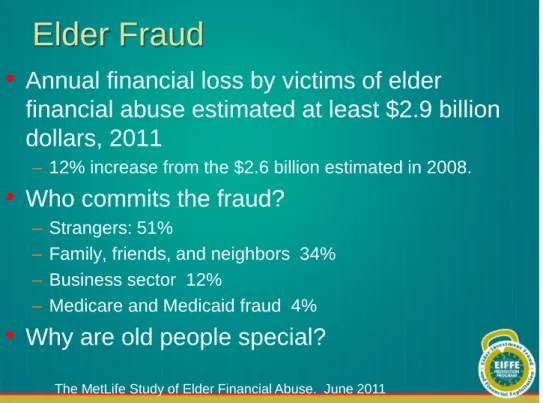
Elder Fraud
•
Annual financial loss by victims of elder
financial abuse estimated at least $2.9 billion
dollars, 2011
– 12% increase from the $2.6 billion estimated in 2008.
•
Who commits the fraud?
– Strangers: 51%
– Family, friends, and neighbors 34%
– Business sector 12%
– Medicare and Medicaid fraud 4%
•
Why are old people special?
The MetLife Study of Elder Financial Abuse. June 2011
Figure 1. Conceptual Schematic of Progressive Decline in Financial Capacity in a Person With Alzheimer Disease (AD)
Widera, E. et al. JAMA 2011;305:698-706
Normal Changes with Age
Increase Risk
•
Important Age-Related Differences in Learning from Positive Feed back versus Negative feedback•
“… the salience of negative feedback seems reduced with age.”– Pietschmann M1, Endrass T, Czerwon B, Kathmann N. Aging, probabilistic learning and performance monitoring. Biol Psychol. 2011;86:74-82.
•
“older adults are less affected by negative feedback and rely more on positive feedback during learning”– Eppinger B1, Kray J, Mock B, Mecklinger A. Better or worse than expected? Aging, learning, and the ERN. Neuropsychologia. 2008;46:521-39.
Normal Changes with Age
Increase Risk
•
Iowa Gambling Test– Four Fixed Decks of Cards, Two Decks initially positive, but rapidly turn negative
– Optimal strategy is to switch to other decks
– Many older people never switch.
•
Correlate loosely with Age-Related Changes in Serotonin and DopamineNot an Extensive Literature, but…
NeuroEconomics, A Field in Its
Infancy--Science is Lagging Behind
the Bad Guys
•
Age Differences Lead to Changes in
NeuroEconomics, Implications of
Not Learning from Losses are Huge
• Age Differences Lead to Changes in Decision
Making about Money Issues
• Nigerian scams where despite losing almost
his entire estate, person puts up that last
dollar to the scammer
• Slot machine payout settings
• Findings in cognitively normal elders;
dementia clearly increases vulnerability
•
35% (8.8 million) of Americans over the
age of 71 have either
–
mild cognitive impairment (MCI)
–
dementia
–
changes in executive cognitive
functions*
* Plassman, BL et al. Annals of Internal Medicine, Vol. 148, No. 6, pp. 427-434, March 18, 2008
Prevalence of Cognitive
Problems
•
14 to 20 % of the elderly population – have 1 or more mental health conditions or problems stemming from substance misuse or abuse.•
Depressive disorders and psychiatric symptomsare common.
http://www.iom.edu/Reports/2012/The-Mental-Health-and-Substance-Use-Workforce-for-Older-Adults/ Press-Release.aspx: Accessed 03/08/2013
Prevalence of Depression and
Substance Abuse in 65+ Population
> Risk of Financial Exploitation
•
Of all elder abuse cases reported, 30% were for financial exploitation(National Elder Abuse Study, 1998)
•
Two nationally representative studies found 4-5% of older adults in the US have been victims of financial abuse(Acierno et al., 2010; Laumann et al., 2008)
– similar prevalence to heart attacks and higher than systolic heart failure (1-2%)
http://www.nanocorthx.com/Articles/HeartDiseaseStrokeStatistics.pdf
EIFFE Can Happen to Anyone…
“To those seniors and especially elderly veterans like myself, I want to tell you this: You are not alone and you have nothing
to be ashamed of. If elder abuse happened to me, it can happen to anyone.”
Mickey Rooney
Testimony to Senate Special Committee on Aging, March 2, 2011
•
Mickey Rooney’s caretaker and step-son
embezzled millions of dollars and created a
management corporation to funnel his dollars
to them
•
Film Documentary about Elder Fraud Called:
"LAST WILL AND EMBEZZLEMENT“
•
Highlights Mickey Rooney’s story
Raising Awareness (1)
•
Why addressing this issue is so important…– vulnerable population is large and growing
– financial health affects overall health
financial loss impacts available food, medication, and other health services
Raising Awareness (2)
•
Almost a third of elders live within
150% of the poverty level
•
Average savings of 50 year old
Raising Awareness (3)
•
Even older adults with savings in the low millions can’t afford to lose substantial amounts, as they don’t have the time to make it up•
Current resources exist for patients only after harm occurs to them; little is available to prevent EIFFE•
Many aspects of normal aging anddisease can contribute to older adults’ vulnerability to EIFFE
What can you do to help
prevent EIFFE?
•
Simple office-based assessments of potential vulnerability to EIFFE– checklist of situations associated with high risk
– assessment questions
– referral sources for those deemed potentially at high risk
– recent paper on office-based assessments by E. Widera et al. JAMA, Feb. 16, 2011 http://jama.ama-assn.org/content/305/7/698.full
Adding Financial Exploitation
to the Geriatric Checklist
Clinician’sPocketGuide Patient Education Brochure
EIFFE Prevention Program Materials
See all EIFFE program materials at this web page on the IPT’s site: http://www.investorprotection.org/ipt-activities/?fa=eiffe-pp
Important Areas of
Consideration for EIFFE Cases
Ask Yourself:
•
Vulnerability [risk] factors
•
Financial capacity issues
•
Investment and financial knowledge
•
Undue influence of others
Vulnerable Older Adults
•
An older adult is vulnerable if he/she
demonstrates characteristics or
performs behaviors that are
associated with subsequent morbidity,
disability, or death
Wenger, NS et al: Annals of Internal Medicine: 2001 and Saliba, D: Journal of American Geriatrics Society: 2001
Financial Capacity
•
“The ability to make and execute
decisions consistent with personal
preferences and values regarding
finances”
Marson, D et al: Encyclopedia of Psychology and the Law: 2008
Investment Fraud and Financial
Exploitation
•
“The illegal or improper use of
another individual’s resources for
personal profit or gain”
Adult Protective Services:
Undue Influence
•
“When exploiters, whether family,
acquaintances, or strangers, use their
power to deceptively gain control over
the decision making of a victim. Often
involves financial exploitation.”
American Bar Assoc. & American Psychological Assoc. Assessment of Older Adults with Diminished Capacity: A Handbook for Psychologists: 2008
Case Scenario 1
•
Mr. Allen is an 83-year-old man who lacks financial capacitydue to Mild Cognitive Impairment (MCI). Mr. Allen has involved his son Steven in some financial decisions. While Mr. Allen is a conservative investor, Steven likes to take risks. He invests a large portion of his father’s retirement funds in a risky stock. Soon afterwards, the stock falls dramatically. Out of embarrassment, Steven doesn’t tell his father what he has done. (Is this fraud?)Case Scenario 2
• Mrs. Hartford is an 86-year-old recent widow. Her daughter, Mae, hires a caregiver, Susan, to help around the house. Mae notices that Susan is
acquiring lots of new things. Then Mae discovers she cannot access her mother’s accounts anymore. She visits her mother; Susan is no where to be found.
• Susan had unduly influenced Mrs. Hartford into signing a durable power of attorney. She then
depleted Mrs. Hartford’s retirement funds. Once Mae realized what was happening, Susan took what was left of Mrs. Hartford’s savings and fled. (Is this fraud?)
Case Scenario 3
• A 79-year-old man allows his financial advisor to purchase an equity-indexed annuity* in the hopes that this will provide him economic security should he live to 85 and not have the same level of
resources he presently has. The advisor does not disclose the “shrouded” information that the annuity doesn’t begin until age 90 nor the high percentage surrender fee should the gentleman decide to change his mind. (Is this fraud?)
Common EIFFE Schemes by
Responsible Party (1)
•
Caregivers or family members
–
use older adult’s personal
materials for own gain, such as:
retirement funds, social security
checks, etc.
Common EIFFE Schemes by
Responsible Party (2)
•
Trusted financial advisors– sells inappropriate annuities or front-end loaded mutual funds, then churns them to generate inordinately high fees that can result in decumulation of assets
•
Strangers– scams by phone, email, or mail – Think fly by night roofers
Responsible Party Characteristics
•
Traits–caregiver
–male, usually relative
–living with the patient
–economically dependent on the patient
–history of mental illness, including
substance abuse and antisocial behavior or other health problems
Tueth, M (Am J Geriatr Psychiatry 8:2, Spring 2000)
Relationship Between Undue
Influence and Vulnerability
•
An increase in dependency on others
–
arises from vulnerability
–
increases chances of being unduly
Part 2: Clinical Assessment of
Vulnerable Older Adults
•
Simple office-based assessment ofpotential vulnerability to EIFFE
– recommended questions you can add
to patient’s waiting room paperwork
– assessment questions clinician asks during visit using Clinician’s Pocket Guide
Red Flags in Patient/Client History
•
Social isolation•
Bereavement•
Dependence on another to provide care•
Financially responsible for adult child or spouse•
Alcohol or drug abuse•
Depression or mental illness (see next slide on prevalence)Prevalence of Depression
• 20% of older adults have Major Depressive Disorder (MDD) or some symptoms of depression.
• Depression as a risk factor: older adults who are abused tend to be depressed compared to those who aren’t.
• Depression as a consequence: older adults can develop depression as a result of being abused or exploited.
– leaves them open to even more exploitation
NIH Senior Health: http://nihseniorhealth.gov/depression/aboutdepression/04.html NCEA: http://www.ncea.aoa.gov/NCEAroot/Main_Site/Library/Statistics_Research/Research_Reviews/ emotional_distress.aspx
Red Flags from Clinical
Observations (2)
•
Change in ability to perform activities
of daily living, including self care, daily
finances, medication management
•
Accompanied by caregiver who is
overly protective; dominates
patient/client
Red Flags from Clinical
Observations
ANY COGNITIVE IMPAIRMENT
Functional disability key feature of dementia – starts with impairment in IADLS
MCI patients are 4 times more likely to make errors on a validated financial capacity instrument*
Damage to the prefrontal cortex makes affected elders less risk averse, i.e., willing to gamble** *Marson DC et al. Am J Geriatr Psychiatry, 2008
**Denburg N.Annals of the New York Academy of Sciences, December 2007
MCI and Financial Exploitation
•
MCI patients are 4 times more
likely to make errors than
controls*
•
Damage to the prefrontal cortex
makes affected elders less risk
averse, i.e., willing to gamble
**Introducing the Issue to Your Patient
•
“We find that some older adults worry aboutmoney; may I ask you a few questions about this?” or
•
“I just read a NY Times article about eldersbeing financially exploited and thought I ought to talk to my mother and my patients, too.”
•
What other opening questions do you thinkwould be good ones?
Questions You Can Ask (1)
•
Who manages your money day to
day? How is that going?
•
Do you run out of money at the end
Questions You Can Ask (2)
•
Do you regret or worry about financial
decisions you’ve recently made?
•
Have you given power of attorney to
another person?
•
Do you have a will? Has anyone asked
you to change it?
Do I probe deeper or refer?
•
If answers raise suspicion:
– go to four referral sections in Clinician’s Pocket Guide or
– probe for further details (See
Financial Concerns Checklist which may be added to the patient/client information packet and completed during intake.)
Financial Concerns Checklist (1)
•
Are you having any of the following
common concerns?
– I have trouble paying bills because the bills are confusing to me
– I don’t feel confident making big financial decisions alone
– I don’t understand financial decisions that someone else is making for me
– I give loans or gifts more than I can afford
– My children or others are pressuring me to give them money or change my will
Financial Concerns Checklist (3)
•
People are calling me or mailing
me asking for money, lotteries
•
Someone is accessing my
accounts or money seems to be is
disappearing
What types of referral may be
needed? (1)
•
Help with managing money or other care tasks– poor resource management or limited
resources available; needs assistance with finances, meals, transportation, ADLs
•
Legal advice or protection– needs assistance with financial planning or legal documentation
What types of referral may be
needed? (2)
•
Fraud and exploitation may have
occurred
–
needs legal counsel
•
Further medical evaluation
–
needs assessment for cognitive,
Ethical Considerations
•
Concerns about calling any local or
state regulatory agency, even
though it is mandatory and failure
to do so is unlawful
•
Literature suggests talking to the
patient and the possible
responsible party individually
Interactions with Possible
Responsible Party (1)
•
Use non-confrontational demeanor
•
Ask about relationship to the patient
•
Discuss patient’s daily activities and
routines
•
Discuss any of patient’s special needs
Interactions with Possible
Responsible Party (2)
•
Observe for following behaviors:
– demeaning comments about the patient
– defensive, suspicious attitude
– hostility about your inquiries
– threat to change doctors
Tueth, M (Am J Geriatr Psychiatry 8:2, Spring 2000)
Referral Sources Where You
Practice (1)
• United Way – 211 local hotline www.211.org
• National Association of Professional Geriatric Care Managers
www.caremanager.org
• Case Management Society of America www.cmsa.org
• National Academy of Elder Law Attorneys (NAELA)
Referral Sources Where You
Practice (2)
• Colorado Department of Regulatory Agencies, Division of Securities, 303-894-2320
http:www.dora.state.co.us
• Find Colorado’s Adult Protective Services contact information at
http://www.apsnetwork.org/Abuse/index.html
• Colorado Attorney General’s Office
• Colorado Department of Insurance
• Local District Attorney’s Office
Part 3: What You Can Say to Your
Patients …
•
Be aware of our own vulnerability•
Be aware of who wants your money•
Be aware of how you can protect yourselfImmunize Your Patients from Bad
Financial Decisions
•
Chapters 17 and 18 in geriatrician Mark Lachs’ book deal with aging and money issues.•
Citing works like this helps patients and their caregivers appreciate your concerns.Investor Education
and Protection
Investment Fraud Affects
Everyone
In the United States,
BILLIONS of dollars are lost each year to
investment fraud and scams.
These scams affect both the rich and poor; the sophisticated and the unsophisticated; the timid, the greedy, and the elderly.
Role of the State Securities
Regulator
•
Each State has a Securities Regulator to protect its citizens from investment fraud.•
Colorado’s State Securities Regulator is Gerald Rome, JD, Acting Commissioner Colorado Division of Securities1560 Broadway, Suite 900 Denver, CO 80202
Phone: 303.894.2320
Role of the State Securities
Regulator
• The Colorado Securities Division:
– Licenses investment professionals and clears securities offerings
– Investigates investor complaints and potential cases of investment fraud
– Enforces securities laws
– Examines brokerage and investment adviser firms – Provides information to investors about an adviser or
broker’s license, prior disciplinary history and background
– Supports investor education and outreach programs
Investment Products and Vehicles
•
A Security is a financial instrument entitling the owner to specified types of financial benefits•
Products commonly referred to as securities:– Stocks, bonds, notes, options, debentures, convertible certificates and variable annuities
•
Products not commonly referred to as securities, but still subject to the laws governing securities:– Interests in mineral/oil rights, limited partnerships, investment contracts and promissory notes
What is Investment Fraud?
•
Investment fraud, also known as stock and/or securities fraud, violates securities laws. It occurs when investors are induced to make purchase or sale decisions on the basis of false information, frequently resulting in losses•
Securities laws also prohibit the sale of unsuitable investments and unregistered products, and transactions by unlicensed advisers/brokers and theft or misappropriation of fundsWho Needs to be Registered to
Sell Securities?
• Brokerage Firms
– Also known as broker-dealers
– Investors maintain their securities accounts with these firms. Brokers are not fiduciaries
• Securities Salespersons
– Also known as stockbrokers; work for brokerage firms
– Individuals with whom investors deal directly when effecting transactions in their accounts
– They typically receive commissions when investors purchase or sell securities
Who Needs to be Registered to
Sell Securities?
•
Investment Advisers– a person or business entity engaged in the business of providing advice, making recommendations or furnishing analysis regarding securities. Advisers are fiduciaries (client’s best interest is first)
•
Things to consider with an Adviser:– fee-based only, commission only
What You Should Expect from an
Advisor
• Full Disclosure: You are entitled to complete and accurate information about an advisor and any securities they recommend to you
• Information on risks, obligations, and costs
• Investment to be suitable based on experience, finances, age
• Monthly account statements
• Timely access to your funds
Common Advisor Scams and
Schemes
•
Unsuitable investments and “know your customer”•
Unauthorized transactions (power of attorney abuse)•
Margin trading•
Churning•
Unreasonable expectations•
Complex investments•
High fees and expensesCommon Types of Fraud
• Investment Fraud
– Affinity fraud
– Theft in brokerage accounts
– Internet and email investment scams
– Ponzi and pyramid schemes
– Oil & gas schemes
– Coins & precious metals
• Caregivers/Family/Friends
– Power of Attorney
– Change of last will and testament
– Property conversion
How To Spot a Con Artist
• Promise no risk with high rewards/returns
• High pressure sales techniques
• Spelling and grammatical errors
• Offer is for you only or a “select group”
• Pressure for an immediate response
• Requires an advance payment
• “Cash only” or checks made out personally
• Promises to provide paperwork “later”
• Often ask for personal information
• Ask you to sign blank forms or documents
• Inability to contact an independent company representative
• Discourage checking with regulators
• Offers that are too good to be true
Self-Defense Tips
• Before you buy, check the background of anyone trying to sell you securities with your State Securities Regulator
• Don’t accept statements from your manager alone – verify with the brokerage firm
• Don’t send money directly to the manager – make out checks to the third-party independent brokerage account
• Never invest based on reputation or word of mouth
• Monitor your investments and ask tough questions
• Look for trouble retrieving your principal or profits
• Don't let embarrassment keep you from reporting fraud
• Read & understand your monthly statement – report problems to your broker or his/her manager
• Unknown caller offering investment product: “HANG UP THE PHONE”
Investigate Before You Invest!
• Check out your broker/advisor and any securities before committing any money or signing any paperwork
• Deal only with registered individuals and reputable firms; ask questions; obtain, keep and read documentation
• Colorado Securities Division
• Check on licensing or registration status, disciplinary history or pending arbitration and employment history for the past 10 years through the Central Registration
Depository (CRD) at:
www.finra.org/Investors/ToolsCalculators/BrokerCheck/
How Your Patient Can File a
Complaint Form
• Facts generate outcomes
– How did the victim learn about the opportunity – Who was there during the meeting
– When and where did the meeting take place – Why did the victim decide to purchase the
investment
– Names, addresses, and telephone numbers
• You can download/complete a complaint form online at:
Complaint Form – What Should
Be Attached
•
Always keep a paper trail– Business card or other information that lists the name and company of the
individual who may have sold investments to the client
– Any monthly statements
– Documentation (e.g. prospectus) – Website address
Additional Investor Education Resources
IPT Investor Education Booklets Video on the IPT WebsiteFuture Directions: What’s Next?
•
Additional CME Programs in 2014•
Web-based EIFFE Education 2014-2015– Free web version available now at www.eiffeprevention.org
•
Continued 6-month follow-up evaluationReferences
1. Acierno, R. et al. Prevalence and correlates of emotional, physical, sexual, and financial abuse and potential neglect in the United States: The National Elder Mistreatment Study.” Am J Pub Health 2010;100(2): 292-297.
2. Bartels SJ, Naslund JA. The underside of the silver tsunami – older adults and mental health care. N Engl J Med. 2013;368:493-496.
3. Denburg NL et. al. The orbitofrontal cortex, real-world decision-making, and normal aging. Ann NY Acad Sc 2007:1121: 480-498.
4. Marson DC et al. Clinical interview assessment of financial capacity in older adults with mild cognitive impairment and dementia.” J Am Geriatr Soc 2009;57:806-814.
5. Plassman BL, Langa KM, Fisher GG, Heeringa SG, Weir DR, Ofstedal MB, et al. Prevalence of cognitive impairment without dementia in the United States,” Ann Intern Med 2008 March 18;148 (6):427–34.
6. Roush RE, Moye, JA, Mills WL, Kunik ME, Wilson NL, Taffet, GE, Naik AD. Why clinicians need to know about the elder investment fraud and financial exploitation program, Generations 2012 Summer; 36(2):94-97.
7. Tueth, M. Am J Geriatr Psychiatry 2000 Spring;8:2.
8. Widera E, Steenpass V, Marson, DC, Sudore R... Finances in the older patient with cognitive impairment: He didn't want me to take over. J Am Med Assoc 2011;305(7):698-706.
Contact Information
• George Taffet, MD, FACP, Professor & Robert J. Luchi, MD, Chair in Geriatric Medicine, Baylor College of Medicine Head, Division of Geriatrics, Houston Methodist Hospital [email protected]
• Gerald Rome, JD, Acting Securities Commissioner, Division of Securities, Colorado Department of Regulatory Agencies 1560 Broadway, Ste. 900, Denver, CO 80202, 303-894-2320; Fax 303-861-2126; [email protected]
• Bob Roush, EdD, MPH, Director, Texas Consortium Geriatric Education Center, Huffington Center on Aging, Baylor College of Medicine, Houston, Texas [email protected]
• Don Blandin, MPA, President and CEO, Investor Protection Trust/Investor Protection Institute, Washington, D.C. [email protected]