A Self-Assessment Model for Quality
Management and Organisational
Development for Continuing and
Professional Education
[ D ]
© 2011 DAETE [2] Project. All rights reserved. ISBN: 978-0-615-55862-2
Graphic design: Georgia Institute of Technology
This document has been created with the financial assistance of the European Union and FIPSE. The opinions expressed herein are those of the participants of Project, and therefore do not represent the official position of the European Union or FIPSE. EFQM is a registered trade mark of the European Foundation for
Quality Management.
Reproduction, in whole or in part of the present document by any means or methods without written authorisation of the authors is prohibited.
Dedication
John Klus, a professor at the University of Wisconsin, Madison, USA , died on 2 September 2011. He was an international leader in the field of Continuing Engineering Education, recognised with many national and international awards for innovation and leadership and a mentor to all. John passionately believed in achieving high quality in everything he did and the work of DAETE is only one example. He was the US instigator of the US-EU projects that have established the current framework for quality improvement in CEE. This, the final product of these projects, is dedicated affectionately to his memory, in the hope that we all may continue the work he started.
Authors from the European Union:
Aalto UniversityMarkku Markkula – Kirsti Miettinen
Imperial College London
Mervyn Jones
Universidade do Porto
Alfredo Soeiro
Universitat Politécnica de Valencia
Patricio Montesinos - Carlos Ripoll
Authors from the United States of America:
Georgia Institute of TechnologyNelson Baker
State University of New York
Kim Scalzo University of Michigan Edward Borbely University of Wisconsin-Madison John Klus
[ D ]
DAETE [2] Project
Partners
European Union:Aalto University, Finland (Coordinator) Imperial College London, United Kingdom Technische Universiteit Delft, The Netherlands Katholieke Universiteit Leuven, Belgium Aarhus Universitet, Denmark
Universitat Politécnica de Valencia, Spain Universidade do Porto, Portugal
United States of America:
Georgia Institute of Technology, Georgia (Coordinator) State University of New York, New York
University of Michigan, Michigan
University of Wisconsin-Madison, Wisconsin
Contributors
Anna-Maija Ahonen, Aalto University Guus de Mari, Technische Universiteit Delft Flemming Fink – Lars Frølund, Aarhus Universitet Terrye Schaetzel, Georgia Institute of Technology Wim Van Petegem, Katholieke Universiteit Leuven
Table of Contents
Introduction ...8Definition of Terms ...9
DAETE [2] Project ...10
The EFQM Model and the Underlying Structure ...11
Model Adapted to University-based Continuing Professional Education ...12
The Journey to Excellence ...13
The Main Paradigms Underlying the EFQM Model ...14
Defining Criteria of the EFQM Model ...18
Quality Management Model for Benchmarking and Self-Assessment ...19
EFQM Self-Assessment Matrix for Continuing and Professional Education ...20
Enablers Criterion 1: Leadership...22
Sub-criterion 1a: Development of Vision and Mission ...23
Sub-criterion 1b: Continuous Improvement of Management Systems ...24
Sub-criterion 1c: Leadership and External Relations ...25
Sub-criterion 1d: Leadership and Motivation ...26
Criterion 2: Policy and Strategy ...27
Sub-criterion 2a: Stakeholder Input into Strategic Planning ...28
Sub-criterion 2b: Performance Indicator Input to Strategic Planning ...29
Sub-criterion 2c: Designing, Communicating and Validating the Strategic Plan ...30 Sub-criterion 2d: Implementation of Policies and
[ D ]
Criterion 3: People ...32
Sub-criterion 3a: Human Resource Management ...33
Sub-criterion 3b: Competence Development of the Staff ...34
Sub-criterion 3c: Staff Commitment and Involvement ...35
Sub-criterion 3d: Internal Communications ...36
Criterion 4: Partnerships and Resources ...37
Sub-criterion 4a: External Partnership Management ...38
Sub-criterion 4b: Economic and Financial Management ...39
Sub-criterion 4c: Technology Management ...40
Sub-criterion 4d: Information and Knowledge Management ...41
Criterion 5: Processes ...42
Sub-criterion 5a: Demand Analysis ...43
Sub-criterion 5b: Programme Design and Delivery ...44
Sub-criterion 5c: Analysis of the Competition ...45
Sub-criterion 5d: Communication and Marketing ...46
Sub-criterion 5e: Infrastructure and Logistics ...47
Sub-criterion 5f: Administrative and Financial Management ...48
Sub-criterion 5g: Quality Control ...49
Sub-criterion 5h: Certification ...50
Results Criterion 6: Customer Oriented Results ...52
Sub-criterion 6a: Programme Content and Programme Creation ...53
Sub-criterion 6b: Programme Delivery ...54
Sub-criterion 6c: Learner Support Services ...55
Sub-criterion 6d: Learning Environment ...56
Criterion 7: Staff Oriented Results ...59
Sub-criterion 7a: Staff Satisfaction ...60
Sub-criterion 7b: Quality of Staff ...61
Criterion 8: Society Oriented Results ...62
Sub-criterion 8a: Image ...63
Sub-criterion 8b: Social Responsibility ...64
Sub-criterion 8c: Impact ...65
Sub-criterion 8d: Sustainability ...66
Criterion 9: Key Performance Results ...67
Sub-criterion 9a: Financial ...68
Sub-criterion 9b Academic ...69
Sub-criterion 9c Quality ...70
Applying the Quality Management Model ...71
Getting Started ...72
Completing the Self-Assessment Matrix ...73
How to Participate in Benchmarking and the Global Conversation about CE Quality Management with other CE Organisations ...75
Forms and Templates ...76
Benchmarking Demographic Data Sheet ...77
Supplemental Benchmarking Data Sheet ...81
Best Practices Template ...82
[ D ]
[ D ]
DAETE [2] Project
n Academic audit: An evaluation of the content and delivery of an academic programme or parts, using a formal approach by academics external to the organisation.
n CE: Continuing Education.
n CEE: Continuing Engineering Education. n CPD: Continuing Professional Development.
n Certificates: Official documents provided by the educational institutions confirming attendance or some specific level of assessed achievement by a student.
n Completionrates: The ratio between participants who have successfully completed a programme to those initially enrolled. n Contacthours: Number of synchronous hours between learner and teacher.
n Costs: Total expenses per year including taxes, overheads, rentals, room rent, consultants, subcontracts, salaries, books and stationary, fringe benefits, food, etc.
n Degrees: Titles at various levels, conferred by a higher education institution as the result of completing an assessed programme of study.
n DemandAnalysis: A quantified assessment of the current and potential demand from customers for the various services, existing or potential, offered by the unit.
n Diploma: Academic certificate awarded by an educational institution that guarantees that the recipient has successfully completed an assessed course of study, but which would not warrant a full degree at the same level.
n ECTS: European Credit Transfer System – A European system designed to measure and credit student work load to facilitate comparison and student mobility between academic
institutions on a pan European basis. ec.europa.eu/education/ programmes/socrates/ects/index_en.html
n EFQM: European Foundation for Quality Management. www.efqm.org
n FTE: Full Time Equivalent – A unit of measure in terms of time spent by any individual when compared to another that is full time.
n HumanResources: Issues concerned with the availability, deployment, and terms of staff within the employment of the unit.
n ICT: Information and Communication Technologies.
n Institution: Higher education organisation or university within which the CE organisation exists.
n Knowledgemanagement: The range of practices used by organisations to identify, create, represent, and distribute knowledge for reuse, awareness and learning (Wikipedia). n ManagementSystem: The people, tools, and processes used in managing the organisation.
n Mission: A succinct statement of the overall purpose of the unit, possibly including its relationship to its place within a larger administrative structure. (It should be compatible with other unit mission statements within the structure.)
n NetIncome: Revenue minus costs per year.
n Organisation: A unit that manages and delivers educational programmes (courses) whether credit or non-credit, online or face-to-face, long or short, big or small. The unit could
be a department, centre, or programme and is part of a university or organisation.
n People: Staff (see further definition of staff below).
n Revenue: Financial income received per year, including all kinds such as grants, donations, fees, and institutional support. n SLH: Student (Participant) Learning Hours, i.e. the number of hours spent by the student while learning, including contact hours and private study.
n Staff: All employees of the organisation whose primary function is something other than teaching.
n StrategicPlan: The overall plan for how the organisation proposes to realise its vision, with reference to resource requirements and timescales.
n TechnologyManagement: The informed application of technology to support all aspects of the unit’s activities.
n Vision: A succinct statement of what the organisation expects
Definition of Terms
DAETE[2] Project
3. Different types of institutions: It is necessary to consider, and to include as much as possible,– a wide variety of institutions and/or types of programmes (e.g., diversity of topic areas, size, geographic region, etc.).
4. Utilization and applicability: Leaders should focus the utilization of the self-assessment model on continuing professional education across all academic disciplines and types of institutions, including applicability to online, face-to-face, and blended delivery programmes.
5. Benchmarking tools: In addition to self-assessment, there is also value in benchmarking against other institutions to compare and learn from the sharing of best practices. The benchmarking tools are designed to provide more information specific to the institution’s demographics and programme offerings and also provide a mechanism for sharing best practices to facilitate continuous improvement through benchmarking. The benchmarking tools include:
1. Benchmarking Demographic Data Sheet
2. Supplemental Data Sheet
3. Best Practices Template
This book includes a score sheet to record the results of the self-assessment as well as additional tools that can be used for benchmarking. Organisations can also download the tools from the DAETE2 project website: daete.up.pt. It is recommended to consult the project website to access the latest version of this tools, to obtain information on the benchmarking of results, and to discuss guidance for further developments.
This publication is Version 2.0 (October 2011) of the DAETE self-assessment matrix for continuing and professional education. It is based on version 1.0 of the document, which was tested by the partners for its applicability for all Continuing Professional Education (CPE) centres and programmes, including those outside of engineering. The original version of the EFQM self-evaluation matrix focused on management and was a result of the Project ALFA II-0180-A financed by the European Commission. The matrix was adopted in 2007 by the project DAETE (Development of Accreditation in Engineering Education and Training - daete.up.pt) and financed by the Atlantis
Program of the European Commission and the US Department of Education FIPSE Program. During this project, this tool was modified to be applicable for Continuing Engineering Education. The matrix was also adopted in 2008 by the project UNI-QM (www.uniqm.net) and financed by the European Commission. The DAETE2 project (daete.up.pt) was a natural continuation of these projects, resulting in version 2.0 of this publication, which includes a set of quality management processes and tools. .
The current set of tools and processes is designed to establish guidelines for a quality management model for CPE and for the accreditation of programmes and other learning services. In continuing to develop this model, the DAETE2 partners agreed to work under the following principles:
1. Diagnosis tool: The matrix is intended to be used for diagnosis and as a tool for continuous improvement, not as a transformation tool.
2. Level of the people that will use the matrix: The matrix will, if possible, be completed by the leaders of the institution, centre, and/or programme. In some instances, it may be appropriate for the institution or programme to broaden participation in completing the self-assessment to address all aspects of the assessment.
The EFQM Model and the Underlying Structure
The EFQM Model
The European Excellence Model and the foundation responsible for its development, more commonly known as EFQM (European Foundation for Quality Management), is a practical tool to help organisations achieve quality by measuring where they are on the path to Excellence.
The model is based on nine criteria which underpin the excellence of an organisation. The criteria include five Enablers and four Results. The Enablers cover what an organisation does. The Results criteria cover what an organisation achieves. The model illustrates that Leadership drives Policy and Strategy delivered through People, Partnerships and Resources. The criteria determine the level of Customer results, People results and the impact on Society as a whole.
EFQM proposes self-assessment as a comprehensive, systematic, and regular review of an organisation’s activities and further proposes these results referenced against the EFQM Excellence Model.
At the heart of the model lies the logic known as RADAR, which is comprised of four elements: Results (which should be addressed for the Results criteria), Approach, Deployment, Assessment and Review (which should be addressed for the Enabler criteria).
A Brief History of the EFQM Model and the Self-Assessment Approach
The European Foundation for Quality Management (EFQM) was created in 1988 by 14 leading European businesses. The EFQM Excellence Model was formally launched in 1991 with the aim to make ‘European Businesses more competitive through the application of TQM philosophy’.
The Model was initially used as a way of recognising achievement, with self-assessment being undertaken by organisations that needed to show continuous improvement over time in order to apply for the European Quality Award. After its introduction, however, it was discovered that the Model and self-assessment were proving to be valuable for driving continuous improvement activity within organisations that were not planning on applying for the award. It was also observed that the Model was being applied in a wider range of organisations than the private sector (for which it had originally been written). As a result, additional revisions of the Model were made. This included the Public and Voluntary Sector Model in 1999, which has since been refreshed and updated in 2003, and again in 2009.
The Fundamental Concepts of Excellence
The Fundamental Concepts of Excellence are the underlying principles of the EFQM Excellence Model which are the essential foundation of achieving Sustainable Excellence for any organisation. They can be used as the basis to describe the attributes of an excellent organisational culture. The eight Fundamental Concepts of Excellence are:
nCustomer Focus nResults Orientation
nLeadership and Constancy of Purpose
nManagement by Processes and Facts
nPeople Development and Involvement
nContinuous Learning, Innovation and Improvement nPartnership Development
Model Adapted to University-based Continuing Professional Education
As mentioned, the DAETE2 project team based its work on the 2003 version of the EFQM model and modified it during previous projects (ALFA II-0180-A and DAETE 1). The intention and purpose of adapting the original EFQM model to the continuing professional education sector was to make it more accessible and useful. For this reason, a tool was developed and adapted to the specific context of university-based continuing education or learning organisations. The project team believes, and validated during the DAETE2 project, that the model has direct applicability to a wide range of professional programmes, including online academic degree programmes.
The EFQM model divides organisational processes and outcomes into nine criteria, each with sub-criteria. The model also addresses these criteria through five evolutionary stages. By achieving the aims set out in each stage, organisations progress along the path to continuous quality improvement.
In the DAETE self-assessment matrix, the various EFQM sub-criteria, especially those related to processes, have been adapted to the needs of organisations involved in continuing education management.
The different development levels are based on the EFQM’s RADAR logic. Through this, an organisation’s enablers are evaluated for the existence of well-defined, developed and established processes in the majority of functional areas. Through regular monitoring, the effectiveness of each activity is assessed, and the results are used to determine and implement improvements.
The Five Levels Structure: Rationale
As mentioned previously, five levels have been developed with the following characteristics:
Level 1: Quality depends solely on the individual (no processes)
The activities depend on individual initiatives rather than globally programmed procedures in the organisation, unit or service. There are no defined associated assessment processes. Problems are rectified as they arise.
Level 2: Process awakening (basic processes)
The responsibility for activities ceases to be individual and tends to become the shared responsibility of the entire department, with some short-term planning. There is some degree of process definition, however no documentation. Performance is assessed occasionally.
Level 3: Vision through processes, professionalisation and a guarantee of quality (intermediate processes)
There are established standards, procedures and directives known throughout the organisation, unit or service. The activities are carried out in accordance with these procedures. Activities are planned with established medium-term objectives and defined indicators for assessment.
Level 4: Systematic assessment and improvement of processes (sophisticated processes)
Established procedures are systematically assessed for potential improvement. The organisation/programme strives to anticipate problems and complaints. There is a clearly visible orientation toward the customer. Activities are planned with well-defined, medium and long-term objectives.
Level 5: Aiming for external excellence (excellent processes)
There is a broad exchange of knowledge and experience both within the organisation and with professions outside the organisation (including competitors). The formulation and improvement of the procedures of the organisation, unit, or service conforms to internal and external industry standards. Experiences and best practices are shared with others. Partnerships and information exchanges exist with customers, suppliers, and other centres, etc. The development and improvement of the sector is assessed and anticipated.
The Journey to Excellence
The route to excellence is paved with continuous improvement, self-assessment, good management practices, and the discipline of planning. At the start, ask yourself: “Does my organisation already have a plan for improvement?” If not, it is important to consider the following basics:
n Assess where you are now. One way to do this is to self-assess
your organisation. The process of self-assessment can help your organisation understand and agree upon the current state.
n Define your business priorities. In order to align your
organisation and your business strategy, you need to
understand your present strengths and areas for improvement. The Fundamental Concepts of Excellence are the most tangible expression of Excellence. You can use these concepts to compare to your own organisation’s beliefs and strategies.
n Identify what needs improving. Your self-assessment can help
provide a detailed map for the people in your organisation. It helps you to answer: “Where do we need to improve?”
n Identify how to improve. Learn from others around you
through benchmarking and research. Identify the good practices of others. You can benchmark processes,
organisations and/or metrics, but first develop a benchmarking strategy that will help to direct your efforts.
In this project, we will focus on a self-assessment methodology; as we consider that it has enormous potential to become a standard in continuing professional education. The assessment methodology will be deployed by using a self-assessment matrix, based on facts. Our experience with earlier versions of the self-evaluation process suggests the most accurate results are obtained when:
1) those filling out the questionnaire know and are responsible for the organisation (programme managers and
management team are examples); and
2) more than one person fills out the questionnaire and the discussion that follows produces specific scores for the organisation.
The Main Paradigms Underlying the
EFQM Model
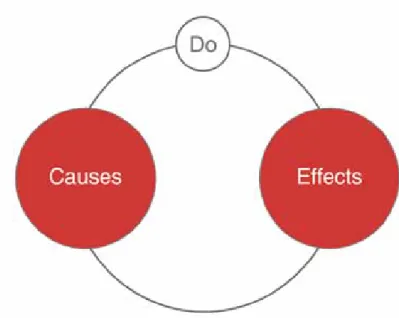
The EFQM Excellence Model is a non-prescriptive framework based on nine criteria. Five of these are ‘Enablers’ and four are ‘Results’. The ‘Enabler’ criteria cover what an organisation does. The ‘Results’ criteria cover what an organisation achieves. ‘Results’ are caused by ‘Enablers’ and ‘Enablers’ are improved using feedback from ‘Results’.
We achieve the final EFQM diagram by considering different approaches. First, we consider the “Enablers and Results” approach”. This model proposes that there are important topics that must first be considered in order to achieve some results. This could be also called the cause-effect paradigm underlying this model (See Figure 1).
Causes are called “Enablers” and effects are called “Results”. Next, we will see that the Enablers and Results are classified into different categories.
As we will see later, Enablers are broken down into five criteria. The five Enablers assess and question whether an organisation has the appropriate approaches in place to achieve set targets. The detail of the Model provides a framework for rigorous analysis that questions whether, in each area, the organisation can demonstrate that chosen approaches and strategies:
nare effective and efficient in delivering results; nare deployed to their full potential; and ndisplay continuous improvement.
On the other hand, Results are broken down into four criteria. The four Results criteria help determine whether comprehensive measures are in place to monitor and track performance, and assess whether objectives have been met. The Results criteria also question the extent to which benchmarking against the best-in-class is undertaken and can be used to enhance learning and improve performance. The criteria challenge an organisation to show that it can:
n comprehensively measure what is important to customers
and others who receive a service from the organisation; and
n demonstrate continuous improvement against targets and
results.
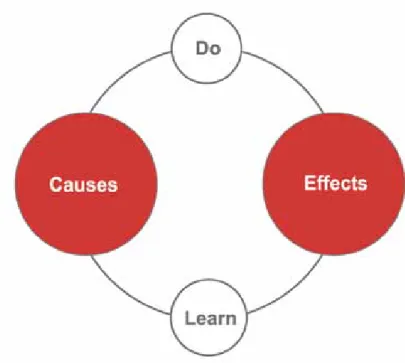
Next, it is important to consider the “Learning approach and the PDCA cycle”. Built upon the previous diagram, we should consider that once that we have obtained some Effects, we can learn from those Effects.
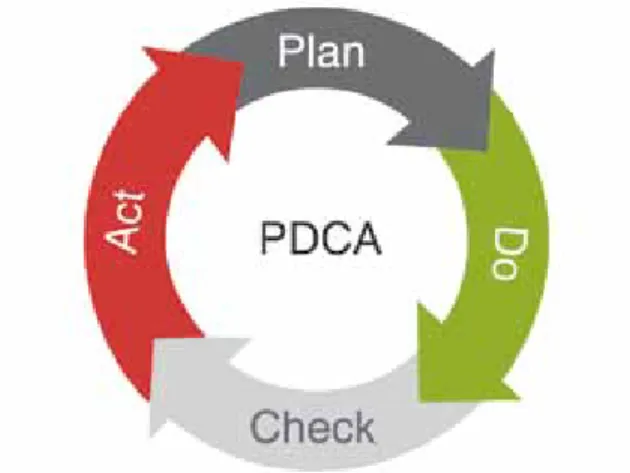
In order to complete the diagram, we are going to consider the PDCA cycle from Deming. This cycle is always present in this model. PDCA stands for Plan, Do, Check, Act.
n
Plan:
The cycle starts with planning things. In this phase,objectives need to be fixed and deployment plans need to be developed.
n
Do:
Once everything has been planned, you start to dothings that will produce specific results.
n
Check and Act:
In order to complete the cycle, thenext step is to take the specific results obtained and to see if they are coherent with what was previously planned. If results are not coherent or not what were expected, corrective action may need to be taken (Act phase) to guarantee that, next time, planned objectives are achieved. Next, look for concrete causes. As mentioned, the model is based on eight fundamental concepts. Those concepts are deployed by the five Enablers criteria and four Results criteria. This is illustrated in the next figure by using a cause-effect diagram.
Figure 3. The PDCA cycle
Finally, by putting everything together, we obtain the EFQM diagram representing the five Enablers criteria, the four Results criteria, and the learning and innovative process of the Model. We can check that the Model is dynamic in nature and has many linkages by studying this diagram. The links between each of the criteria of the Model suggest that it is interlinked and interdependent. The linkages are at four levels:
n Across the whole Model, drawing out and tracking key themes n Between the Enablers and the Results, in terms of cause and
effect
n Within the Results, by having leading and lagging indicators n Across the Enablers, where improvement in one area is often
dependant on the circumstances of another.
Enablers
1
Leadership
3
People
2
Policy and
Strategy
5
Processes
Results
6 Customer
Results
7 People
Results
8 Society
Results
9 Key
Performance
Results
4
Partners and
Resources
Innovation and Learning
➧
Defining Criteria of the EFQM Model
E
nablErsLeadership
Excellent leaders develop and facilitate achievement of the mission and vision. They develop organisational values and systems required for sustainable success and implement these via their actions and behaviours. During periods of change, they retain a constancy of purpose. Where required, such leaders are able to change direction of the organisation and inspire others to follow.
Policy and Strategy
Excellent organisations implement their mission and vision by developing a stakeholder-focused strategy that takes account of the market and sector in which it operates. Policies, plans, objectives and processes are developed and deployed to deliver strategy.
People
Excellent organisations manage, develop and release the full potential of their people at individual, team-based, and organisational levels. They promote fairness and equality, and involve and empower their people. They care for, communicate to, reward, and recognise staff to motivate and build commitment – to ultimately have them use their skills and knowledge for the benefit of the organisation.
Partnerships and Resources
Excellent organisations plan and manage external partnerships, suppliers and internal resources in order to support policy, strategy, and the effective operation of the organisation. During planning, and while managing partnerships and resources, they balance the current and future needs of the organisation, the institution as a whole, the wider community, and the
Processes
Excellent organisations design, manage, and improve processes in order to fully satisfy and generate increasing value for customers, staff, and other stakeholders.
Customer Results
Excellent organisations comprehensively measure and achieve outstanding results with respect to their customers.
People (Staff) Results
Excellent organisations comprehensively measure and achieve outstanding results with respect to their employees.
Society Results
Excellent organisations comprehensively measure and achieve outstanding results with respect to society.
Key Performance Results
Excellent organisations comprehensively measure and achieve outstanding results with respect to key elements of their policy.
Quality Management Model for Benchmarking and Self-Assessment
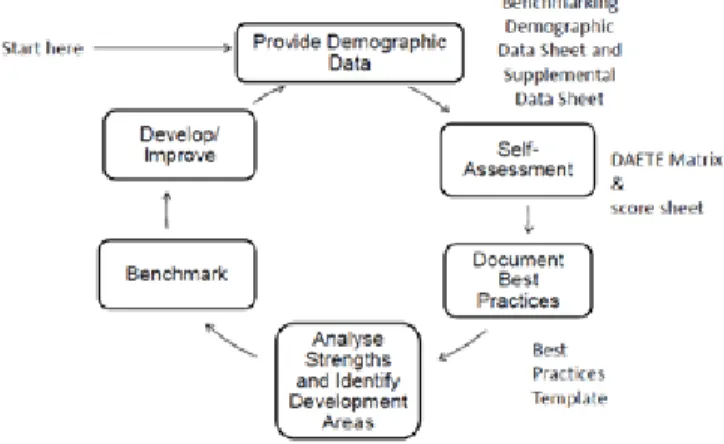
Every organisation will have its own intention and needs for conducting a assessment. Benefits of benchmarking and self-assessment will vary from organisation to organisation. Based on the past two years of dissemination activities, we have developed a cyclical model for quality management, and a set of tools and processes to enable both benchmarking and self-assessment. The process and tools are illustrated below.
The process starts when organisations begin to share their demographic data. That data contains characteristics about the organisation and its programmes. The data allows the organisation to determine who is like them and how programmes, staff, budgets, facilities, etc. compare to one another. We have developed two forms to utilize in collecting and sharing that information: the Benchmarking Demographic Data Sheet and the Supplemental Data Sheet.
The next step in the process is the self-assessment. The DAETE Self Assessment Matrix and Score Sheet are used to capture the ratings of the organisation on each of the sub-criteria adapted from the EFQM Excellence Model. One important step in conducting the self-assessment is to be able to document and explain the rationale for each rating. In cases where an organisation rates itself highly, it is critical to capture the best practices of that organisation to later be shared by other organisations interested in benchmarking for continuous improvement.
An outcome of the self-assessment is the ability to analyse strengths of the organisation, and identify opportunities for development. Many organisations use this data as input to their strategic planning process, and to help drive other strategic decision-making processes.
Once organisations have shared their self-assessment data, it is then possible to conduct benchmarking across many organisations. This allows for various groups to learn from each other and seek out peers who can aid in continuous improvement and ongoing development of their respective organisations. The following tools are available at the DAETE project website at http://daete.up.pt.
1) Benchmarking Demographic Data Sheet 2) Supplemental Data Sheet
3) DAETE Self-Assessment Matrix 4) Best Practices Template
[ D ]
DAETE [2] Project
Self-Assessment Matrix
for Continuing and
Enablers
1
Leadership
3
People
2
Policy and
Strategy
5
Processes
Results
6 Customer
Results
7 People
Results
8 Society
Results
9 Key
Performance
Results
4
Partners and
Resources
Innovation and Learning
➧
CRITERION 1: LEADERSHIP
Definition of the Criterion
Excellent leaders develop and facilitate the achievement of the mission and vision. They develop organisational values and systems required for sustainable success and implement these via their actions and behaviours. During periods of change, they retain a constancy of purpose. Where required, such leaders are able to change the direction of the
SUB-CRITERION 1a: DEVELOPMENT OF VISION AND MISSION
The organisation has developed and articulated the mission, vision and values which align with the vision and mission of the institution, and guide the decision-making of the organisation at all levels.
Definition of Levels
LEVEL 1 LEVEL 2 LEVEL 3 LEVEL 4 LEVEL 5
Quality depends solely on the individual (no processes)
Process awakening
(basic processes) Vision through processes, professionalisation and a guarantee of quality (intermediate processes) Systematic assessment and improvement of processes (sophisticated processes)
Aiming for external excellence (excellent processes)
The vision and mission are not defined, or are so general that they do not guide the work of the organisation. The activities are disconnected and/or without relation to the policies defined by the governing board. The operations depend on the will of the individuals who carry them out.
The management has defined the vision and mission of the organisation. It is explained to the staff, but not necessarily operationalised. The values are defined, but are vague or are not systematically agreed on by the staff. There are no follow-up procedures in place.
The vision and mission are coordinated with staff and understood within the institution in general. This definition allows development strategies for the organisation to be formulated and to define the tactics and actions. The possibility of redefining strategies and goals is accepted with reluctance.
The vision and mission are communicated to, and approved by, the management of the institution. There is wide consensus on the definition of goals, thus making it easier to carry out the associated tactics and actions and build strategic partnerships. Processes defining and implementing the vision and mission are reviewed and re-adapted regularly.
The formulation of the vision and mission is performed by the management of the organisation and by the governing board of the institution. The staff assumes the vision and mission as their own and transmits them from their position. The adaptation of values is assumed to be essential and obligatory. The definition and establishment of the vision and mission serve as a reference point for other institutions involved in continuing education.
Self Assessment Date
SUB-CRITERION 1b: CONTINUOUS IMPROVEMENT OF MANAgEMENT SySTEMS
The management of the organisation promotes and guarantees the development, implementation, and continuous improvement of the management system.
Definition of Levels
LEVEL 1 LEVEL 2 LEVEL 3 LEVEL 4 LEVEL 5
Quality depends solely on the individual (no processes)
Process awakening (basic processes)
Vision through processes, professionalisation and a guarantee of quality (intermediate processes) Systematic assessment and improvement of processes (sophisticated processes)
Aiming for external excellence (excellent processes)
The management of the organisation has not systematically defined the management system. The director is more an administrator of continuing education than a leader of the work culture and business processes.
The management of the organisation possesses the know-how and will to adapt the organisational structure and the management system to function effectively. As a consequence, the management promotes the adaptation of a management system to the work of the staff of the organisation.
The organisation’s management has clearly defined and implemented strategic processes. The operating procedures are developed and implemented. Support procedures are set in line with, and directed toward, strategic processes.
The management carries out a systematic follow-up of the key results of the organisation, communicating and discussing the results achieved with the work teams. Improvements and innovations are promoted.
The organisation is regarded as an important instrument in achieving the targets of the institution by the governing board. The Management and Leadership Model of the organisation is a reference for other organisations. It functions properly from the point of view of different internal and external actors. The management is invited to congresses and events to explain their model for the management of the continuing education organisation.
Self Assessment Date
SUB-CRITERION 1c: LEADERSHIP AND ExTERNAL RELATIONS
The organisation has systematic interaction with customers, strategic partners and other important stakeholder groups, such as learners, teachers, and representatives of social groups in order to operate for common interests and goals.
Definition of Levels
LEVEL 1 LEVEL 2 LEVEL 3 LEVEL 4 LEVEL 5
Quality depends solely on the individual (no processes)
Process awakening (basic processes)
Vision through processes, professionalisation and a guarantee of quality (intermediate processes) Systematic assessment and improvement of processes (sophisticated processes)
Aiming for external excellence (excellent processes)
The organisation’s leaders do not take initiative in terms of external relations. Relationships between the organisation and external players are incidental and not planned. There is no direct contact between leaders and students, teachers or external entities. Leaders are not present in continuing education networks or in other forms of inter-institutional contact.
The organisation’s leaders regularly participate with other universities, companies and institutions in the identification of common needs and solutions. The leaders propose that the university carry out joint projects with other institutions. The initiative is developed on a non-institutional basis but is tolerated by the political leaders of the institution.
The organisation’s management maintains direct links with professional organisations,
companies, public and private institutions which require and provide continuing education. Agreements generated are the result of the effective action of the leaders. Leaders occupy representative positions which permit the establishment of outside links with the organisation. Meetings are held at least periodically with other directors of continuing education. The management systematically assesses external networks to improve strategic collaboration. External links and their results are valued in order to redefine the policies undertaken. The management systematically
participates in meetings with other continuing education organisations at a national level.
The organisation’s management is considered a reference point in the field of continuing education. The leaders are able to establish partnerships in order to create joint projects with other institutions. Their leadership extends beyond the internal environment and reaches international levels. The organisation actively participates in the formulation of development plans and solutions to resolve basic problems.
Self Assessment Date
SUB-CRITERION 1d: LEADERSHIP AND MOTIVATION
The organisation has processes for the motivation and recognition of the staff.Definition of Levels
LEVEL 1 LEVEL 2 LEVEL 3 LEVEL 4 LEVEL 5
Quality depends solely on the individual (no processes)
Process awakening
(basic processes) Vision through processes, professionalisation and a guarantee of quality (intermediate processes) Systematic assessment and improvement of processes (sophisticated processes)
Aiming for external excellence (excellent processes)
The management of the organisation pays little attention to the initiatives of staff and has no direct contact with them. There are no formally established communication channels. There are no periodic meetings with people. There are no fundamental criteria regarding people recognition.
Random meetings and informal channels of communication are generated. Decisions taken in coordinating meetings are not executed. Management always has the last word. Employees may make suggestions, but the ones considered are the only ones the director is interested in.
There are defined channels of communication and regular meetings between staff and management. The organisation’s management establishes recognition policies based on clear criteria. There is an annual staff award or similar positive achievement recognition system. Professional development for the staff is promoted at no cost to them. The establishment of agreed objectives, as well as teams for continuous and systematic improvement are proposed. Delegation of responsibilities is staff-promoted. Innovative contributions of employees are recognised. Meetings, to check targets and how they are achieved, are held by the leaders with the management and the staff.
Regular dialogues with individual employees are held to define work objectives, development plans and related benefits. People who hold positions requiring innovativeness can use part of their time to independently use and improve their innovativeness. There is a communication plan which allows management to maintain constant communication with organisation staff. Methods are benchmarked against other institutions.
Self Assessment Date
CRITERION 2: POLICy AND STRATEgy
Definition of the Criterion
Excellent organisations implement their mission and vision by developing a stakeholder-focused strategy that takes account of the market and sector in which it operates. Policies, plans, objectives and processes are developed and deployed to deliver strategy.
SUB-CRITERION 2a: STAKEHOLDER INPUT INTO STRATEgIC PLANNINg
The needs and expectations of stakeholders (teachers, learners, companies, organisations, staff and society) are taken into account in the process of strategic planning.
Definition of Levels
LEVEL 1 LEVEL 2 LEVEL 3 LEVEL 4 LEVEL 5
Quality depends solely on the individual (no processes)
Process awakening
(basic processes) Vision through processes, professionalisation and a guarantee of quality (intermediate processes) Systematic assessment and improvement of processes (sophisticated processes)
Aiming for external excellence (excellent processes)
Analysis of needs of the stakeholders is not based on a plan.
Some studies of the needs of stakeholders have been made. These studies are not systematic. The information obtained is only partially used in the organisation’s operations.
There is a formal, though non-systematic process which takes needs and expectations of stakeholders
into account in the creation of strategies for the organisation/ programme.
There is a systematic methodology in place to observe and identify stakeholder needs. Meeting objectives based on identified needs and expectations of stakeholders is systematically assessed, and society is included as one stakeholder of the organisation.
Systematic monitoring of needs and expectations of stakeholders
leads to changes in the organisation, in accordance with the results to be achieved. The results are gathered in real-time and
required resources are used as economically as possible to obtain indicator data for future planning. Indicators are systematically compared with those obtained by other institutions of reference. The indicator data is accurate, reliable and available.
Self Assessment Date
SUB-CRITERION 2b: PERFORMANCE INDICATOR INPUT TO STRATEgIC PLANNINg
The assessment of performance indicators regarding customer satisfaction, staff, society and other core stakeholders serves as a key input to strategic planning.
Definition of Levels
LEVEL 1 LEVEL 2 LEVEL 3 LEVEL 4 LEVEL 5
Quality depends solely on the individual (no processes)
Process awakening
(basic processes) Vision through processes, professionalisation and a guarantee of quality (intermediate processes) Systematic assessment and improvement of processes (sophisticated processes)
Aiming for external excellence (excellent processes) There is a casual and non-systematic awareness of the mentioned indicators. The information is based on the individual performance of persons. Decisions are based on opinions rather than facts.
Information referring to the mentioned indicators is collected periodically to adopt strategic actions in the short term.
There is an incomplete, systematic process carried out by the organisation’s staff for periodic collection of information regarding the aforementioned indicators. Indicators are observed with interest, but not analysed in detail. Preventive measures are not taken concerning the results obtained.
The data collection system for indicators is systematic and complete, and is carried out automatically by both internal and external personnel. Giving information about the results is part of the communication plan. The indicators are analysed in depth and preventive measures are taken based on the results obtained.
The results are gathered in real-time and
required resources are used as economically as possible to obtain indicator data for future planning. Indicators are systematically compared with those obtained by other institutions of reference. The indicator data is accurate, reliable and available.
Self Assessment Date
SUB-CRITERION 2c: DESIgNINg, COMMUNICATINg AND VALIDATINg THE STRATEgIC PLAN
The strategic plan is defined, shared, implemented, assessed, and validated to ensure its effective implementation and follow-up.Definition of Levels
LEVEL 1 LEVEL 2 LEVEL 3 LEVEL 4 LEVEL 5
Quality depends solely on the individual (no processes)
Process awakening (basic processes)
Vision through processes, professionalisation and a guarantee of quality (intermediate processes) Systematic assessment and improvement of processes (sophisticated processes)
Aiming for external excellence (excellent processes)
The organisation has a strategic plan, but it does not guide the operational activities. There is little connection between the strategic plan and actions taken at the different activities of the organisation.
There is a coherent strategic plan; but there are no detailed strengths and weaknesses analysis, and no systematic procedures for carrying the plan out and assessing it. There is reluctance towards reviewing the plan.
Systematic communication exists, but there is no discussion or improvement. In coordination meetings, decisions are taken regarding whether the training programmes correspond to the policies and strategy. There are indicators and assessment, as well as systematic planning and comparisons made with policy and strategy.
There are systematic activities covering documentation, presentation, communication, and discussion to improve the processes. Attempts are made to creatively adapt proposals to the organisation’s policies and strategy, seeking innovation rather than the same old way of operating. The importance of assessment and innovation in planning is highly valued and activities, which take external factors into account, are regularly organised.
Policy is developed in conjunction with the organisation’s staff throughout the process, and is used as a benchmark by other organisations. Training plans are based on the organisation’s policy and strategy, and used as a base for the development of new products and services. Periodic meetings are held, with both internal and external representatives, to reflect on whether the strategic plan is being executed effectively.
Self Assessment Date
SUB-CRITERION 2d: IMPLEMENTATION OF POLICIES AND STRATEgy AND UPDATINg THE
STRATEgIC PLAN
The management of the organisation communicates and executes defined strategies and policies, as well as provides continuous updates to the plan.
Definition of Levels
LEVEL 1 LEVEL 2 LEVEL 3 LEVEL 4 LEVEL 5
Quality depends solely on the individual (no processes)
Process awakening (basic processes)
Vision through processes, professionalisation and a guarantee of quality (intermediate processes) Systematic assessment and improvement of processes (sophisticated processes)
Aiming for external excellence (excellent processes)
There is no clear and complete communication of policies and strategies. Planning of activities depends on personal inspiration, and there is no consultation with other persons; thus preventing the execution of coherent tactics. A strategic plan cannot be executed because it does not exist. There is no assessment of policies and strategy.
There is documentation available, but no effort is made to communicate or share it. People consult colleagues regarding undefined situations. They do not consult policy or strategy, because they do not identify with it. Employees must personally consult management to get information about policy and strategy.
A strategic planning process has been defined with due awareness of the competitive advantages available. The implementation process of this plan is characterised by tactics, actions, priorities, timetables for execution, responsibilities, methods and assessment periods with defined documents and follow-up indicators.
There is a dynamic and systematic process for the assessment and improvement of the Strategic Plan based on continuous analysis of indicators and the environment. The process is deployed with the coordinators and managers of the organisation.
The Strategic Plan is completely aligned with the Vision and Mission of the organisation and the Institution. The Strategic Plan is implemented at all levels of the organisation, and is reviewed and improved in accordance with systematic
procedures. The methodology employed for its development is a benchmark for other organisations.
Self Assessment Date
CRITERION 3: PEOPLE
Definition of the Criterion
Excellent organisations manage, develop and release the full potential of their people at individual, team-based, and organisational levels. They promote fairness and equality, and involve and empower their people. They care for, communicate to, reward, and recognise staff to motivate and build commitment – to ultimately have them use their skills and knowledge for the benefit of the organisation.
SUB-CRITERION 3a: HUMAN RESOURCE MANAgEMENT
The organisation has processes to recruit and manage its human resources.Definition of Levels
LEVEL 1 LEVEL 2 LEVEL 3 LEVEL 4 LEVEL 5
Quality depends solely on the individual (no processes)
Process awakening (basic processes)
Vision through processes, professionalisation and a guarantee of quality (intermediate processes) Systematic assessment and improvement of processes (sophisticated processes)
Aiming for external excellence (excellent processes)
The institution recruits staff for the organisation. The organisation’s management does not participate in the definition of criteria for personnel recruitment and management. Strategies are not coordinated with staff recruitment.
The request for staff includes a definition of the profile required for positions other than management. The institution does not allow staff to take part in the selection process. People are mainly seen as an expense.
The organisation’s management defines the profiles and the selection process of all technical, administrative and management staff. There is documentation which outlines the staff policy of the organisation. There is a definition of task profiles related to the strategy of the organisation.
The organisation has defined tasks for each employee. Management’s processes include necessary competencies required for the tasks and their development. Staff policy is considered within the context of the strategic plan. The staff policy is agreed upon by the management and work teams and reviewed regularly.
The organisation defines competency profiles for the future. It has a diverse, multidisciplinary, innovative, and international combination of human resources. Innovativeness is a shared value of the organisation. People are seen as an investment. There is consensus among the staff, management, and the governing board on human resource management policy. The staffing policy is used as a benchmark, and becomes a national and international point of reference.
Self Assessment Date
SUB-CRITERION 3b: COMPETENCE DEVELOPMENT OF THE STAFF
The organisation has policies and processes to improve its individual and organisational competencies, and intellectual capital as a whole.
Definition of Levels
LEVEL 1 LEVEL 2 LEVEL 3 LEVEL 4 LEVEL 5
Quality depends solely on the individual (no processes)
Process awakening (basic processes)
Vision through processes, professionalisation and a guarantee of quality (intermediate processes) Systematic assessment and improvement of processes (sophisticated processes)
Aiming for external excellence (excellent processes)
If the organisation’s staff are specialised in any area, it is because they have done it of their own initiative. The functional areas of the organisation may be unattended due to lack of training or because they have not been identified.
The required occupational profiles have been identified for the functional areas of the organisation to meet everyday needs in the short term. Development needs are defined, however training initiatives are random. Staff members participate in training on an individual basis. There is no follow-up on the training and it is not systematically implemented in work processes.
There is identification and classification of skills and competencies of staff, and the needs of the organisation. Functional areas are considered when defining the training plans for employees. Development and training are part of the strategic plan and its implementation. The results of individual training are shared and implemented within the organisation.
Improvement of personal skills is encouraged and seen as an essential part of the work. There are systematic actions which assess, review, update, and balance skills and competencies of the staff and the needs of the organisation. The effectiveness of training programmes is assessed. The organisation operates as a learning organisation. Staff members receive specialised training based on individual professional development plans. The plans are focused on the development needs of different tasks and sufficiently cover functional areas of the organisation. Members of the staff, in a process of continuous improvement of intellectual capital, are given initiative to develop new competencies needed for a systematic organisational development.
Employees are trainers and mentors of other employees.
Self Assessment Date
SUB-CRITERION 3c: STAFF COMMITMENT AND INVOLVEMENT
The organisation has incentives and processes to boost employee commitment, involvement and responsibility.
Definition of Levels
LEVEL 1 LEVEL 2 LEVEL 3 LEVEL 4 LEVEL 5
Quality depends solely on the individual (no processes)
Process awakening
(basic processes) Vision through processes, professionalisation and a guarantee of quality (intermediate processes) Systematic assessment and improvement of processes (sophisticated processes)
Aiming for external excellence (excellent processes)
Staff responsibilities at the organisation are ambiguously defined but are not communicated to staff. People carry out their tasks without a global vision of the existing processes. People are limited to carrying out those tasks assigned by a superior in an attempt to follow the chain of command.
The organisation has included Work Groups with defined responsibilities. The staff begins to form part of a group and a process, and they acquire delegated functions and responsibilities. The focus is on the daily tasks of the organisation, which helps to
identify needs of the organisation.
The organisation of each group’s work facilitates the active involvement of the staff, promoting creativity, innovation and teamwork. The staff understands and accepts the tasks of their group. Staff members make decisions and are responsible for the results. This process allows different groups to work similarly, based on the strategy of the organisation.
The organisation has planned and defined tools which stimulate innovation and creativity of the people and groups. The people identify with the strategic goals of the organisation. There are periodic presentations of the innovations conceived by each group. There is a delegation of functions in the organisational structure.
The assessment strategy permits the identification of individual and group contributions for later improvement and recognition. These innovations have a positive effect on the work of the institution, inspire confidence, and encourage comparisons with other organisations - serving as a benchmark for many of them. The organisation opts to reward investments in the staff. The workplace atmosphere is a
benchmark for the entire organisation.
Self Assessment Date
SUB-CRITERION 3d: INTERNAL COMMUNICATIONS
The organisation has effective processes for staff communication.Definition of Levels
LEVEL 1 LEVEL 2 LEVEL 3 LEVEL 4 LEVEL 5
Quality depends solely on the individual (no processes)
Process awakening (basic processes)
Vision through processes, professionalisation and a guarantee of quality (intermediate processes) Systematic assessment and improvement of processes (sophisticated processes)
Aiming for external excellence (excellent processes)
Communication between staff and management is informal and random. This generates disinformation and does not promote sharing of objectives and results in each work area. There are either no reports or, if there are reports, they are not shared. Some staff work in isolation, causing mistakes to be repeated.
There are channels of communication, but they are not connected. The responsibilities and accountability for managing these channels are vague. Information is diligently collected, but not distributed in all necessary directions. There are reports - many of which are shared horizontally, but not vertically.
There is a communication system using modern Information and Communication Technologies (ICT), complete with people who are responsible for making it work and for updating it. There is a programme of informative meetings at all levels. There are defined objectives, goals, deadlines, prerequisites of action, etc.
There is optimisation of work teams through systematic dialogue and communication; which in turn, allows experiences and best practises to be shared and improves the workplace environment. Ideas arise for ways to improve systems and forms of communication. Communication
between staff and management is respectful and honest, and not strictly defined by the hierarchy.
The channels of
communication facilitate creation of innovative proposals at all levels of the organisation, and promote visionary teams focused on continuous improvement. There is an internal and external assessment of innovative ideas, regardless of origination. The communication management model serves as a reference point for other organisation/ programmes.
Self Assessment Date
CRITERION 4: PARTNERSHIPS AND
RESOURCES
Definition of the Criterion
Excellent organisations plan and manage external partnerships, suppliers and internal resources in order to support policy, strategy, and the effective operation of the organisation. During planning, and while managing partnerships and resources, they balance the current and future needs of the organisation, the institution as a whole, the wider community, and the environment.
SUB-CRITERION 4a: ExTERNAL PARTNERSHIP MANAgEMENT
The organisation develops and manages its external partnerships (with other organisations, universities, public and private institutions, cooperation networks, etc.) to strengthen its activities.
Definition of Levels
LEVEL 1 LEVEL 2 LEVEL 3 LEVEL 4 LEVEL 5
Quality depends solely on the individual (no processes)
Process awakening (basic processes)
Vision through processes, professionalisation and a guarantee of quality (intermediate processes) Systematic assessment and improvement of processes (sophisticated processes)
Aiming for external excellence (excellent processes)
The continuing
education activity of the organisation is totally independent from the rest of the institution. There are no existing policies or strategies for the organisation to establish external partnerships. Existing partnerships are the result only of casual agreements.
The organisation has policies and strategies to establish external partnerships. However, these policies are not always in line with the strategic plan of the institution. No individual is specifically responsible for the development and implementation of policies and strategies.
External partnerships are systematically related to the policies and strategies of the organisation. Responsibility for the development and implementation of policies and strategies within the organisation has been assigned. There is passive participation in international networks.
Projects resulting from external partnerships are assessed to determine results, with regard to planned objectives and established goals of the organisation. These results are used within the organisation to improve procedures and existing activities. New partnerships are continually pursued. Development projects are undertaken in collaboration with organisations in other institutions. Successful results of external partnerships make the organisation a prestigious international reference for other organisations seeking this type of cooperation.
Self Assessment Date
SUB-CRITERION 4b: ECONOMIC AND FINANCIAL MANAgEMENT
The organisation has developed its management of economic and financial resources, and processes, to strive for growth and sustainability.
Definition of Levels
LEVEL 1 LEVEL 2 LEVEL 3 LEVEL 4 LEVEL 5
Quality depends solely on the individual (no processes)
Process awakening
(basic processes) Vision through processes, professionalisation and a guarantee of quality (intermediate processes) Systematic assessment and improvement of processes (sophisticated processes)
Aiming for external excellence (excellent processes)
The organisation relies on the sale of products without clear reference to any overall programme or budget. Management is based on a selection of business opportunities without specific budget criterion. Programmes and other learning services offered are those proposed by different, independent areas, which may or may not be successful.
There are established and defined
programming and budgetary structures in place on a wider basis, but not for individual activities. There are overall financial goals for the organisation itself.
Policy is planned and defined annually. It includes the
establishment of defined goals for all activities, including financial outcomes and a number of planned partnerships.
There is continuous assessment of the success in meeting internal goals and targets, and partnerships permitting reorganisation as required. Results are assessed to better develop projects and select strategic partners.
Additional projects are generated beyond the normal activities involving national and international institutions. The organisation is considered as a leading and strategic partner for other institutions, generating income to fund and develop innovative programmes.
Self Assessment Date
SUB-CRITERION 4c: TECHNOLOgy MANAgEMENT
The integration of ICT serves the management, staff, operations, products, and learners of the organisation.
Definition of Levels
LEVEL 1 LEVEL 2 LEVEL 3 LEVEL 4 LEVEL 5
Quality depends solely on the individual (no processes)
Process awakening (basic processes)
Vision through processes, professionalisation and a guarantee of quality (intermediate processes) Systematic assessment and improvement of processes (sophisticated processes)
Aiming for external excellence (excellent processes)
Staff in the organisation work with generic, unconsolidated technological solutions. Staff and teachers use their own applications, on their own initiative, and cannot share information between applications or between the staff. The organisation does not provide technological support to staff, teachers or learners. There are no standards for the exchange and systematisation of information.
The organisation has technological systems which partially facilitate financial, administrative and academic tasks. Some routines and processes are computerised. The organisation has ICT applications, and information on training activities is introduced with the help of ICT.
The organisation is equipped with appropriate technology to support management. The internal system is structured, and capable of exchanging information with no individual applications. All data gathered is transformed into information.
Internal processes of the organisation are monitored using appropriate ICT facilities. The organisation’s users provide continuous improvements, which the information system incorporates as necessary. Technology is used in an optimal, efficient way to meet customer needs. The quality of information is constantly improved. This facilitates the relationship between the organisation and the customer, and improves employee performance. The quality of all processes is fully controlled. The system is a benchmark for other organisations.
Self Assessment Date
SUB-CRITERION 4d: INFORMATION AND KNOwLEDgE MANAgEMENT
The organisation collects and manages the information and knowledge of the continuing education sector to support its policies and strategy.
Definition of Levels
LEVEL 1 LEVEL 2 LEVEL 3 LEVEL 4 LEVEL 5
Quality depends solely on the individual (no processes)
Process awakening (basic processes)
Vision through processes, professionalisation and a guarantee of quality (intermediate processes) Systematic assessment and improvement of processes (sophisticated processes)
Aiming for external excellence (excellent processes)
Some members of the organisation gather information about the status of continuing education. They also participate, in an informal way, in some activities of existing continuing education networks. Documentation relevant to operational processes and management of continuing education is centralised in a specific place and available to staff.
There is a person responsible for the collection and study of relevant documents referring to CE management. The organisation has a website to inform staff, customers and different stakeholders.
All important
publications regarding CE management are collected and well-organised in a retrievable fashion. World-renown experts in the field are identified. The web is user-friendly and interactive. The organisation systematically supports appropriate organisations in continuing education at all levels, and actively participates in national and international networks for CE management. Systematic development on projects and benchmarking with other organisations of CE exists. Web is an important part of business operations.
Self Assessment Date
CRITERION 5: PROCESSES
Definition of the Criterion
Excellent organisations design, manage and improve processes in order to fully satisfy and generate increasing value for customers, staff and other stakeholders.
SUB-CRITERION 5a: DEMAND ANALySIS
The organisation identifies continuing education needs of individuals, companies and other stakeholders.
Definition of Levels
LEVEL 1 LEVEL 2 LEVEL 3 LEVEL 4 LEVEL 5
Quality depends solely on the individual (no processes)
Process awakening
(basic processes) Vision through processes, professionalisation and a guarantee of quality (intermediate processes) Systematic assessment and improvement of processes (sophisticated processes)
Aiming for external excellence (excellent processes)
The organisation has little understanding of customer needs. The organisation’s programmes and other services are offered on a trial-and-error basis.
The organisation occasionally uses customer surveys. Intuitive approaches to market needs and teachers’ expertise on knowledge gaps and technology changes are usually used.
Regular surveys of market needs are used. There are informal contacts with employers to detect needs.
The organisation has systematic and well-structured customer surveys. Teachers’ expertise on knowledge gaps and technology changes are systematically used. Technology, globalisation, and emerging trends are used to detect new needs. Former participants, employers and alumni are part of the periodic need revisions. Review of existing “programme history” is a fundamental tool to detect needs.
The organisation uses systematic market research that includes proactive anticipation of needs, as well as part of the need-analysis methodology. The organisation has established a trust relationship with its major customers (e.g., alumni, former participants and employers) to help understand, clarify and meet customers’ needs. In addition, the organisation influences not only its customers, but also society and economic development of the region.
Self Assessment Date
SUB-CRITERION 5b: PROgRAMME DESIgN AND DELIVERy
Programmes and other learning services are designed and delivered to meet customer needs.
Definition of Levels
LEVEL 1 LEVEL 2 LEVEL 3 LEVEL 4 LEVEL 5
Quality depends solely on the individual (no processes)
Process awakening
(basic processes) Vision through processes, professionalisation and a guarantee of quality (intermediate processes) Systematic assessment and improvement of processes (sophisticated processes)
Aiming for external excellence (excellent processes)
The knowledge and training provided, and learning materials used, are limited. Customer needs are no