An Overview on Taxonomy of Virtualized
Environments for Cloud Computing
Pradeep Kumar
Assistant Professor
Department of Computer Science and Engineering Lovely Professional University
Jalandhar, Punjab
Abstract—Cloud computing is an innovative technology that has brought a revolution in the field of computer science. This technology is widely being accepted by various business organizations for improving their business revenue. By using the cloud computing technology, one can establish a new start up. The implementation of cloud based computing is quite difficult without knowing about the virtualization based concepts. Virtualization is an important key for the successful implementation of cloud computing. By using this approach, many virtual machines can be run on a single physical hardware based upon its configuration. The prime focus of this research paper is to understand and know about the various taxonomies of virtualized environment. Taxonomy of virtualization also plays a very important role in the field of cloud computing.
Keywords—Virtualization, Cloud Computing, Taxonomy, Process Level, System Level
I. INTRODUCTION
In the field of computer science, the technology is changing day by day. From the last ten to twelve years, the paradigm is shifting towards the cloud computing. This technology is widely used to achieve the objective of on demand services [1] [2]. Many business organizations are very much impressed with this technology as it provides measures services. Cloud computing is a kind of distributed computing by which the process can be divided into multiple threads for carrying its execution. This can be done with the help of virtualizing the various resources of the machine. The resources of the machine can be virtualized by introducing the concept of virtualization. Virtualization can be implemented with the help of hypervisors. Hypervisor is a software package which contains various softwares that are exploited for the successful implementation of virtualization. In the process of availing the facility of virtualization, the resources of the machine could be virtualized in a resource pool. Resources of the physical machines such as processor, memory, network interface card etc. are used by various virtual machines.
In the course of recent decades, the virtualization and cloud computing is becoming the first choice of IT based organizations. Not only IT organizations but it also provides many features and applications to various types of other business sectors too. Apart from this, it also works on scalability and reliability. Reliability of the customer is increasing on the organizations because now they become able to provide the response to customers within fraction of time. One can start a new entrepreneur by reaping the benefits of virtualization and cloud computing as it requires very minimal cost for capital investment. Resources are always readily available which reduces the time for accessing the services from the cloud servers [3].
Virtualization is the process of using the resources of the machines efficiently. The prime objective of virtualization is to avoid the underutilization of resources. There are various types of virtualization and primarily they are categorized on the basis of the virtualized environment. This paper focused on giving the overview on the various taxonomies of virtualized environment. Moreover, this will help to identify the appropriate virtualized environment for the implementation of cloud computing.
II. TAXONOMYOFVIRTUALIZEDENVIRONMENT
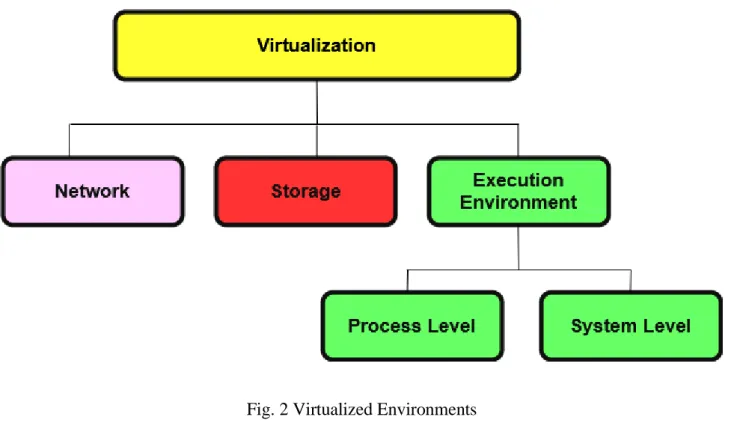
Virtualization is the mechanism by which the hardware resources can be dynamically allocated to various guest operation systems. The categorization of virtualization can be done on the basis of its various taxonomies. There are many taxonomies of virtualized environment which can be used for the implementation of virtualization. Virtualization environment contains the usability of three things i.e. network resources, storage resources and execution environment. The execution environment is further decomposed into two levels. One is process level based and other is system level based. Diagram below shows the virtualized environment.
Fig. 2 Virtualized Environments
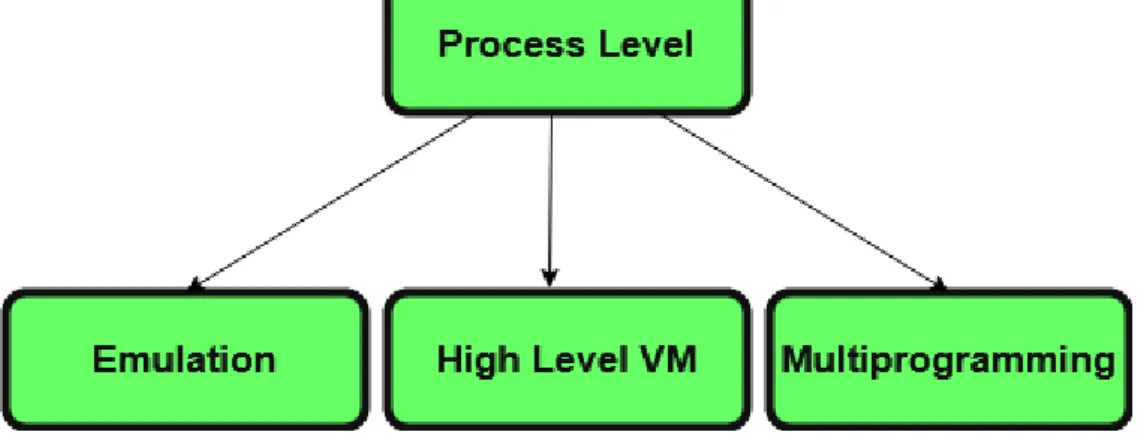
A. Process Level Based Taxonomy of Virtualized Environment
The process level based taxonomy includes the description and understanding of virtualized environment which is at the top of an existing operating system. Process level based virtualization always be implemented on the top of
Fig. 3 Types of Process Level Virtualization Techniques
a. Emulation
Emulation is the technique of simulating the hardware for executing the process or operation. In this the real time based hardware environment will be created to execute the task. This environment mimics the real time hardware based operations. In cloud computing, this environment will be created by using the virtual machine monitor. By doing so, one can understand the behavior of hardware components of the machine for executing the various processes.
b. High Level VM (Virtual Machine)
In cloud computing, virtual machines are created first before running multiple guest operating systems. Virtual machine holds the configuration details about the guest operating system. This will help in finding the information that how much amount of memory and which type of processor has been associated with the guest operating system. In other ways, it helps in installing the guest operating system over the physical machine. Hypervisor will collect the configuration detail from the virtual machine. This detail is used by hypervisor for allocating the resources to guest operating system.
c. Multiprogramming
Multiprogramming is the process of running or executing multiple tasks simultaneously. In virtualization, the multiple tasks can be executed in parallel by all the guest operating systems. All the guest operating systems will use the same amount of resources that are available on the physical hardware machine. The resources will be allocated by hypervisor from the resource pool. Resource pool is the collection of all the resources like memory and storage. In this way, the speed of execution of task will increase and hence there will be proper utilization of the resources.
B. System Level Based Taxonomy of Virtualized Environment
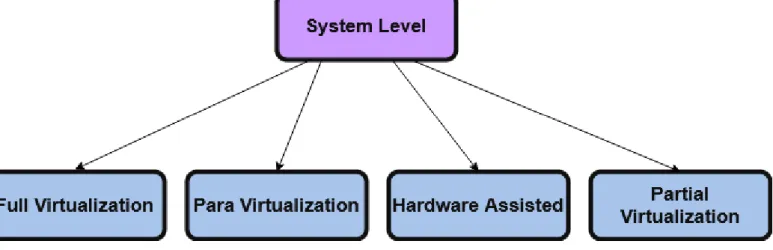
The second broad category of virtualized environment is system level based. In this virtualized environment, the virtualization will be implemented directly over the hardware. There will be no requirement of host operating system. It means that this is similar to type 1 virtualization. Mostly, this type of virtualization would be implemented at the cloud based datacenters. The system level based virtualized environments are of four types i.e. Full Virtualization, Para Virtualization, Hardware Assisted Virtualization and Partial Virtualization. Diagram below is showing the different types of system level based virtualized environment.
Fig. 4 Types of System Level Based Virtualization
a. Full Virtualization
The first type of virtualization under the system level based virtualization is Full Virtualization. There are some sensitive and high privileged instructions which cannot be executed in virtualized environment. In Full Virtualization, the code of these non virtualized sensitive and high privileged instructions will be replaced with new sequence of code so that these sensitive instructions can be executed in virtualized environment. This process of replacing the non virtualized instruction code with new code is called binary translation. Moreover, the guest operating systems isolated from each other.
b. Para-Virtualization
The second type of virtualization under the system level based virtualization is Para-Virtualization. In this type of virtualization, we use the concept of hyper calls. Moreover, we can modify the kernel code of existing operating system so that sensitive and high privileged instructions can be executed in virtualized environment. With the help of hyper call, hypervisor could be able to execute the sensitive instructions in virtual environment. This hyper calling will be done during the execution time so the overhead decreases.
c. Hardware Assisted Virtualization
The third type of virtualization under the system level based virtualization is hardware assisted virtualization. In this type of virtualization, we actually made our hardware components enable to be ready for the virtualization environment. Hardware components on the BIOS become enable and active so that full virtualization can be implemented. Nowadays, in almost every hardware system there is a setting in BIOS to make our hardware enable for implementing virtualization. With the help of virtualization, we can run many guest operating systems on a single physical hardware.
d. Partial Virtualization
The fourth type of virtualization under the system level based virtualization is partial virtualization. In this type of virtualization, we perform the partial emulation of the physical hardware. The complete hardware never simulated. This can be implemented when we have to share the resources amongst multiple users. Guest operating systems do not seem to be isolated from one another. Some of the operations can be executed in virtualization but some operations never be executed.
REFERENCES
[1] Shyam Patidar, Dheeraj Rane, “A Survey Paper on Cloud Computing,” Second International Conference on Advanced Computing & Communication Technologies, 2012.
[2] Mohiuddin Ahmed, Abu Sina Md. Raju Chowdhury, Mustaq Ahmed, Md. Mahmudul Hasan Rafee, “An Advanced Survey on Cloud Computing and State-of-the-art Research Issues,” IJCSI International Journal of Computer Science Issues, Vol. 9, Issue 1, No 1, January 2012.
[3] Rahul Bhoyar, Prof. Nitin Chopde, “Cloud Computing: Service, models, Types, Database and issues,”International Journal of Advanced Research in Computer Science and Software Engineering, Volume 3, Issue 3, March 2013.
[4] Aniruddha S. Rumale, D.N.Chaudhari,” Cloud Computing: Infrastructure as a Service,” International Journal of Inventive Engineering and Sciences (IJIES) ISSN: 2319–9598, Volume-1, Issue-3, February 2013.
[5] Wei-Tek Tsai, Xin Sun, Janaka Balasooriya, “Service-Oriented Cloud Computing Architecture,” Seventh International Conference on Information Technology, 2010.
[6] Mohiuddin Ahmed, Abu Sina Md. Raju Chowdhury, Mustaq Ahmed, Md. Mahmudul Hasan Rafee, ” An Advanced Survey on Cloud Computing and State-of-the-art Research Issues,” IJCSI International Journal of Computer Science Issues, Vol. 9, Issue 1, No 1, January 2012.
[7] S. Subashini and V. Kavitha, "A survey on security issues in service delivery models of cloud computing," Journal of Network and Computer Applications, vol. 34, pp. 1-11, 2011
[8] Zhengxiong Hou, Xingshe Zhou, Jianhua Gu,Yunlan Wang,Tianhai Zhao, “ASAAS: Application Software as a Service for High Performance Cloud Computing,” 12th IEEE International Conference on High Performance Computing and Communications, 2010.
[9] A. Keller and H. Ludwig, "The WSLA framework: Specifying and monitoring service level agreements for web services," Journal of Network and Systems Management, vol. 11, pp. 57-81, 2003.
[10] P. Patel, A. H. Ranabahu, and A. P. Sheth, "Service level agreement in cloud computing," 2009.
[11] M. Rosenblum, T. Garfinkel, "Virtual machine monitors: current technology and future trends", Computer, no. 5, pp. 39-47, May 2005.
[12] J. Renato, FigueiredoA. Dinda, J. Fortes, "A case for grid computing on virtual machines", Proceedings of the 23rd International Conference on Distributed Computing Systems, vol. 03, pp. 550, 2003.
[13] Sugerman Jeremy, Venkitachalam Ganesh;, Lim Beng-Hong, "Virtualizing I/O Devices on VMware Workstation's Hosted Virtual Machine Monitor", Proceedings of the General Track: 2002 USENIX Annual Technical Conference. USENIX Association, pp. 1-14, ISBN 188044609X.
[14] Soltesz Stephen;, Poetzl Herbert;, Marc E.; Fiuczynski;, Bavier Andy;, Peterson Larry, "Container-based operating system virtualization: a scalable high-performance alternative to hypervisors", EuroSys ‘07: Proceedings of the 2007 conference on EuroSys, ISSN 0163-5980.275-287.