A SYSTEMIC APPROACH FOR MODELING AND ANALYSIS OF
COOPETITION
Arash Golnam
Ecole Polytechnique Fédérale de Lausanne
School of Computer and Communication Sciences (I&C)
Station 14, CH-1015 Lausanne, Switzerland
Email [email protected]
Ron Sanchez
Department of Innovation and Organizational Economics
Copenhagen Business School
Kilevej 14A - 3rd Floor DK-2000 Frederiksberg, Denmark
Email [email protected]
Alain Wegmann
Ecole Polytechnique Fédérale de Lausanne
School of Computer and Communication Sciences (I&C)
Station 14, CH-1015 Lausanne, Switzerland
Email [email protected]
Key words: Coopetition, Competence theory, Enterprise modeling, SEAM
ABSTRACT
Coopetition has been defined as an approach to managing that combines competition and
cooperation. Coopetition transcends the traditional paradigms of competition and
cooperation in an effort to achieve the advantages of both. As an inter-organizational
relationship which is of a higher complexity than cooperation between non competitors,
coopetition presents challenges both for business managers and researchers in the strategy
field. In this paper we present a systemic approach to modeling and to the analysis of
coopetition between firms in a business environment that can contribute to our understanding
of the strategic incentives and processes for enterprises to engage in a coopetitive
relationship. Our approach comprises a modeling technique called Systemic Enterprise
Architecture Method (SEAM) that incorporates conceptualizations from competence-based
management (CBM) theory. We illustrate our approach by applying it to the case of
Amazon.com’s coopetitive strategies.
2 1. Introduction
Cooperation and competition occur among the members of the same or different species in nature [1]. Living systems cooperate and compete in order to maintain their survival. From a systems perspective, in some systems, higher numbers of participants result in a greater chance of survival for the individual members (i.e. cooperative systems), whereas in some others a lower number of participants leads to a higher chance of survival for the members (i.e. competitive systems) [2]. The study of cooperation and competition has been a topic of continuing interest in a variety of disciplines ranging from biology to political sciences and business strategy [3], [4].
We adopt the basic view that firms are open systems that interact with external entities in their environment to achieve sustainable value creation and distribution [5]. This interaction appears in two basic ways: they cooperate for the exchange of resources [6, 7] and compete for customers [8] and resources [5] in product and resource markets respectively. Evidence from game theory, particularly games such as Stag Hunt [9] and Prisoner’s Dilemma [3], suggest that in the long run, cooperation may emerge as the evolutionarily stable strategy (ESS) [10] between competing systems [11]. Game theory provides some important insights into the emergence of cooperation between competing firms [12]. In effect, in various business settings, firms as open systems compete and cooperate at the same time, in a wide diversity of ways, to ensure their survival. This hybrid strategy comprising cooperation and competition has been called coopetition [13-16] in the strategy literature.
In dynamic and rapidly transforming business environments characterized by a fast pace of change in technology and customer needs -- as well as in a complex web of relationships and inter-dependencies between enterprises [17] -- coopetition is a recurring theme. From an academic standpoint, significant research has been conducted on coopetition (see [18] for various perspectives on coopetition research). These studies mainly feature resource dependence theory (RDT) [19], transaction cost economics (TCE), [20] and the resource base view (RBV) [21] as their conceptual or theoretical bases to develop a better understanding of coopetition as a phenomenon of interest in strategy research. See for example [15, 16, 17, 24, 25]. In addition, conventional business strategy development methods and frameworks (see for example [8, 26, 27]) have provided useful perspectives on interactions between enterprises. However, these interactions have typically been viewed through either a cooperative or a competitive lens and thus fall short of addressing and analyzing the various aspects of coopetition in business environments.
In this paper, we present an approach for modeling and analysis of coopetition between enterprises. Our approach is based on SEAM (Systemic Enterprise Architecture Method), an enterprise modeling method embodying concepts from competence-based management theory (CBM) theory [5, 17]. CBM theory incorporates and benefits from a number of important perspectives and synthesizes, supplements, and complements existing perspectives and theories by viewing enterprises and their interactions from a dynamic, systemic, cognitive and holistic perspective. SEAM, on the other hand, seeks to develop conceptualizations and notations that lead to systemic representations of functional, information, resource, and organizational aspects of enterprises. Using a SEAM model of the enterprise and of its environment wherein the modeling constructs (basic notational elements) are derived from CBM theory, we propose a technique to conceptualize, graphically represent and analyze coopetition.
The paper is structured as follows. In section 2 we present SEAM and its underlying notations and principles. In section 3, we provide an overview to CBM theory. We present the systems view of an enterprise developed using SEAM embodying conceptualizations from CBM theory in Section 4.
Section 5 includes the application of our modeling approach to the case of Amazon.com’s coopetitive strategies and finally, we present our conclusion and future work in section 6.
2. Systemic Enterprise Architecture Method
SEAM is an enterprise modeling method based on the principles of systems thinking [28]. SEAM is designed to analyze and assist in the design of business and engineering strategies. SEAM, developed at Ecole Polytechnique Fédérale de Lausanne (EPFL), has been used for teaching [29] and consulting [30] since 2001. In [31] we applied SEAM to design coopetitive open innovation value networks. In the following we explain the underlying concepts, notations and principles of SEAM.
2.1 Systems and the Principle of Recursion
In SEAM, we define a system as a group of entities that interact. The principle of recursion holds that when a system is decomposed to its component systems, the component systems can in turn be decomposed to their component systems and so on. In effect, in SEAM we perceive systems as a nested hierarchy. Systems are denoted by block arrows in SEAM.
2.2 Actions, Properties and States
An action transitions the state of the system properties. Properties capture the state of the system. In SEAM properties have different names depending on how they relate to the component systems and their interactions within a system. In Section 4 we instantiate these properties. In SEAM, actions and properties are respectively denoted by ovals and rectangles.
2.3 Whole-composite Principle
The concept of observer is central to SEAM. A system is defined only when an observer detects and identifies a set of entities standing in interaction and correlation [30]. An observer can view a system as a whole (black box view of a system) or as a composite (white box view of a system). Viewing a system as a whole, the system components and their interactions are abstracted. Instead, the system’s emergent actions and properties that conceptualize the overall behavior of the system are observed. On the other hand, when an observer views a system as a composite, its structure, component systems and their interactions are viewed. Applying the whole-composite principle assists us in the perception of a hierarchy of systems by enabling us to set the boundaries to and delimit the system of interest. Whole and composite views of the system are respectively denoted by [w] and [c] in SEAM models.
2.4 Systems and Viability
Systems share the need to remain viable or in other words maintain their identity and continue to exist [30]. In [32, 33] Stafford Beer discusses the underlying structures and elements that are necessary for a system to meet the criterion of viability. Inspired by the work of Stafford Beer, in SEAM systems are composed of “operational units” and a “management system” as their component systems. The operational units are the entities that do the things that justify the existence of the system. The management system, on the other hand, monitors and controls the operational units. Hierarchically, being composed of a set of operational units and a management system an enterprise is a system embedded in a nested hierarchy of larger systems, i.e. value networks, resource and product markets and etc. Each operational unit within the enterprise can in turn be decomposed to a set of sub operational units and a management system.
4 3. Competence Based Management Theory
CBM theory holds that firms, markets, and their interactions are very likely to undergo changes and thereby both recognizes and addresses the challenge of devising strategy that is dynamic in nature. Further, in CBM theory an organization is viewed as a goal-seeking open system. Explicitly elaborating on organizational system effects within and across the boundaries of organizations, CBM theory provides a set of concepts for identifying essential system elements of organizations as goal-oriented human systems for sustainable value creation and distribution. In this regard, another notable aspect of CBM theory is the attention it pays to the cognitive processes and capacities of firms’ managers that shape and change the competitive environment. Moreover, central to CBM theory is the notion of sustainable value creation processes, a vital aspect of which is appropriate processes for
value distribution so that the best resources can be attracted and retained for a firm’s value creation
process. Hence, CBM theory significantly contributes to our understanding of complex inter-organizational issues such as coopetition and provides a theoretical basis to discover and analyze both incentives and processes for enterprises to engage in coopetitive relationships – all from an explicitly dynamic, systemic, cognitive, and holistic perspective [34].
CBM theory seeks to define a coherent and intellectually rigorous conceptual foundation for theorizing in the field of strategy. An important aspect of CBM theory is providing precise and consistent definitions of the primitive entities which serve as the building blocks of its conceptual foundation for theory building about markets, firms, and their cooperative, competitive, or coopetitive interactions [34].
In section 4 we use the definitions of some of the fundamental conceptualizations adopted in CBM theory to describe the enterprise (i.e. the operational units, the management system and their interactions) as a system. The definitions in section 4 are extracted from [17] and [34] and help us lay a common understanding of the conceptualizations used throughout the paper.
4. The Systems View of the Enterprise
Figure 1 is a model of an enterprise as a system. As discussed in section 2 at the highest recursion level, an enterprise is composed of a management system and a set of operational units. In this section we explain these two component systems and their interactions within an enterprise.
4.1 Operational Units
We first analyze the emergent properties and actions of an operational unit viewed as whole and the interaction it has with the environment.
4.1.1 The operational Unit Viewed as a Whole
Modeling an operational unit as whole we represent competence building and competence leveraging
as the actions the operational unit takes to modify its resources and capabilities as its properties in order to output a resource. This resource output can be a product offer to the market or an intermediary resource to help other operational units or the enterprise as a whole to bring a product offer to the market. We now define the conceptualizations we use to represent operational units or in other words systems as a whole:
Def. 1: Resources are assets that a firm can actually access and use in developing and realizing products that create value in its product markets.
In teraction Interacti o n
6
Def. 2: Assets are anything tangible or intangible that could be useful to a firm in developing and realizing products to create economic value in its product markets.
Def. 3: Capabilities are repeatable patterns of action for coordinating resources in processes for value creation. Capabilities can also be seen as resources but they are a special kind of resource because they use or operate on other kinds of resources in a coordinated way.
Def. 4: Competence building is any process by which an organization creates or accesses qualitatively new kinds of resources or capabilities or develops new capabilities to coordinate and deploy new or existing resources. Def. 5: Competence leveraging: is the use of an organization’s existing competences to create product offers not requiring qualitative changes to the resources or the way an organization coordinates them.
4.1.2 The Interactions of an Operational Unit
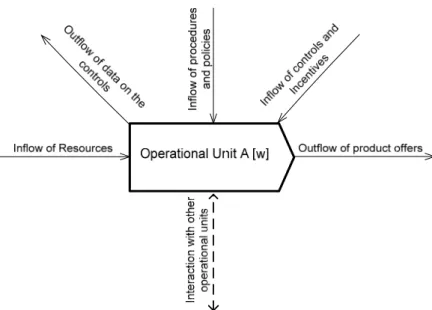
An operational unit interacts with its environment to maintain its viability. Three types of interactions can be identified: interactions between the operational units and the management system; interactions of operational units with one another; and the interaction of an operational unit with the entities outside the boundary of the enterprise. We now elaborate more on these interactions.
The operational unit interacts with the management system in three main ways:
The management system communicates procedures and policies for coordinating competence building and competence leveraging actions of the operational units.
Def. 6. Procedures specify the step-by-step sequence of actions to be followed in a specific situation or to achieve a given objective.
Def. 7 Policies are rules or guidelines that express limits or boundaries within which action should be taken.
The management system establishes and communicates controls and incentives and the operational units provide data on the controls indicated by the management system.
Def. 8 Controls are the various ways in which the managers try to determine the state of an operational unit’s Resources and Capabilities. Controls may include yield rates, defect rates and etc.
Def. 9 Incentives refer to rewards and punishments that the management system establishes to encourage good and discourage inadequate performance by the operational units.
The management system makes decision on resource allocations to the operational units.
The operational units may apply the resources allocated by the management system directly in their competence building and competence leveraging actions or may as well use them as an intermediary means for acquiring other types of resources across the boundary of the enterprise. Such resources include: employees with skills; suppliers with capabilities to provide materials components and services; information to identify the best opportunities for product creation, and licenses, financial and legal permits [17].
Hence, the operational units interact with entities outside the boundary of the enterprise to acquire resources they need for their competence building and leveraging actions and/or to out put a product offer. The operational units also interact with one another for a variety of purposes including transfer of resources, capabilities and etc. Figure 2 represents the overall interactions of an operational unit.
Figure 2 Interactions of the operational unit
4.2 The Management System
Management system as whole implements three actions that require resources and capabilities. In this section we briefly go over these actions.
4.2.1 Regulation, Optimization and Conflict Resolution The overall role of this action is to:
overview the operational units within the enterprise and their interactions looking for conflicts and problems.
look for ways to optimize the overall efficiency and improve the performance of the operational units in using resources and capabilities.
As it can be seen in Figure 1, this action processes data it gathers on the resources and capabilities of the operational units and outputs three properties to the operational units; resource allocations, procedures and policies, and controls and incentives. It also outputs information on current state of resources and capabilities. In effect, regulation, optimization and conflict resolution functions at the operational management level of the enterprise.
4.2.2 Environment Scanning and Forward Planning
The fundamental function of environment scanning and forward planning is guaranteeing the adaptation of the enterprise to the future by identifying the ways the enterprise is impacted by the changes in its environment. The specificity of environment scanning and forward planning is detecting the changes that can not be identified by the management system within the operational units. Such changes include:
changes to the competence building of the competing enterprises
8
changes in the macro environment of the enterprise such as macroeconomic, technological, social, demographic, political-legal and socio-cultural changes and their impacts on customer needs and preferences as well as the product offers in the product market [17].
This management system action processes the environmental data and outputs information on the desired state of the resources and capabilities. This information includes the qualitative changes required to the existing resources and capabilities within the enterprise and signals the need for competence building.
4.2.3 Strategy and Policy Setting
Strategy and policy setting monitors the enterprise as whole. It processes the information on the desired and the current state of the resources and capabilities and forms perceptions of the strategic gaps based on which the Strategic Logic of the enterprise is then formulated and developed.
Def. 10: The Strategic Logic is the enterprise’s operative rational for achieving its goals through coordinated deployments of resources.
The Strategic Logic determines the strategic balance between competence building and leveraging within the enterprise by specifying the competences to be built; the ways to build them and the ways to leverage current and the new competences [17].
In the absence of strategy and policy setting the enterprise may engage in competence leveraging activities that lead to bringing product offers to the market that are about to be rendered obsolete by the emergence of new technologies, regulations and etc. Strategy and policy setting equally avoids the enterprise from investing excessively in competence building such as research and development (R&D) when the enterprise can not leverage its existing competences and has nothing to offer to the market.
5. Modeling and Analysis of Coopetition in Amazon.com
In this section we apply our modeling approach to the case of coopetition at Amazon.com1. We first provide an overview of the book market circa 1997. Then, we will analyze the competence building and leveraging of the companies in the book market. Next, we elaborate on Amazon.com coopetitive strategy applying the perspectives developed in this paper and we finally present a model of the book market circa 1999 highlighting the changes to Amazon.com product resources and offers.
5.1 The Book Market Circa 1997
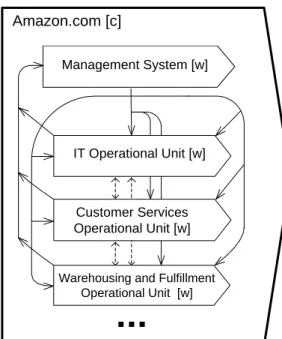
In July 1995 Amazon.com began as an online bookseller and went public in May 1997. Figure 3 is a SEAM model of Amazon.com as a composite. Hence, we can see the operational units within Amazon.com and its management system. The three dots remind us that the operational units shown in the model are not exhaustive. For the sake of simplicity we have abstracted the actions and properties in this model.
1 Our scope of analysis in this case is Amazon.com offerings in the book market, we thereby do not address the product offers of Amazon.com in other markets such as CDs, appliances, e-commerce and IT services and etc.
Amazon.com [c]
Warehousing and Fulfillment Operational Unit [w] Management System [w] IT Operational Unit [w] Customer Services Operational Unit [w] Figure 3 Amazon.com as a composite
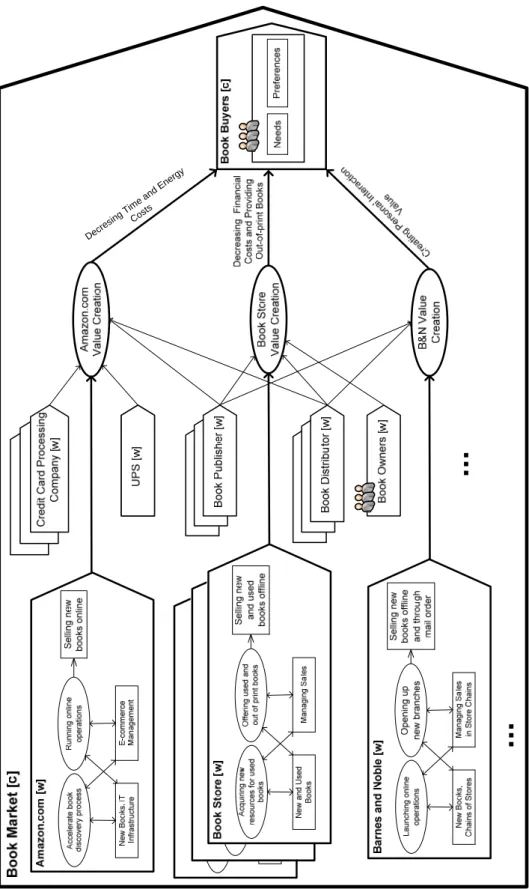
Figure 4 is a SEAM model of Amazon.com in the book market circa 1997. As Amazon.com is represented as a whole its emergent actions (i.e. competence building and leveraging) and properties (resources , capabilities and product offers) can be viewed. In this model we also represent the entities that provide Amazon.com with the resources necessary for developing its product offer and creating value for the book buyers. For instance Amazon.com cooperates with the credit card processing companies to accept online payments from the customers and uses the services of Universal Parcel Service (UPS) to fulfill customer orders.
In Figure 4 we also model the Amazon.com competitors and their resource providers. In 1997 the main brick and mortar actors in the book market were book stores that were small independent non-chain retail book shops and book superstores such as Barnes & Noble (B&N), Borders and etc that ran their chains of stores. As it can be seen in Figure 4, Amazon.com is in competition with Book Stores and Barnes and Noble (B&N) as the leading book superstore.
5.2 Competence Building and Leveraging in the Book Market Circa 1997
In 1997 Amazon.com was the most prominent online bookseller. Leveraging its competences such as fulfillment services, customer services, and online payment services such as 1-click check out, Amazon.com had positively impacted the book buyers’ perception of value by reducing the time and energy they spent to find, purchase and take delivery of the books they demanded. Amazon.com was building competences to develop various IT applications to enhance its value proposition. IT applications such as a book recommender system that could help customers find the right book in a shorter time [35].
The fiercest brick and mortar competitors of Amazon.com were book superstores and in particular B&N. In the three year period between 1992 and 1995 the sales of the book superstores grew to 71 percent. In 1997 B&N sold books to the customers by mail order and through its stores. B&N was leveraging its competences to expand its chain of stores in the US. It was positively impacting customers’ perception of value by offering them a chance for personal interaction and a physical space for finding and purchasing books, a value proposition that the virtual world of online bookselling was
10
lacking. B&N was also building new competences such as acquiring IT infrastructure and IT management capabilities to launch its online operations.
Decr esing Tim e an d En ergy Costs
Book stores, on the other hand, were having a tough time competing with Amazon.com and the book superstores. In a matter of four years (1993-1996) over 200 independent book stores went out of business. While in the same period there were over 450 openings of Book Superstores with B&N and Borders accounting for 348 [17]. Some bookstores offered used as well as new books and consequently made a value proposition to the customers by decreasing the financial costs as well as providing out-of-print books. In Table 1 we compare the competence leveraging and building of Amazon.com and B&N crica 1997.
Competence Leveraging Impact on Value
Proposition
Competence Building Impact on Value
Proposition
Amazon.com
Fulfillment and warehousing
State of the art technology for packaging and tracking and tracing an order.
Online payment services
1 Click Checkout payment service.
Editor’s Service
providing users with email updates on the latest books matching their preferences.
…
Reducing time and energy costs
Developing a book matcher and a book recommender system for accelerating the discovery of books
Reducing time and energy costs
B&N
Opening branches in different locations and hence accessing more customers
Providing a physical space and a chance for interaction
…
Reducing time and energy costs Creating value through Personal interaction
Launching the online operations by acquiring resources and capabilities such as IT infrastructure and management
Reducing time and energy costs
Table 1. Competence building and leveraging at Amazon.com and B&N
As B&N, the brick and mortar competitor of Amazon.com, was developing the resources and capabilities required to launch its online operations, Amazon.com needed to build new competences so that it could enhance its product offering to the customer and thereby guarantee its viability and adaptation to the future changes in the competitive context. In order to do so Amazon.com was in need of qualitatively new resources and capabilities to generate strategic options that could then be leveraged to differentiate its offerings.
5.3 Amazon.com Marketplace
In 1999 Amazon.com allowed book stores to sell in the Amazon.com Marketplace by placing their books alongside Amazon.com’s books in front of millions of customers [36]. This strategy involved Amazon.com in a multifaceted coopetitive relationship with the book stores in that, while cooperating with them by providing them an e-commerce platform for marketing and selling their products online, Amazon.com and the book stores were in a head-on competition within in the Marketplace over customer orders.
Amazon.com also needed to develop new capabilities to manage the new resources. In effect, Amazon.com needs to develop the managerial capabilities to manage its operational units as well as monitoring and regulating the operations of the book stores and their interaction with Amazon.com various operational units on the Marketplace. Hence Amazon.com marketplace can be viewed as a system seeking viability. We call this system a value network [37].
Def. 11: A value network is a business term to describe a group of companies that collaborate to create value for the customer and pursue a common commercial objective.
12 Figure 5 depicts Amazon.com Marketplace as a composite.
Amazon.com Marketplace [c] Management System [w] Book Store [w] IT Operational Unit [w] Customer Services Operational Unit [w]
Warehousing and Fulfillment Operational Unit [w]
Figure 5 Amazon.com Marketplace as a composite.
5.4 The Book Market Circa 1999
Launching the Marketplace can be considered as decision made by the strategy and policy setting
action in the management system to close the gap between the desired and the current state of the resources and capabilities of Amazon.com. The desired state of the resources and capabilities and the need for building new competences is signaled by the environment scanning and forward planning within the management system after processing and analysis of the industry trends, competence buildings, the product offers and the value propositions of the competitors as well as the changes to the needs and the preferences of the customers.
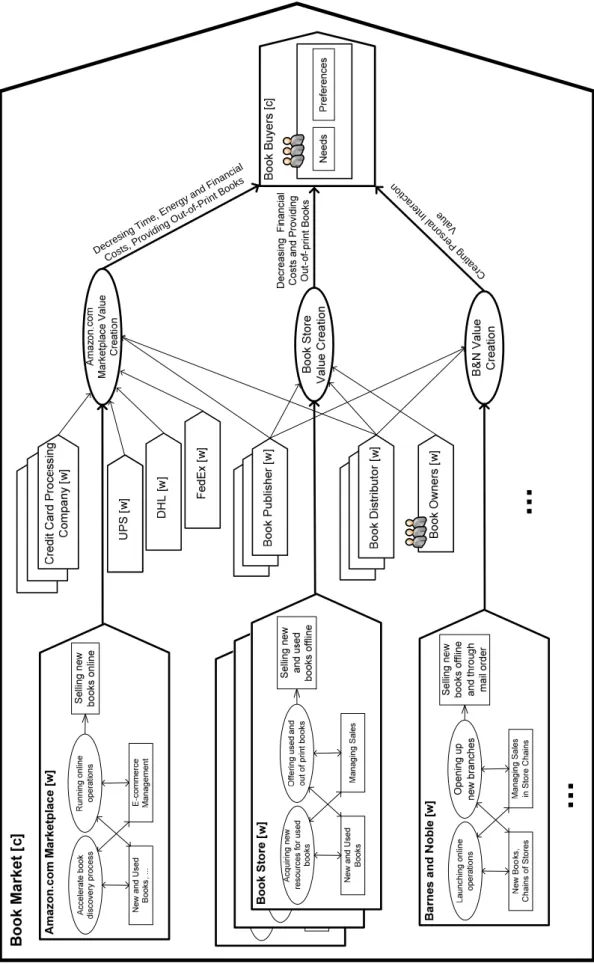
By launching the Marketplace Amazon.com acquired qualitatively new resources (i.e. used books). Such new resources enabled Amazon.com to differentiate its offerings in the following ways:
adding the used books to its product offerings and thereby serving the customer needs for out-of –print books.
the financial cost of acquiring the books was considerably reduced for the customers due to the low price of used books as compared to new books.
as the bookstore with the lowest price would win the customer order in the marketplace, more discounts were offered to the book buyers and thereby the cost of acquiring new books was also reduced.
Book stores benefited from cooperating with Amazon.com as they accessed qualitatively new resources and capabilities in Amazon.com that created strategic options that could be leveraged to enhance their market presence. Figure 6 we present a SEAM model of the book market circa 1999.
Figure 6 Book Market circa 1999 Decre sing T ime, Energ y and Fina ncial Costs , Prov iding O ut-of-Pr int B ooks Cr eat ing P er sonal In te ra ct io n Value
14 6. Conclusion and Future Work
In this paper, we developed a systemic approach for modeling and analysis of business strategies. Our approach incorporated modeling techniques and principles from SEAM and conceptualizations from CBM theory. We proposed a systemic approach for modeling the flow of resources and decisions within an enterprise and conceptualized the collaboration between the enterprise and the resource providers in the product market for value creation. From the strategic group perspective we analyzed how competing enterprises leverage and build competences to positively impact the customers’ perceptions of their product offers value. Finally, we provided systemic implications on how competence building and leveraging activities of enterprises can lead to their involvement in a multi-faceted coopetitive relationship. We applied our approach to analyze Amazon.com’s decision to coopete with the book stores in Amazon.com Marketplace. Our future work will focus on validating our modeling approach by applying it to a prospective case.
7. References
[1] G.W. Flake, The Computational Beauty of Nature: Computer Explorations of Fractals, Chaos, Complex Systems, and Adaptation, The MIT Press, 2000.
[2] G.M. Weinberg and D. Weinberg, General Principles of Systems Design, Dorset House Publishing Company, Incorporated, 1988.
[3] R. Axelrod and W.D. Hamilton, The evolution of cooperation, Science, vol. 211, 1981, pp. 1390-1396.
[4] R.M. Axelrod, The complexity of cooperation: Agent-based models of competition and collaboration, Princeton Univ Pr, 1997.
[5] R. Sanchez and A. Heene, Reinventing strategic management: New theory and practice for competence-based competition, European Management Journal, vol. 15, 1997, pp. 303–317.
[6] R.H. Hall, J.P. Clark, P.C. Giordano, P.V. Johnson, and M. Van Roekel, Patterns of interorganizational relationships, Administrative Science Quarterly, 1977, pp. 457-474.
[7] J. Galaskiewicz, Interorganizational relations, Annual review of sociology, vol. 11, 1985, pp. 281-304.
[8] M.E. Porter, Competitive advantage: Creating and sustaining superior performance, Free Press, 1998.
[9] B. Skyrms, The Stag Hunt and the Evolution of Social Structure, Cambridge University Press, 2003.
[10] P.D. Straffin, Game Theory and Strategy, The Mathematical Association of America, 1996. [11] R. Axelrod, The evlution of cooperation, Basic Books, 1984.
[12] A. Afuah, Strategic Innovation: New Game Strategies for Competitive Advantage, Routledge, 2009.
[13] A. Brandenburger and B. Nalebuff, Co-opetition: the Game Theory That's Changing the Game of Business, Currency, 1996.
[14] A.M. Brandenburger and B.J. Nalebuff, The right game: Use game theory to shape strategy, Harvard Business Review, vol. 73, 1995, pp. 57-57.
[15] M.J. Dowling, W.D. Roering, B.A. Carlin, and J. Wisnieski, Multifaceted relationships under coopetition: description and theory, Journal of Management Inquiry, vol. 5, 1996, p. 155.
[16] B.A. Carlin, M.J. Dowling, W.D. Roering, J. Wyman, J. Kalinoglou, and G. Clyburn, Sleeping with the enemy: Doing business with a competitor, BUSINESS HORIZONS-BLOOMINGTON-, vol. 37, 1994, pp. 9-9.
[17] R. Sanchez and A. Heene, The New Strategic Management: Organization, Competition, and Competence, Wiley, 2003.
[18] G.B. Dagnino and E. Rocco, Coopetition Strategy: Theory, experiments and cases, Routledge, 2009.
[19] J. Pfeffer and G. Salancik, The External Control of Organizations: A Resource Dependence Perspective, Stanford Business Books, 2003.
[20] O.E. Williamson, Transaction-cost economics: the governance of contractual relations, The journal of Law and Economics, vol. 22, 1979, p. 233.
[21] B. Wernerfelt, A resource-based view of the firm, Strategic management journal, vol. 5, 1984, pp. 171–180.
[22] P. Ritala and P. Hurmelinna-Laukkanen, What's in it for me? Creating and appropriating value in innovation-related coopetition, Technovation, vol. 29, 2009, pp. 819–828.
[23] C. Quintana-Garcia and C.A. Benavides-Velasco, Cooperation, competition, and innovative capability: a panel data of European dedicated biotechnology firms, Technovation, vol. 24, 2004, pp. 927–938.
[24] A.A. Lado, N.G. Boyd, and S.C. Hanlon, Competition, cooperation, and the search for economic rents: a syncretic model, The Academy of Management Review, vol. 22, 1997, pp. 110–141.
[25] S.H. Park and M.V. Russo, When competition eclipses cooperation: An event history analysis of joint venture failure, Management Science, vol. 42, 1996, pp. 875–890.
[26] M.E. Porter, Competitive strategy: techniques for analyzing industries and competitors/Michael E. Porter, Free Press; Toronto: Maxwell Macmillan Canada, 1980.
[27] R.M. Grant, Contemporary Strategy Analysis: Concepts, Techniques, Applications, Blackwell Publishers, 2002.
[28] G.M. Weinberg, An introduction to general systems thinking (silver anniversary ed.), Dorset House Publishing Co., Inc. New York, NY, USA, 2001.
[29] A. Wegmann, G. Regev, J.D. De la Cruz, L.S. Lê, and I. Rychkova, Teaching Enterprise and Service-Oriented Architecture in Practice, Proceedings of the Workshop on Trends in Enterprise Architecture Research (TEAR 2007), 2007.
[30] A. Wegmann, G. Regev, and B. Loison, Business and IT Alignment with SEAM, REBNITA/13th IEEE RE workshop, Paris, 2005.
16
[31] A. Golnam, A. Hegarty, G. Regev, and A. Wegmann, A systemic approach for designing open innovation value networks, New York, USA: ISPIM, 2009.
[32] S. Beer, The Heart of Enterprise, Wiley, 1995.
[33] S. Beer, Diagnosing the System for Organizations, Wiley, 1995.
[34] R. Sanchez, A scientific critique of the resource-base view (RBV) in strategy theory, with competence-based remedies for the RBV's conceptual deficiencies and logic problems, Research in Competence-Based Management, volume 4, pp. 3 – 78, Emerald Group Publishing Limited, 2008. [35] R. Spector, Amazon.com: Get Big Fast, Collins Business, 2002.
[36] A. Afuah and C.L. Tucci, Internet business models and strategies: Text and cases, McGraw-Hill Higher Education, 2000.
[37] C.B. Stabell and Ø. Fjeldstad, Configuring value for competitive advantage: on chains, shops, and networks, Strategic Management Journal, 1998, pp. 413-437.