Association for Information Systems Association for Information Systems
AIS Electronic Library (AISeL)
AIS Electronic Library (AISeL)
ICEB 2019 Proceedings International Conference on Electronic Business (ICEB)
Winter 12-8-2019
Two-Sided Market Platform: A Case Study of Cross Border
Two-Sided Market Platform: A Case Study of Cross Border
E-Commerce between Thailand and China
Commerce between Thailand and China
Peter RacthamRuth Banomyong Apichat Sopadang
Follow this and additional works at: https://aisel.aisnet.org/iceb2019
This material is brought to you by the International Conference on Electronic Business (ICEB) at AIS Electronic Library (AISeL). It has been accepted for inclusion in ICEB 2019 Proceedings by an authorized administrator of AIS Electronic Library (AISeL). For more information, please contact [email protected].
The 19th International Conference on Electronic Business
(pp. 475-482). ICEB, Newcastle upon Tyne, UK, December 8-12.
Two-Sided E-Market Platform: A Case Study of
Cross Border E-Commerce between Thailand and China
(Full Paper)
Peter Ractham*, Thammasat Business School, Thammasat University, Thailand,
[email protected]
Ruth Banomyong, Thammasat Business School, Thammasat University, Thailand,
[email protected]
Apichat Sopadang, Faculty of Engineering, Chiengmai University, Thailand, [email protected]
ABSTRACT
Cross Border Electric Commerce )CBEC( has become an important e-commerce model allowing local consumers to purchase products from international suppliers through CBEC platforms. However, in order to synchronize and coordinate the transactions between international sellers and local buyers, CBEC stakeholders need to build an online platform that link between the demand and supply markets. Thus, the Two-Sided Platform models where both buyers and sellers on both sides can share necessary information to promote a synchronous and coordinated market transactions. The two-sided platform can enable streamline coordination of products information, pricing and logistics transactions which could result in an optimal end-to-end CBEC supply chain activities. CBEC stakeholders such as suppliers, consumers, logistic and warehouse companies can gain advantages by expanding the network externality where all parties share relevant information with one another through the two-sided platform. In this study, we conducted interviews with stakeholders who are a part of CBEC trade for Durian and Cosmetics; two of the most popular products from Thailand for the Chinese CBEC market. The study concludes with the need from both demand side and supply side to have an end-to-end coordination. Thus, a supply side or the seller market platform need to be created and link with the demand side platform. Also, in order for supply side market to be created and sustainable in the long run. There are four factors that must be involves in the process 1( government support, 2( Supply Chain Coordination, 3( Online Platform Design ad 4( CBEC Customer Marketing Strategies.
Keywords: E-Business, Cross Border E-Commerce, Two-Sided Platform, E-Logistics
_____________________ *Corresponding author
INTRODUCTION
The global electronic commerce )E-Commerce( market has reached unprecedented level in the last two decades. According to Emarketer, the value of global e-commerce could reach 3.5 trillion U.S. dollar in 2019 )Emarketer, 2019(. The phenomenal growth caused by increases in service quality of e-commerce services, improve product delivery time, affordable and wide variety of products, shrinking in digital divide with high speed internet penetration to citizens around the world as well as increases in digital literacy among consumers are some of the important factors that play the roles in the growth of global e -commerce)ESCAP, 2018, Ho, Kauffman, & Liang, 2008(. Relevant stakeholders from both public and private sectors have also been adapting to e-commerce phenomenal with new and innovative ways to gain new customers from both local and global markets. Firms try to reach new customers in both local and global markets through channels that were not in existent before the rise of e-commerce popularity. Advancement in high speed internet through fiber optic, 4G and the upcoming 5G infrastructures has also allow businesses at all levels to thrive by providing products and services to their customers whom can buy products and services ubiquitously through their smart phones. Manufacturers also produce innovative products and services that cater to both mass and individual customers with assistance from advanced in IT technologies and big data analytics )Bi &Cochran, 2014, Benabdellah, Benghabrit, & Bouhaddou, 2016(. Logistic companies improve their operations which results in improve in delivery time and services quality through lean supply chain management practices and technologies )Tiwari, Wee, & Daryanto, 2018(.
Although, the level of e-commerce innovation and operations have improved drastically with growing examples from e -commerce giants such as Amazon, Ebay, Walmart, Schwarz, Tesco and Alibaba, the stakeholder from the public sector; such as government and tax agencies are still adjusting to the new paradigm where different forms of business transactions between sellers and buyers have changes rapidly both at the local and international levels.
With the growth of total value of e-commerce market increase to 3.5 trillion U.S. dollar in 2019, as there are increases in numbers of business transactions between buyers and sellers, governments around the world have started collecting e -commerce taxes, which still posted many challenges for all involve parties. Since e-commerce taxation has been largely overlook by governmentsfor the last two decades due to the economic policies that supports the early growth of e-commerce industry around the world. Much of the government’s activities during the last two decades are to provide a high speed internet infrastructures in fiber optics, 4G and 5G technology to the population. The advances in high speed internet around the world and the lower cost and increase in popularity of smart phones have play important roles in promoting the e-commerce activities which results in the blossoming of e-commerce business models and new and innovative types of transactions. However, there
Ractham, Banomyong & Sopadang
are still many unresolved issues in regard to how e-commerce can affect the overall population. Issues such as sharing economy and its effects on society i.e. Uber and AirBnB and for an e-commerce industry in the issue of taxation or lack thereof. One of the most prevalent issue regarding business and tax is call Gray Market Economy which mean an economy that happen for the products that has been sold without relevant parties being charge the sale or import tax. Hence this loophole can be remedy with one type of e-commerce; Cross Border E-Commerce )CBEC(.
Cross Border E-Commerce )CBEC(
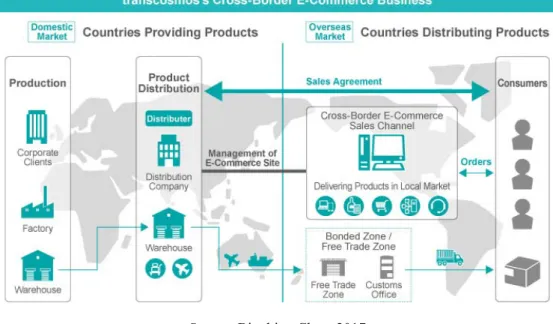
Cross Border Electronic Commerce (CBEC) is when consumers from one country buy products directly through online import channels from international sellers (Gomez, Martens, & Turlea, 2013). CBEC represent a true form of disintermediation of when the internet was introduced in the past. Buyers and sellers can conduct business transaction with one another without an intermediary party. It shows strong potential for both buyers and sellers to gain benefits from the business transaction conducted through CBEC channels. Sellers can expand their customers base beyond their local areas and search out to untapped market beyond their geographical border in an international market. Buyers can buy products or services from international market from the leisure of their own home or from their smart phone. Figure 1 shows the basic CBEC transactions between the buyers and sellers through an online CBEC platform.
Source: Bingbing Chen, 2017
Figure 1: The basic CBEC transactions between the buyers and sellers through an online CBEC platform
Although worldwide value of Cross Border Electronic Commerce has grown significantly in recent years, its size is still relatively small when compare to the total value of the overall traditional E-Commerce industry. However, the CBEC market in China has been growing at a significant rate. China has one of the largest e-commerce markets in the world totally 1.03 USD trillion in 2018 )PwC Analysis, 2018(. Hence, the Chinese market has been very attractive for international entities to conduct their businesses especially through e-commerce channels. In 2018 CBEC generated RMB 7.6 trillion )US$1.1 trillion(. By 2020, eMarketer projects that 25% of Chinese population will be shopping online for overseas products via cross-border e-commerce websites )eMarketer, 2019(. Also, the growing number of outbound Chinese tourists has also grown significantly in recent years, which subsequently increase the awareness in international products among Chinese consumers. This led to the increase in the demand from Chinese consumers to consume products from international markets such as cosmetics from Korea, high price brand name products from United States, luxury goods from Europe, fruit and herbal products from Thailand, etc. However, since CBEC is still relatively new to China e-commerce consumers, there are still unresolved issues that still need to be investigated and clarify to better understand the CBEC market.
Some of the prominent issues in regard to CBEC market is the alignments of CBEC online platform and its network externalities among relevant stakeholders. In short, how can CBEC market create linkages between network of suppliers, number of platforms, increase the network externalities, improve the logistic performances and dealing with various issues on CBEC taxation.
By connecting all the stakeholders from both demand and supply side through online CBEC network platforms then the trade and transactions of good and services from different market can be achieved )Yousefi, 2015(. Furthermore, by having a well-coordinated CBEC market platform, the government can also collect tax from all transactions and subsequently can reduce the number of underground trade transactions or the gray market as well.
In short, CBEC can potentially help lower Grey Market activities where importer import oversea products through cross border channels i.e. at the airports or immigration points in various borders without paying taxes. Some estimate the Grey Market to be worth tens of billions of dollars a year in China, meaning that authorities lose tremendous tax revenue on these transactions. The Chinese grey market is call Daigu. Daigu is a form of cross border commerce where Chinese sellers travel to another country often times in disguise as tourists. Once they come back to China, they would smuggle valuable products back to China without paying custom tax. The Daigu gray market has grown significantly in the last decade where Chinese travelers smuggle products back into china and sell it at the higher price without paying tax. A 2015 survey of Chinese online luxury shoppers found that 35% have used Daigou dealer to purchase luxury goods online, while only 7% used the website of the brand they are buying )Solca, 2015(. Therefore CBEC online platform can provide an official channel for local consumers to buy from reputable brands through CBEC online platform. In order for CBEC platform to be successful in the long run, the platform will need to build and sustain the synchronizations from both supply side i.e. international suppliers and demand side i.e. local customers. Hence a Two-Side Market Platforms need to be established for the ultimate benefit to all parties.
Two-Sided Market Platform
Two-sided market platform is an intermediary platform that provide a facilitating space or features that allow two groups of stakeholders to conduct business transactions )Wismer & Rasek, 2017(. In essence, the two-side market platform enable stakeholder to engage in exchange of good, services and information for all relevant parties. Some of the most popular examples of two-sided market platform is the one where a platform represent an intermediary between supplier and consumers. For example, as more merchant accept the use of e-payment for customer purchases, then more customers would be more likely to use e-payment for their purchases. Hence the more suppliers get involve in the market, the demand could potentially rise as well. Therefore two-side market platform rely heavily on Network effect and Network externality, which mean in order for the platform to become successful, both demand and supply sides need to have a good number of participants or network externality on their side.
In the case of CBEC in China the demand side or the CBEC online platforms market has grown significantly since their inceptions in 2013 and still show strong potentials to grow even more as more customers are buying more products from international market through CBEC platform. Currently, there are many CBEC platform available in China such as NetEase Koala, Alibaba Tmall and JD.com. )Lam, 2018(. Chinese government has also built strong infrastructure through highspeed internet penetrations, advance and affordable mobile smart phones usage rate, wide variety of supplier’s startup through Taobao village and towns, as well as strong logistic system that can easily send products across the country within a short time period )Interview, logistic company(. Also, the Chinese government have been active in term of passing favorable laws to help promote CBEC market.
CBEC Pilot Zones
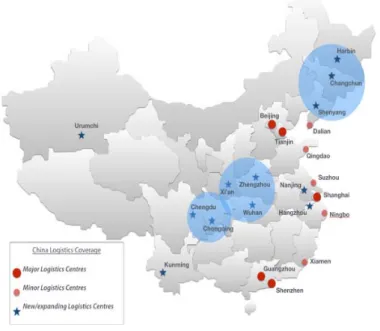
By 2018, Chinese government have set up 13 CBEC pilot zones throughout China. These CBEC pilot zone have set up the bonded warehouses in both tier-1 and tier 2 cities. These zones are located in Shanghai, Hangzhou, Ningbo, Zenzhou, Chongqing, Guangzhou, Senzhen, Tienjin, Hefei, Chendu, Dalian, Qingdao and Suzhou. These bonded warehouses in the CBEC pilot zones act as distribution centers for CBEC products that has been sent to store in the warehouse from international entities. International entities can ship and store their products in the bonded warehouses and then sell their product through CBEC online platform. Once the customers make a purchase from CBEC platform, then they will be charge tax only when there is a purchase order. This allow the foreign entity to lower the risk of not selling their products. Also, Chinese government has made tax exemptions for Chinese consumer with a limited quota per year. In essence, the consumer does not have to pay import tax if they order under a certain limit per year. This strategy is applied for all Chinese consumer who buy from CBEC channels. By having bonded warehouses in different economic zones throughout china, the product delivery time Chinese consumers can be very efficient where CBEC customers often get their order within a short time period i.e. in 1-2 days after they made purchase on CBEC platform. These laws and strategies to help promote CBEC e-commerce to Chinese consumers. Figure 2 shows the CBEC pilot zones.
Ractham, Banomyong & Sopadang
Source: Ecommerce Worldwide 2017
Figure 2: CBEC Pilots Zones RESEARCH METHODOLOGY
We conducted case study by employing field works interview, secondary data from stakeholders from both China and Thailand. The secondary data were from newspapers, official websites, national reports and internal company reports and documents that we attained from our interviews. A field works interview is suited to this type of study due to its exploratory nature. To fully analyze the details especially from resources from both countries as well as many involves stakeholders. We had to gather all the sources to make full understanding at both the micro and macro levels. Once we get both primary data from interviews and secondary from other sources, we started to transcribe the interviews and employ professional translation to ensure the validity of the data. Once. we finish the transcriptions we also ask three CBEC experts from China to verify the content to ensure that we have translate and transcribe everything correctly from the data set that we obtained during our data collection process. Once the three experts made confirmation with our data sources, we send each of the transcript to the interviewees that we interviewed for the final clarifications before we proceed with the data analysis procedures.
Table 1: List of interviews.
Organization Title Products or Services
Goldjet Logistics )China( Business Development
Manager Medium size Logistic Company ASEAN Fruits Import Chamber of Commerce
)Pingxiang, Nanning, China( President and CIO Largest Organization in China Fruit Importer CTI Logistics )Hong Kong( President Medium Size Logistic Company NetEase Koala )China( Senior Business Development
Specialist Largest CEBC Platform in China. Thailand Chamber of Commerce )Thailand( President Thailand Chamber of Commerce
Kerry Express )Hong Kong( CEO Large logistic company
Case Analysis
Although the demand side market in China has grown significantly in recent years, the supply side is still lacking in many aspects. In our case, Thai stakeholders such as exporters, local farmers, logistic companies and government agency do not have an online platform to showcase their products or services for the export goods to Chinese’s CBEC market. Most exporters still operate on the silo-base by individually relying in traditional channels to export their goods. The products displays, marketing, and distributions channels are operating without an online platform. Therefore, the supply and demand is not in equilibrium where both sides need to work together to streamline the process.
We conducted a case study by interviewing relevant CBEC stakeholders from China, Hong Kong and Thailand. We also chose two of the most popular Thai products from Chinese customers who buy from Chinese CBEC online platforms. The two products are Durian and Cosmetics. These are the two products which has the most potential to expand their presence in the
Chinese market. However, there are still few brand selections from Thailand, so weinvestigated the possibility of exporting these untapped brands directly from Thai suppliers through the Chinese consumers through CBEC channels. First, we interviewed with the President of Thai Chamber of Commerce. We received the overview of exporting Thai products in China. Thai chamber of commerce has positioned themselves as a centralize organization to help promote the exporting of Thai product to international market and China is one of the most attractive markets according to their internal data analysis. They support Thai suppliers, famers, manufacturers and distributors to increase the number of exports to the Chinese market.
Our interview resulted in the confirmation of the two of the most popular products; Durian and Cosmetics for the Chinese market.
“Thailand export a lot of durian and durian related products to China each year. However, most durian products we sent to China are mostly the most popular type and well-known brands of durian like ‘Mhon Thong’ and ‘Khan Yao’. We try to promote other types of durian through Trade Fairs in China every year. We hope to be able to export more durian to the Chinese market in the future. That is our goal.”
Another interview with ASEAN Fruits Import Chamber of Commerce in PingXiang, China; the largest fruit importer organization in China also confirm the demand for Thai fruits. The president of the PingXiang Chamber of Commerce stated. “Thai fruit is very popular among Chinese consumers. Some outbound tourists even visit Thailand just to try Durian and Mangosteen. We wish we would get more fruits from Thailand. To be honest, we would take whatever the Thai exporters or gardens have for us, but we have knowledges of where fruit supply are from. We have to send our people to Thailand to search for suitable fruit from different farms and provinces. So most of the time we have to contact the fruit farmer directly. We wish there will be an online platform to answer our need in term of getting more supply as well as the variety of fruit we can import from Thailand.”
Furthermore, the ASEAN Fruits Import Chamber of Commerce PingXiang has stated the need to have an online presence or the online platform for Thai products so they will be able to connect with the suppliers easily as well as having more choices for the suppliers to showcase their products to them before they can import them into China.
“We create an online platform which show information from Thailand side, but we are using it by ourselves. Everything is in Chinese and we try to have English as an alternative language on the side. However, with the language barrier then Thai supplier cannot use our site. Honestly it is very difficult for us to create an online platform that need to have all the necessary information from the local market. Although we have our people in Thailand to look for fruit supply. It will be better to have and E-market place to link the supplier and people in china to exchange information. However, we are in the process of negotiating with Thailand Ministry of Commerce to have a local online platform that is created from the supplier side. Hopefully we’ll be able to work on it together with Thai government soon.”
As for cosmetic product, both logistics companies which also have their own subsidiary platform for CBEC in China also voice their desire to have an online platform for Thai cosmetic so they’ll be able to buy more supply from Thai cosmetic suppliers.
“Thai cosmetic is probably the no. 3 or 4 in popularity among Chinese consumers following only Korean and Japanese in term of popularity of cosmetic products from Asia. In recent years, there are rising popularity in Thai movies and drama amongst Chinese consumer which lead to an increase in awareness and popularity of the cosmetic product for Chinese customers. There are only certain popular brand of Thai cosmetic which is very popular for Chinese consumer. However, their brand such like Snail White has already establish their presence in Chinese market in TMALL. We also want to have some kind of connections with other Thai brands since a lot of our customer love the Thai cosmetics, especially the one that made from natural herb and medicines.”
A logistic company stated the current channel of CBEC practice which is Gray Channel.
“I know a lot of outbound Chinese tourist who visited Thailand often bring a lot of Thai cosmetic back for resale purpose. It is the opportunities for us to import those product and others Thai products for our customer in China. However, we have no ways of knowing what are the best and safe products due to the lack of official online information. I think an online platform should be able to remedy this lack of information problem.”
Although CBEC market from the China has been thriving and a lot of Thai products have been selling well on the platform. There is still need for the demand side market to present the information for their products to their potential buyers. Without an online e-market platform from the supply side, the optimal business transaction between the two sides can’t be complete.
Ractham, Banomyong & Sopadang
In order for CBEC to thrive, both buyers and sellers need to establish a link with each other through an online platform. This platform to connect between supply and demand can lead to an optimal return for both party. By having the platform, buyers can advertise their products and give them local flavor or information where seller can also find wide variety of products that they can also promote through advertising through their channels. Government can also collect import tax from CBEC products and service and ensure the level of, which will benefit their people/consumer in the long run since by having the linkage between both platforms then provide more accountability. For product that’s being sold on their site. Although there are existing platforms in Thailand such as different e-market place for agriculture products, none are built as a platform to cater to the CBEC market. Most Thai platforms are small websites or very product specific platform such as agriculture products that only cater to Thai consumers or for small international business entities.
Also most Thai platforms are in Thai or English which does not suit well with the buyer side. The discrepancy in language is also a big obstacle for both party to communicate effectively and efficiently. From our interview, the Chinese entity attempted to build an online platform that cater to Thai supplier, but they were unable to build an effective platform which has both Chinese and Thai language and the main medium for the site. Also, the integrations between local suppliers to the platform can be extremely difficult for the Supply Side platform to try to integrate all players together, since most likely they’ll need local knowledges and know-how from Thai side to help build the system. While Thai entities such as Thai Chamber of Commerce and Ministry of Commerce have attempted to build an online platform for their export products, it still hasn’t been very successful since they also lack an integration from local suppliers as well as lack the knowledge from the consumer side. Lack in technology integration also play important role for the lack of the online platform. Although there are some small website and product specific platforms that have been created. It still lack the integration system between all the relevant stakeholders on the supply side. Most existing platform act as a silo base where each entity would come up with their own website or platform without much integration with one another. Although there are attempts from government unit such as Ministry of Commerce to create an online platform for agriculture products it still lack the system integration at a macro level to connect all the party together.
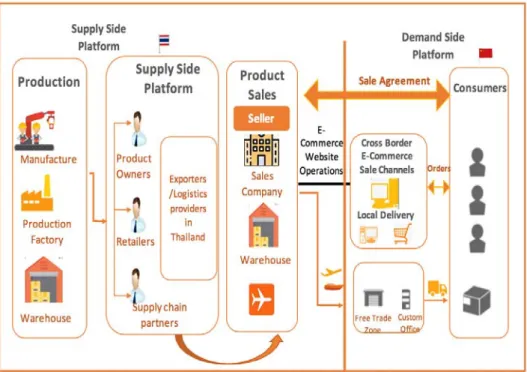
The issues mentioned in lack of standardized platform, language barrier and IT system integration led to a disconnectedness between the suppliers in one country and the buyers from another China. From our interview, most Thai products being sold on China CBEC platforms are usually from the traditional route of importing companies )i.e. NetEase Koala( or the Thai brand has a Chinese establishment in China already )i.e. Tmall(. Thus, the Chinese importers or individual consumers have little or no access to the information from the supplier side except through the traditional route of e-commerce. Hence, this lead to the non-optimal of the demand and supply. The buyer do not have enough information to make decision for the product they may want to buy. Therefore, we proposed that there should be a supply side e-market platform as well. This supply side market platform can consist of manufacturer, warehouse operator, products owners )i.e. farmers(, retailers, distributors and logistic companies as well as other stakeholders that will enable the buyer to be able to look at different products that they want to make transaction or import them the supply side market. By fulling integrate the supply side with the demand side, the two -side e-market platform can play an important role in promoting the CBEC activities. See figure 3 for the proposed Two-sided E- Market Platform.
By having two-sided market platform, stakeholders from the supply-side in this case Thai suppliers can platoffer products information on the online platform which then the supplier or individual customer from China can browse and shop directly from the platform. This will surely help to improve the awareness of the product availability where the brand doesn’t have to be the most popular brand already available I the buyer-side e-market platform. This two-sided market platform will benefit both the sellers and the buyers to fully utilize the marketplace as well as serving the purpose of CBEC where a single customer can have the option to browse and choose different types of product from the seller side where without the Supply-side platform the buyer would have very limited resource in looking for the products they want to purchased.
CONCLUSION
CBEC provide tremendous opportunities for both seller and buyer to conduct e-commerce transactions. However, current form of CBEC in China has only a one-sided online platform mainly from the buyer side. To be able to fully utilized the CBEC original purpose of having the product flow freely from the supplier to the buyers through international market channels, a two-sided CBEC platform must be develop by having the e-market platform on both sides. In order for a supply-side CBEC platform to be built the following issues must be investigated and improve. The relevant issues are as follow:
1( Government support – For the buyer-side CBEC platform, the Chinese government has been supporting in building the CBEC platform by supporting with building the bonded warehouse in 15 pilot zones around China. Also, they have been lowering the import tax for some of the products that is bought through CBEC channel. By having the government support the size of CBEC platform grew significantly and will continue to grow in the future. For the supply-side platform the government such as Thai government need to create a unify CBEC platform where Thai suppliers can have their products display on the platform so the buyers will have the opportunity to look through the product and create transaction.
2( Supply Chain Coordination – The two-sided CBEC platform which link the seller with the buyers in another country should employ end-to-end Supply Chain Coordination where seller can sell their product directly from their location. For examples, a Thai cosmetic producer should be able to ship their product to Chinese consumers by having a full service end-to-end IT integration for the whole transactions.
3( Online Platform Design – in order for CBEC platform to work both the online system should be able to communicate clearly. For example, the seller-side platform must have the language such as Chinese and English for the products. This will lead to the better understanding between seller and buy by getting rid of the language barriers between the two sides.
4( CBEC Consumer Marketing Strategies – in order for the seller to sell their products, they must understand their buyers. Thus an in-depth analysis of their customers will be needed in order for the seller to understand what type of product they can sell and what price point.
Theoretical and Practical Contributions
This study made two types of contributions. First by advancing the understanding of the two-sided market platform by applying it to the CBEC platform in China can help further the understanding of both supply and demand side especially in the IT integration and supply chain coordination. A practical contribution.
LIMITATION
This study was only conducted in two countries; China and Thailand. There are other possibility to explore especially ASEAN regions where China import a lot of their products into their country.
REFERENCE
Benabdellah, A. C., Benghabrit, A., & Bouhaddou, I. (2016, November). Big data for supply chain management: opportunities and challenges. In 2016 IEEE/ACS 13th International Conference of Computer Systems and Applications (AICCSA) (pp. 1-6). IEEE.
Bi, Z., & Cochran, D. (2014). Big data analytics with applications. Journal of Management Analytics, 1(4), 249-265.
e-Marketer )2019(. E-Commerce Market Reports 2019. Retrieve from https://www.emarketer.com (accessed 27 September 2019).
Gomez, E., Martens, B., & Turlea, G. (2013). Drivers and impediments for cross-border e-commerce in the eu (No. 2013-02). Joint Research Centre (Seville site).
Ho, S. C., Kauffman, R. J., & Liang, T. P. )2008(. A growth-theoretic empirical analysis of simultaneity in cross-national e-commerce development. In Proceedings of the 41st Annual Hawaii International Conference on System Sciences)pp. 410-410(.IEEE.
PwC )2018(. China’s next retail disruption: End-to-end value chain digitisation. Global Consumer Insights Survey 2018 China Report. Retrieved from https://www.pwchk.com/ (accessed 27 September 2019).
Wismer, S., & Rasek, A. )2017(. Market definition in multisided markets. Retrieved from http://www.oecd.org/officialdocuments/publicdisplaydocumentpdf/?cote=DAF/COMP/WD%282017%2933/FINAL&doc Language=En (accessed 27 September 2019).
Ractham, Banomyong & Sopadang
Solca, L. )2015(. Digital China Leaving Ostrich Brands Behind. Business of fashion.com. Retrieved from
https://www.businessoffashion.com/articles/professional/digital-china-leaving-ostrich-brands-behind (accessed 28 October 2016).
Teresa Lam, )2018(. China Retail & E-commerce Weekly Updates, Retrieved from https://www.fbicgroup.com/sites/default/files/Weekly%20Retail%20Updates_12Oct-18Oct18_En.pdf (accessed 27 September 2019).
Tiwari, S., Wee, H. M., & Daryanto, Y. (2018). Big data analytics in supply chain management between 2010 and 2016: Insights to industries. Computers & Industrial Engineering, 115, 319-330.
The United Nations Economic and Social Commission for Asia and the Pacific )ESCAP( )2018(. Embracing the E-commerce Revolution in Asia and the Pacific. United Nations ESCAP. Retrieved from https://www.unescap.org/resources/embracing-e-commerce-revolution-asia-and-pacific (accessed 27 September 2019). Yousefi, A. (2015). The impact of cross-border e-commerce on international trade. In Proceedings of the 16th International