BUILDING SOCIAL MEDIA CAPABILITIES IN B2B
CONTEXT
A Case Study
Master’s Thesis
Tuomas Viitasaari
Aalto University School of Business
Information and Service Management
Spring 2019
www.aalto.fi Abstract of master’s thesis
i
Author Tuomas Viitasaari
Title of thesis Building Social Media Capabilities in B2B Context
Degree Master of Science in Economics and Business Administration
Degree programme Information and Service Management
Thesis advisor(s) Riitta Hekkala
Year of approval 2019 Number of pages 94 Language English
Abstract
Social media has become an integral part of our everyday lives during the past decade. Organizations serving both the business-to-consumer (B2C) and business-to-business (B2B) markets have realized that social media provides an efficient medium to reach their target audiences and have started to adopt social media as part of their marketing toolkit. However, utilizing social media is not a trivial task, especially for B2B organizations who have been the last to take advantage of the opportunities that the phenomenon has to offer. This study explores the process of developing social media and content marketing capabilities in B2B context. Drawing in previous literature around social media and content marketing, it aims to examine the social media capabilities development process from the viewpoint of how B2B companies can build and develop their social media capabilities in the fast-paced marketing environment of today. Capabilities are defined as the pool of expertise and knowhow that an individual or a company possesses of a certain topic. In addition, this study takes a look at what B2B firms are using social media for, i.e. what the goals of social media are for B2B companies, and explores whether any generalizable social media best practices can be identified.
In order to study how B2B social media capabilities are formed, a single case study was conducted by examining a medium-sized Finnish company offering financial management software and consulting services. Participant observation and semi-structured interviews were selected as the primary sources of evidence used in the case study, accompanied with supporting documentary evidence. The case study provides a detailed look at the case company and its social media journey, focusing particularly on the process of learning what social media can be used for and how to do so successfully.
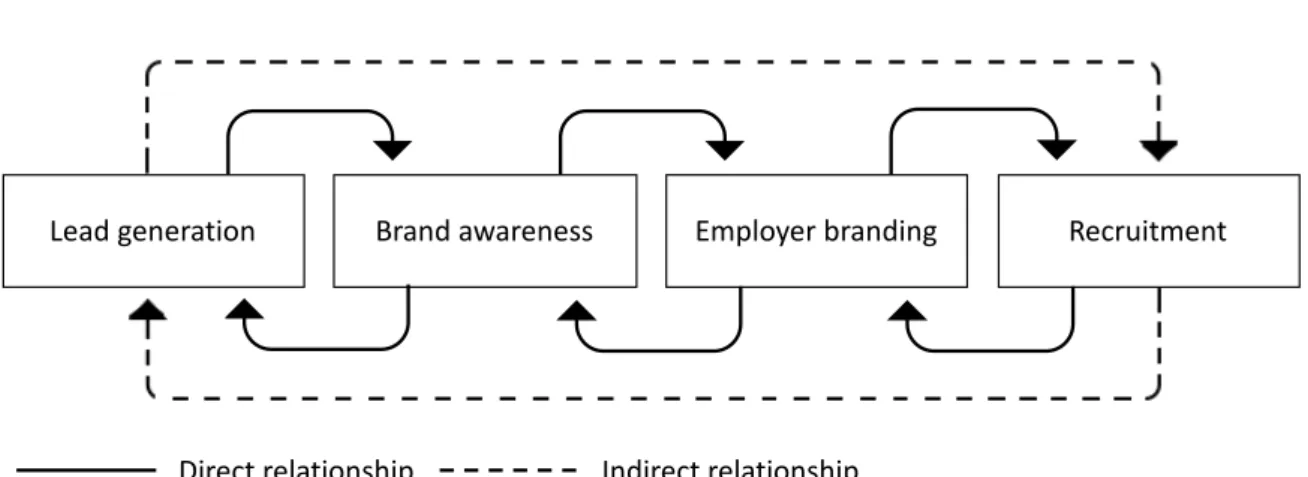
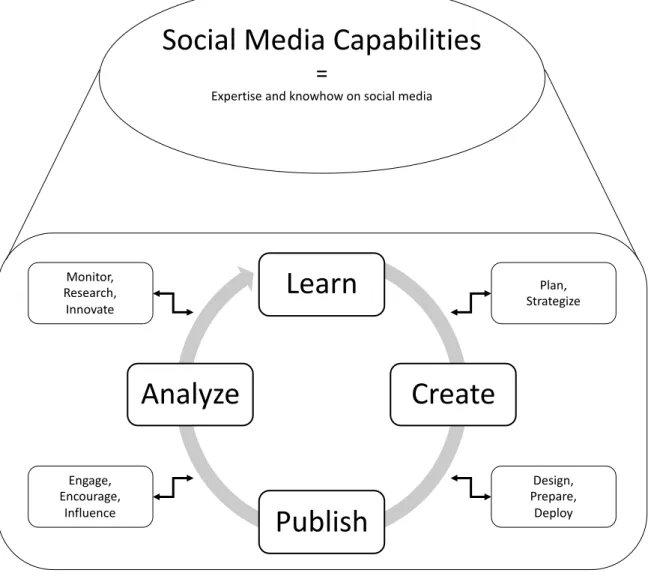
Based on the case analysis and existing literature, the process of building social media capabilities is one of continuous learning that requires companies to experiment with various ways of doing social media and learning from the results. A framework depicting this cyclical capability building process was developed. The findings also suggest that there are four main goals of B2B social media: 1) lead generation, 2) brand awareness (including thought leadership), 3) employer branding, and 4) recruitment. A second framework showcasing these goals and their interrelations was also developed. Finally, three different best practices of B2B social media were identified: 1) the inclusion of photos will increase the performance of social media posts, 2) maintaining a consistent presence on social media will help stand out from the competition, and 3) continuous learning is essential for the successful use of social media in marketing.
Keywords social media, social media capability, social media goals, best practices, B2B, content marketing, case study
www.aalto.fi Maisterintutkinnon tutkielman tiivistelmä
ii
Tekijä Tuomas Viitasaari
Työn nimi Building Social Media Capabilities in B2B Context
Tutkinto Kauppatieteiden maisteri
Koulutusohjelma Tieto- ja palvelujohtaminen
Työn ohjaaja(t) Riitta Hekkala
Hyväksymisvuosi 2019 Sivumäärä 94 Kieli Englanti
Tiivistelmä
Sosiaalisesta mediasta on viime vuosikymmenen aikana tullut erottamaton osa päivittäistä elämäämme. Yritykset niin kuluttaja- (B2C) kuin yritysten välisillä (B2B) markkinoilla ovat nähneet, kuinka sosiaalinen media tarjoaa tehokkaan tavan kohdeyleisöjen saavuttamiseen ja ovat alkaneet ottaa sosiaalisen median osaksi markkinoinnin työkaluvalikoimaansa. Sosiaalisen median hyödyntäminen ei ole kuitenkaan aivan yksinkertainen tehtävä – varsinkaan B2B-yrityksille, jotka ovat viimeisinä lähteneet tutkimaan niitä mahdollisuuksia, joita tämä uusi ilmiö tarjoaa.
Tämä tutkielma keskittyy sosiaalisen median and sisältömarkkinoinnin kyvykkyyksien kehitysprosessiin B2B-yrityksissä. Aiempaan sosiaalisen median ja sisältömarkkinoinnin kirjallisuuteen pohjaten tutkimus etsii vastauksia siihen, kuinka B2B-yritykset voivat kehittää sosiaalisen median kyvykkyyksiään nykymaailman nopeatempoisessa markkinointiympäristössä. Kyvykkyyksillä tarkoitetaan asiantuntemuksen ja tietotaidon varantoa, joka henkilöllä tai yrityksellä on hallussaan. Lisäksi tässä tutkimuksessa tutkitaan, mihin eri tarkoituksiin B2B-yritykset käyttävät sosiaalista mediaa sekä sitä, onko sosiaalisen median käytöstä B2B-ympäristössä tunnistettavissa joitain parhaita käytäntöjä.
Tutkimus toteutettiin yhteen yritykseen keskittyvänä tapaustutkimuksena. Tapaustutkimuksen kohteena oli keskisuuri suomalainen taloushallinnon ohjelmisto- ja palveluyritys. Pääasiallisina tutkimusmenetelminä olivat osallistuva havainnointi sekä teemahaastattelut, joita täydennettiin kirjallisilla aineistoilla. Tapaustutkimus tarjoaa yksityiskohtaisen kuvauksen case-yrityksestä sekä sen matkasta sosiaalisen median maailmassa ja keskittyy erityisesti sosiaalisen median käyttökohteisiin ja sosiaalisen median tehokkaan käytön opetteluun.
Tapaustutkimuksen ja aiemman kirjallisuuden perusteella sosiaalisen median kyvykkyyksien kehittäminen on jatkuva oppimisprosessi, joka vaatii yritykseltä kykyä kokeilla erilaisia toimintatapoja ja oppia niistä. Tätä syklistä prosessia kuvaava viitekehys luotiin osana tutkimusta. Löydökset osoittavat myös sen, että B2B-yrityksillä on tyypillisesti neljä sosiaalisen median käyttökohdetta: 1) liidien generointi, 2) tunnettuus (mukaan lukien ajatusjohtajuus), 3) työnantajabrändäys ja 4) rekrytointi. Nämä käyttökohteet ja niiden väliset yhteydet esitetään omassa viitekehyksessään. Lopuksi, kolme erilaista B2B-sosiaalisen median parasta käytäntöä tunnistettiin: 1) kuvien käyttö sosiaalisen median julkaisuissa parantaa niiden tuloksia, 2) johdonmukainen läsnäolo auttaa yrityksiä erottautumaan sosiaalisen median kentässä ja 3) jatkuva oppiminen on edellytys sosiaalisen median nopeasti muuttuvassa ympäristössä pärjäämiseen.
Avainsanat sosiaalinen media, sosiaalisen media kyvykkyys, sosiaalisen median tavoitteet, parhaat käytännöt, B2B, sisältömarkkinointi, tapaustutkimus
iii
Acknowledgements
This is it – the endgame. My journey through school, which feels like an eternity to be honest, is now coming to a close. This master’s thesis is the last piece in the puzzle that will lead me to other adventures in the “adult world”.
First of all, I would like to thank my mom, dad, brother and our dogs for supporting me throughout the nearly two decades that I have spent in school. Without their guidance and belief in me, getting to this point would not have been possible. I would also like to thank my girlfriend for putting up with me talking (and sometimes ranting) about my thesis over the past two years and brainstorming ideas with me to help me find the right ways to complete this process.
In addition, I want to thank the case company of this thesis and all the people I’ve had the chance to work with during these past two years I have employed there. Special thanks go to my superior at work, who has given me the opportunity to balance my time between school and work flexibly, and to the other two members of our team who have also shared this experience with me, especially during the summer of 2018 when I had the chance to write most of this thesis at the office.
Last but not least, I would like to thank my thesis supervisor Riitta Hekkala who has been patiently guiding me through this process, even though finishing it has taken me longer than I anticipated. Working full-time while writing a thesis is something I wouldn’t advice anyone to do. Fortunately, it has all come together, and it is time for me now to say goodbye to Aalto University.
It’s been a blast! 03.05.2019, Espoo Tuomas Viitasaari
iv
Table of Contents
Acknowledgements ... iii 1 Introduction ... 1 1.1 Motivation ... 2 1.2 Research Gap ... 31.3 Research Questions and the Scope ... 5
1.4 Outline of the Research ... 6
2 Literature Review ... 8
2.1 Marketing in the Internet Era ... 8
2.2 Social Media ... 11
2.2.1 User-Generated Content ... 11
2.2.2 Firm-Generated Content ... 12
2.3 Social Media in B2B Context ... 13
2.4 Why Social Media Matters ... 14
2.4.1 Brand Image and Identity ... 15
2.4.2 Social Media Presence and Engagement ... 16
2.4.3 Electronic Word-of-Mouth ... 18
2.5 Content Marketing ... 18
2.5.1 Influencing Content Creation on Social Media ... 21
2.5.2 Types of Content Published on Social Media ... 24
2.5.3 Goals of Content Marketing ... 26
3 Methodology ... 28 3.1 Research Design ... 28 3.2 Data Collection ... 30 3.2.1 Participant Observation ... 30 3.2.2 Interviews ... 33 3.2.3 Documentary Evidence ... 35
4 Findings and Case Analysis ... 37
4.1 Introduction to the Case Company ... 37
4.2 Current Situation at the Case Company ... 38
4.3 Towards Social Media Strategy ... 40
4.3.1 Platforms and Channels ... 41
4.3.2 Company Blog ... 42
4.3.3 Social Networking Channels ... 45
v 4.4.1 Lead Generation ... 49 4.4.2 Brand Awareness ... 50 4.4.3 Employer Branding ... 51 4.4.4 Recruitment ... 52 4.4.5 Summary of Goals ... 54 4.5 Employee Advocacy ... 55 4.6 Best Practices ... 58 5 Discussion ... 61
5.1 Goals of B2B Social Media Marketing ... 61
5.2 Framework for Building Social Media Capabilities in B2B Context ... 63
5.3 Best Practices in B2B Social Media ... 69
6 Conclusions ... 72
6.1 Theoretical Implications ... 73
6.2 Managerial Implications ... 75
6.3 Limitations and Further Research ... 76
References ... 77
vi
List of Tables
Table 1: List of meetings and events related to social media at the case company. ... 32
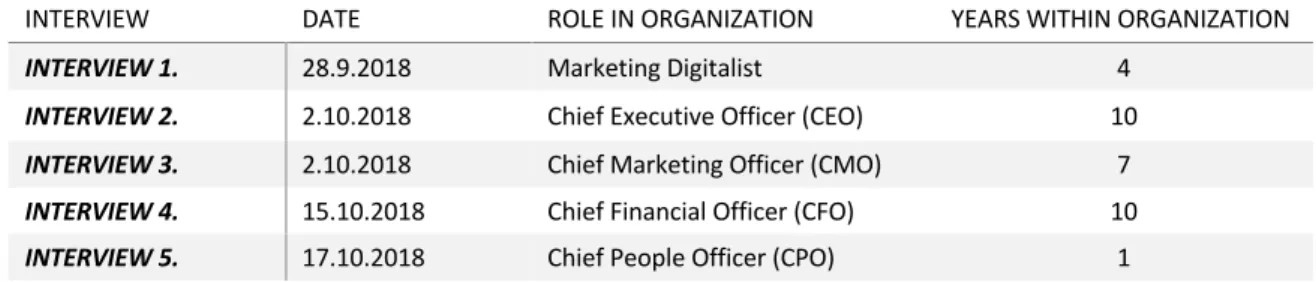
Table 2: List of interviews conducted. ... 35
Table 3: List of the main sources of documentary evidence. ... 36
Table 4: Social media platforms used by the case company. ... 41
Table 5: Social media channels used by the case company. ... 42
vii
List of Figures
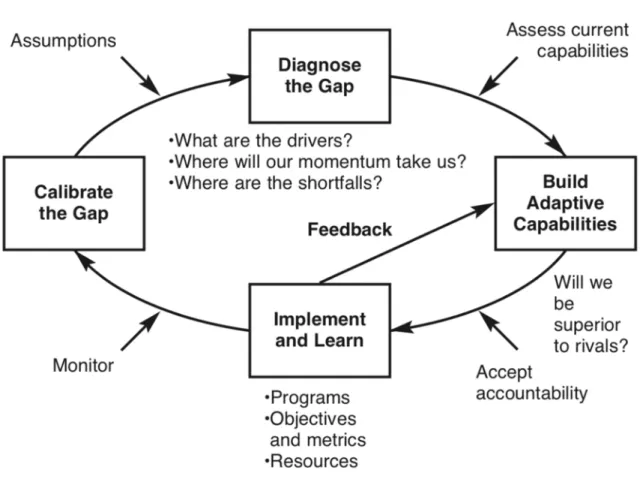
Figure 1. The capability development process (Day 2011). ... 10 Figure 2. Sales funnel framework (Järvinen and Taiminen, 2016). ... 20 Figure 3. B2B company’s influence on social media content creation (Huotari et al., 2015).
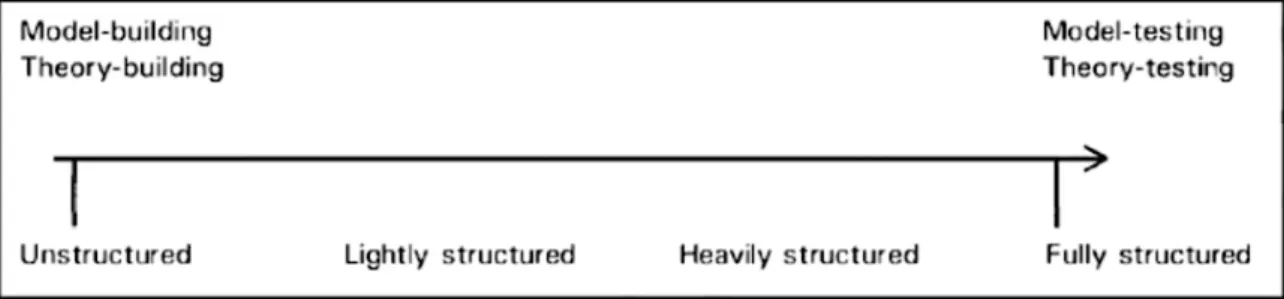
... 22 Figure 4. Spectrum from unsctructured to fully structured interviewing (Wengraf, 2001, p. 61). ... 34 Figure 5. Goals of social media in B2B context and their interrelations ... 62 Figure 6. Framework for building social media capabilities in B2B context ... 65
1 Introduction
Social media has taken the world by storm. A day rarely goes by during which we are not connected to the Internet, browsing through our favorite media, streaming the newest blockbuster series or engaging with communities with members from all around the globe. According to a report by We Are Social and Hootsuite (2018) there are over three billion social media users worldwide, which accounts for nearly half of the Earth’s population. Thus, social media can truly be called a global phenomenon.
Over the past three decades we have witnessed how the invention of the Internet changed the virtually everything from communication and commerce to our culture. Suddenly all that used to be distant was at people’s fingertips. Goods, services, news and media were all available on demand and in great variety. As technology developed, consumers gained access to a multitude of different tools and applications that allowed them to create content themselves. In addition, these new technologies put the consumers in charge of their own media consumption, allowing them to tailor their media experiences any way they wanted. Furthermore, consumers were not limited to only consume media but also take active part in the experience by engaging with creators, influencers and other consumers alike (Daugherty, Eastin and Bright, 2008). These fundamental changes in the media environment eventually resulted in the birth of social media.
Even though social media has become a substantial part of our everyday lives in the past couple of decades, it still is a fairly new concept in the academic world. Despite its growing importance, there is little research on the use of social media in business. The majority of earlier research on social media has focused on the business-to-consumer (B2C) side of things but is especially lacking in terms of business-to-business (B2B) marketing communications.
This calls for research on the use of social media in B2B context. Taking inspiration from and building on top of the scarce existing literature, this study aims to contribute in building a better understanding of the concept in the academic world. How this will be achieved is through a single case study on a mid-sized Finnish B2B organization that offers enterprise software and consulting services in the field of financial management. The case analysis aims at understanding how social media capabilities were developed at the case company as well as to identify what the goals of social media are for a B2B company. Social media research in the B2B environment can also result in a wide range of useful managerial
implications, e.g. how businesses can utilize social media more successfully in supporting their content marketing and sales efforts.
1.1 Motivation
After working for the case company for about a year, the researcher found himself in a position where multiple interesting topics were available for research. The case company had only a couple of years ago started to use social media as part of its marketing mix, i.e. “the set of marketing tools that the firm uses to pursue its marketing objectives in the target market” (Kotler and Keller, 2006, p. 9). There was also increasing interest towards how to utilize this new kind of media more efficiently and successfully, especially since the competition was also beginning to venture into the world of social media. However, the company had been limited by time and resources constraints in the past, resulting in a situation where social media could not receive the kind of focus the company wanted it to have. Thus, the firm welcomed the idea of tackling the situation in an effective and cost-efficient way (see section 4 for a more detailed elaboration of the case company’s background and current situation).
This presented an opportunity for a master’s thesis research that is mutually beneficial for both the case company and the researcher. On one hand, the case company provides an intriguing environment to study the topic and allows the author to immerse himself deep into the world of social media in an industrial marketing context. On the other hand, the case company has the possibility to gain valuable insight and knowledge about social media from the study. For example, alongside its theoretical contributions, the study could possibly find various concrete managerial implications that can hopefully be used to further improve the use of social media at the case company.
The convenience of finding a mutually beneficial rationale for both the case company and the researcher was not the only source of motivation for this study. As social media has taken an ever-increasing share of our lives these days, the researcher was beginning to get more and more interested in taking a closer look at the phenomenon. Topics, such as what kind of elements constitute an excellent social media post, how firms are utilizing the possibilities of social media as part of their marketing efforts and what makes a social media post “go viral” (i.e. gain surprising, substantial publicity), had been on top of the author’s mind for a longer period of time. However, the sheer magnitude of the phenomenon presented challenges in defining a viable research topic that is neither too vague nor too narrow. Only after gaining responsibility for developing the social media culture and
utilization at the case company, the author realized that there now was an opportunity to conduct research on a topic he had been longing for.
In addition, the researcher saw a clear opportunity to develop himself both academically and professionally. Iacono, Brown and Holtham (2009, p. 46) argue that working at a company while simultaneously studying a phenomenon as an insider in the company presents an opportunity where “there is so much to be gained from the research, professionally also, in terms of self-development and learning”. In this case, there was much to be learned in terms of social media, in general and most importantly within the B2B context, for the researcher to better perform in his everyday job even after the research is over. This unique chance to learn and develop skills needed in the job the researcher is occupied with was one of the key motivations for conducting this study.
As the case company and the researcher could mutually benefit from a study concentrated around the use of social media in an industrial marketing (i.e. B2B marketing) context, deciding the general focus for this master’s thesis research was fairly straightforward.
1.2 Research Gap
In addition to the practical motivations for the study, the current situation in the academia was favorable for this study. Even though research on social media is still lacking in terms of quantity, especially in the B2B environment, the academic world is beginning to pay increasing attention to the topic. Given the magnitude of the whole social media phenomenon, it is definitely a topic worth researching.
Some researchers (e.g. Kietzmann, Silvestre, McCarthy and Pitt, 2012; Alves, Fernandes and Raposo, 2016; Buratti, Parola and Satta, 2017; Salo, 2017; Wang, Rod, Ji and Deng, 2017) have focused on understanding the social media phenomenon by conducting literature reviews examining the sparse existing literature around social media in B2B context. These publications also propose various avenues for future research, spanning from one end of the spectrum to another. The general consensus of these papers is that social media requires more attention from researchers to add to the broader understanding of the topic in the academia. This gives rise to a fruitful opportunity to contribute to the still scarce literature on social media within the B2B environment.
Other authors have examined the importance of social media for firms. Hanna, Rohm and Crittenden (2011, p. 273) conclude that “companies of all sizes from different industries now view social media marketing as a mandatory element of their marketing strategy”. Baird
and Parasnis (2011, p. 30) highlight that social media is clearly “where customers are congregating and businesses want to be”. While B2C firms have taken to social media to exploit its opportunities, Iankova, Davies, Archer-Brown, Marder and Yau (2018) note that the majority of B2B companies still perceive social media low in effectiveness.
Interestingly and in contrast to B2B companies’ perceptions, vast numbers of business articles (e.g. Smart Insights, 2018; Forbes, 2018a, 2018b) claim that social media is extremely important for B2B businesses too. Forbes (2018a) claims that social media is “one of the most effective marketing channels during the vendor selection process” with a direct impact on sales performance. This difference of opinions presents an intriguing question: why do B2B companies perceive social media redundant, while their consumer market counterparts and business magazines seem to think differently?
Moreover, previous research on B2B social media seems to be lacking studies focused on a single aspect of the phenomenon. There are only a handful of authors that have taken the approach of concentrating on a single case and/or topic. Järvinen and Taiminen (2016) present one research like this that takes a look at a single case company’s pioneering efforts of bringing marketing automation together with B2B content marketing. The kind of research focused on a more concentrated topic offers a possibility to gain a deeper understanding of the phenomenon studied compared to research that examines a similar topic with a larger scope (Kaplan and Duchon, 1988). Salo (2017) proposes several research directions that have not yet been adequately explored within the industrial marketing context. Among these paths of research are:
• what type of content should firms deliver through social media to reach their desired business goals?
• how social media and content creation could be used as part of the sales process?
• how social media can influence e.g. brand awareness, brand reputation or
word-of-mouth (WOM) activity concerning a brand?
To summarize the above, there seems to be a clear research gap when it comes to understanding the social media phenomenon more deeply in the B2B context. How this study aims to add to the literature is by examining the process of developing social media and content marketing capabilities from the ground up at the selected case company. Capabilities in the context of this study refer to the pool of expertise and knowhow that lies within a firm
or with an individual about a topic. Such a research contributes to the academia by exploring existing theories within the case company and building on top of them to create a description of how organizational social media capabilities can be developed. To the best of the researcher’s knowledge, this is one of the first studies that examines the phenomenon from this particular perspective.
1.3 Research Questions and the Scope
This study explores the process of developing social media and content marketing capabilities at a medium-sized company offering financial management software and consulting services in the B2B market, i.e. the case company. The research aims to examine the social media capabilities development process and explore the question whether it is even possible to establish a universally successful way to operate in the world of B2B social media. To do so, the study will take a close look at the case company’s efforts in finding an effective way of utilizing social media in the industrial marketing context. The company has mostly been “learning by doing”, and this learning process will be examined and documented thoroughly in this study. In other words, this study will try to answer the following research question:
• How can a firm operating in the B2B environment develop capabilities for the successful use of social media?
While exploring the main research question, several sub-questions are also considered:
• What kind of content should a B2B firm post on social media?
• What are the goals of social media in B2B context? (e.g. brand awareness or recruitment)
• What, if any, applicable best practices are there for B2B social media?
By exploring the aforementioned research questions, this study sheds light on social media use in B2B context. It aims to develop an understanding of what it takes for a B2B business to establish itself on social media and use it effectively as part of its marketing mix. The nature of the research is mostly exploratory, as it allows for examining everyday phenomena as they unfold in real-life situations (Calder, 1977). From this a social media
capability framework can be built. It is hoped that the results of the study are generalizable to most small and medium-sized enterprises (SME) within the B2B environment. The research approach used will be further elaborated in the Methodology section of this study.
As mentioned earlier in the paper, on top of building a theory on B2B social media capabilities this study is also expected to uncover concrete measures that can enhance the effectiveness of social media use of SMEs operating in the B2B market. For example, the study aims to, hopefully, discover identifiable social media best practices that can be applied to increase the effectiveness of corporate social media posts. In other words, one desirable managerial implication would be to find practical ways for corporate social media users to create posts that systematically achieve broader reach and higher social engagement on various social media channels, such as LinkedIn or Facebook.
1.4 Outline of the Research
The outline of this master’s thesis follows a conventional structure that has been proven practical in the academia. The research is divided into six distinctive sections starting with the introduction and ending with the conclusions. The introduction provides the reader with the background and motivation for the research and introduces the research problem that the study aims to tackle. The first section strives to capture the attention of the reader with a compelling story that indicates why this study is worthwhile and important. This is done partly by presenting the research gap that exists in the academic literature that justifies the topic as a viable avenue for research. In addition, the introduction also defines the scope of the research and outlines the structure of the thesis.
The second section of this study will introduce the reader to the theory around the topic of the thesis. This includes, among other things, a summary of the previous literature that is relevant to the research at hand. Concepts like social media in general and its origin, B2B social media and why it matters to businesses will be introduced. Also, other important marketing constructs, such as brand image, brand identity and content marketing, will be discussed in the theory section of this study. After reading the section, the reader is familiarized with all the fundamental concepts involved in the study.
The third section presents the research methodology and framework used in this thesis. In this section, the reader will be familiarized with the research approach and data collection and analysis methods as well as the theoretical constructs utilized in the study. A case study method will be explained in detail, after which the use of a single case study in this thesis can be justified in the Methodology section. The main data collection methods,
such as participant observation, semi-structured interviews and documentary evidence, will be explained as part of the section.
Findings and Case Analysis will constitute the fourth section of the thesis. In this section, the case company and its current situation regarding social media will be introduced. Moving forward, the section documents the case company’s journey towards a social media strategy step by step. The reader will get a unique viewpoint into the life of the case company as it developed its social media capabilities. In addition, an in-depth analysis of the said capabilities will be introduced in this section, and the case company’s efforts in finding an effective way of utilizing social media in the B2B market will be discussed, and if generalizable social media best practices can be identified during the case analysis, these will be introduced to the reader.
Following the case analysis, Discussion will further elaborate and examine some of the key findings and revelations that emerged during the case research. Also, the section will present a framework for building B2B social media capabilities in B2B context developed by combining the results of the case study with theories presented in the existing literature. The framework presented will also be critically examined.
Lastly, Conclusions will bring the thesis to an end. This section will summarize the main aspect of the research and highlight the key theoretical findings and managerial implications. The limitations of the research will be evaluated, and further research directions will be proposed.
2 Literature Review
Albeit social media has established itself as a significant part of our everyday lives, the academic world is just beginning to catch up with the concept. Researchers have, quite understandably, focused their attention first on B2C and customer-to-customer (C2C) aspects of the phenomenon as the use of social media comes naturally in these contexts. Only recently has the use of social media increased among B2B firms (Keinänen and Kuivalainen, 2015).
This chapter will shed light on the developments surrounding B2B use of social media and the underlying concepts related to it. Furthermore, the chapter will go through all the relevant previous literature regarding the topic this study. At first, a look into the state of marketing in the Internet era is taken to introduce the broader context with which this study is dealing. After that, an overview of social media in general, including a brief history of its development, as well as the more topical subject of B2B social media are provided. An important aspect of the literature review is to explain why social media matters for businesses, B2B and B2C alike, and what the main concepts behind its importance are. Lastly, the literature review is concluded with the introduction of content marketing, which is one of the most prevalent forms of marketing in today’s social media environment, including the types of content firms should publish on social media as well as the goals of content marketing – and corporate social media in general.
2.1 Marketing in the Internet Era
In the past few decades, the marketing environment has been transforming at an accelerating speed. Markets have become more segmented as new digital media have emerged, vastly increasing the possibilities for companies and customers to be in touch with each other (Cha et al., 2007). This new environment is characterized by increasing complexity and fast-paced change. Organizations operating in today’s world are facing challenges posed by these changes; the gap between the complexity of the markets and the marketing organizations’ capabilities is growing wider. (Day, 2011)
The changes in the environment can be seen in both B2C and B2B markets. The development of new digital technologies from the Internet to Web 2.0 to Social Media has had an impact on customers’ search and choice behavior and the intensity of the competition. (Hagel, Brown, and Davidson, 2009) The power of different channels is growing, with digital channels gaining a more substantial edge over traditional channels year by year. Both
the search and distribution costs have decreased significantly, resulting in mass markets of the pass to become a mass of niche markets (Anderson, 2006).
This new situation has shifted power from the business side more to the consumer side as more information and options are readily available at will. Organizations are facing troubles keeping up with the pace of the changes in the digital environment that requires a whole new set of capabilities from marketers, not to mention the whole organization. According to Day (2011, p. 184), there are two major sources of evidence that explain the underlying causes of this phenomena: 1) an information overload has led to inability to “make decisions, process information, and prioritize tasks”, and 2) organizations’ inability to adopt to changes in the environment (Hamel, 2007).
As the market environment grows in complexity, businesses are faced with pressures to react at accelerating speed. However, research shows there is a widening gap between the markets and the organizational capabilities to respond to these fast-paced changes. (Day, 2011) In today’s digital economy, stability has been replaced with uncertainty. Instead of sticking to the learned practices that have worked in the past, organizations need to embrace innovation to better respond to the situation. (Hagel, Brown and Davidson, 2009)
Literature presents one possible answer in the form of smart business experimentation. Even with all the modern technology available, managers implement new ideas solely based on their “hunch”, i.e. with no actual evidence to back the decisions. Smart business experiments are proposed as one way to tackle the challenges posed by the chaotic environment. Davenport (2009) argues that conducting business experiments allows organizations to test and learn from new ideas in a scientific manner. Anderson and Simester (2011) are also advocates of smart business experiments and suggest that data created with an experiment is much easier to analyze than trying to gain insight from the vast amounts of historical data businesses possess.
Day (2011) builds on the foundation created by Davenport and Anderson and Simester to address the gap between organizations’ capabilities and the changing market environment. According to Day (2011) the Internet era, with e.g. social networking and social media, has increased the complexity of the marketing environment and accelerated the pace of change in markets with which marketers of today must cope with. Instead of having to deal with insufficient data to base their decisions on, organizations are now facing an opposite challenge: there is too much information coming in from a myriad of sources. In order to cope with this complexity, Day (2011) proposes that organizations can developed dynamic
marketing capabilities through agile experimentation, in contrary to sticking with what has worked in the past.
Day (2011) divides dynamic capabilities into three main functions: 1) continuous monitoring and examination of the market environment to sense changes that can present new opportunities or threats, 2) finding novel and innovative ways to respond to these changes, and 3) choosing the right business model to deliver value to the customers and gain an economic profit. For achieving this, Day proposes a capability development process model (see Figure 1.) as a way for organizations to transform their marketing capabilities and establish a culture of continuous learning through smart and agile experimentation.
2.2 Social Media
Social media has its root deep in the development stages of the Internet, and it is worthwhile to briefly address the different development stages to understand the phenomenon better. The term Web 1.0 is generally used to describe the early era of the Internet dating back to the 1990’s or even further. Web 1.0 typically refers to the static age of Internet characterized by low levels of collaboration and social interaction (Cormode and Krishnamurthy, 2008). The development of Internet technologies in the late 1990s and early 2000s paved the way for a more collaborative and social era of the Internet, the Web 2.0.
Web 2.0 is a term coined by O’Reilly Media in 2004. It is typically used as an umbrella term referring to the new era of Internet encompassing various new web technologies. Kaplan and Haenlain (2010, p. 61) summarize Web 2.0 as the change when the Internet was transformed to “a platform whereby content and applications are no longer created and published by individuals, but instead are continuously modified by all users in a participatory and collaborative fashion”. The emergence of these new technologies transformed the Internet to the social and collaborative network it is today.
This development led to the invention of the term social media in the early 2000s. The term began to gain mainstream attention in the early 2000s after the first major social networking sites (SNS), Myspace (est. 2003) and Facebook (est. 2004), were created. Social media is built on the foundation laid by Web 2.0 and spans over various different channels where individuals and businesses share content (Kaplan and Haenlain, 2010). Osei-Frimpong and McLean (2017, p. 6) define social media as “social-virtual environments where individuals and groups communicate and share experiences”, which describes the nature of the whole phenomenon quite well.
The rise of User-Generated Content (UGC) is arguably one of the biggest phenomena of the Web 2.0 era. In short, UGC refers to the vast amount of content self-published by individuals online (Cha et al., 2007). UGC and services built around it have changed the way we consume media in the 21st century. It has allowed media to evolve, giving us more control over our media consumption, making it more personalized than ever before.
2.2.1 User-Generated Content
One of the distinctive features of social media is that the users themselves contribute in creating, disseminating, commenting, sharing and liking the content available on various channels online. This is also why the phenomenon is named “social media”. Kaplan and
Haenlain (2010, p. 61) define UGC as content “created outside of professional routines and practices”. They also argue that UGC is an umbrella which brings together all the different ways people are using social media (Kaplan and Haenlain, 2010).
While UGC has been around ever since we began to create and consume content, it has seen a tremendous rise in its production volumes during the social media era. UGC typically takes less effort and technical skills to produce than professional content, which means that UGC is being produced at a much higher rate than professional content (Cha et al., 2007). There are countless numbers of new content published on all the various social media channels daily. One of the main reasons behind this are all the technological developments that have made producing content easier than ever before, thus lowering the barrier to publish self-created content (Smith, Fischer and Yongjian, 2012; Saravanakumar and SuganthaLakshmi, 2012).
UGC, in general, exhibits a greater variety of different types of content than non-UGC content. From messages and pictures on Facebook to full-length movies published on YouTube, users are creating various kinds of content limited only by their creativity. Add the interactive elements, all the likes, comments and shares, into the mix and only then the vastness of UGC begins to take shape. People not only consume media but play an essential role in its creation process, driving the “shift toward a user-centric model and away from the conventional media model, characterized as publisher-centric” (Daugherty, Eastin and Bright, 2008, p. 16).
2.2.2 Firm-Generated Content
Firm-Generated Content (FGC) refers to the messages, pictures, videos and all other content posted by companies on social media. Kumar et al. (2016) define FGC as firm-initiated marketing communications on their official social media pages. FGC is more familiar in the traditional media where companies tend to communicate directly with the consumers, e.g. transferring information about their latest offerings in the form of advertisements. The nature of this communication is typically “one-way” (or “one-to-many”), i.e. information only flows in one direction: from the firm to the target audience (Gensler, Völckner, Liu-Thompkins and Wiertz, 2013).
However, with social media and the recent developments in technology comes a change in the way companies and consumers interact with each other. Both of the parties have virtually an unlimited access to information, and this increases the importance of being able to communicate the right information to the right audience. FGC plays an increasingly
important role in this, as firms seek to connect with their target consumers online through various social media channels (Osei-Frimpong and McLean, 2018).
Kumar et al. (2016, p. 10) suggest that companies can use FGC on social media to
build “one-on-one relationships with their customers”. This is due to the fact that social media is interactive in its very nature. The authors then explain how social media can have a positive effect on customer behavior in two different ways. First, firms can communicate information to the customer about, for example, their products or sales promotions, and second, the community of people built around a brand (i.e. brand’s fanbase or following) and the interactions between these individuals “can help in reinforcing favorable brand attitudes” (Kumar et al.,2016, p. 10).
2.3 Social Media in B2B Context
Even though an increasing amount of research on social media has been conducted in recent years, previous literature on the topic shows that research on social media is still fragmented and lacking (Keinänen and Kuivalainen, 2015; Alves et al., 2016; Buratti et al., 2017). In their literature review on the current state of social media research involving 44 scientific articles, Alves et al. (2016) found out that most of the research is focused on the consumer side (i.e. B2C context) and uses quantitative measures. They argue that more qualitative research is needed, especially from a B2B perspective.
According to a study by We Are Social and Hootsuite (2018), there are currently over four billion internet users worldwide. Of these people, almost 3.2 million are social media users, and the number keeps increasing every year. In other words, 42% of the world’s population are using social media actively each month. (We Are Social and Hootsuite, 2018) With social media adoption still growing rapidly, it has become an increasingly important arena for business not just to market their products and services but to engage with a global audience, promoting brand awareness and thought leadership, among other things (Barry and Gironda, 2017).
The emergence of social media has led to a situation where “communication about brands happens, with or without permission of the firms in question” (Kietzmann et al.,2011, p. 242). Yet, many executives have failed to grasp the importance of the phenomenon and harness its powers until recently. Kietzmann et al.(2011) suggest this might be due to a lack of understanding about social media and its various forms. For many managers, their lack of understanding and training results in them thinking the use of social media is irrelevant within their specific industry, which is hardly the case these days (Michaelidou et al., 2011).
Research also suggests that organizations lack in management’s commitment and clearness of their vision and strategy when it comes to social media (Buratti et al.,2017, Siamagka et al.,2015).
However, the significance of social media is slowly being realized in the B2B sector as well. Keinänen and Kuivalainen’s research (2015) concluded that B2B social media use is still at its early stages. As social media makes up an increasingly larger portion of our personal lives, the effects ripple into the business side as well; social media use for business purposes seems to correlate well with personal social media use (Keinänen and Kuivalainen, 2015). Michaelidou et al., (2011) stated that over 25% of small and medium-sized B2B companies in the UK are already using social media to an extent, and many are also willing to increase their social media investments.
Despite the B2B market slowly catching up to its consumer counterpart, the contrast between the two is striking. The amount of companies using social media for marketing was expected to reach up to 88% by 2012, and in the light of the increasing popularity of social media worldwide, this number can only be assumed to have grown since then (Smith, Fischer and Yongjian, 2012). Compared to the 25% of B2B firms utilizing social media reported by Michaelidou et al. (2011), firms operating in the B2C sector seem to be a lot more than one step ahead of B2B companies when it comes to social media adoption. But why should B2B firms care about social media?
2.4 Why Social Media Matters
In contrast to traditional marketing methods involving direct, one-way communication between the firm and its target audience, social media has broken the pattern. It offers a venue for consumers to share their experiences, thoughts and emotions regarding brands and their offerings with others online. It also gives the public the ability to engage with brands they like as well as with other likeminded individuals, deepening the feeling of connection to a certain brand, community or fanbase (Mangold and Faulds, 2009). Some go as far as claiming social media as “a game changer” and possibly the main communications channel between firms and their customers (Baird and Parasnis, 2011).
The conventional view considers brands as “firm-owned and controlled asset that can be built in consumers’ minds through carefully coordinated marketing activities” (Gensler et al., 2013, p. 243). This, however, has not been the case for a very long time – if ever. Especially in today’s highly connected environment, brands are influenced by a multitude of things that are out of the firms’ control. In a way, firms can only monitor how their brands
evolve in the outside world and do their best to affect the trajectory of the development in a favorable way (Huotari, Ulkuniemi, Saraniemi and Mäläskä, 2015).
2.4.1 Brand Image and Identity
Brand image and brand identity are vital concepts for any firm, operating in B2C or B2B markets alike. Coined first by Gardner and Levy (1955), the term brand image has been ever since used to describe the general impressions about a brand and/or product in the minds of the consumers. In the words of Sääksjärvi and Samiee (2011, p. 170), brand image “refers to how firms are perceived” by the public.
The creation of a brand image is a conscious act. Firms are trying to convey their core values to the consumers and thus affect the forming of the public opinion that would be favorable for the brand. (Bastos and Levy, 2012) This process involves the selection of various brand related things, such as the brand’s name, logo design, colors and fonts as well as the brand’s language, core messages and desired behavior in the presence of others. Kietzmann et al. (2012, p. 113) state that branding “becomes a conscious act of linking positive real or perceived perceptions, images and experiences to a firm or a product”. They argue that these efforts can have a positive impact on a brand’s reputation, which in turn “then affects future actions favorably, perhaps through brand recognition during a purchasing decision” (Kietzmann et al., 2012, p. 113). Firms must remember that there are also dangers that come with these efforts, as the effects on the brand can as easily be negative rather than positive.
Even though the creation of a brand image is a deliberate process, social media has had a significant impact on it. Consumers can easily share their brand-related experiences publicly online, which alters the balance of power between companies and consumers in the creation of brand images. Gensler et al. (2013, p. 253) suggest that branding efforts have now been “amplified by social media”, ultimately creating an environment where the control over a brand resides outside the company. Consumers now hold a greater deal of power over brands’ image and reputation forcing firms to think about brand management more as a public relations type of activity (Gensler et al., 2013).
The importance of brand image is eminent as it conveys the thoughts, emotions and opinions of the public and can have a notable effect, positive or negative, on consumers’ preferences toward a particular brand (Keller, 1993).
Brand identity, on the other hand, can be seen as all the elements that make up the picture as how firms want their brand to be seen (Sääksjärvi and Samiee, 2011). Distinct
from brand image, this set of brand attributes highlights the uniqueness of a firm and/or brand compared to others. Gensler et al. (2013, p. 243) capture the essence of brand identity well: “Brand identity consists of carefully selected attributes, benefits, and attitudes that are communicated to consumers through purposeful marketing activities, such as brand stories told through advertising”.
In the classical way brand identity is viewed as a uniform, collective view of the brand that is fully controlled by the brand manager (Keller, 1993). However, just as with brand image, social media has changed the way companies need to look at the creation of their brand identities. Rather than thinking of brand identity as a controllable view of the brand that is passively received by the consumers, firms need to view brand identity as a process that involves multiple brand stories, co-created with different stakeholders, circulating the world (Gensler et al., 2013). Nevertheless, though social media has brought change to the way organizations’ brand images and identities are formed, it also a valuable tool for marketers to try to influence the perceptions of the public favorably as further chapters will explain.
2.4.2 Social Media Presence and Engagement
A firm’s presence on social media matters in today’s highly connected world. Being visible online has become quintessential for companies operating in the consumer (i.e. B2C) markets. It is widely regarded in the literature that one key aspect of corporate social media is to get their audiences to engage with the firms, for example by liking, commenting and sharing the content posted on their social media (e.g. Kaplan and Haenlain, 2010; Kietzmann et al., 2011; Heller Baird and Parasnis, 2011; Sashi 2012). Sashi (2012, p. 264) states that “customer engagement turns customers into fans”, which is a situation that every company seeks. Due to its social and conversational nature, social media is one of the better tools for firms to persuade customers to engage with them, and for this reason alone it is highly important for companies to establish at least some level of presence on social media.
Engagement on social media not only brings the existing audience closer to the brand but can also expand its audience. The power of social media lies in the fact that when people engage with each other or brands alike by liking, commenting and sharing their content, the content is spread wider through the personal networks of these individuals. From a company’s perspective, the more engagement its posts gain, the bigger the chances are that their posts are seen by individuals who might be interested in the company’s offerings. Thus, social media is an avenue for firms to attract new potential customers by being active in
creating content and engaging with their existing audience (De Vries, Gensler and Leeflang, 2012).
Social media can also be used to directly engage with people who have not yet been customers of a firm. Dijkmans, Kerkof and Beukeboom (2015) argue that companies should also focus on their efforts to engage with “non-customers” on social media. Their research suggests that the effects of these efforts are more profound among the non-customers than the firms’ existing customers. When faced with a decision to select a new brand to buy from, non-customers are more likely to consider a firm they have engaged with on social media. Furthermore, because non-customers represent a much larger audience to any given firm than their current customers, the efforts put towards engaging with non-customers won’t be wasted. (Dijkmans et al., 2015)
Having a presence on social media can also have an impact on a company’s brand in other ways than by encouraging consumers to engage with the brand. For example, communities of likeminded people (e.g. fans of a brand) can impact the attitudes and behaviors of others, even those that are not part of the community themselves. A research by Naylor, Lamberton and West (2012) suggests that the “mere virtual presence”, i.e. passive exposure to other individuals supporting a brand, can have an effect on consumers’ brand evaluations and willingness to purchase from the said brand. The idea behind this has been discussed in the brand literature for a long time: consumers consume certain brands for the reason of wanting to be perceived in a certain way. The brands that an individual chooses to support reflects who the individual is, which again has an influence on the individual consumer’s preferences (Sääksjärvi and Samiee, 2011). Lipiäinen and Karjaluoto (2015) take this one step further and explain that it is one thing to be present on social media but that it is also important to be active there.
To summarize the chapter, having a presence on social media and engaging with both current customers and non-customers is increasingly important for firms. Previously considered as purely relevant for companies operating on the consumer-side, B2B companies are also now realizing that social media matters. As more and more people are using social media sites and there seems to be a positive effect between social media engagement and people’s attitudes towards the firm they engaged with, Dijkmans et al. (2015, p. 64) highlight the fact that even B2B firms should realize “the importance of establishing a well-thought-out brand presence in social media”.
2.4.3 Electronic Word-of-Mouth
Word-of-mouth (WOM) is a marketing term that refers to consumers talking about brands in their everyday conversations (Kotler and Keller, 2006). In the same way, electronic word-of-mouth (eWOM) is a term used specifically to refer to word-word-of-mouth that takes place in an online environment, such as social media (Hennig-Thurau, Gwinner, Walsh and Gremler, 2004).
As word-of-mouth communication takes place in the everyday lives of all individuals and outside organizational boundaries, companies have every little control over what the consumers are saying about them. This means that companies must be aware that they can be subject to both positive and negative word-of-mouth by the consumers. Hoffman and Fodor (2010, p. 46) explain the situation in detail: “Satisfied and loyal consumers communicate their positive attitudes toward the brand itself or toward the social application created by the company (be it a Facebook application or group, a Twitter presence, a blog or a YouTube video) to new, prospective customers both online and offline. Dissatisfied and disgruntled customers may also share their negative attitudes toward the brand or poor social applications”.
Word-of-mouth has naturally concrete implications for firms, in both B2B and B2C markets. Consumers that trust a certain brand, are more likely that engage in positive WOM about the brand (Ranaweera and Prabhu, 2003). Vice versa, consumers that exhibit positive (or negative) comments about a brand from other individuals are considered more trustworthy than marketing messages created by the firms themselves (Senecal and Nantel, 2004). What this means is that firms should not only focus on the creation of corporate messages but also take into account how these spread and by whom after they have been released to the public.
2.5 Content Marketing
The emergence of social media and digital content has had a significant impact on the information searching habits of both consumers and companies. Digital communication channels are now dominating the interactions between the buyers and sellers. An extensive Corporate Executive Board study involving more than 1,400 B2B firms suggest that, on average, almost 60 percent of the typical purchase decision is made even before ever being in contact with a seller (Adamson, Dixon and Toman, 2012). Instead, they are turning to
information available online. This has eventually led to a new marketing model coined as (digital) content marketing by marketers and the academia (Järvinen and Taiminen, 2016).
Content marketing is now widely used in today’s marketing in both the B2C and B2B sectors. Holliman and Rowley (2014, p. 285) have defined content marketing from a B2B point of view as marketing that “involves creating, distributing and sharing relevant, compelling and timely content to engage customers at the appropriate point in their buying consideration processes, such that it encourages them to convert to a business building outcome”. Barry and Gironda (2017, p. 2) note that due to the rapid growth in the popularity of content marketing in recent years, “B2B marketers have, in effect, become publishers”. Lipiäinen and Karjaluoto (2015, p. 739) emphasize that “becoming an opinion leader is a strategy well-suited to branding that can be supported by creating relevant content on a company blog and participating in relevant conversations within the field”. Järvinen and Taiminen (2016) add to the discussion by saying that Holliman and Rowley’s definition of content marketing emphasizes its position as an inbound marketing, or pull marketing, technique.
The ideology behind inbound marketing is to create “valuable content based on the needs of potential buyers who have already searched for information on a product or a service” (Järvinen and Taiminen, 2016, p. 164). A research by Swani, Milne, Brown, Assaf and Donthu (2017) reinforces the aforementioned notion and argues that information search is an important part of B2B social media behavior. By delivering timely, helpful and interesting content to those who seek it, inbound marketing aims to turn the information-seekers into leads. Leads, in short, are individuals or organizations who have been identified to have shown interest in a firm’s products or services, for example by submitting their contact information (e.g. name, email address or organization) to the firm. Thus, leads can be thought of as potential customers of the company, and the process of acquiring leads is referred to as lead generation.
Figure 2. Sales funnel framework (Järvinen and Taiminen, 2016).
As mentioned above, lead generation is a process during which a company identifies a set of key contacts from a larger pool of people for sales purposes. Järvinen and Taiminen (2016) present a sales funnel framework, depicted in Figure 2 above, that illustrates the lead generation process from a content marketing perspective. At the top of the funnel, a company recognizes the pool of prospective buyers out in the market, then classifies them further into prospects based on certain criteria defined by the company and then again to a smaller set of individuals called leads who are the ones that the salesforce will actually try to contact. As their name suggests, deals are the contacts with whom a business deal was made, which is also the goal of the whole process. How Järvinen and Taiminen’s (2016) framework really differentiates itself from the typical sales funnel (e.g. D’Haen and Van den Poel, 2013) is that all the contacts that have gone through the process, including existing customers, enter back in to the loop as suspects. For existing customers this could mean, for example, that they are then offered additional products and/or services that complement their existing purchases from the seller-side. Those contacts with whom a deal was not closed, enter the funnel again as usual, since a decision not to purchase today might not be the case later in the future.
However, in this study content marketing is not only considered as delivering content to those who have already shown interest in a product or a service. It is rather viewed as a larger concept that aims to capture the attention of the audience in every step of the purchase cycle, from discovering the need to maintaining the customer relationship after the purchase. Nevertheless, it is worth adding that content marketing is especially suitable for inbound marketing as suggested by Holliman and Rowley (2014) and Järvinen and Taiminen (2016). Content marketing naturally involves the use of FGC. A substantial share of the content utilized in content marketing is, typically, created by the firm itself. As mentioned before, Kumar et al. (2016) explain how social media and FGC can benefit firms in two ways: 1) firms can communicate information to their desired audiences, and 2) communities emerged around a brand can strengthen positive brand attitudes. Both of these ways in which firms can benefit from social media in influencing consumer behavior have been recognized and emphasized in the B2C context already but should not be overlooked in the B2B environment either.
As a matter of fact, one could argue the advantages of social media and FCG should be embraced in the industrial marketing even more than in the consumer markets. One reason for this is that the typical B2B sales process takes a significant amount of time, from months to possibly even years (Holliman and Rowley, 2014). This amplifies the necessity of firms to be able to communicate relevant information to their potential and existing customers in the right place and at the right time as well as build lasting relationships with them (Agnihotri, Dingus, Hu and Krush, 2016). Cheung, Lee and Rabjohn (2008, p. 244) argue a similar idea as they talk about information adoption: “Getting the most relevant and comprehensive information to where customers will see it should result in higher information adoption”. Higher information adoption will in turn have an effect on consumers’ purchase decisions: “When customers perceive that the information meets their needs and requirements, they are willing to critique the value of each product or service based on their purchase decision criteria” (Cheung et al., 2008, p. 234).
2.5.1 Influencing Content Creation on Social Media
In order to successfully utilize social media in content marketing, firms must be aware of all the different ways they can influence content creation on social media. In addition to the obvious strategy, i.e. creating their own content, firms can influence content creation on social media through various other means. Huotari et al. (2015) studied how B2B firms are
able to influence social media content creation and developed a theoretical model to describe their results. This model is illustrated in Figure 3. below.
Figure 3. B2B company’s influence on social media content creation (Huotari et al., 2015).
Huotari et al. (2015) divide the firms’ possibilities to influence content creation into two major categories: 1) direct and 2) indirect influence. Direct influence requires the company to adopt the role of content creator and moderator. For example, creating and publishing FCG and engaging actively in conversations within communities on social media are among the most direct forms of influencing content creation on social media. According to Huotari et al. (2015, p. 763) this involves the organization to assume the role of a corporate user; an individual or a team within the organization responsible for activities that “represent the voice of the entire organization”. On social media, tasks handled by a corporate user are the only type of activity that is solely under the control of the organization. This notion is also supported by a recent study by Andersson and Wikström (2017, p. 1104) who side with Huotari et al. that firms can “directly influence content through corporate user accounts”. The role of a corporate user also includes the act of removing unwanted content published on social media, whenever this is possible. However, it is important to note that only irrelevant and inappropriate comments should be removed while negative comments deserve
a response and should spark appropriate actions at the company if deemed necessary (Huotari et al., 2015).
Another example of directly influencing social media content creation is to control the employees’ use of social media and their behavior on social media. Unlike the content created and posted by corporate users, the content created by other internal users (i.e. employees of the company) is seen as a form of indirect influence. The firm does not have the ability to directly influence the content created by its employees on social media, but it can practice control over how the employees are allowed to act on social media when it comes to topics related to their work. This is a very direct and even extreme way of influencing content creation on social media.
However, Huotari et al. (2015) suggest that instead of limiting the employees’ ability to participate in online discussions, training and encouraging employees to use social media successfully should be of a much higher importance to B2B marketers. Training and encouraging employees are among the indirect ways the firm can influence social media content creation internally, i.e. within the organization. The authors add that while corporate users focus on general marketing activities and conveying the company-wide key messages, employee users “should demonstrate professionalism and interact as individuals” when promoting their own occupational expertise as well as representing the company they work for “in discussions related to their company and industry” (Huotari et al., 2015, p. 766-767). It is suggested that by encouraging employees to take part in online discussions they find interesting professionally, these individuals can act as brand ambassadors who “can create personal relationships through social media and promote their products and services to appropriate audiences” (Huotari et al., 2015, p. 769). Brand ambassadorship is typically motivated by the idea that when the firm benefits, all stakeholders including the brand ambassadors benefit from it.
In addition to trying to influence social media content creation internally, firms can aim their efforts outside the company boundaries. External users, such as other companies’ corporate and employee users, other professional users, influencers and civilians, comprise a vast majority of any firm’s audience. Thus, firms should also aim their efforts towards influencing external activities that can have a positive impact on content creation on social media. Reaching out and engaging with individuals who are recognized as influential users among their peers is arguably something that all companies should do, since indirect influence on content creation can be associated with word-of-mouth (WOM) communication. However, it is seen unlikely that B2B marketers could drastically impact
content creation on social media by “lobbying” only a few selected, influential users (Huotari et al., 2015).
Instead, Huotari et al. (2015, p. 767) suggest that B2B marketers should focus their attention to “promoting marketing messages through other communication channels”. Integrating marketing activities throughout social media channels and other (i.e. traditional) communication channels is key when trying to influence content creation by external users. This integration between traditional and novel marketing channels is called omni-channel marketing which refers to creating a seamless brand experience across all mediums (Cummins, Peltier and Dixon, 2016). In the words of Cummins et al. (2016, p. 5), omni-channel marketing is the “synergetic integration of customer touch points and communication opportunities for the purpose of creating a unified brand experience regardless of channel, platform or stage in the selling process”. Manser Payne, Peltier and Barger (2017, p. 189) argue that omni-channel marketing is “a key strategic element for creating platform and message consistency across the entire organization”. This means that organizations should be consistent with their brand and align their marketing messages throughout all the channels they use, from social media to traditional media and advertisements.
2.5.2 Types of Content Published on Social Media
When it comes to the actual types of content firms should publish on social media, research on the subject is quite scarce (e.g. Cvijikj and Michahelles, 2013; Swani, Brown and Milne, 2014; Swani et al., 2017; De Vries et al., 2012). This can be partly due to the sheer magnitude of data available on social media, which keeps increasing every day, that finding a suitable topic and scope for research can be difficult. It can also be that since social media is used by so many different kinds of businesses both in B2C and B2B markets that cover various different industries and segments, generalizable results on published content can be hard to find.
De Vries et al. (2012) studied brand posts on social media and found out that there are multiple drivers that influence brand fans’ (i.e. individuals following a certain brand on social media) engagement levels, e.g. the likelihood to comment or like a brand post. The results of their research revealed that “vivid and interactive brand post characteristics enhance the number of likes” (De Vries et al., 2012, p. 83) and that the share of positive comments correlated with the number of likes a post had. In addition, proposing a question within a brand post was seen to positively increase engagement.
Cvijikj and Michahelles (2013) studied a similar topic, focusing on the different factors that affect engagement on Facebook brand pages. They examined the subject through content type (e.g. informative or entertaining content), post media type (e.g. text, photo or video) and posting time (e.g. weekdays or weekends). Their results suggest that entertaining content seems to be the most influential in increasing engagement, followed closely by informative content. When it comes to the media type, publishing photos resulted in more engagement than what was achieved with other media types. In addition, workdays were found to be the best times to post on social media in order to increase the level of engagement on brand pages on Facebook. (Cvijikj and Michahelles, 2013)
Swani et al. (2014) examined how B2B and B2C companies use social media as a marketing tool. By analyzing over 7000 messages on Twitter (i.e. tweets) by Fortune 500 companies, the authors found out that there are multiple differences in how B2B and B2C companies use the popular social media channel. B2B tweets were found to use more corporate brand names, emotional appeals (i.e. trying to raise positive or negative emotions in people) instead of functional appeals (e.g. product specifications and other tangible aspects) and fewer direct calls to purchase than B2C tweets. In addition, B2B tweets had more links and cues for information search as well as hashtags (i.e. categorization tags commonly used in social media) than did B2C tweets. (Swani et al., 2014) These results suggest that information search is a crucial aspect of B2B social media behavior and that emotions toward brands might also play an important part in B2B decision-making processes.
In another related study, Swani et al. (2017) studied factors affecting brand posts’ popularity on Facebook. Again, B2B brand content was compared to its B2C counterparts among Fortune 500 companies. The results of the study exhibit similar qualities to the earlier study by Swani et al. (2014), and it was found that “the inclusion of corpo