RESOURCE SHARING FOR MULTI-TENANT NOSQL DATA
STORE IN CLOUD
Jiaan Zeng
Submitted to the faculty of the University Graduate School in partial fulfillment of the requirements for the degree
Doctor of Philosophy
in the School of Informatics and Computing, Indiana University
Accepted by the Graduate Faculty, Indiana University, in partial fulfillment of the requirements for the degree of Doctor of Philosophy.
Doctoral Committee Beth Plale, Ph.D. (Chairperson) Martin Swany, Ph.D. Judy Qiu, Ph.D. David Crandall, Ph.D. Atul Prakash, Ph.D. December 4th, 2015
Copyright c⃝2015 Jiaan Zeng
Acknowledgements
First and foremost, I would like to thank my advisor Prof. Beth Plale. She guided me into the research field of data management system and inspired my thinking; she gave me numerous opportunities to explore different directions and identify the research problems. Through working with her, I learned to be a professional researcher. I am thankful to my entire research committee: Prof. Martin Swany, Prof. Judy Qiu, Prof. David Crandall, and Prof. Atul Prakash. Their valuable feedback and professional guidance keep me in the right direction and push me to dive into the details without losing the big picture.
I was fortunate to work with great people in the technical team of the HathiTrust Re-search Center: Guangchen Ruan, Zong Peng, Milinda Pathirage, Samitha Harshani Liyan-age, Miao Chen and Yiming Sun. They continuously work with me on technical problems, give me good advice on paper writing and presentations. In addition, I would like to thank Alexander Crowell and Prof. Atul Prakash at University of Michigan for the collabora-tion on the data capsule, and Jaimie Murdock and Prof. Colin Allen for applying the data capsule to a real world application. Furthermore, I am grateful to my other colleagues in-cluding Yuan Luo, Peng Chen, Quan Zhou, Yu Luo, and Isuru Eranga Suriarachchi at the Data To Insight center. Their support on my projects and research is very helpful. Next I would like to thank Jenny C. Olmes-Stevens, the project manager in the Data To Insight center, for helping me the edits of several papers, and Jodi Stern, the secretary in the Data
To Insight center, for travel arrangement and meeting setup. I also appreciate the help from Rob Henderson. He helps me for various system administrative tasks to make some of the research outcome possible.
Finally, I am greatly thankful to my family and friends for their support and understand-ing, which make this entire process a precious and rewarding experience in my life.
Jiaan Zeng
RESOURCE SHARING FOR MULTI-TENANT NOSQL DATA STORE IN CLOUD
Multi-tenancy hosting of users in cloud NoSQL data stores is favored by cloud providers because it enables resource sharing at low operating cost. Multi-tenancy takes several forms depending on whether the back-end file system is a local file system (LFS) or a parallel file system (PFS), and on whether tenants are independent or share data across tenants. In this thesis I focus on and propose solutions to two cases: independent data-local file system, and shared data-parallel file system.
In the independent data-local file system case, resource contention occurs under certain conditions in Cassandra and HBase, two state-of-the-art NoSQL stores, causing perfor-mance degradation for one tenant by another. We investigate the interference and propose two approaches. The first provides a scheduling scheme that can approximate resource consumption, adapt to workload dynamics and work in a distributed fashion. The second introduces a workload-aware resource reservation approach to prevent interference. The approach relies on a performance model obtained offline and plans the reservation accord-ing to different workload resource demands. Results show the approaches together can prevent interference and adapt to dynamic workloads under multi-tenancy.
In the shared data-parallel file system case, it has been shown that running a distributed NoSQL store over PFS for shared data across tenants is not cost effective. Overheads are introduced due to the unawareness of the NoSQL store of PFS. This dissertation targets the key-value store (KVS), a specific form of NoSQL stores, and proposes a lightweight KVS over a parallel file system to improve efficiency. The solution is built on an
embedded KVS for high performance but uses novel data structures to support concurrent writes, giving capability that embedded KVSs are not designed for. Results show the proposed system outperforms Cassandra and Voldemort in several different workloads.
Beth Plale, Ph.D. (Chairperson) Martin Swany, Ph.D. Judy Qiu, Ph.D. David Crandall, Ph.D. Atul Prakash, Ph.D.
Contents
Acknowledgements v
Abstract vii
1 Introduction 1
1.1 Emerging Characteristics for Big Data Storage . . . 1
1.2 Multi-tenant NoSQL Data Store . . . 3
1.2.1 Logical View Layer . . . 3
1.2.2 Storage Layer . . . 4
1.2.3 Layer Mapping . . . 6
1.3 Research Problems . . . 6
1.3.1 Performance Interference Prevention . . . 6
1.3.2 Cost Effective Multi-tenant Access . . . 8
1.4 Contributions . . . 8
1.5 Dissertation Outline . . . 10
2 Background 11 2.1 Multi-tenancy Model . . . 11
2.2.1 Architecture . . . 15
2.2.2 Data Distribution . . . 18
2.2.3 Data Replication and Consistency . . . 21
2.2.4 Resource Management . . . 22
3 Related Work 23 3.1 Storage Service Sharing . . . 24
3.1.1 Storage Services . . . 24
3.1.2 Resource Scheduling . . . 27
3.2 Data Sharing . . . 30
3.2.1 File System and Key-Value Store . . . 30
3.2.2 Key-Value Store As A Library . . . 30
3.2.3 Compaction Management . . . 31
4 Multi-Tenant Fair Share in NoSQL Stores 33 4.1 Fairness Experiments in Cassandra . . . 35
4.2 Request Scheduling . . . 37
4.3 Adaptive Control Mechanisms . . . 42
4.4 Evaluation . . . 47
4.4.1 Overall Performance . . . 48
4.4.2 Effectiveness of Adaptive Control Mechanisms . . . 53
4.5 Summary . . . 55
5 Workload-Aware Resource Reservation for Multi-Tenant NoSQL Stores 57 5.1 Analysis of Interference . . . 59
5.1.1 Setup . . . 59
5.1.2 Interference Experiments . . . 60
5.2 Resource Reservation . . . 66
5.2.1 Block Cache Reservation . . . 67
5.2.2 Disk Reservation . . . 68 5.2.3 Elastic Reservation . . . 73 5.3 Reservation Planning . . . 74 5.3.1 Problem Formalization . . . 75 5.3.2 Solution . . . 78 5.3.3 Limitations . . . 79 5.4 Evaluation . . . 80 5.4.1 Micro Evaluation . . . 80 5.4.2 Macro Evaluation . . . 87
5.5 Real World Applications . . . 93
5.6 Summary . . . 94
6 A Lightweight Key-Value Store for Distributed Access 96 6.1 Background and Motivation . . . 98
6.1.1 Background . . . 98
6.1.2 KVS on Parallel File System . . . 101
6.2 The KVLight Structure . . . 102
6.2.1 System Model . . . 102
6.2.2 Design Choices . . . 103
6.3.1 Concurrent Write . . . 104 6.3.2 Compaction . . . 106 6.3.3 Consistency . . . 113 6.3.4 Limitations . . . 114 6.3.5 Applications . . . 114 6.4 Implementation . . . 115 6.5 Evaluation . . . 116 6.5.1 Overall Performance . . . 117 6.5.2 Effectiveness of Compaction . . . 122
6.5.3 Real World Applications . . . 124
6.6 Summary . . . 126
7 Conclusions and Future Work 128 7.1 Conclusions . . . 128
7.2 Future Directions . . . 131
Bibliography 133
List of Figures
1.1 Multi-tenancy in the logical view layer. . . 4
1.2 Different storage layers for NoSQL data store. . . 5
2.1 Different multi-tenancy models on storage services. . . 12
2.2 Characteristics of NoSQL store. . . 14
2.3 The architecture of Berkeley DB, a single node NoSQL data store. . . 16
2.4 Two main architectures for distributed NoSQL stores. . . 17
2.5 Key-range based data distribution in HBase. . . 19
2.6 The principal of consistent hashing. . . 20
4.1 Throughputs of different workloads in a shared Cassandra. . . 35
4.2 Architecture. . . 39
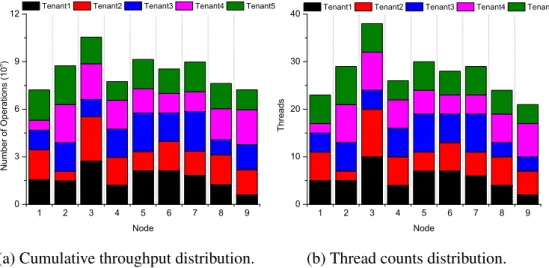
4.3 Distributions of cumulative throughput and thread count over Cassandra nodes. . . 46
4.4 Fair share for read-only workload on data sets with different tenant share configurations. . . 49
4.5 Fair share for read-write workload on data sets with different tenant share configurations. . . 51
4.7 Fair share protects the throughput of the read-only workload from scan
operations. . . 55
5.1 Normalized metrics show interference occurs in different resources. . . 63
5.2 Single resource reservation fails to prevent interference for workloads with different resource demands. . . 65
5.3 Architecture. . . 67
5.4 Throughput varies with different resource reservations. . . 75
5.5 Impacts of #credits on disk reservation. . . 82
5.6 T1’s throughput under different workloads and different number of tenants. 84 5.7 Argus dynamically adjusts its reservations. . . 85
5.8 Overall performance of different workloads. . . 87
5.9 Throughput without planning normalized to throughput with planning. . . . 91
6.1 Lustre Architecture. . . 100
6.2 Read/write performance for different KVS in different setup. . . 101
6.3 KVLight architecture. . . 103
6.4 Design space of KVLight. The arrow points to high performance. . . 104
6.5 The structure supports concurrent write. . . 105
6.6 The aggregated throughput of read decreases as the number of BDBs in-creases. . . 106
6.7 Different key range organizations across BDBs. . . 109
6.8 Tree based compaction design. . . 111
6.9 Compactions run in nodes from different levels of the tree. . . 111
6.11 Aggregated throughput for various workloads on different KVS. . . 118
6.12 Impact of compaction on different workloads in terms of throughput. . . 119
6.13 I/O performance from Iozone. . . 120
6.14 Throughput comparison among different compaction strategies. . . 123
6.15 Speedup tests over various data sizes. Time is reported in log scale. . . 124
List of Tables
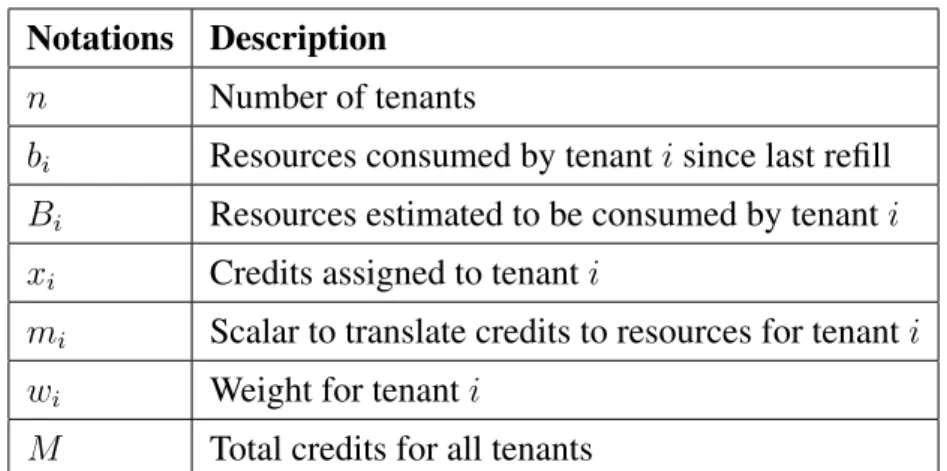
4.1 Notations. . . 40
4.2 Fairness of workloads on across data sets. . . 50
5.1 Workload parameters. . . 61
5.2 Baseline throughput for different workloads. . . 62
5.3 Comparison of different scheduling approaches. . . 71
5.4 Notations. . . 76
5.5 Performance interference compared with vanilla HBase. Values in paren-theses are the performance numbers from vanilla HBase. . . 88
5.6 Evaluate Argus in versatile workloads. Values in parentheses are the per-formance numbers from vanilla HBase. . . 91
5.7 Comparison with A-Cache. Values in parentheses are the performance numbers from A-Cache. . . 92
Chapter 1
Introduction
1.1 Emerging Characteristics for Big Data Storage
Science and business today are facing data sets that are growing dramatically in both com-plexity and volume. In its informal definition, big data consists of large, diverse, and struc-tured or unstrucstruc-tured data. The sheer volume of data increase is predicted to grow expo-nentially by a factor of 300 from 130 exabytes in 2005 to 40,000 exabytes in 2020 [37]. Big data applications, whose data and request go beyond a single node’s capacity, have begun to revolutionize the underlying storage system. In addition, high availability grows increasingly important as businesses rely on online data services. Furthermore, data are in-creasingly dynamically generated, coming from various sources with diverse formats and schemas. All these factors taken together suggest distributed storage and flexible data mod-els are the future.
Experience has shown that traditional systems like the relational databases (RDBM-S) struggle to handle big data applications as they are difficult and expensive to scale across multiple nodes and have I/O performance that does not meet application require-ments [15, 83]. In contrast, NoSQL data store (called Not Only SQL) has emerged as an alternate solution to big data storage. NoSQL store distributes and replicates data across
multiple nodes. Requests are served by every node in a peer-to-peer fashion, not only in-creasing overall storage capacity but also the bandwidth. If a node goes down, other nodes can still serve requests for high availability and minimize data loss. Additionally, NoSQL data stores do not impose a rigid structured schema upon the data, thus providing greater flexibility to store the unstructured data. Because of these attracting features, NoSQL data stores have seen a great deal of uptake in both industry [11, 28, 100] and academia [33, 49]. With the advent of cloud computing, cloud hosted NoSQL stores have grown in use. Users (called tenants) are willing to move their data infrastructures to the cloud [18]. Fol-lowing the spirit of infrastructure-as-a-service, tenants set up NoSQL stores across a set of virtual machines (VMs) that are rented from a cloud provider and billed by a flexi-ble price model, i.e. “pay-as-you-go” model. Additionally, many cloud providers offer database-as-a-service to tenants. Such services ease most of the cluster management bur-dens from tenants. Typical examples include Amazon Dynamo DB [5, 28], Google Cloud Datastore [19] and Microsoft DocumentDB [30].
For economic reasons though, a cloud hosted NoSQL store is usually used by multiple tenants simultaneously. For example, a database-as-a-service instance like Dynamo DB may be shared by different companies (i.e. tenants). Different departments (i.e. tenants) of an organization may be joint tenants of a single NoSQL store. Generally, there are several advantages of adopting multi-tenancy in various storage services [53]. First, multi-tenancy makes management tasks easier. For example, to upgrade the storage service, instead of upgrading multiple service instances, a system admin can update the configurations or code base in a single instance and have the changes immediately available to all tenants. Sec-ond, multi-tenancy can yield better resource utilization as the storage service can support dynamic resource allocation which avoids provisioning each tenant with its maximum
re-sources statically. Finally, data sharing is facilitated by multi-tenancy. For these reasons, support for multi-tenancy in cloud hosted NoSQL data store is an important problem.
1.2 Multi-tenant NoSQL Data Store
A NoSQL data store in a cloud environment can be viewed as having a 2-layer architecture: logical view layer and storage layer. The logical view layer presents to tenants a view of the store and a set of APIs for them to interact with the store. The storage layer represents the underlying infrastructure that physically stores and serves the data.
1.2.1 Logical View Layer
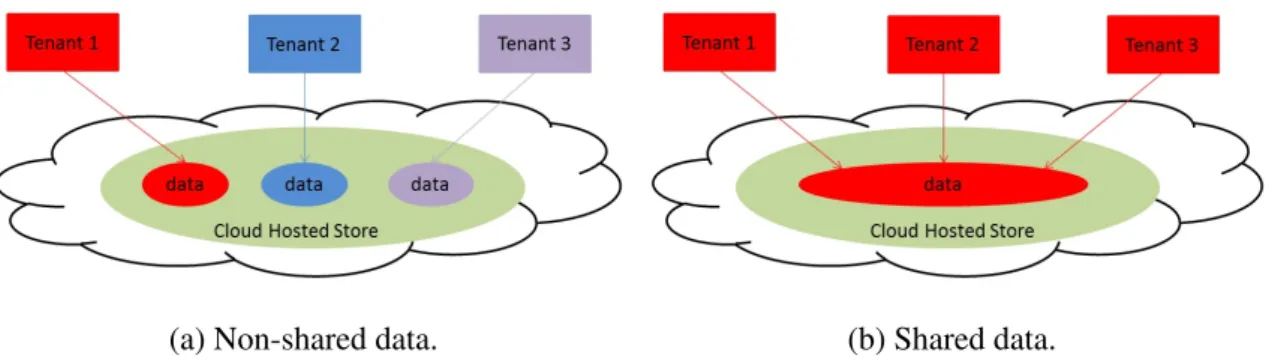
The logical view layer determines how tenants see the data and hides the complexities of underlying infrastructures from them. Each tenant has a dedicated view of the store with non-shared data sets. From a tenant’s point of view, its workload is run against dedicat-ed resources and is not aware of other tenants’ existence. The cloud provider in reality is consolidating each tenant’s data into as small an infrastructure as possible to maximize resource utilization. Tenants’ data and requests end up co-locating with each other in the underlying infrastructure. Performance interference becomes a concern as isolation of cur-rent solutions are flawed.
On the other hand, tenants may share the same data sets in the store. Tenants may be represented by different components in a pipeline that processes the data. For example, the HathiTrust Research Center (HTRC) [49], which serves analytical access to nearly 14 million digitized volumes from the HathiTrust digital library, has an ingest component that loads data from remote rsyncpoints into Cassandra; a data API component used to read
(a) Non-shared data. (b) Shared data.
Figure 1.1: Multi-tenancy in the logical view layer.
Cassandra. All these components can be interpreted as tenants which share the same data set stored in Cassandra to form the data infrastructure of HTRC.
It is important to efficiently support the shared data model in a multi-tenancy cloud setting because of the attractiveness of its pay-as-you-go model and ability to bear elasticity. Chapter 2 further describes the models used in multi-tenancy by most data management systems.
1.2.2 Storage Layer
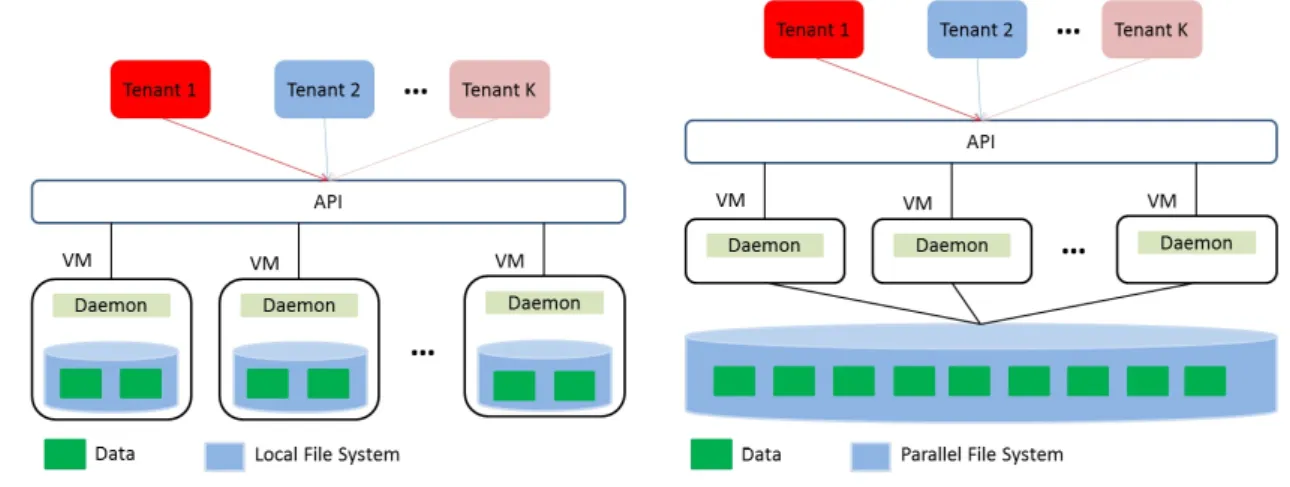
While the logical view layer serves as the front-end to tenants, the storage layer describes the mechanisms for storing data and handling requests. Figure 1.2a shows a NoSQL data store deployed across multiple nodes. Data is stored to the local file system on each node. Because a local file system on a single node may suffer from disk failure and is not scalable, the NoSQL store usually replicates data in a few nodes in the cluster. A persistent daemon service runs on each node in the cluster and communicates with other daemon services to provide a unified view over the local file systems. Various protocols among daemons exist to coordinate daemons’ behaviors to support tasks like data replication, failover and so on.
(a) NoSQL over local file system. (b) NoSQL over parallel file system.
Figure 1.2: Different storage layers for NoSQL data store.
While the local file system has prevailed in the cloud platform for quite some time, the parallel file system (PFS) has begun seeing usage in the cloud in both industry [68] and academia [2, 79]. Originating from the high performance computing (HPC) platform, PFS is a type of clustered file system that partitions data across a dedicated storage node cluster [81]. PFS provides good scalability, high bandwidth access, and failover, all of which are missing in a local file system solution. PFS serves concurrent access from a number of clients and operates over high-speed networks. It can be mounted to multiple nodes and allows files to be accessed using the same interfaces and semantics as local file systems. Behind the scene, PFS transparently hides the complexities of accessing across different storage nodes, data replication, and fail over from end users. Figure 1.2b depicts the scenario of a NoSQL store which is set up over PFS. The daemon service per node gives the illusion that data is stored in local file system while in reality data is transferred to/from
important in the NoSQL storage system.
1.2.3 Layer Mapping
Either of the logical views in Figure 1.1 can be mapped to one of the physical implemen-tations in Figure 1.2. Usually the NoSQL store relies on the local file system to store data. Thus this dissertation studies the performance interference in the multi-tenancy case using a local file system (non-shared data-LFS). The unawareness of the NoSQL store to the fea-tures PFS offers makes it inefficient to run a NoSQL store over PFS today. This dissertation explores the viability of using PFS to support data sharing across tenants in NoSQL data store (shared data-PFS). We leave the investigation of performance interference in NoSQL over PFS for future work.
1.3 Research Problems
The cloud hosted NoSQL data store has seen a great deal of usage because of its scalability and high availability. Because cloud environments encourage sharing, resource sharing and data reuse across tenants is a growing use case. Multi-tenancy in such a shared environment imposes significant performance challenges on the use of NoSQL store, however. The following are the problems addressed in this dissertation.
• Performance interference prevention across tenants in the non-shared data-LFS case • Cost Effective multi-tenant access in the shared data-PFS case
1.3.1 Performance Interference Prevention
Tenant data and requests may be consolidated in a single multi-tenant NoSQL store. Due to the co-location, there will be performance interference among tenants caused by resource
contention. Interference prevention can be realized from the client perspective when a service level agreement (SLA) is enforced, or can be realized at the server side when fair share is enforced across tenants. This dissertation focuses on providing a non-client centric solution to enforce fair share on the server side. A misbehaved tenant may consume a well-behaved tenant’s resources by its workloads, thus degrading the latter’s performance. This interference behavior in the multi-tenancy setting is undesirable. The resource reservation approach in Chapter 5 can potentially be used to enforce SLA for each tenant. We leave the SLA enforcement for future work.
Real world scenarios provide evidence of performance interference. Although Amazon DynamoDB imposes a throughput limit to tenants to prevent the store deing dominated by a few tenants [5], it does not guarantee throughput provision, nor provides fair share among tenants [31, 95]. People from BloomReach Inc. report back-end workloads have a negative impact on front-end workloads’ performance in the same Cassandra cluster [10]. They also report that back-end workloads from different teams (i.e. tenants) may interfere with each other as well [10]. It is straightforward to address the interference issue by running different tenants’ workloads on separate infrastructures, which is the approach BloomReach has taken [10]. Dedicated hardware provides strong isolation but lowers resource utilization and thus increases cost. Effort is occurring in open source NoSQL projects e.g. Cassandra [14] and HBase [1], the base of the prototyped systems in this dissertation, to support multi-tenancy [13, 44]. However, both are still a work-in-progress. Current effort simply schedules requests for tenants in a round robin fashion in Cassandra (the tenant-oriented request scheduling is planned but not implemented yet in HBase) and does not attempt to identify the resource demands of tenants. There is no known performance modeling in the multi-tenant setting. In addition, many of the multi-tenancy features only became
available recently and some of them are not merged to the trunk [43] as of the writing of this dissertation.
1.3.2 Cost Effective Multi-tenant Access
Running a distributed NoSQL store over PFS may introduce overheads owning to the un-awareness of the former to the PFS. For example, data may be unnecessarily replicated; extra network trips may be needed to access the PFS because the daemon service delegates all the requests to the back-end file system; and additional overhead may also arise from the data replication and failover protocols, which are unnecessary in the presence of PFS. In addition, the store provider may hold the resources (e.g. VM) even if no request comes, which is not cost effective. That is because if the VMs are shutdown or repurposed, the data stored in the VM’s is not accessible anymore. Recently, Greenberg et al. point out the burden and inefficiency of running persistent daemon services for a key-value store in the HPC environment [40]. We envision PFS will be widely used in the cloud and thus there will be a pressing need to accommodate the features it provides to NoSQL data store.
1.4 Contributions
This dissertation proposes several approaches to address the multi-tenancy issues discussed in Section 1.3 for the shared and non-shared settings in Figure 1.1. They are discussed here:
Non-shared data-LFS setting I investigate the performance interference in the setting of
local file system for storage and no data sharing. An experimental study carried out on Cas-sandra, a state-of-the-art NoSQL store, shows that a tenant will experience unpredictable performance in terms of throughput when multiple tenants access the store independently.
Chapter 4 proposes a throughput regulation framework that targets system-wide fairness. Specifically, we adapt and extend the deficit round robin algorithm [71] with linear pro-gramming as the scheduler to regulate throughput. The solution adaptively changes the scheduling parameters to achieve system-wide fairness. It also protects the throughput of reads in face of scans by splitting a scan operation into small pieces and scheduling them along with reads.
Throughput regulation can be viewed as a form of resource reservation because through-put represents the underlying resource consumption. It assumes every byte delivered to or from the store consumes the same amount of resources. Such an assumption is also used by [95, 106]. But this assumption does not always hold, especially for workloads having different access patterns and demanding different resources. A workload with a hotspot access pattern may require more cache than a workload with a random access pattern. An equal reservation of cache and disk usage for all tenants may not yield the best result or even fail to provide performance isolation. Chapter 5 models the impact of various resource demands and proposes a resource reservation framework in HBase to enforce the perfor-mance isolation among tenants. The reservation is also elastic in the sense that if a tenant does not use up its reservation, the system is able to reallocate its redundant reservation to tenants in need. Chapter 5 experimentally evaluates different fair sharing algorithms and tries to quantify the trade-offs between fairness and efficiency. It also quantifies the overhead introduced by the isolation mechanisms as too much overhead can undermine the benefit of fairness.
Shared data-PFS setting I explore the feasibility of using PFS for NoSQL data store in
form of NoSQL data store, that makes use of PFS as the back-end storage and does not require daemon services running in front. Such a feature allows the KVS to be accessed on demand and avoids holding resources when no tenant makes requests. A VM hosting a tenant can be revoked or repurposed once the tenant has completed sending requests. In addition, the responsibility of data reliability is shifted to PFS. The KVS only cares about data organization and serving request which is more lightweight than a traditional KVS. Internally, the proposed KVS is built on an embedded KVS, i.e. Berkeley DB [75], to en-able direct file system access for high performance and support the no persistent daemon service feature. Embedded KVS solutions, including Berkeley DB, do not support concur-rent writes due to file system locking. The proposed KVS follows the spirit of log structure merge tree [76] to organize the data in PFS to support concurrent writes in a distributed environment. To remedy the read deterioration caused by writes, it uses a novel tree-based structure and parallel compaction to efficiently support concurrent reads.
1.5 Dissertation Outline
The remainder of this dissertation is as follows. Chapter 2 presents the background infor-mation about multi-tenancy model and NoSQL data store. Chapter 3 summaries related work. Chapter 4 investigates the performance interference and proposes a throughput reg-ulation mechanism targeting system-wide fairness. Chapter 5 further studies the perfor-mance interference based on the results from Chapter 4, and describes a workload-aware resource reservation mechanism for performance isolation. Chapter 6 focuses on building a lightweight key-value store, which is called KVLight, over a parallel file system with novel data structures. Chapter 7 concludes with future work.
Chapter 2
Background
Supporting multi-tenancy is important in a storage service like a NoSQL data store. We first present the background of multi-tenancy including its definition and different models. A cloud hosted NoSQL data store usually runs as middleware between user applications and file systems. It consists of a set of service processes running over a raw file system and provides richer data management features than a regular file system. There are many NoSQL systems nowadays with different APIs, data models, and architectures. Thus we present an overview of NoSQL data store from several perspectives including architecture, data distribution, data replication, and resource management, with a focus on three popular NoSQL systems, i.e. Cassandra, HBase, and Berkeley DB [8, 75], which our prototyped systems are based on.
2.1 Multi-tenancy Model
Multi-tenancy, in its most basic definition, refers to an architecture in which a single soft-ware instance serves multiple users, customers, or tenants [70]. Multi-tenancy can be found in several different places: network multiplexing [58], virtual machine management [92], file system sharing [104], job runtime framework [54], data management system [53] and
so on. This dissertation focuses on multi-tenancy in the data management system, particu-larly NoSQL data store.
Generally, in a data management system, the multi-tenancy can be supported in three different models: shared machine, shared table, and shared process [53]. Each has different advantages and disadvantages, shown in Figure 2.1. In the shared machine model, virtu-alization technologies like virtual machines are used to host different tenants in a shared machine. It provides the strongest isolation among tenants as tenants are separated by d-ifferent VMs. On the contrary, the shared table model, which allows dd-ifferent tenants to share the same table, provides the weakest isolation. Data from different tenants are mixed together in the same place, as are the requests.
Figure 2.1: Different multi-tenancy models on storage services.
From the system utilization perspective, the shared machine model sacrifices the most because each tenant is allocated with a VM which holds up some portion of dedicated system resources. The shared table model, however, achieves the highest utilization by aggregating tenant data into a single location and serving without dedicated resources.
The shared process model stays in the middle of aforementioned two models from both the isolation and resource utilization perspective. In the shared process model, each tenant
has its own table and enjoys a dedicated view of the storage. Under the hood, the storage service is shared by multiple tenants. Tenants have to share the memory, CPU, I/O, network bandwidth and all other resources allocated to the particular storage service process. Com-pared with the shared machine model and the shared table model, the shared process model trades a little bit of tenant isolation for better performance and scale. On one hand, it solely relies on throttling and reservation to isolate resource usage across tenants within the same process, which may not be as strong as the shared machine model. On the other hand, it improves resource utilization in the sense that resources may be reused by different tenants and reallocated among tenants. For instance, if a tenant does not use up the memory given, the management system may reallocate the memory to other tenants in need. The shared process model is also superior to the shared table model in terms of flexibility because the shared table model has to provide a unified schema to store data from all different tenants with different formats, which is very difficult and inflexible.
Most research work about interference prevention target the shared process model in regard to provide isolation across tenants because of the advantages mentioned above [24, 84,104,106,113,115]. Similarly, in this dissertation, we focus on the shared process model for isolation among independent tenants. For tenant consolidation over a shared data set, we use the shared table model as tenants expect to see the same table structure and data in this case.
2.2 Overview of NoSQL Data Store
To deal with the rapid growth of data, NoSQL data stores are designed as modern web-scale databases in mind and the characteristics of schema-free data model, easy replication
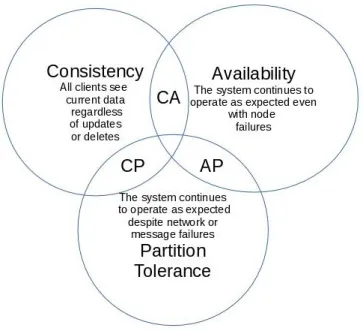
CAP-theorem [39], conflicts arise among different aspects of a distributed system in terms of three factors: consistency, availability and partition-tolerance. The relationship between factors is shown in Figure 2.2.
Figure 2.2: Characteristics of NoSQL store. Source: http://blog.nosqltips.com/ 2011/04/cap-diagram-for-distribution.html
The CAP-theorem postulates that only two of the three factors can be achieved at the same time. For the traditional SQL database, which stresses the ACID properties (Atomic, Consistency, Isolation, and Durability) [39], partition-tolerance or availability is usually sacrificed to honor the consistency. However, for NoSQL data store, because it is designed to be distributed in nature, availability and partition tolerance become critical. Thus most of NoSQL data stores trade in consistency with availability and partition-tolerance. This results in the BASE properties (Basically Available, Soft-state, Eventually consistent) [39]. Next, we investigate NoSQL stores in terms of four aspects: architecture, data
distribu-tion, data replication and consistency, and resource management.
2.2.1 Architecture
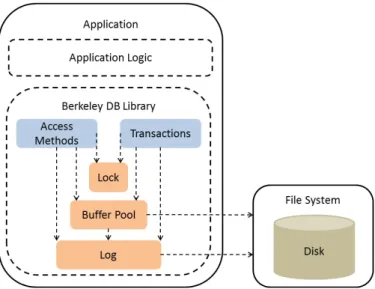
Generally speaking, a NoSQL store can fall in one of the two categories: single node ori-ented and multi-node oriori-ented. Single node oriori-ented NoSQL store is designed to work in a single node environment and usually implemented as a library embedded into the appli-cation. Unlike multi-node NoSQL stores, which have persistent running daemon services delegate the access to file system through network, single node NoSQL store allows ap-plications to access the file system directly and read or write data without going through a network. In addition, no persistent daemon service is required. Thus it is lighter-weight and performs better than multi-node NoSQL store. Examples include Berkeley DB (BDB) [75] and Level DB [62]. Figure 2.3 displays the architecture in BDB. BDB embeds as a library to an application. It provides a set of APIs for applications to access the data store and carry out transactions. Lock, buffer pool and log are the three main components in BDB. They all run in an application process space. BDB interacts with the file system to store data through standard file system APIs.
However, single node NoSQL store suffers from data loss and is not scalable because all its data is stored in the file system local to the node. Besides, it only allows exclusive writes due to file system locking. Applications in different processes have to take turns to write to the store. In contrast, multi-node NoSQL store (or distributed NoSQL) is designed to work across multiple nodes or even multiple data centers. It partitions and distributes data across nodes with replications, and provides not only reliable data storage but also scalable access as requests are distributed in the cluster. Examples of multi-node NoSQL include HBase, Cassandra, and CouchDB [21].
Figure 2.3: The architecture of Berkeley DB, a single node NoSQL data store.
Most of the distributed NoSQL stores draw heavily from either the master-slave archi-tecture or the peer-to-peer archiarchi-tecture, shown in Figure 2.4. The master-slave archiarchi-tecture is used in Google BigTable [16], and its open source implementations e.g. HBase, Hy-perTable [50]. The master is responsible for bookkeeping metadata, request routing and coordinating among slaves while the slave is responsible for carrying out the actual work-load and responding to clients directly. The peer-to-peer architecture used by Amazon Dynamo [28] treats each node as an equal peer. There is no central control point in such architecture and thus it can avoid single point of failure. Nodes usually communicate and propagate messages through a gossip protocol. However, due to the peer-to-peer character-istic, it is usually hard to coordinate activities among nodes. Cassandra is an open source implementation of Dynamo. Voldemort and Riak [86] are also heavily influenced by Dy-namo’s design.
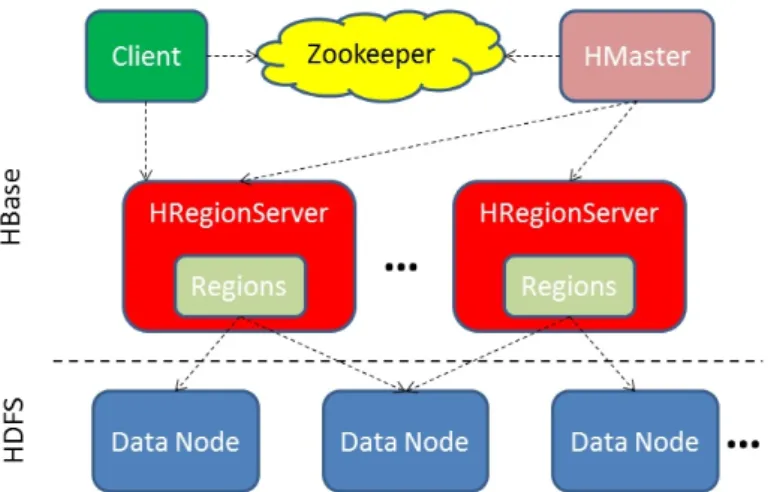
(a) The master-slave architecture of HBase. TheHMastermonitors and
coordi-nate differentHRegionServers, which responde to client for read/write requests
directly.
(b) The peer-to-peer architecture of Cassandra. There is no central control point int the system. A client can connect to any node in the cluster. The connected node serves as a coordinator that forwards the request to the nodes hosting the replicas.
of the aforementioned advantages. The main use of single node NoSQL is to serve as a building block for a larger system. For example, Berkeley DB is used as the back-end store in each individual node in Voldemort [100] and Riak [86]. Berkeley DB also sees usage in many other systems [6].
2.2.2 Data Distribution
The data distribution scheme describes how data is organized in the underlying file system and distributed across nodes. It determines the way data access works. Different distri-bution schemes may be suited to different data access patterns. Generally, there are two main distribution approaches for most of the systems: key-range based distribution and hash based distribution. The key-range based distribution has the entire data set sorted ac-cording to the order of the key and divides the data set into non-overlapped partitions. A partition represents a range of keys between a minimum key value and a maximum key value. Keys falling within that range go to the corresponding partition. Because keys are sorted, scan queries can be answered very easily and quickly. HBase uses the key-range based distribution to distribute data. Figure 2.5 shows a distribution scenario. In HBase, data is stored in a table as rows and sorted by the keyi.e. the row key. As the data grows, the table will be split into several pieces calledRegions. HBase sysadmin can specify what the splitting policy may be for the store. After the splitting, each region consists of a bunch of sorted rows and is the basic unit of data distribution. Regions are distributed across Re-gionServers running in each node in the cluster. The HMaster holds a request routing table which describes the mapping between a key to a region and its server. The client interacts with the HMaster first to figure out which RegionServers to connect for its key requests. Then the client communicates to the RegionServers directly for data access. Although
H-Base can support efficient scan operations, it may suffer from load imbalance situation as some key ranges may be accessed more frequently than other key ranges.
Figure 2.5: Key-range based data distribution in HBase.
The hash based distribution uses a hash function to randomly hash keys to different servers. The randomness may avoid the load imbalance occurring in key-range distribution. In practice, consistent hashing is usually preferred because it makes adding and removing machines in the system easy [56]. Specifically, the output values of the hash function form a ring. The same hash function is applied to all data and mapped to positions in the ring. Each individual node in the cluster maps itself to a position in the ring as well and has knowledge about other nodes’ positions. A node is responsible for storing all the keys that fall in the range between this node and its predecessor node. A client can send requests to any of the nodes. A node receiving a request acts as a coordinator that either reads or writes data to its local storage, or forwards the request to another proper node based on the output value of the hash function. To deal with various node capacities and data skew, a node may be mapped to multiple positions in the ring to take more data if it has a larger capacity or further randomize the mapping in the case of data skew. Figure 2.6 shows an example of 4
of keys. Although hash based distribution can avoid load imbalance, it makes serving scan operation very difficult as data is not sorted in the backend.
Figure 2.6: The principal of consistent hashing. It is used widely in the peer-to-peer archi-tecturee.g. Dynamo, Cassandra, Riak, and so on. Source: http://www.paperplanes. de/2011/12/9/the-magic-of-consistent-hashing.html
Cassandra by default uses consistent hashing to partition the data. It uses a MD5 hash-ing algorithm to hash the row key to a big integer. The output of MD5 is guaranteed to follow balanced distribution even if the input keys do not show an even distribution. It fol-lows the steps described above to handle requests. Voldemort and Riak also use consistent hashing to distribute data and follow similar request handling steps.
Finally, Berkeley DB supports both the key-range based (in the form of a B-Tree [75]) and the hash based data organization. But it does not distribute data across nodes as it is a single node oriented NoSQL data store. It simply stores data into different files.
2.2.3 Data Replication and Consistency
Distributed NoSQL data store usually replicates data to provide highly reliable and con-current data access. Different replication policies may be applied and lead to different consistency levels. Notice that Berkeley DB is not concerned with data replication and consistency as it only stores data locally.
HBase’s replication policy and consistency inherit from the Hadoop Distributed File System (HDFS) which is the underlying storage for HBase. HDFS replicates a block, its basic data unit, into two other nodes in the cluster by default. If one of the three nodes is down, the other replicas can still serve the requests. HDFS maintains strong consistency for the data access. A write to HDFS returns only when all the replicas are written successfully. Thus any reads after the write can get the latest value. To update a record, the new value will be appended to the write-ahead log file stored in HDFS and saved in theMemStore(an in-memory structure). Reads which follow can query theMemStoreto get the latest value.
In contrast to HBase’s rigid and singular model of replication and consistency, Cassan-dra, the representative of a peer-to-peer system, has a flexible scheme. Similar to HBase, it replicates a piece of data to two other nodes. Cassandra allows applications to pick repli-cation policies such as “Rack Unaware” which randomly places the replicas in the cluster, “Rack Aware” which tries to place replicas in different racks in the same data center and “Datacenter Aware” which intends to place replicas in different data centers for greater reli-ability. Cassandra by default follows eventual consistency but allows different consistency levels to exist in the system. It uses the quorum to manage the replicas. The application can specify the condition of a successful operation as the number of replicas responds. For example, a quorum with value “ONE” can have a write return when only one replica is
requires a read to return only when all the replicas respond.
2.2.4 Resource Management
NoSQL data store usually has multiple resources involved to serve requests. For example, CPU for serialization and de-serialization, memory for caching and buffering, disk for reading and writing, network for transferring, and etc. Configuration about how resources are allocated plays an important role in performance in some cases.
Single node NoSQL functions as an embedded library and manages the memory as well as disk usage all by itself. Berkeley DB manages the memory used for reads caching and writes buffering. It also controls the way to generate the data files on disk, e.g. how big a file is, when to flush a file, and etc.
Compared with the monotonic resource management of single node NoSQL, distributed NoSQL store usually separates the management into layers. In HBase, HDFS stores data and manages the disk resource, while the HBase daemon service controls the CPU, cache and network resources. In Cassandra, theRPClayer controls the request scheduling while theStorageProxylayer takes care of the actual reading and writing.
Chapter 3
Related Work
Multi-tenancy hosting of users in cloud NoSQL data stores is favored by cloud providers because it enables resource sharing at lower operating cost. As discussed in Chapter 2, the models of multi-tenancy can be realized in three different abstractions: shared machine, shared table and shared process [53]. Xiong et al. [110] allow tenants to set up database instances within VMs that share a single host. The usage of VM by tenants uses the shared machine model where tenants share the same set of hosts. Salesforce.com [109], provided as software-as-a-service (SaaS), uses the shared table model where different tenants share the same set of database tables. Amazon EC2 [32] provides infrastructure-as-a-service (IaaS) by allowing tenants to create virtual machines (VM) in shared hosts. Amazon Dy-namoDB service [5] and Relational Cloud [23] expose themselves as platform-as-a-service (PaaS), and follow the shared process model where tenants share the same data store pro-cess. Next, we discuss the multi-tenancy in the shared service case and the shared data case.
3.1 Storage Service Sharing
The shared process model is usually preferred to serve tenants with non-shared data [53], because it provides reasonable isolation without imposing too much overhead as discussed in Section 2.1. Therefore, a majority of work [24, 72, 84, 95, 104, 106] about storage service sharing targets the shared process model. This section first summarizes multi-tenancy sup-port in different storage services classified as file system, relational database and NoSQL store. Then it surveys the literature of resource scheduling approaches used for perfor-mance isolation.
3.1.1 Storage Services
File system Wachs et al. use a time-quanta-based disk scheduling approach with cache
space partitioning for performance insulation among applications running on a single file server [104]. We adopt the idea of partitioning cache and disk for tenants but coordinate the partitioning over these two resources through a constraint optimization model rather than treating the resource independently. In addition, we focus on a distributed store which is more complicated than a single node server. Due to the complexity, the underlying storage system is sometimes treated as a black box as responses coming out from it vary in several aspects e.g. latency, size, etc. Gulati et al. use a feedback-based approach on a black-box storage system to dynamically adjust the number of IOs issued to the storage system with observed latency as feedback [41]. We employ the idea of feedback-based scheduling, but model all the tenant behaviors in a unified constraint optimization problem and globally adjust the scheduling parameters instead of having separate adjustments per tenant.
Relational Database Narasayya et al. propose an abstract of resource reservation called SQLVM on resources such as CPU, I/O and memory for tenant performance isolation and focus on I/O scheduling [72]. Das et al. present a CPU scheduling approach in SQLVM to reserve CPU usage for CPU interference prevention [24]. While our approach uses re-source reservation as well, we target multiple rere-sources as a whole instead of treating them individually, because various resources may not be entirely independent. With regard to multiple resources, Soundararajan et al. propose a multi-resource allocator to dynamically partition the database’s cache and its storage bandwidth so as to minimize request latency for all the tenants [97]. However, different from [97], we intend to provide fairness across tenants. Additionally, we attempt the partitioning in a distributed NoSQL store with hi-erarchical architecture instead of a monolithic RDBMS. Walraven et al. utilize a central scheduler to dispatch requests to different back-end RDBMS in a multi-tier web applica-tion [105]. Our work relies on each node to enforce the resource reservaapplica-tion instead of a central scheduler.
NoSQL Data Store Pisces [95] uses partition placement, replica selection, and fair
queu-ing to provide multi-tenant fair share in terms of throughput in Membase, a memory-based NoSQL store with hash partitioning. Like Pisces, our work also targets system-wide fair share. In addition, we also adapt the deficit round robin algorithm [93] for scheduling. Unlike Pisces, our target storage abstraction has disk, memory and network resources in-volved, and is much more complicated than the memory-based store Pisces uses. Also unlike Pisces, our approach distinguishes different resource demands from different work-loads. Besides, our approach does not assume a static load distribution. It can dynamically adjust tenant weights to achieve system-wide fairness. A-Cache [84] divides the block
cache space in HBase and limits a tenant’s cache activities within the cache space it is assigned to resolve the cache interference among tenants. Our experiments show that the cache partition by itself does not resolve interference in some cases.
The open source community has made efforts on supporting performance isolation for multi-tenancy in HBase and Cassandra [13, 44], although in a limited way. In HBase, to prevent a tenant from taking over the entire store, quota management is used [44]. It enforces the maximum number of tables and the maximum number of regions a namespace i.e. a tenant can create in the store. Furthermore, to prevent the interference caused by data and request co-location, HBase uses the concept of region server grouping [43]. It instructs the load balancer to assign regions such that a region server only serves a particular set of regions from a particular set of tenants. Despite the significant amount of efforts on supporting multi-tenancy in HBase, it is still a work-in-progress. Many of the multi-tenancy features only became available recently and some of them are not merged to the trunk yet [43]. In addition, the current multi-tenancy support does not consider resource utilization of workloads and uses a static way to dispatch data and requests e.g. the region server grouping approach. As our experiments show in chapter 5, ignoring resource demands from workloads may lead to low utilization or even failure of isolation. Our work in HBase can shed some light of the future development of multi-tenancy support.
Compared with HBase, the support of multi-tenancy in Cassandra is lessened [13]. Cas-sandra uses a simple weighted round robin algorithm to schedule requests from different tenants. Such a scheduler fails to prevent the domination because it keeps looking for pend-ing requests. An ill-behaved tenant can use a large number of threads to send requests and take up most of the scheduling chances easily. Thus multi-tenancy support in Cassandra is an on-going effort – there are still many open tickets [13]. Our work in chapter 4
extend-s Caextend-sextend-sandra in termextend-s of multi-tenancy extend-support in a extend-scheduling approach with a feedback control loop and some adaptive control mechanisms.
3.1.2 Resource Scheduling
Resource scheduling can regulate the resource usage to avoid domination i.e. some tenants dominate the use of resources. These kinds of resources include CPU, cache, disk, network bandwidth, etc. We use resource scheduling in this dissertation to enforce fair share. We adapt the deficit round robin algorithm [93] because of its simplicity and effectiveness. However, we present related work of resource scheduling as some of it could strengthen the results in future work. We first present the general scheduling algorithms classified as the virtual-time-based approach and the quanta-based approach. Then we discuss the usage of scheduling algorithms in two typical scenarios: reservation and proportional share. Most work on resource scheduling focus on either enforcing resource reservation [24, 42, 84], or providing proportional share [17, 41, 95, 104].
Scheduling Algorithms Generalized processor sharing (GPS) is an idealized scheduler
and achieves perfect fairness with the assumption that tenants’ traffic is fluid [80]. Howev-er, in real world scenarios, resource schedulers can only approximate the behavior of GPS due to the discretionary nature of computer [80]. There are two categories of approxima-tion: based approximation and quanta-based approximation. The virtual-time-based approximation estimates a request’s start time and finish time as virtual time, and uses them as scheduling criterions. Fair queuing scheduler (FQ) assumes request time is linear to the size of data delivered [29]. Weighted fair queuing scheduler (WFQ) extends FQ by considering weights in the estimation of finish time [80]. Both FQ and WFQ pick
a task with the smallest finish time as the next task to run. [102] presents a comparison of different fair queuing algorithms. The quanta based approximation does round robin scheduling to schedule tasks according to the resource quanta allocated. Weighted round robin (WRR) scheduler allocates quanta based on tenant weights. It works for fixed size tasks but struggles with variable size tasks because it requires an estimation of mean task size [57]. Deficit round robin (DRR) is a variation of WRR in the sense that it approximates GPS without knowing the mean size of tasks [93]. In each scheduling round, DRR sched-ules tasks according to a tenant’s quanta. Remaining quanta will be accumulated to the next scheduling round. Due to its simplicity and low time complexity as shown in [24, 95], we use DRR in our resource scheduling. We also empirically compare DRR with WFQ, a virtual-time-based scheduler, in Chapter 5.
Reservation mClock uses reservation and limitation to mitigate I/O interference across
VMs running on the same hypervisor [42]. Its virtual-time-based scheduling approach statically allocates I/O resources, which may cause the storage capacity to be under utilized. In contrast, our reservation is elastic and adaptively changes according to workloads. A-Cache reserves the block cache space for tenants to protect hotspot oriented workload [84]. Our experiments show that our framework proposed is able to resolve interference in some cases where A-Cache fails because it only considers block cache. Das et al. calculate the deficit of CPU reservation and propose a variant of deficit round robin algorithm (DRR) [93] for elastic CPU reservation [24]. However, the elastic approach simply boosts the reservation to a fixed percentage and is not flexible enough for workloads with dynamic resource demands. Our elastic approach adjusts the reservation proportionally according to the actual throughput a tenant yields, and is able to reallocate resources when a tenant’s
workload changes its resource demands. SQLVM reserves IOPS (IO operations/second) for each tenant [72]. It employs the virtual-time-based scheduling approach in [42] and translates the IOPS to a deadline for each tenant to guide the scheduling. Narasayya et al. study a page replacement algorithm for fair sharing the buffer pool memory in a RDBMS [73]. The deadline oriented approach and memory sharing technique can potentially be used in our framework to enforce service-level objectives specified by tenants.
Proportional Share Pisces [95] adapts the deficit round robin algorithm [93] for
through-put regulation and intends to achieve Dominant Resource Fairness (DRF) [38]. We argue that the physical resources reflected from bytes read and bytes written are not independent and violate a fundamental assumption of DRF. Unlike Pisces, our approach asynchronously updates tenant credit account per request instead of synchronously because the disk-based NoSQL store may have a longer delay than a memory-based store Pisces uses. Wachs et al. use a time-quanta-based scheduling for fair sharing the disk [104]. A tenant withholds the disk until the given time expires even though the tenant may not fully use the disk at that time frame, which leads to low disk utilization. Gulati et al. use the FAST-TCP algorithm to detect congestion and provide fair share on a black box storage system [41]. Our frame-work in HBase could adapt this approach in the HDFS scheduling level. Our schedulers use credits to represent the chances of scheduling. The virtualization hypervisor Xen [17] also uses the notion of credit to schedule VCPU, a virtual CPU mapped to a physical core. However, unlike our schedulers where credits are only an approximation of the requests’ resource consumption, the CPU usage of a VCPU is represented by the credits in the Xen scheduler directly. Additionally, a VCPU can yield its usage of the host CPU due to I/O blocking. A request in DRR cannot yield itself once it is scheduled.
3.2 Data Sharing
This dissertation targets the key-value store (KVS), a specific form of NoSQL data store, in the shared data case. KVLight, the proposed system, uses the shared table model for multi-tenancy, which is the most efficient way of sharing data with the same format among tenants as discussed above.
3.2.1 File System and Key-Value Store
There have been efforts on integrating parallel file system (PFS) in the cloud [2, 52, 68, 79]. We focus on building a storage layer over parallel file system to better utilize its features. Yin et al. compare the performance between a parallel file system and a KVS in terms of throughput [111]. Ren et al. propose a file system that utilizes an embedded KVS to manage the file system metadata [85]. KVLight is a KVS that is built on top of a PFS and realizes its data reliability and high scalability features.
3.2.2 Key-Value Store As A Library
Single node KVS (S-KVS) usually embeds itself as a library to the application for high performance access in a single node environment. Berkeley DB uses B-Tree or Hash to organize the key-value pairs [75], while LevelDB stores data in files in a logical tree level [62]. RocksDB [87] extends LevelDB in terms of multi-cores utilization, multi-threaded compaction, and so on. Systems like NVMKV [69], FlushStore [26] focus on building S-KVS over flash storage with suitable data structures. KVLight extends the usability of S-KVS for concurrent writes in a distributed environment where traditional S-KVS does not support.
A distributed KVS over multiple nodes (M-KVS) is usually adopted in real world s-cenarios to handle concurrent access. Several M-KVSs use S-KVS as the building block because it is lightweight and has high performance. Both Dynamo [28] and Voldemor-t [100] use Berkeley DB as Voldemor-their defaulVoldemor-t back-end sVoldemor-torage. Riak builds iVoldemor-ts own S-KVS called Bitcask [9] but allows LevelDB as one of its back-end options [86]. Most M-KVS require persistent running servers and assume the underlying file system is not reliable. KV-Light is designed to support concurrent access workloads but can be accessed on-demand without persistently running servers. MDHIM [40] is a recently developed KVS that also provides on-demand access without running persistent servers in a distributed environment through MPI and a S-KVS i.e. LevelDB. However, unlike MDHIM, KVLight does not require applications to run a MPI cluster with fixed number of processes due to the static data partition.
The idea of running a storage system as a library or “serverless” system is also employed in file systems. PLFS is a library file system which optimizes an application’s data layout for the underlying file system [7]. DeltaFS embeds the file system metadata server as a library in an application to remove the centralized metadata server bottleneck [120]. They are both orthogonal and complementary to KVLight.
3.2.3 Compaction Management
Most KVS achieve high write throughput through log-based write. The proposed KVS in chapter 6 also follows the same spirit. Updates are appended to log files rather than applied in-place. As a result, a read has to consult several files generated by writes to get the data. A background procedure called compaction runs periodically to remedy the read deterioration caused by writes [3, 45, 46]. BigTable’s compaction merges a fixed number of
data files whose sizes are the smallest into one single file [16]. Cassandra and HBase also adopt such an approach. This can reduce the number of files a read request needs to consult. Although the number of data files decreases, a read request may still have to linearly scan several data files because the key range of each file overlaps with others. LevelDB uses a level compaction to compact files level by level [63]. It divides the key space into disjoint key ranges in separate files. Files in the same level will have disjoint key ranges. In a compaction, a file in level-L and files in level-(L+1) with overlapped keys are merged into a new file in level-(L+1). Therefore, a read request can be answered without linear scanning multiple files. The disjoint partitioning is not directly applicable in our system because we need to accommodate concurrent writes from different processes. Instead, we propose a tree-based compaction strategy to approximate the level compaction. Additionally, we also allow several compactions to run in parallel to speed up the entire remedy process. This is similar to the multi-threaded compaction in RocksDB [87] which only applies in S-KVS. Ahmad et al. propose a compaction management framework that offloads the compaction on a dedicated server to lower the impact on actual workloads and uses a cache pre-fetching scheme to avoid the performance penalty from offloading [3]. We adopt the offloading idea and leave the cache usage in future work.
Chapter 4
Multi-Tenant Fair Share in NoSQL Stores
As discussed in Section 1, often for economic reasons, a NoSQL data store will be shared by multiple tenants. The independent tenants may be from a single organization or from different organizations. Tenant workloads operate on disjoint data sets and a tenant should not see the impact of the workloads of other users. In a cloud environment, tenants often want to treat the entire storage system as a black box that can scale on demand, while in reality their data sets are usually co-located and cause resource contentions [95]. Thus a critical goal of multi-tenancy is fair sharing across tenants. In a fair-shared system, fairness is achieved in the sense that a tenant gets her share of the system no matter what other tenants do, i.e., a well-behaved tenant should not experience any impact from misbehaved tenants. Fair share is also the foundation of providing different service level agreements to different tenants. Especially in a cloud environment, some tenants are willing to pay more for a larger share of system resources.
Fair share can be realized at two different levels: 1) at the infrastructure level where fairness is guaranteed by directly scheduling physical resources (disk, CPU, network, etc.) or 2) at the application level where fairness is guaranteed by application level scheduling e.g., Hadoop fair scheduler [35] schedules based on task slots and Moab scheduler [98]
schedules based on compute nodes. For traditional storage systems, fair share is usually provided at the infrastructure level and involves a single physical resource on a single ma-chine [97],e.g., disk bandwidth, CPU, network bandwidth, etc. Ensuring fair sharing in a distributed NoSQL data store is more challenging because NoSQL data stores engage mul-tiple types of resources: cache memory, CPU, disk. It is difficult to maintain a scheduler and queues for each type of physical resource because these schedulers need to cooperate to serve requests. In addition, the use of a coordinator node in Dynamo style NoSQL stores, e.g., Cassandra, involves multiple nodes to handle one request. The coordinator node takes requests and forwards the requests to the nodes where the data is located. Such features require the fair scheduling algorithms to coordinate among nodes. Therefore, our proposed scheduling approach for ensuring fair share in a multi-tenancy NoSQL store is done at the application level.
In this chapter, we propose a novel approach to provide fair share across multiple tenants for NoSQL data stores, especially for Cassandra [14,60]. The approach is designed to work in a distributed manner – cooperation among nodes is taken into account to provide system-wide fairness (global fairness) instead of single node fairness (local fairness). Furthermore, the system provides fair share for read operations by preventing the head-of-line blocking impact of scan operations. In summary, this chapter makes the following contributions:
• A framework that employs a feedback control loop to monitor and schedule requests; • A scheduler based on the adaption and extension of deficit round robin algorithm [71]
with linear programming;
• Adaptive control approaches to provide global fairness instead of local fairness and protect reads from scans;
4.1 Fairness Experiments in Cassandra 50 100 150 200 4000 8000 12000 16000 20000 24000 T h r o u g h p u t ( o p / s ) T ime (seconds) 50 r 50 r 50 r 50 r 50 r (a) 50 100 150 200 6000 12000 18000 24000 30000 36000 42000 T h r o u g h p u t ( o p / s ) T ime (seconds) 50 r 50 r 100 r 200 r 300 r (b) 50 100 150 200 8000 12000 16000 20000 R e a d T h r o u g h p u t ( o p / s ) T ime (seconds) 50 r 50 r 50 r 0 100 200 300 400 50 s 50 s S c a n T h r o u g h p u t ( o p / s ) (c)
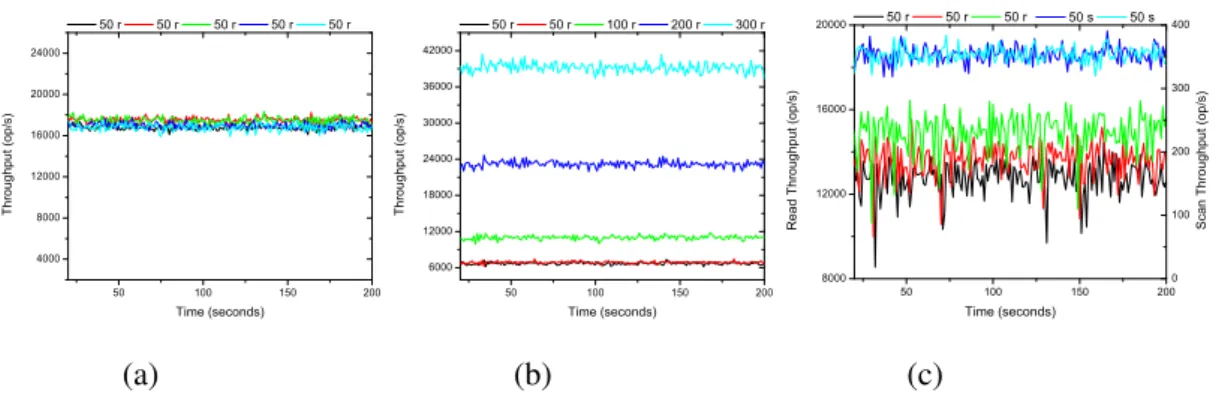
Figure 4.1: Throughputs of different workloads in a shared Cassandra. Each tenant’s throughput is represented by a line of a different color. The legend shows the number of threads a tenant uses and what requests it is sending, e.g.,“50 r” means the tenant uses 50 threads to send read requests, “50 s” means the tenant uses 50 threads to send scan re-quests. (a) Tenants using the same number of threads can fair share. (b) Unfairness occurs when tenants use different # threads. (c) Unfairness occurs when read operations coexist with scan operations.
We motivate the need of fair share support in Cassandra as follows. We use Yahoo Cloud Storage Benchmark (YCSB) [20] to generate the workloads and simulate multiple tenant access. We set up a 9-node Cassandra cluster and allocate 5 additional nodes to run the YCSB benchmark clients. Each tenant owns 1,000,000 rows, each row size is 1.2 KB, the row is pre-loaded by YCSB in a table that is independent from other tenants. A YCSB client connects to multiple nodes in a Cassandra cluster through multiple TCP connections. Each TCP connection is managed by one thread which can be observed from the server side as well because Cassandra launches one thread per connection to handle requests.
each tenant to represent a tenant’s share on the system. For more details of the experiment setup, please see section 4.4. Figure 4.1 plots the throughput as a function of time.
In the first experiment, Figure 4.1a demonstrates that all tenants see roughly the same throughput at 17,000 op/s which we interpret to mean that tenants each receive a fair share of Cassandra under this scenario. In the second experiment, Figure 4.1b shows tenants with 50 threads see throughput of about 6,000 op/s while the tenant with 300 threads sees throughput that is 7 times higher (about 40,000 op/s). Compared to the first experiment, throughput for the tenants with 50 threads drops 60%. Our supposition is that the large drop in performance to the 50-thread tenant is because Cassandra’s resource allocation is done based on the size of the workload that the client generates. This test clearly shows that in a shared Cassandra cluster, a tenant’s throughput can be influenced by other tenants’ de-mands, i.e., the number of threads. Figure 4.1c delineates the result of the third experiment. The read-only tenants’ throughput oscillates dramatically and is worse than the one in Fig-ure 4.1b. Even with the same number of threads, the read-only tenants do not get similar throughput to each other. We attribute the difference to the impact of the scan operation because it makes the system suffer from head-of-line blocking. In summary, the fair share among tenants of Cassandra depends on tenant’s workload. Both the number of threads a tenant uses and types of requests a tenant sends can lead to unfairness in Cassandra when multiple tenants were present.
In the first experiment, Figure 4.1a, all tenants run a read-only workload that reads one row per request. Tenants are configured at 50 threads each, which saturates the throughput of our Cassandra cluster. We can tell from Figure 4.1a that all tenants see roughly the same throughput at 17,000 op/s which we interpret to mean that tenants each receive a fair share of Cassandra under this scenario. In the second experiment, we configure a unique
number of threads for each tenant: 50, 50, 100, 200, and 300 threads for the five tenants. We rerun the read-only workload to see if tenants again see similar throughput. Figure 4.1b shows that tenants with 50 threads see throughput of about 6,000 op/s while the tenant with 300 threads sees throughput that is 7 times higher (about 40,000 op/s). Compared to the first experiment, throughput for the tenants with 50 threads drops 60%. Our hunch is that the large drop in performance is because Cassandra’s resource allocation is done based on the size of the workload that the client generates. A 300-thread client generates requests faster than a 50 thread client; Cassandra sees this and adjusts resources. This test clearly shows that in a shared Cassandra cluster, a tenant’s throughput is influenced by other tenants’ demands. Tenants with more threads deprive tenants with fewer threads’ share of the cluster and thus lead to unfairness from the perspective of the smaller tenant. In the third experiment, we configure 50 threads per tenant. Three of the tenants run the same read-only workload as in the first experiment (read-only tenant), while the other two tenants run a scan-only workload that scans 200 rows per request (scan-only tenant). Figure 4.1c delineates the result. The read-only tenants’ throughputs oscillate dramatically and are worse than the ones in Figure 4.1b.
In summary, the fair share among tenants of Cassandra depends on tenant workloads. We demonstrate that both number of threads and request type can lead to unfairness in Cassandra when multiple tenants were present. Our fairness control approach targets these two factors to provide fair share for multi-tenancy.
4.2 Request Scheduling
ser-ing and writser-ing data from all replicas, maintainser-ing certain consistency levels, detectser-ing and handling failures. This is shown in Figure 4.2. Our proposed approach adds a third compo-nent that resides between RPC and StorageProxy and treats the latter as a black box. Such a design decouples our scheduler from the underlying storage technology, making it easier to adapt to different situations e.g., using solid state drive instead of hard disk as the storage media.
Our proposed fairness control scheduler, working at the application level, uses feedback collected from responses returned from the StorageProxy to guide scheduling. As such, it does not track the number of physical resources a request consumes, a solution that is more modular. The fairness control scheduler is designed with four major pieces: 1) Queues that hold tenants’ requests; 2) Request Scheduler that schedules requests to the StorageProxy, 3) Request Models that collect different metrics from a response as feedbacks to support scheduling; 4) Adaptive Controller that adaptively changes some of the scheduling parame-ters e.g., weights. Each tenant has its own queue and request model. When a request arrives at a coordinator node, the RPC service puts it into the corresponding tenant’s queue. The scheduler schedules a request from queues to the StorageProxy for processing. When a response is returned, the fairness control scheduler collects metrics, e.g., number of bytes read, number of requests in last second, etc., as feedback from responses and serves them as input to the Request Model.
The intuition behind request scheduling for fair share is this: if a tenant has consumed more resources in the past, its upcoming requests will get fewer opportunities to be sched-uled. This draws from the Moab scheduler [98] where future jobs have fewer chances to be scheduled if past jobs consume more resources. We use the deficit round robin (DRR) [93] algorithm to schedule requests because of its simplicity and effectiveness, and linear