This is a peer-reviewed, post-print (final draft post-refereeing) version of the following published document, ©2020 IEEE. and is licensed under All Rights Reserved license:
Ali Mirza, Qublai Khan, Hussain, F., Awan, Irfan, Younas, M. and Sharieh,
S. (2020) Taxonomy-Based Intelligent Malware Detection Framework. In:
IEEE Global Communications Conference: Revolutionizing
Communications, 9-13 December 2019, Waikoloa, HI, USA. ISSN 2576-6813
Official URL: https://doi.org/10.1109/GLOBECOM38437.2019.9013526 EPrint URI: http://eprints.glos.ac.uk/id/eprint/8527
Disclaimer
The University of Gloucestershire has obtained warranties from all depositors as to their title in the material deposited and as to their right to deposit such material.
The University of Gloucestershire makes no representation or warranties of commercial utility, title, or fitness for a particular purpose or any other warranty, express or implied in respect of any material deposited. The University of Gloucestershire makes no representation that the use of the materials will not infringe any patent, copyright, trademark or other property or proprietary rights.
The University of Gloucestershire accepts no liability for any infringement of intellectual property rights in any material deposited but will remove such material from public view pending investigation in the event of an allegation of any such infringement.
Taxonomy-based Intelligent Malware Detection
Framework
Qublai K. Ali Mirza
∗, Fatima Hussain
§, Irfan Awan
†, Muhammad Younas
‡, Salah Sharieh
§,
∗
University of Gloucestershire, UK. (Email: [email protected])
†University of Bradford, UK. (Email: [email protected])
‡Oxford Brookes University,UK. (Email: [email protected])
§
Royal Bank of Canada, Toronto, Canada.
Email:(fatima.hussain, salah.sharieh)@rbc.com
Abstract—Timely detection of a malicious piece of code accu-rately, in an enterprise network or in an individual device, before it propagates and mutate itself, is one of the most challenging tasks in the domain of cyber security. Millions of variants of each latest malware are released every day and each of these variants have a unique static signature. Conventional anti-malware tools use signatures and static heuristics of malware to segregate them from legitimate files, which is not an effective technique because of the number of malware variants released every passing day. To overcome the fundamental flaw of operational techniques, we propose a framework that generalizes the static and dynamic malware features that are used to train multiple machine learning algorithms. The generalization of clean and malicious features enables the framework to accurately differentiate between clean and malicious files.
Index Terms—Malware, ML and Malware Detection, Malware Analysis, Machine Learning
I. INTRODUCTION
The evolution of malware over the past decade and their lethal proliferation has conspicuously challenged the effective-ness of anti-malware packages and other security mechanisms. Millions of malware variants are released every day that are modified versions of older malware and a vast majority of these variants are able to bypass the security mechanisms quite easily. Malware authors release their code, along with variant engines, which not only enable anyone, even with less programming knowledge, to generate their own version of an older malware. This approach is the reason behind exponential rise in malware propagation across the internet, it also makes it significantly harder for the current security mechanisms to eliminate or even mitigate the damage caused by such attacks. The lack of novelty, improvisation, and excess amount of resource consumption are the foundational problems of current anti-malware packages. The general defence mecha-nisms faced by modern malware, which have the capability to dynamically mutate while propagating, is somewhat limited and predictable. The defence mechanism conventionally used is based around signature and heuristics detection, raising flags against defined rules, and traffic monitoring. All of the characteristics of defence mechanisms, commonly imple-mented in combination, are quite predictable and malware with polymorphic and metamorphic capabilities are evolving at such a pace that it is nearly impossible detect them with
such predictable techniques.
Polymorphic malware continuously change their appearance while keeping the primary functionality intact. Most of these malware use encryption to pack the core functionality, which avoids any reverse engineering or heuristics-based analysis to be performed on the malicious code. Polymorphic malware carry a number of mutation engines (MtE), which are not malware themselves and do not possess any malicious code that raise any red flags by security mechanisms. The sole purpose of these MtEs is to change or mutate the encrypted stub of malware that contains the core functionality. When the stub is evolved by an MtE the old stub is deleted and the new one takes charge, this process is performed quite frequently, which gives very little time to the security mechanisms to identify and stop the malicious code before it is changed.
This paper presents a dynamic characteristic’ building framework supported by a unique combination of machine learning algorithms that are trained and tested against 2 million malicious files and more than hundred thousand clean files. This enables the framework to not only identify the variants of analyzed malware, but also enables the framework to dynami-cally form characteristics in real-time to differentiate between clean and malicious files effectively, without consuming a noticeable amount of system or network resources.
The rest of the paper is structured as follows; section II presents the critical evaluation of the related research and their effectiveness while section III discuss the anatomy of be-havioural characteristics generation. In section IV, we present our continuous learning framework, which learns from cus-tomized combination of behavioural characteristics. In section V, we discuss the experiment setup, training of algorithms (through customized behavioural characteristics), along with the critical evaluation of results. Finally paper is concluded in section VI.
II. EVALUATION OFEXISTINGTECHNIQUES Combination of dynamic malware analysis techniques and machine learning tools proves to be a power full duo for mal-ware classification and identification. However, most machine learning based malware identification methods are excessively feature dependent. It is very challenging to identify effective
feature from huge available data sets. To combat this chal-lenge, deep learning based malware detection systems are also getting popular. Deep learning performs effective and automatic feature selection by replacing handcrafted feature selection. However, deep learning classification systems are vulnerable to adversarial learning-based attacks. Therefore, intelligent techniques need to be implemented for adversarial attacks in dynamic malware analysis. Despite of these chal-lenges of effective feature selection and adversarial attacks, in a nutshell machine learning based malware classification works better than the static counterpart; by performing in depth scanning and emulating all the files in the anti-malware engine. Various machine learning algorithms used for dynamic malware classification, identification and detection is presented in [1], [2], [3].
Authors in [4], used Na¨ıve Bayes, k nearest neighbor (kNN), J48 decision trees, sequential minimal optimization (SMO), and the RBF classifier, to evaluate the accuracy provided by these classifiers. Combination of malware and non-malwrae was fed for classification into these classifiers, after feature vector selection. Their feature vector contained 52,236 fea-tures, grouped four categories; System Calls, Registry Edits, File Modifications, and DLLs. kNN was proven to have best average accuracy with 81 percent correctly classified.
In [5], authors presented a cognitive framework to detect the presence of polymorphic malware, inside a Microsoft Windows host. They performed fractal analysis by utilizing a process tree based temporal directed graph. First fractal analysis is performed for finding patterns( cognitively distin-guishable)in the malicious processes followed by formation of process tree graph to characterize malware.
In [6], authors implement various adversarial attacks/defenses for deep learning based dynamic malware analysis classification systems. They used six different crafting techniques for adversarial malware samples used for removing malicious features and evaluated the efficacy of distillation defense and ensemble defense systems for dynamic analysis-based, deep malware classification; and demonstrate the superiority of the later.
In [7], a machine learning model is presented to capture the complex patterns of polymorphic malware and benign files. This model uses logistic regression with ANOVA F-Test and snort. Authors used Kali linux as an attacker to generate polymorphic malware and windows xp system as a vulnerable one. They used logistic regression with ANOVA F-Test for classification ans deployment of significant features into snort IDS, and Polymorphic malware is detected.
Without lost of generality, another types of malware at-tacks which are significantly damaging enterprise business are Ransomware, such as WannaCry Ransomware. Authors in [8] analyzed and presented the implementation of machine learning algorithms for Ransomware classification based on malware’s feature behavioural analysis. They extracted be-haviour attributes from ransomware samples obtained from behavioral analysis reports ( VirusTotal). These attributes were further refined for optimal classification, by using iterative
approach. Afterwards they evaluated classification accuracy of J48 and Decision Tree algorithm ( available in WEKA). In the same spirit, authors in [9], [10], developed and pre-sented method for discriminating feature identification of Ransomware and framework for analysis and detection of Ransomware using machine learning models and performing feature extraction, respectively. Most of the work in features extraction/ classification and reporting of malware detection is done using these well known ML algorithms such as; SVM, J48, Random Forest, LASSO and Ridge Regularization, in [11], [12] respectively. For instance, authors in [13] introduced a model for detection of polymorphic malware by monitoring system calls, using SVM algorithm. While authors in [14] used KNN and SVM for development of a framework for ML based malware detection in mobile devices. Authors used app’s manifest and source code for feature extraction and afterwards performed classification of good ware and malware, by retrofitting ML algorithms during training and testing.
1) Critical Evaluations and Our Contribution: Most of the work for malware analysis, either consider static analysis or dynamic analysis based on some specific feature catego-rization. Static analysis turns to be in-efficient method for sophisticated malware analysis due to incomplete behaviour analysis, while dynamic analysis being highly dependent upon feature selection can leads to false results. False positive and false negative results are expected as change in the feature set will divert the trained algorithm to fall for wrong analysis.
Keeping in view of limitations of existing malware analysis techniques, we propose a framework comprised of custom category generation with a combination of benign as well as malicious features forming a category. Each category is comprised of a combination of clean and malicious features, which means that even if there is a change in behavioural features, the end result will not be altered. This is the unique feature of our proposed framework and a clear distinction be-tween our approach and the ones discussed earlier (comprised of feature-based machine learning algorithms). Previously dis-cussed techniques, train and test machine learning algorithms on specific feature retrieved through different means, which makes it quite reliant those features and changes in those features can considerably divert the trained algorithms to generate a significant number of positives and false-negatives in their results.
III. PROPOSEDFRAMEWORKMODEL
Our framework is comprised of custom category generation, based on behavioural features of both benign and malicious Portable Executable (PE) files. The idea behind this custom categorization is to combine the behavioural feature set and generalize them in a category that can be scaled if there are more relevant features in the dataset.
A. Framework Architecture
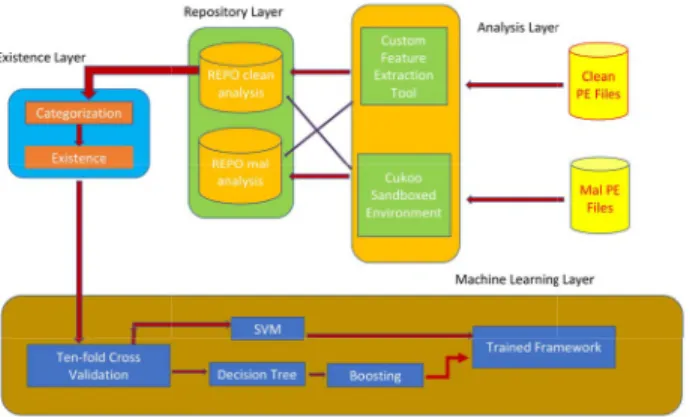
The architecture of the proposed framework is divided into multiple layers as shown in Figure 1. Each layer is dedicated to produce specific results that are used by the following layer.
Fig. 1. Architectural Flow
Each layer deals with the data from both clean and malicious files.
• Layer 1 –Analysis Layer: The Analysis Layer performs a thorough analysis of clean and malicious files and store the analysis results in separate repositories, both type of files are analyzed in the same manner, which means that the reports generated are in the same format and follow the same conventions
• Layer 2 –Category Layer: The Category Layer divides the feature-sets in meaningful categories that are present in both the file types, along with associating the related occurrences. The associations are then sent to the third layer
• Layer 3 –Existence Layer: The Existence Layer sepa-rates the instances in which each feature occurred in the behavioural analysis, along with the related sets. Intersection of both malicious and clean features is taken, along with the complement of both M & C. It is then sent to layer 4
• Layer 4 –Machine Learning Layer: The machine learning layer retrieves the customized dataset and applies ten-fold cross-validation to remove any bias. It then uses Support Vector Machine, Decision Tree, and Boosting on Decision Tree to train and test the framework
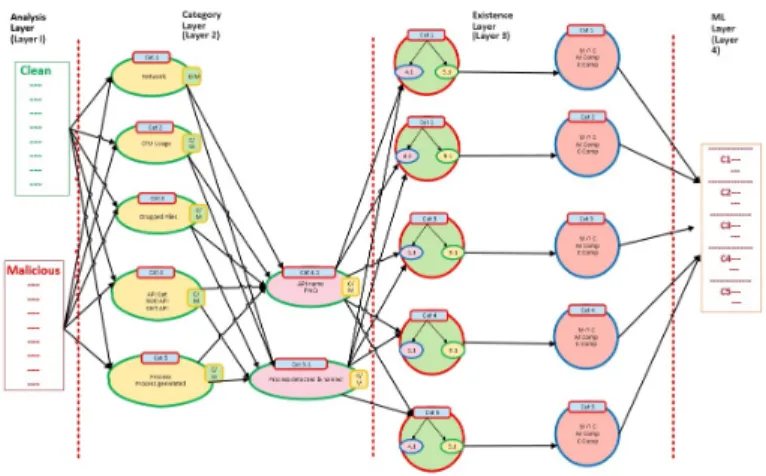
1) Categorization Strategy: The illustration of the layered framework presents a functionality breakdown of each layer and what they produce, along with their significance. As highlighted earlier, the first layer, which is the analysis layer, possess the analysis datasets of clean and malicious files. As discussed in the previous section, this dataset is generated as a result of thorough static and behavioural analysis of clean and malicious files and stored in a standardized JSON file format. The functionality of second layer is quite pivotal in this framework, which is the category layer. Each category layer stores the feature-set in five different features, namely; Network, CPU Usage, Dropper Files, API; Noti API, Certi API, Processes; Processes Generated, as shown in Figure 2. Additionally, API and Processes categories have subcategories; API Name & Frequency and Processes Deleted and Names, respectively. All these categories store the respective extracted
features from both clean and malicious files. The primary reason behind categorizing the features and combining the extracted features is to generalize different behavioural pat-terns in clean and malicious files. Along with categorizing specific behavioural features, this layer links these generalized categories with two subcategories that are derived from Cat4 API and Cat5 Processes. The subcategories derived from Cat4 and Cat5 are also connected with first three categories; Net-work, CPU Usage, Dropper Files. The primary reason behind connecting the subcategories of Cat4 & 5 with other categories is the relevance of APIs and Processes with Network, CPU Usage, Dropper Files is quite significant and have a noticeable impact on these three categories. Category 4.1 holds the information about a specific API and its frequency. When Category 4.1 is linked with Cat1, it identifies the frequency of occurrence of a specific API with respect network traffic. It is then linked with Cat2 and the frequency of occurrence of a specific API and its impact on CPU consumption is monitored. Finally, it is linked with Cat3 and the association of dropping new files in a networked environment or in a single computer with the occurrence of a specific API. Moreover, Category 5.1, which is Processes Deleted and Name, is also associated with first three categories. The association of Cat1 with Cat5.1 monitors the name of processes deleted in a networked environment by a specific process. The association of Cat2 with Cat5.1 monitors the name of a specific process, its impact on CPU consumption and whether it replaced a specific process and their previous and current CPU consumption. Additionally, the association of Cat3 with Cat5.1 monitor the files dropped or deleted by a specific process, along with their locations.
2) Existence Identification: Layer 3 is the existence layer, which integrates the categories, as illustrated in the category layer and takes intersection and complement to identify and differentiate the instance of each category for both clean and malicious feature-set. As mentioned in the previous section, the association of Cat1 with Cat4.1 and 5.1, for both clean and malicious feature-set, identify the existence with respect to Cat1. The later phase takes the intersection of existence between clean and malicious features from customized cat-egories, along with a complement of malicious features in clean feature-set and complement of clean features malicious feature-set. The contents of final categories 1-5 are based on the intersection and complement of the aforementioned feature-set, as illustrated in figure. It is pivotal for the op-erational efficacy of the framework to include common and unique behavioural features of clean and malicious files, which will enable the framework to identify polymorphic and metamorphic malware. As discussed earlier, these types of malware dynamically evolve and attach themselves with legitimate files, as they propagate. Having a generalized com-bination of behavioural feature of clean and malicious files not only enables the framework to distinguish between clean and malicious files, it specifically empowers the framework against legitimate files that have malicious code embedded in it.
Fig. 2. Architecture of Layered Framework
IV. IMPLEMENTATION
In this section we present the implementation details of our proposed framework. This framework is specifically designed for Portable Executable (PE) files, also known as .exe files, which are specific to windows environment. Therefore, all the files used in this research are windows-based executable, both; clean and malicious. The operations of every system or its implementation is based on a set of rules, which define the conditions of its functionalities and the parameters involved in their operations. The pseudocode presented in this section elaborates the condition that make this framework unique and efficient as compared to the ones discussed earlier.
As presented in the pseudocode, RepoC and RepoM hold the static and dynamic features of clean and malicious files respectively, acquired through static and dynamic analysis of both type of P.E files. This leads to the existence module, which has three different phases; Categorization, Existence, and Combination. In the categorization phase, the union of clean and malicious features comprised of; network behaviour, CPU usage, dropped files, APIs, processes generated are stored in Cat1, Cat2, Cat3, Cat4, and Cat5 respectively. The final version of each category after this step stores the union of both clean and malicious features of each category mentioned earlier.
In the existence phase of this module, the virtually con-nected features, as shown earlier in the figure, are combined together. The union of Cat4 and Cat5 is combined with separately with the set of each category; Cat1, 2, 3, 4, 5. This combines the individual features of each category with the hierarchical features of Cat4 and 5, which involves both clean and malicious files. The combination phase of the existence module is the final phase and the information retrieved from this phase is used to train and test the machine learning algorithms in the next phase. In this phase, common features from both; clean and malicious feature-set are identified and stored in a separate set. The whole idea behind this step is to identify the differences a polymorphic malware makes to a legitimate file. The identification of common features and features exclusive to clean and malicious files enable
Algorithm 1 Malware Analysis 1: Input: C, M
2: Output: Cat 1, Cat 2,. . ., Catn 3: C←Set of Clean P.E Files 4: M←Set of Malicious P.E Files 5: while c∈Cdo 6: while m∈ Mdo 7: S ←StaticAnalysis(c,m) 8: D←DynamicAnalysis(c,m) 9: Repo C←Repo C∪ {Cs∪CD} 10: Repo M←Repo M ∪ {Ms∪MD} 11: Existence Module – Categorization
12: Cat 1 ←Cat 1 ∪ {RepoCNet∪RepoMNet} 13: Cat 2 ←Cat 2 ∪ {RepoCCP U∪RepoMCP U} 14: Cat 3 ←Cat 3 ∪ {RepoCfiles∪RepoMfiles} 15: Cat 4 ←Cat 4 ∪ {RepoCAP I ∪RepoMAP I} 16: Cat 5 ←Cat 5 ∪ {RepoCpros∪RepoMpros} 17: Existence Module - Existence
18: Cat 1←Cat 1∪ {Cat4∪Cat5} 19: Cat 2←Cat 2∪ {Cat4∪Cat5} 20: Cat 3←Cat 3∪ {Cat4∪Cat5} 21: Cat 4←Cat 4∪ {Cat4∪Cat5} 22: Cat 5←Cat 5∪ {Cat4∪Cat5} 23: Existence Module - Combination 24: Malfeat ←Set of Malicious Features 25: Cleanfeat←Set of Clean Features, 26: while Malfeat∈(Cat 1,2,3,4,5)do
27: whileCleanfeat∈ (Cat 1,2,3,4,5)do
28: Cat 1.1 ← Cat1.1∪ {Cat1Malfeat ∩ Cat1Cleanfeat}
29: .
30: .
31: Cat 5.1 ← Cat5.1∪ {Cat1Malfeat ∩ Cat1Cleanfeat}
32: end while 33: end while 34: end while 35: end while
the algorithm to differentiate even the slightest embedding of malicious code in a legitimate file. In the proliferation process in a single machine or in a network, multiple executables are used as hosts. In such a scenario, every executable even with a slightest of mutation needs to be identified before it can pass the mutation to the next executable. This technique will enable the algorithm to differentiate between clean and malicious files with significantly high accuracy.
V. RESULTS ANDDISCUSSION
As the experiments are windows-based malware, Ubuntu is chosen as the host environment. The modules containing; clean and malicious files repositories, customized static anal-ysis tool, Cuckoo sandboxed environment, repository layer comprised of clean and malicious files’ analysis reports. The existence layer is programmed in Python and connected with the previous two layers. The Python program is comprised of two modules; the existence layer and the machine learning layer. The existence layer connects with the file system, which holds the analysis reports and after performing the operations as discussed in the implementation section. It passes the finalized parameters to the next module that holds multiple machine learning algorithms that are trained and tested using these parameters.
File Type Quantity Benign 121523 Malicious 2068796
TABLE I
DISTRIBUTION OFBENIGN ANDMALICIOUSFILES INDATASET
Table I presents the distribution of clean and malicious files that are used for static and dynamic analysis, along with populating the feature-set in the existence layer that is later used for training and testing of algorithms. The large number of malware used in the experiment ensures that the framework is highly accurate and eliminate the existence of false-positives in the results. Also, the majority of the malware present in the dataset are variants of highly advanced polymorphic malware that have the ability to forge their presence as clean files, while propagating. Additionally, the dataset is comprised of different types of malware families, as shown in Table II This also enables the framework to be more thorough when it comes to detection of different types of malware, along with the malware that share features from other malware families.
Malware Type Percentage Trojan 65.82% Adware 22.67% Worm 8.66% Virus 1.21% Downloader 0.56% Spyware 0.41% Exploit 0.39% Dropper 0.28% TABLE II
MALWAREDISTRIBUTION IN THEREPOSITORY
A. Results
In order to identify the effectiveness of the proposed framework, the initial experiment was performed on the same dataset but without the customization and categorization of the dynamic feature-set of clean and malicious files. In the first experiment, the same dataset of clean and malicious files was used. The features were generated using the same static and dynamic analysis tools and combined together to form a rich set of features. The primary idea behind the initial experiment was to identify the effectiveness of the combination of machine learning algorithms without using the taxonomy-based detection technique.
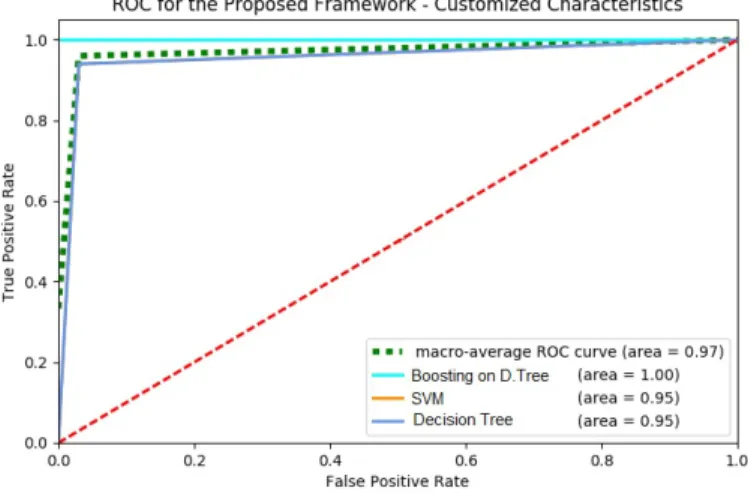
The results illustrated in Figure 3, present the comparison of different machine learning algorithms used in the frame-work that are trained and tested against the rich feature-set acquired from clean and malicious files without applying the categorization techniques. As illustrated in figure, the trained algorithms were able to detect malware with a decent rate but the rate still provide malware with an opportunity to escape detection, especially in real-time situations. SVM and decision tree were able to provide an accuracy of 0.79 and 0.60 respectively. However, when boosting was applied on the results of decision tree, the accuracy went up to 0.91, which is significantly higher than the actual accuracy of decision tree but still not an optimum solution for polymorphic malware. The same dataset was then used on the proposed framework, which has the same set of tools for static and dynamic analysis for clean and malicious files. However, when the rich feature-set from the analysis layer is generated, it is then reduced to a taxonomy discussed in earlier sections and then combined with relevant features. The experiment performed using the hypothesis proposed at the start and implementation discussed in the earlier section, produced the results presented in figure. The results illustrated in Figure 4, present the outcome of the evaluation of the proposed framework. Once the afore-mentioned algorithms were trained against the customised characteristics, the detection accuracy significantly improved
Fig. 4. Customized Characteristics
as compared to the previous results without custom charac-teristics. Decision tree and SVM demonstrated an accuracy of 0.95 each. After applying boosting on decision tree’s results, the outcome was significantly enhanced and the framework was able to differentiate between clean and malicious files with absolute accuracy. The most important aspect in this scenario is the real-time detection based on the dynamic behaviour. The detection was not just based on static file system, it was based on the malware executed in a live environment, which makes the absolute accuracy even more significant. It is quite important to identify the importance of this evaluation, performed on the proposed framework. The dataset used in this evaluation was based on more than 2.1 million files, which means that any result acquired went through a detailed analysis of a significantly large number of features that populated the categorization process. This means the final feature-set acquired after the categorization process was thoroughly rich and was comprised of precise characteristics that enhanced the
VI. CONCLUSION ANDFUTUREWORK
To cater the problem of rapid malware evolution in modern malware, which are equipped with dynamic evasion techniques that enable the malware to continuously keep changing its appearance, code sequence, and even logic in some scenarios, there is a significant requirement of detection techniques that have the similar dynamics embedded in them. The framework proposed in this paper, not only has the capability to detect malware, it can has the capability to accurately differentiate between clean and malicious files. The proposed framework is primarily designed for polymorphic malware that have self-mutation properties and can attach themselves dynamically to multiple legitimate files, which means that the characteristics of the framework discussed in this paper can accurately differentiate between the legitimate and malware host files. The machine learning algorithms used are trained and tested on specially customised feature-set acquired from a quite large dataset of clean and malicious files. The end result illustrate the absolute accuracy of the framework against large set of
accuracy of the overall framework.
polymorphic malware. Even though, the proposed framework demonstrated accuracy in malware identification, it is required to scale it to a level where it can cater the needs of a network. The modern polymorphic malware specifically target enterprise network, which means that any solution proposed should cover the domain of an enterprise network. In order to enhance the effectiveness of this framework, it is crucial to scale it to the level of an enterprise network and evaluate its effectiveness.
REFERENCES
[1] N. Udayakumar, S. Anandaselvi, and T. Subbulakshmi, “Dynamic mal-ware analysis using machine learning algorithm,” in2017 International Conference on Intelligent Sustainable Systems (ICISS), Dec 2017, pp. 795–800.
[2] J. Kargaard, T. Drange, A. Kor, H. Twafik, and E. Butterfield, “Defend-ing it systems against intelligent malware,” in2018 IEEE 9th Interna-tional Conference on Dependable Systems, Services and Technologies (DESSERT), May 2018, pp. 411–417.
[3] M. Ijaz, M. H. Durad, and M. Ismail, “Static and dynamic malware analysis using machine learning,” in2019 16th International Bhurban Conference on Applied Sciences and Technology (IBCAST), Jan 2019, pp. 687–691.
[4] A. Cabrera and R. A. Calix, “On the anatomy of the dynamic behavior of polymorphic viruses,” in2016 International Conference on Collabo-ration Technologies and Systems (CTS), Oct 2016, pp. 424–429. [5] M. S. Khan, S. Siddiqui, and K. Ferens, “Cognitive modeling of
polymorphic malware using fractal based semantic characterization,” in2017 IEEE International Symposium on Technologies for Homeland Security (HST), April 2017, pp. 1–7.
[6] J. W. Stokes, D. Wang, M. Marinescu, M. Marino, and B. Bussone, “Attack and defense of dynamic analysis-based, adversarial neural malware detection models,” in MILCOM 2018 - 2018 IEEE Military Communications Conference (MILCOM), Oct 2018, pp. 1–8. [7] B. J. Kumar, H. Naveen, B. P. Kumar, S. S. Sharma, and J. Villegas,
“Logistic regression for polymorphic malware detection using anova f-test,” in2017 International Conference on Innovations in Information, Embedded and Communication Systems (ICIIECS), March 2017, pp. 1– 5.
[8] H. Daku, P. Zavarsky, and Y. Malik, “Behavioral-based classification and identification of ransomware variants using machine learning,” in2018 17th IEEE International Conference On Trust, Security And Privacy In Computing And Communications/ 12th IEEE International Conference On Big Data Science And Engineering (TrustCom/BigDataSE), Aug 2018, pp. 1560–1564.
[9] Q. Chen and R. A. Bridges, “Automated behavioral analysis of malware: A case study of wannacry ransomware,” in2017 16th IEEE International Conference on Machine Learning and Applications (ICMLA), Dec 2017, pp. 454–460.
[10] S. Poudyal, K. P. Subedi, and D. Dasgupta, “A framework for analyzing ransomware using machine learning,” in2018 IEEE Symposium Series on Computational Intelligence (SSCI), Nov 2018, pp. 1692–1699. [11] D. et al., “Evaluation of android malware detection based on system
calls,” inWorkshop on Security And Privacy Analytics, ACM, 2016, pp. 1–8.
[12] M. et al., “Analysis and evaluation of safedroid v2.0, a framework for detecting malicious android applications,” in Hindawai Security and Communication Networks), September 2018, pp. 1–15.
[13] Madani and V. P., “Towards sequencing malicious system calls,” in
International Conference on Ubiquitous and Future Networks (ICUFN), October 2016, pp. 376–377.
[14] D. Geneiatakis, G. Baldini, I. Nai, and F. Ioannis, “Towards a mobile malware detection framework with the support of machine learning,” in
Security in Computer and In formation Science, Springer, July 2018, pp. 119–129.