G00262932
Magic Quadrant for Enterprise Content
Management
Published: 25 September 2014
Analyst(s): Mark R. Gilbert, Karen M. Shegda, Kenneth Chin, Gavin Tay, Hanns Koehler-Kruener
Enterprise content management offerings
address a range of user constituencies and
business requirements, an increasingly
common one being for delivery of
personalized content in context. In light of
this and other demands, we assess 22 vendors to help you identify the right
one for your needs.
Strategic Planning Assumptions
By 2016, content management will be personalized, with foldering and process needs tailored to each individual user.
By 2017, nearly 50% of all business content will be nontextual, which will require organizations to invest more widely in analytics as part of content management.
Market Definition/Description
The term "enterprise content management" (ECM) describes both a strategic framework and a technical architecture that supports all types of content (and format) throughout the content life cycle.
As a strategic framework, ECM can help enterprises take control of their content, and thereby boost productivity, encourage collaboration, help meet compliance initiatives, enable better content-centric processes and make information easier to share.
As a technical architecture, ECM consists of a platform or a set of applications that interoperate but that can be sold and used separately.
An ECM platform's core components, and their associated functional weightings for the purpose of scoring in this Magic Quadrant, are as follows:
Additonal Perspectives
Geography: Europe
■ Document management (20%), for check-in/check-out, version control, security and library services for business documents. Advanced capabilities such as compound-document support and content replication score more highly than basic library services. Extended capabilities include DRM and metadata-driven views of documents, rather than strict taxonomy-based structures. Also of value are capabilities that offer some level of access to, and version management within, noncore repositories, such as the management of documents in a file share or cloud environment, and support for flexible customization of the user experience. ■ Web content management (WCM, 5%), for controlling a website's content through the use of
specific management tools based on a core repository. Included are content creation functions, such as templating, workflow and change management, and content deployment functions that deliver prepackaged or on-demand content to Web servers. The minimum requirement is a formal partnership with a WCM provider. Native capabilities score more highly than those provided through partnerships. The complexities of provisioning content to users across intranet, extranet and Internet applications are considered, as are responsive design and adaptive device delivery capabilities that empower a range of client devices, and support for new content types and delivery models.
■ Records management (10%), for long-term archiving, automation of retention and compliance policies, and ensuring legal, regulatory and industry compliance. The minimum requirement is an ability to enforce retention of critical business documents based on a records retention schedule. Higher ratings are given for certified compliance with standards such as the
Department of Defense (DoD) Directive 5015.2-STD, the Victorian Electronic Records Strategy (VERS) and Modular Requirements for the Management of Electronic Records (MoReq2010). ■ Image-processing applications (15%), for capturing, transforming and managing images of
paper documents. For this component we require a vendor to offer two things: (1) document capture (scanning hardware and software, optical and intelligent character recognition technologies, and form-processing technology) performed either using native capabilities or through a formal partnership with a third-party solution provider such as Kofax, ReadSoft or Top Image Systems (TIS); (2) the ability to store images of scanned documents in the repository as "just another" content type in a folder, and to route them through an electronic process. Extra credit is given for vertical or horizontal solutions delivered directly or through partners. ■ Social content (15%), for document sharing and collaboration support for project teams and
knowledge management use cases. Blogs, wikis and support for other online interactions are evaluated. Social content — including video — is the fastest-growing category of new content in enterprises.
■ Content workflow (20%), for supporting business processes, routing content, assigning work tasks and states, and creating audit trails. The minimum requirement is simple document review and approval workflow. Higher points are given to vendors with graphical process builders, and both serial and parallel routing. Many vendors are using stronger process capabilities to deliver frameworks or templates as content applications (for case management, for example).
■ Extended components(15%), which can include one or more of the following: mobile
applications, digital asset management, search, analytics and packaged integration capabilities (for portals, ERP and CRM, for example).
Magic Quadrant
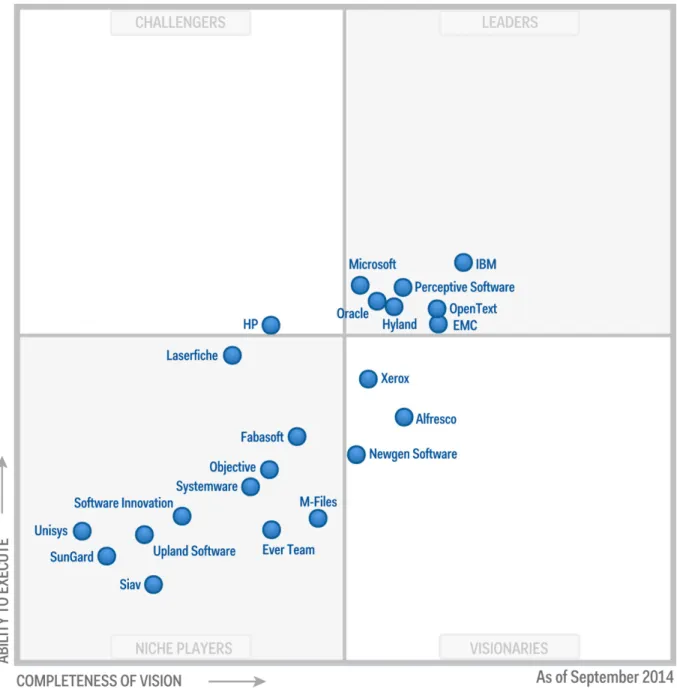
Figure 1. Magic Quadrant for Enterprise Content Management
Vendor Strengths and Cautions
Alfresco
Alfresco, based in Maidenhead, U.K., is evolving from its open-source background. It delivers ECM software both on-premises and in the cloud. Over the past year, it has gained more licensed users, with enterprise deployments implemented by a growing roster of partners. Alfresco embraces open standards such as Content Management Interoperability Services (CMIS), which has enabled it to integrate with third-party products from vendors like IBM (Lotus Notes), Google (Google Docs), Jive and Kofax. It uses open APIs to offer off-the-shelf integrations with SAP and salesforce.com
offerings in the ERP/CRM sector. Alfresco's core ECM platform is Alfresco One.
Strengths
■ Alfresco has demonstrated good knowledge of the ECM market's needs, and has evolved its strategy to focus on the UI and mobile needs with its Workdesk component. It has also extended its solution portfolio.
■ Alfresco One's ability to synchronize content, metadata and workflows between its cloud environment and on-premises deployments enables it to meet enterprises' increasing demands for hybrid ECM deployments.
■ Alfresco has grown its mind share in the ECM market over the past two years, and is attracting new clients in a variety of countries and industries.
Cautions
■ Alfresco has changed aspects of its pricing model, which has caused some issues with existing customers. In the past, Alfresco had more of an unlimited-user approach to support.
■ The quality of firms delivering Alfresco implementation services varies considerably, as the open-source nature of the basic offering enables anyone to deliver implementation services. Enterprises that are considering Alfresco One, the Enterprise platform, should work with Alfresco to find a trained partner with strong references.
■ Compared with the leading ECM vendors, Alfresco is a relatively small organization backed by venture funding. Enterprises should work with it to understand its product road map, which is evolving rapidly.
EMC
EMC, based in Hopkinton, Massachusetts, has focused its content management strategy on
providing easier-to-deploy and more-scalable products with Documentum and a set of key industry solutions to accelerate ROI. EMC has expanded its EMC OnDemand cloud offering by adding solutions for life sciences, and tightened its integration with Syncplicity, its file sync and share service. Documentum D2, its modern, persona-based UI, is expected to provide a better user experience and enhanced collaboration capabilities. EMC is aggressively trying to recapture strong
Strengths
■ EMC provides an extensive content management stack that includes most ECM elements: capture, document management, process management and records management, as well as related document composition capabilities. In March 2014, it also released EMC InfoArchive to address active archiving and application retirement.
■ EMC's focus on industry solutions, specifically for the healthcare, life sciences, energy and engineering sectors, together with its ability to deploy these in the cloud, provides customers with increased value and quicker deployments.
■ EMC provides private cloud content management for all its products and solutions, which include Documentum, Documentum xCP, Captiva and Document Sciences. It continues to increase its deployment options for customers.
Cautions
■ EMC OnDemand is only just beginning to evolve from its current cloud-based managed service model. Continued enhancements to costs and deployment options will be required to provide an appropriate solution for customers to consider.
■ The midmarket remains challenging for EMC as customers in this segment look for reduced costs and less complexity. Traditionally, EMC offered only a separate product for this part of the market: ApplicationXtender, a more limited and tactical solution than Documentum. Recently, EMC embarked on a new approach to the midmarket with its cloud solution strategy.
■ Prospective customers should be aware of EMC's somewhat complex social content strategy, as it is simultaneously expanding the capabilities of Documentum D2, investing in Syncplicity and integrating Documentum with Microsoft SharePoint.
Ever Team
Ever Team is a French company with a growing presence in Europe and the Middle East. Its clients are mostly midsize organizations, although its products are also starting to gain visibility within larger customers. It has one of the most complete, organically grown product portfolios of the vendors in this Magic Quadrant. Ever Team mostly targets customers with more than $1 billion in annual revenue, but partners may offer its products to smaller organizations. Ever Team
concentrates on a number of vertical markets, including utilities, engineering and insurance.
Strengths
■ Ever Team continues to grow and to expand into new geographic areas. It is also broadening its product portfolio by adding analytics to its document life cycle products.
■ Ever Team customers with whom Gartner has spoken often commend its usability, as there is a common, integrated interface to its core products.
■ Ever Team is fully cloud-ready on the same code base as its on-premises offerings, and it enables customers to pick their own infrastructure-as-a-service offerings, such as those of Amazon Web Services, Microsoft (Azure) and Rackspace.
Cautions
■ Ever Team lacks significant presence in North America and Asia/Pacific, which may limit its appeal to large, global clients.
■ Ever Team lags behind the Leaders in its social and file sync and share capabilities. It has only a lightweight collaboration product and offline desktop sync capabilities. It does, however, have integration with Microsoft SharePoint for users wanting to use that environment for
collaboration.
■ Ever Team must improve its customers' overall satisfaction. It is still a small company with limited developer resources and professional services staff. As Ever Team expands into new markets, enterprises should monitor the availability of local support and expertise.
Fabasoft
Fabasoft, headquartered in Austria, offers both on-premises products (Fabasoft Folio and Fabasoft eGov-Suite) and a Europe-based cloud solution (Fabasoft Cloud). Fabasoft's core markets are central Europe and parts of Eastern Europe. It offers an integrated solution that covers all parts of the document life cycle.
Strengths
■ Fabasoft has a strong product portfolio for compliance- and security-conscious clients,
especially in terms of case management and e-government solutions. Its European data centers and certified solutions make it a strong choice for clients in Europe, particularly those in the public sector.
■ Fabasoft's user experience has improved since the last Magic Quadrant. Its reference customers and other clients give it high marks for ease of use.
■ Fabasoft uses Mindbreeze for its search capabilities. This is one of the better search engines and it brings a strong search-and-discovery-based UI to Fabasoft's products.
Cautions
■ Fabasoft has not expanded significantly beyond its core central European markets. If the company is to gain wider traction, it must improve its sales and distribution channel and the marketing of its products.
■ As a relatively small company, Fabasoft cannot do everything. More specialization or a stronger industry focus may be necessary for it to succeed in broader markets.
■ Users of Fabasoft's on-premises products report some complexity in terms of implementation and a need for better technical support.
HP
Three years after Autonomy's acquisition by HP of Palo Alto, California, the two entities' synergies in the ECM market are becoming evident. HP's ECM suite includes tools for capture, process automation, governance, records management and WCM, and solutions for customer
communications. HP has won mind share in the ECM market during the past year, and is appearing on more client shortlists. It has demonstrated commitment to marketing and selling ECM products, while building stronger social and cloud strategies.
Strengths
■ HP has capitalized on its scale and global sales force. Its customer feedback has improved noticeably — HP is now resonating with buyers. Its Ability to Execute has clearly improved since the last Magic Quadrant.
■ HP has a broad set of capabilities in its ECM portfolio — capture, document management, process, digital asset management and WCM — without much redundancy. These capabilities are underpinned by an advanced set of search and analytics capabilities, through the Intelligent Data Operating Layer (IDOL) platform. HP excels at archiving, governance and risk
management.
■ HP has deep expertise in the legal sector with its HP Legal Content Management solution (based on HP WorkSite). It is starting to build solutions that use the full portfolio of Autonomy assets (for example, customer communications management, digital asset management and process management).
Cautions
■ HP needs to continue to improve its products' usability and deepen the training of sales and marketing staff in order to really understand what users are trying to achieve with its solutions. It must listen to its customers more carefully. Prospective customers should evaluate whether the usability of the proposed solution is adequate for their needs.
■ Prospective customers outside HP's core areas of legal services, professional services, financial services and the public sector who are looking for vertical-market applications should carefully evaluate HP's industry depth and solutions.
■ HP focuses on the more fundamental ECM needs of clients — compliance, risk management and records management — but must continue to develop more capabilities for productivity-oriented and process-centric use cases.
Hyland
Hyland, headquartered in Westlake, Ohio, markets its ECM platform, OnBase, to midmarket and enterprise customers looking for transactional content management and vertical-market
targeted acquisitions. It has a strong focus on industries, with organizations in the healthcare, higher education, government and insurance sectors accounting for much of its revenue.
Strengths
■ Hyland's long-standing focus on content-enabled applications (for invoice automation,
transcript processing, patient records and admissions, for example) has appealed to customers looking for purpose-built solutions that can also be easily modified and upgraded. Hyland is extending many of those solutions' capabilities to mobile devices. Mobile solutions include the OnBase Insurance Field Adjuster App for Microsoft Windows 8 tablets and a medical record app for the Apple iPad.
■ Hyland was one of the first ECM providers to embrace the cloud. It has offered OnBase Cloud, a cloud-hosted version of OnBase, for at least a decade using both perpetual-license and SaaS payment models. The cloud solution operates from six global data centers and supports
customers in 25 countries. Current OnBase users who wish to make new deployments, as well as prospective Hyland customers, should evaluate OnBase Cloud.
■ OnBase's ease of deployment and extensibility have been key factors behind Hyland's
leadership position. Hyland has consistently received strong feedback for its customer support. Judging from its reference customers and other Hyland clients with whom Gartner has spoken, these strengths translate into very satisfied customers.
Cautions
■ Hyland has been slowly growing its international footprint, but still derives roughly 85% of its revenue from the U.S., with much of the rest coming from Latin America and Asia/Pacific. Recently, Hyland has been pursuing international expansion more aggressively. Unicode support is a top development priority for OnBase 14. Buyers looking for a vendor with a well-established global presence may want to investigate other options.
■ In a market where compliance is a strong driver, Hyland no longer has a records management offering certified as compliant with the DoD 5015.2 standard. It does have both electronic and physical records management capabilities, but enterprises that require the DoD certification must look to alternative suppliers.
■ Although OnBase can index and store a wide variety of file formats, it is not currently equipped to meet sophisticated digital asset management and enterprise video content management requirements. In the past, it has focused on mainframe-generated reports and static images, as well as PDF and Office files. It must now decide whether to build, buy or partner to deliver this functionality for industries where the need to manage rich media is growing.
IBM
IBM, based in Armonk, New York, has used its scale effectively in the ECM market. With one of the broadest ECM portfolios and a global footprint, it supports large, multinational enterprises with a strong focus on transactional content management, social content and other use cases. It has a
deep track record of serving the financial services, insurance and government sectors, as well as IBM-centric organizations elsewhere.
Strengths
■ IBM's greatest strength, for both existing and prospective customers, is the breadth of its content management and related capabilities, from content ingestion to archiving. IBM uses related capabilities from across its portfolio, including social and collaboration features, content and predictive analytics, portal management and WCM, case management, business process management (BPM) and storage management. Enterprises looking for a strategic infrastructure provider to support many content-related needs should consider IBM.
■ Whereas most of its competitors charge extra for a rich client interface, IBM includes its Content Navigator client in its core server license, which also serves as an application
framework on which IBM builds its ECM portfolio. IBM also includes a limited-use database and application server at no extra cost.
■ IBM offers deep analytics and business intelligence tools, which resonate with specific industry initiatives, such as patient care and insight, and fraud detection. A growing opportunity for IBM lies in building "smarter" ECM infrastructure. These industry initiatives span enterprises and ecosystems.
Cautions
■ One of IBM's greatest strengths also poses its greatest challenge: The breadth of its product and solution portfolio may make it hard for some customers to understand where to start or how to extend their current offerings. IBM's sales teams sometimes lead with different offerings, adding to confusion over its road map. IBM supports three core content repositories, and offers several BPM offerings between IBM FileNet Content Manager and IBM Business Process Manager, as well as search capabilities based on both Lucene and Vivisimo.
■ Cloud adoption among ECM buyers has been slow, although interest is picking up. IBM recently released IBM Navigator on Cloud, which provides a SaaS ECM platform, running on IBM's SoftLayer cloud. This is a start, but IBM will need to continue to bolster its cloud investments to address buyers' changing needs.
■ IBM has one of the largest installed bases for content management, but its growth in this market has slowed. Existing customers are staying put, and IBM is successful at upselling and cross-selling to them. To maintain its market share leadership and reach new customers, IBM will need to continue with its investments in cloud capabilities and solutions that draw on its extensive portfolio, to enable rich, content-based ecosystems.
Laserfiche
Laserfiche, based in Long Beach, California, provides easy-to-deploy ECM products with a focus on document management, records management, imaging and workflow applications. It has a strong installed base in the government, financial services, education and healthcare markets. Its
two product suites — Laserfiche Rio, aimed at large enterprises, and Laserfiche Avante, aimed at small or midsize businesses (SMBs) — provide a wide range of capabilities for different sizes of organization, along with flexible and cost-effective licensing options. Laserfiche offers a SaaS option with the hosting of Laserfiche Rio by partners.
Strengths
■ Laserfiche is an established, stable vendor that has achieved good revenue growth on the back of solid customer acquisition and retention rates.
■ Clients indicate that Laserfiche's products are relatively easy to implement and upgrade, with moderate deployment costs. Laserfiche has also implemented a strategic program to improve the delivery of its services with new deployment methodologies.
■ Users generally find Laserfiche's partners to be capable and fairly well trained. Its products and services are primarily delivered through a strong partner and reseller channel, which helps drive sales, service and support.
Cautions
■ Partner-led technical support for Laserfiche has sometimes been problematic, judging from customer feedback. Enterprises should evaluate partners, first by checking their reference customers, and then by looking for partners with the Laserfiche Gold Certification and individuals who hold the Laserfiche Certified Professional Program (CPP) certification.
■ Laserfiche's cloud services are a very small part of its business. Prospective cloud customers may want to wait for Laserfiche's expanded cloud offering, which should offer a stronger architecture for cloud deployments. Laserfiche is still gaining experience in this area.
■ Depending on their location, enterprises will want to research local support for their Laserfiche solution. Although Laserfiche has expanded its presence in Europe and Asia/Pacific, awareness of its brand remains limited in these areas and getting good support may be a challenge.
M-Files
M-Files is a Finnish ECM vendor that has established itself as a strong contender in EMEA and the U.S., thanks to rapid revenue growth and geographic expansion. It has achieved above-average growth especially in the U.S. It focuses its products on three basic areas: document management, quality management and enterprise asset management. All solutions share a common code base and a metadata-driven architecture.
Strengths
■ M-Files provides a highly flexible, metadata-driven architecture that enables very simple to highly complex document flows and business processes to be assembled relatively easily. Users rate it well for usability, and it can help to enable a more contextualized view of information.
■ M-Files has evolved its cloud and on-premises hybrid architecture to reflect clients' needs. It uses "multi-vault cooperation and replication" to control many aspects of security, processes, sharing and other functions.
■ M-Files has strong Microsoft Windows server and desktop integration, and delivers a user experience familiar to anyone who uses Windows desktop PCs. Reference clients identify M-Files' intuitive user experience as a strength.
Cautions
■ Although M-Files' sales and partner networks are growing rapidly, there remains a
disconnection between its marketing message and its product road map. Customers may be confused by M-Files' changing messaging and may not see the value of its products. The company needs to clarify its direction and focus on specific use cases.
■ M-Files' product development lags behind some of the larger vendors when it comes to social capabilities. The current version, 10.1, lacks free-form text analysis capabilities, although this may change with the next release.
■ Prospective customers should review the qualifications of M-Files' partners. M-Files is growing rapidly, but its partner enablement is somewhat challenged by this fast growth.
Microsoft
Microsoft, headquartered in Redmond, Washington, has delivered a foundational set of content management capabilities in SharePoint for over a decade. SharePoint has strong integration with Microsoft Office, Exchange and Windows, and as a result has been used by about two-thirds of Gartner's clients, in a wide range of geographies and industries. SharePoint is in transition, though, as Microsoft is strategically focused on cloud deployments using SharePoint Online in Office 365, which is relatively unproven.
Strengths
■ Microsoft has a very large installed base of on-premises SharePoint deployments, which has given many users a degree of familiarity with the platform.
■ Microsoft's on-premises ECM capabilities are often used by enterprises with a strategic vision for SharePoint, which is frequently seen as strategic infrastructure for enterprise rollouts. ■ Microsoft's reach in providing support and service around the world is one of the broadest of
any vendor in this market. Microsoft has an extensive partner ecosystem for on-premises deployments and extensions.
Cautions
■ The ECM capabilities of SharePoint Online are similar, but not identical, to those of SharePoint Server, and less proven than Microsoft's traditional on-premises version. Prospective
customers should consider how much e-forms, workflow, integration and application functionality they need in their ECM system.
■ Microsoft's third-party ecosystem of partners is not as technically capable of integrating and extending the online version of SharePoint, due to changes in the app model (the Client Server Object Model). This results in a less functional version of SharePoint for ECM in the cloud than on premises, at present.
■ Gartner clients who use SharePoint reported lower satisfaction levels with it this year than in the past. One key problem area they identified was migration. Even with on-premises upgrades of SharePoint, migration, particularly when customizations have been made, has proved very challenging and complex for many IT shops.
Newgen Software
Newgen Software is headquartered in New Delhi, India, and has regional head offices in Washington DC, the United Arab Emirates and Singapore. The rebranded Newgen ECM Suite has four
components: OmniDocs, OmniScan, OmniFlow and the Enterprise Mobility Platform. Newgen uses the cloud (Amazon and HP Cloud Maps) to deliver industry solutions for, among other things, claims processing, finance and accounting processes, and the U.S. Foreign Account Tax Compliance Act (FATCA). It also offers some solutions as shrink-wrapped options for SMBs.
Strengths
■ Newgen's significant investments and expansion in North America have made modest progress over the past year. For a moderately sized ECM company, Newgen has strong financials and demonstrates good growth.
■ Newgen has shown good vision by embracing mobility requirements with its Enterprise Mobility Platform in an end-to-end solution that addresses new use cases, such as microfinancing and citizen-centric services.
■ Newgen customers have given Gartner positive feedback about this vendor's ability to scale for large transactional scenarios. Newgen also has a good track record of responsiveness to clients' needs.
Cautions
■ Newgen lacks sufficient market awareness in North America. It must increase its marketing and build a well-trained partner ecosystem to gain a stronger presence.
■ Prospective customers should understand that there may be a significant requirement for trained professional services as Newgen's heritage has focused on solving transactional ECM needs that often require tuning and optimization for important business processes. Prospective customers should speak directly to Newgen to ascertain the level of partner training and
certification, or to discuss the use of Newgen's own service team to ensure a high level of platform knowledge. Partner certification is an area that Newgen must continue to enhance.
■ Newgen must continue to work at updating and enhancing its platform in a transparent fashion. Organizations should ask Newgen for a clear road map of product enhancements and visibility into the product upgrade and release cycle. Newgen must develop a stronger provide greater transparency around its release cycle cadence, to enable its partners and clients to plan more effectively.
Objective
Objective is headquartered in Sydney, Australia, and has sales offices in the U.S., the U.K., New Zealand and Singapore. Objective's ECM offering includes document management, records management and workflow capabilities. Objective also offers two SaaS-based ECM services: Objective Enterprise Content Creation for document collaboration and Objective Connect for file synchronization and sharing.
Strengths
■ Objective has improved its executive team, which has resulted in noticeably stronger revenue growth than last year. Due to product enhancements in the 8.x versions, customers' satisfaction with Objective's product functionality is increasing.
■ Objective's growing portfolio of government-focused applications is a key competitive differentiator. It has a growing portfolio of applications and is also strong in the public sector, energy, utilities and environmental markets.
■ Objective Connect for file sync and sharing is gaining greater adoption, especially with governments wanting to share content securely across agencies. Objective's cloud offerings collectively account for almost one-third of its revenue.
Cautions
■ Objective has expanded only modestly from its roots in Australia and New Zealand. It has only a fair amount of visibility in the ECM market as a whole and is not typically shortlisted, even though it may be well suited to an opportunity. In addition to pursuing more geographical expansion, Objective must increase its professional services staff and improve its partner enablement as some clients report that the solution capabilities of its partners are not as strong as they should be.
■ Organizations that have upgraded to Objective 8.0 from Objective 7.x report that it was a complex and costly migration. This may be due to significant architectural changes from the older versions. Upgrades from 8.0 to later versions appear straightforward.
■ Objective has improved the usability of its latest offerings, but clients point to some UI
differences across desktops, smartphones and tablets. The user experience remains somewhat weaker than that of some competitors' offerings.
OpenText
OpenText, headquartered in Waterloo, Ontario, Canada, is the second-largest ECM vendor, based on worldwide market share. OpenText's acquisition-centric growth strategy has added companies and technologies to expand its market position.
Strengths
■ OpenText's relationship with SAP provides a firm foundation for expansion and has enabled it to command a strong position in markets where SAP is strong. The company's integration with SAP is often identified by clients as very strong.
■ OpenText now has a comprehensive ECM portfolio, including Tempo, a file sync and share offering, and cloud offerings that attract good ratings from clients for their functionality and usability.
■ OpenText has continued to add to its portfolio of composite content applications, drawing on the process capabilities of its Metastorm, Global 360 and Cordys BPM products, in addition to applications based on its traditional ECM platform.
Cautions
■ Although OpenText has a very broad product portfolio, some of it has been accumulated through acquisitions, which has resulted in a complicated architecture with somewhat
redundant components. OpenText needs to be more responsive to concerns about its product road map and the longevity of its technology.
■ Some clients have expressed concerns that OpenText's product prices are too high and too difficult to calculate.
■ Some Gartner clients continue to complain about the weakness of OpenText's post-sales support.
Oracle
Oracle, based in Redwood City, California, has a broad set of content management offerings. These range from WebCenter Content for production-class ECM, to WCM capabilities with WebCenter Sites, and ECM solutions with Oracle BPM and WebCenter Portal. Oracle also delivers integration with its ERP and SaaS applications, which round out its infrastructure-centric approach to ECM. The new Oracle Documents Cloud Service offering, "Oracle Documents," is an enterprise file sync and share offering integrated with the company's broader ECM toolset; it is attracting early interest.
Strengths
■ Over the past year, Oracle has responded well to the changing needs of business users of ECM software. It has rebuilt significant portions of the Web and mobile UIs to WebCenter Content to make it more intuitive and thereby increase usability. These changes are being well received by customers.
■ Oracle's vision of cloud deployment models has progressed significantly. This includes progress with hybrid cloud/on-premises deployments.
■ Integration of Oracle WebCenter with Oracle's software stack — including the rest of the WebCenter portfolio and out-of-the-box integrations with Oracle E-Business Suite, PeopleSoft, Siebel and Oracle Fusion Applications — provides substantial benefits to Oracle customers.
Cautions
■ Some Oracle customers have indicated that overall implementation support and post-sales technical support are areas requiring further investment and improvement.
■ Some customers have identified a vagueness and a lack of predictability to the cost structure they face when working with Oracle. Smaller customers can find Oracle's pricing challenging. Oracle needs to be more transparent about its product licensing overall, as well as about its support and maintenance.
■ Oracle must continue to expand its portfolio of ECM solutions. Some enterprises may pass Oracle by, seeing only a modest portfolio or products predominantly for back-office and risk mitigation use cases. Many enterprises would like to see more active content use cases from Oracle, where the resulting process improvements can help them realize a faster ROI.
Perceptive Software
Perceptive Software, headquartered in Lenexa, Kansas, has a strong portfolio of assets and an international footprint. It continues to grow well, nearly four years after its acquisition by Lexmark. Its growth has been boosted both organically and by acquisitions in the fields of search, BPM, recognition technologies and rich media. Perceptive focuses on industries such as healthcare, higher education and government, and on horizontal content-centric applications such as accounts payable.
Strengths
■ Perceptive has grown from primarily delivering departmental imaging solutions (ImageNow) into an international provider of an ECM platform (Perceptive Content). It has signed more global customers, and acquisitions such as Pallas Athena and Saperion have given it a stronger direct presence in Europe in particular.
■ Perceptive has always had a deep focus on vertical markets, and recent acquisitions — of Pacsgear (picture archive), Twistage (video content management) and Acuo Technologies (vendor-neutral archive) — have expanded its portfolio. Perceptive can now build richer solutions for the healthcare and higher education sectors, in particular.
■ Gartner clients who are Perceptive customers generally give the company positive feedback for its product capabilities, ease of implementation, pre- and post-sales support and overall
Cautions
■ Some of Perceptive's existing and prospective customers have expressed concerns about increasing fragmentation of its product architecture and a lack of clarity about its road map. This issue has been caused by the significant number of acquisitions made by Lexmark and Perceptive, which have resulted in some overlaps in its product portfolio. Some Perceptive users think its product architecture needs improvement.
■ Customers looking for a mature cloud ECM architecture will find that Perceptive's is fairly new. At this point, its focus is more on traditional hosting of applications. It has announced plans for a next-generation platform that will be entirely multitenant-cloud-capable and designed to support hybrid environments. Customers should understand that Perceptive's cloud development will be a multiyear project, ultimately leading to a new architectural model.
■ Perceptive has not fully addressed the need for interoperability with other content management environments. Perceptive's current content platform does not support some interoperability standards, such as Web Distributed Authoring and Versioning (WebDAV), Open Document Management API (ODMA) and CMIS.
Siav
Siav is an Italian vendor and system integrator with a strong background in the government and financial services sectors. Its products, Archiflow for document management, Intelligo for imaging and Virgilio for records management, form the core of its product suite and cover the majority of its customers' needs. Siav has used a service-oriented architecture to bring together the various components of its suite.
Strengths
■ Siav has developed a number of industry solutions for its target markets. This has given it very specialized knowledge about, for example, e-government, invoice processing and
correspondence management.
■ Siav has a strong technical foundation and receives strong scores from its clients for usability and technical architecture.
■ Siav has strong consulting capabilities, which resonate well with Italian government agencies. Cautions
■ Whereas many competitors have had capabilities for sharing documents beyond the firewall for some time, Siav introduced its only recently (in July 2014), and they lag somewhat behind. ■ Although it has good presence in southern Europe, Siav still struggles to extend its presence
outside its core market of Italy and neighboring countries. It needs to make greater efforts to expand in order to become a global ECM vendor. It must also build a much stronger partner channel.
■ Siav's capabilities in the areas of social content management, content analytics and enterprise search are still emerging. Partners' products may be needed to supplement the capabilities of Siav's platform in these areas.
Software Innovation
Software Innovation, based in Oslo, Norway, offers traditional on-premises and SaaS-based offerings. Its client base is largely in Scandinavia, and it is showing growth in Europe due to a
growing network of partners. Software Innovation is a steady vendor in the ECM market and offers a product portfolio (comprising Business 360°, Public 360° and ProArc) for case management,
technical document management and records management needs.
Strengths
■ Software Innovation's users often praise its Microsoft-centric architecture for being easy to integrate with Microsoft SharePoint and Office. This has helped the company grow as it appeals to many customers, especially in Scandinavia and Northern Europe. Software Innovation has also won business in Asia/Pacific over the past year.
■ Software Innovation's portfolio of ECM solutions for various industries continues to grow. It has strong expertise in government case management, as well as in the oil and gas industry, where it is well liked for its project management and contract management.
■ Software Innovation has a strong consultative background in, and orientation toward, the product-planning phases. Its engineering group is proficient at tuning its platform for unique requirements.
Cautions
■ The training of Software Innovation's partners appears to vary in quality, judging from some feedback Gartner has received from users. Customers considering Software Innovation should ensure that the implementation is carried out by a well-trained partner. Software Innovation must focus on strong partner enablement to ensure high-quality implementations.
■ Like most vendors in this market, Software Innovation has continued to invest in worldwide, 24/7 support. In comparison with other vendors, its quality is inconsistent and users have commented that it is not timely enough. Software Innovation's customer experience can only benefit from its continued focus on improving this aspect of its help desk and
post-implementation support.
■ Existing users often state that the software seems somewhat dated in terms of look and feel. Software Innovation is working to improve this — for example, it has delivered a new iOS application and Metro-style interfaces for Windows 8 tablet users.
SunGard
SunGard, based in Wayne, Pennsylvania, provides software and technology services for
organizations in the financial services, education and public sectors. SunGard's iWorks Macess is an ECM and business process management platform that serves as a foundation for insurance solutions. It is used primarily by financial services providers and health insurers.
Strengths
■ SunGard's iWorks Macess provides a process platform that complements its content management capabilities to enable the building of insurance applications.
■ SunGard provides scalable process- and content-centric applications for customers in the financial services and insurance sectors.
■ SunGard offers strong services for the financial services and insurance sectors. Cautions
■ SunGard's iWorks Macess is primarily a platform for building content- and process-centric applications for insurance applications, so it has limited appeal for customers looking for a content management product with broader functionality.
■ SunGard's iWorks Macess has a narrow and declining customer base, primarily in the insurance sector. Most of its revenue comes from maintenance and service fees.
■ SunGard has been slow to develop more advanced features, such as mobility and cloud capabilities, for iWorks Macess.
Systemware
Systemware, based in Addison, Texas, has evolved from a historical strength in document archiving and report management to a focus on broader ECM needs. It has a product suite with a set of ECM components, including image and capture, records management, workflow, archiving and output management. Systemware Content Cloud ECM provides a delivery option for customers to deploy their content management applications in an on-premises cloud.
Strengths
■ Systemware offers a proven set of primarily transactional ECM capabilities and provides a highly scalable and fully featured report management and archiving platform. Systemware is increasing flexibility in transactional settings by offering contextualized user experiences with metadata-based views of information, to allow for more personalization of information for specific stakeholders in a process.
■ Systemware has a strong set of industry solutions for financial services, insurance and healthcare markets, including accounts payable and lockbox applications.
■ Systemware's service and support are highly rated by customers, who report that it is responsive in resolving problems.
Cautions
■ Systemware's growth has been limited by its marketing and its partner channel. Its increased marketing effort and spending during the past 18 months are showing signs of translating into broader customer awareness and sales opportunities with more potential customers.
■ Systemware's application portfolio of solutions is not fully mature, but it is evolving as the company expands beyond its core domains.
■ Systemware has limited recognition outside North America. Prospective customers outside North America should check Systemware's references to learn about its ability to support geographically distributed implementations.
Unisys
Unisys, based in Blue Bell, Pennsylvania, has a long track record as a system integrator and as a software provider in the ECM market. Its flagship platform is InfoImage, which supports traditional imaging and workflow uses.
Strengths
■ Unisys is known for meeting high-volume document imaging and workflow needs, for which it has achieved success predominantly in the financial services and government sectors.
■ Unisys has done a good job of using and extending the domain expertise it has accumulated from years of system integration work to build repeatable solutions — for example, for tax/ revenue processing, health and human services, lending and opening new accounts.
■ Unisys has demonstrated an understanding of business users' changing requirements for ECM. It has responded with a new mobile client and an HTML5 client.
Cautions
■ InfoImage is not as strong as many competing products at nontransactional use cases, such as dynamic content, content creation, collaborative content and co-authoring scenarios.
■ Unisys appears very infrequently on enterprises' ECM shortlists, even in scenarios where InfoImage technology would be appropriate. Its marketing and the market's awareness of its brand are less than they should be, which results in less market penetration overall.
■ Unisys needs to keep investing in its product architecture and capabilities as some existing and prospective customers perceive these to be lagging behind the competition.
Upland Software
Upland Software, headquartered in Austin, Texas, focuses on providing ECM capabilities to the midmarket with its FileBound and Clickability offerings. Upland is a new entrant to this Magic Quadrant, its solutions having come from acquisitions made in recent years.
Strengths
■ Upland's FileBound has good basic workflow and reporting capabilities for business processes such as accounts payable approval. FileBound will appeal to SMBs looking for good document imaging, workflow, e-form and archiving capabilities.
■ FileBound features packaged integration with Microsoft Dynamics, Microsoft SharePoint and other sources, such as Open Database Connectivity (ODBC) databases.
■ FileBound's Microsoft-based architecture and good set of core functions should appeal to customers with a strong Microsoft orientation, and the cloud delivery option should have wide appeal.
Cautions
■ Upland does not have a track record of scalability for large enterprises. It is currently better suited to midsize companies.
■ Upland gained its ECM tools (FileBound and Clickability) and project management tools (EPM Live) via acquisition, and there is minimal integration between these offerings.
■ A lack of awareness of its brand may keep Upland off some shortlists. Also, as its customers are primarily in North America and Australia, enterprises in other regions need to check Upland's references for local services and support.
Xerox
Xerox, headquartered in Rochester, New York, offers a mix of ECM products and services. At the heart of its portfolio is Xerox DocuShare, an established application typically deployed as a departmental solution. DocuShare also serves as a way for Xerox to open the door to larger fleet management and multifunction product contracts. Beyond this, Xerox has strong SaaS offerings that are largely aimed at the financial services, legal services and mortgage industries: Xerox Transactional Content Manager (XTCM), Xerox Mortgage Services/BlitzDocs and Xerox Litigation Services (OmniX, CategoriX and Viewpoint).
Strengths
■ Xerox's strong brand, global sales, and support and service capabilities enable it to deliver a range of ECM applications and services.
■ Enterprises evaluating cloud-based ECM solutions should consider Xerox. Xerox has clearly demonstrated success with cloud-based approaches to ECM ranging from simpler tasks like
scanning and indexing all the way through to more complex cloud-based applications, including mortgage and litigation services.
■ Xerox's offerings resonate well with SMBs and for departmental needs, as its general ECM offerings, DocuShare and DocuShare CPX, which also have proven enterprise deployments, offer good capabilities at more moderate prices.
Cautions
■ Many potential customers are unaware of the value Xerox offers in this market because its ECM-related marketing is far weaker than it should be.
■ Strategically, Xerox focuses more on business process outsourcing and business process management than ECM. Prospective customers may be confused about this messaging and consequently eliminate Xerox from their shortlist — or not shortlist it in the first place.
■ Xerox has not grown its industry application offerings around ECM sufficiently to show
improved vision and growth. Although it has been successful in the mortgage-processing and litigation support arenas, and has good service offerings, it needs to capture more opportunities if it is to continue to grow in the ECM market.
Vendors Added and Dropped
We review and adjust our inclusion criteria for Magic Quadrants and MarketScopes as markets change. As a result of these adjustments, the mix of vendors in any Magic Quadrant or
MarketScope may change over time. A vendor's appearance in a Magic Quadrant or MarketScope one year and not the next does not necessarily indicate that we have changed our opinion of that vendor. It may be a reflection of a change in the market and, therefore, changed evaluation criteria, or of a change of focus by that vendor.
Added
■ Upland Software, due to its acquisitions of FileBound and Clickability.
Dropped
■ Saperion, which has been acquired by Perceptive Software and therefore is no longer tracked as a separate entity.
■ SpringCM.
Inclusion and Exclusion Criteria
To appear in this Magic Quadrant, vendors had to meet Gartner's criteria for revenue, geographic presence, functional capabilities and "referenceability." Specifically, each vendor had to:
■ Have at least $12 million in total content management software revenue (licenses, updates and maintenance).
■ Actively market its products and have an established customer base in at least two major regions — for example, North America and Europe, the Middle East and Africa (EMEA), or Asia/ Pacific and Latin America.
■ Have at least four of the core technology components supplied natively; others may be supplied through partners.
■ Have content management software commercially available and reference customers that use its products in production scenarios.
Evaluation Criteria
Ability to Execute
Ability to Execute (see Table 1) measures how well a vendor sells and supports its ECM products and services on a global basis. In addition to rating product capabilities, we evaluate each vendor's viability, installed base, pricing, customer support and satisfaction, and product migrations from one major release to another.
Although not explicitly identified as a core component, information access or search technology has always been a critical part of an ECM suite, as it plays a major role in helping companies sift
through structured and unstructured information. All ECM products ship with a search engine embedded as a core component, so that users can create a full-text index and search content stored in repositories.
Some vendors have added extended components, such as digital asset management for handling rich media, e-forms, and document and email archiving, and document composition for high-volume generation of customized documents.
Table 1. Ability to Execute Evaluation Criteria
Evaluation Criteria Weighting
Product or Service High
Overall Viability High
Sales Execution/Pricing Medium Market Responsiveness/Record Medium Marketing Execution Medium Customer Experience High
Operations Medium
Source: Gartner (September 2014)
Completeness of Vision
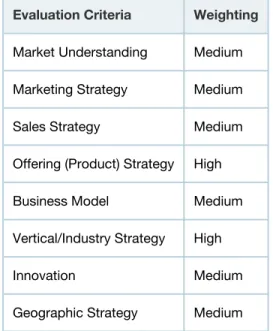
Completeness of Vision (see Table 2) focuses on a vendor's potential. A vendor might succeed financially in the short term without a clearly defined vision or strategic plan, but it won't become a Leader on that basis. A vendor with average vision anticipates change by accurately perceiving market trends and exploiting technology. A vendor with superior vision anticipates, directs and initiates market trends, particularly if it integrates its vision for a broad range of areas, and
capitalizes on its product and service development. Part of our assessment involves looking at how well each vendor understands changing requirements and market trends. We evaluate vendors on their awareness and adoption of emerging functionality, their technical architecture (for example, standards support, Web services and Web 2.0 capabilities), and their focus and abilities in federating and integrating with other content repositories and applications.
Table 2. Completeness of Vision Evaluation Criteria
Evaluation Criteria Weighting
Market Understanding Medium Marketing Strategy Medium
Sales Strategy Medium
Offering (Product) Strategy High
Business Model Medium
Vertical/Industry Strategy High
Innovation Medium
Geographic Strategy Medium
Source: Gartner (September 2014)
Quadrant Descriptions
Leaders
Leaders have the highest combined scores for Ability to Execute and Completeness of Vision. They are doing well and are prepared for the future with a clearly articulated vision. In the context of ECM, they have strong channel partners, presence in multiple regions, consistent financial
performance, broad platform support and good customer support. They are very strong in one or more technologies or vertical markets. Leaders deliver a suite that addresses demand for direct delivery of the majority of core components, although these are not necessarily owned by them, tightly integrated, unique or best of breed in each area. In our assessments, we looked for demonstrated enterprise deployments; integration with other business applications and content repositories; incorporation of social, cloud and mobile capabilities; and vertical-process and horizontal-solution focus. Leaders should drive market transformation.
Challengers
Challengers offer good functionality and have a substantial number of installations, but they lack the vision of Leaders. Nor, typically, do they possess all the core ECM components. Instead, they use partnerships to round out their suites, or they ignore some markets altogether. Challengers may lack a broad ECM focus or wide geographical coverage, but they execute well, despite some product limitations.
Visionaries
Visionaries may offer all capabilities natively or may partner with other vendors to supply some core ECM components. In some cases, Visionaries need to integrate their acquisitions into their existing product portfolios. Visionaries typically show a strong understanding of the market and anticipate shifting market drivers. They may lead efforts relating to standards, new technologies or alternative delivery models, but they have less ability to execute than Leaders. They are building their market presence.
Niche Players
Niche Players typically focus on specific categories of ECM technology (such as transactional content management), midmarket buyers, or supplements to the offerings of business application or stack providers. They may be vendors that are still ramping up their ECM efforts, or that have
neither the Completeness of Vision nor the Ability to Execute to break out of the Niche Players quadrant. Some Niche Players may be "boutiques" that serve only certain regions, industries or functional domains, not the broader market.
Context
ECM solutions and services can be used to help achieve a range of productivity goals, including: ■ Improved effectiveness. Better data quality can lead to better decisions, as time and energy
are not wasted. Project team support environments rely heavily on ECM. Knowledge
repositories based on ECM can help companies build competitive differentiation, innovate and improve customer service.
■ Reduced operational cost. Content-centric processes can be automated by a workflow-based ECM solution that streamlines operations, improves user effectiveness and reduces paper use, handling and storage. Costs can also be reduced by consolidating diverse repositories of content and moving away from legacy content management tools, for which maintenance costs can be significant.
■ Optimized business processes. ECM began with document imaging and document management of high-volume information flowing through repetitive processes. These
transactional types of ECM environment are critical to creating efficiencies in departments for mission-critical processes.
■ Regulatory compliance, better information governance and e-discovery. Companies look to ECM to provide a full life cycle approach to information — from creation to destruction or archiving. ECM tools provide this level of support for many enterprises, beginning with
integration with Microsoft Office or Google Apps for the management of new and collaboratively authored content, and continuing with the use of inherited, predefined metadata to automate the eventual categorization of records. Companies use ECM tools to demonstrate their best efforts at organizing and managing information proactively in fulfillment of legal requirements.
■ Attraction and retention of customers. A Web technology approach based on WCM enables enterprises to use the Web for a range of dynamic, information-based interactions. WCM can be used to deliver interactive channels to existing and prospective customers. Publishing and using social media and socially mediated content is just one of the newer uses of WCM technology.
The context of ECM has shifted from a focus on efficiencies and compliance to one that emphasizes impact and tangible business outcomes.
Market Overview
The worldwide market for ECM software grew by 8.6% in 2013, to a revenue total of $5.1 billion, which indicates that ECM technologies continue to attract more users and deliver value to enterprises.
Creative and varied uses of ECM tools and services abound as organizations move well beyond basic uses, such as for secure file storage in organized libraries, to tackle deeper business
challenges that need strong and flexible process capabilities. This has led organizations increasingly to regard ECM as an environment for solutions that meet a range of business needs, from
departmental requirements to more complex enterprise requirements.
In addition to focusing on solutions to meet this demand, more ECM vendors are offering cloud-based environments, mobile interfaces and social capabilities to meet the market's needs.
As the use of ECM increases via cloud-based deployments and mobile devices, we expect to see a generational "makeover," with ECM moving further away from its roots in networked back-office environments. The concept of "content in context" will be key to this market's evolution as enterprises increasingly need content to be delivered in a personalized fashion — to the right
people, at the right time, on the right devices, and in the context of particular business processes or needs.
Europe Context
25 September 2014
Analyst(s): Hanns Koehler-Kruener
The European ECM market has several differences from the broader ECM market. This research will look at distinguishing factors and special considerations that IT leaders should make when choosing a European ECM solution.
Market Differentiators
The enterprise content management (ECM) market worldwide is expected to grow around 8.6% in 2014. However, that growth is not evenly distributed. High growth rates are being seen in
Eastern Europe, the Middle East and Africa, while Western Europe and the U.S. are
experiencing only single-digit growth (in 2013, Western Europe experienced 2% to 3% growth). However, these higher-growth markets are significantly smaller than the slower-growing
Western European markets.
One reason for the slower growth in Western Europe is its current macroeconomic trends. There aren't as many opportunities for completely new installations; rather, the opportunities are primarily for replacements of existing systems, or for upgrades. While document
management and records management are important issues for many organizations, specific point solutions targeted at individual business problems are often at the forefront of investment. Also, while there is considerable interest in cloud as a deployment model for content
management, its adoption in Western Europe is lagging behind the U.S. because of European regulatory and privacy restraints.
In this European contextualization, we focus on the Western and Eastern European ECM markets, which show enough differentiators for special considerations. Some of the main differences can be grouped into the following aspects:
Language and culture: Each country has its own need for language support, including user interfaces, help files, underlying hard-coded messages, and human and online support. While many of the multinational vendors have the main languages covered, more-unusual languages in smaller markets may be left out of their products' supported languages, and may be covered only with English. This plays into the hands of local vendors, which limit their sales and support to a single region in return for closer relationships with their clients. There are several hundred of these smaller regional vendors all over Western Europe. They have similar functionality to some of the main global players, but neither the depth nor the reach to be real competition in anything but local markets.
Regulations: Although the European Union has tried repeatedly to adopt regulations across Europe for a more uniform approach to things like records management (for example, MoReq2010), there is still plenty of room for local legislation in areas like privacy, data
residency and tax relevancy. For some global players, it is impractical to meet the requirements in smaller markets. This opens the field to local niche players, which can concentrate on
meeting these very specific requirements without having to think about the global implications of code changes. Typical examples can be found in healthcare and local government.
Specialized vendors may concentrate on delivering just one aspect of ECM — such as records management or case management — for a specific use case.
Market saturation and remaining opportunities: The Western European market is largely one for replacements and upgrades. There are few "greenfield" opportunities for ECM in larger organizations; however, there are opportunities among small or midsize businesses (SMBs) that are growing and need new technologies to support their growth initiatives. These SMBs are commonly serviced by a large number of midsize players in different markets. A typical example is the German midmarket, where many SMB clients are serviced by similar-size ECM vendors (with either a regional or industry focus) that deliver some or all ECM components. The Eastern
European market, on the other hand, has been growing faster than Western Europe and has more greenfield opportunities (which are typically seen in smaller buying organizations). Vertical and regional focus: Compared with the larger and somewhat more homogeneous U.S. market, the European market is typically more fragmented, so some providers opt to focus on a specific vertical offering (such as financial services or government) that might appeal to a given country or neighboring countries. For such vendors, this approach enables them to expand beyond the constraints of appealing to only one country. Some vendors try to bolster their opportunities by pursuing a highly focused specialty, such as a quadrilingual Swiss local government solution or an Italian local government solution.
Considerations for Technology and Service Selection
When selecting a vendor in a Western European country, it is important to consider a number of different factors. These can be roughly split into two main areas. The first is based around the products, especially the completeness of a product to cover all aspects of ECM. The second is linked to the company, its financial strengths and its ability to support global customers in a wide variety of languages.
Product focus is the first important consideration. While many of the global vendors in the "Magic Quadrant for Enterprise Content Management" cover all aspects of ECM, local vendors may cover only parts of the product road map, often in response to their specific client use cases. They may decide to leave out aspects like analytics, enterprise federated search, Web content management or social components. Instead, they will focus on core document
management and records management functionality; later, however, this will require additional vendors to be brought in to add more functionality. This can lead to a more fragmented
architectural result, with less out-of-the-box integration and, ultimately, greater complexity. Also, many European vendors have chosen an indirect approach to enter the U.S. or Asia/ Pacific markets using a variety of channel partners. Since these partners may be focused around a particular use case or single aspect of the market, it can limit a vendor's potential to reach into new regions and, thereby, support more widely distributed clients. Whatever makes vendors good choices in their home markets may not work the same across other regions. Support may be fragmented between the partner and the vendor, and training and enablement may also be problematic.
One of the first decisions that IT leaders should examine is the requirement for local support resources. If their ECM project needs to meet international standards, or has the potential to be rolled out across Europe or other regions, then a local German, French or Italian vendor might not have the necessary local support in Asia/Pacific or North America.
Financial viability of the vendor is another factor to consider. Over the past several years, some large vendors have acquired strong regional contenders in an attempt to grow their presence in a particular market or sector. This may lead to a discontinuation of a particular code base or product line, leaving clients with either an end-of-life situation for their particular product, or the need for a costly migration. When evaluating all vendors, it is important for IT leaders to
examine financial viability (for example, growth rate, winning new business, visibility in a market or vertical industry).
There are strong reasons to consider local vendors in particular markets:
■ They usually have very good knowledge of local conditions and regulations, which can lead to superior support.
■ They speak the language of their clients, they are often nearby, and they can involve their development teams for more complex requirements or customizations.
■ Their cloud data centers are likely to be within national borders, making it easier for them to be compliant with local rules.
Notable Vendors
Vendors included in this Magic Quadrant Perspective have customers that are successfully using their products and services. Selections are based on analyst opinion and references that validate IT provider claims; however, this is not an exhaustive list or analysis of vendors in this market. Use this perspective as a resource for evaluations, but explore the market further to gauge the ability of each vendor to address your unique business problems and technical concerns. Consider this research as part of your due diligence and in conjunction with discussions with Gartner analysts and other resources.
CCube Solutions
CCube Solutions is a small ECM vendor in the U.K. market that has focused on delivering a solution to the NHS healthcare sector, since it has a deep understanding of the challenges across that particular sector. Although, at its basis, CCube Solutions is a traditional ECM offering, it has decided to concentrate on delivering services and solutions into a particular sector, not on selling its software product across a wide variety of use cases. In addition, CCube Solutions is expanding its local government and social services clients related to healthcare.
d.velop Group
d.velop, which is headquartered in Germany, has a flexible and technologically advanced suite of products, as well as a strong showing in a variety of use cases. Its main product is d.3 smart suite CE, and it also markets two other product lines. Ecspand is a SharePoint case
management addition that has been popular with enterprises that need such functionality in SharePoint. Foxdox is a mobile, file sync and share solution.
Ever Team
Ever Team is a French ECM vendor with a strong portfolio across the content life cycle. It has particular strengths in French-speaking countries and in the Middle East. The completeness of its offering makes it especially interesting. Its EverSuite range of products covers a wide variety
of use cases in its core across the entire document life cycle. In addition, Ever Team has added strong content analytics capabilities to its product range.
Fabasoft Group
Fabasoft, which is headquartered in Austria, offers on-premises and cloud-based ECM
solutions. Its strongest focus is case management for local and national government solutions, for which it has achieved a strong market presence. The enterprise search product Mindbreeze is part of the Fabasoft family of products, which gives it a very strong search capability.
Formpipe
Formpipe is a Swedish vendor with a good business process management (BPM) story. Its main ECM product, Acadre, is focused on case management. Formpipe has been growing through acquisitions beyond the Swedish market. Its recent acquisitions include Traen (a Danish ECM vendor), Lemoon and GXPi (a U.K. company), which will help it grow its footprint and the availability of additional technologies in its portfolio, which now includes BPM, case management, archiving and capture, especially in the life science market.
M-Files
M-Files is a Finnish ECM vendor that offers its product as an on-premises version and as a cloud version, with strong integration between the environments. M-Files uses a metadata-driven approach to content organization and foldering. It has particular strength in quality assurance, as well as in hybrid cloud and on-premises deployments. Its use of metadata for all aspects of its infrastructure, from security to navigation, gives it a lot of flexibility in
deployments.
Nuxeo
Nuxeo is a French open-source vendor with strong product lines, but a limited international footprint. It is one of the few open-source vendors in the ECM market. Nuxeo does well in French-speaking countries and areas, focusing on document management, case management and digital asset management. It sees itself as a platform onto which specific use cases can b