Breaking down learner isolation:
How social network analysis informs design
and facilitation for online learning
Barb McDonald CPSquare
USA
Nick Noakes
Hong Kong University of Science & Technology Hong Kong [email protected] Bronwyn Stuckey CPsquare Australia [email protected] Susanne Nyrop
Danish University of Copenhagen, Denmark
Abstract
In many online contexts learners report feeling disconnected, and experience an isolation or social exclusion that impacts on their levels of participation, satisfaction and learning. This study examines the ties developed between members of an internationally-offered online workshop that its design emulates aspects of a community of practice. The paper describes application of Social Network Analysis (SNA) strategies to understand the relationships developed that community-based online workshop. The study used purpose built online surveys and semi-structured interviews to surface some of the complex issues at play in developing ‘closeness’ between online participants and the relationship of closeness to meaningful learning.
1. Objectives and Purpose
Social learning theory (Vygotsky 1978, Wenger 1998) suggest learning is takes place in social interaction and social contexts and yet in the online situation research shows there is significant risk for the learner feeling disconnected, isolated and even excluded It is the experience of the members of this research team that those designing and delivering online courses often concentrate, almost exclusively, on the domain and the content of their course. Due to academic pressures and time constraints they fail to realize the importance of the social environment in which the learning takes place. A key issue reported to be responsible for learner failure or lack of satisfaction in online learning experiences is learner isolation and loneliness (Brown, 2001; Kulik and Kulik, 1991; Fishman, 1999; Oliver, 1999; Olugbemiro et al., 1999; Young-Ju Joo et al., 2000, Wang and Newlin, 2000). Social inclusion occurs when someone invites you to engage in relations, and a significant key competence in relationships is negotiation of personal meaning. Those who fail to establish this code of interaction may feel isolated and excluded (Madsen, 2003). Research also suggests that these feelings can be minimized in an open and inclusive context where community practices, tasks and social networking are encouraged (Riel and Polin, 2004). Community, on the other hand, is founded on the notion of social relationships. Analysts in this field have established Social Network Analysis (SNA) as an empirical method to study such social networks and the ties between actors in the network.In recent years, research has been carried out to test and demonstrate the applicability of SNA concepts in online community-based learning environments (Preece, 2000; Wellman, 1997). “Social network analysis (SNA) is the study of social relationships between a set of actors. SNA uses various concepts to evaluate different network properties like centrality, connectivity, and cliques etc, each of which pertain to particular dimensions of the network.” (Rajasekaran & Zaphiris, 2003).
The actual case of online social networking examined in the current research took place in a seven week long workshop; the workshop format is designed to emulate an online community of practice (CoP). The Foundations of Communities of Practice workshop [http://www.cpsquare.org/edu/foundations/] is an international offering of CPSquare [http://www.cpsquare.org/] the Community of Practice (CoP) for practitioners working in the field in Community of Practice development.
2. Background
2.1 An Overview of the Foundations of Communities of Practice Workshop
The seven-week program of the workshop is mediated through a Web interface developed in WebCrossing. The intake
of the workshop is global and in recognition of the time zone issues the mainstay of the community is asynchronous discussion with a lesser use of instant messaging, teleconference and chat. Participants at different stages and tasks in the seven-week program will use other technologies (teleconference, email, messengers), but most discussion is carried out within the Web interface. It is an immersive experience where participants are encouraged to learn about communities of practice by engaging with others in tasks seeing themselves as part of a community of practice. Participants in the workshop are offered opportunities to voluntarily engage in various group formations, roles, tasks, projects and technologies. Over the course of the workshop participants are supported to move in and out of these various levels and modes of participation.
The workshop represents seven weeks of intense activity for: • 20-40 participants
• 3 coaches
• 4 mentors (past participants)
• 3 guest speakers (leaders in the field)
• 3-4 network analyzers (the researchers writing this paper)
The workshop is developed around the Wenger et al (2002) Structural model of communities of practice. This model is made up of the Community, the social fabric; the Domain, the common ground or topic: and the Practice; the repertoire
of the community. The activity of the workshop flows to and from the community aspect through the domain and practice.
Participants spend the first community week in socialization activities and familiarizing themselves with the interface and software. They then move into the Domain phase, which involves a week of wide ranging discussions joined by Etienne Wenger, the thought leader in the workshop. The practical period lasts three weeks where participants, share stories, pose problem cases to solve together and work in project teams. They then return to more conceptual discussion of what they have learned in the domain and end the workshop in a week of final social activity and planning of ways to stay together. The workshop balances the theoretical, practical and social aspects of learning about community while immersing the participants in a community of practice-based environment. The workshop offers a wide variety of working groups, communication tools and roles for the participants to experience as part of the community of practice emulation.
Over the 7 weeks participants engage in:
• whole group discussions (20-30)
• limited number domain table discussions (10)
• households (friendship groups of 4)
Communication is carried out over a choice of tools ranging from:
• web-based asynchronous discussions
• instant messaging
• chat
• teleconferencing
• other tools adopted by groups (third party, shareware, freeware, commercial)
• sometimes face-to-face (if participants share a locale)
Roles in the workshop are designated for the leaders, mentors and facilitators who work and or volunteer in the workshop and model these role behaviours. Participants are also able to adopt these same roles through the various activities and dialogues of the workshop.
Participants can observe and work in the various community roles:
• Legitimate peripheral participant
• active participant
• facilitator
• mentor
• thought leader
There is strong anecdotal evidence that the environment created in the workshop does develop strong ties between people even in the very short intensive time they spend together. How this closeness develops for the group and for individual participants is what this research sought to explore.
2.2 The Research Team
The team of people who carried out the research described in this paper is representative of the both the distributed and true community nature of the workshop itself. The team members were variously interested in understanding if, when, where and how online discussion bought about the greatest individual learning and if and how a facilitator knowing this might foster greater learning. The team members first met online in the November 2002 workshop. Since that time they have formed an ad-hoc research group and developed a meeting place in Groove (peer-to-peer application),
Learning Times Eluminate and Yahoogroups. Team members are academics, researchers, instructional designers,
facilitation consultants and training developers in educational institutions, corporations and private consultancy.
The team met virtually (indeed most have never physically met each other) and researched broadly over several months and came to a realization that research to be carried out would be more powerful if Social Network Analysis (SNA) were also examined in the Foundation’s workshop environment. It seemed vital to know what ties and closeness and conversations were reported by members through social network analysis (who they were talking to) and then
understand and analyze the interactions themselves in discourse analysis (what level they were talking at). The group
invited guest speakers to join them in Groove, speakers known to the group to for having carried out research similar to that the team was interested in. In subsequent workshops in 2003 the team had an opportunity to experiment with the use of online social network analysis tools and engage others in the workshop in discussions of discourse and social network analysis. Over 2003 the team was joined by 2 further members who had participated in the Foundations workshop. Members of the current team are truly globally distributed, residing in Denmark, Argentina, USA, Hong Kong, and Australia. As an ad-hoc group with no budgetary resources the team used freeware or shareware-level costed software and meeting tools and has move to experiment with new tools over the two years of being together. This paper describes the fist research findings of the SNA team examining the interactions of the May 2004 workshop.
2.3 The Social Network Analysis
As a method for examining interactions, connectedness and information sharing, SNA has commonly been used in sociology and organizational studies, however, there is a growing interest in applying it to the field of education and online learning (de Laat et al, 2004). Even in the academic settings, SNA is primarily used within faculty settings to determine information sharing patterns and social capital networks. However, since the questions this research team had
involved a workshop with a finite number of participants (most of whom knew no one else in the workshop) and involved the development of relationships over the course of the short workshop, the team did not feel whole of network SNA practices would be appropriate. Instead, the team decided to focus on personal network development (Egonet) and, therefore, used a method similar to a recent study (de Laat et al, 2004), wherein patterns of interaction in a networked learning community were triangulated, using survey, interviews and SNA data. This approach to the team’s research added new dimensions to the study. The SNA diagrams offer a visual illustration mode of relation and the collaboration patterns that are not revealed in content analysis.
In social network analysis relations can be described in terms of ties between related persons; those who have strong ties are mutually dependant and share many resources, like the members of a family. Having weak ties among related persons, means that you are less dependant emotionally, however, you may be more likely to share information, new ideas and make new contacts. (Granovetter, 1973, 1982, in: Preece, 2000)
The network diagrams produced from SNA survey data are able to visually demonstrate the strength and direction of
the ties between the actors and their alters thereby allowing researchers to analyze the patterns of interaction. The
patterns of interest to this research revolved around the strength and number of the ties and their impact on participant learning. However, the team had to keep in mind that strong ties generally provide emotional support while weaker ties provide information between actors. (Koku and Wellman, 2004). The team felt that knowing whether or not encouraging closeness between participants would assist them in achieving their learning goals. From the course design perspective, do the forced, small groups encourage participant closeness which in turn encourages learning? Is there a direct correlation? What, if any, impact do the learner’s own goals play in the development of ties?
In order to produce the data required for these egonets, the design of the SNA survey it was important to ensure network questions were fit for purpose. This process was to make sure each question was “CAP’D”. (Swarbrick, 2002)
Questions need to relate the:
• Context of the communication activity
• Actors involved
• Purpose of the communication activity
• Direction of the communication exchange
A further dimension that can be added to the CAP'D model: Volume/ Strength in which case the question would look like this: If you had a problem with your PC's network connection (context) how likely (measure of strength) are you to go to (direction) each of the following people (actors) so they would fix it for you (purpose) if they all where equally accessible (context continued.)Scale: Very Unlikely > Unlikely > Neutral >Likely > Very Likely
2.4 Theoretical Framework and Research Questions
The two most active areas of CoP discussion in the workshop are the Domain Inquiry, sets of round table discussions
with the thought leader, and the Practice Lab where small teams of participants work together to develop a product to
address an issue of concern to CoP developers. These were the areas of most readily accessible online discussions and areas that participants in past workshops had in feedback reported the highest levels of learning.
The team determined that it would use Social Network Analysis to explore the following research questions: 1. How and in what ways does closeness relate to learning in a community of practice?
2. Does feeling closer to someone make it more likely that you will learn from/with him/her? 3. How and in what ways might the grouping of participants encourage closeness and learning? 4. How and in what ways might participating in a group task encourage closeness and learning?
These questions were important to the team, as our initial goal was to determine which factors seem to increase learning within the workshop. Ultimately the team seeks to enhance and reinforce those factors within theworkshop that suggest a positive relationship and, therefore, effect participant learning.
The research involved a mixed mode study involving qualitative data collected in an online survey and quantitative data collected through a learning survey and critical event recall interviews with key participants. Data was collected from system logs of workshop groupings, two SNA surveys, an exist survey of learning and interviews with key participants identified form the survey data.
3.1 Survey Design
The workshop has a specific lifecycle as opposed to being conducted a long-standing or long-lived network of actors. For this reason the research did not focus on the whole interrelatedness of the group. Instead, the team focussed on
egonets as a way of identifying and tracking the development of relationships through the personal networks of
individuals. “Ego networks consist of a focal node ("ego") and the nodes to whom ego is directly connected to (these are called "alters") plus the ties, if any, among the alters. Of course, each alter in an ego network has his/her own ego network, and all ego networks interlock to form The human social network.” (Borgatti, 1998). In this case, the ego networks interlock to form the workshop network. The questions the research team developed were designed to focus on egonets.
The research group determined that, since the workshop was only 7 weeks long, two surveys would be completed by the workshop participants: One in the early stages of the workshop (within the first 2 weeks) and one at the close of the workshop. The participants would complete the same survey on these two occasions. In this way, the team would be able to determine changes in closeness attributed to the activity within the workshop.
Six survey questions were designed (Appendix A), the team used SurveyMonkey to collect the data online also
creating a “chase” list to ensure that everyone completed the survey in a timely fashion. SNA requires a close to 100% response rate in order for the data to be seen to be valid. It is not possible to make claims about relationships if all the possible actors are not visible on the network response. So this follow up was necessary and the software made this quite effective. The data was exported form the survey as a series of files and then imported into UCINET for visual analysis, in the network diagram that follow on the participant cases, via NetDraw.
An additional workshop exit survey section was included in the final six week survey and describes areas of greatest personal and group learning in the workshop. This data combined with identification of the closeness allowed the researchers to explore the relationship between closeness, workshop groupings and self-reported meaningful learning experiences.
3.2 Data gathering
Data was collected from participant engagement in the various groups in the workshop and the exit interview (Appendix B). This data is also presented in each of the three key participant stories. The self-reported areas of learning and participant groups were examined to determine which activities and possible groupings were appreciated by learners and identified as contributing to most meaningful. From this activity data three key participants were also identified. These were people who participated in all the activities of the workshop, completed both surveys fully and rated aspects of the workshop learning as very meaningful. The pool of three was selected to also represent the diversity of membership of the workshop in terms of geographic location, language, experience in the domain and sector of work (organisational, consultant, educational)Key participants were identified form this tabular data. Survey data was collected and tabulated and then egonet diagrams were drawn for the key participants.
3.2.1 The tools
The survey tools needed to be online as the participants in the research typically come from all over the world (North and South America, Europe, Asia, Australia and New Zealand). After comparing tools against specific criteria,
SurveyMonkey was selected on the basis of its ease of use, the ability to keep track of survey completion and provide
customer follow-up emails for non-responders, and its low fee (US$20 per month).
There are now quite a number of social network analysis software tools available and most of these are commercial applications whose purchase price can be prohibitively expensive The selection criteria for the social network analysis software was that it needed to be easy to learn and either free or low cost. The team chose UCINET for these reasons.
The files displayed in the following sections were exported from UCINET and drawn in NetDraw demonstrate the
3.3 Data Analysis
The data gathered was very rich and complex and the team determined to extract and examine in depth the data for three key participants who participated across all activities of the workshop.
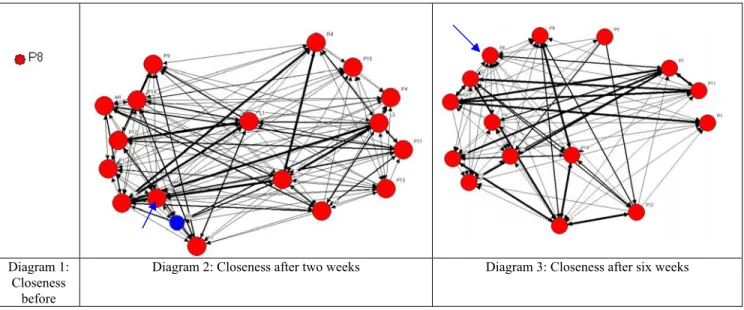
Table 1 is an example of the egonet diagrams for one participant before, at two weeks, and six weeks of the workshop. The dot on the left of the first image indicates an outlier (person with no ties) and in this case that this participant was not known to and did not know anyone in the group before the workshop. The colours of nodes indicate the number of actors linking to them to that node. The arrows are bidirectional where closeness was reciprocated and the thickness of the line indicates the strength of the closeness (distinguishing close or especially close etc). To anonymously present data for this
paper the participants are coded in accordance with their designated roles in the community as (P1-19) for participant, (M1-3) mentor, (L1-4) leader and (R1-7) researcher. Table 1 indicates the egonet for participant 8 a female educator came to the workshop knowing no one (not even the leaders). At a high level this table visually demonstrates the close ties developed to peers in the workshop by this participant.
Diagram 1: Closeness
before
Diagram 2: Closeness after two weeks Diagram 3: Closeness after six weeks
Table 1 Visual representation of the relationships for participant P8 over the time of workshop
The reported closeness was examined against the learner’s group memberships and online discussions to determine where activities and known groupings may have contributed to closeness.
Analysis for the three key participants showed three quite different pictures for developing closeness. Follow-up interviews were carried out with each of these three participants. This interview was designed to qualify the inferences made from the data and to seek further rich text information describing what contributed to closeness and its value in learning. These interviews offer information about the participant’s personal motivations and goals. The interview protocol is included as Appendix C.
4. Findings - Three Key Participant Stories
4.1 Participant Background and Goals
Participant 8
Participant 11
Participant 12
Participant 8 (P8) is a lecturer in Information Technology in the vocational education sector in Australia. She was already very familiar with online learning and had developed a number of online courses using a web-based course management system and had wide experience of facilitating online learning using a range of collaboration tools. She had been involved in facilitating online learning for 4 years prior to the CoP Foundations workshop.
Based on her past experiences of teaching online classes she
understood the need to communicate and show your presence. This understanding came from personal reflection and her experiences of trying to involve students successfully. In addition she has done some reading and participating in online discussions. If she had not had these prior experiences, she felt that she probably would have been much more of a lurker. She doubted that she would have been game to post to the site as it takes practice to build that confidence.
Workshop Goals:
1) Learn as much as she could to improve her own community building skills.
2)
Learn enough to build asuccessful community for a project she had the funding for and the project paid for the workshop.
3)
Engage the “gurus” in this field4)
Participate in a world-wide workshopParticipant 11 (P11) has worked as a Knowledge Management and Innovationresearcher and consultant for a number of years and lives and works primarily in Spain. English is not his first language. He has been working for a not for profit
federation of leading companies and universities working in collaboration to research, develop, test and disseminate the state-of–the-art in Knowledge Management and Business Innovation.
One of the issues he has been researching under the knowledge management umbrella was Communities of Practice. In his current role he has been the primary researcher which involved covering a lot of theory / business cases / interviews to expertson the topic, but admits there were few open examples of online CoPs in Spain (at least for business purpose) to observe let alone participate in. He reported having little experience in on-line environments per se (but had experienced f2f CoP).
Workshop Goals:
1) Obtain online community experience
2)
Meet people with like interests3)
Meet people from different cultures4)
Meet people who could help him further his workParticipant 12 (P12) has a professional background as a librarian and information manager in a local government office in Canada. She also felt that her experiences of working in fairly high functioning teams and having some background in 'team
dynamics' helped her during the workshop. At the time of the workshop, she was a graduate student on a masters program on Knowledge Management and communities of practice at a local university.
NOTE: The curriculum for this Masters degree is an online distance course that requires the CPSquare Foundations of Communities of Practice workshop as one if it’s courses.
Prior to the workshop, she had some experience of monitoring some KM discussion sites (such as KnowledgeBoard). Though she had not participated directly, she had a sense of online interaction at these sites from 'lurking'.
Workshop Goals:
1) Learn and experience more of the dynamics of an online CoP (as opposed to an online course)
environment
2)
Understand more about how to help support those in her own work with government3)
Learn from other'sexperience and knowledge
4)
Exposure directly tointernational thinkers in the field whose work she greatly admired.
4.2
Participant 8’s Story
Before the Workshop
As part of the first survey, the research team asked all participants to rate the strength of their relationship to everyone else in the workshop. P8 reported that she did not have any contact / relationship with anyone prior to the workshop. This is shown in her egonet below.
P8’s Egonet where closeness rated as at least “Acquainted” (c≥3)
Given this it might be expected that her closeness would not develop that strongly over the course of the 7-week workshop. This does seem to be the case with her strongest level of closeness being that of “Acquainted”.
After 2 weeks in the workshop
P8’s Egonet where closeness rated as at least “Acquainted” (c≥3)
P8’s Egonet where closeness rated as at least “Close” (c≥4)
The first two weeks of the Workshop engage the participants in socialization activities and one week of domain specific discussions with the thought leaders and their peers.
After two weeks, P8 rated her self as being at least “Acquainted” with 17 people including nine participants, all the workshop leaders, two out of the three mentors and two out of five researchers. However, she felt that she was not “Close” or “Especially Close” to anyone in the workshop.
After 6 weeks in the workshop
P8’s Egonet where closeness rated as at least “Acquainted” (c≥3)
P8’s Egonet where closeness rated as at least “Close” (c≥4) P8’s Egonet where closeness rated as at least “Especially Close” (c≥5)
By week 6 the participants have engaged in a further three weeks of practical project and problem solving activity. They have worked intensively in small teams and may have met over technology outside the community tools (chat,
telephone, Skype, messenger, etc.) to accomplish this. In addition, all of the participants have rejoined their Domain Tables to further discuss Communities of Practice in the context of their Projects and Leadership tasks.
After 6 weeks, P8 identifies nine people with whom she felt “Acquainted” and nobody she was “Close” or “Especially Close” to. Of these nine “Acquainted” relationships, five were reciprocated (P1, P3, P4, G1, and M2). In fact, one person (P1) rated the reciprocal relationship higher (c=4) than P8. She shared a household and domain table with P1.
Her total network density has increased in that five people noted being at least “Acquainted” with P8, but she did not report a reciprocal relationship.
Summary
P8 came into the workshop knowing no one, but with the goals of:
1) Learn as much as she could to improve her own community building skills.
2) Learn enough to build a successful community for a project she had the funding for and the project paid for the workshop.
3) Engage the “gurus” in this field 4) Participate in a world-wide workshop
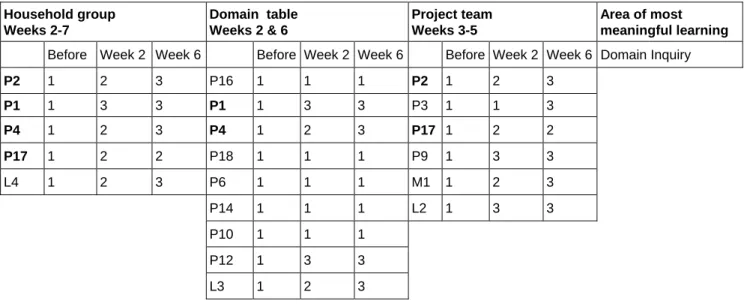
The table below identifies the Degree of Closeness Participant 8 rated each other participant in a particular small grouping for which she was also a member. The last column is P8’s self-identified area of most meaningful learning. The
participants in bold are people who appear more than once in the table and, therefore, in P8’s activities.
Table 1: P8’s Group Associations and Workshop Areas of Most Meaningful Learning
Household group Weeks 2-7 Domain table Weeks 2 & 6 Project team Weeks 3-5 Area of most meaningful learning Before Week 2 Week 6 Before Week 2 Week 6 Before Week 2 Week 6 Domain Inquiry
P2 1 2 3 P16 1 1 1 P2 1 2 3 P1 1 3 3 P1 1 3 3 P3 1 1 3 P4 1 2 3 P4 1 2 3 P17 1 2 2 P17 1 2 2 P18 1 1 1 P9 1 3 3 L4 1 2 3 P6 1 1 1 M1 1 2 3 P14 1 1 1 L2 1 3 3 P10 1 1 1 P12 1 3 3 L3 1 2 3
[Degrees of closeness: 1 = Did/Do not know; 2 = Acquainted; 3 = Getting to know; 4 = Close; 5 = Especially close] The development of her egonet seems to support these goals as, by the end of Week Six of the workshop, she had developed five relationships that were rated as at least “Acquainted” and which were reciprocated. In addition, three of these relationships involved alters who were participants, one involved a guest speaker, and one involved a mentor. While the strength of these ties is not very strong, the range of relationships suggests that she reached out to people in various roles. In her post-workshop interview, she admitted,
“The lack of connections was probably just as much to do with myself and how I build relationships as it was about the workshop.”
P8 reports that she felt she had the most meaningful learning experiences in the Domain Table discussions. Two of her five reciprocated relationships were at her Domain Table. Yet, in her interview, P8 indicated,
“In the domain table, I just felt like a contributor, I didn't get much of a community feel there at all.”
With regard to the Household and Project teams (which were smaller), she said,
“In the household and project, to achieve your task you communicated in a different way... the
communications were more on a personal level... email or chat... and working towards achieving something rather that discussion in general as you did in the domain table.”
Two of her five reciprocated relationships were also members of her Household or Project. She also said,
“Near the end, when we had worked on our project, I felt more connected to that team and perhaps, if we had continued, I would have extended some of those connections.”
P8 seems to have really been able to experience the fullness of the workshop.
Conclusion
It would seem that P8’s interpersonal relationship building is a gradual process where trust is built up over a longer time frame than that of the workshop. Nevertheless, we can see the beginning’s of this relationship building particularly with the actors in her network with whom she had the most interaction in the three groupings of household, domain discussion table and project.
As one of her personal goals was to learn about online community building, she paid particular attention to the way the actors in her network structured and/or facilitated interaction among peers and this was where a considerable amount of learning took place for her.
It is interesting to note though that this participant needed only acquaintance relationships for sustained learning. It would seem that for her closeness is not needed to promote meaningful within the time frame of this workshop. However, there are indications from this participant’s week 6 egonet that sustained meaningful learning would be promoted by closeness and visa versa. It seems most likely that there is a bi-directional relationship between closeness and learning and that in this case, it is mediated through shared action – shared learning by doing through multiple groupings.
4.3
Participant 11’s Story
Before the Workshop
As part of the first survey, the research team asked all participants to rate the strength of their relationship to everyone else in the workshop.
P11’s Egonet where closeness rated as at least “Acquainted” (c≥3)
Participant 11 reports being at least “Acquainted” with four people prior to the workshop. However, when taken to the next level of “closeness” (e.g. reporting a “Close” relationship), he had no workshop members with whom he felt “Close” (c=4) nor “Especially Close” (c=5). ‘Acquainted’ in this connection may, to some extent, be accounted for in exposure to the work of people rather than the person’s themselves. Those noted in P-11’s network as this stage are the leaders and a high profile guest speaker in the workshop. These are all people who have published in the field and their roles on the workshop may precede the start of the workshop.
After 2 weeks in the workshop
The first two weeks of the Workshop engage the participants in socialization activities and one week of domain specific discussions with the thought leaders and their peers.
P11’s Egonet where closeness rated as at least “Close” (c≥4)
P11’s Egonet where closeness rated as at least “Especially Close” (c≥5)
After 2 weeks, Participant 11 identified six people he was “Close” to and one person to whom he was “Especially Close.” A number of these relationships have been developed but at this stage stand as unreciprocated at this level (indicated by the unidirectional arrows). 9 people have now noted at least “Acquainted” level relationships with P11. The predominant relationships at this stage for P11 are with workshop leaders and mentors. Some of the participants noted as close were in the domain table discussions with P11 and others were not. His closest reported relation is to P16, an experienced Australian knowledge management practitioner with both theoretical and practical experience in the field of CoP development. This is the first appearance of this person on P11’s egonet.
After 6 weeks in the workshop
By week 6 the participants have engaged in a further three weeks of practical project and problem solving activity. They have worked intensively in small teams and may have met over technology outside the community tools (chat,
telephone, Skype, messenger, etc.) to accomplish this. In addition, all of the participants have rejoined their Domain Tables to further discuss Communities of Practice in the context of their Projects and Leadership tasks.
P11’s Egonet where closeness rated as at least “Close” (c≥4)
After 6 weeks, P11 identifies 23 people with whom he is at least “Acquainted”. Of these 23 relationships, six were reciprocated (P1, P3, P17, L1, M3, and R3). P11 rated seven of these 23 people as being either “Close” or “Especially Close”. Five of those seven he reports being “Especially Close” to: One Leader, one Mentor, one Guest, and two participants. The two participants (P1 and P16) were both members of his project team. Beyond C=3 (“Acquainted”) the relationships P11 reports are stronger relationships to people than they report to him.
The 23 people P11 reports being at least “Acquainted” with make up the bulk of the density of his network, as only two people (M1 and P4) report an at least “Acquainted” relationship with him that he does not reciprocate.
Summary
P11 came into the workshop acquainted with the work of some of the workshop leaders, but knowing no one else in the workshop. He had the following goals:
1) Obtain online community experience 2) Meet people with like interests 3) Meet people from different cultures
4) Meet people who could help him further his work
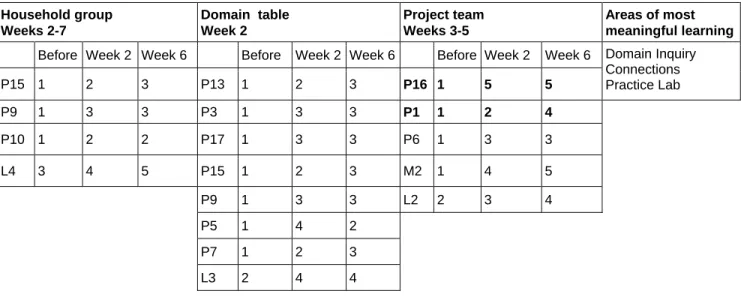
The table below identifies the Degree of Closeness Participant 11 rated each other participant in a particular small grouping for which she was also a member. The last column is P11’s self-identified area of most meaningful learning. The participants in bold are people P11 rated as either “Close” or “Especially Close”.
Table 2: P11’s Group Associations and Workshop Areas of Most Meaningful Learning
Household group Weeks 2-7 Domain table Week 2 Project team Weeks 3-5 Areas of most meaningful learning Before Week 2 Week 6 Before Week 2 Week 6 Before Week 2 Week 6
P15 1 2 3 P13 1 2 3 P16 1 5 5 Domain Inquiry Connections Practice Lab P9 1 3 3 P3 1 3 3 P1 1 2 4 P10 1 2 2 P17 1 3 3 P6 1 3 3 L4 3 4 5 P15 1 2 3 M2 1 4 5 P9 1 3 3 L2 2 3 4 P5 1 4 2 P7 1 2 3 L3 2 4 4
[Degrees of closeness: 1 = Did/Do not know; 2 = Acquainted; 3 = Getting to know; 4 = Close; 5 = Especially close]
The development of his egonet would support these goals. When asked if he had been able to apply what he learned in his interview, P11 said,
“I’m also in the way to organize a conference, International conference on CoP… I am working with L4 and G2, but it is going slowly.”
L4 and G2 were both identified, by Week Six, as people he had become “Especially Close” to. In addition, during P11’s interview, he indicated that he
All of the people P11 stays in contact with he developed a relationship with either in the Domain Inquiry, Connections, or Project, which are the three places he indicated he had the most “Meaningful Learning”. His most regular relationships, talking on a fortnightly basis, are with the members of his project team P1, P16 and M2.
When asked, “Which parts of the workshop were key in meeting your expectations and why?” P11 indicated that it was
“the way the parts were connected and the roles designed were the key, not parts in particular.”
This statement was particularly powerful for the researchers. Especially when the participant clarified by saying,
“Well, I also learned a lot joining and participating in those events (i.e. domain tables or projects) but the one new thing for me was seeing it work. Participation was very important as an alum, but the dynamic as a researcher and consultant.”
P11 was as much watching the work of community builders as he was participating in the activity of the workshop.
Conclusion
It was clear that P11 sought out relationships with those who modeled the practice and had the most experience in community development in this area. His experience in the workshop was a community experience if only to broaden his own personal networks. It could also be said that there is a relationship between the areas of most meaningful learning and the closeness of relationship. It cannot be said in which direction that relationship is causal. Does closeness promote more meaningful learning or does more meaningful learning promote closeness?
4.4 Participant 12’s Story
Before the Workshop
As part of the first survey, the research team asked all participants to rate the strength of their relationship to everyone else in the workshop.
P12’s Egonet where closeness rated as at least “Acquainted” (c≥3)
P12’s Egonet where closeness rated as at least “Especially Close” (c≥5)
P12 already knew 7 members of the workshop, as they were fellow MA students and the MA program leader. These participants make up the better part of her “Acquainted” egonet.
When looking at the next levels of closeness (in the diagrams below), one sees that P12 reports only “Acquainted” relationship to her classmates (above) and a “Close” relationship to the program leader.
It’s interesting to note that the program leader reports an “Especially Close” relationship with P12 before the workshop.
After 2 weeks in the workshop
The first two weeks of the Workshop engage the participants in socialization activities and one week of domain specific discussions with the thought leaders and their peers.
P12’s Egonet where closeness rated as at least “Close” (c≥4)
P12’s Egonet where closeness rated as at least “Especially Close” (c≥5)
After two weeks, P12 has quite a dense egonet of people with whom she feels she is at least “Acquainted.”
When looking at the egonet that reports at least “Close” relationships, one sees that P12’s classmates are feeling closer to her than she is to them. She only reports being close to P18 and L1. P18 is a member of the MA program and was in both her household and domain table.
Again, her program leader (L1) reports a higher degree of closeness than to P12 than P12 reports to feeling for the program leader.
After 6 weeks in the workshop
By week 6 the participants have engaged in a further three weeks of practical project and problem solving activity. They have worked intensively in small teams and may have met over technology outside the community tools (chat, telephone, Skype, messenger, etc.) to accomplish this. In addition, all of the participants have rejoined their Domain Tables to further discuss Communities of Practice in the context of their Projects and Leadership tasks.
Closeness rated as at least “Close” (c≥4)
Closeness rated as at least “Especially Close” (c≥5)
After 6 weeks, P12 identifies 15 people with whom she feels at least “Acquainted”. Of these 15 at least “Acquainted” relationships, four are reciprocated (P13, P14, G2, and L1) – only P14 is part of her Masters program. P12 rated eight of these 15 as at least “Close” and three (P14, G1, and L1) of the eight reciprocated the tie strength.
It’s interesting to note here, that L1 now reports a “Close” (as opposed to “Especially Close”) relationship and P12 reports the “Especially Close” tie to L1.
P12’s network density is particularly high because six people report an at least “Acquainted” relationship with her that she does not reciprocate. Two of those six (M3 and P5) report a “Close” relationship with P12.
Summary
P12 came into the workshop acquainted with the people in her Masters program, but with no connections to anyone else. She indicated goals of:
1) Learn and experience more of the dynamics of an online CoP (as opposed to an online course) environment 2) Understand more about how to help support those in her own work with government
3) Connect with a group of people with similar interests in a voluntary interactive learning environment (CoP) where she could learn from other's experience and knowledge, and to be able to be exposed directly to international thinkers in the field whose work she greatly admired.
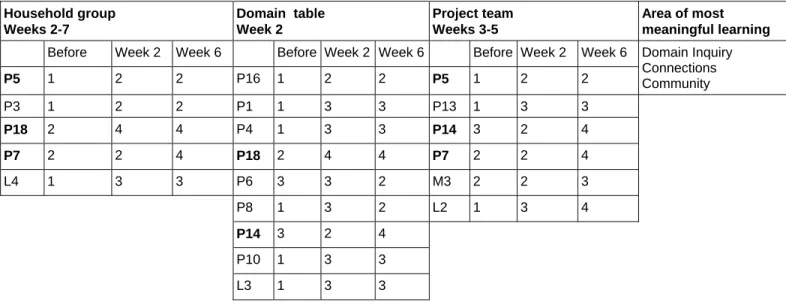
The table below identifies the Degree of Closeness Participant 12 rated each other participant in a particular small grouping for which she was also a member. The last column is P12’s self-identified areas of most meaningful learning. The participants in bold are people who appear more than once in the table and, therefore, in P12’s activities.
Table 3: P12’s Group Associations and Workshop Areas of Most Meaningful Learning
Household group Weeks 2-7 Domain table Week 2 Project team Weeks 3-5 Area of most meaningful learning Before Week 2 Week 6 Before Week 2 Week 6 Before Week 2 Week 6
P5 1 2 2 P16 1 2 2 P5 1 2 2 Domain Inquiry Connections Community P3 1 2 2 P1 1 3 3 P13 1 3 3 P18 2 4 4 P4 1 3 3 P14 3 2 4 P7 2 2 4 P18 2 4 4 P7 2 2 4 L4 1 3 3 P6 3 3 2 M3 2 2 3 P8 1 3 2 L2 1 3 4 P14 3 2 4 P10 1 3 3 L3 1 3 3
[Degrees of closeness: 1 = Do not know; 2 = Acquainted; 3 = Getting to know; 4 = Close; 5 = Especially close]
The development of her egonet seems to support these goals in that, by the end of Week Six, she had a variety of alters in her “Acquainted” relationships and even her “Close” relationships were somewhat diverse (a Leader, a Guest, and one of the two Participants was NOT in her MA program).
The density of her egonet seems to confirm that she made a variety of connections: Even when she did not report an at least “Acquainted” relationship with someone, six people reported at least that strength of a tie to her. In her post-workshop interview she states,
It was good to feel that I knew someone in the space but it turned out that I did nearly all my
communication with people that I DIDN'T know before. So though it was a 'safety blanket' for anticipating participation, it actually was not one that I used once I got into the community.
She also says,
I think that I felt closer to my household and project team members - some of whom on the project team were classmates but once we were online they were more just like other community members.
The progression of her relationship with her MA program leader (L1) is of note, in that the program leader rated their relationship as “Especially Close” Before the Workshop and After Two Weeks while P12 only rated the relationship as “Close” at those two points. Yet, after Six Weeks, the strength of the ties reversed.
Based on her egonet development and her post-workshop interview, it appears to the Research Team that P12 used the workshop opportunities to not only increase the strength of ties to her fellow MA participants, she also took the opportunity to expand her network.
5. Conclusions
The egonets from the social network analysis and the follow-up interviews seem to indicate quite strongly that participating in a variety of group tasks, in which grouping is varied, increases learning by allowing participants to interact more intimate and activity oriented conversations serves to encourage closeness. However, whether or not feeling closer to a community member makes it more likely you will learn from them seems to be dependent on a number of factors.
One factor is the personal learning agenda that each member brings to a community. These personal learning goals appear to impact greatly on the degree of closeness a member wants or needs in order to meet their goals. In other words, the value proposition the community of practice holds for each member can be very different and while personal learning outcomes may be met, closeness may not be needed at all in order to achieve these goals.
For example, participant 8 was strongly driven by seeking access to experts in the field. Thus for her, closeness to fellow participants was not seen as a key factor in achieving this goal. She was information, or domain and practice driven. Consequently, her interactions tended to be transactionally biased resulting in numerous weak ties. In contrast, P11 was coming in looking for people with shared interests, from diverse cultures and who could help him in his future work. Thus for this participant learning was strongly tied to closeness as a result of this personal long term goal. He was both informationally and interpersonally driven and he tended to be community and practice biased. As a result, he tended to be both transactionally and interactionally focused resulting in strong ties with a few participants who met his personal goals. P12 also came in looking to connect to people with shared interests, particularly those in similar work areas as her, but wasn't necessarily looking for longer term work relationships beyond the workshop. She was also keen to experience the dynamics of an online CoP. Out of these three, she was perhaps the most focused on community and the egonets seem to reflect this strongly with stronger ties than the other two.
Whether or not participants knew people coming in to the workshop does not seem to be a key factor in their learning. It is more likely that their personal learning agendas drive the nature and number of the relationships they form in meeting these agendas. The workshop may be an opportunity for participants to extend relationships they have prior to the workshop, but it appears that the design of the workshop may equalize previous relationships. Again, this is dependent upon each member's personal learning agenda.
Another key factor impacting on learning and closeness is the degree of choice participants are given. In this workshop, participants can choose the task for their household, they can choose the subject and outcomes for their project and they can also choose who they will work with in these two small groupings. This, coupled with the fact that the workshop involves them in a number of simultaneous activities with different member’s over a short time frame, makes for an intensive experience which engenders closeness and at the same time increases the likelihood participant's will meet their personal learning goals. Within such a context it is perhaps difficult extricate the exact nature of the relationship between individual activities, learning and closeness.
There are a number of factors that need further research. Some participants did become close to people who were often online at the same time (e.g. P8 and P12). These people were often in very different time zones but their logging in schedule happened to coincide (e.g. one person frequently logged in during their early morning while another frequently logged in during their early evening). These conversations often occurred in synchronous chat and the extent to which these unplanned meetings impact on closeness and learning is worthy of further investigation.
The seven-week context of this workshop obviously is a framing factor for the conclusions being drawn. Thus similar research needs to be carried out on within a planned long-term community of practice where closeness and learning might need to be more entwined if the community is to reach sustainable development.
References
Borgatti, S, (1998) Social Network Analysis Instructional Web Site Accessed online on August 2 2004 at http://www.analytictech.com/networks/Default.htm
Brown, K.G. (2001) Using computers to deliver training: Which employees learn and why? Personnel Psychology, 54(5),
De Laat, M. F., Lally, V. and Lipponen, L. (2004) Patterns of interaction in a networked learning community. In, E-Learn: World Conference on E-Learning in Corporate, Government, Healthcare, and Higher Education, Washington DC, USA, 1-5 Nov 2004. AACE. http://eprints.soton.ac.uk/9765/
Fishman, B.J. (1999) Characteristics of students related to computer-mediated communications activity. Journal of Research on Computing in Education, 32(1), 73-77.
Koku, E. and Wellman, B. (2004) Scholarly Networks as Learning Communities: The Case of Technet (p299-337). In Barab, S.A., Kiling, R., & Gray J.H. (editors) Designing for Virtual Communities in the Service of Learning. Cambridge University Press NY.
Kulik C.C. & Kulik J.A. (1991) Effectiveness of computer-based instruction: An updated analysis. Computers in Human Behavior, 7, 75-94.
Madsen, B., (2003) The vision of social inclusion - a risky process for the professionals and the excluded. Accessed online on August 2 2004 at: http://www.cvustork.dk/filer/key_note.doc
Oliver, R. (1999) Exploring strategies for online teaching and learning. Distance Education, 19 (1), 81-88.
Olugbemiro J., Taplin, M., Fan, R., Chan, M. & Yum, J. (1999). Differences between low and high achieving distance learners in locus of control and metacognition. Distance Education, 20(2), 255-269.
Preece, J.(2000) Online Communities – Designing Usability, Supporting Sociability, Wiley, USA
Rajasekaran & Zaphiris, (2003) Social Network Analysis of a Participatory Designed Online Foreign Language Course, Retrieved online 06/15/04
Riel, M. & Polin, L. (2004) Online Learning Communities: Common Ground and Critical Differences in Designing Technical Environments (p16-52). In Barab, S.A., Kiling, R., & Gray J.H. (editors) Designing for Virtual Communities in the Service of Learning. Cambridge University Press NY.
Swarbrick, A. (2002) Visualising Knowledge Networks: Leveraging the Potential of Work Based Communities”, March 2002. Undergraduate thesis, Computer Science Department, York University. Accessed online on 1 Jun 2004 at KnowledgeBoard: http://www.knowledgeboard.com/download/1938/visualising_knowledge_networks.pdf
Wang, A. and Newlin, M. (2002) Characteristics of students who enroll and succeed in psychology Web-based classes.
Journal of Educational Psychology, 92,1,137-143.
Wellman, B. (1997). An electronic group is virtually a social network. In S. Kiesler (Ed.), Culture of the Internet (pp.
179-205). Mahwah, N.J.: Lawrence Erlbaum Associates. Wenger, E. (1998) Communities of Practice, Cambridge, USA Wenger, E., McDermott, R., and Snyder, W. (2002) Cultivating communities of practice: A guide to managing
knowledge, Boston, Harvard Business School Press
Vygotsky, L.S. (1978). Mind in Society: The development of higher psychological processes. Cambridge, MA: Harvard University Press
Young-Ju Joo, Mimi Bong, & Ha-Jeen Choi. (2000) Self-efficacy for self-regulated learning, academic self-efficacy, and Internet self-efficacy in Web-based instruction. Educational Technology, Research and Development, 48(2), 5-13. Links to tools employed and/or evaluated in the research program
Communication and meeting tools
• WebCrossing http://www.webcrossing.com/Home/
• Compued http://www.compued.com.au
• Yahoo Groups http://groups.yahoo.com/
• Learning Times http://home.learningtimes.net/learningtimes
• Elluminate http://www.elluminate.com/
• Groove http://www.groove.net
SNA data tools
• IKNOW http://www.spcomm.uiuc.edu/Projects/TECLAB/IKNOW/index.html
Survey tools
• SurveyMonkey http://www.surveymonkey.com
• SurveyShare http://www.surveyshare.com/
Appendix A: SNA Survey Questions May 04 Workshop
1) Network mapping can be used to help people identify how they are connected to expertise in the network via their
existing communication networks.
In order for us to be able to do this we would like to ask you to please rate your knowledge of each of the following areas. This is only an initial working list if you have an area of expertise that is not on this list please feel free to add a new option.
None Beginner Experimenter Expert
2) Before coming into this workshop how close were you to each of these people?
Name Did not know Acquainted Getting to know Close Especially Close
3) After this first week of the workshop how close are you to each of these people?
Name Did not know Acquainted Getting to know Close Especially Close
4) During the course of the workshop, how frequently did you talk with or exchange messages or email with each of the
following to discuss something you didn't understand? (This does NOT have to be CoP related.)
Never Infrequently Somewhat frequently Frequently
5) During the course of the workshop, how frequently did you talk with or exchange messages or email with each of the
following to discuss a CoP issue/problem you each have in common?
Never Infrequently Somewhat frequently Frequently
6) If you were in the middle of a CoP project at work, and wanted to brainstorm a few ideas, how likely would you be to
contact each of the following people?
Appendix B: End of Workshop Learning Survey May 04
DA Survey questions to be added into SNA survey administered at end of workshop
1. Where do you feel the most meaningful learning took place for the participants in this workshop? (this question asks you to comment on learning for all the participants in the workshop, rather than your own learning)
[drop down menu, listing following areas – ie respondents can only select one area] Community Circle – introductions
Households Domain Inquiry
Connections – guest speakers Practice Lab
2. Please identify the area/s of most meaningful learning for you:
Most meaningful 1 2 3 4 Least meaningful 5 Community Circle – intro’s
Household Domain Inquiry
Connections – guest speakers Practice Lab
3. Please recall the most significant interaction that contributed to your learning:
Appendix C: Participant Semi-structured Interview Protocol May 04
Participants were asked through what medium they would like to conduct the interview (phone, chat or email). All three chose either chat or email or a mix of the two.
The questions below were used as a guide but the exact number, ordering and wording depending on the participant’s previous responses during the interview.
Prior Experience Questions
• What from your previous experiences helped your learning and interaction with others in the workshop?
• What degree of familiarity did you have with online interaction prior to the workshop?
Learning Goals/Expectations and the extent to which they were met
• What personal or professional learning goals did you have for participating in the workshop? (career, personal interest, curiosity)
• How do you think this (lack of) prior experience impacted on meeting your expectations?
• Did the workshop meet your expectations?
• Which parts of the workshop were key in meeting these and why?
• You reported that ____ is where you learned the most why?
Relationships, Closeness and Groupings • How much did you feel part of the group?
• Did you feel excluded at times? If so, when and why?
• What gave rise to those feelings?
• How easy was it for you to share what you thought (was of value to others)? Why?
• What influenced your decision to join your project?
• How much did your household influence your decision?
• Was there anything else that influenced this? Household? University Cohort? Job responsibilities? Future plans for CoP?
• How did the relationships you developed in the project affect your learning in _____?