Ventilation
The Building Regulations 2000
F
F1
Means of ventilation
APPROVED DOCUMENT
Building Regulations 2000 APPROVED DOCUMENT FV
entilation
2010
edition
www.thenbs.com © Crown Copyright, 2010Copyright in the typographical arrangement rests with the Crown.
This publication, excluding logos, may be reproduced free of charge in any format or medium for research, private study or for internal circulation within an
organisation. This is subject to it being reproduced accurately and not used in a misleading context. The material must be acknowledged as Crown copyright and the title of the publication specified. This document/publication is value added. If you wish to re-use, please apply for a Click-Use Licence for value added material at www.opsi.gov.uk/click-use/system/online/pLogin.asp, or by writing to the Office of Public Sector Information, Information Policy Team, Kew, Richmond, Surrey TW9 4DU. Email: [email protected]. If you require this publication in an alternative format please email [email protected].
ISBN 978 1 85946 370 3 Stock code 72230
Published by NBS, part of RIBA Enterprises Ltd, and available from:
RIBA Bookshops Mail Order
15 Bonhill Street London EC2P 2EA
Telephone orders/General enquiries: 020 7256 7222 Fax orders: 020 7374 2737
Email orders: [email protected] Or order online at:
www.thenbs.com/buildingregs
RIBA Bookshops
RIBA, 66 Portland Place, London W1B 1AD. Telephone 020 7256 7222
Birmingham & Midland Institute, Margaret Street, Birmingham B3 3SP. Telephone 0121 233 2321 RSUA, 2 Mount Charles, Belfast BT7 1NZ. Telephone 02890 323 760
CUBE, 113-115 Portland Street, Manchester M1 6DW. Telephone 0161 236 7691 milkandsugar, 82 Wood Street, Liverpool L1 4DQ. Telephone 0151 707 4380
Coming into effect 1 October 2010
Cert no. TT-COC-002168
ONLINE
VERSION
ONLINE
VERSION
ONLINE
VERSION
FOR BUILDINGS IN 2010
1. This edition of Approved Document F,
Ventilation, replaces the 2006 edition and
comes into force on 1 October 2010.
2. The following are the main changes to the legal requirements in the Building Regulations 2000 and the Building (Approved Inspectors etc) Regulations 2000, and in the technical guidance in Approved Document F.
Changes in the legal requirements
3. All fixed mechanical ventilation systems, where they can be tested and adjusted, shall be commissioned and a commissioning notice given to the Building Control Body.
4. For mechanical ventilation systems installed in new dwellings, air flow rates shall be measured on site and a notice given to the Building Control Body. This shall apply to intermittently-used extract fans and cooker hoods, as well as continuously running systems.
5. The owner shall be given sufficient information about the ventilation system and its maintenance requirements so that the ventilation system can be operated to provide adequate air flow.
Changes in the technical guidance
6. Ventilation provisions have been increased for dwellings with a design air permeability tighter than or equal to 5 m3/(h.m2) at 50 Pa.
7. For passive stack ventilators, the stack
diameter has been increased to 125 mm for all room types. Use of passive stack ventilation in inner wet rooms has been clarified.
8. The guidance for ventilation when a kitchen or bathroom in an existing dwelling is refurbished has been clarified.
9. Reference is made to a new Domestic ventilation
compliance guide for guidance on installing,
inspecting, testing and commissioning ventilation systems in dwellings. Guidance in Appendices D and E of the 2006 edition of Approved Document F, on installing passive stack ventilators and fans in dwellings, can now be found in Section 2 of the new guide.
and issued by the First Secretary of State for the purpose of providing practical guidance with respect to the requirements of the Building Regulations 2000 (as amended).
Approved Document A: Structure
2004 edition incorporating 2004 amendments
Approved Document B (Fire safety) – Volume 1: Dwellinghouses
2006 edition (amended 2010)
Approved Document B (Fire safety) – Volume 2: Buildings other than dwellinghouses
2006 edition incorporating 2007 amendments (amended 2010)
Approved Document C: Site preparation and resistance to contaminants and moisture
2004 edition
Approved Document D: Toxic substances
1992 edition incorporating 2002 amendments
Approved Document E: Resistance to the passage of sound
2003 edition incorporating 2004 amendments
Approved Document F: Ventilation
2010 edition
Approved Document G: Sanitation, hot water safety and water efficiency
2010 edition
Approved Document H: Drainage and waste disposal
2002 edition
Approved Document J: Combustion appliances and fuel storage systems
2010 edition
Approved Document K: Protection from falling collision and impact
1998 edition incorporating 2000 amendments
Approved Document L1A: Conservation of fuel and power – New dwellings
2010 edition
Approved Document L1B: Conservation of fuel and power – Existing dwellings
2010 edition
Approved Document L2A: Conservation of fuel and power – New buildings other than dwellings
2010 edition
Approved Document L2B: Conservation of fuel and power – Existing buildings other than dwellings
2010 edition
Approved Document M: Access to and use of buildings
2004 edition
Approved Document N: Glazing – safety in relation to impact, opening and cleaning
1998 edition incorporating 2000 amendments
Approved Document P: Electrical safety – Dwellings
2006 edition
Approved Document to support regulation 7: Materials and workmanship
1992 edition incorporating 2000 amendments
ONLINE
VERSION
ONLINE
VERSION
ONLINE
VERSION
F
Contents
PAGE
Section 1: Introduction 2
What is an Approved Document? 2
Consideration of technical risk 2
How to use this Approved Document 2
Where you can get further help 3
Responsibility for compliance 3
Section 2: The Requirements 4
LIMITATIONS ON REQUIREMENTS 6
Section 3: General guidance 7
Key terms 7
Types of work covered by this
Approved Document 9
Exemptions 9
Notification of work covered by the
ventilation requirements 9
Historic and traditional buildings 10
Material change of use 11
Live–work units 11
Mixed use developments 11
Materials and workmanship 11
Independent certification schemes 12
Standards and technical specifications 12
The Workplace (Health, Safety and
Welfare) Regulations 1992 12
Section 4: Introduction to the provisions 13
Performance 13
The purpose of ventilation 13
Types of ventilation 13
The ventilation strategy adopted in
Approved Document F 14
Control of ventilation 15
Performance-based guidance 15
Equivalent area of ventilators 15
Ventilation effectiveness 16
Source control 16
Noise 16
Fire precautions 17
Modular and portable buildings 17
Installation of ventilation systems 17
Air flow rate testing and commissioning
of ventilation systems 17
Provision of information 18
Section 5: New dwellings 19
Introduction to provisions 19
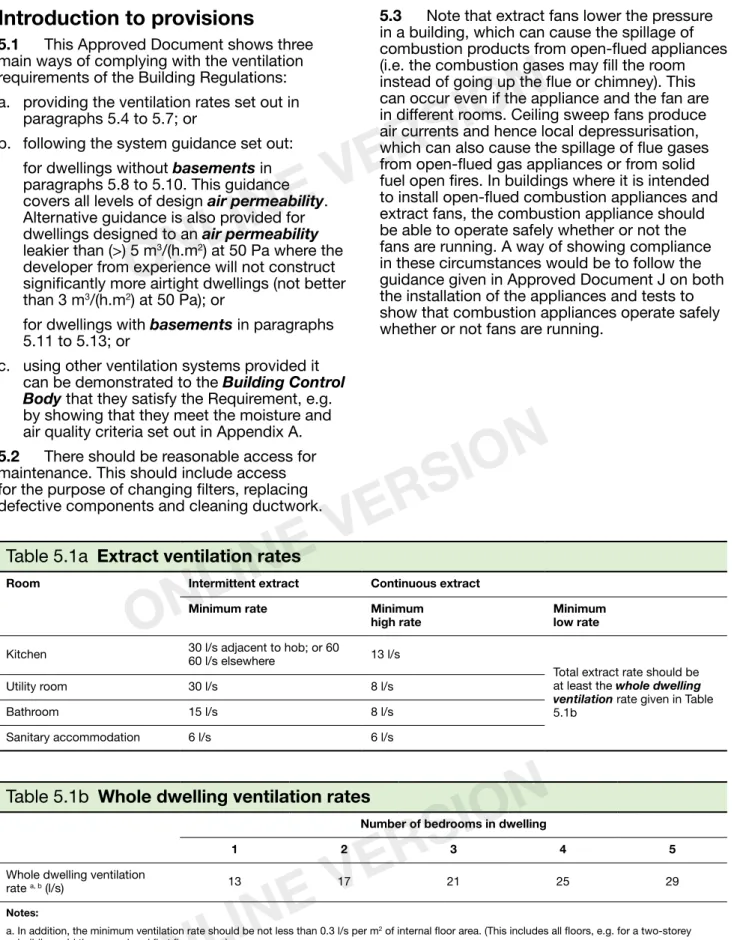
Ventilation rates 20
Ventilation systems for dwellings without
basements 20
Ventilation systems for basements 31
Ventilation of a habitable room through
another room or a conservatory 31
PAGE
Section 6: New buildings other
than dwellings 33
General 33
Access for maintenance 33
Offices 33
Ventilation of other types of building 35
Ventilation of car parks 38
Alternative approaches for ventilation
of car parks 38
Section 7: Work on existing buildings 39
General 39
Addition of a habitable room (not including a conservatory) to an existing dwelling 39 Addition of a wet room to an
existing dwelling 40
Addition of a conservatory to an
existing building 40
Refurbishing a kitchen or bathroom in
an existing dwelling 40
Section 8: Standards and other
publications 41
Standards 41
Other publications 41
Appendix A: Performance-based ventilation 43
Introduction 43
Performance criteria for dwellings 43
Assumptions used in applying performance
criteria for dwellings in Section 5 43
Performance criteria for buildings other
than dwellings 45
Assumptions used in applying performance
criteria for offices in Section 2 45
References 46
Appendix B: Purge ventilation 47
Introduction 47
Windows 47
External doors (including patio doors) 47
Further information 48
Appendix C: Example calculations for
ventilation sizing for dwellings 49
Introduction 49
Details of ground-floor flat 49
Details of semi-detached house 52
Appendix D: Minimising ingress of external
pollution into buildings in urban areas 55
Control of ventilation intakes 55
Location of exhaust outlets 56
References 56
ONLINE
VERSION
ONLINE
VERSION
ONLINE
VERSION
What is an Approved Document?
1.1 This document has been approved by the
Secretary of State to provide practical guidance on ways of complying with the requirements in Part F of Schedule 1 to, and regulations 16C, 20AA and 20C (in so far as it relates to fixed systems for mechanical ventilation) of, the Building Regulations 2000 (SI 2000/2531) for England and Wales, as amended, and regulations 12AA and 12C (in so far as it relates to fixed systems for mechanical ventilation) of the Building (Approved Inspectors etc) Regulations 2000 (SI 2000/2532) for England and Wales (as amended). The Building Regulations 2000 and the Building (Approved Inspectors etc) Regulations 2000 are referred to throughout the remainder of this document as ‘the Building Regulations’ and ‘the Approved Inspectors Regulations’ respectively.
1.2 The intention of issuing Approved Documents is to provide guidance about compliance with specific aspects of building regulations in some of the more common
building situations. They set out what, in ordinary circumstances, may be accepted as reasonable provision for compliance with the relevant requirement(s) of building regulations to which they refer.
1.3 If guidance in an Approved Document
is followed there will be a presumption of compliance with the requirement(s) covered by the guidance. However, this presumption can be overturned, so simply following guidance does not guarantee compliance; for example, if the particular case is unusual in some way, then ‘normal’ guidance may not be applicable. It is also important to note that there may well be other ways of achieving compliance with the requirements. There is therefore no obligation to adopt any particular solution contained in this Approved Document if you would prefer to meet the relevant requirement in some other way. Persons intending to carry out building work should always check with
their Building Control Body, either the local
authority or an approved inspector, that their proposals comply with building regulations. 1.4 It is important to note that this Approved Document, as well as containing guidance, also contains extracts from the Regulations. Such regulatory text must be complied with as stated. The guidance contained in this
Approved Document relates only to the particular requirements of building regulations that the document addresses (set out in Section 2). However, building work may be subject to more than one requirement of building regulations. In such cases the work will also have to comply with any other applicable requirements of building regulations.
1.5 There are Approved Documents that give
guidance on each of the Parts of Schedule 1 and on regulation 7. A full list of these is provided at the back of this document.
Consideration of technical risk
1.6 The construction of new buildings, and building work to existing buildings, must satisfy all the technical requirements set out in the Building Regulations. When considering the incorporation of ventilation measures in dwellings, attention should also be paid in particular to the need to comply with Part B (fire safety), Part C (site preparation and resistance to contaminants and moisture), Part E (resistance to the passage of sound), Part L (conservation of fuel and power), Part J (combustion appliances and fuel storage systems) and Part P (electrical safety), as well as Part F. The adoption of any particular ventilation measure should not involve unacceptable technical risk of, for instance, creating a cold bridge. Designers and builders should refer to the relevant Approved Documents and to other generally available good practice guidance to help minimise these risks.
How to use this Approved
Document
1.7 This Approved Document is subdivided
into eight sections as detailed below.
This introductory section sets out the general
context in which the guidance in the Approved Document must be considered.
Section 2 sets out the relevant legal
requirements as published in the Building Regulations.
Section 3 contains key terms and general
guidance on the types of building work covered by Approved Documents, how to deal with ‘special’ areas of buildings that contain dwellings, procedures for notifying work, materials and workmanship, certification and standards, and health and safety issues.
Section 4 details the principles of ventilation and
its control.
Section 5 details the guidance for ventilation of
dwellings.
Section 6 details the guidance for ventilation of
buildings other than dwellings.
Section 7 details the guidance for ventilation of
existing buildings.
Section 8 lists standards and other publications
referred to in the text.
Note. A reference to a publication is likely to
be made for one of two main reasons: either the publication contains additional or more comprehensive technical detail, which it
Section 1: Introduction
ONLINE
VERSION
ONLINE
VERSION
ONLINE
VERSION
F
would be impractical to include in full in the Approved Document but which is needed to fully explain ways of meeting the requirements; or it is a source of more general information. The reference will be to a specified edition of the document. The Approved Document may be amended from time to time to include new references or to refer to revised editions where this aids compliance.
1.8 In this document the following conventions have been adopted to assist understanding and interpretation:
a. Regulations extracted from the Building Regulations or the Approved Inspectors Regulations as amended are printed against a green background. There is a legal
obligation to comply with the requirements in these regulations. In contrast, the technical guidance in the Approved Document shows one or more ways of complying with ventilation requirements in typical situations. b. Key terms are defined in paragraph 3.1 and
are printed in bold italic text. c. Additional commentary in italic text
appears after some numbered paragraphs. This commentary is intended to assist understanding of the preceding paragraph or sub-paragraph, or to direct readers to sources of additional information, but is not part of the technical guidance itself.
Where you can get further help
1.9 If you do not understand the technical guidance or other information set out in this Approved Document and the additional detailed technical references to which it directs you, there are a number of routes through which you can seek further assistance:
• the CLG website: www.communities.gov.uk; • the Planning Portal website:
www.planningportal.gov.uk;
• if you are the person undertaking the building work you can seek assistance either from your local authority building control service or from your approved inspector (depending on which building control service you are using, or intend to use, to certify compliance of your work with the requirements of the Building Regulations);
• businesses registered with a competent person self-certification scheme may be able to get technical advice from their scheme operator;
• if your query is of a highly technical nature you may wish to seek the advice of a specialist, or industry technical body, in the area of concern.
Responsibility for compliance
1.10 It is important to remember that if you
are the person (e.g. designer, builder, installer) carrying out building work to which any
requirement of building regulations applies you have a responsibility to ensure that the work complies with any such requirement. The building owner may also have a responsibility for ensuring compliance with building regulation requirements and could be served with an enforcement notice in cases of non-compliance.
ONLINE
VERSION
ONLINE
VERSION
ONLINE
VERSION
2.1 This Approved Document, which takes effect on 1 October 2010, deals with the requirements of Part F: Ventilation of Schedule 1 to, and regulations 16C, 20AA and 20C (in so far as it relates to fixed systems for mechanical ventilation) of, the Building Regulations, as amended. It also deals with regulations 12AA and 12C (in so far as it relates to fixed systems for mechanical ventilation) of the Approved Inspectors Regulations, as amended.
Requirement Limits on application
Means of ventilation
F1(1). There shall be adequate means of ventilation provided for people in the building.
F1(2). Fixed systems for mechanical ventilation and any associated controls must be commissioned by testing and adjusting as necessary to secure that the objective referred to in sub-paragraph (1) is met.
Requirement F1 does not apply to a building or space within a building:
a. into which people do not normally go; or b. which is used solely for storage; or
c. which is a garage used solely in connection with a single dwelling.
Requirements in the Building Regulations 2000 Information about ventilation
16C —(1) This regulation applies where Part F1(1) of Schedule 1 imposes a requirement in relation to building work.
(2) The person carrying out the work shall not later than five days after the work has been completed give sufficient information to the owner about the building’s ventilation system and its maintenance requirements so that the ventilation system can be operated in such a manner as to provide adequate means of ventilation.
Mechanical ventilation air flow rate testing
20AA.—(1)This regulation applies where paragraph F1(1) of Schedule 1 imposes a requirement in relation to the creation of a new dwelling by building work.
(2) The person carrying out the work shall, for the purpose of ensuring compliance with paragraph F1(1) of Schedule 1— (a) ensure that testing of the mechanical ventilation air flow rate is carried out in accordance with a procedure
approved by the Secretary of State; and
(b) give notice of the results of the testing to the local authority. (3) The notice referred to in paragraph (2)(b) shall—
(a) record the results and the data upon which they are based in a manner approved by the Secretary of State; and (b) be given to the local authority not later than five days after the final test is carried out.
Commissioning
20C. – (A1) This regulation applies to building work in relation to which paragraph F1(2) of Schedule 1 imposes a requirement, but does not apply to the provision or extension of any fixed system for mechanical ventilation or any associated controls where testing and adjustment is not possible.
(1) This regulation applies to building work in relation to which paragraph L1(b) of Schedule 1 imposes a requirement, but does not apply to the provision or extension of any fixed building service where testing and adjustment is not possible or would not affect the energy efficiency of that fixed building service.
(2) Where this regulation applies the person carrying out the work shall, for the purpose of complying with paragraph F1(2) or L1(b) of Schedule 1, give to the local authority a notice confirming that the fixed building services have been commissioned in accordance with a procedure approved by the Secretary of State.
(3) The notice shall be given to the local authority –
(a) not later than the date on which the notice required by regulation 15(4) is required to be given; or (b) where the regulation does not apply, not more than 30 days after the completion of the work.
Section 2: The Requirements
ONLINE
VERSION
ONLINE
VERSION
ONLINE
VERSION
THE REquIREMENTS
F1
Requirements in the Building (Approved Inspectors etc) Regulations 2000 Mechanical ventilation air flow rate testing
12AA.—(1)This regulation applies where paragraph F1(1) of Schedule 1 imposes a requirement in relation to the creation of a new dwelling by building work.
(2) The person carrying out the work shall, for the purpose of ensuring compliance with paragraph F1(1) of Schedule 1— (a) ensure that testing of the mechanical ventilation air flow rate is carried out in accordance with a procedure
approved by the Secretary of State; and
(b) give notice of the results of the testing to the building control body. (3) The notice referred to in paragraph (2)(b) shall—
(a) record the results and the data upon which they are based in a manner approved by the Secretary of State; and (b) be given to the approved inspector not later than five days after the final test is carried out.
Commissioning
12C. – (A1) This regulation applies to building work which is the subject of an initial notice, and in relation to which paragraph F1(2) of Schedule 1 imposes a requirement, but does not apply to the provision or extension of any fixed system for mechanical ventilation or any associated controls where testing and adjustment is not possible.
(1) This regulation applies to building work which is the subject of an initial notice, and in relation to which paragraph L1(b) of Schedule 1 imposes a requirement, but does not apply to the provision or extension of any fixed building service where testing and adjustment is not possible or would not affect the energy efficiency of that fixed building service.
(2) Where this regulation applies the person carrying out the work shall, for the purpose of complying with paragraph F1(2) or L1(b) of Schedule 1, give to the approved inspector a notice confirming that the fixed building services have been commissioned in accordance with a procedure approved by the Secretary of State.
(3) The notice shall be given to the approved inspector –
(a) not later than the date on which the notice required by regulation 15(4) is required to be given; or (b) where the regulation does not apply, not more than 30 days after the completion of the work.
ONLINE
VERSION
ONLINE
VERSION
ONLINE
VERSION
LIMITATION ON REQUIREMENTS
2.2 In accordance with regulation 8 of the Building Regulations, the requirements in Parts A to D, F to K and N and P (except for paragraphs G2, H2 and J6) of Schedule 1 to the Building Regulations do not require anything to be done except for the purpose of securing reasonable standards of health and safety for persons in or about buildings (and any others who may be affected by buildings or matters connected with buildings).
2.3 Paragraph G2 is excluded as it deals with water efficiency and paragraphs H2 and J6 are excluded from regulation 8 because they deal directly with prevention of the contamination of water. Parts E and M (which deal, respectively, with resistance to the passage of sound and access to and use of buildings) are excluded from regulation 8 because they address the welfare and convenience of building users. Part L is excluded from regulation 8 because it addresses the conservation of fuel and power.
ONLINE
VERSION
ONLINE
VERSION
ONLINE
VERSION
F1
Key terms
3.1 The following are key terms used in this document:
Air permeability isthe physical property used
to measure the airtightness of the building fabric. It is defined as air leakage rate per hour per square metre of envelope area at a test reference pressure differential across the building envelope of 50 Pascal (50 N/m2). The design air permeability
is the target value set at the design stage.
Airtightness isa general descriptive term for
the resistance of the building envelope to
infiltration with ventilators closed. The greater
the airtightness at a given pressure difference across the envelope, the lower the infiltration.
Automatic control iswhere a ventilation device
is opened and closed or switched on and off or its performance is adjusted by a mechanical or electronic controller which responds to a relevant stimulus. That stimulus is usually related to the humidity of the air in a room, pollutant levels (e.g. carbon dioxide concentration in a room), occupancy of the space (e.g. using a passive infra-red motion detector) or pressure difference across the device (e.g. due to the wind outside).
Background ventilator isa small ventilation
opening designed to provide controllable whole
building ventilation. See Diagram 1.
Basement (in relation to dwellings) isa dwelling,
or a usable part of a dwelling (i.e. a habitable room), that is situated partly or entirely below ground level. Note that a cellar is distinct from a basement in that it is used only for storage, heating plant or purposes other than habitation.
Bathroom isa room containing a bath or shower
and, in addition, can also include sanitary
accommodation.
BCB or Building Control Body isa local
authority or an approved inspector.
Cellar is a part of a dwelling which is situated
partly or entirely below ground level, and is distinct from a basement in that it is used only for storage, heating plant or purposes other than habitation.
Closable opening isa ventilation opening
which may be opened and closed under either
manual or automatic control.
Common space is a space where large numbers
of people are expected to gather, such as a shopping mall or cinema/theatre foyer. For the purposes of this Approved Document, a space used solely or principally for circulation (e.g. a corridor or lift lobby in an office building or blocks of flats) is not a common space.
Diagram 1
Provisions for background
ventilation
Continuous operation iswhere a mechanical
ventilation device runs all the time, e.g. mechanical extract ventilation (MEV) and mechanical ventilation with heat recovery (MVHR). The air flow rate provided by the mechanical ventilation need not be constant but may be varied, under either manual or
automatic control, in response to the demand
for pollutant or water vapour removal.
Section 3: General guidance
ONLINE
VERSION
ONLINE
VERSION
ONLINE
VERSION
Equivalent area isa measure of the
aerodynamic performance of a ventilator. It is the area of a sharp-edged circular orifice which air would pass through at the same volume flow rate, under an identical applied pressure difference, as the opening under consideration.
Extract ventilation isthe removal of air directly
from a space or spaces to outside. Extract ventilation may be by natural means (e.g. by
passive stack ventilation) or by mechanical
means (e.g. by an extract fan or central system).
Free area isthe geometric open area of a
ventilator.
Gross internal volume isthe total internal
volume of the heated space, including the volume of all furniture, internal walls, internal floors, etc.
Habitable room isa room used for dwelling
purposes but which is not solely a kitchen,
utility room, bathroom, cellar or sanitary
accommodation.
Infiltration isthe uncontrolled exchange of air
between inside a building and outside through cracks, porosity and other unintentional openings in a building, caused by pressure difference effects of the wind and/or stack effect.
Intermittent operation iswhere a mechanical
ventilator does not run all the time, usually running only when there is a particular need to remove pollutants or water vapour (e.g. during cooking or bathing). Intermittent operation may be under either manual control or automatic control.
Manual control iswhere a ventilation device is
opened and closed, or switched on and off, or its performance is adjusted by the occupants of a room or building (see automatic control).
Occupiable room isa room in a building other
than a dwelling that is occupied by people, such as an office, workroom, classroom or hotel bedroom, but not a bathroom, sanitary
accommodation, utility room or rooms or
spaces used solely or principally for circulation, building services plant or storage purposes.
Passive stack ventilation (PSV) isa ventilation
system using ducts from terminals in the ceiling of rooms to terminals on the roof that extract air to outside by a combination of the natural stack
effect and the pressure effects of wind passing
over the roof of the building.
Permanent opening is a ventilation opening
which is permanently fixed in the open position.
Purge ventilation ismanually controlled
ventilation of rooms or spaces at a relatively high rate to rapidly dilute pollutants and/or water vapour. Purge ventilationmay be provided by natural means (e.g. an openable window) or by mechanical means (e.g. a fan).
Purpose-provided ventilation isthat part
of the ventilation of a building provided by ventilation devices designed into the building (e.g. via background ventilators, PSV, extract fans, mechanical ventilation or air-conditioning systems).
Sanitary accommodation isa space containing
one or more water closets or urinals. Sanitary accommodation containing one or more
cubicles counts as a single space if there is free circulation of air throughout the space.
Stack effect isthe pressure differential between
inside and outside a building caused by differences in the density of the air due to an indoor/outdoor temperature difference.
Surface water activity isa measure of the
availability of water to micro-organisms, and is determined from the ratio of the vapour pressure of the water in the substrate to that of pure water at the same temperature and pressure. This ratio is, in steady-state conditions, numerically equal to the equilibrium relative humidity of the air, except that the latter is commonly expressed as a percentage (from IEA Annex 14 source book, 1991).
Utility room isa room containing a sink or other
feature or equipment which may reasonably be expected to produce water vapour in significant quantities.
Ventilation isthe supply and removal of air (by
natural and/or mechanical means) to and from a space or spaces in a building. It normally comprises a combination of purpose-provided
ventilation and infiltration.
Ventilation opening isany means of
purpose-provided ventilation (whether it is permanent
or closable) which opens directly to external air, such as the openable parts of a window, a louvre or a background ventilator. It also includes any door which opens directly to external air.
Wet room isa room used for domestic activities
(such as cooking, clothes washing and bathing) which give rise to significant production of airborne moisture, e.g. a kitchen, utility room or
bathroom. For the purposes of Part F, sanitary
accommodation is also regarded as a wet room.
Whole building ventilation (general ventilation)
isnominally continuous ventilation of rooms or spaces at a relatively low rate to dilute and remove pollutants and water vapour not removed by operation of extract ventilation, purge
ventilation or infiltration, as well as supplying
outdoor air into the building. For an individual dwelling this is referred to as ‘whole dwelling
ventilation’.
ONLINE
VERSION
ONLINE
VERSION
ONLINE
VERSION
generAl guiDAnce
F1
Types of work covered by this
Approved Document
3.2 This Approved Document gives guidance
on what, in ordinary circumstances, may be considered reasonable provision for compliance with the requirements of Part F of Schedule 1 to, and regulations 16c, 20AA and 20c (in so far as it relates to fixed systems for mechanical ventilation) of, the Building regulations, and regulations 12AA and 12c (in so far as it relates to fixed systems for mechanical ventilation) of the Approved inspectors regulations, for those erecting new dwellings and buildings other than dwellings, or carrying out work on existing buildings.
Exemptions
3.3 The erection or extension of a number of classes of buildings is exempt under regulation 9 of, and Schedule 2 to, the Building regulations from the requirements to comply with the requirements in paragraph 3.2 above:
a. buildings controlled under the Manufacture and Storage of explosives regulations 2005, the nuclear installations Act 1965 or included in the schedule of monuments maintained under section 1 of the Ancient Monuments and Archaeological Areas Act 1979;
b. detached buildings into which people do not normally go, or go only intermittently for the purpose of inspecting or maintaining fixed plant or machinery, provided that the buildings are a specified distance from buildings into which people normally go; c. greenhouses providing that the principal
purpose of the building is not retailing, packing or exhibiting;
d. agricultural buildings (as defined), provided that no part of the building is used as a dwelling, that the building is at least one and one-half times its height from a building containing sleeping accommodation, and that there is a fire exit not more than 30 metres distant from any point in the building. Agricultural buildings used principally for retailing, packing or exhibiting fall outside the exemption;
e. temporary buildings not intended to remain in place for more than 28 days;
f. ancillary buildings used for the disposal of buildings or building plots on site; buildings on the site of construction or civil engineering works for use only during the course of those works and containing no sleeping accommodation; and buildings on the site of mines and quarries which do not contain dwellings, nor are used as offices or showrooms;
g. detached single-storey buildings, with less than 30 m2 floor area and containing no
sleeping accommodation, which are either constructed substantially of non-combustible material or at least 1 metre from the boundary of their curtilage;
h. detached buildings of less than 30 m2
floor area, designed and intended to be used as shelters from nuclear, chemical or conventional weapons and used for no other purpose, provided the excavation for the building is at least 1 metre plus the depth of excavation from any other exposed structure; i. detached buildings of less than 15 m2 floor
area containing no sleeping accommodation; and
j. extensions of buildings at ground level with a floor area less than 30 m2 by the addition of
a conservatory, porch, covered yard, covered way, or carport open on at least two sides.
Notification of work covered by
the ventilation requirements
3.4 in most cases where it is proposed to carry out notifiable ventilation work on a building it will be necessary to notify the work to a BCB
in advance. This notification would usually be by way of a full plans application or a building notice given to a local authority, or an initial notice given jointly with the approved inspector. However, there are three circumstances where such work need not be notified to a BCB in advance:
Competent person self-certification schemes 3.5 it is not necessary to notify a BCB in advance of work which is to be carried out by a person registered with a competent person self-certification scheme for that type of work. in order to join such a scheme a person must demonstrate competence to carry out the type of work the scheme covers, and also the ability to comply with all relevant requirements in the Building regulations.
3.6 Where work is carried out by a person registered with a competent person scheme, regulation 16A of the Building regulations and regulation 11A of the Approved inspectors regulations require that the occupier of the building be given, within 30 days of the completion of the work, a certificate confirming that the work complies fully with all applicable building regulation requirements. There is also a requirement that the BCB be given a notice of the work carried out, again within 30 days of the completion of the work. These certificates and notices are usually made available through the scheme operator.
ONLINE
VERSION
ONLINE
VERSION
ONLINE
VERSION
3.7 BCBs are authorised to accept these certificates and notices as evidence of
compliance with the requirements of the Building Regulations. Local authority inspection and enforcement powers remain unaffected, but they are normally used only in response to a complaint that work does not comply.
3.8 There are a number of competent person
schemes for the installation of mechanical ventilation and air-conditioning systems in buildings. A list of the schemes and the types of work for which they are authorised is available at www.communities.gov.uk.
Emergency repairs
3.9 Where the work involves an emergency
repair, e.g. to a failed fan, in accordance with regulation 12(7) of the Building Regulations there is no need to delay making the repair in order to make an advance notification to the BCB where this is not practicable. However, in such cases it will still be necessary for the work to comply with the relevant requirements and to give a notice to the BCB at the earliest opportunity, unless an installer registered under an appropriate competent person scheme carries out the work. A completion certificate can then be issued in the normal way.
Minor works
3.10 Where the work is of a minor nature as
described in the schedule of non-notifiable work (Schedule 2B to the Building Regulations), the work must still comply with the relevant requirements but need not be notified to the
BCB. In relation to mechanical ventilation and air-conditioning systems such work includes: • replacement of parts, or the addition of an
output or control device where testing and adjusting is not possible or would not affect the system’s energy efficiency;
• provision of a self-contained mechanical ventilation or air-conditioning appliance provided that any electrical work is exempt from a requirement to give advance notice to a BCB, and testing and adjustment is not possible or would not affect its energy
efficiency, and the appliance is not installed in a room containing an open-flued combustion appliance. Examples might be a cooker hood, a bathroom extract fan or a room
air-conditioning unit, which cannot be adjusted from their factory settings.
Historic and traditional buildings
3.11 As mentioned above in paragraph
3.3a, buildings included in the schedule of monuments maintained under section 1 of the Ancient Monuments and Archaeological Areas Act 1979 are exempt from compliance with the requirements of the Building Regulations. There are other classes of buildings where special considerations may apply in deciding what is adequate provision for ventilation:
a. listed buildings;
b. buildings in conservation areas;
c. buildings which are of architectural and historical interest and which are referred to as a material consideration in a local authority’s development plan or local development framework;
d. buildings which are of architectural and historical interest within national parks, areas of outstanding natural beauty, registered historic parks and gardens, registered battlefields, the curtilages of scheduled ancient monuments, and world heritage sites; and
e. buildings of traditional construction with permeable fabric that both absorbs and readily allows the evaporation of moisture.
3.12 When undertaking work on or in
connection with a building that falls within one of the classes listed above, the aim should be to provide adequate ventilation as far as is reasonable and practically possible. The work should not prejudice the character of the host building or increase the risk of long-term deterioration of the building fabric or fittings.
3.13 The guidance given by English Heritage1
and in BS 7913 Principles of the conservation of historic buildings should be taken into account in determining appropriate ventilation strategies for building work in historic buildings.
3.14 In general, new extensions to historic
or traditional dwellings should comply with the standards of ventilation as set out in this Approved Document. The only exception would be where there is a particular need to match the external appearance or character of the extension to that of the host building.
3.15 Particular issues relating to work in historic
buildings that warrant sympathetic treatment and where advice from others could therefore be beneficial include:
a. restoring the historic character of a building that has been subject to previous
inappropriate alteration, e.g. replacement windows, doors and rooflights;
1 www.english-heritage.org.uk
ONLINE
VERSION
ONLINE
VERSION
ONLINE
VERSION
GENERAL GuIDANCE
F1
b. rebuilding a former historic building (e.g. following a fire or filling a gap site in a terrace);
c. making provision for the fabric of historic buildings to ‘breathe’ to control moisture and potential long-term decay problems.
3.16 In determining what is adequate ventilation
in the circumstances, it is important that the
BCB takes into account the advice of the local authority’s conservation officer. The views of the conservation officer are particularly important where building work requires planning permission and/or listed building consent.
Material change of use
3.17 A change of use occurs when there
is a change in the purposes for which, or circumstances in which, an existing building or part of a building is used. For the purposes of building regulations, a material change of use occurs where, after the change:
a. the building or part of a building is used as a dwelling, where previously it was not;
b. the building or part of a building contains a flat, where previously it did not;
c. the building or part of a building is used as a hotel or a boarding house, where previously it was not;
d. the building or part of a building is used as an institution, where previously it was not;
e. the building or part of a building is used as a public building, where previously it was not; f. the building or part of a building is not a
building described in Classes I to VI in Schedule 2, where previously it was; g. the building or part of a building, which
contains at least one dwelling, contains a greater or lesser number of dwellings than it did previously;
h. the building or part of a building contains a room for residential purposes, where previously it did not;
i. the building or part of a building, which contains at least one room for residential purposes, contains a greater or lesser number of such rooms than it did previously; or
j. the building or part of a building is used as a shop, where previously it was not.
3.18 Where a building undergoes any of the
material changes of use described above it will be necessary for the resultant building to comply with the requirements of Part F of the Building Regulations. Where only part of the building undergoes a material change of use, normally only that part needs to comply with the requirements of Part F.
Live-work units
3.19 If a unit contains both living
accommodation and space to be used for commercial purposes (e.g. workshop or office), the whole unit should be treated as a dwelling for the purposes of this Approved Document as long as the commercial part could revert to domestic use. This could be the case if, for example: a. there is direct access between the
commercial space and the living accommodation; and
b. both are contained within the same thermal envelope; and
c. the living accommodation occupies a
substantial proportion of the total area of the unit.
Sub-paragraph c means that the presence of (e.g.) a small manager’s flat in a large non-domestic building would not result in the whole building being treated as a dwelling. Similarly, the existence of a room used as an office or utility space within a dwelling would not mean that the building should not be treated as a dwelling.
Mixed use developments
3.20 When constructing a dwelling as part
of a larger building that contains other types of accommodation, sometimes called a mixed use development, Section 5 of this Approved Document should be used for guidance in relation to each individual dwelling. Section 6 gives guidance relating to the non-dwelling parts of such buildings.
Materials and workmanship
3.21 Any building work which is subject to
the requirements imposed by Schedule 1 to the Building Regulations should, in accordance with regulation 7, be carried out with proper materials and in a workmanlike manner.
3.22 You may show that you have complied
with regulation 7 in a number of ways. These include demonstrating the appropriate use of: • a product bearing CE marking in accordance
with the Construction Products Directive (89/106/EEC), as amended by the CE Marking Directive (93/68/EEC), the Low Voltage
Directive (2006/95/EC) and the EMC Directive (2004/108/EC); or
• a product complying with an appropriate technical specification (as defined in those Directives mentioned above), a British Standard, or an alternative national technical specification of a Member State of the
European union or Turkey, or of another State signatory to the Agreement on the European Economic Area (EEA) that provides an equivalent level of safety and protection; or
ONLINE
VERSION
ONLINE
VERSION
ONLINE
VERSION
• a product covered by a national or European certificate issued by a European Technical Approval issuing body, provided the
conditions of use are in accordance with the terms of the certificate.
3.23 You will find further guidance in the
Approved Document which specifically supports regulation 7 on materials and workmanship.
Independent certification schemes
3.24 There are many uK product certification
schemes. Such schemes certify compliance with the requirements of a recognised standard that is appropriate to the purpose for which the material is to be used. Materials which are not so certified may still conform to a relevant standard.
3.25 Many certification bodies that approve
products under such schemes are accredited by the united Kingdom Accreditation Service (uKAS). Such bodies can issue certificates only for the categories of product covered under the terms of their accreditation.
3.26 BCBs may take account of the
certification of products, components, materials or structures under such schemes in deciding whether the relevant standard has been complied with. Similarly, BCBs may take account of the certification of the installation or maintenance of products, components, materials or structures under such schemes in deciding on compliance with the relevant standard. Nonetheless,
before accepting that certification constitutes compliance with building regulations, a BCB
should establish in advance that the relevant scheme is adequate for that purpose.
Standards and technical
specifications
3.27 Building regulations are made for specific
purposes, including securing the health, safety, welfare and convenience of people in or about buildings; furthering the conservation of fuel and power; furthering the protection or enhancement of the environment; and facilitating sustainable development. Guidance contained in standards and technical approvals is relevant to the extent that it relates to those purposes. However, the guidance may also address other aspects of performance such as serviceability, or aspects which, although they relate to health and safety, are not covered by building regulations.
3.28 When an Approved Document makes
reference to a named standard or document, the relevant version of the standard or document is the one listed at the end of the Approved Document. until the reference in the Approved Document is revised, the standard or document listed remains the approved source, but if the issuing body has published a revised or updated version, any content that addresses the relevant requirements of the Building Regulations may be used as a source of guidance.
3.29 The appropriate use of a product in
compliance with a European Technical Approval as defined in the Construction Products Directive will meet the relevant requirements.
3.30 The Department intends to issue periodic
amendments to its Approved Documents to reflect emerging harmonised European standards. Where a national standard is to be replaced by a European harmonised standard, there will be a coexistence period during which either standard may be referred to. At the end of the coexistence period the national standard will be withdrawn.
The Workplace (Health, Safety and
Welfare) Regulations 1992
3.31 The Workplace (Health, Safety and
Welfare) Regulations 1992, as amended, apply to the common parts of flats and similar buildings if people such as cleaners, wardens and caretakers are employed to work in these common parts. These Regulations contain some requirements which affect building design. The main
requirements are now covered by the Building Regulations, but for further information see
Workplace health, safety and welfare, Workplace (Health, Safety and Welfare) Regulations 1992, Approved Code of Practice and guidance, HSE publication L24, 1996.
3.32 Where the requirements of the Building
Regulations that are covered by this Approved Document do not apply to dwellings, the provisions may still be required in the situations described above in order to satisfy the Workplace Regulations.
ONLINE
VERSION
ONLINE
VERSION
ONLINE
VERSION
F1
Performance
4.1 The purpose of this section is to outline briefly what ventilation in buildings is for and the philosophy behind the guidance for ventilation given in Approved Document F. More detail is given in some of the informative Appendices at the end of this Approved Document.
4.2 The key aim of the requirement of Part F1(1) is that a ventilation system is provided that, under normal conditions, is capable of limiting the accumulation of moisture, which could lead to mould growth, and pollutants originating within a building which would otherwise become a hazard to the health of the people in the building.
4.3 In general terms, the requirement may be achieved by providing a ventilation system which: a. extracts, before it is generally widespread,
water vapour from areas where it is produced in significant quantities (e.g. kitchens, utility
rooms and bathrooms);
b. extracts, before they are generally
widespread, pollutants which are a hazard to health from areas where they are produced in significant quantities (e.g. rooms containing processes or activities which generate harmful contaminants);
c. rapidly dilutes, when necessary, pollutants and water vapour produced in habitable
rooms, occupiable rooms and sanitary
accommodation;
d. makes available over long periods a minimum supply of outdoor air for occupants and disperses, where necessary, residual
pollutants and water vapour. Such ventilation should minimise draughts and, where
necessary, should be reasonably secure and provide protection against rain penetration; e. is designed, installed and commissioned to
perform in a way which is not detrimental to the health of the people in the building; and f. is installed to facilitate maintenance where
necessary.
4.4 The guidance in this Approved Document
has not been formulated to deal with the products of tobacco smoking.
4.5 Ventilation systems in buildings result in energy being used to heat fresh air taken in from outside and, in mechanical ventilation systems, to move air into, out of and/or around the building. Energy efficiency is dealt with under Part L of Schedule 1 to the Building Regulations but consideration should be given to mitigation of ventilation energy use, where applicable, by employing heat recovery devices, efficient types of fan motor and/or energy-saving control devices in the ventilation system.
The purpose of ventilation
4.6 Ventilation is simply the removal of ‘stale’
indoor air from a building and its replacement with ‘fresh’ outside air. It is assumed within the Approved Document that the outside air is of reasonable quality.
4.7 Ventilation is required for one or more of
the following purposes:
a. provision of outside air for breathing; b. dilution and removal of airborne pollutants,
including odours;
c. control of excess humidity (arising from water vapour in the indoor air);
d. provision of air for fuel-burning appliances (which is covered under Part J of the Building Regulations).
4.8 Ventilation may also provide a means to
control thermal comfort but this is not controlled under the Building Regulations. Part L addresses minimising energy use due to the effects of solar gain in summer.
4.9 The airborne pollutants and water vapour mentioned in paragraph 4.7b and c above include those that are released from materials and products paragraph used in the construction, decoration and furnishing of a building, and as a result of the activities of the building’s occupants.
4.10 The pollutant(s) of most importance will
vary between building types (e.g. dwelling, office, factory), building uses (e.g. industrial process, shop, commercial kitchen), and even from room to room within a building (e.g. kitchen, shower room, conference room, photocopier room). Common pollutants in a dwelling are moisture and combustion products from unflued appliances (e.g. gas, oil or solid fuel cookers) and chemical emissions from construction and consumer products. Note that the ventilation system capacity, if used appropriately, is usually sufficient to remove odours arising from normal occupant activities within a dwelling. In an office building, body odour is often the key pollutant, but there are a number of other pollutant sources including the building itself, furnishings, printers and photocopiers.
Types of ventilation
4.11 Buildings are ventilated through a
combination of infiltration and
purpose-provided ventilation:
• Infiltration is the uncontrollable air exchange
between the inside and outside of a building through a wide range of air leakage paths in the building structure.
• Purpose-provided ventilation is the
controllable air exchange between the inside and outside of a building by means of a range of natural and/or mechanical devices.
Section 4: Introduction to the provisions
ONLINE
VERSION
ONLINE
VERSION
ONLINE
VERSION
4.12 It is important to minimise the
uncontrollable infiltration and supply sufficient
purpose-provided ventilation. Air tightness
measures to limit infiltration are covered in Part L of the Building Regulations and its supporting Approved Documents. Approved Document F recommends methods of achieving sufficient
purpose-provided ventilation, allowing for a
reasonably high level of airtightness.
4.13 For the purposes of Part F, a reasonably
high level of airtightness means a level which is significantly tighter than the minimum target value recommended under Part L, because all new buildings are expected to better the target value to some degree. Through good design and execution, domestic and non-domestic buildings can currently achieve an air permeability down to around 2 to 4 m3/(h.m2) of envelope area at 50
Pascal (Pa) pressure difference. Some buildings constructed are tighter than this. It can be anticipated that there will be a continual trend towards more airtight buildings due to drivers for higher energy efficiency and lower carbon emissions.
4.14 The ventilation provisions recommended
for new dwellings in this Approved Document have been specified for two standard designs of
air permeability:
• In the default option, the guidance assumes zero air permeability and thus no
infiltration. The building ventilation is reliant
entirely on installed purpose-provided
ventilation, thus ensuring sufficient
ventilation for dwellings of all levels of air
permeability. This option should be
particularly suitable when intending to construct a more airtight dwelling, or where the person carrying out the building work does not have previous experience of closely matching design with as-constructed air
permeability and may, as a consequence,
achieve a significantly better performance than designed.
• In the alternative option, the guidance assumes an infiltration of 0.15 air changes per hour (ach). The recommended
purpose-provided ventilation is less as infiltration
contributes to the total amount of ventilation. This option is most appropriate when
designing to an air permeability leakier than 5 m3/(h.m2) at 50 Pa, and it is expected from
experience that the measured air permeability
will be close to the design value and will not be better than 3 m3/(h.m2) at 50 Pa.
Paragraphs 5.8 to 5.10 provide further information.
The ventilation strategy adopted in
Approved Document F
4.15 Approved Document F adopts the
following strategy. (Systems which comply with the strategy are described in Sections 5 and 6.)
• Extract ventilation from rooms where most
water vapour and/or pollutants are released, e.g. due to activities such as cooking, bathing or photocopying. This is to minimise their spread to the rest of the building. This extract may be either intermittent or continuous.
• Whole building/dwelling ventilation to
provide fresh air to the building and to dilute and disperse residual water vapour and pollutants not dealt with by extract
ventilation as well as removing water vapour
and other pollutants which are released throughout the building (e.g. by building materials, furnishings, activities and the presence of occupants). Whole building/
dwelling ventilation provides nominally
continuous air exchange. The ventilation rate may be reduced or ceased when the building is not occupied. It may be necessary to purge the air when the building is re-occupied.
• Purge ventilation throughout the building
to aid removal of high concentrations of pollutants and water vapour released from occasional activities such as painting and decorating or accidental releases such as smoke from burnt food or spillage of water.
Purge ventilation is intermittent, i.e. required
only when such occasional activities occur.
Purge ventilation provisions may also be
used to improve thermal comfort, although this is not controlled under the Building Regulations.
4.16 This ventilation strategy can be delivered
by a natural ventilation system or a mechanical ventilation system or a combination of both (i.e. ‘mixed-mode’ or ‘hybrid’ ventilation system). For mainly naturally ventilated buildings, it is common to use a combination of ventilators to achieve this strategy (e.g. for dwellings it is common to use intermittent extract fans for
extract ventilation, trickle ventilators for whole
dwelling ventilation and windows for purge
ventilation). For mechanically ventilated or
air-conditioned buildings, it is common for the same ventilators to provide both local extract and
whole building / dwelling ventilation and, for
buildings other than dwellings, to provide purge
ventilation as well.
4.17 The ventilation systems and devices
mentioned in this document are examples of those commonly in use at the time of writing. Other ventilation systems and devices, perhaps following a different strategy (e.g. positive input ventilation or supply air windows), may provide acceptable solutions, provided it can be demonstrated to the BCB (e.g. by use of a product or system covered by a national or
ONLINE
VERSION
ONLINE
VERSION
ONLINE
VERSION
INTRODuCTION TO THE PROVISIONS
F1
European certificate issued by a European Technical Approval issuing body, provided the conditions of use are in accordance with the terms of the certificate) that they meet Requirement F1. The assessment of the suitability of a ventilation system should take account of the design air permeability of the building, and the fact that the completed building may be ‘tighter’ than the design value because of variability in construction quality.
Control of ventilation
4.18 It is important that ventilation is
controllable so that it can maintain reasonable indoor air quality and avoid waste of energy. These controls can be either manual
(i.e. operated by the occupant) or automatic. Demand-controlled ventilation systems employ sensors to detect the level of occupancy, water vapour or other pollutants and adjust the ventilation rate accordingly in order to avoid over-ventilation and so reduce energy consumption.
4.19 Manually controlled trickle ventilators (the
most common type of background ventilators) can be located over the window frames, in window frames, just above the glass or directly through the wall (see Diagram 1 in Key terms). They are positioned typically 1.7 m above floor level to avoid discomfort due to cold draughts. These ventilators often incorporate a simple flap that allows users to shut off the ventilation – depending on external weather conditions. Trickle ventilators are intended to be normally left open in occupied rooms in dwellings. A window with a night latch position is not recommended because of the difficulty of measuring the
equivalent area, the greater likelihood of
draughts and the potential increased security risk in some locations.
4.20 In dwellings, humidity-controlled devices
are available to regulate the humidity of the indoor air and, hence, minimise the risk of condensation and mould growth. These are best installed as part of an extract ventilator in moisture-generating rooms (e.g. kitchen or
bathroom). Humidity control is not appropriate
for sanitary accommodation, where the
dominant pollutant is normally odour. Trickle ventilators are available which ‘throttle down’ the ventilation flow passage(s) according to the pressure difference across the ventilator to reduce draught risks during windy weather. Manufacturers should be consulted when selecting the correct type of pressure-controlled trickle ventilator.
4.21 Other types of automatic control may
be suitable for regulating ventilation devices (e.g. trickle ventilators, ventilation fans, dampers and air terminal devices) in dwellings. In such cases, it is important that the device controls the ventilation air supply and/or extract according to the need for ventilation in the space to remove or dilute indoor pollutants and water vapour. Trickle ventilators with automatic controls should also
have manual override, so that the occupant can close the ventilator to avoid draughts and fully open the ventilator to provide maximum air flow when required. For pressure-controlled trickle ventilators that are fully open at typical conditions (e.g. 1 Pa pressure difference), only a manual close option is recommended.
4.22 In buildings other than dwellings, more
sophisticated automatic control systems are available. These may be based on sensors located within the building, e.g. occupancy sensors (using local passive infra-red detectors) or indoor carbon dioxide concentration sensors (using electronic carbon dioxide detectors) as an indicator of occupancy level and, therefore, body odour.
Performance-based guidance
4.23 This Approved Document focuses on
performance-based guidance which suggests to the designer what level of ventilation should be sufficient, rather than how it should be achieved. Therefore, the designer has the freedom to use whatever ventilation provisions suit a particular building, including the use of innovative products and solutions, if it can be demonstrated that they meet the performance standard recommended in this Approved Document.
4.24 The actual performance criteria for
acceptable levels of moisture and pollutants are given in Appendix A. The air flow rates necessary to meet the performance criteria are given in the main guidance.
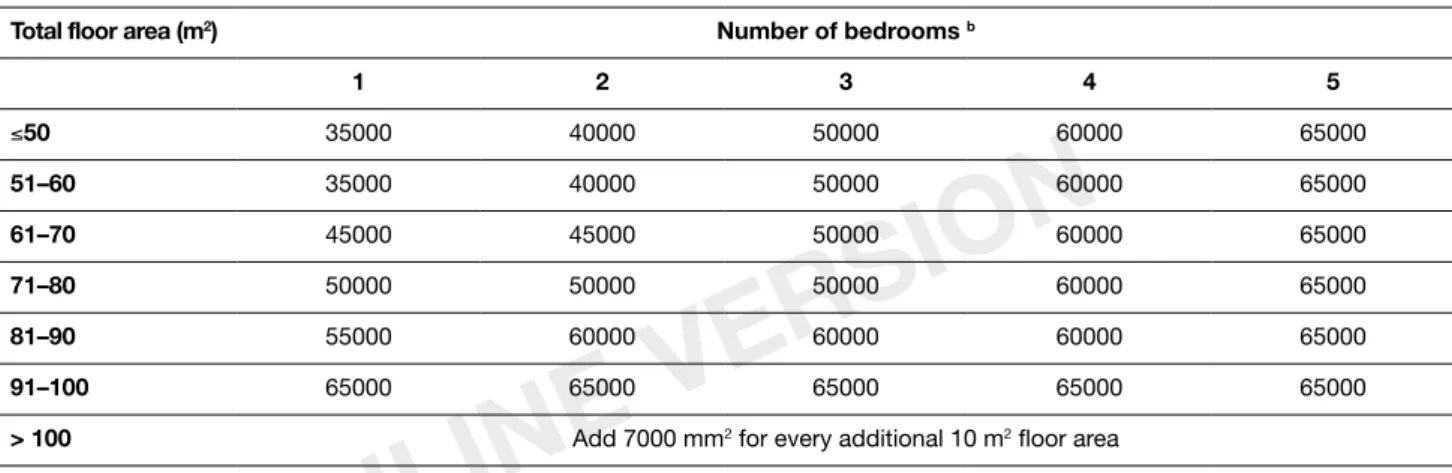
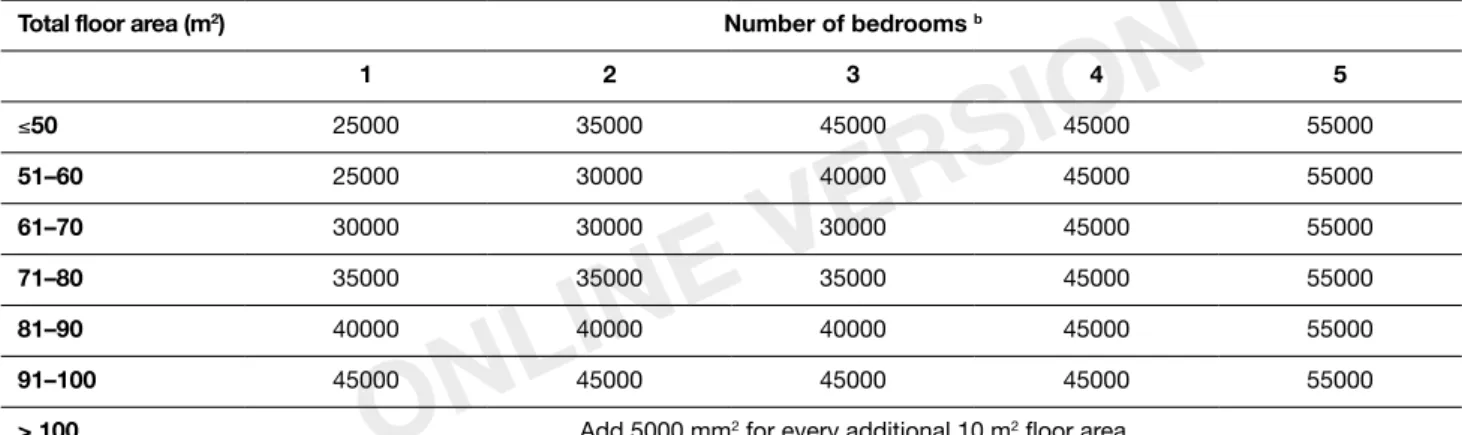
4.25 Simple guidance in the form of ventilator
sizes for the whole dwelling is also provided to make it easier for designers to meet building regulations requirements in common situations.
Equivalent area of ventilators
4.26 Equivalent area is used in the Approved
Document instead of free area for the sizing
of background ventilators (including trickle
ventilators) because it is a better measure of the air flow performance of a ventilator. unlike equivalent area, free area is simply the physical size of the aperture of the ventilator but may not accurately reflect the air flow performance which the ventilator will achieve. The more complicated and/or contorted the air flow passages in a ventilator, the less air will flow through it. So, two different ventilators with the same free area will not necessarily have the same air flow performance. A European Standard, BS EN 13141-1:2004 (Clause 4), includes a method of measuring the equivalent area of background
ventilator openings.
4.27 As equivalent area cannot be verified
with a ruler, it will be difficult to demonstrate to
Building Control Bodies that trickle ventilators
and similar products have the correct equivalent area unless it is clearly marked on the product. For this reason, it is preferable to use ventilators which have the equivalent area (in mm² at
ONLINE
VERSION
ONLINE
VERSION
ONLINE
VERSION
1 Pa pressure difference), or equivalent area
per metre (where the equivalent area of the product varies according to length) marked on the product in an easily visible location from the inside of the dwelling when installed. Where it is not practical for the manufacturer to mark the ventilator because it can be used in conjunction with a range of other components, some form of temporary marking for the installed system should be acceptable to the BCB.
Ventilation effectiveness
4.28 Ventilation effectiveness is a measure of
how well a ventilation system works in terms of delivering the supply air to the occupants of a building. If the supply air is mixed fully with the room air before it is breathed by the occupants, the ventilation effectiveness is 1. If the supply air is extracted from the room before it mixes with any room air, the ventilation effectiveness is 0. If the supply air reaches the occupant without mixing with any room air, the ventilation effectiveness tends towards infinity.
4.29 This is important as a system with
a higher ventilation effectiveness achieves acceptable pollutant levels at the occupant’s breathing zone for a lower air supply rate, and offers potentially significant energy savings. However, it has been decided not to make an allowance for any reduction of fresh air supply rates based on ventilation effectiveness in Approved Document F at this time. This is because ventilation effectiveness is dependent on the ventilation system design, its installation and the way in which occupants use the space. While it is possible to predict what the ventilation effectiveness of a system should be, there is currently insufficient knowledge of the actual ventilation effectiveness achieved in buildings to allow designers to guarantee performance and so avoid significant under-ventilation by reducing air supply rates. This is because ventilation effectiveness may be influenced by factors beyond the designer’s control such as occupant usage (e.g. seating plan and use of computers within a space and whether the space is being heated or cooled by the ventilation air). In the designs shown in this Approved Document, it has been assumed that the ventilation effectiveness is 1.0. CIBSE Guide A provides further
information on ventilation effectiveness.
Source control
4.30 A complementary strategy for achieving
good indoor air quality is to reduce the release of water vapour and/or air pollutants into the indoor air, i.e. source control. Source control is not considered within the main guidance of the Approved Document owing to limited knowledge about the emission of pollutants from constructi