The development of downside accounting beta as a
measure of risk
Rutkowska-Ziarko, Anna and Pyke, Chris
Available at http://clok.uclan.ac.uk/21549/
RutkowskaZiarko, Anna and Pyke, Chris (2017) The development of downside accounting beta as
a measure of risk. Economics and Business Review, 3 (17) (4). pp. 5565. ISSN 23921641
It is advisable to refer to the publisher’s version if you intend to cite from the work.
10.18559/ebr.2017.4.4For more information about UCLan’s research in this area go to
http://www.uclan.ac.uk/researchgroups/
and search for <name of research Group>.
For information about Research generally at UCLan please go to
http://www.uclan.ac.uk/research/
All outputs in CLoK are protected by Intellectual Property Rights law, including
Copyright law. Copyright, IPR and Moral Rights for the works on this site are retained
by the individual authors and/or other copyright owners. Terms and conditions for use
of this material are defined in the
http://clok.uclan.ac.uk/policies/
CLoK
Central Lancashire online Knowledge
Volume 3 (17) Number 4 2017
Volume 3 (1 7) Number 4 201 7Poznań University of Economics and Business Press
ISSN 2392-1641
Economics
and Business
Economics and Busi
ness
R
eview
Review
Subscription
Economics and Business Review (E&BR) is published quarterly and is the successor to the Poznań University of Economics Review. Th e E&BR is published by the Poznań University of Economics and Business Press.
Economics and Business Review is indexed and distributed in ProQuest, EBSCO, CEJSH, BazEcon and Index Copernicus. Subscription rates for the print version of the E&BR: institutions: 1 year – €50.00; individuals: 1 year – €25.00. Single copies: institutions – €15.00; individuals – €10.00. Th e E&BR on-line edition is free of charge.
CONTENTS
ARTICLES
Determinants of central banks’ fi nancial strength: evidence from Central and Eastern European countries (Barbara Pajdo)
Stock price volatility and fundamental value: evidence from Central and Eastern European countries (Jerzy Gajdka, Piotr Pietraszewski)
Risk sharing markets and hedging a loan portfolio: a note (Udo Broll, Xu Guo, Peter Welzel)
Th e development of downside accounting beta as a measure of risk (Anna Rutkowska -Ziarko, Christopher Pyke)
Governance of director and executive remuneration in leading fi rms of Australia (Zahid Riaz, James Kirkbride)
Do Polish non-fi nancial listed companies hold cash to lend money to other fi rms? (Anna Białek-Jaworska)
An attempt to model the demand for new cars in Poland and its spatial diff erences (Wojciech Kisiała, Robert Kudłak, Jędrzej Gadziński, Wojciech Dyba, Bartłomiej Kołsut, Tadeusz Stryjakiewicz)
BOOK REVIEWS
Szczepan Gawłowski, Henryk Mruk, 2016. Przywództwo. Teoria i praktyka [Leadership. Th eory and practice], REBIS Publishing House, Poznań (Jan Polowczyk)
Małgorzata Bartosik-Purgat (Ed.), 2017. Consumer beha viour. Globalization, new technologies, current trends, socio-cultural environment, WN PWN SA, Warszawa (Anna Gardocka -Jałowiec)
Maciej Cieślukowski Gary L. Evans Witold Jurek
Tadeusz Kowalski (Editor-in-Chief)
Jacek Mizerka Henryk Mruk Ida Musiałkowska Jerzy Schroeder
International Editorial Advisory Board Edward I. Altman – NYU Stern School of Business
Udo Broll – School of International Studies (ZIS), Technische Universität, Dresden
Wojciech Florkowski – University of Georgia, Griffi n
Binam Ghimire – Northumbria University, Newcastle upon Tyne
Christopher J. Green – Loughborough University
Niels Hermes – University of Groningen
John Hogan – Georgia State University, Atlanta
Mark J. Holmes – University of Waikato, Hamilton
Bruce E. Kaufman – Georgia State University, Atlanta
Steve Letza – Corporate Governance Business School Bournemouth University
Victor Murinde – University of Birmingham
Hugh Scullion – National University of Ireland, Galway
Yochanan Shachmurove – Th e City College, City University of New York
Richard Sweeney – Th e McDonough School of Business, Georgetown University, Washington D.C.
Th omas Taylor – School of Business and Accountancy, Wake Forest University, Winston-Salem
Clas Wihlborg – Argyros School of Business and Economics, Chapman University, Orange
Habte G. Woldu – School of Management, Th e University of Texas at Dallas
Th ematic Editors
Economics: Horst Brezinski, Maciej Cieślukowski, Ida Musiałkowska, Witold Jurek, Tadeusz Kowalski • Econometrics: Witold Jurek • Finance: Maciej Cieślukowski, Gary Evans, Witold Jurek, Jacek Mizerka • Management and Marketing: Gary Evans, Jacek Mizerka, Henryk Mruk, Jerzy Schroeder • Statistics: Elżbieta Gołata
Language Editor: Owen Easteal • IT Editor: Marcin Reguła
© Copyright by Poznań University of Economics and Business, Poznań 2017
Paper based publication ISSN 2392-1641
POZNAŃ UNIVERSITY OF ECONOMICS AND BUSINESS PRESS ul. Powstańców Wielkopolskich 16, 61-895 Poznań, Poland phone +48 61 854 31 54, +48 61 854 31 55
www.wydawnictwo-ue.pl, e-mail: [email protected] postal address: al. Niepodległości 10, 61-875 Poznań, Poland Printed and bound in Poland by:
Poznań University of Economics and Business Print Shop Circulation: 215 copies
Economics and Business Review is the successor to the Poznań University of Economics Review which was published by the Poznań University of Economics and Business Press in 2001–2014. The Economics and Business Review is a quarterly journal focusing on theoretical and applied research work in the fields of economics, management and finance. The Review welcomes the submission of articles for publication de-aling with micro, mezzo and macro issues. All texts are double-blind assessed by independent reviewers prior to acceptance.
The manuscript
1. Articles submitted for publication in the Economics and Business Review should contain original, unpublished work not submitted for publication elsewhere.
2. Manuscripts intended for publication should be written in English, edited in Word in accordance with the APA editorial guidelines and sent to: [email protected]. Authors should upload two versions of their manuscript. One should be a complete text, while in the second all document information iden-tifying the author(s) should be removed from papers to allow them to be sent to anonymous referees. 3. Manuscripts are to be typewritten in 12’ font in A4 paper format, one and half spaced and be aligned.
Pages should be numbered. Maximum size of the paper should be up to 20 pages.
4. Papers should have an abstract of not more than 100 words, keywords and the Journal of Economic Literature classification code (JEL Codes).
5. Authors should clearly declare the aim(s) of the paper. Papers should be divided into numbered (in Arabic numerals) sections.
6. Acknowledgements and references to grants, affiliations, postal and e-mail addresses, etc. should ap-pear as a separate footnote to the author’s name a, b, etc and should not be included in the main list of footnotes.
7. Footnotes should be listed consecutively throughout the text in Arabic numerals. Cross-references should refer to particular section numbers: e.g.: See Section 1.4.
8. Quoted texts of more than 40 words should be separated from the main body by a four-spaced inden-tation of the margin as a block.
9. References The EBR 2017 editorial style is based on the 6th edition of the Publication Manual of the American Psychological Association (APA). For more information see APA Style used in EBR guidelines. 10. Copyrights will be established in the name of the E&BR publisher, namely the Poznań University of
Economics and Business Press.
More information and advice on the suitability and formats of manuscripts can be obtained from:
Economics and Business Review
al. Niepodległości 10 61-875 Poznań Poland
e-mail: [email protected] www.ebr.ue.poznan.pl
The development of downside accounting beta as
a measure of risk
1Anna Rutkowska-Ziarko
2,
Christopher Pyke
3Abstract : This paper develops a new method for measuring market risk called down-side accounting beta (DAB). To test the validity of DAB the method is applied to the financial data for 14 food companies listed on the Warsaw Stock Exchange during a 6-year period. DAB calculates how changes in the profitability of the whole sector affects the profitability of a given company. The paper concludes that when calculating DAB using Return on Assets (ROA) and Return on Equity (ROE) there is a positive correlation with market betas. The practical implication of this research is that inves-tors, owners and managers can use DAB to calculate the systematic risk of companies not listed on stock markets and consequently to identify the levels of risk associated with companies within the sector.
Keywords : downside accounting betas, downside risk, lower partial moments, semi--variance, capital asset pricing, food company sector.
JEL codes : G11, G12, G32, M40.
Introduction
This paper is an extension of research previously presented by Rutkowska--Ziarko (2015), which concluded that the total risk, defined as variability and semi-variability of the stock prices, is affected by the changeability of profit earned by the company. The aim of this paper is to propose a method for cal-culating downside accounting betas. In addition the paper analyses the rela-tionship between market betas and accounting betas using the variance and semi-variance approach.
1 Article received 23 February 2017, accepted 16 October 2017.
2 University of Warmia and Mazury in Olsztyn, The Faculty of Economics, Department of
Quantitative Methods, ul. M. Oczapowskiego 4, 10-719 Olsztyn, Poland, corresponding author: [email protected].
3 Lancashire School of Business and Enterprise, Greenbank Building, University of Central
Lancashire, Preston, PR1 2HE, United Kingdom, [email protected].
Economics and Business Review, Vol. 3 (17), No. 4, 2017: 5565 DOI: 10.18559/ebr.2017.4.4
Beta is a measure of the systematic risk of a financial security, Sharpe’s CAPM model (1964) calculates market beta using the market price of stocks. However Sharpe’s market beta can only be applied to firms listed on the capital market, as it is impossible to estimate the systematic risk for unlisted companies. There are some methods using the CAPM model which calculate the approximate level of systematic risk for non-listed companies. Using the Hamada model (1972) a non-listed company is compared to companies within the same sec-tor listed on the capital market. It makes the assumption that all companies in the specified industry have similar level of systematic risk if they have a simi-lar capital structure.
Accounting beta was first proposed by Hill and Stone (1980) and is similar to market beta. It is assumed that accounting returns are generated by a statistical process which is structurally similar to generating stock market returns (Hill & Stone, 1980). Accounting beta can be used as an additional tool for calculat-ing the systematic risk of companies listed on the capital market. Accountcalculat-ing beta can also be calculated for non-listed companies to estimate their risk, in-stead of market beta (Sarmiento-Sabogal & Sadeghi, 2015). However there are two main limitations, the first is the availability of the accounting data and the second is the infrequent preparation of financial statements (i.e. annually). Market betas measure the sensitivity of the return from the shares of a given company which are caused by changes in the return of the market portfolio (or market indexes). Whereas accounting betas measure the sensitivity of the profitability ratio of a given company caused by changes in the profitability of the whole sector. The research undertaken by Sarmiento-Sabogal and Sadeghi (2015) found a link between accounting betas and market betas. In their re-search they use a data set taken from US-listed firms whose annual account-ing information was available in COMPUSTAT.
A common approach to calculating accounting beta is by using variances as a risk measure [e.g. Hill & Stone, 1980; Campbell et al., 2009; Mensah, 1992; Nekrasov, 2009; Sarmiento-Sabogal & Sadeghi, 2015). However one of the drawbacks of using this measure of risk is that negative and positive vari-ances from the expected rate of return are treated in the same manner. In fact negative variances are undesirable, while positive ones create an opportunity for a higher profit (Rutkowska-Ziarko, 2013; Pla-Santamaria & Bravo, 2013; Klebaner et al., 2017). Others, (Harlow & Rao, 1989; Estrada, 2002; Post & Viet, 2006; Galagedera & Brooks, 2007; Markowski, 2015) argue that downside mar-ket beta is a better measure of risk than the mean-variance model.
This paper is structured as follows. The first section deals with the concept of downside accounting beta. The second section examines the data set and provides the empirical results. Conclusions close the paper.
57
A. Rutkowska-Ziarko, C. Pyke, The development of downside accounting beta
1. Market Beta, Accounting Beta and Downside Risk
Portfolio analysis and the theory of risk in the capital markets considers total risk and systematic risk. Total risk is related to the variability of the rate of re-turn. This variability can be measured in different ways using classical meas-ures of risk, for example variance, semi-variance or lower partial moments. Systematic risk is related to the influence of the rate of return of a market port-folio and to the rate of return of a given security. The classical measure of
sys-tematic risk is beta coefficients (βi) used in Sharpe’s CAPM model is usually
calculated as follows: 2iM i M COV β S = , (1) where:
COViM – covariance of the rate of return for stock i and market portfolio rates of return,
SM2 – variance of market portfolio rates of return.
In this approach it is assumed that investors display mean–variance behav-iour (Estrada, 2002). If investors treat risk as the possibility of losing, or not earning enough, compared to a given target point then the appropriate meas-ure of systematic risk should be downside beta (βiLPM), calculated as follows (see Price et al., 1982):
2 2( ) LPM i i M CLPM β dS f = , (2) where:
CLPMi2 – asymmetric mixed lower partial moment of second degree for
stock exchange listed company i,
dSM2( f ) – semi-variance of the market portfolio determined in relation to
the risk-free rate of return.
In this paper it is assumed that when determining both semi-variance and the lower partial moment that the reference point is the risk-free rate (Rft) when changing its value from one period to another.
The asymmetric mixed lower partial moment of second degree is calculated as follows (Price et al., 1982):
2 1 1 ( )* 1 T i it ft Mt t CLPM R R lpm T = = − −
∑
, (3) where: 0 for , for Mt ft Mt Mt ft Mt ft R R lpm = R −R R ≥<R In a similar way the semi-variance of the market portfolio is calculated: 2 1 2( ) 1 T Mt t M lpm dS f T = = −
∑
. (4) In determining the downside beta coefficients those periods in which the market rate of return is higher than the risk-free rate of return are disregarded. Both kinds of betas could be regarded as the “market beta” as the market rate of return is used to calculate the systematic risk.To calculate accounting beta one of the profitability ratios can be used in-stead of market rate of return. The market rate of return is the relative change in stock price in any given period which may, or may not, include dividend. However a key question is how does the profitability of the whole market, or the sector, influence the profitability of company i?
The accounting beta coefficient for Return on Assets (βi(ROA)) could be
calculated as follows (Hill & Stone, 1980): 2 ( ) ( ) ( ) iM i M COV ROA β ROA S ROA = , (5)
COViM(ROA) – covariance of the profitability ratio of company i and mar-ket portfolio ratios (marmar-ket indices of profitability ratios), SM2(ROA) – variance of market profitability ratios.
In this way we can calculate the accounting beta for different profitability ratios such as Return on Assets (ROA), Return on Equity (ROE), Return on Sales (ROS), as well for other accounting ratios. This approach is also related to accounting-based risk management and accounting rate of return (Toms, 2012, 2014). Accounting rate of return can be regarded as the relative change in the book value of the company.
An interesting study about the relationship between accounting informa-tion and systematic risk was undertaken by Amorim et al. (2012). They sug-gest in their panel data model that uses accounting variables, that accounting beta means the regression coefficients, where the dependent variable is market beta. They offer a different approach to the one used by Hill and Stone (1980), where the accounting beta is used to understand the sensitivity of the account-ing profitability ratio of a given company caused by changes in the accountaccount-ing profitability ratio of the whole sector.
The main problem with applying the concept of downside market beta to accounting beta is the target level of a given ratio. To calculate the market beta the risk-free rate is used, however there is not anything similar for account-ing ratios, which is one of the limitations of the proposed methodology. One of the solutions is to use the average level of a financial ratio in each sector as
59
A. Rutkowska-Ziarko, C. Pyke, The development of downside accounting beta
the target point. The same approach has been proposed for calculating semi-variance of profitability ratios in work by Rutkowska-Ziarko (2015).
Let us try to define downside accounting beta for ROA: 2 2 ( ) ( ) ( ) LPM i i M M CLPM ROA β ROA dS ROA = , (6) where: 1 1 T M Mt t ROA ROA T = =
∑
– average level of ROA for all analysed companies in the sector, 1 1 T M Mt t ROA ROA T = =
∑
, 1 * k Mt i it i ROA w ROA = =∑
, 1 i i k i i MV w MV = =∑
,MVi– market value of company i,
2( )
M M
dS ROA – semi-variance of the market portfolio determined in relation
to the average level of ROA. 2 1 1 ( ) ( )* ( ) 1 T M i it Mt t
CLPM ROA ROA ROA lpm ROA
T = = − −
∑
(7) where: 0 for ( ) . for M Mt Mt M M Mt Mt ROA ROA lpm ROAROA ROA ROA ROA
≥
=
− <
Similarly the semi-variance of the ROA for the whole sector is calculated: 1 2 ( ) ( ) 1 T Mt t M M lpm ROA dS ROA T = = −
∑
. (8) The downside accounting beta (DAB) for a profitability ratio could also be defined in a similar way. DAB represents how changes in the profitability of the whole sector affect the profitability of a given company in a weak position. A weak position is defined as a period when the average profitability ratio for the company is lower than average level in the sector.Research by Konchitchki et al. (2016) on accounting-based risk and down-side risk using data from Compustat North America Fundamentals Annual
File identified the concept of earnings downside risk where ROA is used as the measure of earnings. The measure of downside risk earnings is calculated using the relationship between lower and upper partial moments for ROA.
2. Application of Downside Accounting Beta (DAB) to the
Food Company Sector
To test the application of DAB the data for 14 food companies listed on the Warsaw Stock Exchange was collected and analysed during the period 1 January 2010 – 30 June 2016. In addition quarterly financial statements during the pe-riod between Quarter 4 2009 and Quarter 1 2016 were also analysed for the 14 food companies.
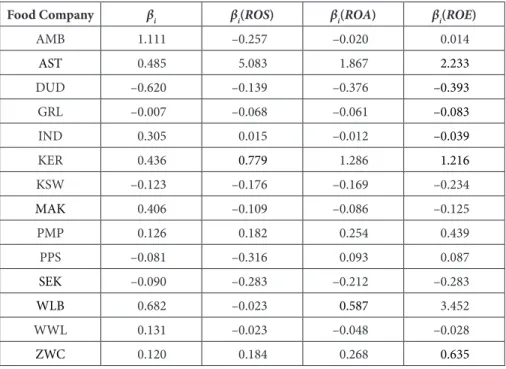
The quarterly financial reports used by investors always refer to a company’s performance in the previous quarter. Therefore, in this study a quarter back shift is applied to the financial data so that it matches with the market share prices. A time series of quarterly rates of return and profitability ratios: ROA, ROE and ROS were determined for every company. The WIG index was taken as a market portfolio and the Warsaw Interbank Offer Rate (WIBOR 3M) for three month investment was used as the risk-free rate. For each food company the market betas and accounting betas were calculated using two different ap-proaches: the risk measured by variance and downside risk. The calculations begin with market betas and accounting beta for risk measured by variance (Table 1).
The market betas show that AMB is the only company that is more volatile than the market, i.e. its rate of return is more changeable than the market. Eight of the companies are less volatile than the market and five companies behave in a different way to the market. They have negative values of betas coefficient. Looking at accounting Beta the βi(ROS) is extremely high for AST. This means that changes in the sector have a huge influence on the return on sales (ROS) for this company. This can be attributed to two main reasons:
(i) It is one of the biggest companies,
(ii) It reached a high level of ROS in the analysed periods.
Therefore, the ROS for AST has a big impact on the average level of ROS for all the companies in the sector.
It should be noted that for some companies, such as GRL, all versions of betas give a similar value of systematic risk. However there are some compa-nies for which the betas are positive and negative i.e. AMB, IND, MAK, PPS, WLB, WWL. The market rate of return for AMB changes in the same way as the whole market, but the return on sales and the return on assets change in the opposite direction to the sector. Next the correlation between market beta and accounting betas for the mean-variance approach were estimated (Table 2).
61
A. Rutkowska-Ziarko, C. Pyke, The development of downside accounting beta
Table 2. Correlation between market beta and accounting betas for the mean--variance approach
βi βi(ROS) βi(ROA) βi(ROE)
βi 1.000
βi(ROS) 0.222 1.000
βi(ROA) 0.426 0.847 1.000
βi(ROE) 0.488 0.510 0.743 1.000 Source: Authors’ calculation.
In all presented tables, critical value of Pearson coefficient is 0.53 at signifi-cance level of 0.05 and 0.46 at signifisignifi-cance level of 0.1. There is a positive cor-relation between market beta and accounting betas. This corcor-relation is moder-ate for βi(ROA) and βi(ROE), and weak for βi(ROS). The statistical significant correlation arises between βi(ROE) with, βi(ROA) with βi(ROE) and βi(ROA) with βi(ROS).
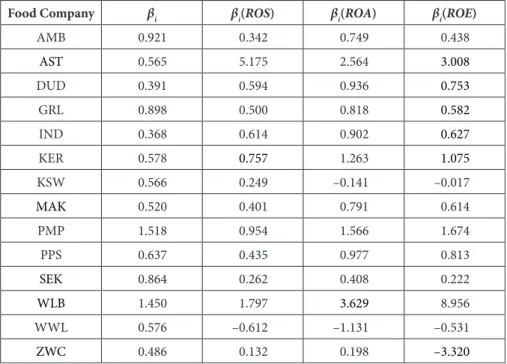
Then the market betas and accounting betas were calculated using down-side risk (Table 3).
Table 1. Food company market betas and accounting beta for risk measured by variance
Food Company βi βi(ROS) βi(ROA) βi(ROE)
AMB 1.111 –0.257 –0.020 0.014 AST 0.485 5.083 1.867 2.233 DUD –0.620 –0.139 –0.376 –0.393 GRL –0.007 –0.068 –0.061 –0.083 IND 0.305 0.015 –0.012 –0.039 KER 0.436 0.779 1.286 1.216 KSW –0.123 –0.176 –0.169 –0.234 MAK 0.406 –0.109 –0.086 –0.125 PMP 0.126 0.182 0.254 0.439 PPS –0.081 –0.316 0.093 0.087 SEK –0.090 –0.283 –0.212 –0.283 WLB 0.682 –0.023 0.587 3.452 WWL 0.131 –0.023 –0.048 –0.028 ZWC 0.120 0.184 0.268 0.635
Table 3. Market downside betas and downside accounting beta
Food Company βi βi(ROS) βi(ROA) βi(ROE)
AMB 0.921 0.342 0.749 0.438 AST 0.565 5.175 2.564 3.008 DUD 0.391 0.594 0.936 0.753 GRL 0.898 0.500 0.818 0.582 IND 0.368 0.614 0.902 0.627 KER 0.578 0.757 1.263 1.075 KSW 0.566 0.249 –0.141 –0.017 MAK 0.520 0.401 0.791 0.614 PMP 1.518 0.954 1.566 1.674 PPS 0.637 0.435 0.977 0.813 SEK 0.864 0.262 0.408 0.222 WLB 1.450 1.797 3.629 8.956 WWL 0.576 –0.612 –1.131 –0.531 ZWC 0.486 0.132 0.198 –3.320
Source: Authors’ calculation.
The βiLPM(ROE) for WLB is very high (8.956) which suggests that its return on equity decreases sharply when the food sector experiences difficult trad-ing conditions. The analysis also shows that the systematic downside risk for PMP (1.518) is higher when compared to the variance approach (only 0.126). This company appears less volatile when using market and accounting beta variances individually, and more volatile when using downside risk measures. This means that the market rate of return, as well as accounting profitability, fell faster and deeper when the food sector was weak during the analysed period. It is assumed here that a weak period is when the average profitability ratio for the company is lower than average level in the sector.
The downside betas provide important information to the managers and owners. They inform what could happen to stock prices on capital markets and the accounting profitability when the market weakens.
Looking at downside market betas for all the companies that were ana-lysed, the market rate of return changes in the same direction when the sec-tor is weak (all βiLPM are positive). However, using the variance approach, the market betas are negative for five companies (compare Table 1). The variance approach and downside approach for each company gives very different in-formation. The correlation matrix is calculated for mean-downside risk ap-proach (Table 4).
63
A. Rutkowska-Ziarko, C. Pyke, The development of downside accounting beta
Table 4. Correlation between market beta and accounting betas for mean-downside risk approach
βiLPM β
iLPM(ROS) βiLPM(ROA) βiLPM(ROE)
βiLPM 1.000
βiLPM(ROS) 0.222 1.000
βiLPM(ROA) 0.426 0.847 1.000
βiLPM(ROE) 0.488 0.510 0.743 1.000
Source: Authors’ calculation.
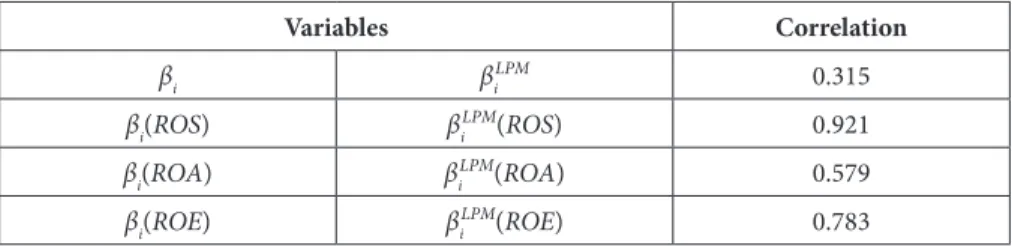
There is a positive correlation between market beta and accounting betas for downside risk. However there is no significant correlation between down-side beta for ROS and downdown-side beta, nor is there a correlation between mar-ket and accounting betas for variance (compare Table 3 and 4). The statistical significant correlation arises between almost all kinds of downside market and accounting betas. To measure systematic accounting risk the βiLPM(ROE) seems to be the best option as it significantly correlates with downside market beta. Finally, the correlation coefficients between the different kinds of betas for the variance approach and downside risk are calculated (Table 5). There is a posi-tive relationship between betas for variance and for downside risk. However for market betas the correlation is statistically insignificant, but the correlation between accounting betas for ROS is strong
Table 5. Correlation between betas for risk variance approach and downside risk
Variables Correlation
βi βiLPM 0.315
βi(ROS) βiLPM(ROS) 0.921
βi(ROA) βiLPM(ROA) 0.579
βi(ROE) βiLPM(ROE) 0.783
Source: Authors’ calculation.
Conclusions
This paper develops the new concept of downside accounting beta (DAB) as a measure of risk. DAB represents how changes in the profitability of the whole sector affect the profitability of any given company in that sector. Empirical evidence is presented using the data from companies listed in the Polish food sector of the Warsaw Stock Exchange which shows that there are significant
similarities between market betas and accounting betas. It also shows that ac-counting betas using ROA and ROE are positively correlated with market be-tas and that there is a significant correlation between accounting bebe-tas with variance and semi-variance approaches. However market betas and downside market betas have a poor correlation.
The variance approach and downside risk measures can give very different results, which is also the case for both market and accounting beta. When there is a downturn on the capital markets the market portfolio rate of return flows in the opposite direction to a given company. During the period analysed, when the food sector was weak, the accounting betas showed that the average profit-ability flowed in the opposite direction. It is assumed here that a weak period is when the average profitability ratio for the company is lower than the aver-age level in the sector. The practical implication of this research is that inves-tors, owners and managers can apply DAB using ROA and ROE to calculate the systematic risk of companies not listed on stock markets and consequently to identify the levels of risk associated with companies within the sector.
References
Amorim, A., Lima I., & Murcia, F. (2012). The effect of the firm’s capital structure on
the systematic risk of common stocks. Cont. Fin. – USP, São Paulo, 23(60), 199-211.
Campbell, J., Polk, C. & Voulteenaho T. (2009). Growth or glamour? Fundamentals
and systematic risk in stock returns. The Review of Financial Studies, 23(1), 305-344.
Estrada, J. (2002). Systematic risk in emerging markets: the D-CAPM. Emerging Markets
Review, 3, 365-379.
Galagedera, U., & Brooks R. (2007). Is co-skewness a better measure of risk in the
down-side than downdown-side beta? Evidence in emerging market data. Journal of Multinational
Financial Management, 17, 214-230.
Hamada, R. (1972). The effect of the firm’s capital structure on the systematic risk of
common stocks. The Journal of Finance,27(2), 435-452.
Harlow, W., & Rao, R. (1989). Asset pricing in a generalized mean-lower partial
mo-ment framework: theory and evidence. Journal of Financial and Quantitative
Analysis, 24, 285-311.
Hill, N., & Stone, B. (1980). Accounting betas, systematic operating risk, and financial
leverage: a risk-composition approach to the determinants of systematic risk. The
Journal of Financial and Quantitative Analysis,15(3), 595-637.
Klebaner, F., Landsman, Z., Makov, U., Jing Yao, J. (2017). Optimal portfolios with
downside risk. Quantitative Finance, 17(3), 315-325.
Konchitchki, Y., Luo Y., Ma, M., Wu, F. (2016). Accounting-based downside risk, cost
of capital, and macroeconomy. Rev Account Study, 21, 1-36.
Markowski, L. (2015). Conditional volatility exposures in asset pricing in the downside
and classical framework. Research in economics and business: Central and Eastern
65
A. Rutkowska-Ziarko, C. Pyke, The development of downside accounting beta
Mensah, Y. (1992). Adjusted accounting beta, operating leverage and financial
lever-age as determinants of market beta. Review of Quantitative Finance and Accounting,
2, 187-203
Nekrasov, A. & Shroff, P. (2009). Fundamentals-based measurement in valuation. The
Accounting Review, 84(6), 1983-2011.
Pla-Santamaria, D., Bravo, M. (2013). Portfolio optimization based on downside risk:
a mean-semivariance efficient frontier from Dow Jones Blue Chips. Annals of
Operations Research, 20(1), 189-201.
Post, T., & Van Vliet, P. (2006). Downside risk and asset pricing. Journal of Banking
and Finance, 30, 823-849.
Price, K., Price, B., & Nantell, T. J. (1982). Variance and lower partial moment
meas-ures of systematic risk: some analytical and empirical results. The Journal of Finance,
37(3), 843-855.
Rutkowska-Ziarko, A. (2015). Influence of profitability ratio and company size on
prof-itability and investment risk in the capital market. Folia Oeconomica Stetinensia,
15(23), 151-161.
Rutkowska-Ziarko, A. (2013). Fundamental portfolio construction based on
semi--variance. Olsztyn Economic Journal, 8(2), 151-162.
Sarmiento-Sabogal, J., & Sadeghi, M. (2015). Estimating the cost of equity for private
firms using accounting fundamentals. Applied Economics, 47(3), 288-301.
Toms, S. (2014). Accounting-based risk management and the capital asset pricing
model: an empirical comparison. Australian Accounting Review, 24(2), 127-133.
Toms, S. (2012). Accounting-based risk measurement: an alternative to capital asset
pricing model derived discount factors. Australian Accounting Review, 22, 398-406.
Sharpe W. (1964). Capital asset prices: A theory of market equilibrium under
Maciej Cieślukowski Gary L. Evans Witold Jurek
Tadeusz Kowalski (Editor-in-Chief)
Jacek Mizerka Henryk Mruk Ida Musiałkowska Jerzy Schroeder
International Editorial Advisory Board Edward I. Altman – NYU Stern School of Business
Udo Broll – School of International Studies (ZIS), Technische Universität, Dresden
Wojciech Florkowski – University of Georgia, Griffi n
Binam Ghimire – Northumbria University, Newcastle upon Tyne
Christopher J. Green – Loughborough University
Niels Hermes – University of Groningen
John Hogan – Georgia State University, Atlanta
Mark J. Holmes – University of Waikato, Hamilton
Bruce E. Kaufman – Georgia State University, Atlanta
Steve Letza – Corporate Governance Business School Bournemouth University
Victor Murinde – University of Birmingham
Hugh Scullion – National University of Ireland, Galway
Yochanan Shachmurove – Th e City College, City University of New York
Richard Sweeney – Th e McDonough School of Business, Georgetown University, Washington D.C.
Th omas Taylor – School of Business and Accountancy, Wake Forest University, Winston-Salem
Clas Wihlborg – Argyros School of Business and Economics, Chapman University, Orange
Habte G. Woldu – School of Management, Th e University of Texas at Dallas
Th ematic Editors
Economics: Horst Brezinski, Maciej Cieślukowski, Ida Musiałkowska, Witold Jurek, Tadeusz Kowalski • Econometrics: Witold Jurek • Finance: Maciej Cieślukowski, Gary Evans, Witold Jurek, Jacek Mizerka • Management and Marketing: Gary Evans, Jacek Mizerka, Henryk Mruk, Jerzy Schroeder • Statistics: Elżbieta Gołata
Language Editor: Owen Easteal • IT Editor: Marcin Reguła
© Copyright by Poznań University of Economics and Business, Poznań 2017
Paper based publication ISSN 2392-1641
POZNAŃ UNIVERSITY OF ECONOMICS AND BUSINESS PRESS ul. Powstańców Wielkopolskich 16, 61-895 Poznań, Poland phone +48 61 854 31 54, +48 61 854 31 55
www.wydawnictwo-ue.pl, e-mail: [email protected] postal address: al. Niepodległości 10, 61-875 Poznań, Poland Printed and bound in Poland by:
Poznań University of Economics and Business Print Shop Circulation: 215 copies
Economics and Business Review is the successor to the Poznań University of Economics Review which was published by the Poznań University of Economics and Business Press in 2001–2014. The Economics and Business Review is a quarterly journal focusing on theoretical and applied research work in the fields of economics, management and finance. The Review welcomes the submission of articles for publication de-aling with micro, mezzo and macro issues. All texts are double-blind assessed by independent reviewers prior to acceptance.
The manuscript
1. Articles submitted for publication in the Economics and Business Review should contain original, unpublished work not submitted for publication elsewhere.
2. Manuscripts intended for publication should be written in English, edited in Word in accordance with the APA editorial guidelines and sent to: [email protected]. Authors should upload two versions of their manuscript. One should be a complete text, while in the second all document information iden-tifying the author(s) should be removed from papers to allow them to be sent to anonymous referees. 3. Manuscripts are to be typewritten in 12’ font in A4 paper format, one and half spaced and be aligned.
Pages should be numbered. Maximum size of the paper should be up to 20 pages.
4. Papers should have an abstract of not more than 100 words, keywords and the Journal of Economic Literature classification code (JEL Codes).
5. Authors should clearly declare the aim(s) of the paper. Papers should be divided into numbered (in Arabic numerals) sections.
6. Acknowledgements and references to grants, affiliations, postal and e-mail addresses, etc. should ap-pear as a separate footnote to the author’s name a, b, etc and should not be included in the main list of footnotes.
7. Footnotes should be listed consecutively throughout the text in Arabic numerals. Cross-references should refer to particular section numbers: e.g.: See Section 1.4.
8. Quoted texts of more than 40 words should be separated from the main body by a four-spaced inden-tation of the margin as a block.
9. References The EBR 2017 editorial style is based on the 6th edition of the Publication Manual of the American Psychological Association (APA). For more information see APA Style used in EBR guidelines. 10. Copyrights will be established in the name of the E&BR publisher, namely the Poznań University of
Economics and Business Press.
More information and advice on the suitability and formats of manuscripts can be obtained from:
Economics and Business Review
al. Niepodległości 10 61-875 Poznań Poland e-mail: [email protected] www.ebr.ue.poznan.pl Maciej Cieślukowski Gary L. Evans Witold Jurek
Tadeusz Kowalski (Editor-in-Chief)
Jacek Mizerka Henryk Mruk Ida Musiałkowska Jerzy Schroeder
International Editorial Advisory Board Edward I. Altman – NYU Stern School of Business
Udo Broll – School of International Studies (ZIS), Technische Universität, Dresden
Wojciech Florkowski – University of Georgia, Griffi n
Binam Ghimire – Northumbria University, Newcastle upon Tyne
Christopher J. Green – Loughborough University
Niels Hermes – University of Groningen
John Hogan – Georgia State University, Atlanta
Mark J. Holmes – University of Waikato, Hamilton
Bruce E. Kaufman – Georgia State University, Atlanta
Steve Letza – Corporate Governance Business School Bournemouth University
Victor Murinde – University of Birmingham
Hugh Scullion – National University of Ireland, Galway
Yochanan Shachmurove – Th e City College, City University of New York
Richard Sweeney – Th e McDonough School of Business, Georgetown University, Washington D.C.
Th omas Taylor – School of Business and Accountancy, Wake Forest University, Winston-Salem
Clas Wihlborg – Argyros School of Business and Economics, Chapman University, Orange
Habte G. Woldu – School of Management, Th e University of Texas at Dallas
Th ematic Editors
Economics: Horst Brezinski, Maciej Cieślukowski, Ida Musiałkowska, Witold Jurek, Tadeusz Kowalski • Econometrics: Witold Jurek • Finance: Maciej Cieślukowski, Gary Evans, Witold Jurek, Jacek Mizerka • Management and Marketing: Gary Evans, Jacek Mizerka, Henryk Mruk, Jerzy Schroeder • Statistics: Elżbieta Gołata
Language Editor: Owen Easteal • IT Editor: Marcin Reguła
© Copyright by Poznań University of Economics and Business, Poznań 2017
Paper based publication ISSN 2392-1641
POZNAŃ UNIVERSITY OF ECONOMICS AND BUSINESS PRESS ul. Powstańców Wielkopolskich 16, 61-895 Poznań, Poland phone +48 61 854 31 54, +48 61 854 31 55
www.wydawnictwo-ue.pl, e-mail: [email protected] postal address: al. Niepodległości 10, 61-875 Poznań, Poland Printed and bound in Poland by:
Poznań University of Economics and Business Print Shop Circulation: 215 copies
Economics and Business Review is the successor to the Poznań University of Economics Review which was published by the Poznań University of Economics and Business Press in 2001–2014. The Economics and Business Review is a quarterly journal focusing on theoretical and applied research work in the fields of economics, management and finance. The Review welcomes the submission of articles for publication de-aling with micro, mezzo and macro issues. All texts are double-blind assessed by independent reviewers prior to acceptance.
The manuscript
1. Articles submitted for publication in the Economics and Business Review should contain original, unpublished work not submitted for publication elsewhere.
2. Manuscripts intended for publication should be written in English, edited in Word in accordance with the APA editorial guidelines and sent to: [email protected]. Authors should upload two versions of their manuscript. One should be a complete text, while in the second all document information iden-tifying the author(s) should be removed from papers to allow them to be sent to anonymous referees. 3. Manuscripts are to be typewritten in 12’ font in A4 paper format, one and half spaced and be aligned.
Pages should be numbered. Maximum size of the paper should be up to 20 pages.
4. Papers should have an abstract of not more than 100 words, keywords and the Journal of Economic Literature classification code (JEL Codes).
5. Authors should clearly declare the aim(s) of the paper. Papers should be divided into numbered (in Arabic numerals) sections.
6. Acknowledgements and references to grants, affiliations, postal and e-mail addresses, etc. should ap-pear as a separate footnote to the author’s name a, b, etc and should not be included in the main list of footnotes.
7. Footnotes should be listed consecutively throughout the text in Arabic numerals. Cross-references should refer to particular section numbers: e.g.: See Section 1.4.
8. Quoted texts of more than 40 words should be separated from the main body by a four-spaced inden-tation of the margin as a block.
9. References The EBR 2017 editorial style is based on the 6th edition of the Publication Manual of the American Psychological Association (APA). For more information see APA Style used in EBR guidelines. 10. Copyrights will be established in the name of the E&BR publisher, namely the Poznań University of
Economics and Business Press.
More information and advice on the suitability and formats of manuscripts can be obtained from:
Economics and Business Review
al. Niepodległości 10 61-875 Poznań Poland
e-mail: [email protected] www.ebr.ue.poznan.pl
Volume 3 (17) Number 4 2017
Volume 3 (1 7) Number 4 201 7Poznań University of Economics and Business Press
ISSN 2392-1641
Economics
and Business
Economics and Busi
ness
R
eview
Review
Subscription
Economics and Business Review (E&BR) is published quarterly and is the successor to the Poznań University of Economics Review. Th e E&BR is published by the Poznań University of Economics and Business Press.
Economics and Business Review is indexed and distributed in ProQuest, EBSCO, CEJSH, BazEcon and Index Copernicus. Subscription rates for the print version of the E&BR: institutions: 1 year – €50.00; individuals: 1 year – €25.00. Single copies: institutions – €15.00; individuals – €10.00. Th e E&BR on-line edition is free of charge.
CONTENTS
ARTICLES
Determinants of central banks’ fi nancial strength: evidence from Central and Eastern European countries (Barbara Pajdo)
Stock price volatility and fundamental value: evidence from Central and Eastern European countries (Jerzy Gajdka, Piotr Pietraszewski)
Risk sharing markets and hedging a loan portfolio: a note (Udo Broll, Xu Guo, Peter Welzel)
Th e development of downside accounting beta as a measure of risk (Anna Rutkowska -Ziarko, Christopher Pyke)
Governance of director and executive remuneration in leading fi rms of Australia (Zahid Riaz, James Kirkbride)
Do Polish non-fi nancial listed companies hold cash to lend money to other fi rms? (Anna Białek-Jaworska)
An attempt to model the demand for new cars in Poland and its spatial diff erences (Wojciech Kisiała, Robert Kudłak, Jędrzej Gadziński, Wojciech Dyba, Bartłomiej Kołsut, Tadeusz Stryjakiewicz)
BOOK REVIEWS
Szczepan Gawłowski, Henryk Mruk, 2016. Przywództwo. Teoria i praktyka [Leadership. Th eory and practice], REBIS Publishing House, Poznań (Jan Polowczyk)
Małgorzata Bartosik-Purgat (Ed.), 2017. Consumer beha viour. Globalization, new technologies, current trends, socio-cultural environment, WN PWN SA, Warszawa (Anna Gardocka -Jałowiec)