The role of work-integrated learning in developing
students’ perceived work self-efficacy
GREGORY REDDAN1
Griffith University, Brisbane, Australia
The notion of work self-efficacy is significant as the self-efficacy beliefs of an individual have considerable influence on his/her level of motivation and performance in the workplace. This paper aims to determine the effects of the learning activities of a work-integrated learning course in Exercise Science in relation to students’ perceived work self-efficacy in industries relevant to their studies. Comparison of pre- and post-course scores on the Work Self-Efficacy Scale demonstrated significant improvement in students’ perceived work self-efficacy in all seven dimensions, as well as their perceived skill levels in thirteen important aspects of the work environment. The results suggested that all three course components (the work experience placement, career development workshops and presentations from practicing lecturers and professionals) provided important contributions to students’ development. The factors that were considered to be most influential included feedback from supervisors, personal motivation and involvement, and regular workplace experience. (Asia-Pacific Journal of Cooperative Education, 2016, 17(4), 423-436)
Keywords: Work self-efficacy; work-integrated learning; career development learning; exercise science.
Perhaps the greatest challenge for universities in the 21st century will be to produce more
employable and work-ready graduates (Crebert et al., 2004; Precision Consultancy & Commonwealth of Australia, 2007; Universities Australia, 2008). Changing patterns of technology have significantly affected the demand for particular occupations and skills (Cooper, Orrell, & Bowden, 2010). Skills such as problem-solving, networking, negotiating and managing complex processes will be required, rather than functional skills (Harvey, Moon, & Geall, 2009). These changes have contributed to the significant interest in work-integrated learning (WIL) in higher education (Cooper, Orrell & Bowden, 2010). WIL is the most frequent term used within Australia to describe the variety of experiences that engage students in workplace situations (Ferns, Campbell, & Zegwaard, 2014). The popularity of WIL in Australia resulted in Universities Australia, the national consortium of Australian Universities, advocating a national internship scheme in 2008 with the purpose of addressing both a national skills shortage and student employability in a systematic fashion (Smith, 2012).
Recently a National Strategy on WIL in University Education (2015) was released by the Australian Collaborative Education Network (ACEN) in partnership with Universities Australia, Business Council of Australia, Australian Industry Group and Australian Chamber of Commerce and Industry, in which WIL is viewed as an “umbrella term for a range of applications and strategies that integrate theory with the practice of work within a purposefully designed curriculum” (Patrick, Peach, & Pocknee, 2009). WIL is perceived to improve the employability of graduates by providing practical experiences directly related to university courses, as well as facilitating the transition from university to work to improve productivity outcomes for employers and the economy (Brimble & Freudenberg, 2010). WIL is focused on producing a highly skilled workforce that can meet industry and community needs. Graduates indicate WIL is an essential factor in making the transition to
1
work and their competitiveness in the employment market (ACEN, 2015). Significant evidence indicates that authentic work experience contextualizes student learning, is influential in graduate employment and should be integrated into course curricula wherever possible (Reddan, 2015). The value of placements and other forms of WIL has been demonstrated by Lowden et al. (2011) who found overwhelming support from institutions of higher education and employers for work placements and internships (Cranmer, 2009). THE IMPORTANCE OF SELF-EFFICACY
Self-efficacy perceptions provide the foundation for human motivation and personal accomplishment (Yakin & Erdel, 2012). Efficacy beliefs influence an individual’s thoughts and behaviors and affect goals and aspirations, resilience to adversity, effort, outcomes and perseverance (Pethe et al., 1999). Self-efficacy has been demonstrated to be a useful measurement with which to predict behavioural outcomes when compared to other constructs related to motivation, especially in psychology and education (Graham & Weiner, 1996). The potential importance of self-efficacy to vocational behavior has long been recognized (Leong & Barak, 2001). The theoretical construct provides not only for understanding an individual’s self-efficacy beliefs, but also the means for their modification through interventions such as WIL. The field of WIL has relied on the use of the notion of self-efficacy as an avenue to link practice-oriented learning processes to learning outcomes (Eames, 2004). WIL programs during the undergraduate experience offer students the opportunity to learn from and reflect on work experience (Raelin 2008) to assist students to provide a smoother transition into full-time work (Elfering et al., 2007).
Work Self-Efficacy
A vast body of literature attests to the pervasive effects of self-efficacy on workplace performance. Nine large scale meta-analyses have consistently demonstrated that the self-efficacy beliefs of an organizational member has significant effects on his/her level of motivation and performance (Bandura & Locke, 2003). Individuals are more likely to be satisfied with their jobs when they feel competent to perform tasks or attain work goals (Lent et al., 2011). Highly efficacious people tend to make better use of and generate resources within their work environment to handle difficult scenarios (Heuven et al., 2006). Beliefs regarding one’s work self-efficacy influence their work-related attitudes and motivation with positive flow-on effects on job performance and satisfaction (Yakin & Erdel, 2012). Work self-efficacy refers to “the belief in one’s ability and competence to perform an occupation (Pethe et al., 1999). Self-efficacy as a theoretical framework to explain how individuals adjust to the workplace was first promoted by Fletcher (1990), who indicated that self-efficacy may help students to make the transition from pupil to practitioner. He suggested that work experience can improve self-efficacy through performance accomplishments and such experiences can result in a feedback loop leading to increased self-efficacy and, in turn, further enhancing an individual’s performance.
Raelin et al. (2011) demonstrated a positive relationship between work self-efficacy and performance in an organizational setting. However, their paper considered work self-efficacy as a total construct. Bates, Thompson & Bates (2013) examined how self-self-efficacy changes within the seven subscales for students upon completion of a placement within a criminology context. However, their results demonstrated some of the sub-components (i.e., learning, teamwork and sensitivity) were not improved by involvement in WIL experiences.
This particular research will determine how work self-efficacy changes within the context of student completion of a WIL placement in Exercise Science.
The Work Self-Efficacy Inventory (WS-Ei)
The WS-Ei was developed by Joseph Raelin (2010) in the belief that assessing new or prospective workers’ confidence in managing workplace situations was a worthwhile process. The inventory measured a range of behaviors and practices that affect an individual’s belief in his/her skills and abilities to be successful in the workplace. The theoretical underpinning of the inventory is that individuals with a higher work self-efficacy are more likely to look forward to, and be successful, in workplace performance (Raelin, 2010). The inventory provided workers with a tool to assess and develop their work self-efficacy along seven specific dimensions through the use of a 5-point Likert scale using a response format from “not at all confident” to “completely confident”. Thirty items were organized into scores related to the following dimensions, as well as an overall composite score:
Learning: confidence in being able to learn productively on the job. Problem-solving: confidence in solving problems in the workplace.
Pressure: confidence in coping with stress as well as time and schedule pressures. Role expectations: confidence in understanding and fulfilling ones roles assigned at
work.
Teamwork: confidence in working well within a team environment.
Sensitivity: confidence in demonstrating sensitivity to others in the workplace. Work politics: confidence in scoping out and arranging organizational politics and
traditions
General work self-efficacy: confidence in managing oneself well in the workplace. Norms for the inventory have set the average score at 3.8 (out of 5) for each of the dimensions and the overall composite score with a standard deviation of 0.6. Previous research supported the construct validity and internal consistency of the Inventory (Raelin, n.d.).
CASE STUDY
Field Project B is an elective final-year course in the Bachelor of Exercise Science program conducted at the Gold Coast campus of Griffith University. The course is designed to link and complement the student’s program of study by preparing and introducing them to the work environment and includes both career development learning (CDL) and work-integrated learning (WIL) (Reddan & Rauchle, 2012). Thirteen two-hour workshops were held on a weekly basis throughout the semester, including specific career development learning activities related to career planning, job search, resume development, job applications, addressing selection criteria, mock interviews and reflection of interview performance. The CDL workshops were based on Kumar’s (2007) SOAR model, specifically the Results element. The other three elements (self-awareness, opportunity awareness and aspirations) were addressed in the complementary course, Field Project A, in the second year of the program. Presentations from practicing lecturers and professionals from the various employing industries were provided on alternate weeks. Students were also required to complete a minimum of 140 hours work experience in an industry related to Exercise Science. The course was graded and the assessment items included: resume and
job application; mock interview performance and reflection; placement performance; and an oral presentation of reflections related to placement.
Research Methodology
This particular study examined the effectiveness of the learning activities in Field Project B in relation to students’ work self-efficacy in industries relevant to their studies in Exercise Science. The results will be used to consider possible improvements in the course for future students. The findings from this research will provide additional data concerning the applications of self-efficacy models to career theory and also determine the utility of the construct of work self-efficacy. Furthermore, the study will also contribute to the research base on cooperative education as fewstudies have explored the effects of WIL on work self-efficacy. The research included four main research questions:
1) What effects did the course learning experiences have on students’ perceived work self-efficacy?
2) How did the learning activities affect students’ perceived level of skill in various workplace dimensions?
3) How important were each of the three major course components in the development of students’ perceived work self-efficacy?
a. The work experience placement
b. The career development learning workshops
c. The workshop presentations from practicing lecturers and professionals 4) Which specific factors were most influential in the development of students’
perceived work self-efficacy throughout the course? Procedure
The research was conducted using 16 third year Exercise Science students who completed the research questionnaire both pre- and post-course (66.6% of the entire cohort). The instruments used for data collection included the Work Self-efficacy Scale (WS-Ei) (Appendix A), which was completed at the commencement and completion of the learning activities of the course. Part A of the scale consisted of 30 statements related to students’ perceptions of their work self-efficacy. Students were required to respond to the statements to questions, for example, thinking about yourself working in the area of Exercise Science, how confident are you in your ability to know what is expected of you as a worker?’ The analysis of Part A provided scores in relation to the seven dimensions of work self-efficacy (learning, problem-solving, teamwork, sensitivity, politics, pressure, role expectations), as well as an overall work self-efficacy score. Part B of the scale required students to indicate their skills levels in 13 important aspects of the work environment. A five-point Likert scale for both Part A and B was used with 1 = ‘not at all’, 2 = a little’; 3 = ‘a moderate amount’; 4 = ‘a lot’; and 5 = ‘completely’. Responses in Part B demonstrated any differences in students’ perceived skills pre- and post-course. A t-test was used to determine if significant differences in pre- and post-course responses existed. The statements included in the WS-Ei are provided in Appendix A.
Students also completed a questionnaire specifically designed for this study (Appendix B) at the conclusion of the course. Students were required to rate the importance of aspects of the course in the development of their work self-efficacy, using a five-point scale with 1 = ‘no importance’, 2 = ‘some importance’; 3 = ‘moderately important’; 4 = ‘highly important’; and 5
= ‘extremely important’. Additionally, students were asked to list and rate the five specific factors they considered most influential in the development of their work self-efficacy during the course. Finally, the questionnaire required students to explain their perceptions as to how specific components of the course had affected their perceived work self-efficacy. This research was approved by the Griffith University Human Research Ethics Committee (GU Ref. No. 2015/721.
RESULTS
The research findings are reported here using the research questions as sub-headings. 1) What effects did the course learning experiences have on students’ perceived work
self-efficacy?
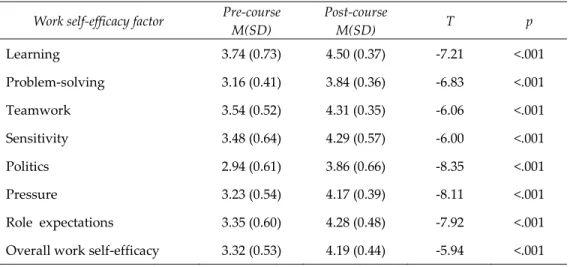
The Work Self-Efficacy Inventory (WS-Ei) (Raelin, 2010) was administered at the commencement of the first workshop and also at the conclusion of the final workshop, using a 5-point Likert scale with results demonstrated in Table 1. Students’ overall results demonstrated a significant improvement from a pre-course score of 3.32 to a post-course score of 4.19 (p<.001), indicating the effectiveness of the course learning experiences in enhancing their perceived work self-efficacy. Furthermore, scores on all seven dimensions of work self-efficacy improved (p<.001), in contrast to the results obtained by Bates, Thompson and Bates (2013), who found no improvement in the sub-components of learning, teamwork and sensitivity following involvement in WIL experiences. The post-course results were, in most cases, significantly greater than the set norms for Part A of the inventory of an average score at 3.8 (out of 5). Results on five of the dimensions were well above the average with scores of 4.50 for Learning, 4.31 for Teamwork, 4.29 for Sensitivity, 4.17 for Pressure 4.17, and 4.28 for Role Expectations. The post-course results for Problem-solving and Politics were very close to average with scores of 3.84 and 3.86 respectively. TABLE 1: Differences in students’ perceived self-efficacy ratings pre-and post-Field Project B
Work self-efficacy factor Pre-course M(SD) Post-course M(SD) T p Learning 3.74 (0.73) 4.50 (0.37) -7.21 <.001 Problem-solving 3.16 (0.41) 3.84 (0.36) -6.83 <.001 Teamwork 3.54 (0.52) 4.31 (0.35) -6.06 <.001 Sensitivity 3.48 (0.64) 4.29 (0.57) -6.00 <.001 Politics 2.94 (0.61) 3.86 (0.66) -8.35 <.001 Pressure 3.23 (0.54) 4.17 (0.39) -8.11 <.001 Role expectations 3.35 (0.60) 4.28 (0.48) -7.92 <.001 Overall work self-efficacy 3.32 (0.53) 4.19 (0.44) -5.94 <.001
2) How did the learning activities affect students’ perceived level of skill in various workplace dimensions?
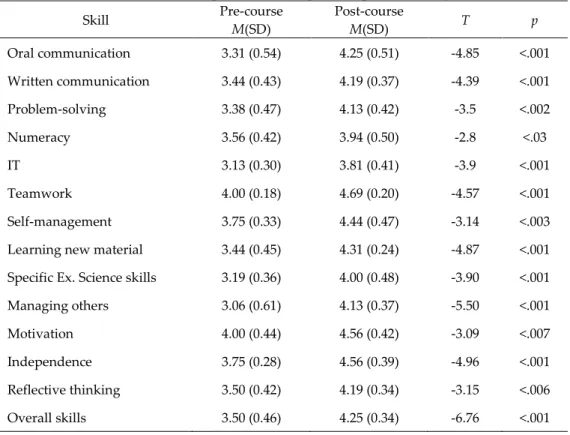
Part B of the Work Self-Efficacy Inventory (WS-Ei) (Raelin, 2010) scale required students to indicate their perceived skill levels in 13 important aspects of the work environment. Pre- and post-course responses are demonstrated in Table 2 and indicate significant improvement in perceptions of their skill levels in all of the workplace dimensions investigated at the completion of the course. Student’s overall results demonstrated a significant improvement from a pre-course score of 3.50 to a post-course score of 4.25 (p<.001), demonstrating the benefits of the course learning activities in enhancing their perceived skills. Highly significant scores (p<.001) were obtained for eight of the skills (oral communication, written communication, IT, teamwork, learning new material, specific Exercise Science skills, managing others and independence. Improvement in four of the other skills was also demonstrated with high levels of significance (problem-solving, p<.002; self-management, p<.003; motivation, p<.007; and reflective thinking, p<.006). The least improvement was demonstrated in numeracy (p<.03) as practice in this skill was not particularly common in student placements.
TABLE 2: Differences in students’ perceived skills pre- and post-Field Project B
Skill Pre-course M(SD) Post-course M(SD) T p Oral communication 3.31 (0.54) 4.25 (0.51) -4.85 <.001 Written communication 3.44 (0.43) 4.19 (0.37) -4.39 <.001 Problem-solving 3.38 (0.47) 4.13 (0.42) -3.5 <.002 Numeracy 3.56 (0.42) 3.94 (0.50) -2.8 <.03 IT 3.13 (0.30) 3.81 (0.41) -3.9 <.001 Teamwork 4.00 (0.18) 4.69 (0.20) -4.57 <.001 Self-management 3.75 (0.33) 4.44 (0.47) -3.14 <.003
Learning new material 3.44 (0.45) 4.31 (0.24) -4.87 <.001 Specific Ex. Science skills 3.19 (0.36) 4.00 (0.48) -3.90 <.001
Managing others 3.06 (0.61) 4.13 (0.37) -5.50 <.001
Motivation 4.00 (0.44) 4.56 (0.42) -3.09 <.007
Independence 3.75 (0.28) 4.56 (0.39) -4.96 <.001
Reflective thinking 3.50 (0.42) 4.19 (0.34) -3.15 <.006
3) How important were each of the three major course components in the development of students’ perceived work self-efficacy?
a. The work experience placement
b. The career development learning workshops
c. The workshop presentations from practicing lecturers and professionals Students were asked to indicate the importance of each of the three course components in the development of their work self-efficacy, using a five-point Likert scale (with 1 = no importance to 5 = extremely important). The results demonstrated in Table 3 indicated that the work experience placement was ‘extremely important’ in the development of their work self-efficacy with a mean of 4.80, whilst students considered the career development learning workshops were ‘highly important’ with a mean of 4.23. The mean score for the responses to the importance of presentations from lecturers and professionals indicates that this component was regarded as ‘moderately important’ by students with a mean of 3.16. TABLE 3: Students’ ratings of the importance of each major course component
Course component Mean score
Work experience placement 4.80 (±0.46)
Career development learning workshops 4.23 (±0.34)
Workshop presentations from lecturers and professionals 3.16 (±0.39)
Importance of the Work Experience Placement
Student responses were also sought on the ways each of the course components affected their work self-efficacy. In regards to the effects of the work experience placement, student A suggested that “placement has been an amazing experience. I have learnt so much about the role of an exercise scientist in regards to filming, analysis and the role of a strength and conditioning.” He indicated significant improvement in his communication and demonstrating skills, as well as his ability to multitask in a professional situation. Student B completed a placement in a laboratory scenario. She noted: “I have gained a range of laboratory terminology and skills, am more comfortable with Workplace Health and Safety procedures and more confident in the laboratory setting. I don’t feel out of place and now have greater communication skills with superiors.” Self-management and independence are considered important workplace skills. Student C suggested that he had developed initiative “as my placement supervisors did not necessarily explain how to or when to complete tasks”, providing him with a greater confidence in his workplace behavior. Student D noted that the work experience placement consolidated knowledge from her studies and provided real-world experience. “I found placement to be more interesting and gave me confidence in ‘real world’ work than anything I have encountered in my program so far.” Communication is an essential skill in the workplace, particularly the ability to relate to clients ranging from children to older adults. Student E considered that he “was able to put myself in a different situation with a variety of individuals to learn new skills. This was helpful as I have learned how to communicate with a variety of ages.” One of the values of placements is to allow students to experience particular workplace scenarios and make judgments about their suitability for particular careers. Student F indicated “I am now confident in a gym setting and my placement has provided clarity as to what I would
like to do in the future.” Many jobs related to Exercise Science require specific technical skills and the ability to apply these skills in multiple scenarios. Student G suggested “My placement experience has greatly improved my work self-efficacy. It has given me the confidence to perform a variety of activities and the chance to use my knowledge in the workplace. This has helped me realize how much I have learned through my degree, I now know I can think on my feet when needed and am excited to learn more in the workplace”. Importance of the Career Development Learning Workshops
Students also provided positive responses to the effects of the career development learning workshops on their work self-efficacy. As Exercise Science is a rather generic degree, many students are unaware of possible related careers. Student A indicated “I’ve enjoyed learning about different avenues that Exercise Science can lead to. It has opened my eyes to professions such as cardiac and sleep technology, which I didn’t know was possible from our degree. I also enjoyed the opportunity of a mock interview as I have never been in that situation before”. Student F found the workshops beneficial in preparing for her transition into the workforce. “I especially liked the emphasis on the importance of developing a CV and job interviews”. Students need to be aware of industry expectations and procedures to gain entry into the workforce or postgraduate programs. Student H noted: “I found these very helpful as it helped prepare me and further my knowledge for what I intend to do after graduating and what my options are. They also helped provide knowledge of what is expected and the best ways to gain entry into the job market or postgraduate courses”. The career development learning workshops are activity-based to allow students to fully engage and personalize the processes. Student D suggested “these workshops allow hands-on learning which I resphands-ond to better than verbal/unengaging presentatihands-ons. I felt more prepared for real-life situations after these development tasks”. Some students indicate that the career development workshops have the most significant effect on their work self-efficacy. Student G indicated “the workshops are the best part of this course. They have improved my work self-efficacy to a new level. I feel much more prepared to face the world and confident that I will get a professional job”. In the mock interview part of the course, students are involved as an interviewee and also as a member of the interview panel. Student I noted “I found this to be very beneficial and relevant. Learning how employers view resumes and different candidates in an interview setting will assist me when applying for positions in the future”. Student J suggested: “the mock interviews and resumes were the highlight of the course in my opinion. I am very confident now in being able to perform well in these situations”.
Importance of the Presentations from Practicing Lecturers and Professionals
Students found the presentations from practicing lecturers and professionals to be very informative and stimulating as they provided greater insight into career options and pathways available after graduation. Furthermore, students appreciated the advice provided by new graduates based on their experiences in gaining employment in particular fields. Student B suggested: “I found the cardiac and sleep technician presentations great because it made feel like a more obtainable goal in the future.” Some students indicated that these presentations would have been more useful if they had been offered earlier in their program of study so that they could better prepare for postgraduate study and specialization. As a result of the presentations, student E realized the importance of
progression and patience in his career development: “It made me realize that we all start at the same level and as you gain experience, you improve your work self-efficacy. This has taught me to be patient and work consistently towards my goals.” Many students fail to realize the depth and value of knowledge gained during their university studies towards employment. Student H indicated: “the presentations improved my work self-efficacy. They helped me gain knowledge about different career opportunities and what I am capable of. Again, it helped me realize how much I know and my confidence to apply my knowledge in the workplace.” Student J commented on the value of the presentations in the development of her communication skills. “By watching other professionals lecture, I feel confident in my ability to educate and share my own personal experiences”. Students are frequently unaware or daunted by the strategies and processes involved in gaining work experience or employment. Student K indicated that “the presentations gave me insight into other possible jobs and how to approach people for placement or work experience”. A further value of the presentations was noted by student F: “The presentations have confirmed that my chosen career path is definitely what I want to do and has improved my confidence in adhering to that goal”. Several students indicated that the presentations provided a real world understanding by emphasizing the importance of networking and creating helpful contacts to open doors into specific career options.
4) Which specific factors were most influential in the development of students’ perceived work self-efficacy throughout the course?
Students were required to list the five specific factors that were most influential in the development of their work self-efficacy during the course. The most common responses included (number of responses shown in brackets): “feedback from supervisors” (16); “personal motivation and interest” (14); and “regular workplace experience” (12). The importance of consistent, constructive feedback from supervisors was indicated by all students as a most important factor in the development of their perceived work self-efficacy. Students suggested that they enjoyed their involvement in the workplace where they were able to apply much of the knowledge they had gained through their studies. Their personal motivation and interest in placements was assisted by the pre-placement interviews, which ensured placements were provided in fields of Exercise Science that were personally relevant. Other frequent responses focused on features of the career development workshops, specially “the interview preparation and performance” (8) and “preparation of resume and cover letter” (7). Many students indicated that these skills were of prime importance in their self-efficacy in regard to gaining access to employment in areas of interest. Most of the student placements involved multidisciplinary professional groups, for example, cardiologists, cardiac technicians, exercise physiologists, dietitians and psychologists. For the majority of students, this placement provided their first inter-professional experience which they regarded as significant in influencing their work self-efficacy. Other common responses that were considered important included “learning to reflect” (5); “seeing results” (5); and “confidence in communication” (4). Students need to be provided with scaffolding and cues to assist in the development of their ability to self-reflect, as many initially find it quite a difficult process. Students gained considerable satisfaction from viewing the progress of their clients or patients following programs they have personally developed. Many students are confident in communicating with their peers but require time during placements to develop their confidence when communicating with a variety of age groups in a workplace setting.
DISCUSSION
The results of this research clearly demonstrate the role of work-integrated learning in developing students’ perceived work self-efficacy. The post-course results were, in most cases, significantly greater than the set norms for the inventory, indicating consistent improvement in factors and skills related to work self-efficacy. Significant improvements in all seven dimensions of work self-efficacy were observed over the duration of the course. These results differed from the study by Bates, Thompson and Bates (2013), who found improvement in only four dimensions following a placement in criminology and demonstrated the specificity of the outcomes of WIL experiences. Students’ perceived skills had also improved at the completion of the course, although not to the same degree of significance. Numeracy demonstrated the least improvement as it is a skill less commonly required in Exercise Science placements.
The results also indicated that all three components of the course provided important contributions to students. The work experience placement was considered as ‘extremely important’ in the development of students’ work self-efficacy, whilst the career development learning workshops were valued by students as ‘highly important’ and the presentations from lecturers and professionals as ‘moderately important’. Therefore, it is essential that these three features of the course should be retained in future years so that students are provided with opportunities to develop their work self-efficacy.
The Work Self-efficacy Inventory (WS-Ei) proved to be very useful to measure improvements in each work self-efficacy factor and skill, as well as providing additional stimuli for student learning and engagement. This research supports Raelin’s work (2010) that assessing workers’ confidence in managing workplace situations is a worthwhile process. The ability to compare research data with norms for the Inventory can provide useful information to guide providers of WIL programs and allow them to clearly observe particular changes as a result of varying types of opportunities. Further research needs to be conducted using samples of students from other disciplines to determine the effects of specific work-integrated learning experiences on the development of the various dimensions of work self-efficacy and skills in important aspects of the work environment. The results would be useful in identifying particular dimensions and skills that require additional emphasis in pre-placement preparation, placement activities and post-practicum reflections. CONCLUSION
In summary, there were several important findings from this study. Firstly, students in Field Project B demonstrated significant improvement in their perceived work self-efficacy, supporting previous research (Reddan & Rauchle, 2012), relating to the importance of including activities and assessment items related to both career development learning and work-integrated learning in university courses. This outcome is noteworthy as perceived work self-efficacy is considered to be of vital importance in workplace performance and satisfaction. Secondly, all three components of the course provided important benefits, with the learning experiences related to placements considered to be the most important in changing students’ perceived work self-efficacy. Students also appreciated the added value provided by the career development learning workshops and presentations from practicing lecturers and professionals, suggesting that academics should consider including aspects of the three components when designing similar courses. Thirdly, the SOAR model (Kumar, 2007) provided an excellent pedagogical basis in the course for the promotion and planning
of career development learning activities as students prepared to seek employment in the workplace. Further research of programs using Kumar’s model and other relevant models would be useful for those engaged as practitioners of work-integrated learning.
REFERENCES
Australian Collaborative Education Network (ACEN) (2015). National strategy on work-integrated learning in university education. Melbourne, Australia
Bandura, A. & Locke, E.A. (2003). Negative self-efficacy and goal effects revisited. Journal of Applied Psychology, 88(1), 87-99.
Bates, M., Thompson, C., & Bates, L. (2013). Not all dimensions of work self-efficacy are equal:
Understanding the role of tertiary work placements in the development of the elements of work self-efficacy. Journal of Cooperative Education and Internships. 47(1), 19-30.
Brimble, M. & Freudenberg, B. (2010). Will WIL’ing Work? B-Hert News, Issue 28, April.
Cooper, L., Orrell, J. & Bowden, M. (2010). Work integrated learning: A guide to effective practice. Routledge: Abingdon, UK.
Crebert, G., Bates, M., Bell, B., Patrick, C-J. & Cragnolini, V. (2004). Developing generic skills at university, during work placement and in employment: Graduates' perceptions. Higher Education Research & Development, 23(2), 147-165.
Eames, C. (2004). Researching in cooperative education: How a practitioner met the challenge. Handbook for Research in Cooperative Education and Internships, 71-94.
Elfering, A., Semmer, N.K., Tschan, F., Kalin, W. & Bucher, A. (2007), First years in job: A three-wave analysis of work experiences. Journal of Vocational Behavior, 70, 97-115.
Ferns, S., Campbell, M. & Zegwaard, K. (2014). Work integrated learning. In S.Ferns (Ed.). HERDSA Guide: Work Integrated Learning in the Curriculum.(pp.1-6).Higher Education Research and Development Society of Australasia.
Fletcher, J. (1990). Self-esteem and cooperative education: A theoretical framework. Journal of Cooperative Education, 26(3), 41-55.
Graham, S. & Weiner, B. (1996). Theories and principles of motivation, In C. Berliner, R. Caffee (Eds.).
Handbook of Educational Psychology (pp. 63-84). New York: Macmillan.
Harvey, L., Moon, S., Geall, V., & Bower, R. (1997). Graduates' work: Organisational Change and Students' Attributes. Centre for Research into Quality, Birmingham.
Heuven, E., Bakker, A.B., Schaufeli, W.B., & Huisman, N. (2006). The role of self-efficacy in performing emotion work. Journal of Vocational Behaviour, 69(2), 222-235.
Kumar, A. (2007). Personal, academic and career development in higher education: Soaring to success. New York, NY: Routledge.
Lent, R.W., Nota, L., Soresi, S., Ginevra, M.C., Duffy, R.D., & Brown, S.D. (2011). Predicting the job and life satisfaction of Italian teachers: test of a social cognitive model, Journal of Vocational Behaviour, 79, 91-97.
Leong, F.T.L. & Barak, A. (Eds.). (2001). Contemporary models in vocational psychology. Manwah, NJ: Lawrence Erbaum Associates.
Lowden, K., Hall, S., Elliot, D., & Lewin, J. (2011). Employers’ perceptions of the employability skills of new graduates. London: Edge Foundation.
Mason, G., Williams, G., & Cranmer, S. (2009). Employability skills initiatives in higher education: What effects do they have on graduate labour market outcomes? Education Economics, 17(1), 1–30. Patrick, C., Peach, D. & Pocknee, C. (2008). The WIL (Work Integrated Learning) report: A national scoping
study. Australian Learning and Teaching Council [ALTC] Final Report. Brisbane, Australia: Queensland University of Technology, Australian Collaborative Education Network. Pethe, S., Chaudhary, S., & Dhar, U. (1999). Occupational self-efficacy scale and manual. National
Psychology Association, Agra.
Precision Consultancy & Commonwealth of Australia (2007). Graduate employability skills. Canberra: Commonwealth of Australia.
Raelin, J.A. (2008). Validating a new work self-efficacy inventory. Unpublished manuscript, Northeastern University, Boston, MA.
Raelin, J., Bailey, M., Hamman, J., Pendelton, L., Raelin, J., Reisberg, R. & Whitman, D. (2011). The effect of cooperative education on change in self-efficacy among undergraduate students: Introducing work self-efficacy. Journal of Cooperative Education and Internships, 45(2), 17-35
Reddan, G. & Rauchle, M. (2012). Student perceptions of the value of career development learning to a work-integrated learning course in Exercise Science. Australian Journal of Career Development, 21(1), 38-48.
Reddan, G. (2015). Enhancing students’ self-efficacy in making positive career decisions. Asia-Pacific Journal of Cooperative Education, 16(4), 291-300.
Smith, C. (2012). Evaluating the quality of work-integrated learning curricula: a comprehensive framework. Higher Education Research & Development, 31(2), 247-262.
Universities Australia. (2008). Universities Australia position paper 3/08. A national internship scheme: Enhancing the skills and work-readiness of Australian university graduates, Canberra: Universities Australia.
Yakin, M. & Erdel, O. (2012). Relationships between self-efficacy and work engagement and the effects on job satisfaction: A survey of certified public accountants. Procedia – Social and Behavioural Sciences, 58, 370-378.
APPENDIX A: WORK SELF-EFFICACY SCALE (RAELIN, 2010):
Exercise Science students’ perceptions and experiences of work-integrated learning: A study of work self-efficacy
Part A - Work self-efficacy
There are 30 statements in this inventory that reflect your confidence in your ability to perform a variety of workplace activities. Using the scale, circle the number that most applies to you.
Thinking about yourself working in the area of Exercise Science, how confident are you in your ability to: Not at all A little Moderate amount A lot Completely
Know what is expected of you as a worker 1 2 3 4 5
Help build a team as a working unit 1 2 3 4 5
Determine what is expected of you on a job 1 2 3 4 5
Know how things “really work” inside an organisation
1 2 3 4 5
Be clear when presenting your ideas 1 2 3 4 5
Work under pressure 1 2 3 4 5
Master an organisation’s slang and special jargon 1 2 3 4 5
Manage conflict among group members 1 2 3 4 5
Understand what all of the duties of my role entail 1 2 3 4 5
Solve new and difficult problems 1 2 3 4 5
Work under extreme circumstances 1 2 3 4 5
Understand the politics in an organisation 1 2 3 4 5
Continue to learn once you’re on the job 1 2 3 4 5
Develop cooperative working relationships with others
1 2 3 4 5
Invent new ways of doing things 1 2 3 4 5
Solve most problems even though initially no solution is immediately apparent
1 2 3 4 5
Find out exactly what a problem is when first becoming aware of it
1 2 3 4 5
Listen effectively to gain information 1 2 3 4 5
Know an organisation’s long-held traditions 1 2 3 4 5
Work well in situations that other people consider stressful
1 2 3 4 5
Understand the behaviour appropriate to your role 1 2 3 4 5
Challenge things that are done by the book 1 2 3 4 5
Learn from your mistakes 1 2 3 4 5
Solve problems no matter how complex 1 2 3 4 5
Coordinate tasks within your work group 1 2 3 4 5
Learn to improve on your past performance 1 2 3 4 5
Be sensitive to others’ feelings and attitudes 1 2 3 4 5
Function well at work even when faced with personal difficulties
1 2 3 4 5
Concentrate on what someone is saying to you even though other things could distract you
1 2 3 4 5
Listen closely to understand opposing points of view
Part B - My skills
The next questions are about the skills you possess. Please indicate your skill level in the following areas using a scale of (1) not at all skilled to (5) completely skilled.
Not at all A little Moderate amount A lot Completely Oral communication 1 2 3 4 5 Written communication 1 2 3 4 5 Problem solving 1 2 3 4 5 Numeracy 1 2 3 4 5 Information Technology 1 2 3 4 5 Teamwork 1 2 3 4 5 Self-management 1 2 3 4 5
Learning new material 1 2 3 4 5
Specific Exercise Science skills 1 2 3 4 5
Managing others 1 2 3 4 5
Motivation 1 2 3 4 5
Independence 1 2 3 4 5
Reflective thinking 1 2 3 4 5
APPENDIX B: QUESTIONNAIRE: WORK SELF-EFFICACY
Work self-efficacy can be defined as your confidence in your ability to perform in a variety of workplace activities. Using the scale below, how important have the following aspects of Field Project B been in the development of your work self-efficacy? Please circle your response.
(1 = no importance; 2= some importance; 3 = moderately important; 4= highly important; 5 = extremely important)
Work experience placement 1 2 3 4 5
Career development learning workshops 1 2 3 4 5
Presentations from lecturers & professionals 1 2 3 4 5
List the five (5) SPECIFIC factors that have been most influential in the development of your work self-efficacy during this course, for example, feedback from placement supervisor. Rank the factors by placing the numbers 1-5 in brackets after each factor.
1)
2)
3)
4)
5)
Please comment on how each of the following aspects of the course has affected your work self-efficacy. Please use sentence format.
A. Work experience placement
B. Career development learning workshops