VERBAL EVENTS AND TEMPORAL RELATIONS
Georgiana Mar¸sic
A thesis submitted in partial fulfilment of the requirements of the University of Wolverhampton
for the degree of Doctor of Philosophy 2011
This work or any part thereof has not previously been presented in any form to the University or to any other body whether for the purposes of assessment, publication or for any other purpose (unless otherwise indicated). Save for any express acknowledgments, references and/or bibliographies cited in the work, I confirm that the intellectual content of the work is the result of my own efforts and of no other person.
The right of Georgiana Mar¸sic to be identified as author of this work is asserted in accordance with ss.77 and 78 of the Copyright, Designs and Patents Act 1988. At this date copyright is owned by the author.
Signature ... Date ...
The ability to capture the temporal dimension of a natural language text is essential to many natural language processing applications, such as Question Answering, Automatic Summarisation, and Information Retrieval. Temporal processing is a field of Computational Linguistics which aims to access this dimension and derive a precise temporal representation of a natural language text by extracting time expressions, events and temporal relations, and then representing them according to a chosen knowledge framework.
This thesis focuses on the investigation and understanding of the different ways time is expressed in natural language, on the implementation of a temporal processing system in accordance with the results of this investigation, on the evaluation of the system, and on the extensive analysis of the errors and challenges that appear during system development. The ultimate goal of this research is to develop the ability to automatically annotate temporal expressions, verbal events and temporal relations in a natural language text.
Temporal expression annotation involves two stages: temporal expression identification concerned with determining the textual extent of a temporal expression, and temporal expression normalisation which finds the value that the temporal expression designates and represents it using an annotation standard. The research presented in this thesis approaches these tasks with a knowledge-based methodology that tackles temporal expressions according to their semantic classification. Several knowledge sources and normalisation models are experimented with to allow an analysis of their impact on system performance.
The annotation of events expressed using either finite or non-finite verbs is addressed with a method that overcomes the drawback of existing methods
corpus. This limitation is overcome in this research by annotating each WordNet verb with an event class that best characterises that verb.
This thesis also describes an original methodology for the identification of temporal relations that hold among events and temporal expressions. The method relies on sentence-level syntactic trees and a propagation of temporal relations between syntactic constituents, by analysing syntactic and lexical properties of the constituents and of the relations between them.
The detailed evaluation and error analysis of the methods proposed for solving different temporal processing tasks form an important part of this research. Various corpora widely used by researchers studying different temporal phenomena are employed in the evaluation, thus enabling comparison with state of the art in the field. The detailed error analysis targeting each temporal processing task helps identify not only problems of the implemented methods, but also reliability problems of the annotated resources, and encourages potential reexaminations of some temporal processing tasks.
The completion of my doctoral studies has been the most significant academic challenge I was ever confronted with. It has been a long journey whose course was sometimes deterred by life getting in the way, but to whose successful completion many people have contributed directly or indirectly, and I would like to take this opportunity to thank them.
First of all, I would like to thank my supervisory team, Ruslan Mitkov, John Prager and Constantin Or˘asan, for their trust, encouragement, patience and guidance. I am thankful to Ruslan Mitkov, my director of studies, for making this thesis possible by providing the necessary infrastructure and resources to accomplish my research work, and for acting as my supervisor despite his many other academic and professional commitments. I would like to thank John Prager for finding the time to read my thesis and to provide insightful and creative comments. I am extremely indebted to Constantin Or˘asan, my supervisor, colleague and friend, for always showing a sincere interest in my work, for his constructive criticism, for the extensive discussions concerning my work, and for all the help he has given me throughout my years in Wolverhampton.
I would like to express my special gratitude and appreciation to my former research advisor Dan Cristea who introduced me to the world of Natural Language Processing. I still think fondly of my time as a postgraduate student that I have spent working with him.
I am privileged for having had Verginica Barbu Mititelu, Iustin Dornescu, Richard Evans, Le An Ha, Laura Hasler, Iustina Ilisei, Irina Temnikova, and Andrea Varga as my colleagues, friends and collaborators during my years spent in Wolverhampton. Their friendship and professional collaboration meant a great
I gratefully acknowledge the members of the Research Group on Natural Language Processing and Information Systems from the University of Alicante, Spain for offering me the opportunity to spend one year collaborating with them. I have a fond recollection of the year I worked in the GPLSI group.
I wish to thank Aidan Byrne, Alison Carminke and Erin Stokes for their help with proof-reading my thesis.
I would like to convey my heartfelt thanks to my friends who probably realised that pursuing a PhD can sometimes be a lonely and isolating experience. In particular, Oana Apostol, Mona Corodeanu, Smaranda Cristea, Gabi Haja, Iustina Ilisei, Ioana Roelake and Anca Zaharia receive my gratitude for their friendship and for being able to ignore my absence from their lives. I am grateful to my close friend Smaranda for her warm friendship, and for always caring and worrying about me. My dear friends Iustina and Javier helped me immensely with their support, encouragement, and all the thoughtful little things they did to take my mind off my PhD-related worries. I thank them for their friendship, for the wonderful times we spent together, and for their hospitality during my recent visits to Wolverhampton. I am very lucky to have such good friends.
Finally, but most importantly, my deepest gratitude goes to my family for all their love and continuous support. My parents, Maricica and Ionel Pu¸sca¸su, have always believed in me and encouraged me to strive for excellence in all that I do. My loving sister, Ana Maria Radu, has been a constant source of moral support, and has always been close to me, despite the distance. My grandmother Veronica Luchian and my uncle Mihai Luchian have always been very supportive, offering me invaluable advice. My wonderful husband Vlad spent many sleepless nights by my side when I was writing up this thesis. He has been an endless source of joy, love, kindness, patience and confidence in me, and thanks to him I did not have to worry about anything else but finalising my PhD. I am heartily thankful to all my loved ones, this thesis would certainly not have existed without them. To them I dedicate this work.
Abstract v
Acknowledgements vii
Table of Contents ix
List of Tables xiv
List of Figures xvii
Abbreviations xix
1 Introduction 1
1.1 About temporal processing . . . 2
1.2 Applications of temporal processing in NLP . . . 4
1.3 Original contributions of this thesis . . . 6
1.4 Research goals . . . 9
1.5 Outline of the thesis . . . 11
2 Time in natural language 15 2.1 Overview . . . 15
2.2 What is time and how is it conveyed in text? . . . 16
2.3 Temporal expressions . . . 17
2.3.1 Grammatical realisation of temporal expressions . . . 18
2.3.2 Expressing position in time . . . 19
2.3.3 Expressing temporal duration . . . 20
2.3.4 Expressing frequency in time . . . 20
2.4 Events . . . 21
2.4.1 Lexical aspect . . . 23
2.4.2 Criteria for aspectual classification . . . 24
2.4.3 Aspectual categories . . . 26
2.5 Temporal relations . . . 40
2.5.4 Reichenbach . . . 49
2.5.5 Time adverbials . . . 50
2.5.6 Other ways of expressing temporal relations . . . 55
2.6 Conclusions . . . 57
3 Computational approaches and existing resources for temporal processing 59 3.1 Overview . . . 59
3.2 Annotation schemes . . . 60
3.2.1 The first TIMEX . . . 60
3.2.2 The TIDES TIMEX2 . . . 61
3.2.3 STAG . . . 66
3.2.4 TimeML and ISO-TimeML . . . 69
3.3 Annotated corpora . . . 76
3.3.1 The TERN corpus . . . 76
3.3.2 The TimeBank corpus . . . 80
3.3.3 The Aquaint corpus . . . 82
3.3.4 The TempEval corpus . . . 84
3.4 Approaches for TE identification and normalisation . . . 86
3.4.1 Natural language interfaces for temporal databases . . . . 86
3.4.2 Scheduling dialogues . . . 87
3.4.3 MUC campaigns . . . 88
3.4.4 Mani and Wilson . . . 90
3.4.5 TERN . . . 91
3.4.6 More recent work . . . 96
3.5 Event annotation . . . 97
3.5.1 Klavans and Chodorow . . . 98
3.5.2 MUC campaigns . . . 98
3.5.3 The Topic Detection and Tracking (TDT) framework . . . 99
3.5.4 Siegel and McKeown . . . 100
3.5.5 Filatova . . . 101
3.5.6 TimeML-motivated research . . . 103
3.6 Temporal relation identification . . . 107
3.6.1 Time stamping events . . . 107
3.6.2 Annotation of corpora with temporal relations . . . 109
3.6.3 Automatically identifying temporal relations . . . 110
3.7 Conclusions . . . 117
4.2.1 Calendar points (CALPOINT) . . . 122
4.2.2 Duration denoting temporal expressions (DURATION) . . 133
4.2.3 Frequency denoting temporal expressions (FREQUENCY) 135 4.2.4 Generic references to past, present or future (TOKEN) . . 135
4.2.5 Unanchorable temporal expressions (UNANCHORABLE) . 136 4.3 Methodology for the identification of temporal expressions . . . . 137
4.3.1 Rule-based identification of TEs . . . 139
4.3.2 Checking syntactic correctness . . . 142
4.3.3 Disambiguation of then . . . 146
4.4 Comparative evaluation for TE identification . . . 152
4.4.1 Evaluation setting 1: rule-based identification only . . . . 152
4.4.2 Evaluation setting 2: setting 1 + syntactic correctness check153 4.4.3 Evaluation setting 3: setting 2 + annotation of anaphoric then . . . 153
4.4.4 Error analysis . . . 155
4.5 Adapting the system for TIMEX3-compliant TE identification . . 160
4.5.1 Results and error analysis . . . 164
4.6 Conclusions . . . 169
5 Temporal Expression Normalisation 171 5.1 Overview . . . 171
5.2 Methodology for the normalisation of temporal expressions . . . . 172
5.2.1 Norm-DCT: Normalisation with respect to the Document Creation Time . . . 174
5.2.2 Norm-Recent: Normalisation with respect to the most recent suitable TE . . . 177
5.2.3 Norm-Class: Backward looking class-sensitive normalisation . . . 178
5.2.4 Norm-Local: Class-sensitive normalisation prioritising clause-local context . . . 180
5.2.5 The direction problem . . . 182
5.2.6 The generic vs. specific problem . . . 185
5.3 Comparative evaluation of TE normalisation methods . . . 187
5.4 Adapting the system for TIMEX3-compliant TE normalisation . . 197
5.4.1 The adaptation process . . . 197
5.4.2 Results and error analysis . . . 201
5.5 Conclusions . . . 214
6.3 Annotation of WordNet verbs with TimeML classes . . . 224
6.3.1 Mapping verbs to WordNet lexicographic files . . . 224
6.3.2 Annotation process . . . 226
6.4 Identification of verbal events in text . . . 230
6.4.1 Identification of finite verb events . . . 231
6.4.2 Identification of non-finite verb events . . . 234
6.4.3 Identification of all verbal events . . . 237
6.5 Annotation of verbal events . . . 238
6.5.1 Annotation of finite verb events . . . 239
6.5.2 Annotation of non-finite verb events . . . 244
6.5.3 Annotation of all verbal events . . . 247
6.6 Conclusions . . . 248
7 Temporal Relations 253 7.1 Overview . . . 253
7.2 Identification of temporal clauses . . . 255
7.2.1 Grammatical overview of temporal clauses . . . 256
7.2.2 Corpus annotation . . . 259
7.2.3 A machine learning approach to the identification of temporal clauses . . . 261
7.2.4 Experiments . . . 264
7.3 Identification of intra-sentential temporal relations . . . 268
7.3.1 Intra-clausal temporal ordering . . . 271
7.3.2 Inter-clausal temporal ordering . . . 274
7.3.3 Identification of the temporal relation holding between two co-sentential temporal entities . . . 278
7.3.4 Evaluation . . . 278
7.4 Placing events in time with respect to the Document Creation Time292 7.4.1 Evaluation . . . 292
7.5 Identification of inter-sentential temporal relations . . . 294
7.5.1 Evaluation . . . 296
7.6 Conclusions . . . 298
8 Conclusions 301 8.1 General conclusions . . . 301
8.2 Research goals revisited . . . 312
8.3 General overview of the thesis . . . 314
8.4 Future research directions . . . 316
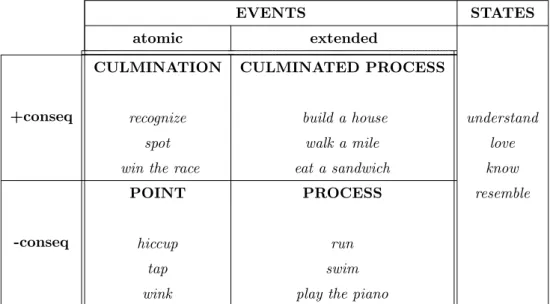
2.1 Dowty’s tests for aspectual verb categories (from Dowty (1979)) . 31 2.2 Subcategorisation of event types proposed by Moens and Steedman 35
2.3 Summary of aspectual classification systems . . . 39
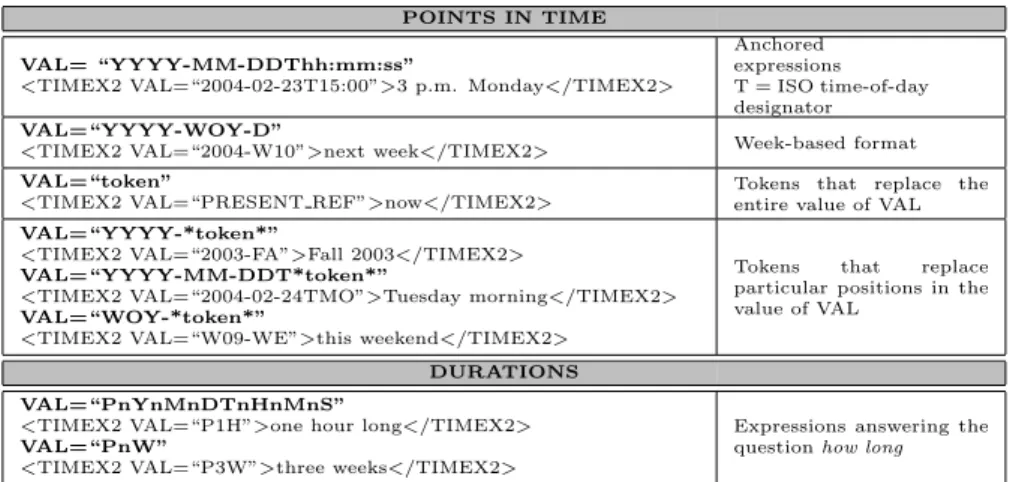
3.1 Possible formats of the TIMEX2 attribute VAL . . . 63
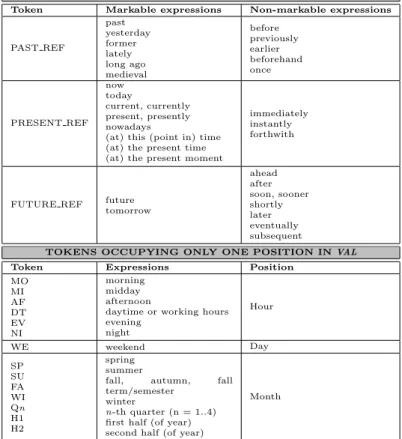
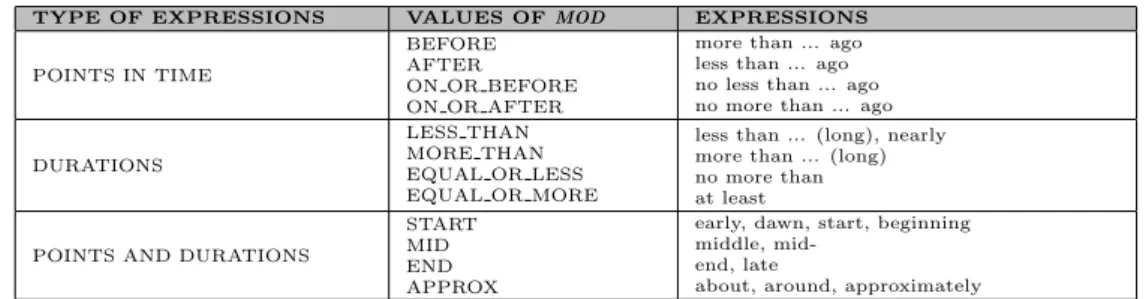
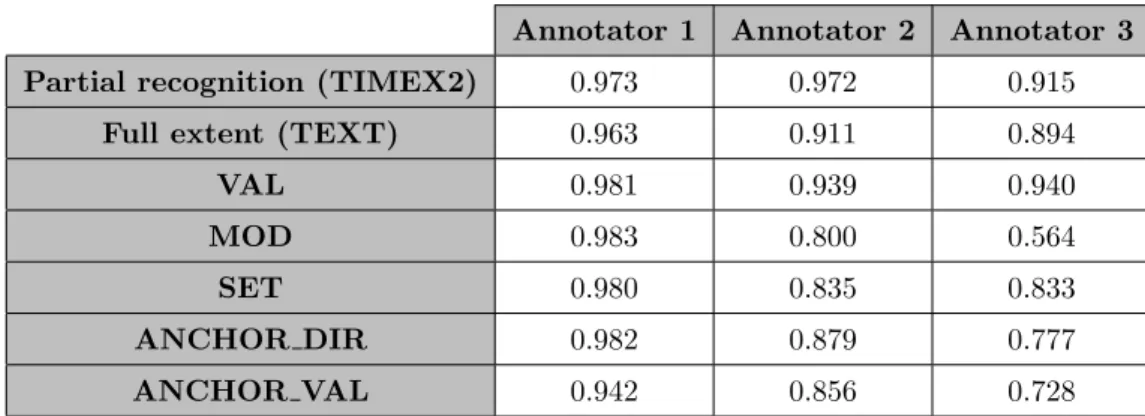
3.2 Tokens that may appear in the value of the TIMEX2 attribute VAL 64 3.3 Tokens that may represent the value of the TIMEX2 attribute MOD 65 3.4 Official inter-annotator agreement figures for the TERN corpus . . 77
3.5 TimeBank 1.2 statistics for each TimeML tag . . . 81
3.6 Inter-annotator agreement for TimeML tag extents . . . 82
3.7 Inter-annotator agreement for TimeML attribute values . . . 83
4.1 The character codes corresponding to the granularity of a TE . . 123
4.2 Temporal functions used for the interpretation of underspecified TEs127 4.3 Evaluation results at different stages in the TE identification process156 5.1 TIMEX2 attributes and their usage . . . 173
5.2 Comparative evaluation results for different normalisation models 190 5.3 The results of the systems evaluated at TERN 2004 against the results of the current system . . . 195
5.4 Official human annotator scores calculated against the final adjudicated TERN 2004 gold standard . . . 196
5.5 TIMEX3 attributes and their usage . . . 198
5.6 Evaluation results for the TIMEX3 annotator . . . 202
6.1 System accuracy for annotating finite verb events . . . 244
7.1 Accuracy of various classifiers in discovering temporal usages of ambiguous connectives . . . 266 7.2 Distribution of temporal relations in TimeBank 1.2 . . . 269 7.3 Relaxed scoring scheme for partial matches . . . 279 7.4 System results for intra-sentential temporal ordering of Event-TE
pairs . . . 280 7.5 Official TempEval results for intra-sentential temporal ordering of
Event-TE pairs . . . 281 7.6 System results for Event-DCT temporal relation detection . . . . 293 7.7 Official TempEval results for ordering events with respect to the
DCT . . . 293 7.8 Reconciliation between temporal relations for inter-sentential
temporal ordering . . . 296 7.9 System results for inter-sentential temporal ordering . . . 297 7.10 Official TempEval results for ordering the main events of two
consecutive sentences . . . 297
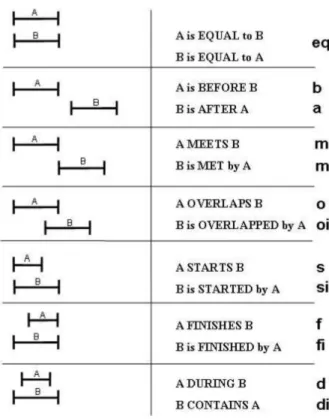
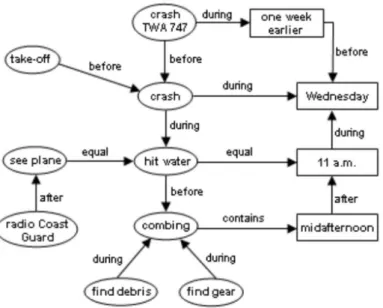
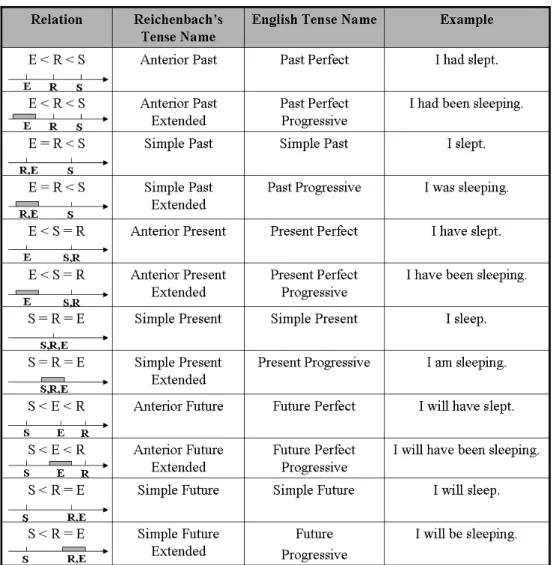
2.1 Aspectual classes distinguished by Bach . . . 33 2.2 Allen’s set of temporal relations . . . 42 2.3 Example of a time graph . . . 43 2.4 Reichenbach’s interpretation of the English tense – aspect system 51
7.1 Distribution of temporal subordinators in Susanne Corpus . . . . 259 7.2 Processing stages for the intra-sentential temporal relation identifier270 7.3 Syntactic tree labelled with temporal relations . . . 272 7.4 Processing stages for the inter-sentential temporal relation
identifier . . . 295
ACE – Automatic Content Extraction
BNC – British National Corpus
CRF – Conditional Random Field
DCT – Document Creation Time
DUC – Document Understanding Conference
ETL – Event Target List
FDG – Functional Dependency Grammar
IE – Information Extraction
ILI – Inter-Lingual Index
IR – Information Retrieval
LDC – Linguistic Data Consortium
MBL – Memory-Based Learning
MUC – Message Understanding Conference
NE – Named Entity
NER – Named Entity Recognition
NLP – Natural Language Processing
NP – Noun Phrase
QA – Question Answering
SAS – Set of Ambiguous Subordinators
STAG – Sheffield Temporal Annotation Guidelines
STS – Set of Temporal Subordinators
SVM – Support Vector Machine
TDT – Topic Detection and Tracking
TE – Temporal Expression
TERN – Temporal Expression Recognition and Normalisation
TREC – Text REtrieval Conference
VP – Verb Phrase
Introduction
The temporal dimension of information is fundamental for reasoning about how the world changes. The world is dynamic in its nature, and time is an important aspect of everything that happens in this world. Things that happen and involve change (events), or situations that stay the same for a certain period of time (states) are related by their temporal reference. People use the concept of time to place events or states in sequence one after the other, to establish how long an event or a state lasted, and to specify when an event occurred. Time seems to play the role of an universal reference system that is used to anchor, sequence, measure and compare the intervals occupied by events and states.
Recent years have seen unprecedented interest in natural language processing (NLP) applications that can process the wealth of electronic data available, with the need for temporally aware systems becoming increasingly popular. This need is justified by the fact that most of the information available electronically is temporally sensitive, in the sense that something that was true at some point in time could be false at another. Despite its omnipresence, agreeing on how time can be formalised has historically been a difficult task, as well as incorporating it into automatic systems that can access the temporal dimension and extract the temporal meaning of a text, known as temporal processing systems.
1.1
About temporal processing
This thesis investigates the area of temporal processing, a topic that has received growing interest in recent years. The ultimate aim of research in this area is the automatic identification of all temporal referring expressions, events, and temporal relations within a text. These tasks are difficult even for humans if they are asked to formalise them in a language understood by computers, despite the fact that they manage temporal information very naturally and efficiently during their everyday life. There are several explanations for this difficulty.
One explanation for the difficulty of identifying temporal information in text is the fact that temporal information can be conveyed via a wide range of different mechanisms including tense, aspect, and lexical semantic knowledge (Mani et al., 2005). These mechanisms need to be correctly identified, interpreted and combined to derive the appropriate temporal information.
Another challenge arises from the fact that temporal information is not always stated explicitly, being often implicit and requiring interpretations or inferences derived from world knowledge. The sentences in [1.1] and [1.2] have similar syntax, but the events they describe are not in the same temporal order.
[1.1] John fell. Mary pushed him.1
[1.2] John fell. Mary asked for help.
The temporal information in these examples is implicit, as the events described are neither anchored to precise points in time, nor specifically ordered with respect to neighbouring events. To derive the correct temporal interpretation for these examples, one must rely on semantic content, knowledge of causation and knowledge of language use. Despite their structure and syntax being so
1. The examples used in this thesis are either created to illustrate a certain phenomenon, or extracted from various sources such as the BNC, annotation guidelines, articles, and so on.
similar, in the first example the event of falling is temporally after the event of pushing, while in the second example the event of falling precedes the event of asking.
Computers currently find it extremely difficult to “understand” semantic information of the type required to distinguish between the two examples above, and to infer the correct temporal order in both cases. As a result, the research community has focused mainly on the various mechanisms used by language to convey temporal information explicitly or implicitly, mechanisms that are automatically identifiable using state-of-the-art techniques. Any temporal processing system should possess abilities to identify such mechanisms in text, and exploit them in solving the following tasks: temporal expression identification and normalisation, event annotation, and temporal relation identification. These tasks are illustrated below using an excerpt from a news article.
27/02/1998
OAU to investigate Rwandan genocide
The Organization of African Unity said Friday it would investigate the Hutu-organized genocide of more than 500,000 minority Tutsis in Rwandanearly four years ago. Foreign ministers of member-states meeting in the Ethiopian capital agreed to set up a seven-member panel to investigate who shot down Rwandan President Juvenal Habyarimana’s plane onApril 6, 1994.
Temporal Processing Tasks
Task 1: Temporal Expression Identification e.g. “nearly four years ago”
Task 2: Temporal Expression Normalisation e.g. “nearly four year ago” =>“1994”
Task 3: Event Annotation e.g. “shot” =>“OCCURRENCE”
Task 4: Temporal Relation Identification
e.g. temporal relation between “shot” and “April 6, 1994” is “OVERLAP”; temporal relation between “investigate” and “shot” is “AFTER”
The ability to derive a precise temporal representation of a text by solving these tasks can improve the performance of many practical NLP applications that require access to the temporal dimension of information, as exemplified below.
1.2
Applications of temporal processing in NLP
The development and evaluation of temporal processing systems is not only an important research topic, but also a very practical challenge. Temporal information has become more and more relevant to many NLP applications such as Question Answering (Moldovan et al., 2005; Saur´ı et al., 2005), Automatic Summarisation (Mani and Shiffman, 2005), Information Retrieval (Alonso et al., 2007), and Information Extraction (Surdeanu et al., 2003).
Question Answering (QA) systems process large text collections to find “a short phrase or sentence that precisely answers a user’s question” (Prager et al., 2000). QA systems need temporal processing to answer questions that explicitly request temporal information as their answer (e.g. [1.3]), or questions that manifest an intrinsic time dependency (e.g. [1.4], [1.5] and [1.6]).
[1.3] When did the French Revolution begin? [1.4] Is Gates currently CEO at Microsoft?
[1.5] Who was president of Enron when its share price was highest? [1.6] Did the Enron merger with Dynergy take place?
While question [1.3] can easily be answered if a candidate paragraph contains an explicit mention of the date the French Revolution started, questions like [1.4], [1.5], and [1.6] cannot be correctly answered unless advanced temporal processing methods are employed to analyse the temporal properties, modalities and ordering of the events involved.
Automatic Summarisation also places increasing demands on the processing of temporal information. Automatic Summarisation systems “take one or several texts and extract the ¿most importantÀ information [...] from them” (Or˘asan, 2006). Multi-document summarisation of news articles which overlap in their description of events would benefit from knowing the relative order of events. This temporal information is essential for assembling a chronologically coherent narrative from the events mentioned in diverse information sources. Automatic Summarisation has many practical applications that include generating biographies, assisting journalists in preparing background information on breaking news, condensing clinical records and deriving the typical evolution of a disease, and so on.
Information Retrieval (IR) is the field of study concerned with “finding material (usually documents) of an unstructured nature (usually text) that satisfies an information need from within large collections (usually stored on computers)” (Manning et al., 2008). With the rapid increase in digital information, the concept of time as a dimension through which information can be organised and explored becomes extremely relevant for IR. Access to temporal information could benefit IR tasks such as clustering of search results according to various time attributes (e.g. Google News Timeline2), or time-based browsing
and exploration of search results using timelines (e.g. Inxight’s TimeWall3).
Information Extraction (IE) is “the name given to any process which selectively structures and combines data which is found, explicitly stated or implied, in one or more texts” (Cowie and Wilks, 2000). The IE focus is typically on extracting attributes of entities (e.g. a person’s professional position), or relations between entities (e.g. the employee of relation). In many cases the extracted attributes and relations are valid only within certain temporal boundaries, as entities and their properties change over time, therefore it is important to capture these temporal restrictions to improve the IE process.
Many applications would benefit from obtaining a precise temporal representation of a text, and with all the digital data available it is impossible to add temporal mark-up by hand, therefore the need for reliable temporal processing systems that can automatically perform temporal annotation has never been greater.
1.3
Original contributions of this thesis
This thesis presents a systematic investigation of how temporal information can be identified in natural language texts. The research in this thesis proposes a framework for the identification and resolution of temporal information, illustrating how the tasks of identifying temporal expressions (TEs),verbal events and the temporal relations holding among them can be automatically addressed.
This study contributes to advances in automatic temporal processing of text in three areas:
1. novel methodology;
2. comparative evaluation facilitated by a modular approach;
3. resources for temporal processing.
To achieve this, an extensive review of the existing research in temporal processing is carried out. This review focuses on both linguistic and computational linguistic aspects of the field. Afterwards, a novel methodology for the identification and annotation of temporal information in text is developed and evaluated following extensive corpus-based and corpus-driven investigations. The main contributions of this research are presented below.
The first main contribution of this work is the development of a novel methodology in automatic temporal processing which can identify and annotate different types of temporal information in text, such as temporal expressions, verbal events and temporal relations. In the case of temporal expressions, the main contribution consists in tackling temporal expressions according to their semantic classification. The exhaustive classification of temporal expressions guiding this work is also unique in the specialised literature. Another contribution is the methodology for the automatic disambiguation of the temporal adverbthen. In the case of verbal events, given the drawbacks of existing methods for event classification (e.g. their narrow coverage), a different methodology is proposed for their classification. An event is typically assigned by other researchers the most frequent class associated with it in TimeBank (Pustejovsky et al., 2006), the reference corpus annotated with temporal information. If the event is not mentioned in TimeBank, then no class can be predicted. This is where this research brings a novel contribution, as the developed methodology provides much
better coverage than existing methods. The present work also brings original contributions to the identification of temporal relations by introducing a new methodology that closely follows human behaviour when deciding the temporal relation between two entities.
The second main contribution of this research is that it performs a comparative, qualitative and quantitative evaluation of modular temporal processing systems. The purpose of this comparative evaluation is to uncover the influence of different modules on the entire annotation process. In order to assess this, an integrated system that allows one to easily switch modules on and off is used.
The third main contribution of this study is the development of novel resources, including:
• a corpus illustrating different usages of then for training and testing the methods employed for its disambiguation;
• a resource that links each verb present in WordNet (Fellbaum, 1998) to the event class that best characterises that verb;
• a corpus capturing the behaviour of ambiguous subordinators that are able to introduce temporal clauses, where each subordinator receives an annotation that sets apart a temporal usage from a non-temporal one.
The above contributions are achieved by setting a number of goals that are presented in the following section.
1.4
Research goals
The research presented in this thesis targets the accomplishment of the following goals:
Goal 1 is to provide a comprehensive review of how temporal information is conveyed in natural language from a theoretical perspective. This review is necessary in order to guide the development of automatic systems that target the identification of different types of temporal information.
Goal 2 is to perform a critical review of existing approaches in automatic temporal processing. Such an overview is useful for assessing the positive aspects and the drawbacks characterising existing methods in order to contextualise and justify choices made throughout this research. It is also necessary for identifying the relevant contributions brought to the domain.
Goal 3 is to build, annotate and investigate corpora and resources which are used throughout this research. The type of annotation applied is guided by the type of information that needs to be identified. The different corpora provide both statistical data concerning the frequency of different phenomena in text, as well as a basis for system evaluation.
Goal 4 is to design, implement and evaluate the methodology concerned with identifying the textual extent of temporal expressions. This process relies on distinguishing different knowledge sources that can prove useful, implementing them as separate modules, and then evaluating them as part of the system to allow an analysis of their impact on system performance.
Goal 5 is to determine the best methodology for the disambiguation of the temporal adverb then, an adverb of great communicative strength that easily expresses various semantic categories. At the temporal expression identification stage it is important to distinguish the anaphoric usage of then that realises the semantic role of time, as only these occurrences of then need to be considered temporal expressions.
Goal 6is to find the best approach for the normalisation of temporal expressions, a process that involves finding the value that a certain expression designates or is intended to designate. This requires experimenting with different normalisation models, and dealing with various problems that appear at this stage. The implementation of these models and solutions to the problems posed by the normalisation process should be done in such a way that the resulted modules are highly customisable, so that a comprehensive evaluation can be performed. A comparative evaluation of the system results when integrating each module should help choose the best solution to the normalisation problem.
Goal 7is to develop and evaluate a method for the identification and annotation of events expressed using verbs in natural language texts. Achieving this goal requires access to a resource that assigns to each verb an event class that best characterises that verb.
Goal 8is to design and evaluate a methodology for the identification of temporal relations between events and temporal expressions, or between events and other events.
Goal 9 is to automatically identify temporal clauses by disambiguating the ambiguous subordinators that can introduce them.
Goal 10 is to identify the limitations of the proposed methodology, and to propose ways forward.
1.5
Outline of the thesis
This thesis is organised into eight chapters which approach temporal processing gradually: from theoretical foundations (Chapter 2) to practical methods (Chapter 3), continuing with the original contribution in the areas of temporal expression identification (Chapter 4) and normalisation (Chapter 5); event annotation (Chapter 6); temporal relation identification (Chapter 7), and finishing with conclusions (Chapter 8). Each chapter addresses one or more research goals.
Chapter 2 discusses various theoretical issues involved in the area of temporal processing. It focuses on the mechanisms used by language to express temporal information, and on the linguistic efforts made to formalise them. This chapter serves as a theoretical foundation for this research, and addresses Goal 1.
Chapter 3 presents existing temporal annotation schemes, resources, and computational approaches employed so far to perform different temporal processing tasks. The benefits and drawbacks of each approach are carefully examined to determine which is the best methodology that should be used in this work for solving each task. This chapter accomplishes Goal 2.
Chapters 4 to 7 concentrate on the original contributions of this research.
Chapter 4 addresses the first stage involved in the task of temporal expression annotation. This stage is known as temporal expression identification and deals with detecting the textual extent of the temporal expressions present in a given text. Considering the example presented in Section 1.1, this stage corresponds to Task 1. The chapter starts with an exhaustive classification of the most common types of TEs encountered in natural language texts. The TE identifier is developed so that it can reliably identify all the TE types captured in the classification. However, certain temporal expressions require additional attention from a module that checks the syntactic correctness of an identified TE, or from a module that identifies when the adverb then is used anaphorically and should be considered a temporal expression. The accurate recognition of a particular usage of then relies on the investigation of an annotated resource that captures the different semantic categories expressed by then. The development of this resource addresses Goal 3. This chapter also contains a comparative evaluation that illustrates the improvement brought by each module to the overall system performance. The system is first evaluated for its ability to annotate according to the TIMEX2 annotation scheme (Ferro et al., 2005), and afterwards it is adapted to the TIMEX3 annotation scheme (Pustejovsky et al., 2003), followed by another evaluation. This chapter contributes to Goals 3, 4 and 5.
Chapter 5 describes the second stage of the temporal expression annotation process that deals with the normalisation of temporal expressions (Task 2 exemplified in Section 1.1). At this stage the values of the attributes assigned to a TE are identified. These attribute values can either be extracted from
the expression itself, or calculated using the attribute values of another TE which serves as an anchor. Several tracking models can be envisaged for finding the most appropriate anchor for an under-specified TE. This work experiments with four temporal anchor tracking models, all having different levels of context dependency. It also addresses two important problems that influence the quality of the normalisation process: the direction problem and the generic vs. specific problem. A comparative evaluation of the four temporal anchor tracking models is also included in this chapter, along with evaluations of the system including the modules solving the two normalisation problems mentioned above. These evaluations focus on the TIMEX2 system produced annotation. After adapting the system to the TIMEX3 standard, another evaluation is performed. This chapter addresses Goal 6.
Chapter 6 focuses on the identification and classification of events denoted by either finite or non-finite verbs. The event identification process relies entirely on the information provided by the syntactic parser. The classification problem is more complicated, due to its semantic nature. This problem is solved by annotating each verb present in WordNet 2.0 (Fellbaum, 1998) with the event class that is most suitable for the verb’s meanings. The resulting resource is employed in the annotation of verbal events with TimeML-compliant (Pustejovsky et al., 2003) information. This method is then evaluated by comparing the system output with the gold standard annotation. The work presented in this chapter addressesGoals 3 and 7, and solves Task 3 illustrated in Section 1.1.
that hold among events and temporal expressions (Task 4 exemplified in Section 1.1). Language uses several mechanisms to encode temporal relations. Temporal clauses are an important mechanism that has not been investigated in the previous chapters. To overcome this, the identification of temporal clauses is addressed in this chapter by first compiling and annotating a corpus of temporal clauses, and then adopting a machine learning method that detects when ambiguous subordinators are used to introduce temporal clauses. Now that the system can identify the most important mechanisms used by language to express temporal relations, this information is exploited with the aim of automatically identifying the temporal relation between two temporal entities. To this end, a novel methodology that relies on the propagation of temporal relations in syntactic trees is proposed and evaluated. This chapter accomplishes
Goals 3, 8 and 9.
Finally, Goal 10 is achieved in the last chapter of the thesis. Chapter 8
summarises the contributions of this research, discusses how the goals of this thesis have been fulfilled, and identifies potential future directions of research.
Time in natural language
2.1
Overview
This dissertation is motivated by the intention to capture the temporality of a given text. It is thus appropriate to begin by investigating how time is perceived by humans. Section 2.2 provides a short overview of the different perspectives from which time can be understood. This chapter then describes how time is expressed in natural language and represents an account of time-related issues from a theoretical perspective. English, as well as any other natural language, possesses several mechanisms for expressing temporal information which can broadly be grouped into three large categories: temporal expressions, events and the temporal relations between temporal expressions and/or events. The most important temporal mechanisms are described in detail in the following sections, grouped under three headings that correspond to the three major types of temporal information: temporal expressions in Section 2.3, events in Section 2.4, and temporal relations in Section 2.5.
2.2
What is time and how is it conveyed in text?
The Oxford Dictionary of English (Soanes and Stevenson, 2005) defines time as “a limited stretch or space of continued existence, as the interval between two successive events or acts, or the period through which an action, condition, or state continues”.
Time has been a major subject of controversy in religion, philosophy, and science, and a definition of time applicable to all fields of study is unlikely to be adopted. For example, some philosophers view time as part of the fundamental structure of the universe, a dimension in which events occur in sequence (Rynasiewicz, 2004). Newton believed time and space form a container for events which is as real as the objects it contains. In contrast to Newton’s belief in absolute time and space, Kant (1999) considers that time does not refer to any kind of container that events and objects “move through”, nor to any entity that “flows”, but is instead part of a fundamental intellectual structure within which humans sequence and compare events. McTaggart (1908) speaks of time as “temporal becoming” or events changing from being future, to being present, to being past. Aristotle (350 BC)1 answered the question “What is
time?” by declaring that “time is the measure of change”, while emphasising “that time is not change [itself]” because a change “may be faster or slower, but not time”. This is now referred to as the relational theory of time.
All these opinions seem to agree on the one-way direction of the so-called
arrow of time pointing from past to future, and on the fact that time provides a baseline reference point in which events can be placed in order of occurrence: in this manner people can establish that one event occurred before or after another.
To gain computational insights into the mechanisms that build this arrow of time in natural language, an investigation of how language is used to convey temporal information is necessary. Insights resulting from such studies may help to formulate assumptions and hypotheses that can then be exploited to automatically “understand” the temporality of a given text. Even though the linguistic data analysed throughout this thesis is limited to English, the interpretative principles formulated here should apply to other natural languages. English, like any other natural language, possesses several mechanisms for expressing temporal information which can broadly be grouped into three large categories: temporal expressions, events and the temporal relations that hold among times and events. The most important temporal mechanisms are described in detail in the following sections, grouped under three headings that correspond to the three major types of temporal information: temporal expressions (Section 2.3), events (Section 2.4), and temporal relations (Section 2.5).
2.3
Temporal expressions
Temporal expressions(referred to throughout this thesis astime expressions
or TEs) are natural language phrases that refer directly to time, giving information about when something happened, how long something lasted, or how often something occurred. The way temporal expressions are lexicalised in natural language is the subject of Section 2.3.1.
Time expressions denote calendar dates, times of day, periods of time, durations or sets of recurring times. Most temporal expressions in English play the syntactic role of circumstance adverbials that express the semantic role of time. Temporal expressions convey different types of time-related information:
position, duration, frequency and relationship (Biber et al., 1999; Quirk et al., 1985). Sections 2.3.2, 2.3.3 and 2.3.4 describe how position in time, duration and frequency, respectively, are expressed in natural language. Time expressions can also indicate temporal relationship. This will be discussed in more detail in Section 2.5.
2.3.1
Grammatical realisation of temporal expressions
Temporal expressions possess a wide range of grammatical realisations. Especially notable is the use of noun phrases that appear either individually or preceded by a preposition and take the form of prepositional phrases (PPs). It should be noted that prepositions preceding time expressions are not included in the extent of the TE, but since they indicate temporal relationships, they will be discussed in more detail in Section 2.5. Noun phrases that include subordinate relative clauses which determine nouns denoting temporal concepts, such as period,week (e.g. the week that he was away), are also considered to be temporal expressions. Another frequent way to designate time expressions is represented by certain adverbs, adjectives or their corresponding phrases (adverbial or adjectival phrases).
A temporal expression is usually signalled by one or more time words, called
lexical triggers, such as:
• nouns: century, year, month, day, weekend, minute, future, past;
• proper names: Christmas, April, Sunday;
• adjectives: past, current, future, next, medieval, monthly;
• specialised time patterns: 9:00, 26/12/2002, ’80s;
• numbers: 4th (as inJohn arrived on the 4th.).
2.3.2
Expressing position in time
Temporal expressions can indicate position in time, specifying when something takes place, and typically serving as a response to a potential When question. Whenever a time position is expressed using noun phrases, it frequently includes determiners, such as that in example [2.1]. However, noun phrases cannot be normally used to express a pinpointed time position, and in such cases, prepositional phrases are more appropriate (example [2.2]). Time position can also be expressed using adverbs: the most frequent ones according to Biber et al. (1999) being now, then, today, ago, yesterday (example [2.3]).
[2.1] Mary met him that afternoon. [2.2] The wedding was on Thursday. [2.3] John went for a walk yesterday.
Time position can either be precisely indicated by the use of time points (example [2.4]), or vaguely specified by expressions which delimitate time periods or intervals (example [2.5]). The following sentences extracted from Allen (1983) exemplify the two usages:
[2.4] We found the letter at twelve noon. [2.5] We found the letter yesterday.
The temporal expression twelve noon introduced by the preposition at in example [2.4] indicates a precise time point at which the letter was found, while the temporal expressionyesterday from example [2.5] refers to a temporal interval in which the finding of the letter occurred.
2.3.3
Expressing temporal duration
Another meaning carried by time expressions is duration, in which case they represent appropriate answers to How long questions. Durations offer the greatest freedom to use noun phrases (example [2.6]), though in most cases these noun phrases can be regarded as abbreviated prepositional phrases lacking the prepositionfor (example [2.7]). Time expressions denoting duration are typically formed by adjoining a quantifier (e.g. several,three,many) with a time unit (e.g. year, week,hour).
[2.6] They lived several years in Italy.
[2.7] His mother-in-law stayed (for) three weeks.
2.3.4
Expressing frequency in time
Temporal expressions can also convey frequency, describing how often something occurs. Such expressions of frequency with respect to a specified or implied span of time can normally represent answers to How often questions. For expressing frequency, noun phrases usually have the construction every/each + T (example [2.8]), whereT is either a time unit (e.g. hour, day) or another word referring to time (e.g. Monday), but time units and other temporal words can also appear as bare plurals without any determiner (example [2.9]). Prepositions likeon,atorin can combine successfully with noun phrases to express time frequency (example [2.10]). Another way to express frequency is provided by adjectives and adverbs derived from time units (e.g. hourly,monthly, annually) (example [2.11]).
[2.8] Mary writes an article or a review every month. [2.9] Saturdays John goes to the theatre.
[2.10] They reviewed their stock portfolio on the first day of each month.
[2.11] A monthly newsletter is emailed to all customers.
Along with temporal expressions, events constitute another important temporal phenomenon that greatly contributes to the temporal information of a given text. The theoretical aspects involved in the temporal treatment of events are discussed in the following section.
2.4
Events
Natural language sentences or clauses describe what some call eventualities
(Bach, 1986), and others call situations (Comrie, 1976; Smith, 1991).
Eventuality is a cover term for statesandevents, introduced by Bach (1986). A stateis an eventuality in which there is no relevant change during the span of time over which the state is true (e.g. know someone, being happy). An event
is an eventuality that involves a change of state (e.g. learn a language, build a house). Events can be seen as dynamic situations that imply change and/or movement, and they include actions initiated by agents.
In the literature, the terminology concerned with eventualities or situations, events and states is inconsistently used, a fact also acknowledged by Tenny and Pustejovsky (2000), who label this terminology related to events as “unstable”. Several classes of eventualities have been distinguished by different authors, but the typical distinction is the one made between non-statives (events) and
statives (states) (Vendler, 1967; Dowty, 1979; Bach, 1981; Jackendoff, 1990; Verkuyl, 1993; Pustejovsky, 1995; Rappaport Hovav and Levin, 1998). This distinction appears to be cognitively basic from the point of view of change,
as events involve a change from an initial state to a resulting one (e.g. build), while states denote properties or relations that do not change throughout the spans of time over which the states hold (e.g. love) (Dowty, 1979; Parsons, 1990; Pustejovsky, 1995). However, much recent work including Briscoe et al. (1990) and Pustejovsky (1995) has adopted the termevent to express what was originally conveyed by the term eventuality introduced by Bach (1986). The same perspective is assumed in this thesis. In the following, unless clearly stated, the termeventrefers to what is otherwise included under the termeventuality, and therefore it also stands for states.
Not only is the terminology describing events inconsistent, but it has also been impossible for researchers to agree what represents the extent of an event. Different approaches have considered events as being expressed using several types of text units, including lexical items like verbs (example [2.12]), nouns (example [2.13]) or adjectives (example [2.14]), verb phrases (example [2.15]), clauses (example [2.16]), sentences (example [2.17]), and semantic entities (example [2.18]). As a result, different distinctions can be made in the same sentence as to what is the number and extent of the events it contains. For example, sentence [2.17] can be seen by some authors as one single event, while other authors would see it as embedding two events, one denoted by the verb rejected and a second one designated by the noun offer.
[2.12] In fiscal 1989, Elco earned $7.8 million, or $1.65 a share. [2.13] Ms. Atimadi says the war has created a nation of widows.
[2.14]They say IRA commanders areresponsiblefor the recent bomb attacks. [2.15] Rally’s Inc. said it has adopted a shareholders rights plan. [2.16]The Federal Bureau of Investigation saysit received more than eight
[2.17] Telerate’s two independent directors have rejected the offer. [2.18] We know that 3,000 teens start smoking each day, although it is a fact that 90% of them once thought that smoking was something that
they’d never do.
However, most linguists associate events with the tensed verb that is central to a sentence or a clause, and by extension with that sentence or clause. This is the reason why event analysis is normally centred on properties of the verb, and justifies the choice of verbal events as representative of the event class in the context of this thesis. This strong correlation between verbs and events is validated by numerous efforts to classify verbs according to how the events they denote take place in time. Semantically, this temporal internal contour of an event is captured by the notion of lexical aspect(Rothstein, 2004).
2.4.1
Lexical aspect
Lexical aspect is the inherent property of an eventuality concerned with the manner in which that eventuality develops or holds in time. This notion is deployed to classify eventualities into different categories according to their temporal semantics. In the literature, it is also referred to as Aktionsart
(Agrell, 1908), semantic aspect (Comrie, 1976), aspectual class (Dowty, 1979), situation type(Smith, 1991), or eventuality type (Bach, 1986).
The category of lexical aspect has been traditionally distinguished from the aspectual properties introduced by grammaticalised morphemes such as the perfective or imperfective verbal morphology found in many languages. The aspectual properties expressed by a grammatical category or characterised by a particular inflectional morphology determine the grammatical aspect of the verb. This is the category one normally refers to when mentioning the
term aspect: “aspect in linguistic terminology is usually understood to refer to different inflectional affixes, tenses, or other syntactic ¿framesÀ that verbs can acquire (aspect markers)”, according to Dowty (1979). Dowty recognises that “semantic differences inherent in the meanings of verbs themselves cause them to have differing interpretations when combined with these aspect markers, and that certain of these kinds of verbs are restricted in the aspect markers and time adverbials they may occur with”. For instance, when combining a non-stative verb like sing with the progressive aspect, the resulting construction is stative (e.g. Mary was singing). The “semantic differences inherent in the meanings of verbs themselves” Dowty mentions, refer to the notion of lexical aspect and contribute to distinguishing the aspectual class of a verb. Dowty relies on the fact that certain classes of verbs may occur only with a restricted set of grammatical aspect markers, in justifying the use of the term aspect in a wider sense to apply also to the aspectual classes of verbs. Several criteria are used in determining aspectual verb classes, and these are detailed below.
2.4.2
Criteria for aspectual classification
Three basic semantic dimensions are normally used as criteria for classifying events into aspectual categories: dynamicity, durativity, and telicity
(Comrie, 1976).
Dynamicity is the most basic aspectual notion setting apart events that involve change, also called non-stative or dynamic events (example [2.19]), from the ones that do not involve change, also known as statives or states
(example [2.20]).
[2.19] Mary walked to the shop. [2.20] John loves his job.
Durativity distinguishes between instantaneous events that take place at a point in time (example [2.21]), and durative events that last a certain amount of time (example [2.22]). This differentiation between events that “occur at a single moment” vs. events that “last for a period of time” (Vendler, 1967) is also present in the literature as the punctuality vs. temporal extension
distinction (Moens and Steedman, 1988), or as the indivisibility property
(Bach, 1986).
[2.21] Mary won the dancing contest.
[2.22] John slept during the contest.
Telicity is the property of an event to have an end point or to be directed towards a goal. According to this feature events can betelicdenoting movements toward an end point or a culmination, or atelic. The distinction between telic and atelic dates back to Aristotle (350 BC), who first observed that some verb meanings necessarily involve an end or result in a way that others do not. He distinguished between kinesis, translated as movements, indicating actions that are directed toward an end (example [2.23]), and energeia, translated as actualities, referring to actions that are complete in themselves (example [2.24]). Telic events are therefore equivalent to Aristotelian kinesis, while atelic ones correspond to Aristotelian energeia.
[2.23] John fixed the roof.
[2.24] Mary was happy to be home.
Multiple terms are used in the literature to capture the telic vs. atelic distinction: bounded vs. non-bounded (Verkuyl, 1993), culminating vs.
non-culminating(Moens and Steedman, 1988),delimitedvs. non-delimited
2.4.3
Aspectual categories
Much work on lexical aspect relies on the aspectual categories initially introduced by Vendler (1967), even if, over the years, refinements and alterations to his typology in terms of lexical and syntactic categories involved, linguistic tests, and semantic formalisation have been advanced by various authors including Dowty (1979), Bach (1986), Moens and Steedman (1988), Smith (1991), and ter Meulen (1995). As a result, various classification systems have been proposed, though they make essentially the same distinctions, collapsing some classes or subdividing others. Each of these classifications builds on previous ones in an attempt to provide a formalised way of distinguishing aspectual categories. From the point of view of Computational Linguistics this is very important because, without a reliable way of distinguishing these categories by humans, it is impossible to implement automatic systems able to identify them. Possessing the ability to discriminate between these aspectual categories is an extremely important step towards temporally understanding a text, as each category is characterised by different temporal properties. The distinctions and observations made by the above authors have guided the definition of the temporal annotation standard TimeML (Pustejovsky et al., 2003) and much of the work involved in automatically identifying event classes.
The classification systems for aspectual categories are described in more detail below, starting with Vendler’s work, and continuing in chronological order with other relevant contributions to the definition and formalisation of aspectual class typologies, such as the proposals of Dowty, Bach, Moens and Steedman, Smith and ter Meulen.
Vendler
Following traditional Aristotelian classes, Vendler (1967) laid out a typology of events underlying verb uses, and marked the beginning of this tradition in lexical semantics literature. Vendler identified four aspectual verb classes based on temporal properties such as temporal duration, temporal termination, and internal temporal structure. In the Vendler classification, verbs may denote
states, activities, achievements or accomplishments. Each of them is detailed in the following paragraphs.
States have no internal temporal structure: they last for a period of time, and they involve no change during the span of time over which they are true (example [2.25]). Vendler argues that states lack continuous tenses, at the same time acknowledging that verbs which are clearly states in their dominant usage can sometimes be used with progressive tenses to refer to an activity (see the definition of an activity below). To illustrate this, he gives the example of the verb think in two different contexts: one where the verb is used with a continuous tense and refers to an activity (example [2.26]), and another one reflecting the most common use of the verb think as a state (example [2.27]).
[2.25] Mary loves art. (state)
[2.26] John is thinking about Mary. (activity)
[2.27] Mary thinks that rabbits are cute. (state)
Activities(orprocesses) are ongoing events with internal change and duration, but no necessary temporal end point, that consist of successive phases following one another in time (e.g. considering the running event from example [2.28], the man who is running lifts up his right leg one moment, drops it the next, then
lifts his other leg, drops it, and so on). They are characterised by temporal homogeneity, i.e. the property of an event of taking place at a given interval as well as at any subpart of this interval (Dowty, 1986). Therefore, if it is true that someone has been running for half an hour, then it must be true that he has been running for every period within that half hour.
[2.28] John is running.(activity)
Accomplishments are events which have duration and a definite end point (example [2.29]). Vendler observes that while the event ofdrawing (as in example [2.30]) has no set terminal point, drawing a circle does have a “climax” or, in other words, it culminates. He points out that accomplishments, like activities, go on in time, but, unlike activities, they proceed toward a terminus, thus lacking temporal homogeneity (i.e. if someone has drawn a circle in two minutes, it cannot be true that he has drawn a circle in any period included in those two minutes).
[2.29] Mary is drawing a circle.(accomplishment)
[2.30] Mary is drawing.(activity)
Achievements have an instantaneous culmination, lacking duration (example [2.31]). Since achievements do not extend over time, they typically do not allow temporalfor-adverbials and lack the ability to be used with continuous tenses. As in the case of states, a change of aspectual class occurs when using a continuous tense with certain verbs which generally denote achievements. For example, by combining the verbwinwith a progressive tense as in example [2.32], its aspectual class changes from achievement to activity (process), the resulting construction refers to the process by which the winning achievement was obtained. This is
due to the progressive auxiliary requiring its argument to be a process that it describes as ongoing.
[2.31] John won the race.(achievement)
[2.32] John was winning the race at that point.(activity)
Vendler claims that, in the vast majority of cases, verbs fall completely, or at least in their dominant use, within one of the four delimited classes, thus assuming that the verb determines the aspectual class. The same view was adopted in this thesis by associating an aspectual class with each English verb, in an attempt to solve the event classification task described in detail in Chapter 6. However, many other authors (Dowty, 1979; Tenny, 1987; Thompson, 2005) promote the view that aspectual properties belong to the verb phrase or the clause, rather than to the verb itself. This is due to many factors, including adverbial modification, the influence of the verb’s arguments, as well as grammatical aspect. The fact that grammatical aspect influences the aspectual class of a verb phrase or clause was illustrated above by combining progressive tenses with verbs generally describing states or achievements. This contextually determined change of aspectual class is known as aspectual composition.
Dowty
The classification proposed by Vendler has the drawback of relying on very few examples, which makes it difficult to assimilate. To compensate for this, Dowty (1979) proposed an informal list of different verbs/verb phrases that correspond to each class, as well as several syntactic and semantic tests to identify members of each aspectual class. Some examples of verbs/verb phrases proposed by Dowty as instances of Vendler’s four categories are:
• States: know, believe, have, desire;
• Activities: run, walk,swim, drive a car;
• Accomplishments: paint a picture,make a chair, draw a circle;
• Achievements: spot, find, lose, reach, die.
The collection of tests for aspectual classification recommended by Dowty is summarised in Table 2.1.
For example, Dowty uses the following adverbial test for the telic vs. atelic distinction: temporal adverbial expressions introduced by the preposition in modify sentences representing bounded (telic) events (example [2.33]), while temporal adverbial expressions introduced by for modify non-bounded (atelic) events (example [2.34]).
[2.33] John built the house in one year/*for one year.(telic)2
[2.34] John danced *in ten minutes/for ten minutes.(atelic)
One test useful for distinguishing accomplishments from other event types relies on the fact that only accomplishments can be found as complements of the verb finish. This particular verb requires that its complement describe an event that involves both a process and a culmination.
[2.35] Mary finished writing the letter.(accomplishment) [2.36] *John finished building.(activity)3
[2.37] *Mary finished spotting John.(achievement) [2.38] *John finished knowing Mary.(state)
2. Throughout this thesis, the symbol * will be used to indicate that certain propositions are either anomalous or highly unlikely to be expressed in natural language.
3. This sentence is acceptable in cases of object ellipsis (i.e. previous context gives information about what John was building), and in such cases it expresses an accomplishment.
Criterion States Activities Accomplishments Achievements 1. meets non-stative tests no yes yes ?
2. has habitual interpretation no yes yes yes in simple present tense
3. V for an hour, OK OK OK bad
spend an hour Ving
4. V in an hour, bad bad OK OK
take an hour to V
5. V for an hour entails yes yes no d.n.a.
V at all times in the hour
6. X is Ving entails d.n.a. yes no d.n.a.
X has Ved
7. complement ofstop OK OK OK bad
8. complement offinish bad bad OK bad
9. ambiguity withalmost no no yes no
10. X Ved in an hour entails d.n.a. d.n.a. yes no
X was Ving during that hour
11. occurs withstudiously, etc. bad OK OK bad
attentively, carefully, etc.
OK = the sentence is grammatical, semantically normal bad = the sentence is ungrammatical, semantically anomalous d.n.a. = the test does not apply to verbs of this class
yes = verbs of this class pass the test no = verbs of this class do not pass the test
? = achievements are like statives according to some stativity tests, but not others
It is worthwhile mentioning that these linguistic tests can vary in reliability. Dowty himself observed that the syntactic tests for distinguishing Vendler’s categories fail to give consistent results. To address this, he then introduces more criteria for classifying events based on agentivity (referring to the existence of an agent that carries out the action denoted by the verb) and on the distinction between complex vs. simple change of state (referring to whether a change of state can or cannot be considered to consist of two or more temporally consecutive subsidiary changes). With this refined classification, he tries to justify certain inconsistencies encountered in Vendler’s classification, as well as in the results of the tests proposed for aspectual class delimitation. The fact that these refinements do not throw more light on how to recognise members of a certain aspectual class, but rather add more complexity and ambiguity to this process, motivates the choice of not presenting them in more detail here.
Bach
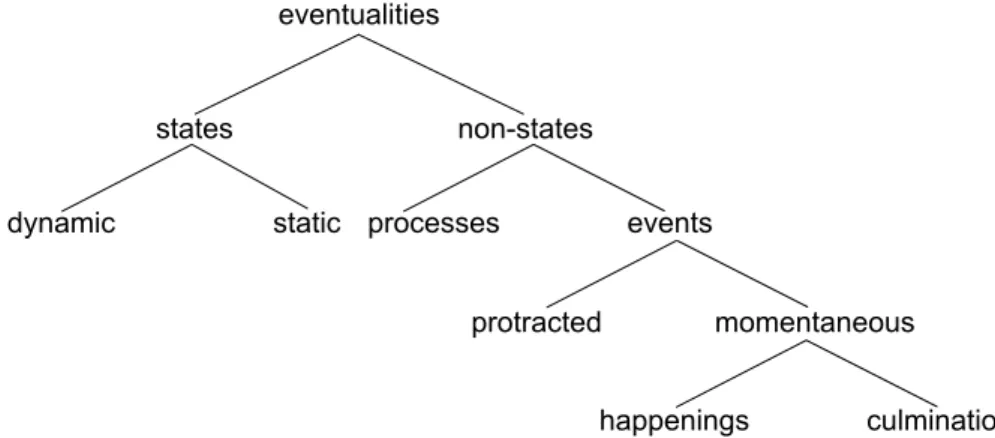
Bach (1986) introduced the notion of eventuality and proposed the division of eventualities into states and non-states, capturing a distinction imposed by the notion of change, a distinction that is deemphasised in Vendler’s and Dowty’s classifications. The aspectual classes distinguished by Bach are presented in Figure 2.1.
Bach distinguishes between two kinds of states according to their ability to occur with progressive tenses: dynamic states and static states. Only dynamic state verbs can freely occur with progressive tenses. Dynamic states are episodic, they apply only to spatio-temporal slices of individuals (example [2.39]). Static states hold permanently of their arguments (example [2.40]), or can be predicated of
Figure 2.1: Aspectual classes distinguished by Bach
them atemporally (example [2.41]).
[2.39] Mary is feeling sick.
[2.40] John knows the answer./*John is knowing the answer.
[2.41] The earth is round./*The earth is being round.
Non-states are further subdivided into processes (equivalent to Vendler’s activities) and events (subsuming Vendler’s accomplishments and achievements). Events are protracted (Vendler’s accomplishments) or momentaneous (Vendler’s achievements). Momentaneous events are split into culminations (example [2.42]) and happenings (example [2.43]), according to whether they involve a transition to a new state that is associated with culminations, but not with happenings.
[2.42] John’s father died a few years ago.(culmination)
[2.43] Mary noticed John’s mistake.(happening)
Bach (1981) also tries to elucidate the parallel between the mass-count distinction in nominal systems and the process-event distinction in aspectual classifications of verbal expressions. He uses the mereological part-of relation to establish the analogy between the nominal pair things-stuff and its verbal