Technical Report 2:
Hop Farming Business Plan Template
Part 3 of 4 for the project entitled: “The current feasibility and working business models for small-scale commercial hop farming in BC”.
Prepared for: Persephone Brewing Company Prepared By: Hop Yard Collective
May 20, 2015
Acknowledgement:
Funding for this publication was funded in part by Agriculture and Agri-Food Canada and the B.C. Ministry of Agriculture through programs delivered by the Investment Agriculture Foundation of B.C.
Disclaimer:
Agriculture and Agri-Food Canada, the B.C. Ministry of Agriculture and the Investment Agriculture Foundation of BC, are pleased to participate in the production of this publication. We are committed to working with our industry partners to address issues of importance to the agriculture and agri-food industry in British Columbia. Opinions expressed in this publication are those of the authors and not necessarily those of the Investment Agriculture Foundation, the B.C. Ministry of Agriculture or Agriculture and Agri-Food Canada.
Table of Contents
How to use this Business Plan Template ... 4
Section 1. Business Overview ... 6
Executive Summary ... 5
Business Idea Overview ... 6
Corporate Structure ... 6
Critical Success factors ... 6
Section 2: Marketing ... 7
What are hops? ... 7
History of Hops in BC ... 7
Current Industry Trends ... 7
Competitive Analysis ... 9
Risk Analysis ... 9
SWOT Analysis ... 11
Product, Price, Place and Promotion ... 12
Production Plan ... 13
Competitive Matrix ... 13
Ownership and Human Resources Plan ... 13
Section 3: Financials ... 14
Investment Analysis ... 14
Start up Capital ... 14
Start up Expenses and Working Capital ... 15
Financing ... 15
Payback Analysis ... 15
Projected Net Income Analysis ... 16
Sensitivity Analysis ... 17
Cash Flow Statement ... 18
Breakeven Analysis ... 18
Appendices ... 20
Appendix A – Materials List for X Acre Hop Yard ... 20
Appendix B – Net Income Statement ... 21
Appendix C – Cashflow Statement ... 22
How to use this Business Plan Template
This business plan template was produced for aspiring hops farmers in British Columbia. The template is designed for independent hops farmers or farmers operating as part of a collective growers program that markets and sells the hops to breweries and includes shared access to harvesting and processing equipment, crop pooling, and technical support. At the time this template was written, there was no active collective growers program available in BC, however, many people were aware of the concept and perhaps this is template will serve to promote the establishment of such a program.
The purpose of this template is to guide a potential hops farmer through a business planning process that will allow them to better understand the requirements for starting a viable hops farm and present a business case strong enough to secure funds for starting the business. This business plan template includes two components:
1. The Business Plan Template Document which is this document and has been designed explicitly for a hops farming business in BC.
2. Financials Spreadsheet which supports the financials section in this document and provides the necessary tools to develop and evaluate different hops farming scenarios. Some sections of the business plan are relatively generic and would likely be included in any new hops farming business plan. These sections within this template are written in normal font (such as this) and are provided as either suggested wording or examples of wording.
The sections that are written in Italics are descriptions of a particular section with explanations on what needs to be included in that section. Because every business plan will be unique in its own way, the Italics section need to be carefully thought out and drafted to fit the needs of whomever is developing the business plan.
Executive Summary
The executive summary should be drafted last in the development of the business plan. This section summarizes the key elements of the business plan very clearly and concisely. The author needs to frame the executive summary in a manner that speaks directly to a specific audience, such as a banker, investor, loan officer ect. The following elements of the business plan are recommended to be inclued in the executive summary.
-‐ Description of the business
-‐ Corporate or ownership structure
-‐ General goals of the business
-‐ Target market
-‐ Financial projections
-‐ Financing
Section 1. Business Overview
Business Idea Overview
This section of the report provides a general overview of the business, which will depend on the business model you chose and the size of your farm. Both farming scenarios would capitalize on a booming craft beer industry that is showing no signs of slowing down.
For farmers in a collective growers program the following provides a general overview:
-‐ Similar to a co-‐op
-‐ Farmer is only responsible for growing, drying and bailing hops
-‐ Hops are transported to a central facility operated by an entity that coordinates the sale of the hops
-‐ This entity, would be responsible for processing, marketing, storing and distribution
-‐ Revenue for the farmer could be generated through a revenue sharing agreement or market price for whole dried hops
-‐ Little to no control over the branding
For independent hops farmers the following provides a general overview of the business
-‐ Corporate farming entity
-‐ Farmer is responsible for everything required to get hops to market, which includes the growing, drying, processing, storing, marketing and distribution
-‐ Full control over the business activities
Corporate Structure
The business will either be a sole proprietorship (single owner and simple business structure), a partnership (usually two or three equal partners in the business) or a corporation (following a conventional corporate business structure)
Critical Success factors
This section describes the factors will contribute to the success of the business. The following are suggestions for critical success factors:
Passion
Hops farmers are very passionate about craft beer and supporting local sustainable agriculture in BC.
Quality
Maintaining quality standards for the production of by implementing strict quality control protocols for the maintenance and management of the entire farming operation.
Brand and Marketing
BC hops can be branded as a local ingredient for BC beers. Beers made with BC hops will be able to differentiate themselves from the competition by appealing to a market segment that is drawn to a high quality product that is socially, economically and environmentally aware.
Section 2: Marketing
What are hops?
Hops are one of the principle ingredients in the beer making process and provide the balance to the beer that often gives the beer its signature. These “spices” are responsible for providing the beer with aroma, bittering and hop flavouring. Although many of the same varieties of hops are grown in different parts of the world, hops are often characterized by their location in addition to their variety, having what wine makers call “terroire”.
Hops are a herbaceous perennial vine and are members of the plant family Cannabinaceae (Kneen, 2004). Hops are native to temperate zones of the northern hemisphere and are most commonly found between the 30th and 50th parallels (Kneen, 2004). These plants typically live over 25 years and take approximately 4 years to fully establish. An established hops plant can grow up to 6 m high and is able to produce upwards of 2 pounds of dried hops per plant in ideal growing conditions (Kneen, 2004). During the spring, the hops bines start growing at a fairly rapid rate, sometimes as much as 30 cm per day. Once the plant has reached it’s maximum height, it begins to produce clusters of hops that typically mature between late summer and early fall, which is when they are picked, processed, and ready to be used for making delicious craft beer. Hops can be used in their whole form or as pellets. Pellets are the most commonly used for commercial brewing, as many brew houses are not equipped to use whole hops in the brewing process.
History of Hops in BC
The earliest cultivation of hops in BC dates back to 1862 when farmers in Saanich, just north of Victoria, began growing hops to sell to local brewers (Evans, 2004). A shortage in other countries allowed big profits in BC, and interest spread to other parts of the province (Evans, 2004). In the Chilliwack area, the industry continued to grow until the 1940’s when nearly 2,000 acres were under cultivation, with 4,000 people employed during the harvest each year (Evans, 2004).
At its peak the Fraser Valley represented the largest hop-‐growing region in the entire British Commonwealth (Evans, 2004). But after World War II, the industry began shrinking, and in the 1950’s, the farms began using mechanized pickers, which ended the need for large numbers of workers (Evans, 2004). Declining, too, was the actual size of the industry, which now had to face the competition of the massive hop production of the Yakima and Willamette Valleys, in
Washington and Oregon to the south. The province’s major corporate-‐owned breweries were buying cheaper hops almost exclusively from Washington State’s heavily subsidized hops industry. Fewer and fewer farmers chose to grow hops until the last of the great Fraser Valley hop farms closed down in 1997 (Evans, 2004).
Current Industry Trends
The sample text below is provided as an example only based information in existence when this report was written. This section will need to be updated with relevant and current information for your farm business.
The currents industry trends for BC grown hops is based on the recent growth of the craft beer industry in addition to the increasing demand for local products. Within the last decade, the craft beer industry in North America has been booming. In 2013, the US experienced an 18% increase in craft beer sales despite a decrease in overall beer sales of 2%. In addition to growth in market share, craft beer prices also increased by 2.3% (DENCBC, 2014). Craft beer in BC has been booming as well. A recent article in the Vancouver Sun stated:
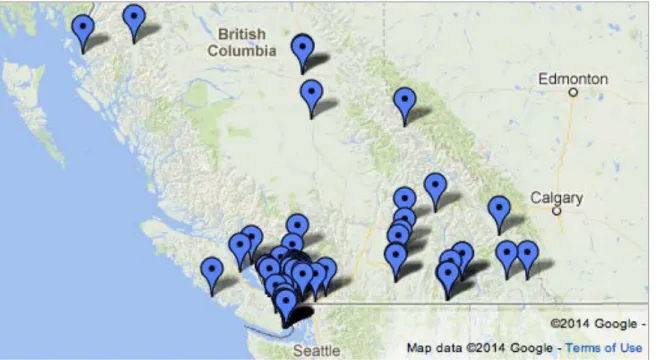
“B.C. has been adding about a dozen new craft breweries a year during the past five years, growth that is mirrored south of the border, where at least 1,000 craft breweries have opened across the United States in that period” (Zeschky, 2014). In BC, craft beer’s market share accounts for nearly 15% of all beer sold according to the Craft Brewers Association of British Columbia, who maintain that brewers are experiencing sales growth between 15 and 20% per year. Since 2007, BC microbreweries (breweries that produce less than 160,000 HL per year) have experienced a 140% increase in sales (BCLDB, annual reports 2007 to 2013), as sales have almost tripled from approximately $60.5 million to $169.6 million (Figure 1). Coupled with the boom in craft beer sales, the number of microbreweries in BC has boomed as well. In 2012, there were roughly 55 microbreweries breweries in BC, in 2013 that number grew to 64, and in 2014 there were 22 more breweries in BC, bringing the total number of breweries to more than 85 (BCBeer.ca).
Figure 1: Annual BC beer sales for microbreweries, macrobreweries, and total domestic beer from 2007 to 2013
• Microbreweries are defined as
small breweries that produce less than 160,000 HL per year
• 23% increase in annual
microbreweries sales since 2007
• 140% increase in annual sales
over the last 7 years
• Microbreweries sales have
almost tripled from $60.5 million in 2007 to $169.6 million in 2013
• Microbreweries share of
domestic beer market increased from 7% in 2007 to 19% in 2013
Figure 2: General location of microbreweries in BC – July 2014
The market for local goods has also recently experienced large growth as the awareness for "food miles" and the carbon footprint of food has been steadily increasing among the general consumer (USDA). Public interest in the source of food (which includes beverages) has meant a real growth in small-‐scale agriculture marketing direct to the consumer right across North America. Many campaigns have been initiated to specifically address and encourage the marketing and production of local food (www.usda.gov/knowyourfarmer). In the US, direct sales from farms and local foods doubled ($600 million to $1.2 billion) between 1992 and 2007. While, the national count of farmers markets increased by over 360% (1,755 to 8,144) between 1994 and 2013.
Competitive Analysis
Risk Analysis
These tables should be revised to appropriately reflect your farm business.
Table 3. Technological analysis
Issues -‐Risk Strategy
• Hops harvesting relies on the reliability of equipment from harvesters (pickers) and hops drying mechanisms. This equipment must be functioning during the harvest period.
• Maintain equipment and responsible
budgeting
• Attend trade shows to better understand efficient farming and Best Management Practices
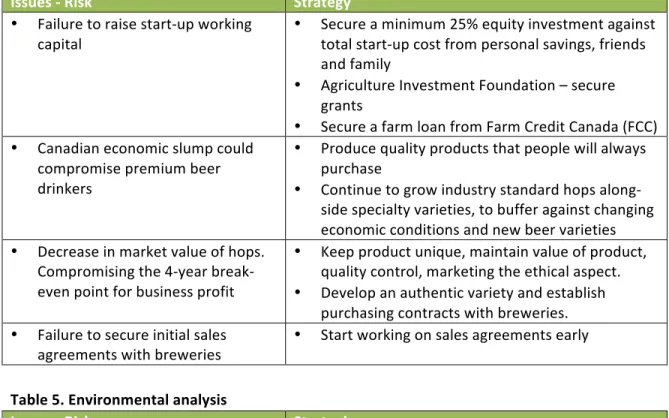
Table 4. Economic analysis
Issues -‐ Risk Strategy
• Failure to raise start-‐up working capital
• Secure a minimum 25% equity investment against total start-‐up cost from personal savings, friends and family
• Agriculture Investment Foundation – secure
grants
• Secure a farm loan from Farm Credit Canada (FCC)
• Canadian economic slump could
compromise premium beer drinkers
• Produce quality products that people will always purchase
• Continue to grow industry standard hops along-‐ side specialty varieties, to buffer against changing economic conditions and new beer varieties • Decrease in market value of hops.
Compromising the 4-‐year break-‐ even point for business profit
• Keep product unique, maintain value of product, quality control, marketing the ethical aspect. • Develop an authentic variety and establish
purchasing contracts with breweries. • Failure to secure initial sales
agreements with breweries • Start working on sales agreements early
Table 5. Environmental analysis
Issues -‐ Risks Strategies
• Climactic risks including drought,
hail, cold temperatures • Innovative farm tools to deal with climactic conditions • Observe weather conditions
• Design an efficient farm with precautionary measures and back-‐up water supplies
• Implement efficient agriculture practices such as mulching
• Adapt to changing growing seasons
• Pests and disease • Develop pest management plan before planting
the hop farm (identify current pests) • Plant pest plants
• Seek opportunities to work with local universities to do research for pest control management • Research best management practices in other
countries and anticipate the impact of climate change on pest inundation
Table 6. Political analysis
Issues -‐ Risks Strategies
• Changes to ALR land designation could alter agricultural zoning and uses in BC
• This is unlikely, but a change in ALR designation could increase the value of farm land but may remove some of the benefits for dedicated farm land in the Province.
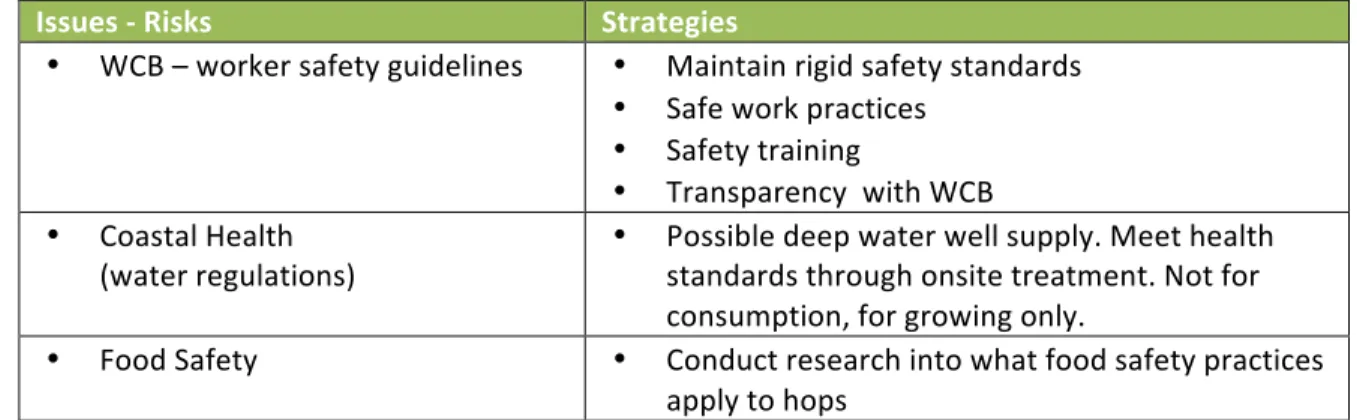
Table 8. Legal analysis
Issues -‐ Risks Strategies
• WCB – worker safety guidelines • Maintain rigid safety standards • Safe work practices
• Safety training
• Transparency with WCB
• Coastal Health
(water regulations) • Possible deep water well supply. Meet health standards through onsite treatment. Not for consumption, for growing only.
• Food Safety • Conduct research into what food safety practices
apply to hops
SWOT Analysis
The SWOT analysis should be revised to reflect your business’ unique Strengths, Opportunities, Weaknesses and Threats.
Strengths
• Business owners have existing farming knowledge, and business experience • Tax break from ALR land
• BC has suitable land/climate for hops • Established growing practices
• Hops are in DEMAND • Crucial ingredient for beer
• Premium price point for ethical, BC hops
Opportunities
• Market opportunity
(local demand exceeds local supply) • Local agriculture component
• Sustainable farming techniques & water management incorporated in business plan • Create local jobs in the community
• Establish BC as hops growing area • Value added farm enterprises • Diversify agriculture in BC • Diversification to craft beer • Decrease food miles for BC beer • Create hops flavours specific to BC • Growth/diversification to craft beer
• Agro-‐tourism
Weakness
• High start up costs
• Breakeven timeframe (long payback
period)
• Labour intensive (est. 3,000 hours for 5 acres)
• Seasonal labour
• Competing with US prices
• Minimal access to proprietary strains • 4-‐year lag to full yield
• long return on investment • relatively high costs of land
Threats
• Change in market price• US hops market (subsidised & cheaper) • Agriculture is vulnerable to uncontrolled
external conditions such as weather
• Climate change – may affect pests, weather & droughts
• New farms entering the hops market in BC • Pests and desease
• Weather and crop failure • Volatility in the market • Crash in craft beer market • Saturation in hops supply
Product, Price, Place and Promotion
Sample text is provided as an example only.
Product
The product is high quality, locally grown hops. Including some premium varieties and also standard brewing hops such as Cascadia and Centennial hops which are used in almost all craft beers. The hops are dried, processed and packaged in clear plastic vacuum sealed containers to preserve the freshness. The brand will appear on every package of hops sold. As the target market is BC Breweries and Brewpubs, these hops will offer a locally grown product compared to the majority of hops which are imported from the US. Social and environmental values are the foundation of the business plan and therefore these are marketed as ethical hops that support local farmers and the economy.
Price
The price will be marketed 20% above standard market value. The price will therefore range by approximately $11 -‐ $17 per pound for processed hops. Market research has suggested that BC Breweries will also pay more for the product because they are a premium locally grown product which can enhance the brewery’s marketing plan. Long term supply agreements with breweries will be established that can secure a market for hops at a reliable price. Long term supply agreements can be negotiated at rate within standard market value rates that incorporate global and local pricing trends.
Place
The goal is to sell the majority of the product to BC craft breweries and provide a sense of ‘place’ with BC for hops that provide unique flavours. The hops farm will be a casual, yet productive environmentally friendly operation with the intent to create an easy going, beer loving environment.
Promotion
Our target market is craft breweries in BC and the product will be marketed directly to that specific segment. Strategies for target marketing include meeting face-‐to-‐face with production managers at breweries, providing sample packages, and an informative website where
breweries can get more information. Other outreach and promotion strategies include:
• Farm tours
• Workshops on hops cultivation
• Attending trade shows and conferences
• Attending other hop farming workshops
• Attending craft beer conferences and competitions • Offering awards for brewing competitions
• Merchandise
•
Sponsoring other local events and local businessesProduction Plan
Describe your production plan from planting to production. Sample text is provided below.
YEAR ONE: Capital purchased in the first year will include the X acre hops yard (trellising and posts), truck, trailer and tractor. Plans will be finalized for picking and processing equipment. YEAR TWO: Fertilizing, maintenance, pruning of the hops. Developing markets and making contacts in brewery industry. Developing marketing tools.
YEAR THREE: First real harvest. Test harvesting equipment, drying equipment, packaging equipment. Ongoing farm maintenance. Test brew batches with local breweries for quality control.
YEAR FOUR: Full harvest year. Maintain soil and crops with general maintenance. Harvest and package crops for market. Focus on markets and customer relations.
MARKETING: Getting hops to market will start at the processing facility, where all varieties will be processed together and marketed to BC Craft Breweries.
Competitive Matrix
The following matrix examines the current known competition of established hops farms and brokers offering hops to BC Breweries.
Table 9. Competitive matrix
YOUR FARM
HERE Hops Connect Country Malt Sartori Cedar Ranch Hops Union Location Pemberton, BC Richmond, BC Chilliwack, BC USA (Wash. St.) Description Either Collective
grower or
independent farmer
Imported whole hops & processed in BC with some locally grown supply
Large Canadian broker of imported hops and malts. Warehouse in Richmond BC.
10 acre hops farm. Grown specifically for Driftwood Brewing.
Hops grown in USA & available for purchase to Canadian Brewers
Local BC Yes Yes/No No Yes No
Price per pound ($) (Aroma Hops)
$15 $15-‐$18 $10 -‐ $18 (USD) $15 $8 -‐ $16 (USD)
Border taxes
& fees No No Yes No Yes
Ownership and Human Resources Plan
Insert sample content below with your proposed ownership model and staffing plan.
Corporate structure: • Sole Proprietorship Staffing plan:
• Two full time seasonal farm labourers
• Five acres = approximately 3,000 labour hours
• Average wage: $12/hour each
• Work season from May – October • Five days a week, 40 hours/week • Farm maintenance as outlined by owner
• Owner to act as farm manager (no wage included)
Section 3: Financials
The financial section must be consistent with the financial projections developed for the business plan. The following sections are recommended for financial analysis are linked with the
accompanying Hop Farming Business Plan Spreadsheet.
Investment Analysis
Start up Capital
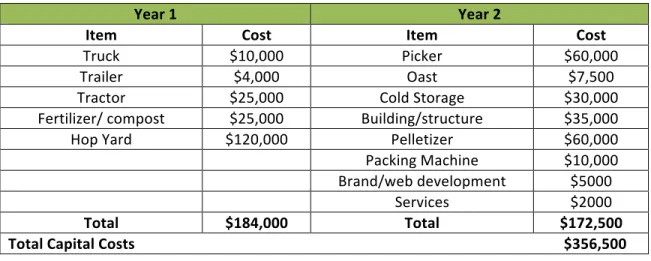
In this section, describe the start up capital required and the time frame to get the hop yard fully operational. As hops take 4 years to reach maturity it’s recommended to phase in the capital purchases over a two or three year period. Below is an example of the capital requirements purchased over a three year period. The table below provides estimates on start up capital costs. You can use similar wording or re-‐write completely, but make sure that all of your start up capital is captured in this section.
Year 1 Capital
The initial start up capital in year 1 will include a tractor, truck, trailer and everything required to construct and plant the hop yard. The tractor will be used for the assembly of the hop yard and used for general management of the yard once it’s in operation. The truck and trailer will be required to transport supplies for the hop yard. The assembly of the hop yard will include all of the supplies and materials for constructing the trellises, amending the soil, planting the
rhizomes, and installing the irrigation system.
Year 2 Capital
By the second year, the estimated yield from the hop yard is XXXX lbs. These hops will need to be picked, dried, pelletized and stored so they can be ready for market. Year two capital purchases will include a picker, oast house, pelletizer, packager, and construction of a thermo-‐ regulated cold storage building to house equipment and store the hops.
Year 3 Capital
Depending on the size of the farming operation, the capital purchases could occur over a three year period, whereby year three is when the processing and packaging equipment would be purchased.
Table 10. Example of Initial start up capital for a 10 acre hop yard over a 2 year period
Year 1 Year 2
Item Cost Item Cost
Truck $10,000 Picker $60,000
Trailer $4,000 Oast $7,500
Tractor $25,000 Cold Storage $30,000
Fertilizer/ compost $25,000 Building/structure $35,000
Hop Yard $120,000 Pelletizer $60,000
Packing Machine $10,000
Brand/web development $5000
Services $2000
Total $184,000 Total $172,500
Start up Expenses and Working Capital
This section of the report will summarize all of the required start up expenses for the full start-‐up of the farm including capital and working capital. Capital costs are explained in the section above and working capital includes all of the costs to operate the business and keep the business afloat until the farm starts generating a profit.
Table 11. Start up expenses from year 1 to end of year 4
Item Year 1 Year 2 Year 3 Year 4
Capital Purchases -‐ -‐ -‐ -‐ Operating Expenses -‐ -‐ -‐ -‐ Total -‐ -‐ -‐ -‐ Total -‐
Financing
Funding can come from personal contributions, grants, bank loans, and investors. It’s
recommended that at least 20% of the initial start-‐up costs come from personal contributions. Grant applications can be made to organizations such as the Investment Agricultural Foundation and the Real Estate Foundation. Farm Credit Canada is another option for securing low interest loans for starting a farming business. The table below can be used to evaluate different funding scenarios.
Table 13. Financing sources, rates and terms
Source Amount Rate Term Total Interest Total Cost
Personal
contributions -‐ n/a n/a n/a n/a
Grants -‐ n/a n/a n/a n/a
Capital Loan -‐ -‐ -‐ -‐ -‐
Operating Loan -‐ -‐ -‐ -‐ -‐
Investors -‐ -‐ -‐ n/a n/a
Total -‐
Payback Analysis
The payback analysis should be based on the interest rate for a loan amount negotiated with the lender(s). This section should outline the payback schedule for all loans (All formulas for
calculating payback schedules are included in the financial spreadsheet under the “Financing” sheet).
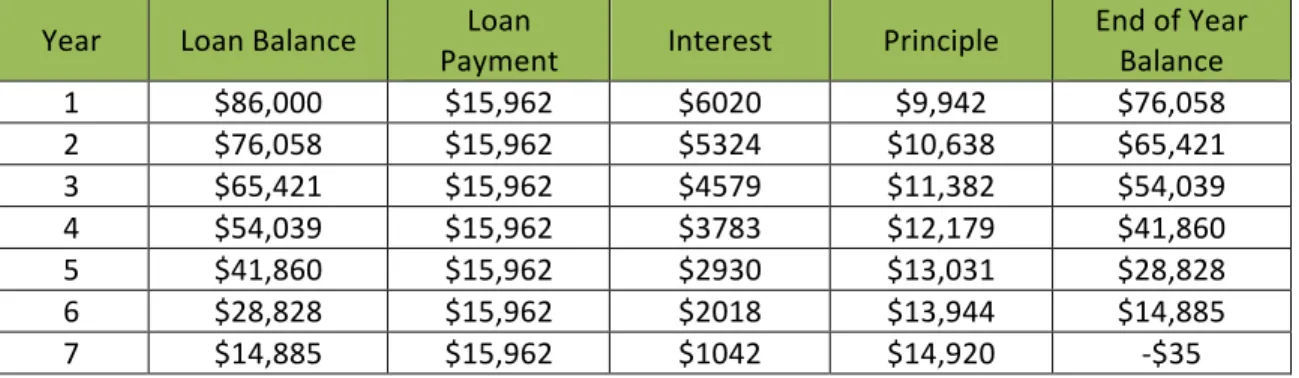
Table 14. Example of payback schedule for an $86,000 loan at 7% paid over 7 years
Year Loan Balance Payment Loan Interest Principle End of Year Balance
1 $86,000 $15,962 $6020 $9,942 $76,058 2 $76,058 $15,962 $5324 $10,638 $65,421 3 $65,421 $15,962 $4579 $11,382 $54,039 4 $54,039 $15,962 $3783 $12,179 $41,860 5 $41,860 $15,962 $2930 $13,031 $28,828 6 $28,828 $15,962 $2018 $13,944 $14,885 7 $14,885 $15,962 $1042 $14,920 -‐$35
Projected Net Income Analysis
The net income shows the projected profitability of the business over time. It is recommended to state all of the assumptions that were used in projecting the net income. Below are some examples of assumptions:
§ Hops yield: 0% in year 1, 40% in year 2, 90% in year 3, and 100% in year 4
§ One acre of hops at full production will yield 1,500 lbs of dried and processed hops
§ The market price for BC hops will be $15/lb
§ One acre of hops plants will produce 3,000 rhizomes
§ The cost of labour for hops farming is $12/hour
§ The value of hops grown through the collective growers program will be $9/lb and is based on a 60/40 revenue share with a collective growers program (Assumption for collective growers only)
It is recommended that a summary of all of the revenues and expenses be provided to show the net income projections over certain period of time. Refer to the “Net Income” sheet in the Financials sheet to complete this section.
Table 15. Summary of Net Income Statement
It’s further recommended that a brief summary of the net income be provided. It will be useful for a lender to know how long until the business finally starts to earn a profit.
Summary of Net Income over 10 Years
Y1 Y2 Y3 Y4 Y5 Y6 Y7 Y8 Y9 Y10 Revenues - - - - Variable Expenses - - - - Fixed Expenses - - - - Net Income - - - -
Sensitivity Analysis
A sensitivity analysis allows you to examine how changes in price or production may influence the profitability of your business. Below are recommended sensitivity analysis’s for hops farming.
Change in Market Price for Hops
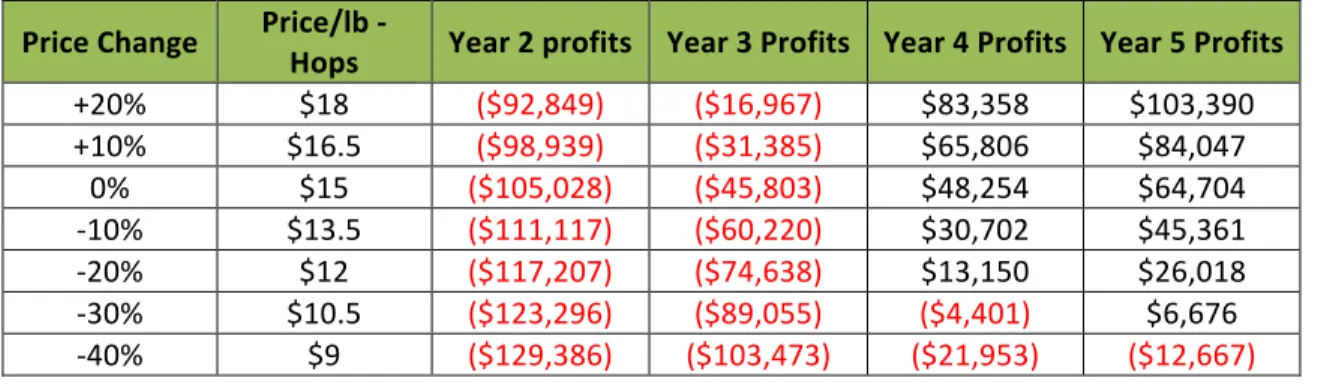
As the farming industry experiences volatility in market prices based on supply, demand and quality, it is likely that the market price for hops could experience some volatility. It is useful to know how these pricing fluctuations may impact the business. The following tables highlight a 4-‐year sensitivity analysis on a drop in market price for hops by 10%, 20%, 30%, and 40% and a rise in market price by 10% and 20% for hypothetical profit projections. Year 1 has been omitted because be no revenues will be generated for that year.
Table 16. Net Profit based on change in market price for hops
Based on the sensitivity analysis above, the volatility in market prices will have a significant impact on profits. If the market decreases by 20%, the business will show profitability, however, if market prices drop by 30% or more then the business will have to alter its business model to accommodate the changing market environment.
Change in Yield
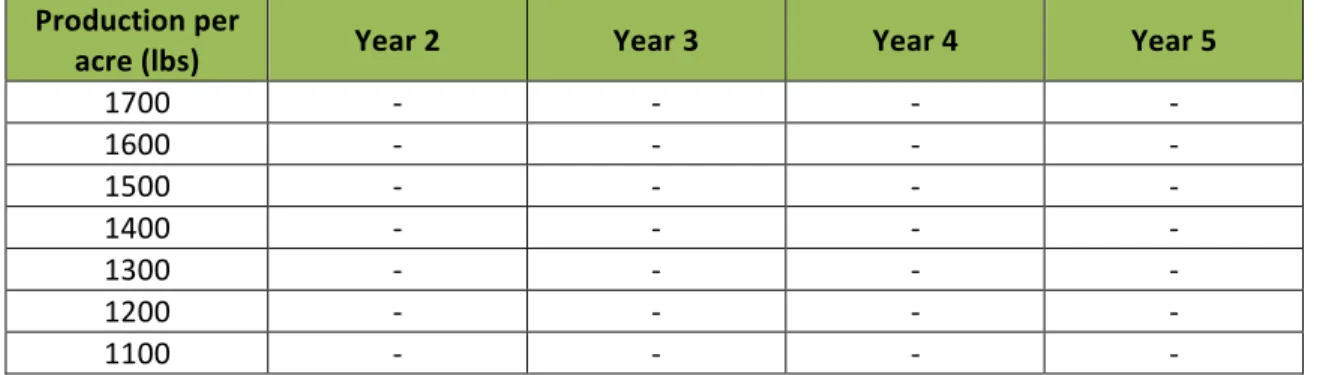
The amount of hops produced annually will have an effect on profits. The following table highlights changes in profits based on varying levels of production between years 2 and 5. Note that year 1 has been omitted because be no hops will be produced for that year. To conduct the sensitivity analysis, adjust the pounds per acres in the “Net Income” sheet.
Price Change Price/lb -‐ Hops Year 2 profits Year 3 Profits Year 4 Profits Year 5 Profits
+20% $18 ($92,849) ($16,967) $83,358 $103,390 +10% $16.5 ($98,939) ($31,385) $65,806 $84,047 0% $15 ($105,028) ($45,803) $48,254 $64,704 -‐10% $13.5 ($111,117) ($60,220) $30,702 $45,361 -‐20% $12 ($117,207) ($74,638) $13,150 $26,018 -‐30% $10.5 ($123,296) ($89,055) ($4,401) $6,676 -‐40% $9 ($129,386) ($103,473) ($21,953) ($12,667)
Table 18. Profits based on change in hops production Production per
acre (lbs) Year 2 Year 3 Year 4 Year 5
1700 -‐ -‐ -‐ -‐ 1600 -‐ -‐ -‐ -‐ 1500 -‐ -‐ -‐ -‐ 1400 -‐ -‐ -‐ -‐ 1300 -‐ -‐ -‐ -‐ 1200 -‐ -‐ -‐ -‐ 1100 -‐ -‐ -‐ -‐
Cash Flow Statement
The cashflow statement shows the business’ liquidity and represents all of the estimated cash in and out on an annual basis. During the first year of operation, no hops will be produced as the projected yield on the plants is 0%. The cash flow for the first year will likely rely solely on contributions from grants, bank loans, investors, and owners’ contributions. From year 2 onwards, hops will be produced and available for sale and revenue will be generated to offset the loan required to keep the cash flow statement positive. Eventually, the revenues generated from hops production will be enough to cover the costs to fully operate the business. The table below provides a summary for the cash flow based on the cashflow in the financials spreadsheet.
Complete the “Cash Flow” sheet in the Financials spreadsheet.
Table 19. Cash flow summary
Cash Flow Summary Years 1 to 4
Year 1 Year 2 Year 3 Year 4
Net Operational Cash In -‐ -‐ -‐ -‐
Total Cash In -‐ -‐ -‐ -‐
Total Cash Out -‐ -‐ -‐ -‐
Surplus -‐ -‐ -‐ -‐
Breakeven Analysis
The breakeven analysis is based on the number of full production acres required to breakeven and minimum price per pound. The breakeven analysis for price has been calculated on an annual basis because the production of hops increases over time. Although the variable and fixed expenses increase over time, the increases are fairly small, while the production increases at much higher rate. Therefore, the breakeven prices are initially very high because no hops are being produced, however, they do decrease overtime. Refer to the “Net Income” sheet in the Financials Spreadsheet for the breakeven analysis calculator for acres and price.
Table 20. Breakeven analysis for number of full production acres Breakeven quantity (Q=FC/(P-‐VC)
Variable Costs -‐
Total Profit per acre -‐
Total Fixed costs per year -‐
Required number of acres to breakeven -‐
Table 21. Breakeven analysis for price per pound
Breakeven Price (P=(FC+(VCxQ))/Q) Y2 Y3 Y4 Y5 Y6 Y7 Y8 Y9 Y10 Variable Costs/lb -‐ -‐ -‐ -‐ -‐ -‐ -‐ -‐ -‐ Fixed Costs -‐ -‐ -‐ -‐ -‐ -‐ -‐ -‐ -‐ Quantity -‐ -‐ -‐ -‐ -‐ -‐ -‐ -‐ -‐ Breakeven -‐ -‐ -‐ -‐ -‐ -‐ -‐ -‐ -‐
Appendices
Appendix A – Materials List for X Acre Hop Yard
Insert a copy of your materials list from the Hop Farming Business Plan Spreadsheet and note the size of your hop yard (number of acres) in the heading above. Appendix B – Net Income
Statement
Appendix B – Net Income Statement
Insert a copy of your materials list from the Hop Farming Business Plan Spreadsheet and note the size of your hop yard (number of acres) in the heading above. Appendix B – Net Income Statement
Appendix C – Cashflow Statement
Insert a copy of your Cashflow Statement for Year 1 from the Hop Farming Business Plan Spreadsheet.
Appendix D – Balance sheets and Net Worth Statement
Insert copies of both the Balance Sheet and Net Worth Statement for the proposed hops farm from the Hop Farming Business Plan Spreadsheet.