Universitat Politècnica de Catalunya (UPC) - BarcelonaTech
Facultat d’Informàtica de Barcelona (FIB)
Treball Final de Grau (TFG)
2012-2013
|
Spring Term
Computer Architecture Department (DAC)
Bachelor Degree in Informatics Engineering (Computing)
Domain Specific Languages for High
Performance Computing
A Framework for Heterogeneous Architectures
Alejandro Fernández Suárez
([email protected])In the hallway of the university, Dominique asked a colleague: “I’ve always wondered why, in general, people talk using always the same general cumber-some vocabulary instead of trying to be concise and specific”.
“Hmm” retorted his surprised interlocutor, “well, I suppose everybody likes keeping things simple, like using the first words that come to their minds and everybody knows”.
“Yeah, that’s it!”, exalted Dominique, “Simple, short, concise and specific so everybody gets your point!”.
This puzzled the interlocutor, but both walked into class with a happy smile...
Acknowledgments
I would like to thank my advisors Vicen¸c Beltran and Eduard Ayguad´e for giving me the opportunity to work at BSC and be involved in very exciting projects. Thanks for believing in me for this project, listening to my ideas and all the helpful comments and advice about my work. I am also grateful to Tomasz Patejko for all his help, comments and deep thinking conversations.
The early days of this project were about getting to know the potential of LMS for our purpose. I would like to thank Arvind Sujeeth and Tiark Rompf for their detailed explanations about LMS and Delite when I was trying to understand the whole system. Thanks also to Florentino Sainz for his work on the OpenCL support for the Mercurium compiler and all the programming models department people that make our code able to run. In general, thanks to all my colleagues at BSC for being part of a great and enjoyable work environment.
Special thanks to my lovely girl Eva, for her support in everything I do and her enthu-siasm in reading and commenting my documents. I really enjoy your questions about practically everything, they help me to better understand everything I write about. Last but not least, I want to thank my friends and family for their support and providing a healthy counterbalance to my work and research.
Domain Specific Languages for High Performance Computing
Alejandro Fern´andez Su´arezComputer Architecture Department (DAC) Universitat Polit`ecnica de Catalunya (UPC)
2013
ABSTRACT
High Performance Computing (HPC) relies completely on complex parallel, hetero-geneus architectures and distributed systems which are hard and error-prone to exploit, even for HPC specialists. Further and further knowledge on runtime systems, depen-dency tracking, memory transaction optimization and many other techniques are a must-have requirement to produce high quality software capable of exploiting every sin-gle bit of power an HPC system has to offer. On the other hand, domain experts like geologists or biologists are usually not technology-aware enough to produce the best software for these complex systems. Nowadays, the only way to successfully exploit an HPC system requires that computer and domain experts work closely towards producing applications to solve domain problems. Domain experts have the knowledge on the do-main algorithms, while computer experts know how to efficiently map these algorithms on HPC systems.
This project proposes a framework that eases most of the processes related to the pro-duction of Domain Specific Languages (DSLs) that run on top of accelerator-based heretogeneus architectures. By using DSLs, domain experts can develop their applica-tions using their own high level language, focusing only on their hard-enough issues. Meanwhile, computer experts stay only improving the implementation of these DSLs to make the most out of an HPC platform. This way, we keep each expert focused as much as possible on its natural domain of expertise.
Lenguajes de Dominio Específico para Computación de Alto
Rendimiento
Alejandro Fern´andez Su´arez
Departamento de Arquitectura de Computadores (DAC) Universitat Polit`ecnica de Catalunya (UPC)
2013
RESUMEN
La computaci´on de alto rendimiento (HPC) se basa en la utilizaci´on de sistemas dis-tribuidos heterog´eneos dif´ıciles de explotar, incluso por expertos en el ´area de HPC. Para producir software HPC capaz de explotar toda la potencia de un supercomputa-dor, cada vez se requiere m´as conocimiento en t´ecnicas avanzadas de programaci´on tales como an´alisis de dependencias u optimizaci´on de transacciones de memoria. Por otra parte, expertos de dominio tales como ge´ologos o bi´ologos no estan tan familiarizados con las tecnolog´ıas actuales como para producir software para arquitecturas modernas. Por este motivo, la ´unica manera de explotar supercomputadores actuales es hacer que los expertos de dominio trabajen muy conjuntamente con programadores expertos para producir sus aplicaciones.
Este proyecto propone un sistema que agiliza muchos de los procesos asociados al de-sarrollo de DSLs para HPC. Mediante el uso de DSLs, los expertos de dominio pueden desarrollar sus aplicaciones utilizando su propio lenguaje de alto nivel, centr´andose so-lamente en sus ya complicados problemas. Mientras tanto, los programadores expertos focalizan sus esfuerzos en mejorar y optimizar la implementaci´on de estos DSLs de modo que aprovechen al m´aximo los recursos que ofrezca cada sistema. De este modo, cada experto se mantiene en su dominio natural, maximizando as´ı su productividad.
Llenguatges de Domini Específic per a Computació d’Alt
Rendimient
Alejandro Fern´andez Su´arez
Departament d’Arquitectura de Computadors (DAC) Universitat Polit`ecnica de Catalunya (UPC)
2013
RESUM
La computaci´o d’alt rendiment (HPC) es basa en la utilizaci´o de sistemes distribu¨ıts het-erogenis dif´ıcils d’explotar, incl´us per experts en l’`area de HPC. Per a produ¨ır software HPC capa¸c d’explotar tota la pot`encia d’un supercomputador, cada cop es requereix m´es coneixement en t`ecniques avan¸cades de programaci´o tals com an`alisi de depend` en-cies o optimizaci´o de transaccions de mem`oria. D’altra banda, experts de domini tals com ge`olegs o bi`olegs no estan tan familiaritzats amb les tecnologies actuals com per a produ¨ır software per a arquitectures modernes. Per aquest motiu, l’´unica manera d’explotar supercomputadors actuals es fer que els experts de domini treballin molt conjuntament amb programadors experts per tal de produ¨ır les seves aplicacions. Aquest projecte proposa un sistema que agilitza molts dels processos associats al volupament de DSLs per a HPC. Mitjan¸cant DSLs, els experts de domini poder desen-volupar les seves aplicacions fent servir el seu propi llenguatge d’alt nivell, concentrant-se en els seus prou complicats problemes. Mentres tant, els programadors experts focalitzen els seus esfor¸cos en millorar i optimitzar la implementaci´o d’aquests DSLs de manera que aprofitin al m`axim els recursos que ofereix cada sistema. D’aquesta manera, cada expert es mant´e al seu domini natural, maximitzant aix´ı la seva productivitat.
Table of Contents
1 Introduction . . . 1 1.1 Motivation . . . 1 1.2 Objectives . . . 3 1.3 Contributions of this TFG . . . 5 1.4 Document structure . . . 52 Related Work and State of the Art . . . 6
2.1 DSLs boosting productivity . . . 6
2.2 Embedding domain-specific languages . . . 7
2.3 Parallel computing libraries . . . 7
2.4 DSLs by extending compilers . . . 8
2.5 Leveraging HPC programming for heterogeneus architectures with OmpSs 9 2.6 DSLs for stencil computations . . . 10
2.7 Lightweight Modular Staging . . . 10
3 Tools . . . 12
3.1 OpenCL . . . 12
3.2 OmpSs (OpenMP SuperScalar) . . . 17
3.3 Scala . . . 19
3.4 Lightweight Modular Staging . . . 24
3.5 Scala-Virtualized . . . 28
3.6 LLVM and Clang . . . 28
4 Data Flow SuperScalar Language . . . 30
4.1 NDRanges . . . 30
4.3 Data Buffers . . . 32
4.4 Executing kernels . . . 33
4.5 The OpenCL example revisited again . . . 34
4.6 Host asynchronous tasks . . . 35
4.7 Using external libraries . . . 36
4.8 Kernel usage safety mechanisms . . . 37
5 Implementation . . . 40
5.1 Kernel usage safety mechanism . . . 40
5.2 Dynamic task and kernel scheduling . . . 41
5.3 Code generation for OmpSs . . . 42
5.4 External library support . . . 43
6 Results . . . 44
6.1 N-Bodies physical simulation . . . 44
6.2 K-Means Clustering algorithm . . . 46
6.3 Cholesky decomposition of a matrix . . . 49
7 Impact, Plan and Cost Analyses . . . 52
7.1 Context . . . 52
7.2 Planning . . . 53
7.3 Action plan . . . 55
7.4 Alternative plans in case of possible deviations . . . 57
7.5 Methodology . . . 58
8 Conclusions and Future Work . . . 59
A Installation . . . 60
A.1 Get the Simple Build Tool . . . 60
A.2 Getting and installing LMS . . . 60
A.3 Installing LLVM and the DFSSL analysis tool . . . 61
B OmpSs code generated by DFSSL . . . 62 B.1 N-Bodies . . . 62 B.2 K-Means . . . 65 B.3 Cholesky decomposition . . . 68 Bibliography . . . 72 Index . . . 77 Glossary . . . 78 Acronyms . . . 79
List of Figures
1.1 Isolated modular approach to DSLs for HPC . . . 2
1.2 DSL production toolchain for HPC environments . . . 3
7.1 Critical path analysis . . . 55
List of Code Samples
2.1 Call to OpenCL kernel annotated with an OmpSs task pragma . . . 9
3.1 Simple OpenCL Example . . . 14
3.2 Annotating parallel loops . . . 17
3.3 OmpSs host side task . . . 17
3.4 OpenCL kernel for OmpSs . . . 18
3.5 OmpSs version of the OpenCL example . . . 18
3.6 Declaration of a generic class TypePrinter . . . 20
3.7 Usage example of instances of a parametrized class TypePrinter[_] . . . 20
3.8 Pattern matching of values of type Int . . . 21
3.9 Simple case class declaration . . . 21
3.10 Pattern matching on case classes . . . 22
3.11 Definition of a traitTypePrinter with abstract type member T . . . 22
3.12 Implementation of abstract type members . . . 22
3.13 Interface of the Vector DSL . . . 24
3.14 Implementation of the Vector DSL . . . 25
3.15 C++ code generator for Vector DSL . . . 26
3.16 Vector DSL example application . . . 27
3.17 C++ code generated for the Vector DSL example application . . . 28
4.1 Example of use NDRange expressions . . . 31
4.2 Example of use of KernelContainer expression . . . 31
4.3 Example of use of Kernel expression . . . 31
4.4 Specifying a default NDRange for a Kernel . . . 32
4.5 Data buffer initialization . . . 32
4.6 Data buffer random access . . . 32
4.8 DFSSL simple application . . . 33
4.9 DFSSL simple application with default range . . . 34
4.10 Simple OpenCL example written in DFSSL . . . 34
4.11 DFSSL Host tasks . . . 35
4.12 DFSSL external library support . . . 36
4.13 Simple OpenCL C kernel file . . . 37
4.14 Trying to create an undefined kernel . . . 37
4.15 Trying to create an undefined kernel . . . 37
4.16 Sample program that triggers a type mismatch error . . . 38
4.17 Kernel type mismatch error . . . 38
4.18 Sample program that triggers a no default range error . . . 38
4.19 Error shown when no default range is specified . . . 39
5.1 Initialization of the kernel file symbol map . . . 40
5.2 Mapping a simple function to all the elements of a buffer . . . 42
5.3 Parallel loop generated for a buffer mapping . . . 42
5.4 DFSSL-generated header file . . . 43
5.5 Using an externally defined function . . . 43
5.6 Generated code for external function usage . . . 43
6.1 N-Bodies problem solved in DFSSL . . . 44
6.2 K-Means clustering algorithm in DFSSL . . . 47
6.3 Cholesky decomposition of a matrix in DFSSL . . . 49
B.1 Generated code for the N-Bodies application . . . 62
B.2 Generated code for the K-Means application . . . 65
C
HAPTER
1
Introduction
The evolution of computer architectures is nowadays focused on multicore technology. Every single computer, even mobile phones have more than one central processing unit. Therefore, multicore technology is everywhere today, and we require parallel program-ming techniques to use them efficiently. Thus, parallel programprogram-ming does no longer just involve expert parallel programmers, but even also mobile application and web de-velopers, operative system programmers, and many more, specially scientists working in supercomputing environments. However, computer architectures are becoming more and more heterogeneous and complex, with more and more different parallel program-ming models and techniques, which makes it difficult even for experts to keep pace. So, how do we keep productivity and performance at the same time? Application developers need to keep producing their applications, but they also need them to be scalable, fast and efficient in modern architectures. Domain Specific Languages (DSLs) are in fact the most popular approach for such purpose.
DSLs are known for being small languages designed to only solve problems from a partic-ular domain. First, due to their tight coupling with a specific domain, they allow domain experts to intuitively express their applications. However, the performance and scala-bility of these languages are proportional to the effort required to develop them. Thus, it only pays off to implement a high performance tool-chain (compiler and execution runtime) for a DSL if it is going to be really widely used. Simple Query Language (SQL) is a good example. SQL is massively used to query and update relational databases, so spending lot of effort to develop and implement a powerful framework to support it is justified. On the other hand, there are hundreds of useful DSLs with a (relatively) small number of users that do not justify the efforts required to optimize it. Another problem of programming languages in general and DSLs in particular is that they often need to be mixed together to solve large problems, which is usually a hard and error-prone process that significantly reduces the benefits and applicability of DSLs.
1.1
Motivation
A framework that eases the development of DSLs that run on HPC systems would justify the effort required to develop a custom tool-chain for each of them. Starting by composing and reusing this high performance framework to produce multiple unrelated
DSLs, the total development costs gets more than amortized. Moreover, providing a framework to develop DSLs for HPC, we will be able to use multiple DSLs to develop complex applications, because the current development of applications that use several languages is usually a painful experience.
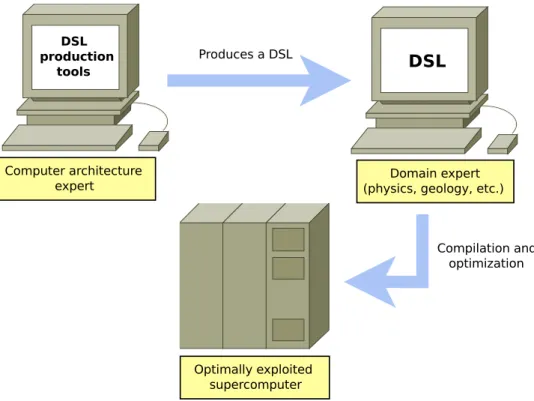
Isolating DSL designers (which are the ones that will create DSLs using our system) from burdens such as low level device management and explicit parallel programming will ease the development of new DSLs, leaving to framework developers activities that only expert machine-level programmers can successfully perform. To begin with, high level DSLs built upon this framework will empower domain experts with productive tools for their domain. At the same time, these tools would be implemented on our system to take advantage of underlying heterogeneus architectures through Open Computing Language (OpenCL) and/or runtime systems. In a ideal situation, domain experts should only access abstractions, which are expressions of their DSL. These abstractions will be provided by language designers, experts in both programming language design and heterogeneous computing. Additionally, this isolated design will in turn would allow further optimizations of generated code. As a result, productivity is increased from both sides: Domain experts, now able to just focus on implementations of algorithms specific for their domains, and language/compiler designers that can safely and blissfully ignore information not related to language and compiler design. Figure 1.1 depicts the approach towards high performance DSLs.
1.2
Objectives
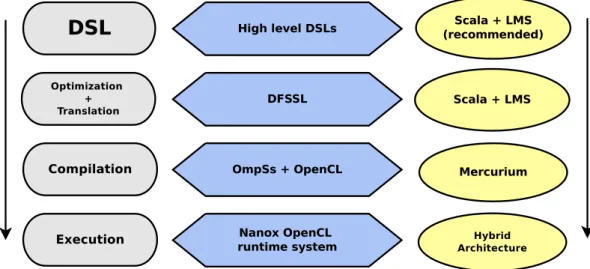
This project presents Data Flow SuperScalar Language (DFSSL), a language that lever-ages the performance and portability of kernels developed in OpenCL C, replacing the cumbersome OpenCL + OmpSs API by a high level programming model. This language, DFSSL, is implemented as an embedded compiler with Scala and the Lightweight Mod-ular Staging (LMS) library. The LMS library will be overviewed in Section 2.7 as related work and explained in detail in Section 3.4 as an important tool for this project. Once DFSSL is ready, high level DSLs can be implemented using Scala + LMS or any other approach, they just need to be translated to DFSSL to benefit from all of its features. Afterwards, the DFSSL code will be translated to OpenMP Superscalar (OmpSs) (a variant of OpenMP for heterogeneus architectures) in order to use the Nanox [9] run-time from Barcelona Supercomputing Center (BSC). Figure 1.2 represents this toolchain and all the steps that take place in the compilation process of a DSL built on top of DFSSL. Please note that high level DSLs targetting DFSSL can be implemented used any convenient approach, but this project will present the tools we used to build DFSSL detailedly, so any other DSL can be built in the same way.
Fig. 1.2: DSL production toolchain for HPC environments
Given the purpose of our framework, the main requirements of DFSSL are:
• Composability. We want DFSSL to interoperate with already existing libraries so we save as much effort as possible on development stages.
• Efficiency. Since it has to be the common layer for high level DSLs, it pays off to invest time on improving its performance.
• Genericity. It is essential that despite being a language focused in data–flow accelerator–based applications, DFSSL is expressive enough to allow almost any kind of high level DSL be implemented on top of it.
• Safety. In DFSSL applications and applications for heterogeneus architectures in general, the program that is run on the host machine interacts with the accelerator program. The language must provide safety mechanisms such as type checking between host and accelerator code or any required system that ensures there are no programming errors when creating or running accelerator programs (kernels).
1.2.1
Detailed objectives
The specific objectives of this project are exactly:
Prototype implementation of DFSSL
This prototype had to be enough to explore the potential of the framework as well as to experiment the possible problems such a project can have, effectively setting a base for further research. With this idea in mind, we designed and implemented DFSSL, focusing on making it best fitted for serving as target language to DSLs for HPC. Thus, DFSSL and the whole framework had to meet the following requirements:
• Comfortable and versatile syntax
• Static checking of source code to minimize programming errors related to host/ac-celerator interaction
• Support for integrating already existing external libraries
• Moderated complexity, enough to specify all major performance–related details
System validation by means of examples
To test and validate DFSSL, we chose some typical problems and algorithms on the area of HPC. These problems were N-Bodies[25], K-Means[45] and Cholesky’s factorization [26]. These examples are shown later in this memo, in Chapter 6. Please note that even if DFSSL is designed to serve as target language to HPC DSLs, we tested it implementing algorithms for simplicity. However, the language was completely verified because all the translation is performed no matter if the code being translated is a simple algorithm or a whole higher level DSL application translated by another tool.
1.3
Contributions of this TFG
This project presents DFSSL, a high level programming model that eases the devel-opment of applications for heterogeneous architectures, focused on serving as a target language for parallel high-level DSLs. DFSSL has been implemented as an embedded compiler in Scala and we explain all the tools we used in detail. This way, any program-mer(s) can implement DSLs on top of DFSSL with a modest effort, using just the same approach.
1.4
Document structure
The rest of this document is structured as follows: Chapter 2 gives a briefing over the state of the art on the field of DSLs for HPC. Following on, Chapter 3 then introduces the tools used to develop the project and justifies the choices made. The next chapter, Chapter 4, explains DFSSL and how to use it. Then, Chapter 5 nails down the details on the implementation of DFSSL’s most important features. To continue, some results from example applications are shown in Chapter 6. Chapter 7 details the development cost of the project, its initial and real planning, the methodology we followed and its social/economic impact. Chapter 8 concludes with some insight about the whole experience and research results obtained from the work done, overviewing some of the future work we can start now. The document ends with two Appendixes A and B. Appendix A contains instructions on how to deploy and install DFSSL, getting it ready for use. Finally, Appendix B shows the code generated by the DFSSL applications explained in Chapter 6.
C
HAPTER
2
Related Work and State of the Art
There exist different DSLs for all sort of applications (including non-performance critical environments), but none of them has been implemented by translation into a language like the one we present in this project. This chapter will overview the state of the art on the main topics regarding DSLs in general and tools for providing high performance DSLs.
2.1
DSLs boosting productivity
DSLs, also called small languages [15], are widely used in computer science [22] where performance and productivity are prior to generality and they are also a subject of intensive research [49]. On one hand, their implementation and design are suitable for a particular domain, so they are very expressive as languages for solving problems from this domain. On the other hand, due to their simplicity and size they are easy to learn and use. DSLs can be found in many domains of computer science, such as AWK [14] for text processing and Bison [21] for parser generation. Further examples are VHDL and Verilog, which are widely used for electronic circuitry design. Agda [36] and Coq [16] are used for theorem proving.
DSLs have also proved to be successful outside computer science. For example, R [19] is used for statistical computation and data analysis. More examples of successful DSLs are Matlab [32] and Mathematica [50] for numerical computing.
With advent of multi/many-core architectures, many emerging programming languages implement parallelism and concurrency as one of their paradigms. DSLs are no different. One of such languages is OptiML [47], a parallel DSL for solving problems from the area of machine learning. OptiML was implemented using Delite (see 2.7.1), which is a library built on top of LMS (see 2.7) and the Scala Virtualized compiler [13, 34].
2.2
Embedding domain-specific languages
Different methods allow DSL developers to embed DSLs in general-purpose languages. DSL embedding has the main advantage of saving time and effort by deep reuse of the host language compiler infrastructure.
One of the first languages that introduced a mean for embedding DSLs is Lisp [46]. Lisp offers a powerful macro system that allows programmers to extend the syntax of the core language. Macros are expanded at preprocessing time into regular Lisp code, then they are further compiled by the compiler. This makes Lisp macros good fit for DSLs. DSL syntax can be defined in terms of Lisp syntax by extending it using this macro system. DSL constructs can be implemented as macros and composed the same way macros are composed.
Lisp macros are an approach to static meta-programming and code generation. A simi-lar idea was implemented in Template Haskell [44]. Even though Haskell does not have macro system like Lisp, the same compile-time meta-programming was achieved by sev-eral extensions in the language, such as quasi-quotations [44]. This facility implements a set of functionalities such as fresh name generation or error reporting, needed for compile-time code generation.
So far, only compile-time code generation has been discussed. One of the platforms that allow runtime code generation is MetaOCaml [41, 48]. This language is a set of extensions of the OCaml language that allow dynamic type-checked code generation. The language is based on a concept called multi-stage programming [48]. The idea is that some computation can be divided into stages, depending on information availability. In MetaOCaml, the programmer is equipped with language constructs that allow explicit specification of the part of the application that should be staged.
2.3
Parallel computing libraries
The first approach (and the most direct and straightforward) to develop a high per-formance DSL is to provide a collection of functions and types defined on a library of an existing language. Then, this library becomes be the actual DSL produced and its implementation usually relies on parallel computing libraries that provide parallel opera-tions. However, implementing DSLs as libraries has some it has some limitaopera-tions. These limitations include difficulty to optimize applications written in this DSL or supporting an expressive syntax. Such problems occur mainly because the compiler is used just as a nonprogrammable black box that turns our code into something we can run. The following sections will give some examples of parallel computing libraries upon which parallel DSLs could be implemented.
2.3.1
DFScala
DFScala [23] is a Scala [39] library for expressing data-flow parallelism. Libraries writ-ten in Scala can offer very complete and expressive interfaces, as if the library syntax was supported by the Scala core language. In contrast with our system, we want to offer support for accelerators and any runtime system, not necessarily the Java Virtual Machine (JVM), which is the case of DFScala.
2.3.2
Generic Parallel Collection Framework
The Generic Parallel Collection Framework [42] of Scala is an implementation of all the standard data structures of Scala whose operations are executed in parallel. This is possible due to the pure functional design of immutable data structures. In the same way as DFScala (see section 2.3.1), using these libraries to implement DSLs poses a restriction on the runtime platform and some other desirable features, whereas our framework will be fully customizable in all these aspects.
2.3.3
CLPP and CUDPP
CLPP [1] and CUDPP [4] are C++ [2] libraries that implementent a collection of parallel operations in OpenCL [11, 35] and CUDA [3], repectively. As all parallel computing libraries, it can be used to provide efficient DSLs. However, this method is very limited when it comes to provide convenient syntax, because DSLs implemented as libraries that call CLPP and/or CUDPP internally can just offer C++ syntax.
2.4
DSLs by extending compilers
An alternative way to produce DSLs without writing a whole compiler is modifying and/or extending an already existing compiler to fit our current needs. By using plug-ins, implicit operations can be added to an already existing language. Depending of the compiler support for extensions, even some operations syntax elements can be com-pletely redefined, thus changing the core behaviour of the language. Although this approach is effective for producing complete DSLs, modifying an existing compiler is not necessarily a straightforward task and in many cases. The only complete DSL implemented this way for HPC environments is Liszt.
2.4.1
Liszt
Liszt [6, 20] is a DSL for mesh-based partial differential equations solvers. Liszt comes with its own runtime systems that optimize all the operations performed on geometry. The main disadvantage of Liszt against DSLs implemented with our system is that Liszt components and optimizations are completely ad-hoc, not reusable for by any other similar DSL and not composable with other libraries. In contrast, our framework will allow optimizations and components of the implementation of DSLs to be reused flawlessly among different DSLs.
2.5
Leveraging HPC programming for heterogeneus
ar-chitectures with OmpSs
OmpSs is a parallel task-based programming model for C/C++ applications. It extends OpenMPtaskpragmas with constructs for specifying data dependencies between tasks and the devices they will run in. It consists of source-to-source translator, Mercurium, and runtime library, Nanox++. Mercurium translates C/C++ code with pragmas de-limiting regions or functions that will be executed in parallel to C/C++ code with calls to Nanox++ API. When an application is executed, Nanox++ handles the efficient parallel execution of tasks. It is worth noting, that the OmpSs program do not require any call to the OpenCL API, the Mercurium compiler will generate all the required boil-erplate code to setup the kernel, while the Nanox++ runtime will perform the required data transfers from the host to the accelerator and viceversa and run the kernel.
1 const unsigned N = 100;
2 #pragma omp task in([N*100] bufin) out([N*100] bufout) 3 #pragma omp device target(opencl) ndrange(1, N*100, N)
4 parKernel(bufin, bufout);
Code 2.1: Call to OpenCL kernel annotated with an OmpSs task pragma
Code 2.1 shows how OmpSs pragmas are used to run the kernelparKernel in parallel on an OpenCL device. First, the programmer specifies dependencies through direction statements (line 1): in, out, and inout. These statements tell the OmpSs compiler (Mercurium) whether a task reads data, writes to it or both, as well as the input size in case of pointers. In line 2, a target device is specified through a device target statement. Also in line 2, the programmer specifies the OpenCL NDRange (offset, global size and local size, repectively) through a ndrange statement. The information about the data dependencies of a task and target architecture is used by the Nanox++ runtime to build dependency graphs, handle data transfers between CPU and GPU, and schedule tasks for parallel execution.
2.6
DSLs for stencil computations
Finite-difference stencil computations are very common in numerical modeling and they exhibit high degree of data parallelism and regular structure. There exist DSLs and frameworks for stencil computations and they usually exploit the stencil’s data access pattern by generating CUDA/OpenCL code, replacing loops by kernels that run on the accelerators.
One of these frameworks is Orio [30], an extensible framework for transformation and autotuning of codes written in different source and target languages, including transfor-mations from a number of simple languages (e.g., a restricted subset of C) to C, Fortran, and CUDA targets. The tool generates many tuned versions of the same operation us-ing different optimization parameters, and performs an empirical search for selectus-ing the best among multiple optimized code variants.
Another similar DSL + framework for stencil computations is Physis [31]. Physis is a compiler-based programming framework that automatically translates user-written structured grid code into scalable parallel implementation code for GPU-equipped clus-ters. The language features declarative constructs that allow the user to express sten-cil computations in a portable and implicitly parallel manner. Then, the framework translates the user-written code into actual implementation code in CUDA for GPU acceleration and MPI for node-level parallelization with automatic optimizations, such as computation and communication overlapping.
2.7
Lightweight Modular Staging
The LMS library [7, 43] is a Scala library composed by a set of functions and type definitions that allow the programmer to define stages [48] throughout the translation process of a language. Each stage represents a translation of the application code in which the system applies the optimizations corresponding the application’s domain. The last stage is the application execution with a specific input, so all the data is defined and the program computes its results. Please note that LMS is a library written in Scala, so a DSL application is compiled together with the DSL implementation, giving place to an executable code generator. Then, once the code generator is run, the DSL application gets translated. LMS allows a modular quick development of all the part composing a DSL: Representation (language user interface), expression (representation semantics or language implementation) and code generation, where the application is finally translated to the next stage. The LMS library requires an experimental version of the Scala compiler called Scala Virtualized Compiler [13, 34]. This compiler allows to redefine all the syntax elements of the language, thus LMS is able to change integrally the Scala default semantic for its purpose. LMS will be explained in proper detail in Chapter 3, in section 3.4.
2.7.1
Delite
Delite [5, 17] is a Scala library built on top of LMS with the purpose of adding parallelism concepts to the LMS DSL implementation constructs. The Delite framework allows to define the semantics of DSL operations in terms of parallel constructs that run on accelerators or centralized multiprocessors by generating CUDA, MPI and C++ code. One of the most popular DSLs implemented with Delite is OptiML [47], a DSLs for machine learning applications.
Even though the purpose of Delite is similar to ours, its support for accelerators is limited to the use of parallel predefined operations. Our system, in contrast, supports any kind of accelerator function written by the DSL implementer. Finally, Delite’s runtime system handles all the predefined operations on at a data flow level. In our case, we will use OmpSS [10], which runs on top of Nanox [9] to get dynamic scheduling for accelerators and the host side application in addition to regular data flow related optimizations.
C
HAPTER
3
Tools
This chapter introduces the main tools used for developing the language this project presents, DFSSL. Firstly, we needed a language to program accelerators and express parallelism. Among the choices are OpenCL [11, 35] and CUDA [3], which are today’s most common languages for accelerators (GPUs, basically). For the purpose of this project, CUDA is too focused on NVIDIA GPUs, so, in order to target any accelerator platform, OpenCL was chosen. Then, we decided to provide DFSSL as an embedded DSL, so we required a host language. This language was required to be virtualizable, meaning every piece of syntax is implemented through functions that can be redefined, extended and combined.
Scala fitted all these requirements. One of the strongest points of Scala is that provides a way to naturally create libraries that look and feel like they are supported natively. Moreover, by using Scala, we could use the LMS library to quickly and efficiently im-plement our language as a DSL embedded in Scala. DFSSL required some support to analyze OpenCL kernel files to provide some of its safety mechanisms. The Low Level Virtual Machine (LLVM) and Clang served that purpose. Finally, in order to use a runtime system to automate the scheduling of application tasks, we decided that DF-SSL was going to target (be translated to) C++ OmpSs with OpenCL. The rest of this chapter briefly describes each of the previously mentioned tools.
3.1
OpenCL
OpenCL [11, 35] is considered nowadays as the open standard for parallel programming of heterogeneus architecture. OpenCL applications are composed of two major parts: Host and accelerator side. The former is the application in charge of issuing work to accelerators, manage input/output and expressing concurrency. The latter runs on the accelerators producing results.
3.1.1
A language for heterogeneus systems
OpenCL requires the programmer to explicitly manage devices (acelerators) and plat-forms, take command over each data transfer made between the host and the devices and specify the control flow of execution queues for each device. Let us take a closer look to these aspects:
Host application A regular C or C++ application containing calls to the OpenCL API. It contains all the code related to device initialization, management of execution queues and data transfers.
Kernels Functions loaded into computing resources such as CPUs, GPUs or any device supported by the OpenCL platforms installed on a particular system. These func-tions are written in a language called OpenCL C, which is basically a C dialect with vector types and many restrictions such as lack of recursivity and pointers The following concepts related to OpenCL devices need to be known in order to under-stand how they operate:
Single Instruction Multiple Thread (SIMT) . This concept refers to the way instruc-tions are executed in the device. The same code is executed in parallel by a different thread, and each thread executes the code with different data.
Work items are the smallest execution entity. Each time a kernel is executed, lots of work-items (a number specified by the programmer) are spawned, each one executing the same code. Each work-item has an ID, which is accessible from the kernel, and which is used to distinguish the data to be processed by each work-item.
Work groups exist to allow communication and cooperation between work items. They reflect how work items are layered (an N-dimensional grid of work groups, with N being 1, 2 or 3). Work-groups also have an unique ID that is accessible from the kernel.
ND-Ranges are the next organization level, specifying how work groups are organized (again, anN-dimensional grid of work groups). ND-Ranges are defined by a local and a global size. The local size corresponds to the number of work items inside a work group and the global size is the actual number of work groups.
The typical workflow of an OpenCL application is: 1. Get available platforms and select one or more. 2. Get platforms’ devices and select one or more.
3. Compile each kernel for each device it will execute on.
4. For each device we are using inside each platform, create a command queue and start submitting work to the this queue.
1 #include <iostream> 2 #include <cstring> 3 #include <CL/cl.h>
4 #define BUF_SIZE_LOCAL 1024
5 #define BUF_SIZE_GLOBAL BUF_SIZE_LOCAL*5*1024
6 const char kernel_init[] = "__kernel void init (__global float *out) {\
7 const uint index = get_global_id(0); \
8 out[index] = 1.0f;}"; 9 const char kernel_add[] = " \
10 __kernel void add (__global float *inout, __global float *in) { \
11 const uint index = get_global_id(0); \
12 inout[index] = inout[index] + in[index];}";
13 int main(int argc, char** argv) {
14 using namespace std; 15 cl_platform_id platform; 16 cl_device_id devices[2];
17 clGetPlatformIDs(1, &platform, NULL);
18 clGetDeviceIDs(platform, CL_DEVICE_TYPE_GPU, 2, devices, NULL);
19 cl_context_properties properties[] = { CL_CONTEXT_PLATFORM, 20 (cl_context_properties)platform, 0 };
21 cl_context context = clCreateContext(properties, 2, devices,
22 NULL, NULL, NULL);
23 cl_command_queue cq1 = clCreateCommandQueue(context, devices[0],
24 0, NULL);
25 cl_command_queue cq2 = clCreateCommandQueue(context, devices[1],
26 0, NULL);
27 size_t local = BUF_SIZE_LOCAL; 28 size_t global = BUF_SIZE_GLOBAL;
29 size_t bs = BUF_SIZE_GLOBAL*sizeof(float); 30 float buf1[BUF_SIZE_GLOBAL];
31 float buf2[BUF_SIZE_GLOBAL];
32 cl_mem device_buf1 = clCreateBuffer(context, CL_MEM_READ_WRITE,
33 bs, NULL, NULL);
34 cl_mem device_buf2 = clCreateBuffer(context, CL_MEM_READ_WRITE,
35 bs, NULL, NULL);
36 size_t initsrcsize = strlen(kernel_init); 37 const char *initsrcptr[] = {kernel_init}; 38 size_t addsrcsize = strlen(kernel_add);
39 const char *addsrcptr[] = {kernel_add};
40 cl_program initprog = clCreateProgramWithSource(context, 1,
41 initsrcptr, &initsrcsize, NULL);
42 clBuildProgram(initprog, 0, NULL, "", NULL, NULL);
43 cl_program addprog = clCreateProgramWithSource(context, 1,
44 addsrcptr, &addsrcsize, NULL);
45 clBuildProgram(addprog, 0, NULL, "", NULL, NULL);
46 cl_kernel initK = clCreateKernel(initprog, "init", NULL); 47 cl_kernel addK = clCreateKernel(addprog, "add", NULL);
48 clSetKernelArg(initK, 0, bs, &device_buf1);
49 clEnqueueNDRangeKernel(cq1, initK, 1, NULL, &local, &global,
50 0, NULL, NULL);
51 clSetKernelArg(initK, 0, bs, &device_buf2);
52 clEnqueueNDRangeKernel(cq2, initK, 1, NULL, &local, &global,
53 0, NULL, NULL);
54 clEnqueueReadBuffer(cq2, device_buf2, CL_FALSE, 0, bs,
55 buf2, 0, NULL, NULL);
56 clFinish(cq1); clFinish(cq2);
57 clSetKernelArg(addK, 0, bs, &device_buf1);
58 clSetKernelArg(addK, 1, bs, &device_buf2);
59 clEnqueueWriteBuffer(cq1, device_buf2, CL_FALSE, 0, bs,
60 buf2, 0, NULL, NULL);
61 clEnqueueNDRangeKernel(cq1, addK, 1, NULL, &local, &global,
62 0, NULL, NULL);
63 clEnqueueReadBuffer(cq1, device_buf1, CL_FALSE, 0, bs,
64 buf1, 0, NULL, NULL);
65 clFinish(cq1);
66 return 0;
67 }
Code 3.1: Simple OpenCL Example
Queues are a way to submit commands and enable the host to use all devices at the same time. Code 3.1 shows an example of an OpenCL application that does the following:
1. Initialize buffers 1 and 2 on two different GPUs 2. Adds them together on GPU 1
Please note there are two different queues, one for each device. The initialization is done in parallel one each GPU, but the addition has to wait for both initializations to finish. Then the addition is performed on one of the GPUs. This tiny example illustrates some of the details a programmer has to take into account to produce a relatively simple application. Subsection 3.1.2 describes these concerns in more detail.
3.1.2
Drawbacks of OpenCL
Despite being powerful and flexible, OpenCL is in many cases too cumbersome. Its power and flexibility come at a price. The main aspects that make OpenCL powerful and thus harder to use are:
Explicit device selection including managing different OpenCL platforms on the same machine and all devices inside each platform. For example, the programmer needs to write code to check each device’s properties in order to determine which is the best one to run a particular kernel.
Explicit data transfers between host and devices. These transfers need also to be man-ually managed, which means each time data has to go back and forth from devices to the host, the programmer needs to write functions that keep different views of the same data (one for each device used) in order to get good performance.
Explicit flow control through queues and events. A queue is associated to a particular device (and its context), so each device inside a machine has its own associated set of queues that can signal events each time an action is finished, commands can wait until a set of events are done before starting and many other synchronization mechanisms. The programmer is then also required to handle all this concurrency in order to effectively use all of a machine’s computing resources. In general, for machines with multiple devices, some kind of user-provided load balancing is necessary to achieve the best performance.
Such amount of code independent from the algorithms being implemented and the ap-plication design itself can be astounding, even for computer science specialists. The fact is that there are no large applications written in OpenCL nowadays, due precisely to these highly complex aspects involving production of HPC software with OpenCL. The tools and methodologies arising from this project will separate these concepts and technicalities from the parallel algorithm design itself. Later in this document, Chapter 4 will show a DSL that allows to just express the most high level concepts of a data flow application. Then, the implementation of this language will automatically deter-mine all data dependencies, thus freeing the programmer from technical duties such as data transfers, flow control or explicit resource management. Outside the scope of this project, as future work, all this information will be then used by a runtime system to execute the application in an even more optimal way.
3.2
OmpSs (OpenMP SuperScalar)
OmpSs [10] is a programming model developed at BSC based on precompiler direc-tives. Its objective is to extend OpenMP with new directives to support asynchronous parallelism and heterogeneity. However, it can also be understood as new directives ex-tending other accelerator based Application Programming Interface (API) like CUDA or OpenCL. OmpSs is built on top of the Mercurium [8] source-to-source compiler and the Nanox [9] runtime system.
3.2.1
OmpSs features used in this project
OmpSs provides a lot of features, however, for the moment, this project will just use parallel loops, host tasks and accelerator tasks.
Parallel loops
Taken directly from OpenMP, a regularfor loop can be annotated so the runtime can run it in parallel flawlessly if all iterations are independent. The code snippet 3.2 show an example of annotated parallel loop.
#pragma omp parallel for
for (unsigned i = 0; i < N; i++) a[i] += b[i];
Code 3.2: Annotating parallel loops
Host side tasks
Tasks are functions run asynchronously at runtime that are automatically scheduled to run in the host application. A given function can be declared and used as a task by annotating it specifying the directions of its parameters, like shown in code snippet 3.3.
#pragma omp task inout(a) output(b)
void sum(int &a, int &b) { a += b; }
Accelerator side tasks (kernels)
In order to run OpenCL kernels in OmpSs and get them scheduled together with host side tasks and other kernels as well, we need to annotate the kernel functions with the deviceconstruct. Code snippet 3.4 shows an example of an annotated OpenCL kernel.
unsigned N = 1024;
#pragma omp device(opencl) ndrange(1, N*10, N)
#pragma omp task inout([N*10] a) output([N*10] b)
kernel void sum(global int *a, global int *b) {
unsigned id = get_global_id(0); a[id] += b[id];
}
Code 3.4: OpenCL kernel for OmpSs
3.2.2
The OpenCL example revisited
In order to illustrate the potential of OmpSs + OpenCL over raw OpenCL, Code 3.5 shows the equivalent code of the OpenCL application example shown previously in Code 3.1.
const unsigned LOCAL = 1024;
const unsigned GLOBAL = LOCAL*5*1024;
#pragma omp device(opencl) ndrange(1, GLOBAL, LOCAL)
#pragma omp task output([GLOBAL] a)
kernel void init(global int *a) {
unsigned id = get_global_id(0); a[id] = 1;
}
#pragma omp device(opencl) ndrange(1, GLOBAL, LOCAL)
#pragma omp task inout([GLOBAL] a) output([GLOBAL] b)
kernel void add(global int *a, global int *b) {
unsigned id = get_global_id(0); a[id] += b[id];
}
int main() {
init(buf1); init(buf2); sum(buf1, buf2); #pragma omp taskwait
return 0; }
Code 3.5: OmpSs version of the OpenCL example
Note how we do not need to specify any OpenCL programs, queue intermediate synchro-nizations or platforms, just the tasks directions, the target device type and the waiting point (the taskwait statement). Everything is automatically managed at runtime by Nanox++, giving place to a much efficient and convenient approach to heterogeneous architecture programming.
3.3
Scala
Scala [37] is a statically typed, multi-paradigm programming language with type infer-ence. It supports both functional1and object-oriented programming paradigms. It also supports concurrency with the actor model. Scala has a lot of mechanisms that allow the programmer to write libraries that are used like they were built-in features provided by the language itself. Thus being attractive for embedding DSLs.
3.3.1
Objects and classes
Scala provides classes, objects and traits. These language constructs are used to im-plement abstract data types. Objects are created through class instantiation. Scala provides singleton objects – they act as group of static functions (they operate on no particular implicit instance). If a class and an object share the same name they are called companion classes/objects. Companion objects and classes have access to each other’s private members.
Scala allows declaring values, methods and types as abstract. Abstract type members are used to build generic components. This feature will be explained in more detail at Section 3.3.5.
Abstract classes cannot be instantiated and its abstract members need to be defined in their subclasses. This is achieved through the extends keyword. Subclasses inherit non-private members of its superclasses. In Scala, multiple inheritance is not allowed, meaning classes cannot inherit from multiple superclasses.
3.3.2
Traits and mixin composition
Traits in Scala are the basic unit of code reuse. Traits are declared in a similar way as regular classes with the exception that the programmer uses keyword trait instead of keyword class.
Scala classes can mix in several traits with the keywordsextendsandwith. By mixing in several traits into classes Scala provides stackable composition. The order in which traits are mixed in matters. Calls to methods on the superclass or mixed in traits through the supercall, are determined by linearization rules. Hierarchies of superclasses and mixed in traits are ordered in a linear way by the Scala compiler. Wheneversuper is invoked, the next method from the formed chain is called.
3.3.3
Generics
Scala supports type parametrization by introducing the concept of generic classes. It allows the programmer to define types that can operate in a type-safe manner on values without relying on their types. Examples of definition and use of generic classes can be seen on Code 3.6 and Code 3.7.
1 class TypePrinter[T:Manifest] {
2 def print() = manifest[T].toString
3 }
Code 3.6: Declaration of a generic classTypePrinter
1 val i = new TypePrinter[Int]
2 i.print
3 val d = new TypePrinter[Double]
4 d.print
Code 3.7: Usage example of instances of a parametrized classTypePrinter[_]
On Code 3.6, a generic class TypePrinter[_] is declared. The implementation of this class was prepared for some, unspecified typeT(line 1). Generics implement parametric polymorphism, meaning the implementation and interface of generics TypePrinter[_] is not coupled with any concrete type such asIntorString. This coupling is achieved when a generic type is instantiated and a type is specified.
Scala’s Manifest is used here as implicit value (line 1). Manifests are also generic, preserving type information, so they can be used at runtime. Such wrapper for type information is needed, because the JVM implements type erasure: Type information is erased by the compiler and becomes unavailable at runtime for compatibility with previous versions of Java that did not support generics.
The generic class TypePrinter[_] contains only one member: A method called print that returns the name of the type as a String. This is achieved through a call to its generic function manifest[_] in line 2.
Code 3.7 shows how generic classes can be used. In line 1 the instance of the class Type-Printer[_]is parametrized with typeInt. So, by parameterizing the generic class with a concrete type, such as Int, another type is constructed, namely TypePrinter[Int]. TypePrinter[_]is a type constructor.
When method print is called in line 2, it returns the string “Int”. A similar situation takes place for the code in lines 4-5, but, in this case, the output is string “Double”. Please note that in this Section we are only scratching the surface of the features generics can implement. They also have a wide variety of purposes such as implementing higher-kinded types [33] and Concept Patterns [40][24].
3.3.4
Pattern matching
One of the functional features that Scala implements is pattern matching. Scala allows the programmer to match values of any type with a match-first policy. However, Scala, as an object-oriented language, extends this concept for objects. This is achieved with a special kind of classes called case classes.
Let us look at the example Code 3.8:
1 def findRoom(n: Int): String = n match {
2 case 103 => "Lab" 3 case 105 => "Dean" 4 case 104 => "Secretary" 5 case _ => "Empty"
6 }
Code 3.8: Pattern matching of values of typeInt
FunctionfindRoom(line 1 on Code 3.8) takes a parameternof typeInt. This parameter is pattern-matched against several cases (lines 2-5). If n is equal to one of these values, the corresponding string is returned. Line 5 is the default pattern, which, if reached, is always executed.
As previously mentioned, Scala allows the programmer to pattern-match case classes. The definition of a case class is shown on Code 3.9.
case class Rectangle(x: Int, y: Int, w: Int, h: Int)
The only difference between case classes and regular Scala classes is that case classes come by default with a constructor with the same name as the case class. Regular scala classes cannot be pattern-matched.
Code 3.10 shows how case classes are pattern-matched.
1 def assertRectangle(r: Rectangle): String = r match {
2 case Rectangle(0, 0, _, _) => // When rectange is at (0,0)...
3 // More cases...
4 case Rectangle(_, _, w, h) => // Use w and h to...
5 }
Code 3.10: Pattern matching on case classes
Code 3.10 illustrates how case classes can be pattern-matched against values of their members (line 2). Values of case class members can be bound and used (line 4).
Case classes act like regular Scala classes in terms of class hierarchies. This means that an instance of a superclass can be matched against instances of case classes implemented as subclasses derived from a given type.
3.3.5
Abstract type members
Subsection 3.3.1 shows how types can be abstract members of a class. This is another way of building abstractions in Scala (next to type parametrization, described briefly in Section 3.3.3).
Abstract type members, as it was the case with generics and type parametrization, allow the programmer to abstract interfaces over implementations.
The source code on Code 3.11 and 3.12 implement the same functionality as the one on Code 3.6 and 3.7: They print out the names of typesInt and Double.
1 trait TypePrinter {
2 type T
3 implicit val m: Manifest[T]
4 def print() = m.toString
5 }
Code 3.11: Definition of a traitTypePrinterwith abstract type memberT
1 class Integrals extends TypePrinter {
2 type T = Int
4 }
5 class Doubles extends TypePrinter {
6 type T = Double
7 val m: Manifest[T] = implicitly
8 }
9 val i = new Integrals
10 i.print
11 val s = new Strings
12 s.print
Code 3.12: Implementation of abstract type members
Firstly, a trait is defined so that it contains an abstract type member. We can see this in line 2 on Code 3.11. This type member is not defined, it will be defined in classes that mix in the TypePrinter trait.
In line 4 an abstract value m of type Manifest[T] is declared. This value is defined in classes that mix in the trait. As it was the case with examples in subsection 3.3.3, we want to avoid type erasure by using manifests.
The type member T is defined in classes Integrals and Doubles (lines 2 and 8 on Code 3.12). Calls to the methodprint in lines 14 and 17 give the same results as calls on Code 3.7.
Abstract type members can be used to build more powerful abstractions apart from what is just needed for this project. See [38] for more details.
3.3.6
TypeTags replacing Manifest
The previous sections have shown some examples on how Scala Manifests, which are directly mapped to Java Manifests, are used to work around type erasure. However, Manfiest is currently deprecated as runtime type information mechanism, and is being replaced by a feature call TypeTag, which operates directly with types as the compiler understands them, not as raw strings. Nevertheless, Manifests are used for this project because one of the main libraries used, LMS, makes heavy use of it on its current version.
3.4
Lightweight Modular Staging
LMS [7, 43] is a Scala library for dynamic code generation. The main idea behind LMS, staging [27], is based on the observation that some computations can be lifted to the stages in which they will be performed less frequently or more information is available. The staging approach, although introduced initially as a set of compiler transformations, can be thought of as a method for embeddeding domain-specific languages [18].
LMS is just a library, so a DSL application is compiled together with the DSL imple-mentation, giving place to an executable code generator. Then, once the code generator is run, the DSL application gets translated. Building DSLs with LMS can be broken down into the following phases:
1. Defining interface of the DSL
2. Implementing operations performed by DSL
3. Implementing code generator for the DSL to target language.
We will use the simple Vector DSL2 as an example for explaining the steps for building DSLs. The DSL provides a generic type VT[_] and a set of operations such as vector addition or dot product. For brevity this section will focus on addition of two vector and multiplication of vector by a scalar.
Interface of the DSL
Firstly, the interface of the DSL must be defined:
1 trait VectorOps extends Base { 2 class VT[O]
3 def infix_+[O:Manifest](x: Rep[VT[O]], y: Rep[VT[O]]) =
4 vector_plus(x,y)
5 def infix_*[O:Manifest](x: Rep[VT[O]], y: Rep[O]) =
6 vector_tms_scalar(x,y)
7 def vector_plus[O:Manifest](x: Rep[VT[O]], y: Rep[VT[O]]):
8 Rep[VT[O]]
9 def vector_tms_scalar[T:Manifest](x: Rep[VT[O]], y: Rep[O]):
10 Rep[VT[O]]
11 }
Code 3.13: Interface of the Vector DSL
2Building Vector DSL is an assignment in the CS 442 course at Stanford University:High
Productiv-ity and Performance with Domain Specific Languages in Scala, given in Spring 2011 at Stanford UniversProductiv-ity. Detailed information on the assignment can be found at http://www.stanford.edu/class/cs442/
The VectorOps trait on Code 3.13 defines the interface of our DSL, which consists of types and operations the programmer will use in the application. The basic type of the language is VT[_] represented here by an empty Scala class (line 2). In lines 4 and 5, operations for adding two vectors (infix_+) and multiplying vector elements by a scalar (infix_*) are defined. The bodies of these methods consist on calls to abstract methods
vector_plus (line 4) and vector_tms_scalar (line 5). These abstract methods will
be implemented in a later phase of the process. They bridge operations defined by the interface with their actual implementations.
The arguments taken by method infix_+ are of type Rep[VT], not VT. Rep[+T] is a higher-kinded type that represents a staged computation. For example, typeRep[Int] indicates that the staged computation will result in type Int in the next stage[43]. VectorOpsis a trait mixed in with Base. Baseis a part of LMS library.
Implementing DSL operations
Code 3.14 shows the exact implementation of the Vector DSL for this example. The implementation forms an expression tree[43].
1 trait VectorOpsExp extends VectorOps with Expressions {
2 case class VtPlus[O:Manifest](x: Exp[VT[O]], y: Exp[VT[O]]) 3 extends Def[VT[O]]
4 case class VtTmsScalar[O:Manifest](x: Exp[VT[O]], y: Exp[O]) 5 extends Def[VT[O]]
6 case class AXPY[O:Manifest](a: Exp[O], x: Exp[VT[O]], y:
7 Exp[VT[O]]) extends Def[VT[O]]
8 def vector_plus[O:Manifest](x: Exp[VT[O]], y: Exp[VT[O]]) =
9 (x,y) match {
10 case (x, Def(VtTmsScalar(y1,a))) => AXPY(a, y1, x)
11 case (Def(VtTmsScalar(x1,a)), y) => AXPY(a, x1, y)
12 case _ => VtPlus(x, y)
13 }
14 def vector_times_scalar[T:Manifest](x: Exp[VT[O]], y: Exp[O]) =
15 VtTmsScalar(x, y)
16 }
Code 3.14: Implementation of the Vector DSL
The implementation is defined in trait VectorOpsExp (line 1). It implements the in-terface of our DSL, VectorOps. The trait Expressions provides an infrastructure for implementing an Intermediate Representation (IR) of our DSL as expression tree. The tree contains IR nodes of our DSL.
The IR nodes are implemented as case classes (lines 2, 3 and 4). These classes take arguments of type Exp[_]. This LMS type constructor represents constants and
sym-bols. Each case class extends a parametrized type constructor Def[_]. This LMS type constructor represents definitions. Symbols are bound to definitions. The design choice of LMS is that each composite construct (such as case classVtPlus) refers to its param-eters through symbols. Symbols are globally numbered so no redundant code occurs in the target application. This mechanisms also allow for some optimizations that will not be discussed here, such as common subexpression elimination.
Lines 6-12 show the body of methods vector_plus and vector_times_scalar. On Code 3.13 these methods were declared abstract. This is the way an implementation is bound to its interface. However, this binding is loose, meaning interface and implemen-tation of a DSL are implemented as separate traits. The DSL implementer is able to provide several implementations for the same interface.
In lines 2-4, definitions are implemented as Scala case classes. They can be pattern-matched. This in turn allows the implementation of optimizations such as rewriting (lines 6-10). Here the IR node AXPY3 is emitted if any of the arguments passed to the + operator is the result of a vector-scalar multiplication (lines 7 and 8). In other case (line 9) we emit a regular addition IR node.
DSL code generator to target language
Code 3.15 shows the code generator to C++ of the Vector DSL. The code generator is implemented as a trait that extends LMS’ trait CGen (line 1). Trait CGen extends the core code generation traits with code generators for regular C code, so we do not have to redefine regular assignment or looping, for example. The core code generation traits provide an infrastructure for dynamic code generation such as method quote, which obtainins the symbol corresponding to a given particular definition.
1 trait VectorCppGen extends CGen {
2 val IR: VectorOpsExp
3 import IR._
4 override def emitNode(sym: Sym[Any], rhs: Def[Any]): Unit =
5 rhs match {
6 case VtPlus(x, y) => emitValDef(sym,
7 quote(x) + " + " + quote(y))
8 case VtTmsScalar(x, y) => emitValDef(sym,
9 quote(x) + " * " + quote(y))
10 case AXPY(a, x, y) => emitValDef(sym,
11 quote(x) + ".axpy(" + quote(y) + ", " + quote(a) + ")")
12 case _ => super.emitNode(sym, rhs)
13 }
3aX+Y, whereais a scalar andXandY are vectors. The multiplication and the addition can be
14 }
Code 3.15: C++ code generator for Vector DSL
In lines 2 and 3, there is the information about the intermediate representation and the implementation of the DSL interface. Theimport statement in line 3 injects the types of IR nodes into the scope of the code generator so it can refer to them through pattern matching (body of methodemitNode in lines 6-9).
While LMS is traversing an expression tree of our DSL, each IR node is pattern-matched (lines 6-9). If the definition is matched (left-hand side of acasestatement in line 6), C code is generated for a given IR node (right-hand side of the statement). If no match is found, the symbol and definition of the IR node are passed forwarded to the next mixed-in trait (or superclass) on the chain.
An example application
Once we have all the parts of a DSL (representation, implementation and code genera-tion), our DSL is ready to translate applications into the target language. For example, Code 3.16 would be a valid application for the Vector DSL.
1 object VectorDSLApp { 2 trait SimpleApp { 3 val v = Vector(1, 2, 3) 4 val w = Vector(2, 5, 2) 5 6 val scaledv = 5 * v 7 val sum = v + w
8 val sum2 = scaledv + w
9
10 show(sum * sum2)
11 }
12 }
Code 3.16: Vector DSL example application
For simplicity, we will not show all the details of the operations not described in this section (like the Vector(...) constructor or the show operation. For a complete documentation about LMS, see the referenced material and its official website [7]. By the way, the code emitted after running the generator of the application is shown in Code 3.17.
1 #include <iostream> 2 #include "vectorDataStruct.h" 3 int main() { 4 Vector x0(1, 2, 3); 5 Vector x1(2, 5, 2); 6 Vector x2 = x0+x1;
7 Vector x3 = x0.axpy(5, x1); // Pattern recognized and optimized
8 Vector x4 = x2*x3;
9 for (size_t i = 0; i < x4.len(); ++i) std:cout << x4[i] << " ";
10 std::cout << std::endl;
11 }
Code 3.17: C++ code generated for the Vector DSL example application
3.5
Scala-Virtualized
LMS allows programmers to stage any kind of computation resulting on an object of a particular type. However, the vanilla Scala compiler does not provide us with staging of control flow constructs such asif-elsestatements or loops.
The functionality of staging control flow is achieved through an extended Scala compiler called Scala-Virtualized[34]. The control flow constructs are compiled down into regu-lar method calls. So, Scala statement if(a) b then c is compiled into function call
__ifThenElse(a, b, c). Statement return a is compiled into __return(a). LMS
requires all these features and thus DSLs need to be compiled with Scala-Virtualized. More examples and implementation details can be found in [34] and [43].
3.6
LLVM and Clang
LLVM[29] is a compiler for C-based languages that provides an infrastructure for pro-gram analysis, transformations and optimizations. LLVM implements different compi-lation phases. These phases can work upon program units of different granularities: module, function and basic block.
One of the key features of LLVM is that it compiles program code to bytecode that can be further translated into a human-readable intermediate representation. LLVM bytecode can be subject of a program transformation but the results can be easily inspected by analyzing this IR. The IR of LLVM is a virtual instruction set, that is fully typed, register-based, and independent from the source language and target architecture. Clang[28] is a frontend for LLVM for C-based languages. It shares the same design goals as LLVM: Providing library-based infrastructure for indexing, static source analysis and
source-to-source transformation tools. Thanks to its extensible design, standalone tools that operate on program’s abstract syntax tree can be developed. As a code generator for LLVM, Clang can be used for writing tools that operate on LLVM’s IR.
For this project, Clang and LLVM are used to create a custom tools that allows the implementation of DFSSL to integrate OpenCL kernel files with the host application. Then type checking is performed at staging time, as well as many other security checks regarding input and output specification of parameters. These details will be further explained in Chapter 5.
C
HAPTER
4
Data Flow SuperScalar Language
This chapter will explain DFSSL, the language we developed in this project. DFSSL is a language for abstracting the low-level details of data flow accelerator-based application development. It also provides safety elements regarding the interoperation between host and accelerator code. Tasks such as managing execution queues and setting kernel argu-ments explicitly, are hidden behind syntax of the language and managed by its compiler and the runtime architecture it targets. This in turn allows language designers to treat DFSSL as an intermediate layer upon which higher-level DSLs can be implemented. DFSSL provides the following main features:
• Declaring NDRanges that represent N-dimensional workspaces for kernels.
• Binding and using containers of kernels (a regular .cl file containing kernel func-tions in OpenCL C)
• Declaring and initializing data buffers • Executing kernels
• Specify tasks that should run asynchronously on the host side • Use external libraries when the target platform is known
The complete DFSSL manual and user guide come with the main distribution of its compiler (see Appendix A for further details about how to install DFSSL and use all of its features including the input/output system or advanced math support). This chapter will focus on explaining the most important features of DFSSL to justify its value and existence.
4.1
NDRanges
DFSSL has one basic parallelism source on the accelerator side. Just like in regular OpenCL, NDRanges are the reffer to the way a kernel is run at the accelerator. Sepa-rating this concept from the kernel execution itself allows us to reason about the kind