Thematic Forum
Gendernet
Aidsnet
NETWORKING
CURRENT
MODALITIES
AND
FUTURE SCENARIOS
October 2007
Final Report
Hanne Lund Madsen
[email protected]
CBS : Copenhagen Business School
CD : Capacity Development
BOND : British Overseas NGOs for Development
DAC : Development Assistance Committee
DFID : Department for International Development
ECDPM : European Centre for Development Policy Management
GEPPA: : Research Network for Governance, Economic Policy and Public Adm. ICCO : Inter-church Organisation for Development Cooperation
J4P : Justice for Poor
KAB : Knowledge, Attitudes, and Behaviour
KM : Knowledge Management
Norad : Norwegian Agency for Development Cooperation
MDG : Millennium Development Goals
M&E : Monitoring and Evaluation
NGO : Non-Governmental Organisation
OD : Organisational Development
ODI : Overseas Development Institute
OL : Organisational Learning
PME : Planning, Monitoring and Evaluation
PRNGO : The NGO Counselling Service
PRSP : Poverty Reduction Strategy Papers
RBA : Rights-based Approach
SCSC : Sida Civil Society Centre
Sida : Swedish International Development Cooperation Agency
TOR : Terms of Reference
UNAIDS : United Nations Programme on HIV/AIDS
UNDP : United Nations Development Programme
2. NETWORK CONCEPTS, DYNAMICS & LESSONS... 3
2.1. Distinguishing features and qualities ... 3
The network framework ... 5
Context and motivations/needs... 6
2.2. Purpose: Support or advocacy?... 7
One-way street? ... 8
True added value is in the outward agency/advocacy functions... 8
Networks as ideal for learning... 9
2.3. Successes and outcomes... 10
2.4. Capabilities, functions or the art of networking... 11
Contagion... 13
Facilitation and leadership of networks ... 13
2.5. Structures - organisation or organism? ... 15
For whose sake?... 15
Networks as joint capacity development projects?... 16
Path dependency ... 17
Bonding and bridging ... 17
Boundaries and exclusiveness or openness and accessibility? ... 18
Personal or organisational networks? ... 18
2.6. Power in networks... 19
Innovation or control? ... 20
Corporation or turf struggles?... 20
A narrow path? ... 21
2.7. Sustainability or life expectancy? ... 22
3. NGO NETWORKING IN NEIGHBOUR COUNTRIES... 24
Sweden... 25
Norway ... 26
Great Britain ... 28
The Netherlands... 29
Germany ... 29
4. VISIONS AND FUTURE SCENARIO ... 30
ANNEXES
I. List of literature II. List of consultations III. Force field analysis
IV. Networks, projects and partnerships
V. Definitions
I. BACKGROUND
A number of trends, simultaneous developments and realisations have prompted a joint initiative among five major Danish thematic networks within the international development community to explore future scenarios of networking and, as part of this, theories and lessons regarding networking. This initiative is very pro-active and expresses commitment to a continued development and
nourishment of networking forms among Danish development NGOs. At the same time this study engages with considerations that would have been relevant and natural to address at the time when the initiation and the funding of networks started. The five networks are:
The Danish Child and Youth NGO Network The Danish Education NGO Network Thematic Forum
Gendernet Aidsnet
All five networks have - by and large - the same structure and source of funding, (Danida), and they all have capacity development (CD) and knowledge sharing as a primary objective.
The overall aim of this study is to:
• Provide a solid basis for discussion of the future perspectives for NGO Networks including a synthesis and analysis of experiences regarding NGO networks in Denmark and aboard • Discuss the networking concept on the basis of the study and create a framework for common
positioning and decision among Danish NGO Networks regarding possible scenario for future networking cooperation.
A Reference Group appointed by the Networks involved has been engaged in the study and has provided input and reflection during the process, including participation in a mini-scenario workshop. Some of the findings have also been shared within the larger NGO Community at a seminar on the revision of the Danida Civil Society Strategy and the observations taken into account. A debriefing has taken place with the Reference Group and the Final Report has been approved. In light of the
opportunities presented in connection with the revision of the Danida Civil Society Strategy, the Reference Group is currently considering the most appropriate forum for discussion of the future architecture of the Danish Networks.
The Networks have asked the following questions that have guided the study:
Focus Question One: When and how have the networks contributed most to improving the quality of the Danish NGOs work and performance?
Focus Question Two: Which other aims and long-term visions could there be for the Danish Networks beyond that of knowledge sharing and capacity development?
Focus Question Three: Which structures and processes can be used in networks in particular structures other than the present dominant model?
Focus Question Four: How can the sustainability of the networks be ensured in the long run?
Finally, the TOR request that three different future scenarios for the Networks be identified, which can serve as a basis for reflection and clarification of positions.
The Coordinator Group and the Networks are found to have a very good picture of where the enabling dynamics may be found and where weariness and inertia are emerging. This understanding is
established both through the daily work as coordinators or participants in networks and through a large number of reviews and evaluation of the networks carried out recently, which shall not be repeated here1. Furthermore, several of the Networks have launched debates about future activities and added value. The challenge of the current process is to take the thinking one step further both conceptually and strategically in a future-minded and visionary manner. This in turn means that Focus Question One will be given relatively less emphasis, and that the presentation intentionally presents matters to the point to help clarify positions for the future.
It is interesting to note that this study and process is initiated at a time when the Danish NGO Network Landscape has materialised, formalised and developed over a number of years. Many of the questions posed now would have been very relevant at the time when the structure and modalities of the
networks were being designed. The same goes for the comparative international perspective, which was not included in the design phase nor in the individual network evaluations or the meta-review conducted by Danida. This will naturally frame the scenario development and the cooperation among networks will naturally be in focus. The current revision of the Danida Civil Society Strategy and the establishment of yet another network, NGO Forum, underscore the relevance and topicality of the current visioning exercise. These agenda setting initiatives have been launched during this study, which in turn have implications for the intended use of the study.
The assignment is initiated by a number of Networks, which share both commonalities and differences. Some have just started and others are soon reaching the limit for Danida support. The present study will not picture each and every Network and its particular perspective as this has been done in several evaluations. Rather the task is to move beyond the individual network perspective and capture the span, the different nexus in the network cooperation, possible dilemma and common drivers.
While the realm of interest of the Danish NGO Networks is both capacity development and network dynamics, the present study will focus on the network dimensions and less on the capacity
development aspects. Reference is made to the capacity development study launched by the Danish Child and Youth NGO Network (Lund Madsen, 2005). A visioning exercise also ideally calls for an assessment of future trends and developments within the overall aid architecture and dynamics within the civil society sector globally. It goes without saying that networking should reflect and be attuned to the role of Danish NGOs in supporting Southern Partners, in promoting Global Goals and in enhancing participation and information in Denmark. However, the scope of this study does not include an assessment of the global civil society dynamics, the increased importance of global networks etc., and reference is made to the background studies made as part of the revision of the Danida Civil Society Strategy (www.um.dk). The duration of the study has been very short in turn setting a limit on the number of stakeholders consulted.
The report is structured in three main parts: Chapter II provides the meta-reflections around networking with observations pertaining to the Danish experiences, Chapter III gives examples of networking structures and purposes in neighbouring countries and Chapter IV presents four scenarios for NGO relationships within networking and beyond.
As the Consultant on this assignment I want to express appreciation for the excellent cooperation enjoyed with the Reference Group and for the forthcoming and engaged exchange with the people consulted. It is recommended that the outcome be shared in an appropriate form with those who devoted time and attention to making this a truly interesting process.
1
2. NETWORK CONCEPTS, DYNAMICS & LESSONS
The first network related paper initiated by two Danish NGO Networks in 2004 addressed both the definitions of networks and in particular the drivers or obstacles to participation in networks (Nielsen, 2004). It covered typologies of networks, the main services provided by networks; it had a theoretical scope and addressed the following dimensions: Performance, Objectives, Capacity, Architecture, Individuals.
This study and thus this knowledge have been available within the Danish NGO Thematic Network community for three years by now and we will seek to use it as a springboard to move beyond the established thinking.
The finding of this scenario study is that Social Network Analysis is a tremendously large field with dozens of schools of thought and theoretical disciplines. The other field of relevance to the Danish Thematic Networks, namely Knowledge Management, has also been expanding tremendously, making it impossible to do justice to it in this short paper. In earlier decades the term ‘inter-organisational cooperation’ was often termed ‘coalition’ or ‘alliance’ especially if the goal was to achieve change in society, and many manuals and evaluations have been made in this field. Today there is a lot of thinking, research and evaluation related to NGO advocacy/agency networks and probably more than in the field of NGO network collaboration for learning. One example is the large ODI study on network for policy influence and impact based on a review of over 100 texts and documents. (ODI, 2005) and the ODI network on research and policy, RAPID. Moreover, the recent study conducted by the European Centre for Development Policy Management (ECDPM) initiated by DAC’s Governance Network offer a very detailed and comprehensive overview of the modalities of networking and of conceptual approaches to network capacity (www.ecdpm.org).
In order to navigate in this ocean of theoretical approaches, analytical concepts and research works the burning questions of the Danish NGO Networks have been used as ‘search machines’. Moreover, some of the recurrent themes and issues surfacing in the evaluations and reviews of the Danish Networks have been used as ‘path finders’. Thus the presentation below is very selective and seeks to provide concepts and understanding that will help identify and articulate future visions of the Danish Networks and address some of the current problems. The report is not an evaluation and the
observations are at times deliberately put to the point in order to support future visioning.
2.1. Distinguishing features and qualities
“The network organization’s hallmark is that it possesses self-managed information flows, uses IT extensively to engage in intensive knowledge exchange, communication across team and functional boundaries, a management that is focused on business process, high degree of decentralization, low formalization, low hierarchy, flexible roles, teams being the organization units, power defined as expertise, sharing being a salient cultural value, and innovation being the salient capability. (Travica, 1999, 20)
The principles for good networking that have materialised over the years match the theories about networking:
• The voluntary nature and non-binding nature • Motivation as the driving force
• Rewards, Appreciation and Recognition as the main stimulants of networking participation • Trust as a fundamental base
• Organism in terms of flexibility, openness, transparency and accessibility • Process focus
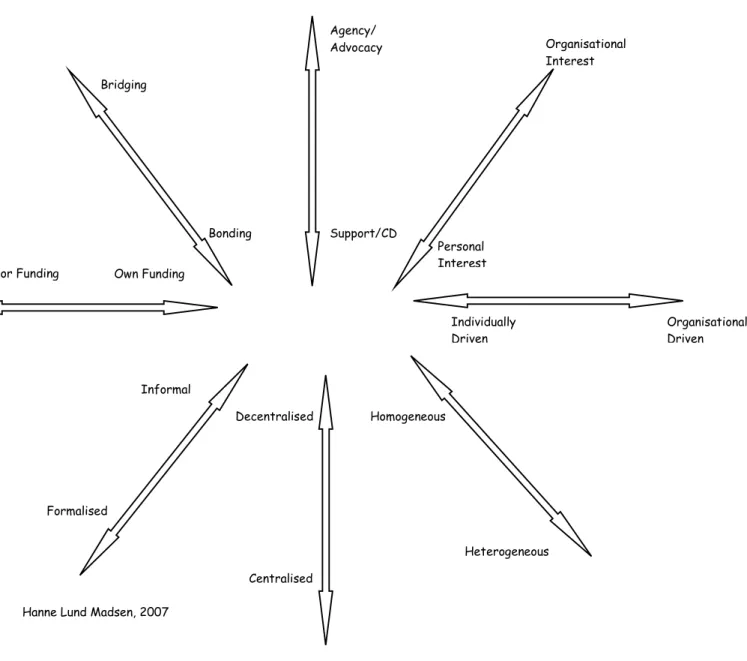
• Personal representation (Tematisk Forum, 2007, 2; Nielsen, 2007, 26; Taschereau, 2007) Having said that, networks unfold and position themselves differently on a number of key dimensions or continuums, as shown in the diagram below:
• Personally or organisationally hosted and driven • Non-formal or formalised
• Decentralised or centralised
• Homogeneous or heterogeneous members/participants • Support or Agency/Advocacy functions
Basically all networks can position themselves within this spider diagram along the various continuums.
Figure I. Dimensions and Continuums in Networking
Hanne Lund Madsen, 2007
Agency/ Advocacy Support/CD Personal Interest Organisational Interest Individually Driven Organisationally Driven Homogeneous Heterogeneous Decentralised Centralised Formalised Informal Bridging Bonding
In an effort to encircle the distinctiveness of networks, a comparison with organisations or with projects and partnerships is often made (Annex IV).
It is clear that when looking at the Danish Networks they contain just as many features of a project organisation as of a network – indicating that the identity may be an issue creating some of the repeated discussions as to direction and outcome.
Networks are means to an end – unless the distinctiveness is really called for or seen as the solution then it need not be a networking model that is required. A very centralised network with particular functions should perhaps rather be considered an umbrella organisation.
Finally, networks are more than anything else about relationships and the fostering of conducive relationships for various purposes.
The network framework
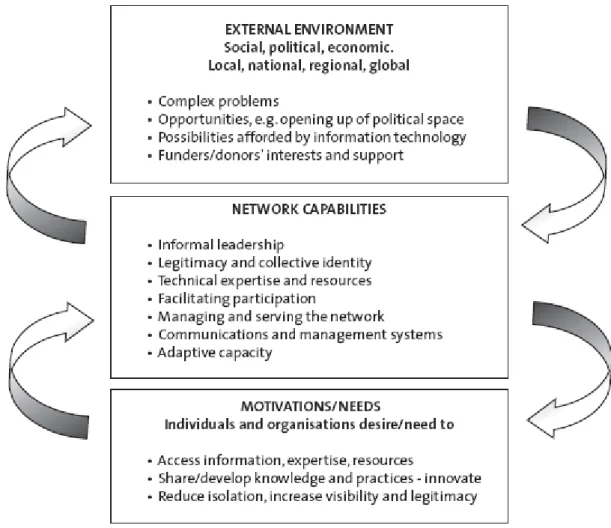
ECPDM models the network’s internal and external relationships in the following way while giving emphasis to the capabilities within the network:
Figure II. The Network Framework
Context and motivations/needs
The figure highlights the contextual framework for the establishment and development of networks as well as the motivation/needs among the members. As learning networks, the Danish NGO Networks have perhaps been less driven by particular changes or issues in the context as many advocacy networks are, but clearly the facility opened up by the Civil Society Strategy and matched by Danida funds have been a significant opening.
Nielsen, 2004, accounted for the literature, saying that organisations participate in networks with the aim of improving their performance. This applies both to advocacy and support networks. In the case of advocacy networks, the improved performance is related to greater shared constituency, better campaigns, better research, more channels of influence to use, etc. In the case of support and CD networks the improved performance is anticipated to be achieved in-directly through the improvement of methods and competencies within the organisation’s own work. However, as mentioned frequently, the transmission mechanisms for this indirect performance support are poorly developed, and
relatively few member organisations have decided on networking profile in a strategic perspective, or identified organisational praxis changes to be fuelled by networking participation. The predominant view has been that networking for learning and for professionalisation is a good thing, which will probably also bring back inspiration to the organisation.
It is important to understand the “space” in which the networks and the member organisations operate within today and at the time of establishment. The Danish NGO Networks started in a context
characterised by
• Relatively few service providers and resource centres focussing on the non-profit sector • No centre-placed institution (and network) like INTRAC in England monitoring and
responding to the needs of NGOs and strategically looking ahead (CASA aspired to this role within the field of development cooperation also but did not survive)
• Relatively little mobility between the research and practice development community
• Little knowledge praxis developed by framework agreements like the ones pursued by DFID2 • No clearly identified competence hub for organisational development
• Danida push for sector specialisation, but the capacity assessments of the Danish NGOs have not had competence and professional requirements high on the agenda
• General pre-occupation and push for documenting results • Networking receiving limited strategic and political attention
• Low investment in human resource development (staff and leadership) within organisations. The Networks thus filled a vacuum in terms of Danish platforms for knowledge building, learning and competence development and have not been subject to much competition from actors or platforms offering courses, network facilitation etc. up till now.
However, since the Danida Civil Society Strategy, 2000, in a new way paved the way for thematic networks it took quite some time to get the present networks operating – for many reasons, including the formation time within the networks, approval processes within Danida and - as noted by many observers - little priority and no urgency of need in getting the networks going. The Danish Child and Youth NGO Network was established as the first in 2003, and the preparation phase of Thematic Forum took five years with many stalemates at various points in time. The informal former NGO Contact Committee has just recently been reborn and formalised as a political organ and voice of the NGO community.
2
DFID enters framework agreements with research centres, universities, etc. to provide expertise and new thinking in policy prioritised areas of development cooperation.
Other networks had been in existence for a number of years – for example 92 Gruppen, which has a different format and set up with an umbrella-type organisation and strong emphasis on advocacy and lobby. Yet again others died a silent death such as Fagligt Forum focussing on education and information about global issues. Parallel to the efforts unfolding for Thematic Networks, Danida established their virtual Practice Networks with varying degrees of success and research networks like GEPPA was launched3. Frivillig Klub (Volunteer Club) at CBS started research in the dynamics of volunteerism and built networks around this initiative. The 2006 Network Review provides further overview of these developments (Danida 2006).
Broadening the picture, it is important to note that the Thematic Networks are just one among several knowledge streams and platforms, which the Danish NGOs are engaged with. Most of the Danish NGOs are members of, or affiliated to, international federations or organisations in which a lot of development and sharing takes place with regard to best practices, innovations, learning and sharing, etc. Moreover, many of the NGOs participate in international learning and knowledge networks within HIV/AIDS, Gender, Environment, Human Rights, Children, etc.
However, the context in which the Networks operate has changed over the years – not least due to the increase in the number of technical networks and the recent formalisation of a political advocacy network, NGO Forum. The PRNGO has developed and increased its services and scope and is now managing a small networks appropriation. Moreover, the developments that have spurred the revision of the Civil Society Strategy also influence the framework conditions of the networks and their challenges. Consideration of new scenarios for the Networks is thus warranted.
2.2. Purpose: Support or advocacy?
Before moving into further detail it is important to establish what types of networks we are talking about in order also to see where they could possible be moving or would want to remain.
Networks are a means to reaching a goal. The various typologies of networks thus commonly evolve around definitions relating to purpose and secondly to how the network is structured and operating to match this purpose. Keeping the purpose in mind will also remind us that networks may not be the only or even best means of achieving the purpose.
The most fundamental distinction or characteristic of a network is whether the network defines itself as a support and capacity developing network or as an agency and advocacy network. The first is primarily a facilitative function focussing inwards within the network and helping network members perform their own functions better. The latter is an outward directed network seeking to obtain changes through joint action in societies (RAPID, 2005a). The raison d’etré is fundamentally different from the support network.
It is clear that the Danish Networks are presently mainly support and learning networks and they are by design stripped of any direct advocacy or agency function. However, they do have information and dialogue functions, which are being explored more and more and they also sometimes act outwards. Many observers note that the NGO leadership is very cautions that the networks do enter into the field of advocacy, as the NGOs themselves, in their own capacity, do the advocacy. Danida, too, is
cautiously watching that there are no ‘political activities’ involved and generally refer to the NGO Forum when decisions are to be taken. When NGO leaders call for more emphasis on advocacy within the work of Thematic Forum, it is purely confined to Thematic Forum building competence of the
3
GEPPA has now been merged with to other research networks into one called Danish Development Research Network
staff in promoting advocacy with partners in the South. (Thematic Forum, 2007). The recent
establishment of NGO Forum as the political voice of the NGO Community underlines that advocacy and agency may be considered a “no-go area” for the support networks.
A lot of the literature and research focussing on the functions, challenges and issues surrounding advocacy networks does not apply to the Danish Support Networks. However, when looking into the future and considering anew the purposes and the matching means, the question of advocacy and agency gains new relevance.
The Needs Assessment Report commissioned by Thematic Forum indicated at the time a tentative agreement within the Danish NGO community, that the NGO Forum is the political organ and the Networks are devoted purely to technical competence development. The consultations in connection with this study showed both openness and necessity of reconsidering the prudence of this arrangement and especially to seriously considering a closer link between the thematic networks and NGO Forum.
One-way street?
Recent research suggests that many advocacy networks from the establishment host certain support functions or develops support functions over time. However, a support and CD network cannot turn into an advocacy network – that is, if it was to turn into an advocacy network it would imply a rebirth of the network, with new mandates and authority and possibly also new funding sources.
Experience also shows that advocacy networks, by their very nature, engage the leadership of the members in deciding on the position and claims to be advocated, and the participants in an advocacy network mobilises both the constituency and the leadership – both upwards and downwards. However, learning and CD networks mainly mobilise at the vertical dimensions – among the participants
themselves and among potentially new members- and more seldom at the horizontal dimensions. Advocacy networks are really concerned about constituency and leadership, whereas learning networks are less focussed, if at all, on constituency and for many reasons have received little on-going attention at the leadership levels. Generally the trend has been that top-management or even Boards may endorse the establishment of knowledge networks as an important vehicle for the organisation (UNDP’s knowledge networks) and the implementation and operationalisation is delegated to relevant units within the organisation – it is not a recurrent issue on the management agenda.
The Danish Network Coordinators and Steering Groups have often expressed frustration with the difficulties of attracting leadership attention to the networks. Both due to the realisation that the transmission mechanisms from network to organisational praxis requires leadership involvement and commitment to materialise, and because the themes of the network (HIV/AIDS or Gender) deserve more attention at the political and strategic levels of the member NGOs. Finally, more recognition and appreciation is welcomed for the important and serious work unfolding within the networks.
True added value is in the outward agency/advocacy functions4
Many types of networks may be useful and beneficial. However, the area in which the added value is highest and most unique is, by most researchers and studies, found to be in the case of advocacy and outward agency. The underlying reasoning is that by joining forces, the members and the networks receives a unique force that cannot be replaced or substituted by other means (Taschereau, 2007). By
4
Relevance of networking and drivers of forming networks is covered in Danida (2006); ICCO, 2004 and Engel (1993) describing upgrading, upstream and upshift drivers for networking in addition to sense of frustration, increased complexity and the global village as factors in networking growth.
comparison many of the support functions and services provided by networks can equally well be taken care of in other ways.
A comprehensive, comparative study of 28 Latin American networks show that by far the most added value originated from learning together and advocacy. These two functions lie at the very heart of networking, other activities are mostly instrumental. However, the priority given by network members to either learning or advocacy may vary greatly, for example between continents and countries.” (ICCO, 2004,6)
Networks as ideal for learning
The relative significance of added value for support and advocacy functions respectively may be levelling out, as several paradigms underline that “networking is the most attractive and effective form of learning”. This rests on the assumption that learning and knowledge acquisition is basically a social process. However, this perspective does not factor in questions of efficiency and the capacity to participate in social networks for learning. As experience shows, many networks do not advance learning very effectively.
Nevertheless, ICCO coins it the following way: “We would like to postulate that learning-oriented networks represent civil society’s answer to the challenges of the emerging knowledge society”(ICCO, 2004: 16).
Also within the corporate world, learning is often considered a social construction process that unfolds best in informal networks: “What is learned is profoundly linked to the conditions under which it is learned. Knowledge creation occurs in the context of a community, one that is fluid and evolving rather than tightly bound or static. The canonical formal organization, with its bureaucratic rigidities, is a poor vehicle for learning. Sources of innovation do not reside exclusively inside firms; instead, they are commonly found in the interstices between firms, universities, research laboratories,
suppliers, and customers (…). Consequently, the degree to which firms learn about new opportunities is a function of the extent of their participation in such activities” (Powel, 1996, 118).
From this perspective, the choice of networks within the Danida Civil Society Strategy as the modality for learning, competence development and capacity development is spot on.
The question is, can the quality of learning in networks in any way be said to be better in the networks that encompass both agency and support functions? In other words, is learning around advocacy strategies better facilitated by actually acting in unison on an advocacy campaign while learning and reflecting on the process? It is probably hard to argue that the CD and learning for improved
performance is best achieved in the networks that do not engage in agency – especially in the light of decades of documentation on action-learning. INTRAC is very clear in arguing that learning is a developmental process that integrates thinking and doing (www.intrac.org/Praxisinterchange) and in this perspective the learning would also benefit from a more action/agency-oriented perspective of the Danish Networks. It is also relevant in the future to consider if more links between the Danish CD Networks and the Alliance programmes would be beneficial. The Alliance programmes are intended to facilitate testing, experimentation and operationalisation. The rationale need to be revisited for
maintaining the separation of CD confined to Denmark and the testing abroad.
However, whether action learning is a suitable vehicle for learning depends a lot on the composition of networks. In homogeneous networks with bonding features the action learning is more feasible, than in very heterogeneous networks with bridging features (Taschereau, 2007). Again, the preoccupation with differentiation (and preference for differentiation) in earlier Danish NGO Network Reviews needs to be reconsidered in light of this.
When learning in networks is given many attributes, it is also because a practice has developed of employing a number of learning sets and methods. Not necessarily methods exclusively designed for networks, but which works particularly well in learning networks: reflective teams, action learning sets, coaching, etc. The Danish Networks have recently started to explore these formats more. However, the question is if the present circle of participants is more interested in mini-projects and therefore an emphasis on the above learning processes and reflection could possibly imply a change in the circle of participants. Clearly, the above described learning processes presume a certain disposition at the personal and professional level and preparedness to be challenged – the so-called ‘daring to share’.
Secondly, learning in networks is praised due to the ability to benefit from new information technology - in retrieval, processing and sharing of information and knowledge. The revolution in information technology goes hand in hand with the increase in networking activities at all levels. The Danish Centre for Management has, in a survey among Danish top directors, found that networks are given high priority as the learning modality for the future (Hjalager, 2007). The Danish Networks each have their homepages, but advanced electronic form of knowledge sharing have not been much used. All evaluations and reviews have noted that this field is too little developed. The recent initiative on joint Internet portal has been met with mixed reactions.
The Danish Networks are established with the purpose of engaging in advocacy together, but they are sharing lessons on how to do advocacy. The “No-go” area of advocacy and agency for the Danish Networks may imply that they cut themselves off from more dynamic action-oriented forms of learning. It is somewhat of a paradox that the Danish NGOs are defined as support networks with the aim of enhancing capacity as advocacy organisations, and the first rule of advocacy work is to join networks to enhance agency!
In a future scenario it could be envisaged that the advocacy group of Thematic Forum became engaged in, supported and learned from a future advocacy initiative.
2.3. Successes and outcomes
Recent network studies group the success factors in the following four categories (ICCO, 2004; Tascherau, 2007):
• Factors relating to the success of the joint efforts in pursuing established objectives; • Factors relating to the capacity and disposition of network participants;
• Factors relating to the management and governance of networking activities; • Factors related to funding and the role of donors.
Relevance, focus and value added is highlighted as the most important. Participation is next and the study stresses what participants can do to make networks successful:
• Daring to Share
• Capacity to give, take and translate • Commitment.
For the agency networks the successes are normally gauged by the attainment or progress towards achieving a specific impact or change within society – e.g. ban on landmines or informed consent for HIV/Patients. For learning networks, the success criteria in CD for members are generally much more weakly defined and like OD it risks becoming a never ending process (Lund Madsen, 2005).
As the Danish Networks are support networks their target of improving performance is achieved indirectly through the transmission and adoption mechanisms or bridges from network to member. However, reviews, evaluations and studies have confirmed again and again that – despite some efforts – the mechanisms for institutionalising the learning and establishing bridges to the member
organisations are too weak (Lund Madsen, 2006; Danida, 2006). Consultations indicate that also in the public sector little attention is given to the organisational implications and impact of networking5. The many evaluations and reviews undertaken of the Danish NGO Networks reach very positive conclusions with regard to the Networks instrumental role in building competence among member organisations. They are praised for their relevance, for their smooth running, for the knowledge products developed, and for delivering according to the multi-year plans submitted to Danida. However, evaluations and reviews have not systematically considered the outcomes in terms of changed behaviour, relationships or actions among members, let alone if the education programmes of member organisations education programmes or HIV/AIDS programmes significantly improved and delivered better results in the South. Thus the very first question of this scenario study cannot be easily answered: “When and how have the networks contributed most to improving the quality of the Danish NGOs work and performance”?
The answers to this question, synthesised by the Network Coordinators (Annex VI), highlight many important and encouraging examples of “how and when”, but the link to improved organisational performance is not as yet established. Some of the positive experiences selected for this synthesis of positive experiences often relate to the networks being catalysts – albeit not responsible - for an agency or advocacy function – which perhaps indicates an urge, as the networks mature, to move out of the inward looking CD perspective towards interaction with society and making their voices heard. In all cases the successes depend on the purposes established for the network and the successes are not automatically achieved within networks. “But some networks don’t work. Access can be varied, interaction meagre, influence marginal and sustainability problematic There still remains limited systematic understanding of when, why and how they function best for policy impact in international development” (ODI, 2005: v)
Diversity is, by some evaluators, seen as a fundamental characteristic of networking and almost a precondition of success. However, networks may be designed both by heterogeneous actors as well as homogenous actors. Success for the network is the right match of purpose, contextual conditions, capabilities and member needs and motivation.
There is clearly scope for investigating and exploring evaluation methodologies of the Danish Networks, which encompass the relational and the impact perspective and also for undertaking joint thematic evaluations. New functions of the Networks within evaluation management could also be considered thereby contributing to increased independence of the evaluation management and the furthering of best practices.
2.4. Capabilities, functions or the art of networking
Previous studies of the Danish NGO Network have presented a number of typical networking
functions, some of which correspond to the capabilities described in the Network Framework on page 5. Supplementing these capabilities, Ramaligam outlines a number of key functions in the following way - they may be dominant or co-existing:
5
Figure 3: Key functions in networks and of different types of network
FUNCTIONS CORRESPONDING STEREO TYPES
Filters ‘decide’ what information is worth paying attention to and organise unmanageable amounts of information.
A NGO Filter Type is for example, the
Development Executive Group is an international forum, which provides and exchanges information on project and employment opportunities.
Amplifiers help take little known or little understood ideas and make them more widely understood.
Advocacy or campaigning NGOs such as the Jubilee Campaign are amplifying networks. The Fair-Trade Foundation, for instance, works though a network of those licensed to use the brand to amplify the fair trade message.
Convenors bring together people or groups of people.
For example, Coalition 2000 in Bulgaria brings together CSOs, government institutions, the private sector and donors in various coordinated initiatives to fight corruption.
Facilitators help members carry out their activities more effectively.
For example, the MediCam network in Cambodia gives members access to services and facilities such as meeting rooms, a specialised library, communication means, training opportunities and access to policymakers and donors.
Community builders promote and sustain the values and standards of the individuals or organisations within them
The Active Learning Network for Accountability and Performance in Humanitarian Action
(ALNAP) promotes best practice and minimum standards of learning accountability and
performance among humanitarian agencies.
Investor/providers offer a means to give
members the resources they need to carry out their main activities.
The African Capacity Building Foundation, for instance, provides technical assistance, skills and funding to its policy research partners.
Source: Adapted from Ben Ramaligam, 2006
Probably all networks need to have a minimum of all functions within the network to thrive and develop. Recent discussions within the European network SCEP (Separated Children in Europe Programme) clarified that the above functions could very well be taken care of by various members according to their comparative advantages. This would not only reduce the burdens on the secretariat, but also foster the networking itself as the various tasks would bring members into connection with each other, and thus nourish the decentralised and web-nature of the network. Some members were also very instrumental as providers and investors, while others, in financial terms, were mainly
receivers. The discussions also clarified that the above dimensions were useful for progress and review purposes6.
Wogn mentions that there are two basic incitements at play in networks – reward and recognition – and facilitators need to work consciously with these incentives. Unlike in the formal organisation where a range of formal procedures and agreements regulate the behaviour and motivation of the staff, network members are completely free from any bonds and their contribution rests on their motivation often triggered by reward or recognition (Nielsen, 2007).
6
It is interesting to note that topical discussions on the art of networking and learning in networks has been relatively limited, despite the large expertise and experience available within other sectors and internationally. Nor has there been any investment in the Coordinators regarding networking competencies. It is promising to see that The Danish Child and Youth NGO Network is planning a training course on coaching as an instrument for learning, and it would be relevant to discuss how coaching and reflective teams itself could become one of the key working modalities of the networks. No doubts, the Networks have in practice experienced both ups and downs in networking, which over time has prompted various initiatives such as study trips to networks in England and most recently this study.
Experiences from networking in the United States indicate that the art of networking is now being upgraded to ‘version two’ to use a computer metaphor7. The past practice of convening people in networks in order to identify ideas and joint activities is replaced by networking on the basis of ideas, which people and organisations gather around. The velocity is high as constellations emerge around new ideas. Networking is about organisational culture. People and organisations enter networks in the realisation that networks provide access to what they cannot name or even plan for. Networking has also moved from engaging only the human resource managers to entering into the Board Rooms of the institutions and organisations treasuring intelligence and a position ahead of the curve.
Contagion
A key concept in network analysis and in organisational change is "contagion" – often described as the pattern by which information, beliefs or behaviors are transferred and diffused through a network. Thus contagion is crucial for learning and support networks. Examples often include how new methods are diffused and adopted within various organisations or firms where traditional vehicles of formal training etc. has not been used. Taking relational perspectives as a starting point, influence is applied through repeated interaction, leading to shared opinions among strongly connected individuals and viewed from a positional perspective, shared views emerge from people playing similar roles (Zack, 2000).
Closely related to contagion is the idea of bandwagon mechanisms, which denotes transfer mechanisms by way of constructive group pressure and ‘wanting to be like the rest in the (NGO) community’.
The evaluation of the Danish Education NGO Network notes that the Network should consider ways whereby best practice develops and is copied, and suggests that more insight into the processes of contagion and bandwagon could also provide completely new working methods and methods of diffusion to those presently being exercised. Part of such approach could include providing counselling and advice to the pilot organisation – a service which the networks are currently not allowed to provide, but which the NGO Counselling Service can provide.
Facilitation and leadership of networks
It is now generally agreed that regarding capabilities, the quality and nature of facilitation is key to bringing out the true successes of networks and enabling members to share, give, take and make commitments for change8. Some claim that networks cannot survive and develop without professional facilitation.9 Experience shows that self-facilitation is indeed possible, gradual development and reorintation can take place without facilitation, and duration can be around 10 years for non-facilitated
7
Consultation with Wogn (www.wogn.dk)
8
Consultation with Gert Rosenkvist
9
networks. This in particular applies to homogenous networks with high levels of bonding and where the members themselves hold certain facilitation and reflection skills.
Network facilitation is seen as demanding a lot of process facilitation, and in Denmark professional network facilitation is a growing service in high demand. Facilitation of networks requires first and foremost competence within process management and facilitation and knowledge about how networks work, while expertise or past experience in the professional (technical) fields in question is of lesser importance. However, a certain technical knowledge will make it more easy for the facilitator to understand the topics and the processes within the network10.
A proverb goes that ‘knowledge cannot be managed, only enabled’. Practical guidelines on the Five Knowledge Enablers have been developed: Instilling a knowledge vision; managing conversations; mobilizing "knowledge activists;" creating the right context for knowledge creation; and globalizing local knowledge” (Nonaka, 2000).
Past Reviews of the Networks (Danida, 2006; Nielsen, 2006) show very high satisfaction levels with the work of the Coordinators. The reviews also call for an upgrading of the facilitation skills and for giving less emphasis on the skills in the particular professional/technical area, be it education or gender. If that line of argument is fully accepted, there is, in principle, no need for a specific network coordinator for each network. The facilitation can be outsourced to network facilitators and process consultants. However, some consider the technical expertise offered by the Network Coordinators as indispensable for the network’s added value, and future scenarios would benefit from articulating the knowledge vision of the networks. The recent seminar on “What has happened to the professionalism and technical expertise in development cooperation”11 underlined the need for specialist knowledge of high professional standards within prioritised areas. It also called for considering competence
development and services in a global context rather than in a Danish context only.
The need for facilitators to nurse the network dynamics and the learning processes, together with stimulating and invigorating networking sessions, have been highlighted several times. Ramilingam’s Tool for Knowledge and Sharing, 2006, provides ideas in this regard. Some of the multi-module training programmes of the Networks including peer reviews and coaching have been evaluated very positively.
The ECDPM study emphasises the crucial importance of leadership of networks and especially leadership with vision, credibility and legitimacy to convene and mobilise in pursuit of a vision. Leadership is normally seen as indispensable in advocacy networks and advocacy often attracts higher attention at the senior management level – simply because leadership of the member organisations is more directly involved – either in voicing the advocacy concerns to the public, or in taking decisions about the profile of campaigns, etc. Generally, leadership offers less attention to knowledge and learning networks. Knowledge and support networks may, at the time of establishment, be the results of a deliberate move from senior management, but their day to day functioning mainly engages staff and middle managers and attracts little attention of the leadership. The concern expressed by the coordinators of the Danish NGO networks regarding the attention and leverage from the NGO
leadership may thus be put into perspective as part of a more general trend, as well as related to the de-linking of support and advocacy.
Networks are not easy to lead and very different to lead than an organisation. Other tools and perspective as needed when leading engagement on a voluntary basis than on a contractual basis
10
Consultation with HOLST-GRYCH
11
(Anders la Cour).12 The image of an antenna with two-way communication, high visibility but low interference, slim but solid foundation, clear circumference and with the ability to connect irrespective of time and space could be an image of the leadership of networks
The Steering Committees of the Danish Networks are in principle there to both coordinate and lead. It would be interesting in a future scenario for the Steering Committees to consider if and how they could enhance their leadership of the voluntary element prominent within the networks. This would initially imply consideration of how the Steering Committees could drive forward and instill joint knowledge visions and joint visions about the levels of impact of the networks. It would also imply exploring the leadership styles and tools suggested by Anders la Cour and other writers on this subject.
2.5. Structures - organisation or organism?
The dimension of organisation or organism was addressed in the Network Review 2006. The literature acknowledges the existence of network organisations with two differing definitions. The first relates to a traditional hierarchical organisation or company having been reformed to work as network
organisations. The second refers to organisations that were born as networks with multiple memberships. At the international level we see many such human rights network organisations, agricultural network organisations, etc. Also in the field of support and capacity development we see many network organisations.
There is no rule saying that the network organism or the network organisation is the better choice. It all depends on the purpose, member profile, etc. Past reviews of the Danish NGOs networks have expressed concern about the high level of organisation, and recommended more organism and fluidity. (Danida, 2006; Nielsen, 2007) The Reviews have studied networks, which all conform to the Danida guidelines and requirements for financing and this has in part shaped this finding. Past reviews have not assessed the informal, auto-piloted and non-financed networks that have existed in the
‘undergrowth’ of the Danish development community with high levels of organism, flexibility and adaptation to changing contexts. One example is Arena for Organisational Development.
However, what is really key is that the Steering Committees, Coordinators and the Members are alert to the pro and cons of each modality and are ready to tackle the drawbacks, respond with appropriate mitigation measures and nurture the driving forces within each model. For example, in the network organism one challenge is that structure is to be created simultaneously with the process and the product. In the network organisation with higher levels of formalisation the challenge is to avoid stifling, business as usual, and the network organisation becoming an end in itself.
For whose sake?
A general development tendency of networks is that the network develops a life of its own as it
gradually matures and grows. The formalisation and institutionalisation that may be beneficial in many respects also risks destabilising the balance or the initial agreements leading to the establishment of the networks. The node of the network becomes the owner and the network secretariat sometimes almost invisibly moves from facilitating to orchestrating13. A gradual move beyond purely CD and knowledge sharing to that of wanting to take joint action, develop identity as an agency, etc. is another common development. However, as noted above, the real change from one to the other requires a
12
Presentation by Anders la Cour, Copenhagen Business School: “Leadership in voluntary organisations and associations”. Organised by Arena for Organisational Development, 2004.
13
rebirth of the network with new mandates and powers, codes of conduct etc. and power sharing with the existing members.
Among the Danish Networks this gradual development has, according to some observers, been quite pronounced. While the member participation has been significant, the Networks have had to
orchestrate and drive ahead new action plans and proposals. The Networks themselves have noted the increased saturation, lower attendance at important annual seminars and inadequate critical mass in several working groups. The latest needs assessment report noted that the challenge is to get enough people on board, and recommends that “the Steering Committee provides resources to the Secretariat in order to support the first round recruitment to working groups” and that strategically important issues should be cultivated and then handed over to working groups when the time is ripe. (Thematic Forum, 2007).
From another perspective a prime objective of the Networks could be seen as driving forward and nursing strategic initiatives and be agenda setting. Again this function requires the mandate of an agency type network to really succeed. In a future visioning of the Networks it will be relevant to decide on the responsive versus the driving profile of the networks.
Networks as joint capacity development projects?
There are plenty of examples of networks being confused with alliances or project cooperation in new fields such as CD14. Establishing a joint project on CD among likeminded NGOs could be very relevant and justified. However, when opting for a network model it is normally due to the desire to enjoy and cultivate some of the distinguishing features of networking as compared to project or programme cooperation.
Annex IV gives a matrix presentation of the differences between networking and project cooperation, and although the borderlines are fluid, it is clear that both have strengths depending on the purpose it is to serve. It is a paradox that in the 1980’s everybody wanted to do project work, even though few knew what it entailed. Over the years project work has become very familiar. But today everybody opts for a network and again not all master the art of networking. Thus there is a tendency to run networks like projects.
One of the key issues for the Danish Networks appears to be located in the set-up of the networks as “projects”, with all the implications of predetermined objectives, indicators, activity types, time-lines, etc. where there is a great risk that the members are instrumental in attaining the goals of the network and not vice versa. And a risk that the emphasis on joint projects undermines the added value of networking.
Interestingly, the evaluation of the Danish Education NGO Network finds that the network is very good at ad hoc Mini-projects with well-defined aims and seems to encourage more of this. (Nielsen, 2006)
14
A recurrent discussion in the literature is the difference between building the capacity of networks (primarily within agency) and achieving capacity development in or through networking. However, for the Danish
Networks the purpose has clearly been on creating a conducive environment for learning among members. With no agency or advocacy functions the question of enhancing the capacity of the networks to perform (in their own name) has not been in focus. What has been in focus is the capabilities of the network to cultivate the features and processes cherished in networking – here the profile of the facilitator and the disposition of the participants regarding Motive, Means and Opportunities (MMO) are important.
When looking at the new proposals and action plans of the Danish Networks, the objectives are described at the level of network activities and not at the level of achievements to be obtained by the member organisations.
This observation is supported by the finding that the Danish Networks (and the Network Reviews too) have mainly been preoccupied with what took place in the network, and less with the changes that network participation brought about in member organisations. Outcomes of networking have only recently been discussed in terms of changed behaviour, relationships and actions among members. This is closely connected to the viability of networks addressed on page 21.
Path dependency
Path dependency concerns the tendency that past decisions, successes and praxis forms play an important role for present options and possibilities. Also within networks there are certain
development paths, paradigms and institutional factors at play. These dependencies are very important for the scope and depth of innovation and learning15.
From another angle ECDPM addresses the issue of path dependency as the ‘straight road to death’. They caution against model network or blueprint strategies. It is noted that there is a “tendency among donors in search of success stories to exhibit irrational exuberance about certain institutional
arrangements…and given their quest for homogeneity and risk aversion, the chances are that donors will tend to propose models that facilitate monitoring rather than innovation and serendipity”. Successful research networks now functioning in Africa did not arrive by similar routes. Rather, they are 'reflections of different origins and different trajectories traversed over the years. In the process most networks have accumulated a wealth of experience, some of which constitute vital social capital that could be dissipated by forcing conformity to a model of another network' (Taschereau, 2007, 19) Many evaluation reports of Danish NGO Networks have noted the surprisingly conventional and uniform set-up and structure of the Danish Networks. There is clearly a need for closer examination of the phenomenon of path-dependency within the Danish Networks, both the informal and intangble perceptions that flourish about networking and the formal and institutional arrangements, which Danida guidelines represent.
The financial aspect of path-dependency is also crucial. The past pre-occupation with getting Danida funds and providing no own direct contributions have in turn meant that most networking activities unfold within the Danida model. The question is, has the Danida model in fact, unintentionally, turned the networks into projects and has the path-dependency ring-fenced the types of innovation that are possible?
It goes without saying that true visioning of future scenarious implies daring to look beyond past path-dependency.
Bonding and bridging
In heterogeneous networks a main factor is that of bridging – bridging cultural differences, institutional differences, class divisions, professional disciplines, etc.
In homogeneous networks where the members are very similar the main process is characterised as bonding and creating a community with high levels of trust, ties, etc. It takes place in small size communities where every one knows each other by name. In bonded networks the access of new external actors is less easy, and a tendency of closed minds towards the outside may appear, which in
15
turn may limit inspiration and innovation. However, the bonding may also be very productive as a secure platform for experimentation, knowledge sharing and constructive self-critique. Trust, being so important for networks to flourish, is indicative of the importance of a certain level of homogeneity and bonding.
There is no basis for concluding that the one is more valuable or attractive than the other. Nor is there a basis for considering heterogeneous networks more productive than homogeneous. The crucial issue is that the purpose matches the membership and level of diversity. Past reviews of the Danish NGO Thematic Networks have clearly spoken in favour of heterogeneous networks with characteristics of bridging (Danida, 2006, 8; Nielsen, 2007) and the same assumption is reproduced in the new Danida guidelines (Danida, 2006b).
If the NGOs really want to explore new modalities and diversity in competence development it would be interesting to question the rationale of keeping all Danida training separate from NGO training and keeping the training undertaken by Danida Fellowship Centre separate from both Danida Staff and Danish NGOs; and to explore if just some of the training would benefit from engaging the actors that are to cooperate in reality around development changes.
Boundaries and exclusiveness or openness and accessibility?
Networks are often supposed to be very open and very permeable social structures. However, the cluster of people or organisations in a particular relational pattern could not exist without a form of outward boundary. The whole notion of network membership implies a process of distinction and setting of boundaries. The objective of the network functions as a compass, as a boundary and as a protection mechanism against moving in all possible directions. These boundaries are in fact key in identifying the network and differentiate it from other networks.
Some argue that to make networks work they need to be perceived as attractive and prestigious by the members. Restrictive membership, careful selection, by nomination or by merit, and a sense of being chosen are important tools in fostering and branding the network16. Others attach little importance to this type of ‘jet-setting’ the networks, and underline the true quality and outcome of the interaction in the network as decisive17. ECDPM, in their recent research, very much underline openness as crucial for learning and cross-fertilisation, also with other networks and knowledge streams. Fowler, as also mentioned already by Nielsen 2004, stresses the importance of getting the right people on board, as the utility and value of the networks stands or falls on members as sources of useful information to be shared (Fowler, 1997). However, the extent to which the openness has in fact reduced commitment and ownership is little explored and talking about identification of the “right” members could easily run into a number of taboos.
The Danish Networks are in some ways very open in that anybody can walk in and participate in the meetings; and semi-closed in that they target Danish Development NGOs. The question who are the ‘right and best’ participants has not been posed directly, but rephrased as difficulties of meeting the needs of full time educational specialists within a large NGO and at the same time a volunteer in a small privately run charity initiative. In a future scenario it could be useful to consider if the networks could work on both dimensions of bonding and bridging.
Personal or organisational networks?
Networks may of course be either personally or organisationally driven. The question is whether the organisationally driven network is still to be considered as working only at the personal level with the
16
Consultation with HOLST-GRYCH
17
members involved in the network? The experience of HOLST-GRYCH is that networking unfolds at the personal/professional level and the change is achieved at the individual level and in the
individual’s preparedness and capabilities to initiate change within their own organisation. Rosenkvist supports the findings of earlier studies (Lund Madsen 2005) that many networks are established and justified with reference to organisational changes, but that the transmission mechanisms between the individual participant and the organisational change processes are poorly explored.
Clearly, it is important for any network to decide the level of intended change, which may not only facilitate the achievements of the same, but also spare many frustrations and disappointed
expectations.
There are indications that the Danish NGO Networks have been skating between different expectations as to the level of change, which in turn have at times created tensions. Some of the bigger NGOs may have more than 6 different entry points for networking as the participation in the networks are dependent on the staff’s technical profile/responsibilities. The attention of the NGO leadership to the Networks has been a contested field. Recent studies and the present consultations confirm that many member organisations have not made a commitment on achieving certain
organisational changes facilitated through the participation in networks, and that the participants often acted in their own capacity. At the same time recent studies confirm that appreciation of network participation at the personal/professional level is significant, but the increasing number of networks has prompted the organisations to consider where to use their time and resources. As a possible explanation of why some leaders may not as yet consider networks a top priority at the organisation level, Wogn suggests that leaders tend to confuse their own leadership networks, which is a ‘private initiative’, with learning networks, which ought to be an organisational measure. Recent surveys show that Danish directors in the public sector primarily use networks for emotional support (Hjalager, 2007).
In the upgraded version two, networking is close to the heart of the organisation. It implies leadership and strategic decisions around networking, encouraging a networking culture within the organisation, considering networking as a dimension in recruitment and staff development appraisals, and in the overall strategic five year plans of the organisation. ‘Waterholes’ in different locations and of different scale is made available – right from the access to marketing ideas, to facilities for holding ad-hoc meetings and training, to support from a process consultant right to access to decision makers. The above has highlighted a number of structures, processes and dynamics that can inspire contemplation of the third question: Which structures and processes can be used in networks - in particular structures other than the present dominant model? The international comparative perspective will moreover provide more ideas on structures.
2.6. Power in networks
In network analysis three aspects of power are addressed: Prominence, range and brokerage. Prominence reflects the hierarchical status of an individual. It is a measure for the centrality of an individual, or a network, based on the demand for linking to a node - the degree to which ties are directed to one node at the expense of all others. Range reflects discretion to act. The greater the range of one’s ties, the more resources and views one has access to, and the less dependent one is on
particular ties. Finally, brokerage reflects the ability to exploit "holes" in a social network by connecting nodes that formerly have not been connected. By measuring the extent of ‘holes’ in a knowledge-sharing network structure, for example, before and after implementing a knowledge management method, it may be possible to gauge the impact of the method on the ‘markets of
knowledge exchange”. Brokerage indicates not only opportunities to exploit the method but also points of resistance that may arise by those currently filling a brokerage role (Zack, 2000).
It has been suggested, that even in networks where members enter on equal terms, the dynamics within the network and the transactions taking place will inevitably imply that ‘wealth and power’ graviates towards some members, who clearly finds the added value more significant than others.(RAPID, 2005c)
Also INTRAC notes that communication and knowledge can be tools of power and that there is a need for exploring the politics of knowledge and how this impacts on capacity building (www.intrac.org/ praxisinterchange).
Currently, the Danish Networks have not considered the three aspects of power within the networks and how it influences innovation, control or learning.
However, the consultations in networks which the consultant has taken part in clearly indicate that these are nevertheless at play. The risk that the larger organisations dominate often surfaces and the resistance to being repeatedly exposed to the best practices of the larger organisations is voiced. The larger organisations, on their part, often refer to their supportive role within the networks due to their resources and expertise, which concur with certain responsibilities. The member organisations also often indirectly praise each other in terms of prominence, range and brokerage. The centre of power is often described as being located outside the Networks - in the NGO Forum or in Danida- and yet the confidence in the informal power of the participants in the networks is also significant.
For a future scenario it is warranted to look much more in depth at how these three aspects of power can be developed for the betterment of learning and change.
Innovation or control?
In homogeneous networks within small communities the cherished innovation capacity of networks may be threatened or reduced by social control. So while networks may create innovation and new knowledge, they may also establish norms and codex, which function as controls. In the designed control functions – such as codes of conduct and quality standards – the control is a positive and desired result. In the case of unarticulated and invisible control mechanisms, ‘jantelov’ – rule of the fittest, etc. it is clearly a barrier to achieving the aims of the network. This is closely related to path-dependency.
It is relevant for the Networks to recognise the dynamics between innovation and control and be able to mitigate or exploit as relevant the power dynamics always at play within networks.
Corporation or turf struggles?
Networking is no exception from the rule that competition is healthy. Healthy competition can even co-exist with different forms of cooperation, as long as the unique product of the networks is not undermined by the cooperation. However, turf struggles are just as common as healthy competition and cooperation (Simmons, 1998). Due to the ’soft’ incentive of reward and recognition, the open boundaries of networks, the participation challenge etc. turf struggles are in fact common among networks – in other words turf struggles denote the power dynamics among networks.
Simmons coins it this way: “Creative spirits, motivated enthusiasts, and innovative drivers become the casualties of an organizational turf war. Once people start wrangling for a territorial advantage, pushing their hidden agendas, and under-cutting their peers, no one is focused on organizational goals. The turf war mentality lowers our sights and we waste valuable time and effort crushing an enemy