theRepository at St. Cloud State
Culminating Projects in English Department of English
5-2018
The Effect of Extensive Reading on Standardized
Reading Test Scores of Elementary EL Students
Kyeongmee Oh
St. Cloud State University
Follow this and additional works at:https://repository.stcloudstate.edu/engl_etds
This Thesis is brought to you for free and open access by the Department of English at theRepository at St. Cloud State. It has been accepted for inclusion in Culminating Projects in English by an authorized administrator of theRepository at St. Cloud State. For more information, please contact [email protected].
Recommended Citation
Oh, Kyeongmee, "The Effect of Extensive Reading on Standardized Reading Test Scores of Elementary EL Students" (2018).
Culminating Projects in English. 121.
The Effect of Extensive Reading on Standardized Reading Test Scores of Elementary EL Students
by
Kyeongmee Oh
A Thesis
Submitted to the Graduate Faculty of St. Cloud State University
in Partial Fulfillment of the Requirements for the Degree
Master of Arts in
English: Teaching English as a Second Language
May, 2018
Thesis Committee: James Robinson, Chairperson
Michael Schwartz James Heiman
Abstract
The diverse studies have supported extensive reading as one of the effective methods for the improvement of EL/EFL students in their language proficiency and reading skills. The purpose of this study was to investigate the effect of extensive reading on standardized reading tests scores of elementary EL students.
In this study, I collected three different data of each 3rd and 4th grade EL student in the
experimental group and the control group. First, the amount of the reading hours of the students who were in the extensive reading program for 7 months was collected. Secondly, the fall and spring MAP reading test scores of 2016-2017 school year of each student in both experimental group and the control group were collected to compare and contrast the growth rate of individual student and each group. Thirdly, ACCESS reading proficiency scores of 2016 and 2017 were collected to see if extensive reading program helped the students who used extensive reading program gain more reading tests scores than the students who did not use extensive reading program.
The results of this study indicates that there is no significant or clear correlation between the amount of reading time and the growth of standardized reading test scores of the EL
elementary students who had ER program. It also shows that the ER program helped the
experimental group grow in their MAP reading test, but not in their ACCESS reading test. There might be several possible factors that affected on the negative results of this study. However, despite the negative results of this study, it is believed that the ER program exerted a positive influence on the motivation and attitude of elementary EL students.
Table of Contents Page List of Tables ... 5 List of Figures ... 7 Chapter 1. Introduction ... 8 2. Literature Review ... 12
The Definition of Extensive Reading ... 12
The Effect of Extensive Reading on Language Proficiency, Vocabulary, and Comprehension Skills ... 13
The Effect of Extensive Reading on Testing Scores ... 17
Lack of Benefit of Extensive Reading ... 19
3. Methodology ... 23 Research Questions ... 23 Participants ... 23 Materials ... 25 Procedure ... 29 4. Results ... 32 5. Discussion ... 47 References ... 51 Appendices A. Parent’s Letter for ER Reading Program ... 55
Chapter Page B. ACCESS Reading Test Scores and MAP Reading Test Scores of the
List of Tables
Table Page
1. 2016-2017 MAP Reading Scores Goals for the Third and Fourth Grade ... 31
2. 2015 MAP Reading Test Student Growth Norms ... 31
3. The Amount of Reading Minutes and ACCESS Reading Test Scores of the
EL Students in the Experimental Group ... 33
4. Paired Sample Statistics for 2016 ACCESS Reading Scores and 2017
ACCESS Reading Scores of the EL Students in the
Experimental Group ... 34 5. Paired t-test 2016 and 2017 ACCESS Reading Test Scores of the
Students in the Experimental Group ... 36 6. Paired Sample Statistics for 2016 ACCESS Reading Scores and 2017
ACCESS Reading Scores of the EL Students in the Control Group ... 36
7. Paired t-test of ACCESS Reading Test Scores of the Students in the
Control Group ... 37 8. The Amount of Reading Minutes and MAP Reading Test Scores of the EL
Students in the Experimental Group ... 38 9. Paired Sample Statistics for Fall MAP Reading Scores and Spring MAP
Reading Scores of the EL Students in the Experimental Group ... 39
10. Paired t-test of MAP Reading Test Scores of the Students in the
Table Page 11. Paired Sample Statistics for Fall MAP Reading Scores and Spring MAP
Reading Scores of the EL Students in the Control Group ... 41
12. Paired t-test of MAP Reading Test Scores of the Students in the Control
Group ... 42 13. The Correlation between the Amount of Reading Minutes and Standardized
Reading Test Scores for the Experimental Group ... 43
14. Paired Sample Statistics to Compare the Growth Rate in ACCESS Reading
Test Scores between the Experimental Group and the Control Group ... 43
15. Independent Sample t-test of 2016 and 2017 ACCESS Reading Scores of the
Experimental Group and the Control Group ... 44
16. Paired Sample Statistics to Compare the Growth Rate in MAP Reading Test
Scores between the Experimental Group and the Control Group ... 45
17. Independent Sample t-test of Fall and Spring MAP Reading Scores of the
List of Figures
Figure Page
1. Scatter plot of the relationships between the amount of reading minutes and
growth on the ACCESS reading test ... 35 2. Scatter plot of the relationships between the amount of reading minutes and
Chapter 1: Introduction
Even though it has been in the process of transition from No Child Left Behind Act (NCLB) to the new Every Student Succeeds Act (ESSA), all U.S. states will still use standardized and high-stakes achievement tests to all students with “subgroups” of students including English learners for assessment, classification, and placement of EL students along
with and for accountability purposes.NEA President Dennis Van Roekel (2008) mentioned that
under the law, each district and school must show that the student body as a whole, as well as each subgroup of students such as ELLs, must meet the same academic standards in reading and math. However, as most standardized, content-based tests are administered in English and normed on native English-speaking test populations, they may inadvertently function as English
language proficiency tests(Abedi, 2002). English learners may perform less proficiently and
score less on the tests comparing to non-EL students due to the various factors such as unfamiliar vocabulary, prior knowledge, test-wiseness, and time constraints (Garcia, 1991). In their study,
Stephenson, Jiao, and Wall (2004) used a sample of students (Primary, Elementary, Middle
Grades, and High School) taking the multiple-choice portion (Listening, Writing Conventions, and Reading subtests) of the Stanford English Language Proficiency (Stanford ELP) test to identify any group differences between native and non-native speakers of English. The results showed that there were significant differences in the scores between the Native and Non-native groups on all four levels of the Listening, Writing Conventions, and Reading subtests. The native English speakers consistently scored higher than the non-native speakers of English.
Nevertheless, school administers and districts have emphasized on growing the tests scores of all students including EL students and set the school goals accordingly because of many different
reasons such as school funding issues, thereby making EL teachers provide content-based instructions more than ELD (English Language Development) instructions during the direct EL service time in order to achieve the school goals.
However, EL teachers have had difficulty helping EL students grow their tests scores to achieve the goals of school. First of all, even though they teach the academic language of contents, most EL teachers believe that their job as an EL teacher is to provide ELD instructions to EL students during the direct EL service time. Sanders, Goldenberg, and Marcelletti (2013) explained the description of ELD instruction to point to how educators might provide effective ELD instruction. ELD instruction focuses on helping English learners develop English language skills and is delivered in a portion of the school day separate from the academic content that all students need to learn. ELD instruction is designed specifically to advance English learners’ knowledge and use of English to help them learn and acquire English to a level of proficiency (e.g., advanced) that maximizes their capacity to engage successfully in academic studies taught in English. Although there might be multiple goals for ELD instruction, preparation for academic studies taught in English remains the top priority because of its relevance to school and career success. Helping EL students succeed in academic contexts is the most challenging goal and most likely the greatest need to emerge. The primary goal of ELD instruction is learning English, so in ELD instruction, language is the primary objective and content is secondary (p. 14).
Secondly, when EL teachers plan their instructions, they usually set different goals in different domains for each EL group in terms of speaking, listening, reading, or writing proficiency. Above all, EL teachers understand that they need to teach reading strategies more to EL students in order for them to gain higher testing scores because EL students comparatively receive lower
scores than non- EL students in reading tests. Dennis Van Roekel (2008) explained that recent testimony presented to Congress revealed that EL students’ academic performance levels are significantly below those of their peers in nearly every measure of achievement. In the 2005 National Assessment of Educational Progress, for example, only 29% of ELLs scored at or above the basic level in reading, compared with 75% of non-ELLs. According to the study of Abedi (2002), the results suggested that EL students performed substantially lower than non-EL students. However, the performance gap between EL and non-EL students was not the same across the content areas. In content areas with a higher level of language demand such as reading and writing, the performance gap between EL and non-EL students was the highest, whereas in content areas with less language demand such as math and science, the performance gap was much smaller and in some cases was almost nonexistent. He concluded that EL students performed substantially lower than non-EL students, particularly in content areas with more language demand such as reading. However, in reality, EL teachers are not given enough time to focus more on teaching reading strategies to help students grow in their reading test scores since they provide the regular direct EL service for a limited time (approximately 30 minutes per day). Thus, the question about how teachers can provide more effective reading instructions to EL students so they can practice and develop their reading skills has been discussed frequently among the EL teachers.
The diverse studies have supported extensive reading as the one of the effective methods for the improvement of EL/EFL students in their language proficiency and reading skills. As Krashen (1981, 1982, & 1985) strongly claimed, I also believe the “power of reading”, which is that readers can acquire knowledge about language incidentally through reading. For L2 readers,
extensive reading can provide the quantity and exposure to the patterns of language, thereby promoting language development (Hedgcock & Ferris, 2009). Renandya (2007) also claimed that it is a lack of suitable input that accounts for much of the variability in the outcome of foreign language learning. The author pointed out the possible conditions for the improvement of language proficiency as follows:
With a large supply of books and other print or non-print materials in the classroom and with a little help from the teacher, students then choose books that they are interested in and can understand on their own, talk about what they have read, act out the content of the book, and do other enjoyable and meaningful post-reading activities. After a period of time, it is not uncommon to see dramatic improvements in students’ language proficiency as a result of being exposed to an input-rich classroom
environment. (p. 134)
Most studies have investigated the effects of an ER program in EFL adult class settings but little research about the effects of an ER program on EL elementary students’ language proficiency or reading skills. Therefore, it appears that more study needs to be conducted to investigate the effect of an ER program on elementary EL students’ reading skills and reading tests scores. This study aims to investigate the effect of extensive reading program on reading tests scores of elementary EL students to see if extensive reading program can be considered as an effective teaching method for EL students’ reading skills.
Chapter 2: Literature Review
In this chapter, I will review the previous research that is relevant to extensive reading. First of all, I will introduce the definition of extensive reading and key elements of it in order to
clarifythe concepts for ease of understanding. Secondly, I will investigate how extensive reading
helps improve language proficiency of ESL/ EFL students, especially their reading skills in terms of vocabulary acquisition and comprehension skills. Lastly, the effect of extensive reading on testing scores will be discussed.
The Definition of Extensive Reading
In many ESL/EFL classrooms, teachers have mainly implemented intensive reading strategy, focusing vocabulary, grammar, text features, and comprehension. In intensive reading, students normally work with short texts with close guidance from the teacher. The aim of intensive reading is to help students obtain detailed meaning from the text, to develop reading skills–such as identifying main ideas and recognizing text connectors–and to enhance vocabulary and grammar knowledge (Renandya, 2007). At the same time, ESL/EFL teachers believe that intensive reading is not the only way to teach reading skills to ESL/EFL students since students can also learn grammar, spelling, and vocabulary effectively by encountering them in a variety of
texts.Renandya (2007) supported this idea by suggesting that intensive reading alone will not
help learners develop their reading fluency, a crucial skill that mature readers acquire only after repeated exposure to massive quantities of written text. If so, how can EFL/ESL teachers provide their students with large quantities of texts? According to Grabe and Stoller (2002), extensive reading exposes learners to “large quantities of material within their linguistic competence” (p. 259). Day (2011) defined that extensive reading in the EFL/ESL context is an approach to
teaching reading whose goal is to get students reading in the English language and enjoying it (p. 10). Day and Bamford (1998) also explained that the main purpose of the extensive reading is to get students reading in second language and liking it (p. 6). Along with it, Day and Bamford (2002) discussed ten principles for an extensive reading for a successful ER program (pp. 137-140).
1. The reading material is easy.
2. A variety of reading material on a wide range of topics must be available. 3. Learners choose what they want to read.
4. Learners read as much as possible.
5. The purpose of reading is usually related to pleasure, information and general understanding.
6. Reading is its own reward.
7. Reading speed is usually faster rather than slower. 8. Reading is individual and silent.
9. Teachers orient and guide their students. 10. The teacher is a role model of a reader.
Krashen (1982) claims that students can acquire language on their own when they receive enough exposure to comprehensible language and it is done in a relaxed and stress-free atmosphere. Furthermore, Krashen held that the unconscious process of language acquisition, such as reading for pleasure, is more successful and lasts longer than conscious learning. Therefore, ER satisfies both these conditions since, by definition, it involves reading large amounts of easy material at home, with little or no follow-up work or testing (Powell, 2005). The Effect of Extensive Reading on Language Proficiency,
Vocabulary, and Comprehension Skills
When EFL/ESL teachers implement extensive reading in their classes, they expect to see not only the improvement of students’ language proficiency, but also reading comprehension skills. In order to study the effect of extensive reading, I will review the relevant empirical
research showed that extensive reading has positive impacts on EFL students’ language proficiency and reading comprehension skills including vocabulary acquisition.
Learning vocabulary is the important part in second language acquisition and it is also one of the important elements for their successful reading comprehension. When I looked at my EL students’ reading comprehension scores, I could find more details about their testing results. I realized that vocabulary and informal text were the weakest areas that my students needed to improve in order to get higher scores. Thornton and Houser (2005) mentioned that the amount of class time is very limited and teachers must make difficult choices on how to use that limited time to promote language learning. Huckin and Coady (1999) conducted research to claim that incidental vocabulary learning is possible while the learner is engaged in extensive reading. They argued that incidental learning of vocabulary has certain advantages over direct instruction even though incidental learning of vocabulary is still not fully understood, and many important questions remain unanswered. Krashen (1989) also claimed that students who had more free reading time outside of school showed better vocabulary and students who participated in in-school reading program showed significant vocabulary gains. He believed that an hour of pleasure reading is far preferable to 30 minutes of drill when teaching L2 students vocabulary, suggesting “more comprehensible input, more language acquisition”.
On the basis of a corpus analysis in the study, Nation (2014) estimated that readers can move from elementary levels of vocabulary in a second language (of 2000 word families) to a
very high level (of 9000 word families) after a total 1,223 hours of reading and learning
vocabulary through extensive reading can be one of the most effective and enjoyable
meanings from written context may account for a large proportion of the annual vocabulary growth of students who read regularly. They suggested that teachers should promote extensive reading because it can lead to greater vocabulary growth than any program of explicit instruction alone ever could. If so, can we use extensive reading as an alternative strategy for students to develop their vocabulary acquisition, thereby improving their reading comprehension skills? In their study, Pigada and Schmitt (2006) examined the relationship between incidental vocabulary acquisition in terms of multiple types of word knowledge other than meaning and extensive reading in order to see the vocabulary acquisition benefits which a learner of French derives from a period of extensive reading. The participant was a 27-year-old learner of French whose level of proficiency was lower than other intermediate French learner. He started reading the first level of graded readers from the “Lectures” collection that includes four levels for about a
month. The target words were made of two groups, which were 70 nouns and 63 verbs (133 words in total). Both word groups were tested on meaning, spelling, and grammatical behavior. The results find that about two-thirds of the target words tested were enhanced in at least one of their word knowledge aspects and indicate that extensive reading can be effective in promoting vocabulary acquisition process. Therefore, extensive reading can lead to substantial vocabulary learning. In their study, Kweon and Kim (2008) explored to see how and which unknown words can be incidentally learned and retained while Korean learners of English read substantial amounts of authentic text. The participants were 12 college students who were taking
intermediate English reading course in South Korea. They read authentic written texts (chapter books) that were uncontrolled for vocabulary. The participants in this study were asked to read on average 4 to 6 hours per day for 5 weeks, which is considerably long. The students did some
activities based on the books such as taking a comprehension quiz, having a group discussion, writing a response journal on a topic. Two pre-tests and two post-tests were given to the participants. The results of the tests showed significant differences in student understanding between the pre-test 1 and test 1 but no significant differences between test 1 and post-test 2. Kweon and Kim concluded that vocabulary was incidentally acquired through extensive reading.
Elley and Mangubhai (1983) examined the impact of extensive reading in English
language proficiency by employing “book flood” studies. In their study, students in Classes Four and Five (9-11 years old) of 12 Fiji elementary schools were randomly assigned to one of the three treatments: the Shared Book Experience, Sustained Silent Reading of books, or the control group, that used the traditional Tate Oral English Syllabus. They compared the two groups (the Shared Book Experience, Sustained Silent Reading of books) with the control group in order to see that exposure to large number of story books will have an effect on general language
competence. Students in Class Four and Class Five were tested in reading comprehension under standardized conditions for the pre-test. The three pre-tests were used to compare the two groups with the control group in order to assess the impact of books: STAF Reading Comprehension, English structures Test, and English Composition Test. The results shows that L2 students in book flood groups who were exposed to a variety of high-interest illustrated story books gained greater than normal on the English comprehension and structures and outperformed the control group. The Shared Book group gained 15 months growth and the Silent Reading group gained 9 months growth in their reading comprehension, while the control group produced only 2.5 months growth in the same period. Robb and Susser (1989) compared the improvement in
reading comprehension of Japanese college freshmen taught by either a skill-based or extensive reading procedure. The extensive reading group read modules from the SRA Reading Laboratory Kits at their own pace. While they read, they were not taught any skills overtly and they could choose what they wanted to read from a wide selection. The skill-based group was taught skills of efficient reading through the primary textbook, which was “A Reading Skills Book”. The results show that extensive reading was superior to a skills approach on reading comprehension. The authors suggested that the extensive reading procedure is an effective and pleasurable way for students to learn to read English as a foreign language. Bell (2001) conducted this study on young adult students working in various government ministries in Yemen Arab Republic in order to measure reading speeds and comprehension. The participants were 26 elementary level
learners at the British Council English Language Centre in Yemen. Fourteen learners in the experimental group received an extensive reading program for over a period of 2 semesters. The learners in this group read in classroom, checked out books from class library, and visited to the library regularly. Twelve learners in the control group received an intensive reading program by reading short passages and completing tasks for grammar, lexis, and rhetorical patterns. The extensive reading program led to greater improvement in learners’ reading comprehension than traditional text-based, intensive reading activities. The learners in the extensive group achieved significantly higher scores on a test of reading comprehension than those in the intensive group. The Effect of Extensive Reading on Testing Scores
Mason and Krashen (2017) discussed that correlational studies confirm that those who do more pleasure reading perform better on a wide variety of language tests. In their study, the eight Japanese students who ranged in age from 21 to 78 years old participated in a self-selected
independent reading program in an EFL class. They were also asked to take alternate forms of the TOEIC (The Test of English for International Communications) before, during, and after their reading program. The overall result shows that readers gained more than 1/2 points on the TOEIC for each of recreational reading. Along with that, the result also found that a reader can move from the bottom of the “elementary proficiency” level to the threshold of the “international proficiency” in three years of self-selected pleasure reading and gain .6 points per hour and about 1 hour of reading per day (total 1095 hours). In their study, Nishizawa, Yoshioka, and Fukada (2010) had the 37 college students who participated at the ER program that took place in the college library for 45 minutes a week for 120 weeks over 4 consecutive academic years. Students selected their own reading materials, read at their own pace, and recorded their reading histories in logbooks. The logbooks included the data such as book titles, the length of the text, the cumulative amount of reading, their personal evaluation of the story, and the readers’ comments on each book. They found out that the participants read a median 690,000 words of easy-to-read books and increased their average TOEIC score to 507 by their fourth year, which showed a strong correlation between their TOEIC scores and the amount of the reading.
Constantino, Lee, Cho, and Krashen (1997) conducted the study to examine the correlations between free reading in English and TOEFL scores. 43 international university students (17 female and 26 male) living in the United States participated in their study. The participants filled out a 13-item questionnaire and the questions were about their TOEFL scores, the frequency and amount of reading in their first language and in English, and the number of books they read in English before they took the TOEFL test. The results showed that “Books read” and “free reading” were highly correlated with TOEFL scores. Therefore, they concluded
that free reading was a strong predictor of TOEFL scores. Gradman and Hanania (1991) examined 44 background factors to measure the relationship between these factors and the students’ level of language proficiency, as determined by their TOEFL scores. The participants were 101 students who enrolled in seven-week sessions of the Intensive English Program. The data about the extensive background information of participants were collected through the individual interviews. The information included 1) general: 2) formal learning of English: 3) exposure to and use of English in class: 4) extracurricular exposure to and use of English: 5) attitudes and motivation: and 6) personal observations by the students on their language learning background and current needs. To analyze the collected data, they used the coding scales to give each factor values in order to view the correlations between all the factors,
including the TOEFL scores. The results demonstrated that out of a large number of background factors, the extent of active exposure to the language through individual outside reading was the strongest factor of the TOEFL scores.
Lack of Benefit of Extensive Reading
As reviewed previously, ER can increase vocabulary, increase reading speed, and result in higher scores on standardized tests such as TOEIC and TOEFL. Students can additionally benefit from ER with easing the acquisition of the new vocabulary and increasing learner motivation due to positive feeling gained while reading (Bowman, 2017, p. 53). In this chapter, some negative effects of ER found in some research will be reviewed.
Huckin and Coady (1999) claimed that extensive reading for meaning does not lead automatically to the acquisition of vocabulary. They explained that much depends on the context surrounding each word, the nature of the learner’s attention, the task demands, and other factors.
In other words, if vocabulary learning requires a precise and effortful coordination of form and meaning, it may not optimally occur with an activity like extensive reading that allows the reader to bypass such precision and effort. Learner attention is another crucial variable. In incidental vocabulary acquisition, the learner’s attention is focused primarily on communicative meaning, not on form.
Some research showed no differences in the reading tests scores between ER groups and non-ER groups. In his study, O’Neill (2012) investigated the effect of Extensive Reading program on TOEIC (Test of English for International Communication) reading scores of Japanese university students. The participants were 213 university students who participated at ER program and 159 university students who did not participate at ER program. Both groups received 90-minute intensive reading instructions using the traditional grammar-translation approach in EFL classes. The experimental group was provided with a supplementary ER
program as a homework assignment using 900 fiction-based graded readers of various levels that they could check out from school library. Paper-based book report forms were used to evaluate students’ participation in ER program including basic information about books, writing prompts, and students’ opinion sections. The TOEIC was administered at the end of each school year during the 2-year period and reading section scores from the first year and the second year were compared. The results showed that students who did not have ER program gained 8.1 points, or 5.3% and students who had ER gained 19.4 points, or 12.9%. The author concluded that a two-tailed t-test showed no statistical significance in gains of TOEIC reading section scores between the two groups.
Carney (2016) examined the extensive reading achievement of an intact group of EFL learners at a Japanese university in their TOEIC reading scores. The participants were 20 female university students in Japan and were required to do large amounts of graded reading for 7.5 months. The number of words read through extensive reading, recorded through the online M-Reader website, and usage statistics from Word Engine, and online vocabulary learning system were used for the data analysis. The results show that no statistically significant relationship was found between extensive reading and TOEIC reading score increases.
Fujita and Noro (2009) investigated the 10-minutes extensive reading on the reading speed, comprehension and motivation of Japanese high school EFL learners. Seventy-six high school first graders participated in this study. Once a week, they chose their favorite books during recess and read them at the beginning of the class. The ER session were administered 10 times from November to February. Before the first session, guidance about ER was provided and teachers helped students choose good books or answered questions raised by them during each session. They found that 10-minutes extensive reading improve students’ reading speed significantly but not their reading comprehension.
Wong (2001) claimed that motivating students to read more English is still a daunting job for the English teachers of Hong Kong in spite of the introduction of the Hong Kong Extensive Reading Scheme in English (HKERS) in 1991. The attitude towards English reading among the students of Hong Kong remains negative and the motivation to read stays at the same low level and concern about the declining English proficiency among the students is still widespread. Wong also suggested the changes that it needs to be taken: First, reading should be pragmatic and purposeful. Second, a separate class time should be allocated for teaching students the
needed second language reading skills and strategies to take on the challenge of English reading. Thirdly, a special reading room should be set aside for reading purpose only. Fourthly, by setting up a “desired” level that all students should be, the HKERS actually needs to compromise the individual differences of students. Fifthly, provide wide selection of authentic and relevant reading materials. Lastly, connect reading with writing.
Chapter 3: Methodology Research Questions
The purposes of the present study are to examine the effects of an extensive reading program on the reading scores of English proficiency tests and of standardized tests of
elementary EL students in order to see if an ER programs help elementary EL students grow in their English language proficiency and in their standardized reading test scores. Accordingly, the research questions of this study are the following:
1. Is there a correlation between the growth rate of standardized reading test scores and the amount of reading time of the students who had an ER program?
2. Does extensive reading program help elementary EL students grow in their reading test scores of English language proficiency tests?
3. Does extensive reading program help elementary EL students grow in their reading test scores of standardized tests?
Participants
Participants in this study were the third grade and the fourth grade EL students (8-10 years old) from an elementary school in Central Minnesota. Nine third grade students and 10 fourth grade students were participated in the experimental group and 14 third grade and 7 fourth grade students were participated in the control group for this study. In the first week of the school year, the EL teachers at this elementary school had several meetings to cluster EL
students (K-5th grade) based on their English language proficiency and/or academic ability or
performance in the regular classroom. ACCESS (English language proficiency assessments for EL students) tests scores, Dibel ((Dynamic Indicators of Basic Early Literacy Skills) scores, and
DRA (Developmental Reading Assessment) scores from the previous school year were used to
place lower grade EL students (k-2nd grade) in each leveled EL group. In the same way,
ACCESS test scores and MAP (Measure of Academic Progress) spring reading scores from the
previous school year were used to place upper grade EL students (3rd -5th grade) in each leveled
EL group. The number of EL groups for each grade level can be varied depending on the number of EL students of each grade every year.
The participants in this study were divided into three to five different leveled EL groups, which are high, mid-high, intermediate, mid-low, and low group for the third grade and high, intermediate, and low group for the fourth grade. The three groups of each grade level that participated in this study were high, mid-high, and intermediate group for the third grade and high, intermediate, and low group for the fourth grade. Each group was made up of five to eight students. The mid-low group and the low group in third grade did not participate for this study in order to minimize the threats to validity. The home languages of participants were Vietnamese, Hmong, Spanish, Oromo, and Chinese. These students received 30-minute direct EL service every day from Monday through Friday in the regular EL classroom setting. Even though the EL teachers provided EL students with various types of instructions, based on ELD (English
Language Development) standards and with instructions that align with the classroom curriculum for direct EL service, they implemented very intensive instructions for listening, speaking, reading, and writing as they only see EL students for 30 minutes per day. Therefore, all participants received intensive instructions during the regular EL classes. The experimental group was provided extensive reading instruction once a week for 25 minutes during the regular EL class and as a homework assignment.
Materials
The three sources were used to collect the data in this study: the records from online reading program (Raz-Kids), English proficiency test (ACCESS), and standardized test (MAP)
Online reading program (Raz-Kids). The EL department of the district has encouraged EL teachers to use online reading program, Raz-Kids, as a teaching resource. Accordingly, EL teachers have obtained subscription to use this reading program for a couple of years and the researcher has utilized this program for extensive reading instruction for two years. The teachers can create classroom lists for each EL group with student’s login information and assign the reading level based on each student’s reading proficiency on its website, www.razkids.com. The application for this program can also be downloaded on electronic devices such as iPads, mobile phones, or desktop computers for students’ usage outside the classroom.
The website provides detailed descriptions about the program. First, Raz-Kids provides comprehensive leveled reading resources with hundreds of eBooks offered at 29 different levels of reading difficulty. Secondly, students can access their leveled text through an interactive learning portal designed to keep them motivated and engaged. Thirdly, every eBook allows students to listen to, read at their own pace, and record themselves reading. Fourthly, students take a corresponding eQuiz complete with an extended answer response to test comprehension and determine future instruction needs. Fifthly, once a child has read ten or more of the leveled eBooks and passed each of the corresponding eQuizzes, they advance on to the next reading level where they have access to lengthier and more difficult text. Lastly, teachers can keep track the recordings to check the amount of student’s reading time and progress on vocabulary and comprehension.
Therefore, Raz-Kids can be used as a successful ER program for EL students outside the classroom as its services meet the general purposes of the extensive reading that Day and
Bamford (1998, 2002) explained. It provides a variety of reading materials on a wide range of topics based and students can choose what they want to read on students’ reading proficiency level. Moreover, students will be earning rewarding stars every time they complete a task, then they can use the stars to personalize their Robot avatar and to purchase items for their Raz Rocket in their reading room.
English language proficiency test for EL students (ACCESS tests). The kindergarten through fifth grade EL students at the school in this study have to take English language
proficiency assessment, ACCESS, every year, so the EL teachers can monitor students’ progress in academic English acquisition. ACCESS also serves as a criterion to aid in determining when EL students have attained language proficiency comparable to that of their English-proficient peers. ACCESS assesses four language domains of Listening, Speaking, Reading, and Writing. There are six different English proficiency levels for each domain, which are entering,
beginning, developing, expanding, bridging, and reaching and students will be given the ELP (English Language Proficiency) level for each domain based on their scores every year. The EL teachers at the elementary school in this study use the scores of ACCESS tests for placing students in EL groups, setting students’ goals, planning their instructions, and making decisions if a student can exit at the end of the school year.
On the website of WIDA (www.wida.us), the characteristics of ACCESS tests are well described as follows:
• Helps students and families understand students’ current level of English
• language proficiency along the developmental continuum.
• Serves as one of multiple measures used to determine whether students are
• prepared to exit English language support programs.
• Generates information that assists in determining whether ELLs have attained the
• language proficiency needed to participate meaningfully in content area
• classrooms without program support.
• Provides teachers with information they can subsequently use to enhance
• instruction and learning in programs for their English language learners.
• Provides districts with information that will help them evaluate the effectiveness
• of their ESL/bilingual programs.
• Meets, and exceeds, federal requirements for the monitoring and reporting of
• ELLs' progress toward English language proficiency.
Standardized test (MAP tests). The NWEA website (www.nwea.org) provides the information about MAP tests to help understand the characteristics and purposes of them. MAP assessments are computer adaptive achievement tests in Mathematics and Reading. The
computer adjusts the difficulty of the questions so that each student takes a unique test. The difficulty of each question is based on how well the student has answered previous questions. Students are assigned to take MAP based on grade level such as MAP 2-5, or MAP 6+. MAP assessments help teachers identify the instructional level of the student and also provide context for determining where each student is performing in relation to local or state standards and national norms. MAP reports allow teachers to better target instruction based on students’ strengths and needs. The scale used to measure a student's progress is called the RIT scale, short for Rasch Unit (Rasch unIT). It is used to chart a student's academic growth from year to year. The RIT is not a measure of mastery or a grade, rather it provides information about what a student is ready to learn. Based on the reading RIT score, students see a variety of texts during the assessment, which range in complexity. If students read and understand texts in these levels, a lexile range is calculated based upon their performance. Lexile is one of many ways to measure
text complexity. Teachers use MAP data to monitor students’ progress and screen students for interventions and enrichment. The MAP reports will provide teachers with additional knowledge of where a student’s strengths are and if additional support is needed in any specific area.
Teachers will use this information to help guide instruction in the classroom and create flexible groupings to better differentiate lessons based on content. A future goal is to share the
information from the MAP reports with students as a way to demonstrate progress and motivate further growth.
At the elementary school in this study, students in the second grade through the fifth grade have to take MAP test three times throughout the school year: fall, winter, and spring. Teachers mainly use fall scores and spring scores to measure their growth in reading and math and use winter scores to monitor students’ progress. The EL teachers at the elementary school in this study use them not only for the same purposes as they do with ACCESS test scores, but also for the communication with the classroom teachers. As mentioned previously in the instruction part, the EL teachers have set the SLG (Students Learning Goals) to help EL students grow in their MAP reading tests since the administers emphasized the importance of the growth in MAP tests. When the EL teachers checked MAP reading test scores on the school system each time students took MAP test, they can see which areas in reading EL students need to work in order to improve their reading skills. The two weakest areas in reading that the EL teachers found out were vocabulary and the comprehension of informative texts. The EL teachers have used the MAP data to discuss how they could plan their instructions effectively in order to help students grow in their reading skills during the monthly Data Team meeting.
Procedure
Online reading program. The experimental group was each mid-high EL group of third and fourth grade students who participated in the ER program by using an online reading
program, Raz-Kids, for 7 months (October-April) during a school year. The teacher created rosters for each group and students’ login information for each student on www.razkids.com. Each student’s reading level was assigned based on his/her lexile. After that, parent letter about the reading program in different languages along with English version was handed out during the fall conferences, thereby helping parents understand the purpose of the reading program and answering their questions, if at all (Appendix A). During the direct EL service time, the teacher had extensive reading time on every Thursday for about 25 minutes. Participants chose any leveled-books they like to read in order to do the activities by using the classroom iPads (fourth grade students used their own school iPad). The teacher modeled reading by helping students decode, think, and make sense to texts when they read, conferenced with each student about any questions or concerns about his/her reading activities or his/her progress in their eQuizzes, or reassigned their reading level. At home or any other places, students could use any type of mobile devices to access Raz-Kids to do extensive reading. The amount of each student’s reading time, the type of books that they read, the activities that they did, and the scores of eQuizzes were recorded when they logged in their reading room for the different reading activities. The amount of each student’s reading time was collected at the end of April for analysis.
The control group received intensive instructions according to the regular EL curriculum based on the ELD standards in two different EL classes for each third grade and fourth grade
student without extensive reading instruction. As materials, Avenues, Carousel of IDEA, and themed books with different activities from Reading A-Z were mostly used to focus on four domains (listening, speaking, reading, and writing) of English language proficiency.
English proficiency test (ACCESS tests). The participant in this study took computer-based ACCESS tests in February, 2016 and 2017. The EL classes were cancelled to administer ACCESS tests for 2 to 3 weeks. The EL teachers at the school in this study could use specific program as EL database, which is ELLevation and they received the testing results in May each year on ELLevation as well as from the district. The ACCESS reading test scores of 2016 and 2017 were collected to analyze in order to compare the growth rate of the ACCESS reading test scores of the participants and to see how much each individual student and each group grew in their reading scores with or without ER program.
Standardized Test (MAP tests). The participants in this study took MAP test three times throughout the 2016-2017 school year. For this study, fall (2016) reading scores and spring (2017) reading scores were collected to compare how much each individual student and each group grew in their reading scores with or without ER program as winter MAP test scores are only used for teachers to monitor students’ progress. Teachers used MAP reading scores (Table 1) to measure individual student’s progress and to see where each student is. The MAP reading scores also were used to cluster students (including EL students and Sped students) in order to provide what students need during their intervention time.
Table 1
2016-2017 MAP Reading Scores Goals for the Third and Fourth Grade
Grade Fall Goal Spring Goal
3 197 206
4 208 215
Table 1 indicates the MAP reading test students’ goals for fall and spring that teachers working at the elementary school in this study use to see where students are. Although students are given their individual goals for fall and spring tests, teachers use these goals to place students in three different levels: meet the goal, partially meet the goal, or not meet the goal. Most EL students fall on “not meet the goal” level.
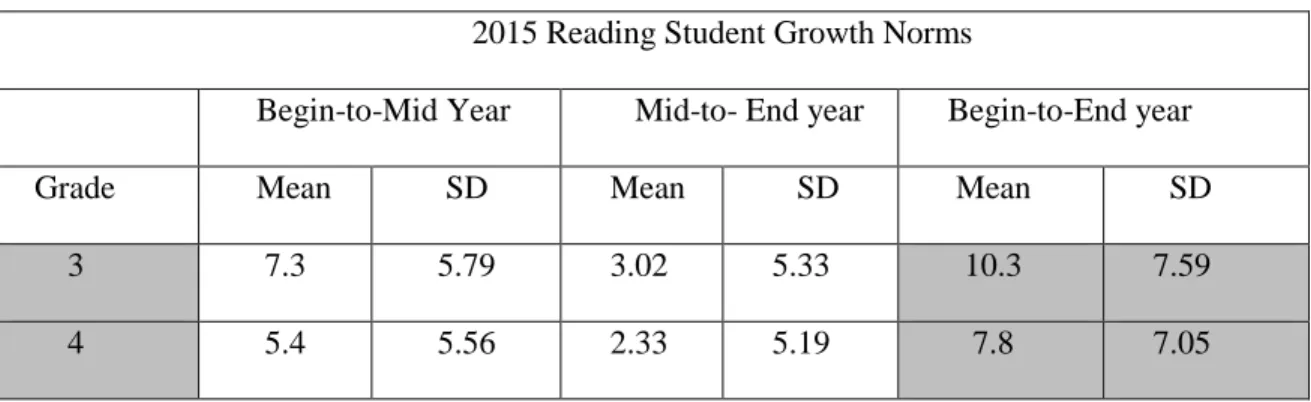
According to the 2015 NWEA RIT Scale Norms Study, the third grade students gained 10.3 points in average and the fourth grade students gained 7.8 points in average from begin-to-end school year (Table 2).
Table 2
2015 MAP Reading Test Student Growth Norms
2015 Reading Student Growth Norms
Begin-to-Mid Year Mid-to- End year Begin-to-End year Grade Mean SD Mean SD Mean SD 3 7.3 5.79 3.02 5.33 10.3 7.59 4 5.4 5.56 2.33 5.19 7.8 7.05
Chapter 4: Results
The purpose of this study was to see if there was any significant growth on standardized reading test scores of third and fourth grade EL students who had ER program in 2016-2017 school year. The amount of reading time of the students who had ER program, ACCESS reading test scores and MAP reading test scores of both the students who had ER program and the students who did not have ER program were collected. The EL students in this study take ACCESS test in February every year, so the reading test scores of 2016 and 2017 were used to examine the effect of ER program on the EL students’ ACCESS reading test scores. The EL students also take MAP test three times a year, fall, winter, and spring. In this study, the fall reading scores and the spring reading scores were used to investigate the effect of ER program on the EL students’ standardized reading test scores. IBM SPSS statistics 22 program was used to compute the datasets for data analysis. A correlation will be used to describe the relationships between the amount of reading time and the growth in standardized reading test scores of the students who had ER program. A paired sample t-test and two independent sample t-test will also be used to compare and contrast the growth in standardized reading test scores of students who had an ER program and the students who did not have an ER program.
The first research question inquired if there was a significant correlation between the growth rate of standardized reading test scores and the amount of reading time of the students who had an ER program.
Table 3
The Amount of Reading Minutes and ACCESS Reading Test Scores of the EL Students in the Experimental Group
Students
the amount of reading minutes ACCESS reading scores in 2016 ACCESS reading scores in 2017 Growth (points) 3 A 1222 5.8 2.9 - 2.9 3 B 487 3.9 6 2.1 3 C 849 6 6 − 3 D 794 4.9 3.5 - 1.4 3 E 718 6 3.1 - 2.9 3 F 395 3.5 6 2.5 3 G 1003 6 6 − 3 H 151 6 6 − 3 I 878 4.9 2.8 - 2.1 4 A 389 6 5.7 - 0.3 4 B 363 5.8 3.8 - 2.0 4 C 92 6 4.6 - 1.4 4 D 320 6 5.2 - 0.8 4 E 276 5.2 3 - 2.2 4 F 172 5.8 4.7 - 1.1 4 G 244 4.4 5 0.6 4 H 583 4.9 3.2 - 1.7 4 I 196 3.0 3.2 0.2 4 J 195 5.5 2.9 - 2.6 Average 490.9 5.2 4.4 - 0.84
Table 3 shows that the students in the experimental group read 490.9 minutes in average for 7 months. It also indicates that 12 students had negative growth, 4 students had positive growth, and 3 students had the same score (6.0) as previous year on their ACCESS reading test scores. Even though the student 3A read the most of 1222 minutes, the reading score dropped by - 2.9 points. On the other hand, the student 3F read for 395 minutes, the reading test score got improved by 2.5 points, thereby receiving the highest score 6.0. The student 3H read for 151 minutes, which was the second least amount of reading minutes, but the reading score was the same of 6.0 as the previous year.
Table 4
Paired Sample Statistics for 2016 ACCESS Reading Scores and 2017 ACCESS Reading Scores of the EL Students in the Experimental Group
Mean N Std. Deviation Std. Error Mean
ACCESS reading (2016) 5.242 19 .9412 .2159
ACCESS reading (2017) 4.400 19 1.2991 .2980
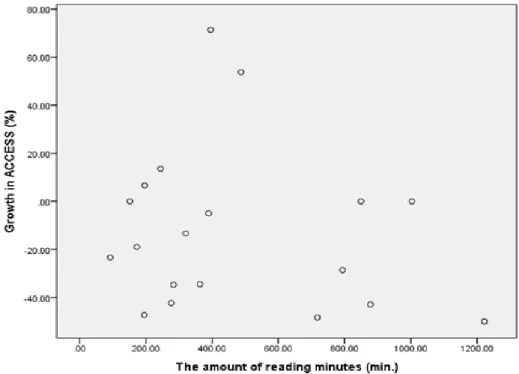
Table 4 tells that the mean of 2016 ACCESS reading test scores is 5.242 (SD = .9412) and the mean of 2017 ACCESS reading test scores is 4.400 (SD = 1.299). It can be said that the students in the experimental group did not grow in their ACCESS reading test as the mean score of 2017 ACCESS reading scores is lower than the mean score of 2016 ACCESS reading scores. The results of ACCESS reading test scores of the students in the experimental group can be seen more clearly in the scatter plot below (Figure 1).
Figure 1. Scatter plot of the relationships between the amount of reading minutes and growth on the ACCESS reading test.
Figure 1 showed that most students are distributed below 0% growth regardless of the amount of reading time, which means most EL students in the experimental group grew
negatively. The student who had the most amount of reading time grew negatively by more than - 40% and the student who read about 400 minutes made a big growth by about 70%. The students who fell below - 40% growth had various amounts of reading time ranging from about 200 minutes to over 1,200 minutes. It can also be said that the less the students read, the more they gained in their ACCESS reading test.
Table 5
Paired t-test of 2016 and 2017 ACCESS Reading Test Scores of the Students in the Experimental Group Paired Differences Sig. (2-tailed) Mean Std. Deviation Std. Error Mean 95% Confidence Interval of the Difference Lower Upper ACCESS reading(2016) – ACCESS reading(2017) -0.8421 1.5486 .3553 -1.5885 -0.0957 .029
The results of t-test in Table 5 points out that the students in the experimental group grew negatively (M = -0.8421, p > .029) in a statistically significant manner in their ACCESS reading test scores. Therefore, the data shows that the ER program did not help the elementary EL students grow in their ACCESS reading scores.
Table 6
Paired Sample Statistics for 2016 ACCESS Reading Scores and 2017 ACCESS Reading Scores of the EL Students in the Control Group
Mean N Std. Deviation Std. Error Mean
ACCESS reading (2016) 5.029 21 .9608 .2097
ACCESS reading (2017) 4.776 21 1.1970 .2612
Table 6 shows that how the control group did in their 2016 and 2017 ACCESS reading test. It tells that the mean of 2016 ACCESS reading test scores is 5.029 (SD = .9608) and the mean of 2017 ACCESS reading test scores is 4.776 (SD = 1.197). It can be said that the students
in the control group did not grow in their ACCESS reading test as the mean score of 2017 ACCESS reading scores is lower than the mean score of 2016 ACCESS reading scores.
However, when comparing the mean scores of the ACCESS reading scores of the control group with the mean scores of the ACCESS reading scores of the experimental group (Table 4), the difference between the mean scores of the experimental group is -.84 and the difference between the mean scores of the control group is -.21. Therefore, it can be said that the control group grew less negatively than the experimental group.
Table 7
Paired t-test of ACCESS Reading Test Scores of the Students in the Control Group
Paired Differences Sig. (2-tailed) Mean Std. Deviation Std. Error Mean 95% Confidence Interval of the Difference Lower Upper ACCESS reading(2016) - ACCESS reading(2017) -0.2524 1.1152 .2434 -.7600 .2552 .312
The students in the control group also gained negatively in their ACCESS reading scores (M = -0.2524, p < .312), but not statistically significantly. When Table 5 and Table 7 were compared, the students in both the experimental group and the control group did not gain in their ACCESS reading test scores.
Table 8
The Amount of Reading Minutes and MAP Reading Test Scores of the EL Students in the Experimental Group
Students
the amount of reading minutes
MAP reading scores in fall, 2016
MAP reading scores in spring, 2017 Growth (points) 3 A 1222 192 189 - 3 3 B 487 190 200 10 3 C 849 197 204 7 3 D 794 197 189 - 8 3 E 718 196 215 19 3 F 395 190 199 9 3 G 1003 191 206 15 3 H 151 203 211 8 3 I 878 195 201 6 4 A 389 182 209 27 4 B 363 203 206 3 4 C 92 181 202 21 4 D 320 195 208 13 4 E 276 195 198 3 4 F 172 196 209 13 4 G 244 192 202 10 4 H 583 189 189 − 4 I 196 176 170 - 6 4 J 195 179 170 - 9 Average 490.9 191.5 198.8 7.3
The Table 8 shows that 14 students gained, 1 student had the same score as the previous test, and four students did not gain in their MAP reading test scores. The reading test score of the
student (3A) who read the most of 1222 minutes dropped by the -3 points, but the student (4 C) who read the least of 92 minutes gained 21 points. The student (4A) who gained the most points of 27 points read 389 minutes and the student (4J) who gained the least of - 9 points read 195 minutes. Table 1 indicates that the fall goal of MAP reading score is 197 and the spring goal of MAP reading score is 206 for the third grade. Both MAP reading test scores of the third grade students did not meet the goal as the mean of fall MAP reading test scores of the third grade is 194.6 and the mean of spring MAP reading scores of the third grade is 201.6. In the same way, the fall goal of MAP reading score is 208 and the spring goal of MAP reading score is 215 for the fourth grade. Both MAP reading test scores of the fourth grade students did not meet the goal as the mean of fall MAP reading test scores of the fourth grade is 188.8 and the mean of spring MAP reading scores of the fourth grade is 196.3. As shown in Table 2, the average growth of third grade and fourth grade students in MAP reading test were 10.3 points and 7.8 points. Three third grade students (about 33.3%) gained more than 10.3 points and five fourth grade students (50%) gained more than 7.8 points in this study.
Table 9
Paired Sample Statistics for Fall MAP Reading Scores and Spring MAP Reading Scores of the EL Students in the Experimental Group
Mean N Std. Deviation Std. Error Mean
Fall MAP reading test 191.526 19 7.4935 1.7191
Spring MAP reading test 198.789 19 12.4926 2.8660
Table 9 tells that the mean of fall MAP reading test scores is 191.526 (SD = 7.4935) and the mean of spring MAP reading test scores is 198.789 (SD = 12.4926). It can be said that the students in the experimental group grew a little in their MAP reading test as the mean score of
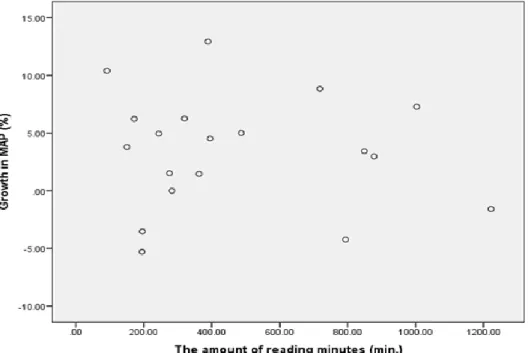
spring MAP reading scores is a little higher than the mean score of fall MAP reading scores. However, the mean of both fall MAP and spring MAP reading scores of the EL students in the experimental group did not meet the goals that are shown in Table 1. The results of the MAP reading test scores can also be seen clearly below in Figure 2.
Figure 2. Scatter plot of the relationships between the amount of reading minutes and growth on the MAP reading test.
In Figure 2, it is showed that most students who gained in their MAP reading test scores read less than about 400 minutes and two students who read more than 750 minutes made negative growth in their MAP reading scores. The student who read the least amount of reading time (about 90 minutes) grew about 10 % and the student who read the most amount of reading time (about 1,200 minutes) grew negatively.
Table 10
Paired t-test of MAP Reading Test Scores of the Students in the Experimental Group
Paired Differences Sig. (2-tailed) Mean Std. Deviation Std. Error Mean 95% Confidence Interval of the Difference Lower Upper Fall MAP reading - Spring MAP reading 7.26321 9.8027 2.2489 2.5384 11.9879 .005
Table 10 shows that the students who had an ER program grew in their MAP reading test scores statistically significantly (M = 7.2632, p > .005). According to the Table 5 and Table 10, it can be said that the students in the experimental group did better in their MAP reading test (M = 7.2632, p > .005) than their ACCESS reading test (M = -0.8421, p > .029). Therefore, the data shows that the ER program helped the elementary EL students in the experimental group grow in their MAP reading scores even though the scores did not meet the student growth norms of the state that are shown in Table 2.
Table 11
Paired Sample Statistics for Fall MAP Reading Scores and Spring MAP Reading Scores of the EL Students in the Control Group
Mean N Std. Deviation Std. Error Mean
Fall MAP reading test 189.952 21 8.9469 1.9524
Table 11 shows that how the control group did in their 2016 and 2017 MAP reading test. It tells that the mean of fall MAP reading test scores is 189.952 (SD = 8.9469) and the mean of spring MAP reading test scores is 201.238 (SD = 7.2588). It can be said that the students in the control group did grow in their MAP reading test as the mean score of spring MAP reading scores is higher than the mean score of fall MAP reading scores. However, when comparing the mean scores of the MAP reading scores of the control group with the mean scores of the MAP reading scores of the experimental group (Table 9), the difference between the mean scores of the experimental group is 7.3 and the difference between the mean scores of the control group is 11.3. Therefore, it can be said that the control group grew more than the experimental group. Table 12
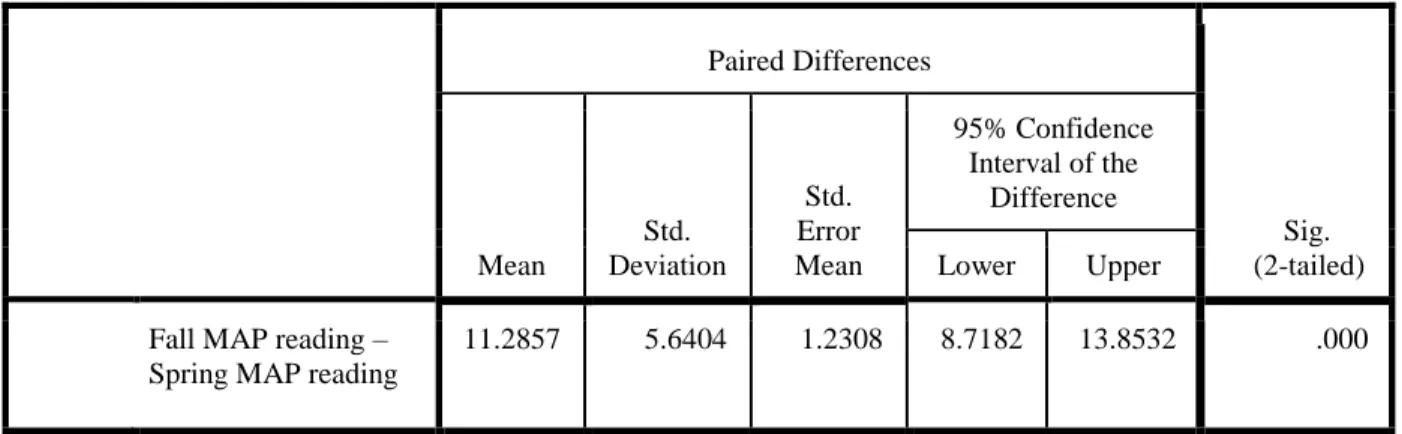
Paired t-test of MAP Reading Test Scores of the Students in the Control Group
Paired Differences Sig. (2-tailed) Mean Std. Deviation Std. Error Mean 95% Confidence Interval of the Difference Lower Upper
Fall MAP reading –
Spring MAP reading
11.2857 5.6404 1.2308 8.7182 13.8532 .000
Table 12 also showed that the students in the control group grew in their MAP reading test scores statistically significantly (M = 11.2857, p > .00). From Table 7 and Table 12, it can be also said that the students in the control group did a little better in their MAP reading test (M = 11.2857, p > .00) than their ACCESS reading test (M = -0.2524, p < .312). When Table 10 and Table 12 were compared, the students in both the experimental group and the control group did gain in their MAP reading test scores.
Table 13
The Correlation between the Amount of Reading Minutes and Standardized Reading Test Scores for the Experimental Group
N
Pearson Correlation with hours of reading
Significance
Growth in ACCESS
reading test scores 19 -0.181 0.458
Growth in MAP
reading test scores 19 -0.092 0.709
In Table 13, the correlation between the amount of reading minutes and the ACCESS reading test scores is negative by - .181 and the correlation between the amount of reading minutes and the MAP reading test scores is also negative by - .092. In conclusion, there is no significant correlation between the amount of reading time and the growth of standardized reading test scores of the students in the experimental group (r = - .181 and r = - .092, p < .458 and p < .709).
The second research question asked if extensive reading programs helped elementary EL students grow in their reading test scores of English language proficiency tests (ACCESS tests) compared the students who completed the alternative reading program.
Table 14
Paired Sample Statistics to Compare the Growth Rate in ACCESS Reading Test Scores between the Experimental Group and the Control Group
Group N Mean (%) Std. Deviation Std. Error Mean t df Mean Difference Growth in ACCESS reading scores control 21 -3.4827 24.50022 5.34639 1.014 38 9.33696 experimental 19 -12.8197 33.43549 7.67063 .999 32.775 9.33696
Paired sample statistics (Table 14) was used to compare the growth rate in ACCESS and MAP reading test scores between the students in the experimental and the students in the control group. Table 14 shows how much the students in both the experimental group and the control group grew in their ACCESS reading test scores. The students in the control group had an average ACCESS reading test score of 5.03 in 2016 and 4.82 in 2017 for a gain of -.21 points, or -3.48 %. Students in the experimental group had an average ACCESS test reading score of 5.2 in 2016 and 4.4 in 2017 for a gain of -.84 points, or -12.82%. This showed that there is no
significant gains in ACCESS reading test scores of the students in the experimental group and the students in the control group.
Table 15
Independent Sample t-test of 2016 and 2017 ACCESS Reading Scores of the Experimental Group and the Control Group
Equality of Variances t-test for Equality of Means
F Sig. t df Sig. (2-tailed) Mean Difference
ACCESS growth of
experimental group – ACCESS growth
of the control group
the 1.473 .232 1.014 38 .317 9.33696
It was shown in Table 14 that the students in the control group grew less negatively
(-3.48%) than the students in the experimental group (-12.82%) in their ACCESS reading test. However, independent sample t-test tells that there is no significant differences in ACCESS reading growth between the experimental group and the control group (p < .317). Therefore, it was not strong or clear to say the ER program helped EL elementary students grow in their ACCESS reading test scores.
The third question was to investigate if extensive reading programs helped elementary EL students grow in their reading test scores of standardized tests (MAP tests) compared the
students who completed the alternative reading program. Table 16
Paired Sample Statistics to Compare the Growth Rate in MAP Reading Test Scores between the Experimental Group and the Control Group
Group N Mean (%) Std. Deviation Std. Error Mean t df Mean Difference Growth in MAP reading scores control 21 5.6090 2.81553 .61440 1.756 38 2.19257 experimental 19 3.4164 4.90141 1.12446 1.711 28.098 2.19257
Table 16 indicates how much the students in both the experimental group and the control group grew in their MAP reading test scores. The students in the control group had an average MAP reading test score of 189.9 in 2016 and 201.2 in 2017 for a gain of 11.3 points, or 5.61%. The students in the experimental group had an average MAP test reading score of 191.5 in 2016 and 198.8 in 2017 for a gain of 7.3 points, or 3.42%. Paired sample statistics showed that there is significant gains in MAP reading test scores of the students in the experimental group and the students in the control group.
Table 17
Independent Sample t-test of Fall and Spring MAP Reading Scores of the Experimental Group and the Control Group
Equality of Variances t-test for Equality of Means
F Sig. t df Sig. (2-tailed) Mean Difference
MAP growth of the
experimental group – MAP growth of
the control group
4.702 .036 1.711 28.098 .098 2.19257
It was shown in Table 16 that the students in the control group grew more (5.61%) than the students in the experimental group (3.42%) in their MAP reading test. However, independent sample t-test (Table 17) tells that there is no significant differences in MAP reading test growth between the experimental group and the control group (p < .098). Therefore, it can be concluded that the ER program helped the elementary EL students grow in their MAP reading test as much as the control group treatment.
Chapter 5: Discussion
The ample research has been conducted to investigate the positive aspects of an ER program and a lot of them claimed that ER can help EFL/EL students increase their vocabulary, reading speed, and scores on the standardized tests. Along with that, it has been proved that ER can increase learners’ motivation for reading, which helps EFL/EL students grow in their English language development.
Based on the findings from research that were reviewed in this study, I wanted to examine the effects of an ER program on elementary EL students’ standardized reading test scores. It seemed that most students enjoyed choosing the books that they liked to read, having individual reading time during the class period once a week, and accessing extra books they could read out of the classroom. During the class, I modeled several times to teach the students how they could use the online ER program independently and conferenced with each student to check their reading levels, problems, or questions that they had with an ER program. After the implementation of an ER program for 7 months, I collected the ACCESS reading test scores and the MAP reading test scores of the EL students who had an ER program and of the EL students who did not have an ER program in order to investigate the effects of an ER program on their reading test scores.
For my first research question, the results of this study showed that there is no significant correlation between the amount of reading time and the growth in their ACCESS reading test scores and MAP reading test scores of the students who had an ER program. For the second and third research question, the ER program that was implemented in this study did not help the elementary EL students grow in their standardized reading test scores any more than the control