N
ew faculty face challenges significantly different from those of their predecessors, including working with students who represent increasingly diverse ages, eth-nicities, capabilities, and levels of interest and commitment (Golde and Dore 2001, Austin 2002). Science graduates who become faculty commonly find themselves underprepared for their teaching responsibilities, which can include the challenge of trying to motivate undergraduates with little background or interest in science (Pruitt-Logan et al. 2002). In addition, faculty increasingly are called on to function in interdisci-plinary teams and to conduct service and outreach along with teaching and research (Anderson and Swazey 1998, Austin 2002). Similarly, students entering nonacademic careers need organizational, managerial, and collaborative skills that typically are not addressed in traditional doctoral pro-grams (Golde and Dore 2001, Gaff 2002).New models of graduate education are emerging in re-sponse to the need to prepare students for careers involving teaching, outreach, service, and interdisciplinary work in ad-dition to research (Austin 2002, Pruitt-Logan et al. 2002). Austin (2002) recommends that graduate students aspiring to be faculty be given opportunities to think deeply about teaching, working with mentors to address topics such as how curricular choices are made, how learning occurs in a spe-cific field, and how to address difficulties that arise in the class-room or laboratory. One mechanism for meeting these needs is through intensive K–12 teaching partnerships. This article describes the impacts of such partnerships on graduate stu-dents’ professional development. We focus on the National Sci-ence Foundation’s (NSF) Graduate Teaching Fellows in K–12 Education (GK–12) program, with a particular emphasis on
evaluation results from Cornell University’s GK–12 program, for which we serve as co–principal investigators.
Graduate student involvement in K–12 outreach Graduate students at Cornell University and other institutions participate in a wide range of K–12 outreach programs. Uni-versity outreach traditionally has been regarded as a unidi-rectional flow of knowledge from colleges and universities to K–12 teachers and students, but recognition is growing that effective outreach requires mutual respect built through long-term partnerships in which teachers are regarded as true col-laborators rather than simply outreach recipients (McKeown 2003, Tanner et al. 2003). To help meet the need for collab-orative partnerships between universities and K–12 classes, in 1999 NSF initiated the GK–12 program, which provides fel-lowships and tuition for graduate students who devote 15 hours per week working with K–12 teachers and students.
In the first six years of the program, NSF provided more than 3400 GK–12 fellowships to graduate students at 167 universities and colleges. Collectively, these fellows have
Nancy M. Trautmann (e-mail: [email protected]) is director of Cornell Sci-ence Inquiry Partnerships and senior extension associate in the Department of Natural Resources, Cornell University, Ithaca, NY 14853. Her work focuses on the development and assessment of techniques for engaging secondary students and teachers in scientific research and other forms of inquiry-based learning. Marianne E. Krasny is a professor and director of graduate studies in the same department. Her outreach programs and research focus on the intersection of science and civic education. © 2006 American Institute of Biological Sciences.
Integrating Teaching and
Research: A New Model for
Graduate Education?
NANCY M. TRAUTMANN AND MARIANNE E. KRASNY
New models of graduate education are emerging in response to the need to prepare students for careers involving not only research but also teaching, outreach, service, and interdisciplinary work. One such model is provided by the National Science Foundation’s (NSF) Graduate Teaching Fellows in K–12 Education (GK–12) program, which challenges universities to build educational outreach into graduate education. Thirty-three percent of the GK–12 faculty advisors at Cornell University credited the fellowship with improving their advisees’ research or perspectives on science, and 89 percent reported that it enhanced their advisees’ teaching skills. Because Cornell fellows create and use curriculum materials related to their own specialized field of science, they gain experience integrating education with research. By implementing and evaluating student-centered teaching strategies, they also engage in the scholarship of teaching in ways that many fellows have said will carry over into their careers.
worked with more than a quarter-million schoolchildren (Sonia Ortega, GK–12 program director, Division of Grad-uate Education, NSF, Arlington,VA, personal communication, 8 September 2005). NSF’s goal in funding GK–12 fellow-ships is not for graduate students to become K–12 teachers. Instead, NSF aims to provide science and engineering students with “an opportunity to acquire additional skills that will broadly prepare them for professional and scientific careers in the 21st century” (NSF 2005). Among the expected out-comes specified by NSF are two that relate specifically to graduate students’ professional development: (1) improved communication, teaching, and team-building skills for the graduate student fellows, and (2) documentation of project outcomes and activities that can be used to improve gradu-ate education (NSF 2005).
Initially, the GK–12 program was controversial because of concerns about sidetracking graduate students from their focus on research and about placing scientists in classrooms without adequate pedagogical training (Mervis 2000, Williams 2002). However, evaluation results have begun to demonstrate a number of important benefits for participating teachers, K–12 students, and graduate student fellows. A nationwide as-sessment that included case studies of 12 sites concluded that the strongest impacts of the GK–12 program were in-creased content knowledge for teachers, positive role models for K–12 students, stronger relationships between schools and universities, and improved communication and teaching skills for fellows (Mitchell et al. 2003).
Each institution develops its own approach to GK–12 partnerships. At some institutions, fellows help teachers im-plement curricula that have been selected in advance for the program as a whole. At others, groups of teachers and fellows work together to plan projects for the upcoming school year, or each fellow works with one or more partner teachers to de-sign and implement activities based on individualized expertise and classroom needs. Strategies for preparing fellows for their work in K–12 classrooms likewise vary considerably from one institution to the next.
Cornell University’s GK–12 program
The Cornell Science Inquiry Partnerships (CSIP) program has provided GK–12 fellowships to 8–11 graduate students per year since 2000. The fellows represent a broad range of dis-ciplines, including engineering, environmental sciences, plant biology, chemistry, geology, and sociology. They work in rural and urban secondary schools in biology, chemistry, earth science, physics, and environmental science courses, in-cluding remedial courses for at-risk students. The common focus for CSIP fellows and their partner teachers, regardless of discipline, is engaging students in scientific research and inquiry-based learning.
CSIP fellows work with partner teachers to determine where and how inquiry can best be used to meet class-specific needs and enhance established curricula, generally us-ing one of the followus-ing approaches:
• Open-ended research: an original experiment or series of experiments, monitoring projects, or other research designed and conducted by students. For example, a grad-uate student in chemical ecology, whose doctoral research focused on insect pheromones, worked with high school biology classes to design and conduct experiments on the extent to which humans react to olfactory cues.
• Redesigned laboratory activities: traditional laboratory and field activities that have been adapted by fellow–teacher teams to meet curriculum requirements through a more inquiry-based approach. For example, using lessons designed by a fellow, high school biology students learned about natural selection and variation while making obser-vations and measurements of bird specimens or of Web-based photographs (Ardia 2005).
• Nature-of-science lessons: activities designed to lead to an understanding of how scientists study the natural world. For example, middle school students learned about peer review through class discussions of a pair of articles pub-lished in the National Geographic,accompanied by a hands-on activity with fossils (Gift and Krasny 2003). • Interactive “meet-the-scientist” presentations: sessions
designed to engage students in some aspect of the fellows’ research. For example, a fellow whose research focuses on nanotechnological approaches to drug delivery in the brain introduced students to the concepts of diffusion, polymers, and enzyme-mediated reactions through experiments in which they modeled controlled-release drug delivery using gelatin and food dyes (http://csip.cornell.edu/Curriculum_ Resources/CSIP/Neeves/KNeeves.asp).
In addition to their work in classrooms, CSIP fellows par-ticipate in a number of professional development activities, including a two-day workshop and year-long seminar, in which they explore strategies for guiding students of various achievement levels in inquiry-based learning, review key as-pects of education theory and practice, and reflect on their work in classrooms. CSIP fellows also work with the project leaders, partner teachers, and graduate research advisors to de-velop activity plans and curriculum resources, some of which have been published in refereed journal articles (Gift and Krasny 2003, Schusler 2004, Ardia 2005) and on the CSIP Web site (http://csip.cornell.edu). One fellow expanded her work with secondary students into a book on the genetics of edi-ble plants that has been accepted for publication by the Na-tional Science Teachers Association (Rice et al. 2006).
Impacts of GK–12 programs on graduate student professional development
Year-end interviews with faculty advisors accompanied by pre-and post-questionnaires completed by fellows indicate a number of impacts attributable to CSIP. These include ben-eficial impacts on some of the graduate students’ research and
scientific knowledge, accompanied by increases in their teach-ing, communication, and time management skills and by the ability to effectively incorporate outreach into their future careers as professional scientists.
Becoming a better scientist.Despite the potential that in-tensive involvement in K–12 outreach would distract grad-uate students from their focus on research, engaging in outreach has been found to help some graduate students gain knowledge and skills directly related to their research and expertise in science (Williams 2002). In CSIP, 33 percent of the fellows’ graduate advisors reported that the program had a positive impact on their advisees’ scientific research (table 1). These faculty explained that the fellowship helped broaden their advisees’ perspectives on their research questions, or helped them reconnect with the basic science behind their spe-cific fields as they presented their work to secondary stu-dents and teachers. One advisor said that teaching middle school students had caused her advisee to “cut through the jargon and complexities and put the science into an inter-disciplinary context.”Another noticed a “wonderful carryover between trying to design experiments with students and [the fellow’s] own research.”
Some fellows and their faculty advisors mentioned the benefits of engaging graduate students in mentoring younger students’ research. For example, one fellow reported:
Towards the end of the year, my advisor mentioned that I was framing my research questions much more tightly in terms of testable hypotheses, predictions and observed dis-crepancies from the predicted outcomes. I came to science from social science and was accustomed to framing research questions much more broadly. It’s ironic that [from] my months of nagging tenth grade students about testable, falsifiable hypotheses and the resultant logical pre-dictions...in the end, I was the one who benefited the most.
Another said, “I have gained confidence as a scientist. I ask clearer questions and find clearer answers as a result of ar-ticulating the process to kids. I also am more aware of the con-text for the research I do.”
Other fellows reported gaining broader perspectives on their fields of expertise as they worked to develop strategies for framing their research in contexts relevant to K–12 students and then discussed these plans with graduate fellows from other scientific disciplines:
It seems that most PhD projects—at least in my depart-ment—are focused on a very specific problem within an already narrow specialty. This provides the opportunity to gain deep understanding of a particular field but does not do as much to foster learning of a more general nature. For me, CSIP has acted as a complement to my PhD research by encouraging me to think broadly about chemistry, how it relates to other sciences, and how it is viewed in society
at large. Being involved in CSIP has helped to make my graduate education more complete.
Faculty also noticed improved skills related to logic, under-standing, organization, and writing that may have been at-tributable to the CSIP experience. Several said that the fellowship helped to counterbalance the isolating impacts of writing a thesis or dissertation and caused their advisees to keep up their interest or to become more passionate about their research.
Teaching ability.Not surprisingly, improved teaching skill is cited as an outcome of GK–12 programs nationwide (Mitchell et al. 2003) and is the primary impact cited by CSIP fellows and their faculty advisors (tables 1, 2). In response to an open-response survey question about the greatest impact of their work in CSIP, 45 percent of fellows reported improved
Table 1. Graduate advisors’ reports on the impacts of the Cornell Science Inquiry Partnerships (CSIP) program on fellows.
Number of fellows
Impact (percentage)
Teaching
Enhanced teaching skills and 24 (89) curriculum development
experience
Likely to have positive impact 12 (44) on future college-level teaching
Comparison to a typical teaching assistantship:
More useful to the fellow’s 19 (70) career
Required greater time or 9 (33) mental energy
Caused less distraction 3 (11) from research
Science/research
Positive impact on fellow’s 9 (33) research
Gained broader perspectives 4 (15) on science
Decreased interest in research 1 (4)
Outreach
Gained interest and experience 13 (48) in educational outreach
Other outcomes
Examined career choices 19 (70) Improved presentation skills 9 (33) Improved organization and time- 8 (30) management skills
Gained self-confidence 8 (30)
Enhanced CV 5 (19)
Became more professional 2 (7)
Note:Derived from faculty interviews at the completion of the sec-ond through fourth year of the the program. Individual graduate fel-lows (n= 27, 6 of whom participated in CSIP for two years) appear multiple times in this column, depending on the number of listed impacts reported by their faculty advisors.
skill in teaching, and 36 percent cited greater awareness of the challenges of teaching (table 2). One fellow responded, “My experience this year has really taught me that students need to be reminded or taught about how to do science and how science is done. I will definitely include this major issue in the design of my courses even for undergraduate students and continue to think about ways to teach these important con-cepts.” Another wrote,“CSIP has helped me to recognize the capacities of individual students and classrooms to design and approach authentic scientific questions. By working with small groups, I have seen that students who design open-ended projects of interest to them are highly motivated to research and retain subject matter.”
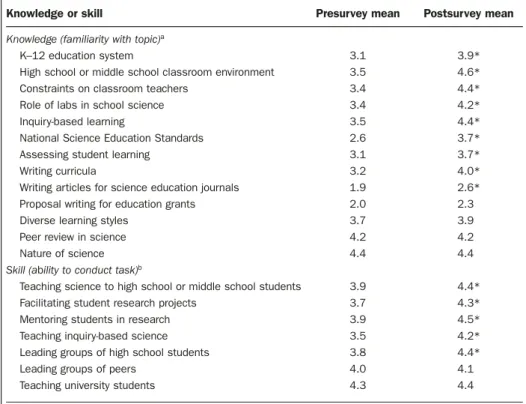
As evidenced by their responses to Likert-scale questions on pre- and postsurveys, fellows’ self-perceived understand-ing of techniques for curriculum development and assessment of student learning grew over the course of the year, as did their self-perceived ability to teach inquiry-based science and to lead students in research projects (table 3).
Almost 90 percent of the faculty advisors reported that their advisees improved their teaching skills as result of their ex-perience in CSIP, and 70 percent rated the fellowship more valuable to their advisee’s career than a typical campus teach-ing assistantship (table 1). In typical teachteach-ing assistant (TA) positions, graduate students supervise laboratory activities de-signed to demonstrate or verify selected topics, and receive lit-tle or no training in effective teaching strategies (Austin 2002, Luft et al. 2004). In contrast, fellows in CSIP and similar GK–12 programs have greater autonomy in deciding what they will teach, and they develop curriculum resources designed to engage students in research and other forms of inquiry-based learning related to their own fields of exper-tise. Another difference is that GK–12 fellows are likely to be mentored more closely than a typical TA, because their part-ner teachers are required to be in the classroom with them at all times. While the fellows bring scientific expertise to the classroom, the teachers provide valuable advice about class-room management and help to evaluate the effectiveness of the fellows’ teaching strategies. Fellows also have the oppor-tunity to reflect deeply on their teaching experiences during weekly seminars in which they learn new pedagogical strate-gies and discuss their classroom successes and challenges within the context of current learning theory.
CSIP faculty and fellows cited the benefit to fellows of learning to communicate with a wide range of audiences, in-cluding students who were not excelling in school. Some also mentioned the specific benefit of working with high school students, because of the greater understanding that the fellows gain of the varied backgrounds and experiences pos-sible in the undergraduates they will teach if they go on to be-come professors. Several fellows and faculty advisors also speculated that the experience in mentoring student research would be valuable to the fellows in their intended faculty careers.
Outreach interest and skills. Although many science faculty at Cornell University and other research-intensive universi-ties view educational outreach as an add-on rather than an integral part of the institution’s mission, this may change as universities strive to meet calls for greater social and com-munity engagement (Campus Compact 2000). Graduate students who participate in GK–12 and other university– school partnership programs develop new perspectives on the roles that university scientists can play in K–12 classrooms, leaving them better equipped to conduct effective outreach programs in their future careers if they so desire. In CSIP, in-creased interest in educational outreach was one of the im-pacts cited by fellows and their faculty advisors (tables 1, 2). The fellows’ comments illustrate their commitment to in-corporating K–12 outreach into their future careers. Ac-cording to one graduate student, “My experience in this fellowship has given me a perspective on the experiences and training necessary for a scientist to engage in a successful partnership with a classroom. It has reinforced my desire to work within a community of scientists to inspire, facilitate, and evaluate collaborations with teachers and students.” An-other wrote, “CSIP has reaffirmed my interest to work as a partner with schools and students. My career goals, if changed, have been broadened to include student scientists in future research endeavors.”
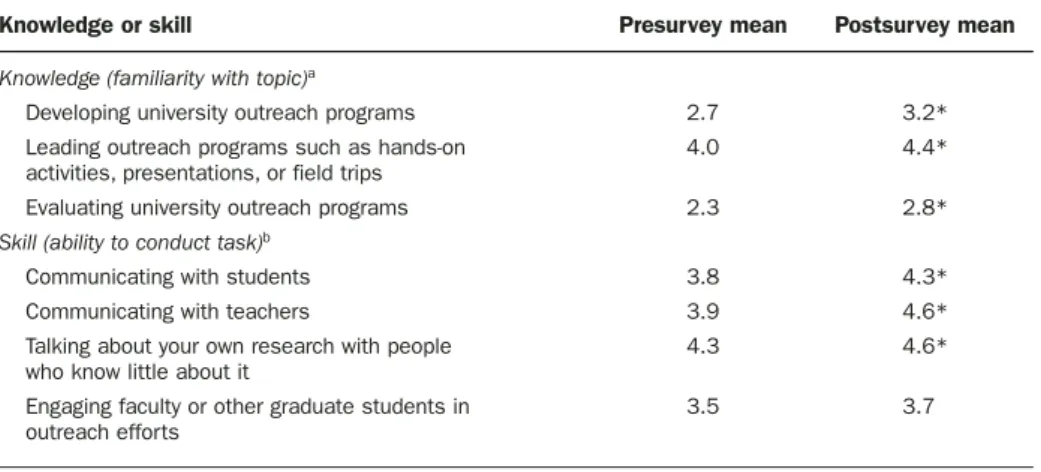
Fellows’ self-perceived knowledge about developing, lead-ing, and evaluating outreach programs grew through CSIP (table 3), as did their outreach-related skills, including the abil-ity to present complex scientific topics to lay audiences
Table 2. Results of a survey of graduate fellows on the greatest impacts of their experience with the Cornell Science Inquiry Partnerships (CSIP) program.
Number of fellows
Impact (percentage)
Teaching
Improved teaching skills 15 (45) Greater awareness of the 12 (36) challenges of teaching
Greater appreciation for or 7 (21) interest in teaching
Science/research
Broadened knowledge or 7 (21) perspectives in science
Became a better scientist 5 (15)
Outreach
Greater interest in partici- 6 (18) pating in outreach
Other outcomes
Improved communication skills 6 (18)
Gained confidence 3 (9)
Reevaluated career path 2 (6)
Note:Responses were reported by fellows (n= 33) in year-end sur-veys in the first four years of the program, replying to the open-response question “What would you say is the biggest impact that CSIP has had on you as a fellow?” Responses total more than 33 (and percentages total more than 100) because some fellows reported more than one greatest impact.
(tables 1, 4). One fellow explained, “I think participating in CSIP has had a huge impact on my ability to discuss my re-search in a variety of settings. It has also taught me to think of myself as a scientist. Working in the schools also gave me a better impression of how people view a PhD student and what sort of resource we can be for them.”Another remarked, “I have become a better scientist because I can now see how much effort is required to relay what it is we do as scientists to the lay public and how much that effort will be rewarded.”
Career choices.Graduate students who apply for GK–12 fellowships are likely to be interested in teaching as one com-ponent of their future careers. Most CSIP applicants profess a keen interest in teaching and say they are aiming for careers at colleges or universities where teaching is a priority. At the end of their fellowship year, CSIP fellows generally cite small rather than major shifts in career goals: “I think I will focus my job search more on colleges that value and support teach-ing. I’d still like to do research, but teaching has become more important.”
CSIP gave me more options for what I’ll do in the future. I’d love to be involved in curriculum development—a field I didn’t even know existed before CSIP. Also, I have a much more realistic idea of what
teach-ing secondary school would entail. I had thought for years, “Maybe I’d like to teach high school one day.” I still feel that way, but I feel like if I do it won’t be such a rude shock to discover how hard it is and how much more work it takes to teach outside the textbook.
Seventy percent of the faculty ad-visors said that CSIP had affected their graduate students’ visions of career choices. In some cases, the fellowship made the faculty more aware of their advisees’ interest in teaching or outreach. For example, one fellow stated that her advisor “saw a new side of me—was sur-prised and excited by the materials I developed.”
Balancing responsibilities.GK–12 fellowships require graduate stu-dents to balance competing de-mands for their time and attention, working in typically high-pressure environments to become research scientists while also spending sig-nificant amounts of time teaching off campus (Thompson 2002). However, of the 29 Cornell
Univer-sity faculty members who advised 33 graduate fellows over the first four years of CSIP, only one reported a negative impact on his advisee’s research. This professor complained that his advisee had become too enamored with teaching and outreach at the expense of her former dedication to research. Compared with the responsibilities of a typical campus TA, CSIP was rated more demanding in terms of time or mental energy by one-third of faculty advisors. Although the commitment of 15 hours per week for CSIP should be similar to the hours re-quired for a TA, fellows dedicate a considerable amount of mental energy to designing classroom activities and developing innovative curriculum resources. Of the faculty who judged CSIP more demanding than a typical teaching assistantship, some commented that the fellowship had been worth the time and attention because of the benefits their advisees had gained from the experience. One advisor noted, “CSIP may not be more total hours, but they’re definitely more
demandinghours. But this is what is great. We have talented students and should be challenging them.” Interestingly, 11 percent of faculty advisors said that CSIP caused less of a distraction from research than they would have expected had their fellow served as a TA, largely because the hours were more flexible and could be adjusted to accommodate research responsibilities.
Table 3. Changes in Cornell Science Inquiry Partnerships (CSIP) fellows’ self-reported knowledge and skills related to teaching.
Knowledge or skill Presurvey mean Postsurvey mean
Knowledge (familiarity with topic)a
K–12 education system 3.1 3.9*
High school or middle school classroom environment 3.5 4.6*
Constraints on classroom teachers 3.4 4.4*
Role of labs in school science 3.4 4.2*
Inquiry-based learning 3.5 4.4*
National Science Education Standards 2.6 3.7*
Assessing student learning 3.1 3.7*
Writing curricula 3.2 4.0*
Writing articles for science education journals 1.9 2.6*
Proposal writing for education grants 2.0 2.3
Diverse learning styles 3.7 3.9
Peer review in science 4.2 4.2
Nature of science 4.4 4.4
Skill (ability to conduct task)b
Teaching science to high school or middle school students 3.9 4.4*
Facilitating student research projects 3.7 4.3*
Mentoring students in research 3.9 4.5*
Teaching inquiry-based science 3.5 4.2*
Leading groups of high school students 3.8 4.4*
Leading groups of peers 4.0 4.1
Teaching university students 4.3 4.4
*Statistically significant (p< 0.05).
Note:As indicated in beginning- and end-of-year written questionnaires administered to 27 graduate fel-lows in the second through fourth year of the CSIP program.
a. In response to the instruction “Please rate your current knowledge about these topics,” with 1 = very low, 2 = low, 3 = moderate, 4 = high, and 5 = very high.
b. In response to the instruction “Please rate your current skills in these areas,” with 1 = very low, 2 = low, 3 = moderate, 4 = high, and 5 = very high.
Implications for graduate education
Despite potential concerns that K–12 classroom work could sidetrack graduate students from their research, findings from Cornell University and other GK–12 programs indicate that many graduate students engaged in K–12 teaching part-nerships gain perspectives and skills that will be valuable in their future careers as professional scientists (Williams 2002, Mitchell et al. 2003, Stamp and O’Brien 2005). Along with in-creased teaching and communication skills, impacts include broadened perspectives on science and experience in inte-grating teaching with research.
In CSIP and some other GK–12 programs, graduate stu-dents are encouraged to develop their own lesson plans with a focus on inquiry-based learning. This requires greater cre-ativity and mental energy than a typical TA position, but also gives the graduate students greater opportunities to en-gage in the scholarship of teaching through designing, im-plementing, evaluating, and potentially publishing their own curriculum resources. The student-centered teaching strate-gies employed in CSIP are central to current efforts to reform science teaching at the university and K–12 levels (Project Kaleidoscope 1999, Handelsman et al. 2004). If fellows apply their teaching experience to future academic careers, one of the long-term impacts of the GK–12 program may be to trigger reform in college-level teaching. This is important because teaching at the university level tends to resist change, perhaps in part because science faculty traditionally receive little or no pedagogical training and tend to be unaware of re-search related to effective teaching (Golde and Dore 2001, Pruitt-Logan et al. 2002, Handelsman et al. 2004).
In addition to gaining experience with pedagogical strate-gies that help students to learn, CSIP and similar GK–12 fel-lows are encouraged to develop classroom activities that introduce students to their own
sci-entific research or field of special-ization. In 2002, the National Research Council held a workshop to explore ways to better integrate research and education in NSF-funded biocomplexity initiatives. The workshop summary explains the reason for convening this group of scientists and educators:
Principal investigators of natural science research projects are accus-tomed to designing fresh
approaches to research problems, but most face a formidable chal-lenge when attempting to integrate education into their research. Many find that they are not suffi-ciently cognizant of modern edu-cational methods to appropriately inform either the general student population or the general public
about their science. Likewise, many educators strive to communicate the excitement and importance of science to students and the public, but do not always have access to information on the latest research advances. (Avila 2003, p. 1)
The GK–12 program provides unprecedented opportuni-ties for graduate students and faculty to explore ways to in-tegrate education and scientific research. For graduate students aspiring to be faculty, this experience is likely to affect the ways in which they will teach, mentor student research, and work with the increasing number of graduate students who are in-terested in developing skills in teaching and outreach as well as research (Nyquist et al. 1999, Austin 2002, Williams 2002, Luft et al. 2004). Once they become scientists in academia, business, or industry, graduate students who have held GK–12 fellowships are likely to be better prepared than their prede-cessors to conduct K–12 outreach based on collaborative partnerships with teachers, and to incorporate such outreach models into grant proposals in response to NSF’s “broader im-pacts” review criterion or to calls for university engagement with communities.
For some graduate students, the reported impacts of the GK–12 program reach beyond the enhancement of teaching and outreach skills to include deepened or broadened per-spectives on science. Like NSF Integrative Graduate Educa-tion and Research Traineeship (IGERT) fellowships, GK–12 programs such as CSIP thus may help graduate students de-velop the ability to look at their research through a more in-terdisciplinary lens, a valuable skill in an era in which scientific breakthroughs are more likely to occur at the boundaries between rather than within traditional disciplines (Sung et al. 2003).
Table 4. Changes in Cornell Science Inquiry Partnerships (CSIP) fellows’ self-reported knowledge and skills related to outreach.
Knowledge or skill Presurvey mean Postsurvey mean
Knowledge (familiarity with topic)a
Developing university outreach programs 2.7 3.2*
Leading outreach programs such as hands-on 4.0 4.4* activities, presentations, or field trips
Evaluating university outreach programs 2.3 2.8*
Skill (ability to conduct task)b
Communicating with students 3.8 4.3*
Communicating with teachers 3.9 4.6*
Talking about your own research with people 4.3 4.6* who know little about it
Engaging faculty or other graduate students in 3.5 3.7 outreach efforts
*Statistically significant (p <0.05).
Note:As indicated in beginning- and end-of-year written questionnaires administered to 27 graduate fel-lows in years 2–4 of the program.
a. In response to the instruction “Please rate your current knowledge about these topics,” with 1 = very low, 2 = low, 3 = moderate, 4 = high, and 5 = very high.
b. In response to the instruction “Please rate your current skills in these areas,” with 1 = very low, 2 = low, 3 = moderate, 4 = high, and 5 = very high.
Research is needed into the mechanisms responsible for the impacts observed in graduate students participating in GK–12 programs nationwide. Although graduate students at all GK–12 sites spend 15 hours per week engaged in K–12 out-reach, the fellows work in classrooms ranging from kinder-garten through 12th grade. Some lead classroom activities they have designed themselves, while others use curricula that have been selected in advance by their institution and part-ner school district. In preparation for classroom work, some fellows attend month-long orientation sessions before entering classrooms, while others participate in GK–12 seminars throughout the school year. Comparative studies could help to determine the impact of variables such as these on the par-ticipating graduate students and on the effectiveness of their outreach activities.
The results presented in this paper and in other GK–12 studies are evaluative, and interpretation of the findings is lited by the fact that little empirical evidence exists of the im-pacts of GK–12 fellowships compared with other types of professional development opportunities. Very little research has focused on campus teaching assistantships, and most of the existing studies have focused on the services that TAs provide rather than on the impacts of these experiences on participating graduate students (Ethington and Pisani 1993). A promising direction for future research would be to inves-tigate the impacts on graduate students of various opportu-nities, including GK–12, IGERT, and research fellowships, as well as teaching assistantships and other types of educational outreach activities. This could include studies comparing impacts on groups of students participating in different types of programs in any given year, as well as longitudinal stud-ies designed to follow the development of skills, knowledge, and attitudes in individual students over the course of their graduate education and into their early careers. The results of such research would help universities better prepare gradu-ate students for the changing and broadening roles they will be expected to assume in their professional lives, either in acad-emia or beyond.
Acknowledgments
This article is based on work supported by the National Sci-ence Foundation (NSF) under Grants DGE 0231913 and 9979516 and by Cornell University. Any opinions, findings, conclusions, or recommendations expressed here are those of the authors and do not necessarily reflect the views of the NSF. We are grateful to Jim MaKinster, Christine Cunningham, Leanne Avery, and Linda Tompkins for their contributions to Cornell Science Inquiry Partnerships (CSIP) and the research presented here, and to anonymous reviewers who gave con-structive advice about this manuscript. We also wish to thank all the teachers, fellows, and students who have participated in CSIP over the past five years.
References cited
Anderson MS, Swazey JP. 1998. Reflections on the graduate student experi-ence: An overview. New Directions for Higher Education 101: 3–13.
Ardia DR. 2005. Natural selection and variation: A hands-on lesson using bird specimens. American Biology Teacher 67: 561–566.
Austin AE. 2002. Preparing the next generation of faculty: Graduate school as socialization to the academic career. Journal of Higher Education 73: 94–122.
Avila BKB. 2003. Integrating Research and Education: Biocomplexity Investigators Explore the Possibilities. Washington (DC): National Acad-emies Press.
Campus Compact. 2000. Presidents’ Declaration on the Civic Responsibil-ity of Higher Education. Providence (RI): Brown UniversResponsibil-ity. Ethington CA, Pisani A. 1993. The RA and TA experience: Impediments and
benefits to graduate study. Research in Higher Education 34: 343–354. Gaff JG. 2002. Preparing future faculty and doctoral education. Change 34:
63–66.
Gift N, Krasny ME. 2003. The great fossil fiasco: Teaching about peer review. American Biology Teacher 65: 270–278.
Golde CM, Dore TM. 2001. At Cross Purposes: What the Experiences of Doctoral Students Reveal about Doctoral Education. Philadelphia: Pew Charitable Trusts.
Handelsman J, et al. 2004. Scientific teaching. Science 304: 521–522. Luft JA, Kurdziel JP, Roehrig GH, Turner J. 2004. Growing a garden without
water: Graduate teaching assistants in introductory science laboratories at a doctoral/research university. Journal of Research in Science Teach-ing 41: 211–233.
McKeown R. 2003. Working with K–12 schools: Insights for scientists. BioScience 53: 870–875.
Mervis J. 2000. Sharp jump in teaching fellows draws fire from educators. Sci-ence 288: 428.
Mitchell J, Levine R, Gonzalez R, Bitter C, Webb N, White P. 2003. Evalua-tion of the NaEvalua-tional Science FoundaEvalua-tion Graduate Teaching Fellows in K–12 Education (GK–12) Program. Chicago: American Educational Research Association. ERIC ED478204.
[NSF] National Science Foundation. 2005. NSF Graduate Teaching Fellows in K–12 Education (GK–12) Program Solicitation. Arlington (VA): National Science Foundation. NSF 05-553.
Nyquist JD, Manning L, Wulff DH, Austin AE, Sprague J, Fraser PK, Calcagno C, Woodford B. 1999. On the road to becoming a professor: The grad-uate student experience. Change 31: 18–20.
Project Kaleidoscope. 1999. Steps toward Reform. Washington (DC): Project Kaleidoscope.
Pruitt-Logan AS, Gaff JG, Jentoft JE. 2002. Preparing Future Faculty in the Sciences and Mathematics: A Guide for Change. Washington (DC): Association of American Colleges and Universities.
Rice E, Krasny ME, Smith M. 2006. Garden Genetics: Teaching with Edible Plants. Arlington (VA): NSTA Press. Forthcoming.
Schusler T. 2004. Ecological impacts of high deer densities. Teaching Issues and Experiments in Ecology 2. (1 December 2005;http://tiee.ecoed.net/vol/ v2/issues/figure_sets/deer/abstract.html)
Stamp N, O’Brien T. 2005. GK–12 partnership: A model to advance change in science education. BioScience 55: 70–77.
Sung NS, Gordon JI, Rose GD, Getzoff ED, Kron SJ, Mumford D, Onuchic JN, Scherer NF, Sumners DL, Kopell NJ. 2003. Educating future scien-tists. Science 301: 1485.
Tanner KD, Chatman L, Allen D. 2003. Approaches to biology teaching and learning: Science teaching and learning across the school–university divide—cultivating conversations through scientist–teacher partner-ships. Cell Biology Education 2: 195–201.
Thompson SL. 2002. Exploring graduate-level scientists’ participation in a sustained K–12 teaching collaboration. School Science and Mathemat-ics 102: 254–265.
Williams VL. 2002. Merging University Students into K–12 Science Education Reform. Santa Monica (CA): Science and Technology Policy Institute.