From value at risk to stress testing:
The extreme value approach
Franc
ßois M. Longin
*Department of Finance, Groupe ESSEC, Graduate School of Management, Avenue Bernard Hirsch, B.P. 105, 95021 Cergy-Pontoise Cedex, France
Received 11 September 1997; accepted 1 February 1999
Abstract
This article presents an application of extreme value theory to compute the value at risk of a market position. In statistics, extremes of a random process refer to the lowest observation (the minimum) and to the highest observation (the maximum) over a given time-period. Extreme value theory gives some interesting results about the distribution of extreme returns. In particular, the limiting distribution of extreme returns observed over a long time-period is largely independent of the distribution of returns itself. In ®nancial markets, extreme price movements correspond to market corrections during ordinary periods, and also to stock market crashes, bond market collapses or foreign exchange crises during extraordinary periods. An approach based on extreme values to compute the VaR thus covers market conditions ranging from the usual environment considered by the existing VaR methods to the ®nancial crises which are the focus of stress testing. Univariate extreme value theory is used to compute the VaR of a fully aggregated po-sition while multivariate extreme value theory is used to compute the VaR of a popo-sition decomposed on risk factors.Ó2000 Elsevier Science B.V. All rights reserved.
JEL classi®cation:C51; G28
Keywords:Aggregation of risks; Capital requirements; Extreme value theory; Financial crises; Financial regulation; Measure of risk; Risk management; Value at risk; Stress testing
www.elsevier.com/locate/econbase
*Tel.: +33-1-34-43-30-40; fax: +33-1-34-43-30-01.
E-mail address:[email protected] (F.M. Longin).
0378-4266/00/$ - see front matterÓ2000 Elsevier Science B.V. All rights reserved. PII: S 0 3 7 8 - 4 2 6 6 ( 9 9 ) 0 0 0 7 7 - 1
1. Introduction
The contribution of this article is to develop a new approach to VaR: the
extreme value approach. As explained in Longin (1995), the computation of
capital requirement for ®nancial institutions should be considered as an
ex-treme value problem. The focus of this new approach is on theextremeevents
in ®nancial markets. Extraordinary events such as the stock market crash of October 1987, the breakdown of the European Monetary System in September 1992, the turmoil in the bond market in February 1994 and the recent crisis in emerging markets are a central issue in ®nance and particularly in risk man-agement and ®nancial regulation. The performance of a ®nancial institution over a year is often the result of a few exceptional trading days as most of the other days contribute only marginally to the bottom line. Regulators are also interested in market conditions during a crisis because they are concerned with the protection of the ®nancial system against catastrophic events which can be a source of systemic risk. From a regulatory point of view, the capital put aside by a bank has to cover the largest losses such that it can stay in business even after a great market shock.
In statistics, extremes of a random process refer to the lowest observation (the minimum) and to the highest observation (the maximum) over a given time-period. In ®nancial markets, extreme price movements correspond to market corrections during ordinary periods, and also to stock market crashes, bond market collapses or foreign exchange crises during extraordinary periods. Extreme price movements can thus be observed during usual periods corre-sponding to the normal functioning of ®nancial markets and during highly volatile periods corresponding to ®nancial crises. An approach based on ex-treme values then covers market conditions ranging from the usual environ-ment considered by the existing VaR methods to the ®nancial crises which are the focus of stress testing. Although the link between VaR and extremes has been established for a long time, none of the existing methods could deal properly with the modeling of distribution tails.
To implement the extreme value approach in practice, a parametric method based on ``extreme value theory'' is developed to compute the VaR of a po-sition. It considers the distribution of extreme returns instead of the distribu-tion of all returns. Extreme value theory gives some interesting results about the statistical distribution of extreme returns. In particular, the limiting dis-tribution of extreme returns observed over a long time-period is largely inde-pendent of the distribution of returns itself.
Two cases are considered to compute the VaR of a market position: a fully aggregated market position and a market position decomposed on risk factors. The former case may be used for positions with few assets and a stable com-position and the latter case for complex com-positions with many assets and a time-changing composition. The case of a fully aggregated market position is treated
with the asymptoticunivariatedistribution of extreme returns while the case of
a market position decomposed on risk factors involves the asymptotic
multi-variatedistribution of extreme returns. Univariate extreme value theory deals
with the issue of tail modeling while multivariate extreme value theory ad-dresses the issue of correlation or risk-aggregation of assets from many dif-ferent markets (such as ®xed-income, currency, equity and commodity markets) during extreme market conditions.
The ®rst part of this article recalls the basic results of extreme value theory. The second part presents the extreme value method for computing the VaR of a market position. The third part illustrates the method by estimating the VaR and associated capital requirement for various positions in equity markets. 2. Extreme value theory
This section brie¯y discusses the statistical behavior of univariate and multivariate extremes. Both exact and asymptotic results pertaining to the distribution of extremes are presented.
2.1. The univariate distribution of extreme returns1
Changes in the value of the position are measured by the logarithmic returns
on a regular basis. The basic return observed on the time-interval [t)1,t] of
lengthfis denoted byRt. Let us callFRthe cumulative distribution function of
R. It can take values in the interval (l, u). For example, for a variable
dis-tributed as the normal, one gets:l ÿ1 andu 1. Let R1;R2;. . .;Rn be
the returns observed over n basic time-intervals [0, 1], [1, 2], [2, 3],. . ., [T)2,
T)1], [T)1,T]. For a given return frequencyf, the two parametersTandnare
linked by the relation Tnf. Extremes are de®ned as the minimum and the
maximum of thenrandom variablesR1;R2;. . .;Rn. LetZndenote the minimum observed over n trading intervals: ZnMin R1;R2;. . .;Rn.2Assuming that
1The results of the basic theorem for independent and identically distributed (i.i.d.) variables can
be found in Gnedenko (1943). Galambos (1978) gives a rigorous account of the probability aspects of extreme value theory. Gumbel (1958) gives the details of statistical estimation procedures and many illustrative examples in science and engineering. Applications of extreme value theory both in insurance and ®nance can be found in Embrechts et al. (1997) and Reiss and Thomas (1997). Leadbetter et al. (1983) give advanced results for conditional processes.
2The remainder of the article presents theoretical results for the minimum only, since the results
for the maximum can be directly deduced from those of the minimum by transforming the random variableR into )R, by which minimum becomes maximum and vice versa as shown by the following relation: Min R1;R2;. . .;Rn ÿMax ÿR1;ÿR2;. . .;ÿRn:
returnsRtare independent and drawn from the same distributionFR, the exact
distribution of the minimal return, denoted byFZn, is given by
FZn z 1ÿ ÿ1 FR zn: 1
The probability of observing a minimal return above a given threshold is
de-noted bypext. This probability implicitly depends on the number of basic
re-turnsnfrom which the minimal return is selected (to emphasize the dependence
ofpext on the variablen, the notationpext(n) is sometimes used in this article).
The probability of observing a return above the same threshold over one
trading period is denoted byp. From Eq. (1), the two probabilities,pext andp,
are related by the equation:pext pn.
In practice, the distribution of returns is not precisely known and, therefore, if this distribution is not known, neither is the exact distribution of minimal returns. From Eq. (1), it can also be concluded that the limiting distribution of
Zn obtained by lettingntend to in®nity is degenerate: it is null forzless than
the lower boundl, and equal to one forzgreater thanl.
To ®nd a limiting distribution of interest (that is to say a non-degenerate
distribution), the minimumZnis reduced with a scale parameteran(assumed to
be positive) and a location parameter bn such that the distribution of the
standardized minimum Znÿbn=an is non-degenerate. The so-calledextreme
value theoremspeci®es the form of the limiting distribution as the length of the
time-period over which the minimum is selected (the variables n or T for a
given frequencyf) tends to in®nity. The limiting distribution of the minimal
return, denoted byFZ, is given by
FZ z 1ÿexp
ÿ 1sz1=s 2
forz<ÿ1=sifs<0 and forz>ÿ1=sifs>0. The parameters, called the tail index, models the distribution tail. Feller (1971, p. 279) shows that the tail
index value is independent of the frequencyf(in other words, the tail is stable
under time-aggregation). According to the tail index value, three types of ex-treme value distribution are distinguished: the Frechet distribution (s<0), the
Gumbel distribution (s0) and the Weibull distribution (s>0).
The Frechet distribution is obtained for fat-tailed distributions of returns
such as the Student and stable Paretian distributions. The fatness of the tail is
directly related to the tail indexs. More precisely, the shape parameterk(equal
toÿ1=s) represents the maximal order of ®nite moments. For example, ifkis
greater than one, then the mean of the distribution exists; ifkis greater than
two, then the variance is ®nite; ifkis greater than three, then the skewness is
well-de®ned, and so forth. The shape parameter is an intrinsic parameter of the
distribution of returns and does not depend on the number of returnsn from
number of degrees of freedom of a Student distribution and to the charac-teristic exponent of a stable Paretian distribution.
The Gumbel distribution is reached for thin-tailed distributions such as the normal or log-normal distributions. The Gumbel distribution can be regarded
as a transitional limiting form between the Frechet and the Weibull
distribu-tions as 1sz1=s is interpreted as ez. For small values ofsthe Frechet and Weibull distributions are very close to the Gumbel distribution.
Finally, the Weibull distribution is obtained when the distribution of returns has no tail (we cannot observe any observations beyond a given threshold de®ned by the end point of the distribution).
These theoretical results show the generality of the extreme value theorem: all the mentioned distributions of returns lead to the same form of distribution for the extreme return, the extreme value distributions obtained from dierent distributions of returns being dierentiated only by the value of the scale and location parameters and tail index.
The extreme value theorem has been extended to conditional processes. For processes whose dependence structure is not ``too strong'', the same limiting
extreme-value distributionFZgiven by Eq. (2) is obtained (see Leadbetter et al.,
1983, ch. 3). Considering the joint distribution of variables of the process, the following mixing condition (3) gives a precise meaning to the degree of de-pendence
lim
l!1jFi1;i2;...;ip;j1;j1;...;jq xi1;xi2;. . .;xip;xj1;xj2;. . .;xjq
ÿFi1;i2;...:;ip xi1;xi2;. . .:;xipFj1;j2;...:;jq xj1;xj2;. . .;xjqj 0; 3
for any integersi1<i2< <ip andj1<j2< <jq, for whichj1ÿipPl.
If condition (3) is satis®ed, then the same limiting results apply as if the vari-ables of the process were independent with the same marginal distribution (the
same scale and location parameters an and bn can be chosen and the same
limiting extreme-value distribution FZ is also obtained). With a stronger
de-pendence structure, the behavior of extremes is aected by the local depen-dence in the process as clusters of extreme values appear. In this case it can still be shown that an extreme value modeling can be applied, the limiting extreme-value distribution being equal to
FZ z 1ÿexp
ÿ 1 szh=s ;
where the parameterh, called the extremal index, models the relationship
be-tween the dependence structure and the extremal behavior of the process (see Leadbetter and Nandagopalan, 1989). This parameter is related to the mean size of clusters of extremes (see Embrechts et al., 1997, ch. 8; McNeil, 1998).
cases of weak dependence and independence. In other cases, the stronger the dependence, the lower the extremal index.
Berman (1964) shows that the same form for the limiting extreme-value distribution is obtained for stationary normal sequences under weak
assump-tions on the correlation structure (denoting byqm the correlation coecient
betweenRtandRtm, the sum of squared correlation coecientsP1m1q2mhas to remain ®nite). Leadbetter et al. (1983) consider various processes based on the normal distribution: discrete mixtures of normal distributions and mixed diusion jump processes all have thin tails so that they lead to a Gumbel distribution for the extremes. As explained in Longin (1997a), the volatility of the process of returns (modeled by the class of ARCH processes) is mainly in¯uenced by the extremes. De Haan et al. (1989) show that if returns follow an
ARCH process, then the minimum has a Frechet distribution.
2.2. The multivariate distribution of extreme returns3
Let us consider a q-dimensional vector of random variables denoted by
R R1;R2;. . .;Rq. The realization of theith component observed at timetis
denoted by Ri
t. Although the de®nition of extremes is natural and
straight-forward in the univariate case, many de®nitions can be taken in the
multi-variate case (see Barnett, 1976). In this study the multimulti-variate minimum Zn
observed over a time-period containing n basic observations is de®ned as
Min R1 1; R12;. . .;R1n ÿ ; Min R2 1; R22;. . .;R2n ÿ ;. . .;Min Rq1; Rq2; . . .; Rq n ÿ . The mul-tivariate minimal return corresponds to the vector of univariate minimal re-turns observed over the time-period.
As for the univariate case, for an i.i.d. process, the exact multivariate dis-tribution of the minimum can be simply expressed as a function of the distri-bution of the basic variable. As in practice, we do not know the exact distribution, so we consider asymptotic results. We assume that there is a series
of a vector of standardizing coecients (an, bn) such that the standardized
minimum Znÿbn=an converges in distribution toward a non-degenerate
distribution. The main theorem for the multivariate case characterizes the
possible limiting distributions: a q-dimensional distribution FZ is a limiting
extreme-value distribution, if and only if, (1) its univariate margins F1
Z, F2
Z;. . .;FZqare either Frechet, Gumbel or Weibull distributions; and (2) there is
a dependence function, denoted bydFZ, which satis®es the following condition:
FZ z1;z2;. . .;zq 1ÿ FZ1 z1FZ2 z2 FZq zq
ÿ dFZ zqÿz1;zqÿz2;...;zqÿzqÿ1 : 4
3A presentation of multivariate extreme value theory can be found in Tiago de Oliveira (1973),
Unlike the univariate case, the asymptotic distribution in the multivariate case is not completely speci®ed as the dependence function is not known but
has to be modeled. Considering two extremesZiandZj, a simple model is the
linear combination of the dependence functions of the two special cases of total dependence and asymptotic independence as proposed by Tiago de Oliveira (1973):
dFZi;Zj zjÿzi qijMax 1;e zjÿzi
1ezjÿzi 1ÿqij: 5
The coecientqijrepresents the correlation between the extremesZiandZj.
In summary, extreme value theory shows that the statistical behavior of
extremes observed over a long time-period can be modeled by the Frechet,
Gumbel or Weibull marginal distributions and a dependence function. This asymptotic result is consistent with many statistical models of returns used in ®nance (the normal distribution, the mixture of normal distributions, the Student distribution, the family of stable Paretian distributions, the class of
ARCH processes. . .). The generality of this result is the basis for the extreme
value method for computing the VaR of a market position, as presented in Section 3.
3. The extreme value method for computing the VaR of a market position This section shows how extreme value theory can be used to compute the
VaR of a market position.4The method for a fully aggregated position, as
presented here, ®rst involves the univariate asymptotic distribution of the minimal returns of the position. The method is then extended to the case of a position decomposed on risk factors. The VaR of the position is obtained with a risk-aggregation formula, which includes the following inputs: the sensitivity coecients of the position on risk factors, the VaR of long or short positions in risk factors, and the correlation between risk factors during extreme market conditions. The issues of positions including derivatives and conditional VaR based on the extremes are also discussed.
3.1. The extreme value method for a fully aggregated position
The method is summarized in the ¯ow chart in Fig. 1. Each step is detailed below:
4A general exposition of VaR is given in Wilson (1996), Due and Pan (1997) and Jorion
Step 1:Choose the frequency of returns f.The choice of the frequency should be related to the degree of liquidity and risk of the position. For a liquid po-sition, high frequency returns such as daily returns can be selected as the assets can be sold rapidly in good market conditions. The frequency should be quite high as extreme price changes in ®nancial markets tend to occur during very short time-periods as shown by Kindleberger (1978). Moreover, low frequency returns may not be relevant for a liquid position as the risk pro®le could change rapidly. For an illiquid position, low frequency returns such as weekly or monthly returns could be a better choice since the time to liquidate the assets in good market conditions may be longer. However, the choice of a low fre-quency implies a limited number of (extreme) observations, which could impact Fig. 1. Flow chart for the computation of VaR based on extreme values (this ®gure recalls the eight steps of the extreme value method for computing the VaR of a fully aggregated position).
adversely upon the analysis as extreme value theory is asymptotic by nature. The problem of infrequent trading characterizing assets of illiquid positions may be dealt with by some data adjustment as done in Lo and MacKinlay
(1990) and Stoll and Whaley (1990). 5The choice of frequency may also be
guided or imposed by regulators. For example, the Basle Committee (1996a) recommends a holding period of 10 days.
Step 2:Build the history of the time-series of returns on the position Rt. For a fully aggregated position, a univariate time-series is used.
Step 3:Choose the length of the period of selection of minimal returns T.The estimation procedure of the asymptotic distribution of minimal returns does not only consider the minimal return observed over the entire time-period but several minimal returns observed over non-overlapping time-periods of length
T. For a given frequencyf, one has to determine the length of the period of
selection of minimal returns,Tor equivalently the number of basic returns,n,
from which minimal returns are selected (as already indicated, the two
pa-rametersTandnare linked by the relationTnf). The selection period has to
satisfy a statistical constraint: it has to be long enough to meet the condition of application of extreme value theory. As this clearly gives an asymptotic result, extremes returns have to be selected over time-periods long enough that the exact distribution of minimal returns can be safely replaced by the asymptotic distribution.
Step 4: Select minimal returns Zn. The period covered by the database is
divided into non-overlapping sub-periods each containing n observations of
returns of frequency f. For each sub-period, the minimal return is selected.
From the ®rst n observations of basic returns R1;R2;. . .;Rn, one takes the
lowest observation denoted by Zn;1. From the next n observations
Rn1;Rn2;. . .;R2n, another minimum calledZn;2 is taken. FromnN
observa-tions of returns, a time-series Zn;ii1;N containingNobservations of minimal
returns is obtained.6
Step 5: Estimate the parameters of the asymptotic distribution of minimal
returns. The three parameters an, bn and sof the asymptotic distribution of
minimal returns denoted byFZasympn are estimated from theNobservations of
minimal returns previously selected.7The maximum likelihood method is used
5I am grateful to a referee for pointing out this issue.
6For a database containingNobsobservations of daily returns, for a frequency of basic returnsf,
and for a selection period of minimal returns containingnbasic returns, the number of minimal returnsNis equal to the integer part ofNobs/f/n.
7While classical VaR methods consider the information contained in the whole distribution, the
method based on extreme values takes into account only the relevant information for the problem of VaR: the negative extremes contained in the left tail. The extreme value method focuses on the extreme down-side risk of the position instead of the global risk.
here as it provides asymptotically unbiased and minimum variance estimates. Note also that the maximum likelihood estimator can be used for the three
types of extreme value distribution (Frechet, Gumbel and Weibull) while other
estimators such as the tail estimator developed by Hill (1975) are valid for the
Frechet case only. The extremal index h may also be worth estimating if the
data present strong dependence. Details of the estimation of the extremal index can be found in Embrechts et al. (1997, ch. 8).
Step 6:Goodness-of-®t test of the asymptotic distribution of minimal returns.
This step deals with the statistical validation of the method: does the asymp-totic distribution of minimal returns estimated in Step 5 describe well the statistical behavior of observed minimal returns? The test developed by Sher-man (1957) and suggested by Gumbel (1958, p. 38), is based on the comparison of the estimated and observed distributions. The test uses the series of ordered
minimal returns denoted by Z0
n;ii1;N: Zn0;16Zn0;26 6Zn0;N. The statistic is computed as follows: XN 12 XN i0 FZasympn Z 0 n;i1 ÿFZasympn Z 0 n;i ÿN11 ; whereFasymp Zn Zn0;0 0 and F asymp Zn Zn0;N1 1:
The variableXN is asymptotically distributed as a normal distribution with
mean N= N1N1 and an approximated variance 2eÿ5= e2N, wheree
stands for the Neper number approximately equal to 2.718. The variableXN
can be interpreted as a metric distance over the set of distributions. A low
value forXN indicates that the estimated and observed distributions are near
each other and that the behavior of extremes is well described by extreme
value theory. Conversely, a high value for XN indicates that the estimated
and observed distributions are far from each other and that the theory does
not ®t the data. In practice, the value of XN is compared with a threshold
value corresponding to a con®dence level (5% for example). If the value of
XN is higher than the threshold value, then the hypothesis of adequacy of the
asymptotic distribution of minimal returns is rejected. The rejection can be explained by the fact that minimal returns have been selected over too short sub-periods. In other words, the number of basic returns from which minimal returns are selected is too small. Extreme value theory is, in fact, an as-ymptotic theory, and many basic observations should be used to select minimal returns such that the estimated distribution used is near the limit. If the hypothesis of adequacy is rejected, one has to go back to Step 3 and
choose a longer selection period. If the value of XN is lower than the given
threshold, the hypothesis of adequacy is not rejected and one can go further to Step 7.
Step 7: Choose the value of the probability pext of a minimal return not
probability is not used.8The reason is simple: we do not know of any model
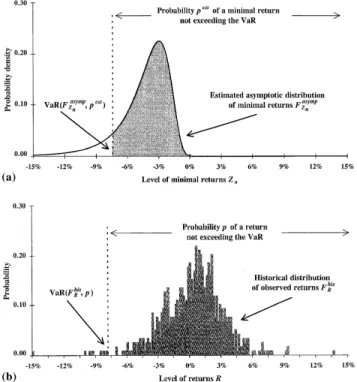
with a theoretical foundation that allows a link between the VaR and the probability of a return not exceeding the VaR (or more exactly ± VaR, as VaR is usually de®ned to be a positive number). In the extreme value method, in-stead of using the probability related to a basic return, the probability related to a minimal return is used: for example, the probability of a minimal daily return observed over a semester being above a given threshold (the threshold value for a given value of the probability corresponding to the VaR number of the position). As explained in Section 2, for an independent or weakly
de-pendent process, the two probabilities are related by: pextpn.9 Note that
when the distribution of returns is exactly known, the extreme value method is equivalent to any classical methods as they give the same VaR number for a
given value ofpor the associated value ofpext. To emphasize the dependence of
the VaR on the distribution and the probability used, the VaR obtained with a
given distribution of returnsFR and a probabilitypis denoted by VaR(FR,p),
and the VaR obtained with the associated exact distribution of minimal returns
FZn and a probability pext is denoted by VaR(FZn; pn). Under the condition
pextpn, we have VaR(F
Zn;pn)VaR(FR,p).
The choice of the de®nition of the probability is guided by the statistical result concerning the extremes, presented is Section 2. The extreme value theorem shows that the link between the probability related to a minimal re-turn and the VaR can be developed on theoretical grounds. The strength of the method is great as the asymptotic distribution of extremes is compatible with many statistical models used in ®nance to describe the behavior of returns.
The choice of the value of probabilitypextis arbitrary (as in other methods).
However, several considerations can guide this choice: the degree of ®nancial stability required by regulators (for example, the Basle Committee (1996a)
presently imposes a value for probabilityp equal to 0.99 implying a value for
probabilitypext equal to 0.99n assuming weak dependence or independence of
returns), the degree of risk accepted by the shareholders of ®nancial institu-tions, and the communicability of the results in front of the Risk Committee of the banks. For example, the VaR computed with a value of 95% for the
8The existing VaR methods of the classical approach use the probability of an unfavorable move
in market prices under normal market conditions during a day or a given time-period, and then deduce the VaR with a statistical model. For example, the VaR computed by RiskMetricsTM
developed by JP Morgan (1995) corresponds to the probability of observing an unfavorable daily move equal to 5% (equivalent to the probabilitypof a return not exceeding the VaR equal to 95%). In RiskMetricsTM, the link between the probability and the VaR is realized with the normal
distribution.
9The equationpextpn is still valid in the case of weak dependence. In the case of strong
probabilitypextof a minimal return selected on a semester basis corresponds to
the expected value of the decennial shock often considered by banks.
Step 8:Compute the VaR of the position.The last step consists of computing the VaR of the position with the asymptotic distribution of minimal returns previously estimated. The full model contains the following parameters: the
frequencyfand the number of basic returnsnfrom which minimal returns are
selected, the three parameters an, bn and sof the asymptotic distribution of
minimal returnsFZasympn , and the probabilitypextof observing a minimal return
not exceeding the VaR. For processes presenting strong dependence, if the
value of probabilitypext is derived from the value of probabilityp using the
equation pext pnh, then the extremal index h for minimal returns is also
needed.
Considering the case of a fully aggregated position, the VaR expressed as a percentage of the value of the position is obtained from the estimated as-ymptotic distribution of minimal returns:
pext1ÿFasymp Zn ÿVaR exp " ÿ 1 s ÿVaRÿbn an 1=s# 6 leading to VaR ÿbnan s1ÿ ÿln pexts: 7
This ``full'' valuation method used to compute the VaR of a market position requires the construction of the history of returns of the entire position. For complex positions containing many assets or with a time-changing composi-tion, it may be time-consuming to rebuild the history of returns of the position and re-estimate the asymptotic distribution of minimal returns every time the VaR of the position has to be computed. For this reason, it may be more ef-®cient to decompose the position on a limited number of risk factors (such as interest rates, foreign currencies, stock indexes and commodity prices) and compute the VaR of the position in a simpler manner with a risk-aggregation formula. Such a method is presented next.
3.2. The extreme value method for a position decomposed on risk factors
The risk-aggregation formula relates the VaR of the position to the sensi-tivity coecients of the position on risk factors, the VaR of long or short positions in risk factors and the correlation between risk factors. In this way, the computational work is reduced to the estimation of the multivariate dis-tributions of both minimal and maximal returns of risk factors (which is done once for all) and to the calculation of the sensitivity coecients of the position on risk factors (which is repeated every time the composition of the position changes).
A simple ad hoc risk-aggregation formula is used here to compute the VaR
of a position.10Consideringqrisk factors, the VaR of a position characterized
by the decomposition weights wii1;q, is given by
VaR Xq i1 Xq j1 qijwiwjVaRiVaRj v u u t ; 8
where VaRi represents the VaR of a long or short position in risk factori,wi
the sensitivity coecient of the position on risk factoriandqij the correlation
of extreme returns on long or short positions in risk factorsiandj.
For each risk factor, the VaR of a long position, denoted by
VaRl
i FZasympn ; pext, is computed with Eq. (7) using the parameters of the
marginal distribution of minimal returns. Similarly, the VaR of a short
posi-tion, denoted by VaRs
i FYasympn ; pext, is computed with the same equation using
the parameters of the marginal distribution of maximal returnsFYasympn .
Considering two risk factors i and j, four types of correlation of extreme
returnsqijcan be distinguished according to the type of position (long or short)
in the two risk factors. For a position long (short) in both risk factorsiandj,
the correlationqij corresponds to the correlation between the minimal
(maxi-mal) returns of risk factorsiandj. For a position long (short) in factoriand
short (long) in factorj, the correlation qij corresponds to the correlation
be-tween the minimal (maximal) return of risk factoriand the maximal (minimal)
return in factorj. To emphasize the dependence on the type of position (long or
short), the four correlation coecients are denoted byqll
ij,qssij,qlsij andqslij.
In the case of total dependence (qij1 for all i and j), the VaR of the
position is equal to the sum of the weighted VaR of each risk factor,P
q
i1wiVaRi. In the case of independence (qij0 for alli andj, i6j), the VaR of the position is equal to the square root of the weighted sum of the squared VaR of each risk factor, Pqi1 wiVaRi2
q
:
To summarize, for a position decomposed on a given set ofq risk factors,
the VaR can be formally written as VaR wi i1;q; VaRli FZasympn ; p
ext ÿ i1;q; VaRsi FYasympn ; p ext ÿ i1;q; qab ij a;blors i;j1;q :
10This formula is inspired by the formula used in the variance/covariance method. In the case of
normality, the VaR obtained with the position decomposed on risk factors and based on the risk-aggregation formula (8) with the VaRs of risk factors and correlation coecients classically computed corresponds to the VaR obtained with the fully aggregated position.
The method needs the estimation of 6q parameters of the marginal
distribu-tions of both minimal and maximal returns used to compute the 2qVaRs for
long and short positions in risk factors, and the estimation of 4q correlation
coecients of the multivariate distribution of extreme returns used to aggre-gate the VaRs of risk factors.
The extreme value method takes explicitly into account the correlation be-tween the risk factors during extreme market conditions. It has often been argued that there is a rupture of correlation structure in periods of market stress. For example, using multivariate GARCH processes, Longin and Solnik (1995) conclude that correlation in international equity returns tends to in-crease during volatile periods. Applying multivariate extreme value theory, Longin and Solnik (1997) ®nd that correlation in international equity returns depends on the market trend and on the degree of market volatility. Correla-tion between extreme returns tends to increase with the size of returns in down-markets and to decrease with the size of returns in up-down-markets.
3.3. Positions with derivatives
The VaR of positions with classical options is usually computed by the delta-gamma method to take into account the non-linearity. The VaR of po-sitions with more complex options is often obtained with a Monte Carlo simulation method since no analytical formula is available. With non-linearity, the tail behavior of the distribution is a critical issue. Although the extreme value method may be dicult to implement straightforwardly, extreme value theory may be very useful for determining a model for generating returns from the point of view of extreme events. For example, the non-rejection of the
Frechet distribution would suggest fat-tailed distributions such as a Student
distribution or a GARCH process. The non-rejection of the Gumbel distri-bution for extreme returns would suggest thin-tailed distridistri-butions such as the normal distribution or a discrete mixture of normals. The non-rejection of the Weibull distribution for extreme returns would suggest that bounded
distri-butions with no tails may be used to describe returns. 11Parameters from these
models may be estimated by considering the extremes. For example, the
11Note that if a given distribution of returns implies a particular (Frechet, Gumbel or Weibull)
distribution of extreme returns, the reverse is not true. For example, a Student distribution for returns implies a Frechet distribution for extreme returns, but a Frechet distribution for extreme returns does not necessarily imply a Student distribution for returns. Results about the extremes should be used to infer information about the tails of the distribution only. It should not be used to infer information about the whole distribution as the center of the distribution is not considered by extreme value theory.
number of degrees of freedom of a Student distribution and the degree of persistence in a GARCH process are directly related to the tail index value.
In an extreme value analysis using observed data, it is the historical distri-bution that is studied. However, for evaluating a position with derivatives, one may need a risk-neutral distribution. Using results for the normal distribution
(Leadbetter et al., 1983, pp. 20±21), in a worlda la Black±Scholes, the
risk-neutral asymptotic distribution of extreme returns diers from the historical
one by the value of the location parameter only:b
nbnÿ lr0, where the
asterisk refers to the risk-neutrality, and wherelandr0 represent respectively
the expected return and the risk-free interest rate over a time-period of lengthf.
The scale parameter and the tail index are unaected by the change of
distri-bution:a
nan andss0. For other processes (such as a mixed diusion
process with jumps or a GARCH process), all three parameters may be aected by the change of probability.
3.4. Conditional VaR based on extreme values
Extreme value theory gives a general result about the distribution of ex-tremes: the form of the limiting distribution of extreme returns is implied by many dierent models of returns used in ®nance (the normal distribution, a discrete mixture of normals, the Student distribution, the stable Paretian distribution, ARCH processes...). Such generality may also mean a lack of re®nement. For example, as the asymptotic extreme value distribution is largely unconditional, the VaR given by the extreme value method is inde-pendent of the current market conditions. In practice, everyday risk man-agement may be improved by taking into account the current market conditions. Thus it may be useful to investigate conditional VaR based on extreme values.
3.5. Related works
Boudoukh et al. (1995) also consider the distribution of extreme returns. They do not use the asymptotic results given by extreme value theory but derive exact results by assuming a normal distribution for returns. In a non-parametric setting Dimson and Marsh (1997) consider the worst realizations of the portfolio value to compute the risk of a position. Danielsson and De Vries (1997) and Embrechts et al. (1998) use a semi-parametric method to
compute the VaR. In both works, the tail index is estimated with HillÕs
esti-mator, which can be used for the Frechet type only. Note that the Weibull
distribution is sometimes obtained, and the Gumbel distribution is often not rejected by the data (some foreign exchange rates and non-US equity returns for example).
4. Examples of application
The case of a fully aggregated position is illustrated with long and short positions in the US equity market. To illustrate the case of a position de-composed on risk factors, long, short and mixed positions in the US and French equity markets are considered.
Table 1
Estimation of the parameters of the asymptotic distributions of extreme daily returns on the S&P 500 Index observed over time-periods of increasing length: 1 week, 1 month, 1 quarter and 1 se-mestera
Length of the selection
period Scaleparameteran
Location parameterbn
Tail index
s Goodness-of-®ttest statistics (A)Minimal daily returns
1 week T5 0.492 )0.518 )0.183 2.770 f1;n5;N1;585 (0.009) (0.013) (0.020) [0.001] 1 month (T21) 0.533 )1.074 )0.148 1.371 f1;n21;N377 (0.023) (0.030) (0.031) [0.085] 1 quarter T63 0.585 )1.451 )0.302 )1.040 f1;n63;N125 (0.049) (0.059) (0.070) [0.851] 1 semester T125 0.623 )1.726 )0.465 )0.229 f1;n125;N63 (0.085) (0.091) (0.128) [0.591] (B)Maximal daily returns
1 week T5 0.501 0.572 )0.084 3.291 f1;n5;N1;585 (0.012) (0.013) (0.032) [<0.001] 1 month T21 0.544 1.158 )0.140 0.938 f1;n21;N377 (0.025) (0.032) (0.042) [0.174] 1 quarter T63 0.705 1.597 )0.104 0.516 f1;n63;N125 (0.053) (0.071) (0.066) [0.303] 1 semester T125 0.845 1.985 )0.060 )0.139 f1;n125;N63 (0.087) (0.118) (0.082) [0.555]
aThis table gives the estimates of the three parameters of the asymptotic distribution of extreme
daily returns selected over time-periods of increasing lengthTas indicated in the ®rst column. Estimation results are given for the distribution of minimal daily returns (Panel A) and for the distribution of maximal daily returns (Panel B). The scale and location parameters (anandbn) and
the tail index (s) are estimated by the maximum likelihood method. Standard errors of parameters' estimates are given below in parentheses. The database consists of daily returns on the S&P 500 index over the period January 1962±December 1993 (7927 observations). Extreme daily (f1) returns are selected over non-overlapping sub-periods of length ranging from 1 week to 1 semester. A minimal (maximal) daily return corresponds to the lowest (highest) daily return on the S&P 500 index over a given sub-period. The number of selected extremes (N) is inversely related to the length of the selection period (T) or equivalently to the number of daily returns from which extreme re-turns are selected (n). The last column indicates the result of Sherman's goodness-of-®t test with the p-value (probability of exceeding the test-value) given below in brackets. The 5% con®dence level at which the null hypothesis of adequacy (of the estimated asymptotic distribution of extreme returns to the empirical distribution of observed extreme returns) can be rejected, is equal to 1.645.
4.1. The case of a fully aggregated position
The extreme value method presented in Section 3.1 is now applied to the computation of the VaR of both long and short positions in the Standard and
PoorÕs 500 index (this widely available data are used here to allow an easy
replication of the results). Estimation results of the asymptotic distribution of extreme returns are ®rst presented. VaRs are then computed for dierent values of the probability of an extreme return not exceeding the VaR. The sensitivity of VaR results to the frequency and to the length of the selection period, and the impact of the stock market crash of October 1987 on VaR results are also studied. The VaR given by the extreme value method is also compared with the VaR given by classical methods. Finally, capital requirements are computed in order to assess the regulation of market risks.
4.1.1. Estimation of the asymptotic distribution of extreme S&P 500 index returns
Results of the estimation of the parameters of the asymptotic extreme value distribution are given in Table 1 for minimal returns (Panel A) and for
max-imal returns (Panel B). Extreme daily (f 1 day) returns are observed over
time-periods ranging from one week (T 5 days) to one semester (T 125
days). The database consists of daily returns on the S&P 500 index over the period January 1962±December 1993. Looking at a long time-period (without important structural changes) allows consideration of a variety of market conditions that may occur again in the future. Returns are de®ned as loga-rithmic index price changes. Considering the results for minimal daily returns: the scale parameter increases from 0.492 to 0.623, indicating that the negative extremes are more and more dispersed; the location parameter increases (in absolute value) from 0.518 to 1.726, showing that the average size of negative extremes is larger and larger; the tail index value is always negative and is
between)0.148 and)0.465, implying that the limiting distribution is a Frechet
distribution.12 In other words, the asymptotic distribution of minimal daily
returns shifts to the left and spreads while the shape of the distribution, and specially the way the left tail decreases, remains the same. As the extreme value
distribution is a Frechet distribution, Hill's estimator based on tail
observa-tions can be used for the tail index. Following the procedure used in Jansen and De Vries (1991), the tail index estimate for the left tail is equal to)0.290 with a standard error of 0.043.
12A Frechet distribution for extreme returns in the US equity market has been found by Jansen
and De Vries (1991), Loretan and Phillips (1994) and Longin (1996). Considering other international equity markets, Longin and Solnik (1997) ®nd that all types of extreme value distribution (Frechet, Gumbel and Weibull) are obtained.
A likelihood ratio test shows that the Gumbel distribution (and a fortiori the
Weibull distribution) is always rejected in favor of the Frechet distribution.
The test is distributed as a chi-square variable with one degree of freedom
(obtained by dierence in the number of parameters in the Frechet and Gumbel
distributions). For example, in the case of minimal returns selected over a
semester, the value of the test is equal to 40.545 with ap-value (probability to
exceed the test value) less than 0.001.
Sherman's goodness-of-®t test indicates that the hypothesis of adequacy (of the estimated asymptotic distribution of extreme returns to the empirical dis-tribution of observed returns) is not rejected at the 5% con®dence level when extreme daily returns are selected over time-periods longer than a month. For extremes selected over a week, the test statistic is equal to 2.770 and is higher than the threshold value of 1.645 associated with a 5% con®dence level. For extremes selected over a month, a quarter and a semester, the test statistics are
respectively equal to 1.371, )1.040 and )0.229, and are lower than the
threshold value. The exact distribution of minimal returns can then be safely replaced by the asymptotic distribution as long as minimal returns are selected over time-periods of length greater than a month. Similar comments apply to maximal daily returns. However, the right tail appears less heavy than the left tail, and the Gumbel distribution for maximal returns is not rejected by the data.
The impact of the stock market crash of October 1987 (the greatest
obser-vation associated with a record-low return of)22.90%) on the estimation of
the parameters of the distribution of minimal returns is also investigated. Considering minimal daily returns selected over a semester, the whole sample
contains 63 observations N 63. From Table 1A the parameters' estimates
are with the standard error in parentheses: 0.623 (0.085) for the scale
param-eter,)1.726 (0.091) for the location parameter, and)0.465 (0.128) for the tail
index. Removing the observation of the October 1987 crash from the sample
(Nis now equal to 62) and estimating the distribution of minimal returns again,
the parameters' estimates are now: 0.604 (0.054) for the scale parameter,
)1.748 (0.064) for the location parameter and)0.301 (0.093) for the tail index.
The impact of the greatest observation is largest on the tail index, while the two standardizing coecients are changed slightly. By dropping the observation of the stock market crash of October 1987, the estimated distribution appears to be less fat-tailed (the tail index is closer to zero). Although the dierence is not statistically signi®cant, the economic impact in terms of VaR and regulatory capital requirement may be worth studying.
The Basle Committee (1996a) allows banks to consider price shocks equivalent to a short holding period such as a day, but it recommends a holding period of 10 days. The behavior of the asymptotic distribution under temporal aggregation is not speci®ed by extreme value theory although the tail index value should remain the same, as shown by Feller (1971, p. 279).
For this reason, asymptotic distributions of extreme returns of various fre-quencies are also estimated. Estimation results are given in Table 2 for minimal returns (Panel A) and for maximal returns (Panel B). Three values
are used for frequency f: 1, 5 and 10 days. Empirically, the asymptotic
dis-tribution of minimal (maximal) returns spreads and shifts to the left (right). For example, considering minimal returns, the scale parameter is equal to 0.623 for one-day returns, 1.098 for ®ve-day returns and 1.875 for 10-day
returns, and the location parameter is equal to )1.726 for one-day returns,
)2.746 for ®ve-day returns and )3.244 for 10-day returns. Such a result was
expected as low-frequency returns are more volatile than high-frequency
re-turns. The tail index value is always negative (between )0.465 and )0.134)
Table 2
Estimation of the parameters of the asymptotic distributions of extreme returns on the S&P 500 Index of various frequencies: 1, 5 and 10 daysa
Frequency of returns Scale parameteran
Location parameterbn
Tail index
s Goodness-of-®ttest statistics (A)Minimal returns
One-day returns f 1 0.623 )1.726 )0.465 )0.229 T125;n125;N63 (0.085) (0.091) (0.128) [0.591] Five-day returns f5 1.098 )2.746 )0.319 )0.599 T125;n25;N63 (0.136) (0.160) (0.120) [0.725] Ten-day returns f10 1.875 )3.244 )0.134 0.499 T120;n12;N63 (0.208) (0.272) (0.096) [0.309] (B)Maximal returns One-day returns f 1 0.845 1.985 )0.060 )0.139 T125;n125;N63 (0.087) (0.118) (0.082) [0.555] Five-day returns f5 1.207 3.033 )0.147 )1.929 T125;n25;N63 (0.138) (0.176) (0.115) [0.973] Ten-day returns f10 1.606 3.834 )0.100 )0.243 T120;n12;N63 (0.181) (0.239) (0.115) [0.596]
aThis table gives the estimates of the three parameters of the asymptotic distribution of extreme
returns of various frequencies f as indicated in the ®rst column. Estimation results are given for the distribution of minimal returns (Panel A) and for the distribution of maximal returns (Panel B). The scale and location parameters (anandbn) and the tail index (s) are estimated by the maximum
likelihood method. Standard errors of parameters' estimates are given below in parentheses. The time-series of returns of various frequencies are built from the database of daily returns on the S&P 500 index over the period January 1962±December 1993. The parameternis adjusted such that extreme returns of all three frequencies are selected over non-overlapping semesters (T125 for one-day and ®ve-day returns andT 120 for 10-day returns). The last column indicates the result of Sherman's goodness-of-®t test with thep-value (probability of exceeding the test-value) given below in brackets. The 5% con®dence level at which the null hypothesis of adequacy (of the esti-mated asymptotic distribution of extreme returns to the empirical distribution of observed extreme returns) can be rejected, is equal to 1.645.
implying a Frechet extreme value distribution for all frequencies. It seems to decrease slightly for minimal returns while it remains fairly stable for maxi-mal returns.
The extremal index h, which models the relationship between the
depen-dence structure and the behavior of extremes of the process, is also estimated. Using the blocks method presented in Embrechts et al. (1997, pp. 419±421, Eq.
(8.10)), the estimate of h is equal to 0.72 when looking at minimal one-day
returns selected over a semester, and equal to 0.73 when looking at maximal
one-day returns (a threshold value of 5% is used to de®ne return
excee-dances). Higher values ofhare obtained when a lower frequency for returns is
used: 0.84 for minimal 10-day returns selected over a semester and 0.92 for
maximal 10-day returns. These estimates are close to the valueh1 obtained
for the case of weak dependence or independence.
4.1.2. VaR of long and short positions in the S&P 500 index
The estimations obtained above are now used to compute the VaR of positions in the S&P 500 index. Empirical results are reported in Table 3 for a long position (Panel A) and for a short position (Panel B). Two holding
pe-riods are considered: 1 day and 10 days (f 1 and 10). Extremes returns are
selected over time-periods of two dierent lengths: 1 quarter and 1 semester.
The value of the probabilitypext of an extreme return not exceeding the VaR
ranges from 50% to 99% (a higher probability value meaning a higher risk aversion or a higher degree of conservatism). It is important to compute the VaR for dierent probability values as it gives an idea of the pro®le of the
expected loss beyond the VaR.13 For example, considering a holding period
of 1 day and minimal returns selected on a semester basis, the VaR is equal to $1.98 for a long position of $100 and for a probability value of 50%. In other words, there is one chance in two that the position loses more than $1.98 in one trading session over a semester. The concept of mean waiting period (also called return period) is useful for interpreting the results. The mean waiting period is de®ned as the average time that one has to wait to see an observation exceeding a given threshold. The mean waiting period for a minimal return less than or equal to level z, denoted by T(z) is equal to 1=FZasympn z or 1/
(1) pext), expressed in units of the selection period of minimal returns. The
mean waiting period that one has to wait to observe a loss greater than $1.98 is then equal to two semesters (or one year). For a value of 95% for the
13See Longin (1997b), Embrechts et al. (1998) and Artzner et al. (1999) for a measure of the
probability pext (equivalent to a mean waiting period of 20 semesters or 10
years), the VaR increases to $5.72. A higher value for pext implies a higher
VaR number. A con®dence band measuring the uncertainty due to the es-timation procedure of the asymptotic extreme value distribution can be Table 3
VaR of long and short positions in the S&P 500 Index computed using the extreme value methoda
Probability of not
exceeding VaR Holding period: 1 daySelection period: Holding period: 10 days
1 quarter Selection period:1 semester Selection period:1 quarter Selection period:1 semester (A)Long position
50% 2.18 1.98 4.12 3.72 (1 year) [2.05, 2.30] [1.88, 2.07] [3.91, 4.33] [3.50, 3.94] 75% 2.98 2.78 5.80 5.41 (2 years) [2.74, 3.23] [2.59, 2.97] [5.49, 6.11] [5.06, 5.77] 90% 4.21 4.20 7.78 7.72 (5 years) [3.68, 4.75] [3.72, 4.68] [7.26, 8.29] [7.05, 8.40] 95% 5.36 5.72 9.23 9.67 (10 years) [4.42, 6.29] [4.77, 6.66] [8.48, 9.98] [8.57, 10.77] 99% 9.07 11.76 12.63 15.19 (50 years) [5.62, 12.52] [7.27, 16.25] [10.86, 14.41] [11.85, 18.54] (B)Short position 50% 2.38 2.26 4.20 4.24 (1 year) [2.26, 2.58] [2.16, 2.37] [4.03, 4.36] [4.05, 4.44] 75% 3.10 3.04 5.54 5.70 (2 years) [2.91, 3.30] [2.89, 3.20] [5.29, 5.79] [5.41, 6.00] 90% 4.02 3.98 7.17 7.53 (5 years) [3.66, 4.37] [3.72, 4.24] [6.74, 7.61] [7.02, 8.04] 95% 4.73 4.69 8.41 8.95 (10 years) [4.18, 5.28] [4.31, 5.08] [7.76, 9.06] [8.17, 9.73] 99% 6.56 6.42 11.44 12.57 (50 years) [5.10, 8.02] [5.48, 7.37] [9.82, 13.07] [10.53, 14.61]
aThis table gives the VaR of positions in the S&P 500 index computed using the extreme value
method for various values of the probabilitypextof an extreme return not exceeding the VaR, as
indicated in the ®rst column. The corresponding waiting periods are given below in parentheses. The VaR of a long position (Panel A) is obtained with the estimated asymptotic distribution of minimal returns, while the VaR of a short position (Panel B) is obtained with the estimated as-ymptotic distribution of maximal returns. The VaR is computed for a position of $100, or equivalently, the VaR is expressed as the percentage of the value of the position. Two holding periods are considered: 1 and 10 days (f1 and 10). Extremes returns are selected over non-overlapping time-periods of two dierent lengths: 1 quarter and 1 semester. The probabilitypextof
observing an extreme return not exceeding the VaR depends on the length of the selection period (parameterTornfor a given frequencyf):pextpext n. The probability used to compute the
VaR with extreme returns selected on a quarterly basis n63is related to the one used to compute the VaR computed with extreme returns selected on a semester basis n125by using the equation:pext 63 pext 12563=125. The 50% con®dence band is given below in brackets for
each estimate of VaR. It is estimated from the quantiles of the estimated asymptotic distribution of extreme returns.
computed.14For example, for a long position and a probability value of 95%,
the 50% con®dence band for the VaR estimate of $5.72 is $4.77, $6.66. In other words there is a 50% chance for the VaR to be located between $4.77 and $6.66. The 90% con®dence band is $3.42, $8.01.
Impact of the frequency: From the results reported in Table 3, the VaR
numbers computed from returns with the lower frequency (f 10 days) are
always higher than the VaR computed from returns with the higher frequency
(f 1 day). They are around 90% higher in most of the cases. In order to
compute the regulatory capital requirement, VaR numbers calculated ac-cording to shorter holding periods than 10 days have to be scaled up to 10 days, by the square root of the time factor. For example, VaR obtained from
daily returns would have to be multiplied by a time factor ofp1020. For a
long position and a probability value of 95%, the scaled VaR obtained with
one-day returns is equal to $18.09 p105:7221and is thus much higher
than the VaR computed with 10-day returns ($9.67). Such a dierence suggests that the scaling factor proposed by the Basle Committee may be too high.
Impact of the length of the selection period: The VaR can be computed from
the distribution of extreme returns selected over time-periods of dierent length as long as it ®ts well the empirical distribution of observed extremes. Of course,
the value of the probabilitypexthas to be adjusted as this parameter depends on
the length of the selection period. For two selection periods containingnandn0
basic returns, a simple adjustment rule may bepext n pext n0n=n0
. This rule is consistent with i.i.d. processes and also with processes presenting weak or strong dependence. VaR results previously presented for extreme returns se-lected over a semester are now compared with those obtained for extreme re-turns selected over a dierent time-period. The probability value of 95% used in the case of extreme returns selected over a semester corresponds to a proba-bility value of 97.44% 0:9563=125for extreme returns selected over a quarter.
Using the estimates of the parameters given in Table 1A the corresponding VaR numbers for a long position are $5.36 for a selection period of a quarter. This number is not statistically dierent from the VaR obtained with a selec-tion period of a semester ($5.72). As similar VaR numbers are obtained, the extreme value method seems to be robust to the choice of the length of the selection period.
Impact of the dependence in the data: The relationship between the
depen-dence in the data and the behavior of extremes is modeled with the extremal
indexh. When the probabilitypextof an extreme return not exceeding the VaR
14The formula for the estimation error on the quantile estimation is given in Kendall (1994, pp.
358±359). The estimation risk for VaR is discussed in Jorion (1996). Techniques for verifying the accuracy of VaR can also be found in the recommendations of the Basle Committee on backtesting (1996b) and in Kupiec (1995).
is derived from the probabilityp of a basic return not exceeding the VaR, the
equation pext pnh should be used in the case of strong dependence. Note
that, as the extremal index is always lower than one, the VaR is always higher in the case of strong dependence than in the case of weak dependence or
in-dependence. Empirically, using the estimate ofh equal to 0.72 obtained with
minimal daily returns selected over a semester, the equation pextpn0:95
becomes pext pnh0:950:72 0:9637 by taking into account the
depen-dence. The corresponding VaR is equal to $6.60, compared to $5.72 obtained by assuming weak dependence or independence of returns. The impact of de-pendence seems to be less pronounced when a lower frequency for returns is
employed. Using the estimate ofhequal to 0.84 obtained with minimal 10-day
returns selected over a semester, the probabilitypext corrected for the eect of
dependence is equal to 95.78% 0:950:84and the corresponding VaR is equal
to $10.58 compared to $9.67 obtained by assuming weak dependence or in-dependence of returns. The dierence in VaR results is not statistically sig-ni®cant but it may be judged quite large from an economic point of view (additional capital is always costly for ®nancial institutions).
Impact of the stock market crash of October 1987: The impact of the stock
market crash of October 1987 on VaR results is also investigated. Using the asymptotic distribution of minimal daily returns selected over a semester, the VaR of a long position is equal to $4.65 by excluding the crash from the set of minimal returns for the estimation, compared with $5.72 by including the crash. From a statistical point of view, the dierence can be attributed to the tail index, whose value is larger when the return observation of the crash is included in the estimation.
4.1.3. Comparison with classical methods
The VaR given by the extreme value method, VaR(FZasympn ;pext) for a long
position or VaR(FYasympn ;pext) for a short position, is now compared with the
VaR given by classical methods, denoted by VaR(FR,p), where FR is a
par-ticular distribution of returns.15 To make VaR results given by both
ap-proaches directly comparable, it is assumed that the probabilitiespextandpare
related by the equation:pextpn, which is valid under the assumption of weak
dependence and independence of returns. Four classical VaR methods are considered:
· VaR(Fhis
R ,p) based on the historical distribution of returns, denoted byFRhis.
· VaR(Fnor
R ;p) based on the normal distribution of returns, denoted byFRnor.16
15Former empirical studies on VaR include Beder (1995) and Jackson et al. (1997).
16Over the period January 1962±December 1993, the estimates of the meanland standard
deviationrof the normal distribution of returns are 0.027% and 0.883% for one-day returns, and 0.264% and 2.852% for 10-day returns.
· VaR(FGARCH
Rt ;p) based on the conditional GARCH process. A
GARCH(1, 1) is used here. Return Rt observed at time tis assumed to be
drawn from a conditional normal distribution denoted byFGARCH
Rt . The
con-ditional variance rt2 of this distribution is given by r2t a0a1e2tÿ1
b1r2tÿ1, where parameter a1 represents the persistence in volatility of the
latest squared innovation et2ÿ1, and parameter b1 measures the persistence
in volatility of the past variancert2ÿ1.17
· VaR(FEWMA
Rt ;p) based on the exponentially weighted moving average
(EWMA) process for the variance used in RiskMetricsTM. Return Rt
ob-served at timetis assumed to be drawn from a conditional normal
distribu-tion denoted byFEWMA
Rt . The conditional variancert2of this distribution is
given by r2
t 1ÿke2tÿ1kr2tÿ1, where the parameterk, called the decay
factor, re¯ects the persistence of volatility over time. 18This process is an
in-tegrated GARCH(1, 1) process with the constrainta1b11.
The methods using the asymptotic extreme value distribution, the empirical distribution and the normal distribution are unconditional as they give the same results whatever the market conditions at the time of estimation. Con-ditional models such as the GARCH and EWMA processes account for the time-varying conditions of the market as they use a normal distribution with time-varying mean and variance. As a consequence, they lead to a VaR which re¯ects the degree of market volatility at the time of estimation.
Empirical VaR results for positions in the S&P 500 index are given in Table 4 for the various methods presented above. The VaR is computed for a long position (Panel A) and a short position (Panel B). Two holding periods are
considered: 1 and 10 days (f 1 and 10). Three values for the probabilitypext
of an extreme return not exceeding the VaR are taken: 50%, 95% and 99% corresponding to waiting periods respectively equal to 1, 10 and 50 years.
Considering a long position and a holding period of 1 day, the VaR based on the historical distribution of returns observed over the period January
1962±December 1993 is equal to $2.06 for a value of 50% for probabilitypext
and to $6.32 for a probability value of 95%. These numbers are close to those obtained with the extreme value distribution: $1.98 and $5.72. Such results are consistent with the good ®t of the extreme value distribution to the data as previously discussed. Note that for very high probability values (99% for ex-ample), the VaR cannot be computed from the historical method because of
17The estimates of the three parameters a
0, a1 and b1 of the GARCH(1, 1) process are
respectively equal to 0.004, 0.094 and 0.904 for one-day returns, and 0.488, 0.141 and 0.807 for 10-day returns.
18The estimate of the parameterkof the EWMA process is equal to 0.93 for one-day returns and
the lack of data. Such a drawback does not exist for the extreme value method
which, as a parametric method, allowsout-of-sampleVaR computations.
The VaR based on the unconditional normal distribution of returns is equal
to $2.22 for a value of the probabilitypext equal to 50%. By comparison, the
VaR based on the asymptotic extreme value distribution is equal to $1.98. For low probability levels, the two methods then lead to similar results. As the normal distribution has thin tails, the VaR computed for more conservative probability levels is not much higher: for example, for a value of probability
pextequal to 95%, it is equal to $2.93, a number much lower than that given by
the extreme value distribution ($5.72). Such a result illustrates the problem of Table 4
VaR of long and short positions in the S&P 500 Index computed using the extreme value method and classical methodsa
Methods used to
compute VaR Holding period: 1 dayProbability of not exceeding VaR Holding period: 10 daysProbability of not exceeding VaR
50% 95% 99% 50% 95% 99%
(A)Long position VaR(Fasymp Zn ;pext 1.98 5.72 11.76 3.72 9.67 15.19 VaR(Fhis R ;p) 2.06 6.32 n.c. 3.73 9.58 n.c. VaR(Fnor R ;p) 2.22 2.93 3.31 4.27 7.24 8.70 VaR(FGARCH Rt ;p) 1.01 1.34 1.52 2.12 3.73 4.53 VaR(FEWMA Rt ;p) 0.93 1.24 1.40 1.95 3.41 4.12 (B)Short position VaR(Fasymp Yn ;Pext) 2.26 4.69 6.42 4.24 8.95 12.57 VaR(Fhis R ;p) 2.41 4.65 n.c. 4.01 9.19 n.c. VaR(Fnor R ;p) 2.27 2.98 3.36 4.80 7.77 9.23 VaR(FGARCH Rt ;p) 1.09 1.43 1.60 2.81 4.43 5.22 VaR(FEWMA Rt ;p) 0.99 1.29 1.45 2.48 3.93 4.25
aThis table gives the VaR of positions in the S&P 500 index computed using various methods as
indicated in the ®rst column. The VaR is computed for a long position (Panel A) and for a short position (Panel B). Five statistical models are considered: the asymptotic distribution of extreme returns, the historical distribution of returns, the unconditional normal distribution of returns, and GARCH and EWMA processes of returns. The VaR is computed for a position of $100, or equivalently, the VaR is expressed as the percentage of the value of the position. Two holding periods are considered: 1 and 10 days (f1 and 10). Extreme returns are selected over non-overlapping semesters (n125 andT125 for one-day returns andn12 andT120 for 10-day returns). Three values for the probabilitypextof an extreme return not exceeding the VaR are
taken: 50%, 95% and 99% corresponding to waiting periods respectively equal to 1 year, 10 years and 50 years. For the classical VaR methods, the probabilitypof a return not exceeding the VaR is related to probabilitypextby the relationpextpn, which is valid under the assumption of weak
dependence or independence of returns. For the conditional models (GARCH and EWMA pro-cesses), the VaR is computed on December 31, 1993 (the last day of the database). For high values of probabilitypext(orp), the VaR is not calculable (n.c.) with the historical distribution because of