Selective Software Outsourcing via the Internet for Web-Enabled Value
Creation: Determinants and Limits
Claudia Loebbecke
Department of Media Management University of Cologne [email protected]
Claudio Huyskens
Department of Media Management University of Cologne [email protected] Abstract
Netsourcing, a rather innovative form of web-enabled value creation, describes outsourcing of selected software applications to external service providers via the Internet. It promises flexibility and cost advantages over operating software applications in-house. However, it also raises the question which software applications corporate users should netsource and which they should keep in-house.
To answer these questions, we develop a research framework with seven independent variables derived from the literature on full IT outsourcing. On data collected in a 2004 survey among the 500 largest German companies, we apply a logistic regression analysis. As a result, we find significant statistical support for Strategic Management variables and no support for TCE variables as being relevant to the netsourcing decision. We conclude the paper with some lessons learned and suggestions for further research.
Keywords: Netsourcing, Selective Outsourcing, Web-enabled Value Creation, Strategic Management, Transaction Cost Economics
1. Introduction
Offering selected web-enabled software applications and application modules to corporate users has recently gained attention in the business press as reports on Salesforce.com, USinternetworking, and other service providers and market volume estimates of up to 21 billion USD for 2007 suggest. Web services add a new chapter to the field of web-enabled software. They present the glue that allows for very diverse web-enabled software applications and application modules to be integrated and to interoperate [18, 61]. Putting emphasis on integration and interoperability, web services give corporate customers the opportunity to selectively source single applications and even application modules from diverse providers. Not being dependent on a single provider due to a commutability of software applications permits corporate customers to regard software application sourcing more transaction-oriented as suggested by utility computing, which - among other elements - describes software applications as "available as needed and billed according to usage, much like water and electricity today" [50, p. 6]. For potential customers, the question remains whether and when to take advantage of such modularized offerings, in contrast to outsourcing almost their complete IT infrastructure or - in the other extreme - to keeping all IT in-house.
Web-enabled software applications and application modules are composed of a web interface as service environment, the Internet as channel for service delivery, and the service product, e.g., the management of customer data [28, 51, 52]. From a user's perspective, such web-enabled software applications allow for outsourcing selected corporate software assets to external service providers. As the Internet is the underlying infrastructure for selective outsourcing of software application assets, such a sourcing option is specified as netsourcing [e.g., 32]. Kern et al. [33, p. 1] define netsourcing "the practice of renting or 'paying as you use' access to centrally managed business applications, made available to multiple users from a shared facility over the Internet or other networks via browser-enabled devices". Following this
definition, netsourcing can be regarded an umbrella over a range of business models including Application Service Provision [11, 21, 33]. ASP offerings differ from web services and other business models such as Internet Service Providers, Operations Service Providers, Solution Service Providers also subsumed under the term netsourcing, as they only provide single, complete and standardized applications.
Lacity and Hirschheim [35, 36], and Lacity et al. [40] regard transferring IT activities to external service providers as an outsourcing decision with different degrees and they differentiate between full and selective IT outsourcing. Full IT outsourcing describes the transfer of a substantial part of IT-related activities to one single or a consortium of external providers. In contrast, selective IT outsourcing portrays the transfer of single activities such as development or maintenance, single processes (i.e., Supply Chain Management, Customer Relationship Management), or single software applications to an external service provider. Netsourcing is even more limited specifying selective outsourcing of software applications and application modules via the Internet. Concerning the time span of such netsourcing settings, in spite of their 'pay as you use' characteristic [33], contracts do not need be limited to spot trades, but could instead also be regarded as long-lasting engagements of external service providers and corporate users.
IT outsourcing developments described above have evolved in three historic waves. Compared to full outsourcing arrangements during the first wave, netsourcing arrangements describe the third and current wave. The first IT outsourcing wave began in the 1960s. A technology focus, typical of this wave, was caused by the dominance of strongly centralized mainframe systems. The second IT outsourcing wave, starting in the 1980s, is marked by a business focus. It was driven by the evolution of intra-organizational, distributed client-server systems. The advent of the Internet and its capability as delivery channel provide improved connectivity and thereby open the door for the third IT outsourcing wave, the netsourcing wave. Starting in the late 1990s, the netsourcing wave characterizes an industry-specific utilization of browser-based remote computing models for outsourcing of selected applications via the Internet [11, 12, 18]. In this paper, we focus on netsourcing, because it is of increasing practical relevance and expand insights from previous research. Netsourcing allows for a better differentiation among software applications with regard to their outsourcing eligibility and thereby casts new light on the meaning of traditional IT outsourcing factors for an analysis of web-enabled business value.
2. Research Framework
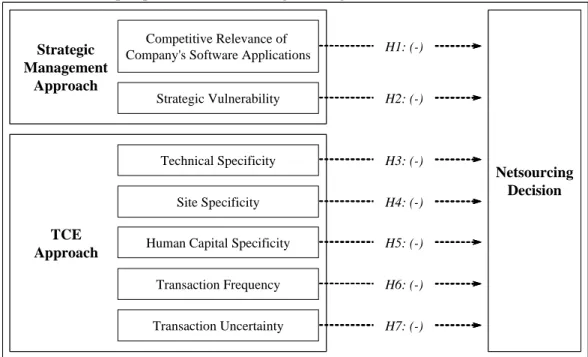
To investigate whether and to what degree the same factors that drive full IT outsourcing are equally relevant for netsourcing decisions, we develop the following research framework on the basis of the literature on full IT outsourcing (see Figure 1).
As dependent variable, we choose a company's Netsourcing Decision, i.e., we analyze whether or not a company netsources or should netsource, but not which exact applications to consider for netsourcing. 2.1 Independent Variables
The seven independent variables are derived from the Strategic Management [e.g., 43, 48, 49] and the
Transaction Cost Economics (TCE) literature [e.g., 8, 62, 63, 64] and have in the past been used for studying full IT outsourcing decisions [2, 12, 14, 21, 23, 31, 32, 36, 37, 38, 39, 54, 55, 60]. Table 1 outlines the variables and the main sources.
In the research on full IT outsourcing, the Strategic Management approach delimits firms eligible of outsourcing from those not eligible according to the strategic relevance of their IT. Netsourcing factors derived from Strategic Management acknowledge the variety of the corporate software portfolio, reaching from commoditized application packages to specifically developed and individualized applications. TCE introduce the cost of market usage by differentiating corporate IT and its outsourcing eligibility according
to several transaction variables. Regarding netsourcing, factors derived from TCE recognize the short-term transaction-oriented perspective of netsourcing offerings.
Netsourcing Decision Strategic Management Approach TCE Approach Competitive Relevance of Company's Software Applications
Strategic Vulnerability
Site Specificity
Human Capital Specificity
Transaction Frequency Transaction Uncertainty Technical Specificity H1: (-) H2: (-) H3: (-) H4: (-) H5: (-) H6: (-) H7: (-) Netsourcing Decision Strategic Management Approach TCE Approach Competitive Relevance of Company's Software Applications
Strategic Vulnerability
Site Specificity
Human Capital Specificity
Transaction Frequency Transaction Uncertainty Technical Specificity H1: (-) H2: (-) H3: (-) H4: (-) H5: (-) H6: (-) H7: (-) Netsourcing Decision Strategic Management Approach TCE Approach Competitive Relevance of Company's Software Applications
Strategic Vulnerability
Site Specificity
Human Capital Specificity
Transaction Frequency Transaction Uncertainty Technical Specificity H1: (-) H1: (-) H2: (-) H2: (-) H3: (-) H3: (-) H4: (-) H4: (-) H5: (-) H5: (-) H6: (-) H6: (-) H7: (-) H7: (-)
Figure 1: Netsourcing Framework
Approach Variable Literature Sources
Competitive Relevance of Company's Software Applications
Apte, Mason 1995 [3]; Cronk, Sharp 1995 [10]; Feeny, Willcocks 1998 [17]; Teng et al. 1995 [59]; Nelson et al. 1996 [46]; Fowler, Jeffs 1998 [19]; Hancox, Hackney 1999 [22]; Hancox, Hackney 2000 [23]
Strategic Management
Strategic Vulnerability Hilmer, Quinn 1994 [27]; Jurison 1995 [30]; Loh, Venkatraman 1995 [42]; Vital, Benoit 2002 [60] Technical Specificity Stuckey, White 1993 [57]; Ang, Cummings 1997 [1];
Hancox, Hackney 1999 [22]; Hancox, Hackney 2000 [23]
Site Specificity Stuckey, White 1993 [57]
Human Capital Specificity Loh 1994 [41]; Cheon et al. 1995 [6]; Aubert et al. 1996 [4]; Nam et al. 1996 [45]
Transaction Frequency Aubert et al. 1996 [4]; Earl 1996 [16]; Nam et al. 1996 [45]; Poppo, Zenger 1998 [47]
TCE
Transaction Uncertainty Cheon et al. 1995 [6]; Aubert et al. 1996 [4]; Earl 1996 [16]; Poppo, Zenger 1998 [47]; Benoit et al. 2004 [5] Table 1: Independent Variables and Corresponding Literature Sources
In the following, we briefly introduce each of the seven independent variables:
Competitive Relevanceof Company's Software Applications: Competitive edge is reached by creating and exploiting unique sources of value. Within the value chain, sources of unique value could be identified in capabilities which are impossible for competitors to imitate at reasonable cost. Thus Competitive Relevance of Company’s Software Applications is critical to netsourcing decisions as disregard could commoditize competitive edge and finally lead to decreased value in IT [e.g., 3, 10, 22, 23, 46].
Strategic Vulnerability: Critical capabilities such as specialized or strategically important skills expose a company to strategic vulnerability. Netsourcing such capabilities causes risks insofar, as the company is endangered of losing critical skills [27], which are needed across several functional areas [60]. Also, a company runs the risk to suffer a netsourcing-induced shift of control to the external service provider [30, 42].
Technical Specificity relates to the customization level of corporate software applications [57]. Traditionally, a major cost reduction effect in IT outsourcing arrangements has originated in economies of scale due to mass production efficiency [1, 13, 25, 35, 40, 53]. However, economies of scale diminish with considerable customization or even individualization. The netsourcing cost advantages promised therefore vanish as software is increasingly tailored to an industry or even a single customer.
Site Specificity refers to the location dependency of an IT asset [57]. Technical infrastructure requirements, such as specific servers only being available within a company's boundaries, illustrate such a dependency. Also, potential threats such as indiscretion or leaking information are conceptualized under Site Specificity. Neglecting existing Site Specificity increases costs and thereby compensates the netsourcing cost advantages.
Human Capital Specificity portrays the dependency of an asset on a company's own specially trained personnel [4, 6]. First, external system developers and maintenance staffs may lack knowledge about a specific problem context in a netsourcing scenario, resulting in catch-up costs. Second, external personnel produces governing risks of dedication, timeliness and, finally, performance. These Human Capital Specificity factors could outweigh cost advantages from netsourcing.
Transaction Frequency refers to the number of recurring acquisitions of the same asset [4]. Any acquisition involves vendor search, screening, and subsequently bargaining activities. Frequent acquisitions bind resources to the activities described above. In addition, even one-time acquisitions of software packages may imply recurring activities regarding upgrades and maintenance. Therefore, Transaction Frequency depends on the frequency of changes in software application requirements in order to determine the amount of searching, screening, and bargaining. Frequent changes imply additional costs and therefore hamper cost savings from netsourcing.
Transaction Uncertainty is traditionally determined by performance measurement complexity [47]. Indirect measurement of outsourced applications and the intensity of control activities boost the costs associated with netsourcing, hence making it less attractive [5, 6, 15]. Figure 1 depicts our research framework.
2.2 Research Hypotheses
Concerning the seven independent variables gained from the literature, we introduce one research hypothesis and the corresponding null-hypothesis per variable:
H1: The higher the Competitive Relevance of a Company's Software Applications, the less a company netsources software applications.
H10: Competitive Relevance of Company's Software Applications has no influence on the netsourcing of software applications.
H2: The more a company's software applications are subject to Strategic Vulnerability, the less a company netsources software applications.
H20: Strategic Vulnerability has no influence on the netsourcing of a company's software applications.
H3: The more Technical Specificity is inherent in a company's software applications, the less a company netsources a company's software applications.
H30: Technical Specificity inherent in a company's software portfolio has no influence on the netsourcing of a company's software applications.
H4: The more a company's software applications inherit a high degree of Site Specificity, the less a company netsources software applications.
H40: Site Specificity of software applications has no influence on the netsourcing of a company's software applications.
H5: The more a company's software applications inherit a high degree of Human Capital Specificity, the less a company netsources software applications.
H50: Human Capital Specificity of software applications has no influence on the netsourcing of a company's software applications.
H6: The more Transaction Frequency is inherent in a company's software portfolio, the less a company netsources software applications.
H60: Transaction Frequency in the software portfolio has no influence on the netsourcing of a company's software applications.
H7: The more Transactions Uncertainty is inherent in a company's software application portfolio, the less a company netsources software applications.
H70: Transaction Uncertainty of software applications has no influence on the netsourcing of a company's software applications.
3. Research Approach
3.1 Data Collection
We collected the data with a 2004 survey among the top 500 German companies based on total sales and then applied a systematic sampling [9] to draw the participants1, resulting in a sample of 333 out of 500 companies. Of those 333, we eliminated 41 to avoid redundancies due to IT aggregation with the respective parent company also included in the sample. From the remaining 292 companies, 54 could not be contacted and therefore were not available for the survey. This left us with a sample of 238 companies. Of the 238 companies contacted, 88 Chief Information Officers (CIOs) or IT directors filled out the questionnaire completely, yielding a response rate of 36.97%. A t-test for equality of means was conducted among respondents and a group of non-respondents comparing both groups on the basis of total sales and number of employees in order to assure the absence of a significant non-respondent bias [24]. The test yielded no significant difference between respondents and non-respondents (SIGt > 0.05)
(see Table 2).
Respondents N = 81
Non-Respondents N = 38
Parameter Mean Mean t-value Sig.
Total sales (in Mill. €) 8,047.086 7,360.026 -.218 .828
# of employees 18,273.640 17,249.210 -.111 .912 Table 2: Two-Parameter Comparison of Respondents and Non-Respondents
With 88 filled-out questionnaires received, we count 54 cases in the set of companies that netsource and 34 cases in the smaller set of companies who do not netsource. (see Table 3). The 34 cases in the smaller set are not in line with a rule of thumb, described by Green [20] and Tabachnick, Fidell [58], which requires for a logistic regression 50 plus 8 times the number of independent variables, that is 106 cases in
1 One of the first three companies in the alphabetical list of 500 companies is drawn by lot. Further candidates are drawn from the list with an interval of three, thus picking one third of listed companies. Then the procedure is repeated for the remaining list, selecting one of the first two by lot and consequently drawing further candidates with an interval of two.
our research (50+8x7 independent variables). However, also referring to Steyerberg et al. [56] and Tabachnick, Fidell [58], for exploratory research, four to five times the number of independent variables are sufficient to conduct logistic regressions. Transferred to our research this means a minimum of 28 to 35 cases, which we do satisfy.
In the survey, we ask the respondents to assess their company's software application portfolio with regard to each of our seven independent variables on a scale ranging from '1' to '5'.
3.2 Data Analysis
We considered using regression analysis and structural equation modeling (SEM) to analyze our data. Regression analysis was chosen over SEM due to several reasons: SEM is not suited for non-linear relations in the data. Also, multi-collinearity among variables is only accounted for in regression modeling. Especially covariance-based SEM rather targets confimatory research, which does not fit with our explorative research design [19]. In line with this, regression models can at an explorative stage be conducted with fewer cases compared to SEM methods such as LIREL, requiring a minimum of 100 to 150 cases [19]. Finally, the risk of over-fitting the model in SEM may have emerged in the explorative research stage, as the potential model fits the data but may not be suitable for hypothesis testing [7]. Hence, we apply a logistic regression analysis to determine the directional influence of each independent variable on the dependent variable. We choose a binary logistic regression analysis as the dependent variable is binary. A '0' for the dependent variable states that the company is netsourcing software applications; a '1' states that the company is not netsourcing.
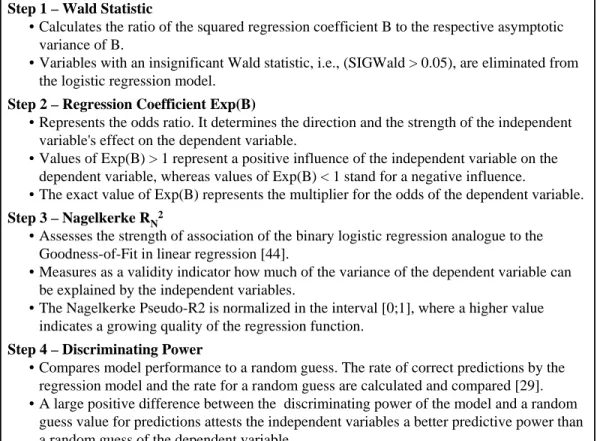
Overall, a significant Wald Statistic for the regression coefficient B as determinant of model entry (SigWald
< 0.05), an exponential form of the regression coefficient Exp(B) larger than one (Exp(B) > 1) as indication of directional influence, a sufficient Nagelkerke Pseudo-R2 (RN
2
> 0.2) as Goodness-of-Fit indicator and a positive discriminating power are required to support each of the seven hypotheses. For a more detailed description of the data analysis, see Figure 2.
4. Results and Findings
4.1 Survey Entries
Table 3 and Table 4 depict the survey entries by the 88 participating companies. 4.2 Logistic Regression Analysis
In a first step, only variables with a significant Wald Statistic are included in the regression model (see Table 5).
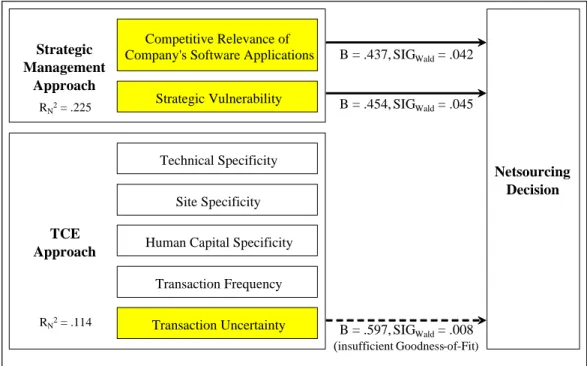
With respect to Competitive Relevance of Company's Software Applications and Strategic Vulnerability, the significance of the Wald Statistic (SIGWald < 0.05) denies H10 and H20 and thereby attests the
influence of both variables on the netsourcing decision. Therefore both variables are included in the logistic regression model. An Exp(B) > 1 for Competitive Relevance of Company's Software Applications
and for Strategic Vulnerability attests a deterioration of odds for the netsourcing decision (see Table 6). Of the TCE variables, only Transaction Uncertainty, is included in the logistic regression model with Exp(B) >1 and a sufficient significance level (SIGWald = 0.008 < 0.05) for the Wald Statistic (see Table 6).
The other four independent TCE based variables, Technical Specificity, Site Specificity, Human Capital Specificity, and Transaction Frequency, are not included in the binary logistic regression model as the significance of their Wald Statistic does not deny (SIGWald > 0.05) H30, H40, H50, and H60 (see Table 5).
The Nagelkerke Pseudo-R2 has a value of 0.225 for the Strategic Management variables indicating an acceptable quality of the regression function. A Nagelkerke Pseudo-R2 value of 0.114 for the single TCE
based variable Transaction Uncertainty, however, attests a low quality of the regression function. Due to the insufficient quality of the model, Transaction Uncertainty is not further supported as a significant factor to netsourcing.
The discriminating power of the binary logistic regression model is confirmed by a model prediction rate of 69.3% for the Strategic Management variables and 64.8% for the variables derived from TCE. Those figures are to be compared to 52.6% for a random guess. Figure 3 summarizes the results of the logistic regression analysis.
4.3 Major Findings
Our research confirms the importance of factors derived from Strategic Management for netsourcing decisions. However, different from the literature on full IT outsourcing, it questions the importance of TCE based factors in the netsourcing context.
The Strategic Management variables, Competitive Relevance of Company's Software Applications and
StrategicVulnerability, find empirical support in the logistic regression model as significant variables to netsourcing software applications.
Step 1 – Wald Statistic
• Calculates the ratio of the squared regression coefficient B to the respective asymptotic variance of B.
• Variables with an insignificant Wald statistic, i.e., (SIGWald > 0.05), are eliminated from the logistic regression model.
Step 2 – Regression Coefficient Exp(B)
• Represents the odds ratio. It determines the direction and the strength of the independent variable's effect on the dependent variable.
• Values of Exp(B) > 1 represent a positive influence of the independent variable on the dependent variable, whereas values of Exp(B) < 1 stand for a negative influence.
• The exact value of Exp(B) represents the multiplier for the odds of the dependent variable.
Step 3 – Nagelkerke RN2
• Assesses the strength of association of the binary logistic regression analogue to the Goodness-of-Fit in linear regression [44].
• Measures as a validity indicator how much of the variance of the dependent variable can be explained by the independent variables.
• The Nagelkerke Pseudo-R2 is normalized in the interval [0;1], where a higher value indicates a growing quality of the regression function.
Step 4 – Discriminating Power
• Compares model performance to a random guess. The rate of correct predictions by the regression model and the rate for a random guess are calculated and compared [29]. • A large positive difference between the discriminating power of the model and a random
guess value for predictions attests the independent variables a better predictive power than a random guess of the dependent variable.
Step 1 – Wald Statistic
• Calculates the ratio of the squared regression coefficient B to the respective asymptotic variance of B.
• Variables with an insignificant Wald statistic, i.e., (SIGWald > 0.05), are eliminated from the logistic regression model.
Step 2 – Regression Coefficient Exp(B)
• Represents the odds ratio. It determines the direction and the strength of the independent variable's effect on the dependent variable.
• Values of Exp(B) > 1 represent a positive influence of the independent variable on the dependent variable, whereas values of Exp(B) < 1 stand for a negative influence.
• The exact value of Exp(B) represents the multiplier for the odds of the dependent variable.
Step 3 – Nagelkerke RN2
• Assesses the strength of association of the binary logistic regression analogue to the Goodness-of-Fit in linear regression [44].
• Measures as a validity indicator how much of the variance of the dependent variable can be explained by the independent variables.
• The Nagelkerke Pseudo-R2 is normalized in the interval [0;1], where a higher value indicates a growing quality of the regression function.
Step 4 – Discriminating Power
• Compares model performance to a random guess. The rate of correct predictions by the regression model and the rate for a random guess are calculated and compared [29]. • A large positive difference between the discriminating power of the model and a random
guess value for predictions attests the independent variables a better predictive power than a random guess of the dependent variable.
Figure 2: Steps of the Data Analysis in the Binary Logistic Regression
Number of Entries yes no
Netsourcing 54 34
Number of Entries Independent Variable
very few few some many all
Competitive Relevance of
Company's Software Applications 14 29 15 20 10
Strategic Management
Approach Strategic Vulnerability 8 29 18 22 11
Technical Specificity 19 25 18 13 13
Site Specificity 5 11 20 36 16
Human Capital Specificity 11 13 23 29 12
Transaction Frequency 3 22 26 30 7
TCE Approach
Transaction Uncertainty 6 28 27 20 7
Table 4: Survey Entries for Independent Variables (N= 88)
df Sig. Included Competitive Relevance of
Company's Software Applications 1 .042 Yes Strategic Vulnerability 1 .045 Yes
Transaction Uncertainty 1 .008 Yes
Human Capital Specificity 1 .167 No
Site Specificity 1 .366 No
Technical Specificity 1 .568 No
Transaction Frequency 1 .314 No
Legend:
df = Degrees of Freedom; Sig = Wald Significance Level Table 5: Variables entered in Logistic Regression Analysis
B S.E. Wald df Sig. Exp(B) Competitive Relevance of
Company's Software Applications .437 .215 4.140 1 .042 1.548 Strategic Vulnerability .454 .227 4.015 1 .045 1.575 Constant -3.122 .783 15.899 1 .000 .044 Transaction Uncertainty .597 .226 7.006 1 .008 1.817 Constant -2.254 .727 9.621 1 .002 .105 Legend: B = Regression Coefficient S.E. = Standard Error Wald = Wald Statistic
df = Degrees of Freedom Sig = Wald Significance Level Exp(B) = Exponential Form of B Table 6: Variables included in Logistic Regression Model
Strategic Management Approach TCE Approach Competitive Relevance of Company's Software Applications
Strategic Vulnerability
Site Specificity
Human Capital Specificity
Transaction Frequency Transaction Uncertainty Technical Specificity Netsourcing Decision B = .437, SIGWald= .042 B = .454, SIGWald= .045 B = .597, SIGWald= .008 (insufficient Goodness-of-Fit)
RN2= Nagelkerke Pseudo-R2; B = Not Standardized Logistic Regression Coefficient; SIGWald= Wald Significance
RN2= .114 RN2= .225 Strategic Management Approach TCE Approach Competitive Relevance of Company's Software Applications
Strategic Vulnerability
Site Specificity
Human Capital Specificity
Transaction Frequency Transaction Uncertainty Technical Specificity Netsourcing Decision B = .437, SIGWald= .042 B = .454, SIGWald= .045 B = .597, SIGWald= .008 (insufficient Goodness-of-Fit)
RN2= Nagelkerke Pseudo-R2; B = Not Standardized Logistic Regression Coefficient; SIGWald= Wald Significance
RN2= .114 RN2= .225 Strategic Management Approach TCE Approach Competitive Relevance of Company's Software Applications
Strategic Vulnerability
Site Specificity
Human Capital Specificity
Transaction Frequency Transaction Uncertainty Technical Specificity Netsourcing Decision B = .437, SIGWald= .042 B = .454, SIGWald= .045 B = .597, SIGWald= .008 (insufficient Goodness-of-Fit)
RN2= Nagelkerke Pseudo-R2; B = Not Standardized Logistic Regression Coefficient; SIGWald= Wald Significance
RN2= .114 RN2= .225 Strategic Management Approach TCE Approach Competitive Relevance of Company's Software Applications
Strategic Vulnerability
Site Specificity
Human Capital Specificity
Transaction Frequency Transaction Uncertainty Technical Specificity Netsourcing Decision B = .437, SIGWald= .042 B = .454, SIGWald= .045 B = .597, SIGWald= .008 (insufficient Goodness-of-Fit)
RN2= Nagelkerke Pseudo-R2; B = Not Standardized Logistic Regression Coefficient; SIGWald= Wald Significance
RN2= .114 RN2= .225
Figure 3: Binary Logistic Regression Results (N = 88)
Concerning the variables derived from TCE, we do not find any support for the directional influence of the variables on netsourcing. Technical Specificity, Site Specificity, and Transaction Frequency do not substantiate an influence on the Netsourcing Decision. In other words, results do not indicate restraining effects due to customization of software applications. In the same way, existing dependency on the location of an application server is not indicated to keep companies from netsourcing. Neither are activities related to repurchases and adaptations indications for denial of netsourcing software applications.
Human Capital Specificity lacks significant influence on the Netsourcing Decision. The fact that both variables are however statistically correlated (R = 0.212; SIGPearson = 0.048) is in line with an effect that
Lacity and Hirschheim [35] describe concerning full IT outsourcing. They ascribe this effect to politically motivated behavior resulting from the fear of an outsourcing-induced power shift. Transaction Uncertainty theoretically associated with performance measurement problemsdoes not show a significant directional influence on the Netsourcing Decision.
Overall, our research confirms that the more competitive relevance of software applications a company claims to have, the less likely it is to netsource. The same holds true for the number of software applications a company considers to make it strategically vulnerable.
These results confirm the findings from the full IT outsourcing literature regarding Strategic Management variables [27, 59]. In contrast, variables from TCE are not in line with full IT outsourcing experiences [e.g., 1, 4, 45, 47].
5. Lessons Learned and Further Research
Generally speaking, Strategic Management considerations play an equally important role in netsourcing decisions as it is well known from full IT outsourcing. Therefore, we have learned that
• Identifying software applications that are competitively relevant in a company's software portfolio allows for better selecting the software applications to be netsourced and for better assessing the potential for creation of web-enabled business value due to netsourcing gains. This insight triggers not only a request for internally ranking software applications in one's application portfolio according to its competitive relevance. It also encourages the benchmarking of highly ranked software applications against competitors. External service providers may want to educate users and assist them with industry data and specialists' expertise in benchmarking projects.
• To reduce negative influence of the important factor Strategic Vulnerability, corporate users and external service providers should foster an effective service management that consists of cooperative control instances and appropriate communication structures. Thus, the loss of hierarchical control and of critical skills could be limited. Service management standards as the Information Technology Infrastructure Library (ITIL), which supports a change from functional and component based orientation towards a business process oriented structure of IT, could promote the development of cross functional skills by including capability-oriented management and communication structures.
In contrast to our expectations, a transaction cost related calculus appears to be less important to Netsourcing Decisions. Running applications remotely, company-specific application customization, or difficulties with governing of external personnel may not overcompensate the netsourcing advantages promised. Even frequent changes in the software portfolio and performance measurement complexities seem not to outweigh advantages from netsourcing. However, the lack of significance in our TCE related investigations demands additional research.
Obviously, complementary studies are necessary to further investigate the benefits and the drawbacks of netsourcing from a CIO perspective and to better understand the difference between factors driving full IT outsourcing decisions and those relevant for netsourcing. We suggest an additional qualitative investigation into the role of the TCE based variables in netsourcing decisions. The applicability of TCE variables and their operationalization for research of web-enabled sourcing options could thereby be reconsidered. Further research may want to include a differentiation of applications in the survey design in order to specifically relate results to certain applications. Also, we propose to expand the current analysis to include additional factors from the social and organizational literature [e.g., 22, 23, 26, 34] in the research design.
References
1. Ang, S. and Cummings, L. "Strategic Response to Institutional Influences on Information Systems Outsourcing," Organization Science (8:3), 1997, pp. 235-256.
2. Ang, S. and Straub, D. "Production and Transaction Economics and IS Outsourcing: A Study of the U.S. Banking Industry," MIS Quarterly (22:4), 1998, pp. 535-552.
3. Apte, U. and Mason, R. "Global Disaggregation of Information-Intensive Services," Management Science
(41:7), 1995, pp. 1250-1262.
4. Aubert, B., Rivard, S., and Patry, M. "A Transaction Cost Approach to Outsourcing Behavior: Some Empirical Evidence," Information and Management (30:2), 1996, pp. 51-64.
5. Benoit, A., Rivard, S. and Patry, M. "A Transaction Cost Model of IT Outsourcing," Information and Management (41:7), 2004, pp. 921-932.
6. Cheon, M., Grover, V., and Teng, J. "Theoretical Perspectives on the Outsourcing of Information Systems,"
Journal of Information Technology (10:4), 1995, pp. 209-219.
7. Cliff, N. "Some Cautions concerning the Application of Causal Modeling Methods," Multivariate Behavioral Research (18:1), 1983, pp. 115-136.
9. Cochran, W. Sampling Techniques, 3rd ed., Wiley, New York, 1977.
10. Cronk, J. and Sharp, J. "A Framework to Deciding What to Outsource in Information Technology," Journal of Information Technology (10:4), 1995, pp. 259-267.
11. Currie, W. and Desai, B. "Application Service Providers: A Model in Evolution," Proceedings of the 5th International Conference on Electronic Commerce (ICEC), Pittsburgh, PA, Sadeh, N., Dively, M., Kauffman, R., Labrou, O., Shehory, O., Telang, R. and Cranor, L. (eds.), 2003, pp. 174-180.
12. Currie, W. and Seltsikas, P. "Delivering Business Critical Information Systems through Application Service Providers: The Need for a Market Segmentation Strategy," International Journal of Innovation Management
(5:3), 2001, pp. 323-349.
13. Desai, B., Weerakkody, V., Currie, W., Teeboune, S., and Khan, N. "Market Entry Strategies of Application Service Providers: Identifying Strategic Differentiation," Proceedings of the 36th Annual Hawaii International Conference on System Sciences (HICSS), Big Island, HA, Sparque, R. (ed.), 2003, 7, 189a.
14. Dibbern, J., Goles, T., Hirschheim, R., and Jayatilaka, B. "Information Systems Outsourcing: A Survey and Analysis of the Literature," The DATA BASE for Advances in Information Systems (35:4), 2004, pp. 6-102. 15. Earl, M. "Outsourcing Information Services," Public Money and Management (11:3), 1991, pp. 17-21. 16. Earl, M. "The Risks of Outsourcing IT," Sloan Management Review (17:3), 1996, pp. 26-32.
17. Feeny, D. and Willcocks, L. "Core IS Capabilities for Exploiting Information Technology," Sloan Management Review (39:3), 1998, pp. 9-22.
18. Ferris, C. and Farrell, J. "What are Web Services," Communications of the ACM (46:6), 2003, pp. 31-35.
19. Fowler, A. and Jeffs, B. "Examining Information Systems Outsourcing: A Case Study from the United Kingdom," Journal of Information Technology (13:2), 1998, pp. 111-126.
19. Gefen, D., Straub, D. and Boudreau, M. "Structural Equation Modelling Techniques and Regression: Guidelines for Research Practice," Communications of the AIS (4:7), 2000, pp. 2-77.
20. Green, S. "How Many Subjects does it take to do a Regression Analysis," Multivariate Behavioral Research, (26:3), 1991, pp. 499-510.
21. Grover, V., Cheon, M., and Teng, J. "An Evaluation of the Impact of Corporate Strategy and the Role of Information Technology on IS Functional Outsourcing," European Journal of Information Systems (3:3), 1994, pp. 179-190.
22. Hancox, M. and Hackney, R. "Information Technology Outsourcing: Conceptualizing Practice in the Public and Private Sector," Proceedings of the 32nd Annual Hawaii International Conference on System Sciences (HICSS),
Maui, HA, Sparque, R. (ed.), 1999, 7, 7067.
23. Hancox, M. and Hackney, R. "IT Outsourcing: Frameworks for Conceptualizing Practice and Perception,"
Information Systems Journal (10:3), 2000, pp. 217-237.
24. Hansen, M. and Hurwitz, W. "The Problem of Nonresponse in Sample Surveys," Journal of American Statistics Association (41), 1946, pp. 517-529.
25. Harrington, L. "The ABCs of ASPs," Transportation & Distribution (41:11), 2000, pp. 15-18.
26. Henderson, J. "Plugging into Strategic Partnership: The Critical IS Connection," Sloan Management Review
(31:3), 1990, pp. 7-18.
27. Hilmer, F. and Quinn, J. "Strategic Outsourcing," Sloan Management Review (35:4), 1994, pp. 43-55.
28. Hong, W., Tam, K., and Yim, C. "e-Service Environment: Impacts of Web Interface Characteristics on Consumers' Online Shopping Behavior," in E-Service: New Directions in Theory and Practice, Rust, R. and Kannan, P. (eds.), M. E. Sharpe, Armonk, NY, 2002, pp. 108-128.
29. Hosmer, D. and Lemeshow, S. Applied Logistic Regression, 2nd ed., John Wiley & Sons, New York, 2000. 30. Jurison, J. "The Role of Risk and Return in Information Technology Outsourcing Decisions," Journal of
Information Technology (10:4), 1995, pp. 239-247.
31. Kern, T. "The Gestalt of an Information Technology Outsourcing Relationship: An Explanatory Analysis,"
Proceedings of the 18th International Conference on Information Systems (ICIS), DeGross, J. and Kumar, K. (eds.), Atlanta, GA, 1997, pp. 37-58.
32. Kern, T. Netsourcing Business Applications: Leveraging the Third Wave of Outsourcing, Prentice Hall, Upper Saddle River, NJ, 2002.
33. Kern, T., Lacity, M., and Willcocks, L. Netsourcing: Renting Business Applications and Services over a Network, Prentice Hall, Upper Saddle River, NJ, 2002.
34. Kern, T. and Willcocks, L. The Relationship Advantage: Information Technologies, Sourcing and Management, Oxford University Press, Oxford, 2001.
35. Lacity, M. and Hirschheim, R. "Realizing Outsourcing Expectations," Information Systems Management (11:4), 1994, pp. 7-19.
36. Lacity, M. and Hirschheim, R. Information Systems Outsourcing: Myths, Metaphors, and Realities, John Wiley & Sons, New York, 1993.
37. Lacity, M. and Willcocks, L. "Interpreting Information Technology Sourcing Decisions from a Transaction Cost Perspective: Findings and Critique," Accounting, Management and Information Technologies (5:3/4), 1995, pp. 203-244.
38. Lacity, M. and Willcocks, L. "An Empirical Investigation of Information technology Sourcing Practices: Lessons from Experience," MIS Quarterly (22:3), 1998, pp. 363-408.
39. Lacity, M. and Willcocks, L. Global Information Technology Outsourcing: In Search of Business Advantage, Wiley, Chichester, 2001.
40. Lacity, M., Willcocks, L. and Feeny, D. "The Value of Selective IT Sourcing," Sloan Management Review
(37:3), 1996, pp. 13-25.
41. Loh, L. "An Organizational-Economic Blueprint for Information Technology Outsourcing: Concepts and Evidence," Proceedings of the 15th International Conference on Information Systems (ICIS), DeGross, J., Huff, S. and Munro, C. (eds.), Vancouver, CA, 1994, pp. 73-89.
42. Loh, L. and Venkatraman, N. "An Empirical Study of Information Technology Outsourcing: Benefits, Risks, and Performance Implications," Proceedings of the 16th International Conference on Information Systems (ICIS), Ariav, G., Beath, C., DeGross, J., Hoyer, R. and Kemerer, C. (eds.), Amsterdam, NL, 1995, pp. 277-288.
43. Miles, R. and Snow, C. Organizational Strategy, Structure and Process, McGraw-Hill, New York, 1978.
44. Nagelkerke, N. "A Note on a General Definition of the Coefficient of Determination," Biometrika (78:3), 1991, pp. 691-693.
45. Nam, K., Rajagopalan, S., Rao, H., and Chaudhury, A. "A Two-Level Investigation of Information Systems Outsourcing," Communications of the ACM (39:7), 1996, pp. 36-44.
46. Nelson, P., Richmond, W. and Seidmann, A. "Two Dimensions of Software Acquisition," Communications of the ACM (39:7), 1996, pp. 29-35.
47. Poppo, L. and Zenger, T. "Testing Alternative Theories of the Firm: Transaction Cost, Knowledge-Based, and Measurement Explanations for Make-or-Buy Decisions in Information Services," Strategic Management Journal
(19:9), 1998, pp. 853-877.
48. Porter, M. Competitive Advantage: Creating and Sustaining Superior Performance, Free Press, New York, 1985. 49. Quinn, J. Strategies for Change: Logical Incrementalism, Irwin, Homewood, Ill., 1980.
50. Ross, J. and Westerman, G. "Preparing for Utility Computing: The Role of IT Architecture and Relationsship Management," IBM Systems Journal (43:1), 2004, pp. 5-19.
51. Rust, R. and Kannan, P. "E-Service: A New Paradigm for Business in the Electronic Environment,"
Communications of the ACM (46:6), 2003, pp. 37-42.
52. Rust, R., Zahorik, A., and Keiningham, T. Service Marketing, Harper Collins, New York, 1996.
53. Schmerken, I. "Financial ASPs Deliver Apps on Tap," Wall Street & Technology (18:5), 2000, pp. 46-54. 54. Slaughter, S. and Ang, S. "Employment Outsourcing in Information Systems," Communications of the ACM
(39:7), 1996, pp. 47-54.
55. Smith, M., Mitra, S., and Narasimhan, S. "Information Systems Outsourcing: A Study of Pre-Event Firm Characteristics," Journal of Management Information Systems (15:2), 1998, pp. 61-93.
56. Steyerberg, E., Eijkemanns, M. and Habbema, J. "Stepwise Selection in Small Data Sets: A Simulation Study of Bias in Logistic Regression Analysis," Journal of Clinical Epidemiology (52), 1999, pp. 935-942.
57. Stuckey, J. and White, D. "When and When Not to Vertically Integrate," Sloan Management Review (34:3), 1993, pp. 71-83.
58. Tabachnick, B. and Fidell, L. Using Multivariate Statistics, Harper & Row, New York, 1996.
59. Teng, J., Cheon, M. and Grover, V. "Decisions to Outsource Information Systems Functions: Testing a Strategy-Theoretic Discrepancy Model," Decision Sciences (26:1), 1995, pp. 75-103.
60. Vital, R. and Benoit, A. "A Resource-Based Analysis of IT Outsourcing," The DATA BASE for Advances in Information Systems (33:2), 2002, pp. 29-40.
61. Williams, J. "The Web Services Debate: J2EE vs. .NET," Communications of the ACM (46:6), 2003, pp. 59-63. 62. Williamson, O. Markets and Hierarchies, Analysis and Antitrust Implications: A Study in the Economics of
Internal Organization, Free Press, New York, 1975.
63. Williamson, O. "Transaction-Cost Economics: The Governance of Contractual Relations," Journal of Law and Economics (22:2), 1979, pp. 233-261.
64. Williamson, O. "The Modern Corporation: Origins, Evolution, Attributes," Journal of Economic Literature