XML Data Integration using Fragment Join
Jian Gong, David W. Cheung, Nikos Mamoulis, and Ben KaoDepartment of Computer Science, The University of Hong Kong Pokfulam, Hong Kong, China
{jgong,dcheung,nikos,kao}@cs.hku.hk
Abstract. We study the problem of answering XML queries over multiple data sources under a schema-independent scenario where XML schemas and schema mappings are unavailable. We develop the fragment join operator — a general op-erator that merges two XML fragments based on their overlapping components. We formally define the operator and propose an efficient algorithm for imple-menting it. We define schema-independent query processing over multiple data sources and propose a novel framework to solve this problem. We provide theo-retical analysis and experimental results that show that our approaches are both effective and efficient.
1
Introduction
Data integration allows global queries to be answered by data that is distributed among multiple heterogeneous data sources [1]. Through a unified query interface, global dis-tributed queries are processed as if they were done on a single integrated data source. To achieve data integration, a schema mapping is often used, which consists of a set of mapping rules that define the semantic relationship between the global schema and the local schemas (at the data sources). In these systems, such as Clio [2], processing a global query typically involves two steps: query rewriting, and data merging.
While much work has been done on query rewriting, very little has been done on data merging. In most existing approaches, data merging is mostly anad hoc compu-tation — a special data merging routine is custom-coded for each mapping rule. This approach leads to inflexible system design. In this paper we propose a schema indepen-dent framework that allows data merging be processed without referring to any specific schema mapping rules.
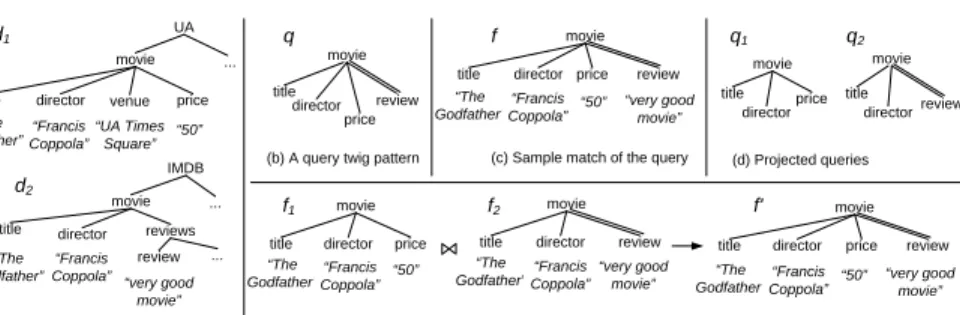
Let us illustrate our idea by an example. Figure 1(a) shows two XML documents taken from UA Cinema website and IMDB website, respectively. Both UA and IMDB contain thetitle and thedirectorof each movie. In addition, UA containsvenueand
price, while IMDB contains the movie’sreviews. Consider a user who wants to find out
thetitle,director,price, andreviewfor eachmovie. This is expressed by the twig pattern query shown in Figure 1(b). Note that neither UA nor IMDB can answer the query alone because UA lacksreviewsand IMDB lackspricinginformation. The (global) query thus has to be broken into two query fragments, one for each site. The returned results from the two sites should then be merged based on their common components. Figure 1(c) shows an example of the query result. Our goal is to answer such twig pattern queries in a schema-independent fashion where mapping rules are not needed.
“The Godfather” “The Godfather” movie title review price movie title price review movie
title price
movie title review
(e) Join XML fragments to obtain the query result movie
title price review
(b) A query twig pattern (c) Sample match of the query movie title venue “UA Times Square” price “50” UA ... movie title reviews review “very good movie” ... IMDB ...
(a) Sample XML documents director director director director director “Francis Coppola” director director movie title price (d) Projected queries director movie title review director d1 d2 q f q1 q2 f' f1 f2 “The Godfather” “Francis Coppola” “50” “The Godfather” “Francis Coppola” “very good movie” “Francis Coppola” “50” “very good movie” “The
Godfather”Coppola”“Francis
“The Godfather” “Francis Coppola” “50” “very good movie”
Fig. 1.Query on sample XML documents and the results.
In our approach, we join data fragments based on their overlapping content in order to answer queries. For example, we firstprojectthe global query on the two XML doc-uments and obtain two local queries (Figure 1(d)). Then, we retrieve XML fragments
m(t, d, p) from UA andm(t, d, r)from IMDB. Afterward, we join these fragments
based on their overlapping parts, which are title (t) and director (d) (Figure 1(e)).
2
Preliminaries
An XML documentDis a rooted, node-labeled treeD = hN, E, ri, whereinN is a node set,E⊆N×Nis an edge set, andr∈Nis the root node. Each node in an XML document has a label and may contain some text. Thevocabularyof an XML document
d, denoted byv(d), is the set of distinct node labels ofd.
Definition 1. (XML FRAGMENT)An XML fragmentf is an edge-labeled XML docu-ment, where each edge is labeled by either “/” (parent-child edge) or “//”
(ancestor-descendant edge). An XML fragmentf is a fragment of an XML documentd, denoted
asf vd, if there exists an injective mappingλ:f.N →d.N, such that: (i)∀n∈f.N, n=λ(n), and (ii)∀e(n1, n2)∈ f.Elabeled as “/” (resp., “//”),λ(n1)is the parent
(resp., ancestor) ofλ(n2).
Definition 2. (TWIG PATTERN AND MATCH) A twig pattern is an XML fragment,
where the text content of the nodes is disregarded. A fragmentf is amatchto a twig
patternq, denoted asf `q, if there exists a mappingγ: q.N → f.N, such that the
node labels and edges ofqare preserved inf. A fragmentf1is contained in another
fragmentf2, denoted asf1f2, if all the nodes and edges off1are contained inf2.
Definition 3. (PROJECTION)Given a fragmentfand a vocabularyv(d)of a document d, the projection off onv(d), denoted asρv(d)(f), is obtained by removing fromf all
the nodes whose labels are not inv(d)and the corresponding connecting edges.
3
The fragment join operator
Definition 4. (FRAGMENT JOIN) Given a set of of fragments f1, ...,fn (n ≥ 2), a
fragmentf is a join off1, ...,fn, denoted as(f1, ..., fn) ./
a b a c a b d a ? a b a c a b d a a b d a c a b a c a b d a a b d a b a c a b a c a b d a a b d a a a b a c a b d a a b d a c a b a c a b d a a b a c b d a a b a c a b a c r ... a b d a r ... f1 f2 d2 d1
(a) The fragmentf1ofd1, f2ofd2 (b) Joint nodes and corresponding join results
d
b a
c f2 f1
f1 f2
Fig. 2.XML fragment join on different joint sub-trees.
such that: 1)f0
i = fi,1 ≤ i ≤ n, 2)∀n ∈ f.N,n ∈ f10.N ∪...∪fn0.N, and 3)
∀e∈f.E,e∈f10.E∪...∪fn0.E.
In addition, the join set off1, ...,fnis a set of fragmentsF={f|(f1, ..., fn) ./
→f},
denoted as(f1, ..., fn) ./
⇒F.
Definition 5. (JOINT SUB-TREE) Given two fragments f1 and f2, a subtree jsis a
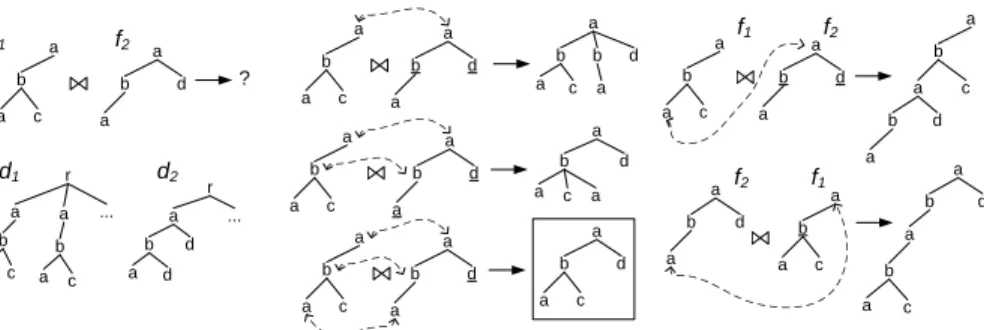
joint sub-tree off1andf2if (1)jsf1,jsf2, (2) the root ofjs= the root off2. Figure 2(b) shows the five results of the fragment join betweenf1andf2shown in Figure 2(a). Each of these results is based on a joint sub-tree, whose nodes are pointed by double-arrowed dashed lines in the two fragments.
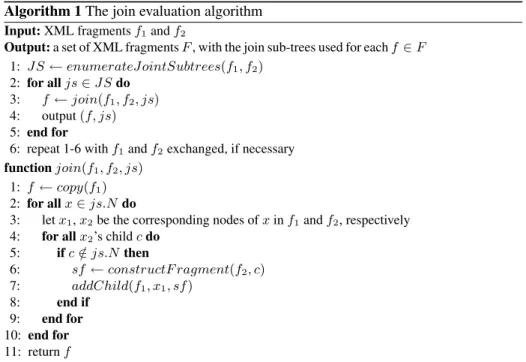
We propose Algorithm 1 for evaluating the fragment join of two fragmentsf1and
f2. For example, consider the first join result shown in Figure 2(b). The joint-subtree for this join result consists of a lone nodea. Theboundary nodesare the children of the root nodeainf2, which are labeled bandd(underlined). The subtrees of these boundary nodes are attached to the matching nodeainf1forming the join result.
4
Schema-independent, query-based data integration
Our research problem is formally stated as following:given XML documentsd1andd2,
and a twig pattern queryq, computeF ={f|f `q; (f1, f2) ./
→f;f1vd1;f2vd2}. Our approach to solve this problem consists of the following phases.
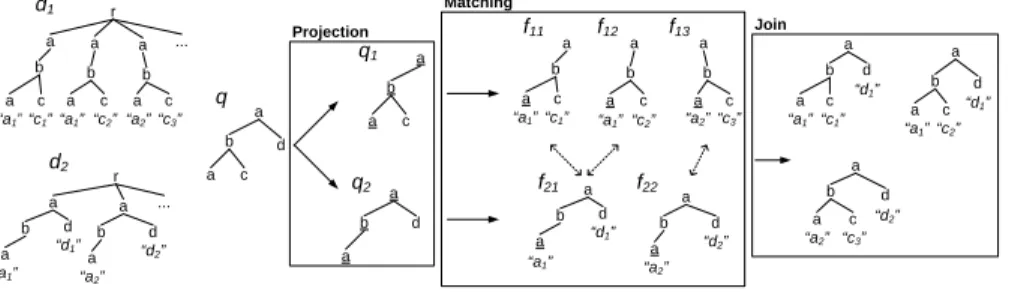
Projection.The twig queryq is rewritten into local queriesq1 = ρv(d1)(q)and q2=ρv(d2)(q)using theprojectoperator (Section 2). We then apply the fragment join
operator onq1andq2to find a joint sub-treejsfor which the join result isq.
Matching.Two sets of fragmentsF1andF2are returned, which contains all matches to the local queryq1ind1and all matches to the local queryq2ind2, respectively1.
Join.For each pair of fragments(f1, f2)∈F1×F2, we compute the fragment join off1andf2 using the joint-subtree obtained in theprojectionphase. The join results are returned as the query’s answer.
1
We thank the authors of [3] for providing us with the implementation of TwigList, used as a module for evaluating twig queries in our work.
Algorithm 1The join evaluation algorithm Input:XML fragmentsf1andf2
Output:a set of XML fragmentsF, with the join sub-trees used for eachf∈F
1: J S←enumerateJ ointSubtrees(f1, f2)
2: for alljs∈J Sdo 3: f←join(f1, f2, js)
4: output(f, js) 5: end for
6: repeat 1-6 withf1andf2exchanged, if necessary
functionjoin(f1, f2, js)
1: f←copy(f1)
2: for allx∈js.Ndo
3: letx1,x2be the corresponding nodes ofxinf1andf2, respectively
4: for allx2’s childcdo
5: ifc /∈js.Nthen 6: sf←constructF ragment(f2, c) 7: addChild(f1, x1, sf) 8: end if 9: end for 10: end for 11: returnf
Figure 3 illustrates our approach (the found joint sub-tree contains the underlined nodes). We note that projecting a global query onto local sources so that one single local query is applied to each source may not be sufficient to retrieve the complete set of query results. For example, consider again queryqin Figure 3. We observe that joining q11, a sub-twig pattern ofq1 containing nodesbandc and the edge between them, withq2also gives usq(using the joint sub-treeb) . Therefore, in order to ensure that all valid query results are found, we should consider all pairs of sub-twig patterns ofq1andq2that can formq.
Definition 6. (RECOVERABILITY)Given a twig patternq, a pair of twig patterns (qi,
qj) is recoverable for q, denoted as(qi, qj) r
; q, if(qi, qj) ./
→ q using some joint
sub-treejs; else, (qi,qj) is non-recoverable forq, denoted as(qi, qj) r
6
;q.
We add two more schema-level phases to the Projection-Matching-Join framework, in order to ensure completeness of the query results.
Decomposition.After the projection phase in which local queries q1 andq2 are derived, the decomposition phase returns:Q1={qi|qiq1}, andQ2={qj|qj q2}.
Recoverability checking.After the decomposition phase, this phase returns:{(qi, qj)
|(qi, qj)∈Q1×Q2∧(qi, qj) r
;q}.
5
Experimental evaluation and conclusion
We use DBLP and CiteSeer datasets in our experiments. The raw CiteSeer data are in plain text BibTeX format. We converted them into an XML file having similar schema
a b a c a b d a a b a c a b a c r ... a b d a r ... q1 q2 d2 d1 a b a c q d a b a c a b d a “a1” “c1” “a1” “c3” “a2” “c2” “a1” “a2” “d2” a b a c a b a c a b a c
“a1” “c1” “a1”“c2” “a2”“c3”
f11 f12 f13 f22 f21 “d1” a b d a a b d a “a1” “a2” “d2” “d1” a b a c “a1” “c1” d “d1” a b a c “c2” “a1” d “d1” a b a c “c3” “a2” d “d2” Projection Matching Join
(a) Two XML documents (b) The twig pattern query and Projection-Matching-Joinquery answering process
Fig. 3.Query answering from multiple data sources: projection, matching, and join.
5 10 15 20 Ti m e (s ) fragment join twig query 15 30 45 60 75 Ti m e (s ) fragment join twig query 10 20 30 40 50 Ti m e (s ) fragment join twig query 5 10 15 20 Ti m e (s ) fragment join twig query Q1 Q2 Q3 Q4 0 1 2 3 4 5 0 1 2 3 4 5 0 1 2 3 4 5 0 1 2 3 4 5
Fig. 4.Overall performance of PDRMJ for all queries and datasets.
to that of DBLP data. The size of Citeseer dataset is 15MB. We randomly sample the original DBLP (130MB) dataset to extract the publication records and attributes, and obtain five DBLP datasets, whose sizes are: 1MB, 10MB, 20MB, 40MB, and 80MB, respectively. Thus, we have five pairs of datasets used for the queries, each consisting of the Citeseer dataset plus one of the sampled DBLP datasets.
We manually created four test twig pattern queries, named Q1-Q4, each of which queries on a set of atrributes of papers, such as title. All these queries can only be answered using both DBLP and Citeseer datasets (but not one of the two datasets alone) by fragment join in our framework.
The overall performance of our complete, optimized approach (PDRMJ) is tested in Figure 4 for all queries Q1-Q7 on all datasets. The overall response time is broken down to two parts: (i) the time spent by all sub-twig pattern queries issued against the different sources, and (ii) the time spent by the fragment joins. We observe that the performance for all queries scales roughly linearly to the size of the DBLP dataset (recall that the size of the CiteSeer dataset is fixed). In addition, nearly half of the cost is due to the twig pattern queries against the sources.
In conclusion, we developed a fragment join operator for query-based data inte-gration from multiple sources. We studied the problem of schema-independent data integration based on this operator. We conducted experiments to show the effectiveness of our approaches.
References
1. Lenzerini, M.: Data integration: a theoretical perspective. In: PODS. (2002)
2. Yu, C., Popa, L.: Constraint-based XML query rewriting for data integration. In: SIGMOD. (2004)