
Boise State University
Boise State University
ScholarWorks
ScholarWorks
Materials Science and Engineering Faculty
Publications and Presentations
Department of Materials Science and
Engineering
1-2020
Perspective on Coarse-Graining, Cognitive Load, and Materials
Perspective on Coarse-Graining, Cognitive Load, and Materials
Simulation
Simulation
Eric Jankowski
Boise State University, [email protected]
Nealee Ellyson
Boise State University
Jenny W. Fothergill
Boise State University
Michael M. Henry
Boise State University
Mitchell H. Leibowitz
Boise State University
See next page for additional authors
Follow this and additional works at:
https://scholarworks.boisestate.edu/mse_facpubs
Part of the
Materials Science and Engineering Commons
Publication Information
Publication Information
Jankowski, Eric; Ellyson, Nealee; Fothergill, Jenny W.; Henry, Michael M.; Leibowitz, Mitchell H.; Miller, Evan
D.; Alberts, Mone't; Guevara, Jamie D.; Jones, Chris D.; Klopfenstein, Mia; Noneman, Kendra K.; Singleton,
Rachel; and Jones, Matthew L. (2020). "Perspective on Coarse-Graining, Cognitive Load, and Materials
Simulation". Computational Materials Science, 17, 1109129-1 - 109129-11.
https://dx.doi.org/10.1016/
j.commatsci.2019.109129
Eric Jankowski, Nealee Ellyson, Jenny W. Fothergill, Michael M. Henry, Mitchell H. Leibowitz, Evan D.
Miller, Mone't Alberts, Jamie D. Guevara, Chris D. Jones, Mia Klopfenstein, Kendra K. Noneman, Rachel
Singleton, and Matthew L. Jones
Contents lists available atScienceDirect
Computational Materials Science
journal homepage:www.elsevier.com/locate/commatsci
Perspective on coarse-graining, cognitive load, and materials simulation
Eric Jankowski
a,⁎, Neale Ellyson
a, Jenny W. Fothergill
a, Michael M. Henry
a,
Mitchell H. Leibowitz
a, Evan D. Miller
a, Mone
’
t Alberts
a, Samantha Chesser
b, Jaime D. Guevara
c,
Chris D. Jones
a, Mia Klopfenstein
a, Kendra K. Noneman
a, Rachel Singleton
d,
Ramon A. Uriarte-Mendoza
e, Stephen Thomas
f, Carla E. Estridge
g, Matthew L. Jones
aaMicron School of Materials Science and Engineering, Boise State University, 1910 University Dr, Boise, ID 83725, United States bDepartment of Physics and Mathematics, Kansas Wesleyan University, Salinas, KS 67401, United States
cDepartment of Computer Science, Boise State University, Boise, ID 83725, United States dDepartment of Mathematics, Boise State University, Boise, ID 83725, United States
eDepartment of Chemistry and Biochemistry Northern Arizona University, Flagstaff, AZ 86011, United States
fDepartment of Electrical Engineering and Computer Science, The University of Tennesee at Knoxville, Knoxville, TN 865974, United States gThe Boeing Company, St. Louis, MO 63134, United States
A R T I C L E I N F O Keywords: Coarse-grained models Cognitive load Molecular dynamics Organic photovoltaics Epoxy Thermosets Teaching Software Thermodynamics A B S T R A C T
The predictive capabilities of computational materials science today derive from overlapping advances in si-mulation tools, modeling techniques, and best practices. We outline this ecosystem of molecular sisi-mulations by explaining how important contributions in each of these areas have fed into each other. The combined output of these tools, techniques, and practices is the ability for researchers to advance understanding by efficiently combining simple models with powerful software. As specific examples, we show how the prediction of organic photovoltaic morphologies have improved by orders of magnitude over the last decade, and how the processing of reacting epoxy thermosets can now be investigated with million-particle models. We discuss these two ma-terials systems and the training of mama-terials simulators through the lens of cognitive load theory.
For students, the broad view of ecosystem components should facilitate understanding how the key parts relate to each otherfirst, followed by targeted exploration. In this way, the paper is organized in loose analogy to a coarse-grained model: The main components provide basic framing and accelerated sampling from which deeper research is better contextualized. For mentors, this paper is organized to provide a snapshot in time of the current simulation ecosystem and an on-ramp for simulation experts into the literature on pedagogical practice.
1. A vibrant ecosystem
This perspective describes four issues in computational materials, the vibrant ecosystem in which they are being solved (Fig. 1) and a review of recent advances and best practices for studying materials self-assembly. A central theme of this work is the use of simplified models
[1]to provide accessible on-ramps for deeper investigation. The four issues are as follows:
1. Understanding materials behavior through computer simulation 2. Reproducibility of research
3. Accessibility of materials simulation tools 4. Demand for computationally literate researchers
These issues overlap: Reproducible results better advance
understanding of materials. Accessible tools facilitate reproducibility. Students with molecular simulation expertise have transferable, in-de-mand skills. By discussing these issues in the context of the molecular simulation ecosystem, we show how components of the ecosystem are related and are advancing materials research.
The problems of research reproducibility and demand for compu-tationally literate researchers are broad, encompassing more than the molecular simulation community. In 2016, 52% of researchers agreed there is a“crisis”of reproducibility[2]and more than 600,000 high-paying tech jobs went unfilled in the US[3]. Who willfill these jobs and who will ensure research is reproducible? One candidate population is the pool of XSEDE[4]supercomputer users. These researchers (2,186 undergraduate and 8,409 graduate students in 2017) use nationally-available high performance computing (HPC) facilities to perform sci-entific research[5]and develop expertise with automating repeatable
https://doi.org/10.1016/j.commatsci.2019.109129
Received 1 April 2019; Received in revised form 7 July 2019; Accepted 8 July 2019 ⁎Corresponding author.
E-mail address:[email protected](E. Jankowski).
Computational Materials Science 171 (2020) 109129
0927-0256/ © 2019 The Authors. Published by Elsevier B.V. This is an open access article under the CC BY-NC-ND license (http://creativecommons.org/licenses/BY-NC-ND/4.0/).
tasks, managing software stacks, using parallel hardware, and writing software to extract understanding from data. Such computational searchers have the opportunity to demonstrate leadership with re-producibility because the entire research apparatus of one user, in-cluding the hardware, software, and pseudorandom number generator seeds used to perform a computation can be replicated exactly by an-other user—luxuries that are generally not available to non-computa-tional research. However, the fact that only 0.011% of the 19.8 million US undergraduates in 2017 were XSEDE users gives a sense for how rare such leaders might be and the gaps that exist in training computa-tionally literate scientists. Researchers themselves are aware of the gaps: 60% of those surveyed in 2015 reported computational training as their greatest need[6]. In part, this is due to increased data ubiquity and the associated data science and HPC skills needed to manage it[7]. Because computational materials researchers develop XSEDE-user skills, understanding the computational materials ecosystem of tools, techniques, and practices can inform modern workforce training more broadly. We aim for materials simulations that are transferable, re-producible,usable, andextensible(TRUE[8]). In this work we describe best practices and computational tools that enable TRUE simulations. These practices and tools help researchers waste less time, enhance research reproducibility, and prepare them for in-demand technical roles.
“Best practices” refers to the use of open software, software en-gineering practices, and pedagogy for teaching computing generally and molecular simulations specifically. These practices have both a) enabled the creation of open source tools used broadly by the molecular simulation community, and b) been used within the molecular simu-lation community to advance simusimu-lation tools and modeling techniques (Fig. 1). The“simulation tools”discussed are used primarily to perform molecular dynamics simulations using pairwise potentials to model the interactions between simulation elements. Each of the main simulation engines is a significant feat of software engineering towards meeting their users’ demands of application-specificity and performance.
“Modeling techniques”refers to the algorithms used within simulation engines, interaction potentials (forcefields), statistical sampling tech-niques, and theory. Explaining how practices, techtech-niques, and engines are connected to each other is important because each area in isolation has near-infinite depth that can hinder accessibility to new researchers.
2. Timescale problems
Molecular simulations predict the structure and properties of ma-terials using computer implementations of physics-based descriptions of matter. The recent review article by Braun et al. provides a compre-hensive overview of the components and considerations for molecular dynamics (MD) simulations[9], which we also focus on here. MD si-mulations suffer from twoscalingtimescale problems: The more atoms needed to represent a system, (1) the more calculation time is required to generate the next configuration, and (2) the more configurations need to be sampled before equilibrium is achieved. In other words, it takes a lot more time to simulate larger systems. These timescale
problems derive from algorithmic scaling of calculating interactions betweenNsimulation elements (often atoms) and because larger sys-tems have more configurations (microstates)[10,11]. Graphics pro-cessing units (GPUs) represent a major advance in computing hardware for ameliorating these scaling problems, and we recommend the 2010 review by Stone et al. as a starting point[12]. Because of the perfor-mance benefits of GPUs, all open-source MD packages now offer GPU support[13–17].
We introduce here thetrainingtimescale problem that MD and MC simulation techniques also suffer from: Researchers spend more time making and fixing modeling errors as the number of software de-pendencies and scientific topics needed for the model increases, espe-cially if any of them are new to the researcher. The importance of the training timescale problem explains the growing efforts around training computational researchers[18]. Because scaling and training problems are obstacles to performing TRUE simulations, it is important for re-searchers to be mindful of tradeoffs between them when making modeling choices.
3. Best practices and cognitive load
Evidence-based instructional practices are being applied within communities of scientific software developers to create tools and training materials that feed back into these communities. Ambrose et al. provides a comprehensive review of the science of teaching, and is an accessible introduction to research aroundcognitive loadthat we focus on here[19]. The basic idea of cognitive load is that the mental fa-culties of learners arefinite, and their performance on a task (e.g., testing a new MD package) is hindered when they are asked to do more than one thing at a time[20]. The lens of cognitive load provides an accessible introduction to the research around stereotype threat and inclusivity, major barriers to participation of historically under-represented groups in science, technology, engineering, and mathe-matics [21–23]. Reduction of cognitive load is a principle of course design [24–26,6,27,28], human computer interactions [29], model-based computing[30,31], and efforts to make academic writing more accessible[32]. In particular, Software Carpentry, Data Carpentry, and Library Carpentry (The Carpentries) are community-driven projects that apply the science of teaching (especially cognitive load reduction) to empower individuals to use computing in support of their professions
[27,18,26,6,28]. We focus on cognitive load because of its centrality to tool accessibility and inclusive research communities.
For a sense of the ubiquity of cognitive overload in materials si-mulation, consider a novice simulator investigating how metal nano-particles sinter on a surface during additive manufacturing in an at-mosphere with alkanes. They begin with an xmlfile and discover they need to use a command-prompt to get it“in”to their lab’s simulation engine. They review the literature tofind dozens of seemingly appro-priate forcefields with different parameterizations and functional forms
[33]. After selecting the embedded atom model[34]to represent the metal atoms, theyfind difficulty choosing a forcefield for the atmo-sphere from MM4[35], OPLS-AA[36], GAFF[37], COMPASS[38], and TraPPE[39], all with different models for the same compounds—how can this be? They consider the importance of charges, leading to Ewald summation[40]and polarizable forcefields[41]. They begin to despair and wonder if compiling a density functional theory package will be faster. It isn’t. Now with six unresolved lines of questioning and a command-prompt that beeps at the letter‘f’, the simulator feels like they’re moving backward.
Beeping prompts and sad students arefinding help in the modern pedagogy summarized above, facilitated by the development of open-source tools. It came as a surprise to many that large, decentralized software projects could be successful despite lack of private return[42]. However, people enjoy helping each other online, both for the enjoy-ment of sharing their experiences and building professional reputation, and researchers further derive utility from software that helps with
Fig. 1.Molecular simulations are becoming more informative and reproducible due to overlapping advances in modeling techniques and simulation tools through best practices in teaching, sharing, and software development.
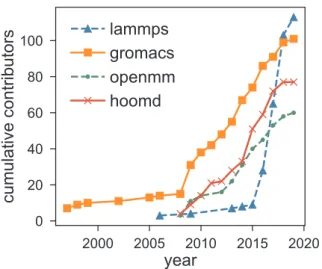
research[43]. This is apparent in the development logs of Carpentries lessons: As one example, there are 1,942 commits from about 230 in-dividuals since 2013, all attempting to make a better lesson for teaching the basics of version control (Software Carpentry commit log). Open-source, GPU-accelerated MD engines have experienced growth in community development over the same time frame (Fig. 2). This is not to say any one of the Carpentries, GPUs, or GitHub explains the recent growth in open source science software, but instead emphasizes that coincident contributions to pedagogical practices, hardware advances, and online development communities are important in understanding this ecosystem.
Simulators are exchanging information beyond individual packages, now sharing teaching material under version control (David Kofke’s molecular simulation course), pre-packaged virtual machines for workshops [44], and new journals for living documents of best prac-tices, tutorials, and perpetual reviews. A number of organizations have grown around the support of sustainable software development for science and the work of Katz et al. provides a broad overview[45]. A list of tools for molecular simulation is included inTable 1, and The OpenScience Project catalogs hundreds of open projects across dis-ciplines.
Beyond tools designed for molecular simulation, there are important categories of tools for lowering the cognitive load of software devel-opment and fostering collaboration. GitHub, Bitbucket, and Gitlab are the three largest platforms[66]for collaborating on code repositories, and offer extra useful features at no cost for academic use. Messaging products Slack and Gitter are now popular for their integration with hosted repositories[67]and lower the barrier to entry for discussing issues and getting help. To lower the cognitive load of getting someone else’s code to run, myBinder[68]enables users to launch Jupyter no-tebooks supporting multiple languages with pre-made enviroments for the code in question. As examples, the MoSDeF tutorials[69]use my-Binder to spin up a Jupyter notebooks enabling users to begin tutorials without touching the software environment on their own computer. For solving the software stack problem on HPC clusters, singularity[70]
enables users to deploy portable“containers”from open-source Dock-erfiles[71]across multiple clusters, works with NVIDIA GPUS, and on many XSEDE resources.
Recurring themes in recommended readings[72,27,73]around best practices and considerations for community-driven scientific software development include:
1. take into account cognitive load 2. use version control
3. automate repetitive tasks
4. collaborate on and share open code
5. write code in the highest-level language possible
6. software development is a fundamental literacy for engineers and researchers.
We also recommend Ref.[51]as an example of a clearly described scientific software package (MDAnalysis) with relevance to materials simulation.
4. Modeling techniques
We now return to the original problem of advancing understanding of materials from molecular simulations and describe techniques for extracting more information from each step of an MD trajectory. Both coarse-grained models and advanced sampling help with scaling time-scale problems by focusing on the key features of the phenomenon of interest, spending less effort on irrelevant details. In practice, im-plementing these techniques can lead to increased cognitive load if we are unaware of available infrastructure, so we organize key sources for learning more.
Fig. 2.Number of unique authors of four popular MD simulation engines over the last two decades. The increased growth around 2010 coincides with ma-turation of GPU technologies for MD and growth in Software Carpentry efforts. Numbers are approximate, as a few authors in each community may be double-counted if they commit with multiple pseudonyms.
Table 1
Open source software helpful for materials simulations. Package Name Description
Diffractometer[46,47] Python code for generating scattering patterns from MD snapshots foyer[48] Python package for atom-typing
freud[49] Python exposure of C++ analysis: RDF, order parameters, correlation functions
mBuild[50] Python package for system initialization with reusable, hierarchical components enabling complex initialization from simple building blocks MDAnalysis[51] Python package for MD trajectory analysis supporting manyfile formats
MDTraj[52] Python package for analyzing and extracting information from MD trajectories
MorphCT[46,53] Python package for obtaining and aggregating charge transport properties from MD snapshots OVITO[54] Python explosure of C++ analysis: Visualization, structure determination
packmol[55] Library for initializing configurations of simulation elements physical_validation[56] Python package for performing thermodynamic consistency checks
Planckton[57] Python package for initializing and executing HOOMD-Blue (hoomd) simulations PLUMED[58] Software for advanced sampling, using collective variables
pyLAT[59] Python package used to manage LAMMPS output
Rhaco[60] Python package for initializing and simulating molecules and atoms at surfaces SSAGES[61] Use collective variables and advanced sampling methods with amny engines
signac-flow[62,63] Python package for automating workflows including HPC schedulers and job submission signac[62,63] Python package used to manage multi-dimensional data spaces and general workflows at scale VMD[64] Interactive and scriptable visualize and analysis of simulations
VOTCA[65] Package for automating coarse-graining and charge transport calculations
E. Jankowski, et al. Computational Materials Science 171 (2020) 109129
Briefly, by representing a collection of atoms with“coarse” simu-lation elements, significantly longer timescales are accessible because a) less computation is needed to compute the next configuration, and b) dynamics are accelerated because the underlying energy landscape is smoothed. Simplified models of polymers are among thefirst systems studied with molecular simulations[74,75]and the literature around coarse-graining is now extensive. For a polymer focus, see the recent perspective by Gartner and Jayaraman [76]. For biomolecules and protein folding there are many good sources including the reviews of Voth[77], Clementi[78], Elber[79], Klepeis[80], Kamerlin[81], and Kmiecik[82]. The MARTINI model stands out as a broadly successful coarse biomolecular model[83]. The specific problem of virus capsid self-assembly is reviewed in Perlmutter et al. [84]. For multiscale modeling, coarse-grained potentials can be derived by matching structure[85]or forces[86,87], and the relative entropy framework of Shell and Chaimovich[88,89]provides a measure of information loss through coarse-graining.
The calculation of free energy differences, rare events, and alter-native approaches to sampling long dynamics can be accomplished by applying statistical mechanics to simulated trajectories. SSAGES[61]
provides a comprehensive overview of advanced sampling techniques as well as open software for deploying them. Markov state models (MSM)[90]are statistical tools for describing the coarse dynamics of MD trajectories and provide a way of aggregating information from multiple short runs. MSMs themselves are a coarse-graining approach that has benefited from and contributed to the molecular simulation ecosystem. Machine learning approaches provide opportunities for ex-tracting collective variables, trends, and patterns from materials simu-lations, and the review by Ferguson[91]provides a current, compre-hensive view.
5. Organic photovoltaic structure and performance
In this section we review key topics in simulations of organic pho-tovoltaics (OPVs) and describe our recent work in this context. OPVs convert photons into electrical current and engineering their structure to improve performance is an active area of research. For a more de-tailed picture of why OPVs are a promising technology for sustainable energy generation, start with [92,93]. OPV performance is strongly dependent on the morphology, and Refs.[94,95]provide overviews of the key factors governing charge generation, separation, and transport. A review summarizing computational OPV morphology prediction at different length-scales is presented in Ref.[96]. Computational pre-dictions of OPV morphologies are used as inputs into charge transport simulations that link OPV structure to metrics determining their effi -ciency. Refs. [95,97]explain charge generation and transport, while
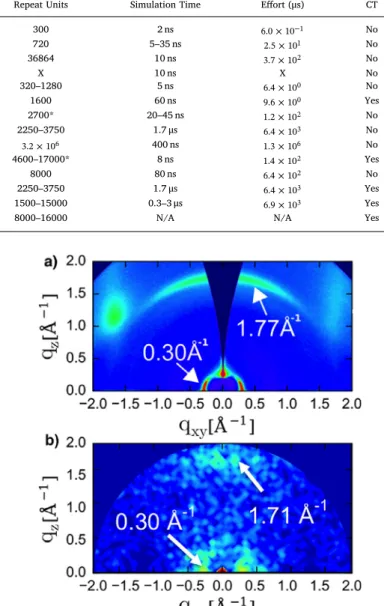
[98]explains how these properties can be simulated with kinetic Monte Carlo algorithms. We summarize recent morphology and charge transport predictions of the benchmark OPV material poly(3-hex-ylthiophene) (P3HT) inTable 2. Combining hardware, software, and coarse-graining advances, routine simulations of P3HT have improved by roughly four orders of magnitude over the last decade (0.6 monomer-μs in 2010 vs. 6900 monomer-μs in 2018).
A challenge to making efficient OPVs is determining which combi-nations of photoactive compounds and thermodynamic conditions (temperature, pressure, concentrations) will result in a favorable mor-phology—a task well-suited to MD simulation. Probing this vast data space requires organizing ensembles of simulations, distributing them on high-performance computing clusters, retrieving the data, and then distilling the data into understandable chunks.
In our recent work [111,112,11,109], we use HOOMD-Blue (hoomd) to predict morphologies of perylene, perylothiophene, P3HT, and poly(benzodithiophene-thienopyrrolo-dione) (BDT-TPD) oligomers using simplified (united atom) models. Neglecting partial charges and treating conjugated systems as rigid are two assumptions that lower cognitive load associated with forcefields, avoiding thefirst-principles
calculation of unknown charge, dihedral, and angle parameterizations missing from OPLS-UA or GAFF. These simplifications helped with both training and scaling timescale problems, resulting in morphology pre-dictions in agreement with experiments[111,112,11](seeFigs. 3and
4).
An example of developing transferable skills to deal with combi-natorial explosion occured in this P3HT work: Only 14 temperatures, 6 solvent strengths, and 5 densities equates to 420 unique simulations. In each of these 420 cases, we aim to understand how the proximity and orientation of thiophene rings correlates with charge transport. A single structural descriptor is applied to each case, and a“phase-diagrams”is constructed for each density, providing a handful offigures summar-izing large data spaces (Fig. 5).
Testing transferability, reproducibility, usability, and extendibility of OPV modeling techniques is an exciting area of future work. For P3HT in particular, the number of models, simulation engines, and sampling schemes used makes it a good candidate for evaluating TRUE-ness. With a myriad of open approaches for coarse-graining, there is no fundamental reason why multiscale efforts validated by different groups could not be a test-bed for testing reproducibility these scales. Similarly, the availability of various charge-transport calculation ap-proaches provides for opportunities to reproduce predictions of how charge transport depends on morphology and chemistry. Such cross-validation teams would help accelerate improvements around charge transfer calculations themselves, where opportunities exist to improve understanding of this broadly applicable phenomenon.
6. Predicting crosslinking dynamics
In this section we review computational approaches to predicting the crosslinked networks of toughened thermosets and discuss our re-cent work in this context. Thermosets are strong, low-density materials formed by the covalent bonding of liquid precursors into a 3D network that can be made less brittle through the introduction of a thermoplastic
“toughener”. In the fabrication of composite materials made from carbonfibers impregnated with toughened thermosets the network is
“cured” through the heating and cooling of a part over time. The temperature history experienced by the part during curing influences the rates of diffusion and reaction, and therefore its resulting nanos-tructure and residual stresses. As the thermoset precursors crosslink, there is an entropic driving force for the phase-separation of the ther-moplastic[113], which complicates nanostructure evolution. For a re-view of the key concepts in modeling thermosets (cure fraction, gela-tion, and glass transition temperature) see Li and Strachan[114]. The challenge focused on here is using molecular simulations to predict how thermoset formulation, toughener chemistry, and temperature history determine the cured nanostructure.
The central problems are those of scaling and training timescales, plus the fact that reacting systems are not in equilibrium. On the sampling side, the slow dynamics of gelling, glassy thermosets make relaxation intractably long even for small systems. Further, validating simulations against experimental systems with 1 nm-100 nm phase-se-parated length scales demands large simulated volumes. On the training side the main tensions are between faithful representation of reaction kinetics, coarse models that enable access to long timescales, and im-plementing these simultaneously. The knowledge that the equilibrium integration schemes available in hoomd andlammps are in conflict with the exothermic formation of bonds, and that using ReaxFF[115]
won’t permit sufficient volumes to be accessed is liberating: It allows the question to be reframed as“How predictive of nanostructure can a simplified model of crosslinking thermosets be?”.
To advance towards the goal of large, fast, predictive thermoset simulations we developepoxpyas detailed in Ref.[116]. This was the
first project in which we employed continuous integration into model development. Sanity checks built around initialization of the tough-eners and the generation of trajectories with and without the reaction
algorithms implemented allowed the submission of large ensembles of jobs to multiple clusters with confidence. This further allowed the re-search team to quickly progress through a series of models in support of the science question:
•
DPD models are good for simplicity and performance, but not for representing entangled glasses•
LJ potentials and bond constraints can be parameterized to model entangled glasses•
Angle constraints are needed here forTg measurements tofit theDiBenedetto expression
•
In some cases, million-particle systems are needed to capture the microphase separated morphologies (Fig. 6)•
Bond-forming models can be made withhoomd plugins and cali-brated against reaction kinetic models with and without heats of reactionThe results of our approach are summarized with recent simulations in
Table 3. The two distinguishing features of our recent work ([116]) are (1) the ability to investigate structural evolution while the model epoxies cure and (2) ability to do so for million-particle volumes in a few days or weeks on a single GPU.
Despite the simplifications, our coarse simulations match experi-mental reaction dynamics and glass transition temperatures [124]. Further, because we can vary temperature over the course of these re-acting systems we can for the first time use MD to investigate how nanostructure depends upon temperature history during curing. Here
we present new results (Fig. 7andFig. 8) summarizing the evolution of structure in two types of curing simulations where the primary acti-vation energy is 2.1 dimensionless energy units, the secondary
= = =
EA 2.52,N 400000,L 73.7nm anddt=0.01, using the
Lennard-Jones parameters from Table 5.1 and thefiducial simulation parameters from Table 5.2 of[124]. Specifically, the ratio of coarse amine, epoxy, and toughener (A, B, and C) considered here is 1:2:2, with
= = =
εAA 0.9216,εBB 1.0,εCC 0.8840,εAB AC BC, , are obtained using the
Lorentz-Berthelot mixing rule (e.g. εAB= εAA BBε ), harmonic bond
=
r0 1.0andk=100σε2. The Langevin thermostat with drag parameter
=
γ 4.5 is used to advance simulation trajectories. Simulations were performed on NVIDIA K40 cards using hoomd 2.2.1 (commit hash f664aebdf55e44f10cdd6d5edc3a090f1bca713b),
In both figures, the wavenumber associated with microphase
Table 2
Overview of recent computational studies of P3HT, including method (MD or MC), resolution (AA–all-atom, UA–united-atom, 3CG–coarse-grained with 3 simulation elements per repeat unit, 1CG–coarse-grained with one element per repeat unit), approximate number of repeat units simulated, simulation time, computational effort (estimated largest product of Repeats Units×Time), and if the structures were used for charge-transport calculations. The work of Carrillo et al.
[99]is a notable outlier, having successfully combined coarse models of millions of repeat units with development access to the then-most-powerful supercomputer on the planet. *Explicit numbers were not provided in the report, but are estimated here.
Year Study Method Model Repeat Units Simulation Time Effort (μs) CT
2010 Moreno[100] MD AA 300 2 ns 6.0×10⁻¹ No 2010 Huang[101] MD AA 720 5–35 ns 2.5×101 No 2010 Huang[101] MD 3CG 36864 10 ns 3.7×10² No 2011 Lee[102] MD 1CG X 10 ns X No 2013 Bhatta[103] MD AA 320–1280 5 ns 6.4×100 No 2013 D’Avino[104] MD UA 1600 60 ns 9.6×100 Yes 2013 Alexiadis[105] MD AA 2700* 20–45 ns 1.2×10² No 2013 Jankowski[106] MD 3CG 2250–3750 1.7μs 6.4×10³ No 2013 Carrillo[99] MD 1CG 3.2×10⁶ 400 ns 1.3×10⁶ No 2016 Jones[107] MD 3CG 4600–17000* 8 ns 1.4×10² Yes 2016 Scherer[108] MD 3CG 8000 80 ns 6.4×10² No 2017 Jones[46] MD 3CG 2250–3750 1.7μs 6.4×10³ Yes 2018 Miller[11,109] MD UA 1500–15000 0.3–3μs 6.9×10³ Yes
2019 Greco[110] MC 1CG 8000–16000 N/A N/A Yes
Fig. 3.a) Simulated and b) experimental grazing incident X-ray scattering of P3HT show near identical features and wavenumbers along the (0 1 0) and (1 0 0) planes. The agreement indicates the same structures are being probed in both cases. Figure adapted with permission from Ref.[11].
Fig. 4.a) Experimental and b) simulated grazing incident X-ray scattering of BDT-TPD showing agreement. The agreement validates our simplified model. Reprinted with permission from[112]. Copyright 2017 American Chemical Society.
E. Jankowski, et al. Computational Materials Science 171 (2020) 109129
separation is plotted vs. time, with the simulation temperature (red) overlaid, along with the system’s glass transition temperature (purple) which is a function of the degree-of-cure. InFig. 7, the sample being cured at 0.8 kT (aboveTg) is quenched to 0.5 kT (belowTg) before
gelation, and inFig. 8the quench occurs after the onset of gelation. In both cases, the morphologies achieve the same degree of cure (α=0.78), and the standard error offive independent simulations are plotted with the grey error bars. We observe that curing post-gelation narrows the variance in cured structure, and these results demonstrate
the importance of temperature history on cured morphology. The present example combining simplified models with continuous integration—two of the best practices from section 3—demonstrates improved understanding of materials behavior. Because the code is open, the data is available, and because experimentation in this area is active, we identify epoxy thermosets as an area where we expect de-velopment around TRUE simulations to accelerate. Community vali-dation of morphology predictions from simulations with varied tem-perature histories offers opportunity to increase the industrial impact of molecular simulations.
7. Training new simulators
In this section we describe several examples of on-boarding students to new projects wherein open tools (namely hoomd, mBuild, foyer, signac) and Software Carpentry pedagogy are used to reduce cognitive load and aid reproducibility. In addition to using the aforementioned tools directly in python scripts, we develop two packages, Rhaco[60]
and Planckton[57], that combine these tools to accomplish common tasks for specific systems. Rhaco facilitates the initialization and
Fig. 5.100 P3HT chains of 15 repeat units are represented as three simulation species: Yellow (sulfur), blue (aromatic carbon), and cyan (aliphatic carbon). Temperature, solvent strength (specified as a scaling of the Lennard-Jones well depth) and density, determine thermodynamic self-assembly of 420 unique structures. The self-assembled structures are quantified for ordering on the interval[0, 1]–where 0 is completely disordered and 1 is completely ordered, according to the clustering of neighboring repeat units based on relative dis-tances and orientations. Ordering is then summarized into“phase-diagrams”
depicting the order as a function of these three variables; demonstrating how hundreds of simulations can be distilled to a few, quickly interpretablefigures.
Fig. 6.The ability to perform curing simulations of million-particle toughened thermoset models enables the identification of sufficient box sizes. Here, di-vergence of the low-wavenumber structure factor is used to identify macro-phase separation, and for small volumes (blue, left) of this CG model the morphologies appear macrophase separated. Large volumes (orange, right) of the same model show a local maximum in the structure factor (qmax) indicating microphase separation is observable when the length-scales of separation are smaller than half the simulation box length. Here, 1.2e6 particles (35 nm boxes) are needed, reinforcing the importance of fast, large simulations for studying toughened epoxy thermosets.
Table 3
Overview of recent reacting epoxy models, sorted by system size. Most efforts do not capture dynamic bonding during MD integration nor validate glass transition (Tg) as a function of cure fractionα(DiBenedetto expression).
Model (Chemistry) Bond Probability System Size T αg( ) Validation CGMD[117] EP/CA Arbitary 5.0×10³ No AAMD[118] (DGEBA/DETA) Arbitary 5.9×10³ No CGMD/AAMD[119] (DGEBA/DETA) 1 2.2×10⁴ No AAMD[120] (DGEBA/33DDS) 1 6.9×10⁴ No AAMD[121] (DGEBA/44DDS) 1 9.8×10⁴ No DPD[122] (DGEBA/DETA) 1 1.1×10⁵ No DPD[123] (DDS/RA/SA) 0.001 2.5×10⁵ No CGMD/DPD[124] (DGEBA/44DDS/PES) ∼exp( ) Ea kBT 4.0×10 6 Yes
Fig. 7.Time evolution of the dominant length scale measured by the tough-ener-toughener structure factor for toughened reacting epoxy thermosets quenched belowTg(solid line) before gelation at time step 10,480,000. Curing temperature is shown by the dotted line. Error bars represent standard error fromfive independent simulations.
simulation of matter near surfaces and Planckton provides infra-structure for coupling MD simulations of OPVs to charge transport si-mulations (Table 1). Examples of the diverse surface systems in-vestigated with Rhaco are summarized inFig. 9and have enabled broad testing of forcefield compatibilities and qualitative investigation of surface phenomena while teaching students from multiple disciplines. InFig. 10we summarize DNA, fullerene, OPV material, asphaltene, and patchy particle models developed by new students leveraging mBuild andhoomd. These examples are representative of students being able to initialize and debug models in weeks. In the case ofFig. 10a, quickly moving past the initialization step of building coarse-grained DNA identified issues with our implementation of the Knotts model. In
Fig. 10b, the minimal physics for polar fullerene oxides solubilizingC60
was identified by trying seven coarse models. InFig. 10c, initializing the complex truxene (a new candidate molecule for OPVs) with foyer immediately identified needed dihedral constraints. The asphaltenes
components inFig. 10d can be tuned for molecular weights and number of chains and was accomplished by an REU team. The patchy trapezoids inFig. 10e permit quick testing of how patch size and shape influences assembly propensity.
By combining tools for particular applications, we create“ higher-level” languages for describing the system initializations in these ex-amples. This enables the concepts of the models to be probed faster, lowering the load associated with initialization and parameterization, and the management of conversion between units and dimensionless quantities used inhoomd. Further, the code development benefits are bidirectional: By engaging with developer communities, students broaden their network of support and provide feedback that informs tool development. All of the repositories mentioned here (hoomd, mBuild, foyer, signac, and Software Carpentry’s instructor training) have now merged student pull requests originating from missing fea-tures or bugs encountered en route to the above work. These examples dispel the notion that aiming for simplicity necessarily creates“ black-boxes”that limit student understanding of details, or the notion that higher-level languages necessarily create dependencies on established techniques. Rather, aiming for low cognitive load can focus develop-ment of new techniques and features with the best payofffor the re-searcher. Students anecdotally report increased interest and confidence, and this area represents a potential opportunity for future studies of professional identity, retention, and long-term career outcomes[126]. Related to the professional identities of materials simulators is the idea that certain scientist roles might enhance TRUE simulations. For example, should training prioritize the development of tool developers and tool users separately, or jack-of-all-trades scientists that can do everything? Wefind guidance to answering this question from our ex-periences with distributed code development: It is impossible for any individual to master everything, so leveraging the knowledge em-bedded in diverse development communities should be prioritized. Prioritizing diverse development communities highlights the need for the individuals in these communities to communicate and collaborate. The existence of and adherence to community codes of conduct (see The Carpentries athttps://bit.ly/2GR6pKs) helps to ensure commu-nities practice inclusivity and fosters collaboration. Within such com-munities we do not know if the prioritization of particular roles is yet warranted to enhance the realization of TRUE simulations, but we hold the optimistic opinion that communities offer the opportunity for the
Fig. 8.Time evolution of the dominant length scale measured by the tough-ener-toughener structure factor for toughened reacting epoxy thermosets quenched belowTg(solid line) after gelation at time step 30,480,000. Curing temperature is shown by the dotted line. Error bars represent standard error fromfive independent simulations.
aa
b
c
d
Fig. 9.a) PDMS chains initialized over NiMnGa, b) configuration of PDMS on NiMnGa by combining UFF and an OPLS-UA-derived potential, c) PDMS initialized on an M1 surface, d) Sintering silver nanoparticles on a corundrum surface combining EAM and UFF.
E. Jankowski, et al. Computational Materials Science 171 (2020) 109129
ensemble of individual interests and strengths to overlap in a way that makes any indvidual’s shortcomings irrelevant.
8. Outlook
This instant in time represents a period of major change in the materials simulation ecosystem. Distributed coding communities have appeared, grown (Fig. 2), and disrupted the development practices and availability of simulation tools, continuing progress towards TRUE si-mulations since the field’s origins[127,128]. In this perspective we make the case for thoughtful training to take a central role in enhancing research reproducibility while simultaneously training researchers for broadly-needed technical roles. We also make the case thaten routeto TRUE simulations, these simulations should begin as less“true”: Low-ering cognitive load by sacrificing completeness now is made up for by increased efficiency and correctness later. However, TRUE simulations are not yet the norm. Materials simulators are in a position of oppor-tunity and responsibility: We can demonstrate how reproducible sci-ence can be performed through increased engagement with our peers in the coming years. If the current momentum around communication and collaboration wanes, however; if the community becomes less inclusive rather than more, we may expect the amount of beeping prompts to increase. We take a more optimistic view: There has never been a better time to be a molecular simulator because of how active the community is with helping train its members to do transferable, reproducible, usable, extensible science.
Declaration of Competing Interest
The authors declare that they have no conflicts of interest to this work.
Acknowledgements
This material is based upon work supported by the National Science Foundation under Grants Nos. 1835593, 1653954, 1658076, and 1229709. This work used the Extreme Science and Engineering Discovery Environment (XSEDE), which is supported by National Science Foundation Grant No. ACI-1053575[4]. This research is part of the Blue Waters sustained-petascale computing project, which is sup-ported by the National Science Foundation (awards OCI-0725070 and ACI-1238993) and the state of Illinois. The authors gratefully ac-knowledge sponsorship through the Laboratory Directed Research and Development (LDRD) program of the Idaho National Laboratory. This material is based upon work supported by The Boeing Company under contract BRT-LO118-0015. We acknowledge high-performance com-puting support of the R2 compute cluster (DOI: 10.18122/B2S41H) provided by Boise State University’s Research Computing Department. Blue Waters is a joint effort of the University of Illinois at
Urbana-Champaign and its National Center for Supercomputing Applications. KN, BA, MA, JG and EJ thank the Shodor Education Foundation and the Blue Waters Student Internship Program for support of this work. The raw and processed data required to reproduce these findings are available to download fromhttps://doi.org/10.5281/zenodo.2619585. References
[1] S.E. Page, The Model Thinker: What You Need to Know to Make Data Work for You, Hachette, UK, 2018.
[2] M. Baker, 1,500 scientists lift the lid on reproducibility, Nature 533 (7604) (2016) 452–454,https://doi.org/10.1038/533452aURL:http://www.nature.com/ doifinder/10.1038/533452a.
[3] M. Smith, Computer Science for All (2016).https://www.whitehouse.gov/blog/ 2016/01/30/computer-science-all.
[4] J. Towns, T. Cockerill, M. Dahan, I. Foster, K. Gaither, A. Grimshaw, V. Hazlewood, S. Lathrop, D. Lifka, G.D. Peterson, R. Roskies, J.R. Scott, N. Wilkens-Diehr, XSEDE: accelerating scientific discovery, Comput. Sci. Eng. 16 (5) (2014) 62–74,https://doi.org/10.1109/MCSE.2014.80URL:http:// ieeexplore.ieee.org/lpdocs/epic03/wrapper.htm?arnumber=6866038. [5] J. Wernert, L. Rivera, 2018 eXtreme Science and Engineering Discovery
Environment (XSEDE) Annual User Satisfaction Survey Evaluation Report Prepared for: John Towns Prepared by Lizanne DeStefano Table of Contents (September).
[6] T.K. Teal, K.A. Cranston, H. Lapp, E.P. White, G. Wilson, K. Ram, A. Pawlik, Data carpentry: workshops to increase data literacy for researchers, Int. J. Digit. Curation 10 (2015) 135–143,https://doi.org/10.2218/ijdc.v10i1.351 URL:http://www.ijdc.net/index.php/ijdc/article/view/351.
[7] A.S. Vasilevich, A. Carlier, J. de Boer, S. Singh, How not to drown in data: a guide for biomaterial engineers, Trends Biotechnol. 35 (8) (2017) 743–755,https://doi. org/10.1016/j.tibtech.2017.05.007URL:https://doi.org/10.1016/j.tibtech.2017. 05.007 https://linkinghub.elsevier.com/retrieve/pii/S0167779917301270. [8] P.T. Cummings, Computational screening of soft materials systems with
applica-tion to nano-lubricaapplica-tion systems, Telluride Sci. Res. Cent. Work. Mol. Eng. soft matter Spanning small Mol. to Macromol., Telluride, CO (2017),https://doi.org/ 10.6084/m9.figshare.8966312 https://figshare.com/articles/Telluride{_}Meeting {_}-{_}6-23-2017-final{_}pdf/8966312.
[9] E. Braun, J. Gilmer, H.B. Mayes, D.L. Mobley, J.I. Monroe, S. Prasad, D.M. Zuckerman, Best practices for foundations in molecular simulations [Article v1.0], Living J. Comput. Mol. Sci. 1 (1) (2018),https://doi.org/10.33011/ livecoms.1.1.5957URL:https://bit.ly/2HPkcmv.
[10] D. Frenkel, Simulations: the dark side, Eur. Phys. J. Plus 128 (1) (2013) 10, https://doi.org/10.1140/epjp/i2013-13010-8URL:http://link.springer.com/10. 1140/epjp/i2013-13010-8.
[11] E.D. Miller, M.L. Jones, M.M. Henry, P. Chery, K. Miller, E. Jankowski, Optimization and validation of efficient models for predicting polythiophene self-assembly, Polymers (Basel) 10 (12) (2018) 1305,https://doi.org/10.3390/ polym10121305URL:http://www.mdpi.com/2073-4360/10/12/1305. [12] J.E. Stone, D.J. Hardy, I.S. Ufimtsev, K. Schulten, GPU-accelerated molecular
modeling coming of age, J. Mol. Graph. Model. 29 (2) (2010) 116–125,https:// doi.org/10.1016/j.jmgm.2010.06.010URL:https://doi.org/10.1016/j.jmgm. 2010.06.010 https://linkinghub.elsevier.com/retrieve/pii/S1093326310000914. [13] J.A. Anderson, C.D. Lorenz, A. Travesset, General purpose molecular dynamics
simulations fully implemented on graphics processing units, J. Comput. Phys. 227 (10) (2008) 5342–5359,https://doi.org/10.1016/j.jcp.2008.01.047URL:http:// www.sciencedirect.com/science/article/pii/S0021999108000818 http:// linkinghub.elsevier.com/retrieve/pii/S0021999108000818.
[14] C.R. Trott, LammpsCuda-a new GPU accelerated molecular dynamics simulations package and its application to ion-conducting glasses, Technische Universitaet Ilmenau (2011) (Ph.D. thesis).
[15] J.A. Anderson, S.C. Glotzer, The development and expansion of HOOMD-blue through six years of GPU proliferation, arXiv 1308.5587. arXiv:1308.5587.http://
a
b
c
d
e
Fig. 10.a) Coarse-grained DNA initialized directly from sequence of nucleobases using the model from [125], b) Micelle self-assembly from a coarse-grained model of fullerene and their oxides, c) truxene molecule with electroactive components core and three functional groups, d) ex-amples of programmatically-generated as-phaltene components, e) 2D patchy parti-cles designed to self-assemble terminal structures.
arxiv.org/abs/1308.5587.
[16] J. Glaser, T.D. Nguyen, J.A. Anderson, P. Lui, F. Spiga, J.A. Millan, D.C. Morse, S.C. Glotzer, Strong scaling of general-purpose molecular dynamics simulations on GPUs, Comput. Phys. Commun. 192 (2014) 97–107,https://doi.org/10.1016/j. cpc.2015.02.028arXiv:1412.3387,http://arxiv.org/abs/1412.3387 http:// linkinghub.elsevier.com/retrieve/pii/S0010465515000867.
[17] M. Zheng, X. Li, L. Guo, Algorithms of GPU-enabled reactive forcefield (ReaxFF) molecular dynamics, J. Mol. Graph. Model. 41C (2010) (2013) 1–11,https://doi. org/10.1016/j.jmgm.2013.02.001URL:http://www.ncbi.nlm.nih.gov/pubmed/ 23454611.
[18] G. Wilson, Software Carpentry: lessons learned, F1000Research 3 (2014) 62, https://doi.org/10.12688/f1000research.3-62.v1arXiv:1307.5448,http:// f1000research.com/articles/3-62/v1.
[19] S.A. Ambrose, M.W. Bridges, M. DiPietro, M.C. Lovett, M.K. Norman, How Learning Works: Seven research-based principles for smart teaching vol. 48, John Wiley & Sons, 2010,https://doi.org/10.1002/mop.21454URL:https://
firstliteracy.org/wp-content/uploads/2015/07/How-Learning-Works.pdf. [20] D. Kahneman, Attention and effort, Citeseer, 1973.
[21] S. Cheryan, V.C. Plaut, P.G. Davies, C.M. Steele, Ambient belonging: how stereo-typical cues impact gender participation in computer science, J. Pers. Soc. Psychol. 97 (6) (2009) 1045.
[22] J.R. Shapiro, A.M. Williams, The Role of stereotype threats in undermining girls’ and women’s performance and interest in STEMfields, Sex Roles 66 (3–4) (2012) 175–183,https://doi.org/10.1007/s11199-011-0051-0URL:http://link.springer. com/10.1007/s11199-011-0051-0.
[23] J.N. Schinske, H. Perkins, A. Snyder, M. Wyer, Scientist spotlight homework as-signments shift students’stereotypes of scientists and enhance science identity in a diverse introductory science class, CBE Life Sci. Educ. 15 (3) (2016) 1–18,https:// doi.org/10.1187/cbe.16-01-0002.
[24] A.C. Bart, A. Sarver, M. Friend, L. Cox II, PythonSneks: an open-source, in-structionally-designed introductory curriculum with action-design research, Proc. 50th ACM Tech. Symp. Comput. Sci. Educ.–SIGCSE 19 (2019) 307–313,https:// doi.org/10.1145/3287324.3287428URL:http://dl.acm.org/citation.cfm?doid= 3287324.3287428.
[25] M.P. Cook, Visual representations in science education: The influence of prior knowledge and cognitive load theory on instructional design principles, Sci. Educ. 90 (6) (2006) 1073–1091,https://doi.org/10.1002/sce.20164URL:http:// onlinelibrary.wiley.com/doi/10.1002/sce.20164/abstract http://doi.wiley.com/ 10.1002/sce.20164.
[26] A. Simperler, G. Wilson, Software Carpentry get more done in less time, Arxiv Prepr. arXiv:1506.02575.http://arxiv.org/abs/1506.02575.
[27] G. Wilson, D.A. Aruliah, C.T. Brown, N.P. Chue Hong, M. Davis, R.T. Guy, S.H.D. Haddock, K.D. Huff, I.M. Mitchell, M.D. Plumbley, B. Waugh, E.P. White, P. Wilson, N.P.C. Hong, Best Practices for Scientific Computing, PLoS Biol. 340 (2014),https://doi.org/10.1371/journal.pbio.1001745e1001745, arXiv:1210. 0530v1,http://arxiv.org/abs/1210.0530 http://www.pubmedcentral.nih.gov/ articlerender.fcgi?artid=3886731&tool=pmcentrez&rendertype=abstract. [28] B.M. Duckles, Value of Software Carpentry to Instructors Report, Tech. Rep.
January, Foundation, Software Carpentry Foundation, Data Carpentry, Portland, OR (2016).
[29] N. Hollender, C. Hofmann, M. Deneke, B. Schmitz, Integrating cognitive load theory and concepts of human-computer interaction, Comput. Human Behav. 26 (6) (2010) 1278–1288,https://doi.org/10.1016/j.chb.2010.05.031URL:https:// doi.org/10.1016/j.chb.2010.05.031.
[30] S.A. Bohner, S. Mohan, Model-based engineering of software: Three productivity perspectives, Proc.–33rd Annu. IEEE Softw. Eng. Work. SEW-33 2009 (2010) 35–44,https://doi.org/10.1109/SEW.2009.19.
[31] G. Varga, A. Ledeczi, C.R. Iacovella, P.T. Cummings, J. Sallai, A. Ledeczi, C.R. Iacovella, C. McCabe, P.T. Cummings, Enabling Cross-Domain Collaboration in Molecular Dynamics Workflows, Fourth Int. Conf. Adv. Collab. Networks, Syst. Appl. (COLLA 2014) (2014) 41–47.
[32] D.M. Oppenheimer, Consequences of erudite vernacular utilized irrespective of necessity: problems with using long words needlessly, Appl. Cogn. Psychol. 20 (2) (2006) 139–156,https://doi.org/10.1002/acp.1178URL:http://doi.wiley.com/ 10.1002/acp.1178.
[33] J.W. Ponder, D.A. Case, Protein Simulations, Adv. Protein Chem. 66 (2003) 27–85, https://doi.org/10.1016/S0065-3233(03)66002-XURL:http://www.
sciencedirect.com/science/article/pii/S006532330366002X.
[34] M.S. Daw, M.I. Baskes, Semiempirical, quantum mechanical calculation of hy-drogen embrittlement in metals, Phys. Rev. Lett. 50 (17) (1983) 1285–1288, https://doi.org/10.1103/PhysRevLett. 50.1285.
[35] N.L. Allinger, K. Chen, J.H. Lii, An improved forcefield (MM4) for saturated hy-drocarbons, J. Comput. Chem. 17 (5–6) (1996) 642–668,https://doi.org/10. 1002/(SICI)1096-987X(199604)17:5/6<642::AID-JCC6>3.0.CO;2-U. [36] W.L. Jorgensen, J. Tirado-Rives, The OPLS [optimized potentials for liquid
si-mulations] potential functions for proteins, energy minimizations for crystals of cyclic peptides and crambin, J. Am. Chem. Soc. 110 (6) (1988) 1657–1666, https://doi.org/10.1021/ja00214a001URL:http://pubs.acs.org/doi/abs/10. 1021/ja00214a001.
[37] J. Wang, R.M. Wolf, J.W. Caldwell, P.A. Kollman, D.A. Case, Development and testing of a general Amber forcefield, J. Comput. Chem. 25 (9) (2004) 1157–1174, https://doi.org/10.1002/jcc.20035arXiv:z0024.
[38] H. Sun, COMPASS: an ab initio force-field optimized for condensed-phase appli-cations–overview with details on alkane and benzene compounds, J. Phys. Chem. B 102 (38) (2002) 7338–7364.
[39] S.J. Keasler, S.M. Charan, C.D. Wick, I.G. Economou, J.I. Siepmann, Transferable
potentials for phase equilibria-united atom description offive- and six-membered cyclic alkanes and ethers, J. Phys. Chem. B 116 (36) (2012) 11234–11246, https://doi.org/10.1021/jp302975c.
[40] D.N. LeBard, B.G. Levine, P. Mertmann, S.A. Barr, A. Jusufi, S. Sanders, M.L. Klein, A.Z. Panagiotopoulos, A. Barr, A. Jusufi, S. Sanders, L. Klein, Self-assembly of coarse-grained ionic surfactants accelerated by graphics processing units, Soft Matter 8 (8) (2012) 2385–2397,https://doi.org/10.1039/C1SM06787G URL:http://xlink.rsc.org/?DOI=C1SM06787G http://xlink.rsc.org/?DOI= c1sm06787g.
[41] T.A. Halgren, W. Damm, Polarizable forcefields, Curr. Opin. Struct. Biol. 11 (2) (2001) 236–242,https://doi.org/10.1016/S0959-440X(00)00196-2URL:http:// ac.els-cdn.com/S0959440X00001962/1-s2.0-S0959440X00001962-main.pdf?_ tid=3e24fd1e-415c-11e7-bada-00000aacb35e&acdnat=1495725195_ b9be23eab111032341bb59fde8955297.
[42] E. von Hippel, G. von Krogh, Open source software and the”Private-Collective” innovation model: issues for organization science, Organ. Sci. 14 (2) (2003) 209–223,https://doi.org/10.1287/orsc.14.2.209.14992URL:http://pubsonline. informs.org/doi/abs/10.1287/orsc.14.2.209.14992.
[43] M.M. Wasko, S. Faraj, Why should i share? Examining social capital and knowl-edge contribution in electronic networks of practice, MIS Q. 29 (1) (2005) 35, https://doi.org/10.2307/25148667URL:http://www.jstor.org/stable/25148667 https://www.jstor.org/stable/10.2307/25148667.
[44] E. Jankowski, AIChE 2018 CoMSEF Hands-On Workshop Molecular Modeling Toolbox, 2018.https://doi.org/10.18122/cme_lab/5/boisestate.
[45] D.S. Katz, L.C. McInnes, D.E. Bernholdt, A.C. Mayes, N.P.C. Hong, J. Duckles, S. Gesing, M.A. Heroux, S. Hettrick, R.C. Jimenez, M. Pierce, B. Weaver, N. Wilkins-Diehr, Community organizations: changing the culture in which re-search software is developed and sustained, Comput. Sci. Eng. 21 (2) (2019) 8–24, https://doi.org/10.1109/MCSE.2018.2883051URL:https://ieeexplore.ieee.org/ document/8565942/.
[46] M.L. Jones, E. Jankowski, Computationally connecting organic photovoltaic per-formance to atomistic arrangements and bulk morphology, Mol. Simul. 43 (10–11) (2017) 756–773,https://doi.org/10.1080/08927022.2017.1296958
URL:https://www.tandfonline.com/doi/full/10.1080/08927022.2017.1296958 https://doi.org/10.1080/08927022.2017.1296958.
[47] E.D. Miller, M.M. Henry, E. Jankowski, Diffractometer (aug 2018).https://doi.org/ 10.5281/zenodo.1340716.https://zenodo.org/record/1340716.
[48] C. Klein, A.Z. Summers, M.W. Thompson, J. Gilmer, C. McCabe, P.T. Cummings, J. Sallai, C.R. Iacovella, Formalizing atom-typing and the dissemination of force fields with foyer, Comput. Mater. Sci. 167 (May) (2018) 215–227,https://doi.org/ 10.1016/j.commatsci.2019.05.026arXiv:1812.06779,http://arxiv.org/abs/1812. 06779.
[49] E.S. Harper, M. Spellings, J. Anderson, S.C. Glotzer, harperic/freud: Zenodo DOI release (nov 2016).https://doi.org/10.5281/ZENODO.166564.https://zenodo. org/record/166564.
[50] C. Klein, J. Sallai, T.J. Jones, C.R. Iacovella, C. McCabe, P.T. Cummings, A hier-archical, component based approach to screening properties of soft matter, Found. Mol. Model. Simul.https://doi.org/10.1007/978-981-10-1128-3_5.
[51] R. Gowers, M. Linke, J. Barnoud, T. Reddy, M. Melo, S. Seyler, J. Domański, D. Dotson, S. Buchoux, I. Kenney, O. Beckstein, MDAnalysis: a python package for the rapid analysis of molecular dynamics simulations, in: Proc. 15th Python Sci. Conf., 2016, pp. 98–105.https://doi.org/10.25080/Majora-629e541a-00e.https:// conference.scipy.org/proceedings/scipy2016/oliver_beckstein.html. [52] R.T. McGibbon, K.A. Beauchamp, M.P. Harrigan, C. Klein, J.M. Swails,
C.X. Hernández, C.R. Schwantes, L.P. Wang, T.J. Lane, V.S. Pande, MDTraj: a modern open library for the analysis of molecular dynamics trajectories, Biophys. J. 109 (8) (2015) 1528–1532,https://doi.org/10.1016/j.bpj.2015.08.015. [53] M.L. Jones, MorphCT–DOI: 10.5281/zenodo.1243843 (2018).https://doi.org/10.
5281/zenodo.1243843.
[54] A. Stukowski, Visualization and analysis of atomistic simulation data with OVITO-the Open Visualization Tool, Model. Simul. Mater. Sci. Eng. 18 (1) (2009),https:// doi.org/10.1088/0965-0393/18/1/015012.
[55] L. Martínez, R. Andrade, E.G. Birgin, J.M. Martínez, PACKMOL: a package for building initial configurations for molecular dynamics simulations, J. Comput. Chem. 30 (13) (2009) 2157–2164,https://doi.org/10.1002/jcc.21224 URL:http://repositorio.uta.edu.ec/bitstream/123456789/27787/1/AL674.pdf http://doi.wiley.com/10.1002/jcc.21224.
[56] P.T. Merz, M.R. Shirts, Testing for physical validity in molecular simulations, PLoS One 13 (9) (2018) 1–21,https://doi.org/10.1371/journal.pone.0202764 URL:https://doi.org/10.1371/journal.pone.0202764.
[57] E.D. Miller, M.M. Henry, M.L. Jones, E. Jankowski, Planckton (mar 2019).https:// doi.org/10.5281/zenodo.2616728.
[58] G.A. Tribello, M. Bonomi, D. Branduardi, C. Camilloni, G. Bussi, PLUMED 2: new feathers for an old bird, Comput. Phys. Commun. 185 (2) (2014) 604–613,https:// doi.org/10.1016/j.cpc.2013.09.018URL:https://linkinghub.elsevier.com/ retrieve/pii/S0010465513003196.
[59] M.T. Humbert, Y. Zhang, E.J. Maginn, PyLAT: Python LAMMPS Analysis Tools, J. Chem. Inf. Model. acs.jcim.9b00066 (2019),https://doi.org/10.1021/acs.jcim. 9b00066acs.jcim.9b00066,http://pubs.acs.org/doi/10.1021/acs.jcim.9b00066. [60] M.L. Jones, Rhaco–DOI: 10.5281/zenodo.1308187 (2018).https://doi.org/10.
5281/zenodo.1308187.
[61] H. Sidky, Y.J. Colón, J. Helfferich, B.J. Sikora, C. Bezik, W. Chu, F. Giberti, A.Z. Guo, X. Jiang, J. Lequieu, J. Li, J. Moller, M.J. Quevillon, M. Rahimi, H. Ramezani-Dakhel, V.S. Rathee, D.R. Reid, E. Sevgen, V. Thapar, M.A. Webb, J.K. Whitmer, J.J. De Pablo, SSAGES: software suite for advanced general en-semble simulations, J. Chem. Phys. 148 (4) (2018),https://doi.org/10.1063/1.
E. Jankowski, et al. Computational Materials Science 171 (2020) 109129
5008853.
[62] C.S. Adorf, P.M. Dodd, V. Ramasubramani, S.C. Glotzer, Simple data and workflow management with the signac framework, Comput. Mater. Sci. 146 (C) (2018) 220–229,https://doi.org/10.1016/j.commatsci.2018.01.035URL:https://doi. org/10.1016/j.commatsci.2018.01.035.
[63] C.S. Adorf, V. Ramasubramani, B.D. Dice, M.M. Henry, P.M. Dodd, S.C. Glotzer, glotzerlab/signac (feb 2019).https://doi.org/10.5281/zenodo.2581327. [64] W. Humphrey, A. Dalke, K. Schulten, VMD: visual molecular dynamics, J. Mol.
Graph. 14 (1) (1996) 33–38,https://doi.org/10.1016/0263-7855(96)00018-5 URL:http://www.sciencedirect.com/science/article/pii/0263785596000185 http://linkinghub.elsevier.com/retrieve/pii/0263785596000185.
[65] V. Rühle, C. Junghans, A. Lukyanov, K. Kremer, D. Andrienko, Versatile object-oriented toolkit for coarse-graining applications, J. Chem. Theory Comput. 5 (12) (2009) 3211–3223,https://doi.org/10.1021/ct900369wURL:http://pubs.acs. org/doi/abs/10.1021/ct900369w.
[66] M.J. Foley, GitHub to give users of its free plan access to unlimited private re-positories, 2019.https://zd.net/2VaIrhY.
[67] V. Käfer, D. Graziotin, I. Bogicevic, S. Wagner, J. Ramadani, Poster: communica-tion in open-source projects-end of the e-mail era? IEEE/ACM 40th Int. Conf. Softw. Eng. Companion 2018 (2018) 242–243.
[68] P. Jupyter, M. Bussonnier, J. Forde, J. Freeman, B. Granger, T. Head, C. Holdgraf, K. Kelley, G. Nalvarte, A. Osheroff, M. Pacer, Y. Panda, F. Perez, B. Ragan-Kelley, C. Willing, Binder 2.0–Reproducible, interactive, sharable environments for science at scale, in: F. Akici, D. Lippa, D. Niederhut, M. Pacer (Eds.), Proceedings 17th Python Science Conference, 2018, pp. 113–120.https://doi.org/10.25080/ Majora-4af1f417-011.
[69] A.Z. Summers, Chrisiacovella, J. Gilmer, mosdef-hub/mosdef_tutorials: MoSDeF Tutorials 0.0.0 (mar 2019).https://doi.org/10.5281/zenodo.2617384. [70] G.M. Kurtzer, V. Sochat, M.W. Bauer, Singularity: scientific containers for mobility
of compute, PLoS One 12 (5) (2017) 1–20,https://doi.org/10.1371/journal.pone. 0177459.
[71] D. Merkel, Docker lightweight linux containers for consistent development and deployment, Linux J. (2014) 239,http://dl.acm.org/citation.cfm?id=2600239. 2600241.
[72] T. Crick, B.A. Hall, S. Ishtiaq, Reproducibility in Research: Systems, Infrastructure, Culture, arXiv (2015) 1–12. arXiv:1503.02388.http://arxiv.org/abs/1503.02388. [73] D.S. Katz, K.E. Niemeyer, S. Gesing, L. Hwang, W. Bangerth, S. Hettrick, R.
Idaszak, J. Salac, N.C. Hong, S.N. Corrales, A. Allen, R.S. Geiger, J. Miller, E. Chen, A. Dubey, P. Lago, Report on the Fourth Workshop on Sustainable Software for Science: Practice and Experiences (WSSSPE4), arXiv 1 (1) (2017) 0–3. arXiv:1705. 02607,https://doi.org/10.5334/jors.184.http://arxiv.org/abs/1705.02607. [74] D. Richter, A. Baumgärtner, K. Binder, B. Ewen, J.B. Hayter, Dynamics of
collec-tivefluctuations and brownian motion in polymer melts, Phys. Rev. Lett. 47 (2) (1981) 109–113,https://doi.org/10.1103/PhysRevLett.47.109.
[75] K. Kremer, G.S. Grest, K. Kremer, I. Festkorperforschung, F. Julich, W. Germanjf, I. Physik, U. Mainz, D. Mainz, W. Germany, G.S. Grest, Dynamics of entangled linear polymer melts: a moleculardynamics simulation dynamics of entangled linear polymer melts: a molecular-dynamics simulation, J. Chem. Phys. 5057 (2013),https://doi.org/10.1063/1.458541.
[76] T.E. Gartner, A. Jayaraman, Modeling and simulations of polymers: a roadmap, Macromolecules 52 (2019) 755–786,https://doi.org/10.1021/acs.macromol. 8b01836.
[77] G. Voth (Ed.), Coarse-Graining of Condensed Phase and Biomolecular Systems, CRC Press, 2008, ,https://doi.org/10.1201/9781420059564URL:https://www. taylorfrancis.com/books/9781420059564.
[78] C. Clementi, Coarse-grained models of protein folding: toy models or predictive tools? Curr. Opin. Struct. Biol. 18 (1) (2008) 10–15,https://doi.org/10.1016/j.sbi. 2007.10.005.
[79] R. Elber, Long-timescale simulation methods, Curr. Opin. Struct. Biol. 15 (2) (2005) 151–156,https://doi.org/10.1016/j.sbi.2005.02.004.
[80] J.L. Klepeis, K. Lindorff-Larsen, R.O. Dror, D.E. Shaw, Long-timescale molecular dynamics simulations of protein structure and function, Curr. Opin. Struct. Biol. 19 (2) (2009) 120–127,https://doi.org/10.1016/j.sbi.2009.03.004.
[81] S.C. Kamerlin, S. Vicatos, A. Dryga, A. Warshel, Coarse-grained (multiscale) si-mulations in studies of biophysical and chemical systems, Annu. Rev. Phys. Chem. 62 (1) (2011) 41–64, https://doi.org/10.1146/annurev-physchem-032210-103335.
[82] S. Kmiecik, D. Gront, M. Kolinski, L. Wieteska, A.E. Dawid, A. Kolinski, Coarse-grained protein models and their applications, Chem. Rev. 116 (14) (2016) 7898–7936,https://doi.org/10.1021/acs.chemrev.6b00163.
[83] S.J. Marrink, D.P. Tieleman, Perspective on the martini model, Chem. Soc. Rev. 42 (16) (2013) 6801–6822,https://doi.org/10.1039/c3cs60093aURL:http://www. ncbi.nlm.nih.gov/pubmed/23708257.
[84] J.D. Perlmutter, M.F. Hagan, Mechanisms of virus assembly, Annu. Rev. Phys. Chem. 66 (2014) 217–239, https://doi.org/10.1146/annurev-physchem-040214-121637arXiv:1407.3856,http://arxiv.org/abs/1407.3856%0Ahttps://doi.org/10. 1146/annurev-physchem-040214-121637.
[85] T.C. Moore, C.R. Iacovella, C. McCabe, Derivation of coarse-grained potentials via multistate iterative Boltzmann inversion, J. Chem. Phys. 140 (22) (2014) 224104, https://doi.org/10.1063/1.4880555arXiv:1410.1853,http://aip.scitation.org/ doi/10.1063/1.4880555 http://www.ncbi.nlm.nih.gov/pubmed/24929371. [86] L. Lu, J.F. Dama, G.A. Voth, Fitting coarse-grained distribution functions through
an iterative force-matching method, J. Chem. Phys. 139 (2013),https://doi.org/ 10.1063/1.4811667.
[87] L.-P. Wang, T.J. Martinez, V.S. Pande, Building forcefields: an automatic, sys-tematic, and reproducible approach, J. Phys. Chem. Lett. 5 (11) (2014)
1885–1891,https://doi.org/10.1021/jz500737mURL:http://pubs.acs.org/doi/ 10.1021/jz500737m.
[88] M.S. Shell, The relative entropy is fundamental to multiscale and inverse ther-modynamic problems, J. Chem. Phys. 129 (14) (2008),https://doi.org/10.1063/ 1.2992060.
[89] A. Chaimovich, M.S. Shell, Relative entropy as a universal metric for multiscale errors, Phys. Rev. E–Stat. Nonlinear, Soft Matter Phys. 81 (6) (2010) 1–4,https:// doi.org/10.1103/PhysRevE.81.060104.
[90] B.E. Husic, V.S. Pande, Markov state models: from an art to a science, J. Am. Chem. Soc. 140 (7) (2018) 2386–2396,https://doi.org/10.1021/jacs.7b12191 URL:http://pubs.acs.org/doi/10.1021/jacs.7b12191.
[91] A.L. Ferguson, Machine learning and data science in soft materials engineering, J. Phys. Condens. Matter 30 (4) (2018) 043002, , https://doi.org/10.1088/1361-648X/aa98bdURL:http://stacks.iop.org/0964-1726/26/i=10/a=105037? key=crossref.7455f3bb928620d7b120b4c9d6c542f4 http://stacks.iop.org/0953-8984/30/i=4/a=043002?key=crossref.8eb5b295cc38868eda810456a0c743d4. [92] N. Espinosa, M. Hösel, D. Angmo, F.C. Krebs, Solar cells with one-day energy
payback for the factories of the future, Energy Environ. Sci. 5 (1) (2012) 5117, https://doi.org/10.1039/c1ee02728jURL:http://xlink.rsc.org/?DOI= C1EE02728J.
[93] K.A. Mazzio, C.K. Luscombe, The future of organic photovoltaics, Chem. Soc. Rev. 44 (1) (2015) 78–90,https://doi.org/10.1039/C4CS00227JURL:http://xlink.rsc. org/?DOI=C4CS00227J.
[94] K. Vandewal, S. Himmelberger, A. Salleo, Structural factors that affect the per-formance of organic bulk heterojunction solar cells, Macromolecules 46 (2013) 6379–6387,https://doi.org/10.1021/ma400924b.
[95] T.M. Clarke, J.R. Durrant, Charge photogeneration in organic solar cells, Chem. Rev. 110 (11) (2010) 6736–6767,https://doi.org/10.1021/cr900271s URL:http://pubs.acs.org/doi/abs/10.1021/cr900271s.
[96] T.F. Harrelson, A.J. Moulé, R. Faller, Modeling organic electronic materials: bridging length and time scales, Mol. Simul. 43 (10–11) (2017) 730–742,https:// doi.org/10.1080/08927022.2016.1273526.
[97] C. Groves, Developing understanding of organic photovoltaic devices: kinetic Monte Carlo models of geminate and non-geminate recombination, charge trans-port and charge extraction, Energy Environ. Sci. 6 (11) (2013) 3202–3217, https://doi.org/10.1039/c3ee41621f.
[98] C. Groves, Simulating charge transport in organic semiconductors and devices: a review, Reports Prog. Phys. 80 (2) (2017) 026502, ,https://doi.org/10.1088/ 1361-6633/80/2/026502URL:http://stacks.iop.org/0034-4885/80/i=2/a= 026502?key=crossref.44d1e9a057340b9d03e5e225c0a84eab.
[99] J.-M.Y. Carrillo, R. Kumar, M. Goswami, B.G. Sumpter, W.M. Brown, New insights into the dynamics and morphology of P3HT:PCBM active layers in bulk hetero-junctions, Phys. Chem. Chem. Phys. 15 (41) (2013) 17873,https://doi.org/10. 1039/c3cp53271bURL:http://xlink.rsc.org/?DOI=c3cp53271b http://pubs.rsc. org/en/Content/ArticleLanding/2013/CP/c3cp53271b http://www.ncbi.nlm.nih. gov/pubmed/24056906.
[100] M. Moreno, M. Casalegno, G. Raos, S.V. Meille, R. Po, Molecular modeling of crystalline alkylthiophene oligomers and polymers, J. Phys. Chem. B 114 (4) (2010) 1591–1602,https://doi.org/10.1021/jp9106124URL:http://www.ncbi. nlm.nih.gov/pubmed/20058895.
[101] D.M. Huang, R. Faller, K. Do, A.J. Moulé, Coarse-grained computer simulations of polymer/fullerene bulk heterojunctions for organic photovoltaic applications, J. Chem. Theory Comput. 6 (2) (2010) 526–537,https://doi.org/10.1021/ct900496t URL:http://pubs.acs.org/doi/abs/10.1021/ct900496t https://pubs.acs.org/doi/ 10.1021/ct900496t.
[102] C.-K. Lee, C.-W. Pao, C.-W. Chu, Multiscale molecular simulations of the nanoscale morphologies of P3HT:PCBM blends for bulk heterojunction organic photovoltaic cells, Energy Environ. Sci. 4 (10) (2011) 4124–4132,https://doi.org/10.1039/ c1ee01508gURL:http://xlink.rsc.org/?DOI=c1ee01508g.
[103] R.S. Bhatta, Y.Y. Yimer, D.S. Perry, M. Tsige, Improved forcefield for molecular modeling of poly(3-hexylthiophene), J. Phys. Chem. B 117 (34) (2013) 10035–10045,https://doi.org/10.1021/jp404629aURL:http://www.ncbi.nlm. nih.gov/pubmed/23899343 http://pubs.acs.org/doi/abs/10.1021/jp404629a. [104] G. D’Avino, S. Mothy, L. Muccioli, C. Zannoni, L. Wang, J.J. Cornil, D. Beljonne,
F. Castet, G.D. Avino, S. Mothy, L. Muccioli, C. Zannoni, L. Wang, J.J. Cornil, D. Beljonne, F. Castet, Energetics of electron-hole separation at P3HT/PCBM heterojunctions, J. Phys. Chem. C 117 (25) (2013) 12981–12990,https://doi.org/ 10.1021/jp402957g.
[105] O. Alexiadis, V.G. Mavrantzas, All-atom molecular dynamics simulation of tem-perature effects on the structural, thermodynamic, and packing properties of the pure amorphous and pure crystalline phases of regioregular P3HT,
Macromolecules 46 (6) (2013) 2450–2467,https://doi.org/10.1021/ma302211g URL:http://pubs.acs.org/doi/abs/10.1021/ma302211g.
[106] E. Jankowski, H.S. Marsh, A. Jayaraman, Computationally linking molecular features of conjugated polymers and fullerene derivatives to bulk heterojunction morphology, Macromolecules 46 (14) (2013) 5775–5785,https://doi.org/10. 1021/ma400724eURL:http://pubs.acs.org/doi/abs/10.1021/ma400724e. [107] M.L. Jones, D.M. Huang, B. Chakrabarti, C. Groves, Relating molecular
mor-phology to charge mobility in semicrystalline conjugated polymers, J. Phys. Chem. C 120 (8) (2016) 4240–4250.
[108] C. Scherer, D. Andrienko, Comparison of systematic coarse-graining strategies for soluble conjugated polymers, Eur. Phys. J. Spec. Top. 225 (8–9) (2016) 1441–1461,https://doi.org/10.1140/epjst/e2016-60154-9.
[109] E.D. Miller, M.L. Jones, E. Jankowski, Tying together multiscale calculations for charge transport in P3HT: structural descriptors, morphology, and tie-chains, Polymers (Basel) 10 (12) (2018) 1358,https://doi.org/10.3390/polym10121358


![Fig. 10. a) Coarse-grained DNA initialized directly from sequence of nucleobases using the model from [125], b) Micelle self-assembly from a coarse-grained model of fullerene and their oxides, c) truxene molecule with electroactive components core and thre](https://thumb-us.123doks.com/thumbv2/123dok_us/10113679.2911927/10.892.61.626.89.308/initialized-directly-sequence-nucleobases-micelle-fullerene-electroactive-components.webp)
